Pages
Stay In Touch
More
© 2013 KentuckyGuard
Story by J.C. Newton, Kentucky National Guard Recruiting Command
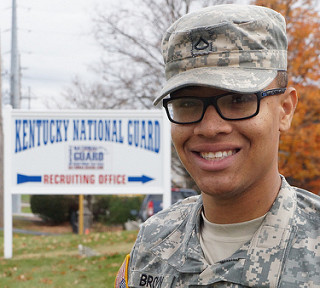
Pfc. Kierre Brown is a marketing assistant for the 2nd Battalion 75th Recruiting and Retention. (Photo by David Altom, Kentucky National Guard Public Affairs)
FRANKFORT, Ky. — It was a simple mission for Pfc. Kierre Brown, a marketing assistant for the 2nd Battalion 75th Recruiting and Retention: drive the shop’s vehicle from Frankfort to Richmond, drop off some equipment, pick up some equipment and return safe and sound.
Traveling to Richmond was uneventful and after making his prescribed exchange, Brown began his return trip.
Brown tells what happened next, “I decided to stop at a little Gas and Grocery to get me a Dr. Pepper. As I exited the car a man called to me and asked if I was in the National Guard. I told him I was and he proceeded to tell me that he had a son who was a sophomore at Western Kentucky University. The gentleman said that he and his wife had hoped that their son would join the Guard instead of going straight to college.”
The two parents felt their son would benefit from the experience of military training and that the education benefits would really help them out financially. Brown was quick to offer his assistance.
“I gave the man the number of the recruiter from their home town and I gave him my personal cell phone number and name. I told him that I would be happy to talk to his son about the Guard and I could be a good person to talk to without pressuring his son.”
The father thanked Brown for his time and they both went on their way. Brown then noticed two elderly ladies by the air pump at the corner of the lot. They looked at him smiled and motioned for him to come over. It turned out that they were trying to get air in their tire but were having no luck.
Brown tried putting air into the tire with little success. He checked and saw there was a large hole in the tire. He asked the car owner if she had a spare. In the true spirit of “Always Ready, Always There” he changed the tire for them and put the flat tire in the trunk. The ladies asked if they could pay him and he politely declined.
“I couldn’t take any money for doing the right thing, but I did tell them I would appreciate their prayers for my wife who is currently in her initial training for the Guard,” he said.
After the eventful pit stop, Brown got back in his car and started towards Frankfort. Just as he entered Franklin County he noticed a wreck on the side of the road just ahead of him. Seeing no emergency vehicles on site he stopped to check on the occupants. The driver of one vehicle was hurt enough to warrant medical attention and told Brown that they had called 911. Brown stayed on site, directed traffic around the wreck, and kept an eye on the injured man until emergency crews arrived.
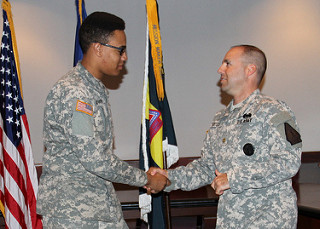
Pfc. Kierre Brown, a marketing assistant for the 2nd Battalion 75th Recruiting and Retention receives a coin from his commander, Maj. Fred Bates V, for showing initiative and presenting good community relations. “Sometimes it’s the little things that that affect our image in a big way,” said Bates. (Photo courtesy Kentucky National Guard Recruiting Command)
“I guess it was a pretty successful day,” Brown said upon his return. “I accomplished my mission, was able to help some people and I have an opportunity to educate another young person about the benefits of being a member of the Kentucky National Guard.”
Back at recruiting headquarters Brown’s commander, Maj.Fred Bates V, got wind of his troop’s exploits and presented him with a recruiting commander’s coin.
“There’s more to being a recruiter than mere numbers,” said Bates. “We are the face of the military in our local communities. For many people we’re their first and only contact with the National Guard, and sometimes it’s the little things that affect our image in a big way. Private First Class Brown understands this and he represents us all with the utmost professionalism.”
Story by David Altom, Kentucky National Guard Public Affairs
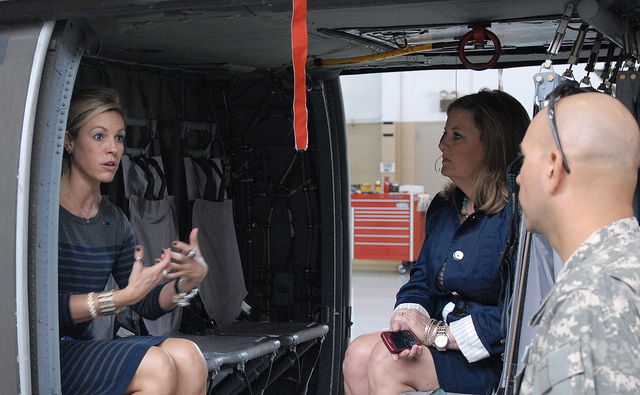
Employment Transition Coordinator Tammie Hollar (left) speaks to an employer and Soldiers at the Army Aviation Support Facility in Frankfort, Ky., Oct. 1, 2012. (Kentucky National Guard photo by Sgt. Scott Raymond)
FRANKFORT, Ky. — It’s been said that getting a job is lot like dating. (If you’re already married, think back to when you weren’t.) You don’t want to go out with just anybody, right? You know what you want in terms of lifestyle and compatibility, and you’ve got standards. Or at least you think you do. So you look around, see what’s available, and you think about what you want out of “that perfect relationship.” Eventually you find the right person — you hope — and you know you’ll have a great time if you can only get him or her to notice you.
And therein lies the problem. Getting noticed and scoring a date with that special someone.
There’s no arguing that military life gives Guard members training and experience that can be used in civilian employment. After all, that’s one of the great things about joining the Guard. But translating those traits into a relevant job-related language and building a proper resume is all too often the biggest stumbling block to getting a date, er, um … job with the right employer.
That’s where Tammie Hollar comes in.
Hollar is the employment transition coordinator with Kentucky Employer Support of the Guard and Reserve. One of her jobs is helping service members find their voice, get their training and experience down on paper — or online — and help them on the road to a successful and happy career.
It’s a mission she is very passionate about.
“I’m a big believer in the employability of our Guard members,” said Hollar. “It’s just a matter of getting the attention of the right employer and matching up skill sets and culture fits, and selling them on who you are and what skills you have.”
Hollar has nearly 20 years experience in human resources, recruiting, managing and supporting diversity initiatives in corporate settings and working with community agencies that support people with disabilities and veterans.
In short, she’s “been there, done that.”
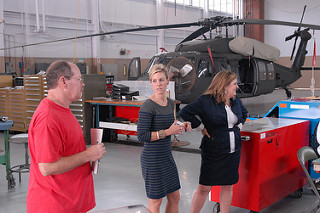
Tammie Hollar (center) speaks with a civilian contractor at the Army Aviation Support Facility in Frankfort, Ky., Oct. 1, 2012. (Kentucky National Guard photo by Sgt. Scott Raymond)
One of the most crucial things that Hollar pushes is proper resume building. Sometimes job seekers have a tough time understanding the resume building process. Hollar is determined to get help overcome the wording.
“The people I work with usually have the skeleton idea or outline on what they want to say,” she said. “But they’re not always sure on the latest resume trends and job search techniques. That’s where I can help them.”
Hollar explained that because we are now in an age of automation and electronic search engines — think Google — companies use these same kinds of systems to screen applicants.
“If your resume doesn’t have the right key words, it may not even make it to an actual person,” she warned. “You have to know the right words and phrases to put in your resume. Don’t be afraid to ask for assistance in translating your skills to fit the workplace.”
Your resume is your branding, Hollar contends, so you have to personalize it with your abilities and training.
“It’s always surprising to me how many people act modest when it comes to listing their capabilities. Remember, you’re not bragging — you’re looking for a job and they need to know what skill set you bring to the table.”
One other thing she suggests is personalize the resume to the targeted employer.
“That can make a huge difference. It shows them that you’ve done your homework, that you’ve taken the time to learn what they’re all about and that you are eager to be part of their team. Think of it as flattery.”
And a little bit of flattery — whether you’re looking for a job or a date — goes a long way.
To find out more about Kentucky ESGR and getting on with your career contact Hollar at Tammie.Hollar.ctr@ng.army.mil or message her through Facebook at https://www.facebook.com/KYESGR
What do you think of this article? Let us know in the comments below or on Facebook.
Story submitted by 2/138th Task Force Longrifles Public Affairs Office
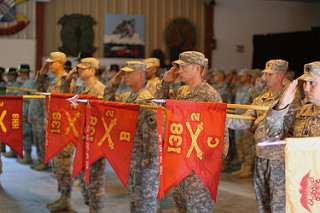
Soldiers from the 2nd Battalion, 138th Field Artillery Regiment
salute the flag during the Transfer of Authority ceremony at Camp Lemonnier, Djibouti, on Oct. 18, 2012. The 2/138th is tasked with providing regional security and stability while strengthening local and national relationships, as well as to protect U.S. and Coalition interests in the Horn of Africa. (photo submitted)
CAMP LEMONNIER, Djibouti – The hardest part of any deployment is the last month, according to Texas Army National Guard Soldiers from 3rd Squadron, 124th Cavalry (3-124 CAV). The Soldiers spent the last few weeks packing, checking gear, and completing the Relief In Place (RIP) with their replacements, 2nd Battalion, 138th Field Artillery Regiment (2-138th FAR) out of Kentucky.
The last item for the RIP to be complete was a Transfer of Authority (TOA) ceremony making Task Force Longrifles officially responsible for all force protection at Combined Joint Task Force – Horn of Africa (CJTF-HOA).
The ceremony, completed at Camp Lemonnier’s Eleven Degrees North on Oct. 18, 2012 involved the casing of 3-124 CAV colors, signifying the completion of the unit’s deployment. Squadron Commander Lt. Col. Tommy Hooker spoke during the ceremony about the success of their mission.
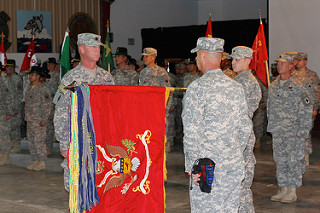
Lt. Col. Rob Larkin and Command Sgt. Maj. Timothy Gividen uncase the 2nd Battalion, 138th colors, representing the assumption of authority at Camp Lemonnier, Djibouti, on Oct. 18, 2012.
“In the past nine months Task Force Raptor has successfully accomplished all directed force protection measures within the CJTF-HOA area of operations and a multitude of contingency operations and missions throughout the deployment.”
Hooker was confident that Task Force Longrifles would maintain the high standards set by the Texans and be just as successful in their deployment. The Soldiers from Task Force Longrifles then uncased their own colors and officially assumed all duties and responsibilities from Task Force Raptor.
The incoming commander, Lt. Col. Robert Larkin commented about the successful RIP and TOA with 3-124th CAV after the ceremony.
“The CAV unit did an excellent job and provided numerous lessons they had learned to help us be setup for nothing but success.”
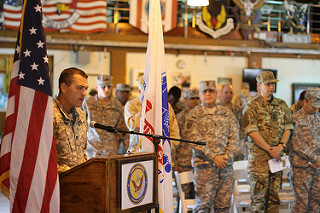
Chaplain Mark Slaughter says a prayer at the Transfer of Authority ceremony at Camp Lemonnier, Djibouti, on Oct. 18, 2012. This ceremony signifies the transfer of authority from the 3rd Squadron, 124th Cavalry to the 2nd Battalion, 138th Field Artillery Regiment.
The ceremony ended with Chaplain (Capt.) Mark Slaughter saying a prayer for the Soldiers heading home to have a happy reunion with their loved ones and for the men and women of Task Force Longrifles to have a great deployment.
The Kentucky flag now flies over every force protection building in the CJTF-HOA area of operations, showing all who see it that the Longrifles are finally here.
Story and photos by Lt. Col. Kirk Hilbrecht, Kentucky National Guard Public Affairs
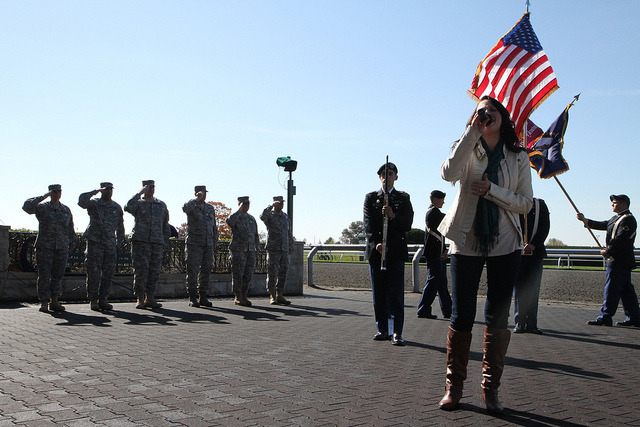
Kentucky National Guard Spec. Cheyenne Jennings sang the national anthem at the opening ceremonies at Keeneland’s Military Appreciation Day on October 21, 2012. (Photo by Lt. Col. Kirk Hilbrecht, Kentucky National Guard Public Affairs)
LEXINGTON, Ky-Military families from all services attended the Military Appreciation Day at Keeneland racetrack in Lexington on October 21, 2012.
Click here for more photos.
“We are extremely grateful to the staff here at Keeneland for giving their time and effort to make this a special day for our military families,” said Kentucky National Guard Chief Warrant Officer Jennifer Maggard from State Family Programs. “This is just another wonderful example of how Kentucky values its military community.”
The Kentucky National Guard’s Family Programs set up a resource table to provide assistance to military families, plus conducted a kickoff to this year’s Operation Military Cheer, a drive to provide for the needs of military children and youth for the upcoming holiday season.
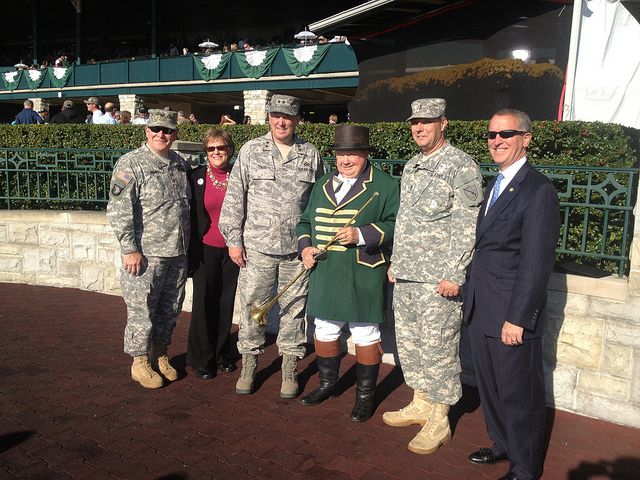
(Left to right) Col. Ben Adams, Army Chief of Staff, Kentucky National Guard and his wife. Maj. Gen. Edward Tonini, Adjutant General of the Kentucky National Guard; Keeneland’s bugler. Chief Warrant 5 Jim Simms, State Command Warrant Officer; and Mr. Bill Thomason, President of Keeneland race track. (Kentucky Guard photo by Lt. Col. Kirk Hilbrecht)
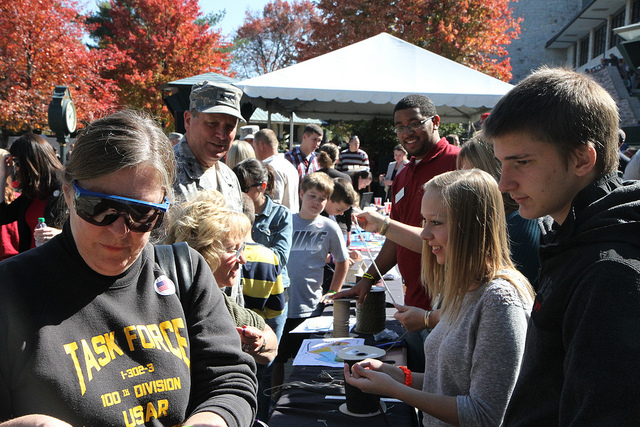
The Kentucky National Guard’s Family Programs set up a resource table to provide assistance to military families, plus conducted a kickoff to this year’s Operation Military Cheer, a drive to provide for the needs of military children and youth for the upcoming holiday season. (Kentucky Guard photo by Lt. Col. Kirk Hilbrecht)
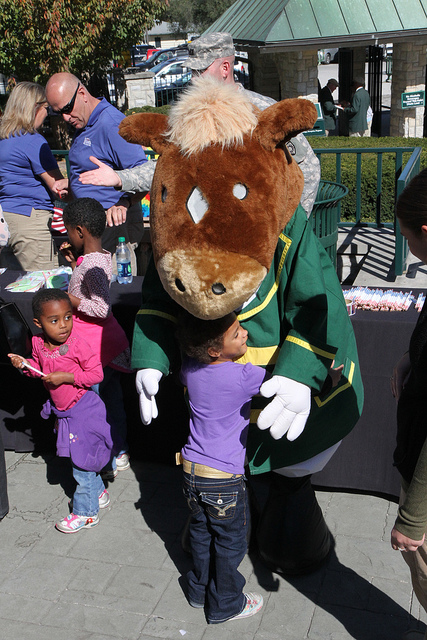
Keeneland Racetrack mascot “Buckles” makes friends with a young military family member during Military Appreciation Day. (Kentucky Guard photo by Lt. Col. Kirk Hilbrecht)
Story by Master Sgt. Philip Speck, 123rd Airlift Wing Public Affairs
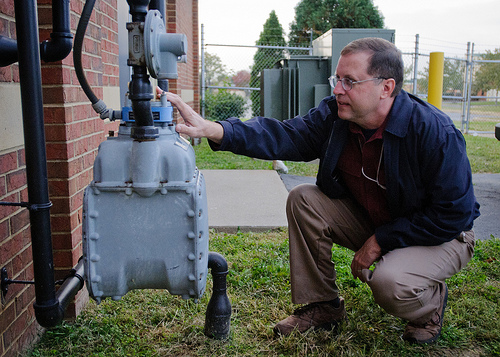
Tom Spalding, an environmental technician for the 123rd Airlift Wing, checks a gas meter Oct. 12, 2012, at the Kentucky Air National Guard base in Louisville, Ky. Many of the meters on base wirelessly transmit energy-usage data for monthly reports, helping officials identify opportunities to reduce energy consumption. (Kentucky Air National Guard photo by Master Sgt. Phil Speck)
LOUISVILLE, Ky. – The 123rd Communications Flight recently installed new network servers at the Kentucky Air National Guard Base that will reduce energy consumption by up to 84 percent while maintaining the same level of performance, officials said.
“This initiative is one of many being implemented to help conserve energy at the Air Guard Base,” said Tom Spalding, an environmental technician for the Kentucky Air Guard.
The U.S. Air Force is the largest energy consumer in the federal government, and the Kentucky Air Guard is constantly looking for new ways to conserve energy, Spalding said. Under an executive order, federal agencies have established a goal of reducing energy consumption by up to 3 percent annually.
“The 123rd Airlift Wing is fully committed to improving resiliency, reducing demand, assuring supply and fostering an energy-aware culture,” said Lt. Col. Robert Hamm, vice wing commander of the 123rd Airlift Wing. “Our overriding concern is securing energy for the future.”
One way the base ensures energy conservation is through the use of “smart meters” on each building. The meters record continual usage of electricity, water and natural gas, then feed the data into a report that helps officials identify usage patterns and opportunities for increased efficiency.
“There is a little broadcast station on each building that sends metrics to a central computer that helps us create a monthly report on each building’s energy usage,” Spalding said.
Interior lighting has been upgraded across the base, too. New bulbs use less energy but produce the same amount of light. The 123rd Civil Engineer Squadron also is on constant watch for opportunities to improve insulation and weather stripping around windows and doors.
While base officials continue to identify systemic solutions for energy conservation, Spalding encouraged every Airman to do his or her part with simple actions that can become daily routine:
- Turn off lights in unoccupied rooms.
- Replace inefficient items. If a piece of equipment is loud, hot, or old, that’s probably a good indication that it’s not energy efficient.
Connect all your computer peripherals (but not the computer itself) to a switched power strip, and turn that strip off at the end of each day. By eliminating the stand-by power used by monitors, speakers, printers and chargers, the wing can save a substantial amount of electricity over the course of year.
Story by Capt. Stephen Martin, Kentucky National Guard Public Affairs
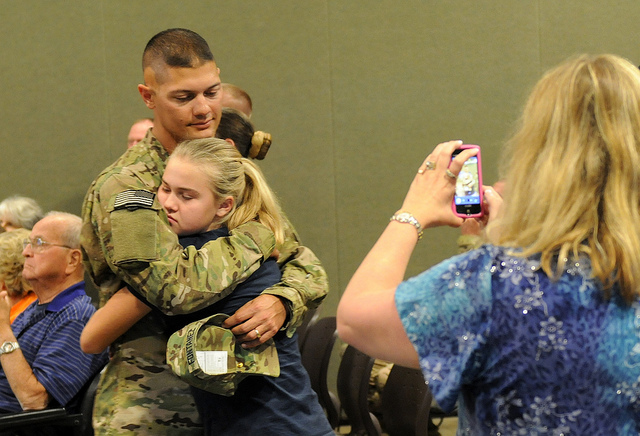
Capt. Joseph Fontanez hugs a family friend during a departure ceremony for the Kentucky National Guard’s Agribusiness Development Team 5 at the Kentucky State University’s Research Farm in Frankfort, Ky., Oct. 23, 2012. ADT 5 will deploy to Afghanistan for a year to assist local farmers in becoming agriculturally self-sufficient. (Kentucky National Guard photo by Sgt. Scott Raymond)
FRANKFORT, Ky.— Approximately 39 members of the Kentucky National Guard’s Agribusiness Development Team 5 departed for Afghanistan Oct. 23, 2012.
To see all the photos from the event, please click HERE.
Click here to see WKYT TV’s coverage of the ceremony!
Maj. Gen. Edward W. Tonini, adjutant general for Kentucky, and the Kentucky National Guard Command Staff joined friends and families of the team members at the Kentucky State University Demonstration Farm in Frankfort to send the unit off.
“This mission is certainly unique,” said Tonini. “The ADT mission was designed to rebuild Afghanistan’s economy and give stability to it’s government.”
“Because of our background in agriculture and the stellar reputation of the Kentucky Guard, we’ve led the way in providing these skillsets to the Afghan people.”
ADT 5 will take the reins from Kentucky’s ADT 4 who has been in Afghanistan since February. The mission of this team is to continue the work set forth by the previous four Kentucky units in assisting local Afghans in becoming agriculturally self-sufficient and develop their agriculture marketplace.
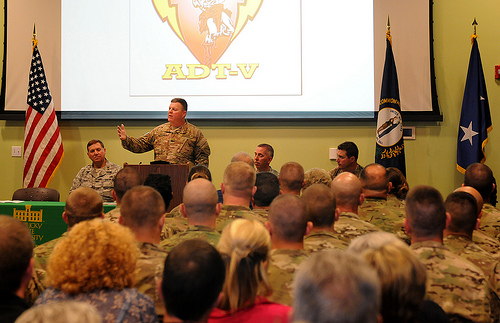
Col. Bob Hayter, Commander of the Kentucky National Guard’s Agribusiness Development Team 5 speaks to Soldiers, Airmen and family members during the unit’s departure ceremony at the Kentucky State University’s Research Farm in Frankfort, Ky., Oct. 23, 2012. The unit will be the fifth Kentucky such team to deploy to Afghanistan, taking over for ADT 4 in December. (Kentucky National Guard photo by Sgt. Scott Raymond)
In addition to agriculture activities, ADT 5 will also be instrumental in coordinating an effort with the Kentucky F.F.A. (Future Farmers of America), Kandahar University in Afghanistan and non-profit organizations to create programs to improve the incomes of Afghan farmers.
The team is made up of Airmen, Soldiers and civilian agricultural specialists with a variety of skills and backgrounds in agriculture matters.
Col. Bob Hayter is the commander of ADT 5 and feels fully prepared for the mission they’re about to embark on.
“We have 5 more weeks of training before we put boots on the ground in Afghanistan and I know we could go today. We’re that ready.”
Story Re-Published from USA Today: Click HERE.
By Chris Kenning, The (Louisville) Courier-Journal
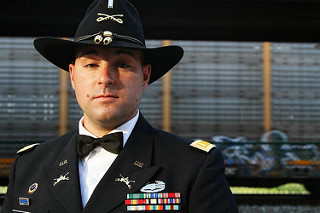
1st Lt. David Doggette
LOUISVILLE (October 23. 2012) - More than nine months after returning from a second deployment to Iraq, Kentucky National Guard Lt. David Doggette has been struggling to translate his broad military experience — ranging from driving a tank to leading a platoon — into a good civilian job.
(NOTE: If you would like more information on the Employer Support to the Guard and Reserve (ESGR) and the Employment Initiative Program, please contact Phil Miller at 502-607-1532 or Tim Stinnett at 502-607-6055.)
Doggette, a 30-year-old from Park City, Ky., who wants a career in safety management, said finding a job in the tight labor market is made more difficult by his long deployments away from the workforce — and the possibility of more to come.
“Everybody’s been very quick to thank me for my service, and nobody’s saying outright they’re worried about (future) deployments, but it’s definitely an undercurrent,” he said.
Unemployment for veterans of the wars in Iraq and Afghanistan remains a problem, but it is even more of an issue for National Guard members who juggle jobs and repeated deployments.
Although still higher than the overall jobless rate of 7.8%, the unemployment rate for veterans of Iraq and Afghanistan dropped to 9.7% in September, down from 11.7% a year earlier, according to the Bureau of Labor Statistics.
The Kentucky Guard’s “citizen soldiers” — who, unlike former active-duty troops, face the added difficulty of having to hold down jobs while being deployed overseas for what is often a year at a time — had a jobless rate last month of 16.3%, according to Guard figures.
Ross Cohen, senior director of the U.S. Chamber of Commerce’s Hiring our Heroes program, which has held about 100 job fairs, said there’s an array of new programs to help.
They range from Guard outreach directly to employers to job fairs put on by veterans groups, politicians and local workforce agencies.
One problem being addressed is showing vets how to bridge a “communication gap” as they try to translate their military skills into experience that employers can see will make them good employees.
Employers “need to know that you also learn to work well in teams, give and take orders, (can) be accountable for millions of dollars of equipment and respond to changing circumstances,” Cohen said.
Ted Daywalt, president of the Georgia-based group VetJobs, who testified about the issue before Congress earlier this year, said it’s a national problem. While recent veterans are increasingly finding work, National Guard members — whose part-time role differs from full-time, active-duty troops, but who in the past decade have been mobilized at record levels — have faced steeper challenges.
Though few will openly admit it, “a lot of employers are reluctant to hire them,” said Daywalt, noting that many will volunteer for another deployment to help pay bills at home. “We get thousands of calls a month, and easily 40 to 50% of them are in the National Guard.”
Though partly a function of a recovering economy, the state is also “connecting more veterans with jobs,” said Bill Riggs, Deputy Secretary of Kentucky’s Education and Workforce Development Cabinet, who oversees the “Hiring Kentucky Heroes” jobs program.
Still, with an estimated 3,000 unemployed post-9/11 veterans in Kentucky, Riggs said “there’s still more work to be done.” Indiana’s National Guard says its unemployment rate is 10.5 percent.
With the wars in Afghanistan and Iraq winding down and bringing an expected 1 million-plus veterans into the workforce by 2016, the issue of veteran unemployment has loomed large nationally.
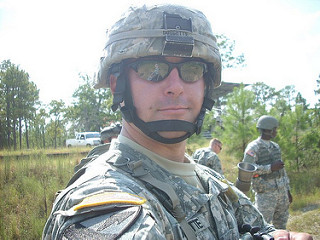
1st Lt. David Doggette trains with his unit prior to deploying to Iraq in 2010. (photo submitted)
Both President Obama and Republican challenger Mitt Romney have said veteran jobs is a top priority, with Romney encouraging states to create a standardized way to recognize military training credentials, an idea that is also part of a jobs bill pending in Congress.
Obama has helped enact tax credits to encourage companies to hire vets, while overhauling post-service training. According to the White House, more than 125,000 service members and military spouses have been hired or trained in the last year through a program called Joining Forces.
In June, Kentucky Gov. Steve Beshear enacted a statewide jobs program for vets, who are now getting help translating military experience into marketable civilian skills, developing their resumes and conducting practice job interviews.
State officials could not immediately provide figures on how many vets have been helped.
Ross Cohen, senior director for the U.S. Chamber’s “Hiring our Heroes” program, which has held about 100 job fairs, including the Louisville event that is expected to draw 300 jobless vets, said there’s an array of new programs to help.
That ranges from Guard outreach directly to employers to job fairs put on by veterans groups, politicians and local workforce agencies.
One problem they are addressing is showing vets how to bridge a “communication gap” as they try to translate their military skills into experience that employers can see will make them good employees.
Employers “need to know that you also learn to work well in teams, give and take orders, (can) be accountable for millions of dollars of equipment and respond to changing circumstances,” he said.
Kentucky National Air Guard member Jacob Fuller, 22, of Lexington, who recently landed a job as an airport firefighter in northern Kentucky, says he was alerted to the opening through the Kentucky Guard’s employment program.
And he said he capitalized on his military firefighter training and beat out a more than 100 other applicants, he said.
“I ended up getting really lucky,” he said. “I still know a decent number of people who are still unemployed, or can only find part time or low-level jobs.”
Ted Daywalt, president of the Georgia-based group VetJobs, who testified about the issue before Congress earlier this year, said it’s a national problem. While recent veterans are increasingly finding work, National Guard soldiers — whose part-time role differs from full-time, active-duty soldiers, but who in the past decde have been mobilized at record levels — have faced steeper challenges.
Many of the nearly more than 8,000 people in the Kentucky Army National Guard and the Air National Guard, for example, have served at least three, and as many as five, deployments — leaving them away from the workforce for years.
Guard members have job protections while they are serving, but those don’t protect them when factories are shuttered or small contracting businesses dry up during a recession. And when they return, younger soldiers especially are fighting for jobs with less work experience.
Though few will openly admit it, “a lot of employers are reluctant to hire them,” said Daywalt, noting that many will volunteer for another activation deployment to help pay bills at home. “We get thousands of calls a month, and easily 40 to 50 percent of them are in the National Guard.”
Finding a good job has been a challenge for Kentucky National Guard Specialist Matthew Dornbusch, of Walton, Ky., who returned in June from a deployment to Iraq and Kuwait.
“It’s hard returning from overseas” to find good jobs scarce, he said, adding that most of what’s available “seems like you’re either making $8 an hour or you need a college degree.”
Dornbusch said he initially struggled with the prospect of low-paying jobs after a deployment during which he felt that his soldiering duties, including being a mechanic to writing public information stories, were infused with a larger meaning.
“You get a job offer at a gas station attendant making $7.50 an hour, you think, ‘I just came from a combat zone. I feel like I’m worth more that,’” he said.
Now married, with a child on the way, he’s pursuing a bachelor’s degree in Geographic Information Systems at Northern Kentucky University — and continues to look for a good job, including by going to state veterans hiring fairs.
“A lot of us have so much experience, you’ve just got to get that across,” he said.
Some guard families are hoping that the winding down of the wars may presage fewer deployments, which would ease the burdens to employment.
But Daywalt said planned reductions in active-duty troop strength could keep demand for fill-in guard units high for the near future.
Additionally, U.S. Army chief of staff Gen. Ray Odierno said this summer that guard and reservists would shift next year from previous peacetime training blocks of two weeks a year to up to seven weeks to increase readiness.
That could present further employment barriers, but it’s still far less time than soldiers have been asked to give during the wars in Iraq and Afghanistan.
Despite the challenges, Daywalt said he’s encouraged that overall veteran unemployment figures are “going in the right direction” and that “everyone is trying to figure out how to help these people.”
Story by David Altom, Kentucky National Guard Public Affairs
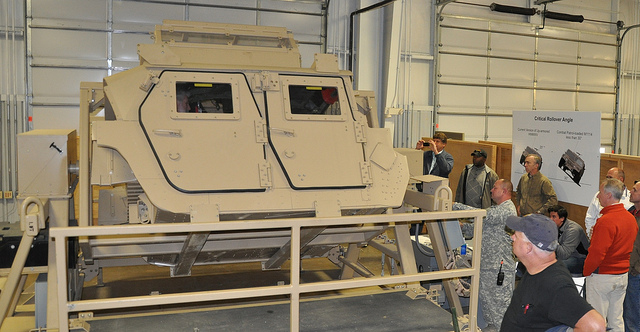
The Humvee Egress Assistance Trainer revving up for a spin. It may seem like a carnival ride to some, but it is a proven lifesaver. (Photo by Capt. Steve Martin, Kentucky National Guard Public Affairs)
Greenville, Ky.— Question: what’s tan and steel, spins 360 degrees, shares its name with a professional basketball team and saves lives on the battlefield?
Answer: The HEAT.
Okay, so it’s not funny. That was just to get your attention. Now comes the important stuff, the part you’re supposed to read ….
Sgt. Michael Fontanez is a true believer in the HEAT. Currently assigned to the Pre-mobilization Training and Assistance Element at the Kentucky National Guard’s Wendell H. Ford Regional Training Center, Fontanez discovered the value of his training during a 2008-09 tour of duty in Iraq with the 101st Airborne Division.
It was while in a 12 vehicle convoy near Fallujah that a roadside IED went off in front of Fontanez’s Mine Resistant Ambush Protected (MRAP) vehicle, creating a large crater. What happened next is a testament to the collective courage of a Soldier and his team — and the value of quality training.
“The explosion made visibility bad and we fell into the hole,” said Fontanez. “As we started rolling the first thing comes to your mind is, what do you do. So we started yelling ‘Roll over! Roll over!’ just as we were trained.”
The team also pulled their gunner down from the turret and held him until the vehicle stopped rolling, an action that most likely saved his life.
“Once we stopped moving the first thing we did was check ourselves,” Fontanez said. “Sometimes you don’t know if you’re injured. We also checked our equipment, weapons, goggles, the important stuff we’re supposed to carry. We tried the door but it wouldn’t open, so we pretty much crawled out of the turret. We then went into a safe area and checked for an ambush.”
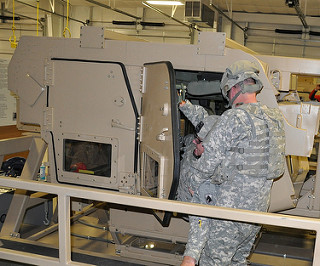
A Kentucky National Guard soldier helps his battle buddy egress from an inverted Humvee Egress Assistance Trainer during a demonstration at the Wendell H. For Regional Training Center in Greenville, Ky. (Photo by Capt. Steve Martin, Kentucky National Guard Public Affairs)
Fortune smiled that day; there was no ambush and no fatalities. But there were injuries. Fontanez hit the top of his head and incurred a cervical injury. The gunner suffered an inch wide cut on his face. But they survived, thanks to the HEAT and the quick reaction of the team.
“The training helped us run on autopilot,” said Fontanez. “We knew what was going to happen and we knew what to do. That step by step training triggered our muscle memory, we all ran on the same page, even with being disoriented.”
Fontanez now helps Kentucky’s Citizen Soldiers prepare for deployment using the HEAT and he loves his job. His advice to anyone getting ready to go through his lane?
“They should most definitely take it seriously. It can seem like a exciting ride, like at the county fair. So sure, have fun with it. But it has a purpose. It will save your life.”
Don’t take our word for it. Ask Fontanez’s wife and three girls. They’ll make believers out of you.
Story and photos by: Capt. Stephen Martin, Kentucky National Guard Public Affairs
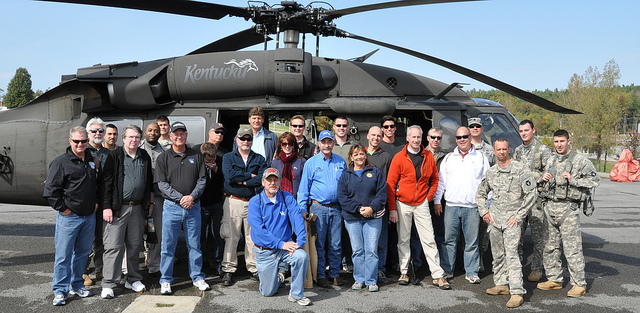
Civic leaders from across the state visited the Kentucky National Guard’s Wendell H. Ford Regional Training Center in Greenville, Ky. to visit troops and view training Oct. 12, 2012. (Photo by Capt. Stephen Martin, Kentucky National Guard)
GREENVILLE, Ky. — Civic Leaders from across the state visited the Kentucky National Guard’s Wendell H. Ford Regional Training Center in Greenville, Ky. to visit troops and get a little taste of what it’s like to be a Citizen Soldier.
Click here to see more photos from this event.
“It was a privilege to not only watch the Kentucky National Guard train and see how much work and preparation goes into a deployment, but it was an honor to have the opportunity to interact with so many men and women serving our country,” said Larry Vaught, sports editor for the Danville Advocate-Messenger.
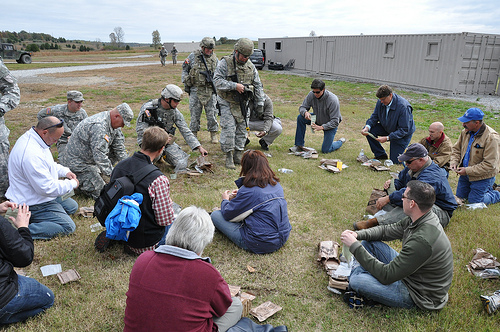
Civic leaders get a demonstration and assistance in how to properly eat a Meal, Ready to Eat or “MRE” from Kentucky Guardsmen currently conducting training at the Wendell H. Ford Regional Training Center Oct. 12, 2012. (Photo by Capt. Stephen Martin, Kentucky National Guard)
These 20 civic leaders were selected from a pool of educators, employers and influential community members to visit the pre-mobilization training for Agribusiness Development Team 5 .
Rick Rummel, who is the founder and President of Ohio Valley Surgical, saw the value of the training that Kentucky Guardsmen have to go through in order to be adequately prepared for the mission asked of them.
“I ended the day with the appreciation of how important, necessary, and how completely thorough the training is for those getting ready to deploy and also how necessary regular training is,” said Rummel. “Quite a day that I will remember for, well, as long as my memory works.”
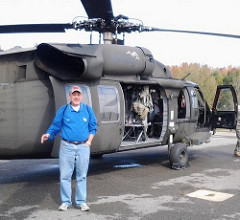
Danville Advocate sports editor and Kentucky Wildcat fan Larry Vaught took part in a civic leader visit with troops at the Kentucky National Guard’s Wendell H. Ford Regional Training Center Oct. 12, 2012. (Photo courtesy Vaught’s Views)
Rummel, along with the other civic leaders, traveled to the training site on a UH-60 Blackhawk in the morning and watched as the ADT5 troops practiced their urban operations training, clearing buildings and responding to would-be aggressors.
Additionally, WHFRTC has one of the premiere Humvee Rollover trainers in the country, also known as the Humvee Egress Assistance Trainer or HEAT. These community leaders had the opportunity to see examples of the training as well as climb in and get a 30 degree tip demonstration themselves.
“This is also known as ‘turn three at Talledega’ for those race car fans,” joked Staff Sgt. Sandy Austin, HEAT Operator for WHFRTC.
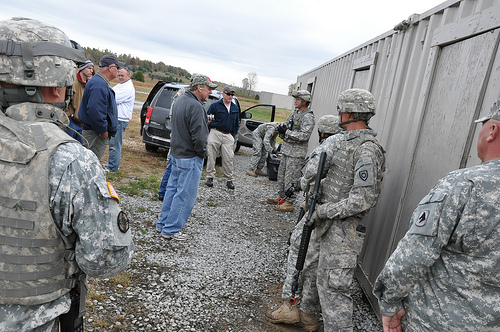
Civic leaders from across the state get a demonstration of Kentucky National Guard troops going through urban combat training during a visit to the Wendell H. Ford Regional Training Center in Greenville, Ky. (Photo by Capt. Stephen Martin, Kentucky National Guard)
After stepping off the helicopter, Vaught commented, “Probably the one thing that will stick out with me the most was learning just how skilled the National Guard troops are when they are called for service and what wonderful training facilities they have to prepare them for all sorts of operations.”
“I’m not sure any of us appreciate the Kentucky National Guard nearly enough.”
Story by Maureen Rose, The Gold Standard
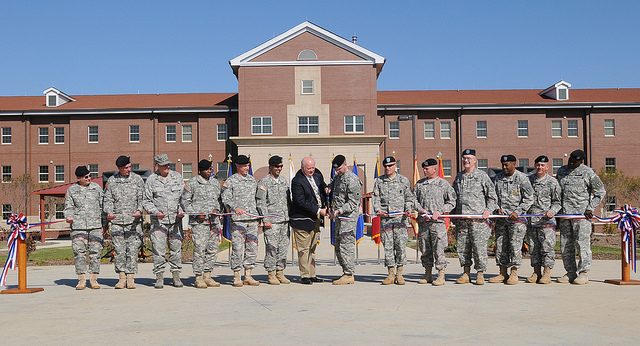
Family members of Master Sgt. Morgan French, along with members of the Kentucky National Guard Command Staff and Fort Knox Garrison staff cut the ribbon to open the new barracks for the Warrior Transition Unit at Fort Knox, Ky., Oct. 12, 2012. The building was named in French’s honor for his ties to Kentucky, Fort Knox and his service in U.S. Army Armor. (Kentucky National Guard photo by Sgt. Scott Raymond)
FORT KNOX, Ky. — “The namesake embodies the meaning of Soldier.”
The namesake being referred to was Master Sgt. Morgan French, for whom the Warrior Transition Battalion dedicated its barracks in a ceremony Oct. 12, 2012. The WTB serves Soldiers whose medical injuries or illnesses require six months or more of complex medical management or rehabilitation, and includes those from the active duty component as well as National Guard, and reservists and their Families.
Maj. Gen. Lonnie Culver, Deputy Adjutant General of the Kentucky National Guard, said French’s biography was better than any Hollywood story.
Culver related how French was a wounded warrior who served two more deployments after overcoming the cruel treatment he endured as a prisoner of war during World War II. French was the last survivor of the Harrodsburg Tankers, a Kentucky National Guard unit activated into federal service as the war loomed on the global horizon.
Shortly after the unit’s arrival at Clark Field in the Philippines in 1941, the Filipino-American forces were decimated by the Japanese attack on Manila airfield. French survived the Bataan death march only to be shipped to a POW camp in Japan where he spent three grueling years, and witnessed the mushroom cloud that spread over Nagasaki after an atomic bomb was dropped.
After recovering, French returned to active duty, completing two tours of duty in Korea as well as the U.S. and Germany. He received a Bronze Star and a Purple Heart during his 20-year career. After his retirement, he served another 20 years as an instructor at the Armor School at Fort Knox. He died in February.
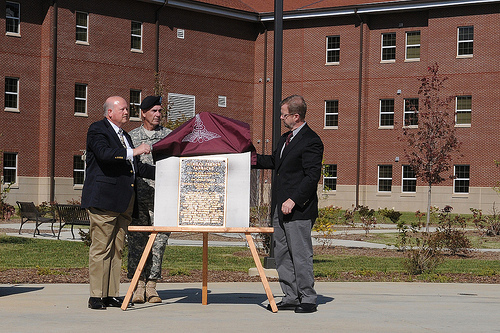
Family members of Master Sgt. Morgan French unveil a plaque during a barracks dedication ceremony at Fort Knox, Ky., Oct. 12, 2012. The new barracks named in French’s honor will house injured service members at the Warrior Transition Unit on post. (Kentucky National Guard photo by Sgt. Scott Raymond)
“He represented the thousands who served and paid dearly for the privilege,” Culver said. “My wish is that all who come into contact with this facility – Soldiers, family members, health care providers – will be inspired by Master Sgt. French’s story.”
Col. Bruce Jenkins, the Fort Knox garrison commander, agreed wholeheartedly.
“We got it right when we named these barracks for Master Sgt. French – he was an amazing hero and outstanding Soldier,” Jenkins said. “It only makes sense that he be honored this way.”
The $46.5 million barracks have 112 suites that can accommodate 224 Soldiers in the apartments that include bathroom facilities, walk-in closets, full service kitchens, laundry facilities and private sleeping quarters.
“What our Soldiers lived in before was good,” Jenkins added, “but these units are tailored specifically to their needs and most are handicap accessible.”
French’s son and granddaughter joined those cutting the ribbon to officially open the barracks, which were then open for tours. The barracks are conveniently located in the complex where the battalion headquarters are located, as well as the Soldier and Family Assistance Center, and just across the street from the hospital where most will receive their care.
“The Soldiers under our care will get what they need and get it quickly,” Jenkins vowed. “No one does it better than the U.S. Army.”
To see more photos from the ceremony, click here.