Pages
Stay In Touch
More
© 2013 KentuckyGuard
Story by Staff Sgt. Scott Raymond, Kentucky National Guard Public Affairs
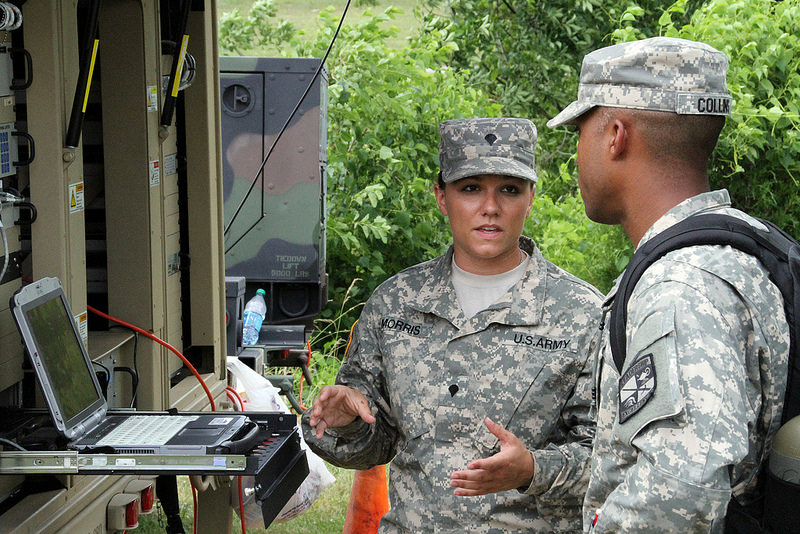
Spc. Jennifer Morris with the 149th Signal Company shares her knowledge of a Satellite Transportable Terminal with a ROTC cadet at Fort Knox, Ky., June 20, 2014. Morris and other members of the Kentucky National Guard were on hand to showcase various career fields for the cadets to pursue when they graduate. (U.S. Army National Guard photo by Staff Sgt. Scott Raymond)
FORT KNOX, Ky. — Each year thousands of Army ROTC cadets attend the Leadership Development and Assessment Course to help determine where and how they will serve in the Army. This 28-day event is considered a centerpiece of the ROTC program and historically has been held at Joint Base Lewis-McChord in Washington. For 2014, the LDAC was held at its new home alongside the U.S. Army’s Cadet Command at Fort Knox.
More than 8,000 cadets filtered through the grounds of Fort Knox during the summer for LDAC, formerly known as Advanced Camp. The course is a series of evaluations for each cadet in various leadership positions. A small portion of the event called Branch Orientation allows the cadets a taste of each branch of the Army they can request to be commissioned into. In addition to active duty units, Army National Guard and U.S. Army Reserve units played a role in representing each speciality, such as infantry, transportation, armor and aviation.
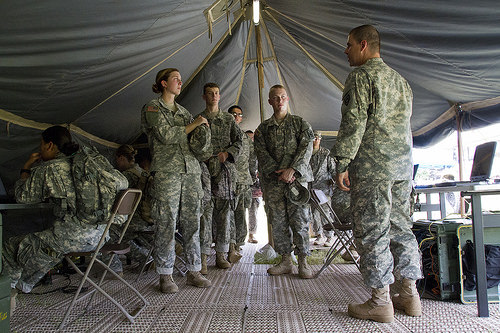
Spc. Nathan Hamilton with the 149th Signal Company discusses the advantages of being a signal officer with ROTC cadets at Fort Knox, Ky., June 20, 2014. Thousands of cadets took in their future opportunities during branch orientation as part of their annual Leadership Development and Assessment Course. (U.S. Army National Guard photo by Staff Sgt. Scott Raymond)
Soldiers of Kentucky’s 149th Signal Company were on hand to demonstrate the highlights of the Signal Corps and what being a signal officer would be like.
“It’s an honor to have the opportunity to share my passion for communications with future signal officers,” said Spc. Nathan Hamilton, a multi-channel transmission system operator with the 149th. “Hopefully I can provide some of my knowledge to them for a few to be as excited about communications as I am.”
Soldiers from the unit set up a Satellite Transportable Terminal, STT with full communication operability, provided a brief run-down of what signal is about and even gave cadets the chance to get on-line to check an email or two.
Sgt. 1st Class Matthew Mathesius, Readiness NCO for the 149th Signal said the unit was requested by the Army’s signal headquarters in Fort Gordon, Georgia to support the branch orientation. He believed their set up would attract cadets to the Signal Corps because of the unique mission and equipment the job requires.
“Thousands of cadets will have the opportunity to see the best signal company in the Army National Guard in action,” he said.
“Our static display differs from other branches because it is not just a piece of equipment on display. It is a functioning satellite terminal trailer and command post node that provides data and voice capability to demonstrate what we do. This showcases our ability to provide communication access anywhere, anytime.”
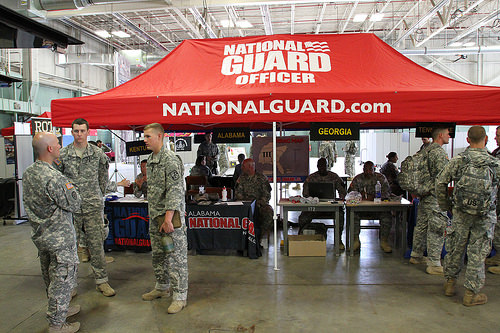
Chief Warrant Officer Greg Scott speaks with ROTC cadets at a National Guard display at Fort Knox, Ky., June 20, 2014. National Guard Soldiers and Reservists played a large role in the U.S. Army ROTC’s annual Leadership Development and Assessment Course. (U.S. Army National Guard photo by Staff Sgt. Scott Raymond)
In addition to the signal Soldiers, Kentucky Guardsmen from the 2nd Battalion, 138th Field Artillery showed up with one of their M109 Howitzers to draw cadets into artillery. Soldiers from Kentucky’s 198th Military Police Battalion also attended to provide the information for those interested in military law enforcement.
According to Chief Warrant Officer Greg Scott, Kentucky Army National Guard Liaison to the cadet command, around 50 percent of each year’s graduating classes become officers in the reserve components which is why it is important for National Guard and Reserve units to have such a presence at LDAC.
“This year the Army National Guard and the Reserves played a major role in executing the seven branch orientation events,” said Scott. “Every state and territory is invited to participate to inform interested cadets of what their state has to offer.”
“The goal, with the idea that we are all one team, is to broadcast what your branch has to offer and to talk about the benefits of the Guard in every state. Each component is out here to find the best of the best as their future leaders.”
While budgetary constraints played a part also, using local units close to Fort Knox, Scott said the LDAC’s move to Kentucky will be a benefit to the Kentucky National Guard.
“It only makes sense that we try to take the lead on this. Moving forward, this could be a major opportunity for the Kentucky National Guard to play a big role in the summer training that is conducted in our own backyard.”
Story by Capt. Curtis Persinger, 198th Military Police Company
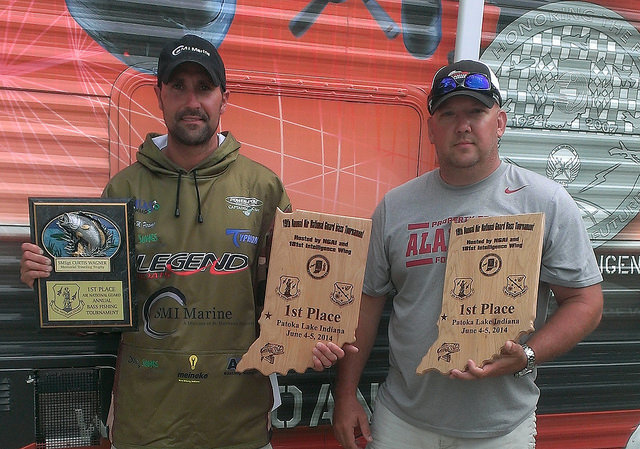
Capt. Curtis Persinger and Master Sgt. Scott Carrier make up the first team to ever make back to back wins at the the 19th Annual Air National Guard Bass Tournament at Lake Patoka, Indiana. (Photo courtesy Capt. Curtis Persinger, 198th Military Police Battalion)
Are you into sports or consider yourself a sportsman? Do you play on a team or coach a team? Or maybe you compete in an individual event. We want to hear from you, whether it’s football, baseball, soccer, golf, hunting, fishing or whatever. Tell us your sporting story and let us share it with the world. Email [email protected] with your sporting idea.
LOUISVILLE, Ky. — This was the 19th Annual Air National Guard Bass Tournament. It is sanctioned by National Guard Bureau, and the Army side just joined three years ago in 2012. Master Sgt. Scott Carrier and I fished the first year and finished 18th out of 65 teams. Last year we won at Lake Guntersville with an astonishing weight of 52lbs over two days (five fish limit per day). We averaged well over 5lbs per fish a day. Day One was 24-7lbs and Day Two we weighed in 27-7lbs. It was an unexpected win. We were on good fish, but we had no clue how big of fish we were on. We ended up winning by 5lbs.
Last year’s story is important because tournament officials told us there had never been a back to back or repeat champion. That was about to change. We just didn’t know it at the time.
This year the Indiana Guard stepped up and hosted the tournament at Patoka Lake, which happens to be my home lake. I have about 15 years of experience on it, so when I heard the announcement I was really excited.
Scott and I practiced three days on a very tough Patoka Lake. The fish were on a post-spawn pattern and I knew the fishing would be extremely tough. We were only getting about 10-12 bites a day. That wasn’t good at all.
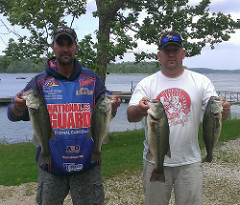
Capt. Curtis Persinger and Master Sgt. Scott Carrier with their first day’s catch during the 19th Annual Air National Guard Bass Tournament at Lake Patoka, Indiana. (Photo courtesy Capt. Curtis Persinger, 198th Military Police Battalion)
Day One: We ran about 30-35 spots ranging from 2 to 20 feet deep. We ran about 30 gallons of gas which is over an 8,000 acre lake. Again, the fish were spread out between shallow and deep. I was hoping for more cloudier conditions but every day we received several hours of sun which hurt our bite. We ended up having about 12 bites on day 1.
That day we only had 5 fish that met the 15 inch requirement. Our last two fish were caught in the last hour of fishing and if it wasn’t for Scott going full force we might have not had a limit. He caught one of my fish in mid-air as it came un-hooked, falling on his back. It could have been an ESPN “Top 10 Highlight!”
The day ended with us leading by 1 1/2 lbs, totaling out around 15 lbs. We used several different lures, Slongs jigs, spinner baits, swim baits and Carolina jigs.
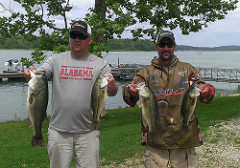
Master Sgt. Scott Carrier and Capt. Curtis Persinger with their second day’s catch during the 19th Annual Air National Guard Bass Tournament at Lake Patoka, Indiana. (Photo courtesy Capt. Curtis Persinger, 198th Military Police Battalion)
Day Two: I knew this would be even tougher than our first day and it was anything but perfect. We lost power/connectivity in both of our GPS fish finders, so we were basically running around the lake blind. Fortunately again, I knew most of the depths around the lake. Fishing started well. I caught my first fish within the first five minutes and caught another one within the first two hours.
We then went through a long dry spell and around noon I hooked a monster estimated between 5 1/2-6 1/2 pounds. I can tell you that I literally went to my knees on the boat.
At that point in the day with only two fish in the live well I thought we had just lost the tournament on that big fish. Then Scott saved us in a big way! He caught a nice three pounder. That might have been the most important fish of the tournament. Not only did it give us our third fish, but it got us refocused.
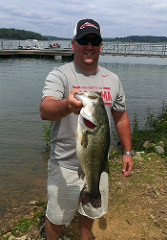
Master Sgt. Scott Carrier and the 5.97 bass that ensured the Kentucky Army National Guard’s victory at the 19th Annual Air National Guard Bass Tournament. (Photo by Capt. Curtis Persinger, 198th Military Police Battalion)
We started fishing and I remember looking at Scott and saying put on a spinnerbait. He kind of gave me the “Really?” look. I told him, “Scott trust me. I’ve caught several big ones here on a spinnerbait.
With 10 minutes to go I hear Scott say “Curtis, fish!” I turned around and saw this “llama” thrashing the water as Scott starts to walk it around the boat. It happened extremely fast. I dropped my pole, scattered for the dipping net and went sliding under Scott and his line to dip the fish on the passenger back side corner of the boat. The next 90 seconds were absolutely chaos as we were screaming, hugging, high-fiving, punching, throwing poles down, trying to find life jackets. For most tournament anglers they have experienced these several times throughout their life.
As we headed towards the ramp I knew we were coming in light with only a 4 fish limit, but that big fish gave us a “punchers chance” to win the tournament. As the dust settled we ended up weighing in 13.75 for a tournament lead of 28.80lbs. The Indiana Guard team came in stronger with a bigger stringer on day 2 but only had a combined weight of 28.27.
We had pulled it off. First ever back to back winners, just as the tournament officials told us.
We left with a few bumps, bruises, and mentally smoked but we brought back the hardware to the Kentucky Army National Guard for the second straight year and more importantly memories for life. The win and that 5.97 bass for Scott was a hell of a way to celebrate his “birthday”
It goes among some of the best team tournaments I have ever fished 15 years. I remember looking down at my bracelet after Scott caught that huge fish and thinking, “Damn.”
I wear a bracelet on my right wrist that I designed three years ago as a company commander when I took the 940th Military Police Company to Iraq in 2011. My motto was “Make a Way.” It comes from the Latin term “Aut Viam Inveniam Aut Facium,” which means “I Will Find a Way or Make a Way.” We did just that at Patoka Lake!
Next year’s tournament will be on Lake Martin, Alabama. Scott and I already have plans to make a recon trip to Alabama in the near future to do some fishing. With momentum in our favor, three times champions is on our mind!
By 2nd Lt. James W. Killen, 123rd Airlift Wing Public Affairs
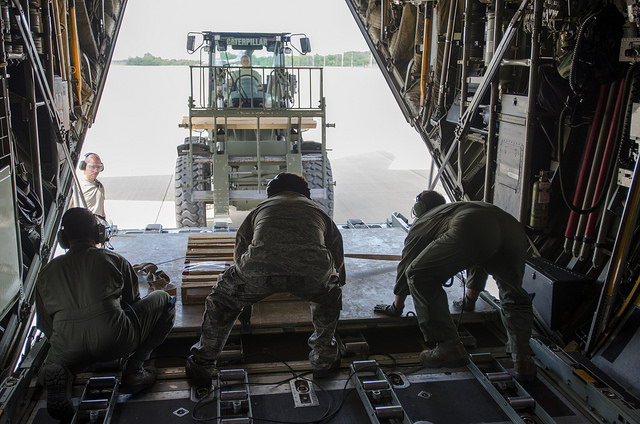
Airmen from the Kentucky Air National Guard’s 123rd Contingency Response Group offload cargo from a Kentucky Air Guard C-130 Hercules during Capstone ’14, a homeland earthquake-response exercise at Fort Campbell, Ky., on June 18, 2014. The 123rd CRG joined forces with the U.S. Army’s 688th Rapid Port Opening Element to operate a Joint Task Force-Port Opening here from June 16 to 19, 2014. (U.S. Air National Guard photo by Master Sgt. Phil Speck)
FORT CAMPBELL, Ky. – Natural disasters are an unavoidable fact of life, but that doesn’t mean the nation can’t be prepared for them. Architects can design more resilient buildings and strengthen existing ones, disaster-management officials can pre-stage recovery equipment and supplies, and the men and women who respond can hone their training to ensure rapid assistance.
The Airmen of the Kentucky Air National Guard’s 123rd Contingency Response Group are those men and women, and they successfully demonstrated their disaster-response capabilities here June 16-19 during a simulated-earthquake exercise called CAPSTONE ’14. The exercise tested the 123rd CRG’s response to a major earthquake in the New Madrid Seismic Zone that caused massive damage across an eight-state region from Arkansas to Ohio.
Click here for additional photos from this story.
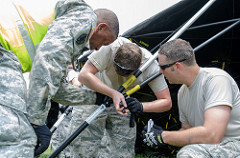
Personnel from the Kentucky Air National Guard’s 123rd Contingency Response Group and the U.S. Army’s 688th Rapid Port Opening Element work together to erect a Base X tent at Fort Campbell, Ky., on June 17, 2014, while participating in at Capstone ’14, a homeland earthquake-response exercise. The 123rd CRG joined with the 688th RPOE to operate a Joint Task Force-Port Opening from June 16 to 19, 2014. (U.S. Air National Guard photo by Master Sgt. Phil Speck)
The 123rd CRG, working in partnership with the U.S. Army’s 688th Rapid Port Opening Element, established a Joint Task Force-Port Opening within hours of deploying to Fort Campbell’s airfield. The task force was charged with receiving and processing large quantities of food, water, medicine and other relief supplies arriving by airlift. The supplies were then trucked to a staging point for further distribution into affected areas.
The reception and off-loading of aircraft was handled by the Kentucky Air Guardsmen, while the Soldiers were responsible for delivering the supplies to their final destination, explained Army Capt. Jacob Elders, executive officer of the 688th RPOE.
The flight line operated like a well-orchestrated dance, with C-130 Hercules aircraft landing, offloading their cargo to multiple 10,000-pound forklifts and taking off again in quick succession, all under the control of the CRG. Meanwhile, heavy vehicles from the 688th RPOE would transport the supplies to a staging area called the forward node, known here only as “The Node.”
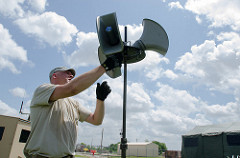
Master Sgt. Kyle Goins, a communications specialist for the Kentucky Air National Guard’s 123rd Contingency Response Group, sets up a “big voice” system at Fort Campbell, Ky., June 17, 2014, during Capstone ’14, a homeland earthquake-response exercise. The 123rd CRG joined forces with the U.S. Army’s 688th Rapid Port Opening Element to operate a Joint Task Force-Port Opening here from June 16 to 19, 2014. (U.S. Air National Guard photo by Master Sgt. Phil Speck)
If one were to peer into the Joint Operations Center, it wouldn’t have been difficult to understand how seriously each service member took the mission. Everyone was busy continuously, acting with a sense of urgency to ensure the steady flow of relief to people in need.
Morning meetings functioned as round tables where every element had the opportunity to outline its objectives, expectations, needs and successes. The meetings took less than 15 minutes despite the fact that input was being sought from more than 30 people — a testament to knowing the importance of the mission, the need to be quick and efficient, but also to ensure that necessary information was shared, according to Lt. Col. Bruce Bancroft, Joint Assessment Team chief.
“When you are trying to get relief supplies to hundreds of thousands of people, there is no time for extra words,” Bancroft said. “The mission comes first, and it has to be accomplished quickly, efficiently and in a manner that ensures no one waits longer for us than is absolutely necessary.”
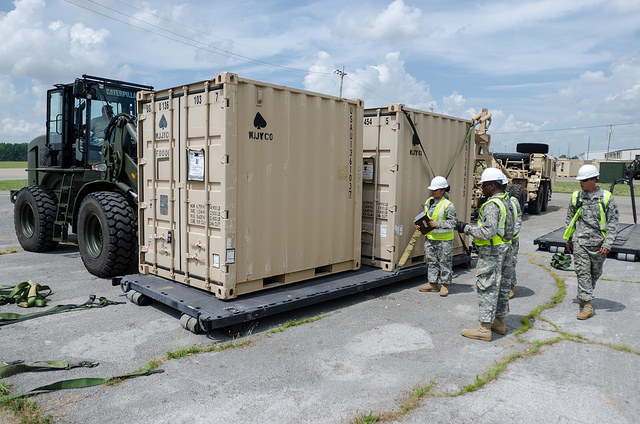
Soldiers from the U.S. Army’s 688th Rapid Port Opening Element inspect cargo on June 18, 2014, before strapping it down for transport to a staging area called the Forward Node during Capstone ’14, a homeland earthquake-response exercise at Fort Campbell, Ky. The 688th RPOE joined forces with the Kentucky Air National Guard’s 123rd Contingency Response Group to operate a Joint Task Force-Port Opening here from June 16 to 19, 2014. (U.S. Air National Guard photo by Master Sgt. Phil Speck)
Army Capt. Gary “Luke” Wheeler, commander of the 688th RPOE, was pleased with the performance of the joint Army-Air Guard team, saying the exercise “turned out very well.”
“We had some great planning going into the exercise and good communications,” he added. “Everything we needed, we got support for on the RPOE side. It was definitely a well-executed mission by everybody.”
The Kentucky Air Guard’s Col. Mark Heiniger agreed with Wheeler’s assessment, noting that the teamwork displayed by the Airmen and Soldiers was “phenomenal.”
“We’re very proud of our Airmen and Soldiers,” said Heiniger, commander of both the 123rd CRG and the JTF-PO. “Their enthusiasm for the mission and willingness to give it everything they had was the key to our mission success.”
Exercises like CAPSTONE ’14 are not only designed to test the capabilities of military personnel, Heiniger added. They also enhance working relationships with multiple cooperating civilian agencies.
“We incorporated our exercise with another event called CUSEC, which is short for Central U.S. Earthquake Consortium,” he said. “So, we got as much bang for the buck out of this exercise as we could. This was a team-building exercise for government agencies, state agencies, our CRG and our RPOE.”
Staff report
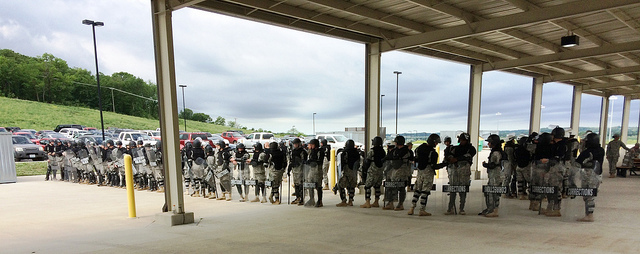
The Kentucky National Guard’s 438th Military Police Company rehearses with the 165th Military Police Company on riot control tactics prior to entering Joint Regional Correctional Facility at Fort Leavenworth, Kansas, to curtail a staged inmate riot drill. (Photo courtesy Capt. Darren Kinman, 438th Military Police Company)
FORT LEAVENWORTH, Kansas — The 438th Military Police Company recently conducted its annual training mission at Fort Leavenworth, Kansas. The unit partnered with the 705TH Military Police Battalion, which has the mission of running the Midwest Joint Regional Correctional Facility (JRCF). The 438th is not the traditional combat support company, but a guard company.
According to Capt. Darren Kinman, one of the wartime functions for the 438th is detainee operations, which include the processing of prisoners of war and running theater interment facilities.
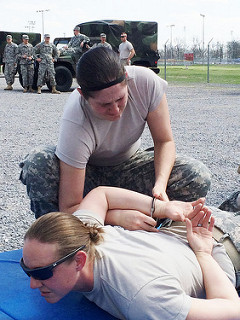
2nd Lt. Hallie Freeman conducts handcuffing procedures and arm bar take downs during a training exercise at Fort Leavenworth, Kansas. (Photo courtesy Capt. Darren Kinman, 438th Military Police Company)
“As a unit we needed to combine all the tasks running a facility with the stress of handling a confined individual,” he said. “When we deploy, they are truly at one arm’s length or closer to the enemy everyday working a cell block. That isn’t the time to find out if we are ready for this type of mission.
Rather than prisoners of war, the JRCF houses approximately 464 medium to minimum security inmates from all branches of service. The mission of the JRCF is to provide pre-trial confinement and post-trial incarceration for U.S. military prisoners sentenced to up to ten years.
“The day-to-day operations are very similar to the requirements needed to run a combat zone facility,” said Kinman. “We had been unable to completely replicate this environment in training, so we contacted the experts who do it every day. This allowed us to put all the pieces of training together and have someone to ask questions to refine our techniques, tactics and practices.”
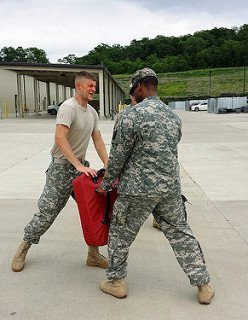
Pvt. 1st Class Justin Morris stands tall as he completes his hand to hand level 1 OC (pepper spray) certification. (Photo courtesy Capt. Darren Kinman, 438th Military Police Company)
The 705th sent a mobile training team to Murray to allow the unit to complete pre-certification required to work inside the facility. This included the standard operating procedures of the facility and how to deal with inmates. This also required a less then lethal certification course where soldiers had to experience the OC spray.
Upon arrival to Fort Leavenworth, the 438th was integrated into the facility shadowing the soldiers in day-to-day operations. Also, the soldiers were able to conduct an emergency action drill where they were integrated into a massive exercise, from riot control to hostage negotiations, inside the facility from a staged inmate disturbance. The soldiers also conducted a facility wide shakedown in attempt to locate contraband possessed by the inmates.
The annual training mission has been beneficial in exposing the soldiers to shift work inside the facility. Meanwhile, it has allowed the unit to test its overall ability to conduct day-to-day operations in a real world environment.
“The soldiers get to feel the friction of controlling another human in confinement,” said Kinman. “They’ve developed the confidence needed to handle a very serious mission if called upon.”
Staff Report
ASHLAND, Ky. — University of Morehead President Wayne Andrews and Major General Ed Tonini, Adjutant General for Kentucky, signed a Memorandum of Understanding outlining a framework for a wide range of collaborative projects at the Kentucky Veteran’s Expo, sponsored by MSU, in Ashland, Ky. June 18.
(Video provided by Morehead State University Videographer)
Story by Maj. Stephen Martin, Kentucky National Guard Public Affairs
The Kentucky National Guard hosted 26 leaders from across both army and air units to complete the first lean six sigma course in the state for the organization at Wendell H. Ford Regional Training Center in Greenville, Ky. May 12-22. (courtesy photo)
FRANKFORT, Ky. — The Kentucky National Guard hosted a Lean Six Sigma (LSS) Green Belt Process Improvement course May 12-22, 2014 at the Wendell H. Ford Regional Training Center in Greenville. The course educated 26 Soldiers and Airmen from across the Army and Air National Guard.
“Our senior leaders are constantly looking at ways to improve the (National) Guard’s organizational readiness,” said Brig. Gen. Scott Campbell, Joint Force Land Component Commander for the Kentucky National Guard. “Graduating this course is an important milestone for both your career and significantly changing the way our Guard operates.”
Leaders were trained on various skills during the 80-hour course that will enable them to complete numerous projects for the organization ranging from improving medical services to reducing delivery time of all types of equipment to the units across the commonwealth.
The Kentucky National Guard is in its third year, joining 40 states, six Army Reserve commands and four Training Site commands across the country that are in competition for the Army Communities of Excellence Award.
To be competitive, high performing organizations establish an ‘integrated management system’ which aligns four different business practices to improve operations across the board. This year, Kentucky received an “honorable mention” for the ACOE award.
“In this resource constrained environment, the need to continually analyze how we maximize taxpayers’ dollars is an ongoing challenge,” said Lt. Col. Allen Boone, Director of Strategic Management for the Kentucky National Guard. “The Army has saved billions of taxpayer dollars from these continuous process improvement activities. We’re focusing on integrating strategic planning, continuous process improvement and performance measurements in everything we do.”
Lt. Col. Tom Roach, Aviation Training and Standardization Officer for the Kentucky National Guard, has attended numerous training events similar to this Lean Six Sigma course, but this one stood out to him in particular.
“I’ve had the opportunity to attend several great training events that focus on improving the efficiency of our work processes. However, this was the only one that used statistical analysis to validate data and transform it into usable information. Intellectually, it was a very demanding course and our class performed very well.”
Story by Staff Sgt. Scott Raymond, Kentucky National Guard Public Affairs
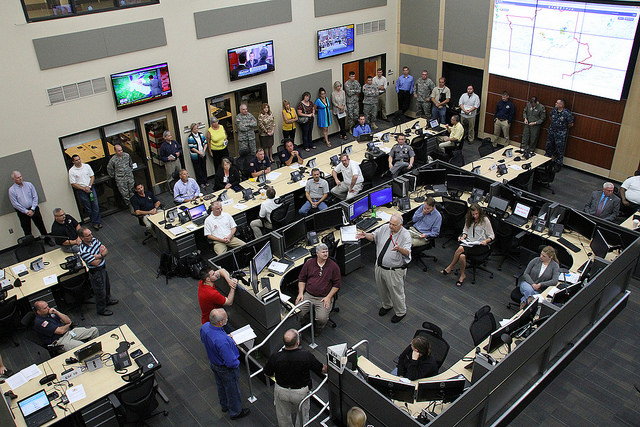
Charlie O’Neal, Assistant Director of Kentucky’s Emergency Management speaks to representatives from various state agencies to kickoff CAPSTONE-14 at the Commonwealth Emergency Operations Center in Frankfort, Ky., June 16, 2014. More than 20 state and local agencies gathered for the exercise which tested the state’s response to a major earthquake in the New Madrid Seismic Zone at the border of Kentucky and Missouri. (U.S. Army National Guard photo by Staff Sgt. Scott Raymond)
FRANKFORT, Ky. — During the winter of 1811-1812, the New Madrid fault line shook several times. The quakes were the strongest earthquakes east of the Rocky Mountains since Europeans settled the continent. The movement of the Earth reversed the flow of the Mississippi River and rang bells on the East Coast, more than 1,000 miles away. Two hundred years later, scientists say the seismic zone situated along the Kentucky-Missouri border is at high risk for another major earthquake at any moment.
To prepare for the possibility of a catastrophic event, Kentucky Emergency Management, the Kentucky National Guard and more than 20 other state and local agencies gathered June 16-20 in Frankfort for CAPSTONE-14. The multi-state exercise tested the state’s emergency response to a catastrophic earthquake along the fault line.
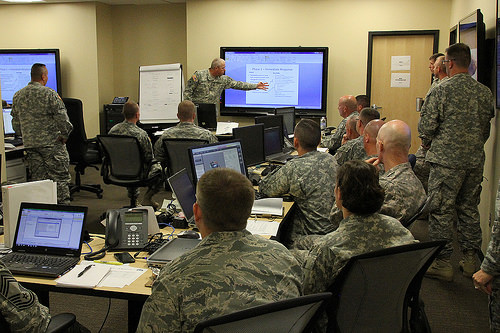
Col. William A. Denny briefs members of the Kentucky National Guard on their roles during the CAPSTONE-14 exercise in Frankfort, Ky., June 16, 2014. The exercise brought the Guard together with more than 20 other agencies to discuss their response to a major earthquake striking the state in the future. (U.S. Army National Guard photo by Staff Sgt. Scott Raymond)
“CAPSTONE-14 offers Kentucky and our neighboring states the opportunity to build upon the existing partnerships and opportunities to identify unified real-world solutions for emergency response to a catastrophic event of this magnitude,” said Michael Dossett, KYEM Director.
Under the direction of the Central United Earthquake Consortium (CUSEC), CAPSTONE-14 took three years to plan and is based upon the occurrence of a damaging earthquake in the New Madrid Seismic Zone. The consortium is made up the states which would be immediately affected by such an event and includes Alabama, Arkansas, Illinois, Indiana, Kentucky, Mississippi, Missouri and Tennessee.
Click here to see more photos from CAPSTONE-14.
A primary goal of the exercise was interoperability among the numerous agencies involved. Soldiers and Airmen of the Kentucky National Guard manned posts within the Commonwealth Emergency operations Center in Frankfort, but also put boots on the ground in earthquake response scenarios in the region.
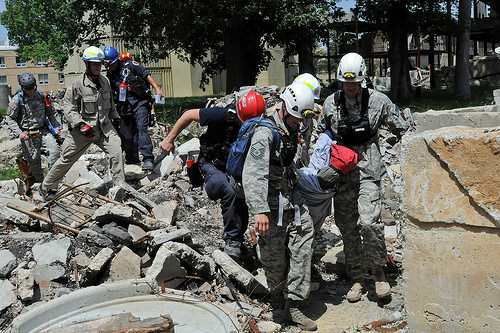
Members of the 41st Civil Support Team work with firefighters to recover a simulated casualty during training at Muscatatuck Urban Training Center in Butlersville, Ind., June 17, 2014. The firefighters, known as Task Force One from Louisville, Lexington and Northern Kentucky departments trained with the 41st as part of CAPSTONE-14, a multi-state exercise that tested emergency response to a major earthquake in the New Madrid Seismic Zone. (U.S. Army National Guard photo by Staff Sgt. Scott Raymond)
Members of the 41st Civil Support Team would be among the first called in. For CAPSTONE-14, the unit worked alongside civilian firefighters in search and rescue operations at Muscatatuck Urban Training Center (MUTC) in Indiana.
“Doing this in an exercise such as CAPSTONE allows us to experience the challenges that will be present during a real incident and gives us the opportunity to develop procedures to combat issues now instead of when a real threat hits,” said Capt. Steve Smith, team leader with the 41st.
“While the state of Kentucky would drastically be affected by a seismic incident on the New Madrid fault, it should give the citizens a little more comfort knowing that Search and Rescue organizations and the National Guard are being proactive in taking steps to work together prior to any incident,” said Smith.
Kentucky Guardsmen with the Chemical, Biological, Radiological, Nuclear and High Yield Explosive (CBRNE) Enhanced Response Force Package, or CERFP would also hit the ground quickly. The unit’s mission would assist in the location and extraction of victims from collapsed structures and the treatment of a mass casualty scenario. CERFP Soldiers and Airmen also trained at MUTC in conjunction with their counterparts from the Indiana and Georgia National Guard.
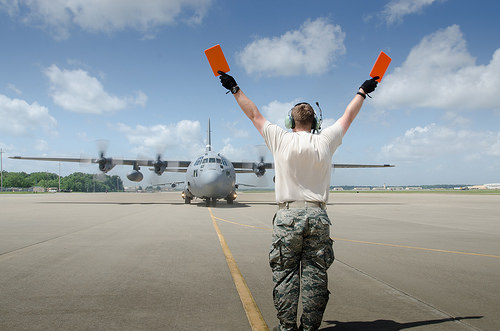
Staff Sgt. Joseph Bigelow, a crew chief for the Kentucky Air National Guard’s 123rd Contingency Response Group, marshals a Kentucky Air National Guard C-130 Hercules during CAPSTONE-14, a homeland earthquake-response exercise at Fort Campbell, Ky., on June 17, 2014. The 123rd CRG is joining with the U.S. Army’s 688th Rapid Port Opening Element to operate a Joint Task Force-Port Opening here from June 16 to 19, 2014. (U.S. Air National Guard photo by Master Sgt. Phil Speck)
Air Guardsmen with Kentucky’s 123rd Airlift Wing flew into regional airports in Western Kentucky to assess runway conditions and ensure a cargo hub could be set up for relief efforts into the damaged area. The wing worked with local officials and an active duty U.S. Army unit in their part of the exercise.
“The cooperation and interaction we have had this week is a critical part of what would be our response to such an event,” said Col. William A. Denny, plans and operations officer for the Kentucky Guard. “We must remain partners in our service to the commonwealth and CAPSTONE-14 has shown us what we have done right and what we can improve.”
“This is a scenario we don’t ever want to see, but when it happens, the Kentucky Guard will be there side by side with those who can best aid the state and the region.”
Story by 2nd Lt. James Killen, 123rd Airlift Wing Public Affairs
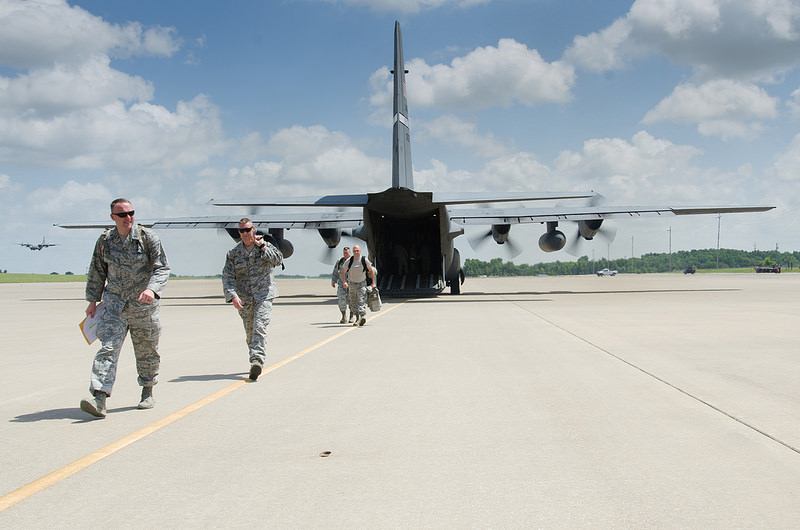
Airmen from the Kentucky Air National Guard’s 123rd Contingency Response Group arrive at Fort Campbell, Ky., June 17, 2014, via a Kentucky Air Guard C-130 Hercules to participate in CAPSTONE-14, a homeland earthquake-response exercise. The 123rd CRG is joining with the U.S. Army’s 688th Rapid Port Opening Element to operate a Joint Task Force-Port Opening here from June 16 to 19, 2014. (U.S. Air National Guard photo by Master Sgt. Phil Speck)
FORT CAMPBELL, Ky. – More than 100 members of the Kentucky Air National Guard’s 123rd Contingency Response Group and the U.S. Army’s 688th Rapid Port Opening Element deployed here June 16-19 for an exercise that will test their ability to respond to a major earthquake along the New Madrid Seismic Zone.
The exercise, called CAPSTONE-14, requires the troops to set up and operate a Joint Task Force-Port Opening, a self-contained air cargo distribution center that delivers crucial relief supplies during disasters and contingencies, according to Col. Mark Heiniger, JTF-PO commander.
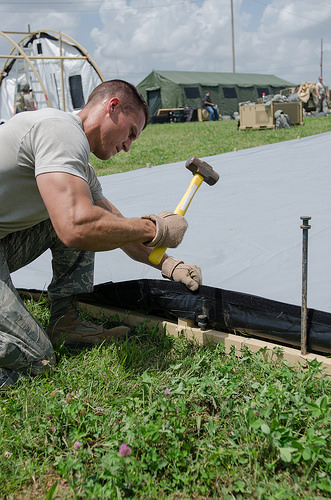
Tech. Sgt. Jason Prifogle, squad leader for the Kentucky Air National Guard’s 123rd Contingency Response Group, hammers stakes for an Alaskan Shelter during CAPSTONE-14, a homeland earthquake-response exercise at Fort Campbell, Ky., on June 17, 2014. The 123rd CRG is joining with the U.S. Army’s 688th Rapid Port Opening Element to operate a Joint Task Force-Port Opening here from June 16 to 19, 2014. (U.S. Air National Guard photo by Master Sgt. Phil Speck)
The two units will work together this week to run the JTF-PO, which combines an Air Force Contingency Response Group with an Army Transportation Company to form an Aerial Port of Debarkation. The CRG ensures the seamless flow of relief supplies by air, while the transportation company facilitates their final distribution over land.
Click here to see more photos from this story.
The mission is not a new one for Kentucky’s 123rd Contingency Response Group. The unit stands ready to respond to any contingency natural disaster, Heiniger said, initially deploying an 11-person Joint Assessment Team to evaluate airfield infrastructure in the affected area and determine if it can support large-scale relief operations.
This week’s exercise began June 16, with the JAT landing here and providing a “go-no go” report to U.S. Transportation Command within four hours of arrival. In that time, they evaluated the runway’s integrity for airlift operations and the movement capability of ground vehicles that will distribute relief supplies brought in by cargo aircraft. They also established a secure communications channel for operations.
“The JAT has an important mission that has to be carried out quickly by experts,” Heiniger said. “Decisions have to be made, and they have to be right for the JTF-PO to be successful.”
Upon site approval, the JAT began accepting the remaining Airmen and Soldiers, along with all the equipment necessary to execute the mission, from tents and electric generators to forklifts and communications gear.
One of the key objectives of the exercise is perfecting seamless operations between multiple states, multiple state and federal agencies, and multiple military units. A common theme here is “purple,” which signifies the merger of green (U.S. Army) and blue (U.S. Air Force) forces toward the accomplishment of one mission.
“The interoperability, especially stateside for the RPOE mission and the CRG, is critical,” said U.S. Army Capt. Jacob Elders, executive officer for the 688th RPOE. “Not every service brings everything to the fight, but when you link the two together, you have a full mission.
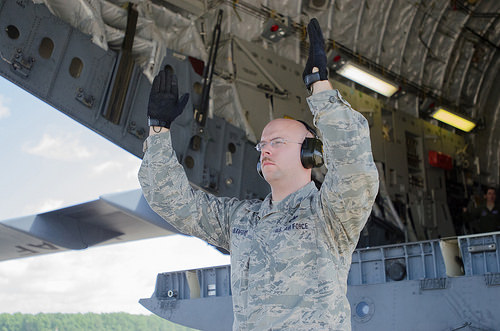
Tech. Sgt. Jerrod Blanford, an aerial porter from the Kentucky Air National Guard’s 123rd Contingency Response Group, spots a forklift as it unloads cargo from a Kentucky Air Guard C-130 Hercules during CAPSTONE-14, a homeland earthquake-response exercise at Fort Campbell, Ky., on June 17, 2014. The 123rd CRG is joining with the U.S. Army’s 688th Rapid Port Opening Element to operate a Joint Task Force-Port Opening here from June 16 to 19, 2014. (U.S. Air National Guard photo by Master Sgt. Phil Speck)
CAPSTONE-14 is part of a broader effort to ensure the region has an effective response to a major earthquake to a zone that spans eight states. According to seismologists, the New Madrid Zone operates on a 200-year cycle for magnitude 6.0 and greater earthquakes. The last earthquake of that magnitude was recorded in 1811.
“To really put it in perspective, a major earthquake along the New Madrid Seismic Zone is likely to cause more damage than Hurricane Katrina,” noted Lt. Col. Bruce Bancroft, Joint Assessment Team chief for the Kentucky Air National Guard. “Preparing for the possibility is essential to saving lives and getting the region back to normal as quickly as possible.”
The 123rd Contingency Response Group is the only fully operational CRG in the Air National Guard and one of just seven CRGs in entire U.S. Air Force. It and the 688th RPOE have previously been verified by U.S. Transportation Command as fully mission capable to provide key assistance during national or international emergencies.
Staff report
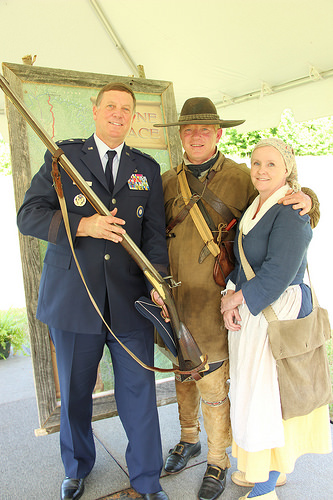
Maj. Gen. Edward Tonini was the primary guest speaker at the Boone’s Trace Dedication Ceremony held at Cumberland Gap National Historical Park on 14 June 2014. Tonini was joined by Steven and Stephanie Caudill a.k.a “Daniel and Rebecca Boone.” (US Army National Guard photo by Staff Sgt. Rebecca Wood)
FRANKFORT, Ky. — The Kentucky National Guard gave a salute to the legacy of Daniel Boone during the dedication of the Boone Trace Project at Cumberland Gap National Historical Park on Saturday, June 14.
Kentucky’s adjutant general, Maj. Gen. Edward W. Tonini, spoke during ceremony at the park near Middlesboro.
“Daniel Boone’s legacy is alive and well in the Kentucky National Guard,” said Tonini. “After two centuries his influence still affects our training and our fighting spirit.”
The dedication ceremony opened the first phase of a 120-mile corridor that traces the footsteps of Boone as he marked a path for settlers to follow into Kentucky.
Sam Compton, president of the Boone Society Inc., an association of Boone descendants, said the pioneer is uniquely linked to Kentucky and its military history. Boone, who served as a militia colonel during the American Revolution, fought with family members at the Battle of Blue Licks, the last battle of the American Revolution in Kentucky. His son, Israel, died there.
“Family, honor, and duty were the foundations of his actions,” Compton said. “He was a leader, a protector, and a patriot.
Click here for more photos of this event.
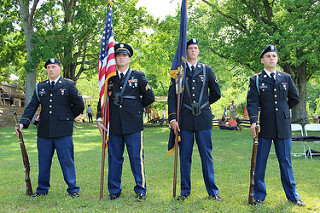
A Kentucky National Guard color guard was part of the dedication ceremony. (US Army National Guard photo by Staff Sgt. Rebecca Wood)
According to Tonini, the legendary Kentuckian’s role as a protector continues even today.
“In Frankfort we are building the Kentucky National Guard Memorial, which will honor nearly 500 citizen soldiers and airmen who have died in the line of duty since 1912,” he said. “Standing guard in front of the memorial will be a larger than life bronze statue of Daniel Boone, protecting the memory of those who have followed him into the pages of history.
“It will be a magnificent sight to behold, to see this grand rendition of this legendary hero, standing watch over our soldiers and airmen, just as he did when he and his thirty axmen blazed a trail through the Cumberland Gap into Kentucky.”
The Boone Trace corridor will have education stations along the way for families and students to learn about the founding of Kentucky and the beginning of America’s westward movement.
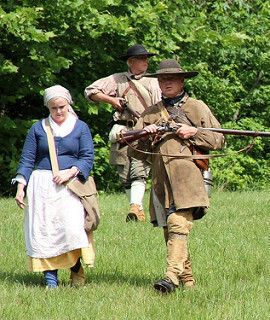
Daniel and Rebecca Boone — portrayed by Steve and Stephanie Caudill — lead settlers through the historic Boone Trace in a reenactment at the Cumberland Gap National Park. (US Army National Guard photo by Staff Sgt. Rebecca Wood)
“It is not always a happy story, but it is our nation’s history; all of us should know something about it to better understand what it means in our third century to be an American,” Compton said.
The dedication included a re-enactment of the first settlers crossing the Cumberland Gap with Daniel Boone, portrayed by Steve Caudill. Members of the public participated in the walk, representing the 250,000 settlers who passed through the Gap between 1775 and the early 1800s.
“The Boone Trace Project is a dynamic and changing collection of venues and activities,” added Compton. “Together they offer visitors to southeast Kentucky a variety of opportunities to connect with the life and times of Daniel Boone and those who came with him and who followed him into America’s First Frontier. New events and new opportunities for connecting with the Boone Trace and its story are being created now. Others are being planned for the future. The Boone Trace Project is about bringing history to life and life to history. It’s a great American story, and it starts here.”
More information about the Boone Trace Project is available at www.boonesociety.org.
Story by Sgt. Brandy Mort, 133rd Mobile Public Affairs Detachment
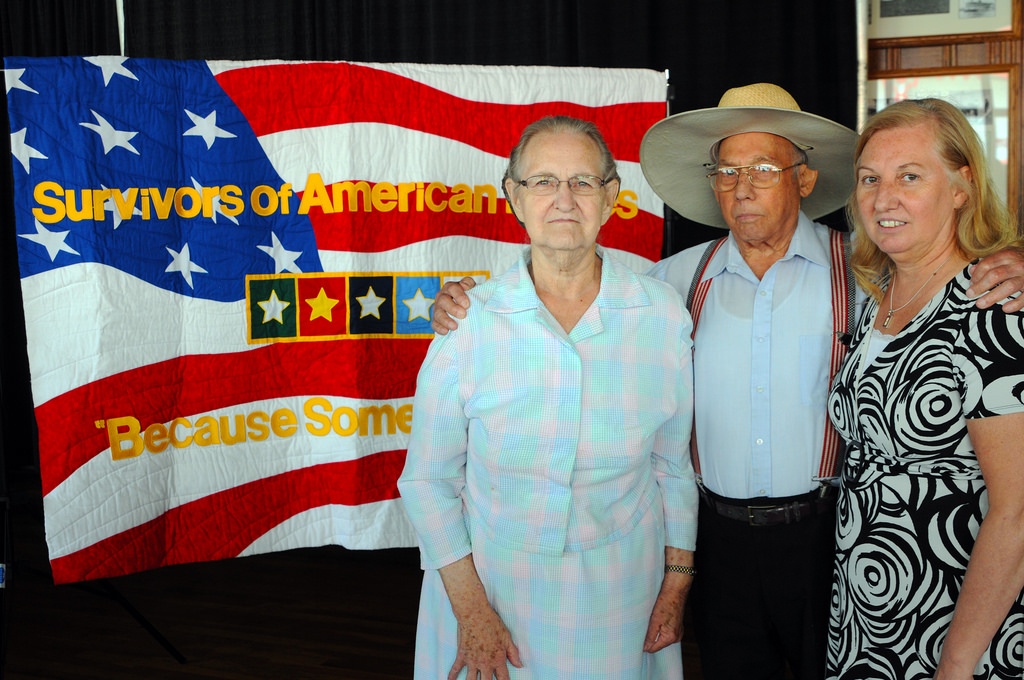
Lynn Romans, along with her mother and father, attended a Survivors Outreach Services event in honor of the late Sgt. Darrin Potter, June 14 in Newport, Ky. More than 400 family members of fallen Service members attended the event. (U.S. Army National Guard photo by Sgt. Brandy Mort)
NEWPORT, Ky. - More than 400 U.S. Military “Gold Star” family members set sail for a riverboat ride on the Ohio River June 14 in Newport. A “Gold Star” family is one that has lost an immediate member in conflict or in support of certain military operations. The term originated during World War I and continues today.
Surviving family members from six states, including Kentucky, enjoyed a riverboat ride provided by B&B Riverboats and a meal courtesy of Gold Star Chili.
“I am honored to be able to serve Gold Star Chili to Gold Star families,” said Beverly Phillips, Manager of catering for Gold Star’s corporate office. “My son is a lieutenant in the Army and I always love giving back to those who give so much.”
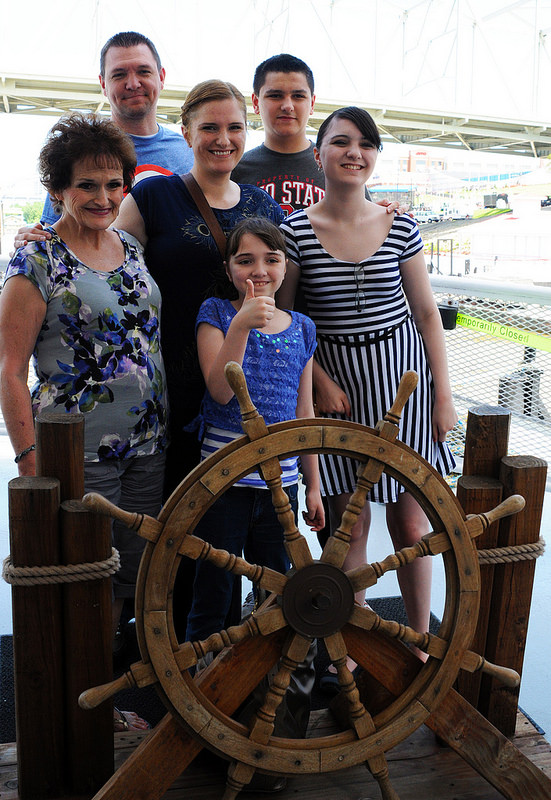
The Stiles family attends a riverboat ride in Newport, Ky., June 14 to honor the late Staff Sgt. William Culp of Ohio. Surviving family members came from six states to the event which is the second largest SOS event in the country. (U.S. Army National Guard photo by Sgt. Brandy Mort)
This event was organized by National Guard and Active Duty Survivor Outreach Services coordinators, the riverboat ride is the second largest such event in the country.
Terri Bernstein, Captain of the B&B Riverboats, is in charge of all the operations of the vessel including hosting events and coordinating food. Her late husband, Staff Sgt. Nicholas R. Carnes, a Kentucky Guardsman who was killed in Afghanistan in 2007 was a Ludlow, Kentucky, native and also served as a riverboat captain.
“Events like today are priceless,” said Bernstein. “After attending an event myself I was eager to get involved and see how I could offer my help.”
The riverboat ride was a first time event for Kentucky. Bernstein hopes to continue to provide the event for years to come.
Click here to see more photos from the event.
While many enjoyed the event, today was also a moment to remember their lost loved ones for a few.
“I think days like today are very rewarding,” said Lynn Romans, mother of the late Sgt. Darrin Potter, who died in Iraq in 2003. “It’s great to know that people remember the sacrifices our service members make.”
SOS coordinators organize events like these to recognize the surviving family members of military service members who have given their lives in defense of our nation.
“I like to attend events like these to share my story,” said Romans. “I feel safe at these events. When you come to an event you know that you’re amongst people who feel the same way you do and it’s great to have such a wonderful support system.”
David Orange, a Kentucky National Guard SOS coordinator and retired Air Force chief master sergeant said the event was destined to happen with Cincinnati, Ohio-based Gold Star Chili and Newport-based B&B Riverboats, a Gold Star family-owned company involved in a Gold Star event.
“It was meant to be,” he said. “Whether on the grounds of Churchill Downs or here on the Ohio River, Survivor Outreach Services and the National Guard are always willing to support it’s Gold Star Families however we can.”