
Pages
Stay In Touch
More
© 2013 KentuckyGuard
Staff Report
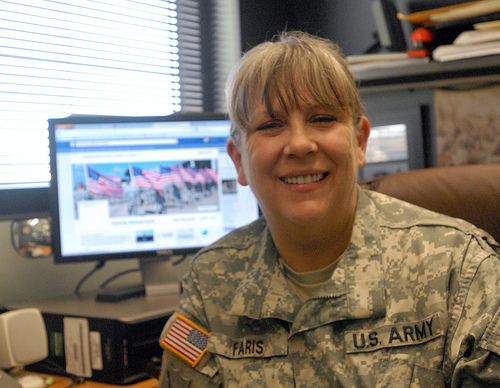
Sgt. 1st Class Debra Faris works as the Personnel Security Manager for the Kentucky National Guard. (Kentucky National Guard photo by David Altom)
FRANKFORT, Ky. -Growing up, we watch the diverse scenarios of life unfolding around us, both good and bad, such as, getting a speeding ticket, getting arrested, the heartbreak of divorce, identity theft, animal attacks, domestic abuse, murder, and the list goes on. In the innocence of our youth, we tell ourselves that, those things will never happen to me.
“Now that we are adults, we know better and if we would have paid attention to the signs, most of these scenarios could have been prevented,” said Sgt. 1st Class Debra Faris, Personnel Security Manager for the Kentucky Guard. “With every generation it seems like we have more vulnerabilities than the previous generation.”
“OPSEC or Operations Security doesn’t just apply to the military personnel and operations,” said Faris. “It applies to everyday life.”
With today’s social media it is easier for our professional and personal information to be accessed and compromised if we don’t implement certain fail-safes. These fail-safes are not foolproof but could discourage an adversary enough to go on to an easier target.
“The Family Readiness Group does an excellent job of informing the Kentucky National Guard family members, so the Soldiers should make it their mission to ensure that their families are educated,” she added.
Faris reminds us that 9-11 was a wake-up call, not only for America but the whole world. However, there are still those ‘innocents’ that need educated to protect the home front. Steps to protect those that you care about include:
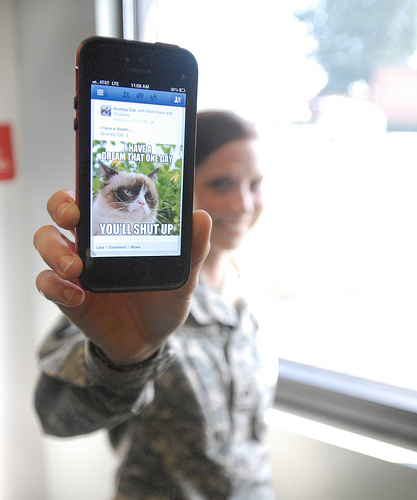
Social media brings on a whole new range of OPSEC vulnerabilities for Guard members and their families.
“Sometimes you just have to think like the enemy,” Faris concluded. “International terrorists are not the only foes that are interested in your comings and goings. The common criminal also wants to know.”
By Master Sgt. Carlos Claudio, 192nd Fighter Wing Public Affairs
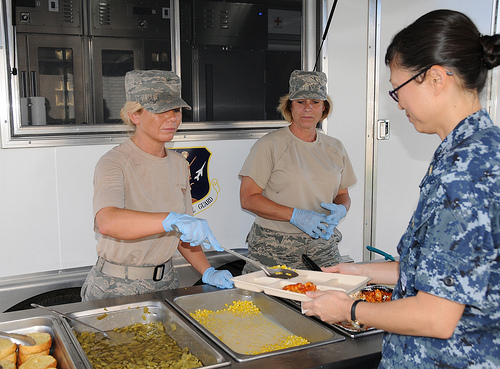
U.S. Air Force Tech. Sgt. Donna Hooper (left) and Master Sgt. Krista Lindsey, Force Support Flight, 123d Airlift Wing, Louisville, Ky., serve lasagna in front of a Disaster Response Mobile Kitchen Trailer (DRMKT) July 15 at ‘Hope of Martin’ Innovative Readiness Training held at Martin Middle School in Martin, Tenn. (U.S. Air National Guard photo by Master Sgt. Carlos J. Claudio/Released).
MARTIN, Tenn. — At first glance, the trailer looks like any other mobile transport you see on the highway. But upon closer inspection, the vehicle takes on a different appearance with professional graphics, high-tech lighting and exhaust pipes protruding from the top.
“It’s a Disaster Response Mobile Kitchen Trailer (DRMKT),” explained Master Sgt. Krista Lindsey, non-commissioned officer in charge of Services at the Kentucky Air National Guard’s 123rd Airlift Wing in Louisville, Ky. “Its purpose is to provide meals in a disaster response situation for all personnel, whether it’s a state or a federal mission.”
The trailer was used recently at Martin Middle School here in support of the Hope of Martin community outreach project, an Air National Guard-led initiative providing medical care during an Innovative Readiness Training mission.
The 123rd sent a four-person team while the Tennessee Air Guard’s 134th Air Refueling Wing in Knoxville, Tenn., deployed a six-person team led by Tech. Sgt. Jacob Daniels. Both teams shared cooking duties while supporting the IRT mission.
“The advantages of this trailer are that it is mobile, portable and has safer, enclosed burners for cooking,” Lindsey said.
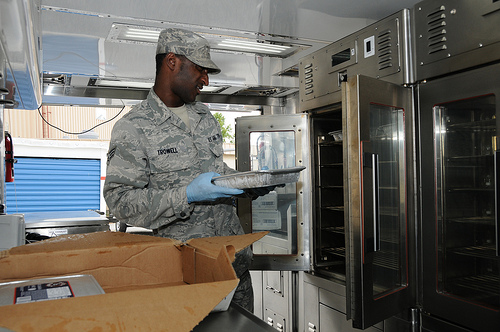
U.S. Air Force Senior Airman Dwight Trowell, Force Support Flight, 123d Airlift Wing, Louisville, Ky., loads lasagna meals in the oven of a Disaster Response Mobile Kitchen Trailer (DRMKT) July 15 at ‘Hope of Martin’ Innovative Readiness Training held at Martin Middle School in Martin, Tenn. (U.S. Air National Guard photo by Master Sgt. Carlos J. Claudio/Released).
Once the DRMKT is filled with 50 gallons of water for cooking and cleaning, it is completely self-sufficient, even generating its own electricity via a built-in generator.
The trailer houses two fuel tanks. The first tank is for burners and accepts diesel, kerosene and JP-8 fuels. The second tank is for the generator and only accepts diesel fuel. The entire vehicle can be loaded into a C-130 Hercules transport plane for delivery anywhere to support a disaster or mission like Hope of Martin.
The mobile kitchen is equipped to serve a large number of people — 2,000 people per meal or 6,000 people per day — that’s double that amount of regular field kitchens. It’s also designed for fast set-up and teardown, which enables the DRMKT to serve at multiple sites in a single day if needed. According to Lindsey, set up time with an experienced crew is approximately 40 minutes.
The DRMKT was first tested in January at the presidential inauguration in Washington, D.C., where the 123rd served 350 hot meals three times a day to military security teams, plus a midnight meal.
“There were no major issues,” said Senior Airman Dwight Trowell, who worked the inauguration.
The DRMKT can cook meals en route to a location, but safety and distance logistics need to be worked out.
It also comes equipped with a very handy resource built into the wall: “The trailer computer is a great tool that serves as a mini learning center,” Lindsey said. “Services personnel can read Word documents, recipes, watch cooking videos and read equipment manuals simply by using the touch screen.”

U.S. Air Force Senior Airman Dwight Trowell, Force Support Flight, 123d Airlift Wing, Louisville, Kentucky, cues a training video to play on the wall display of a Disaster Response Mobile Kitchen Trailer (DRMKT) July 15 at ‘Hope of Martin’ Innovative Readiness Training held at Martin Middle School in Martin, Tenn. (U.S. Air National Guard photo by Master Sgt. Carlos J. Claudio/Released).
The computer also saves space in the vehicle by eliminating the need to carry recipe-card boxes or cooking books, and it allows each unit to customize menus for specific missions.
A convenient tab on the computer lets personnel to view accumulated “gray water” (dirty water), generator wattage and outside and inside temperatures.
The IRT program is designed to train U.S. military medical personnel and provide assistance to underserved communities. The IRT mission to Tennessee assisted more than 3,000 patients, performed more than 8,000 procedures and provided more than 1,200 eyeglasses for a total value of $600,000 worth of services to the Martin community.
Story and photos by Spc. John Rader, 149th VCC Unit Public Affairs Historian Representative
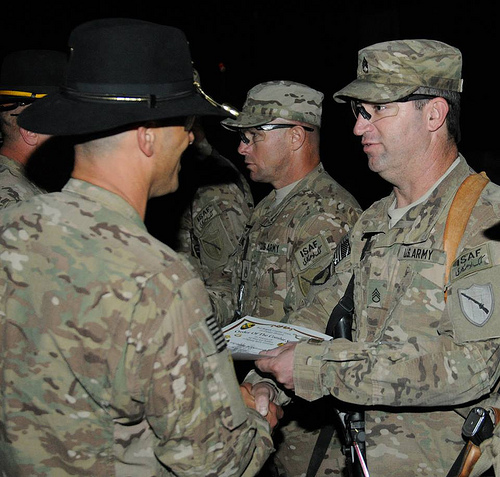
Staff Sgt. Andy Wiglesworth with the 149th Vertical Construction Company is presented the Order of the Combat Spur by Col. Robert Whittle Jr., commander of the 2nd Brigade, 1st Cavalry Division at Bagram Airfield in Afghanistan, Aug. 4, 2013. (Photo courtesy of 2/1 Cavalry)
Bagram Air Field, Afghanistan — In June, the Soldiers of the 149th Vertical Construction Company were tasked with a very high priority construction mission at Bagram Air Field in Afghanistan. The engineers were tasked with constructing a two story tactical operation command center for the 2nd Brigade, 1st Cavalry Division, known as the “Black Jack” Brigade that was due to arrive in Afghanistan during the summer. The Guardsmen were very familiar with the build as it mirrors the office space they constructed for their own operations area that they share with the 122nd Engineer Battalion from the South Carolina National Guard.
The task was assigned to 1st Platoon with Warrant Officer Jacob Lewis at the helm as the officer in charge of construction. The build took two months to complete and houses 45 offices, two large conference rooms, and two large command centers.
Check out all the photos of the ceremony on the “Black Jack” Brigade’s Facebook page, here.
Daily updates to the project were passed up the chain of command so the 149th leadership, the 122nd Engineers, the 555 Engineer Brigade, the 101st Airborne Division, and the International Security Assistance Force Joint Command (IJC) can track the progress of the construction. All eyes in the Regional Command East Territory were on the 149th as each phase of the project came closer to completion.
With the experience of one similar build completed by 3rd Platoon with Warrant Officer Robert Wiota as the officer in charge of construction, the unit already has a notch in their belt for this particular build. Construction began and continued without any glitches or issues arising. Each phase of the project rolled along flawlessly as the 149th ran 24-hour operations made up of 1st, 2nd, and 3rd shifts that maneuvered seven days a week. With the first 30 days complete, the Soldiers were already days ahead of schedule and their progress was noted by everyone in their chain of command.
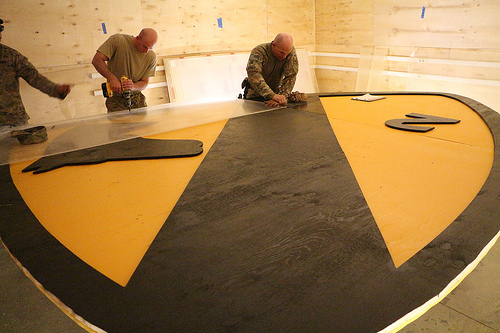
Soldiers of the 149th Vertical Construction Company put the final touches on a table in the shape of the 1st Cavalry Division patch at Bagram Airfield, Afghanistan, July, 2013. 149th Soldiers wanted to add a personal touch to the construction and came up with the idea for the table to honor the cavalry. (U.S. Army National Guard photo by Spc. John Rader)
“I’ve said it once, and I’ll say it again, the 149th VCC is the flagship company of this battalion,” said Lt. Col. Victor Brown, commander of the 122nd. “This company continues to amaze me.”
With more and more of the smaller operating bases in Afghanistan closing or decreasing in size, Bagram is growing as more troops arrive there to begin or continue operations from the still thriving air field. With the 1st Cavalry Division arriving, Bagram is the right choice for such a large outfit that will operate in every Regional Command Territory in theater, making it imperative to have command centers to occupy upon the arrival of their main body.
“The work and sweat that these troops put into this project is noted by not only me, but everyone up the chain,” explained Lewis. “I couldn’t ask for a better group of soldiers. They pay attention to every detail, catch things that I haven’t seen yet, and fix it right away without being told.”
Since the build is designed to not be a permanent fixture, the two story structure is constructed under a large area maintenance shelter and uses only two key elements of the vertical construction trade- carpentry and electrical work.
“I give all the troops in my squad the ability to learn as we go along,” said 149th’s Staff Sgt. Steven Willoughby, 2nd Squad Leader. “We try not to rush things for two reasons. One reason we don’t, is so that the soldiers that are not too familiar with this type of work can get a hands-on approach to learning the skill. The second reason is to ensure quality of the craftsmanship. We want to present an excellent product to the 2/1 Cavalry when they arrive.”
“Our name will be attached to the quality of this structure long after we leave and have done our part,” he said.
On July 22nd 2013, the construction project assigned to the 149th Vertical Construction Company was marked complete, ready to be presented to Col. Robert Whittle Jr. and his staff of the 2/1 Cavalry that will operate out of the structure. Preparing for the walk-through, Lewis instructed 1st Platoon to put the finishing touches on a side project to add a unique and personal touch for both the engineers of the 149th and the Troopers of the 2/1 Cavalry.
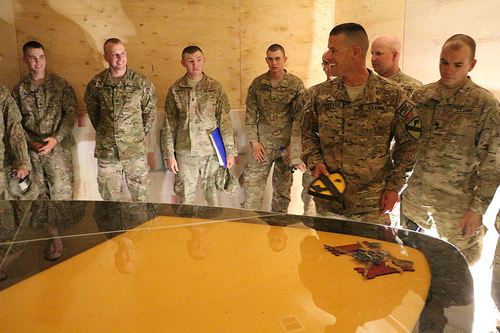
Soldiers of the 149th Vertical Construction Company present a large wooden table in the shape of the 1st Cavalry Division patch to Col. Robert Whittle Jr., commander of the 2nd Brigade, 1st Cavalry Div., at Bagram Airfield, Afghanistan, July 22, 2013. Whittle said the table will go wherever the unit goes, and will return with them to the U.S. at Fort Hood, Texas. (U.S. Army National Guard photo by Spc. John Rader)
“I sent back plans to Kentucky and had them drawn up and send back to me for this surprise side project,” said Lewis. “All the Soldiers involved were on board with this addition to our construction task and pitched in when and where they could. Most of my guys stayed long after their shift had ended to work on this and it really is the icing on the cake.”
As the walk through comes to an end, Chief Lewis directed his leadership to the last conference room in the building that had not been seen yet. The door opens to find all the 149th, 1st Platoon engineers standing behind a conference table that was built with that personal touch. The table is in the shape of the calvary patch and adorns all the likeness of the very recognizable yellow shield that is established as the symbol of the United States Calvary.
“I don’t know what to say here… what you all did here is amazing. I’m literally at a loss for words,” said Whittle. “I will make sure we take this table wherever we go, and when we get back home, I will make sure we hang this up at our headquarters in Fort Hood.”
To show the gratitude of the “Black Jack” Brigade to the 149th Soldiers that worked day in and day out on the construction, a surprise ceremony was held to induct those Soldiers into the “Order of the Combat Spurs.” From that day forth, the 2/1 Calvary Division recognizes the Soldiers of the 149th by issuing this award that authorizes the troops that are given the prestigious honor to wear the Calvary Stetson and Combat Spurs in noted situations as honorary members of the Calvary.
The tradition of the Order dates back to medieval times and roots itself in knighthood, where the awarding of spurs symbolized entry and ranks into the fraternity of mounted warriors. Usually the squire aspiring to knighthood would complete some tasks or deeds to prove his worth on the battlefield. Under these criteria, the 149th Soldiers performed such tasks and were awarded the esteemed honor.
“This is really an amazing award to take home,” said Sgt. Gary Forsyth, of the 149th. “It’s an award that not every Soldier has the opportunity to obtain, especially since we’re engineers, and now, an honorary part of the Calvary community.”
“Everyone worked really hard on this project and we have been awarded to a great extent for our hard work,” continued Forsyth. “I couldn’t be happier with the construction process and how the build turned out.”
The Kentucky Guardsmen added this to their long list of accomplishments while in theater. With just a few more months left in Afghanistan; the engineering projects in Bagram and all across Regional Command East and North Territories will continue.
“We have some great projects in front of us in the coming months and I couldn’t be more proud of these Soldiers,” said 149th Commander, Capt. Adam Evans. “They have worked on so many projects, completed some very difficult task, and always seem to rise to the occasion to get the job done with a touch of excellence.”
“It’s the little recognitions like this that keeps these troops going day in and day out. We will be back in Kentucky in just a few short months and we will have plenty of stories for our families.”
Story by Staff Sgt. Sidney Hoffmann, ADT 5 Unit Public Affairs Historian Representative
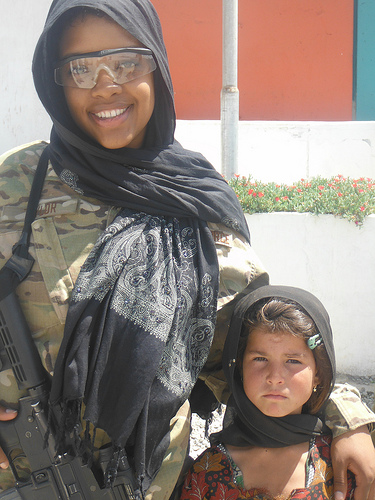
Master Sgt. Zakiya Taylor with Kentucky’s Agribusiness Development Team 5 stands with the daughter of a woman attending a canning class in Zaharay District, Afghanistan. The class, facilitated by U.S. Service members was a refresher course for local women to preserve foods for their families. (U.S. Army National Guard photo by Staff Sgt. Sidney Hoffmann)
ZAHARAY DISTRICT, Afghanistan — Kentucky Agribusiness Development Team 5 has completed many projects with this humanitarian mission here in Regional Command South, Afghanistan. One project they became a part of was a canning class facilitated by a U.S. Army Female Engagement Team from Fort Bliss, Texas.
The FET coordinated the location and ensured the information got out to the local women about the class. Master Sgt. Zakiya Taylor of ADT 5 provided the instructor from Kandahar City and distributed the supplies, which included the steam pot, funnels, ladles, jars, jar lifters, and sealers.
“With the supplies, we were able to provide approximately 40 local Afghan women with the tools and knowledge necessary to begin canning fruits and vegetables in their own homes,” said Taylor, ADT 5’s food preservation specialist.
Reinforcing the idea of Afghans teaching Afghans, the team contracted with a young Afghan woman, Laila Afag, from Kandahar City to teach the classes. A successful business woman in her own right, Afag co-owns three canning factories in the city and is an expert in teaching canning techniques for fruits and vegetables. Additionally, six of the women were teachers in the local area and would be able to pass along what they had learned in the class to others. Interestingly, one of the local teachers is a fifteen year old girl from Zharay, she was one of the few that could read, write and understand the material. The teachers were excited to display their educational skills and Afag allowed the teachers to assist her in presenting to the class.
“The canning supplies we were able to provide will be for home use and the demonstration classes given by Laila Afag will help the women preserve their produce,” said Taylor. “This makes them not only marketable in the future, but a sustainable tool to pass down to future generations.”
Since refrigeration and cold storage is not readily available in many of the local homes here, being able to store foods for longer periods of time is essential for the survival of the people.
Afag was highly motivated and proud she could extend her knowledge and services to this project.
“It is an easy craft; one they can pass down from one generation to the next,” she said. “They will be able to can and preserve a large variety of food if done correctly. The knowledge is there, because it is popular in this area.”
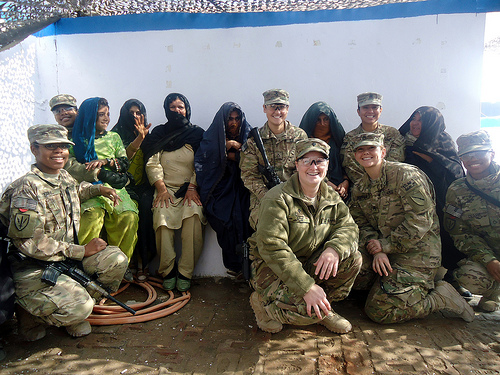
Female Soldiers with Kentucky’s Agribusiness Development Team 5 gather for a group photo with women and children in the Zaharay District, Afghanistan. The Afghan women attended a canning class while some Soldiers helped with a children’s class. (Courtesy photo)
It is important to note these women are familiar with the process; however, the value-added is having the proper tools and focusing on sanitary techniques.
The class included the process of paste canning, pickling and fruits preserving. Each woman was provided a handout to follow along with during the presentation. The material was presented at a very basic level, which provided beginners a jumpstart on making quality preserves without studying the science of preserving. The women were very interested in participating and learning about the canning process. Afterward, many women stated they felt confident and certain they could effectively implement these techniques at home.
A high note of the event was when the Zharay District Governor, Sayeed Ashina Agha, and Director Bismullah Khan, District Education Representative, came on the last day of training to recognize the women and give them encouragement and support for their participation. Even though the Taliban threats occur and transportation is not always an option to get to Forward Operating Base Pasab, these women truly risk their lives to take advantage of the programs provided for them.
“There is nothing like seeing their smiling faces and knowing the team has done something these women will take with them for the rest of their lives,” said Taylor.
Story by Spc. Brandy Mort, 133rd Mobile Public Affairs Detachment
In honor of Women’s Equality Day, established today in 1971, we’re pleased to profile one of our own and her accomplishments.
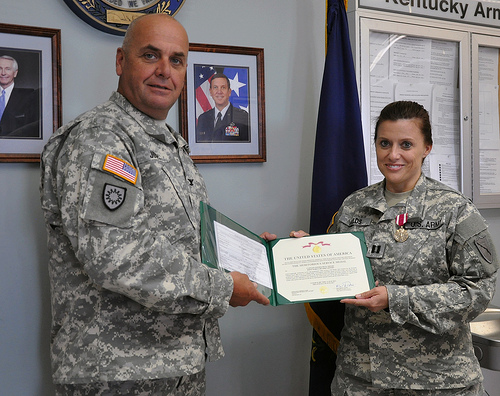
Col. Charles Jones presents a Meritorious Service Medal to Capt. Stephanie Fields in Frankfort, Ky., July 3, 2013. Fields was awarded for her work as the deputy state surgeon for the Kentucky National Guard, for which she also received the Maj. Gen. Deborah C. Wheeling for excellence in that position. (Photo by David Altom)
FRANKFORT Ky. – As Deputy State Surgeon for the Kentucky National Guard’s Joint Force Headquarters, Capt. Stephanie Fields doesn’t give up easily and she’s always looking for ways she that she can improve systems already put into place.
She has been the Deputy State Surgeon for six out of the ten years of her service and because of her hard work and determination Fields has received various awards, and was recently awarded the Maj. Gen. Deborah C. Wheeling Deputy State Surgeon Award of Excellence.
“I’ve received two Army Achievement Medals,” said Fields, “One was for supporting wounded warriors while on Title 10 orders and the other was for work with Combat Life Savers training improvements. I’ve also received the Meritorious Service Medal for contributions as the Deputy State Surgeon and the Maj. Gen. Deborah C. Wheeling award for improvements made in health services that impacts Soldiers and Commanders .”
Fields has done a lot for the state of Kentucky, including improving the medical readinesss of Kentucky’s Guardsmen.
“Kentucky has made tremendous strides in the realm of medical readiness,” said Fields, “In 2007, Kentucky was at 9% readiness. Today we are at 86%. I believe one of the biggest contributing factors is the emphasis placed on medically ready Soldiers by commanders and leadership.”
Serving in the medical field has given Fields insight for both the military and civilian sides.
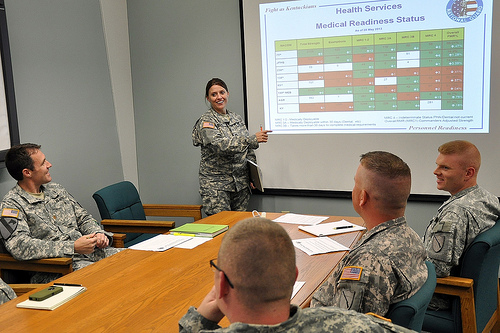
Capt. Stephanie Fields discusses the medical readiness of the Kentucky National Guard during a personnel meeting in Frankfort, Ky., May 28, 2013. (U.S. Army National Guard photo by Staff Sgt. Scott Raymond)
“I think every medical person should spend some time serving,” said Fields. “Caring for Soldiers has given me a different perspective as a medical professional. Soldiers have issues that stem from something that is a result of deployments and family separation. Life goes on at home, even during a two-week annual training, that is time a Soldier spends away from their family, they deserve all the support we can give them for their sacrifices.”
Fields hopes that she is an asset to the Kentucky National Guard because she has the Soldiers best interest at heart. She hopes to continue to help the Soldiers of Kentucky at all costs is the main goal for Fields in the future.
“I am dedicated to the Soldier, organization and the people in my department that motivate me every day with their own dedication.” Said Fields, “Many times we have received last minute request and/or see a need we can support them. Whatever it takes, we will make it happen.”
Photo Essay Courtesy of the 1204th Aviation Support Battalion
CAMP ATTERBURY, Ind. - During times of natural disasters some areas may be too remote or inaccessible for convoy resupply due to destruction or congested highways. These communities still need basic life support such as food and fresh water. The Kentucky Army National Guard possesses that ability.
Recently, Kentucky National Guardsmen of the 1204th Aviation Support Battalion, based out of Burlington, Ky. and Bravo Co. 2nd Battalion 147th Aviation, out of Frankfort, Ky. received training during the ARMY NORTH Vibrant Response Exercise on sling load operations. They distributed 500 gallon water blivets to a simulated devastated region. The training demonstrated seldom utilized capabilities to conduct relief operations during a natural disaster.
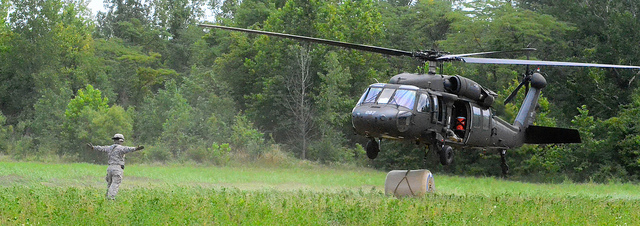
Sgt. Greg Wieland, a water purification specialist, with Alpha Company, 1204th Aviation Support Battalion, 63rd Tactical Aviation Brigade, Kentucky National Guard headquartered out of Burlington, Ky., signals a UH-60 Black Hawk helicopter as it carries a water blivet during a sling load operation during the U. S. Army North (Fifth Army) lead Vibrant Response 13-2 training exercise Aug. 2 at Camp Atterbury, Ind. The water blivet will be used to supply water to Soldiers at Forward Operating Base Night Hawk for hydration, cleaning, and cooking purposes. (Army Photo by Staff Sgt. Alexandria Brimage-Gray/Released)
“The initiative taken by the Soldiers of Alpha Company, 1204th ASB and Bravo Company 2-147th to accomplish this mission demonstrate everything that is right about the Kentucky Army National Guard aviation community, ” said Maj. Phil Robinson, commander of the 1204th. “The Soldiers and leaders from each unit capitalized upon an opportunity to combine their separate collective training events into a complex multi-echelon mission that provided some of the best training throughout the operation.”
“I am proud of the fact that these Soldiers are continually striving to integrate all aspects of our capabilities in a continuous effort to be prepared for any civil support need within the Commonwealth.”
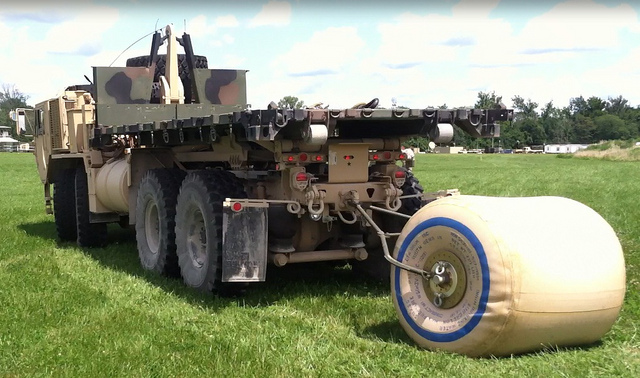
Forward Area Water Point Supply System (FAWPSS) is being delivered to the distribution point during the U.S. Army North (Fifth Army) lead Vibrant Response 13-2 training exercise Aug. 2 at Camp Atterbury, Ind. The water blivet will be used to supply water to Soldiers at Forward Operating Base Night Hawk for hydration, cleaning, and cooking purposes. (Photo by 1LT Gregory Slater/Released)
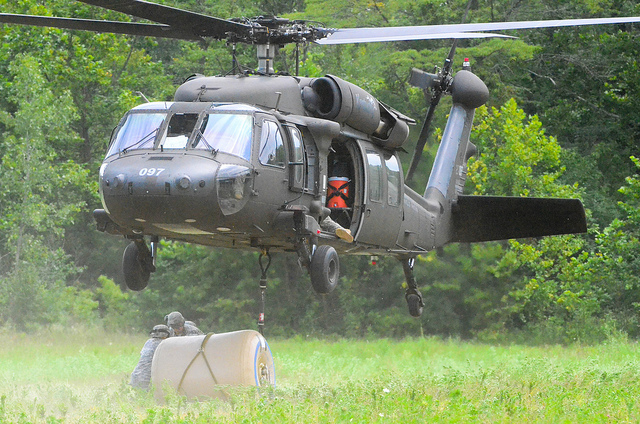
Water purification specialist with Alpha Company, 1204th Aviation Support Battalion, 63rd Tactical Aviation Brigade, Kentucky National Guard headquartered out of Burlington, Ky., connect a water blivet to a UH-60 Black Hawk while conducting sling load operations during the U. S. Army North (Fifth Army) lead Vibrant Response 13-2 training exercise Aug. 2 at Camp Atterbury, Ind. The water blivet will be used to supply water to Soldiers at Forward Operating Base Night Hawk for hydration, cleaning, and cooking purposes. (Army Photo by Staff Sgt. Alexandria Brimage-Gray/Released)
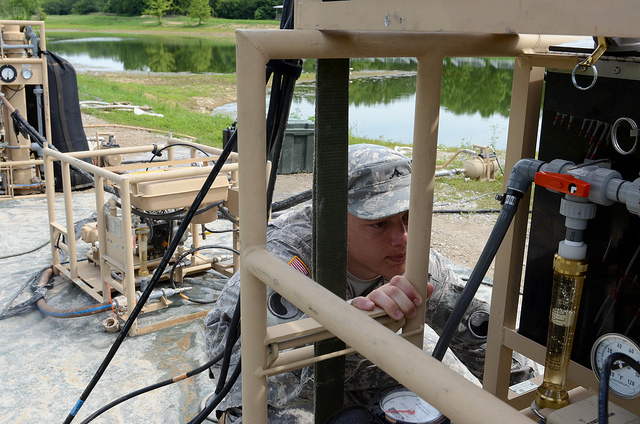
CAMP ATTERBURY, Ind. – Pvt. Nicholas Heath, a water purification specialist, with Alpha Company, 1204th Aviation Support Battalion, 63rd Tactical Aviation Brigade, Kentucky National Guard headquartered out of Burlington, Ky., conducts an inspection on the strainer as the water goes through a ultra filtration system during the U. S. Army North (Fifth Army) lead Vibrant Response 13-2 training exercise Aug. 2 at Camp Atterbury, Ind. The water moving through the strainer is the first step in the ultra filtration water purification process. (Army Photo by Staff Sgt. Alexandria Brimage-Gray/Released)
Story by Sgt. Cody Stagner, 133rd Mobile Public Affairs Detachment
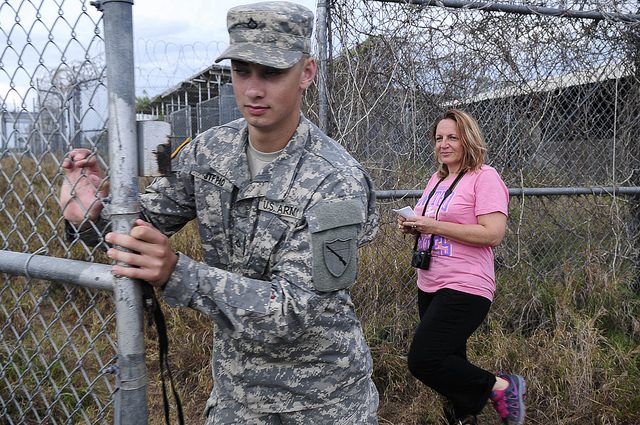
Pfc. Cody Cooper, a member of the 133rd Mobile Public Affairs Detachment escorts news media representatives during a tour of Camp X-Ray at Guantanamo Bay, Cuba, Aug. 8, 2013. Camp X-Ray was the first detention camp at Guantanamo Bay. (U.S. Army National Guard Photo by Sgt. Cody Stagner)
JOINT TASK FORCE GUANTANAMO, Cuba — Established in 1903, the U.S. Naval Station at Guantanamo Bay, Cuba, is now home to the world’s most recognized detention facility on the planet—Joint Task Force Guantanamo.
Regardless of difficulty and the fate of their temporary duty station, Kentucky Guardsmen from the 133rd Mobile Public Affairs Detachment, teamed up with the 120th Public Affairs Detachment from Indianapolis, flourish on Cuban soil.
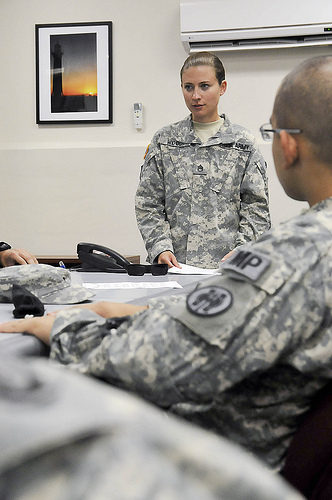
Staff Sgt. Rebecca Wood, a member of the 133rd Mobile Public Affairs Detachment, conducts media training for Service members at Joint Task Force Guantanamo in Guantanamo Bay, Cuba, Aug. 8, 2013. Media relations training helps Service members learn how to interact with news media representatives that visit Guantanamo (U.S. Army National Guard Photo by Sgt. Cody Stagner/133rd MPAD)
“We could not have asked for a better deployment situation,” said Capt. Andi Hahn, the commander of the 133rd and officer-in-charge of media relations for JTF GTMO. “All of our Soldiers have unique backgrounds and skillsets that are useful and necessary for our successes here.”
One ongoing success is the control and management of command information and its distribution throughout JTF GTMO.
“The Wire magazine has 1,250 copies distributed weekly all around the base,” said Cpt. Brian Pennington, the officer-in-charge of command information. “In addition, we also take all command photos and control the distribution of all information through various channels of communication.”
Leading troops is nothing new to the Lexington, Ky., native. He values his experience as a non-commissioned officer in Iraq from 2004-2005, and as a commissioned officer in Afghanistan from 2010-2011.
“Leading troops in combat is different from leading troops in Guantanamo, but also very similar,” he said. “I have been blessed to serve with outstanding Soldiers that perform difficult duties at a professional level without delay.”
From day one, Pennington lead a talented team of public affairs specialists to function as journalists, photographers, videographers, editors, graphic designers and webmasters to overhaul The Wire and makeover the 20-page periodical with a more attractive reader appeal.
To see recent issues of The Wire, click here.
They added custom graphics, reorganized its consistency and permanently dedicated portions of the periodical to favorite topics of readers, such as movie reviews, comics, Service Member spotlights and fitness.
“Working in the public affairs office with others who bring years of experience has inspired me to want to work closely to the public affairs field,” said Spc. Lerone Simmons, a member of the 133rd from Brooklyn, N.Y. “I have really enjoyed getting to know the people here.”
Simmons, a journalism student at Kentucky State University, submits one to two stories each week to the base publication and hopes his efforts lead him to a job that travels abroad.
“This is an opportunity many journalists have never had,” he said. “Not only do I have the privilege to be published, but I am also proud to get to serve my country.”
Other Soldiers of the 133rd also place service before self and are riding in the front seat with Guantanamo as it makes headlines in the news.
“Media representatives visit most every week to get interviews for the stories our families are reading back home,” said Pfc. Cody Cooper, a media escort in the 133rd from Scottsville, Ky. “It is my job to escort them around the base and through the detention camps and help make sure their needs are all met. Regardless of the media’s political view, our mission stays the same.”
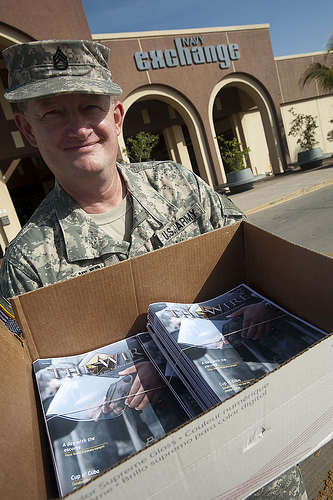
Staff Sgt. Aaron Hiler, a public affairs specialist in the 133rd Mobile Public Affairs Detachment distributes The Wire Magazine to the Navy Exchange at U.S. Naval Base Guantanamo Bay, Cuba, Aug. 16, 2013. Hiler is deployed in support of operations for Joint Task Force Guantanamo as a graphic designer and webmaster for The Wire Magazine, a base wide publication (Staff Sgt. Lorne W. Neff/120th PAD)
This deployment has given the 19-year-old a chance to hone his skills by cross training and observing world-known broadcast journalists in their element.
“I really enjoy what I do here,” he said. “When Irish TV and Radio visited, the simple way they interacted with each other and me as their escort made me feel like I was a part of their team. This is where I am supposed to be.”
During military commission proceedings at Guantanamo, the two Guard units facilitate mass numbers of visiting journalists.
“The most challenging obstacle for me is logistics,” said Staff Sgt. Rebecca Wood, the non-commissioned officer in charge of media relations. “For commissions, I might have to figure out how to move thirty reporters from point A to point B using three different modes of transportation and with limited staff. I have to think about every reporter’s well-being as well as the six Soldiers who help me carry out this mission. There are a lot of moving parts.”
To add to the moving parts in their daily mission, Wood and Hahn fore fronted a new instructional course that serves a greater good for the entire base.
“We teach service members how to do interviews and try to relieve some of the stigma about military talking to reporters,” said Wood. “I have seen Soldiers come into our classroom saying they don’t trust reporters, and then we hand-pick them later to do an interview and they nail it. It’s a win-win situation for public affairs, the reporter, the Soldier and his or her leadership.”
Wood, originally from Parkersburg, W. Va., accepts the challenge of balancing a multitude of responsibilities with open arms.
“I can’t wait to apply what I am learning to the civilian sector and in my career with the Kentucky Guard,” she said. “I am truly blessed to have an opportunity like I have here at Guantanamo Bay, Cuba, and the Guard is what made it possible.”
Story by Senior Airman Vicky Spesard, 123rd Airlift Wing Public Affairs
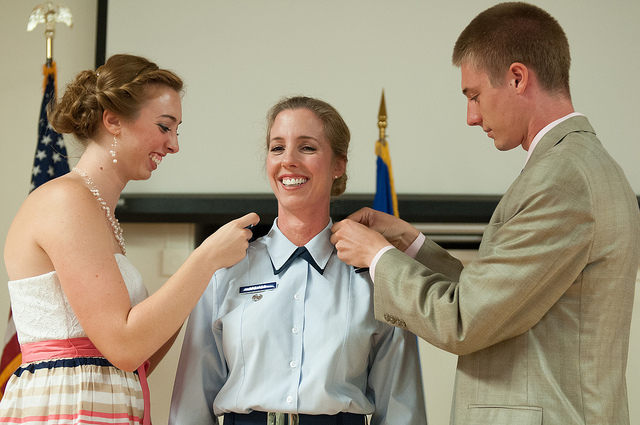
The children of Col. Kathryn Pfeifer pin colonel’s rank insignia to her uniform blouse during a promotion ceremony at the Kentucky Air National Guard Base in Louisville, Ky., Aug. 17, 2013. Pfeifer, director of staff for Headquarters, Kentucky Air National Guard, is the first female line office to attain the rank of colonel in the Kentucky Air Guard. (U.S. Air National Guard photo by Senior Airman Vicky Spesard)
KENTUCKY AIR NATIONAL GUARD BASE, LOUISVILLE, Ky. — Lt. Col. Kathryn Pfeifer, director of staff for Headquarters, Kentucky Air National Guard, was promoted to rank of colonel during a ceremony, Aug. 17, breaking a symbolic barrier in the process.
“This is a great day for Col. Pfeifer and her family, but this is a historic day for the Kentucky National Guard and the Kentucky Air National Guard,” explained Kentucky’s adjutant general, Maj. Gen. Edward Tonini, who officiated the ceremony. “She is the first female line officer to obtain the rank of colonel in the history of the Kentucky National Guard.”
Line officers are authorized to command a war-fighting force, as opposed to officers who normally exercise authority in a non-combat specialty field such as the medical or the chaplaincy corps.
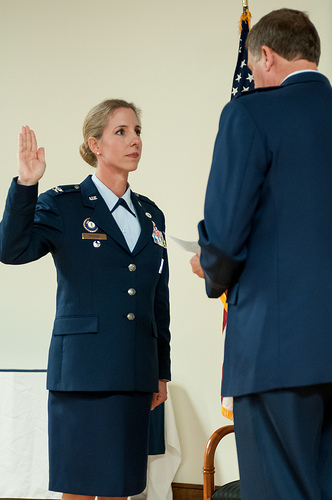
Col. Kathryn Pfeifer, director of staff for Headquarters, Kentucky Air National Guard, takes the oath of office during a promotion ceremony held Aug. 17, 2013, at the Kentucky Air National Guard Base in Louisville, Ky. Pfeifer is the first female line office to attain the rank of colonel in the Kentucky Air National Guard. (U.S. Air National Guard photo by Senior Airman Vicky Spesard)
“I know our organization is in good hands as we go forward with your kind of leadership,” Tonini continued. “I truly believe that good things happen to good people. I know you are one of those, and I genuinely appreciate all that you have done.”
Upon hearing the orders for promotion, Tonini joined Pfeifer’s husband to pin silver eagles to her uniform epaulets, a time-honored tradition. Pfeifer’s two children assisted in the ceremony as well, replacing the lieutenant colonel’s rank on her dress uniform shirt with silver colonel’s eagles.
After taking the oath of office, Pfeifer took a few minutes to thank her family and friends, and address those gathered to celebrate her promotion.
“It is an honor and a privilege for me to stand here today, not because of the historical significance of being the first female line officer, but primarily because of the support I’ve received along the way,” Pfeifer said.
“The mentors in your life have such a huge influence on you as a young officer and all the way through, even to us who are old folks,” she continued. “The enlisted corps, you are key and instrumental in guiding us, teaching us how the enlisted corps works, keeping us out of trouble, and we have learned the ways of how to become a successful officer. Senior officers you help us drive our careers, so without you, many of us would never be here.
“Whether you are receiving feedback as a colonel, an airman or somewhere in between, pick out the good tidbits along the way and absorb them to make yourself become a better officer.”
In her current role, Pfeifer advises and assists the chief of staff for the Headquarters, Kentucky Air National Guard, in the formulation of plans, policies, and procedures and provides coordination and staff assistance during state emergencies when the Air Guard is called to active duty. Pfeifer also reviews projected personnel policy changes for impact on existing plans and programs and recommends action.
Pfeifer graduated as a mechanical engineer from North Carolina State University and received her commission through Air Force Reserve Officer Training Corps in 1988. She began her military career in the missile maintenance field troubleshooting technical issues with Intercontinental Ballistic Missiles and launch facilities.
After four years, she transitioned to civil engineering, filling various positions at different active-duty and Air National Guard wings, both in the United States and overseas for the next 14 years.
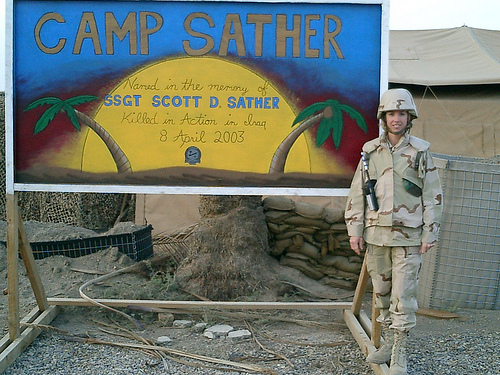
Maj. Kathryn Pfeifer deployed to Iraq in 2003, where she was stationed at Sather Air Base. (Courtesy photo)
In 2000, after a two-year break in service, she joined the Kentucky Air National Guard. Three years later, she was mobilized in support of Operation Iraqi Freedom and spent a tour of duty at Sather Air Base, Iraq, supporting civil engineer operations.
Following those years, Pfeifer became 123rd Airlift Wing Inspector General here. She followed that assignment by standing up the newly formed 123rd Force Support Squadron, merging the missions of the Military Personnel Flight and Services Flight under one umbrella.
Pfeifer then moved to the Headquarters, Kentucky Air National Guard. Prior to assuming her current position, she served as the director of personnel.
“We continue to lean forward to recognize and promote our best service members, regardless of gender or family of origin, who earn their promotions through their excellent work and dedication, ” Tonini said. “Kathy is a stellar officer who exhibits the qualities and character we expect from our colonels.”
Story by Airman Joshua Horton, 123rd Airlift Wing Public Affairs
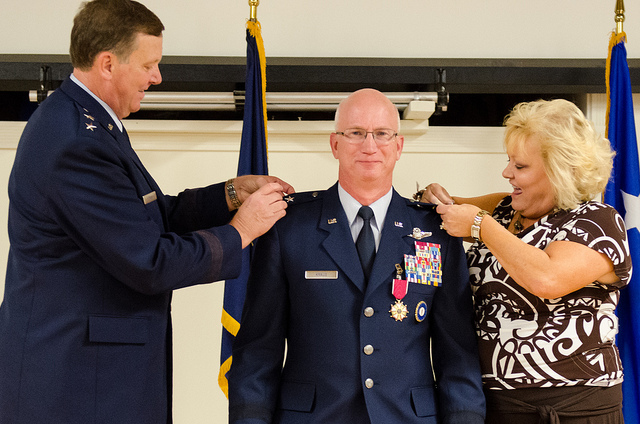
Maj. Gen. Mark Kraus’ wife, Leslie and Kentucky’s adjutant general, Maj. Gen. Edward Tonini, pin the rank insignia of major general to Kraus’ uniform during a promotion ceremony at the Kentucky Air National Guard Base in Louisville, Ky., Aug. 18, 2013. Kraus is a Kentucky Air Guardsman who serves as Air National Guard assistant to the commander of U.S. Air Forces Central. (U.S. Air National Guard photo by Airman Joshua Horton)
KENTUCKY AIR NATIONAL GUARD BASE, LOUISVILLE, Ky. — Brig. Gen. Mark R. Kraus, a Kentucky Air Guardsman who serves as Air National Guard assistant to the commander of U.S. Air Forces Central, was promoted to the rank of major general during a ceremony held here Sunday.
Kraus’ wife, Leslie was assisted by Maj. Gen. Edward W. Tonini, Kentucky’s adjutant general, in pinning the new rank insignia before an audience of more than 200 family, friends and coworkers.
Tonini, who praised Kraus for his dedication to excellence during a career spanning more than 39 years, then presented the new major general with a flag depicting two stars on a field of Air Force blue.
“Unbridled service is that standard by which we define the Kentucky National Guard,” Tonini told the audience. “In my opinion, Mark exemplifies that slogan. This is an absolutely great, great day for Kentucky and a great day for the Kraus family.
To see more photos with Maj. Gen. Kraus, click here.
“Mark is someone who has ‘been there and done that.’ His illustrious career has taken him through the Middle East, Southwest Asia, Europe, North Africa, Antarctica, Central America, South America, and he even spent some time conducting operations along the U.S.-Mexican border.
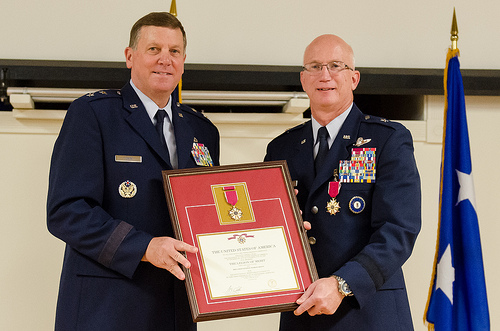
Brig. Gen. Mark Kraus (right), a Kentucky Air National Guardsman who serves as Air National Guard assistant to the commander of U.S. Air Forces Central, is awarded The Legion of Merit, first oak leaf cluster, by Kentucky’s adjutant general, Maj. Gen. Edward Tonini, during a ceremony held Aug. 18, 2013, at the Kentucky Air National Guard Base in Louisville, Ky. Kraus also was promoted to the rank of major general during the ceremony. (U.S. Air National Guard photo by Airman Joshua Horton)
“What happens here today bodes well for the future of the Kentucky National Guard, for the Kentucky Air National Guard, for all of our men and women who wear the uniform, and for the citizens of this great nation.”
Kraus was further recognized during the ceremony with the award of The Legion of Merit, first oak leaf cluster, for his numerous accomplishments as Kentucky’s assistant adjutant general for Air, a post he held from October 2008 to May 2013.
His “exemplary leadership resulted in Headquarters Kentucky Air National Guard earning two Air Force Organizational Excellence Awards and the 123rd Airlift Wing earning three Air Force Outstanding Unit Awards,” according to the award citation.
Kraus also stood up multiple critical mission sets, including the 223rd Intelligence Flight as a stand-alone mission under the Air Force Intelligence, Surveillance, and Reconnaissance Agency, providing sensitive mission support information to Air Force and key national intelligence user agencies, the citation said. He was instrumental, too, in the development of the mission doctrine and organization for Kentucky’s 123rd Chemical, Biological, Radiological, Nuclear, Explosive Enhanced Response Force Package, which delivered an outstanding performance during an initial certification exercise and resulted in multiple best-practices now in use nationwide.
Kraus used the occasion to thank his family and the Airmen of the 123rd Airlift Wing, with whom he served as commander from November 2004 to October 2008.
“I’m truly honored that of all the things that you could have been doing today, you chose to be here instead to celebrate this milestone in my career,” Kraus said. “When I joined this organization with two stripes on my sleeve, it never occurred to me that I’d be here this long and that I would turn those two stripes into two stars. I am truly a blessed man.
“I am the ninth Airman in the history of this organization, from its beginning in 1947, to be allowed the opportunity to wear the rank of major general,” Kraus continued. “That alone is humbling enough, but all the more so when I think and consider the thousands of others who have come before me and the limitless talents of those that I have served with over the years.”
Kraus also thanked his wife for her “unfailing support” through the years, saying she was instrumental to his success.
“I don’t know where I would be today (without her support),” Kraus said, “but I know this: I wouldn’t be here doing this if it weren’t for her.”
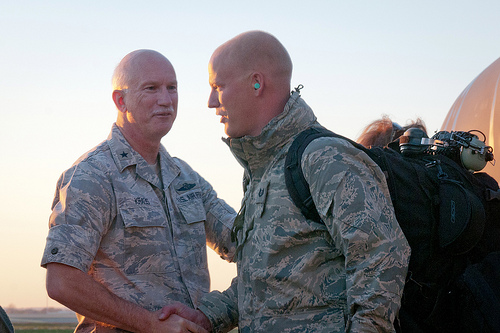
Brig. Gen. Mark Kraus, Kentucky’s assistant adjutant general for Air, welcomes home a Kentucky Air Guard member Nov. 10, 2012, in Louisville, Ky. The Airman was one of 58 Kentucky Air Guardsmen returning from a four-month deployment to the Persian Gulf region. (U.S. Air Force photo by Master Sgt. Phil Speck)
In his current role, Kraus serves as advisor to the commander, United States Air Forces Central, on Air National Guard program matters. He is responsible for assisting in the development of contingency plans and the conduct of air operations in a 20-nation area of responsibility covering Central and Southwest Asia.
Kraus maintains frequent and regular liaison with the commander, vice commander and staff at Ninth Air Force/United States Air Forces Central Headquarters, focusing on matters relating to the Air National Guard. He monitors operational readiness and the safety record of Air National Guard units and informs the Commander and staff on actions to be taken to improve statuses.
Kraus has served as an RF-4C Weapon Systems Officer and C-130 Navigator, and has held a variety of leadership positions including command at the squadron, group and wing level. His military career spans more than 39 years, including six years of enlisted service prior to his commissioning as an officer through the Air National Guard Academy of Military Science in 1979.
While deployed for Operations Iraqi and Enduring Freedom, he served with United States Central Command as commander of the 386th Air Expeditionary Wing, and Deputy Commander of the 455th Expeditionary Operations Group.
Kraus also has served as the Intelligence Directorate assistant to the director of the Air National Guard and the Air National Guard assistant to the commander of the Air Force Intelligence, Surveillance and Reconnaissance Agency.
“In closing I would like to say again how proud, yet humble, that I am to have to opportunity to further represent the Kentucky Air National Guard,” Kraus said. “I’m honored that you have joined me for today’s ceremony, and I thank you very much.”
Story by Staff Sgt. Scott Raymond, Kentucky National Guard Public Affairs
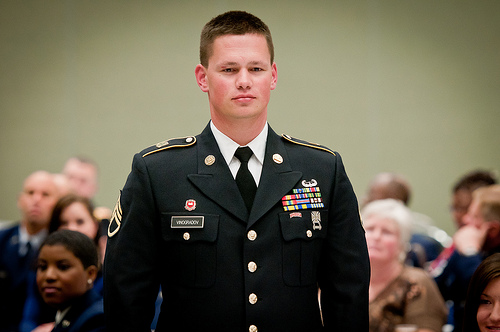
Staff Sgt. Aleksandr Vinogradov, a combat engineer with the 577th Sapper Company, stands at attention during the Outstanding Airman and Soldier of the Year Banquet in Louisville, Ky., on March 16, 2013. Vinogradov was named the Kentucky Army National Guard’s Outstanding Non-Commissioned Officer of the Year for 2013. (U.S. Air National Guard photo by Staff Sgt. Maxwell Rechel)
FRANKFORT, Ky. — The Vinogradov family has a long and distinguished history in the military. In Russia.
One of the newest Soldiers from the family is continuing the strong legacy in being the best at what he does. In the United States, with the Kentucky National Guard.
In 2004, Aleksandr Vinogradov moved from his home in Yoshkar-Ola, Russia to Ashland, Ky. A short three years later, he enlisted into the Kentucky Guard as a petroleum supply specialist. And after six years in uniform, Vinogradov was named Kentucky Army National Guard’s Outstanding Non-Commissioned Officer of the Year for 2013. He said he’s just continuing a tradition of military excellence in his family, it’s just what they do.
“I joined the Guard because the military was always something that I wanted to do,” he said. “Growing up in the military family I felt like this was a right job for a man to do to provide for his family.”
To see more photos from this story, click here.
Vinogradov is a third generation career-Soldier in a family that has seen many serve in the Russian military since before World War II. His father and grandfather both retired as colonels working with missile defense. His maternal grandfather retired from the Russian Air Force after a long career as a test pilot. According to Vinogradov, his grandfather piloted the plane that dropped the first Soviet Atomic bomb in the 1950s. He said his grandfather’s plane was badly damaged from the blast. He was a highly decorated pilot, but unfortunately died of cancer just after Aleksandr was born.
“All I knew of him was that it was his dream to see his grandson grow up and join the Army and ship off to boot-camp,” said Vinogradov.
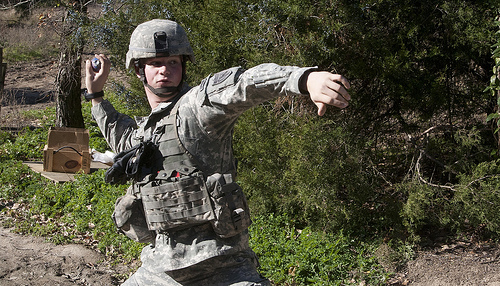
Staff Sgt. Alexander Vinogradov, 75th Troop Command, prepares to throw a simulated grenade on the Individual Maneuver and Tactics Course at the Wendell H. Ford Regional Training Center in Greenville, Ky., Nov. 17, 2012. (U.S. Army National Guard photo by Spc. Brian Ewalt)
When he was younger, Vinogradov’s parents seperated. He and his sister, Lana, moved with their mother to the United States. With a master’s degree in English, their mother began working as a teacher for the Ashland Public School system.
It was Vinogradov’s sister who first joined the military, enlisting in the Kentucky National Guard and the 201st Engineer Battalion in 2006. After getting married, she moved to the Nevada Guard working as a budget analyst for the state’s Yellow Ribbon and Family Support Services.
Vinogradov said he didn’t have the patience to wait, he wanted to start his military career as soon as possible. He joined the Guard because of the split option which allowed him to go to basic training the summer of his junior year in high school.
Several years later, his role in the National Guard is an exciting part of his life. He enjoys drill weekends and all the training as a combat engineer with the 577th Sapper Company.
“I plan on staying in the guard for at least 20 years,” said Vinogradov. “I enjoy it so much that I cant really imagine what I would do if I was to get out. I honestly think someone will have to kick me out of the Guard because I am not planning on leaving on my own.”
He knows his father and grandfather are proud of him and his accomplishments, even if he isn’t on “their side.” While some differences remain, Vinogradov said the ideals are the same, and he is happy where is now now.
“To me a Soldier is a special person regardless of what country he is from, because standing up to fight for your country is the most honorable thing a person can do.”
