Pages
Stay In Touch
More
© 2013 KentuckyGuard
JAK
CONTACT: David Altom, 502-607-1562, cell 502-330-1951
WHO: The Kentucky Army National Guard’s Agribusiness Development Team I
WHAT: Welcome Home Ceremony
WHEN: 11:00 a.m. EDT, July 2, 2010
WHERE: Army Aviation Support Facility Hanger #2, Boone National Guard Center, Frankfort, Ky., 40601
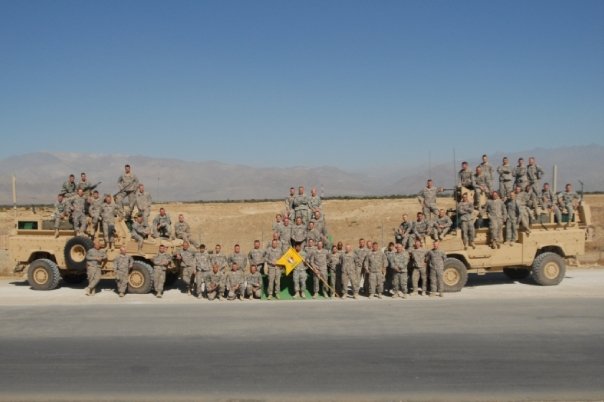
FRANKFORT, Ky. (June 30, 2010) - The Kentucky National Guard will host a welcome home ceremony for 60 Citizen-Soldiers and Airmen of Agribusiness Development Team One at 11:00 a.m. EDT July 2, 2010 at the Army Aviation Support Facility Hanger #2 at Boone National Guard Center, 100 Minuteman Parkway, Frankfort, Ky. 40601.
The ADT I deployed last summer to Afghanistan assigned with the mission of assisting Afghan farmers in becoming agriculturally self-sufficient and helped develop their agricultural marketplace. The task force is composed of a mix of Army National Guard Soldiers and Air National Guard Airmen with a variety of skills and backgrounds in agriculture matters. Led by Col. Mike Farley, the unit completed more than 300 successful agriculture projects and traveled to four Afghan Provinces with no casualties.
This was the first deployment for ADT I but the unit transferred authority to Kentucky’s ADT II who took over operations during a ceremony at Bagram Air Field June 23. Kentucky’s ADT III is already being assembled for next year.
Since Sept. 11, 2001 more than 12,000 members of the Kentucky Army and Air National Guard have deployed worldwide in support of the Global War on Terror.
To learn more about the Kentucky National Guard and the Department of Military Affairs, visit: www.kentuckyguard.com
JAK
Story by Mr. Richie Farmer / Photo by Staff Sgt. Michael Oliver/133rd Mobile Public Affairs Detachment
FRANKFORT, Ky. - Nearly 500 soldiers and airmen from the Kentucky National Guard are currently deployed overseas in support of the Global War on Terror. I salute them all for everything they do to protect our freedom and keep us safe. I am especially proud of 64 of those guardsmen who deployed to Afghanistan in June to carry out a very special mission.
Kentucky’s second Agribusiness Development Team (ADT II) is stationed halfway around the globe for a year to help the Afghan people better provide for their families by helping revitalize agriculture in their war-torn country.
This will be the second such mission for the Kentucky National Guard. ADT II will be taking over for Kentucky’s ADT I, which is returning home soon after working in Afghanistan since September 2009.
I appreciate the hard work and sacrifice of the young men and women of both of these teams. They demonstrate some of the best qualities of rural Kentucky - neighbors looking out for each other and lending a helping hand.
Like Kentucky, Afghanistan’s economy is heavily dependent on agriculture. Seventy percent of Afghans earn their living from agriculture, and it produces 40 percent of that nation’s gross national product.
If the Agribusiness Development Teams can improve Afghan agriculture, they will improve the Afghan people’s standard of living and the stability of the provincial and central governments. That decreases the likelihood that locals will find any reason to support insurgents or terrorists.
Col. Hunter Mathews, Agribusiness Development Team II commander, takes time out with 1st Lt. Travis Riley, ADT II security force commander, during a training exercise at Camp Atterbury, Ind. May 26 prior to their deployment to Afghanistan.
ADT II, like its predecessor, is helping Afghan farmers become agriculturally self-sufficient and develop markets. The team is not aiming to transform Afghanistan’s farms into modern Kentucky farms. Rather, it will help the Afghans make incremental but substantial improvements in their agriculture and capitalize on what they already do well.
The 64 members of ADT II include soldiers and airmen from Army National Guard and Air National Guard units from throughout Kentucky as well as some Army Reservists and Virginia National Guardsmen. The core of the unit is 10 agriculture and marketing specialists, including farmers, range management specialists, marketing managers, animal husbandry specialists, soil and irrigation specialists and a large animal veterinarian. Two of the guardsmen are agriculture engineers.
ADT II is receiving agricultural training and expertise from the Kentucky Department of Agriculture and the University of Kentucky. The team will have the capability to reach back to Kentucky for knowledge and skills whenever expert advice is needed. For example, UK has a Web site that will enable members of ADT II to post photographs of possible plant and animal diseases or viruses and, within a few days, have validated results.
The members of ADT I are scheduled to return home in late June or early July, and I urge you to give them the hero’s welcome they deserve.
Members of both ADTs are putting into action the values of family and patriotism that are instilled in them from the fertile fields of Kentucky. They are helping fellow human beings while enduring tremendous personal sacrifice - being far from their loved ones and, in many cases, missing milestones in their children’s lives. I hope you are as proud of these young men and women as I am.
I invite you to follow ADT II’s deployment on its blog at www.kyadt2.wordpress.com. Also, take a minute to become a fan on its Facebook page - a link is on the right side of the Kentucky National Guard’s blog at www.kentuckyguard.wordpress.com.
JAK
Image and Caption courtesy of Department of Military Affairs
The Battle of Salman Pak, a National Guard Heritage painting by James Dietz, is now on display at the Maj. Gen. Richard L. Frymire Emergency Operations Center at Boone National Guard Center in Frankfort.
FRANKFORT, Ky. (June 30, 2010) — It was Palm Sunday, and two U.S. convoys were about to converge at a crossroads 30 miles south of Baghdad. The two had almost met when they were struck by one of the largest groups insurgents ever to attack a convoy. The stretch of road was guarded by the 617th Military Police Company, from Richmond, Kentucky. Mobilized on October 2, 2004, once in Iraq the MPs organized into squads. The 4th Platoon’s 2nd Squad, 10 men and women in three armored High-Mobility Multipurpose Wheeled Vehicles, operated as “Raven 42.” Raven 42 had already skirmished with the insurgents, so squad leader SSG Timothy Nein had drilled them intensively.
Both convoys were under heavy attack and the insurgents were closing in when Raven 42 heard the firing. The three HMMWVs returned fire as they raced to an access road, where they too came under heavy fire. As a round knocked his gunner unconscious, SSG Nein turned and saw 28 men getting out of seven cars near a berm. With two MPs wounded already, Nein called for reinforcements and air support – and went on the offensive.
Many of the enemy were firing from a nearby trench. Nein called to his vehicle commanders, SGTs Leigh Ann Hester and Dustin Morris, firing from behind the berm, to bring an M203 grenade launcher. Hester was closer; under fire, she raced for the weapon and jumped into the trench. With Morris covering, Nein and Hester moved down the trench. The M203 was ineffective at such close range, so the two alternated lobbing grenades and firing their M48. Minutes later Nein and Hester were finished clearing the trench; 24 insurgents were dead, 9 wounded and one captured. Three contractor drivers from the convoys were dead, and handcuffs found on enemy corpses indicated plans to kidnap more.
Later this spring, Specialists William Haynes, Casey Cooper and Ashley Pullen received Bronze Stars for valor. Medic Jason Mike received the Silver Star, as did SGT Hester and SSG Nein. Pullen and Hester were the first women in U.S. history to receive medals for valor in actual combat; Nein’s Silver Star was later upgraded to the Distinguished Service Cross. All of the men and women of Raven 42 exemplify the great combat heritage of the National Guard.
Visit the Kentucky National Guard eMuseum: www.kynghistory.ky.gov
Visit the Kentucky National Guard Memorial: www.kyngmemorial.com
JAK
Photos and Story by Capt. Stephanie Fields
Ms. Monique Carter, administrative assistant for the the Bluegrass Army Depot Satellite Medical Clinic, works with a Soldier at the newly opened facility.
Frankfort, Ky. (June 28, 2010) – The Kentucky National Guard is answering the call to provide better support for its wounded warriors, thanks to the newly established Satellite Medical Clinic located at the Richmond Bluegrass Army Depot.
The need for the clinic is apparent. Since September 11, 2001, approximately 40% of the nation’s Guard and Reserve force has been called up to support Operation Enduring Freedom and Operation Iraqi Freedom. Of those soldiers over 50% are on their second and even third tours.
MAJ Kevin Pettus, the full time Kentucky Guard Medical Provider for the the Bluegrass Army Depot Satellite Medical Clinic, assists a Soldier at the newly opened facility.
Traumatic Brain Injury (TBI) has been labeled the “signature injury” of this war due to the high number of soldiers being involved in IED explosions. In 2009, the Department of Defense and Veteran’s Administration had a joint summit where the following information was revealed – as many as 360,000 troops are affected with TBI. Of those troops 27% suffered with post-deployment mental health problems, 18% with alcohol abuse and 13% with anxiety.
Kentucky Soldiers are not immune to these statistics. In the fiscal year of 2009, the Kentucky National Guard medically separated over 60 Soldiers. Over the last three years the Kentucky National Guard Office of Health Services has assisted in obtaining pre-authorizations for care over $1,792,240.89 secondary to line of duty-related medical injuries both combat and non-combat related.
“We are unique in our approach to caring for wounded warriors,” said Maj. Kevin Pettus, the full-time physician who runs the new medical clinic. “With the influx of injuries from both Afghanistan and Iraq it is not uncommon for military treatment facilities to be overwhelmed. It used to take a Kentucky Guardsman a minimum of a year to complete a medical evaluation due to the backlog of cases. It was not uncommon for a Soldier to be in a medical process for more than two years.”
That situation has changed. The new clinic opened its doors last February, the result of a partnership between the Kentucky Guard and Ireland Army Hospital at Fort Knox. The results, says Pettus, speak for themselves.
“With assistance from Ireland Hospital we have reduced medical evaluation process to approximately 120 days for most soldiers. This is a huge step forward in terms of relieving stress on our troops and their families.”
“Most significant,” Pettus says, “we are able to refer most of our soldiers to the local economy, which gives us a much broader selection of providers.”
Pettus is supported by Monique Carter, a contracted administrative assistant and additional support staff provided by Ireland Army Hospital. J1- Health services provides all administrative needs and funding for the clinic.
“We are very proud of our staff and the proactive initiatives we’ve undertaken to help their fellow Guardsman,” said Pettus. “This is just one of many ways that the Kentucky Guard serves our Soldiers and their families.”
JAK
Image and Caption courtesy of Department of Military Affairs
The Battle of Takur Ghar, a National Guard Heritage painting by Keith Rocco, is now on display at the Maj. Gen. Richard L. Frymire Emergency Operations Center at Boone National Guard Center in Frankfort.
FRANKFORT, Ky. (June 25, 2010) — Paktia Province, Afghanistan, March 4, 2002 - Operation Enduring Freedom, the military action against Taliban and al-Qaida forces in Afghanistan, was the catalyst for the largest mobilization of Air National Guard personnel since the Korean War. It also marked the first time that Air National Guard ground units, particularly pararescue personnel and air combat controllers, were used to support joint ground combat operations.
As part of Enduring Freedom, in March 2002 a joint military operation named “Anaconda” was mounted in Paktia province to surround and defeat Taliban forces hiding in the area. On the third day of Operation Anaconda an Army MH-47E Chinook helicopter was fired upon as it attempted to land on a ridge on Takur Ghar mountain. Taking heavy fire, the helicopter lurched and attempted to take-off to extricate itself from the field of fire. When the Chinook lurched, one of the Navy SEALs on board, Petty Officer First Class Neil C. Roberts, fell from the rear ramp. Too damaged to return for Petty Officer Roberts, the Chinook landed further down the mountain. A second MH-47E attempted to land and rescue Roberts, but it too was fired upon and forced to leave the immediate area. The third MH-47E to attempt a landing on what became known as Roberts’ Ridge was hit with automatic weapons fire and rocket-propelled grenades while still 20 feet in the air. The helicopter, containing an Army Ranger Team and Technical Sergeant Keary Miller, a Combat Search and Rescue Team Leader from the 123d Special Tactics Squadron, Kentucky Air National Guard, hit the ground hard. Within seconds, one helicopter crewman, the right door gunner, was killed, as were three Army Rangers.
The 17-hour ordeal that followed would result in the loss of seven American lives, including Petty Officer Roberts. Technical Sergeant Miller not only managed to drag the wounded helicopter pilot to safety, but also orchestrated the establishment of multiple casualty collection points. In between treating the wounded, Miller set up the distribution of ammunition for the Army Rangers who were taking the fight to the enemy. For his extraordinary life-saving efforts while putting himself in extreme danger under enemy fire, Technical Sergeant Miller was awarded the Silver Star by the U.S. Navy, one of the few members of the Air National Guard to be so honored.
Visit the Kentucky National Guard eMuseum: www.kynghistory.ky.gov
Visit the Kentucky National Guard Memorial: www.kyngmemorial.com
JAK
Staff Report
2nd Lt. Joshua Witt speaking at the 26th Annual Governor’s Safety Conference. Lieutenant Witt is the KYARNG Safety and Occupational Health Manager.
Frankfort, Ky. (June 24, 2010) –– National Guard Soldiers across the Commonwealth will be seeing, hearing and experiencing Army Safety in a new way this summer. The J1 Safety Office has initiated a renewed commitment to actively engaging Soldiers and leaders across the organization. This plan of direct and indirect communication will foster much needed one-on-one contact with the field. Phone calls, targeted emails and Unit specific training will serve to engender a widened view of Army Safety.
“In order for Army Safety to be an integral part of the conversation, it first has to be made credible and relevant to the audience,” said 2nd Lt. Joshua Witt the KYARNG Safety and Occupational Health Manager. “Soldiers want to know what right looks like and will follow the examples they see.”
The J1 Safety Office has already begun to make inroads through recent public speaking engagements at the 26th Annual Governor’s Safety Conference and Yellow Ribbon Reintegration Weekends. Soldiers and their families are especially interested in learning about emergency preparedness for natural disasters. The resources available at www.ready.gov and Ready Army have been well received as Guard members anticipate future state active duty missions and emergency mobilizations. Preparing in advance of such events promotes individual and family safety.
The grass roots safety campaign will include site visits and formal classroom instruction at Guard facilities throughout the state. Sgt. Michael Clem, Safety Administrative NCO, is scheduled to train and certify 100 full-time KYNG technicians in Red Cross adult CPR and first aid. These skills are valuable to Soldiers at work, at home and in their communities. Field Maintenance Shop 9 in Glasgow and the Maneuver Area Training Equipment Site at Fort Knox will be the first locations to receive Red Cross training.
Motorcycle safety training will continue to be a focus due to increasing numbers of Soldier accidents and fatalities. The two and a half day Basic Rider Course (BRC) is being offered at numerous locations from Paducah to Ashland. In most cases, the cost for Soldiers to attend the BRC is paid by the J1 Safety Office.
Commanders and additional duty safety officers can also receive specialized safety assistance as units prepare for annual training and related events. The J1 Safety Office anticipates working alongside leaders at all levels to ensure that safety best practices are heard and understood.
“This level of engagement is imperative if safety is to become more than a good idea,” stated Witt. “We will go where the Soldiers are, and do what the Soldiers do. We’ll serve as the safety subject matter experts and lead from the front. This how we can best serve the Soldiers in the field.”
Contact:
SGT Michael Clem
[email protected]
100 Minuteman Parkway, Building 124
Frankfort, KY 46041
(502) 607-1276
JAK
Photos and Story by Spc. Michelle Waters
Members of the 2113th Transportation Company are honored during their welcome home ceremony on June 20th in Paducah, Ky. The 2113th spent six months in Iraq with Tennessee's 278th Heavy Combat Team.
2nd Lt. Timothy A. Lee, a platoon leader for the 2113th Transportation Company, greets his four-month old daughter, Amy, for the first time during the 2113th welcome home ceremony on June 20th in Paducah, Ky. Lee was deployed for six months in support of Operation Iraqi Freedom.
PADUCAH, Ky. (June 23, 2010)-– After a six-month deployment, 126 members of the 2113th Transportation Company returned home from Iraq to a joyful crowd on June 20th in Paducah, Ky.
“I want everyone to know just how successful these Soldiers were in their mission” said Maj. Gen. Edward W. Tonini, Adjutant General for Kentucky.
The 2113th was attached to the 1st Squadron, 278th Armored Calvary Regiment based out of Tennessee. The 2113th covered some 7,500 miles of enemy territory providing security to U.S. and foreign national convoys in Iraq, and supported base closure efforts in pulling more units out of Iraq. They also helped turn in over 40 million dollars worth of equipment that have been collecting since the beginning of the war.
“The Soldiers of the 2113th are the most professional Soldiers that I have ever had the privilege to serve with,” said Capt. John F. Harvey, commander of the 2113th.
The 2113th returned home early from the deployment as a response to President Barack Obama’s promise to have no more than 50,000 Soldiers in Iraq by the end of 2010.
JAK
Louisville, Ky. (June 22, 2010) —
Follow WDRB-TV Fox41 for the latest
stories, photographs and video on Kentucky’s Agribusiness Development Teams
in Afghanistan at http://www.fox41.com/Global/category.asp?C=190489.
JAK
Staff Report
Members of the Kentucky National Guard participated in the National Multiple Sclerosis Society's Bike MS ride earlier this month. The cyclists completed the 150 mile course in two days. The team began at Churchill Downs in Louisville, Ky. on June 5, 2010 and finished the course at Keeneland Race Track in Lexington, Ky. June 6.
JAK
Story courtesy of Department of Military Affairs
Private Hugh J. Leonard, Company D, 192nd Light Tank Battalion died on 7 September 1944 when the "Hell Ship" Shinyo Maru was sunk. In this photo, Private Leonard is in attendance at the 1937-38 Kentucky Derby with the rest of the Harrodsburg Tankers.
FRANKFORT, Ky. (June 14, 2010)— The 38th Tank Company from Harrodsburg, which was redesignated as Company D, 192nd Light Tank Battalion, was the first Kentucky unit ordered to active duty. These Mercer County Guardsmen reported to their armory on 25 November 1940. They arrived at Fort Knox, Kentucky on 28 November 1940.
On 31 August 1941 the 192nd Tank Battalion was transferred to Camp Polk, Louisiana to participate in maneuvers conducted from 2 September to 19 October 1941. Their superior performance prompted Major General George S. Patton, Jr. to recommend the battalion for overseas duty. The soldiers were told only that they were going on “extended maneuvers”.
On Thanksgiving Day, 20 November 1941, the 192nd Tank Battalion disembarked at Fort Avery in Manila. The unit was initially stationed at Fort Stotsenburg on the Island of Luzon. On 1 December 1941 the Provisional Tank Group was placed on full alert and transferred to nearby Clark Air Field. On 7 December 1941, Japan attacked Pearl Harbor. Only eight hours later, on 8 December 1941, across the International Date Line, Japan launched an aerial attack on the Philippines at 12:30 p.m.
The Harrodsburg Tankers, along with the allied forces, fought the Japanese valiantly without reinforcements and without being re-supplied. Disease, malnutrition, fatigue, and a lack of basic supplies took their toll. On 9 April 1942 they were ordered to surrender Bataan. They had delayed the Japanese Army’s timetable from 50 days to four months, giving the Allies vital time to protect Australia. Members of the unit either escaped to Corregidor or were in the infamous “Bataan Death March”. When Corregidor fell the remaining Harrodsburg Tankers and many allies were taken prisoner of war. Only 37 of the original 66 Kentucky Guard Members from Harrodsburg who served in the Philippines survived Japanese captivity.
Things did not improve for those who survived the Death March. They were held at Prisoner of War camps in the Philippine Islands in horrible and overcrowded conditions. Many were later transferred aboard packed “Hell Ships” to work in camps in Japan, Korea and China.
Many died along the way and many were killed when the unmarked prisoner transport ships known as “Hell ships” for the deplorable and crowded conditions were sunk during transport.
Visit the Kentucky National Guard eMuseum: www.kynghistory.ky.gov
Visit the Kentucky National Guard Memorial: www.kyngmemorial.com