
Pages
Stay In Touch
More
© 2013 KentuckyGuard
Story by Shelia Brookins, Kentucky National Guard Family Readiness Support Assistant
November is Military Family Appreciation Month, a celebration of the Military Family in which the Department of Defense and the nation honors the commitment and sacrifices made by the families of the nation’s service members. We offer the following to raise awareness on matters of importance among Kentucky’s unsung heroes.
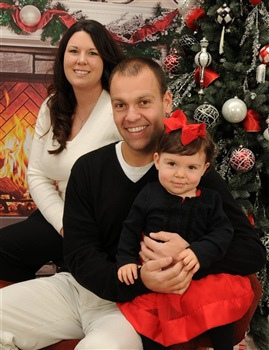
Micha Hobbs with her husband, Staff Sgt. Brandon Hobbs and their daughter Brylee Kate. Micha is the family readiness group leader for her husband’s infantry unit. (Photo courtesy Micha Hobbs)
RAVENNA, Ky. – It takes a special kind of person to take on the task of Family Readiness Group (FRG) leader/volunteer. In addition to balancing their own obligations between family and job, the FRG leader serves as a lifeline between Guard families and unit commanders. These unpaid volunteers are without a doubt key to the operational readiness of our National Guard.
In order to get some insight I asked Micha Hobbs to share her story. Micha is the proud spouse of Staff Sgt. Brandon Hobbs and the mother of one year old Brylee Kate. Micha and Brandon have been together since they were juniors in high school, so she was there when he joined the Kentucky National Guard. Micha currently works full-time as a speech language pathologist at Estill Springs Elementary in Irvine, Ky. She also works as a nurse for Reliant Health in Skilled Nursing Facilities, and she is still able to volunteer her to time to assist the families of Company C, 1st Battalion 149th Infantry in Ravenna.
How did you become interested in volunteering for the FRG? In 2006 my husband was preparing for his first deployment to Iraq and he encouraged me to attend an FRG meeting and get to know other family members from his unit. I attended a meeting and enjoyed it. I was asked to become a volunteer and so I served as secretary until 2008.
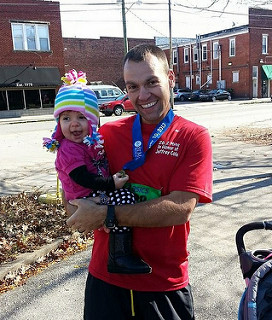
Staff Sgt. Brandon Hobbs and his daughter, Brylee Kate. (Photo courtesy Micha Hobbs)
In 2010 my husband asked me to start our FRG up again. I had reservations about it because I knew with the leadership role came a lot of duties and expectations. After thinking on it for a few days I decided to take it and I’ve been here ever since.
Why is working with the family readiness group important to you? If a soldier can make as many sacrifices for me and my freedoms, the least I can do is support them and help make things easier for them on the home front! I have been on two different ends of the FRG, both receiving and supporting.
I know while my husband was deployed the FRG was my saving grace. I had a group of people that I could always count on to make me feel better if I was down, answer my questions or just relate to when I needed to talk. We had outings, meetings, celebrated holidays together and much more. It was such a rewarding and helpful experience and it helped keep my husband’s mind at ease as well. He felt that he did not need to worry about me as much because he knew I had a support system at home.
Now, as a leader, I am responsible for putting out information, helping others network and making sure families are aware of all of the resources available to them.
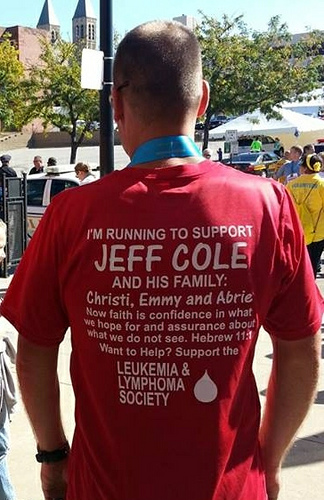
Staff Sgt. Brandon Hobbs during a marathon supporting his former commander, Lt. Col. Jeff Cole, who has a rare form of leukemia. Being part of the Kentucky National Guard is, for many, like being part of an extended family. (Photo courtesy Micha Hobbs)
What do you feel are some of the benefits of the FRG for the families and soldiers? During the last deployment I was the FRG Leader. I definitely felt the pressure as I received at least a phone call or email everyday with a concerned spouse, mother, father, relative, friend, etc. I knew that it was my responsibility to keep the families informed with accurate and up to date information and help them in every way that I could.
I had a great relationship with the company commander at the time and he did a great job of keeping me informed from abroad. I also made sure that I kept families up to date on all the resources and information available to them during deployment. It was a stressful and busy time, but we all made it through. Whether it’s pre-, during or post-deployment, the FRG is a great way to get to know families in the unit, obtain loads of information about a variety of topics, and have that support system everyone needs in the military.
Story by David Altom, Kentucky National Guard Public Affairs
November is Military Family Appreciation Month, a celebration of the Military Family in which the Department of Defense and the nation honors the commitment and sacrifices made by the families of the nation’s service members. We offer the following to raise awareness on matters of importance among Kentucky’s unsung heroes.
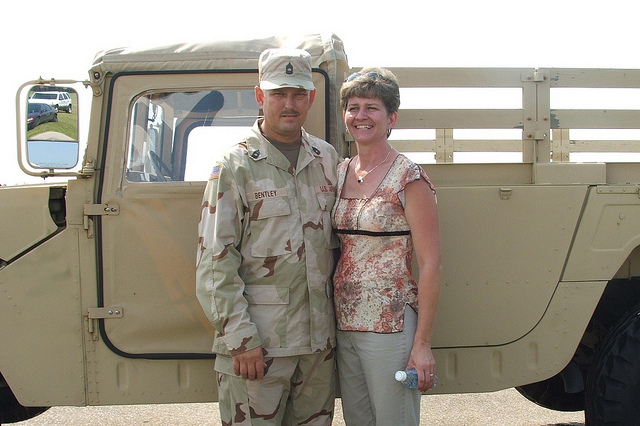
Donna and Jack Bentley during his 2005 deployment. Donna has been involved in Family Programs since 1995. (Photo courtesy Donna Bentley)
FRANKFORT, Ky. — You often hear us say that “the troops can’t do their job without the support of their families” and “families are the unsung heroes of the military community.” But what does that exactly mean? Why are families so important? What resources are available to them?
Family Readiness Support Assistants (FRSA)
On the frontlines of family support are the Family Readiness Support Assistants. Their mission is to empower commanders in their duty to deliver the Total Army Family Program in order that Soldiers and families are informed, educated, assisted, and ready for the unique demands of military life before, during, and after deployment.
Donna Bentley is the Kentucky Guard’s Senior Family Readiness Support Assistant. The wife of a retired Kentucky National Guardsman, she works with six other FRSA specialists who represent Kentucky’s major commands, also known as MACOMs.
“I support the State Family Program Director in volunteer program management and training coordination which enhances the overall services provided by volunteers to Army and Air National Guard MACOMS and Service Member families,” said Bentley. “We are the commanders’ advisors on their family readiness program. We contribute to the unit’s combat readiness by promoting efficient and effective communication between the command, the state family programs office, the FRGs and all family members.”
The core function of the FRSA is to work with FRGs, military contacts, rear detachments (during deployment), and volunteers to provide training and hands-on assistance. This training from the FRSA establishes and maintains an effective family readiness system within units and commands.
The FRSA is vital in coordinating volunteer efforts at the state level and serve as an arm of the State Family Program Office. Continuing communication and empowering training is provided to Soldiers and their families due to dedicated efforts of FRSA’s.
Click here for more information about the Kentucky National Guard’s Family Programs.
“Last year we got one hundred percent of our FRGs charted and functional in Army and Air Guard units,” Bentley said. “That included training more than 200 volunteers plus unit commanders and first sergeants.”
Among other things the training included suicide prevention and family operational security (OPSEC), which was provided by the J2 state security office.
Bentley knows what it’s like to be on both the giving and the receiving ends of family support. The wife of a retired war veteran, she’s been involved with family programs since 1995 as an FRG Leader. She’s also got son who’s an Air Force C-130 pilot.
“My husband was deployed in 2005-2006 for fifteen months. It was hard as our youngest son was a high school senior who was trying to make decisions for his future military career. It was even harder on my service member as he missed out on most of the events of our son’s senior year. It did make us closer as a family. We definitely do not take for granted the things we do for each other.”
C-130 command pilot has deployed for numerous overseas missions
By Maj. Dale Greer, 123rd Airlift Wing Public Affairs
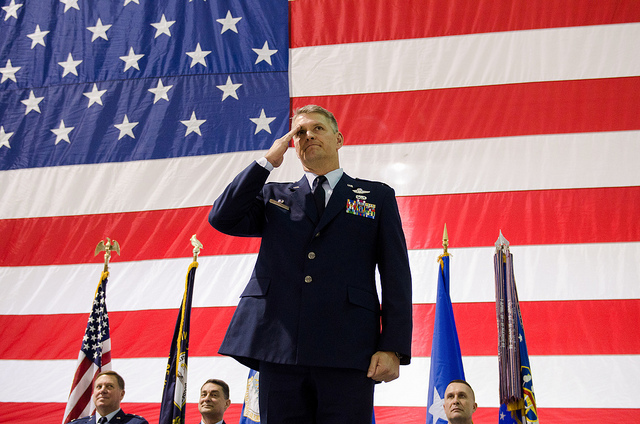
Col. Barry Gorter receives his first salute as commander of the 123rd Airlift Wing during a change-of-command ceremony held in the Fuel Cell Hangar at the Kentucky Air National Guard base in Louisville, Ky., Nov. 24, 2013. (U.S. Air National Guard photo by Airman 1st Class Joshua Horton)
KENTUCKY AIR NATIONAL GUARD BASE, LOUISVILLE, Ky. — Col. Barry Gorter assumed command of the 123rd Airlift Wing during a ceremony here Nov. 24, thanking the unit’s members for their past dedication and pledging his commitment to future readiness.
“This is our time,” Gorter told the nearly 900 Airmen who gathered in the Fuel Cell Hangar to witness the change of command. “Whether you’ve been in the military four days or 40 years, this is our time — your chance and my chance to serve our country.
“And ours is an interesting time. The war in Iraq is over. Afghanistan is quickly winding down. But there are concerns — concerns like instability in the Middle East and emerging threats in the Pacific region. But if the call comes tomorrow to go overseas and engage in conflict, we’re ready. We are experienced and battle-tested, and we continue to train with vigor.
“Being selected to sit in the corner office during this period of our time is humbling. Members of the Kentucky Air National Guard: You are so talented, and I’m privileged to be your commander.”
Gorter, the wing’s 23rd commander, replaces Col Warren Hurst, who has been named Kentucky’s assistant adjutant general for Air.
The symbolic high point of the ceremony came when Hurst passed the wing guidon to Maj. Gen. Edward Tonini, adjutant general of the Commonwealth of Kentucky, who then passed it on to Gorter, formally marking the transfer of responsibility.
Tonini called Gorter “the right man for the job” based on his past performance as deputy commander of the 123rd Maintenance Group, commander of the 123rd Operations Group and vice commander of the 123rd Airlift Wing.
“You’ve had great success in previous deployments, to include Operation Restore Hope, Provide Promise, Volant Oak, Coronet Oak, Iraqi Freedom and Enduring Freedom,” Tonini said. “Your leadership and experience set you up to take command of these Airmen, and I know you will serve them well.”
Tonini also used the occasion to praise Hurst for his “tremendous accomplishments” as wing commander over the past 14 months. That brief period was marked by multiple overseas deployments and the unit’s first Consolidated Unit Inspection, which compressed five high-headquarters evaluations into just eight days, resulting in multiple “excellent” grades.
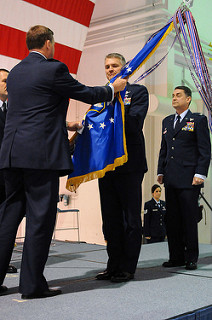
Col. Barry Gorter (center), incoming commander of the 123rd Airlift Wing, accepts the unit guidon from Maj. Gen. Edward Tonini, Kentucky’s adjutant general, during a change-of-command ceremony at the Kentucky Air National Guard Base in Louisville, Ky., Nov. 24, 2013, as Col. Warren Hurst (right), the outgoing wing commander, observes. Hurst has been named Kentucky’s assistant adjutant general for Air. (U.S. Air National Guard photo by Staff Sgt. Vicky Spesard)
“For more than four decades, I’ve watched this organization grow from a modest air reconnaissance mission to an airlift force that is recognized all over the world,” Tonini said.
“The emphasis to excel has to come from the top down. The pace has to be set by someone. And at this wing, that pace is set by the commander. Colonel Hurst, I want to recognize you for the job you’ve done over the last 14 months. You’ve taken this air wing to new levels and carried it effortlessly.
“I look forward to your future role in the Kentucky National Guard Joint Forces Headquarters. You will continue to take our organization to greater heights.”
Hurst likened his term as wing to commander to “an incredibly fast ride” and said the unit’s performance during the Consolidated Unit Inspection was “nothing short of remarkable.”
“I am very proud and extremely pleased with your professionalism and dedication, especially through a very challenging year marked with sequestration, furloughs, inspections, DV visits, multiple deployments — and cap that off with a government shutdown,” Hurst said.
“Thank you for pressing forward through all the obstacles and knowing what needed to be done to maintain our ability to provide a combat-ready force.
“I am honored and blessed to have led the best tactical airlift wing in the United States Air Force.”
Prior to Gorter’s selection, 19 men have led the 123rd. Three of those commanders served two different tenures, however, making Gorter’s appointment the 23rd in wing history.
Gorter is a C-130 command pilot with more than 3,000 hours in various aircraft. He joined the Kentucky Air National Guard in 1991 after completing undergraduate pilot training at Laughlin Air Force Base, Texas.
The next 10 years were spent supporting numerous exercises, inspections and contingency operations as a traditional Guardsman while also serving in the civilian sector as a pilot for American Airlines.
In 2002, Gorter became the officer-in-charge of the Kentucky Air Guard Quality Assurance program. He transitioned as the commander of the 123rd Aircraft Maintenance Squadron in 2006, and in 2008 became deputy commander of the 123rd Maintenance Group.
Gorter was selected to backfill for the maintenance deputy commander at the 86th Airlift Wing, Ramstein Air Base, Germany, for nine months prior to attending Air War College in residence.
Upon graduation from Air War College in 2010, he was named to serve as commander of the 123rd Operations Group here, a post he held until June 2013 when he was named vice commander of the 123rd Airlift Wing.
Gorter recently deployed as the U.S. Central Command deputy director of mobility forces at Al Udeid Air Base, Qatar. Upon his return, he was selected as the director of mobility forces to the commander of Air Forces Northern.
Staff report
November is Military Family Appreciation Month, a celebration of the Military Family in which the Department of Defense and the nation honors the commitment and sacrifices made by the families of the nation’s service members. We offer the following to raise awareness on matters of importance among Kentucky’s unsung heroes.
FRANKFORT, Ky. – Money is often cited as the number one problem when it comes to preserving domestic tranquility. Money builds us up and it brings us down. Some think it is the key to happiness; the mismanagement of it is most certainly key to our misery.

Not everybody has a Santa to bail them out during the holiday spending season. Good money management can be the greatest gift your family can receive. (Kentucky National Guard file photo)
In the military community money is a huge factor when it comes to wartime deployment. Adding to those hardships are complications arising from pay issues, particularly during the recent sequestration and federal shutdown.
That’s the bad news. The good news is that the Kentucky National Guard recognizes these challenges. Regina Harris is an accredited finance counselor on staff with the Family Programs as a personal finance counselor. Let’s see what she has to say about money and what to do about it.
So what exactly is your job?
My official mission is to assist service members with any personal financial issue that arises in their or their families lives. I strive to let them know that my services are free, anonymous and confidential.
Is this strictly a National Guard program?
While I work with National Guard Family Programs, I’m available to help any military service member, active duty and reserve force. We support Kentucky’s entire military community.
What are some of the financial challenges military families face?
Couples don’t always see eye to eye on finances. It helps to have a neutral person assist or guide them to making sound financial decisions; establishing that neither person is right or wrong. We can always realize outlandish financial decisions without any other input.
It’s not just married couples, either. Single service members often need someone to talk with about financial accountability. I can do that for them. Service members sometimes want guidance on budgeting, buying a car, buying auto or life insurance, buying a house, getting into an apartment, child support, preparing for a Furlough or answering a Security Clearance inquiry. Also, relieving debts, saving for emergencies and retirement are worthy topics.
Does a military service member have to be in trouble to use your services?
No, you do not have to be in financial distress. A personal finance counselor may be the only phone number you have to connect you to other resources; we gladly connect. Even when things are going fantastically well financially we can be a sounding board to help you plug any possible financial oversights or to agree with your plan.
Do you ever visit units on site?
Yes, I’m happy to provide financial briefs at the unit level. I regularly attend Yellow Ribbon ceremonies and I’m available for other events as well.
It’s my pleasure to help service members feel good and in control of their money. It’s my passion to serve, it’s what I do and it’s why the DOD has provided these person financial counselor services for you.
If you need help with your finances or just have general questions contact Regina Harris at 502-548-4836 or rharris@mflc.zeiders.com
Story by Staff Sgt. Scott Raymond, Kentucky National Guard Public Affairs
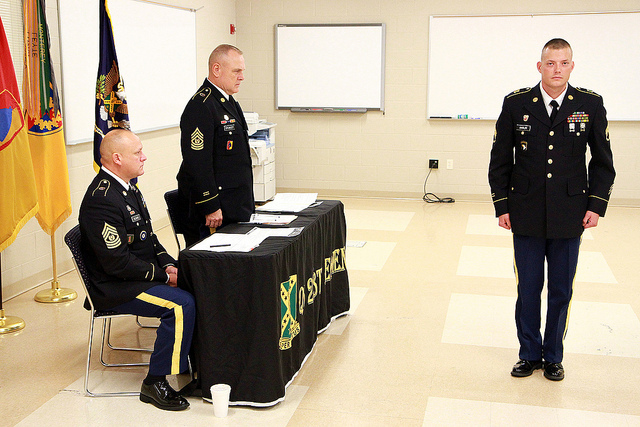
Staff Sgt. Nicholas Anglin with the 201st Engineer Battalion appears before the board during the 2014 Kentucky National Guard Soldier of the Year competition in Greenville, Ky., Nov. 17, 2013. In addition to the board, Anglin and 13 fellow Guardsmen competed in such events as weapons qualification and land navigation over the three-day weekend. (U.S. Army National Guard photo by Staff Sgt. Scott Raymond)
GREENVILLE, Ky. — Many basic Soldier skills are not always your everyday tasks; fieldstripping an M-16, searching a detainee, details of drill and ceremony. This knowledge is part of what should be in every Soldier’s toolbox and to a select few each year, these tasks become a competition. All combined, the proficiency of such tasks, along with marksmanship and physical fitness, push some to become the best of the best.
On the track, at the range and in the fields of the Wendell H. Ford Regional Training Center, 14 Kentucky National Guardsmen put their skills to the test in the 2014 Soldier of the Year competition, Nov. 15-17.
To see more photos from the event, click here.
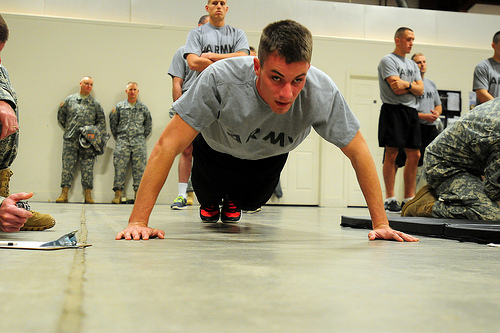
Spc. Benjamin Joynt prepares to begin his push-ups during an Army Physical Fitness Test as part of the 2014 Kentucky National Guard Soldier of the Year competition in Greenville, Ky., Nov. 16, 2013. The APFT began an event-filled day for the competitors that took them from the gym to the range to the fields to the classrooms of the Wendell H. Ford Regional Training Center. (U.S. Army National Guard photo by Staff Sgt. Scott Raymond)
“Getting back to the basics of soldiering, that’s what the Soldier of the Year Competition is all about,” said State Command Sgt. Maj. Thomas Chumley Jr., who oversaw his first competition as the State Command Sergeant Major.
“I wanted to challenge them, I wanted to challenge them mentally, physically and spiritually. When they leave here, I wanted them to feel like they’ve earned something,” he added.
From the moment competitors arrived, the pressure was on. Soldiers, NCOs and Senior NCOs alike were forced to rely on their training and experience as the weekend tested their abilities as an American Soldier.
The Guardsmen first sat down for the written tests and essay questions to start the weekend out quietly on Friday evening. But before the sun rose on Saturday, the quiet was gone as each Soldier completed the Army Physical Fitness Test, then were off to the range for individual weapon qualifications. When the last round was fired, they traded their rifles for compasses and maps and negotiated the Muhlenburg County terrain in a challenging land navigation exercise.
While in the field, a variety of Army Warrior Tasks awaited each Soldier to test other skills.
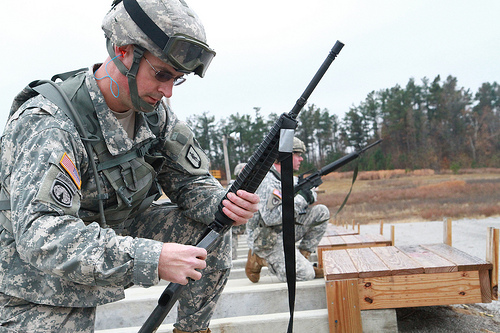
Sgt. 1st Class Joseph Gray with the 238th Regiment loads a magazine into his M-16 during the 2014 Kentucky National Guard Soldier of the Year competition in Greenville, Ky., Nov. 16, 2013. (U.S. Army National Guard photo by Staff Sgt. Scott Raymond)
“The weekend was jammed packed for sure,” said Owenton, Ky., native, Staff Sgt. Nicholas Anglin with the 201st Engineer Battalion who was named NCO of the Year for the competition.
Spc. Christopher DeLeon with the 2123rd Transportation Company from Richmond, Ky., was the runner-up in 2012. After a year of working hard, studying and increasing his PT, DeLeon returned to capture the Soldier of the Year title this year.
“I feel accomplished, like I didn’t let anyone down,” he said. “I made them proud and I’m proud of myself. This feels great, it’s an awesome feeling.”
“I will take everything I have learned from Soldier of the Year and apply it to my 2123rd Soldiers and maybe be a sponsor for another Soldier to come here next year and train him to keep the reign of the 2123rd,” he added.
Chumley said he has been involved with similar competitions at various levels in his career and that the Soldiers inspire him each time. This year’s Soldier of the Year competition was just another reason why he loves doing his job.
“This weekend has been outstanding,” said Chumley. “The Soldiers here inspire me with their life stories and how the Kentucky National Guard has set them up with a good foundation and solid leadership skills. I’m just amazed every time we have one of these.”
2014 Soldier of the Year winners:
Soldier of the Year – Spc. Christopher DeLeon, 2123rd Transportation Co. from Richmond, Ky.
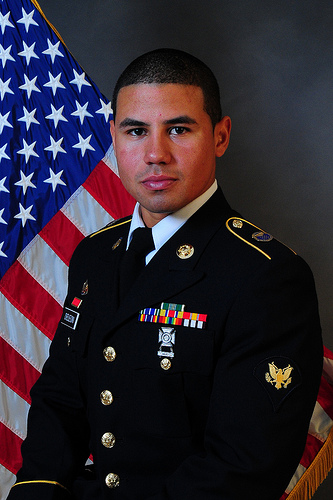
NCO of the Year – Staff Sgt. Nicholas Anglin, HSC 201st Engineers from Owenton, Ky.
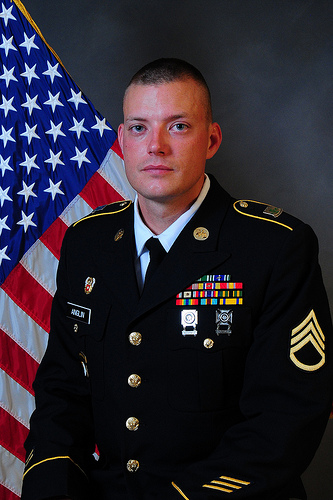
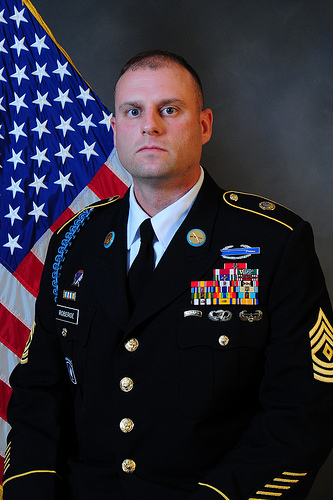
Senior NCO of the Year – 1st Sgt. Matthew Roberge, 1/149th Infantry from Nicholasville, Ky.
Story by Maj. Randy Stillinger, 36th Combat Aviation Brigade Public Affairs
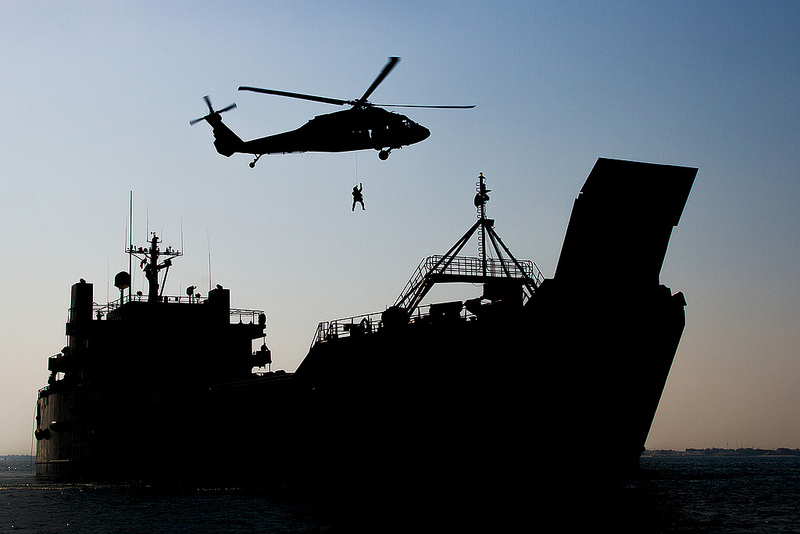
UH-60 “Black Hawk” helicopters from C Company, 2nd Battalion, 238th General Support Aviation Battalion conducts hoist training off the coast of Kuwait in the Arabian Gulf. The specialized training prepares medevac crews to extract downed aviators while at sea. The 2-238th includes Soldiers from both the Indiana and Kentucky Army National Guard and is currently deployed to the Middle East with the 36th Combat Aviation Brigade (Texas Army National Guard) in support of Operation Enduring Freedom. (U.S. Army photo by Sgt. Mark Scovell/Released)
CAMP BUEHRING, Kuwait – As winter weather appears on the horizon in the United States, the blowing sand of the Kuwaiti desert continues to challenge its Army Aviators.
To see all the photos from this unit’s deployment, please click HERE.
Since their arrival in Kuwait, Charlie Company, 2-238th General Support Aviation Battalion has endured harsh conditions that few Americans will ever experience.
These Army National Guard soldiers from Indiana and Kentucky, and their UH-60 Black Hawk helicopters, are deployed with the 36th Combat Aviation Brigade (CAB) to the Middle East in support of Operation Enduring Freedom. Their mission is to provide Medical Evacuation (MEDEVAC) capabilities to the region and build partnerships with countries that will further long-term stability in and around the Arabian Gulf.
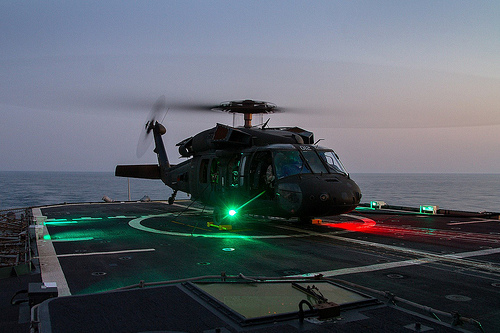
A UH-60 “Black Hawk” helicopter from C Company, 2nd Battalion, 238th General Support Aviation Battalion conducts shipboard operations off the coast of Kuwait in the Arabian Gulf. The specialized training prepares medevac crews to extract downed aviators while at sea. The 2-238th includes Soldiers from both the Indiana and Kentucky Army National Guard and is currently deployed to the Middle East with the 36th Combat Aviation Brigade (Texas Army National Guard) in support of Operation Enduring Freedom. (U.S. Army photo by Sgt. Mark Scovell/Released)
For the deployment Charlie Company was actually split into two “phases” with both groups serving nine-month tours, one after another. The company swapped out in September.
Charlie Company actually has a front row seat for what may be the future of Army Aviation operations in the post-Iraq/Afghanistan era as they venture out over the water. Once used as a stepping stone for units headed north into Iraq, Camp Buehring is their home base for operations and training missions across the region.
A significant key to regional security is the free flow of maritime traffic in the Arabian Gulf. Of particular importance is the Strait of Hormuz between the United Arab Emirates and Iran, which is crucial to the export of oil to the world market.
Working over the water and embarking on ships is a new skill for most Army Aviators, but these soldiers have risen to the challenge. Maritime missions for Black Hawk helicopters include Combat Search and Rescue (CSAR), Medical Evacuation, the transfer of personnel and logistics support to U.S. ships in the area. These overwater missions require Army Aviators to add challenging tasks and extensive knowledge to an already long list of training requirements.
Maj. Bryon Blohm, who commanded Phase 1, said, “The personnel recovery mission executed by MEDEVAC is a unique opportunity to leverage existing assets in this theater to meet today’s joint operational environment.”Although utilizing the helicopter’s ability to hoist patients from the ground into the aircraft is common for these aviators, a recent training event challenged even the most experienced MEDEVAC pilots. The training included flying out into the Persian Gulf off the coast of Kuwait to a U.S. Army cargo transport ship.
A Flight Medic was then lowered from the hovering helicopter onto the cargo deck of U.S. Army Vessel (USAV) SP/4 James A. Loux (LSV-6). A simulated “patient” was then loaded into a rescue basket and then hoisted into the waiting aircraft for the flight back to a hospital on land.
Overwater hoisting mission is normally carried out by Coast Guard or Naval aviators so this type of training for the Army is somewhat uncommon. Capt. Scott Oden, the Company Commander for Phase 2, said that to his knowledge this has never been done before by Army soldiers from Kentucky or Indiana.
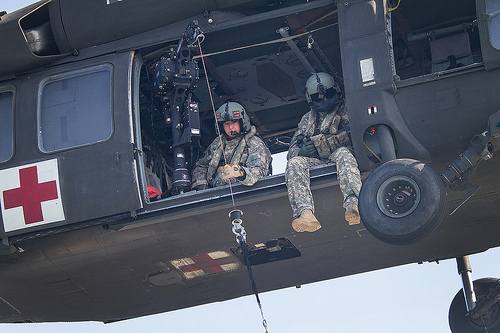
Staff Sgt. Jacob White and other crew members from Det. 1 C Company, 2nd Battalion, 238th General Support Aviation Battalion conducts hoist training in a UH-60 “Blackhawk” helicopter off the coast of Kuwait in the Arabian Gulf. The specialized training prepares medevac crews to extract downed aviators while at sea. The 2-238th includes Soldiers from both the Indiana and Kentucky Army National Guard and is currently deployed to the Middle East with the 36th Combat Aviation Brigade (Texas Army National Guard) in support of Operation Enduring Freedom. (U.S. Army photo by Sgt. Mark Scovell/Released)
Oden, of Indianapolis, said, “We’re here to develop the training, the Tactics, Techniques, and Procedures (TTP) so we can go back and continue to train our crew members to be able to respond in a moment’s notice from anywhere in Kuwait.”
The soldiers are also working with the Kuwaiti Air Force and other multi-national partners in the region to strengthen their ties, execute joint training events, and learn best practices from each other to provide long-term stability.
The 1-189th General Support Aviation Battalion from Montana serves as the company’s higher headquarters for this deployment. Lt. Col. Jamie Wilkins, who serves as the battalion’s commander, said that he’s very proud of everything that the MEDEVAC company has done since they’ve arrived and is impressed with their initiative to take on new and challenging training.
Oden also appreciates all the support that they’ve received from home since they left.
“We know that you have a very difficult job maintaining the home front as well as sacrificing your time,” Oden said. “It does not go unnoticed. We’re very appreciative of it and we’re looking forward to seeing you.”
The second half of the company will return home to their respective bases in Shelbyville, Ind., and Frankfort, Ky., in the spring of 2014.
By Staff Sgt. Scott Raymond, Kentucky National Guard Public Affairs
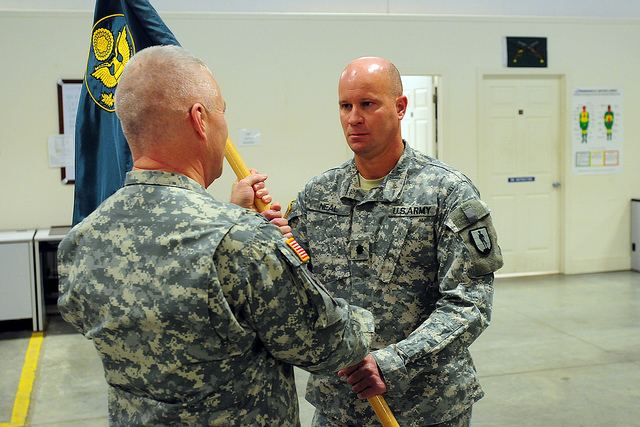
Lt Col. Todd Neal receives the battalion guidon from Col. Hal Lamberton during a change of command ceremony at the Wendell H. Ford Regional Training Center in Greenville, Ky., Nov. 15, 2013. Neal assumed command of the 2nd Modular Training Battalion of the 238th Regiment. (U.S. Army National Guard photo by Staff Sgt. Scott Raymond)
GREENVILLE, Ky. — Lt. Col. Todd Neal assumed command of the 2nd Modular Training Battalion, 238th Regiment during a change of command ceremony at the Wendell H. Ford Regional Training Center in Greenville, Ky., Nov. 15, 2013.
Lt. Col. David Roche relinquished command, a position he has held for the past two years. Col. Hal Lamberton, the regimental commander said Roche was a pivotal part of the 238th Regional Training Institute being named an Institution of Excellence for 2012. Lamberton also awarded Roche the Meritorious Service Medal for his leadership of the 2/238th.
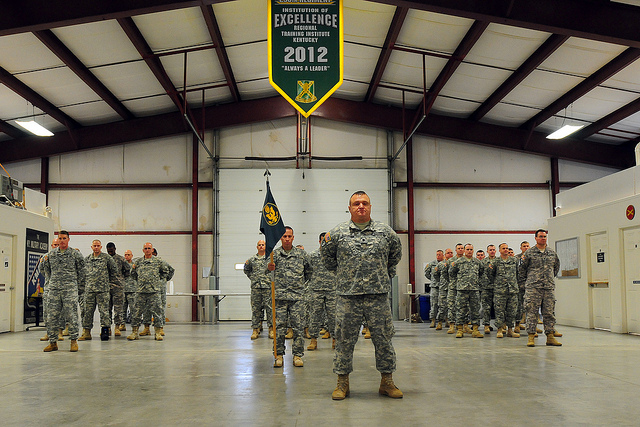
Soldiers of the 238th Regiment stand in formation during a change of command ceremony at the Wendell H. Ford Regional training Center in Greenville, Ky., Nov. 15, 2013. The regiment is is made up of the 1st Field Artillery Battalion, the 2nd Modular Training Battalion and the Regimental Headquarters. (U.S. Army National Guard photo by Staff Sgt. Scott Raymond)
Neal comes to the unit from the 149th Maneuver Enhancement Brigade where he spent several years in the brigade’s plans and operations section. Neal said taking command of a battalion should be on every officer’s list of goals in their careers. He thanked several Soldiers and mentors who have helped him along the way to this highlight of his time in uniform.
“As a young officer, there are two or three things you look to do. You want to be a successful platoon leader and get a company command, but most guys look at the pinnacle of their careers being a brigade or battalion commander,” said Neal. ” This is a step I fortunately been able to take and I look forward to the challenge and doing a good job for the organization and the leadership and improve on what is already in place.”
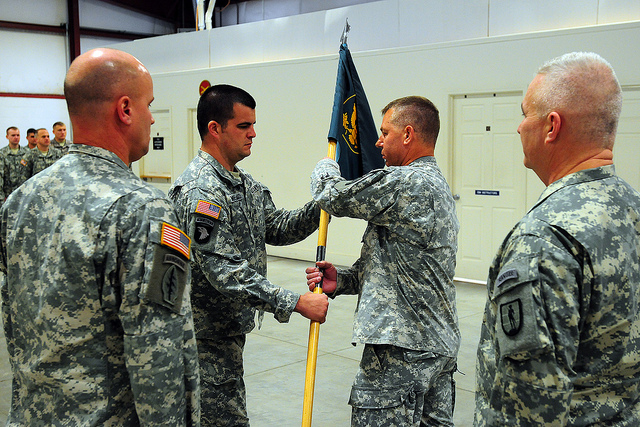
Lt. Col. Daivd Roche receives the battalion guidon from Master Sgt. Benzie Timberlake during a change of command ceremony at the Wendell H. Ford Regional Training Center in Greenville, Ky., Nov. 15, 2013. Roche relinquished command of the 2nd Modular Training Battalion to Lt. Col. Todd Neal (left). (U.S. Army National Guard photo by Staff Sgt. Scott Raymond)
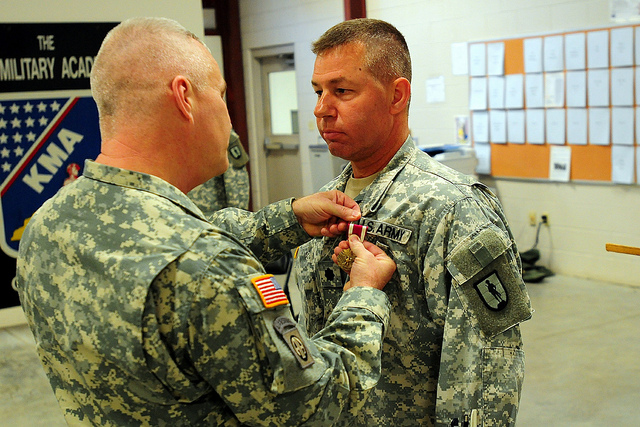
Col. Hal Lamberton, commander of the 238th Regiment pins the Meritorious Service Medal to the uniform of Lt. Col. David Roche following a change of command ceremony in Greenville, Ky. Lamberton cited Roche as a key figure in the 238th receiving the distinction of becoming an institution of excellence in 2012. (U.S. Army National Guard photo by Staff Sgt. Scott Raymond)
By 123rd Airlift Wing Public Affairs
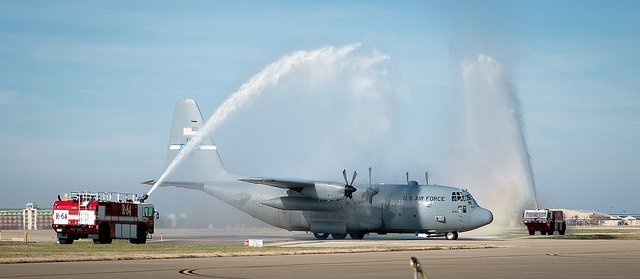
Fire trucks spray a symbolic salute at the Kentucky Air National Guard Base in Louisville, Ky., as a C-130 Hercules aircraft piloted by Lt. Col. Scott Wilson taxies to its parking spot Nov. 20, 2013. Wilson, who is set to retire Jan 31, 2014, was completing his final, or “fini,” flight in the C-130. (U.S. Air National Guard photo by Maj. Dale Greer)
KENTUCKY AIR NATIONAL GUARD BASE, LOUISVILLE, Ky. — Lt. Col. Scott Wilson, a C-130 pilot in the Kentucky Air National Guard’s 123rd Airlift Wing, completed his final, or “fini,” flight in the Hercules transport aircraft here Nov. 20.
Wilson, who has served in the U.S. Air Force and Air National Guard for 26 years, is set to retire Jan 31, 2014.
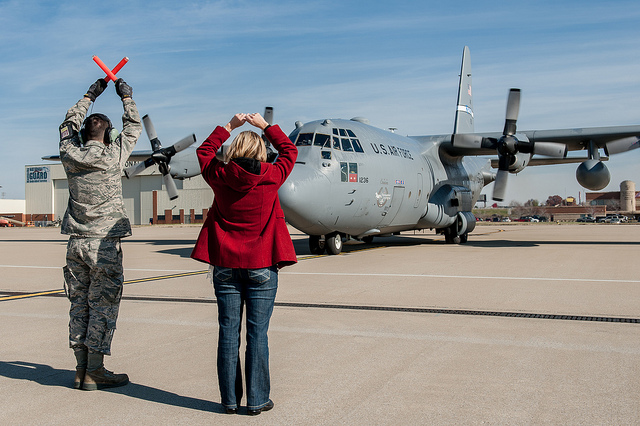
Lt. Col. Scott Wilson, a C-130 pilot in the Kentucky Air National Guard’s 123rd Airlift Wing, completes his final, or “fini,” flight in the Hercules transport aircraft Nov. 20, 2013, at the Kentucky Air National Guard Base in Louisville, Ky., as his wife, Heather, marshals the plane to a stop. Wilson, who has served in the U.S. Air Force and Air National Guard for 26 years, is set to retire Jan 31, 2014. (U.S. Air National Guard photo by Maj. Dale Greer)
The pilot’s wife and colleagues marked the occasion by dousing Wilson with water and champagne as he exited the aircraft.
Fini flight celebrations are a long tradition in the U.S. Air Force and Air National Guard. Their origins can be traced back at least as far as the Vietnam War, when Airmen would hose down a pilot each time he completed 100 combat missions.
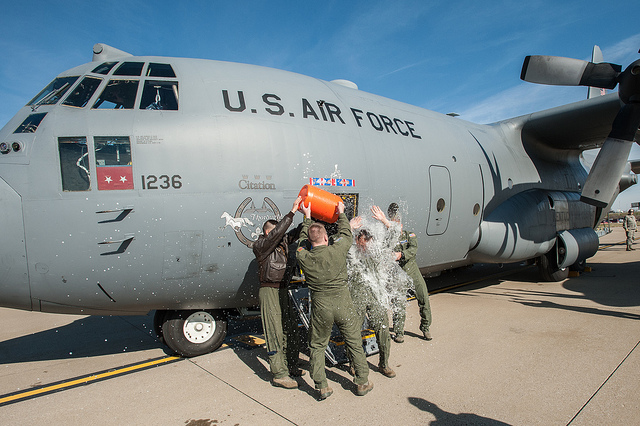
Members of the 123rd Airlift Wing douse Lt. Col. Scott Wilson, a Kentucky Air National Guard C-130 pilot, with water as he exits the aircraft for the last time at the Kentucky Air National Guard Base in Louisville, Ky., on Nov. 20, 2013. Wilson, who is set to retire Jan. 31, 2014, was completing his final, or “fini,” flight. (U.S. Air National Guard photo by Maj. Dale Greer)
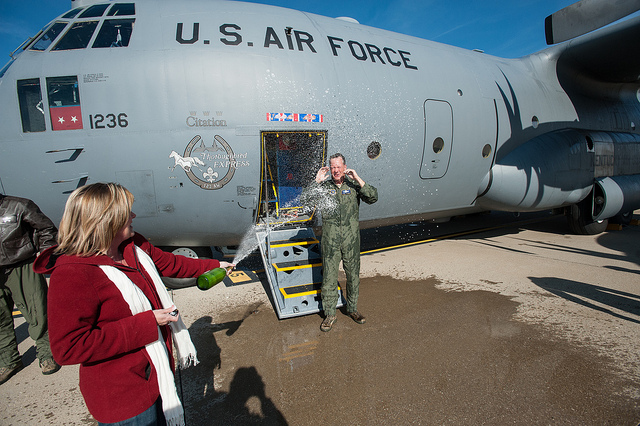
Heather Wilson, wife of Kentucky Air National Guard C-130 pilot Lt. Col. Scott Wilson, spays her husband with champagne at the conclusion of his final, or “fini,” flight in the Hercules aircraft at the Kentucky Air National Guard Base in Louisville, Ky., on Nov. 20, 2013. Wilson, who has served in the U.S. Air Force and Air National Guard for 26 years, is set to retire Jan 31, 2014. (U.S. Air National Guard photo by Maj. Dale Greer)
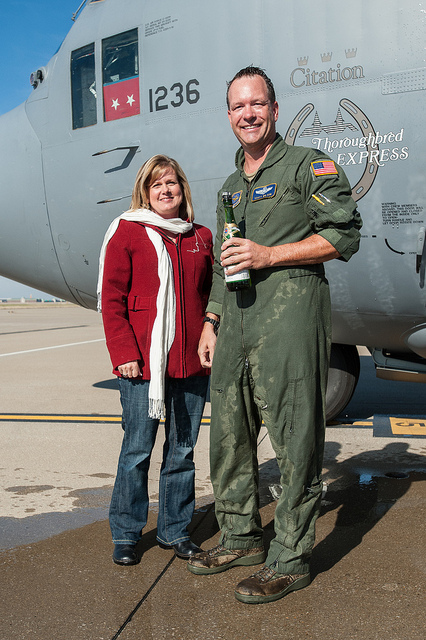
Lt. Col. Scott Wilson, a C-130 pilot in the 123rd Airlift Wing, and his wife, Heather, stand by the crew door a Hercules aircraft at the Kentucky Air National Guard Base in Louisville, Ky., after he was doused with water and champagne by his colleges upon completion of his final, or “fini,” flight Nov. 20, 2013. Wilson, who has served in the U.S. Air Force and Air National Guard for 26 years, is set to retire Jan 31, 2014. (U.S. Air National Guard photo by Maj. Dale Greer)
Staff report
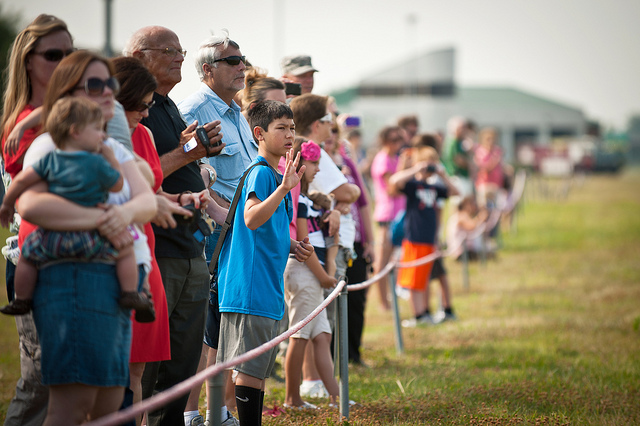
Families are the unsung heroes of the US armed forces. They often suffered similar stress and loneliness as their deployed loved ones. It’s the job of the Family Assistance Center and Family Programs to provide support and guidance during both wartime and peacetime service. (U.S. Air Force photo by Maj. Dale Greer)
FRANKFORT, Ky. — Each year the President signs a proclamation declaring November Military Family Month. Last year President Obama said that our nation owes “each day of security and freedom that we enjoy to the members of our Armed Forces and their families. Behind our brave service men and women, there are family members and loved ones who share in their sacrifice and provide unending support.”
This annual proclamation marks the beginning of a month-long celebration of the Military Family in which the Department of Defense and the nation will honor the commitment and sacrifices made by the families of the nation’s servicemembers.
Throughout the month of November, military families serving around the world are honored through a variety of observances and recognized for their commitment and the many contributions they make every day in support of the military and our nation. Efforts to recognize the sacrifices of the military family by Active, Guard, and Reserve leaders are being joined and supported by DoD organizations to include the Army Air Force Exchange Service, Defense Commissary Agency, and others.
Community leaders, businesses, and military bases and posts are teaming up to recognize military families through special events such as: open houses, fun runs, family fun nights, and community dinners; discounts at MWR facilities, local business and sporting events; and special recognitions during community activities throughout the month of November.
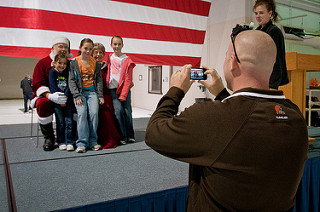
A military family enjoying “Christmas in October” last year at the Kentucky Air Guard Base in Louisville, Ky. (U.S. Air Force photo by Senior Airman Maxwell Rechel)
Family Support Program & the Family Assistance Center
Key to our state’s military community is the Kentucky National Guard’s Family Support Programs and the Family Assistance Center. This includes a State Youth Coordinator, Family Readiness Support Assistants, Family Assistance Center, Military Life Consultant, Personal Financial Counselor, Military One Source, Transition Assistance Advisor, Yellow Ribbon Reintegration Program, Survivor Outreach Services, and Community Outreach.
Joan Kivior serves as the Family Assistance Center Program Coordinator. A veteran of the Persian Gulf War and the war in Afghanistan, she knows the importance of families in the military community.
“For us military families are number one,” said Kivior. “I can tell you from experience that they are the heart and soul of the our armed forces. Without the support of our families the troops can’t do their job. It’s our job in the FAC to take care of the families so our soldiers and airmen can do theirs.”
According to Kivior last year the FAC provided assistance to both Army and Air Guard members and families experiencing personal and/or financial difficulties. Her team contacted 6,844 service members and their families, generating 2,243 cases to external agencies such as the American Legion, the Veterans Administration, USA Cares, the Military Family Trust Fund, Local Community Action Agencies and Church organizations and so on.
“It’s most definitely a team effort,” said Kivior. “We’ve worked hard to develop relationships throughout government and the private sector to help our families. There are very few problems we can’t solve one way or another.”
Kivior reminds us that the FAC provides assistance to family members from all branches of service residing in Kentucky, and not just the National Guard.
“While not everyone lives near an active duty base, we are scattered all across the state. We support all of our military families, active duty, Guard and reserve, Army, Air Force, Navy and Marines. We’ve even helped folks connected with the Coast Guard. We can do it all.”
Click here for contact information on the Kentucky National Guard Family Assistance Center or call 1-800-372-7601.
Staff Report
KUWAIT — Detachment 1, C Company, 2nd Battalion, 238th Aviation Medical Evacuation (MEDEVAC) unit, based out of Frankfort, Ky., is currently deployed to Kuwait providing much needed support to the military in that region, both on and off the coast (stay tuned for upcoming stories on this unit).
Chief Warrant Officer Three Kevin Keith is currently deployed with the MEDEVAC as a UH-60 Blackhawk Maintenance Test Pilot. You can see him below, then a Chief Warrant Officer two, pinning his wife, Misty, with a Freedom Lapel in 2006. Keith had just returned from a deployment as a young pilot to Iraq and was attending the Freedom Salute Ceremony with his family.
You can find stories like these and more in our Bluegrass Guard section of the website. Click HERE to see many of our Bluegrass Guard’s from over the years.
