Pages
Stay In Touch
More
© 2013 KentuckyGuard
Story by Sgt. Sandra Fariss, 206th Engineer Battalion, Unit Public Affairs Historian Representative
Kentucky Guardsmen Spc. Jacob Reckner, Spc. Jacob Stamps and Pvt. Dustin Girtin of the 1123rd Sapper Company, measure boards for flooring during an overseas deployment training mission at Joint Multinational Readiness Center in Hohenfels, Germany, Nov. 1. (Photo by Spc. Stacy Shelton, 1123rd Sapper Company)
NOTE: Each week kentuckyguard.com publishes stories by Kentucky National Guard unit public affairs historian representatives, also known as UPAHRs. This is an additional duty taken on by a Soldier or Airmen with the intent of telling their unit’s story. This is one such story ….
HOHENFELS, Germany — Kentucky Guardsmen of the 1123rd Sapper Company take their engineer skills overseas for their annual training in Hohenfels, Germany, Oct. 22 through Nov. 11.
In southern Germany they took on the tasks of building B-Huts from the ground up, refurbishing existing structures, built concrete block walls and installed electrical wiring before the harsh winter months.
The construction mission they tackled would present a challenge since their expertise is in demo, obstacle emplacement and reduction as well as mobility and counter-mobility operations.
“Once again my Soldiers have proven that if asked, they can build it,” said 1st Sgt. Shane D. Parrott, 1123rdSapper Company. “What Sappers really like is knocking things down, we will wait till the next mission for that.”
Kentucky Guardsmen of the 1123rd Sapper Company assemble a B-Hut during an overseas deployment training mission at Joint Multinational Readiness Center in Hohenfels, Germany, Nov 2. (Photo by Staff Sgt. Ryan Raker, 1123rd Sapper Company)
The mission of the 1123rd Sapper Company was to construct a block perimeter wall to control access to a Short Take Off and Landing (STOL) operational and storage facility. Site preparation began immediately upon arrival, moving and installing over 1900 blocks weighing 45 pounds each at the STOL site.
They also constructed a B-Hut in Combat Outpost Antleburg on the western side of the base and refurbished existing structures at the Enslwang Military Operations Urban Terrain (MOUT) site facility in Hohenfels, Germany.
In less than 2 weeks time, the engineers had constructed a sturdy 20 feet by 30 feet building completely out of several stacks of wood and metal. They had to construct every part of the building from the trusses to the walls to the doors. Even though many Soldiers worked outside their MOS, the soldiers stayed highly motivated by learning a new trade.
Story and photos by Sgt. 1st Class Michael Oliver, Kentucky National Guard Public Affairs Office
Click here to view more photos
Kentucky Guardsman Staff Sgt. Birgit Corriveau, Joint Force Headquarter Secretary General Staff Office administrator, hands off her donation to Staff Sgt. Paul Hunt, Family Program, during the annual Thanksgiving food drive at Boone National Guard Center in Frankfort, Ky. (photo by Sgt. 1st Class Michael Oliver, Kentucky National Guard Public Affairs Office)
FRANKFORT, Ky. — Kentucky National Guard Family Programs hosted their annual Thanksgiving food drive at Boone National Guard Center in Frankfort, Ky., Nov. 17.
As BNGC staff and employees drove into work, they handed off donations at the front gate. Family Programs staff members were able to fill three truckloads of perishable items, weighing more than 2000 pounds. They also collected more than $700.
“This was my first year helping with the coordination of the event and to see us collect more than 2000 pounds of food in three hours for such a small installation, that is a great successful day,” said Staff Sgt. Paul Hunt, State Family Program Operation non-commissioned officer in charge.
Kentucky National Guardsman Staff Sgt. Paul Hunt, Family Program, and Freddie Maggard, National Guard Community Outreach director, drop off Thanksgiving food drive donations to David Montgomery, Open Hands Community Food Pantry director, in Lawrenceburg, Ky.
Four local charities received the donations, including Open Hands Food Pantry, Lawrenceburg, Ky., Coalition of Committed Christians Soup Kitchen, Simon House, and Salvation Army, Frankfort, Ky.
“To have a big donation from the Kentucky National Guard makes a difference when people come in seeing over flowing shelves,” said Katie Howard, Open Hands Food Pantry volunteer.
Click here to view more photos
By Sgt. Scott Raper, 149th Maneuver Enhancement Brigade
Pfc. Aaron Morgan, 940th Military Police Company (photo by Sgt. Scott Raper, 149th Maneuver Enhancement Brigade0
VICTORY BASE COMPLEX, Iraq – Maintaining the security of Victory Base Complex remains a task of U.S. Forces during their final days in Iraq. It is a vital role that the Soldiers of the 149th Maneuver Enhancement Brigade will play right up until the end of the troop withdraw.
The 149th MEB makes up the security forces that occupy guard towers high above the perimeter of the shrinking base. Each tower commands a bird’s eye view of VBC’s boundaries and its surroundings. Members of the 940th Military Police Co. are some of those assigned to this important assignment.
“If anything should happen, we see it first. I feel like I am making things safer for everyone else,” said Pfc. Aaron Morgan, an M.P. from Erlanger, Ky.
The job may not sound like one for the Military Police, but Morgan simply said “M.P.’s are multi-purpose, we will do whatever we’re told.”
Base defense has demanded a lot from the 940th during their time overseas. Soldiers of the unit were asked to take on various tasks around VBC; as tower guards, they are contributing to internal security and as part of quick reaction forces. Morgan credits their M.P. training and a positive attitude to keep up with the challenges.
“We’ve done a lot of missions. From patrolling the city, high towers, providing security all around…it’s like we are tasked with something new every day,” he said. “We just adapt. We fall back on our training. And we realize all the different kinds of training we go through has all paid off.”
The impact of their assignments has proven to be far from simple. However, the versatile Guardsmen do their best to overcome. That includes their time they spend away from the many stations they man.
“The jobs we have here are hard work, but the time flies by and we make the best of our down time.”
Time is truly moving by as the M.P.’s see the convoys headed out of the gates in a southbound direction. Everyday VBC gets smaller with more equipment and troops leaving on their way out of Iraq. Soldiers of the 940th said they are proud to be a part of the end of the war. They recognize the significance of the role the Kentucky National Guard is playing in the final chapter of Operation New Dawn.
“I think it’s really cool being one of the last units out of Iraq. It will be a story we will be telling for awhile,” said Morgan.
By Maj. Dale Greer, 123rd Airlift Wing Public Affairs
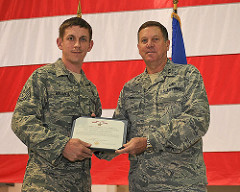
Kentucky’s adjutant general, Maj. Gen. Edward W. Tonini (right), presents Tech. Sgt. Matthew D. Basanta of the 123rd Civil Engineer Squadron with a Bronze Star Medal during a ceremony held Nov. 20, 2011, at the Kentucky Air National Guard Base in Louisville, Ky. Basanta earned the combat decoration for his exceptionally meritorious service while deployed to Afghanistan as an explosive ordnance disposal team leader supporting Operation Enduring Freedom. (U.S. Air Force photo by Tech. Sgt. Dennis Flora)
KENTUCKY AIR NATIONAL GUARD BASE, LOUISVILLE, Ky. — Kentucky’s adjutant general presented three members of the 123rd Civil Engineer Squadron with Bronze Star Medals here Nov. 20 for their outstanding service while deployed to Afghanistan as Explosive Ordnance Disposal specialists.
Before an audience of nearly 1,000 Airmen in the Fuel Cell Hangar, Maj. Gen. Edward W. Tonini pinned the distinctive, five-point stars on the battle uniforms of Tech. Sgt. Matthew D. Basanta, Tech. Sgt. Matthew J. Meuser and Tech. Sgt. Robert L. Woods.
All three Airmen were EOD team leaders who spent six months clearing the Afghan countryside of enemy ordnance and neutralizing scores of Improvised Explosive Devices buried in roads and other public spaces.
“The achievements of these three Kentucky Air Guardsmen exemplify the highest standards of duty, honor and bravery,” said Col. Greg Nelson, commander of their parent unit, the 123rd Airlift Wing.
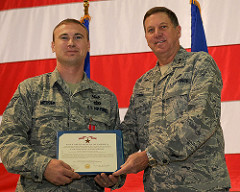
Kentucky’s adjutant general, Maj. Gen. Edward W. Tonini (right), presents Tech. Sgt. Matthew J. Meuser of the 123rd Civil Engineer Squadron with a Bronze Star Medal during a ceremony held Nov. 20, 2011, at the Kentucky Air National Guard Base in Louisville, Ky. Meuser earned the combat decoration for his exceptionally meritorious service while deployed to Afghanistan as an explosive ordnance disposal team leader supporting Operation Enduring Freedom. (U.S. Air Force photo by Tech. Sgt. Dennis Flora)
“Working tirelessly in some of the most dangerous regions of Afghanistan, they conducted daily Explosive Ordnance Disposal missions at great risk to their own lives so that coalition forces could operate safely and effectively. Whether they were disabling IEDs along more than 600 miles of roads or conducting patrols under constant threat of attack, Sergeants Basanta, Meuser and Woods aided the war effort immeasurably, saving the lives of coalition forces by neutralizing one of the enemy’s most insidious weapons.
“They truly represent the best qualities of the United States Air Force, the Kentucky Air National Guard and the 123rd Airlift Wing. I’m proud to serve with them.”
The Bronze Star is awarded to service members who distinguish themselves by heroic or meritorious achievement in connection with non-aerial military operations against an armed enemy.
Basanta distinguished himself while assigned to 466th Operating Location Alpha, Combined Joint Task Force Paladin-East, Forward Operating Base Ghanzi, Afghanistan, from Feb. 23 to Aug. 23, 2011.
During that time, Basanta executed 40 EOD combat missions throughout Ghanzi Province, completing 16 route patrols that cleared more than 600 miles of roads, according to the narrative that accompanies his award citation. He also participated in four named operations that destroyed two enemy caches containing 2,400 pounds of explosives.
In two separate instances, Basanta removed 200-pound IEDs from culverts by approaching to within hands’ reach, attaching ropes and pulling them free so they could be remotely disrupted without causing damage to Afghanistan’s most strategic highway.
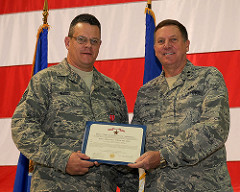
Kentucky’s adjutant general, Maj. Gen. Edward W. Tonini (right), presents Tech. Sgt. Robert L. Woods of the 123rd Civil Engineer Squadron with a Bronze Star Medal during a ceremony held Nov. 20, 2011, at the Kentucky Air National Guard Base in Louisville, Ky. Woods earned the combat decoration for his exceptionally meritorious service while deployed to Afghanistan as an explosive ordnance disposal team leader supporting Operation Enduring Freedom. (U.S. Air Force photo by Tech. Sgt. Dennis Flora)
He also provided valuable insight into enemy tactics, safely disrupting two IEDs by deciphering their initiation systems and intended targets. His surgical disruption techniques and detailed exploitation resulted in flash reports to the field, alerting coalition forces and Afghan National Security forces to new threats, the narrative said.
Meuser distinguished himself by exceptionally meritorious service while assigned to 466th Explosive Ordnance Flight Bravo, Combined Joint Task Force Paladin-South, Kandahar, Afghanistan, from Aug. 25, 2010 to Feb. 22, 2011.
During that time, Meuser led a three-person team on more than 72 combat missions covering the 675-square-kilometer Ground Defense Area surrounding Kandahar Air Field, according to the narrative that accompanies his award citation. He responded to and rendered safe 15 IEDs and destroyed over 3,000 legacy unexploded ordnance and enemy weapons cache items, thus limiting the IED threat and reducing the number-one insurgent weapon used against International Security Assistance Force troops.
Notably, Meuser led his team during named operations in support of British Regimental Forces and U.S. Army Scouts who infiltrated two compounds suspected of harboring known IED facilitators responsible for 40 indirect fire attacks on Kandahar Air Field. His team meticulously cleared areas identified as IED threats, enabling the successful capture of the primary objective, the narrative said.
Additionally, Mueser was pivotal in the disposal of more than 50,000 pounds of excess or dangerously unserviceable North Atlantic Treaty Organization munitions, allowing logistics resources to focus on battlefield resupply and saving the United States millions of dollars in redeployment costs.
Woods distinguished himself by exceptionally meritorious service while also assigned to 466th Explosive Ordnance Flight Bravo, Combined Joint Task Force Paladin-South, Kandahar, Afghanistan, from Aug. 25, 2010 to Feb. 22, 2011.
During that time, Woods led 42 combat missions that rendered safe, recovered, destroyed or exploited numerous IEDs, unexploded ordnance and weapons caches, according to the narrative that accompanies his award citation. He also conducted post-blast analysis missions throughout Regional Command-South, collecting evidence that was instrumental in the detention of two bomb-making facilitators in Kandahar Province.
Woods’ expertise was evident when he devised and implemented an innovative safing procedure against a dud-fired, rocket-propelled grenade that lodged in the door of an armored troop-transport vehicle during a route-clearing mission, the narrative said. After Woods neutralized the ordnance, he meticulously analyzed the remaining vehicles in the convoy and discovered two more that were contaminated with ordnance residue. His resulting actions minimized the potential for damage and preserved more than $2 million in combat vehicles for future operations, releasing critical life-saving resources back into the fight.
Woods also effectively evaluated, safed and destroyed more than three tons of explosive remnants of war, thereby preventing their use against coalition forces.
The three Bronze Star recipients are among the hundreds of Kentucky Air National Guardsmen who have been mobilized worldwide in support of Operations Enduring Freedom, Iraqi Freedom and New Dawn during the past decade. The unit has deployed personnel overseas more than 3,400 times since Sept. 11, 2001.
Story and Photos By: 1st Lt. Mark Slaughter, Kentucky Yellow Ribbon Program
Additional photos provided by Bruce Herrick Secretary of Derby City QDMA.
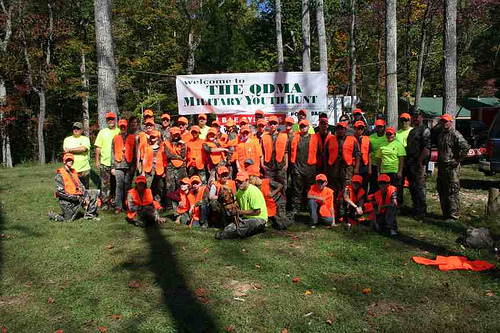
Brandenburg, Ky. — If you have ever been around a group of kids all weekend, chances are good you probably heard more than a few times, “I am bored.” Well, that’s what didn’t happen the weekend the Derby City Quality Deer Management Association’s hosted their first military youth hunt.
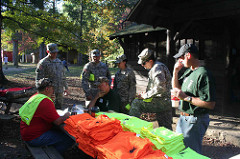
Soldiers from Fort Knox and Fort Campbell registering their kids for the Derby City Quality Deer Management Association’s (QDMA) Military Youth Hunt. The four day event took place October 7th-10th at YMCA, Camp Piomingo (Photo by Bruce Herrick, Secretary of Derby City QDMA)
The four day event started October 7th and ran through the 10th at YMCA Camp Piomingo at the Otter Creek Outdoor Recreation Area. More than 30 young hunters and their mentors spent four-days enjoying the great outdoors, all thanks to some volunteers from the Derby City Branch QDMA and the Bourbon Trail Branch QDMA.
The children were provided everything they needed at no cost to the families, all thanks to sponsors like BAE Systems, Bass Pro Shops, Plano, Cabelas, Society of Military Engineers, WMMG Radio, Raytheon, League of Kentucky Sportsmen, Bluegrass Game Calls, Hunters for the Hungry, YMCA, Camp Piomingo, Walmart, KDFWR and others.
QDMA members of the Quality Deer Management Association raised almost $20,000 for the hunt. It was such a success plans are already in the works for another event next year, and the kids can’t wait.
The QDMA, by the way, is a non-profit wildlife conservation organization dedicated to ensuring a high-quality and sustainable future for deer hunting. Founded in 1988, the QDMA currently has more than 50,000 members in all 50 states and several foreign countries including many deer management professionals.
By partnering with state wildlife agencies, timber companies, hunting groups, and product manufacturers they work to achieve their goals of safe and ethical hunting. The overall focus of the group is a strict adherence to wildlife and trespass laws promoting involvement in education and management for the hunters and non-hunters toward a better understanding of wildlife management. QDMA members strive to maintain a stewardship and appreciation for all wildlife in the hopes of passing these values on to future hunters, and there is no doubt that the weekend’s event did just that.
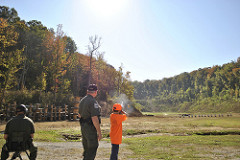
Matthew Robinson, son of Master Sgt. (retired) Shawn Robinson, going through shotgun familiarization training at Knob Creek Gun Range, in Bullitt County, Kentucky, under the watchful eye of members from Kentucky Fish and Wildlife. (Photo by 1st LT Mark Slaughter, Kentucky Yellow Ribbon)
Committee member of the Derby City Chapter of QDMA, and Chairman of the Military Youth Hunt, Joe Shreves worked hard to organize the event that brought kids in from almost every branch of service and from all over the Commonwealth.
Like all good hunting stories, the program came about during a discussion while sitting around a campfire.
“Naturally, we wanted the most deserving
kids and that is when we decided to give
consideration to children whose parents
were deployed overseas defending our
freedoms,” said Shreves. “The idea came up to go to Fort Knox and take some military kids.”
The idea grew and eventually 30 youth participated, 17 from Fort Campbell, six from Fort Knox, two from the Navy, and four are children of members in the Kentucky National Guard.
Before the youth hunt began the young people took part in the hunter education course and every one of them received a completion card, which is required to hold a Kentucky hunting license. Department of Fish and Wildlife Employees were on hand to help the kids complete the hunter education. This includes training, testing and range work with .22 rifles and 20 gauge shotguns.
On the range Matthew Robinson, son of retired Master Sgt. Shawn Robinson from the Murray State College ROTC program was impressed.
“This is awesome!” he declared as he finished the shotgun familiarization portion of the program.
Education was the first phase of the camp. Before the kids could hunt they had to learn about important topics like firearm safety, archery, wilderness survival techniques, conservation, and ethical hunting before heading into the field. After completing the classes the young hunters were provided a rifle donated by local hunters and sent to the range where they zeroed their sights.
On the zero range Kaytlin Nestor got some help from her father, Staff Sgt. David Nestor from the 101st Airborne Division Fort Campbell. The father-daughter team worked quickly with expertise, accurately setting up her rifle. Kaytlin has had a lifetime of shooting experience, but this weekend was special because it gave her some precious with her father, who has been deployed in support of the Global War on Terror.
“I am really looking forward to Saturday morning when the hunt begins,” said Kaytlin.
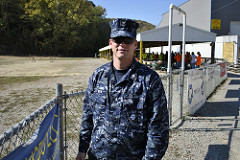
Navy Corpsman HM2 Brian Minton from the Naval Operation Support Center Louisville provided medical support over the weekend. (Photo by 1st LT Mark Slaughter, Kentucky Yellow Ribbon)
Hunting began before the sun came up Saturday morning, when the hunters and their mentors were taken to designated hunting positions. Throughout the weekend the number one goal was safety and every precaution was taken to insure the safety of the kids and volunteers. Hunting procedures were prepared and rehearsed well in advance.
Navy Hospital Corpsman Second Class Brian Minton was on duty from the Naval Operation Support Center Louisville. Minton provided medical support over the weekend and was on the scene ready for action in the event of any misstep.
Shreves had high praise for his medical support. “HM2 Minton was a valuable asset, and his presence brought great credit to himself and the US Navy.”
Minton, by the way, works as an EMT in the civilian world, and had just returned from a deployment in Afghanistan where he served as a corpsman for the United States Marine Corps.
“The weekend was great, and it was good to see so many kids and families enjoying themselves,” said Minton.
With their training complete early Saturday morning the kids were taken to designated hunting areas.
“We mainly hunted on two properties, Grand View Hunt Club, which is a private hunt club that I manage, and we hunted the Hardin County Landfill,” said Shreves.
Besides hunting skills the younger hunters learned something many of the seasoned mentors already knew. Hunting is a great sport but it is not just about connecting with nature, it is about making friends, and having a hunting buddy that life long memories are made with is priceless.
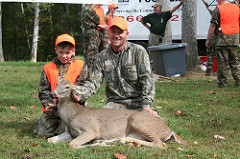
Ben Hutchinson and mentor Donnie Dattilo pose with Ben’s first deer. Ben’s mother took the processed meat to Camp Atterbury, Ind. where his father was preparing to for an upcoming deployment (Photo by Bruce Herrick, Secretary of Derby City QDMA)
A lot of the kids had early success in the hunt but more than that many of them connected with one another on a personal level. Having a parent deployed is tough, and it is good to have a friend to help you through that time, someone who knows what it is like when a Mom or Dad is away.
That is exactly what Brandon Jeffcoat and Ben Hutchinson experienced. Over the weekend whenever you saw Brandon, Ben would not be far away. The two of them made a great pair. When Ben tagged his deer on Sunday Brandon was there to celebrate. Ben’s mom made the drive in with his two younger brothers to pick up the deer and take it to his dad who was at Camp Atterbury, Indiana preparing to deploy.
Ben’s proud Mother said “You have shown me the side of my son that I have never seen.”
Ben’s mentor Donnie Dattilo also had a great time saying, “I could shoot a 200 class deer this year, and not have as good a time as I did with Ben.”
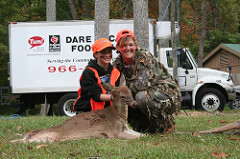
Jessica Slater and her mentor, Jennifer Shannonhouse posed with a deer harvested at the Derby City Quality Deer Management Association’s Military Youth Hunt. Jessica proudly declared that she would process the entire thing into jerky and send it to her father, 1st Lt. Greg Slater, in Iraq. (Photo by Bruce Herrick, Secretary of Derby City QDMA)
Jessica Slater comes from a military family. She has two brothers in the military — one just left for basic training — and her father, 1st Lt. Greg Slater is deployed with the 1204th Aviation Support Battalion.
Both Jessica and her mentor, Jennifer Shannonhouse, had a great experience during the hunt. Jessica proudly declared that she was going to send venison jerky to her father in Iraq. The first step, of course, was getting a dear. Shannonhouse was a little worried at first when she saw how small Jessica was and how big the rifle was, but her fears soon faded.
“After her first 4 shots she had hit the target 3 times,” said Shannonhouse. “I was not concerned anymore. She was a lot of fun and was so incredibly excited about getting her deer. I am glad she has decided to process the meat for her dad. He will never forget that and neither will she.”
The youth hunters also donated their meat to Hunters for the Hungry making a difference in the local community. It is programs like these have brought hundreds of thousands of pounds of venison to homeless shelters, soup kitchens and food banks, that help feed those in need.
Shreves was pleased with the final result, saying “It was our goal to provide a quality hunting experience for the children of our deserving service members. From the looks of the children that participated, we were successful at making that happen, but we can do so much more. Imagine what a dozen chapters in Kentucky could accomplish. With the two chapters that participated in this hunt, Derby City and Bourbon Trail, we were able to host 30 children. There are hundreds that need our support!”
For more information on next year’s event please contact Derby City QDMA president, Pete Blandford, (502) 231-2625; Joe Shreves, (502) 377-5333, email [email protected]; or Bruce Herrick, (502) 239-8388, email [email protected] or visit www.derbycityqdma.com to volunteer, donate or sign up.
Story By: Spc Matthew Dornbusch, 1204th Aviation Support Battalion Unit Public Affairs Historian Representative
Photos by Sgt. 1st Class Gary Moriarty, 1204th Aviation Support Battalion
Click here for more photos on the story.
NOTE: Each week kentuckyguard.com publishes stories by Kentucky National Guard unit public affairs historian representatives, also known as UPAHRs. This is an additional duty taken on by a Soldier or Airmen with the intent of telling their unit’s story. This is one such story ….
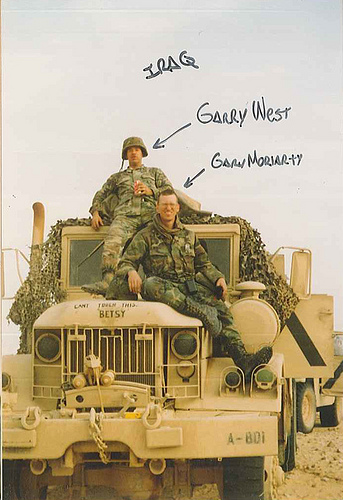
Spc. Gary Moriarty and battle buddy more than 20 years ago during Operation Desert Storm. Moriarty is now a sergeant first class with the Kentucky Army National Guard's 1204th Aviation Support Battalion deployed as part of Operation New Dawn.
Iraq – Operation Desert Storm, commonly referred to as the Gulf War, or now the First Gulf War, officially began January 17th 1991. Its preparation was quick; a few months prior Soldiers were trained and mobilized, ready to help liberate the small nation of Kuwait. At 3 A.M on that January morning, the U.S. led attack on Saddam’s forces began with its air campaign. Thirty-eight days later on February 24th, ground forces moved into Kuwait and liberated Kuwait City in only three days. It would only be a few weeks later that coalition forces moved into Iraq and an official cease fire was reached.
With the shadow of the current operations in Iraq, Operation Desert Storm is hardly talked about any longer. Most of the younger Soldiers hardly even know the events that lead up to the conflict, let alone what happened in the conflict itself. Maybe it was because it ended so quick, or maybe because the casualty rate was so low. Whatever the reasons, there is a small group of the Soldiers within Headquarters Company, 1204th Aviation Support Battalion who have not forgotten. These Kentucky Army National Guard Soldiers, twenty years after their deployment and return home from the First Gulf War, are once again in the Middle East. Their legacy was as the first soldiers in, and now, twenty years later, they will be potentially the last ones out.
Sgt. 1st Class Dean Regester was stationed at Ft. Knox, Kentucky in 1990 when he was mobilized for Operation Desert Storm. He deployed overseas with the 19th Engineers as a lightweight vehicle mechanic. Regester compared what he did then with what route clearance teams do now.
“Back then there were no roads,” he said. “The engineers I was with made the roads.”
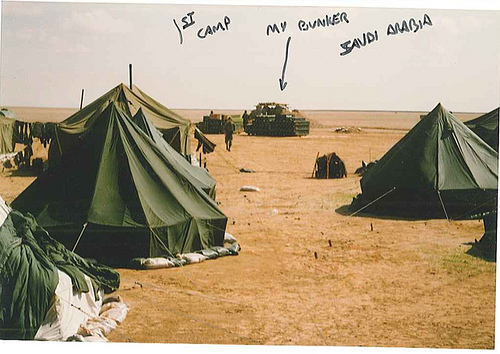
"FOB? We didn't have FOBs!" Ground forces during the Persian Gulf War were always on the move, negating the need for fixed installations.
Sgt. 1st Class Stephen Leasgang was only nineteen when his unit, 4-8 CAV with the 3rd Armored Division, was called into action. He departed from Germany where he was stationed, moved through Saudi Arabia and into Iraq. With the MOS 19K — a M1 Abrams Tank Operator — Leasgang has already been redeployed to the Middle East and compared the two wars.
“FOBs?” he said, referring to “forward operating bases. “We didn’t have FOBs. The only thing we had then were assembly areas for vehicles. That’s where we slept.”
2nd Lt. Greg Slater was a twenty year old specialist when he entered theater during Operation Desert Shield. He was with the 2nd Armored Cavalry Regiment, a rapid deployment unit. They could be deployed to any part of the world in a very short amount of time. Slater was a crew chief at the time.
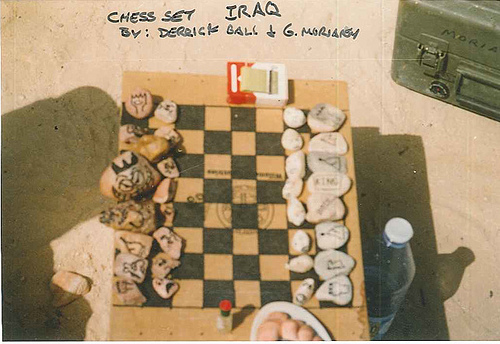
Improvise, adapt and overcome: Long before the advent of 3D digital video games and Facebook, troops during the Persian Gulf War had to come up with their own entertainment.
“I’ll never forget when we crossed the berm into Iraq and a Blackhawk flew overhead. He dropped his flares and fired his rockets.”
Sgt. 1st Class Kevin Ireland was also a specialist with the 2nd ACR back in 1990. Prior to then he spent four years in Germany as a high frequency radio operator.
When asked about his most memorable moment Ireland immediately laughed and said, “March 2, 1991. We were taking sniper fire from a quarry. I was going on almost four days of no sleep when my captain jumped into the hole I had dug to tell me my son had been born. I was so excited I forgot about the sniper fire and started running around telling everyone about my son.”
Staff Sgt. Kelly Darland had just finished special forces selection, but was still formally with the 101st Pathfinders. He was pulled, however, to go with the 5th Group Special Forces team. He was put on Personal Security Detail and assigned to guard the officer in charge of the security force that personally watched over the prince of Kuwait.
Sgt. Larry Watkins was a Petty Officer 3rd Class with the United States Navy serving aboard the U.S.S. America. He was in the Red Sea when his ship was ordered to move off the coast of Kuwait. Watkins worked with aviation ordnance and loaded bombs onto aircraft. This was an around the clock operation and helped the United States keep air superiority over Iraq.
Sgt. John Amburgey was a lance corporal with 2nd Marine Division 2nd Amphibious Assault Vehicle Battalion in Alpha Company. He was stationed at Courthouse Bay located within Camp Lejeune, North Carolina.
“We were already to go on a NATO float to Europe,” said Amburgey. “The next morning Cpt. Wagner, our commanding officer, told us since we were already gearing up, we were probably going to go [to the Middle East].”
Sgt. 1st Class Gary Moriarty was a specialist in 1990 stationed in Schwabach, Germany. He was assigned to the 6/3 Air Defense, whose slogan was “If it flies it dies!”
“The individual resiliency of the soldiers was amazing,” said Moriarty. “Everybody did everything.”
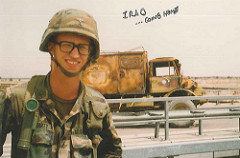
Mission accomplished, headed home – The goal of every deployed Soldier, past, present and future.
Moriarty related a story about a moment that still sticks out in his mind – he saw a line of tanks at night while he wore a pair of night vision goggles. The tanks fired their rounds and explosions went off in the distance.
“It was devastating, it was chaos, it was war,” said Moriarty.
The experiences of all these me were completely different, but have tied together as Kentucky Army National Guard Soldiers. Where they once helped liberate a country from a tyrant, they are now helping bring the current operations to a close. They have seen the people of Iraq evolve from being ruled by dictatorship to now running an emerging democratic nation. This, they hope, is not the proverbial end to the U.S. book of involvement in Iraq, but the beginning for a country headed in the right direction.
Story by Sgt. Scott Raper, 149th Maneuver Enhancement Brigade Public Affairs
[youtube http://www.youtube.com/watch?v=oogWQTcYLig]
(Video by Sgt. Mark Owen, 149th MEB Unit Public Affairs Historian Representative)
Command Sgt. Maj. Thomas Johnson of the 149th Maneuver Enhancement Brigade pours gravy on the plate of a Soldier as Col. Scott Campbell observes at Victory Base Complex, Nov. 20. The meal celebrated Thanksgiving for the remaining troops on VBC and was also the last hot meal served before the dining facility closed. (photo by Sgt. Scott Raper, 149th Maneuver Enhancement Brigade)
VICTORY BASE COMPLEX, Iraq – A final meal at the dining facility on Camp Liberty is a sign of the times. A sign that the number of U.S. troops in Iraq is shrinking and Victory Base Complex is not what it used to be. And also a sign of the holidays, as the meal celebrated Thanksgiving a bit early. Soldiers of the 149th Maneuver Enhancement Brigade continue to draw down VBC, but took time to come together and be thankful.
“It’s our opportunity to talk with the Soldiers, and to look every one in the eye and thank them,” said Col. Scott Campbell, 149th MEB’s Commander. “We can reflect on our families and the holiday. And while we are apart, they are still in our hearts and minds.”
With all dining facilities closing, the effort was made to serve one last prepared meal to the remaining troops at VBC as the holiday approached. Although a few days prior to Thanksgiving Day, the food and festivities was still appreciated by the Soldiers. With amenities disappearing quicker than people from VBC, Soldiers were grateful for the opportunity to celebrate a holiday, even if away from home.
“This is just another sacrifice we make,” said Spc. Benjamin DiPalma. “But we did have a good meal and even decorations. It was a nice small reminder of home.”
Kentucky Guardsmen of the 149th Maneuver Enhancement Brigade celebrate Thanksgiving early during their final meal at the dining facility on Camp Liberty at Victory Base Complex, Iraq. (photo by Sgt. Scott Raper, 149th Maneuver Enhancement Brigade Public Affairs)
Leaders of the 149th took shifts behind the service line dishing up turkey, ham, potatoes, gravy, and all the items needed for a good holiday meal. Long lines of Soldiers continued to form until every one was served.
“It’s great that the command staff would do this,” said Capt. Adam Culbertson. “It shows they care and they are willing to do anything for us.”
In the Soldiers’ last day at the chow hall, conversations of the final days in Baghdad could be heard in a dull roar. Soldiers said they were thankful for spending time with their fellow troops; thankful for finishing the job in Iraq, and thankful for the fact that the job is almost over.
These troops will still be working on Thanksgiving however, and the days after to redeploy troops from the country by the end of the year. As facilities close and the mission winds down, Soldiers of the 149th will endure until the job is finished.
“It’s significant that this is the last day at the dining facility and the holiday makes it that much more special,” said Campbell. “This is their last hot meal, it’s MRE’s (Meals Ready to Eat)after this.”
Story by David Altom, Kentucky National Guard Public Affairs
Photos by John Perkins, Creative Services
Click here for more photos on this story.
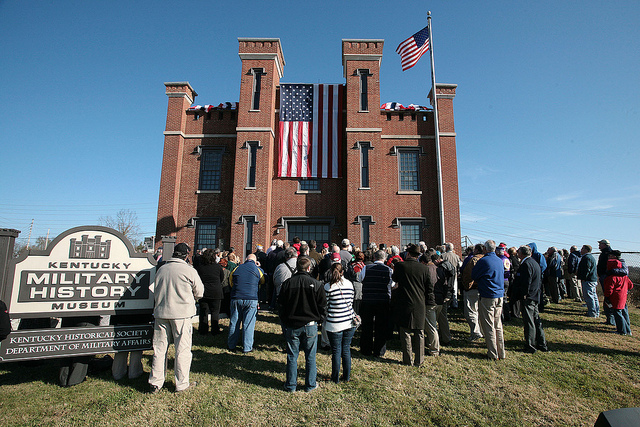
FRANKFORT, Ky. — This year’s Veterans Day was made even more special with the grand reopening of a longstanding institution, the Kentucky Military History Museum.
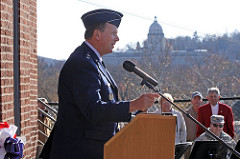
Maj. Gen. Edward W. Tonini speaks at the grand reopening of the Kentucky Military History Museum.
Located on East Main St. in Frankfort, the museum features a “Military Treasures” exhibit with artifacts and stories of Kentuckians who fought in battles spanning nearly 200 years.
For more than four years, the State Arsenal has been undergoing extensive renovations. The goal of the project is to restore the building as closely as possible to its original appearance. Upgrade to the heating, ventilation and air conditioning system have been made, as well as nearly every other aspect of the building, from windows to doors, the walls and floors.
Nearly $1.5 million has been allocated so far to the project, which is funded by the Kentucky Department of Military Affairs, the Kentucky Historical Society Foundation and the Veteran’s Program Trust Fund Board. By the time the restoration is complete in 2013 the project will run approximately $2 million.
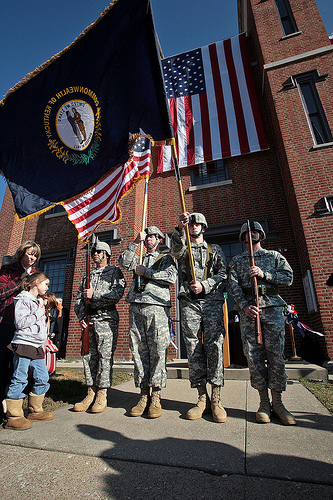
Kentucky National Guard troops provide a color guard for the ceremony.
“This newly renovated museum represents a tangible record of our state’s history, from the Revolutionary War until today,” said Adjutant General Edward W. Tonini, who spoke at the event. “Behind the brick and mortar of this museum is the heart of Kentucky’s military legacy – the men and women who put the interests of others ahead of their own.”
The building was originally constructed as the state arsenal in 1850 at the cost of $8,500. At one point, it was used as a warehouse for military equipment and munitions for the Kentucky State Guard. During the Civil War, it housed a cartridge factory that employed many women and became a point of defense for the capital city. It was also used as a storage facility until being put to use as the Kentucky Military History Museum in 1974.
Today, the museum is operated jointly by the Kentucky Historical Society and the Kentucky Department of Military Affairs. It is currently listed in the National Register of Historic Places.
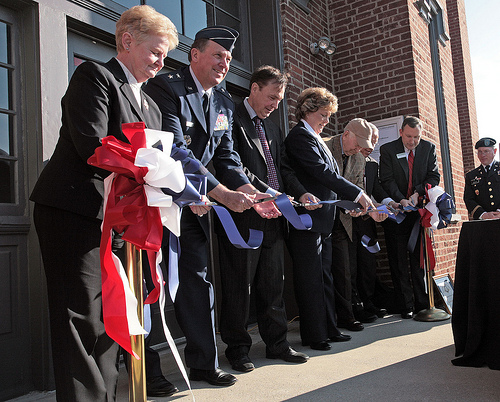
Adjutant General Edward W. Tonini joins members of the Kentucky Military History Museum board in the ribbon cutting ceremony.
By Sgt. Scott Raper, 149th Maneuver Enhancement Brigade
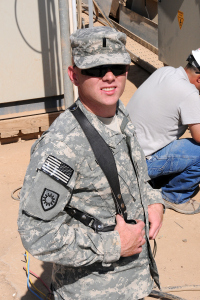
1st Lt. Geremy Harper, Headquarters, Headquarters Company, 149th Maneuver Enhancement Brigade
BAGHDAD – Operation of a military base overseas is not an easy task. There is only so much Soldiers can do to handle such a job. That’s where civilian contractors come into play. At Victory Base Complex, several companies work to assist the military with the basics of what is essentially a fully functional city. The cooperation is vital and someone must be the go-between to keep up the relationship.
“It’s my job to ensure that necessary services are provided and maintained by the contractors on VBC,” said 1st Lt. Geremy Harper with Headquarters, Headquarters Company, 149th Maneuver Enhancement Brigade.
Harper’s position falls under the Directorate of Public Works in the brigade. He is responsible for the interaction with the Fluor Company, a contractor that provides such services as plumbing, electrical and construction. Their employees respond to problems ranging from a burnt out light bulb and faulty air conditioners to water main breaks on the base perimeter. Harper must be aware of all the issues Fluor deals with to ensure the coordination with military assets to fix the problem.
His daily assignments include formal proposals for minor construction and repair projects. He must include plans and applicable budget concerns to meet the needs of the military and the base.
Administrative work keeps him busy, but as he said, “something interesting happens everyday. The best day is a boring day. It’s our job and Fluor’s to keep life, health and safety of Soldiers in mind.”
Soldiers of the 149th MEB have not been in Iraq long, but Harper is amazed at the amount of work his section has had to do. And as soon as they become used to the workload, things change as VBC shrinks in preparation for the redeployment of U.S. Forces from Iraq. Harper said as ideas of the shutdown shift, so does his operation. And it is not always a smooth transition.
“The hardest part of the drawdown is that we can’t fix everything that needs to be fixed,” he said.
As an engineer officer back home, the Murray, Ky. native is used to doing all the work, from making the plan to executing it. He is grateful for the help the contractors provide, calling them great people to work with. It can sometimes be a struggle he said, especially missing his three-year-old daughter, but being part of something historical means a lot to him. And he credits his fellow Soldiers such as Sgt. 1st Class Jason Brown for the camaraderie on the job day in and day out.
“Every time I leave the office, I take my radio because we are on 24/7, but it is the job satisfaction that makes me enjoy it. It is fun and exciting work.”
story by Staff Sgt. Amy Parker, 201st Engineer Battalion
NOTE: Each week kentuckyguard.com publishes stories by Kentucky National Guard unit public affairs historian representatives, also known as UPAHRs. This is an additional duty taken on by a Soldier or Airmen with the intent of telling their unit’s story. This is one such story ….
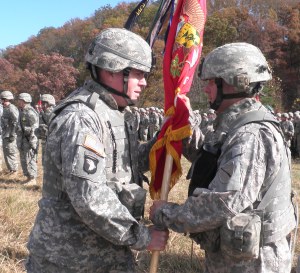
Kentucky Guard 201st Engineer Battalion newest commander Lt. Col. Dean Gosney hands off the unit's guideon to Command Sgt. Major Jesse Withers at a change of command ceremony in Clay City, Ky., Oct. 22. (photo by Spc. Megan Caudill, Headquarters Support Company 201st Engineer Battalion)
CLAY CITY, Ky. - The Kentucky National Guard’s 201st Engineer Battalion conducted a change of command ceremony during their Sapper Challenge training event at the Eastern Kentucky Training Site near Clay City, Ky., Oct 22.
“After 21 years in the unit and 2 and a half years in command, this battalion has become my family,” said Lt. Col. Jerry Morrison, outgoing commander. “No matter how hard I pushed, you always responded with more, thank you.”
Morrison handed the reins of the 201st Engineer Battalion to Lt. Col. Dean Gosney.
Gosney’s been associated with the Kentucky Guard and the 201st for more than 20 years.
“I’m humbled and honored to take command of the greatest battalion in the state,” said Gosney. “These engineers are some of the most highly trained, versatile Soldiers on the battlefield.”
Maj. Andrew Caldwell served as the commander of troops, Capt. Derrick Frodge served as the Adjutant and Maj. J.B. Richmond was the narrator.
Morrison’s spouse Becki received a bouquet of red roses. Red is the color of the heart and reflects the loving concern she has shown the 201st over the last three years. Her roses were in full bloom representing fulfillment of her time with the unit as First Lady.
Gosney’s spouse Karen was also presented with a bouquet of yellow rose buds that symbolize her arrival as the first lady. In time, the roses will blossom as will her relationship with the Soldiers and families.
“I challenge Lt. Col. Gosney to grab the reins and guide them left or right,” said Morrison. “You don’t need to kick them, just hang on because they’re ready to run.”