Pages
Stay In Touch
More
© 2013 KentuckyGuard
Story by Staff Sgt. Scott Raymond, Kentucky National Guard Public Affairs
In recognition of March as Women’s Month kentuckyguard.com is publishing a series of articles honoring women who are significant figures in Kentucky’s military history. The following is one such story ….
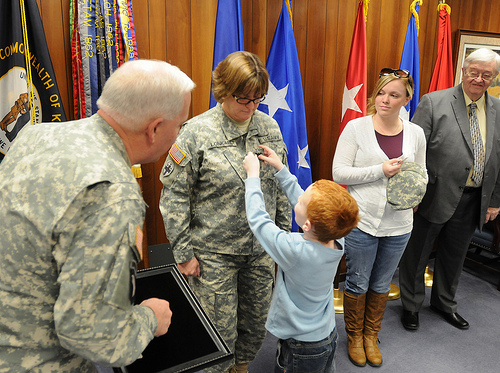
Col. Natalie Lonkard gets help from her 6-year-old grandson, Braden during her promotion ceremony in Frankfort, Ky., Feb. 25, 2013. Lonkard’s daughter and father were also in attendance to see her become the only female colonel currently serving in the Kentucky Army National Guard. (Kentucky National Guard photo by Staff Sgt. Scott Raymond)
FRANKFORT, Ky. — Natalie Highley Lonkard has worked in the medical field for more than 20 years. She continues to use her skills as a nurse as both a civilian and a Soldier. Following several deployments at home and overseas during a successful career in uniform, Lonkard was recently promoted to the rank of colonel and assumed command of the Kentucky Medical Detachment in Lexington, Ky. She is the first official female commander of the 76-Soldier unit, and the only woman currently serving in the Kentucky Army Guard as a colonel.
As the commander of a unit that is 35 percent female, certainly a higher diversity rate than most units, Lonkard relies on past experience and influences that have helped her climb the ranks to encourage new generations of women in the National Guard.
“Younger female Soldiers will realize that they can meet the goals that they set forth for themselves in the military,” she said. “I have worked with many, and hope that they see in me what I received from those before me; you can do whatever you choose to do with education, a strong work ethic and a little perseverance.”
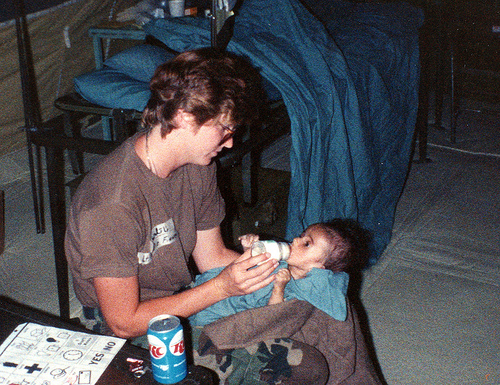
2nd Lt. Natalie Lonkard cares for an Iraqi child in a mobile hospital during Operation Desert Storm, 1991. (Courtesy photo)
Lonkard wanted to join the military straight out of high school to serve her country, and to see the world. But she waited, became a registered nurse in obstetrics and started a family. With a young daughter, Lonkard decided the National Guard was the better option to stay closer to home. She enlisted into the Kentucky Guard’s 475th Mobile Army Surgical Hospital (MASH) in 1989.
As a newly commissioned 2nd lieutenant, Lonkard’s time at home came to an end with the United States’ involvement in the liberation of Kuwait in January, 1991. Lonkard and the 475th deployed to the Persian Gulf in support of Operation Desert Storm. She said it came as a surprise, something the recruiter did not tell her about. The unit set up a hospital for wounded service members, but also treated local civilians as well. Lonkard said the unit’s mission became one of humanitarian aid although it was recognized as a military support mission.
“I do remember several of the Iraqi patients we had there,” she said. “I worked two newborn deliveries, which was my civilian job, so I felt very comfortable assisting those women.”
After six months away from home, Lonkard returned to Kentucky and continued her work in both uniforms.
Lonkard later deployed to the Caribbean island of Dominca where she taught CPR and Obstetric classes to local health professionals. She also provided her skills in medical clinics as part of missions to Ecuador and Guyana.
In April, 2008, Lonkard was again mobilized as the commander of the Warrior Transition Battalion at Fort Campbell. She remembered this as a highly visible position there, surrounded by the home of the 101st Airborne Division. She was faced with three obstacles; she was female, she was a nurse, and a National Guard Soldier, all on an active duty post that was anxious of what kind of commander she would be.
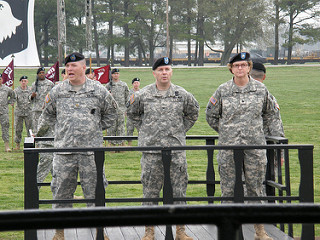
Lt. Col. Natalie Lonkard during the change of command ceremony for the Warrior Transition Unit at Fort Campbell, 2008. (Courtesy photo)
For two years, Lonkard keep in mind the many factors necessary for the care of so many young men and women injured in both Iraq and Afghanistan.
“Our mission, to provide for the Soldier and family with the medical process was difficult at times,” she said. “But when they would come back to thank you for what you did, it was all worth it.”
After a stint as the case manager for the Kentucky Medical Detachment, Lonkard received her opportunity to put her 20-plus years of medical experience to use as the unit’s commander.
“Reaching the rank of colonel is a very important milestone for me that not many obtain, much less many women,” she said. “I am looking forward to the challenges that are ahead for our unit in meeting the needs of Kentucky’s Soldiers. We want to assure that every Soldier is medically ready to be deployed or meet a mission requirement within Kentucky.”
Lonkard attributes a lot in her career and life to those she has surrounded herself with, in both military and civilian sides of her life. She said both careers complement each other well and those co-workers and fellow Soldiers have given her quality experiences and great stories that she will remember always. Her employer, Frankfort Regional Medical Center has been very supportive of her military career as well.
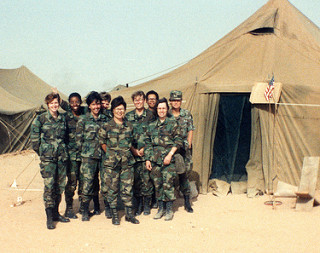
2nd Lt. Natalie Lonkard and members of the 475th Mobile Army Surgical Hospital (MASH) stand outside their tent in Saudi Arabia during Operation Desert Storm, 1991. (Courtesy photo)
“Females in my units were always there for me,” said Lonkard. “Col. Karen Likins, Col. Franketta Zalaznik, Col. Betty Robb and Lt. Col. Lisa Amburgey were all there to make us realize that if we worked hard for the National Guard, we would be promoted accordingly and that being a female would not be an issue.”
She feels her time has proven her to be honest, fair and loyal to all that wish to work together toward common objectives.
“I hope that this new command position will provide the opportunity to assist Soldiers within my unit and across Kentucky to meet their career goals. I believe in teamwork, communication and education. With an emphasis on these three, I feel that any goals can and will be met.”
Lonkard’s words and influence has continued its reach of encouraging new generations of female Soldiers. Capt. Sabrena Fields has served with Lonkard since the 90s, calling it an honor to serve with her. Fields also credits Lonkard with inspiring her to continue her education and furthering her own nursing career.
“I feel that Colonel Lonkard has opened the door for many more women and female Soldiers coming up in the ranks,” said Fields. “They realize that there are many opportunities to further themselves in the Kentucky National Guard.”
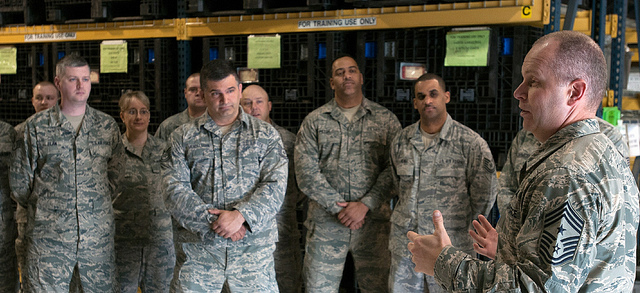
Chief Master Sgt. James W. Hotaling, command chief master sergeant of the Air National Guard, meets with Airmen from the 123rd Airlift Wing during a tour of the Kentucky Air National Guard Base in Louisville, Ky., on March 16, 2013. Hotaling, who assumed the job Feb. 4, 2013, was in town to serve as the keynote speaker of the Kentucky National Guard’s Outstanding Airman and Soldier of the Year Banquet. (U.S. Air Force photo by Staff Sgt. Maxwell Rechel)
123rd Airlift Wing Public Affairs
LOUISVILLE, Ky. — In one of his first official visits to the field, the Air National Guard’s newest command chief toured the Kentucky Air National Guard base here March 16.
Click here for more photos of this story.
Chief Master Sgt. James Hotaling, who became the Air Guard’s 11th command chief master sergeant on Feb. 4, met with Airmen from across the 123rd Airlift Wing while visiting a range of duty sections, from aircraft maintenance to force support.
A career special tactics Airman, Hotaling also was keynote speaker at the Kentucky National Guard’s Outstanding Airman and Soldier of the Year Banquet later that evening.
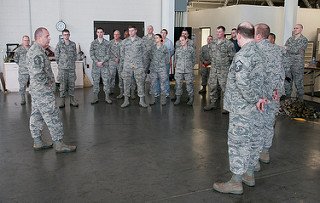
Chief Master Sgt. James W. Hotaling, command chief master sergeant of the Air National Guard, meets with Airmen from the 123rd Airlift Wing during a tour of the Kentucky Air National Guard Base in Louisville, Ky., on March 16, 2013. Hotaling, who assumed the job Feb. 4, 2013, was in town to serve as the keynote speaker of the Kentucky National Guard’s Outstanding Airman and Soldier of the Year Banquet. (U.S. Air Force photo by Staff Sgt. Maxwell Rechel)
As ANG command chief, Hotaling represents the highest level of enlisted leadership in the Air National Guard. He is responsible for matters influencing the health, morale and welfare of assigned enlisted personnel and their families.
Prior to assuming his current post, Hotaling served as the command chief master sergeant for the Continental U.S. North American Aerospace Defense Command Region and 1st Air Force (Air Forces Northern), Tyndall Air Force Base, Fla.
Hotaling entered the Air Force in 1987 as a special tactics combat controller. His background includes joint planning, application of air power in support of special operations, and command and control of tactical operations.
He has participated in Operations Desert Shield, Desert Storm, Provide Relief, Support Justice, Uphold Democracy, Vigilant Warrior, Southern Watch, Enduring Freedom and Iraqi Freedom. During these operations, Hotaling planned and executed combat and humanitarian operations in support of national interests in Iraq, Haiti, Somalia, and Afghanistan.
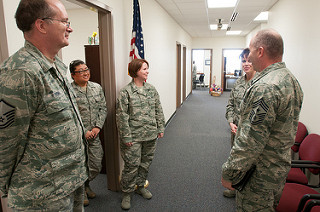
Chief Master Sgt. James W. Hotaling, command chief master sergeant of the Air National Guard, meets with Airmen from the 123rd Airlift Wing during a tour of the Kentucky Air National Guard Base in Louisville, Ky., on March 16, 2013. Hotaling, who assumed the job Feb. 4, 2013, was in town to serve as the keynote speaker of the Kentucky National Guard’s Outstanding Airman and Soldier of the Year Banquet. (U.S. Air Force photo by Staff Sgt. Maxwell Rechel)
He served for 10 years on active duty, performing various operational and staff duties. After a small break in service, he joined the US Coast Guard Reserve as a Port Security Specialist. In 2001, Hotaling rejoined the Air Force as a combat control reservist, serving as an individual mobilization augmentee.
In 2003, he was instrumental in the establishment of the Oregon Air National Guard’s 125th Special Tactics Squadron, and he served as the Senior Enlisted Advisor to the Oregon Joint Force Headquarters-Combat Operations Group.
Story and photos by Sgt. Datarra Ignacio-Hooper, 238th Regiment
NOTE: Often, kentuckyguard.com publishes stories by or about Kentucky National Guard unit public affairs historian representatives, also known as UPAHRs. This is an additional duty taken on by a Soldier or Airman with the intent of telling their unit’s story. This is one such story ….
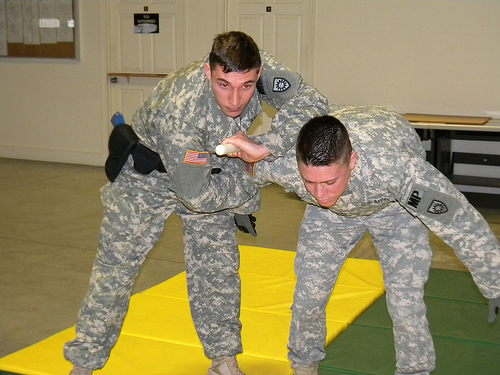
Spc. Aaron Lunn (left) performs a mechanical advantage control hold with a baton on Sgt. Joseph Zaragoza during military police training at Wendell H. Ford Regional training Center in Greenville, Ky., March 4, 2013. (KYNG photo by Sgt. Datarra Ignacio-Hooper)
GREENVILLE, Ky. — There was plenty of hands on training taking place at the Wendell H. Ford Regional Training Center involving military police instructors and their students. The 31B Military Police Reclassification Course is designed to prepare the Soldier to perform duties at Skill Level 1 in MOS 31B. According to course instructors, the course contains the critical tasks for duty performance at this level and presents them using sound training methodologies.
“A military police officer does an array of duties” said Sgt. 1st Class Donald Green, an instructor at the 238th Regiment. “Military police are responsible for providing support to the battlefield by conducting area security, internment/resettlement, maneuver and mobility support, law and order, and police intelligence operations.”
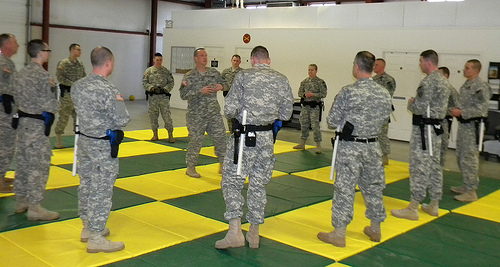
Staff Sgt. Cutris Stalcup, a Military Police Instructor briefs students on Search Technique Training and Restraint Techniques during a MP course at Wendell H. Ford Regional Training Center in Greenville, Ky., March 4, 2013. (KYNG photo by Sgt. Datarra Ignacio-Hooper)
Once re-classed, a military police officer will be able to protect lives and property on Army installations by enforcing military laws and regulations, as well as controlling traffic, preventing crime, and responding to emergencies.
Sgt. 1st Class Stephen Montgomery, a student in the course said there was a wealth of information in the training, including responsibilities while off military installations..
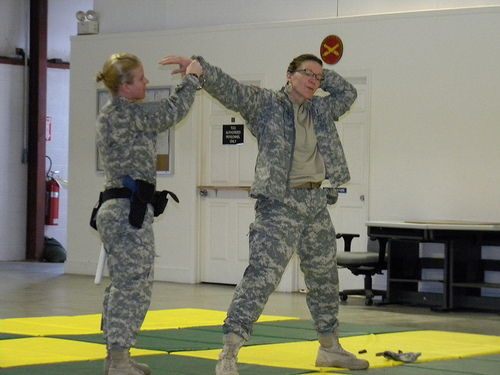
Spc. Billie Jacobs (left) removes handcuffs from an acting suspect Sgt. 1st Class Michelle Owen during a military police training course at Wendell H. Ford Regional Training Center March 4, 2013. (KYNG photo by Sgt. Datarra Ignacio-Hooper)
“I enjoyed learning about the new information that was being shared,” he said. And overall, I’m impressed about how much the MPs are involved in the community.”
Story and photos by Spc. Matthew Thomason, ADT 5
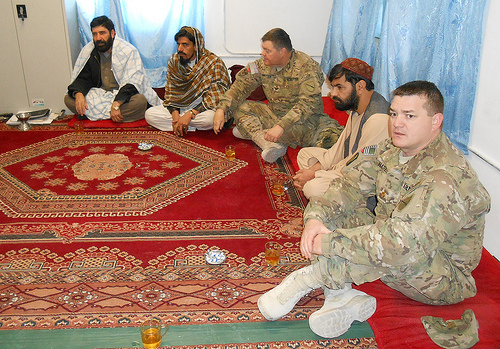
Col. Bob Hayter (center) and Maj. James Hatfield, of Kentucky’s Agribusiness Development Team 5 meet with farmers and Afghan government officials in the Zharay District, Jan. 23, 2013. The meeting brought roughly 200 farmers together to discuss potential improvements in farming in the area. (Kentucky National Guard photo by Spc. Matthew Thomason)
ZHARAY DISTRICT, Afghanistan — Darkness enveloped the landscape as soldiers from Kentucky Agribusiness Development Team 5 began strategically placing their vehicles and personnel at the Zharay District Education Center on January 23, 2013. They were there to provide security, oversight and facilitation for the government shura. The shura would address multiple issues such as irrigation, pest control and livestock management that local farmers were dealing with and attempt to help these farmers resolve their agricultural problems.
A shura is an Islamic process of decision making through assembly and deliberation. It comes from the Arabic word for consultation.
“This shura linked over 200 local farmers with GIRoA (Government of the Islamic Republic of Afghanistan) officials at both the district and provincial level,” said Tech Sgt. Nathan Steele. “By implementing surveys on 15 different topics, we are able to better understand what problems these farmers face.”
ADT 5 has been diligently working alongside officials of the GIRoA to improve the resources and education of the farmers within Zharay District and their ability to provide sustainment for both themselves and the local economy.
“ADT 5 has the ability to indirectly reduce kinetic activity on the battlefield by helping to improve the farmer’s ability to provide food for their families and generate income,” said Steele. “The less money the farmers have to take from the Taliban produces one less IED or enemy fighter to target ISAF or GIRoA forces.”
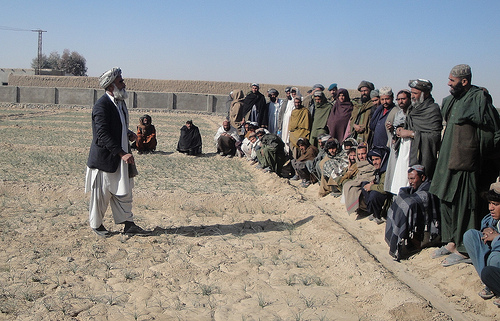
Local farmers meet with officials of the Government of the Islamic Republic of Afghanistan in the Zharay District, Jan. 23, 2013 to discuss the problems the farmers face in the area. Soldiers of Kentucky’s Agribusiness Development Team 5 assisted in the council and provided security to the gathering. (Kentucky National Guard photo by Spc. Matthew Thomason)
“This is the first shura of its kind in this area and outside the wire, coordinating security between the Afghan National Army, Afghan Uniformed Police and ISAF personnel that received no interference by opposing forces. This really speaks volumes to the will of the Afghan people and the success of ISAF forces in a region once known as the birthplace of the Taliban,” he explained.
The undisputed success of this shura truly speaks to the dedication of both the ISAF and GIRoA forces who are both working toward a common goal of success for the nation and people of Afghanistan.
Steele said there are broader impacts of the shura’s success, calling it a show of competency in the local government. He believes that because of actions such as this, the people of Afghanistan can see that their government is working for them.
“This discredits the Taliban and insurgency and helps to ensure the confidence of the people is in their own government, he said. “In my opinion, we (ISAF and GIRoA forces) didn’t just aide local farmers today, we helped to ensure the success of Afghanistan and that is a win in my book.”
“Best bang for the buck” prepares active duty and reserve component Soldiers for real world missions
Story by David Altom, Kentucky National Guard Public Affairs
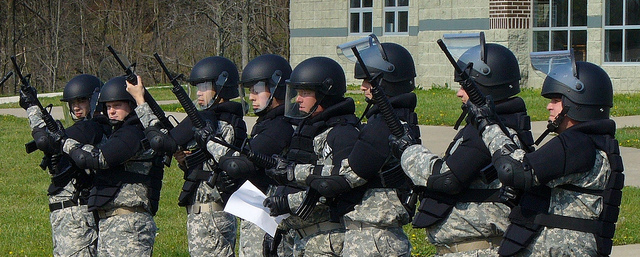
“Always ready, reliable and accessible!” Military police students practice civil disturbance tactics during MOS class at the 238th Regimental Training Institute at the Wendell H. Ford Regional Training Center. The 238th RTI recently received accreditation as an Institute of Excellence, qualifying it to teach active duty and reserve component soldiers across several disciplines. (Kentucky Army National Guard photo by Sgt. 1st Class Dennis M. Anderson, 238th Regimental Training Institute)
GREENVILLE, Ky. – In a time of budget cuts, drawdowns and a post-war scramble for resources and money, a bright light of achievement shines on the Commonwealth of Kentucky. The 238th Regimental Training Institute, once reknown as the Kentucky Military Academy, has caught the eye of the United States Army – and in a good way.
It was January of this year that the 238th RTI was designated as an “Institute of Excellence” by the Army, the culmination of a series of inspections that resulted in a 98% average, with three of five inspections with a perfect score. This designation is the first for the 238th, covering a variety of disciplines to include field artillery, infantry, military police, officer candidates and warrant officer candidates.
What does this achievement mean for the 238th RTI and the Kentucky Army National Guard? In short, it means greater training opportunities for the Kentucky Army Guard and a secure relationship with Big Army.
“This Institution of Excellence accreditation puts us in the top echelons of our peers,” said Col. Allen Denny, commander of the 238th RTI. “This is important as it gives us a leg up when competing for resources, additional courses and other opportunities.”
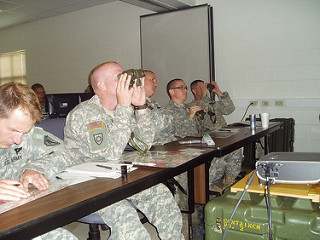
Students in an artillery class conducted by the 238th Regimental Training Institute at the Wendell H. Ford Regional Training Center. Cadre push to have the latest training on the technological skills so soldiers are better prepared when they hit the ground on deployment. (Kentucky Army National Guard photo by Sgt. 1st Class Dennis M. Anderson, 238th Regimental Training Institute)
“We are in an uncertain environment due to a shift in strategy, a transition from an Army at War to an Army in Preparation, and an era of fiscal uncertainty,” said Denny. “However, this accreditation puts us in excellent position to maintain and to grow and to continue to add benefit to the Kentucky National Guard and the One Army School System.”
With 11 full-time and 54 part-time staff members on board at the 10,000 acre Wendell H. Ford Regional Training Center, the 238th RTI is not the largest such institution, which makes the accreditation all the more remarkable. Other facilities such as Camp Shelby, Miss. and Fort Jackson, S.C. have been around for a lot longer and are considerably larger, but the 238th RTI is hot on their heels in terms of growth and quality of instruction.
Click here to read about the Kentucky Army Guard’s first ever combined officer and warrant officer graduation
“This accreditation solidifies our credibility, whether it’s training Kentucky National Guardsmen or Guard members from other states,” said Lt. Col. William McDaniel, operations chief for the 238th. “It also gives us the opportunity in certain course fields that we have to train active component Soldiers so they receive the same training value here that they would at an active duty school.”
Capt. Anthony Haley, budget analyst resource manager, wasn’t surprised that the regiment received its accreditation. “This was something we’ve been preparing for about three years. A lot of hard work and dedication went into preparation into getting to this point.”
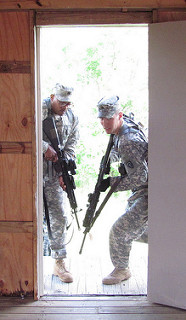
Busting down doors — Students practice tactical skills during exercises conducted by the 238th Regimental Training Institute at the Wendell H. Ford Regional Training Center. The quality of training provided by the 238th RTI is such that it’s common for students to return home and ask when the next level class is available. (Kentucky Army National Guard photo by Sgt. 1st Class Dennis M. Anderson, 238th Regimental Training Institute)
Credit where credit is due
While Haley said that the accreditation was a team effort, he pointed to two specific elements in the mission’s success: the training staff and cadre, and the quality assurance team.
“Our quality assurance guys need to get some of the credit. They spent a lot of time looking the documents and the standards and making sure that when the TRADOC accreditation team came that they could see and understand that we were meeting the Army standards.”
To hear everyone talk about the accreditation process, Sgt. 1st Class Kevin Estes gets much of the credit for making sure that the regiment got it’s due recognition. Regulations had to be analyzed, spreadsheets composed and binders assembled. Then it all had to be presented and explained. As the quality assurance NCO, that was Estes’ job and he’s lauded by the staff for pulling it off with exemplary professionalism and a ton of hard work.
Estes, a true quiet professional, summed it all up in one sentence: “It was just another day in the office.”
There’s more to it, of course. Estes explained that while he had to look at and assess the standards, the instructors were the ones who got the job done … and done right!
Professional and credible instructors
“The regiment has always had good instructors,” he said. “But it wasn’t always easy to show ‘what right looks like.’ We’ve always instructed very well and put out quality Soldiers. What the accreditation standard does is make you show that you’re actually doing that, and doing it at a higher standard.”
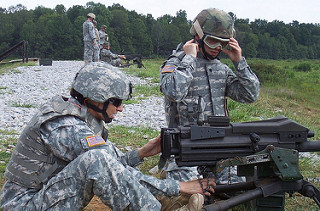
At the firing range with the 238th Regimental Training Institute at the Wendell H. Ford Regional Training Center. Hands on application of classroom skills is an essential ingredient in training professional soldiers. (Kentucky Army National Guard photo by Sgt. 1st Class Dennis M. Anderson, 238th Regimental Training Institute)
That’s the measuring of it all. But then there’s the actual hands-on instruction, the meat of the matter and the key to the 238th’s success.
“What it all boils down to is, if we’re not putting out a quality product, we’re not going to get repeat business,” said Sgt. 1st Class James Abston.
The quality product, of course, being professionally trained Soldiers. A field artillery course manager, Abston says the “repeat business” from his students is testament to the high level of training affected by the regiment.
“Our students are the reason we’re here,” Abston said. “I’ve got guys who just graduate from the lower level courses emailing me asking when the high level courses are being offered. They’re getting our name out there and asking to come back, plus they’re telling their units to send more troops to us for training.”
The accreditation is all nice and good, but Abston sees the role of the regiment as a higher calling.
Click here to find out more about the Kentucky National Guard Warrant Officer program
“To me the most important part is that these students can wind up deploying and in the middle of the fight. Most of them have already been deployed – they’re war veterans and they know what they need. They’ll throw down the flag if they need to, so that means you have to provide quality training and prove that you know what you’re talking about.”
The experience and leadership exhibited by the students has proven to be an asset to the schoolhouse, says instructor Sgt. 1st Class Timothy England.
“We scan our students as they come through and we put a bug in their ear about coming back and being an instructor,” he said. “Our instructor pool improves with each year. They learn from each other, they don’t hoard information but instead they love sharing it.
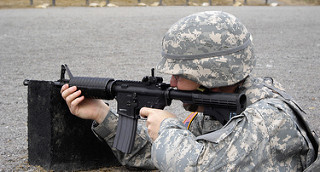
This is what it’s all about! The 238th Regimental Training Institute has full access to range facilities at the Wendell H. Ford Regional Training Center, one of the fastest growing training sites in the nation. (Kentucky Army National Guard photo by Sgt. 1st Class Dennis M. Anderson, 238th Regimental Training Institute)
NCOs are the backbone
Of course, behind every unit is a top sergeant, in this case the regiment’s Command Sgt. Maj. Timothy Goad. And like any good top sergeant, Goad brags on his non-commissioned officers, giving them credit for the work that’s been done.
“As long as the Army’s been around the NCO corps has been its backbone. In the time that I’ve been here I’ve been so proud of the quality of our NCOs. They’re phenomenal! I just give them some direction and they take it and run with it. You can’t find a better group in my opinion. That shows in our accreditation as an institute of excellence.”
Goad points out that a majority of the RTI’s staff is M-Day, or part-time. “I have to salute our M-Day staff. They’ve got other jobs and careers in the civilian world, but they still put out quality training that is high above the standard.”
One of the misconceptions about the regiment is that it doesn’t deploy. That’s true. But it’s also true that “the school house” is full of instructors who have deployed, literally “been there, done that and got the t-shirts to prove it.”
“Approximately 80 percent of our staff has deployed at one time or another,” said Master Sgt. Charles Johnston, senior field artillery instructor. “When our students see that combat patch on their instructor’s uniform, that means something.”
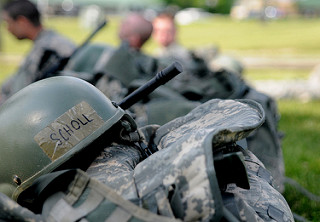
Kentucky National Guard Officer Candidate students take a moment to relax after a required 10-mile ruck march to complete phase two of their OCS curriculum with the 238th Regimental Training Institute at the Wendell H. Ford Regional Training Center. The 238th RTI also offers a warrant officer candidate program as well as a broad range of MOS training for active duty and reserve component NCOs. (Photo by: Spc. David Bolton, Public Affairs Specialist, 133rd Mobile Public Affairs Detachment, Kentucky Army National Guard).
Technology and the future
Johnston also points out that the 238th RTI aggressively pursues updating the technology that they teach on. “If we find out that our courses are lagging behind we push pretty hard to make sure that we update our gear and put it in our training. We want to make sure that what we’re teaching is something that matters to our students and is up to date.”
So there you have it. While history shows that the post-war U.S. military often ponders future missions and direction, the Kentucky National Guard and the 238th Regimental Training Institute have a definite purpose – and perhaps even a higher calling.
Chief instructor Master Sgt. John Hazlett sums it all up with characteristic though practical optimism:
“This accreditation is a celebration of the fact that we have all of these different elements at this regiment and they’re all being recognized at the highest level. If any of these elements fail at their job, we don’t become an institute of excellence. So everybody’s got to do their part for us to succeed.”
“The future of the Kentucky National Guard is happening now at the 238th,” said Hazlett. “The point of the spear is right here. New ideas that come out of active duty, from Afghanistan, Iraq and Africa, we’re the first to implement those right here, right now. When a Soldier comes here, they truly learn how to be a leader, how to lead a squad, a platoon or a company. When they leave here, they leave better than they ever were before.”
By Maj. Dale Greer 123rd Airlift Wing Public Affairs
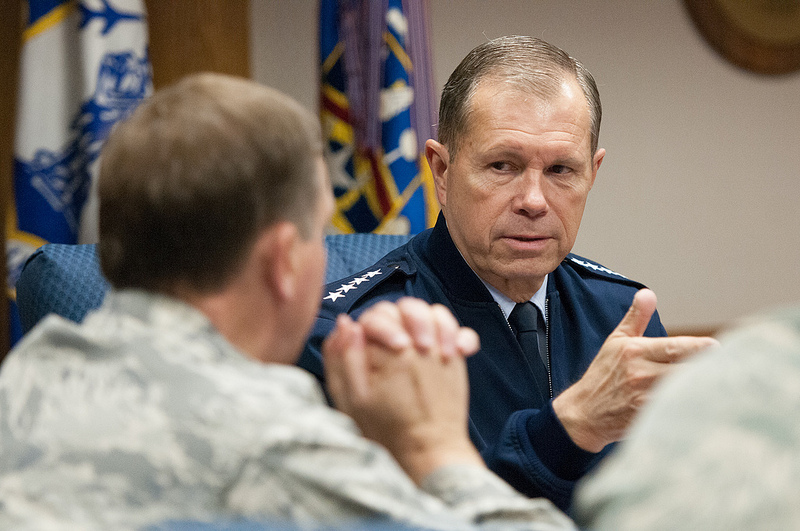
Gen. William M. Fraser III (right), commander of U.S. Transportation Command, speaks with Kentucky’s adjutant general, Maj. Gen. Edward W. Tonini, during a visit to the Kentucky Air National Guard Base in Louisville, Ky., on March 12, 2013. Fraser was on base to learn more about the mission and the Airmen of the 123rd Airlift Wing. (U.S. Air Force Photo by Master Sgt. Phil Speck)
LOUISVILLE, Ky. — The commander of U.S. Transportation Command toured the Kentucky Air National Guard Base here March 12, marking the second time in little more than a month that a four-star general has visited the 123rd Airlift Wing.Gen. William M. Fraser III, who was on base to learn more about the unit and its Airmen, received a mission brief from Col. Warren Hurst, wing commander, and Maj. Gen. Edward W. Tonini, Kentucky’s adjutant general.
Fraser also talked with troops and examined a range of static displays that showcased the wing’s disaster-relief capabilities, from special tactics and contingency response to a new Mobile Emergency Operations Center, a state-of the-art field kitchen and Kentucky’s Fatality Search and Recovery Team.
The Fatality Search and Recovery Team, or FSRT, is one of just 17 in the Air National Guard, according to Master Sgt. Krista Lindsey, non-commissioned officer in charge. Team members, who are tasked with recovering the remains of victims killed by natural disasters or hostile action, can operate in a variety of dangerous environments, including those contaminated by nuclear, biological or chemical agents.
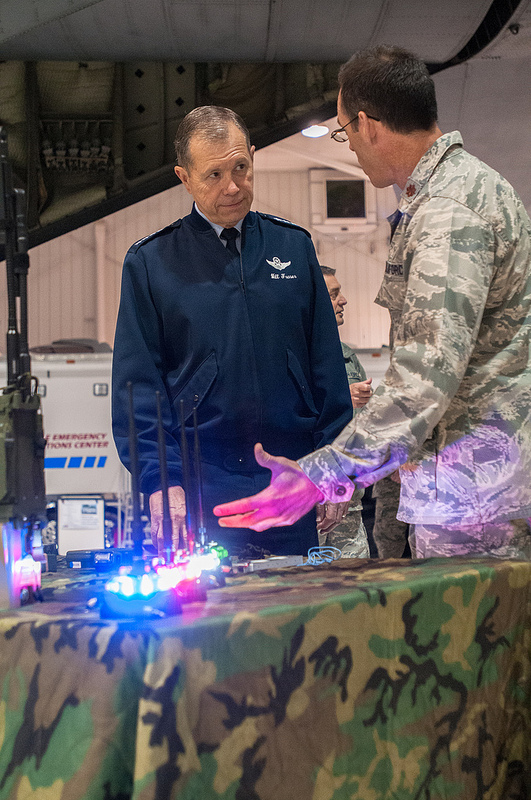
Maj. Sean McLane, director of operations for the Kentucky Air National Guard’s 123rd Special Tactics Squadron, demonstrates a variety of special operations equipment to General William M. Fraser III, commander of U.S. Transportation Command, during a tour of the 123rd Airlift Wing in Louisville, Ky., on March 12, 2013. The gear is used to establish operations at austere landing zones. (U.S. Air Force Photo by Master Sgt. Phil Speck)
The Mobile Emergency Operations Center is a 36-foot long, $750,000 trailer equipped with an on-board generator, a full suite of civilian communications capabilities and meeting room space. It can be towed to the scene of any domestic catastrophe and serve as a technological bridge between military and civilian communications networks, according to Senior Master Sgt. Carol Davis, emergency manager for Kentucky’s 123rd Civil Engineer Squadron.The field kitchen, formally known as the Disaster Relief Mobile Kitchen Trailer, offers a vast improvement over previous models because it offers greater efficiency and boasts high-tech features like a touch-screen recipe database, said Tech. Sgt. Ricky Odle of the 123rd Force Support Squadron. Nine Kentucky Air Guardsmen deployed to Washington, D.C., with the kitchen in January, serving more than 1,800 hot meals to U.S. troops supporting the inauguration of President Barack Obama.
Gen. Paul J. Selva, commander of Air Mobility Command, viewed the same displays when he visited the 123rd Airlift Wing on Feb. 5.
Story by Staff Sgt. Scott Raymond, Kentucky National Guard Public Affairs
In recognition of March as Women’s Month, kentuckyguard.com is publishing a series of articles honoring women who are significant figures in Kentucky’s military history. The following is one such story ….
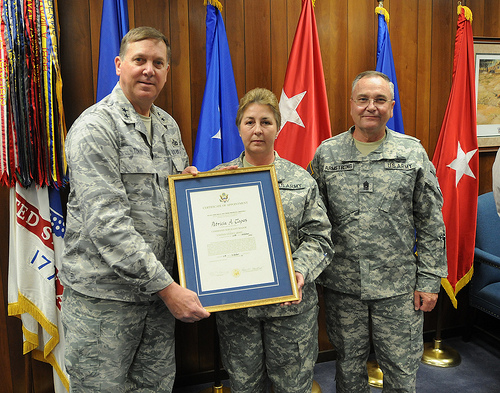
Kentucky adjutant general, Maj. Gen. Edward W. Tonini presents Sgt. Maj. Pat Copas with a plaque upon her promotion to the rank of command sergeant major during a promotion ceremony at Boone National Guard Center in Frankfort, Ky., Oct. 31, 2012. Copas is just the third female to hold the rank of command sergeant major. (KYNG photo by Staff Sgt. Scott Raymond)
FRANKFORT, Ky. — In the history of the Kentucky National Guard, only three female Soldiers have risen to the rank of command sergeant major. In October of 2012, Pat Copas became the third. There are only 18 command sergeants major in all of Kentucky’s citizen-Soldiers, of which two are female, Copas and Command Sgt. Maj. Teresa Rea.Copas admits that it’s sometimes more difficult for females to progress in their careers, but says if they work hard and stay focused, they too can prove they are equals and do the job just as well.
“I feel very blessed that our leadership had the confidence to select me for greater responsibilities,” she said of being promoted to command sergeant major. “Getting to this point in my career has been very challenging but also very rewarding.”
Copas has served in the Kentucky Guard since 1981 when she enlisted as a traditional Soldier in the 475th Mobile Army Surgical Hospital (MASH). She has been a full-time Soldier since 1983, working in supply and personnel. She called becoming first sergeant of Joint Force Headquarters in 2005 a highlight of her career as she had the opportunity to work directly with Soldiers and to have a greater impact on their training and welfare.
Her role of “great responsibility” has her working to improve readiness of Soldiers and advance their professional development, but also to improve diversity
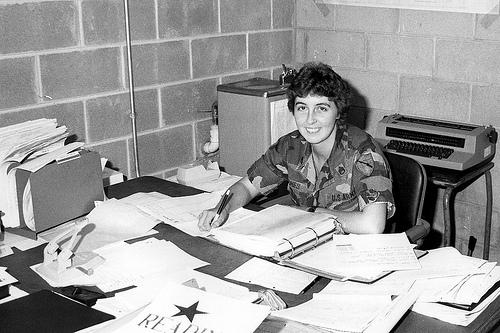
Then Staff Sgt. Pat Copas worked as unit supply sergeant for the 63rd Theater Aviation Brigade in Frankfort, Ky., 1993. (Courtesy photo)
A command sergeant major is the highest ranking enlisted advisor to the commander, and Copas nows overseas the most diverse battalion in the Kentucky Guard. The 751st Troop Command is made up of nearly 700 Soldiers, and roughly 20 percent are female. The battalion is made up of units from Richmond to Paducah, including transportation units, a medical company and the 202nd Army Band.”The 751st is the most diverse in Kentucky due to the multiple types of units. The Kentucky National Guard is working to improve diversity within our organization but we still have a long way to go.”
Copas said she wants to see more professional and dedicated females strive to attain leadership positions in the Guard. She pointed out Sgt. Maj. Janet Timberlake, who also was recently promoted, becoming the first African-American female sergeant major in Kentucky. She also became the sixth female to hold the rank.
“It’s Soldiers like Sergeant Major Timberlake that exemplifies what a Soldier should be,” said Copas. “She is a very dedicated and hard-working leader who embodies the seven Army values. I was very proud to see this senior NCO, a female, promoted to the rank of sergeant major.”
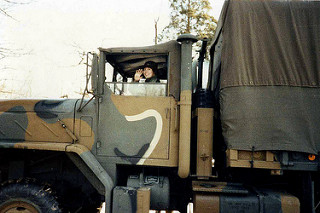
Pat Copas waves from the cab of a supply truck of the 475th Mobile Army Surgical Hospital (MASH) in 1985. (Courtesy photo)
Copas said some of the proudest moments of her career are the opportunities she gets to see Soldiers that she mentored progress in the Guard. Working at the unit level allowed her to work closely with Soldiers and now she is taking that approach to the next level. The rank has changed and her duties are different, where she may have more on her to-do list, but the basic characteristics of a NCO remain. She is still in the business of taking care of Soldiers.”When I think back on my life before the Guard, what I have accomplished makes me very proud,” she said.
By Kentucky National Guard Command Historian John Trowbridge
With March being Women’s History month kentuckyguard.com is publishing a series of stories celebrating Kentucky women and the roles they played in our military history. Following is one such story ….
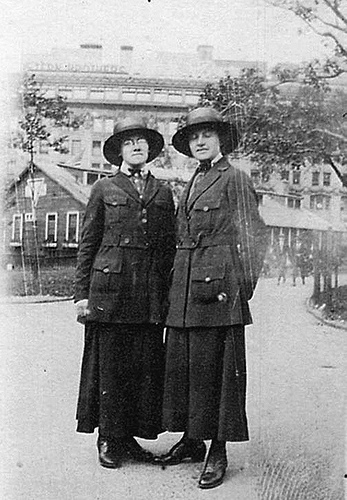
Elizabeth Eleanor and Margaret Gretchen Minnich,
while serving in the U.S. Army Nurse Corps at Sarisbury
Court, England.
FRANKFORT, Ky. — Part one of this story provided a brief history on women in the United States during World War I and how Elizabeth and Margaret Minnich came to uniformed service. Part two continues with their mobilization and deployment to Europe.
On 23 February 1918, the Minnich sisters’ unit was mobilized into active duty service and on 1 March was ordered to Camp Zachary Taylor in Louisville for additional instruction and training until 18 June 1918. In early April, the nurses were ordered to active duty for training, some reported to Camp Taylor, others were sent to hospitals at Camp Dix, Camp Sherman, Camp Devens, Camp Greene, Camp Lee, and Camp Upton. The Minnich sisters were sent to Camp Meade, Maryland, for their training.
By June 1918, Gorgas had certified Base Hospital No. 40 was prepared to take charge of a hospital in France, or anywhere else, and to conduct it to the best interest of the soldiers, and to the satisfaction of the Medical Department.
On 28 May 1918, Elizabeth and Margaret Minnich were ordered to the Holley Hotel in New York City, to await the arrival of the remainder of personnel of Base Hospital No. 40 at Camp Mills, prior to deployment overseas. After staying at the hotel, the nurses were assigned to comfortable quarters at various locations around the city until ordered overseas. In the interim, the nurses’ uniforms were being made and fitted by the Red Cross. In the afternoons, at the Armory in New York City, the nurses were drilled and given military instruction. During their stay in New York they were cared for by the Red Cross Association.
By 12 July 1918, the Minnich sisters were aboard the famous White Star Line’s RMS Olympic, which arrived at Southampton, England, on 19 July. The Olympic, sister ship of the Titanic and Britannic, had been converted into a troop transport in support of the war effort. The trip across the ocean was uneventful, the ocean quiet. Although the Olympic was crowded, everyone seemed happy and anxious to get to work. Upon arrival at the Southampton docks the nurses were sent to Sarisbury Court, arriving there the following morning by truck. When the personnel of Base Hospital No. 40 arrived at Sarisbury Court, the construction of the hospital buildings was not complete.
The majority of the personnel were detached and assigned to English and American hospitals in England and France. Quarters for the nurses had not been completed, so they had to be quartered on the third floor of the mansion house. Sarisbury Court was scheduled to be the largest American hospital in England. It was situated along a bend of the Hamble River, about six miles from Southampton; the estate covered 186 acres of rolling farmland, meadows, and woods. The manor house stood on high ground and on a clear day its tower could be seen twenty miles away. The manor house and surrounding property had been purchased by the American Red Cross for conversion to an American hospital.
The Red Cross personnel assigned to Sarisbury Court tried to relieve the Kentuckians’ homesickness and the boredom of waiting for patients by organizing entertainment and recreational activities for them. Captain Thomas C. Campbell, the Red Cross chaplain, organized a glee club and string band with Bruce Reynolds and Sidney Freeman, former members of the Boston Symphony Orchestra, who were serving with Base Hospital No. 40. Captain Campbell introduced croquet and lawn tennis to the nurses. Additionally, he observed that English women rode bicycles, and he procured a number of bicycles for the use of the nurses. To his surprise he discovered that only a few of the American nurses knew how to ride.
The nurses’ time in service was not all fun and games; they still had their duty to perform. When Base Hospital No. 40 arrived in England their hospital was not completely built, so personnel were assigned to various hospitals across England and France. Some of these teams were stationed close to the front and came under the guns of the enemy near the Metz Front and the Argonne Forest. In a letter written to The Lexington Leader, Corporal John R. Marsh, who had been a reporter for the paper before the war, made the following commentary on his returning fellow members of Base Hospital No. 40 that had been serving in France: Our “overseas contingent” got back from France the other day loaded down with souvenirs and stories, not to mention a few of those interesting creatures the A. E. F. has lovingly named “cooties.
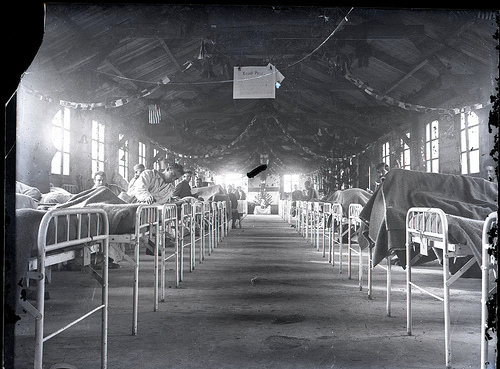 On 17 August, Margaret was part of a ten-nurse detachment attached to American Red Cross Medical Hospital No. 21, Paignton, Devonshire, England, and served with that organization until re-assignment to Base Hospital No. 40 on 2 January 1919.
Elizabeth remained with Base Hospital No. 40 in her sister’s absence. The Sarisbury Court hospital was opened for admission of patients on 27 September 1918, 125 cases being admitted on that date. During its operation, the majority of the hospital cases seen by the doctors and nurses were influenza and pneumonia and their complications.
The reunion of the sisters at Sarisbury Court in January 1919, was short lived, for, on 15 February, Margaret reported to Base Hospital No. 113, at Savenay, France.
The following day Elizabeth reported to Evacuation Hospital No. 20, located at Beau Desert, in the vicinity of Bordeaux, France, serving with that organization until 14 May 1919. On 15 May, Elizabeth was assigned to Base Hospital No. 111, also part of the Hospital Center, Beau Desert.
In June 1919, the sisters were reunited, this time in Savenay when Elizabeth was assigned to Base Hospital No. 113. During this time Base Hospital No. 113 was designated as a hospital from which all disabled nurses were to be evacuated to the United States. Records do not indicate if either of the sisters was ill during their time with this unit. However, unlike the other nurses of Base Hospital No. 40, they did not return to the United States with their original unit.
On 15 July 1919, the Minnich sisters sailed from St. Nazaire, France, aboard the Santa Teresa, arriving in New York on 27 July 1919. On 22 August, Elizabeth was placed on the Reserve Nurse List at Camp Dix, New Jersey. On 31 August, Margaret was also relieved from active duty. So ended the military careers of the Minnich sisters.
The war made a lasting impression on the Minnich sisters. They had survived their overseas military service; and although they had not come under direct fire of the enemy, they still shared with their male counterparts the suffering, death, and hazards of war. These women saw, first hand, the horror of war and its aftermath on the human body and spirit. They had to contend with, on a daily basis, the uncertainty of war. There was always the possibility of an attack by the enemy on their hospital, or the possibility of reassignment to a location closer to the front. They not only had to care for their patients, they had to take care of themselves to insure they did not become a casualty of an infectious disease.
Following their military service, the Minnich women returned to Kentucky and their nursing careers. The 1920 Federal Census listed Margaret as living in Paducah and Elizabeth as living in Frankfort.18 In August 1921, Margaret married Dr. Cary Randolph Blain, a Presbyterian minister of Christiansburg, Virginia. Margaret and Cary never had any children of their own; however, they adopted and raised three children.
In the early 1920s Elizabeth was working at Kings Daughters Hospital on East Main Street in Frankfort. She later moved to Breathitt County, taking a nursing position at Bach Memorial Hospital. By the 1930s she had moved to Ashland, where she worked as a nurse at Kings Daughters Hospital.20 In 1936, she became extremely ill, and, due to her veteran status, was sent to the Veterans Home in Dayton, Ohio, for treatment. Elizabeth Eleanor “Lizzy” Minnich died at the Veterans Home on 16 June 1939, following a three year illness. Her body was brought back to Kentucky where she was buried with military honors near the grave of her father, and sister, Rose, in the Ashland Cemetery.
During his military service, Private First Class John Bayles Minnich served at the Edgewood Arsenal in Maryland.23 According to his service record, he served with the newly organized Chemical Warfare Service. He was discharged on 8 December 1918. After the war, John returned to the hotel business, once again managing the Continental Hotel in Pineville. On 27 May 1927, he married Edith Nuckols, a schoolteacher in Pineville. The couple had one child, Elizabeth Gretchen Minnich, named in honor of her two aunts.
John Minnich served as president of the Kentucky Hotel Association in the 1920s. He moved his family to Middletown, Ohio, in 1930 when he took the manager position at the Manchester Hotel for Armco Steel Corporation. He served as the head of the Gas Rationing Board in Middletown during World War II. In 1965, the family moved to Ormond Beach, Florida, where John retired. He became a member of the Ormond Beach American Legion Post 267, the Oceanside Country Club, and the First United Methodist Church. John Minnich died on 21 April 1977, at the Ormond Beach Hospital. His remains were cremated.
A year after the death of her brother, on 1 April 1978, Margaret Gretchen Minnich Blain died at the Regency Nursing Home, Forstville, Maryland. She is buried in the historic Stonewall Jackson MemorialCemetery in Lexington, Virginia.
The story of this Kentucky family serves to illustrate the sacrifice not only of this family, but is typical of many American families who served in the armed forces of the United States during World War I. Although these Kentucky veterans were not in battle or on the battlefront, when called upon, they volunteered to serve. They honorably and faithfully performed their duty to their country. They put their lives on hold, willing to sacrifice their lives for a belief in democracy and freedom in the “War to End All Wars.”
By Kentucky National Guard Command Historian John Trowbridge
With March being Women’s History month kentuckyguard.com is publishing a series of stories celebrating Kentucky women and the roles they played in our military history. Following is one such story ….
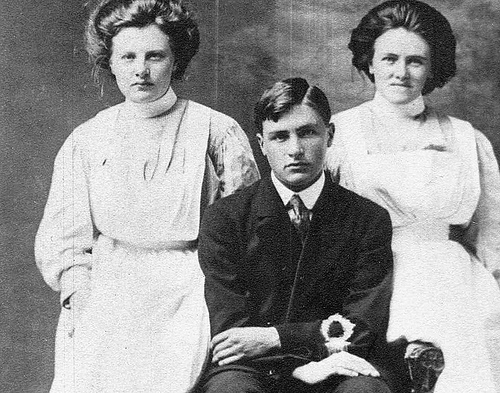
Margaret Gretchen, John Bayles, and Elizabeth Eleanor Minnich.
FRANKFORT, Ky. — The door that barred the way to women joining the ranks of the United States military was opened slightly on 28 February 1901, with the introduction of the Nurse Corps (Female) and on 13 May 1908, with the establishment of the Navy Nurse Corps. However, it was not until the United States entered World War I that the government and the military authorities got serious about allowing women into the service.
Approximately 4,300,000 Americans served in the military during the war. Of that number an estimated 30,000 were women. American women served in the Army, Navy, Marines, and Coast Guard.
American servicewomen served around the globe; by war’s end they had seen service in the Philippines, Guam, Samoa, Haiti, Virgin Islands, England, Ireland, Scotland, France, Belgium, Italy, Serbia, Siberia, Hawaii, and Puerto Rico, in addition to various locations within the United States.
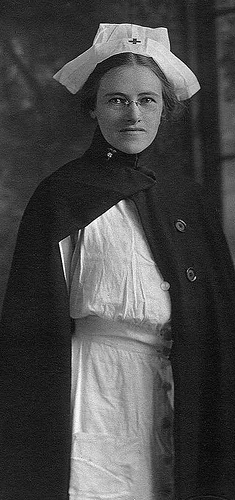
Elizabeth Minnich in her nurse uniform.
Many women who served overseas in combat areas suffered the same hardships and potential dangers of their male counterparts. Some women serving near the battlefront were killed in accidents, others were wounded or gassed, some died of disease. A number of American nurses are buried in military cemeteries in foreign countries far from their native soil. More than 320 American women serving in the military were casualties of the war to end all wars.
Women served valiantly with dedication and devotion to duty throughout the war. Three Army nurses were awarded the Distinguished Service Cross, twenty-three received the Distinguished Service Medal, while numerous others received a variety of citations. Four Navy nurses received the Navy Cross, while six others received citations. More than 100 Army nurses were awarded with French decorations.
The British military presented decorations to more than ninety Army nurses.
Once war ended and the role of women in the military faded, they quietly returned to their homes, families, and civilian life. Though the Army and Navy Nurse Corps continued to exist in peacetime, it would be a number of years before these women would receive the rank, pay, and benefits of their male counterparts. Many of the women “veterans” who had served in the Army Signal Corps during the war were told they would not be eligible for honorable discharge or veterans benefits. After a more than sixty-year battle, however, Congress passed Section 1414 of the GI Bill Improvement Act of 1977, finally giving the women veteran status.
During World War I, Kentucky provided approximately 250 women to the military service. These women came primarily from the nursing profession. Of the 250, fifteen were from the Appalachian region of the state.
An interesting case in point is the story of the Minnich family of Oil Springs in Johnson County, deep in the mountains of southeastern Kentucky. This mountain family provided two daughters and one son to the war effort. The three were the children of William W. and Myrain F. (Long) Minnich. Elizabeth Eleanor “Lizzie” was born on 22 November 1883, Margaret Gretchen was born on 30 July 1888, and John Bayles was born on 6 February 1890.
All three attended Berea College. Elizabeth and Margaret graduated from the College of Nursing with the class of 1909. Both women listed their home address as Olympia, Bath County. In 1911, John completed the three-year course. While attending Berea College, John dreamed of one day becoming governor of Kentucky. His working experience, however, was at Boone Tavern, and he spent his entire career in hotel management. Prior to his entry into military service, John was managing the Continental Hotel in Pineville, Bell County, Kentucky.
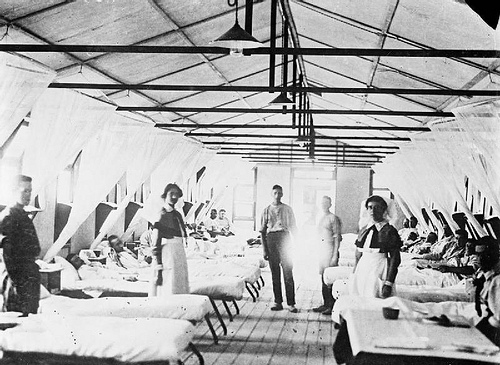 For nearly ten years following their graduation from Berea College, Elizabeth and Margaret worked at hospitals in Madison, Bell, Franklin, and Fayette counties. The United States entered the war on 6 April 1917. Elizabeth and Margaret joined exactly one year later, on 6 April 1918. John joined five days later, on 11 April. At time of enlistment, Elizabeth was thirty-four, Margaret was twenty-nine, and John was twenty-eight.
Both women were working for the Kentucky Public Health Nursing Association in Frankfort. Elizabeth lived at 190 North Upper Street in Lexington and is credited on official records to Fayette County. Margaret was living in the Pineville hotel managed by her brother and is credited to Bell County.
Elizabeth and Margaret joined Base Hospital No. 40, known as the “Barrow Unit” after its director, Dr. David Barrow of Lexington. In June 1917, Surgeon General William C. Gorgas authorized the organization of Base Hospital No. 40. Home for the base was Lexington’s Good Samaritan Hospital. All base hospitals were required to be sponsored by either a medical school or hospital. Organization of this unit was placed in the hands of the American Red Cross Association, with Colonel Jefferson R. Kean in charge. On 15 July 1917, Elizabeth Bogle, of Lexington, was appointed head nurse.
In December 1917, Dr. Barrow was instructed to change the original 500-bed unit to a 1,000-bed hospital, which would require an organization of thirty-three officers, 100 nurses, five civilian employees and 200 enlisted men. By late December the organization of Base Hospital No. 40 was completed, even though the nurses had not been called to active service.
Next up: Deployment and service in Europe!
Story and photos by Capt. Daniel Van Horn, Task Force Longrifles Public Affairs
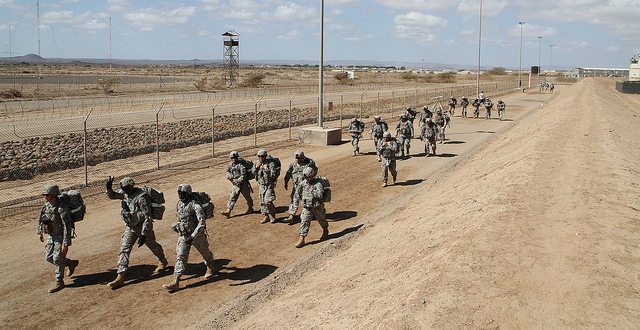
Soldiers from Task Force Longrifles begin the 9-mile ruck-march as part of the Longrifle Raid at Camp Lemmonier, Djibouti, Feb. 15, 2013. The march was one of several events that tested participants physical endurance, military skill and artillery knowledge. (Kentucky National Guard photo by Capt. Daniel Van Horn, Task Force Longrifles Public Affairs)
CAMP LEMONNIER, Djibouti — Soldiers from Task Force Longrifles will tell you that the 2013 edition of the Longrifle Raid was anything but easy.
The Longrifle Raid was started two years ago by the previous Battalion Command Sgt. Major, Thomas Chumley, and was a test of physical endurance, military skill, and artillery knowledge. Soldiers that successfully complete each event earn the right to wear the coveted Red Cord on their dress uniform.
This year’s Raid started with 27 Soldiers from across the battalion. The first event for the day was a standard Army Physical Fitness Test at 5:00 in the morning. Each Soldier had to score a minimum of 70 points in all three categories: push-ups, sit-ups, and 2-mile run. After successfully completing the APFT, Soldiers were able to get breakfast and change into a clean uniform before an inspection and drill and ceremonies competition lead by 1st Sgt. Robert Burns from Headquarters, Headquarters Battery.
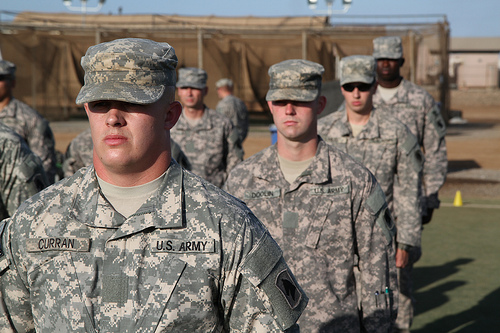
Soldiers from Task Force Longrifles complete an open ranks inspection as part of the Longrifle Raid on Feb. 15, 2013 at Camp Lemmonier, Djibouti.. (Kentucky National Guard photo by Capt. Daniel Van Horn, Task Force Longrifles Public Affairs)
“Drill and ceremonies is one of the skills that a Soldier should never lose. It is a snapshot of their ability and attention to detail,” said Burns after the last squad finished his event. “Having Soldiers from different units compete as one team also helps build camaraderie and teamwork which would be important for the rest the Raid.”
The next event was the obstacle course, which gave each Soldier an opportunity to once again get dirty and sweaty. The course was a physically demanding one where Soldiers had to complete 15 push-ups, a 180-pound tire flip five times, high-crawl, low-crawl, two 30-pound ammo can carries for 20 yards, 15 ammo can raises over their head, and finally sprint 100 yards with both cans to the start of the course.
With the sun starting to really heat up, the Soldiers began preparing for their next event, a nine-mile road march with 35 pounds in their rucksack. This event proved to be the hardest of the day with several Soldiers dropping out due to the heat. The route wound its way along the perimeter of the camp with Soldiers having to make three laps in less than 2.5 hours to qualify for the next event.
“Because of the heat, distance, and weight we had to carry, the road march was by far the hardest part of the Raid,” said 1st Lt. Denis Babiyev, executive officer from Bravo Battery.
With the physically demanding part of the raid complete, the events moved to military skill and artillery knowledge and included the following tests; loading and filling a radio, call for fire, 9-line medevac, un-exploded ordinance report, and react to enemy contact
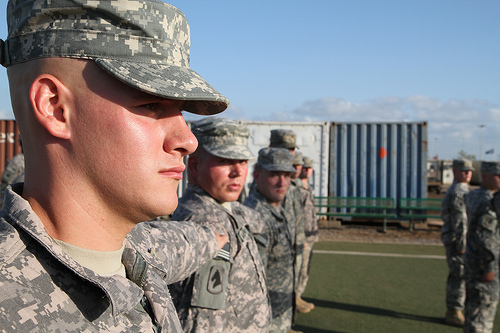
Sgt. Bradley Osbourne looks forward as the command for dress-right dress is given during a drill and ceremonies event at Camp Lemmonier, Djibouti, Feb. 15, 2013. (Kentucky National Guard photo by Capt. Daniel Van Horn, Task Force Longrifles Public Affairs)
For Spc. Tyler Douglas an Automated Tactical Data Systems Specialist with Charlie Battery, completing the raid this year was a big goal.
“I figured this deployment would be the best time to prepare for the Raid,” he said. “In the future, not many Soldiers will be able to say they earned it while deployed to Africa, so it’s a once in a lifetime opportunity.”
The final event consisted of an NCO board with the battalion command sergeant major and battery 1st sergeants asking one to two questions about the unit history, military customs/courtesies, artillery facts, and warrior ethos. The day was challenging, hot, and long, but by the end of it, twenty-one Soldiers had earned the distinct privilege of calling themselves Longrifle Raiders with a braided red cord adorning their shoulders.