Pages
Stay In Touch
More
© 2013 KentuckyGuard
By Lt. Col. Kirk Hilbrecht, Kentucky National Guard Public Affairs
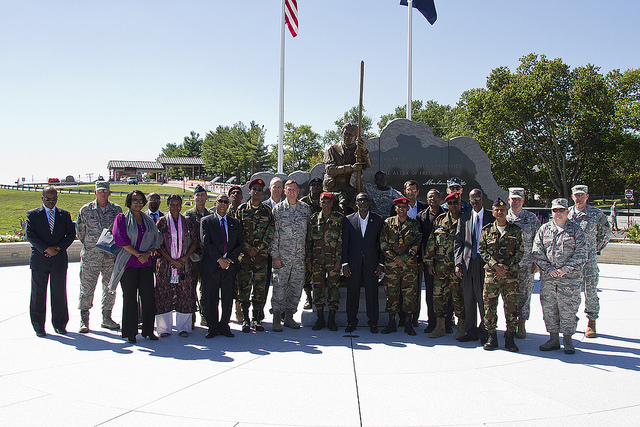
Kentucky Guardsmen gather with several members of Djibouti’s military and government cabinets at the Kentucky National Guard Memorial in Frankfort, Ky., Sept. 15, 2015. The visit was part of the Kentucky Guard’s State Partnership with Djibouti. (U.S. Army National Guard photo by Staff Sgt. Scott Raymond)
FRANKFORT, Ky. — The Kentucky National Guard hosted several members of Djibouti’s military and government cabinets, Sept. 13-20, as part of the Kentucky Guard’s State Partnership with Djibouti. Civilian members of the Djiboutian delegation included the Honorable Tom Kelly, U.S. Ambassador to Djibouti, the President of the National Assembly, Mr. Mohamed Ali Houmed, Djiboutian ministers of health, foreign affairs, chambers of commerce, and the University of Djibouti. The military delegates included chiefs of defense, Air Force, logistics, military education and materiel. This was the first Djiboutian partnership event in Kentucky since the National Guard selected Kentucky for this state partnership in June.
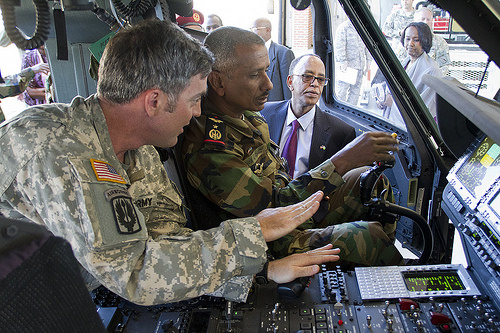
Chief Warrant Officer Kevin Keith discusses the capabilities of a UH-60 Blackhawk with Lt. Col. Chakib Mahamed Ali, deputy commander of the Djibouti Air Force during a visit to the Kentucky Guard’s Army Aviation Support Facility in Frankfort, Ky., Sept. 15, 2015. Members of the Djibouti military toured several sites across Kentucky as part of the country’s new partnership with the Kentucky Guard. (U.S. Army National Guard photo by Staff Sgt. Scott Raymond)
“Our Kentucky Guardsmen, our government officials and our civic leaders have been fantastic ambassadors to these global neighbors this week,” stated Kentucky’s Adjutant General, Maj. Gen. Edward Tonini. “We’re honored to host our new partners and friends from the Republic of Djibouti.”
While in Kentucky, the Djiboutian delegation toured Boone National Guard Center in Frankfort; ate dinner at the Governor’s Mansion with Lt. Gov. Crit Luallen; visited Kentucky troops working at Fort Knox and training at Wendell H. Ford Regional Training Center in Western Kentucky; toured Kentucky’s Air National Guard Base; made a stop at Churchill Downs; attended a University of Louisville football game; toured Waterstep and UPS; interacted with ROTC cadets at the University of Louisville and at the University of Kentucky; met boxing great, Mohammad Ali; and visited the Louisville Islamic Center.
“We came to Kentucky knowing of the Kentucky Guard,” said President Mohamed Ali Houmed, “We are leaving Kentucky now knowing these people as friends. Friends of us and friends of Djibouti.”
Click here for more photos.
Through the SPP, the Kentucky Guard will conduct military-to-military engagements in support of defense security cooperation goals similar to this current trip. The program also works to strengthen partner nation’s domestic response capabilities.
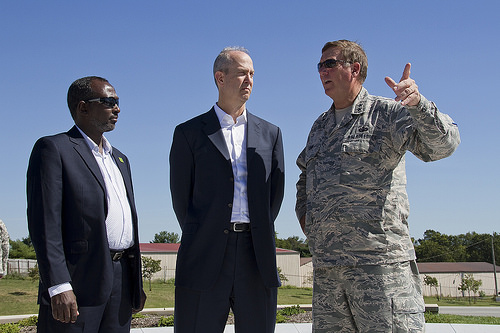
Maj. Gen. Edward W. Tonini, Kentucky’s adjutant general, speaks with Thomas Kelly, U.S. Ambassador to Djibouti (middle) and Mr. Muhamed Ali Houmed, President of the National Assembly of Djibouti during a visit to the Kentucky National Guard Memorial in Frankfort, Ky., Sept. 15, 2015. The partnership with Djibouti is the Kentucky’s Guard second collaborative effort as part of the National Guard’s State Partnership Program. (U.S. Army National Guard photo by Staff Sgt. Scott Raymond)
The State Partnership Program is administered by the National Guard Bureau and guided by U.S. Department of State foreign policy goals. The SPP has been successfully building relationships for over 20 years involving 74 nations around the globe. With the inclusion of Djibouti, the National Guard will have 69 state partnerships in 75 countries.
A Kentucky delegation led by Tonini participated in the State Partnership Program signing ceremony in Djibouti, Africa in June 2015. http://tinyurl.com/djiboutikyspp
Djibouti is Kentucky’s second partnership program. The Ecuador-Kentucky SPP was formalized in 1996. Since its inception, the partnership has completed 66 exchange events with Ecuador ranging from security, maintenance, emergency management, and Army and Air Force aviation.
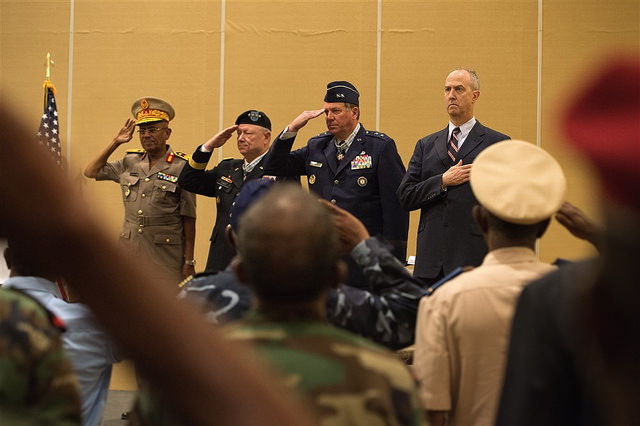
From left, Maj. Gen. Zakaria Cheik Ibrahim, Djiboutian Armed Forces chief of defense, National Guard Bureau Joint Chief of Staff Gen. Frank Grass, Maj. Gen. Edward Tonini, Kentucky National Guard adjutant general and U.S. Ambassador to Djibouti Thomas Kelly, stand during the American and Djiboutian national anthems during the Kentucky National Guard and the Republic of Djibouti State Partnership Program signing ceremony at the Kempinski Hotel, Djibouti, June 2, 2015. The SPP provides host countries with a skilled force capable of helping to train and develop the host nation’s defenses and security, disaster response, crisis management, and interagency cooperation. (U.S. Air Force photo by Staff Sgt. Nathan Maysonet)
In a historic first for East Africa, Representatives from the Kentucky National Guard (KNG) and the Djiboutian Armed Forces (FAD) ratified a state partnership agreement in a signing ceremony held at the Kempinski Hotel in Djibouti City, June 2, 2015.
“Ten African countries already benefit from this program and we are honored to be the eleventh African country and the first to benefit from East Africa,” said Maj. Gen. Zakaria Cheik Ibrahim, FAD chief of defense. “This follows from the new partnership that our two countries are committed to. Since the meeting between our two heads of state in May 2014, the cooperation between our two countries has strengthened positively and we are very optimistic to see, in the coming years, a considerable expansion of our defense and security cooperation.”
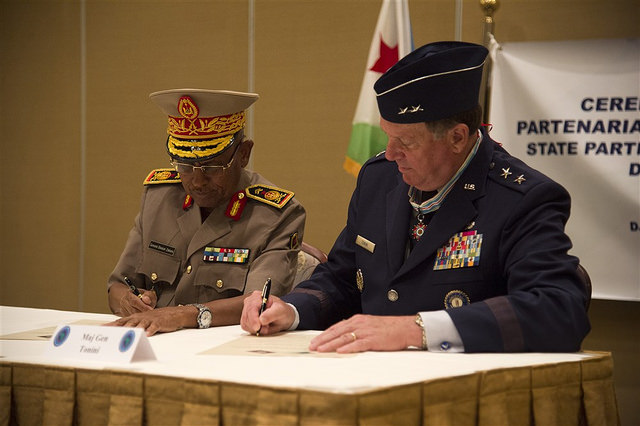
Maj. Gen. Zakaria Cheik Ibrahim, (left), Djiboutian Armed Forces (FAD) chief of defense and Maj. Gen. Edward Tonini, Kentucky National Guard (KNG) adjutant general, sign a State Partnership Program agreement at the Kempinski Hotel, Djibouti, June 2, 2015. The agreement means a long term cooperative agreement between the KNG and FAD that will foster mutually beneficial exchanges between the two at all levels of the military as well as the civilian world. (U.S. Air Force photo by Staff Sgt. Nathan Maysonet)
The State Partnership Program (SPP) originated from a U.S. European Command program that paired reserve component soldiers and airmen with Baltic States in 1991. The National Guard Bureau later proposed pairing states with three nations emerging from the collapse of the Soviet Bloc. These partnerships became the SPP of today.
“The globalization of our societies has made our world smaller and borders are now blurred by our ever-changing world,” said National Guard Bureau Joint Chief of Staff Gen. Frank Grass. “In that short time period, the National Guard and states continue to build close and lasting personal relationships with our partner nations around the world.”
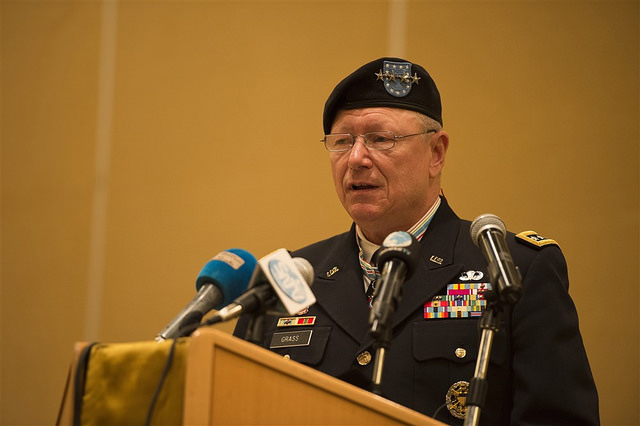
National Guard Bureau Joint Chief of Staff Gen. Frank Grass speaks at the Kentucky National Guard and the Republic of Djibouti State Partnership Program signing ceremony at the Kempinski Hotel, Djibouti, June 2, 2015. Grass spoke about the need for state’s National Guard to continue to build close and lasting personal relationships with U.S. partner nations around the world through agreements like the SPP. (U.S. Air Force photo by Staff Sgt. Nathan Maysonet)
The program provides host countries with a skilled force capable of helping to train and develop the host nation’s defenses and security, disaster response, crisis management, and interagency cooperation.
“The SPP links a unique component of the Department of Defense with the armed forces of a partner country in a cooperative, mutually beneficial relationship by means of a tailored, small footprint, high-impact security cooperation engagement that fosters long-term enduring relationships with allies around the world,” said Maj. Gen. Edward Tonini, KNG adjutant general.
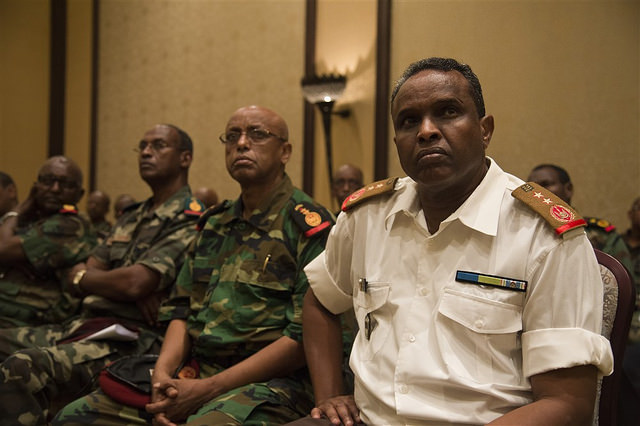
Representatives of the Djiboutian Armed Forces (FAD) attend the Kentucky National Guard and FAD State Partnership Program agreement signing ceremony at the Kempinski Hotel, Djibouti, June 2, 2015. The Republic of Djibouti is the 11th African country to join a SPP and the first in East Africa. (U.S. Air Force photo by Staff Sgt. Nathan Maysonet)
Djibouti is already a key regional partner with the U.S., and is engaged in humanitarian and counter-terrorism operations throughout East Africa. The FAD has an extensive relationship with the personnel assigned to Combined Joint Task Force-Horn of Africa, which includes Kentucky Guardsmen, who are a force multiplier to the region, explained Tonini.
“This is not a double partnership, it’s a force multiplier,” said Tonini. “Having a partnership with Djibouti allows us the opportunity to engage in mutually beneficial exchanges at all levels of the military as well as the civilian world.”
According to Lt. Col. Shawn Keller, KNG State Partnership Program Director, there are several areas where the KNG can cooperate with the FAD including both military and civilian engagements.
“Although the SPP is based on military to military engagements, the partnerships can eventually leverage these relationships into civilian engagements that use the whole of government concept,” said Keller. “Our partnership with Djibouti has the support of the governor and commonwealth’s state agencies, universities and civic organizations, many of which are already engaged in Africa, and are eager to work with us to expand opportunities for citizen diplomacy with the people of Djibouti.”
For CJTF-HOA, which is based at Camp Lemonnier, Djibouti, and is the only permanent U.S. military base in Africa, this partnership provides several advantages.
For one, this partnership brings with it state money that can help fund additional training, joint exercises, and more, for both the FAD and CJTF-HOA, explained Maj. Wes Chaney, U.S. Embassy to Djibouti security cooperation officer.
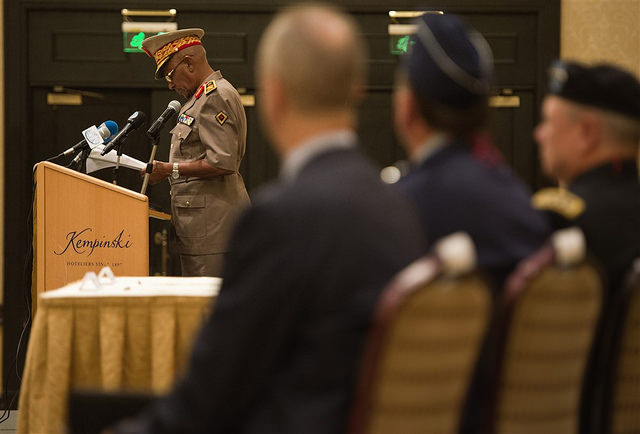
Maj. Gen. Zakaria Cheik Ibrahim, Djiboutian Armed Forces (FAD) chief of defense, speaks at the Kentucky National Guard and FAD State Partnership Program agreement signing ceremony at the Kempinski Hotel, Djibouti, June 2, 2015. Zakaria spoke about the strong partnership between the U.S. and Djibouti that began with both countries’ commitment to fight terrorism after 9/11, which led to the American presence at Camp Lemonnier, Djibouti. (U.S. Air Force photo by Staff Sgt. Nathan Maysonet)
“Kentucky brings its own state money to help in Djibouti,” said Chaney. “Their support effectively doubles or quadruples what is available to accomplish missions and aid here.”
Another key advantage for CJTF-HOA and Djibouti is the mere presence of the Kentucky guardsmen’s and guardsmen in general, explained U.S. Ambassador to Djibouti, Thomas Kelly.
“The U.S. National Guard personnel bring many benefits to the strategic partnership between our two countries,” said Kelly. “As citizen soldiers, they use their military and civilian experiences, to identify solutions and cooperate on our many shared initiatives.”
It’s this blend of our citizen soldier’s civilian and military experiences that the SPP is about. Their day-to-day civilian work and life experiences, combined with their military training, provides countries like Djibouti with a highly skilled and highly adaptable partner in countless fields, explained Chaney.
Additionally, because Kentucky’s guardsmen, like all states’ National Guardsmen, act as the state’s rapid response force, they also bring disaster response capabilities that can help build Djibouti’s capacity in this critical area.
“This is a Title 32 program, which means they are authorized to train emergency management,” said Chaney. “This means they can train non-military types such as policeman and fire fighters.”
Lastly, the fact that the Kentucky Guardsmen will return to their homes and workplaces after completing their tour at CJTF-HOA means what they learn and experience here working with the Djiboutian people and their sister services, will be brought back to Kentucky.
“As guard members, we are constantly re-evaluating better methods to protect the homeland, conduct overseas operations, and foster enduring partnerships,” said Tonini. “We are looking forward to the many different ways we can partner with Djibouti to exchange this knowledge. The partnership will benefit both sides in areas of military and civilian engagements such as humanitarian assistance and disaster response, counter narcotics operations, border security, health and academia.”
Kentucky signed a similar SPP agreement with Ecuador in 1996, making Djibouti its second partner nation. The SPP agreement between Djibouti and the KNG will create a long term stable relationship with one of America’s key allies in Africa.
“Your presence among us today demonstrates the importance accorded by the U.S. to the strengthening of the cooperation between the U.S. military and the Djiboutian Defense and Security Forces as well as our two friendly peoples,” said Zakaria. “I am convinced that we could mutually benefit from this partnership, which will consolidate our operational capabilities in multiple areas. Long-Live the Djibouti-American cooperation.”
Story by Allison Crawford, WKMS - Murray State University
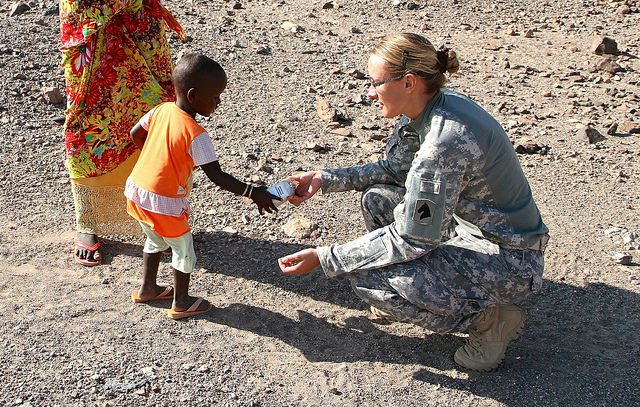
Sgt. Tiffany Anestis with the 2nd Battalion, 138th Field Artillery hands out supplies to local civilians during the unit’s deployment to Djibouti and the Horn of Africa, Dec. 11, 2012. Kentucky Guard leadership said the relationships built during the 2/138th deployment helped pave the way for the new partnership. (U.S. Army National Guard photo by Sgt. Alexa Becerra)
The Kentucky National Guard is beginning a new partnership with Djibouti to support defense security cooperation goals. The National Guard State Partnership Program works to develop military and civilian relationships with a variety of state partners. Spokesman Lt. Col. Kirk Hilbrecht said this could include training and assistance with things like security, emergency management and building schools.
The partnership includes personnel exchanges between the two countries. But Hilbrecht said it’s about more than just skills and training.
“It is a true cultural exchange. And for them to really get a great taste of Kentucky, they’ll have to come here. And likewise, people who will be working with the Djiboutians will have to go to Djibouti. And we look forward to exchanges on both sides,” Hilbrecht said.
Hilbrecht said the partnership is meant to benefit both guardsmen and Djiboutians.
“It becomes something pretty cool when you say, ‘hey, we’re not just knocking down doors but we’re opening up hearts and minds by working with state partners like Djiboutians where they are really looking at us as… many things, not just military but also civilians. But again it helps us become more rounded individuals,” Hilbrecht said.
Guardsmen travel to Djibouti in June to formalize the new partnership. Hilbrecht said once Djiboutian needs and requests are determined, the guard will set up personnel exchanges.
Hilbrecht said the Kentucky Guard has had a successful partnership with Ecuador since 1996. The Guard will maintain its partnership with Ecuador while taking on the new partnership with Djibouti.
 |
| Medical Leader | TORIE FOWLER |
| TECHNOLOGY BRINGS FAMILY TOGETHER: Sergeant First Class Jason Rhodes looks on thanks to SKYPE as his wife gives birth to the couple’s first child. The Kentucky National Guard member was stationed in Djibouti, Africa. |
Courtesy The Medical Leader, Pikeville Medical Center
PIKEVILLE, Ky. — When Sergeant First Class Jason Rhodes and his wife Samantha found out they were expecting their first child, they were ecstatic.
Unfortunately, they were about to walk out the door to attend a conference in Lexington for families facing deployment.
“I had taken a test that came out negative, so I threw it in the trash,” recalled Samantha. “The next morning before we left I happened to look in the trash can and noticed a faint positive sign on the pregnancy test. When we got to Lexington, I took another test and set it on the bathroom counter. A few minutes later, Jason came out holding it in his hand.”
The couple was excited to grow their family, but Jason, an SFC in the Kentucky Army National Guard, would be leaving in less than two months for a deployment to Djibouti, Africa.
Samantha began seeing the physicians at Pikeville Medical Women’s Care Center for prenatal care and Jason was able to attend the first ultrasound before he left.
“Growing up, I always thought about my wedding day and the day I would have a baby,” Samantha said.
“I knew the delivery wouldn’t be what I dreamed about, because Jason wasn’t going to be a part of it. He never got to feel the baby kick, and you never get those moments back. It was so important for me to have him be a part of it.”
Even though Jason is more than 7,000 miles away, Pikeville Medical Center made it possible for him to be a part of the birth.
The hospital was able to set up a television used to SKYPE Jason the entire time Samantha was in the hospital.
SKYPE is a form of technology used to facilitate communication with others using a webcam.
Samantha said, “I arrived at Pikeville Medical Center to be induced on a Wednesday night at 10 pm. Within 30 minutes, we were talking to Jason. We were able to talk the entire time.”
When the decision was made to go to surgery, the hospital transferred the necessary SKYPE equipment into the operating room. PMC OB-GYN Dr. Rick Mcllelan was on-call and delivered the baby by c-section.
“Having Jason there, actually being able to hear him talk in the operating room put my nerves at ease. There are so many men who aren’t able to see their children until after they leave the hospital, and my husband was in Africa and witnessed the whole thing,” Samantha said. “He was speechless and we can’t thank the hospital enough for that moment.”
Caleb Michael Rhodes was born on April 5, 2013, weighing in at 9 lbs, 5 oz.
The SKYPE didn’t stop after the baby was born. Jason was able to stay connected with his new family during their stay at Pikeville Medical Center.
He watched as they brought his newborn son into the room for the first time, his first feeding and his first review from the pediatrician.
“It was something I will never forget. It was the best few days of my life,” Jason said via text-messaging.
“I can’t thank the hospital enough. The Information Systems department, Public Relations, Rita Crum, all the Labor and Delivery nurses, Dr. McClellan and the physicians at the Women’s Care Center, everyone was amazing,” Samantha added.
“We are so grateful, and the experience was more than I could imagine.”
Both mom and baby are doing well. Samantha says they SKYPE Jason at home every day. Jason is scheduled to return home at the beginning of June.
Samantha is the daughter of PMC speech language pathologist Camilla Damron and her husband Rick Damron. Her father is Bobby Davis. She is the granddaughter of PMC chaplain Kaminski Robinson and board member Jo Nell Robinson.
Jason is the son of Terry and Dan Rhodes of Mt. Sterling and the grandson of Karen and Pat Middendors.
Story by Staff Sgt. Steve Tressler, Task Force Longrifles Public Affairs
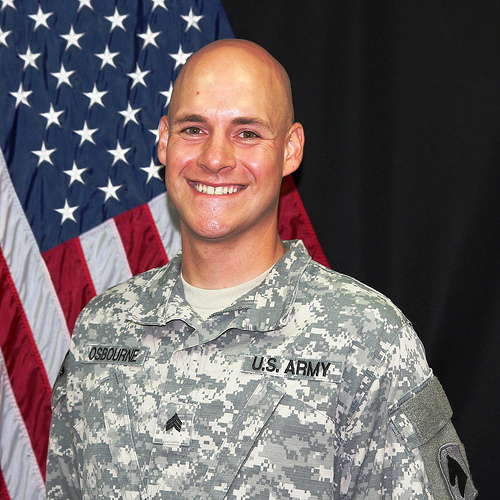
Sgt. Bradley Osbourne, a Danville, Ky. native, was the distinguished honor graduate for the Warrior Leader Course at Camp Lemonnier, Djibouti, Africa in March 2013. Soldiers of the deployed unit were offered the chance to complete the course instead of waiting until they retuned home.(KYNG photo by Staff Sgt. Steve Tressler)
CAMP LEMONNIER, Djibouti — Every enlisted Soldier Army-wide who wants to continue being promoted and more importantly, to eventually lead other Soldiers must at some point attend Warrior Leader Course. Some deployed Soldiers have to wait until they return home to attend this mandatory step their career progression. But for members of the 2nd Battalion, 138th Field Artillery, WLC came to them in the Horn of Africa.
Task Force Longrifles is proud to announce that 58 out of 62 Soldiers graduated from the intensive, March 2013 edition of WLC, conducted here at Camp Lemmonier. The unit shared more pride in the fact that the distinguished honor graduate of the course, Sgt. Bradley Osbourne is one of their own.
WLC is usually a month-long course that teaches Soldiers the basic skills to lead small groups of Soldiers. It is also a course that is offered at several locations in the U.S., but this is only the second time in 10 years it has been offered here to Soldiers. The Texas National Guard and the Kentucky National Guard were the only states to make the school available to their Soldiers while here at Camp Lemonnier.
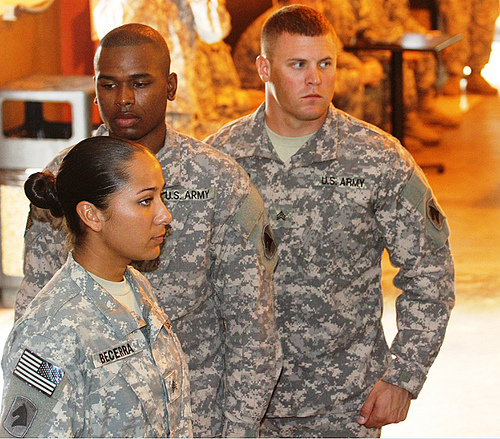
Sgt. Alexa Becerra, a Versailles, Ky. native, and one of the six nominees for Distinguished Honor Graduate, prepares to receive her graduation certificate. Following close behind are WLC graduates Spc. Brandon Bell and Sgt. Travis Berthold. (KYNG photo by Capt. Chris Fitzwater)
The instructors said this group was a little easier to instruct and train than normal. “This unit already had great cohesion and it was evident that the working relationships of the Soldiers were already established. This made it easier for us because we didn’t have to manage those relationships the way we normally would in the US with a class full of Soldiers who don’t know one another” said Assistant WLC Commandant Master Sgt. Rick Ewert.
Task Force Longrifles Command Sgt. Maj. Timothy Gividen pushed to get WLC brought to Africa for his Soldiers. He said the reason behind bringing the course to the Soldiers here, rather than waiting until they got back to the U.S. was simple, “We [leadership] wanted to get as many young Soldiers through the course as possible.”
WLC is not MOS (military occupational specialty) dependent, every Soldier must attend if they have any desire to be promoted. It’s an intensive school with the primary emphasis on leadership skills. It also prepares Soldiers to advance to the rank of staff sergeant.
The Soldiers of Task Force Longrifles were able to attend this course here in Djibouti thanks to the officers and the NCO corps already in place within their units. The NCOs covered down on the their mission so that the junior Soldiers could attend.
“Our command truly came together and stepped up to the plate to cover down on shifts and work longer hours to be able to make this all possible for us,” said Sgt. Alexa Becerra with Task Force Longrifles.
“Being able to complete this milestone for my career while deployed was a great opportunity for me,” she said. “Going through the Warrior Leader Course here in the Horn of Africa was a very unique experience; one that not many Guard Soldiers will be able to say they had.”
Story and photos by Capt. Daniel Van Horn, Task Force Longrifles Public Affairs
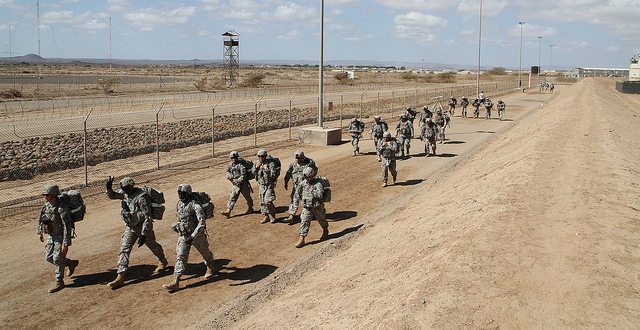
Soldiers from Task Force Longrifles begin the 9-mile ruck-march as part of the Longrifle Raid at Camp Lemmonier, Djibouti, Feb. 15, 2013. The march was one of several events that tested participants physical endurance, military skill and artillery knowledge. (Kentucky National Guard photo by Capt. Daniel Van Horn, Task Force Longrifles Public Affairs)
CAMP LEMONNIER, Djibouti — Soldiers from Task Force Longrifles will tell you that the 2013 edition of the Longrifle Raid was anything but easy.
The Longrifle Raid was started two years ago by the previous Battalion Command Sgt. Major, Thomas Chumley, and was a test of physical endurance, military skill, and artillery knowledge. Soldiers that successfully complete each event earn the right to wear the coveted Red Cord on their dress uniform.
This year’s Raid started with 27 Soldiers from across the battalion. The first event for the day was a standard Army Physical Fitness Test at 5:00 in the morning. Each Soldier had to score a minimum of 70 points in all three categories: push-ups, sit-ups, and 2-mile run. After successfully completing the APFT, Soldiers were able to get breakfast and change into a clean uniform before an inspection and drill and ceremonies competition lead by 1st Sgt. Robert Burns from Headquarters, Headquarters Battery.
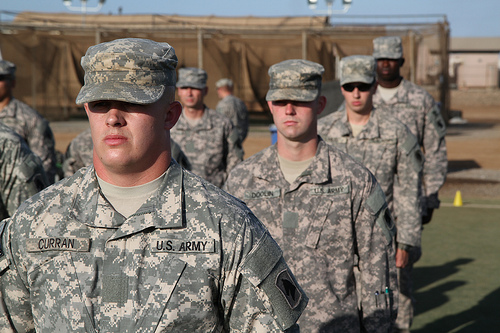
Soldiers from Task Force Longrifles complete an open ranks inspection as part of the Longrifle Raid on Feb. 15, 2013 at Camp Lemmonier, Djibouti.. (Kentucky National Guard photo by Capt. Daniel Van Horn, Task Force Longrifles Public Affairs)
“Drill and ceremonies is one of the skills that a Soldier should never lose. It is a snapshot of their ability and attention to detail,” said Burns after the last squad finished his event. “Having Soldiers from different units compete as one team also helps build camaraderie and teamwork which would be important for the rest the Raid.”
The next event was the obstacle course, which gave each Soldier an opportunity to once again get dirty and sweaty. The course was a physically demanding one where Soldiers had to complete 15 push-ups, a 180-pound tire flip five times, high-crawl, low-crawl, two 30-pound ammo can carries for 20 yards, 15 ammo can raises over their head, and finally sprint 100 yards with both cans to the start of the course.
With the sun starting to really heat up, the Soldiers began preparing for their next event, a nine-mile road march with 35 pounds in their rucksack. This event proved to be the hardest of the day with several Soldiers dropping out due to the heat. The route wound its way along the perimeter of the camp with Soldiers having to make three laps in less than 2.5 hours to qualify for the next event.
“Because of the heat, distance, and weight we had to carry, the road march was by far the hardest part of the Raid,” said 1st Lt. Denis Babiyev, executive officer from Bravo Battery.
With the physically demanding part of the raid complete, the events moved to military skill and artillery knowledge and included the following tests; loading and filling a radio, call for fire, 9-line medevac, un-exploded ordinance report, and react to enemy contact
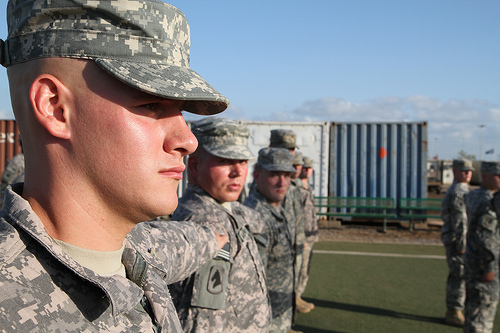
Sgt. Bradley Osbourne looks forward as the command for dress-right dress is given during a drill and ceremonies event at Camp Lemmonier, Djibouti, Feb. 15, 2013. (Kentucky National Guard photo by Capt. Daniel Van Horn, Task Force Longrifles Public Affairs)
For Spc. Tyler Douglas an Automated Tactical Data Systems Specialist with Charlie Battery, completing the raid this year was a big goal.
“I figured this deployment would be the best time to prepare for the Raid,” he said. “In the future, not many Soldiers will be able to say they earned it while deployed to Africa, so it’s a once in a lifetime opportunity.”
The final event consisted of an NCO board with the battalion command sergeant major and battery 1st sergeants asking one to two questions about the unit history, military customs/courtesies, artillery facts, and warrior ethos. The day was challenging, hot, and long, but by the end of it, twenty-one Soldiers had earned the distinct privilege of calling themselves Longrifle Raiders with a braided red cord adorning their shoulders.

DJIBOUTI – State Command Sgt. Maj. Gregory Armstrong, 138th Fires Brigade Commander Col. Brian Wertzler and Soldiers from Task Force Longrifles received a tour of the USNS Joshua Humphreys on Feb. 5, 2013. (Photo by Sgt. Alexa Becerra, 2-138th FAR PAO)
staff report
DJIBOUTI — Kentucky National Guard leadership spent the last couple of weeks with more than 500 Soldiers currently stationed in Djibouti, Africa on a one-year overseas tour.
Task force Longrifles, made up of Soldiers from 2nd battalion, 138th Field Artillery out of Lexington, Ky., escorted several key leaders from the Kentucky Guard to include Col. Brian Wertzler and State Command Sgt. Major Gregory Armstrong among others, giving them hands-on experience into what the 2/138th Soldiers are experiencing during their deployment.
These two were given the opportunity to tour the US Naval Ship, the Joshua Humphreys which is currently supporting operations in Djibouti.
Human-interest feature as posted on Task Force Longrifles news website: http://www.taskforcelongrifles.wordpress.com
Story and pictures by Staff Sgt. Steve Tressler

Brig. Gen. Patrick Dolan, a Marion County, Ky., native and a member of the Kentucky National Guard, conducts a Catholic Mass service for Soldiers in Djibouti, Africa.
DJIBOUTI, AFRICA – Patrick Dolan would have you to believe that he is just a humble boy from Marion County, Ky., whose father taught him a lot about faith and God.
Like most country boys from Marion County, Dolan did his share of hunting and drag car racing. He tried his best not to get into trouble.
Brig. Gen. Chaplain Dolan is also a humble and diverse man with a wealth of hands-on experience.
Task Force Longrifles Soldiers currently in Djibouti know Chaplain Dolan as both spiritual council and genuine Soldier. Dolan proudly wears the badges of the military schools he attended: US Army air assault school, airborne school and the pathfinder school.
Dolan was called to the church as a seventh grader. “My father would get up and go to daily mass, and after some time I began going with him. I had served as an altar boy and in the choir, but it was going to daily mass with my father when I really felt like I was being called to something bigger,” Dolan recalls.
Dolan was ordained as priest in 1978 and attended the Pontifical Urbaniana University, Italy where he received his doctorate in Theology. Dolan was commissioned as an Army chaplain in 1986 and began serving in the Kentucky National Guard in 1992.
For more than thirty years, Dolan has served the spiritual needs of deployed Servicemembers from Ecuador to Egypt, Afghanistan to Kuwait. While visiting Camp Lemmonier, Djibouti, Dolan blessed Servicemembers from the Navy, Marine Corps, Air Force and Army during daily mass.
Task Force Longrifles Commander Lt. Col. Rob Larkin said, “It’s nice to have him here and it always feels good to see an old friend.”
In 2011, Dolan was promoted to the rank of brigadier general. He became the first Kentucky National Guard chaplain and first Roman Catholic priest assigned as Army National Guard assistant to the chief of chaplains for the United States Army. In this position, Dolan acts as the chief advisor to the Chief of Chaplains on matters relating to the National Guard.
Not too bad for a drag-racing country boy from Kentucky raised on faith in God.
[youtube http://www.youtube.com/watch?v=-nj2oBaeLg4]
University of Kentucky versus the University of Louisville in the “Battle for the Bluegrass”
This game just kicked off at the KFC Yum! Center in Louisville and these troops are cheering on their favorite team from overseas.
Some stats on this intense rivalry (according to Wikipedia):
| Total meetings | 44 |
| Series record | Kentucky leads, 30-14 |
| First meeting | February 15, 1913 |
| Kentucky 34, Louisville 10 | |
| Last meeting | March 31, 2012 |
| Kentucky 69, Louisville 61 | |
| Next meeting | December 29, 2012 |
| Largest win | Kentucky, 91–57 (1948) Kentucky 85-51 (1986) |
| Longest win streak | Kentucky, 5 (1916, 1922 (twice), 1948, 1951) |
| Current win streak | Kentucky, 4 (2010–present) |
| Trophy | none |
Who’s going to win this year?
[youtube http://www.youtube.com/watch?v=_KqmC2f9dE0]
Video by 2/138th Field Artillery Regiment Public Affairs.
Check out and LIKE the Task Force Longrifles facebook page www.facebook.com/taskforcelongrifles