Pages
Stay In Touch
More
© 2013 KentuckyGuard
By Lt. Col. Kirk Hilbrecht, Kentucky National Guard Public Affairs
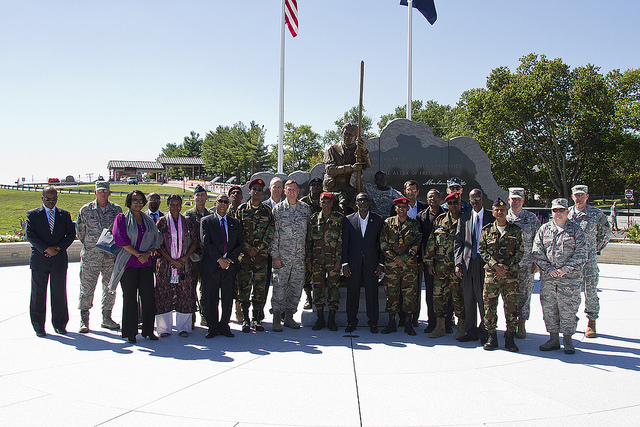
Kentucky Guardsmen gather with several members of Djibouti’s military and government cabinets at the Kentucky National Guard Memorial in Frankfort, Ky., Sept. 15, 2015. The visit was part of the Kentucky Guard’s State Partnership with Djibouti. (U.S. Army National Guard photo by Staff Sgt. Scott Raymond)
FRANKFORT, Ky. — The Kentucky National Guard hosted several members of Djibouti’s military and government cabinets, Sept. 13-20, as part of the Kentucky Guard’s State Partnership with Djibouti. Civilian members of the Djiboutian delegation included the Honorable Tom Kelly, U.S. Ambassador to Djibouti, the President of the National Assembly, Mr. Mohamed Ali Houmed, Djiboutian ministers of health, foreign affairs, chambers of commerce, and the University of Djibouti. The military delegates included chiefs of defense, Air Force, logistics, military education and materiel. This was the first Djiboutian partnership event in Kentucky since the National Guard selected Kentucky for this state partnership in June.
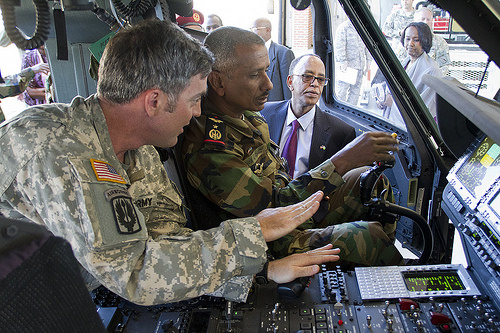
Chief Warrant Officer Kevin Keith discusses the capabilities of a UH-60 Blackhawk with Lt. Col. Chakib Mahamed Ali, deputy commander of the Djibouti Air Force during a visit to the Kentucky Guard’s Army Aviation Support Facility in Frankfort, Ky., Sept. 15, 2015. Members of the Djibouti military toured several sites across Kentucky as part of the country’s new partnership with the Kentucky Guard. (U.S. Army National Guard photo by Staff Sgt. Scott Raymond)
“Our Kentucky Guardsmen, our government officials and our civic leaders have been fantastic ambassadors to these global neighbors this week,” stated Kentucky’s Adjutant General, Maj. Gen. Edward Tonini. “We’re honored to host our new partners and friends from the Republic of Djibouti.”
While in Kentucky, the Djiboutian delegation toured Boone National Guard Center in Frankfort; ate dinner at the Governor’s Mansion with Lt. Gov. Crit Luallen; visited Kentucky troops working at Fort Knox and training at Wendell H. Ford Regional Training Center in Western Kentucky; toured Kentucky’s Air National Guard Base; made a stop at Churchill Downs; attended a University of Louisville football game; toured Waterstep and UPS; interacted with ROTC cadets at the University of Louisville and at the University of Kentucky; met boxing great, Mohammad Ali; and visited the Louisville Islamic Center.
“We came to Kentucky knowing of the Kentucky Guard,” said President Mohamed Ali Houmed, “We are leaving Kentucky now knowing these people as friends. Friends of us and friends of Djibouti.”
Click here for more photos.
Through the SPP, the Kentucky Guard will conduct military-to-military engagements in support of defense security cooperation goals similar to this current trip. The program also works to strengthen partner nation’s domestic response capabilities.
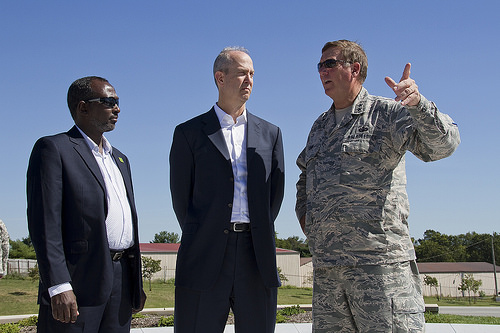
Maj. Gen. Edward W. Tonini, Kentucky’s adjutant general, speaks with Thomas Kelly, U.S. Ambassador to Djibouti (middle) and Mr. Muhamed Ali Houmed, President of the National Assembly of Djibouti during a visit to the Kentucky National Guard Memorial in Frankfort, Ky., Sept. 15, 2015. The partnership with Djibouti is the Kentucky’s Guard second collaborative effort as part of the National Guard’s State Partnership Program. (U.S. Army National Guard photo by Staff Sgt. Scott Raymond)
The State Partnership Program is administered by the National Guard Bureau and guided by U.S. Department of State foreign policy goals. The SPP has been successfully building relationships for over 20 years involving 74 nations around the globe. With the inclusion of Djibouti, the National Guard will have 69 state partnerships in 75 countries.
A Kentucky delegation led by Tonini participated in the State Partnership Program signing ceremony in Djibouti, Africa in June 2015. http://tinyurl.com/djiboutikyspp
Djibouti is Kentucky’s second partnership program. The Ecuador-Kentucky SPP was formalized in 1996. Since its inception, the partnership has completed 66 exchange events with Ecuador ranging from security, maintenance, emergency management, and Army and Air Force aviation.
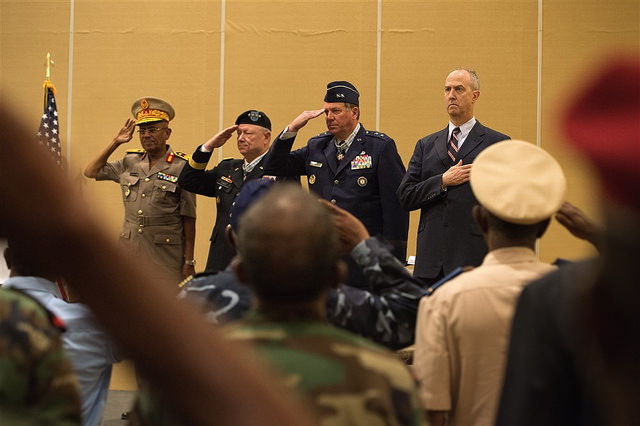
From left, Maj. Gen. Zakaria Cheik Ibrahim, Djiboutian Armed Forces chief of defense, National Guard Bureau Joint Chief of Staff Gen. Frank Grass, Maj. Gen. Edward Tonini, Kentucky National Guard adjutant general and U.S. Ambassador to Djibouti Thomas Kelly, stand during the American and Djiboutian national anthems during the Kentucky National Guard and the Republic of Djibouti State Partnership Program signing ceremony at the Kempinski Hotel, Djibouti, June 2, 2015. The SPP provides host countries with a skilled force capable of helping to train and develop the host nation’s defenses and security, disaster response, crisis management, and interagency cooperation. (U.S. Air Force photo by Staff Sgt. Nathan Maysonet)
In a historic first for East Africa, Representatives from the Kentucky National Guard (KNG) and the Djiboutian Armed Forces (FAD) ratified a state partnership agreement in a signing ceremony held at the Kempinski Hotel in Djibouti City, June 2, 2015.
“Ten African countries already benefit from this program and we are honored to be the eleventh African country and the first to benefit from East Africa,” said Maj. Gen. Zakaria Cheik Ibrahim, FAD chief of defense. “This follows from the new partnership that our two countries are committed to. Since the meeting between our two heads of state in May 2014, the cooperation between our two countries has strengthened positively and we are very optimistic to see, in the coming years, a considerable expansion of our defense and security cooperation.”
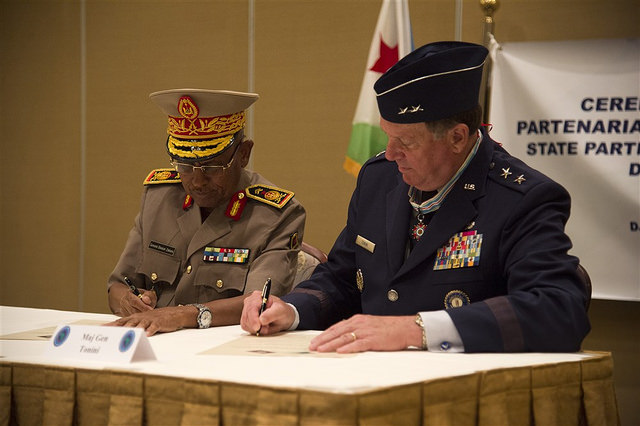
Maj. Gen. Zakaria Cheik Ibrahim, (left), Djiboutian Armed Forces (FAD) chief of defense and Maj. Gen. Edward Tonini, Kentucky National Guard (KNG) adjutant general, sign a State Partnership Program agreement at the Kempinski Hotel, Djibouti, June 2, 2015. The agreement means a long term cooperative agreement between the KNG and FAD that will foster mutually beneficial exchanges between the two at all levels of the military as well as the civilian world. (U.S. Air Force photo by Staff Sgt. Nathan Maysonet)
The State Partnership Program (SPP) originated from a U.S. European Command program that paired reserve component soldiers and airmen with Baltic States in 1991. The National Guard Bureau later proposed pairing states with three nations emerging from the collapse of the Soviet Bloc. These partnerships became the SPP of today.
“The globalization of our societies has made our world smaller and borders are now blurred by our ever-changing world,” said National Guard Bureau Joint Chief of Staff Gen. Frank Grass. “In that short time period, the National Guard and states continue to build close and lasting personal relationships with our partner nations around the world.”
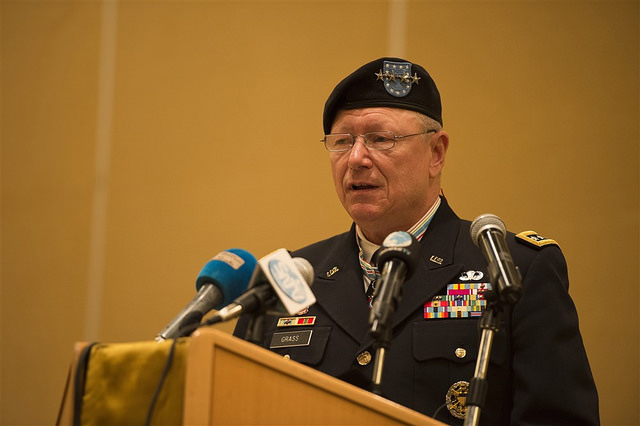
National Guard Bureau Joint Chief of Staff Gen. Frank Grass speaks at the Kentucky National Guard and the Republic of Djibouti State Partnership Program signing ceremony at the Kempinski Hotel, Djibouti, June 2, 2015. Grass spoke about the need for state’s National Guard to continue to build close and lasting personal relationships with U.S. partner nations around the world through agreements like the SPP. (U.S. Air Force photo by Staff Sgt. Nathan Maysonet)
The program provides host countries with a skilled force capable of helping to train and develop the host nation’s defenses and security, disaster response, crisis management, and interagency cooperation.
“The SPP links a unique component of the Department of Defense with the armed forces of a partner country in a cooperative, mutually beneficial relationship by means of a tailored, small footprint, high-impact security cooperation engagement that fosters long-term enduring relationships with allies around the world,” said Maj. Gen. Edward Tonini, KNG adjutant general.
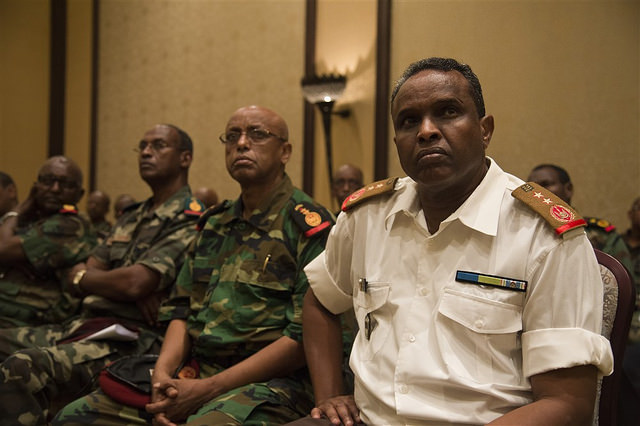
Representatives of the Djiboutian Armed Forces (FAD) attend the Kentucky National Guard and FAD State Partnership Program agreement signing ceremony at the Kempinski Hotel, Djibouti, June 2, 2015. The Republic of Djibouti is the 11th African country to join a SPP and the first in East Africa. (U.S. Air Force photo by Staff Sgt. Nathan Maysonet)
Djibouti is already a key regional partner with the U.S., and is engaged in humanitarian and counter-terrorism operations throughout East Africa. The FAD has an extensive relationship with the personnel assigned to Combined Joint Task Force-Horn of Africa, which includes Kentucky Guardsmen, who are a force multiplier to the region, explained Tonini.
“This is not a double partnership, it’s a force multiplier,” said Tonini. “Having a partnership with Djibouti allows us the opportunity to engage in mutually beneficial exchanges at all levels of the military as well as the civilian world.”
According to Lt. Col. Shawn Keller, KNG State Partnership Program Director, there are several areas where the KNG can cooperate with the FAD including both military and civilian engagements.
“Although the SPP is based on military to military engagements, the partnerships can eventually leverage these relationships into civilian engagements that use the whole of government concept,” said Keller. “Our partnership with Djibouti has the support of the governor and commonwealth’s state agencies, universities and civic organizations, many of which are already engaged in Africa, and are eager to work with us to expand opportunities for citizen diplomacy with the people of Djibouti.”
For CJTF-HOA, which is based at Camp Lemonnier, Djibouti, and is the only permanent U.S. military base in Africa, this partnership provides several advantages.
For one, this partnership brings with it state money that can help fund additional training, joint exercises, and more, for both the FAD and CJTF-HOA, explained Maj. Wes Chaney, U.S. Embassy to Djibouti security cooperation officer.
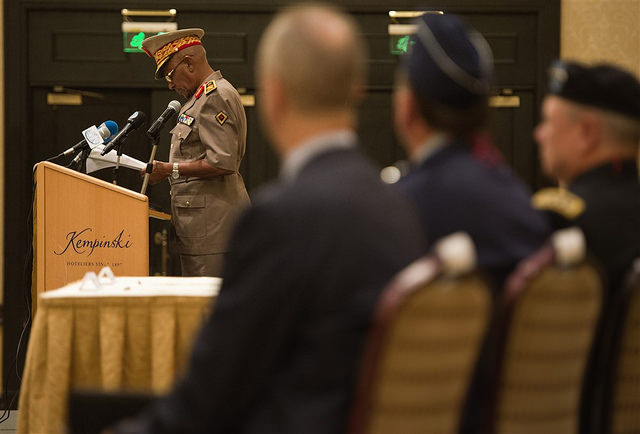
Maj. Gen. Zakaria Cheik Ibrahim, Djiboutian Armed Forces (FAD) chief of defense, speaks at the Kentucky National Guard and FAD State Partnership Program agreement signing ceremony at the Kempinski Hotel, Djibouti, June 2, 2015. Zakaria spoke about the strong partnership between the U.S. and Djibouti that began with both countries’ commitment to fight terrorism after 9/11, which led to the American presence at Camp Lemonnier, Djibouti. (U.S. Air Force photo by Staff Sgt. Nathan Maysonet)
“Kentucky brings its own state money to help in Djibouti,” said Chaney. “Their support effectively doubles or quadruples what is available to accomplish missions and aid here.”
Another key advantage for CJTF-HOA and Djibouti is the mere presence of the Kentucky guardsmen’s and guardsmen in general, explained U.S. Ambassador to Djibouti, Thomas Kelly.
“The U.S. National Guard personnel bring many benefits to the strategic partnership between our two countries,” said Kelly. “As citizen soldiers, they use their military and civilian experiences, to identify solutions and cooperate on our many shared initiatives.”
It’s this blend of our citizen soldier’s civilian and military experiences that the SPP is about. Their day-to-day civilian work and life experiences, combined with their military training, provides countries like Djibouti with a highly skilled and highly adaptable partner in countless fields, explained Chaney.
Additionally, because Kentucky’s guardsmen, like all states’ National Guardsmen, act as the state’s rapid response force, they also bring disaster response capabilities that can help build Djibouti’s capacity in this critical area.
“This is a Title 32 program, which means they are authorized to train emergency management,” said Chaney. “This means they can train non-military types such as policeman and fire fighters.”
Lastly, the fact that the Kentucky Guardsmen will return to their homes and workplaces after completing their tour at CJTF-HOA means what they learn and experience here working with the Djiboutian people and their sister services, will be brought back to Kentucky.
“As guard members, we are constantly re-evaluating better methods to protect the homeland, conduct overseas operations, and foster enduring partnerships,” said Tonini. “We are looking forward to the many different ways we can partner with Djibouti to exchange this knowledge. The partnership will benefit both sides in areas of military and civilian engagements such as humanitarian assistance and disaster response, counter narcotics operations, border security, health and academia.”
Kentucky signed a similar SPP agreement with Ecuador in 1996, making Djibouti its second partner nation. The SPP agreement between Djibouti and the KNG will create a long term stable relationship with one of America’s key allies in Africa.
“Your presence among us today demonstrates the importance accorded by the U.S. to the strengthening of the cooperation between the U.S. military and the Djiboutian Defense and Security Forces as well as our two friendly peoples,” said Zakaria. “I am convinced that we could mutually benefit from this partnership, which will consolidate our operational capabilities in multiple areas. Long-Live the Djibouti-American cooperation.”
Story by Allison Crawford, WKMS - Murray State University
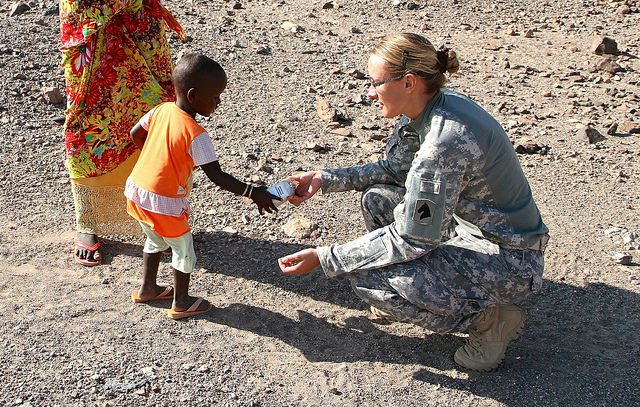
Sgt. Tiffany Anestis with the 2nd Battalion, 138th Field Artillery hands out supplies to local civilians during the unit’s deployment to Djibouti and the Horn of Africa, Dec. 11, 2012. Kentucky Guard leadership said the relationships built during the 2/138th deployment helped pave the way for the new partnership. (U.S. Army National Guard photo by Sgt. Alexa Becerra)
The Kentucky National Guard is beginning a new partnership with Djibouti to support defense security cooperation goals. The National Guard State Partnership Program works to develop military and civilian relationships with a variety of state partners. Spokesman Lt. Col. Kirk Hilbrecht said this could include training and assistance with things like security, emergency management and building schools.
The partnership includes personnel exchanges between the two countries. But Hilbrecht said it’s about more than just skills and training.
“It is a true cultural exchange. And for them to really get a great taste of Kentucky, they’ll have to come here. And likewise, people who will be working with the Djiboutians will have to go to Djibouti. And we look forward to exchanges on both sides,” Hilbrecht said.
Hilbrecht said the partnership is meant to benefit both guardsmen and Djiboutians.
“It becomes something pretty cool when you say, ‘hey, we’re not just knocking down doors but we’re opening up hearts and minds by working with state partners like Djiboutians where they are really looking at us as… many things, not just military but also civilians. But again it helps us become more rounded individuals,” Hilbrecht said.
Guardsmen travel to Djibouti in June to formalize the new partnership. Hilbrecht said once Djiboutian needs and requests are determined, the guard will set up personnel exchanges.
Hilbrecht said the Kentucky Guard has had a successful partnership with Ecuador since 1996. The Guard will maintain its partnership with Ecuador while taking on the new partnership with Djibouti.
Program builds cultural awareness and foreign language skills in future leaders
By Staff Sgt. Vicky Spesard, 123rd Airlift Wing Public Affairs
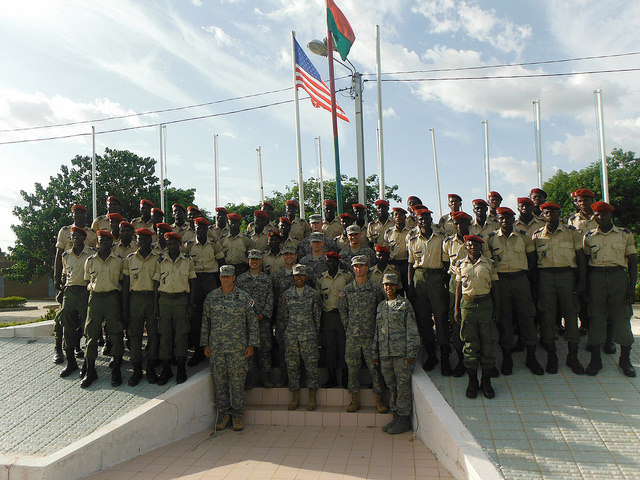
U.S. Army Cadets pose with their mission commander, cadre leader and first-year African officer cadets at the Georges Namoano Military Academy in Burkina Faso in June 2014 after the African cadets completed an English language course. The American cadets were participating in the U.S. Army Cadet Command’s Cultural Understanding and Language Proficiency Program, which is designed to strengthen cultural awareness and foreign language proficiency skills among the Army’s future leaders. (Courtesy photo)
KENTUCKY AIR NATIONAL GUARD BASE, LOUISVILLE, Ky. — Master Sgt. Zakiya Taylor didn’t know a single word of French when she arrived in Burkina Faso in early June, traveling not as a tourist but as a mentor to the eight Army ROTC cadets who accompanied her.
In support of the U.S. Army Cadet Command’s Cultural Understanding and Language Proficiency Program (CULP), Taylor’s mission was to serve as their cadre leader, aiding the young cadets in bridging cultural divides between themselves and African officer cadets from the Georges Namoano Military Academy.
“I was really excited to be chosen for this mission,” said Taylor, a Kentucky Air National Guardsman who normally serves as dining facility manager for the 123rd Airlift Wing in Louisville. “This gave me an opportunity to mentor young people and to test my leadership skills.”
While in Burkina Faso, Taylor and the cadets lived in barracks alongside their African counterparts, attended classes with them and visited a local population whose dominant language is French.
“Some of their cadets could read and write our language, but had little understanding of it,” Taylor explained. “Our cadets went through English language workbooks with them and provided teachable moments. It was a wonderful experience for both groups.”
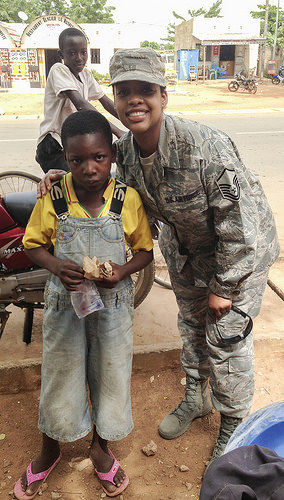
Air Force Master Sgt. Zakiya Taylor of the Kentucky Air National Guard’s 123rd Airlift Wing greets a Burkinabe boy while serving as a cadre leader for U.S. Army Cadets participating in the U.S. Army Cadet Command’s Cultural Understanding and Language Proficiency Program in Burkina Faso in June 2014. The program strengthens cultural awareness and foreign language skills among the Army’s future leaders. (Courtesy photo)
Click here to see more photos from this story.
The idea behind the CULP Program, which is headquartered at Fort Knox, Kentucky, is for young Army leaders to develop more cultural awareness and foreign language proficiency skills. According to the program’s website, cadets experience up to three different “venues” during immersion, learning about humanitarian service, host nation military-to-military contact, and the social, cultural and historical aspects of a country.
In 2013, more than 1,200 ROTC Cadets traveled across the world to participate in CULP. As the program has grown, the Army discovered it did not have enough personnel to accompany the cadets, according to Air Force Lt. Col. Shawn Keller, so other services were invited to provide cadre leaders. The 2014 effort marked the second year of participation for the Kentucky National Guard.
Keller, a Kentucky Air Guardsman and director of the Kentucky National Guard State Partnership Program, became a bridge between the Cadet Command and the Kentucky Guard in 2013, serving as a test case by accompanying a group of cadets to Burkina Faso last year. Upon his return, he knew the mission could be fulfilled by the state’s Army and Air Guard members.
“The program sends cadets to more than 40 countries around the world each summer for a period of approximately three weeks,” Keller said. “When the program reached out to the Kentucky Guard, they found qualified people with life experience and experience working with young people. When the Army asked for the Guard’s assistance, I knew where to get it.”
This partnership between the Army and Kentucky Guard is an invaluable asset to the continued growth of the program, according to Cadet Command officials.
“We recognize and appreciate the outstanding support we get every year from the Kentucky National Guard and other National Guard partners across the United States,” said Army Col. Brian Mennes, deputy commanding officer for U.S. Army Cadet Command. “This year 75 percent of our culture and language proficiency missions are supported with National Guard NCOs and officers, who are acting as cadre, providing essential coaching, mentoring and training to our future leaders.
“Missions such as these,” he continued, “are good examples of the experience and knowledge our cadets gain from their time with members of the National Guard.”
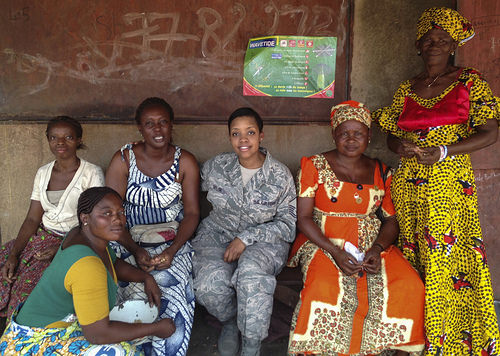
Air Force Master Sgt. Zakiya Taylor of the Kentucky Air National Guard’s 123rd Airlift Wing meets with Burkinabe businesswomen while serving as a cadre leader for U.S. Army Cadets participating in the U.S. Army Cadet Command’s Cultural Understanding and Language Proficiency Program in Burkina Faso in June 2014. The program strengthens cultural awareness and foreign language skills among the Army’s future leaders. (Courtesy photo)
Besides Taylor, three additional Kentucky Air Guardsmen and two Soldiers from the Kentucky Army Guard accompanied cadets overseas this summer. Air Force Lt. Col. Brian McMorrow, medical plans and operations officer for the Kentucky Air Guard’s CBRNE Enhanced Response Force Package, accompanied one group to the Democratic Republic of Congo, while Air Force 1st Lt. Jessica Ellis, medical liaison officer for the CBRNE Enhanced Response Force Package, took another group to Croatia. Air Force Lt. Col. Dallas Kratzer, director of military personnel for the Kentucky Air Guard, traveled to Bosnia where his group of cadets experienced all three venues of the CULP Program.
“Originally, my group of cadets was going to go to another location when record rains turned into devastating floods throughout Bosnia,” Kratzer explained. “We were rerouted to Bosnia to help with flood-relief efforts. The operation became a multi-nation effort as military forces from around Europe came to help.
“Working side by side with so many different militaries was an invaluable learning experience,” he continued. “The students were focused on getting to know the other service members as well as assisting local Bosnians. When we ended the mission with one-on-one contact with the cadet officers, it gave our cadets a true sense of immersion into different cultures. It was a truly fantastic mission.”
McMorrow’s mission to the Democratic Republic of Congo mirrored Taylor’s mission to Africa, with U.S. cadets visiting foreign military cadet installations and teaching English language and culture to their foreign counterparts.
“It was truly fabulous watching our young Army cadets leading their (Congolese) cadet officers and building relationships with each other,” McMorrow said. “The give and take between the two vastly different groups on such a human level was an experience that I and my group of cadets will never forget.”
Taylor echoed those sentiments.
“This was a great leadership opportunity for me,” she said. “I was solely responsible for these cadets, getting them to their mission location and taking care of them from start to finish. The mission didn’t improve my French, but it has made me a better leader. I know the cadets’ experiences will make them better leaders, too.”
Story by Staff Sgt. Scott Raymond, Kentucky National Guard Public Affairs
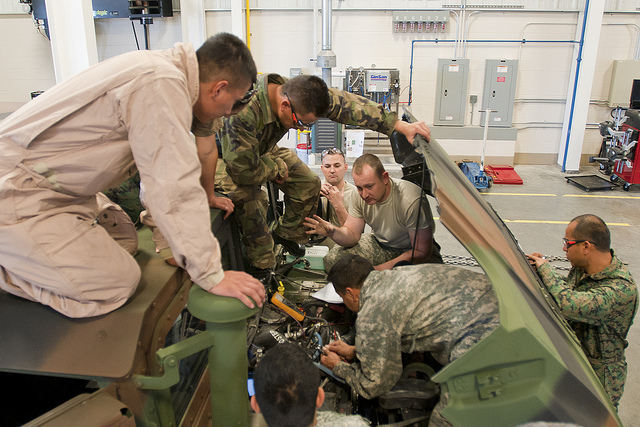
Staff Sgt. Adam Honican (center) with the Kentucky Guard’s Field Maintenance Shop 4 explains the throttle position sensor of a M1152 Humvee to members of the Ecuadorian military in Richmond, Ky., Dec. 11, 2013. The Ecuadorians visited Kentucky to learn more about newer models of the Humvee as part of the State Partnership Program between their country and the commonwealth. (U.S. Army National Guard photo by Staff Sgt. Scott Raymond)
RICHMOND, Ky. — The National Guard’s State Partnership Program celebrated its 20th anniversary in 2013. For 17 of those years, the Kentucky National Guard and the South American country of Ecuador have grown a mutually beneficial relationship of training and cooperation.
While the partnership has seen its livelier days, the Soldiers and Airmen of both countries continue to find common ground in their fields. Several members of the Ecuadorian military visited Frankfort and Richmond, Ky. in December as part of a maintenance-training program, in a fresh sign of the association,
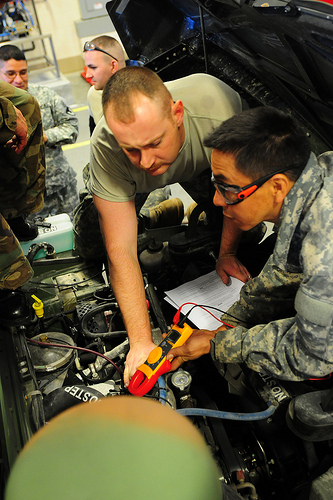
Staff Sgt. Adam Honican assists an Ecuadorian Marine in calibrating a throttle position sensor on a M1152 Humvee in Richmond, Ky., Dec. 11, 2013. Mechanics with the Ecuadorian military do not have the latest equipment to properly maintain their new Humvees, but learned new ways to adapt to the needs of the vehicles. (U.S. Army National Guard photo by Staff Sgt. Scott Raymond)
The purpose of the visit was for the Ecuadorians to see how Kentucky maintains their fleet of M1152 Humvees. Ecuador recently purchased more than 100 of the vehicles from the United States and was seeking the knowledge on the new model.
Members of the Ecuadorian Army and Marines spent several days in Kentucky gaining new ideas for the up-keep of the new Humvees. From the basics of work order flow to the proper way to calibrate a throttle position sensor, Kentucky Guardsmen shared what they knew.
“It’s pretty neat to have the opportunity to teach them things they don’t get in their own country,” said Staff Sgt. David Gross with the Field Maintenance Shop in Richmond. “They were excited to be here and were very willing to learn whatever we had to share. We are more than happy to spread the mechanic knowledge to foreign military partners.”
To see more photos from this story, click here.
Ecuador’s use of its Humvees is quite different from the U.S. Tactical wheeled vehicles are a critical asset for operations along Ecuador’s border regions, particularly the northern border with Colombia. Securing that border is a top priority for both the U.S. and Ecuador. Transnational organized crime, narcotics and human trafficking, and incursions by terrorist organizations are a common and serious threat to Ecuador’s security.
Wheeled tactical vehicles are the primary means for effectively patrolling the austere conditions found in the mountains and jungles in the border region. Ecuador operates their Humvees for long hours in these harsh conditions and improving their vehicles’ mission capability rate is a key factor in achieving border security goals.
Lt. Mayra Artaega with Ecuador’s army led the small group north for the visit. She believes the maintenance and logistics systems of the U.S. military are of the highest standards and working with their partner nation will only enhance their abilities in Ecuador.
“Tactical vehicles are critical to border security for us in Ecuador, but as a small country our financial resources and facilities are much more limited than they are in the U.S.,” she said. “Working with our friends in the Kentucky National Guard and sharing best practices for properly maintaining our new Humvee fleet is one of the best ways we can protect our investment.”
December’s event was the sixth in a series of exchanges focused on Ecuador’s wheeled vehicle program. Two events were conducted in Ecuador, most recently in April of 2012, and the rest have been in Kentucky.
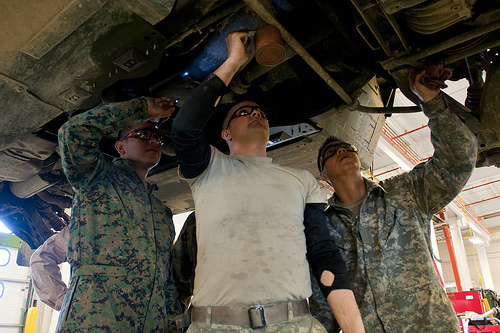
Staff Sgt. David Gross discusses transmission maintenance with two members of the Ecuadorian military on a M1152 Humvee in Richmond, Ky., Dec. 11, 2013. Ecuador has purchased new models of the Humvee and were in need of training on the different methods of maintenance. (U.S. Army National Guard photo by Staff Sgt. Scott Raymond)
According to Lt. Col. Shawn Keller, Kentucky’s State Partnership Program director, the military relationship between the two countries is much better than the strained political relationship of late. The tactical vehicle exchanges with Kentucky and a follow-on visit scheduled for May of 2014 are the only U.S.-Ecuador engagements that Ecuador’s Minister of Defense has approved for 2014. A fact that Keller says speaks volumes for the trust and value that Ecuador has for Kentucky and the state partnership program.
“This event is unique, and it’s not only about Kentucky’s continued efforts to help Ecuador build a strong tactical vehicle maintenance program,” said Keller. “This event also symbolizes Kentucky’s emerging role as a key player in keeping the pilot light burning until the political climate once again allows the U.S. and Ecuador militaries to fully engage.”
“The unique ability to build and maintain lasting relationships with partner countries, even in challenging times, is a hallmark of the National Guard’s State Partnership Program.”
123rd Airlift Wing Public Affairs
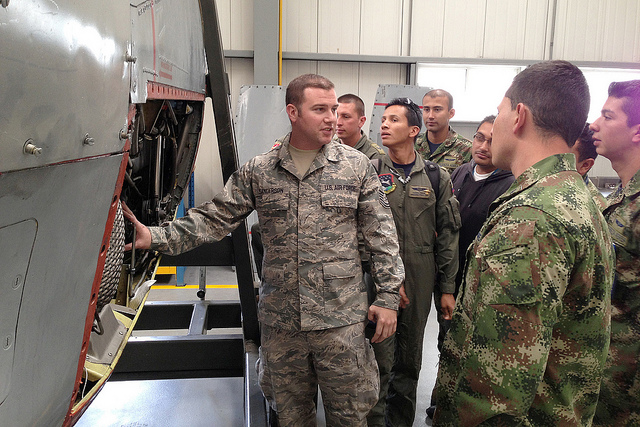
Tech. Sgt Jason Sanderson, a crew chief in the Kentucky Air National Guard’s 123rd Global Mobility Squadron, explains C-130 engine components and inspection procedures to members of the Columbia Air Force during a training event held in Bogota, Columbia, in August and September 2013. (U.S. Air National Guard Photo)
BOGOTA, COLOMBIA — An Airman from the Kentucky Air National Guard deployed here Aug. 11 to Sept. 14 to help build stronger ties with the Columbia Air Force while serving as an instructor for the 571st Mobility Support Advisory Squadron.
The 571st’s Mobile Training Team was conducting the fourth in a series of training events focused on Colombia’s C-130 aircraft maintenance program, according to Tech. Sgt. Jason Sanderson, a crew chief in the Kentucky Air Guard’s 123rd Global Mobility Squadron.
Held at the central airlift maintenance facility in Bogota, the course’s intent was to assist in broader relationship-building efforts between the U.S. and Colombian air forces, while directly assisting the Fuerza Aérea Colombiana in their efforts to increase the sortie generation rate for critical airlift missions, Sanderson said.
The Mobility Support Advisory Squadron mission, based out of Travis Air Force Base, Calif., supports the 12th Air Force’s continued engagements in the U.S. Southern Command area of responsibility in Latin America and the Caribbean. This particular engagement was unique because Sanderson was one of the first Air National Guard members brought in to augment the Mobility Support Advisory Squadron mission and teach a C-130 maintenance instructional seminar.
According to Maj. Shawn Keller, State Partnership Program director for the Kentucky National Guard, the inclusion of Air Guard members in active-duty security cooperation missions is a trend that is likely to continue.
“The Air Force has discovered that the Guard has a long and successful history of building and sustaining international partnerships,” Keller said. “As budgets and manpower continue to shrink, the Mobility Support Advisory Squadron and other U.S. military units operating in USSOUTHCOM are taking advantage of the strong foundational relationships that the State Partnership Program has been building in the region since the mid-1990s. They have also realized that the Guard is an excellent source of highly skilled and seasoned Airmen who can fill critical positions on their Mobile Training Teams.”
The initial plan for Air Guard involvement was developed during a joint maintenance assessment conducted by a team from the South Carolina and Kentucky National Guard State Partnership Programs in April 2013. South Carolina, whose Air National Guard is equipped with the F-16 weapon system, was recently partnered with Colombia under the National Guard Bureau partnership program.
Kentucky, which has C-130s, also participates in the State Partnership Program and has been paired with Colombia’s neighbor, Ecuador, since 1996.
The airlift mission plays a vital role in Colombia’s counter-narcotics and border security efforts, Keller said, and mission-capable aircraft are a key to success. As a result of Colombia’s request for assistance in the form of a C-130-specific maintenance seminar, the South Carolina Air National Guard partnered with Kentucky and other states to provide C-130 subject matter experts.
“South Carolina has done a tremendous job of quickly establishing an effective partnership in a country that is definitely one of the busiest in SOUTHCOM,” Keller said. “They realized the importance of airlift support to Colombia immediately, and wasted no time in reaching out to other Air National Guard units for support. South Carolina has a great State Partnership Program team, and we are happy to be supporting their mission.”
The training course, which lasted approximately three weeks, was “translated to the 14 partner-nation students by the 571st’s highly experienced senior air advisor, Tech. Sgt. Javier Borges,” Sanderson said.
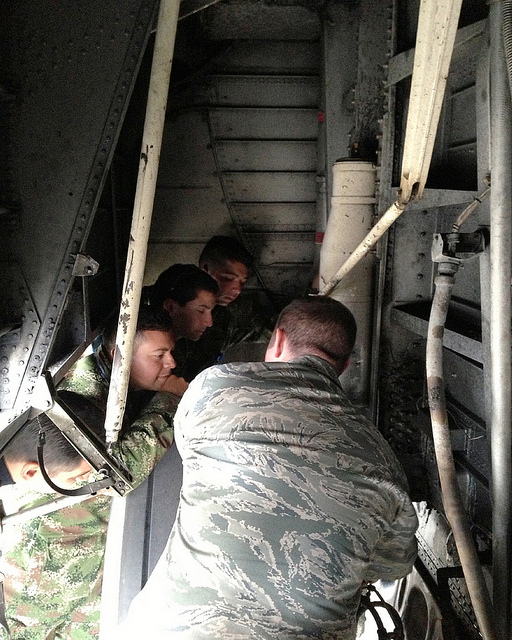
Tech. Sgt. Jason Sanderson, a crew chief in the Kentucky Air National Guard’s 123rd Global Mobility Squadron, trains maintainers from the Columbia Air Force on the components of a C-130 aircraft Main Landing Gear System during a training event held in Bogota, Columbia, in August and September 2013. (U.S. Air National Guard Photo)
“Borges was instrumental in the success of the aircraft maintenance seminar as well as the instruction of C-130 air drop and loadmaster seminars conducted during the engagement,” he added.
Sanderson was able to provide assistance in the fields of auxiliary power unit and bleed air systems; engine systems; and fuel systems components and operations. He also provided an introduction to C-130 avionics and communication/navigation systems, and lectured on the importance of the Crew Chief Concept of flight line operations, production inspections, technical order systems, the role of quality assurance, and proper maintenance documentation.
“The students are highly competent, very enthusiastic about learning the C-130 and excited about the U.S. involvement in helping them achieve their goals,” said Master Sergeant Aaron Carrillo, an air traffic controller with the 571st who observed several maintenance seminars and served as team sergeant instructor for the mission.
In addition to providing instructional seminars, the team was able to organize a partnership-building day at the end of the second week. The Fuerza Aérea Colombiana, or FAC, provided their own officer club for the event, while the 571st provided food and entertainment, Sanderson said.
Part of that entertainment involved a friendly soccer match between the 571st team and the partner nation. Much to the dismay of the 571st’s first-time mission commander, Maj. Justin Allen, the Colombians won the match by a margin of five goals.
“It was a wonderful experience for the (571st) team, as well as for the students who participated.” Allen said. “We may have lost the match but we won on the larger scale of building partnerships.”
Keller agreed.
“Overall, the fourth Mobility Support Advisory Squadron engagement to Colombia was a great success,” he said. “Sergeants Sanderson and Borges were able to instruct the FAC maintainers on C-130-specific aircraft systems as well as give them a glimpse into the overall maintenance concept of the U.S. Air Force and its continued success on the world stage.
“Both the 571st Mobility Support Advisory Squadron, through their increased focus on building partnership capacity, and the Air National Guard, through the National Guard Bureau’s State Partnership Program, stand ready for involvement in future engagements. When a crisis or contingency operation occurs, the United States and their partner nations will be better prepared to respond together.”
Story and photos provided by Maj. Shawn Keller, Kentucky National Guard State Partnership Director

Staff Sgt. Elmer Quijada, Capt. Jennifer Nash, Chief Warrant Officer John Radford, Maj. Shawn Keller and Staff Sgt. Pedro Soto show off their training certificates following two weeks learning the Spanish language in Costa Rica. The training is part of the Kentucky National Guard State Partnership Program.
SAN JOSE, Costa Rica – Geography doesn’t often make the list of favorite subjects in school, but most people in the United States are familiar with Costa Rica. About the size of West Virginia, this small Central American country has a big reputation as the world leader in eco-tourism; and as a major exporter of produce and coffee to the U.S., it’s hard to walk down the produce aisle or into your local Starbucks without noticing bananas, pineapples or java bearing the “Costa Rica” label. But in early September, six members of the Kentucky National Guard had a unique opportunity to experience a side of Costa Rica that most tourists never see—by living with a Costa Rican family.
The Kentucky soldiers and airmen were in Costa Rica from 2-15 September participating in a Spanish language and cultural immersion program sponsored by the National Guard’s State Partnership Program (SPP). Kentucky has partnered with the Republic of Ecuador since 1996, and the Kentucky-Ecuador connection was one of the first State Partnerships in US Southern Command. The Kentucky National Guard has a number of soldiers and airmen that are fluent in Spanish, but finding individuals with expertise in the nuances of Latin American culture and customs is a more difficult challenge. Training events like this year’s immersion program are an important tool in building and maintaining the enduring relationships that are a hallmark of the SPP.
Participants for the event were carefully selected from career fields that support the top three military priorities of the Ecuador partnership—aviation operations and maintenance, search and rescue operations and wheeled vehicle maintenance. The group attended daily classes at the Costa Rica Spanish Institute (COSI) in the capital city of San Jose. An average day consisted of a four hour group class with an additional hour of one-on-one instruction each afternoon. The Kentucky group’s level of Spanish varied considerably, ranging from individuals that were raised in bi-lingual homes to others who had little or no exposure to Spanish before the trip. Although everyone was placed in classes appropriate for their level, even those considered fluent by most standards found the course to be a real challenge.
“COSI is the most intense language training I’ve experienced,” said Staff Sgt. Elmer Quijada, a pararescueman with the 123rd Special Tactics Squadron. “As a native Spanish speaker, I was surprised how much I learned about the language. Also, the people and culture of Costa Rica were wonderful, and the overall experience was first class.”

Chief Warrant Officer John Radford, Capt. Jennifer Nash, Master Sgt. Russ LeMay, Staff Sgt. Pedro Soto, Staff Sgt. Elmer Quijada and Maj. Shawn Keller at the Catedral de Los Angeles, Cartago, Costa Rica.
Afternoons provided time to decompress from the rigors of conjugating Spanish verbs while experiencing the local sights and sounds of San Jose and spending time with host families. Each member of the Kentucky team was placed with a Costa Rican family and lived with them for the duration of the trip. They shared daily meals, activities and conversations with their families, which for those individuals new to Spanish often proved to be the day’s biggest challenge.
“I had no Spanish background whatsoever,” said Chief Warrant Officer Two John Radford, a UH-60 pilot with the Kentucky Army National Guard’s Bravo Co. 2nd Battalion, 147th Aviation Regiment. “I expected a family that spoke some English, but that wasn’t the case at all. As soon as I arrived, I was given the grand tour of the ‘casa’ (house) in Spanish, at which time I realized I was in serious trouble.”
Radford cites some confusion regarding the operation of the shower head, which was provided to him by his host entirely in Spanish.
“This naturally resulted in three days of ice cold showers and me learning the word “fria” (cold),” he said. “But in the end, having to learn the language quickly in order to communicate proved to be beneficial and really made the lessons stick.”
In addition to providing formal language courses, COSI sponsored several excursions for the group including visits to San Jose’s famous Mercado Central, the old capitol city of Cartago and it’s 19th century Cathedral and the active volcano Irazu that is located about an hour away from San Jose. The team also took part in a weekend trip to Puerto Viejo, a small town located on Costa Rica’s Atlantic coast. The drive to Puerto Viejo provided a unique opportunity to experience the highly variable geography of Costa Rica on roads that meandered through volcanic peaks, cloud forests and coastal jungles.

Capt. Jennifer Nash and her host family during Spanish language immersion training in Costa Rica.
Although Costa Rica is one of the safest countries in Central America, the group had a few unexpected adventures. A magnitude 7.9 earthquake, centered approximately 80 kilometers northwest of COSI’s San Jose campus, struck Costa Rica’s Pacific coast region on September 5th. Fortunately those living close to the epicenter suffered few injuries and surprisingly little damage. Still, it was quite an experience for the Kentucky group, and the first earthquake several of them had experienced.
“We were in the middle of class, and the walls just started rocking back and forth,” said Staff Sgt. Pedro Soto, a vehicle mechanic with the KYNG-J4. “ It took a few seconds for me to realize that we were actually having an earthquake. It’s just not something I’ve ever experienced in Kentucky.”
In another incident, a member of the group woke up in Puerto Viejo eye-to-eye with a 4-inch jungle scorpion, with which he had apparently been sharing the same bed. But other than a few shattered nerves, everyone had a memorable experience and returned safely home with a better knowledge of Spanish and a fond appreciation for the rich culture and beautiful landscapes of Costa Rica.
“Living with a family in Costa Rica and attending classes at COSI was an invaluable experience,” said Capt. Jennifer Nash, a C-130 pilot with the 165th Airlift Squadron. “Best of all, I got to know other members of the Kentucky National Guard and share this experience with them.”
LOUISVILLE, Ky. — Following photos taken during a recent visit by members of the Ecuadoran Air Force .
Click here to read the story.
Click here to read the story in Spanish.
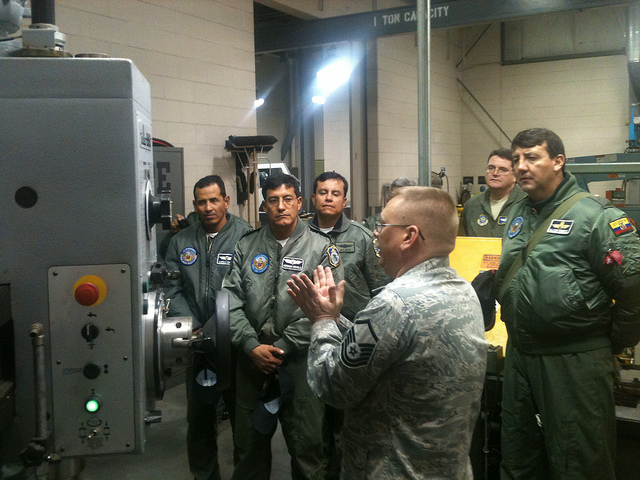
Kentucky Air National Guard Master Sgt. Allen Harper demonstrates the latest equipment in the 123rd Maintenance Squadron's Structural Repair Shop to members of the Ecuadoran Air Force. The team from Ecuador were in Kentucky last month to observe C-130 operations and participate in a weeklong subject matter expert exchange. L-R: Sgt. Sixto Fonseca, Sgt. Hernan Revelo, Maj. Jorge Alcanzar, Master Sgt. Allen Harper, Maj. Roberto Salazar, and Lt. Col. Jim Nelson (in background). (Photo by 1st Lt. Oscar Ortiz, Kentucky Army National Guard)
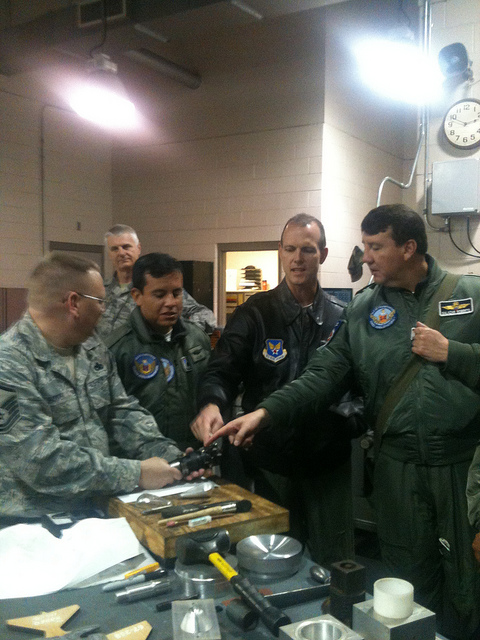
Kentucky Air National Guard Master Sgt. Allen Harper demonstrates the operation of a CNC machine cutting tool to members of the Ecuadoran Air Force during a visit to the 123rd Maintenance Squadron Structural Repair Shop. The team from Ecuador were in Kentucky last month to observe C-130 operations and participate in a weeklong subject matter expert exchange. L-R: Maj. Jorge Alcanzar, Chief Master Sgt. Bill Davis (background), Col Jared Curtis (USAF), Maj. Roberto Salazar. (Photo by 1st Lt. Oscar Ortiz, Kentucky Army National Guard)
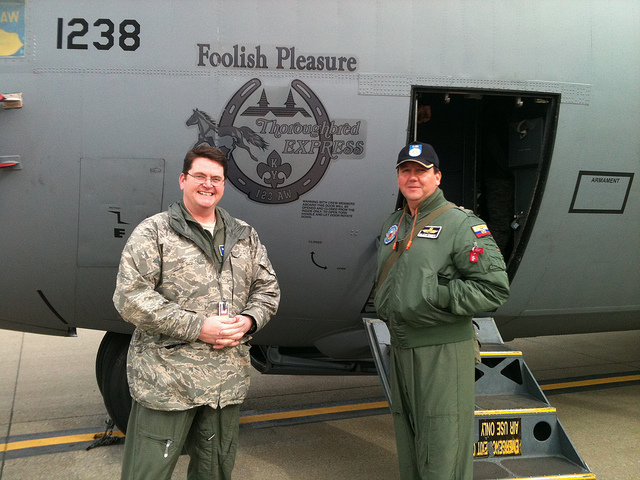
Lt . Col. Jim Nelson gives Maj. Roberto Salazar a tour of a Kentucky Air National Guard C-130 Hercules (Tail Number 1238, "Foolish Pleasure"). Salazar was part of a team from Ecuador that visited Kentucky last month to observe C-130 operations and participate in a weeklong subject matter expert exchange. (Photo by 1st Lt. Oscar Ortiz, Kentucky Army National Guard)
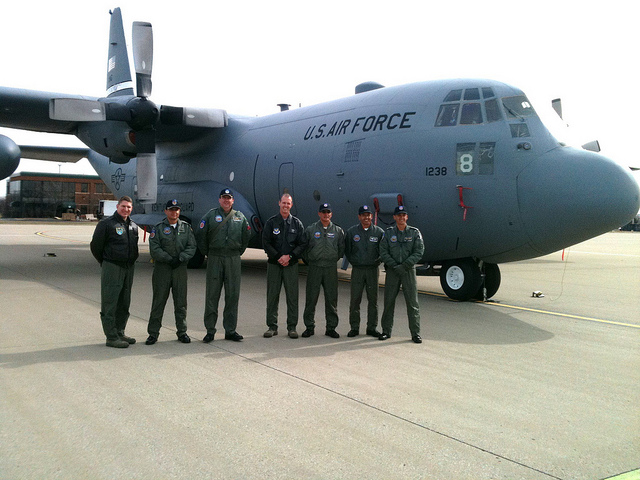
Visitors from the Ecuador Air Force and the U.S. Military group, Ecuador, were in Kentucky last month to observe C-130 operations and participate in a weeklong subject matter expert exchange. L-R: Lt Col Pete Jacob (USAF), Major Jorge Alcanzar, Maj Roberto Salazar, Col Jared Curtis (USAF), Sgt. Hernan Revelo, Sgt. Sixto Fonseca, Capt. Marco Martínez. (Photo by 1st Lt. Oscar Ortiz, Kentucky Army National Guard)
Escrito por: Sub-Oficial Segundo Phil Speck, Asuntos Públicos de la Escuadrilla de Puente de Vuelo 123
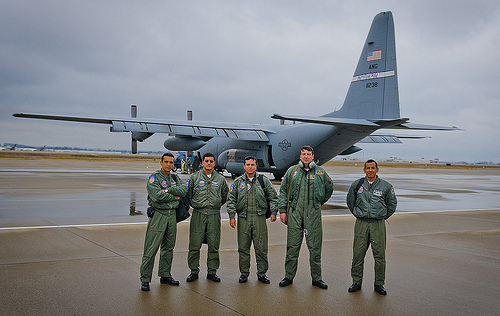
Miembros de la Fuerza Aerea Ecuatoriana caminan a un C-130 de la Guardia Nacional de Kentucky preparandose para un corto vuelo de entrenamiento. Cinco miembros de la tribulancia de la Fuerza Aerea Ecuatoriana visitaron la Guardia Nacional Aerea de Kentucky con el Intercambio de Expertos del C-130 a mediados de Febrero. (Photo por Sub-Oficial Segundo de la Fuerza Aerea de los E.U. Phil Speck)
KENTUCKY AIR NATIONAL GUARD BASE, LOUISVILLE, Ky. - Cinco miembros de la Fuerza Aérea Ecuatoriana visitaron la Base de la Guardia Nacional Aérea de Kentucky a mediados de febrero para observar las operaciones del C-130 y participar en un Intercambio de Expertos en la materia.
El evento fue centrado en operaciones y seguridad de aeronaves, con la meta compartida de mejorar la eficacia operativa del programa de C-130 Ecuatoriana, dijo Mayor Shawn Keller, director del Programa de Asociación Estatal de la Guardia Nacional de Kentucky.
Los visitantes eran miembros expertos de la tripulación, con una mezcla de pilotos y mecánicos de vuelo participando en el evento. Cinco miembros del Escuadrón de Puente Aéreo 165th de Kentucky estuvieron presentes para ayudar en el evento.
En este momento Ecuador tiene cuatro aeronaves C-130: un modelo H1, un L100 – la versión civil del C-130 – y dos modelos B más viejos, los dos de cuales fueron anteriormente asignados y volados por la Guardia Aérea de Kentucky.
“La Asociación Estatal fue anfitrión del Intercambio de Expertos C-130 en Febrero del 2011,” dijo Keller. “Ese evento se enfoco ante todo en mantenimiento de aeronaves. Esta vez, la visita fue más concentrada específicamente en operaciones con énfasis en seguridad, entrenamiento, planificación de misiones y capacidad de visión nocturna. Las gafas de visión nocturna son una capacidad que la Fuerza Aérea Ecuatoriana no tiene en este momento, pero tienen entusiástico interés in adquirir los sistemas de visión nocturna para sus C-130 en el futuro.”
Keller dijo que el punto culminante de este intercambio fue una serie de vuelos de orientación que brindo una rara oportunidad para los Ecuatorianos de volar con tripulación de la Guardia Aérea de Kentucky en misiones de entrenamiento de gafas nocturna.
“Nunca e volado con gafas nocturnas,” dijo Capitán Marco Martínez, piloto del C-130 en la Fuerza Aérea Ecuatoriana. “Esta experiencia es muy importante. Tener las gafas nocturnas es una grande ventaja precisamente para volar en altitudes bajas.”
En adición a los vuelos de orientación y la mirada a fondo a las operaciones diarias del Escuadrón de Puente Aéreo, los ecuatorianos fueron proveídos con un breve recorrido y instrucción de capacidad por la escuadrilla de mantenimiento de aeronaves, el Grupo de Respuesta de Contingencia 123 y el Escuadrón de Tácticas Especiales 123.
Los visitantes fueron expuestos a la hospitalidad de Kentucky con visitas a Fort Knox, Kentucky, y un recorrido privado de la destilería Maker’s Mark en Loretto, Kentucky, dijo Keller.
“El Programa de Asociación Estatal de La Guardia Nacional de Kentucky comenzó en 1996, y continua siendo una relación valiosa y vibrante para ambos la Republica de Ecuador y Kentucky.”
Intercambios del C-130 han sido eventos regulares desde las primeras épocas de la asociación, e ambas partes dicen que esperan continuar esta asociación por buen tiempo.
“Nuestros socios Ecuatorianos han podido ver como otra unidad funciona, como mitigan preocupaciones compartidas y como los problemas a los que nosotros no enfrentamos son similares a los de ellos,” dijo Teniente Coronel Jim Nelson, piloto del C-130 de la Guardia Aérea de Kentucky.
“Viendo como solucionamos estos problemas les da una perspectiva nueva a como ellos pueden hacer lo mismo, con modificar algunos de nuestros procedimientos y políticas para que se adapten a su programa y mejorar su capacidad, confiabilidad y seguridad.”
By Master Sgt. Phil Speck, 123rd Airlift Wing Public Affairs
Members of the Ecuador Air Force walk out to a Kentucky Air Guard C-130 preparing to take a short training flight. Five Ecuador Air Force aircrew members visited the Kentucky Air National Guard on a Subject Matter Expert Exchange in Mid-February. (U.S. Air Force photo by Master Sgt. Phil Speck)
KENTUCKY AIR NATIONAL GUARD BASE, LOUISVILLE, Ky. – Five members of the Ecuador Air Force visited the Kentucky Air National Guard Base in mid-February to observe C-130 operations and participate in a weeklong Subject Matter Expert Exchange.
The event focused on aircraft operations and safety, with the shared goal of enhancing the overall operational effectiveness of Ecuador’s C-130 program, said Maj. Shawn Keller, director the Kentucky National Guard’s State Partnership Program.
All the visitors were experienced aircrew members, with a mix of pilots and flight engineers participating in the event. Five traditional Guard members from Kentucky’s 165th Airlift Squadron were on hand for the week to help host the exchange.
Ecuador currently has four C-130 aircraft in its inventory: an H1 model, an L100 — the civilian version of the C-130 — and two older B models, both of which were once assigned to and flown by the Kentucky Air Guard.
“The State Partnership hosted its last C-130 Subject Matter Expert Exchange in February 2011,” Keller said. “That event focused primarily on aircraft maintenance. This time around, the visit was tailored specifically to operations with an emphasis on safety, training, mission planning and night-vision capabilities. Night vision goggles are a capability that Ecuador’s Air Force does not currently have, but they do have a keen interest in acquiring NVG systems for their C-130s in the future.”
Keller said the highlight of the exchange was a series of orientation flights that gave the Ecuadorians a rare opportunity to fly along with Kentucky Air Guard crews on actual NVG training missions.
“I’ve never flown with NVG,” said Capt. Marco Martinez, an Ecuador Air Force C-130 pilot. “It’s a very important experience. It’s a big advantage to have NVGs to fly precisely in very low altitudes.”
In addition to the orientation flights and an in-depth look at the day-to-day operations of the 165th Airlift Squadron, the Ecuadorians were provided with a short tour and capabilities briefing from the wing’s Aircraft Maintenance operations, 123rd Contingency Response Group and 123rd Special Tactics Squadron.
1st Sgt. Hernan Revelo, an Ecuador Air Force C-130 flight engineer, said all of the material presented was “great and helpful to know,” and he plans to share it with new C-130 crewmembers back in Ecuador.
The visitors also were treated to plenty of Kentucky hospitality during their stay, with visits to Fort Knox, Ky., and a private tour of the Maker’s Mark Bourbon Distillery in Loretto, Ky., Keller said.
Lt. Col. Pete Jacob, Air Force section chief of the U.S. Military Group, Ecuador, escorted the visitors to Kentucky. Col Jared Curtis, air attaché to Ecuador, also accompanied the group to observe the event and assess the capabilities that the Kentucky Air National Guard has to offer for future exchanges, Keller said.
“The Kentucky National Guard State Partnership began in 1996, and it continues to be a vibrant and valuable relationship for both the Republic of Ecuador and Kentucky,” he added.
C-130 exchanges have been a regular event since the early days of the partnership, and both parties say they look forward to continuing them well into the future.
“Our Ecuador partners have been able to see how another unit does business, how we mitigate shared concerns and how the problems we encounter are very similar to the ones they encounter,” said Lt. Col. Jim Nelson, a Kentucky Air National Guard C-130 pilot.
“Seeing how we solve those problems gives them a fresh perspective on how they can do the same, by modifying some of our procedures and policies to fit their program and enhance their capabilities, reliability and safety.”