Pages
Stay In Touch
More
© 2013 KentuckyGuard
By Staff Sgt. Scott Raymond, Kentucky National Guard Public Affairs
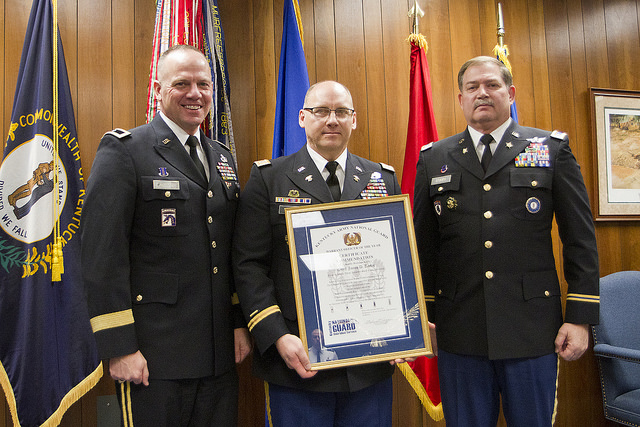
Chief Warrant Officer James Taylor (center) is named Kentucky’s Warrant Officer of the Year by Brig. Gen. Stephen Hogan (left) and State Command Chief Warrant Officer Dean Stoops (right) during a ceremony in Frankfort, Ky., Feb. 17, 2016. Taylor serves as the property book officer for the 201st Engineer Battalion and the 103rd Chemical Battalion.(U.S. Army National Guard photo by Staff Sgt. Scott Raymond)
FRANKFORT, Ky. — Annually the Kentucky Guard selects the most outstanding warrant officer. For the second year in a row, that Soldier came from the 149th Maneuver Enhancement Brigade. Chief Warrant Officer James Taylor, with the 201st Engineer Battalion earned the title for 2015.
“It is a humbling experience to be accepting this award. Nothing in my experience has prepared me for an honor like this - especially to be recognized for doing something that I so love to do,” said Taylor. “When one works in a field where every warrant officer regularly extend themselves above and beyond their duties, it is difficult to consider anything that one does as outstanding. I am blessed to have the opportunity to work with such a professional cohort of warrant officers that we have here in Kentucky. I share this award with them.”
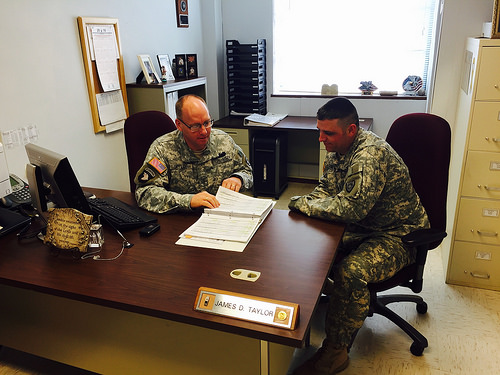
Chief Warrant Officer James Taylor discusses inventory with a Soldier with the 103rd Chemical Battalion in Richmond, Ky. Dec. 29, 2015. Taylor has served in uniform for 27 years and is known as a constant mentor and teacher, sharing his knowledge of supply with officers and enlisted Soldiers. (Courtesy photo)
Taylor serves as the property book officer for the 201st as well as for the 103rd Chemical Battalion, overseeing the inventory of five companies and three detachments. In true warrant officer fashion, through his knowledge and work ethic, Taylor has earned the respect of many across the Kentucky Guard.
“Chief Taylor’s leadership and expertise delivers incredible results to the logistical readiness of the 201st Engineer Battalion,” said Lt. Col. Douglas Clay, commander of the 201st. “He is a proven leader and sets an excellent example through his consistent and steady performance.”
Enlisting in 1989, Taylor began his career as a combat engineer. In 2003, he switched fields into unit supply and by 2009 was the unit property book NCO. It was in 2009 that Taylor decided to become a warrant officer.
“I made the decision to become a warrant officer to expand my audience,” he said. “I wanted to share my knowledge with commanders and staff officers while continuing to lead enlisted personnel.”
And lead he does. Taylor is credited with with providing a smooth transition for force structure re-alignments with the brigade and becoming a subject matter expert on the Global Combat Support System, the Army’s newest supply standards. He singlehandedly directs and coordinates the management and control of unit equipment worth more than $150 million.
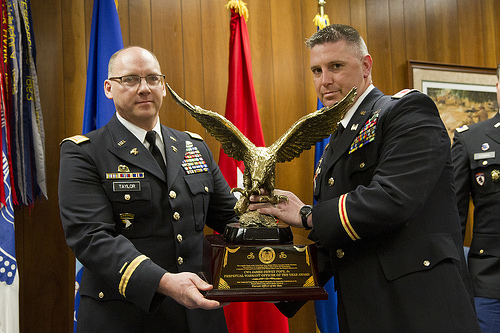
Chief Warrant Officer Buddy Barcus (right) presents the Kentucky Warrant Officer of the Year trophy to Chief Warrant Officer James Taylor in Frankfort, Ky., Feb. 17, 2015. Taylor followed Barcus as the top warrant officer in Kentucky, both from the 149th Maneuver Enhancement Brigade. (U.S. Army National Guard photo by Staff Sgt. Scott Raymond)
“We all have success and failures,” he said. “In relation to my own experience I regularly refer to the book of Philippians 4:13 ‘I can do all things through Christ which strengthens me,’ to overcome those tough assignments. I have found that over my 27 years of service the best way to influence other Soldiers to do their best is to know the standard, lead by example, and never give up. Always take the hard right over the easy wrong. The standards that we set as leaders will be the one that they use while making critical decisions.”
Taylor’s dedication extends beyond the uniform. A devout Christian, Taylor is an active member of two local churches where he has ministered for the past six years. He regularly coordinates and participates in food drives and various community service activities.
“Chief Taylor desire to serve others is continually inspiring,” said Command Chief Warrant Officer Dean Stoops. “He is always willing to travel and assist other Soldiers overwhelmed with tasks at hand. He is also adamant about inspiring others to go the extra mile.”
“He is the embodiment of the quiet professional,” said Stoops.
By Staff Sgt. Scott Raymond, Kentucky National Guard Public Affairs
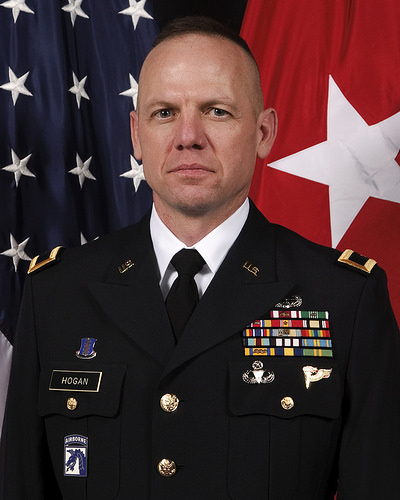
Brig. Gen. Stephen R. Hogan was appointed the 52nd adjutant general of Kentucky, Dec. 7, 2015 by newly-elected Gov. Matt Bevin. (Kentucky National Guard photo)
FRANKFORT, Ky. — A favorite quote amongst members of the Kentucky Guard goes like this, “There’s something in the very air of Kentucky which makes a man a Soldier.”
That’s also how you could sum up Brig. Gen. Stephen R. Hogan, Kentucky’s newest Adjutant General.
After a 30-year career in an Army uniform, Hogan returned from retirement in December to assume the role as the commonwealth’s 52nd adjutant general.
Hogan inherits a Kentucky National Guard that is in his mind “the best it’s ever been.”
It’s now his job to keep it there.
“Everyday in uniform is a blessing. Being a Soldier is all I’ve wanted to do since I was five-years-old, and this position offers me a challenge I have not seen before,” he said. “I derive satisfaction from being around the Soldier and being a part of this team. The willingness to serve something bigger than self is the cost of admission for this organization.”
After three decades in service, Hogan will rely on his Soldier’s perspective to lead Kentucky’s Soldiers and Airmen. That strong frame of reference for operations across the spectrum must serve him well as the Guard continues to be called upon at a moment’s notice in a variety of ways.
“We’ve become comfortable with unpredictability in an ambiguous environment,” he said. “ the Guard needs to remind itself of its role, and the reoccurring themes of flexibility and expertise in a great deal of areas.”
“I think any unit needs to be orchestrated, as a team and there is no point in a Guardsman’s career from E-2 to a two-star that the standards aren’t important.”
On his first day in the Guard in 1993, Hogan received what he calls the keys to leadership at the most simplistic, basic level.
“Retired Col. Bill Clark summed it up like this; ‘You must be a subject matter expert in your field, and whatever your troops are required to do, you are required to do.'”
Hogan said he hasn’t forgotten those words and that ideal. He said they’ve helped carry him through his career as an officer. Military education and experience have taught him more, but not as much as that original to-the-point conversation.
Hogan’s father was the only direct family member that served in the military. Even though he was drafted into the Army in the 1950s, Hogan said his father was very proud of his service because he understood the concept of service of self.
After commissioning through Morehead State University’s ROTC program in 1985, Hogan served eight years on active duty with the 101st Airborne Division and 6th Infantry Division.
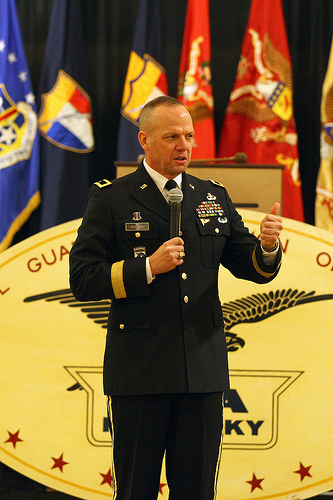
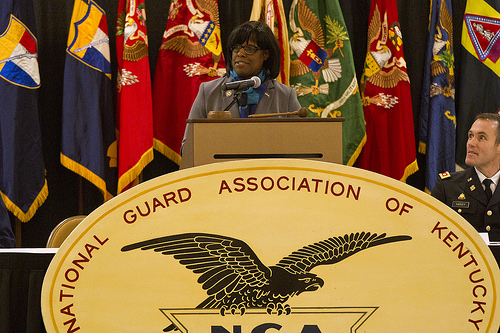
Brig. Gen. Stephen R. Hogan speaks during the National Guard Association of Kentucky conference in Louisville, Ky., Feb. 6, 2016. Hogan said the Kentucky Guard was in as good of shape as it could be and stressed teamwork for the organization moving forward. (U.S. Army National Guard photo by Staff Sgt. Scott Raymond)
June 2, 1993 was Hogan’s first day as a Kentucky Guardsmen. He became a tactical officer with the 138th Field Artillery Brigade, followed by stints with the 149th Armor and Kentucky’s Officer Candidate School.
But it would be his time in command of Kentucky’s Joint Support Operations, the Counter Drug task force that would define the leader that now commands the Kentucky Guard.
As the former commander of the hand-picked unit, Hogan said he has seen some of the finest Soldiers Kentucky has to offer serving the commonwealth. He said leading a group of driven Soldiers with such camaraderie and dedication to service remains a highlight of his career. It was core principles that he believes made and continues to make JSO such a quality unit. An idea he sees as essential for the Guard to thrive.
“We’re going to emphasize core fundamentals and competencies for Soldiers and Airmen. We’ve proven what we can do and how well we’ve done it, but I would like to see some forward movement in all aspects of how we do our jobs.”
“I would like to see the organization return to those core competencies and become an even more professional institution.”
Hogan understands he now has a unit of 8,500 under him to supervise and represent. It’s time for him to become a subject matter expert in a new job, for which he knows he has work to do. And his success will be measured on the success of his troops.
“If I don’t push myself, the organization pushes me, and requires me to be the best version of myself as we go forward in order to earn my part on the team.”
Kentucky National Guard Public Affairs Staff Report
Summary of the Kentucky National Guard in the Persian Gulf War 1990-91
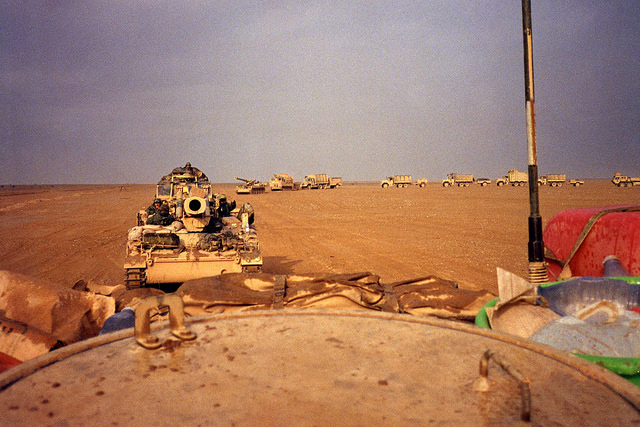
Soldiers with the 1st Battalion, 623rd Field Artillery move supplies and equipment along the Iraqi border during Operation Desert Storm, Feb. 27, 1991. As one of the few National Guard combat arms units deployed to the theater, the 623rd provided fire support for coalition forces during the conflict. (Kentucky National Guard historical photo)
It’s been 25 years since the United States first went to war in the Persian Gulf. Aug. 2, 1990 saw the invasion of Kuwait by neighboring Iraq, an event that both shocked and outraged the world. Spearheading a 21-member United Nations coalition, the United States initiated Operation Desert Shield, the largest military buildup since the Vietnam War.
On Jan. 17, 1991, Americans at home watched as Operation Desert Shield turned into a Desert Storm. A six-week air campaign preceded what came to be known as “The One-Hundred Hour War,” leading to the swift liberation of Kuwait.
Click here for more historical photos.
Once again Kentuckians found themselves on the forefront of the assault. From Fort Campbell came the 101st Airborne Division, the 160th Special Operations Aviation Regiment, and the 5th Special Forces Group. Fort Knox sent elements of its 194th Separate Armor Brigade. Together, the two bases sent 21,500 men and women into battle.
Because of the size and intensity of the planned offensive, reserve components from all over Kentucky were called to duty, performing such diverse missions as ensuring the transportation and accountability of equipment and supplies, providing direct fire support, battlefield medical support and refugee relief, water purification, film and video documentation of military actions, security and handling of prisoners of war. Some reservists served as replacements for active duty units called to action.
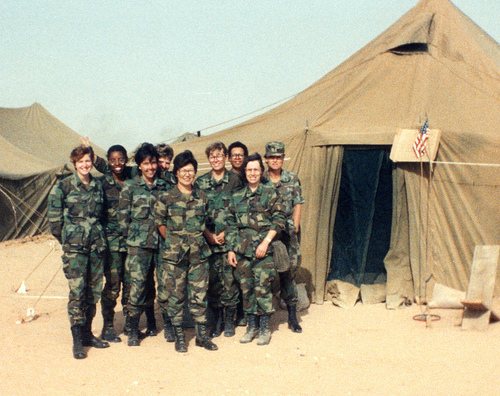
Members of the 475th Mobile Army Surgical Hospital (MASH) stand outside their tent in Saudi Arabia during Operation Desert Storm, 1991. (Courtesy photo)
Kentucky can be especially proud of the 1078 Kentucky Army National Guardsmen and women who went to the desert and performed valiantly during Desert Storm.
They were Soldiers with the following units: 137th Transportation Det., 217th Quartermaster Det., 2123rd Transportation Co., 475th Mobile Army Surgical Hospital (MASH), 133rd Public Affairs Det., 223rd and 438th Military Police Companies.
Batteries of Kentucky’s 1st Battalion, 623rd Field Artillery served as one of the few National Guard combat arms units activated.
Nearly 400 National Guard units were activated with nearly 40,000 Guardsmen serving in theater.
During the offensive, Kentucky Guard artillery was given the mission of providing fire support for the coalition forces while heavy equipment transportation traveled as far as the Euphrates carrying the load for the advancing troops. Military police personnel processed thousands of enemy prisoners of war and our Mobile Army Surgical Hospital cared for the ill and injured during a post-war humanitarian relief effort.
Back home the C-130’s of the 123rd Tactical Airlift Wing moved personnel and equipment throughout the U.S. in support of Desert Storm, while our engineers assisted in a variety of state and local projects.
U.S. Army Reserve units deployed from Kentucky included the 100th Division, the 807th Mobile Army Surgical Hospital, the 888th Medical Detachment, and the 5010th Army Hospital.
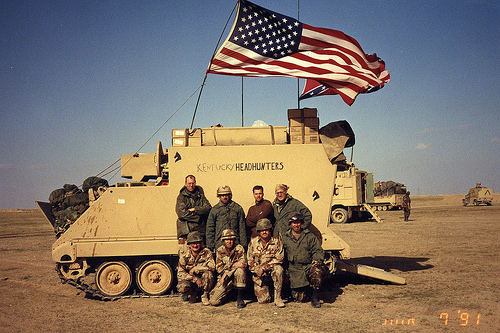
Soldiers of the Kentucky National Guard’s 1st Battalion, 623rd Field Artillery deployed to the Persian Gulf for Operation Desert Storm, Jan-April, 1991. The artillery unit was one of eight Kentucky units activated for service during the conflict. (Kentucky National Guard historical photo)
In all, 23,210 Kentucky Service members from both the active and reserve forces served in Southwest Asia.
“Serving in Operation Desert Shield and Desert Storm was a very rewarding experience for me as a young officer in the Kentucky National Guard,” said Lt. Col. Allen Boone, who served as a lieutenant with the 623rd at the time.” In less than three years after joining the nationally recognized 623rd Field Artillery, I found myself halfway around the world with some of the finest men in the United States Armed Forces.”
“It was an honor for me to serve in operations which proved to be one of the greatest examples of military power by U.S. Armed Forces in the history of our nation. The years of strategic planning, followed by equipping and properly training personnel for military operations was executed with effective precision in the first 100 hours of ground combat.”
“The motto of the 623rd is “Seize the Opportunity” and it’s Soldiers who served in the Civil War through Iraq and Afghanistan continue a legacy of professional service to our nation at home and around the world.”
PERSIAN GULF WAR TIMELINE (May 1990 – April 1991)
1990 - May 28-30: Iraqi president Saddam Hussein says that oil overproduction by Kuwait and United Arab Emirates is “economic warfare” against Iraq.
July 15: Iraq accuses Kuwait of stealing oil from Rumaylah oil field near the Iraqi-Kuwaiti border and warns of military action.
July 22: Iraq begins deploying troops to the Iraqi-Kuwaiti border and building a massive military buildup.
August 2: About 100,000 Iraqi troops invade Kuwait. Kuwait is in Iraqi control by the end of the day.
August 6: The U.N. Security Council imposes a trade embargo on Iraq in a 13-0 vote, with Cuba and Yemen abstaining. President George H. W. Bush orders the deployment of U. S. armed forces to defend Saudi Arabia in an operation named OPERATION DESERT SHIELD.
August 7: First U.S. troops arrive in Saudi Arabia.
August 8: Saddam Hussein proclaims the annexation of Kuwait.
August 9: U. N. declares Iraqi annexation of Kuwait void.
August 10: Hussein declares a “jihad” or holy war against the U. S. and Israel.
August 12: Naval blockade of Iraq begins. All shipments of Iraqi oil halted.
August 28: Iraq declares Kuwait as its 19th province and renames Kuwait City as al-Kadhima.
September 14-15: United Kingdom and France announce the deployment of 10,000 troops to Saudi Arabia.
December 17: The United Nations sets a deadline for Iraq to withdraw from Kuwait before January 15, 1991, or face military action. Hussein rejects all U. N. resolutions.
1991 - January 9: Talks in Geneva, Switzerland, between U.S. Secretary of State James Baker and Iraqi Foreign Minister Tariq Aziz end with no progress.
January 12: Congress grants President Bush authority to wage war.
January 16: The White House announced the commencement of OPERATION DESERT STORM: offensive action against the forces of Iraq under the provisions of U.N. Security Council/U.S. Congressional resolutions.
January 17: The war begins at 2:38 a.m. Baghdad time when AH-64 Apache attack helicopters destroy Iraqi radar sites, later F-117 Nighthawk Stealth Fighters bomb Baghdad and Iraqi forces. Operation Desert Storm begins.
January 18: Iraq strikes with Soviet-made SCUD missiles on Israel. The U.S. deploys Patriot missiles to Israel and Saudi Arabia.
January 22: Iraqi troops begin blowing up Kuwaiti oil wells.
January 25: Iraqi troops begin “environmental war” by dumping millions of gallons of crude oil into the Persian Gulf.
January 29: Iraqi forces invade the town of Khafji in Saudi Arabia. Iraqi forces are soon engaged by Saudi Arabian and Qatari troops with U.S. Marine artillery.
January 31: Iraqi forces capture Melissa Rathbun-Nealy, the first female Prisoner of War since World War II.
February 1: Iraqi forces are driven out of Saudi Arabia. Allied Forces win the Battle of Khafji. Secretary of Defense Richard Cheney warns U. S. will retaliate if Iraq uses chemical or unconventional weapons.
February 8: Total U. S. troop strength in the Gulf over a half million.
February 12-13: A bombing raid by U.S. forces against Baghdad kills 400 Iraqi civilians in an air raid shelter, and three major bridges.
February 19: Soviet-Iraqi peace plan rejected by President Bush. Oil spill in Gulf now estimated at 1.5 million barrels.
February 22: Pres. Bush issues a 24-hour ultimatum: Iraq must withdraw from Kuwait to avoid start of a ground war.
February 24: Allied Forces invade Iraq and Kuwait at around 4 a.m. Baghdad time. The U.S. Army is the first to enter Iraqi territory.
February 25: An Iraqi SCUD missile hits U.S. barracks near Dhahran, Saudi Arabia, killing 28 U.S. troops.
February 26: Saddam Hussein orders the Iraqi withdrawal from Kuwait. About 10,000 retreating Iraqi troops are killed when Allied aircraft bomb them, it is called the “Highway of Death.”
February 27: U.S. Marines and Saudi Arabian troops enter Kuwait City. The U.S. Army’s 1st Armored Division engages the Iraqi Republican Guard in the Battle of Medina Ridge in Iraq. President Bush declares Kuwait liberated.
February 28: By Presidential order all Coalition offensive operations ceased at 0800 local time.
March 1: The cease-fire plan is negotiated in Safwan, Iraq.
March 17: First U.S. troops arrive home.
April 11: The U.N. Security Council declared a formal cease-fire, ending the Gulf War.
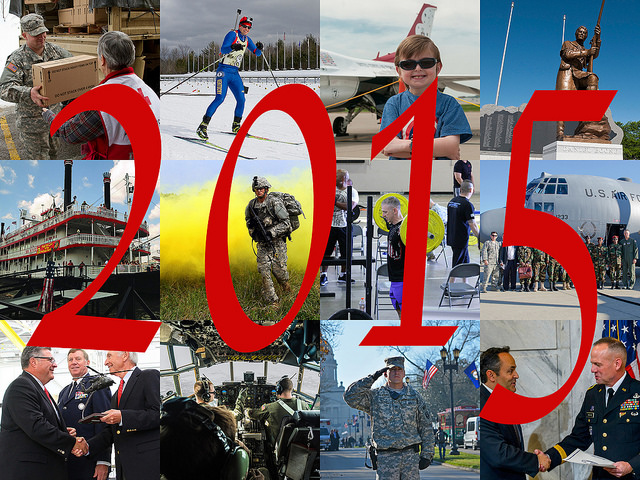 Another year’s in the books, with more pages to document the service of the Kentucky National Guard. Around the commonwealth and across the globe, our Guardsmen once again have displayed what we call unbridled service. Below are a few of our favorite stories of duty and accomplishment.
Thanks to all our friends, families for allowing us to make 2015 another successful year of service to Kentucky and the Nation.
Guard activated for winter storm response
Guardsmen compete in biathlon finals
Air Guard welcomes 9-year-old fighting cancer
Kentucky dedicates Guard memorial
Four million pounds for a purpose
Kentucky hosts Djibouti delegation
Kentucky Guard cuts ribbons on new facilities
123rd Airlift Wing named top airlift unit
Guardsmen support Gubernatorial Inauguration
By Brendan P. Bartholomew, San Francisco Examiner
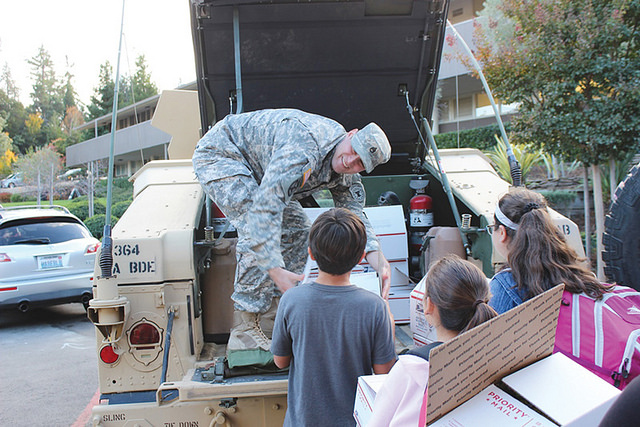
Crocker Middle School students packed up donated items into an Army Humvee in Hillsborough, Calif., to send to troops in Afghanistan. (Courtesy LeAnn Thornton)
HILLSBOROUGH, Calif. — U.S. Army personnel recently visited Crocker Middle School in Hillsborough, where students filled their Humvee with care packages bound for troops in Afghanistan.
The event capped what has become an annual tradition at the school, where kids reach out to their community, soliciting donations of food, personal care products, holiday decorations, and other items intended to provide soldiers overseas with the comforts of home.
Hillsborough adopted the Army’s 1st Brigade combat team, 101st Airborne Division (air assault) in 2007. Crocker Middle School began collaborating with the city and the Hillsborough Police Department on the Adopt-A-Unit campaign in 2012, when coordinator LeAnn Thornton contacted teacher Audrey Fairchild, asking if her students would sign a holiday banner for deployed troops. The students responded by asking what other forms of support they could provide.
This year, the unit from 101st Airborne is back home, so the school adopted the Kentucky Army National Guard’s 1163rd Area Support Medical Company, a team of reservists whose ranks include a police officer and a commercial airline pilot, along with doctors, nurses, and EMT firefighters.
The 1163rd ASMC is attached to an Army combat hospital in Afghanistan, where they provide emergency medical services, both to base personnel and individuals airlifted in from other locations.
The soldiers say the care packages have a positive impact on troop morale by uplifting the spirits of those serving abroad.
Army recruiter Staff Sgt. John Kaleski and reservist Sgt. Rick Nelson accompanied the Humvee at Crocker. Kaleski enjoyed talking with the students about everything from “Star Wars” to their favorite football and soccer teams. He was deployed in Afghanistan in 2003 and Iraq in
2004.
“We had all the local kids talking like Snoop Dogg,” Kaleski laughed.
According to Thornton, the care packages have played a role in establishing good will with Afghan children. Last year, Crocker students collected about 100 pounds of
Halloween candy, which they included in the care packages. This year, the students collected three times that amount.
When troops shared the candy with Afghani kids, the children responded by showing them where hidden explosives were located. “The Halloween candy literally saved lives,” Thornton said.
Kaleski noted the Army has base stores where deployed troops can acquire life’s necessities, but the inventory rarely changes. Part of a care packages’ magic is it might contain specific brands that remind a soldier of home. “When my sister was sending me a care package, all I wanted was Chef Boyardee Beefaroni,” Kaleski said.
Sentiments like Kaleski’s are part of Crocker student Jocelyn Murphy’s motivation for participating in the care package campaign.
“As they’re putting their lives on the line, they deserve something they actually recognize from home,” Murphy said.
Fellow student Christopher Mahoney also talked about the life-and-death stakes deployed soldiers might face.
“I think it’s good to support troops because they’re risking their lives,” Mahoney said, “They enlisted, and that’s very selfless.”
See the original story at the San Francisco Examiner here.
Kentucky National Guard Public Affairs Staff Report
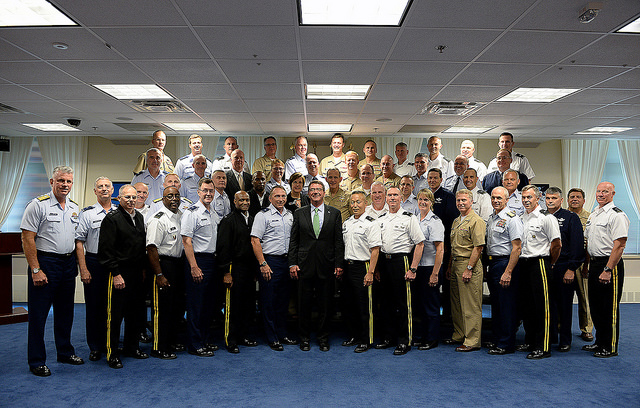
Secretary of Defense, Ash Carter gathers with more than 50 U.S. general officers during the CAPSTONE General and Flag Officer Course in Washington, D.C., July, 2015. Kentucky’s Brig Gen. Scott Campbell was one of six National Guard officers selected to attend. (Courtesy photo)
FRANKFORT, Ky. — Brig. Gen. Scott Campbell, of the Kentucky National Guard, is the deputy commanding general of the 38th Infantry Division and was chosen to attend the Department of Defense’s CAPSTONE Program July 13 to Aug. 14, 2015.
The CAPSTONE General and Flag Officer Course was created in 1982. The Goldwater-Nichols DoD Reorganization Act of 1986 subsequently mandated that all newly selected active duty generals and flag officers attend CAPSTONE. The course is managed by the National Defense University in Washington, D.C. Course attendance is still competitive for National Guard and Reserve general officers.
According to NDU, the course objective is to make these individuals more effective in planning and employing U.S. forces in joint and combined operations. The CAPSTONE curriculum examines major issues affecting national security decision making, military strategy, joint/combined doctrine, interoperability, and key allied nation issues.
Campbell was one of only six National Guard general officers included in the class of 55 Fellows. Few Kentucky Guard general officers have been extended the privilege of attending this course since its inception.
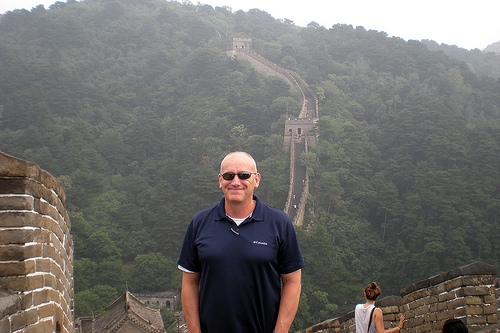
Brig. Gen. Scott Campbell tours the Great Wall of China during the overseas portion of the CAPSTONE General and Flag Officer Course, July, 2015. Campbell visited China, Japan and Korea as part of the course which examines major issues affecting national security decision making, military strategy, joint/combined doctrine, interoperability, and key allied nation issues.(Courtesy photo)
“This was by far the best educational experience of my 34-year career,” said Campbell. “It was an amazing experience that exposed me to senior decision makers, both domestic and international, and gave me a better understanding of the complexities in the world and the security challenges facing the U.S.”
The course began in Washington, D.C. with briefings from directors of the various federal agencies and combatant commanders. Day 3 began stateside travel with visits to various military command headquarters in Virginia, Florida, Nebraska, Colorado, and Illinois.
The class returned to Washington upon completion of the 10-day stateside trip and prepared for overseas travel. The class was broken into three groups traveling to Europe, South America or the Pacific region.
Campbell was selected for the Pacific trip which included stops in Japan, South Korea, and China with a visit to U.S. Pacific Command in Hawaii on the return trip. The overseas trip lasted approximately 13 days with the CAPSTONE Fellows visiting with U.S. and host nation military officials, U.S. Embassy officials to include ambassadors, host nation government officials and local think tanks.
Campbell said the focus of the overseas tour was to study U.S. policy as it relates to the visited nation and the region. The exchanges also included cultural stops which included The Forbidden City and The Great Wall of China, the Demilitarized Zone, Seoul Tower and Gyeongbok Presidential Palace in Korea, and Pearl Harbor in Hawaii.
The course ended back in Washington, D.C. and concluded with briefings from the Secretary of Defense and directors of federal agencies, to include the National Security Agency, Central Intelligence Agency, Federal Emergency Management Agency, as well as the DoD Service Chiefs from each branch of the military.
“I feel very privileged for being selected to attend,” Campbell said. “The senior leader briefers and CAPSTONE staff told us that the most fundamental objective of this course is an understanding and appreciation of the other services and agencies and building relationships with the other Fellows that will stay with you throughout your life. I feel like that objective is being met. I’ve already met several of my Capstone classmates in other forums and we now share a common bond.”
By Sgt. 1st Class Jon Soucy, National Guard Bureau
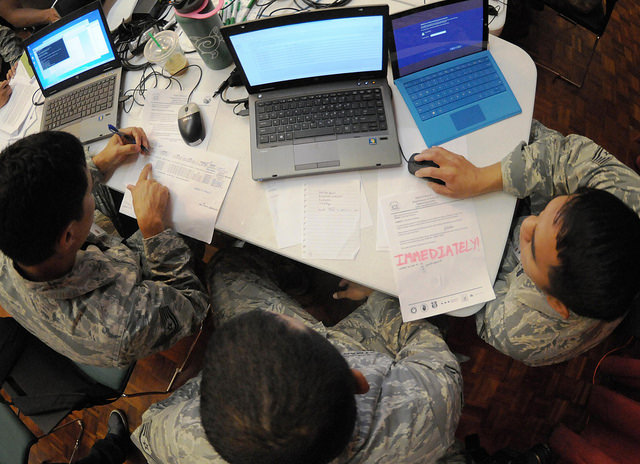
Members of a cyber protection unit with the Hawaii Air National Guard conduct cyber defense operations during a training exercise in June. As cyber warfare takes on an ever increasing role, the Guard announced plans to activate additional cyber protection units spread throughout 23 states by the end of fiscal year 2019. Those units are part of service-specific cyber requirements and provide additional capabilities to deter cyber threats across a wide array of platforms. (Photo by Airman 1st Class Robert Cabuco/Released)
ARLINGTON, Va. — As part of ongoing growth of cyber forces throughout the Department of Defense, the National Guard announced plans to activate 13 additional cyber units spread throughout 23 states by the end of fiscal year 2019.
“Our goal for cyber-defense is to train, equip and provide highly skilled forces responsive to the needs of the nation,” said Army Gen. Frank Grass, chief of the National Guard Bureau. “Working with the Army and Air Force our cyber squadrons and teams will provide trained and ready Soldiers and Airmen to support requirements established by the services and U.S. Cyber Command.”
Seven new Army Guard Cyber Protection Teams will be activated across Alabama, Arkansas, Colorado, Illinois, Kentucky, Louisiana, Minnesota, Mississippi, Missouri, Nebraska, New Jersey, New York, North Dakota, South Dakota, Tennessee, Texas, Utah, and Wisconsin. They join four previously announced Army Guard CPTs spread across California, Georgia, Indiana, Maryland, Michigan and Ohio.
In partnership with the Air Force, the Air Guard will activate four new Cyber Operations Squadrons in Idaho, Michigan, Texas and Virginia. In addition, a cyber Information Surveillance Reconnaissance squadron will stand up in California and a cyber ISR group in Massachusetts.
The current roll out of Guard cyber units is part of laying out a larger foundation for future cyber forces scheduled for activation.
“This is the beginning,” said Air Force Col. Kelly Hughes, chief of the Space and Cyber Warfare Operations Division at the Air National Guard Readiness Center. “This is a massive amount of force structure the Guard has laid into this mission, but this is just the first layer.”
Established in 2010, Army Cyber Command is the lead for Army missions, actions and functions related to cyberspace, including the responsibility for planning, coordinating, integrating, synchronizing, directing and conducting Army network operations and the defense of all Army networks.
Activating cyber units in these states allows for the Guard to fulfill Army and Air Force cyber missions while positioning cyber protection units in each of the 10 Federal Emergency Management Agency response regions.
“The focus is to get that presence in as many states as possible and especially making sure we have all the FEMA regions covered,” added Hughes about the current activation plans.
Ensuring each FEMA region has coverage, ties into the Guard’s mission to respond to large-scale emergencies and disasters at home, said Air Force Col. Timothy T. Lunderman, director of joint cyber operations at the National Guard Bureau, adding that because the Guard is community based there are already relationships in place. Cyber teams and squadrons, he added, are another asset governors can use at the state level should they be needed.
“If we have never met before, and I come knocking on your door and say, I’m here to help you with a cyber incident,’ you’d close the door,” said Lunderman. “The Guard is in all 50 states, three territories and the District of Columbia. We have the capability and relationships already established. If state and local officials need help they’re more likely to turn to the folks they know. The people they know are the Guard.”
And like other Guard assets, cyber protection units—whose members only operate on DoD and government networks, including those of state governments—can be used in multi-state settings through the Emergency Management Assistance Compact, said Lunderman.
“While each state may not yet be home to a cyber protection team or squadron, Guard elements in each state, territory and the District of Columbia already have a computer network defense team or other cyber protection assets assigned, said Hughes.”
“The Army National Guard has laid computer network defensive teams into every state,” he said. “Between the Army Guard and the Air Guard there is a level of cyber protection capability in each state.”
Armed with civilian experience in cyber security and network engineering, Hughes said, National Guard cyber specialists are able to provide robust capability.
“That’s the kind of thing you can get with the Guard,” he said. “Our longevity and knowledge is hard to match. That is what makes the Guard great.”
It’s also a mission that Guard members can easily transition from state status to federal status.
“We can do this mission from anywhere,” said Hughes. “We don’t have to physically relocate to do it. As long as we have the connectivity, we can operate from home station.”
Guard cyber protection units are part of larger service-specific requirements to provide cyber defense capabilities, explained Lunderman, adding those requirements have been spread throughout the active, Guard and reserve components. Each cyber team member, regardless of component, trains to the same service standard.
The future of cyber defense is open ended.
“When you look at the way the Internet was designed and built, nobody could even fathom what it has become today and it’s really even harder to think what it might become tomorrow,” said Lunderman.
The need for cyber defense assets is expected to increase.
“It’s only going to grow,” Hughes said.
By Staff Sgt. David Bolton, 133rd Mobile Public Affairs Detachment
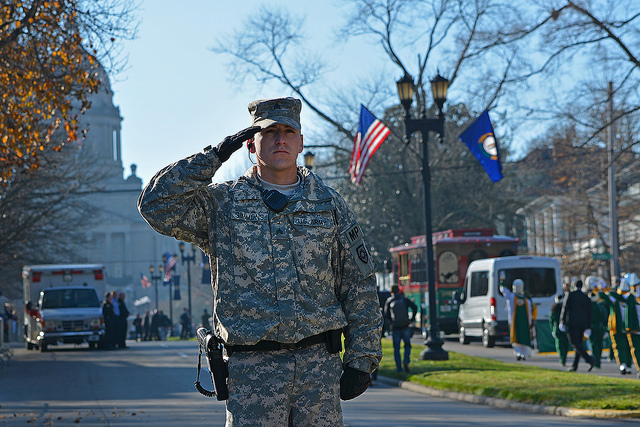
Sgt. Caleb Simmons with the 940th Military Police Company salutes a passing Color Guard during the Gubernatorial Inauguration parade in Frankfort, Ky., Dec. 8, 2015. Kentucky Guard military police Soldiers assisted local law enforcement in securing areas near the Capitol for events surrounding Gov. Matt Bevin’s public swearing in. (Kentucky National Guard photo by Walt Leaumont)
FRANKFORT, Ky. — Out in full force, the Kentucky National Guard celebrated with fellow Kentuckians as Gov. Matt Bevin was publicly sworn in Dec. 8, in Frankfort. Also sworn in was Army Brig. Gen. Stephen R. Hogan, the Kentucky Guard’s 52nd adjutant general.
“This is really the one big event we get to do every four years to really support the Commonwealth and let them know we have a band,” said Sgt. Shari Kinslow, a musician assigned to the 202nd Army Band.
“For us, this is the time of year where we get to be compared to some of the active duty bands up in D.C.,” she said.
The 202nd played several events for the inaugural celebration, including the private swearing-in ceremony, the parade and the public swearing in.
The inaugural events were special for Kinslow since this was her last performance before retirement. She served 20 years with the Kentucky Guard.
“I’ll miss this, it’s more like a family than just a unit,” she said.
Click here for more photos.
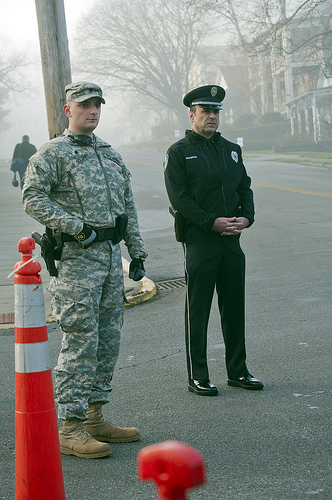
Spc. Josh Goldener, military police with the 1103rd MP Detachment, and Officer Mike Davidson, Frankfort Police Department, conduct traffic surveillance for Governor Matt Bevin’s inauguration at the Capitol building in Frankfort, Ky. Dec. 8, 2015. Present at the inauguration was the Kentucky National Guard’s new Adjutant General Brig. Gen. Stephen R. Hogan. (U.S. Army National Guard photo by Staff Sgt. David Bolton)
More than 150 Soldiers and Airmen were on duty in a variety of roles in and around the downtown area.
If the event patrons didn’t know the Kentucky Guard has a band, the 19-round artillery salute proved the Kentucky Guard has artillery. Getting the 105mm Howitzers and personnel in place, took special planning and coordination.
“You have to know how many people it will take to fire the guns, and coordinate the transportation of the artillery pieces from Lexington to Frankfort,” said Master Sgt. Joseph Mattingly, intelligence non-commissioned officer, 138th Field Artillery Brigade. “You have to draw ammo from Fort Knox, make sure everyone knows what’s going on, and run through rehearsals.”
As the liaison officer between color guard and artillery salute, Mattingly said the hardest part of the event was making sure he could reach everybody and keeping everyone on a timeline. The duty, he said, was fulfilling.
“It’s always an honor every time you do something like this,” said Mattingly.
Spc. Josh Goldener, said the honor of serving and protecting the attendees of the inauguration is a memory that will last with him a lifetime.
“It’s a huge honor to get to be a part of both the new governor and TAG’s first day,” said Goldener. “I mean this is history. I’m standing here getting to serve in something that happens every four or eight years. It’s very cool to be able to say I was a part of this and someday I can tell my kids or grandkids I was part of this event.”
Goldener provided security with his unit, the 1103rd Law and Order Detachment. Along with members of the 940th Military Police, the Kentucky Guard force ensured the safety of the patrons downtown.
“The hardest part is really just dealing with the circumstances surrounding today,” said Goldener.
“Not only because of its importance,” he said, “but because of what’s going on everywhere in the world at this time. We’re all on high alert even though there is no specific threat, we’re doing our best to stay vigilant and make sure we catch anything before it happens.”
The Kentucky Guard’s 63rd Theater Aviation Brigade closed out the inaugural ceremonies with a flyover of three UH-60 Blackhawk helicopters.
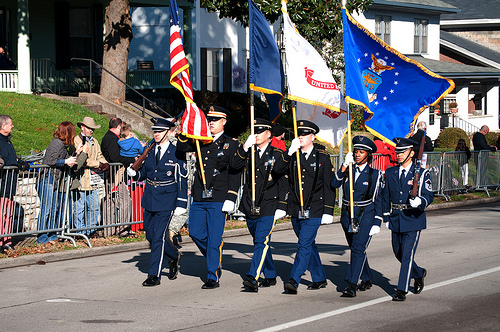
Soldiers and Airmen of the Kentucky National Guard act as Color Guard during the inaugural parade in front of the Capitol building in Frankfort, Ky. Dec. 8, 2015. The parade was part of the inaugural day activities for newly-elected Governor Matt Bevin. (U.S. Army National Guard photo by Staff Sgt. David Bolton)
In his closing remarks, Bevin – a former U.S. Army officer – thanked the Guard for being part of the day and always being ready to serve.
“We thank those of you who have paid that price and to your families,” said Bevin. “Thank you for all your support. Our thanks go to the men and women who have served, so that we might gather here.”
Kentucky National Guard Public Affairs Staff Report
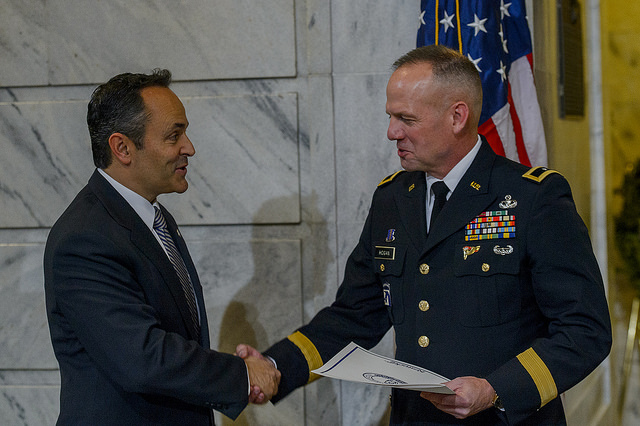
Governor Matt Bevin congratulates Brig. Gen. Stephen R. Hogan following Hogan’s swearing in at the State Capitol in Frankfort, Ky., Dec. 8, 2015. Bevin selected Hogan as the 52nd adjutant general, commanding the Kentucky National Guard. (Photo by Marvin Young)
FRANKFORT, Ky. — Retired Brig. Gen. Stephen Hogan, who served more than 30 years in the Kentucky National Guard and active duty Army is the state’s next adjutant general, Governor-elect Matt Bevin announced Dec. 7.
Hogan was sworn into office shortly after midnight, Dec. 8, succeeding Maj. Gen. Edward W. Tonini who has served in the role since 2007.
Hogan said he will be taking charge of a National Guard organization that is among the best in the nation. Hogan was officially introduced to members of the Kentucky Guard during a welcome ceremony at the Boone National Guard Center following the inauguration.
“This is a wonderful feeling to be before you today,” said Hogan to those in attendance. “I am very honored and humbled to be back in uniform for an organization that I have a great deal of confidence in.”
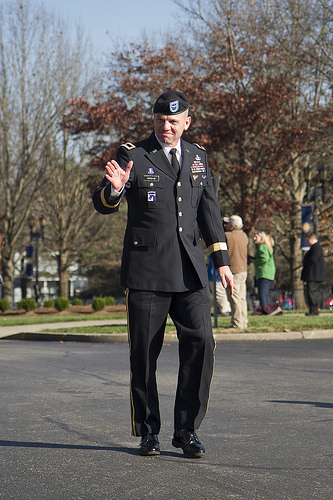
Brig. Gen. Stephen R. Hogan, Kentucky’s adjutant general walks in the Inaugural parade in Frankfort, Ky., Dec. 8, 2015. Hogan was selected by newly-elected Governor Matt Bevin to lead the Kentucky National Guard. (U.S. Army National Guard photo by Staff Sgt. Scott Raymond)
Click here for more photos.
As Kentucky’s 52nd adjutant general, Hogan will command the nearly 8,000 military members of the Kentucky Army and Air National Guard. He will also oversee the statewide Department of Military Affairs, Kentucky Emergency Management, the Appalachian and Bluegrass Challenge Academies and Bluegrass Station in Avon, Kentucky.
The cabinet-level post administers an annual budget of approximately $170 million to support operations at 56 armories, three major training sites and the Air National Guard base at Louisville International Airport.
Hogan brings a wealth of experience to the job, formerly serving as assistant adjutant general for the Kentucky Army National Guard. In that role, he was responsible for balancing the requirements of readiness, modernization, force structure and sustainment of the National Guard for mobilization and domestic missions. He oversaw specified units that provided wide ranging support to the National Guard’s federal and state mission sets, as well as those units that provided specialized support to civil authorities.
Hogan was commissioned through the Reserve Officer Training Corps program at Morehead State University in 1985. He earned a Master of Strategic Studies from the U.S. Army War College in 2008. In 2010 and 2013 he completed the U.S. Northern Command Joint Task Force Command Course and U.S. Northern Command Joint Dual Status Commander’s Course.
Hogan’s significant active duty assignments included tours with the 101st Airborne Division (Air Assault), Fort Campbell, Kentucky; 6th Infantry Division Light, Fort Richardson, Alaska; The Army Operations Center at the Pentagon, Washington, D.C., and Multi-National Corps Iraq, Baghdad, Iraq. When not serving on federal active duty, Hogan served in the Kentucky Army National Guard as an active duty Guardsman with the State’s Counter-Drug Unit, from June 1993 to February 2011.
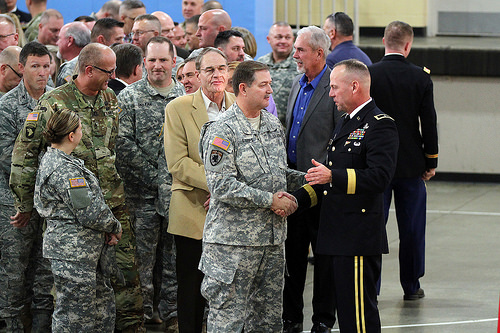
Command Chief Warrant Officer Dean Stoops congratulates Brig. Gen. Stephen R. Hogan on becoming Kentucky’s newest adjutant general during an introduction ceremony in Frankfort, Ky., Dec. 8, 2015. Hogan was officially introduced to members of the Kentucky Guard following the gubernatorial inauguration. (U.S. Army National Guard photo by Staff Sgt. Scott Raymond)
Hogan rode in the Inaugural parade through downtown Frankfort to the Capitol to attend Bevin’s public swearing in. Bevin praised Hogan’s service and expressed his trust in Hogan’s future as the leader of the Kentucky Guard.
“It is my pleasure to name Brigadier General Stephen R. Hogan as adjutant general for the Commonwealth of Kentucky,” said Bevin. “We owe our freedom and safety to the men and women of our military. General Hogan has served our country and our commonwealth with honor and distinction and understands first hand, the critical importance of the Citizen-Soldier. I have absolute confidence that he will be an excellent Commanding General.”
By Staff Sgt. Scott Raymond, Kentucky National Guard Public Affairs, with contributions by Kentucky State Police Public Affairs
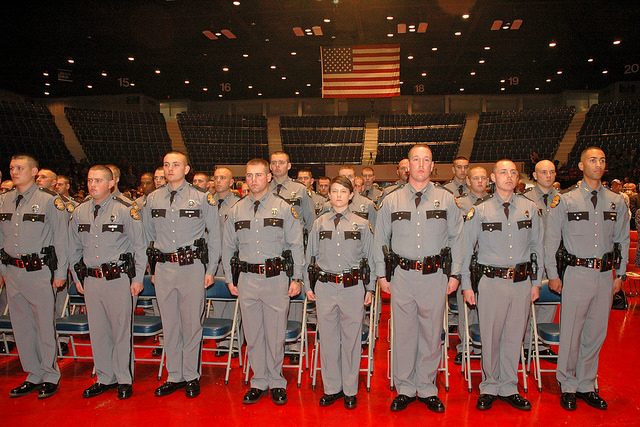
The Kentucky State Police Academy presented diplomas to 45 new troopers at ceremonies held in Frankfort on Oct. 29. Among the new Troopers were three Kentucky Guardsmen. (Photo courtesy of Kentucky State Police)
FRANKFORT, Ky. — The Kentucky State Police Academy presented diplomas to 45 new troopers at ceremonies held in Frankfort, Oct.29. Their addition to the force brings the agency’s strength to a total of 880 troopers serving the citizens of the Commonwealth.
Of those 45 new troopers three are all too familiar with wearing a common uniform and standing for something bigger than themselves. They are also Kentucky National Guardsmen.
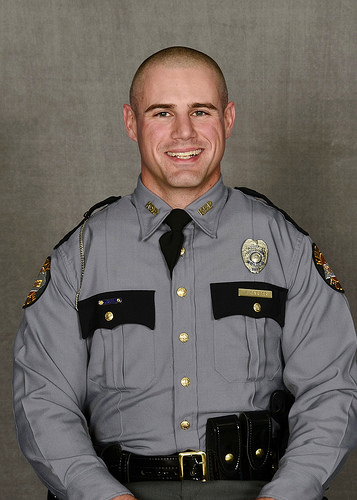
Staff Sgt. Jordan Carter with the 1st Battalion, 623rd Field Artillery graduated from the Kentucky State Police Academy Oct. 29, 2015. (Photo courtesy of Kentucky State Police)
Staff Sgt. Jordan Carter with the 1st Battalion, 623rd Field Artillery, 1st Lt. Jacobe Farmer with Bravo Company, 1st Battalion, 149th Infantry and Sgt. Michael Jacobs from the 2123rd Transportation Company each accepted a new role and responsibility to the commonwealth.
“The National Guard had taught me numerous skills and values that helped me as a soldier,” said Jacobs. “However, I wanted a new challenge with similar interests that would help me adapt to a civilian career that I would enjoy.”
“I always wanted to be a Trooper. I figured that joining the Guard would help me obtain that goal,” said Carter. “Plus I like helping people so it provided a great opportunity.”
The new troopers are part of the agency’s 93rd cadet class. They reported for duty on May 24, 2015 in a class that consisted of 70 cadets.
The training included more than 1,000 hours of classroom and field study in subjects such as constitutional law, juvenile and traffic law, use of force, weapons training, defensive tactics, first aid, high speed vehicle pursuit, criminal investigation, computer literacy, hostage negotiations, evidence collection, radio procedures, search and seizure, crash investigation, drug identification, traffic control, crowd control, armed robbery response, land navigation, electronic crimes, sex crimes, hate crimes, domestic violence, bomb threats and hazardous materials.
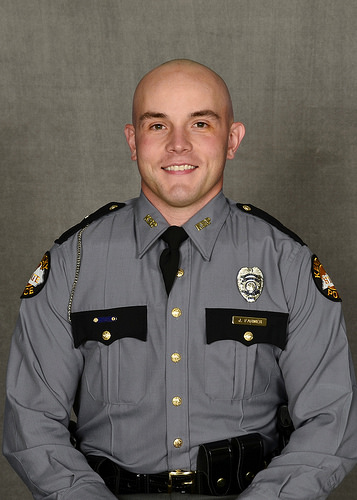
1st Lt. Jacobe Farmer with Bravo Company, 1st Battalion, 149th Infantry graduated from the Kentucky State Police Academy Oct. 29, 2015. (Photo courtesy of Kentucky State Police)
Each Guardsman expressed a true desire to help others, the same thought that inspired them to join the military.
All three also are grateful for the training they have received in the Guard, which helped them through the Kentucky State Police Academy.
“Joining the guard prepared me in numerous ways and instilled in me the seven Army values which should be something that everyone lives by,” said Carter. “Being a Trooper involves so much and the seven Army values aren’t just “valued” by the Army. They are incorporated in the daily life of a Trooper as well.”
“Multi-tasking and attention to detail go hand and hand with what I have picked up from being in the Guard and my military training towards my career field in law enforcement,” said Farmer. “As a Trooper I will deal with a variety of events and at times they will be one after another and/or all together and for me to be able to handle many tasks at once while not leaving out important details is essential in my field.”
Lt. Col. L. Allen Joiner, commander of the 1/623rd said the unit is proud of Carter and their decisions of selfless service in multiple uniforms, a benefit he has seen first hand.
“Serving both on the State Police force and in the Kentucky National Guard, these individuals are able to acquire knowledge and experience that saves lives during Kentucky natural disasters and emergencies when these organizations are working side by side,” said Joiner. “An example is during the 2009 ice storm, one of our Soldiers, who was also a State Police officer was able to use his civilian position resources to provide current road conditions to our military units across Western Kentucky.”
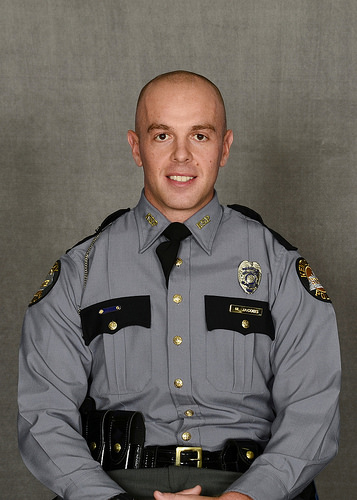
Sgt. Michael Jacobs from the 2123rd Transportation Company graduated from the Kentucky State Police Academy Oct. 29, 2015. (Photo courtesy of Kentucky State Police)
Carter will be assigned to Post 3 in Bowling Green and Jacobs Post 16 in Henderson. Farmer joins Post 4 in Elizabethtown alongside Indiana National Guardsman Brad Holloman.
“Joining the KSP is not for the weak-hearted or weak-minded and it takes a special person to be a Kentucky State Trooper,” said Farmer “The training academy to many people would be the most physically enduring thing they have done, but in the end you are a part of the KSP family and the honor, respect, and tradition that it has and upholds.”
“Being a Trooper will benefit my military career in regards to maintaining discipline, staying vigilant, and performing at a higher standard,” said Jacobs. “I look forward to learning in both roles as a Soldier and Trooper to be the best I can be for the Commonwealth of Kentucky.”