



Pages
Stay In Touch
More
© 2013 KentuckyGuard
By Sgt. 1st Class Jon Soucy, National Guard Bureau
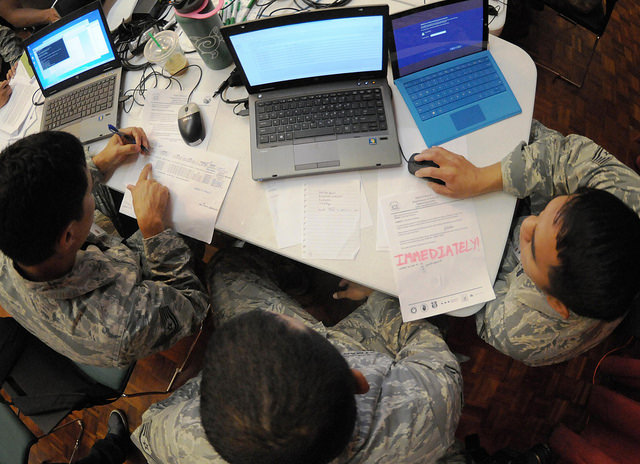
Members of a cyber protection unit with the Hawaii Air National Guard conduct cyber defense operations during a training exercise in June. As cyber warfare takes on an ever increasing role, the Guard announced plans to activate additional cyber protection units spread throughout 23 states by the end of fiscal year 2019. Those units are part of service-specific cyber requirements and provide additional capabilities to deter cyber threats across a wide array of platforms. (Photo by Airman 1st Class Robert Cabuco/Released)
ARLINGTON, Va. — As part of ongoing growth of cyber forces throughout the Department of Defense, the National Guard announced plans to activate 13 additional cyber units spread throughout 23 states by the end of fiscal year 2019.
“Our goal for cyber-defense is to train, equip and provide highly skilled forces responsive to the needs of the nation,” said Army Gen. Frank Grass, chief of the National Guard Bureau. “Working with the Army and Air Force our cyber squadrons and teams will provide trained and ready Soldiers and Airmen to support requirements established by the services and U.S. Cyber Command.”
Seven new Army Guard Cyber Protection Teams will be activated across Alabama, Arkansas, Colorado, Illinois, Kentucky, Louisiana, Minnesota, Mississippi, Missouri, Nebraska, New Jersey, New York, North Dakota, South Dakota, Tennessee, Texas, Utah, and Wisconsin. They join four previously announced Army Guard CPTs spread across California, Georgia, Indiana, Maryland, Michigan and Ohio.
In partnership with the Air Force, the Air Guard will activate four new Cyber Operations Squadrons in Idaho, Michigan, Texas and Virginia. In addition, a cyber Information Surveillance Reconnaissance squadron will stand up in California and a cyber ISR group in Massachusetts.
The current roll out of Guard cyber units is part of laying out a larger foundation for future cyber forces scheduled for activation.
“This is the beginning,” said Air Force Col. Kelly Hughes, chief of the Space and Cyber Warfare Operations Division at the Air National Guard Readiness Center. “This is a massive amount of force structure the Guard has laid into this mission, but this is just the first layer.”

Established in 2010, Army Cyber Command is the lead for Army missions, actions and functions related to cyberspace, including the responsibility for planning, coordinating, integrating, synchronizing, directing and conducting Army network operations and the defense of all Army networks.
Activating cyber units in these states allows for the Guard to fulfill Army and Air Force cyber missions while positioning cyber protection units in each of the 10 Federal Emergency Management Agency response regions.
“The focus is to get that presence in as many states as possible and especially making sure we have all the FEMA regions covered,” added Hughes about the current activation plans.
Ensuring each FEMA region has coverage, ties into the Guard’s mission to respond to large-scale emergencies and disasters at home, said Air Force Col. Timothy T. Lunderman, director of joint cyber operations at the National Guard Bureau, adding that because the Guard is community based there are already relationships in place. Cyber teams and squadrons, he added, are another asset governors can use at the state level should they be needed.
“If we have never met before, and I come knocking on your door and say, I’m here to help you with a cyber incident,’ you’d close the door,” said Lunderman. “The Guard is in all 50 states, three territories and the District of Columbia. We have the capability and relationships already established. If state and local officials need help they’re more likely to turn to the folks they know. The people they know are the Guard.”
And like other Guard assets, cyber protection units—whose members only operate on DoD and government networks, including those of state governments—can be used in multi-state settings through the Emergency Management Assistance Compact, said Lunderman.
“While each state may not yet be home to a cyber protection team or squadron, Guard elements in each state, territory and the District of Columbia already have a computer network defense team or other cyber protection assets assigned, said Hughes.”
“The Army National Guard has laid computer network defensive teams into every state,” he said. “Between the Army Guard and the Air Guard there is a level of cyber protection capability in each state.”
Armed with civilian experience in cyber security and network engineering, Hughes said, National Guard cyber specialists are able to provide robust capability.
“That’s the kind of thing you can get with the Guard,” he said. “Our longevity and knowledge is hard to match. That is what makes the Guard great.”
It’s also a mission that Guard members can easily transition from state status to federal status.
“We can do this mission from anywhere,” said Hughes. “We don’t have to physically relocate to do it. As long as we have the connectivity, we can operate from home station.”
Guard cyber protection units are part of larger service-specific requirements to provide cyber defense capabilities, explained Lunderman, adding those requirements have been spread throughout the active, Guard and reserve components. Each cyber team member, regardless of component, trains to the same service standard.
The future of cyber defense is open ended.
“When you look at the way the Internet was designed and built, nobody could even fathom what it has become today and it’s really even harder to think what it might become tomorrow,” said Lunderman.
The need for cyber defense assets is expected to increase.
“It’s only going to grow,” Hughes said.
By Walt Leaumont, Kentucky National Guard Public Affairs
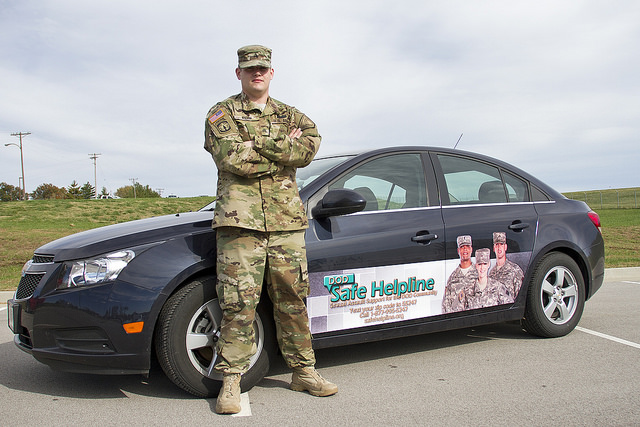
Sgt. Josh Kemp with the 2nd Battalion, 75th Recruiting and Retention Command was honored by the National Guard Bureau for his graphic design work in support of the Department of Defense’s Safe Helpline number. Kemp was presented the 2015 Sexual Assault Prevention Innovation Award for his contribution. (U.S. Army National Guard photo by Staff Sgt. Scott Raymond)
FRANKFORT, Ky. — Sgt. Joshua Kemp with the 2nd Battalion, 75th Recruiting and Retention Command received the 2015 Sexual Assault Prevention Innovation Award Oct. 23.
The award recognizes Service members and Department of Defense (DoD) civilians whose work in support of the military community has been particularly noteworthy. DoD created the award to spark creativity and incentivize efforts to address not only sexual assault prevention, but also ideas that enhance overall command climate. Kemp was recognized for proactively participated in peer-to-peer mentorship on topics of healthy relationships, responsible drinking, and bystander intervention in social settings.
Maj. Gen. Edward W. Tonini, Kentucky’s adjutant general presented the award during a presentation that was held in conjunction with a video teleconference with Gen. Frank J. Grass, chief of the National Guard Bureau.
“This was a collaborative effort with the Sexual Assault Response Center, this award is for all who helped with this project,” said Kemp. “And I have to thank my command staff for creating a climate that allows for developing and implementing creative solutions.”
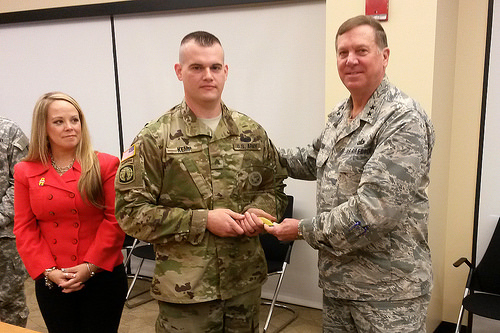
Sgt. Josh Kemp with the 2nd Battalion, 75th Recruiting and Retention is presented the 2015 Sexual Assault Prevention Innovation Award by Maj. Gen. Edward Tonini in Frankfort, Ky., Oct. 23, 2015. (Kentucky National Guard photo by Lt. Col. Scott Thomas)
One of the creative solutions Kemp developed was a mobile marketing campaign centered on wrapping General Services Administration (GSA) vehicles with the DoD Safe Helpline logo and contact information. The campaign is also an example to the Soldiers and Airmen of the Kentucky Guard that the Sexual Assault Prevention and Response program has the support of senior leadership and sexual misconduct will have severe consequences.
“We have a zero tolerance in Kentucky for such actions, and we’re not afraid to spread the word of our program,” said Maj. John Harvey, the state’s Sexual Assault Prevention and Response Officer.
“Without Sergeant Kemp’s enthusiasm and ingenuity, the car wrap idea never would have culminated into a finished product, for so many people to see as this car drives by.”
According to Harvey Kemp has played an integral role in raising awareness of sexual assault since arriving at Joint Force Headquarters in 2009. Not to be deterred by rank restrictions inhibiting his ability to serve as a Victim Advocate, Kemp has found creative ways to make an impact in other areas by leveraging his passion, talent, and dedication for sexual assault prevention.
He constantly mentors his peers on attitudes, behaviors, and personal responsibility when in social settings and informs fellow Service members of sexual assault prevention and response information and resources. He leads hip-pocket training on responsible drinking and bystander intervention methods so Soldiers can be better prepared in the event a sexual assault occurs. Kemp also indirectly supports families of Kentucky Guard Soldiers by providing context to his wife, Rebecca, a Family Readiness Support Assistant, on the regulations and policies pertaining to dependent members of the military affected by sexual assault.
“Regardless of the message, the Kentucky Guard is a family and we must make sure everyone knows what we stand for and how we can help when the time comes,” he said.
“This is about getting the word out and this is just one more way we can do just that.”
Kentucky National Guard Staff Report
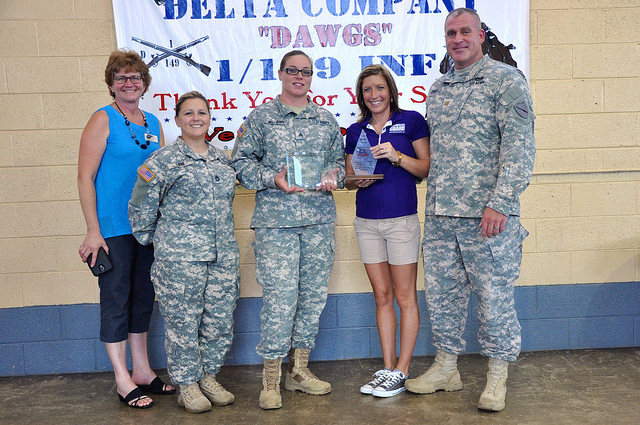
Jennifer Hatfield (second from right) is presented with the National Guard Bureau’s Youth Development Volunteer Award in Middlesboro, Ky., Aug. 23, 2015. Maj. Bryan Combs, Family Programs Director (far right) presented Hatfield with the award for her work as the Family Readiness Group leader for Delta Co. !st Battalion, 149th Infantry. (Kentucky National Guard photo by Olivia Burton)
FRANKFORT, Ky. — “Sometimes you do things not looking for someone to say thank you,” said Jennifer Hatfield, Family Readiness Leader for Delta Company, 1st Battalion, 149th Infantry.
But recently, the National Guard Bureau did say thank you to Hatfield, presenting her with the Youth Development Volunteer Award.
Hatfield received the award during the unit’s family day in Middlesboro, Kentucky, Aug. 23.
“If we had more Jennifer Hatfields in the world, the world would be a better place,” said Maj. Bryan Combs, Kentucky’s Family Programs director.
The award is given to those who have positively impacted Guard Family Readiness Groups and key volunteer efforts.
Hatfield has been the FRG leader since 2012 and her leadership skills contributed to the success of two military child events in 2013 and 2014. Her personal community involvement included Middlesboro Youth League Cheerleading Coach, Coordinator for 5K for Our Hometown Hero’s, Gymnastics Instructor in Middlesboro, and Middlesboro T-Ball. She was instrumental in building and strengthening community relationships that have benefitted both the area and the Kentucky Guard.
“We certainly want to recognize one of our own on both a national and local scale,” said Combs. “The dedication and time that she takes for the 149th Infantry is outstanding, and her support is
through her own accord, her own time, and her own energy.”
“What I can tell you from a state level is we do everything we can to support families so our Soldiers can train, but we can’t do that without people like Jennifer. The ground roots level is where it’s at. It’s that person like Jennifer that meets face to face, who knows what our soldiers needs are, what the families and kids are going through that makes us strong.”
Combs said she has played a key role in the FRG to build trust and continuity within the unit and family members. A tough task that has been successful for Hatfield and the 1/149th and it all started with her raising her hand to help and recognizing military children.
“I started Month of the Military Child Appreciation Day because there was a need here for our kids here in this area,” she said. “It started out small and it’s grown tremendously over the years. I do it because I feel our military children need to be involved just as much as the families. They’re just as important as everyone else. I couldn’t do it without the help of the guys here in the unit.”
“Sometimes I do feel like no one sees what I do, so receiving this award feels really good.”
Story by Staff Sgt. Scott Raymond, Kentucky National Guard Public Affairs
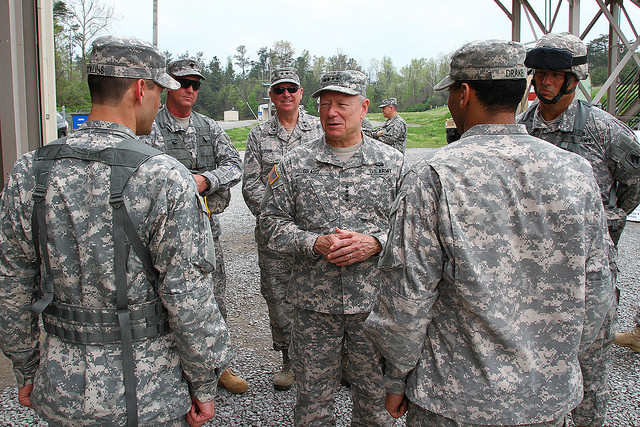
Gen. Frank J. Grass, chief of the National Guard Bureau speaks with Soldiers with the 138th Field Artillery Brigade at the Wendell H. Ford Regional Training Center in Greenville, Ky., April 17, 2015. During his three-day visit, Grass met with Soldiers and Airmen across the state, attended Thunder Over Louisville and Military Appreciation Day at Keeneland in Lexington, Ky. (U.S. Army National Guard photo by Staff Sgt. Scott Raymond)
FRANKFORT, Ky. — Military challenge coins are handed out everyday for excellence, but it’s not everyday that a Soldier’s first coin is from a four-star general. That was the case for Pfc. Lauren Walker, a combat medic with the 1163rd Area Support Medical Company.
“That was my first coin, my first big recognition as a Soldier that I’m doing the right thing,” said Walker. “It’s a pretty big deal to me.”
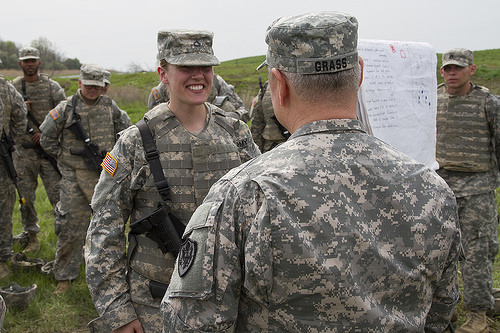
Pfc. Lauren Walker with the 1163rd Area Support Medical Company speaks with Gen. Frank J. Grass, chief of the National Guard Bureau at the Wendell H. Ford Regional Training Center in Greenville, Ky., April 17, 2015. The 1163rd was finishing up the unit’s pre-mobilization training prior to a scheduled deployment to Afghanistan this spring. (U.S. Army National Guard photo by Staff Sgt. Scott Raymond)
“It means a lot to us that he came down here from D.C. to see the little 1163rd. It was a great reminder for us to stay motivated to keep up the hard work and keep driving on.”
Visit our flickr page for more photos of Gen. Grass’ visit to Kentucky.
For Soldiers with the 1163rd, pre-mobilization training was going according to schedule April 18 at the Wendell H. Ford Regional Training Center in Greenville, Ky. Then in the middle of a field training class, everything came to a brief halt as Gen. Frank J. Grass, chief of the National Guard Bureau rolled up on their location.
Escorted by Maj. Gen. Edward W. Tonini, Kentucky’s adjutant general, Grass visited as part of his initiative to travel to every state and territory to personally thank Guardsmen around the Nation.
“Every time I travel, one of the things I find is I learn something about the National Guard that I didn’t know,” said Grass. “Getting to visit Soldiers and Airmen here and learn about the missions that you all are doing is phenomenal.”
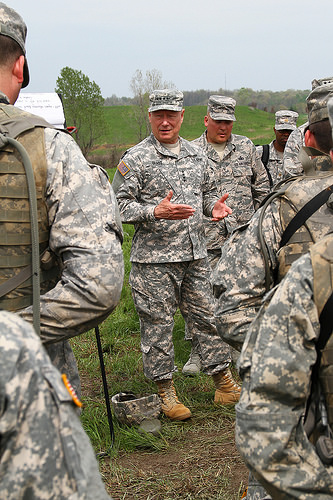
Gen. Frank J. Grass, chief of the National Guard Bureau speaks with Kentucky Guardsmen of the 1163rd Area Support Medical Company during a visit to the Wendell H. Ford Regional Training Center in Greenville, Ky., April 17, 2015. Grass thanked the Soldiers for their service and answered questions from them on the state of the National Guard. (U.S. Army National Guard photo by Staff Sgt. Scott Raymond)
“You think about the number of people that serve in uniform, this is an all volunteer force, and you’ve got to thank them,” he said.
Grass observed part of the training class then spoke with the unit about their upcoming deployment and their thoughts on being a part of the Guard.
“What I find interesting everywhere I go is how young the force is, how talented and how astute they are to what is happening in the world, and they know exactly why they’re joining.”
Sgt. Duncan Wooster’s story also inspired Grass. Wooster enlisted late in life and has a stable career as an airline pilot, but is also determined to be a true non-commissioned officer to the 1163rd. Grass complimented Wooster on helping young Soldiers of the 1163rd to devise plans to be smarter with the extra money they will make during the deployment.
“I’m excited and very honored to go work with such a great group of people and just want to try to influence them to make better decisions,” said Wooster. “I took everything Gen. Grass said to heart and was very impressed that he took time to come out in the field to see us. It was an honor to meet him and speak with him one-on-one.”
The National Guard chief’s visit left a positive buzz with the unit. A drive that their leadership hopes carries them into and through their deployment to Afghanistan.
“The time Gen. Grass spent with the Soldiers indicates to me that we stood out and made a positive impression on him,” said 1st Lt. Anna Mataspha, officer in charge of the 1163rd’s training. “How many other units in the Guard have come across the Chief of the National Guard, that’s pretty special and it elevates us to be even better than what we already are. It’s a great boost right before they deploy.”
During his three-day visit to Kentucky, Grass also met with Soldiers of the 138th Field Artillery Brigade in Greenville and Soldiers with Charlie Co., 1st Battalion, 376th Security and Support Aviation upon his return to Louisville. Grass was also an impressed spectator at Thunder Over Louisville, April 18 and a special guest at Military Appreciation Day at Keeneland in Lexington, Kentucky, April 19.
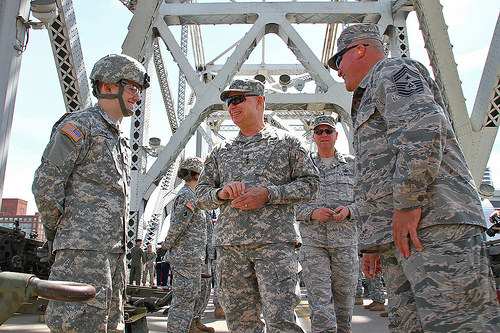
Gen. Frank J. Grass, chief of the National Guard Bureau and Chief Master Sgt. Mitch Brush speak with Spc. Kyle Shenk with the 138th Field Artillery Brigade during Thunder Over Louisville, April 18, 2015. Grass visited with Kentucky Guardsmen on duty for the event throughout downtown Louisville. (U.S. Army national Guard photo by Staff Sgt. Scott Raymond)
“Thunder Over Louisville was just phenomenal and to see how much the military was involved, the salute to Veterans, the salute the Kentucky Army and Air National Guard, there was a half-million people there and you couldn’t move without bumping into a Guardsmen or their family member somewhere.”
In awe of the events and the participation of the Kentucky Guard, Grass departed Kentucky with final thoughts to the Citizen-Soldiers and Airmen of the bluegrass.
“I would tell them thank you for serving your nation and look at the opportunities you’re getting as a member of the Guard, and thanks to their families and employers. It all becomes a family and the Guard is more family than anything I’ve seen.”
Staff Report
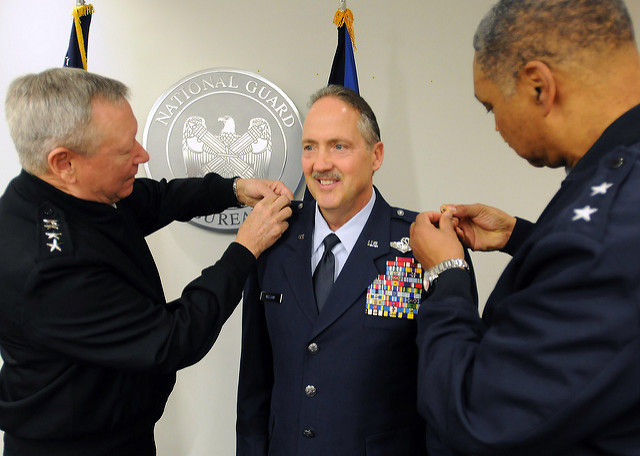
U.S. Army Gen. Frank Grass (left), chief of the National Guard Bureau, promotes Greg Nelson, vice director of Strategic Plans, Policy and International Affairs at the National Guard Bureau, to the rank of brigadier general during a ceremony at the National Guard Readiness Center in Arlington, Va., Nov. 19, 2014. Nelson served as commander of the Kentucky Air National Guard’s 123rd Airlift Wing in Louisville from 2008 to 2012. (U.S. Army National Guard photo by Staff Sgt. Michelle Gonzalez
ARLINGTON, Va. — Col. Greg Nelson, a former commander of the Kentucky Air National Guard’s 123rd Airlift Wing was promoted tot he rank of brigadier general during a ceremony at the National Guard Readiness Center in Arlington, Nov. 19, 2014. Nelson led the 123rd from 2008 - 2012. He now serves as the vice-director of Strategic Plans, Policy and International Affairs at the National Guard Bureau.
As wing commander, Nelson provided leadership and management of a very diverse tactical airlift flying unit. Working in concert with a wide variety of federal and state authorities, he was accountable for all aspects of operations, personnel, equipment and funding matters, ensuring the wing’s readiness to perform its wartime mission.
“Greg is an invaluable member of our Air Force and a huge asset to the Guard,” said Maj. Gen. Edward Tonini, adjutant general of Kentucky. “I couldn’t be more proud for Greg and his family. A promotion well-deserved.”
Nelson also served as an RF-4C weapon systems officer and C-130 instructor navigator. He has held multiple leadership and senior staff positions, most recently the Deputy Director of Mobility Forces, United States Central Command. Nelson was the Director of Strategic Plans and Programs for Joint Force Headquarters, Kentucky National Guard. He also commanded the 123rd Airlift Control Flight, was deputy command post chief, chief of logistics plans and chief of wing plans. Nelson’s military career spans more than 35 years, including nine years of enlisted service prior to his officer commissioning through the Air National Guard Academy of Military Science in 1984. During his career, Nelson has participated in Operations Desert Shield, Desert Storm, Southern Watch, Provide Promise, Joint Forge, Joint Guard, Coronet Oak, Phoenix Oak, Bright Star, Partnership For Peace, Noble Eagle, Enduring Freedom, Fundamental Justice, Iraqi Freedom, and New Dawn.
By Bill Boehm, National Guard Bureau & Kentucky National Guard Staff
(to view the original story, click HERE)
FRANKFORT, Ky. — The Massachusetts Bay Colony was founded in 1630. Over 5,000 men, women, and children made the two-month voyage to the New World, leaving the relative comfort and safety of England behind in an effort to break free of religious intolerance, and to manage their communities the way they saw fit. In doing so, their actions tread new ground in the country that would become the United States of America.
Kentucky National Guard Tank Company participates in the 1951 Governor Lawrence Wetherby inaugural parade in Frankfort, Ky.
Known by several names over the years, the Kentucky National Guard is among the oldest military organizations in the United States. Its history goes back over two hundred years to the frontier days of the 1770s, when Kentucky was part of Virginia. During those early days, nearly every able-bodied man was considered to be a member of the militia. Militiamen were part-time Soldiers. They were farmers, merchants, or tradesmen who took up arms in emergencies. The Militia Act of June 24, 1792, by the Kentucky General Assembly, officially formalized the ‘Citizen-Soldier’ for the Commonwealth.
The military organization we know today as the National Guard came into existence with a direct declaration on December 13, 1636. On this date, the Massachusetts General Court in Salem, for the first time in the history of the North American continent, established that all able-bodied men between the ages of 16 and 60 were required to join the militia. The North, South, and East Regiments were established with this order. The decree excluded ministers and judges. Simply stated, Citizen-Soldiers who mustered for military training could be and would be called upon to fight when needed.
National Guard Heritage Print of the Battle of Salman Pak, where the Raven 42 Squad from the 617th Military Police Company, Kentucky Army National Guard, repelled an attacked by 50 insurgents on a coalition convoy. For the squad's actions that day, members received numerous awards to include a Distinguished Service Cross and two Silver Stars.
Laws often evolve from well-intentioned actions, yet sometimes prove themselves to be ineffective. Given such odds, how could this possibly work?
Owing to many failures in the time that English settlers had attempted colonization in the Massachusetts frontier and elsewhere in North America, leaders decided that a proactive and ready state of mind must be kept by all citizens, particularly those training in military tactics. Being part of citizenry in the small villages meant that a price must be paid for the freedoms that could potentially be enjoyed, were the colony to ultimately succeed. That price exacted meant taking responsibility for defending the settlements of the Massachusetts Bay Colony.
The settlers of the new outposts experienced austere surroundings. With no established or familiar conventions upon which to rely, the colony relied upon male pioneers to provide food, shelter, and defensive protection for the women and children present, as well for themselves. Even with all available hands working, this was a difficult task. Worse, the nearby Pequot Indian tribe proved a restless and unpredictable neighbor, leaving the Massachusetts colonists vulnerable to guerilla-style attacks that could decimate the fledgling settlements. In an environment rife with disease, poor sanitation, and harsh weather conditions, all able-bodied members of the Massachusetts colony pulled together out of necessity.
Self-sufficiency proved instrumental. In a new land, hiring mercenary fighters in the European
tradition to ward off Indian attacks would be impossible. For one thing, the colonists had no money. Other foreign interests in the New World such as the French or Spanish, even if they were available for defensive purposes, did not share English views on religion and political matters. They would have seriously undermined the stability of the Massachusetts Bay Colony. Governing and policing the settlement would have to be left to the colonists themselves. Therefore, the militia system of self-defense brought from England had the best chance of succeeding for the colonists.
And it did succeed. Soon after the establishment of the militia in Massachusetts, the entire New England region defended itself against the aggression of the Pequot nation. Other colonies such as Connecticut and Rhode Island mustered militia units to fight the Indian tribe, and succeeded in forcing the Pequots to capitulate in 1638. Ultimately, the militia enlisted from the many small villages proved a strong component in building confidence for the settlement as a whole.
Although other colonial settlements in North America such as those in Florida, Virginia, and New Mexico that would become part of the United States utilized military protection in order to allow settlers safe passage and to defend against aggressors, Massachusetts proved to be the first entity to have its government establish and raise a militia. Nor did these other colonies’ militia service remain continuous. The tie to legal precedent in this manner remains to this day. That record of service has remained continuous and unbroken, no matter the change in each unit’s function as a part of the militia or the National Guard.
Kentucky National Guard Bravo Troop 54 Machine Gun Squad at Monticello Camp in Fort Knox, Ky., Aug. 1926
This distinction qualifies it as the birthplace of the militia in the United States. With the North, South, and East Regiments established, its exemplary military tradition continues through this day with four Massachusetts National Guard units – the 101st Engineer Battalion, the 101st Field Artillery, the 181st Infantry Regiment, and the 182nd Infantry Regiment. The tradition born in Salem continues today.
Today, Massachusetts’ population numbers 6.5 million people, and the Commonwealth figures prominently as a center of manufacturing, electronics/technology, and finance. Much has changed since 1636, but one thing has not: the National Guard still consists of Citizen-Soldiers and Airmen providing protection from natural disaster, training regularly to uphold high standards of readiness, and also deploying to far-away countries to protect the United States’ national interests abroad. Although the country’s growth and expansion has made it a large military force around the world, the National Guard still remains a community cornerstone – just as it did when it was given birth on December 13, 1636.
dwa
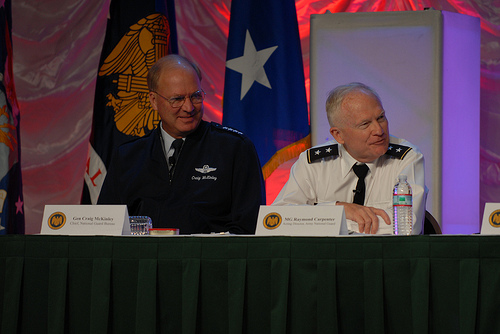
Gen. Craig R. McKinley, Chief of the National Guard Bureau, and Maj. Gen. Raymond Carpenter, Acting Director, U.S. Army National Guard, National Guard Bureau, field questions from the participants at the 2011 National Volunteer Workshop hosted at the Galt House July 25 in Louisville, Ky. (Staff Photo by Staff Sgt. Fredrick P. Varney, 133rd Mobile Public Affairs Detachment)
Click here for more photos of this event.
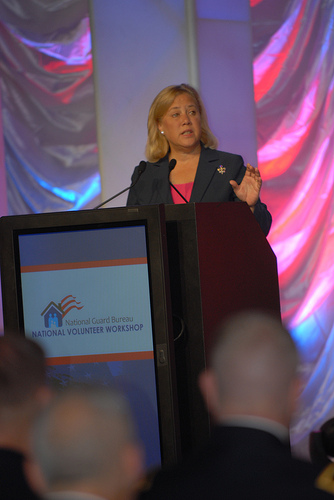
United States Senator Mary L. Landrieu from Louisiana, addresses the participants at the 2011 National Volunteer Workshop hosted at the Galt House July 25 in Louisville, Ky. Landrieu is an advocate for the military and supports efforts to improve educational opportunities and good standard of living for military families. (Staff Photo by Staff Sgt. Fredrick P. Varney, 133rd Mobile Public Affairs Detachment)
LOUISVILLE, Ky. (July 26, 2011) — The 2011 National Volunteer Workshop was off to a great start with a panel of distinguished guests — including Gen. Craig R. McKinley, Chief of the National Guard Bureau and Maj. Gen. Raymond Carpenter, Acting Director, U.S. Army National Guard — taking questions from the audience.
The keynote speaker for this event was U.S. Senator Mary L. Landrieu from Louisiana, an advocate for military families. Landrieu is well known for visiting troops and their families, as well as fighting to improve living conditions, educational benefits and the standard of living in the military community.
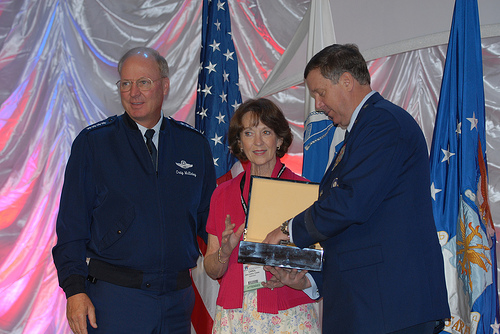
Gen. Craig R. McKinley, Chief of the National Guard Bureau, presents Kentucky's Adjutant General Edward W. Tonini with an award for his support of the 2011 National Volunteer Workshop hosted at the Galt House July 25 in Louisville, Ky. Carol Tonini, wife of the adjutant general, was present during the ceremony. (Staff Photo by Staff Sgt. Fredrick P. Varney, 133rd Mobile Public Affairs Detachment)
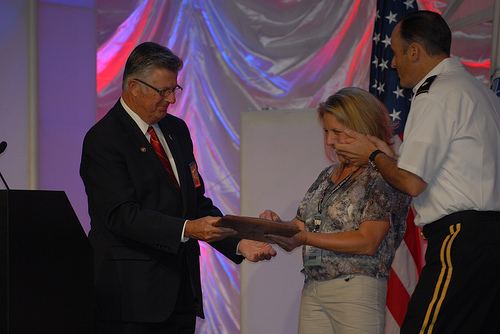
Alex Baird, Chief of Family Programs, National Guard Bureau, presents Mrs. Mary Small, the wife of CW4 Phil Small, an award for her dedication and support as a volunteer for the Vermont National Guardsmen. The 2011 National Volunteer Workshop was hosted at the Galt House July 25 in Louisville, Ky. (Staff Photo by Staff Sgt. Fredrick P. Varney, 133rd Mobile Public Affairs Detachment)
dwa
Story and photos by Staff Sgt. Michael Oliver, Kentucky National Guard Public Affairs Office
Kentucky Guardsman Sgt. 1st Class Gregg Blakeley, Unit Training Equipment Site materials identifier and examiner, receives the 2010 National Guard Bureau Environmental Security award from Maj. Gen. Edward W. Tonini, state adjutant general, and Col. Michael Bennett, Army National Guard Environmental Program Division chief, at a ceremony on Boone National Guard Center in Frankfort, Ky., May 10. Also in attendance is Blakeley’s wife Ashley.
FRANKFORT, Ky., - Kentucky Guardsman Sgt. 1st Class Gregg Blakeley was presented with the first place sustainability 2010 National Guard Bureau Environmental Security award for his waste and material recycling program at the Unit Training Equipment Site on Wendell H. Ford Regional Training Center .
“I didn’t come up with this program all by myself,” said Blakeley. “It has been a team effort from the entire maintenance shop.”
By insuring environmental compliance, Blakely saves the Kentucky Guard thousands of dollars in materials, resources and enhances Soldiers safety and prevents training interruptions.
“Our motto in Kentucky is ‘Unbridled Service’ and the work that Sgt. 1st Class Blakeley has done is a model of ‘Unbridled Service,’” said Maj. Gen. Edward Tonini, state adjutant general.
“Guys come up with ideas to improve the shop and I say let’s do it,” said Blakeley.
###
dwa
Story by Master Sgt. Philip Speck
123rd Airlift Wing Public Affairs
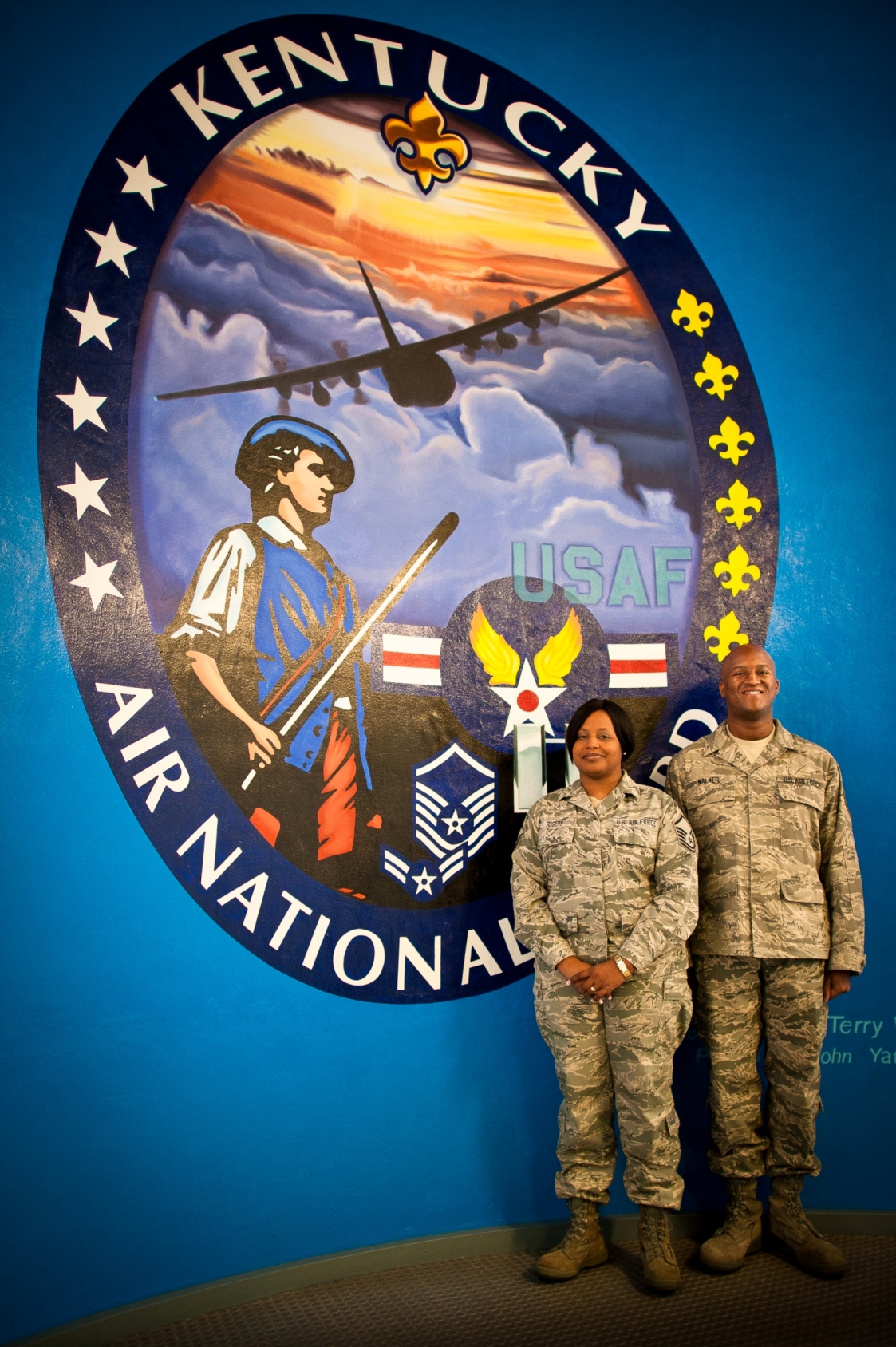
Kentucky Air National Guard Master Sgt. Cynthia Rogers and Tech. Sgt. Anthony Walker were honored for their work in recuiting and retention. (Photo by Maj. Dale Greer, Chief of Public Affairs, 123d Airlift Wing)
FRANKFORT, Ky. (May 5, 2011) – Two members of the Kentucky Air Guard have been recognized by the National Guard Bureau for their outstanding job performance.
Master Sgt. Cynthia Rogers was named Air National Guard Retention Office Manager of the Year for Region 4, a geographic area that includes nine states and the District of Columbia, while Tech. Sgt. Anthony Walker was named ANG Production Recruiter of the Year for Region 4.
“Both of these individuals are exceptional Airmen who perform their crucial duties with dedication and excellence, day-in and day-out,” said Senior Master Sgt. Scott Crimm, recruiting and retention superintendent for the Kentucky Air Guard. “Their outstanding commitment is one of the reasons why the Kentucky Air Guard consistently meets its recruiting and retention goals, keeping the unit strong and well-positioned to answer a wide range of mission needs all around the world.”
Walker earned his honor with a long list of accomplishments, including targeted recruiting efforts designed to fill chronically understaffed positions in the special operations career field. During fiscal year 2010, those efforts resulted in a 100 percent staffing rate for pararescue and support positions, and a 90 percent staffing rate for combat control positions. Walker also led the organization in overall recruits, enlisting 29 Airmen in the Kentucky Air National Guard during fiscal year 2010 to boost unit-wide staffing levels to 103 percent of the authorized troop count.
Lt. Col. Kathryn Pfeifer, commander of the Kentucky Air Guard’s 123rd Force Support Squadron, called Walker a “truly outstanding recruiter who continually focuses his recruiting efforts, enabling us to find candidates to fill specific needs.”
“He has an exceptional way of interacting with candidates, cementing their interest in the Kentucky Air National Guard while engaging with unit commanders about their vacancy needs,” she added.
A strong supporter of diversity, Walker worked with human resources during fiscal year 2010 to develop recruiting strategies intended to attract a broader range of young men and women to the unit.
“He’s continually working on plans and strategies to bring new Airmen into the Kentucky Air Guard,” Sergeant Crimm said. “He also gives back to the community by donating off-duty time to a local youth ministry and to a mentorship program.”
Rogers earned her award with an equally long list of accomplishments, including a 94 percent reenlistment rate for fiscal year 2010. During those 12 months, only six Airmen elected not to re-enlist in the Kentucky Air Guard.
Rogers also is a Post 9-11 Montgomery G.I. Bill guru, Sergeant Crimm said.
“She is recognized within the Air Guard recruiting and retention community as a expert on those benefits, and she briefed the entire Kentucky Air Guard on the program to ensure maximum awareness,” he said.
“Sergeant Rogers always has the best interests of our Airmen in mind,” Colonel Pfeifer said. “She goes above and beyond to ensure unit members get the information they need on items such as the Yellow Ribbon Integration Program, tuition assistance, the Post 9-11 G.I. Bill or re-enlistment bonuses. She is a fair and honest individual who clearly outlines the benefits and programs available to our members, and who also keeps commanders informed on how they can further assist in areas where their Airmen are concerned.”
In her off-duty time, Rogers serves the local homeless population by volunteering at Louisville’s Christian Wayside Mission complex. She also champions diversity recruiting efforts by attending minority events in the community.
###
WASHINGTON, D.C. (Feb. 25, 2010) – With increasing government and private support, a National Guard program that helps high school dropouts transform their lives is closing in on its 100,000th graduate.
“The National Guard is proud of the success of the National Guard Youth ChalleNGe Program,” said Air Force Gen. Craig McKinley, the chief of the National Guard Bureau. “It is essential that we reduce the number of high school dropouts, and Youth ChalleNGe is part of the solution.”
McKinley was hosted by retired Air Force Lt. Gen. John B. Conaway, chairman of the National Guard Youth Foundation, along with several other corporate and military leaders, politicians and celebrities at the 2010 Challenge Champions Gala held Tuesday evening, Feb. 23.
“Gen. McKinley and the National Guard are not only fighting our nation’s wars overseas and helping here inside the United States … but they have another mission – helping to save America’s youth, so they can be productive citizens,” Conaway said.
Highlights for the nation’s second-largest mentoring program in the last year include a jump in the percentage of federal dollars contributed to each state from 60 percent to 75 percent; an Office of Management and Budget-directed $20 million boost in Defense Department money for the program for the 2011 fiscal year; and increasing private support despite a challenging economy.
“I’m not doing it for nobody else,” said Jameka Micchell, a 17-year-old ChalleNGe cadet from Georgia, who was selected to attend the gala. She is currently in the 17-month voluntary intervention program and has her heart set on joining the 92,850 young people who have graduated since 1993.
“I’m doing this for myself,” Micchell said, “because I realize that I need to change.”
About 1.3 million students drop out of high school each year, costing the nation more than $335 billion in lost wages, revenues and productivity over their lifetimes, said Youth ChalleNGe officials.
“This is a national epidemic, and it is a national shame,” said Louisiana Sen. Mary Landrieu. “We must do something about it, and this program does.”
High school dropouts are more likely to live in poverty, receive public assistance, go to prison and face health problems and divorce. Life expectancy is nine years shorter than a high school graduate. Of the $50 billion the federal government spends on incarceration, $45 billion is spent on individuals who did not get a high school diploma.
“Not only does this dropout rate cost our economy billions of dollars each year, but it means that fewer and fewer Americans are able to succeed in this economy,” Landrieu said. “It is our responsibility to provide opportunities – not guarantees, but opportunities.”
The National Guard has been doing that since 1993, when the congressionally mandated program was founded.
Twenty seven states and Puerto Rico currently have the program; another five states and the Virgin Islands have requested to add the program, which targets 16- to 18-year-old high school dropouts.
At the gala, J. Randolph Babbitt, the administrator of the Federal Aviation Administration gave out the first two pilots’ licenses he has personally presented since he took office – to two graduates of the Youth ChalleNGe Program.
Rick Hendrick, owner of Hendrick Motor Sports – home of NASCAR driver Dale Earnhardt Jr. – announced 10 mechanic internships for cadets.
And WWE superstar MVP told how he got caught up in street gangs and served a nearly 10-year prison sentence before turning his life around.
“Crime pays, but you have to pay it all back with interest,” MVP said. “It is through dedication, hard work and sacrifice you can achieve your dreams – not through crime.”
“The cadets are just very, very inspirational,” said Indy 500 champion Dan Wheldon of Panther Racing. “It really drives us on to be able to represent the National Guard and the Youth ChalleNGe Program.”
Earnhardt said he sees the cadets as the true stars. “Their paths in life are inspirational to all of us,” he said. “I don’t give them advice: I listen.”
