Pages
Stay In Touch
More
© 2013 KentuckyGuard
Check out our most recent Bluegrass Guard - this issue focuses on the benefits of the Kentucky Guard and why they matter to you.
(You can see all of our Bluegrass Guard magazines going all the way back to 1982 by clicking HERE.)
Let us know what you think by emailing us at PAO@Kentuckyguard.com!
Story by Master Sgt. Phil Speck, 123rd Airlift Wing Public Affairs
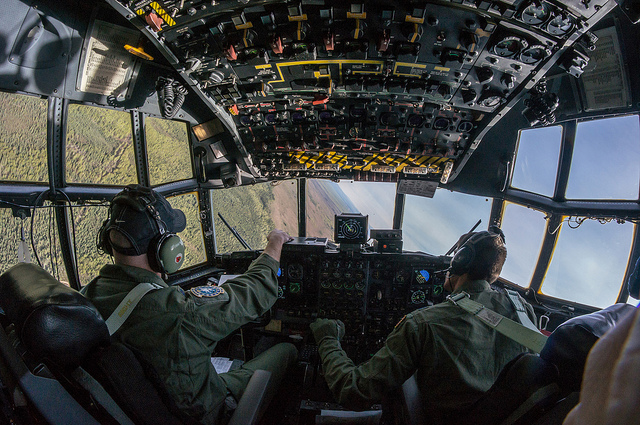
An aircrew from the Kentucky Air National Guard’s 165th Airlift Squadron flies a Kentucky Air National Guard C-130 Hercules over the mountains of Alaska during a training scenario as part of Red Flag-Alaska on May 15, 2014. More than 100 Kentucky Airmen participated in the exercise from May 7 to 23. (U.S. Air National Guard photo by Senior Airman Robert Buchberger)
JOINT BASE ELMENDORF-RICHARDSON, Alaska – More than 100 Airmen from the Kentucky Air National Guard completed 10 days of intense combat training here May 23, airlifting 35,000 pounds of essential cargo and airdropping 280 Army paratroopers into enemy territory while facing attacks from hostile aircraft and surface-to-air missiles.
The training, part of a regular Pacific Command exercise called Red Flag - Alaska, exposed Kentucky’s C-130 aircrews to a “hyper-realistic training environment” that will strengthen their preparation for combat missions in any setting, said Col. Robert Hamm, commander of Kentucky’s Louisville-based 123rd Operations Group.
Click here for more photos from this story.
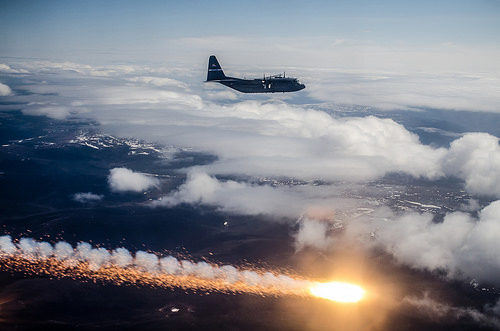
A Kentucky Air National Guard C-130 Hercules flies in formation as another C-130 deploys flare countermeasures in the skies over Alaska during exercise Red Flag-Alaska on May 22, 2014. Aircrews from Kentucky’s 165th Airlift squadron received intensive combat training during the exercise, which ran from May 7 to 23. (U.S. Air National Guard photo by Master Sgt. Phil Speck)
“The fast pace and high tension of the exercise required our Airmen to maintain constant focus despite being mentally and physically fatigued throughout,” Hamm said. “It was as close as it gets to the stress they’ll have to endure in actual combat.
“Our guys accomplished every one of their learning objectives, and I think it opened up a lot of their eyes about how serious this is — about how different (combat) is from the way we train locally because we can’t create the same conditions back home.”
Among those differences were the ability to train alongside escort and strike aircraft while facing threats from aggressors in the air and on the ground. Kentucky’s three C-130s were escorted into and out of hostile territory by F-15 and F-22 fighters, whose mission was to eliminate enemy aircraft and surface-to-air missile batteries, Hamm said.
The Kentucky Airmen also had the opportunity to navigate challenging mountain terrain in the Pacific-Alaska Range Complex where the exercise was staged, and to interoperate with a full spectrum of assets from AWACS to A-10s, working with each of these units to plan and execute every mission.
Lt. Col. Matthew Quenichet, director of operations for the 165th Airlift Squadron, was pleased with Kentucky’s performance in such an intense environment.
“It was a big accomplishment just to survive the sortie, hit your time-on-target, make your landing, pick up your cargo, and get it to the end of the vulnerability zone,” he said.
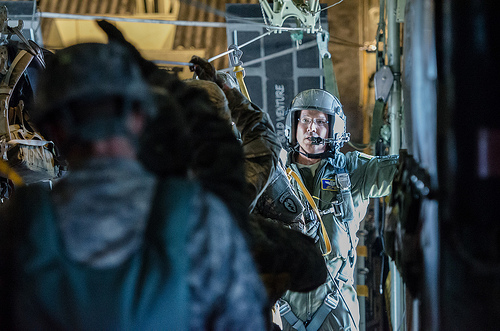
Chief Master Sgt. Jeffrey Brown, a loadmaster from the Kentucky Air National Guard’s 165th Airlift Squadron, prepares the paratroop door on a Kentucky Air Guard C-130 Hercules for Soldiers from the 2-377th Parachute Field Artillery Regiment, 4th IBCT 25 Infantry Division, while flying just north of Joint Base Elmendorf-Richardson, Alaska, on May 13, 2014. The jump was part of Red Flag-Alaska, a Pacific Command exercise designed to provide aircrews with realistic combat training. (U.S. Air National Guard photo by Master Sgt. Phil Speck)
That vulnerability zone is where the simulated war took place. Aircraft from Joint Base Elmendorf-Richardson and Eielson Air Force Base, Alaska, would meet there to begin the conflict. Units took turns being allied forces or aggressors, while C-130 crews executed various scenarios in which they had to fly through treacherous terrain, land on dirt-strip runways, pick up cargo, and airdrop cargo or Army paratroopers.
This exercise marked the first time that Army forces were integrated into the training, and the Kentucky Air Guard became the first Air Force unit ever to drop paratroopers into an airfield for a simulated seizure during Red Flag – Alaska.
“There was a lot of apprehension going into this,” Quenichet said. “People were not sure what to expect, but they were excited. It was a lot for people to take in. The idea was to throw more challenges at the aircrews than they would ever see in actual combat.”
Two groups of Kentucky Airmen participated in the exercise, Quenichet added: Highly experienced aircrews with extensive combat exposure in Afghanistan; and brand-new co-pilots, engineers and loadmasters who had never seen anything like it before.
“It may have taken the new aircrews an entire career to get this kind of experience, but they got it in their first couple of months in the airplane here,” Quenichet said. “We worked together as a team to get a game plan and accomplish this mission. Once we were en route, it wasn’t a simulator. It was real airplanes flying through incredibly challenging terrain, facing actual threat systems. The only difference between the scenarios here and real combat was that there weren’t pieces of metal flying at you.
“By the end of the exercise, all our aircrews were right where they needed to be.”
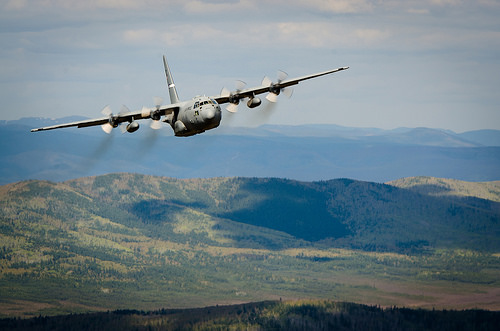
A Kentucky Air National Guard C-130 flies over Alaska on May 9, 2014, in support of Exercise Red Flag-Alaska. More than 100 Kentucky Airmen from the 123rd Airlift Wing participated in the exercise from May 7 to May 23. Red Flag-Alaska is designed to hone the combat skills of U.S. Air Force flight crews. (U.S. Air National Guard photo by Master Sgt. Phil Speck)
Lt. Col. Kevin Allred, commander of Detachment 1, 353rd Combat Training Squadron, said the event was one of the smoothest Red Flags he’s seen.
“I’m very impressed all the way around,” Allred said. “From the deployment to getting in to town, they were all over everything. All of your crews were fired up to be here — that’s really fun to watch. I think everyone got really good training out of it, because they wanted to be here.”
Allred also said he was pleased by how smoothly the Army integration went, adding that officials plan to build on the airfield-seizure scenario in future exercises.
Hamm credited the 353rd with providing excellent support throughout Red Flag — a factor that helped the Kentucky Airmen maximize their training opportunities.
“The 353rd Combat Training Squadron provided outstanding support for a phenomenal exercise,” Hamm said. “There was no tension, and we got everything we asked for. We couldn’t ask for better support from those guys.”
Story by David Altom, Kentucky National Guard Public Affairs
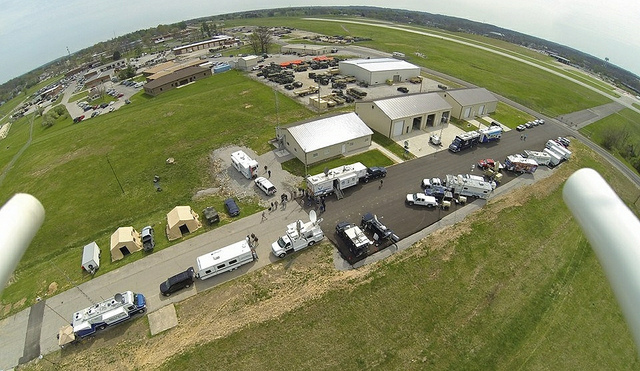
A bird’s eye view of COMEX 2014, courtesy of a unmanned aerial vehicle. Eighteen different communications command vehicles and trailers from 11 different agencies took part in COMEX 2014, a showcase for communications capabilities for first responders held at Boone National Guard Center.
FRANKFORT, Ky. — A recent communications exercise “showcase” held at Boone National Guard Center last April gave the Guard a chance to flex its muscles and strengthen its partnerships with local agencies.
“This showcase was developed to demonstrate interoperability with different agencies and new technologies,” said Chief Warrant Officer David Barker, wireless IT manager for the Kentucky National Guard. “We had eighteen different communications command vehicles and trailers from eleven different agencies. Most if not all had some type of reach back communications capability to support data and voice without land base communications support.”
In addition to National Guard and Kentucky Emergency Management assets, participating agencies included: the Kentucky Department of Transportation, the Labor Cabinet, Environmental Protection, Kentucky Early Warning System, the State Fire Marshall, and Military Auxiliary Radio Service.
Civilian volunteers, like those who run MARS, play a vital role in disaster communications. Barker was quick to champion those volunteers who took part in the showcase.
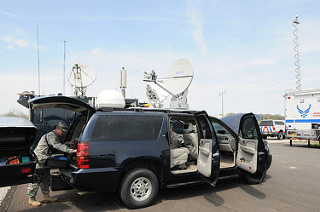
A Kentucky National Guard soldier prepares to deploy some wireless communications gear during COMEX 2014. (U.S. Army National Guard photo by Staff Sgt. Scott Raymond)
“If we didn’t rely on them we’d be hurting,” he said. “In a real disaster that’s your first line of response. They love this stuff, they spend their own money on gear and they are already deployed across every region of the state, out in the field and ready to respond.
A capability that was new to the COMEX was a UAV that was able to display video locally to the participants and demonstrate how it could take quality video and pictures of a disaster scene where it was too dangerous for personnel to go.
Capt. Joe Fontanez ran the tactical end of the exercise for the COMEX. He saw the exercise as an opportunity for everyone involved.
“This year we tried to do something different and integrate our tactical communications systems in the state-wide test,” he said. “This gave participating units the opportunity to test their tactical equipment alongside civilian equipment to see what talks and what doesn’t. For instance, the 63rd Theater Aviation Brigade was able to use their in house satellite communications assets for voice, video, data, and movement tracking which will enhance the incident site commander’s situational awareness on the ground.”
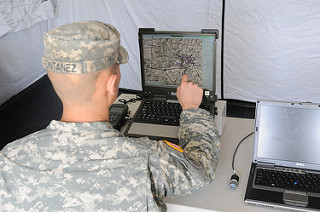
Capt. Joe Fontanez runs the tactical portion of COMEX 2014, showcasing the Kentucky National Guard’s radio communications capabilities. “Our Soldiers onsite were very upbeat and excited to be working with agencies from all over the state,” he said. (U.S. Army National Guard photo by Staff Sgt. Scott Raymond)
Fontanez stressed the partnership between the agencies, specifically on what the Guard can do to help its partners in time of emergency.
“We provided satellite internet that civilian agency partners would be able to utilize on the ground and also demonstrated how our system works to pass text message traffic as well as track vehicle movement in and around the incident site.”
Doing it in a parking lot is one thing, but can they do it in the field, under real world conditions?
“We plan on getting in a long range shot (100-200 miles) next year, allowing us to demonstrate how invaluable radio communications can be in the event our online digital technology fails.”
As with every exercise, strengths are measured and weaknesses identified and corrected. All in all, COMEX 2014 brought together a wide range of capabilities and personalities,
“Our Soldiers onsite were very upbeat and excited to be working with agencies from all over the state,” said Fontanez. “Not only did they get to show off their skills and equipment, but they got the opportunity to network with similiarly minded individuals who are passionate about communications. We even helped a few people with their own equipment which gave our troops an enormous sense of pride and accomplishment.”
Barker plans on taking the COMEX to other regions of the state, which will allow the Kentucky Guard to team up with even more agencies.
“We need to branch out a capture a bigger audience,” he said. “There is a ton of emergency agencies out there that we can work with. Not everybody can come to Frankfort, so we’re going to bring the showcase to them, let them know who we are and what we can do for them when a real emergency comes up. That’s the next step.”
Story by Staff Sgt. Scott Raymond, Kentucky National Guard Public Affairs
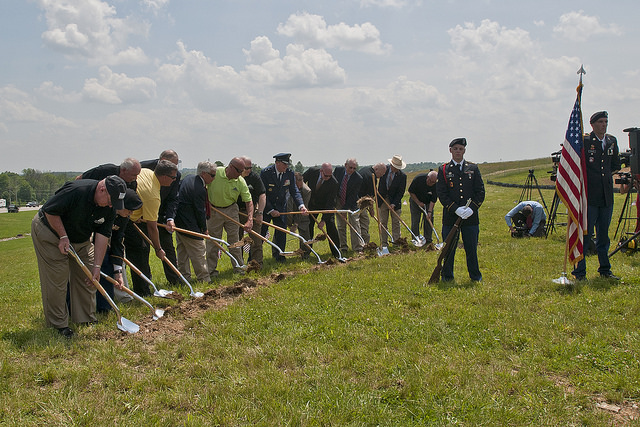
Kentucky Adjutant General Edward W. Tonini, retired Kentucky Guardsmen and board members of the Kentucky National Guard Memorial Fund break ground for the new Kentucky Guard’s memorial in Frankfort, Ky., May 26, 2014. After several years of planning and fund-raising, the project will begin construction this summer. (U.S. Army National Guard photo by Staff Sgt. Scott Raymond)
FRANKFORT, Ky. — Friends and family of the Kentucky Guard joined Adjutant General, Maj. Gen. Edward W. Tonini and hundreds of current and former Citizen Soldiers and Airmen to celebrate Memorial Day by breaking ground for the Kentucky National Guard Memorial in Frankfort, May 26.
After years in the works, construction of the memorial will begin this summer. 1st Lt. Joshua Witt, board member of the Kentucky National Guard Memorial Fund said the moment is a long time coming.
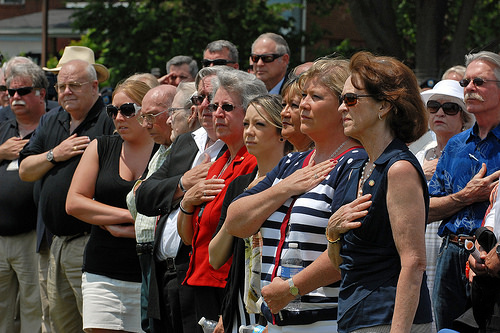
Family members of fallen Kentucky Guardsmen are joined by friends, former and current Kentucky Guardsmen during the National Anthem at a ground-breaking ceremony for the Kentucky National Guard Memorial in Frankfort, Ky., May 26, 2014. More than 140 names of fallen Kentucky Guardsmen will be etched in the memorial to be built this summer. (U.S. Army National Guard photo by Staff Sgt. Scott Raymond)
“We have come together finally on Memorial Day 2014 for the event we dreamed of five years ago,” he said. “This is the chance for us to recognize the reality of a $1.3 million fund-raising goal for a project that represents the sacrifice of more than 140 Kentucky Guardsmen that gave their lives since 1912.”
Click here to see more photos from the event.
Witt called the memorial a fitting tribute to Kentucky’s fallen. The memorial will feature a 22-foot wide granite stone in the shape of Kentucky bearing the names of Kentucky National Guard soldiers who have died in the line of duty. So far, 148 Soldiers have been identified to have their names engraved on the stone.
One of those names to be etched is Sgt. James Sherrill who was killed April 3, 2005 in Bayji, Iraq while serving with the 2113th Transportation Company. Sherrill’s mother, father and daughter attended the groundbreaking and agreed that the memorial will bring strength to them and peace of mind.
“I think this will mean a whole lot to us,” said Sherrill’s father, William. “This memorial will be a big part of his memory, it’s going to be really beautiful.”
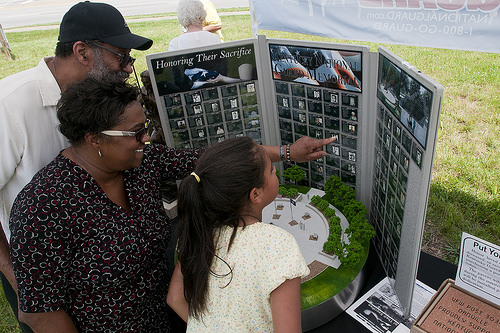
William and Beatrice Sherrill point out the picture of their son, Sgt. James Sherrill to Alexandra Sherrill, James’ daughter at a ground-breaking ceremony for the Kentucky National Guard Memorial in Frankfort, Ky., May 26, 2014. Sherrill was killed in Iraq in 2005 while serving with the 2113th Transportation Company. (U.S. Army National Guard photo by Staff Sgt. Scott Raymond)
“Even after nine years, it’s like we are still part of the family,” he said. “It really gives us a great feeling knowing that so many people remember and honor our son.”
The memorial will also include a 9.5-foot tall, solid bronze Daniel Boone statue and a 70-foot wide circle of pavers volunteers are calling the “sacred space.” It will have a separate entrance and its own parking.
Volunteers with the Memorial Fund are hopeful to dedicate the monument next Memorial Day.
Staff Report
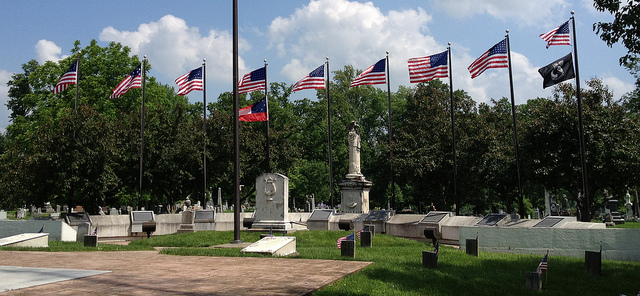
Flags flutter in the breeze at the Kentucky War Memorial in Frankfort Cemetery, Frankfort, Ky.
FRANKFORT, Ky. — President John F. Kennedy said, “A nation reveals itself not only by the men it produces but also by the men it honors, the men it remembers.”
Today, we remember and honor the American Servicemembers, ordinary men and women, who died while in military service.
Since 1866, when the people of Waterloo, New York dipped their flags to half mast and decorated their village to remember the Soldiers who died during the Civil War, our nation has paid tribute to those lives of all service men and women who have fallen in the line of duty.
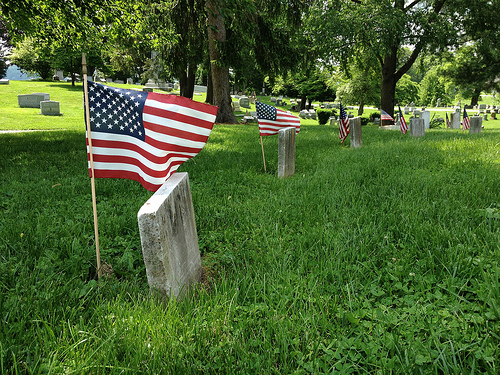
Flags whip in the wind over the graves of Kentucky Service members at the War Memorial in Frankfort Cemetery in Frankfort, Ky.
In the 100 years since the organization became known as the Kentucky National Guard, hundreds of its Citizen-Soldiers have given the last full measure of devotion to the Commonwealth and the Nation.Names such as 1st Sgt. William C. Liles from Hartford, Ky., who died during the Mexican Border Campaign in 1917 and Pvt. Robert Brooks of Sadieville, Ky., the first U.S. Armored forces casualty of World War II, tell of the past sacrifices of Kentucky and a nation at war. Since Sept. 11, 2001, more than 16,000 Kentucky Guardsmen have deployed overseas in support of operations in the War on Terror — 18 did not return.
Sgt. Jonathan Hughes of Lebanon, Kentucky, who was killed in Iraq in 2005, and Sgt. Daniel Wallace of Dry Ridge, Kentucky, who died in 2008 in Afghanistan, are among the newest names added to the alter of freedom.
The Kentucky Guard is in the process of funding their own memorial to be dedicated to those names and others who we honor today.
The Kentucky National Guard Memorial will create a sacred space for families, friends, and comrades to reflect and remember. So far, 464 potential names have been discovered that may one day be honored on the memorial and 145 have been confirmed for inclusion who died while in the line of duty from March 19, 1912 to present. That date is significant because it is when the state of Kentucky made an official name change from the “Kentucky State Guard” to the “Kentucky National Guard.”
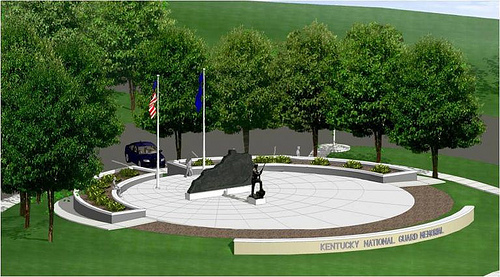
An artist rendering of the future Kentucky National Guard Memorial to be built in Frankfort, Ky. (Courtesy of KYNG Memorial Fund)
The memorial will be built in Frankfort at the Boone National Guard Center with a ground breaking ceremony scheduled for today. Funding for the memorial has been provided entirely through private donations.
To find out more about the project visit www.kyngmemorial.com.
Story by: Maj. Stephen Martin, Kentucky National Guard Public Affairs
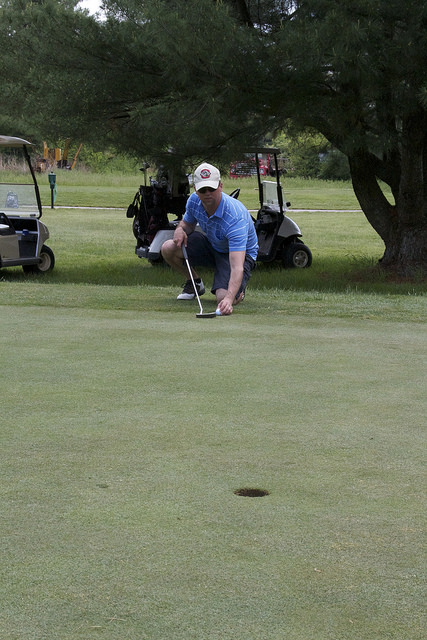
Sgt. 1st Class Stephen Arny from Bravo Co. 2nd Battalion, 147th Avation lines up his shot at the fourth annual Mark L. Sherman Golf Scramble at The Brook Golf Course in Versailles, Ky. May 12. The event honored a former member of the 63rd Theater Aviation Brigade, Lt. Col. Mark Sherman, who passed away in 2011 by providing scholarships to those who qualify. (U.S. Army National Guard photo by Capt. Stephen Martin)
VERSAILLES, Ky. — The fourth annual Mark L. Sherman Golf Scramble was held at The Brook Golf Course in Versailles, Kentucky. May 12. The event honored a former member of the 63rd Theater Aviation Brigade, Lt. Col. Mark Sherman, who passed away in 2011 by providing scholarships to those who qualify.
“I want to thank all those that participated and sponsored this years scramble,” said retired Chief Warrant Officer five Jim Simms, executive director for the National Guard Association of Kentucky, who hosted the event. “The turnout of 93 players and additional volunteers to provide support shows the heart of not only the Kentucky National Guard but also the citizens of the Commonwealth.”
To see all the photos of this event, please click HERE.
Among sponsors of the event, Triple Crowne Golf Carts hosted the “Hole in One” chance to win a golf cart and Big Ass Fans contributed significantly to the scholarship fund for 2014.
The registration fees and donations allowed the foundation to raise $5,000.00 for scholarships to be awarded to deserving students this year.
This year’s winners:
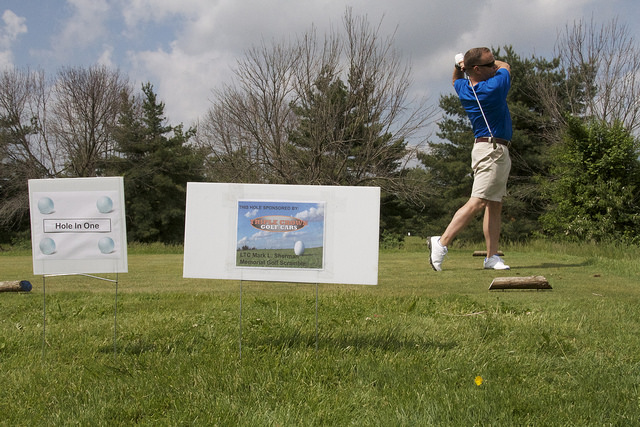
Master Sgt. Chad Jones from the 138th Fires Brigade takes his turn on the “Hole in One” to win a golf cart, sponsored by Triple Crowne Golf Carts. The fourth annual Mark L. Sherman Golf Scramble was held at The Brook Golf Course in Versailles, Ky. May 12. (U.S. Army National Guard photo by Capt. Stephen Martin)
FIRST PLACE
-Jim Crawford
-Scrapper Letcher
-Dusty Pollard
-Christopher Carrington
SECOND PLACE
-Sam McConnell
-Jenny McConnell
-Gary Ross
-Glenn Reed
LONGEST DRIVE - MEN
-Tony Villier
LONGEST DRIVE - WOMEN
-Jenny McConnell
CLOSEST TO THE PIN - MEN
-Jerry Morrison
CLOSEST TO THE PIN - WOMEN
-Jenny McConnell
Story by Staff Sgt. Vicky Spesard, 123rd Airlift Wing Public Affairs
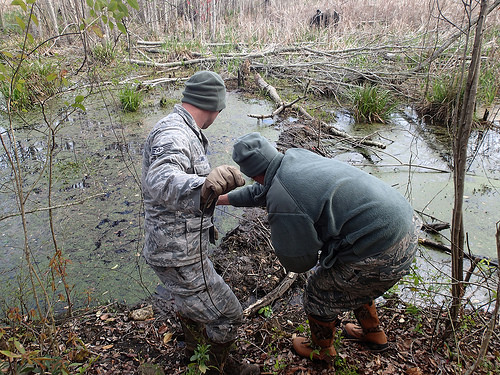
Staff Sgt. Tim Baker of the Kentucky Air National Guard’s 123rd Civil Engineer Squadron and Master Sgt. Greg Stephens of the 116th Air Control Wing position detonation cord and C4 explosive to blow up unoccupied beaver dams at Robins Air Force Base, Ga., on April 27, 2014. (Courtesy photo)
LOUISVILLE, Ky. — A destructive force made its way through the swamps of Georgia, bottling up water flow and flooding parts of Robins Air Force Base. The enemy at hand: the American beaver.
Answering the call for action were Staff Sgts. Dustin Turner and Tim Baker, Explosive Ordnance Disposal specialists with the Kentucky Air National Guard’s 123rd Civil Engineer Squadron.
The Airmen, who are more accustomed to defusing Improvised Explosive Devices or blowing up unstable munitions, applied their wartime skills to the beaver dams instead, eliminating the unoccupied structures with C4 explosives.
According to the Georgia Department of Natural Resources, beavers begin their ritual of chewing up trees and building dams each spring. That has the cascading effect of destroying natural waterways and other animal habitats.
In the case of the beaver assault on Robins Air Force Base, the eight dams — some as big as 60 to 75 feet long — were causing water to pool in streams that no longer flowed naturally. That led to a rise in water-fowl population and impaired base efforts to log tall trees in the forest near the end of runways, resulting in hazardous flight conditions.
“The beaver dams were impeding flight operations,” Turner explained. “Because the area is very swampy, heavy equipment couldn’t get in there to remove the dams, so the best option was to use explosives.”
To restore the natural water flow and bring flight operations back to normal, the two specialists — with the help of Senior Master Sgt. John Bell, Master Sgt. Greg Stephens and Tech. Sgt. Barry Duffield of the 116th Air Control Wing — drilled holes in the empty dams, filled them with explosives and blew them up.
“We were excited to get the call to help because this isn’t normally what we get to do,” Turner said. “We got the chance to get a little dirty and see terrain that we don’t get to see.”
In the event the beavers renew their aggressive campaign against the base, the 123rd Civil Engineer Squadron’s EOD specialists will be ready to take on the challenge.
“It’s a little out of our daily mission, so it’s a good training opportunity for us and a great way to lend assistance to another unit,” Turner said. “We would welcome the chance to help them out again.”
Story by Spc. Vincent Willingham, 149th BSB Unit Public Affairs Historian Representative
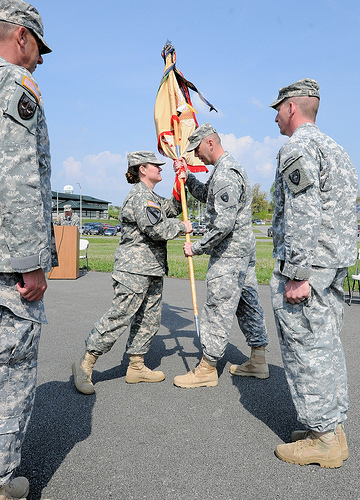
Lt. Col. Ruth Graves passes the battalion colors to Lt. Col. Jerry Morrison, commander of the 149th Maneuver Enhancement Brigade to relinquish her command of the 149th Brigade Support Battalion during a change of command ceremony at the Wendell H. Ford Regional Training Center in Greenville, Ky., April 27, 2014. Maj. Kent Cavallini assumed command of the unit. (U.S. Army National Guard photo by Staff Sgt. Scott Raymond)
GREENVILLE, Ky. — Members of the 149th Brigade Support Battalion and distinguished guests witnessed the change of command ceremony occur between outgoing commander Lt. Col. Ruth Graves and new commander, Maj. Kent Cavallini at the Wendell H. Ford Regional Training Center in Greenville, Kentucky, April 27, 2014.
As the 149th Brigade Commander Lt. Col. Jerry L. Morrison passed the Battalion colors from Graves to Cavallini, the change of command was official. Morrison said both commanders have worked hard to ready the unit for its intense upcoming training schedule.
“Lt. Col. Graves was instrumental preparing the unit for collective training after returning from Operation New Dawn in Iraq. Her leadership was pivotal to the successful transition and preparation,” he said.
“Maj. Cavallini assumes command with a focus on unit readiness and leader development. He takes over as the operational tempo increases supporting a brigade training event this training year, a brigade warfighter exercise, and an externally evaluated Brigade training event in 2016.”
“Maj. Cavallini is an outstanding officer with impeccable values and is very deserving this opportunity to lead and train Soldiers,” said Morrison.
Click here for more photos from the ceremony.
During the ceremony on April 27, 2014, red roses were presented to Graves’ husband, signifying the loving concern he has shown the battalion over the last two years. Yellow rosebuds were presented to Mrs. Cavallini. The yellow rosebuds signify the blossoming relationship she will form with the Soldiers and families of the battalion.
When asked about her most memorable experience as battalion commander, Graves summed it up by saying that in “building relationships over her career has made all the difference.”
She has been able to form bonds with people that “you can’t get any other way.” A key piece of advice Graves wanted to leave with the battalion was to “not just meet the standard, but always exceed it to get ahead.”
Story by Staff Sgt. Scott Raymond, Kentucky National Guard Public Affairs
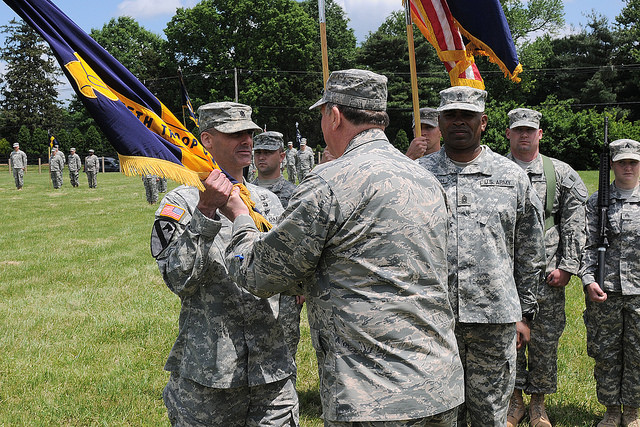
Lt. Col. Bryan Howay receives the brigade colors from Adjutant General Edward W. Tonini during a change of command ceremony for the 75th Troop Command in Louisville, Ky., May 17, 2014. Howay took charge of the unit from Col. Mike Abell, who had led the 75th since 2012. (U.S. Army National Guard photo by Staff Sgt. Scott Raymond)
LOUISVILLE, Ky. — In a sign of things to come, Soldiers of the Kentucky National Guard’s 75th Troop Command gathered for a change of command ceremony May 17 at the future home of the brigade, the Butler Reserve Center in Louisville, Kentucky.
Lt. Col. Bryan Howay assumed command of the 75th from Col. Mike Abell on the grounds of the new location for the Kentucky Guard near Louisville’s Bowman Field. The 75th has undergone a major realignment over the past year and now finds itself the tenant of what Adjutant General Edward W. Tonini called, “A magnificent facility, perfectly suited for the needs of the newly christened 75th Troop Command.”
Tonini also called the acquisition of the building a career-long endeavor and said the Guard will soon begin remodeling to accommodate the brigade headquarters and two battalions of the 75th.
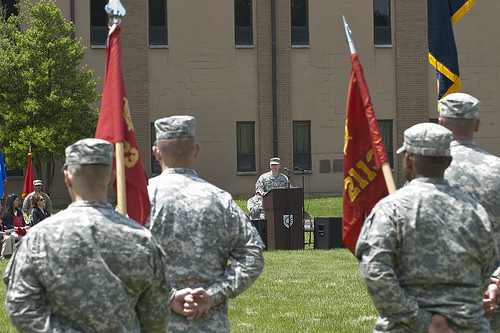
Col. Mike Abell speaks to Soldiers of the 75th Troop Command during a change of command ceremony in Louisville, Ky., May 17, 2014. The ceremony was the first event the Kentucky Guard held at its newest facility, the former Butler Reserve Center in Louisville. (U.S. Army National Guard photo by Staff Sgt. Scott Raymond)
“As we plan the future of this unit and its headquarters, we will continue to show our Guard’s interchangeability and adaptability to new missions, technologies and challenges,” he said.
Tonini praised both Abell and Howay as “models of professionalism and sterling examples of the Kentucky Guard’s ethos of ‘Unbridled Service’.”
Howay has been a member of the Kentucky Guard since 1987 and served as the 75th’s executive officer since 2012. He has led Kentucky Guardsmen in a variety of missions in support of both the commonwealth at home and the country overseas. Even with all the changes the unit has had, he said the unit will be ready for its next assignment.
“A Soldier doesn’t get to go from a private in 1987 to the level of brigade commander without the support of a lot of people along the way,” said Howay. “It’s been a long road, but now it’s just time to get ready for the next mission, whatever that may be. That is now the focus of the 75th Troop Command.”
Click here to see more photos from the ceremony.
Command Sgt. Maj. Thomas Johnson, 75th’s command sergeant major has served with both the incoming and outgoing commanders and said they have always kept the Soldiers of their commands at the center of their attention. A fact Johnson said is key to the success of any unit.
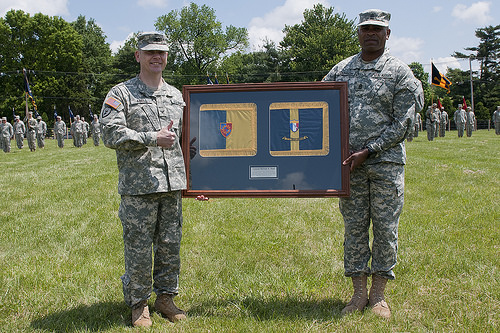
Command Sgt. Maj. Thomas Johnson (right) presents Col. Mike Abell, outgoing commander of the 75th Troop Command with a token of appreciation from the brigade. The gift included both guidons of the 75th and the 149th Maneuver Enhancement Brigade. (U.S. Army national Guard photo by Staff Sgt. Scott Raymond)
“Today’s event signified that Kentucky leaders have proven that being a competent and effective leader is still at the forefront, especially with the military drawdown,” he said. “Both of these men have earned it.”
“They have proven and demonstrated the high standards they set are successful, but it has always been in support of the command and most importantly the Soldiers and their families.”
Story by David Altom, Kentucky National Guard Public Affairs
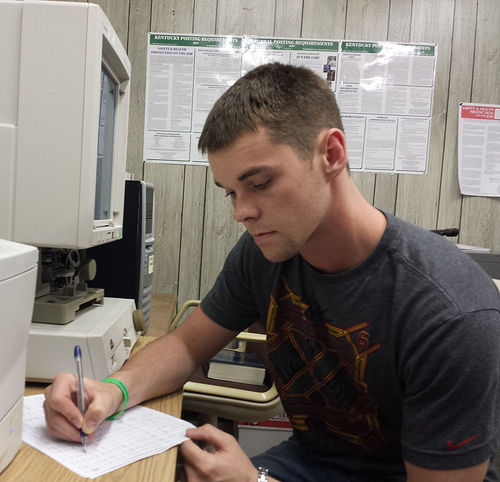
Dillon Walker found more than 60 potential names for the Kentucky National Guard Memorial in his high school research project. Dillon is the nephew of Master Sgt. Clinton Cubert, who died in 2006 as the result of injuries sustained by an IED while serving in Irag. (Photo by David Altom, Kentucky National Guard Public Affairs)
FRANKFORT, Ky. — For Dillon Walker it was more than just another school assignment. The Western Hills High School student wanted to do something special for his senior project, so he chose military appreciation as a theme. Little did he know his efforts would affect so many.
Click here for more photos on this story.
In 2006 Walker’s uncle, Master Sgt. Clinton Cubert, was hit by an improvised explosive device while serving with the Kentucky Army National Guard’s 2113th Transportation Company in Samarra, Iraq. Cubert’s injuries were critical and he was eventually transported to Kentucky where he could receive medical care near his family.
“I was about nine or ten when that happened,” said Walker. “I remember visiting at the hospital and helping take care of him, helping him with his physical therapy and talking to him, just spending time with him.”
Cubert died on April 16, 2006 of complications from his injuries. Walker’s fondest memories of his uncle preceded his tragic death.
“He was a great man,” said Walker. “He loved hiking and hunting, anything to do with the outdoors. And he was a great soldier. I really looked up to him.”
Click here to find out more about Master Sgt. Clinton Cubert and other Kentucky Guard members who have fallen in the line of duty.
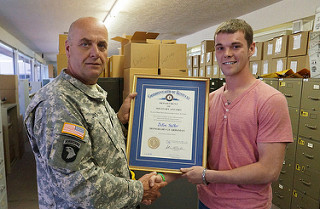
Col. Charles Jones, Deputy Adjutant General for Kentucky, presents Dillon Walker with an Honorary Kentucky Guard certificate in recognition for his work in identifying fallen troops. (Photo by David Altom, Kentucky National Guard Public Affairs)
Fast forward to today. Walker’s assignment led him to the Kentucky Department of Military Affairs and the Military Records and Research Branch. There he was given a unique mission, one that hit him in his heart: identifying the names of Kentucky National Guard members who have fallen in the line of duty.
“I found out about the Kentucky National Guard Memorial and how they needed help in identifying the names of fallen Guard members,” said Walker. “I figured this would be as good a way as any to give back.”
Click here to find out more about the Kentucky National Guard Memorial.
“It’s a daunting task, and an important one,” said Department of Military Affairs Jason LeMay, who has been accumulating the list of names for the memorial. “We started out with more than 500 potential names and we’ve confirmed about 150 so far.”
More than 300 names still have to be vetted and it all has to be done before the first of July so the stone cutters can begin etching the monument in time for the November dedication. Walker found more than 60 potential candidates while conducting his research project.
“That’s a huge dent in our numbers. Dillon’s efforts are crucial to meeting our deadline,” said LeMay. “We are grateful to have him on our team.”
“We’re so proud that a young person would take on such an important responsibility,” said Col. Charles Jones, Deputy Adjutant General for Kentucky. Jones presented Walker with a certificate making the high school senior an honorary member of the Kentucky National Guard. “Dillon’s service to these fallen troops and their families reflects the honor of his uncle’s legacy.”
Walker plans to attend the Memorial Day groundbreaking ceremony for the memorial that will display his uncle’s name. It’s just another step in honoring a man he holds in such high esteem.