
Pages
Stay In Touch
More
© 2013 KentuckyGuard
Story by 2nd Lt. James Killen, 123rd Airlift Wing Public Affairs
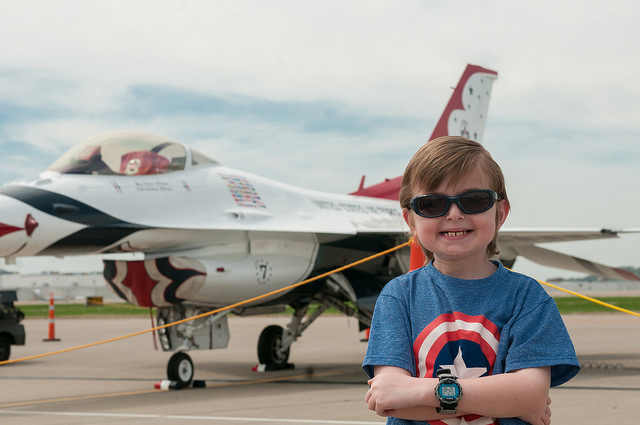
Nine-year-old Dawson Barr and his family visit the Kentucky Air National Guard’s 123rd Airlift Wing to view aircraft that will be flown in the annual Thunder Over Louisville Air Show, in Louisville, Ky., April 18, 2015. Dawson has been battling cancer his entire life and currently has an inoperable brain tumor, making him legally blind in both eyes. (U.S. Air National Guard photo by 2nd Lt. James W. Killen)
KENTUCKY AIR NATIONAL GUARD BASE, LOUISVILLE, Ky. — Members of the Kentucky Air National Guard welcomed a 9-year-old boy with cancer to the base Saturday as aircraft from around the world prepared to perform in the Thunder Over Louisville air show.
Dawson Barr, accompanied by his sister, mother and father, toured the flight line with Chief Master Sgt. Joe Dawson, superintendent of the 123rd Operations Group here.
“Dawson had an absolute blast!” Chief Dawson said. “We visited every aircraft on the flight line, met and talked with several people along the way, and we also got to watch a C-17 Globemaster taxi out and take off.”
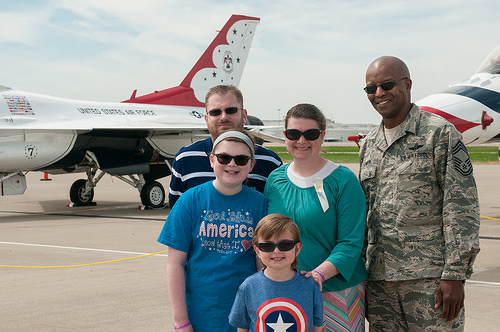
Nine-year-old Dawson Barr and his family visit the Kentucky Air National Guard’s 123rd Airlift Wing to view aircraft that will be flown in the annual Thunder Over Louisville Air Show, in Louisville, Ky., April 18, 2015. Dawson has been battling cancer his entire life and currently has an inoperable brain tumor, making him legally blind in both eyes. (U.S. Air National Guard photo by 2nd Lt. James W. Killen)
Dawson toured the Operations Building, ate lunch supplied by the 123rd Security Forces Squadron, and watched several aircraft take off while observing from the 165th Airlift Squadron Heritage Room, which offers one of the best views on base.
Dawson was diagnosed with cancer at just 6 months of age. Doctors were cautious about his life expectancy, primarily because of the number of tumors he has — seven on the brain and three on the spine — and their severity.
He has defied the odds, though, and according to his mother, Aimee Barr, “He’s an amazing little kid with a magnetic personality; he’s a fighter, too.”
Dawson endured five years of chemotherapy, ending his treatments in February 2012. He currently has one inoperable tumor that severely impacts his vision, making him legally blind in both eyes. The chemotherapy and other treatments have left Dawson with a number of challenges, from hormone imbalances to osteoporosis.
Aimee says that doesn’t stop him, though.
“He’s a normal 9-year-old boy. He wants to play soccer, he wants to be a professional football player, and if that doesn’t work, he’s going to be a professional baseball player.”
Dawson made an impact on several of the people he met at the Kentucky Air Guard, with many noting how positive and upbeat he was, and how he asked so many great questions.
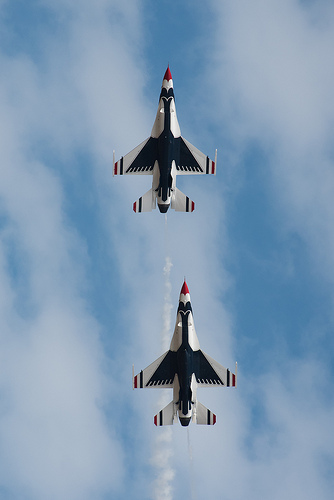
Two F-16 Fighting Falcons from the U.S. Air Force Thunderbirds aerial demonstration team perform in the Thunder Over Louisville air show April 18, 2015, in Louisville, Ky. More than 650,000 people lined the banks of the Ohio River for the show. (U.S. Air National Guard photo by Maj. Dale Greer)
“I thoroughly enjoyed meeting and spending time with Dawson, his sister, Lauren, and their parents, Aimee and Shane Barr,” Chief Dawson said. “That young man is a fighter in the true sense of the word, with the most positive attitude and the most uplifting spirit that you will ever see in a little boy.”
Dawson has a message for those who may be struggling with challenges or illness. In a calm and steady voice he said, “If you’re going through something, just keep going. Eventually something good will happen, and it will be okay.”
Story by Master Sgt. Phil Speck, 123rd Airlift Wing Public Affairs
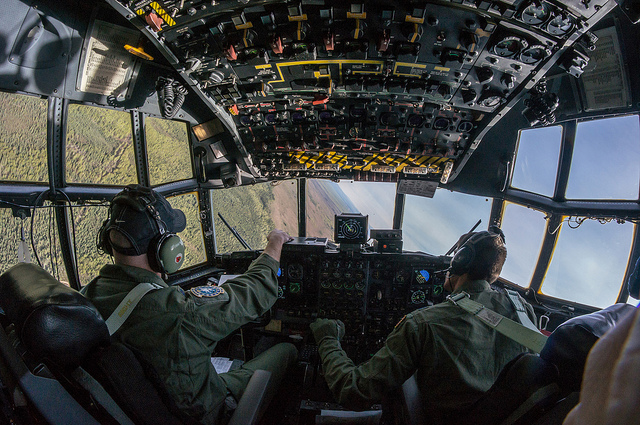
An aircrew from the Kentucky Air National Guard’s 165th Airlift Squadron flies a Kentucky Air National Guard C-130 Hercules over the mountains of Alaska during a training scenario as part of Red Flag-Alaska on May 15, 2014. More than 100 Kentucky Airmen participated in the exercise from May 7 to 23. (U.S. Air National Guard photo by Senior Airman Robert Buchberger)
JOINT BASE ELMENDORF-RICHARDSON, Alaska – More than 100 Airmen from the Kentucky Air National Guard completed 10 days of intense combat training here May 23, airlifting 35,000 pounds of essential cargo and airdropping 280 Army paratroopers into enemy territory while facing attacks from hostile aircraft and surface-to-air missiles.
The training, part of a regular Pacific Command exercise called Red Flag - Alaska, exposed Kentucky’s C-130 aircrews to a “hyper-realistic training environment” that will strengthen their preparation for combat missions in any setting, said Col. Robert Hamm, commander of Kentucky’s Louisville-based 123rd Operations Group.
Click here for more photos from this story.
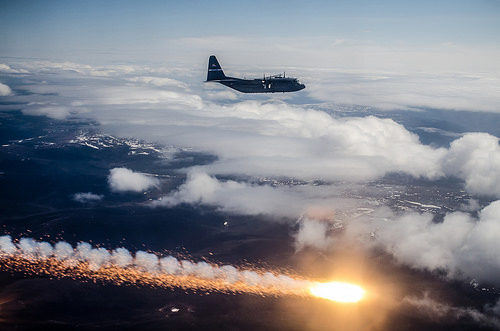
A Kentucky Air National Guard C-130 Hercules flies in formation as another C-130 deploys flare countermeasures in the skies over Alaska during exercise Red Flag-Alaska on May 22, 2014. Aircrews from Kentucky’s 165th Airlift squadron received intensive combat training during the exercise, which ran from May 7 to 23. (U.S. Air National Guard photo by Master Sgt. Phil Speck)
“The fast pace and high tension of the exercise required our Airmen to maintain constant focus despite being mentally and physically fatigued throughout,” Hamm said. “It was as close as it gets to the stress they’ll have to endure in actual combat.
“Our guys accomplished every one of their learning objectives, and I think it opened up a lot of their eyes about how serious this is — about how different (combat) is from the way we train locally because we can’t create the same conditions back home.”
Among those differences were the ability to train alongside escort and strike aircraft while facing threats from aggressors in the air and on the ground. Kentucky’s three C-130s were escorted into and out of hostile territory by F-15 and F-22 fighters, whose mission was to eliminate enemy aircraft and surface-to-air missile batteries, Hamm said.
The Kentucky Airmen also had the opportunity to navigate challenging mountain terrain in the Pacific-Alaska Range Complex where the exercise was staged, and to interoperate with a full spectrum of assets from AWACS to A-10s, working with each of these units to plan and execute every mission.
Lt. Col. Matthew Quenichet, director of operations for the 165th Airlift Squadron, was pleased with Kentucky’s performance in such an intense environment.
“It was a big accomplishment just to survive the sortie, hit your time-on-target, make your landing, pick up your cargo, and get it to the end of the vulnerability zone,” he said.
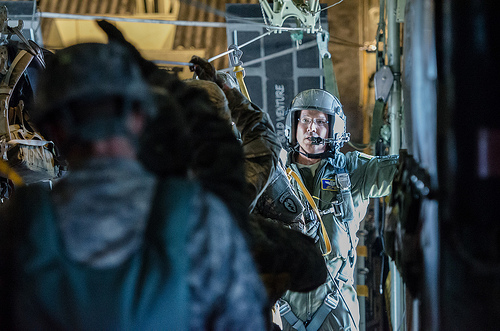
Chief Master Sgt. Jeffrey Brown, a loadmaster from the Kentucky Air National Guard’s 165th Airlift Squadron, prepares the paratroop door on a Kentucky Air Guard C-130 Hercules for Soldiers from the 2-377th Parachute Field Artillery Regiment, 4th IBCT 25 Infantry Division, while flying just north of Joint Base Elmendorf-Richardson, Alaska, on May 13, 2014. The jump was part of Red Flag-Alaska, a Pacific Command exercise designed to provide aircrews with realistic combat training. (U.S. Air National Guard photo by Master Sgt. Phil Speck)
That vulnerability zone is where the simulated war took place. Aircraft from Joint Base Elmendorf-Richardson and Eielson Air Force Base, Alaska, would meet there to begin the conflict. Units took turns being allied forces or aggressors, while C-130 crews executed various scenarios in which they had to fly through treacherous terrain, land on dirt-strip runways, pick up cargo, and airdrop cargo or Army paratroopers.
This exercise marked the first time that Army forces were integrated into the training, and the Kentucky Air Guard became the first Air Force unit ever to drop paratroopers into an airfield for a simulated seizure during Red Flag – Alaska.
“There was a lot of apprehension going into this,” Quenichet said. “People were not sure what to expect, but they were excited. It was a lot for people to take in. The idea was to throw more challenges at the aircrews than they would ever see in actual combat.”
Two groups of Kentucky Airmen participated in the exercise, Quenichet added: Highly experienced aircrews with extensive combat exposure in Afghanistan; and brand-new co-pilots, engineers and loadmasters who had never seen anything like it before.
“It may have taken the new aircrews an entire career to get this kind of experience, but they got it in their first couple of months in the airplane here,” Quenichet said. “We worked together as a team to get a game plan and accomplish this mission. Once we were en route, it wasn’t a simulator. It was real airplanes flying through incredibly challenging terrain, facing actual threat systems. The only difference between the scenarios here and real combat was that there weren’t pieces of metal flying at you.
“By the end of the exercise, all our aircrews were right where they needed to be.”
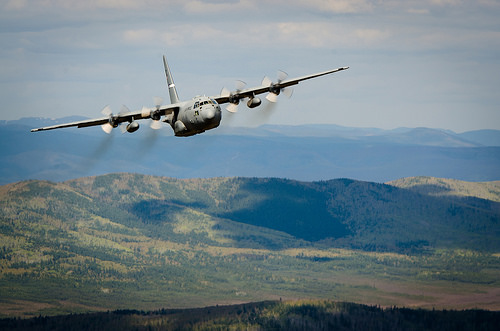
A Kentucky Air National Guard C-130 flies over Alaska on May 9, 2014, in support of Exercise Red Flag-Alaska. More than 100 Kentucky Airmen from the 123rd Airlift Wing participated in the exercise from May 7 to May 23. Red Flag-Alaska is designed to hone the combat skills of U.S. Air Force flight crews. (U.S. Air National Guard photo by Master Sgt. Phil Speck)
Lt. Col. Kevin Allred, commander of Detachment 1, 353rd Combat Training Squadron, said the event was one of the smoothest Red Flags he’s seen.
“I’m very impressed all the way around,” Allred said. “From the deployment to getting in to town, they were all over everything. All of your crews were fired up to be here — that’s really fun to watch. I think everyone got really good training out of it, because they wanted to be here.”
Allred also said he was pleased by how smoothly the Army integration went, adding that officials plan to build on the airfield-seizure scenario in future exercises.
Hamm credited the 353rd with providing excellent support throughout Red Flag — a factor that helped the Kentucky Airmen maximize their training opportunities.
“The 353rd Combat Training Squadron provided outstanding support for a phenomenal exercise,” Hamm said. “There was no tension, and we got everything we asked for. We couldn’t ask for better support from those guys.”
By Maj. Dale Greer, 123rd Airlift Wing Public Affairs
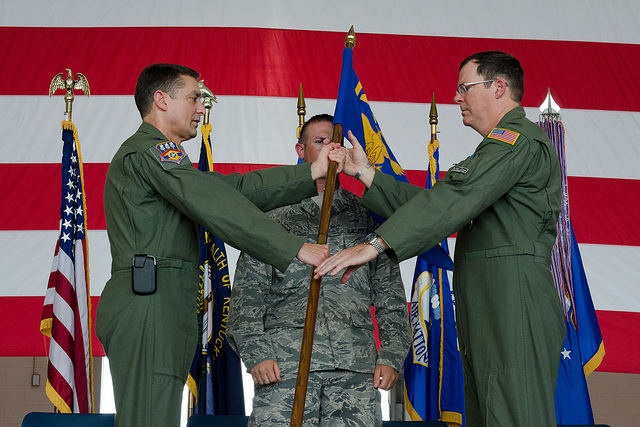
Col. Robert Hamm (right), incoming commander of the 123rd Operations Group, accepts the unit’s guidon from Col. Warren Hurst, commander of the 123rd Airlift Wing, during a change-of-command ceremony held at the Kentucky Air National Guard Base in Louisville, Ky., on June 22, 2013. Hamm previously served as vice commander of the 123rd Airlift Wing. (U.S. Air National Guard photo by Airman Joshua Horton)
KENTUCKY AIR NATIONAL GUARD BASE, LOUISVILLE, Ky. — Col. Robert Hamm took charge of the 123rd Operations Group during a change-of-command ceremony here June 22, and Col. Barry Gorter assumed the post of 123rd Airlift Wing vice commander.
Hamm, the wing’s outgoing vice commander, said he looked forward to working with the men and women of the operations group, whom he called “outstanding.”
“I thank you for your unrelenting professionalism, your unstinting devotion to duty and your resolute readiness on behalf of our nation,” Hamm told the group’s Airmen in comments before an audience of more than 600 coworkers in the Fuel Cell Hangar. “We will not allow a lessening of those necessary traits.”
The 123rd Operations Group is home to more than 230 Airmen serving in the 165th Airlift Squadron, 123rd Special Tactics Squadron and 123rd Operations Support Flight. The airlift unit’s C-130 aircraft, aircrews and support agencies provide worldwide airland and airdrop capabilities to combatant commands, while the special tactics squadron’s pararescuemen, combat controllers and special operations weather teams provide support to the U.S. Special Operations Command through short-notice, worldwide deployments.
“The outstanding nature and culture of our organization was recently validated by two major-command inspectors general,” Hamm noted, calling recent inspection results “almost unprecedented” for the level of excellence demonstrated by group members.
“123rd Operations Group, your performance never ceases to amaze and humble,” he said. “I applaud you.”
Col. Warren Hurst, wing commander, praised Hamm for his performance as vice wing commander over the past 2 ½ years, saying he “contributed immeasurably to improvements, better efficiency and better oversight of wing resources.”
“He’s been a tremendous asset to the wing,” Hurst said, “and will undoubtedly excel in leading the operations group through its next set of challenges.”
Hurst also spoke highly of Gorter, who “has done a remarkable job as the operations group commander for the past three years,” he said.
“In that time, the unit has deployed to (Afghanistan) twice, supporting combat airland and airdrop missions over in the AOR. They’ve also supported different missions around the globe, to include foreign-assistance type missions in countries like Columbia or in Bangladesh.”
Gorter personally served as chairman of the C-130 Group Council, an agency responsible for managing C-130 issues across the Air Guard community, Hurst noted, and in 2012, he deployed to the U.S. Central Command Area of Operations to serve as deputy director or mobility forces at the Combined Air and Space Operations Center, providing oversight of airlift operations across the AOR.
“Col. Gorter, I’d like to thank you for your leadership in moving the operations group further down the road,” Hurst said. “You’ve done an outstanding job. I look forward to having you as the vice wing commander.”
Gorter took the opportunity to thank his Airmen for their support during his tenure as operations group commander.
“I feel very fortunate to have been able to serve alongside such an outstanding group of members,” he said. “The Kentucky Air National Guard is a big family, and the nucleus of that family is the full-time employees. Thanks to each of you full-timers out here who persevere, who grind out the day-to-day tasks that, if we were at an active-duty unit, would be spread across many more personnel… You get it done, and you get it done well.
“Thanks also to the traditional members. The mission does not get done without the traditional members (who) make up 70 percent of our unit and carry a huge amount of the workload.”
Gorter noted that Airmen from the Kentucky Air National Guard have flown 8,700 flying hours during the past three years — more than 2,500 of which have been in a combat environment.
“Crews have flown all over the world, from Bangladesh to South America to Afghanistan to Europe to Kuwait, to the entire United States and many places in between — all in operations in which you have performed brilliantly,” he said. “Thank you for your professionalism and your standard of excellence. You have amazed me for the past three years.”
By Master Sgt. Diane Stinnett, 123rd Airlift Wing Public Affairs
Click here for the complete set of photos.
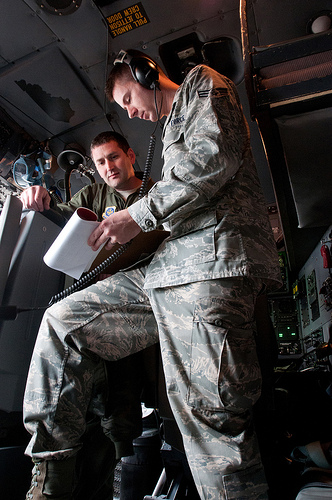
Senior Airman Braden Sikkema (foreground), an intelligence analyst with the 123rd Operations Group, has been named the Kentucky Air National Guard's 2012 Outstanding Airman of the Year in the Airman category. Sikkema has deployed twice and was selected for several special assignments in the commonwealth in 2011. (U.S. Air Force photo by Master Sgt. Phil Speck)
KENTUCKY AIR NATIONAL GUARD BASE, LOUISVILLE, Ky. — Senior Airman Braden Sikkema, Tech. Sgt. Karen Fulton and Master Sgt. Clint Stinnett have been selected as the top enlisted members of the Kentucky Air National Guard for 2012, claiming the title of Outstanding Airmen of the Year.
The trio of exemplary Airmen edged out a competitive field of 21 other nominees in the areas of leadership, job performance, personal improvement and community service, according to Chief Master Sgt. Jim Smith, the Air Guard’s state command chief master sergeant.
“The evaluation process was truly challenging,” said Smith, who chaired the selection committee comprised of Air Guard chief master sergeants and the Kentucky Army Guard’s state sergeant major. “We had an excellent pool of nominees this year. All were model Airmen who go above and beyond, both on duty and off.”
Sikkema, the winner in the Airman category, is an intelligence analyst with the 123rd Operations Group.
“He is phenomenal for how far along in his military career he is,” said Maj. Kevin Kraus, who supervises the young Airman. “He has a lot of drive, a lot of passion for what he does. He’s been on two deployments already, and for a Senior Airman that is fairly unusual in the intelligence career field.”
In addition to the deployments, Sikkema was selected for several special assignments here in the commonwealth. He participated in a homeland-response exercise, demonstrating the ability to collect imagery from the back of a C-130 aircraft for use in evaluating disaster damage. He also was chosen to brief the adjutant general on the nature and scope of airlift and agricultural-development operations in Afghanistan.
“It’s a pretty big honor being selected to brief the TAG,” Kraus noted.
Sikkema excels in the area of community involvement, too. He is active in his church, where he assists with special-needs children, and was invited by the Puerto Rico Air National Guard to attend their ROTC career day, providing the enlisted perspective to a new generation of cadets.
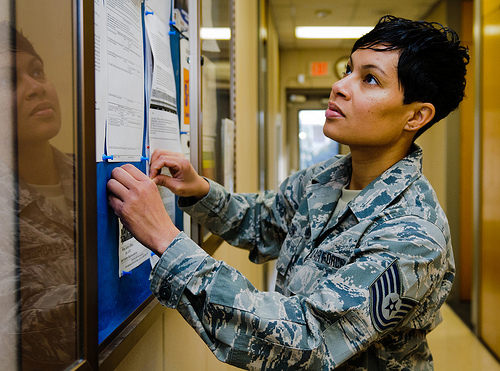
Tech. Sgt. Karen Fulton, an orderly room clerk assigned to the 123rd Logistics Readiness Squadron, has been named the Kentucky Air National Guard's 2012 Outstanding Airman of the Year in the NCO category. Fulton received an excellent rating during a 2011 OPSEC inspection and developed master file plans for 12 separate flights within the squadron. (U.S. Air Force photo by Master Sgt. Phil Speck)
Fulton, the winner in the Non-Commissioned Officer category, is an orderly room clerk assigned to the 123rd Logistics Readiness Squadron. Her supervisor, Chief Master Sgt. Jeff Moore, calls her the squadron’s “go-to” person.
“She is pretty much the whole backbone of our squadron,” Moore said. “She took this squadron and built it up to where I would put our organization against anyone’s on the administration side.”
Fulton, who manages her unit’s security program, received an excellent rating during a 2011 OPSEC inspection. She also developed and implemented squadron master file plans for 12 separate flights within the squadron and flawlessly processed more than 300 orders through the new Defense Travel System. To date, she is the only person Air Force-wide to have logged a perfect score in both the Knowledge Operations Management Course and the Information Fundamentals Basic Technical Training School, Moore said.
“She is the sharpest troop I have ever had working for me in my 30 years of service,” he added.
Fulton is also active in her community, shaping the next generation by mentoring at-risk students as a member of the Jefferson County Traditional Middle School Parent Teacher Student Association, and by coordinating youth activities at her church.
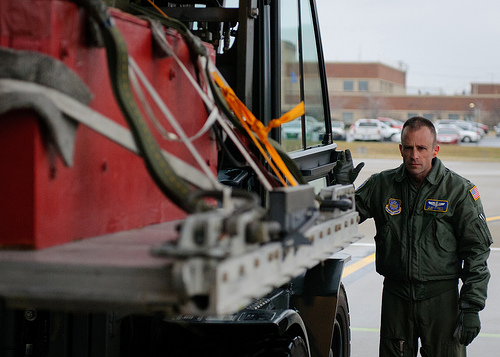
Master Sgt. Clint Stinnett, a loadmaster with the 165th Airlift Squadron, has been named the Kentucky Air National Guard's 2012 Outstanding Airman of the Year in the senior NCO category. In 2011, Stinnett voluntarily deployed to Afghanistan in support of Operation Enduring Freedom, flying 27 combat missions and five airdrop missions. During one of these flights, Marine Corps Commandant Gen. James F. Amos singled him out for superior professionalism. Stinnett also deployed twice last year in support of Operation Coronet Oak, supporting airlift operations in Central and South America. (U.S. Air Force photo by Master Sgt. Phil Speck)
Stinnett, the senior NCO of the year, is a loadmaster with the 165th Airlift Squadron who was nominated because of his dedication and professionalism.
“He is so meticulous about everything,” said his supervisor, Chief Master Sgt. Jeff Brown. “When he’s given a task — and a lot of times, he doesn’t even have to be asked to do it — he’s on top of it and it’s perfect. He doesn’t complain about anything, he just gets it done. You can always count on him.”
In 2011, Stinnett voluntarily deployed to Afghanistan in support of Operation Enduring Freedom, Brown said. While deployed, he flew troop-transport and cargo-supply sorties, including 27 combat missions and five airdrop missions. During one of these flights, Marine Corps Commandant Gen. James F. Amos singled him out for superior professionalism. Stinnett also deployed twice last year in support of Operation Coronet Oak, supporting airlift operations in Central and South America.
At his home unit, Stinnett overhauled the training program for the flight simulator and altitude chamber. His new streamlined process resulted in a higher percentage of aircrew being trained at a lower cost, Brown noted. He also developed information packages for those attending the training, detailing all the necessary information. As a result of his dedication, Stinnett was upgraded to evaluator loadmaster, joining only four other evaluators in his section. During a training flight, he was applauded by the Standards and Evaluation loadmaster from Air Mobility Command for his knowledge of airdrop procedures. Additionally, the operations group commander handpicked him to establish a new tactics loadmaster position, leading to more effective training for combat operations.
Stinnett takes his commitment to the military home with him, too. He is a lifetime member of the Enlisted Association of the National Guard of the United States and Kentucky and an active member of the American Legion.
All three Outstanding Airmen of the Year will be honored — along with the Kentucky Army National Guard’s Outstanding Soldiers of the Year — during a banquet to be held May 19 at the Kentucky State Fair and Exposition Center.
