Pages
Stay In Touch
More
© 2013 KentuckyGuard
By By Maj. Dale Greer, 123rd Airlift Wing Public Affairs
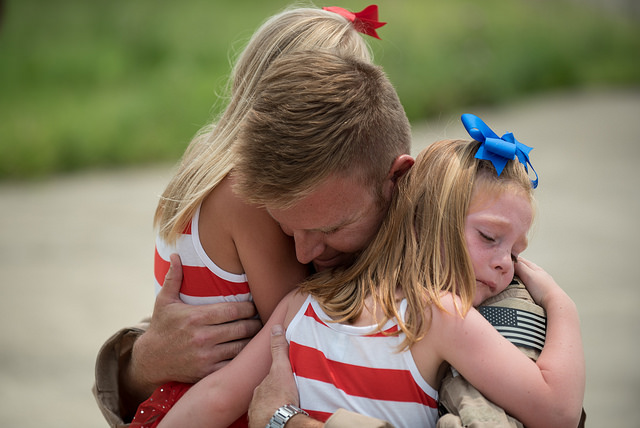
Capt. Ross Farling, a C-130 pilot in the 123rd Airlift Wing, hugs his daughters during an emotional homecoming ceremony at the Kentucky Air National Guard Base in Louisville, Ky., July 4, 2015. Farling was among 39 Kentucky Air Guardsmen who were returning from a deployment to the Persian Gulf region, where they’ve been supporting Operation Freedom’s Sentinel since February. (U.S. Air National Guard photo by Maj. Dale Greer)
KENTUCKY AIR NATIONAL GUARD BASE, LOUISVILLE, Ky. — The 123rd Airlift Wing observed a historic milestone March 24 when Staff Sgt. Patrick Murray retuned from a deployment to Southwest Asia, where he was supporting Operations Freedom’s Sentinel and Inherent Resolve, the counter-terrorism mission in Afghanistan and the campaign against the Islamic State in Iraq and Syria.
Murray’s return marks the first time since October 2001 that the wing has had no personnel deployed to the U.S. Central Command Area of Responsibility, which includes the Middle East and Northern Africa.
During the past 14 years, the wing has deployed its Airmen to more than 45 countries in support of CENTCOM and homeland security operations, totaling more than 393,000 days of active-duty service.
“I am extremely proud of the dedication of our Airmen to answer the nation’s call any time they’re needed, anywhere in the world,” said Col. Ken Dale, commander of the 123rd Airlift Wing, the Kentucky Air National Guard’s primary operations unit. “No unit in the United States Air Force has been more engaged in the wars in Iraq and Afghanistan and the homeland security mission than the 123rd Airlift Wing.”
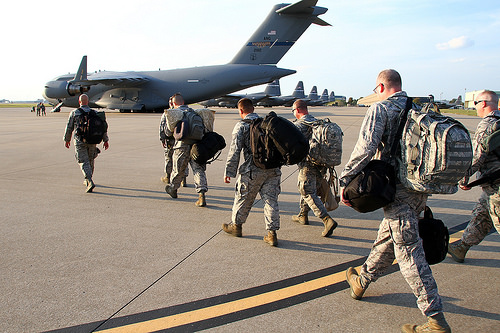
Airmen with the 123rd Contingency Response Group prepare for their deployment to West Africa from the Kentucky Air National Guard Base in Louisville, Ky., Oct. 2, 2014. The Guardsmen will work to set up a logistics hub in support of Operation United Assistance. (U.S. Army National Guard photo by Staff Sgt. Scott Raymond)
Dale emphasized that the new milestone represents more of a temporary pause in deployments than an indication that they will stop completely.
“We anticipate further deployments to the U.S. Central Command AOR in the future, especially from the members of our Special Tactics Squadron, who maintain a constant state of readiness for short-notice contingencies of all kinds,” he said.
Following the terrorist attacks of Sept. 11, 2001, 637 members of the Kentucky Air Guard were placed on active duty for varying lengths of time in support of real-world missions around the world. These deployments included missions to support homeland defense (Operation Noble Eagle), the war on terrorism abroad (Operation Enduring Freedom) and the war in Iraq (Operation Iraqi Freedom). Of these 637 Kentucky Airmen, 454 deployed overseas for U.S. military operations in dozens of countries, including Iraq, Afghanistan, Oman, Pakistan, Qatar, Saudi Arabia, the United Arab Emirates, Algeria, Bosnia, Croatia, Romania, Senegal, Serbia and the Ukraine. Most of these federalized troops were taken off active duty in early 2004, but the wing continued to deploy troops around the world as needed to meet operational requirements.
In 2006, for example, 560 Kentucky Air Guard troops deployed to such location as Afghanistan, Iraq, Curaçao, Qatar, Kyrgyzstan and Antarctica. In 2007, more than 210 wing members deployed to Afghanistan to fly airlift missions that delivered thousands of tons of equipment and supplies to forward-deployed troops who were engaged with the enemy. And nearly 300 Kentucky Air Guardsmen returned to Afghanistan in 2009 for the same mission, transporting 20,000 troops and 6,000 tons of cargo across the theater of operations during a two-month deployment.
More recently, about 160 Kentucky Airmen broke airlift records when they airdropped or transported a record amount of cargo and personnel in support of Operation Enduring Freedom while deployed to Bagram Airfield, Afghanistan, from October 2010 to January 2011. The unit set records again in 2012 when 100 Airmen deployed the Persian Gulf, flying 1,400 missions in four months to airlift 5,300 tons of cargo and 15,000 passengers. It returned to the region last year, flying 625 combat airlift sorties in support of Operations Inherent Resolve and Freedom’s Sentinel.
In an effort to deter aggression, fighter aircraft routinely fly while troops on the ground mobilize and train to defend the ROK. However, there still lies another piece to the puzzle.That puzzle piece is none other than the 607th Air Mobility Division.
Source: KR16 air mobility: The glue holding everything together
Story by Master Sgt. Phil Speck, 123rd Airlift Wing Public Affairs
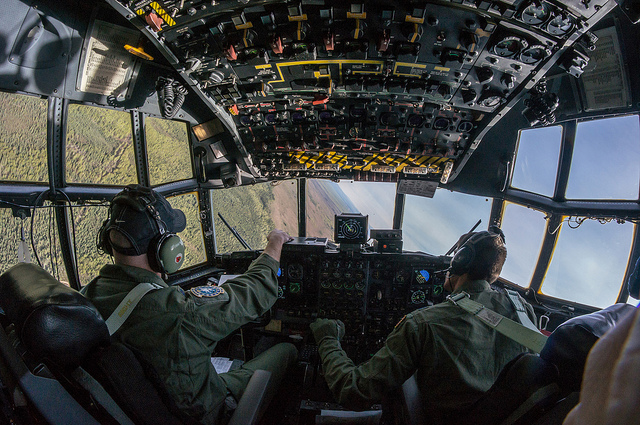
An aircrew from the Kentucky Air National Guard’s 165th Airlift Squadron flies a Kentucky Air National Guard C-130 Hercules over the mountains of Alaska during a training scenario as part of Red Flag-Alaska on May 15, 2014. More than 100 Kentucky Airmen participated in the exercise from May 7 to 23. (U.S. Air National Guard photo by Senior Airman Robert Buchberger)
JOINT BASE ELMENDORF-RICHARDSON, Alaska – More than 100 Airmen from the Kentucky Air National Guard completed 10 days of intense combat training here May 23, airlifting 35,000 pounds of essential cargo and airdropping 280 Army paratroopers into enemy territory while facing attacks from hostile aircraft and surface-to-air missiles.
The training, part of a regular Pacific Command exercise called Red Flag - Alaska, exposed Kentucky’s C-130 aircrews to a “hyper-realistic training environment” that will strengthen their preparation for combat missions in any setting, said Col. Robert Hamm, commander of Kentucky’s Louisville-based 123rd Operations Group.
Click here for more photos from this story.
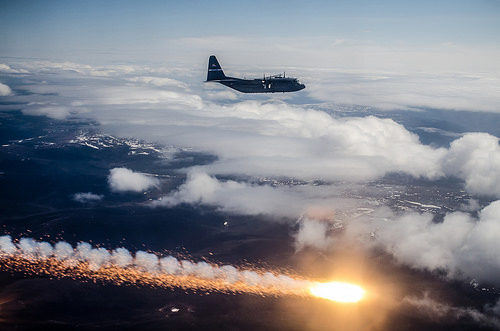
A Kentucky Air National Guard C-130 Hercules flies in formation as another C-130 deploys flare countermeasures in the skies over Alaska during exercise Red Flag-Alaska on May 22, 2014. Aircrews from Kentucky’s 165th Airlift squadron received intensive combat training during the exercise, which ran from May 7 to 23. (U.S. Air National Guard photo by Master Sgt. Phil Speck)
“The fast pace and high tension of the exercise required our Airmen to maintain constant focus despite being mentally and physically fatigued throughout,” Hamm said. “It was as close as it gets to the stress they’ll have to endure in actual combat.
“Our guys accomplished every one of their learning objectives, and I think it opened up a lot of their eyes about how serious this is — about how different (combat) is from the way we train locally because we can’t create the same conditions back home.”
Among those differences were the ability to train alongside escort and strike aircraft while facing threats from aggressors in the air and on the ground. Kentucky’s three C-130s were escorted into and out of hostile territory by F-15 and F-22 fighters, whose mission was to eliminate enemy aircraft and surface-to-air missile batteries, Hamm said.
The Kentucky Airmen also had the opportunity to navigate challenging mountain terrain in the Pacific-Alaska Range Complex where the exercise was staged, and to interoperate with a full spectrum of assets from AWACS to A-10s, working with each of these units to plan and execute every mission.
Lt. Col. Matthew Quenichet, director of operations for the 165th Airlift Squadron, was pleased with Kentucky’s performance in such an intense environment.
“It was a big accomplishment just to survive the sortie, hit your time-on-target, make your landing, pick up your cargo, and get it to the end of the vulnerability zone,” he said.
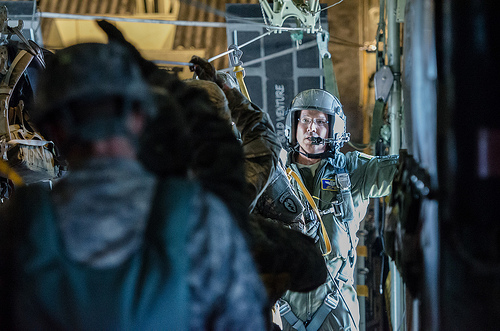
Chief Master Sgt. Jeffrey Brown, a loadmaster from the Kentucky Air National Guard’s 165th Airlift Squadron, prepares the paratroop door on a Kentucky Air Guard C-130 Hercules for Soldiers from the 2-377th Parachute Field Artillery Regiment, 4th IBCT 25 Infantry Division, while flying just north of Joint Base Elmendorf-Richardson, Alaska, on May 13, 2014. The jump was part of Red Flag-Alaska, a Pacific Command exercise designed to provide aircrews with realistic combat training. (U.S. Air National Guard photo by Master Sgt. Phil Speck)
That vulnerability zone is where the simulated war took place. Aircraft from Joint Base Elmendorf-Richardson and Eielson Air Force Base, Alaska, would meet there to begin the conflict. Units took turns being allied forces or aggressors, while C-130 crews executed various scenarios in which they had to fly through treacherous terrain, land on dirt-strip runways, pick up cargo, and airdrop cargo or Army paratroopers.
This exercise marked the first time that Army forces were integrated into the training, and the Kentucky Air Guard became the first Air Force unit ever to drop paratroopers into an airfield for a simulated seizure during Red Flag – Alaska.
“There was a lot of apprehension going into this,” Quenichet said. “People were not sure what to expect, but they were excited. It was a lot for people to take in. The idea was to throw more challenges at the aircrews than they would ever see in actual combat.”
Two groups of Kentucky Airmen participated in the exercise, Quenichet added: Highly experienced aircrews with extensive combat exposure in Afghanistan; and brand-new co-pilots, engineers and loadmasters who had never seen anything like it before.
“It may have taken the new aircrews an entire career to get this kind of experience, but they got it in their first couple of months in the airplane here,” Quenichet said. “We worked together as a team to get a game plan and accomplish this mission. Once we were en route, it wasn’t a simulator. It was real airplanes flying through incredibly challenging terrain, facing actual threat systems. The only difference between the scenarios here and real combat was that there weren’t pieces of metal flying at you.
“By the end of the exercise, all our aircrews were right where they needed to be.”
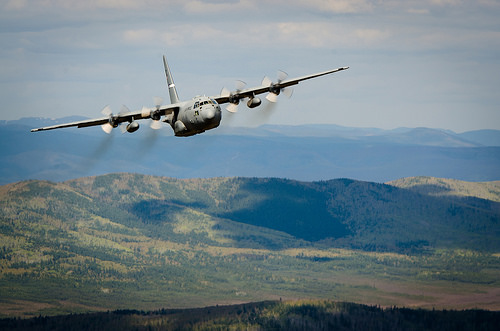
A Kentucky Air National Guard C-130 flies over Alaska on May 9, 2014, in support of Exercise Red Flag-Alaska. More than 100 Kentucky Airmen from the 123rd Airlift Wing participated in the exercise from May 7 to May 23. Red Flag-Alaska is designed to hone the combat skills of U.S. Air Force flight crews. (U.S. Air National Guard photo by Master Sgt. Phil Speck)
Lt. Col. Kevin Allred, commander of Detachment 1, 353rd Combat Training Squadron, said the event was one of the smoothest Red Flags he’s seen.
“I’m very impressed all the way around,” Allred said. “From the deployment to getting in to town, they were all over everything. All of your crews were fired up to be here — that’s really fun to watch. I think everyone got really good training out of it, because they wanted to be here.”
Allred also said he was pleased by how smoothly the Army integration went, adding that officials plan to build on the airfield-seizure scenario in future exercises.
Hamm credited the 353rd with providing excellent support throughout Red Flag — a factor that helped the Kentucky Airmen maximize their training opportunities.
“The 353rd Combat Training Squadron provided outstanding support for a phenomenal exercise,” Hamm said. “There was no tension, and we got everything we asked for. We couldn’t ask for better support from those guys.”
Story by 2nd Lt James Killen, 123rd Airlift Wing Public Affairs
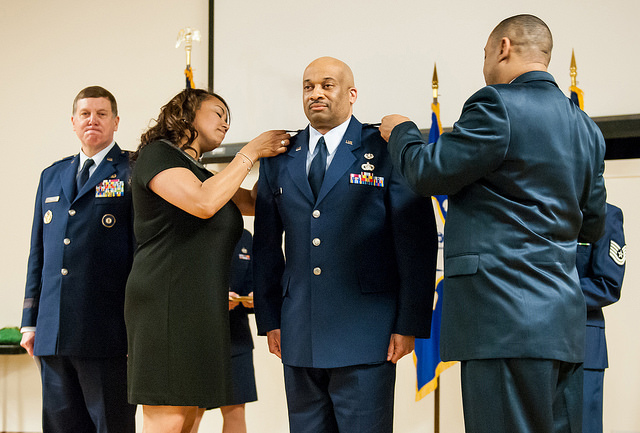
The wife and brother of Lt. Col. Charles Walker pin colonel’s rank to his uniform during a promotion ceremony at the Kentucky Air National Guard Base in Louisville, Ky., March 22, 2014. Walker, staff judge advocate for Joint Forces Headquarters Air Component, Kentucky National Guard, is the first African-American to be promoted to the rank of colonel in Kentucky Air Guard history. (U.S. Air National Guard photos by Staff Sgt. Vicky Spesard)
KENTUCKY AIR NATIONAL GUARD BASE, LOUISVILLE, Ky. — The Kentucky Air National Guard promoted two officers to the rank of colonel during a ceremony here March 22, including its first African-American to achieve that rank.
Col. Charles Walker, the first black officer to be promoted to colonel in the organization’s history, is staff judge advocate for Joint Forces Headquarters Air Component, Kentucky National Guard. The other leader promoted, Col. Jeffrey Wilkinson, serves as vice commander of the Kentucky Air Guard’s 123rd Airlift Wing.
“What a fantastic day this is in the history of the Kentucky Air National Guard and, frankly, the Kentucky National Guard in general,” said Maj. Gen. Edward Tonini, adjutant general for the Commonwealth of Kentucky.
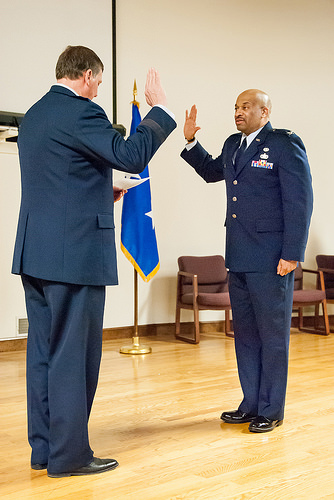
Kentucky’s adjutant general, Maj. Gen. Edward Tonini (left), executes the Oath of Office during a ceremony promoting Charles Walker to the rank of colonel at the Kentucky Air National Guard Base in Louisville, Ky., March 22, 2014. Walker, staff judge advocate for Joint Forces Headquarters Air Component, Kentucky National Guard, is the first African-American to be promoted to the rank of colonel in Kentucky Air Guard history. (U.S. Air National Guard photos by Staff Sgt. Vicky Spesard)
“Chuck has had a very interesting career,” Tonini told the audience of more than 200 family, friends and coworkers, “always going the extra mile” in every task he’s undertaken.
Walker began his career in the active-duty Air Force in 1991, serving until 1998 as a section commander in aircraft generation and mission support units. He also served as an executive officer and, later, the operations officer for a Military Entrance Processing Station. Walker graduated cum laude with a juris doctorate from the John Marshall School of Law in Chicago in 1999 and joined the Air Force Reserves in 2004 as a deputy staff judge advocate.
He remained in the Reserves until 2005, when Walker joined the 123rd Airlift Wing here as a staff judge advocate. He held that post until May 2013, when Walker accepted his current position at Joint Forces Headquarters.
In addition to serving as the state’s top Air Guard lawyer, Walker is director of the Air National Guard’s Contemporary Base Issues Course, a national-level seminar designed to assist commanders, supervisors and support staff in addressing everyday command and legal issues.
In civilian life, Walker is a trial attorney with the United States Department of Justice, Office of the United States Trustee, in Nashville, Tenn. He also serves on the board of directors for the Mid-South Commercial Law Institute, is a co-founder of the Credit Abuse Resistance Education program in Tennessee and is a faculty member at the National Advocacy Center in Columbia, S.C.
Remarking on the depth and breadth of Walker’s career, Tonini praised his dedication to service and excellence.
“He didn’t get (this promotion) because he is African-American, he got it because he is the best,” Tonini said.
Walker used the occasion to thank his family and friends for their support through the years, and to praise his colleagues for their commitment to the Air Force Core Values.
“This is the best airlift wing in the United States Air Force, without question,” Walker told the audience. “We can hold our own against anybody. This is a fantastic wing to serve with. What we do here is important, and we do it the right way.”
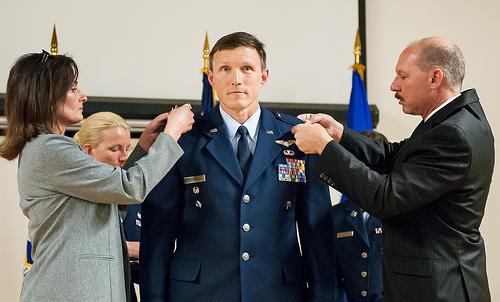
The wife and a family friend of Lt. Col. Jeffrey Wilkinson pin colonel’s rank to his uniform during a promotion ceremony at the Kentucky Air National Guard Base in Louisville, Ky., March 22, 2014. Wilkinson, vice commander of the 123rd Airlift Wing, is the first special tactics officer to be promoted to the rank of colonel in Kentucky Air Guard history. (U.S. Air National Guard photos by Staff Sgt. Vicky Spesard)
Wilkinson, the 123rd Airlift Wing’s vice commander, represents a different kind of diversity, Tonini said, noting that he is the first special tactics officer in the history of the Kentucky Air Guard to be promoted to the rank of colonel.
“I know you well enough to know that you’re the kind of guy that will accept (your new role), embrace it, and do the very best,” Tonini said to Wilkinson.
The colonel began his Air Force service in 1990, receiving a commissioning through the Reserve Officer Training Corps at the Syracuse University, in Syracuse N.Y. He’s spent most of his career in Air Force Special Operations, with time split between active duty, traditional Air National Guard duty and Active Guard Reserve duty as both a special tactics and combat rescue officer.
After leaving active duty, and before joining the Kentucky Air Guard full time in 2001, Wilkinson worked as a quality engineer for General Electric Appliances in Louisville.
He has participated in multiple overseas deployments, including Operation Uphold Democracy, Operation Joint Endeavor, Operation Enduring Freedom and Operation Iraqi Freedom, as well as numerous national exercises and natural disaster-response missions.
Prior to accepting his current post, Wilkinson served as commander of the Kentucky Air Guard’s 123rd Special Tactics Squadron. In that role, “he was the most most dynamic leader the special tactics squadron has had in their history,” Tonini said.
In his closing remarks, Wilkinson thanked his friends and family for their support and said he’s looking forward to the new challenges of serving as vice commander.
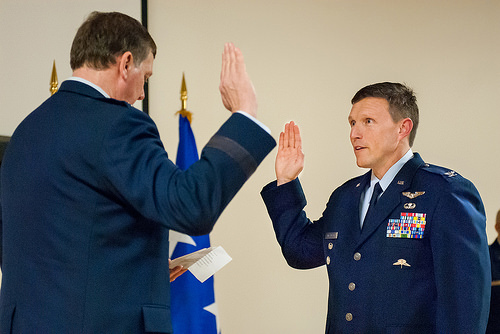
Kentucky’s adjutant general, Maj. Gen. Edward Tonini (left), executes the Oath of Office during a ceremony promoting Jeffrey Wilkinson to the rank of colonel at the Kentucky Air National Guard Base in Louisville, Ky., March 22, 2014. Wilkinson, vice commander of the 123rd Airlift Wing, is the first special tactics officer to be promoted to the rank of colonel in Kentucky Air Guard history. (U.S. Air National Guard photos by Staff Sgt. Vicky Spesard)
“I recognize and embrace the increased responsibilities that come with this position,” he told the audience. “I will deliver all within my ability to advocate and champion for you, for our mission, and for all of our folks who contribute to the United States Air Force’s finest airlift wing.”
Walker and Wilkinson’s promotions come on the heels of Kathryn Pfeifer’s promotion to the rank of colonel in a ceremony here Aug 17. Pfeifer, director of staff for Headquarters, Kentucky Air National Guard, became the first female line officer to attain the rank of O-6 in Kentucky Air National Guard history.
All three promotions are indicative of the Kentucky National Guard’s commitment to diversity, which Tonini defined as a “readiness imperative” in a recent policy memo.
“Diversity and inclusion allow the Kentucky National Guard to benefit from the talents, abilities, ideas and viewpoints of a workforce drawn from the richness of Kentucky and American society,” Tonini said in the memo, dated March 17. “I am personally committed to making the Kentucky National Guard the service of choice for all who seek to serve our Commonwealth, our nation and its people.”
Story by Master Sgt. Philip Speck, 123rd Airlift Wing Public Affairs

Chief Master Sgt. Jim Amburgey (right) receives a certificate of retirement from Col. Kenneth Dale, commander of the 123rd Maintenance Group, during his retirement ceremony at the Kentucky Air National Guard Base in Louisville, Ky., on Jan. 12, 2014. Amburgey served for more than 38 years. (U.S. Air National Guard photo by Staff Sgt. Vicky Spesard)
KENTUCKY AIR NATIONAL GUARD BASE, LOUISVILLE, Ky. — With 38 years of outstanding service to the 123rd Airlift Wing, Chief Master Sgt. Jim Amburgey was honorably retired from the U.S. Air Force during a ceremony held here Jan. 12.
More than a hundred friends, family and fellow Guardsmen, both active and retired, attended the ceremony, which was punctuated by laughter and tears as the chief looked back on his career.
Col. Kenneth Dale, commander of the 123rd Maintenance Group, has worked with Amburgey for the past 34 years and praised him as a rock upon which the Kentucky Air National Guard was built.
“A nation reveals itself by the men it produces, but also by the men it honors, and the men it remembers,” Dale said, quoting former president John F. Kennedy. “Today we’re honoring one of the very best: Chief Amburgey.

Col. Kenneth Dale (left), commander of the 123rd Maintenance Group, pins the Meritorious Service Medal to the jacket of Chief Master Sgt. Jim Amburgey during Amburgey’s retirement ceremony at the Kentucky Air National Guard Base in Louisville, Ky., on Jan. 12, 2014. Amburgey served for more than 38 years. (U.S. Air National Guard photo by Staff Sgt. Vicky Spesard)
“I believe Chief Amburgey has had a positive impact on every single person in this room.”
Amburgey decided to follow in the footsteps of his father, Master Sgt. Jim Amburgey Sr., and join the Kentucky Air National Guard on Sept. 12, 1975 as an Air Operations Specialist in the command post. The unit was flying RF-101 Voodoos at the time.
When Dale asked members of the audience how many people were part of the wing then, only two Airmen raised their hands — Amburgey and retired Maj. Gen. Carl Black.
Amburgey transitioned to the engine shop in 1978, and four years later, he was assigned to be Dale’s first trainer.
From 1985 until his retirement, Amburgey held a variety of positions in the 123rd Maintenance Operations Flight, including aircraft production controller and superintendent.
“He is truly the MOF subject-matter expert for the Air National Guard,” Dale said.
Because of his expertise in the Maintenance Operations Flight, Amburgey has been called upon for assistance from other units and the National Guard Bureau, which selected him by name to perform compliance inspections, Dale said.
After the terrorist attacks of September 2001, Amburgey deployed to Afghanistan several times, and in 2007 he was promoted to chief master sergeant — “one of the wisest things our wing has ever done,” Dale said.
As a deployed maintenance chief, Amburgey wowed the deployed commander at Bagram Airfield, Afghanistan, by having no missions lost due to maintenance, and by attaining a mission capability rate that was well over 90 percent — a rate which Dale said Bagram had not seen until the Kentucky Air National Guard and Chief Amburgey showed up.
“Every since he joined he the Kentucky Air National Guard, he’s been a true pillar of the Kentucky National Guard and U.S. Air Force,” Dale said. “He helped build the foundation of the Kentucky Air National Guard’s success and recognizable name around the world.
“Chief, thank you for your candor and your courage throughout the years. Thank you for making the tough decisions, the right decisions, for four long decades.”
Amburgey, who was presented with a Meritorious Service Medal and the Kentucky Distinguished Service Medal during the ceremony, thanked his many friends and family members for their support through the years, and for the spirit of teamwork that made his career so rewarding.
“Take away ranks, (and) we’re all people,” Amburgey said. “We’re all just a big team.”
Story by Master Sgt. Phil Speck, 123rd Airlift Wing Public Affairs Office
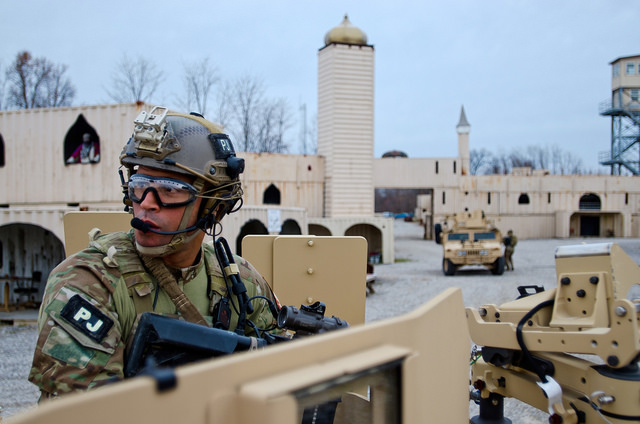
A member of the Kentucky Air National Guard’s 123rd Special Tactics Squadron defends a vehicle during training at Zussman Range at Fort Knox, Ky., on Nov. 21, 2013. The Airman and his teammates were practicing insertions, extractions and close-quarters combat in a simulated Afghan village. (U.S. Air National Guard photo by Master Sgt. Phil Speck)
FORT KNOX, Ky. — A UH-60 Blackhawk helicopter comes to a hovering stop above a two-story building in the middle of an Afghan village. With blades rotating above, a Kentucky Air National Guard pararescueman scoots to the edge of the chopper’s open door and grabs a thick rope before sliding 25 feet down to the building’s roof. He’s followed by five teammates who quickly secure the rooftop and scan the village for threats.
The scene may sound like a sequence from a Hollywood blockbuster, but it’s just another day at the “office” for members of the Kentucky Air National Guard’s 123rd Special Tactics Squadron. They executed the mission in November as part of regular combat training at Fort Knox’s Zussman Urban Training Center.
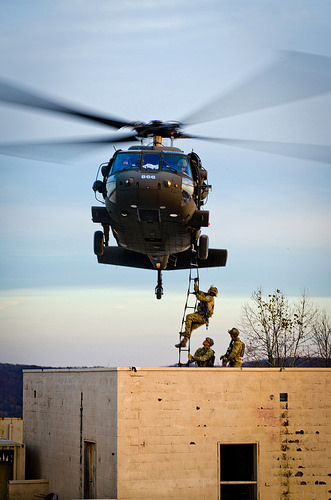
Members of the Kentucky Air National Guard’s 123rd Special Tactics Squadron climb a rope ladder onto a Kentucky Army National Guard UH-60 Blackhawk during training at Zussman Range at Fort Knox, Ky., on Nov. 21, 2013. The Airmen were practicing insertions, extractions and close-quarters combat in a simulated Afghan village. (U.S. Air National Guard photo by Master Sgt. Phil Speck)
The center offers realistic combat environments that simulate what troops can expect to find Afghanistan, according to Staff Sgt. Jeff G., a Kentucky Air Guard pararescueman whose last name is being withheld because of the sensitive nature of his duties.
“This is as good as it gets for training,” he said.
Pararescuemen and their combat controller colleagues from the 123rd Special Tactics Squadron are Special Forces Airmen. The former specialize in medical treatment and personnel recovery, while the latter control air traffic and air strikes. Both maintain a high level of training to be prepared for any mission.
The “fast rope insertion” described above is just one of many skills the men trained for in November. They also trained for fast extraction, in which a helicopter hovers overhead and drops a rope ladder for the operatives to climb up.
“We do this training to keep our skills up, stay proficient, so we can seamlessly integrate with other units,” Staff Sgt. G. said.
While at Zussman, the team also conducted close-quarters battle training. The operatives cordoned and searched buildings for people or high-value targets such as weapons caches, clearing the buildings one room at a time and eliminating threats as needed.
Throughout this process, they were met by actors who portrayed local Afghans, from a local market owner to hostile enemy forces that assaulted them with high-powered paintball guns. STS personnel used modified versions of their real-world weapons to fight back, employing non-lethal paint bullets, or “simunitions,” to return fire.
The Airmen also conducted full-mission-profile training tasks, using the equipment they would take with them overseas for a real-world operation. Among these tools were the Jaws of Life, a powered cutting device used to extract individuals from a downed aircraft or vehicle.
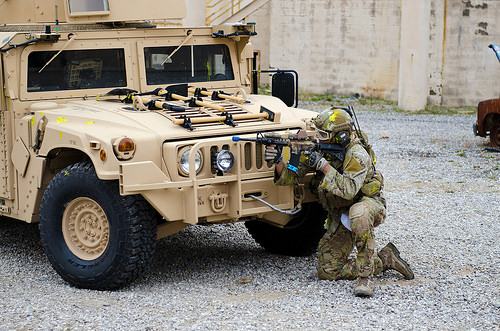
A member of the Kentucky Air National Guard’s 123rd Special Tactics Squadron defends his position during training at Zussman Range at Fort Knox, Ky., on Nov. 21, 2013. The Airman and his teammates were practicing insertions, extractions and close-quarters combat in a simulated Afghan village. (U.S. Air National Guard photo by Master Sgt. Phil Speck)
According to Master Sgt. Bryan Hunt, a combat controller for the 123rd STS, the unit does this type of training — which they call Military Operations on Urban Terrain — four times a year. It benefits both newcomers and unit veterans he said.
Each scenario was preceded by a dry run, or a practice walk-through. The Airmen would then execute a full-mission profile with night-vision goggles while taking simulated hostile fire.
“We try to apply everything we learned during a dry run, so when you’re actually being shot at, and you’re hot, your goggles are fogging up, the challenge was keeping your head, staying calm and applying the techniques you’ve learned previously,” Staff Sgt. G. said.
“The training was excellent and beneficial because it mimicked actual combat in Afghanistan. It represents that 360-degree battlefield that we experience in Afghanistan.”
Story by Senior Airman Desiree W. Moye, 386th Air Expeditionary Wing Public Affairs
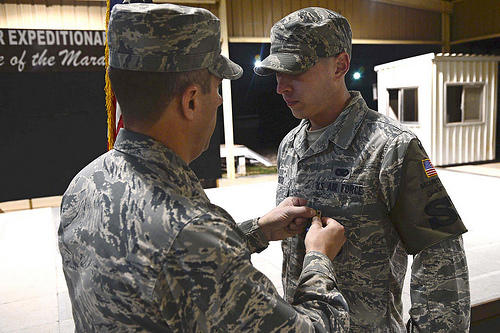
Col. John Klein Jr., 386th Air Expeditionary Wing commander, awards an Air Force Achievement Medal to Staff Sgt. Kenneth Soto, 387th Expeditionary Security Forces Squadron response force leader, at an undisclosed location in Southwest Asia. Soto, deployed from the 123rd Airlift Wing, Kentucky Air National Guard, was presented the medal for his response while off duty to a domestic violence incident in March 2013. (U.S. Air Force photo by Senior Airman Desiree W. Moye)
SOUTHWEST ASIA — Staff Sgt. Kenneth Soto, a Kentucky Air National Guardsman who is deployed here as a security response force leader for the 387th Expeditionary Security Forces Squadron, was awarded the Air Force Achievement Medal for heroism Jan. 21.
Soto was presented with the medal at an undisclosed air base for intervening during a domestic violence incident while off-duty in March 2013.
“Security forces personnel are trained to respond on and off duty to people in need,” said Soto, whose home unit is the 123rd Airlift Wing in Louisville, Ky.
Soto was in his hotel room during a college band trip to Hartford, Conn., when he heard a disturbing commotion next door. He decided to intervene when he heard a young lady screaming in agony.
“I ran down the hallway to see what was up and when I found the room I knocked on the door again and again until the guy answered,” he said
Being unarmed and off duty wasn’t a deterrence in Soto’s eyes, because gaining entry to the victim’s room and confronting the perpetrator was his only option, Soto said.
“Once I actually saw the victim, it as an abysmal sight,” he said. “She was unconscious and bleeding profusely.”
According to the award citation, Soto forced the attacker to the ground and placed him in a subdued position before assessing the victim’s injuries. He administered first aid, and safeguarded her and the scene until local authorities arrived.
Responding law enforcement noted that Soto performed admirably and potentially saved the victim’s life, the citation said.
“I always mention Kenny Soto as the guy that saved my life that night,” said Hannah Sanders, the victim, and Soto’s good friend. “If he didn’t stop it when he did, one more blow to my skull could have killed me.”
Col. John Klein Jr., 386th Air Expeditionary Wing commander, lauded Soto’s actions during the medal presentation.
“I am humbled and honored to be given the opportunity to pin a medal on a true hero,” he said.
Lt. Col. Matthew Groves, 386th Expeditionary Operations Group deputy commander, echoed Klein’s sentiment.
“His response is a beacon of courage,” said Groves, who is also deployed from Kentucky’s 123rd Airlift Wing. “It was simply heroic of him, and I’m proud to serve with him here and back home.”
Soto, however, doesn’t agree with their description of him as a hero. He sees the sequence of events as simply a reflection of his security forces training.
“I know for a fact that if any of the defenders I have had the privilege to serve with were there, it would have gone down the same way,” he said.
Story by Airman 1st Class Joshua Horton, 123rd Airlift Wing Public Affairs

Col. Robert Hamm (left), commander of the 123rd Operations Group, and Senior Master Sgt. Colin King (center), operations group first sergeant, unfurl the new unit flag of the 123rd Operations Support Squadron as Lt. Col. Matthew Groves, 123rd OSS commander, stands by to accept the guidon during a redesignation ceremony at the Kentucky Air National Guard Base in Louisville, Ky., Nov. 24, 2013. Prior to the ceremony, the 123rd Operations Support Squadron was classified as a flight. (U.S. Air National Guard photo by Airman 1st Class Joshua Horton)
KENTUCKY AIR NATIONAL GUARD BASE, LOUISVILLE, Ky. — The Kentucky Air National Guard’s 123rd Operations Support Flight was redesignated as the 123rd Operations Support Squadron during a ceremony held here Nov. 24.
Col. Robert Hamm, commander of the 123rd Operations Group, unfurled the new unit’s flag during the ceremony and formally presented it to Lt. Col. Matthew Groves, 123rd OSS commander.
The 123rd is one of more than 40 operations support flights across the National Guard that are being converted to squadrons, which are typically larger than flights and usually exercise more administrative control.

Col. Robert Hamm (left), commander of the 123rd Operations group, hands the 123rd Operations Support Squadron’s new guidon to Lt. Col. Matthew Groves, squadron commander, during a redesignation ceremony at the Kentucky Air National Guard Base in Louisville, Ky., Nov. 24, 2013. Prior to the ceremony, the 123rd Operations Support Squadron was classified as a flight. (U.S. Air National Guard photo by Airman 1st Class Joshua Horton)
Groves took time during the ceremony to thank his fellow Airmen and family for their support.
“In all the chaos of our daily lives, the thank you is often forgotten,” he told the audience. “I’d like to include it now. Thank you sincerely for the challenges that you’ve faced in the past, for the work you accomplish today and for the obstacles that you will overcome in the future.”
The 123rd Operations Support Flight performs a variety of essential functions, including intelligence analysis and flight records.
Story by Staff Sgt. Vicky Spesard, 123rd Airlift Wing Public Affairs
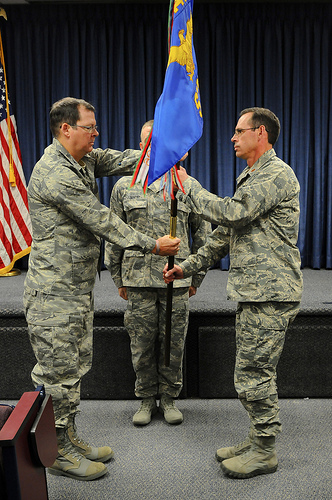
Col. Robert Hamm (left), commander of the 123rd Operations Group, presents the guidon of the 123rd Special Tactics Squadron to Maj. Sean McLane, the unit’s new commander, during a change-of-command ceremony held at the Kentucky Air National Guard Base in Louisville, Ky., Nov. 24, 2013. The passing of the guidon is a time-honored tradition signifying change of leadership. (U.S. Air National Guard photo by Staff Sgt. Vicky Spesard)
KENTUCKY AIR NATIONAL GUARD BASE, LOUISVILLE, Ky. — Maj. Sean McLane assumed command of the Kentucky Air National Guard’s 123rd Special Tactics Squadron during a change-of-command ceremony here Nov. 24.
He replaces Lt. Col. Jeffrey Wilkinson, who now serves as deputy air commander of the squadron’s parent organization, the 123rd Airlift Wing.
McLane began his Air Force career in 1993 as an enlisted tactical air controller before being commissioned as a distinguished graduate of the Air National Guard Academy of Military Science in 2002. He most recently served as director of operations for the 123rd Special Tactics Squadron and brings many years of experience to his new role.
“Having been the lowest enlisted member of the squadron, you get to see how all of the leadership’s decisions affect you,” McLane said during the ceremony. “I don’t want to be disconnected from that Airman. When that extra workload or difficulty comes to him, I want to know how he is affected.
“If I can’t change the outcome of how it affects him, I can explain to him why it has to be that way,” he continued. “What I really want is for people to understand why they are doing what they are doing and how it affects the mission.”
McLane first came to the Kentucky Air National Guard in 1996 when the special tactics unit was a flight of about 24 members. He earned his combat control beret in 1997, maintaining full combat mission-ready status as a traditional Guardsman while attending college and, eventually, teaching high school math, science and history. His military career includes assignments as a special tactics squadron flight commander and weapons and tactics officer.
“I have known Major McLane since he was an NCO, and I had a lot of respect for him then,” said Chief Master Sgt. Tom DeSchane, the squadron’s combat control enlisted manager. “He has vision and he likes to have as much input as he can before he makes decisions. I think that’s what is going to make him a successful commander for the STS.”
Now staffed with more than 80 personnel, the squadron provides a rapidly deployable force to establish positive control of the air-ground interface, battlefield trauma care, terminal attack control, personnel recovery and air/ground meteorological effects forecasting in support of overseas contingency operations and domestic disasters.
“I want people to be proud of the job that they are doing, proud of their squadron and proud to be a member of it,” McLane emphasized. “If they have the proud ownership of their position, they are going to do their job better.”
Mission readiness is another top priority. McLane has deployed numerous times in support of military contingency and combat operations, including Enduring Freedom and Iraqi Freedom; multiple Joint Chiefs of Staff-directed exercises; and civil natural-disaster response operations and state exercises.
“I’m not interested in fighting the last war,” he told the audience. “I’m interested in fighting the next one. I’m not interested in preparing for the last natural disaster we have faced. I am very concerned with being ready to respond to all of them.”
“When you look at the mission of special tactics, our federal and state mission, where they overlap is what we are going to train to and what we are going to be good at. If we do that, we will be ready for the future war and be ready for what the state needs us to do.”
Story by Master Sgt. Phil Speck, 123rd Airlift Wing Public Affairs

Tech. Sgt. Mike Johnson (right), a crew chief from the Kentucky Air National Guard’s 123rd Aircraft Maintenance Squadron, shows Staff Sgt. Brian Hinckley, a crew chief from the Connecticut Air National Guard’s 103rd Aircraft Maintenance Squadron, different maintenance aspects of the C-130 Hercules aircraft at the Kentucky Air National Guard base in Louisville, Ky., on Nov. 14, 2013. The Connecticut unit is converting from C-21A Learjets to the Hercules transport. (U.S. Air National Guard photo by Master Sgt. Phil Speck)
KENTUCKY AIR NATIONAL GUARD BASE, LOUISVILLE, Ky. – Airmen from Kentucky Air National Guard are extending a helping hand to another unit in the Air Guard family.
The Connecticut Air Guard’s 103rd Airlift Wing is in the process of converting from the C-21A Learjet to the C-130H Hercules transport aircraft, and Kentucky Airmen are providing maintenance training to ease the transition.
Five maintainers from Connecticut visited Louisville in early November for hands-on learning, and more are expected to follow this month, said Lt. Col. Chris Bishop, commander of Kentucky’s 123rd Aircraft Maintenance Squadron.
The Kentucky Air Guard’s 123rd Airlift Wing went through a similar airframe conversion in 1989, when the unit replaced its RF-4C supersonic reconnaissance jets with C-130s.
According to Bishop, the 103rd asked the 123rd for guidance because of its reputation for excellence. The Kentucky wing is one of the most decorated units in the U.S. Air Force, with 15 Air Force Outstanding Unit Awards.
“They reached out to us,” Bishop said. “They knew we were one of the best, and our record proves it. We’re a small family anyways, and our success is based on relationships. This was an opportunity to further develop those relationships with another unit.”

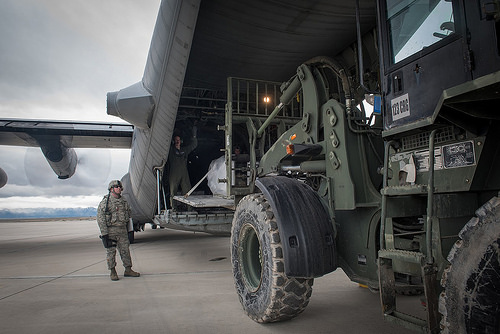
Tech. Sgt. Mike Johnson (right), a crew chief from the Kentucky Air National Guard’s 123rd Aircraft Maintenance Squadron, speaks to Staff Sgt. Brian Hinckley, a crew chief from the Connecticut Air National Guard’s 103rd Aircraft Maintenance Squadron, about the tires of the C-130 Hercules aircraft at the Kentucky Air National Guard base in Louisville, Ky., on Nov. 14, 2013. The Connecticut unit is converting from C-21A Learjets to the Hercules transport. (U.S. Air National Guard photo by Master Sgt. Phil Speck)
Airmen from the two wings first met over the summer, when the 123rd sponsored a “Maintenance University” training event at the Air National Guard’s Combat Readiness Training Center in Gulfport, Miss. It was there that the Connecticut maintainers received their first field experience with C-130 maintenance, several months prior to taking possession of their own aircraft. The 103rd now has its first Hercules airframe, which arrived in October.
The Connecticut unit has been flying C-21A Learjets since 2007. The Learjets are much smaller airframes rated for six to eight passengers, while a C-130H can carry up to 92 combat troops or 42,000 pounds of cargo, depending on the configuration. Prior to flying Learjets, the 103rd was equipped with A-10 Thunderbolt II close-air-support aircraft.
The Connecticut Air Guard is slated to receive eight C-130H aircraft — the same number assigned to Kentucky — by July.
The Connecticut Airmen have already completed some home-station training, provided by maintainers from Little Rock Air Force Base, Ark., but the visits to Kentucky give them the chance to see how C-130 maintenance is carried out on a daily basis at an operational unit, Bishop said.
The 103rd will go through some growing pains as its Airmen become familiar with their new equipment and tools, he added. They also will have to change their approach to mission planning because of the more complex logistics requirements associated with “heavy” cargo aircraft.
There will be other changes, too.
The Connecticut maintenance group is expected to double in size, according to Staff Sgt. Brian Hinckley, flight line crew chief for the 103rd Aircraft Maintenance Squadron. And timelines will be longer as they move from the svelte Learjet to the cavernous Hercules.
“Everything is bigger and slower,” Hinckley observed. “The missions are a day or two, instead of an hour or two.”
But the new airframe also means more opportunities for unit members to be globally engaged through temporary duty assignments, exercises and deployments requiring C-130 airlift capabilities.
“We’re all over-the-top excited,” Hinckley said. “We can’t wait.”
Bishop said the Kentucky maintainers are happy to assist their Connecticut colleagues, especially given the 123rd’s own history with the C-130.
“We’re a small community here in the Guard, and we help each other out when we can,” he said. “We know they would do the same for us. We got help from other units such as Mansfield, Ohio, and West Virginia when we converted to the C-130, and now we’re just returning the favor.”