Pages
Stay In Touch
More
© 2013 KentuckyGuard
Tech. Sgt. Jason Ketterer, 123rd Airlift Wing Public Affairs
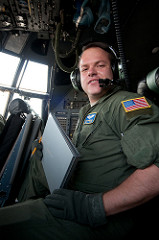
Tech. Sgt. Matthew McKeehan is a Flight Engineer for the 165th Airlift Squadron. (U.S. Air Force photo by Master Sgt. Phil Speck)
KENTUCKY AIR NATIONAL GUARD BASE, LOUISVILLE, Ky. — For more than two decades, the 123rd Airlift Wing has been sending enlisted crewmembers to the sky in the C-130 Hercules. Their airborne office hurtles these flight engineers and loadmasters across the globe to perform their mission year ’round, whether it be supporting hurricane relief operations at home or fighting the global war on terror abroad.
It’s a rare opportunity most enlisted airmen will never know: They get to fly in airplanes.
“If you ask the average person on the street, ‘Who flies airplanes?’ naturally they’re going to say pilots,” said Lt. Col. Shawn Dawley, commander of the Kentucky Air National Guard’s 165th Airlift
Squadron. “And in some aircraft, that’s absolutely accurate. It’s only a pilot.
“But with the C-130, due to the complexities of the systems, the complexities of the mission, the types of tasks we’re asked to accomplish, we have to organize ourselves around a crew concept to divvy up responsibilities amongst crew members to manage the whole task.”
And now, thanks to a restructuring of the force, the 165th Airlift Squadron is looking to recruit potential
Airmen who want to be part of that collective crew by serving as loadmasters and flight engineers.
During sorties as an enlisted member in the tactical airlift world, a flight engineer is responsible for
monitoring fuel systems, electrical systems, hydraulics and pneumatics. Sitting between three officers
on the flight deck, the engineer also preflights the C-130 and computes take-off and landing data.
A loadmaster’s realm is at the bulkhead and the rear of the aircraft. Physically separated from the rest of
the crew, a loadmaster calculates the metrics of cargo to verify that the weight and subsequent balance
within the fuselage is safe for transport.
“The constant variation of loads requires us to be prepared for all types of cargo to be moved with our
aircraft,” said Airman 1st Class Erick Anderson, a loadmaster with the 165th. “Loadmasters are required
to be fluent in and resourceful with our publications so that we’re quick to identify conflicts with cargo
and plane limitations. We’re responsible for everything from transporting passengers to dropping a
parachutist out of a plane at 10,000 feet, hauling vehicles to isolated areas or airdropping ammo, water,
medical supplies and equipment to our troops in battle.”
A loadmaster has “awesome responsibilities to the aircraft and crew,” according to Chief Master Sgt. Jeff
Brown, Loadmaster Section chief, and there is no room for unsafe execution.
“We need airmen who know how to be safe, want to be safe, that are willing to fly into unsafe conditions in order to do what needs to be done,” Brown said. “When you’re in the AOR, in Afghanistan in particular, you’re in a dangerous area from take off to landing.”
“Integrity First” — one of the Air Force Core Values — is paramount in tactical airlift, officials said.
“The actions of one directly affect the lives of the other men and women on board,” said Senior Master
Sgt. Scott Davis, acting supervisor of the Flight Engineer Section.
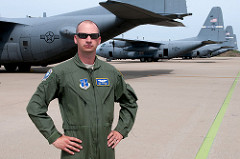
Airman 1st Class Erick Anderson is a Loadmaster for the 165th Airlift Squadron. (U.S. Air Force photo by Tech. Sgt. Dennis Flora)
The ability to work well in teams while being self-sufficient is another key attribute for enlisted crewmembers.
“Confidence in yourself and your training will play a part in determining any Airman’s success as an aviator, but you also have to play well with others,” Davis said. “You report to the aircrew commander, but you have to operate independently. A lot of times you have to be the systems expert. So we’re
looking for someone who can not only work well with others, but who is also self-motivated to keep up on their own training.”
That training will take enlisted crewmembers to the farthest corners of America.
“My training for the military consisted of attending technical schools located throughout the
continental United States,” recalls Tech. Sgt. Matthew McKeehan, a flight engineer in the 165th Airlift
Squadron. “My first school was in San Antonio, Texas, at Lackland Air Force Base for basic engineer
training. Next was survival training, which took me to Pensacola, Fla., and Spokane, Wash. After these
training assignments were completed, I traveled to Little Rock, Ark., for specific training on the C-130. All in all, it took me away from home for a solid year.
“While this was the most challenging training I’ve ever accomplished, the hard work and time sacrificed
away from friends and family has been well worth it,” he noted.
According to Dawley, the skills that will make or break an aircrew member’s career are not easily displayed on a resume. Nor can they necessarily be measured by scores from aptitude tests like the
Armed Forces Vocational Aptitude Battery or the Air Force Officer Qualifying Test.
Individuals must possess a thick skin to be able to recover from mistakes, learn from them and not let it
affect the mission at hand, he said. Also, Airmen must possess an “intrapersonal versatility” to be able to
contribute in a professional manner with whomever they are assigned to work with in a crew.
“Long hours and 120-day deployments can be taxing in any work environment, but the personality that
you bring to work needs to be mission-oriented and focused,” he said.
“Lastly, to say that it takes courage to perform all of these tasks is an understatement by far. A flight
engineer or a loadmaster has to be willing to strap themselves into a 155,000 pound piece of metal, load
it with jet fuel and deliberately fly it into the teeth of the adversary, yet possess maturity, wisdom and
judgment to not be reckless adrenaline junkies.”
For Brown, being a loadmaster has been a tremendously rewarding career.
“Watching heavy equipment leave the airplane during an airdrop has always been an exhilarating
experience for me,” he said. “You’re traveling along at approximately 150 mph, the (rear) ramp door
opens, the parachute goes out behind the airplane, opens up and pulls that load out. It’s almost like that
load is sitting still and the airplane pulls away from it at 150 miles an hour. That’s about how fast the
cargo leaves the airplane.”
Brown also gets a lot of satisfaction from aeromedical evacuation missions and emergency airdrops.
“A lot of times, especially in the AOR, we’ll go in to pick up (soldiers) or Marines who have been severely
injured. You have to get that guy out and fly him to a medical facility quickly. We’ll also do emergency
airdrops, where we go into a combat area to drop ammunition to troops who are in contact with the
enemy right there, and they are almost out of ammunition and have to have it right away. Those are
always fulfilling missions because you know how important your work is to those wounded soldiers or
the troops on the ground.”
Story by Sgt. 1st. Class Steve Baker, 202nd Army Band Unit Public Affairs Representative
Click here for more photos.
NOTE: Each week kentuckyguard.com publishes stories by or about Kentucky National Guard unit public affairs historian representatives, also known as UPAHRs. This is an additional duty taken on by a Soldier or Airmen with the intent of telling their unit’s story. This is one such story …
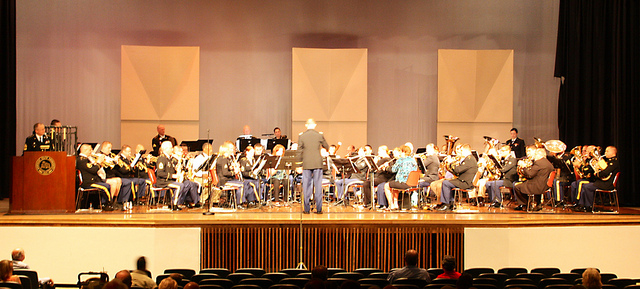
FRANKFORT, Ky. — The 202nd Army Band of the Kentucky National Guard with support from the Frankfort Arts Foundation performed an Armed Forces Day tribute concert on Sunday, May 20th. The “No Finer Calling: A Salute to America’s Soldiers” concert featured patriotic, big band era and military march music for an enthusiastic audience at the Bradford Auditorium on the campus of Kentucky State University.
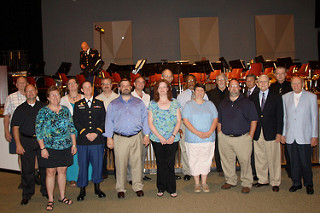
Former members of the 202nd Army Band (from left to right): Richard Houghton, Steve Flood, Suzie Kinman, Sharon McGuire Belize, Courtney Spragens, Phil Johnston, Jason Green, John Whalen, Doris Corcoran, Doug Begley, Jim Barber, Linda Allen, Brian Gorrell, Michael Bonza, David Adwell, John Hoover, Dan Long and Ron Baker. (Photo by Sgt. 1st Class Steve Baker, 202nd Army Band Unit Public Affairs Representative)
A highlight of this event was the 29 former 202nd band members returning and 19 of those members rehearsed or performed in this concert. Former members came as far away as Michigan and Florida to attend. Retired Chief Warrant Officer John Hoover, a former commander of the 202nd, performed as well as guest conducted.
“The reunion weekend was a wonderful chance to return to my military family,” said Retired Sgt. 1st Class Jerry Wallace. “The friendship and music were very, very special.”
Former members of the 202nd Army Band (from left to right): Richard Houghton, Steve Flood, Suzie Kinman, Sharon McGuire Belize, Courtney Spragens, Phil Johnston, Jason Green, John Whalen, Doris Corcoran, Doug Begley, Jim Barber, Linda Allen, Brian Gorrell, Michael Bonza, David Adwell, John Hoover, Dan Long and Ron Baker
As a special tribute to the 108 Kentuckians who have fallen in the Global War on Terrorism each soldiers name and rank were read followed by a single chime. The special tribute continued with the playing of Taps followed by the performance of “No Finer Calling.”
The Julie Giroux symphonic composition has three movements: Integrity March and Fanfare - “Integrity”, Far From Home - “Service Before Self” and Honor Above All - “Excellence In All We Do”. The band performed movements II and III.
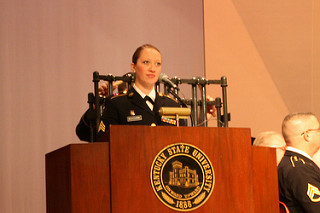
Sgt. Emily McAleesejergins narrates during “No Finer Calling.” (Story by Sgt. 1st. Class Steve Baker, 202nd Army Band Unit Public Affairs Representative)
Movement III contains the composer’s original combat prayer narration accompaniment during the latter part. Sgt. Emily McAleesejergins presented the emotional narration which reads as follows:
“Lord, God, My Saving Grace. In Your Hands My Soul I Place,
Dear Lord, God Forgive My Sins, Please Let My Faith Not Falter.
Lord, God, Please Grant Me Strength. Let Your Spirit Flow Through Mine.
Dear Lord, God. Let Wisdom Reign and Courage Guide My Journey.
Oh Lord, God. The King of Kings. Armor Born of Love Be Mine.
Dear Lord, God. When My Days End Let Heaven’s Light Shine On Me.”
It is the hope and prayer of the 202nd that all family members, veterans and active duty military personnel finds peace and continue to honor the memories of our fallen comrades. It is our honor to musically “voice” those who cannot.
“I have never been so proud of the soldiers of the 202nd Army Band as I was Armed Forces weekend,” said 1st Sgt. Jim Wallace. “They supported multiple missions, honored fallen comrades and celebrated enduring friendships with former unit members. The spirit and morale of these soldiers is inspiring.”
Interested in joining up?
The 202nd is actively recruiting now and looking for trombonists, euphonium, French horn, oboe and keyboard performers. It’s a great opportunity for a young person to serve his or her country, get world class training and have college costs covered.
For additional information about the 202nd Army Band please contact Sgt. 1st Class Angela Wilkins, 502-607-5331 or email her at [email protected].
Story by: Staff Sgt. Steve Tressler, 138th Fires Brigade Public Affairs
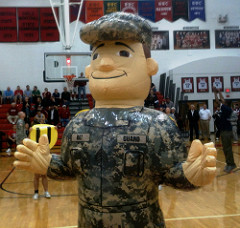
Nat Guard attends a Louisville Basketball game to celebrate his 18th birthday with friends and family in April. (photo by Staff Sgt. Steve Tressler, 138th Fires Brigade Public Affairs)
FRANKFORT, Ky. — Wherever he goes Nat Guard gets a mountain of attention due to his physical size and grandiose smile. However, the biggest thing about Nat often goes unnoticed — his love for the Kentucky National Guard!
Nat is the inflatable Kentucky National Guard mascot you see just about everywhere you see an event where the Guard is present. He just turned 18 years old and he is excited about the possibility of going to boot camp and becoming a ‘real’ Kentucky Guardsman.
Nat was delivered, not by stork but by a C-130, to Kentucky National Guard Marketing Director JC Newton, whom Nat calls Dad.
“When I first met Nat I fell in love with him,” said Newton “He’s always smiling and positive, and never says a bad thing about anybody.”
Nat has been a member of the Kentucky Guard marketing team since birth and has dreamed of the day he could join.
“I have attended every Kentucky High School Sweet 16 basketball tournament since 1992, I’ve been to NASCAR events, Pro baseball games, truck pulls, you name it!” said Nat. “I’ve got the second best job in the world.”
He quickly pointed out that being a Kentucky Guard Soldier was the best job in the world. Many of us would agree, what with free college tuition, money while in school, student loan repayment, health benefits, etc … The list goes on and on.
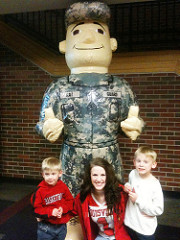
Nat Guard attends a Louisville Basketball game to celebrate his 18th birthday with friends and family in April. (photo by Staff Sgt. Steve Tressler, 138th Fires Brigade Public Affairs)
A little known fact about Nat is that he’s quite an athlete. Tubby Smith, former Kentucky basketball coach, tried unsuccessfully to recruit Nat as a ‘big-man center’ for the Wildcats. Nat, although honored, turned the coach down, saying that that being a Wildcat would be awesome, but not as awesome as being a Kentucky Guardsman.
The Kentucky Guard mascot has been approached his whole life by young and old people everywhere to take pictures and sign autographs. He always obliges and does it with a smile.
Nat was dealt a really tough blow this week. On his 18th birthday he was told he could not enlist in the Kentucky National Guard as a full-time Soldier because his current role as mascot was much more important in attracting the best and the brightest to the Guard.
Nat reacted the same way he always does. He smiled and said “Whatever is best for our Kentucky Guard team!”
Knowing Nat, that’s just not a bunch of ‘hot-air’ talking either.
Story by Staff Sgt. Paul Evans, KY ADT 4 Public Affairs NCO
NOTE: Each week kentuckyguard.com publishes stories by or about Kentucky National Guard unit public affairs historian representatives, also known as UPAHRs. This is an additional duty taken on by a Soldier or Airmen with the intent of telling their unit’s story. This is one such story ….
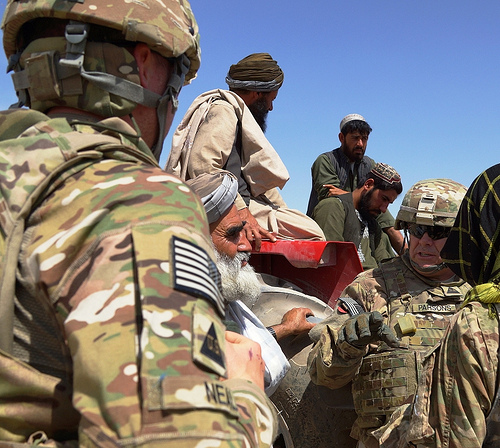
Beau Neal (left), a resident of Versailles, Ky. watches as Ken Parsons (right), a resident of Lancaster, Ky. speaks through a translator during tractor safety training in southern Afghanistan’s Kandahar Province on April 25, 2012. The two civilian agricultural specialists from Kentucky’s Agribusiness Development Team 4 assisted putting together the training with local agricultural leaders to help educate farmers in the area. (Photo by U.S. Army Staff Sgt. Paul Evans)
FORWARD OPERATING BASE PASAB, Afghanistan — “If you train a person, there just isn’t any way to take that away from them,” reflected Ken Parsons, a civilian agricultural specialist from Lancaster, Ky. with Kentucky’s Agribusiness Development Team 4.
To see all the photos from this story, please click HERE.
“The Taliban can’t take that (knowledge) away from them, no one can take it away from them. Any type of training that we can do, those are the things I think that are going to help these folks out more than anything else. And believe it or not, they’re very receptive to training,” Parsons added.
In southern Afghanistan’s Zharay District, Kandahar Province, ADT 4 recently helped empower local agricultural leaders with some good old-fashioned tractor training.
“Initially, we had some ideas after we got the mission statement that we need to focus on education and training, because those are going to be cost efficient projects that are…very high impact,” said civilian agricultural specialist Beau Neal, a native of Versailles, Ky. “The way me and Parsons see it, education is key, especially with younger people in building up a country.”
“What happened with that is there was one of the agencies over here distributing a large amount of machinery throughout Kandahar. One of the things that they wanted to do was make sure that these folks had training,” Parsons recalled.
“So that’s what we did,” Parsons noted. “We provided some technical expertise to the extension agent. To the guy’s credit, he took it and ran with it. He just did an excellent job, and the people that were trained were people we call master farmers.”
“The extension agent just did a wonderful job of training those people. What they’re in turn supposed to do is go out into the surrounding villages and train those people,” Parsons explained.
Parsons briefly explained an extension agent’s job description.
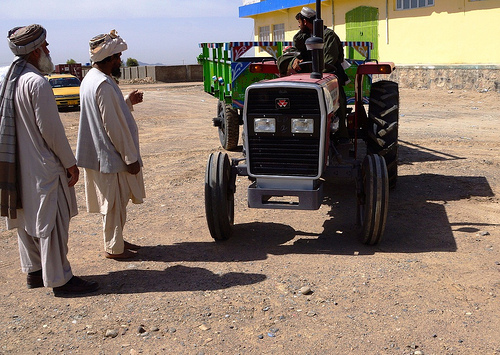
Local agricultural leaders lead tractor safety training in southern Afghanistan’s Kandahar Province on April 25, 2012. Kentucky’s Agribusiness Development Team 4 assisted putting together the training with local leaders to help educate farmers in the area. (Photo by U.S. Army Staff Sgt. Paul Evans)
“He’s a government employee…and he is to go out in the community and give agricultural expertise, say some of the things that they do, try to give some advanced agricultural information to the folks out in this country,” Parsons said. “The only problem is we’re in a combat area, so he has to be leery of where he goes. He’s (also) a government official, so he has to be leery of that.”
Effective government officials in Afghanistan are frequently targeted by the Taliban to keep the Afghan government from gaining legitimacy with local populations.
“The person we have here as an extension agent, I think has the agricultural community’s interest at heart,” Parsons said. “He is a natural born teacher, he likes to teach, and I think that us giving him some technical expertise and some backup and some help along the way, I believe the guy will do a really good job even with all the roadblocks he has in front of him.”
Neal offered some insight into how the training program was designed.
“The whole purpose of being over here is sort of mentorship of the agricultural extension agents,” Neal discussed. “I had some training materials in regard to tractor training and Parsons did too. We (also) added a few things.”
“We ended up having four or five different PowerPoint presentations. Part of those, we had our translators here in the unit that are working with us, we had them translate, which is kind of a time consuming process. It’s tough,” Neal noted.
“I’ve learned that these languages here are very challenging. Aside from translating the words, you’ve got to flip the words around,” Neal explained. “So, I worked with the translators here as well as Parsons. I got ahold of a Pashto keyboard… (and) sort of went through the presentations with our translators.
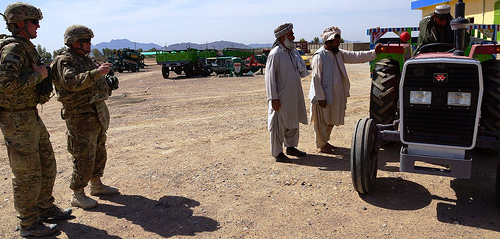
Beau Neal (left), a resident of Versailles, Ky. and Ken Parsons (right), a resident of Lancaster, Ky. observe as local agricultural leaders lead tractor safety training in southern Afghanistan’s Kandahar Province on April 25, 2012. The two civilian agricultural specialists from Kentucky’s Agribusiness Development Team 4 assisted putting together the training with local agricultural leaders to help educate farmers in the area. (Photo by U.S. Army Staff Sgt. Paul Evans)
“Essentially, all we did was prepare the presentations, translate them… and he just took over (from there),” Neal said. “What he did… he would read them off, and expand and explain on them just like a professor would. And he did awesome.”
“To see the extension agent, how he took it over. He took it over and he just ran with it,” Parsons reflected.
“There’s no language barrier there. I could stay up there and have to go through an interpreter. There was no language barrier with him… (and) the man has respect in the community, so we can’t ask for a lot more,” Parsons added.
“To set in there and just to change slides for (the agricultural extension agent) and watch him teach his own people was pretty rewarding to me,” Neal recalled. “I didn’t understand a word they were saying, but he reminded me of a college professor because he would read the slide and he would expand on it.”
“I had our translator translate a lot of what he (the agricultural extension agent) was saying so I could follow along and make sure he was hitting the important points, and he was right on point,” Neal added. “That was really rewarding, just to know that we provided him with some materials and he just ran with it.”
Technology also helped bridge the language barrier in tractor training.
“We were able to pull up some stuff on YouTube and show some of the equipment that they had down here…about how it worked. And the students were very, very interested in that,” Parsons mentioned.
After classroom sessions, master farmers conducted a few hands-on training sessions with tractors. Parsons and Neal discussed the training briefly.
“This was just rudimentary, very basic, very low level tractor training. We had a few impediments, a few roadblocks along our way,” Parsons recalled. “But we overcame that, and it seemed like it worked pretty well.”
“The overall goal is to teach safety. The equipment that they have here is not like the equipment they have in the United States. All of the equipment in the United States is made with safety in mind,” Parsons explained. “This unfortunately is not that way.”
“Safety is a big component of it to me,” Neal said. “People don’t realize that there is quite a bit of machinery around here.”
“You even see tractors on the road every now and then, which is a risk in itself,” he added with a bit of laughter. “You see the way people drive here.”
“A lot of these guys, if they’re not familiar with the equipment, with tractors, the machinery in general…those are things that can take fingers off,” Neal explained. “You can get hurt easily. I’ve experienced that firsthand all the time at home farming.”
“The big thing is just to make sure the agricultural extension agents are competent enough and let them proceed to teach the people in their district,” Neal said.
“These (lessons) are essential tools that Afghanis are going to need for safe operation, proper operation, maintenance, (and) upkeep of the tractor to increase the longevity,” Neal added.
Projects like this (tractor training) to me are probably just as effective as something you spend a couple hundred-thousand dollars on, because it’s something nobody can take away from you,” Neal said. “It’s something nobody can steal.”
“It’s just a high impact project that you can touch a lot of lives, you can make some impact, it’s very cost efficient,” he added.
“They’ve (Afghan farmers) got a lot of obstacles to overcome. A lot of them are manmade, and a lot of them are just made by nature,” Parsons noted.
“We’ve got some small programs coming up. The programs that I’m working on in particular are not big money programs, but they’re programs that we think are essential,” he added.
“I’m proud to be here. This has its challenges, but I found that just about everybody that is here has been willing to help me, willing to put up with me, and that makes me feel good. I hope when I look back at this, that I can say this has been well worth it,” Parsons concluded.
LOUISVILLE, Ky (May 28th, 2012)-Chief Master Sgt. James Smith, Kentucky’s State Command Chief, responded to questions from former little league team mate, Terry Meiners, WHAS Radio personality, during an interview Thursday. Smith and Bat’s Marketing Director, Greg Galiette, were invited to speak on behalf of the Louisville Bats Military Appreciation Day on Memorial Day.
Chief Master Sergeant James Smith’s military career began on 10 September 1977, with his enlistment into the Kentucky Air National Guard. Jim served the Air Guard in many assignments within the Wing, advancing to Chief Master Sergeant and State Command Chief. As the State Command Chief, Jim Smith is the liaison with all the Army and Air Guard Generals, the Staff, and other Kentucky Guard members, promoting the enlisted concerns and advancements for the Air Guard.
Listen to this interview by clicking on the image below.
Story by Staff Sgt. Paul Evans, KY ADT 4 Public Affairs NCO
NOTE: Each week kentuckyguard.com publishes stories by or about Kentucky National Guard unit public affairs historian representatives, also known as UPAHRs. This is an additional duty taken on by a Soldier or Airmen with the intent of telling their unit’s story. This is one such story ….
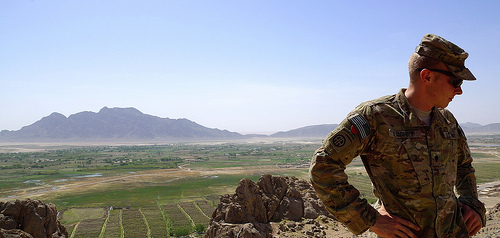
Spc. Jesse Loghry, a 22-year-old Irvington, Ky. resident on his third deployment in four years, takes a moment to catch his breath after climbing a mountain in Southern Afghanistan on April 6, 2012. Loghry, a combat medic by trade, serves as a vehicle gunner on Kentucky’s Agribusiness Development Team 4. (Photo by U.S. Army Staff Sgt. Paul Evans)
FORWARD OPERATING BASE PASAB, Afghanistan — Four years into his career, Spc. Jesse Loghry, a combat medic serving as a vehicle gunner with the Kentucky National Guard’s Agribusiness Development Team 4 is already an old veteran. That’s because the Springdale, Ark. native, who graduated high school at Ft. Knox, Ky. in 2008 is well into his third deployment.
To view all the photos from this story, click HERE.
“I’m 22-years-old. This marks my third deployment and yet…not the best decision I could’ve made,” Loghry joked.
“On this trip, I’m slotted 11B (Infantry), something I thought I’d never get the chance to do,” he reflected. “I’m a medic. I never would have thought any time that I’d be behind a 50 (caliber rifle), pulling a gunner’s job going down the road, but here I am doing it.”
“The biggest thing is that I don’t want somebody else to put themselves in harm’s way whenever I’m perfectly capable of it,” Loghry explained. “And I’ve always wanted to be in the military, so it’s just another thing. I get up, toss on the uniform, and I get a sense of pride that very few people in the world will ever see the things that you see.”
“It’s a different sense of just being able to know that you’re different. You’ve got experiences that nobody else will ever have,” he added.
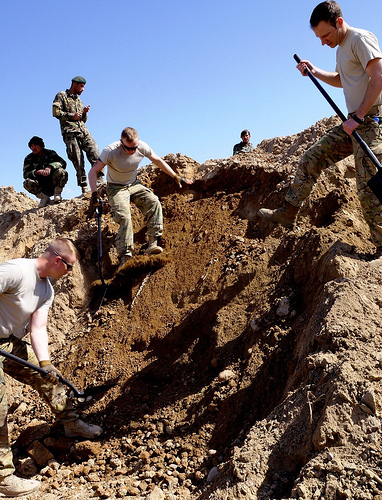
Spc. Jesse Loghry (2nd from left), a 22-year-old Irvington, Ky. resident on his third deployment in four years slides down a dirt hill while filling sandbags in Southern Afghanistan on March 1, 2012. Loghry, a combat medic by trade, serves as a vehicle gunner on Kentucky’s Agribusiness Development Team 4. Also pictured (left to right): Sgt. David Spry of Winchester, Ky.; three random Afghan Soldiers watching; and Spc. Keith Stanley of Frankfort, Ky. (Photo by U.S. Army Staff Sgt. Paul Evans)
“In my deployments, I get told by a lot of different people that I work with, they’re like ‘man, you’re the best medic I’ve ever worked with,’ and it does give you a sense of pride,” Loghry described. “The biggest thing for me is, if you’re going to do something, do it to the best of your ability. So, I feel like I have made a small difference, at least in some people’s lives.”
Loghry spent his first two deployments serving in Iraq.
“The first one, we started in 2009. We were out of FOB Key West in northern Iraq. I was with the 2113th Transportation Co. out of Paducah, Ky., and I was put into 2nd Platoon, 2nd Squad as their medic. We ran convoy security to just everywhere in the north half of Iraq from Baghdad all the way up to just about the (Turkish) border,” Loghry recalled. “I was primary medic on just about every mission.”
“We were in our trucks about eight, nine hours of the day. So we would be gone for two or three days, come back, have a day to rest, and go back out again,” he added.
“The second deployment was this past year in 2011. When I came on orders, it was exactly a year after I’d come back home from the first one,” Loghry said. “I was with the 940th MP (Military Police) Co. out of Walton, Ky., who were attached to the 149th Maneuver Enhancement Brigade.”
“We were primary base QRF (quick reaction force) for all of VBC (Victory Base Compound in Baghdad)…we did external dismounted patrols, we gathered human intelligence, basically made sure the bad guys weren’t going to attack the FOB,” he explained.
“With this mission, I was at (Camp) Atterbury getting ready to go home from Iraq and (ADT 4 member Spc. Courtney) Stewart messaged me on Facebook and asked me if I was back in the states,” Loghry recalled. “Then she asked me if I felt like going overseas again. I said, ‘sure, why not.’”
Loghry briefly reflected on how he’s dealt with deploying so many times at such a young age.
“It hasn’t really affected me that much till now, because I just always thought of it as ‘I’m young, I don’t have any kids. I don’t really have anything holding me back. If I go overseas and something happens to me, it’s not really going to affect anybody except my family,’” he explained.
“I would rather be overseas than someone who’s got a wife and kids. Now, I’m still only 22,” Loghry added. “But it’s starting to get to me that I just kind of need to get my life going back home.”
For Soldiers who have not deployed, Loghry offered a few key pieces of advice.
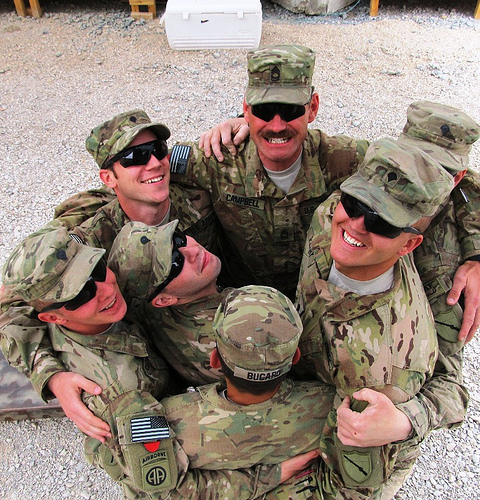
Spc. Jesse Loghry (farthest left), a 22-year-old Irvington, Ky. resident on his third deployment in four years enjoys some group bonding time with fellow Soldiers in Southern Afghanistan on March 26, 2012. Loghry, a combat medic by trade, serves as a vehicle gunner on Kentucky’s Agribusiness Development Team 4. Also pictured (from left): Spc. Keith Stanley (outside left) of Frankfort, Ky.; Spc. Chris Young of Richmond, Ky.; Master Sgt. Chris Campbell of Nicholasville, Ky.; and Spc. Preston Perry of Lexington, Ky. (Photo by U.S. Army Staff Sgt. Paul Evans)
“Remember the little things,” Loghry advised. “Because that’s what will push you through. The smallest things back home, like my little brother, he turned 4 (years-old) this year, and I see pictures on Facebook of him growing up. And it’s just like, I remember whenever he just three months old. He’s grown up so much, and it’s like, ‘God, I miss the hell out of him.’”
“Listen to your Senior NCOs,” Loghry added. “The ones that have been over and have done the stuff, really listen to them and try to learn everything you can. No matter what your job is, try to learn everything.”
Having served in Iraq and Afghanistan, Loghry offered a few comparisons of his experiences in each.
“Afghanistan, we live in tents. I’m not used to that,” he said. “I like Afghanistan because we’ve got a really good chow hall. In Iraq, at the end, we were eating MREs and basically, everything was kind of shut down.”
“I like the scenery a little bit better in Afghanistan,” Loghry added. “In Iraq, it’s all desert, it’s all flat…either that or if you’re in the city, you see run-down buildings. It’s like you’re in the ghetto everywhere. There’s trash and dead animals laying in the street and they don’t even care.”
Loghry said he has received some emotional support while deployed from family and a few close friends who happen to be active duty Army officers.
“My dad always seems really supportive about it,” he described. “My mom, I know she hates it. And my little brother Charles, he’s going to turn 22 (years-old) in December. He joined the Army and he’s now active duty as a Medic at Ft. Knox. I don’t ever want him to think that he’s got to live up to (my) expectations,” Loghry added.
“I’ve got a few good friends. Like 2nd Lt. Ryan Torres, that’s always going to be my best friend,” Loghry said. “I’ve known him since high school and he’s now active duty. Once he finishes up Ranger school and we go on vacation while I’m home on leave, he’s going to the 3rd Armored Cavalry Stryker Brigade (in Germany).”
“My other best friend, 2nd Lt. Dillon Orison, he actually graduated from college (at Western Kentucky University) in May. “He’s going to be an Armor officer. Other than that, I’ve got very few people I talk to back home,” Loghry noted.
If everything goes well, Loghry said he does plan on deploying again, but plans to take a few years off before the next trip.
“Depending on how the duration of this thing goes will be the deciding factor of whether I want to end up staying in the Army or not,” Loghry said. “I don’t want to say that I’m burnt out, but at the same time I’d love to be home right now.”
By: Harry Wiley, Kentucky Employer Support to the Guard and Reserve Public Affairs
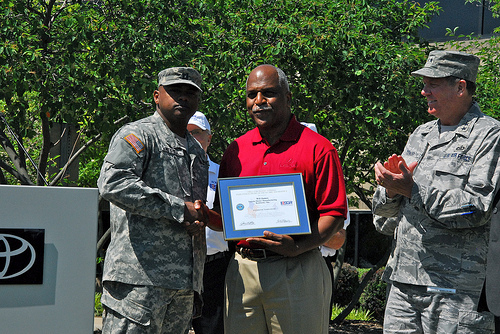
Toyota Motor Manufacturing Company was honored by the Kentucky Employer Support of the Guard and Reserve in which multiple awards were presented to the company and to Wilbert ‘Will’ James, Jr., president of TMMC, by KY ESGR and the National Chairman for ESGR, James G. Rebholz for their continued support to the Kentucky Guard and Reserve in Georgetown, Ky. May 18. Maj. Gen. Edward W. Tonini, adjutant general of Kentucky and Retired Maj Gen. Robert S. Silverthorn, Jr, chair for Kentucky ESGR were also in attendence to help honor the company. (Photo by Army Capt. Stephen Martin, Kentucky National Guard)
GEORGETOWN, Ky. — Toyota Motor Manufacturing Kentucky was honored at its Kentucky facility here May 18 with multiple awards from the Kentucky Committee for Employer Support of the Guard and Reserve.
To see all the photos from the event, please click HERE.
“Our Kentucky ESGR committee is proud of the support that companies in the Commonwealth give to our young servicemen and women,” said Robert S. Silverthorn, Jr., Kentucky ESGR chair.
“However, it is a unique honor for a company to receive multiple awards. Toyota has shown its leadership in supporting our Guard and Reserve troops in many ways, from its scheduling of servicemembers’ time at work so that it does not conflict with military duties to its pledge to hire these men and women.”
“Kentucky’s unemployment rate for our Guard and Reserve service members far exceeds the national unemployment average,” said Silverthorn. “Toyota’s leadership in the area of hiring of these men and women is not only admirable, it sets a high example for other Kentucky companies to follow. Today’s reaffirmation of the patriotic spirit of TMMK was demonstrated by its public signing of a Department of Defense/ESGR Statement of Support.”
The significance of this event was underscored by the presence of ESGR National Chair James G. Rebholz at the ceremony. “ESGR salutes and thanks Toyota for its significant and unwavering support of our Guard and Reserve members and their families,” said Rebholz. “Its leadership and commitment to these Citizen Warriors and their families evidenced by its signing of the Statement of Support makes it a true partner in our national security efforts. We in the Department of Defense look forward to continuing a mutually beneficial relationship with Toyota.”
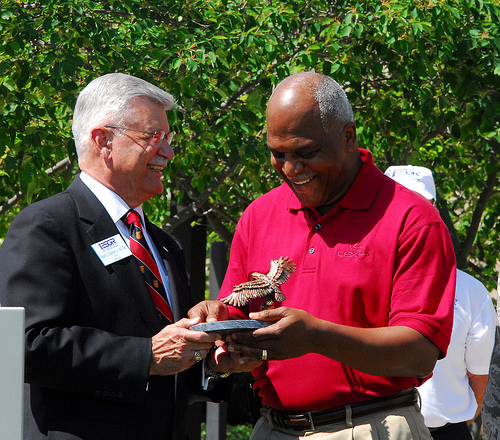
Retired Maj. Gen. Robert S. Silverthorn Jr. presents an Employer Support of the Guard and Reserve award to the president of Toyota Motor Manufacturing Kentucky, Wilbert ‘Will’ James, Jr. in Georgetown, Ky. May 18 for Toyota’s support to the Guard and Reserve troops. (photo by Capt. Stephen Martin, Kentucky National Guard Public Affairs)
TMMK was presented with ESGR’s Pro Patria and Seven Seals awards. In addition, TMMK President Wil James was surprised with an ESGR Patriot Award. The “Pro Patria Award” is presented annually by the Kentucky ESGR committee to one small, one large and one public sector employer in the Commonwealth that has provided the most exceptional support of our national defense through leadership practices and personnel policies that support its employees who serve in the National Guard and Reserve. The Seven Seals Award, which depicts the heraldry seals of the seven military services, is given at the discretion of the Kentucky state chairman to honor a wide array of support for service members from all seven Reserve Components and is the only ESGR award that bridges both the employer and volunteer recognition programs.
The Patriot Award was created by ESGR to recognize individuals who provide outstanding patriotic support and cooperation to their employees, who like the citizen warriors before them, have answered their nation’s call to serve. James was nominated for the Patriot Award by TMMK employee Kentucky Army National Guard Cpt. Tim Mitchell, who serves with the Kentucky Joint Forces Headquarters in Frankfort.
“I certainly feel very honored, especially when I learned the nomination came from one of my own team members,” stated James. “As a company, we understand the importance of supporting men and women who answer the call to support our country through service in the Guard or Reserve.”
ESGR also presented TMMK with an ESGR flag to fly at its Georgetown facilities. TMMK employees, who are military veterans, flew the flag at the close of the awards ceremony.
ESGR is a Department of Defense agency with a mission to develop and promote a culture of employer support from all public and private employers for the men and women of the National Guard and Reserve and their families, as well as to assist them in employment. ESGR operates through a network of more than 4,800 volunteers throughout 54 committees located in all states, the District of Columbia, Guam/CNMI, Puerto Rico, and the Virgin Islands. ESGR is the resource for the employers of citizen warriors. ESGR provides education, consultation, and if necessary mediation for employers of Guard and Reserve employees. More information about ESGR Employer Outreach Programs and volunteer opportunities is available at www.esgr.mil.
staff report
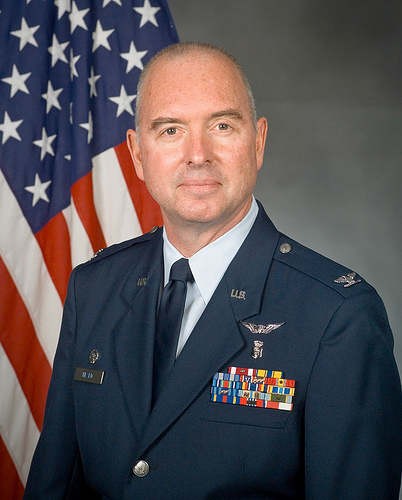
Col. Henry “Hank” Heard, Kentucky Air National Guard 123rd Medical Group
LOUISVILLE, Ky. — Col. Henry “Hank” Heard has been named commander of the Kentucky Air National Guard’s 123rd Medical Group, 123rd Airlift Wing Commander Col. Greg Nelson announced.
Heard most recently served as commander of the 187th Medical Group, an Alabama Air National Guard unit located at Montgomery Regional Airport in Montgomery, Ala.
Heard attended West Georgia College and the Southern School of Pharmacy before transferring to the Medical College of Georgia. He graduated in the third class of physician assistants from Medical College of Georgia in 1976.
Heard soon became active in several professional organizations, serving as president of the Georgia Association of Physician Assistants and as a member of the Composite State Board of Medical Examiners of Georgia.
Nearing 41 years of age without prior military experience, Heard joined the 908th Medical Squadron, United States Air Force Reserve, at Maxwell Air Force Base, Ala. He transferred to the 187th Fighter Wing in 1996.
Heard is the first Air Force physician assistant to complete the United States Army Flight Surgeons course in 1995, the first Air Guard physician assistant to complete the “Top Knife” program in Klamath Falls, Ore., and the first physician assistant to be promoted to the rank of colonel in the Air National Guard. In 2002, Heard was honored as the Air National Guard’s Outstanding Physician Assistant of the Year.
The following year, he deployed overseas as a member of the 160th Expeditionary Fighter Squadron Medical Element. During his most recent deployment, Heard assumed command of the 447th Expeditionary Medical Squadron at Sather Air Base, Iraq.
As a civilian, Heard works in an Emergency Medicine practice at an Emory University community hospital in Atlanta, Ga. He also is a commercial pilot with instrument and multi-engine ratings.
His major awards and decorations include the Meritorious Service Medal with three oak leaf clusters, an Air Force Commendation Medal, an Air Force Achievement Medal, a Meritorious Unit Award, the Air Force Outstanding Unit Award with a bronze valor device and three oak leaf clusters, an Iraq Campaign Medal with bronze star, an Air Force Expeditionary Service Ribbon with gold border and an Expert Marksmanship Ribbon with bronze star.
Story by Sgt. Bryan Ploughe, 1st Battalion, 623d Field Artillery Unit Public Affairs Historian Representative

Kentucky Army Guardsmen Pfc. Kara Denise Bucklew and Spc. Eddy D. Mitchell, both MPs with the 223rd Military Police Company stationed in Louisville, Ky., guard the winner’s trophy in front of the winner’s circle at Churchill Downs in Louisville, Ky. May 5 2012. This year marks the 138th running of the roses and was Bucklew’s first Derby experience. (Photo by: Spc. David Bolton, Public Affairs Specialist, 133rd Mobile Public Affairs Detachment, Kentucky Army National Guard).
Louisville, KY. (May 8, 2012) – The 138th “Run for the Roses” was one that was on track to set new attendance records. The previous attendance record, which was set in 2011 was 164,858 spectators. This year that number was surpassed by nearly 500, with 165,307 in attendance. The record attendance also generated a record number of wagers. A total of $187 million dollars was bet on the full 13-race card.
“With these projected numbers, we knew this event was going to be monumental,” said Lt. Col. Jeffery Hughes, the commander of troops. “Here in the operations center, we are working in concert with state and local officials and first responders to monitor the crowds and be here to respond to whatever need may arise. We have 282 Soldiers on ground for this event that will be serving in several different support roles, from security and traffic control to escorting VIP’s. Taking into consideration the size of the crowds and other factors, this event is running exceptionally smooth.”
Col. Charles Harris, the state security officer for the Kentucky National Guard, said, “We have a Proper Use Memorandum in place to use assets like the Civil Air Patrol to support local authorities with information in case of a catastrophic event.”
It’s not just man-made disasters the team plans for, said Harris. “We monitor issues like the weather, so we will be as prepared as possible if the unthinkable occurs, like a tornado or severe thunderstorm. Additionally, part of our job is to warn our Soldiers and Airmen if there is a threat of severe storms, or heat, or anything else that may hamper their mission.”
The operations center for the Kentucky National Guard works in concert with local law enforcement and emergency personnel to ensure the safety and the smooth operation for the entire Churchill Downs premises.
By: Sgt. Dale Elliott, 75th Troop Command Unit Public Affairs Historian Representative
NOTE: Each week kentuckyguard.com publishes stories by Kentucky National Guard unit public affairs historian representatives, also known as UPAHRs. This is an additional duty taken on by a Soldier or Airmen with the intent of telling their unit’s story. This is one such story ….
 GREENVILLE, Ky. — Last year Kentucky saw record breaking high temperatures throughout the state. With this heat area hospitals saw several heat related injuries and deaths. Despite the risks members of the Kentucky National Guard fought the danger, continued training and worked through it.
This year may not be so bad. “I don’t think there is any data whatsoever to suggest a record hot summer,” said Marc Weinburg, chief meteorologist for WDRB TV-41 in Louisville. “The La Nina that has dominated our weather for the last year is over and its impact is done. The last month has deviated greatly from the last year showing the impact from the La Nina is over. I think there really is an equal chance of warmer or normal for temperatures this summer.”
Even though he does not expect a record breaking summer all of us should start thinking about being prepared for the heat.
“It is important to listen to the signals that your body gives off during strenuous in heat,” said Weinberg. “If you feel light headed or your body is telling you it is time to take a break then it is important to listen. There are a lot of warning signs before heat exhaustion or heat stroke occur.”
In 2011, 13 different units participated in annual training at Wendell H. Ford Regional Training Center in Greenville, Ky. Despite the risky nature of some of this training the weather did not severely effect any of the soldiers.
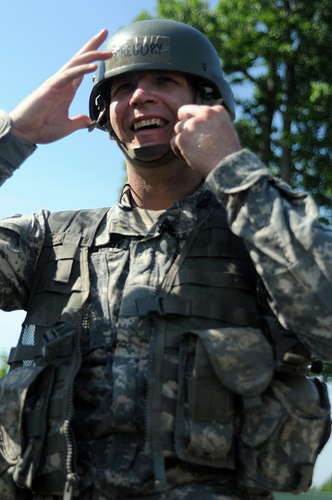
Carson Gregory, a Kentucky National Guard Officer Candidate with class 54-12, takes a break during his 10-mile ruck march that marked the completion of phase two of the classes’ training at Wendell H. Ford Regional Training Center April 15, 2012. (Photo by Spc. David Bolton, Public Affairs Specialist, 133rd Mobile Public Affairs Detachment, Kentucky Army National Guard)
Lt. Col. Ruth Graves, WHFRTC manager, was pleased with these results. “We have been at heat category 5 for a few weeks now. We have safety briefings everyday at our sync meetings with the help of range control.”
“With several of these units in 24 hour operations, keeping safety on the minds of everyone involved frequently. That has helped keep this a safe year,” said Graves. “Some units have had heat-related injuries, but these were easily treated because they were paying attention and was able to catch it before they became serious.”
Fort Knox range control also monitors heat categories for training, but the individual units must do their own monitoring.
“One thing the units and people training need to remember is that when we do a heat category reading, that reading is at the Range Control building.” said Charles Blakey, an employee of Fort Knox Range Control. “The units have to monitor on their own. It may be 99° here but in other parts of the base it could be 105° or 110°.”
The military as a whole has been focusing on “self aid” and “buddy care” for quite a while now and it seems to be paying off. Soldiers are keeping themselves and their “battle buddy” properly hydrated. This training and good leadership monitoring has drastically reduced the serious injuries and deaths related to heat injuries.
Every year you can watch the local news and see examples of heat related injuries and deaths, it becomes clear that what the military is doing has made an impact on soldiers health. It also becomes clear that civilian employers and civilians in general need to take a lesson from the military and apply those “buddy care” principles.
Citizen Soldiers and Airmen should also keep “buddy care” in mind when with their civilian employer or family members. Who knows — the knowledge you share might save a life!