
Pages
Stay In Touch
More
© 2013 KentuckyGuard
Tech. Sgt. Jason Ketterer, 123rd Airlift Wing Public Affairs
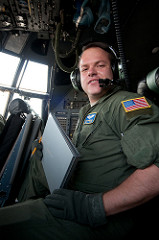
Tech. Sgt. Matthew McKeehan is a Flight Engineer for the 165th Airlift Squadron. (U.S. Air Force photo by Master Sgt. Phil Speck)
KENTUCKY AIR NATIONAL GUARD BASE, LOUISVILLE, Ky. — For more than two decades, the 123rd Airlift Wing has been sending enlisted crewmembers to the sky in the C-130 Hercules. Their airborne office hurtles these flight engineers and loadmasters across the globe to perform their mission year ’round, whether it be supporting hurricane relief operations at home or fighting the global war on terror abroad.
It’s a rare opportunity most enlisted airmen will never know: They get to fly in airplanes.
“If you ask the average person on the street, ‘Who flies airplanes?’ naturally they’re going to say pilots,” said Lt. Col. Shawn Dawley, commander of the Kentucky Air National Guard’s 165th Airlift
Squadron. “And in some aircraft, that’s absolutely accurate. It’s only a pilot.
“But with the C-130, due to the complexities of the systems, the complexities of the mission, the types of tasks we’re asked to accomplish, we have to organize ourselves around a crew concept to divvy up responsibilities amongst crew members to manage the whole task.”
And now, thanks to a restructuring of the force, the 165th Airlift Squadron is looking to recruit potential
Airmen who want to be part of that collective crew by serving as loadmasters and flight engineers.
During sorties as an enlisted member in the tactical airlift world, a flight engineer is responsible for
monitoring fuel systems, electrical systems, hydraulics and pneumatics. Sitting between three officers
on the flight deck, the engineer also preflights the C-130 and computes take-off and landing data.
A loadmaster’s realm is at the bulkhead and the rear of the aircraft. Physically separated from the rest of
the crew, a loadmaster calculates the metrics of cargo to verify that the weight and subsequent balance
within the fuselage is safe for transport.
“The constant variation of loads requires us to be prepared for all types of cargo to be moved with our
aircraft,” said Airman 1st Class Erick Anderson, a loadmaster with the 165th. “Loadmasters are required
to be fluent in and resourceful with our publications so that we’re quick to identify conflicts with cargo
and plane limitations. We’re responsible for everything from transporting passengers to dropping a
parachutist out of a plane at 10,000 feet, hauling vehicles to isolated areas or airdropping ammo, water,
medical supplies and equipment to our troops in battle.”
A loadmaster has “awesome responsibilities to the aircraft and crew,” according to Chief Master Sgt. Jeff
Brown, Loadmaster Section chief, and there is no room for unsafe execution.
“We need airmen who know how to be safe, want to be safe, that are willing to fly into unsafe conditions in order to do what needs to be done,” Brown said. “When you’re in the AOR, in Afghanistan in particular, you’re in a dangerous area from take off to landing.”
“Integrity First” — one of the Air Force Core Values — is paramount in tactical airlift, officials said.
“The actions of one directly affect the lives of the other men and women on board,” said Senior Master
Sgt. Scott Davis, acting supervisor of the Flight Engineer Section.
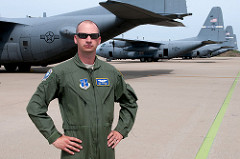
Airman 1st Class Erick Anderson is a Loadmaster for the 165th Airlift Squadron. (U.S. Air Force photo by Tech. Sgt. Dennis Flora)
The ability to work well in teams while being self-sufficient is another key attribute for enlisted crewmembers.
“Confidence in yourself and your training will play a part in determining any Airman’s success as an aviator, but you also have to play well with others,” Davis said. “You report to the aircrew commander, but you have to operate independently. A lot of times you have to be the systems expert. So we’re
looking for someone who can not only work well with others, but who is also self-motivated to keep up on their own training.”
That training will take enlisted crewmembers to the farthest corners of America.
“My training for the military consisted of attending technical schools located throughout the
continental United States,” recalls Tech. Sgt. Matthew McKeehan, a flight engineer in the 165th Airlift
Squadron. “My first school was in San Antonio, Texas, at Lackland Air Force Base for basic engineer
training. Next was survival training, which took me to Pensacola, Fla., and Spokane, Wash. After these
training assignments were completed, I traveled to Little Rock, Ark., for specific training on the C-130. All in all, it took me away from home for a solid year.
“While this was the most challenging training I’ve ever accomplished, the hard work and time sacrificed
away from friends and family has been well worth it,” he noted.
According to Dawley, the skills that will make or break an aircrew member’s career are not easily displayed on a resume. Nor can they necessarily be measured by scores from aptitude tests like the
Armed Forces Vocational Aptitude Battery or the Air Force Officer Qualifying Test.
Individuals must possess a thick skin to be able to recover from mistakes, learn from them and not let it
affect the mission at hand, he said. Also, Airmen must possess an “intrapersonal versatility” to be able to
contribute in a professional manner with whomever they are assigned to work with in a crew.
“Long hours and 120-day deployments can be taxing in any work environment, but the personality that
you bring to work needs to be mission-oriented and focused,” he said.
“Lastly, to say that it takes courage to perform all of these tasks is an understatement by far. A flight
engineer or a loadmaster has to be willing to strap themselves into a 155,000 pound piece of metal, load
it with jet fuel and deliberately fly it into the teeth of the adversary, yet possess maturity, wisdom and
judgment to not be reckless adrenaline junkies.”
For Brown, being a loadmaster has been a tremendously rewarding career.
“Watching heavy equipment leave the airplane during an airdrop has always been an exhilarating
experience for me,” he said. “You’re traveling along at approximately 150 mph, the (rear) ramp door
opens, the parachute goes out behind the airplane, opens up and pulls that load out. It’s almost like that
load is sitting still and the airplane pulls away from it at 150 miles an hour. That’s about how fast the
cargo leaves the airplane.”
Brown also gets a lot of satisfaction from aeromedical evacuation missions and emergency airdrops.
“A lot of times, especially in the AOR, we’ll go in to pick up (soldiers) or Marines who have been severely
injured. You have to get that guy out and fly him to a medical facility quickly. We’ll also do emergency
airdrops, where we go into a combat area to drop ammunition to troops who are in contact with the
enemy right there, and they are almost out of ammunition and have to have it right away. Those are
always fulfilling missions because you know how important your work is to those wounded soldiers or
the troops on the ground.”
Video by: Tech Sgt. Jason Ketterer, Kentucky National Guard Public Affairs
[youtube http://www.youtube.com/watch?v=pCOWPf1_y6U]
LOUISVILLE, Ky. -Nearly 60 members of the Kentucky National Guard’s Agribusiness Development Team 3 were honored during a welcome home ceremony at the Kentucky Air National Guard Base at the end of February.
Click here to read the full story published on www.Kentuckyguard.com.
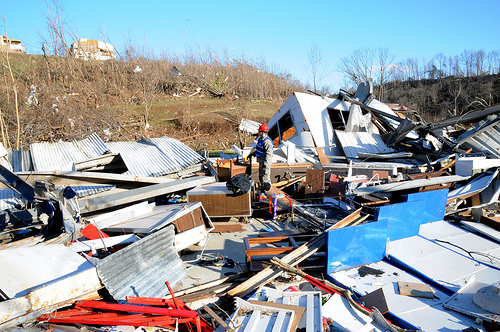
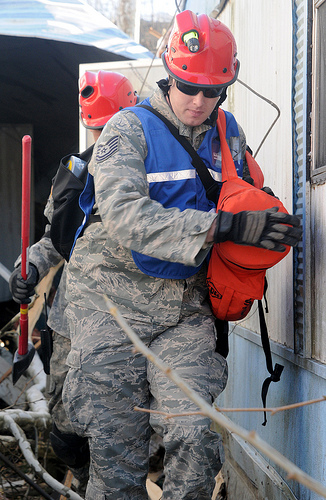
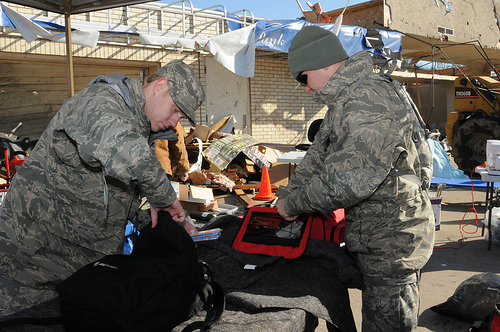
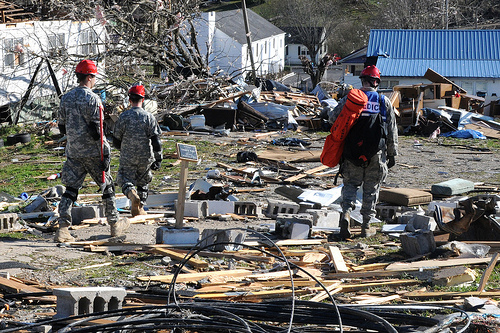
Kentucky Air Guardsman Tech. Sgt. Harold Baker, a medic with the Chemical Biological Radiological Nuclear and Explosive Enhanced Response Force Package out of Louisville, Ky., checks for trapped survivors in homes in the city of West Liberty, Ky., where severe storms devastated the area Mar. 3. (Photo by Spc. David Bolton, 133rd Mobile Public Affairs Detachment, Kentucky National Guard).
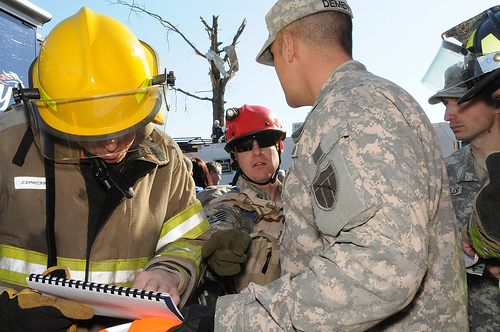
By Tech. Sgt. Jason Ketterer, 123rd Airlift Wing Public Affairs
Click here to view a photo gallery for this story.
Click here to view a video report of this story.
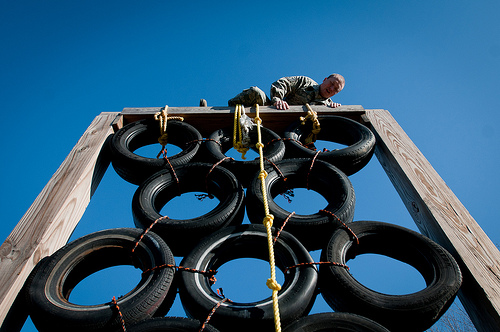
Master Sgt. Josh Devine, a member of the Kentucky Air National Guard’s 123rd Security Forces Squadron, climbs over a tire tower at Southern High School in Louisville, Ky., Dec. 10, 2011. Airmen from the 123rd SFS were at the high school to use the Junior ROTC obstacle course for a team-building exercise as part of Wingman Day activities. (U.S. Air Force photo by Senior Airman Maxwell Rechel)
LOUISVILLE, Ky. — Members of the Kentucky Air National Guard’s 123rd Security Forces Squadron spent Dec. 10 navigating an obstacle course at Louisville’s Southern High School as part of a team-building exercise held in conjunction with Wingman Day.
Wingman Day is an annual event designed to promote resilience and focus attention on the physical, spiritual, social and psychological health of Airmen while building esprit de corps, said Master Sgt. Larry Bristow, 123rd Security Forces Squadron unit training manager.
The idea is for Airmen to learn the importance of taking care of themselves and their fellow troops — a goal which made the obstacle course a natural choice for Wingman Day activities, Bristow said.
He came up with the idea of using the obstacle course — maintained by Southern’s Army Junior ROTC program — while attending his son’s soccer game at the campus last year.
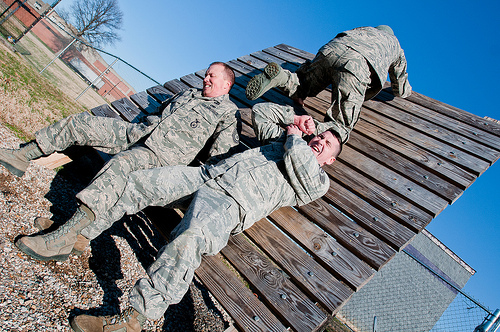
Staff Sgt. Ed Nooning and Master Sgt. Josh Devine, members of the Kentucky Air National Guard’s 123rd Security Forces Squadron, help Tech. Sgt. Jesse Smith over an obstacle at Southern High School in Louisville, Ky., on December 10, 2011. Airmen from the 123rd SFS were at the high school to use the Junior ROTC obstacle course for a team-building exercise as part of Wingman Day activities. (U.S. Air Force photo by Senior Airman Maxwell Rechel)
“When Wingman Day came around, we thought this would be a good event for the whole squadron to work together and become more familiar with each other,” he said.
Maj. Grant Simpson, commander of the 123rd Security Forces Squadron, said the course was a welcome change of pace from normal training at the Air Guard Base, which typically focuses on security patrols or other solitary activity.
“We get so sequestered in our computer training and everything else that a lot of times when you come to drill, you don’t get a chance to interact with people on another fire team or a different group,” he said.
The course features an un-anchored rope climb, low crawl, tower climb, tightrope, and 10-foot vertical wall.
“I think everybody did real well,” Simpson added, chuckling. “But they’re going to be hurting tomorrow.”
