
Pages
Stay In Touch
More
© 2013 KentuckyGuard
By 123rd Airlift Wing Public Affairs
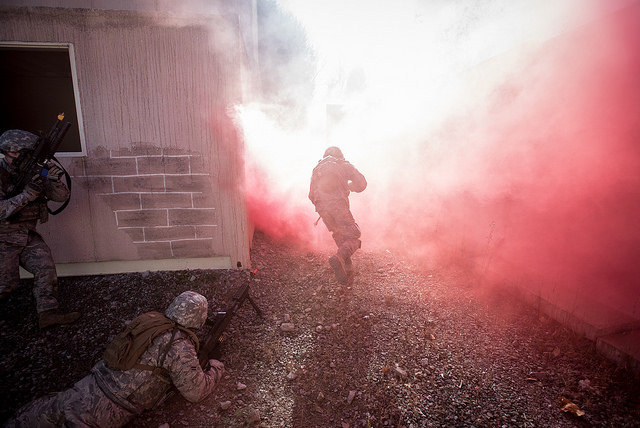
Fire Team members from the Kentucky Air National Guard’s 123rd Security Forces Squadron conduct training to recover a downed pilot inside a simulated Afghan Village at Fort Knox, Ky., Oct. 20, 2015. The Airmen were required to execute a coordinated search while defending their positions and engaging hostile enemy forces. (U.S. Air National Guard photo by Maj. Dale Greer)
FORT KNOX, Ky. — Fire Team members from the Kentucky Air National Guard’s 123rd Security Forces Squadron conducted a field training exercise here Oct. 20 that was designed to enhance their ability to operate in a combat environment.
Unit members were evaluated on their ability to extract a downed pilot from a simulated Afghan village and defend a military outpost in the Afghan countryside.
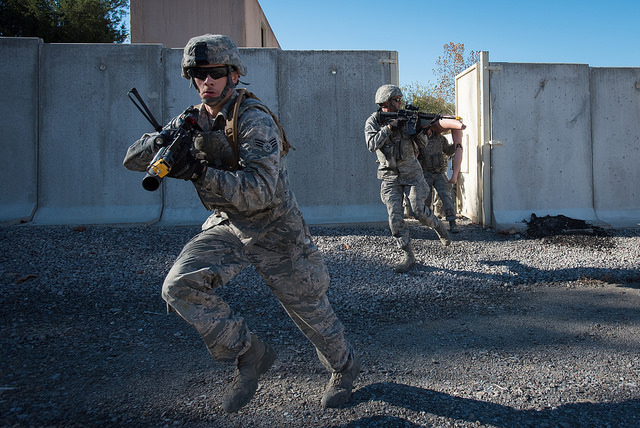
Fire Team members from the Kentucky Air National Guard’s 123rd Security Forces Squadron conduct training to recover a simulated downed pilot inside a mock Afghan Village at Fort Knox, Ky., Oct. 20, 2015. The Airmen were required to execute a coordinated search while defending their positions and engaging hostile enemy forces. (U.S. Air National Guard photo by Maj. Dale Greer)
Click here for more photos.
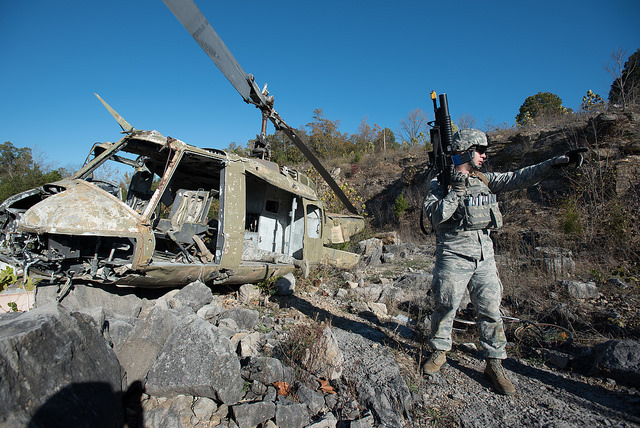
Senior Airman Randy Roberts, a Fire Team leader from the Kentucky Air National Guard’s 123rd Security Forces Squadron, directs efforts to recover a simulated downed pilot inside a mock Afghan Village at Fort Knox, Ky., Oct. 20, 2015. Roberts and his fellow Airmen were required to execute a coordinated search while defending their positions and engaging hostile forces. (U.S. Air National Guard photo by Maj. Dale Greer)
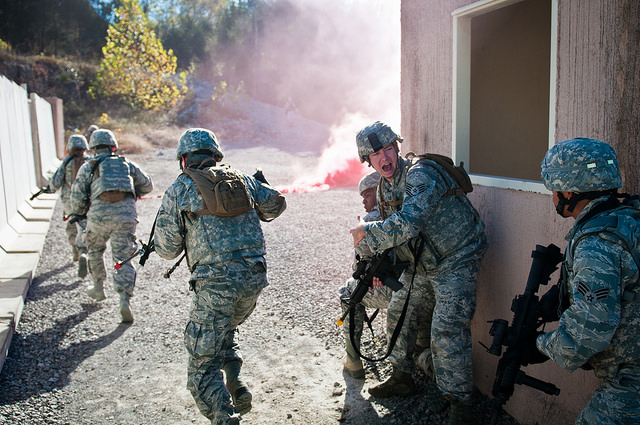
Tech. Sgt. Julien Borchert, a squad leader for the Kentucky Air National Guard’s 123rd Security Forces Squadron, shouts commands during a field training exercise at Ft. Knox, Ky., Oct. 20, 2015. Unit members were being evaluated on their ability to extract a downed pilot from a simulated Afghan village. (Kentucky Air National Guard photo by Master Sgt. Phil Speck)
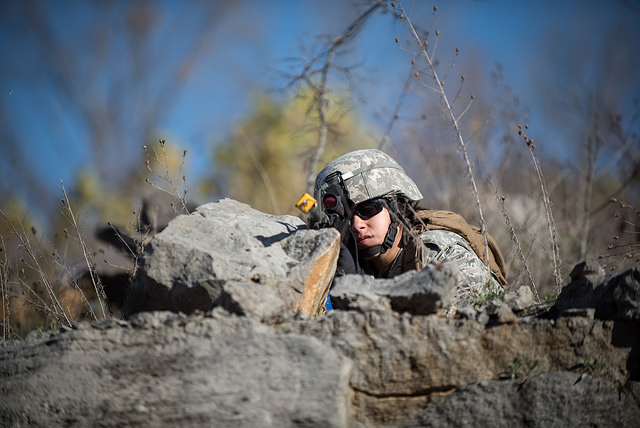
A Fire Team member from the Kentucky Air National Guard’s 123rd Security Forces Squadron provides cover as his teammates search for a simulated downed pilot inside a mock Afghan Village at Fort Knox, Ky., Oct. 20, 2015. The Airmen were required to execute a coordinated search while defending their positions and engaging hostile forces. (U.S. Air National Guard photo by Maj. Dale Greer)
By Master Sgt. Phil Speck, 123rd Airlift Wing Public Affairs
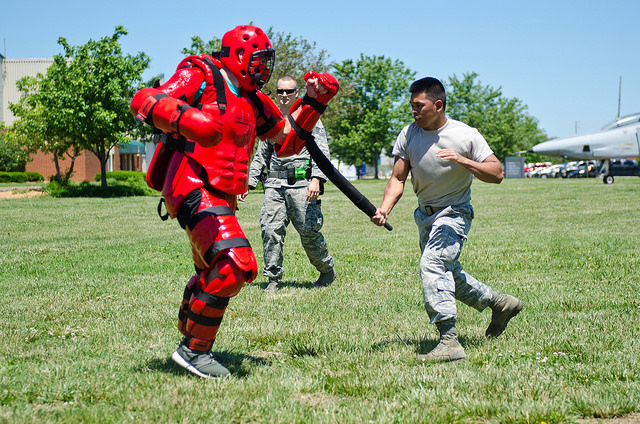
Senior Airman Reymart Relos (right), a services technician for the 123rd Force Support Squadron, attacks a 123rd Security Forces Squadron member during baton training as part of a week-long course for security forces augmentees at the Kentucky Air National Guard Base in Louisville, Ky., May 19, 2015. The course is designed to train Airmen from other career fields to perform base security functions, providing a pool of Airmen to assist the 123rd Security Forces Squadron during shortfalls in manning due to emergencies. (U.S. Air National Guard photo by Master Sgt. Phil Speck)
KENTUCKY AIR NATIONAL GUARD BASE, LOUISVILLE, Ky. — The 123rd Security Forces Squadron recently held a five-day Security Forces Augmentee training event for 10 Airmen from different job specialties spanning multiple units within the 123rd Airlift Wing.
Security Forces Augmentee training is designed to take Airmen outside of their career fields and provide them with the skills to perform basic security functions in order to assist security forces during shortfalls in manning due to emergencies, contingencies or an increase of the Force Protection Condition, according to Capt. Jason Rayl, operations officer for the 123rd Security Forces Squadron.
Rayl explained that the augmentees would be utilized in emergency situations until fully qualified security forces members could be recalled.
“It’s a good opportunity for members outside the security forces career field to participate in the security of the installation and gain a better understanding of how SFS operates in a home-station environment,” he said.
The training includes a variety of basic security forces tasks and concepts, including weapons qualification, use of force, small-unit tactics, searches and seizures, and more. All of the lessons are important, from tactics training to searching techniques, and help augmentees carry out the SFS mission set of air base defense and the Kentucky Air Guard’s mission of providing tactical airlift capabilities worldwide, Rayl said.
The augmentees also learned advanced weapons techniques, and hand-to-hand combat for self-defense and weapons retention — all training that a normal Airman outside of Security Forces would not learn.
The final day of training consisted of augmentees being paired with fully trained security forces members on a variety of different security posts and being practically evaluated with different exercise scenarios to test the trainees’ mastery of what they learned throughout the week.
At the completion of the course, a graduation ceremony was conducted in which the augmentees were presented certificates by the wing commander and unit challenge coins.
As the program grows, augmentees will receive additional on-the-job training to qualify them to work specialized security posts and entry control points to enhance overall security of the installation, Rayl said. They will also complete annual refresher training next year.
Airman 1st Class Benjamin Bohannon, a services technician for the 123rd Force Support Squadron, said the training was excellent.
“I enjoyed it — it was very different than what I was used to,” Bohannon said. “It’s 13 weeks of tech school all rolled into one week. It was very intense, but also good training.”
Craig Davis, unit training manager for the 123rd Security Forces Squadron, said the program pays substantial dividends for base security.
“Utilizing augmentees as a force-multiplier will enhance the security and well-being of all members on base,” Davis said.
Lt. Col. George Imorde, commander of the 123d Security Forces Squadron, mentioned the difficulty of scheduling the training annually in a resource-constrained environment but highlighted its importance.
“DoD-wide, resources are tight,” he said. “It took a collective effort to pull this training together. The combination of wing, group and squadron leadership support, coupled with energetic volunteerism and stellar non-commissioned officer initiative, is what ultimately made this a highly successful training event.”
Security Forces will be recruiting both full-time Airmen and members of the traditional Guard force from across the wing to meet the Air Force and Air National Guard’s needs during increases to Force Protection measures.
In light of recent attacks against military targets domestically and abroad, creating a trained and qualified augmentee force will ensure the overall safety and security of KYANG members and its assets, Imorde said.
Beginning in October, the 123rd Security Forces Squadron will be hold a new initial augmentee training program for volunteers who wish to participate and assist the entire wing. For more information, contact the 123d Security Forces Squadron.
Story by Master Sgt. Phil Speck, 123rd Airlift Wing Public Affairs
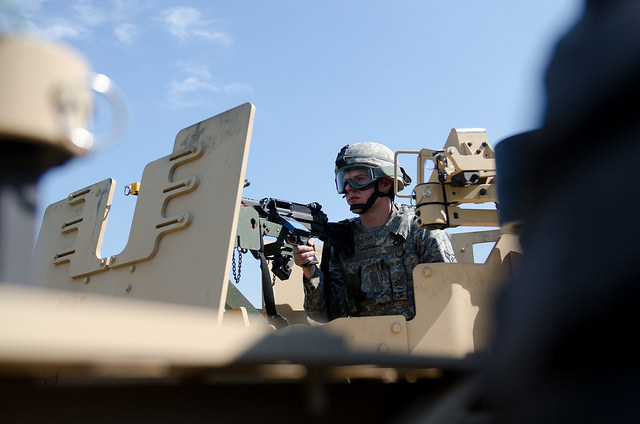
Airman First Class Adam Cantrell, a security forces journeyman from the Kentucky Air National Guard’s 123rd Security Forces Squadron, provides over watch during a mounted patrol as part of a training exercise at the Wendell H. Ford Regional Training Center in Greenville, Ky., on Sept. 17, 2014. The unit’s Airmen conducted a five-day, combat-skills training course to prepare for future deployments. (U.S. Air National Guard photo by Master Sgt. Phil Speck)
GREENVILLE, Ky. — Airmen from the Kentucky Air National Guard’s 123d Security Forces Squadron conducted five days of intense field training here recently to prepare them for future deployments in potentially hostile environments.
The training kicked off Sept. 15 with the Airmen being inserted into the Wendell H. Ford Regional Training Center via a Kentucky Army National Guard UH-60 Blackhawk helicopter. From there, they set up a perimeter, completed a two-mile patrol and assaulted a village to rescue two simulated prisoners of war — all in just the first two hours.
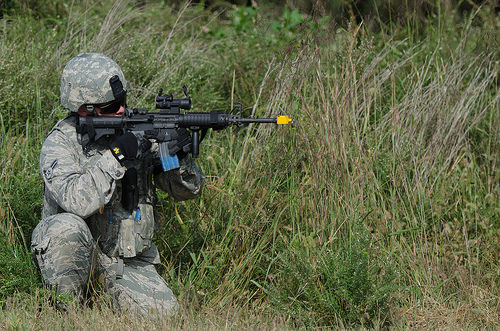
An Airman from the Kentucky Air National Guard’s 123 Security Forces Squadron aims his weapon at opposing-force actors during a training exercise at the Wendell H. Ford Regional Training Center in Greenville, Ky., on Sept. 18, 2014. The unit’s Airmen conducted a five-day, combat-skills training course to prepare for future deployments. (U.S. Air National Guard photo by Master Sgt. Phil Speck)
The Airmen also conducted exercises on land navigation and night patrols before concluding the week with a robust field-training scenario designed to simulate air base defense and mounted patrols in a combat environment, according to Lt. Col. George Imorde, commander of the 123d Security Forces Squadron.
Imorde said the training couldn’t have come a better time, as many of the squadron’s Airmen were preparing at the time to deploy to Africa in support of Operation United Assistance, the U.S. government’s multi-agency effort to stop the largest Ebola outbreak in history.
“This field training exercise enhanced our rapid-deployment ability to support Operation United Assistance, and the realistic base defense/force protection training provided a refresher of the duties and expectations directly related to our combat mission,” Imorde said.
A common misconception is that security forces only guard the gates at Air Force installations, secure the flight line and patrol the base, according to Tech. Sgt. Craig Davis, NCOIC of combat arms for the 123rd. But that is just a small portion of their responsibilities, he said.
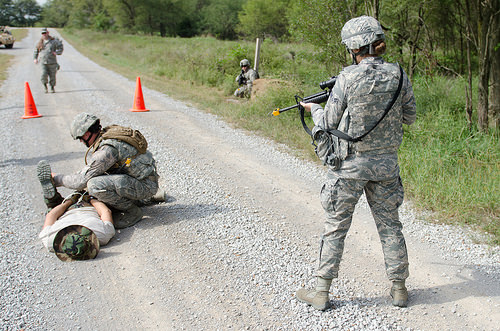
Personnel from the Kentucky Air National Guard’s 123 Security Forces Squadron apprehend a simulated opposing-force actor during a training exercise at the Wendell H. Ford Regional Training Center in Greenville, Ky., on Sept. 18, 2014. The unit’s Airmen conducted a five-day, combat-skills training course to prepare for future deployments. (U.S. Air National Guard photo by Master Sgt. Phil Speck)
“The bigger picture of what we do is the defense and protection of air bases in deployed environments,” Davis said. “The methodology of completing those tasks is really our primary mission. When we deploy, these Airmen and NCOs are expected to know air base defense.”
For some of the 123rd’s newest NCOs, the Greenville exercise provided their first opportunity to demonstrate leadership under a deployed base-defense scenario, Davis said.
“Letting these young Airmen see what we do, and how we do it, is a very rewarding thing,” Davis said. “You get to see young NCOs become seasoned NCOs and take charge by bringing teams together. Everyone is an individual, but when people come together and work toward a common goal as a team, it’s pretty rewarding. When they are no longer looking to you for instruction, and they are looking to each other for approval, then you know the training has been successful.”
Members of the Wing’s 123rd Force Support Squadron also participated in the exercise, serving hot meals prepared in the unit’s Disaster Relief Mobile Kitchen Trailer.
Story by Master Sgt. Phil Speck, 123rd Airlift Wing Public Affairs
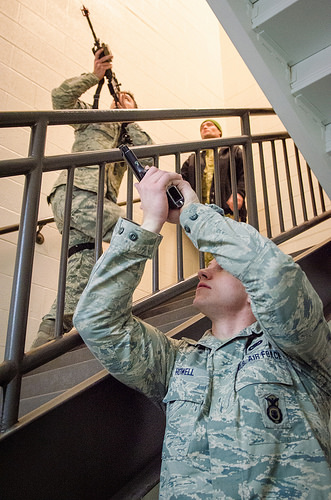
Staff Sgt. Joseph Howell (right), a combat arms trainer for the 123rd Security Forces Squadron, and Senior Airman Charles Henderson, a security forces fire team member, clear a stairwell at the Kentucky Air National Guard Base in Louisville, Ky., as a Louisville Metropolitan Police Department SWAT Team member provides instruction during a joint training exercise Jan. 13, 2014. The training is designed to enhance cooperation and interoperability between the Air Guardsmen and civilian police officers. (U.S. Air National Guard photo by Master Sgt. Phil Speck)
KENTUCKY AIR NATIONAL GUARD BASE, LOUISVILLE, Ky. – Airmen from the 123rd Security Forces Squadron conducted bilateral training with members of the Louisville Metropolitan Police Department’s Special Weapons and Tactics Team here Jan. 14, focusing on tactics, techniques and procedures used to defeat an attack by armed assailants.
More than 50 Louisville SWAT members divided into teams to train with the security forces Airmen, according to Tech. Sgt. Craig Davis, non-commissioned officer-in-charge of Combat Arms for the 123rd Security Forces Squadron. The officers and Airmen then worked together to stop a simulated gunman who was firing on base personnel as part of an “active-shooter” exercise.
After the exercise ended, the Airmen and officers covered additional training areas such as building approaches, room clearing and stairwell clearing.
Davis said the training was an excellent learning experience for both parties.
“LMPD really enjoyed their time out here,” he said. “They weren’t aware of our capabilities, but they walked away confident and with a better appreciation of them, knowing we can work together in potential emergencies in the future.”
Lt. Col. George Imorde, commander of the 123rd Security Forces Squadron, hopes to conduct more bilateral training in the future to strengthen the two units’ interoperability.
“Bilateral training is not something we get to do very often, but we need to do it to establish the relationship between military and civilian law enforcement elements,” he said. “Each unit gets to share their tactics, techniques and procedures. The real benefit is the relationship-building, because there are many emergency scenarios that might occur on military installations requiring a local law enforcement response.”
One such scenario would be a real-world active-shooter incident, during which the Louisville police department’s SWAT Team would integrate with Airmen from the 123rd Security Forces Squadron to secure the installation, he noted.
“Active shooters have been increasing throughout the country, and it seems like (these incidents are) more prevalent these days,” said Lt. Brent Routzahn, the Louisville police department’s SWAT Team commander. “We came out to show how we conduct business on our side and to be on the same page with the Air Guard, so if an incident ever did happen on the base, we would be on the same page regarding how we are going to operate and be familiar with each other.”
Imorde said such familiarity can pay big dividends.
“Now, (Louisville police department officers) have seen a footprint behind our gates that they’ve never seen before. They know what we look like, they know where our buildings are, they are familiar with our property, they know who we are, and they understand our capabilities,” he said. “That’s important.
“The feedback from our military personnel was that it was invaluable training, and something they don’t get every day,” Imorde added. “Airmen attend courses to become a military law enforcement officer, and sometimes that training gets far removed from real-world application. To get this additional insight and experience keeps our members refreshed on the latest tactics, techniques and procedures.”
Master Sgt. Greg Myers, operations superintendent for the 123rd Security Forces Squadron, said his Airmen now have more knowledge they can use to enhance base security.
“What we did in this training is why people join security forces, and why people stay in security forces,” he said. “We are stronger now, and our protection capabilities for the installation have grown tremendously. All the way from the entry teams to the command-and-control aspects, if anything were to happen, we know how we’re going to work with LMPD when their officers arrive and how we will proceed. It enhances the force protection of the installation immediately.”
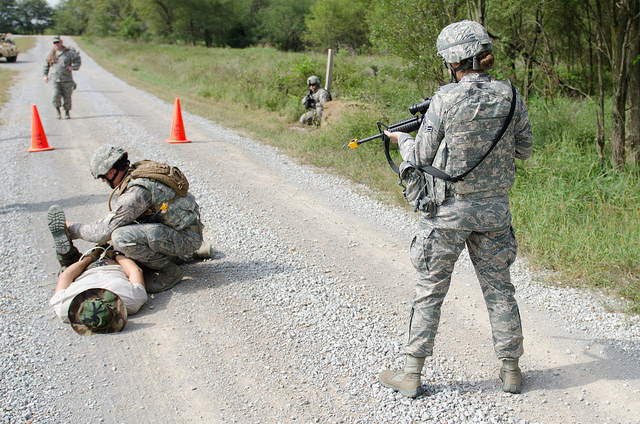
123 Security Forces Squadron personnel apprehend an simulated opposing force actor during a training exercise, at Wendell H. Ford Regional Training Center in Greenville, Ky. on Sept. 18, 2014. The SFS conducted a week-long training course for combat skills training and to prepare for future deployments. (U.S. Air National Guard photo by Master Sgt. Phil Speck)
By Master Sgt. Phil Speck, 123rd Airlift Wing Public Affairs Office
Wendell H. Ford Regional Training Center, Greenville, Ky.– Airmen from the Kentucky Air National Guard’s 123d Security Forces Squadron participated in field training on September 15-19 at WHFRTC. This training was designed to help prepare young Airmen and non-commissioned officers for future deployments.
Click here for more photos from this story.
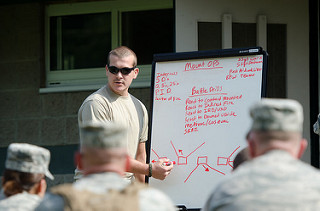
Staff Sgt. Kyle Clark, security forces craftsman for the 123rd Security Forces Squadron, teaches a security tactics class during a training exercise, at Wendell H. Ford Regional Training Center in Greenville, Ky. on Sept. 17, 2014. The 123rd SFS conducted a week-long training course for combat skills training and to prepare for future deployments. (U.S. Air National Guard photo by Master Sgt. Phil Speck)
This bi-annual training event began on base in the classroom the week prior. The week-long training was kicked off by an aviation insertion via a Kentucky Army National Guard UH-60 Blackhawk helicopter. From there they set up a perimeter, completed a 2 mile patrol, and assaulted a village to rescue two prisoners of war, and this was just the first few hours of the training. They also trained on land navigation, night training patrols, and ended with a field training exercise (FTX). The FTX was designed to simulate air base defense and mounted patrols in a combat environment. According to Lt. Col. George Imorde, commander of the 123d Security Forces Squadron, the training couldn’t have come at a better time.
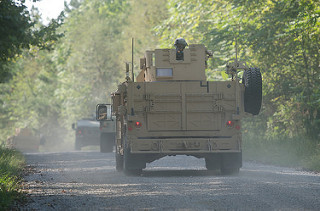
123 Security Forces Squadron personnel conduct a mounted patrol during a training exercise, at Wendell H. Ford Regional Training Center in Greenville, Ky. on Sept. 17, 2014. The SFS conducted a week-long training course for combat skills training and to prepare for future deployments. (U.S. Air National Guard photo by Master Sgt. Phil Speck)
“The Security Forces AFSC (Air Force Specialty Code) training gained through the field training exercise enhanced our rapid deployment ability to support the 123d Contingency Response Group deployment in support of Operation United Assistance. The realistic Base Defense/Force Protection training conducted at WHFRTC provided a refresher of the duties and expectations placed upon the Security Forces career field directly related to our combat mission,” Imorde added.
Unfortunately, the Airmen are unable to receive this type of enhanced training at home station. For most people, Security Forces are the first person they see as coming onto an Air Force base. A common misconception by many is Security Forces only guard the gates, secure the flight line and patrol the base. But according to Tech. Sgt. Craig Davis, Combat Arms NCOIC for the 123d SFS, this is just a small portion of what they do.
“The bigger picture of what we do is the defense/protection of air bases in deployed environments. The methodology of completing those tasks is really our primary mission. We place a lot of emphasis on home station defense and not nearly enough on air base defense. When we deploy, these Airmen and NCOs are expected to know air base defense,” Davis said.
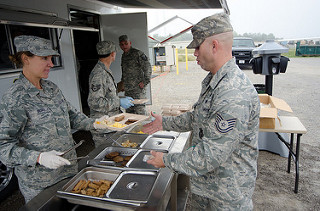
Tech. Sgt. Amanda Bedel, a food specialist for the 123rd Force Support Squadron, serves breakfast to Tech. Sgt George Whelan, a combat arms instructor for the 123rd Security Forces Squadron, at Wendell H. Ford Regional Training Center in Greenville, Ky. on Sept. 17, 2014. The Kentucky Air National Guard’s FSS fixed meals for the SFS members during a week-long field training course. (U.S. Air National Guard photo by Master Sgt. Phil Speck)
For some members of SFS, this was the first time leading in this type of environment as new NCOs. Training new Airmen and preparing them for deployments is a very rewarding task Davis said.
“Letting young Airmen see what we do, and how we do it. Seeing young NCOs become seasoned NCOs and take charge bringing teams together. Everyone is an individual, when you come together and work towards a common goal as a team it is pretty rewarding. When they are no longer looking to you for instruction and they are looking to each other for approval, then you know the training has been successful,” Davis said.
Members from the Wing’s 123rd Force Support Squadron went on the training exercise as well to feed the troops. They brought their DRMKT (Disaster Relief Mobile Kitchen Trailer) and prepared hot meals for the Airmen as they trained.
By Master Sgt. Phil Speck, 123rd Airlift Wing Public Affairs
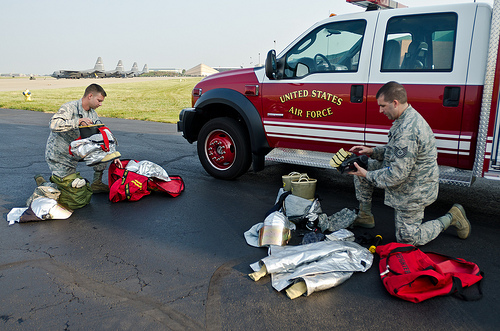
Staff Sgt. Kyle Miller (left) and Tech. Sgt. Dewayne Gibson, fire protection craftsmen from the 123rd Civil Engineer Squadron, inspect firefighting equipment Sept. 10, 2013, at the Kentucky Air National Guard Base in Louisville, Ky., prior to an overseas deployment. More than 85 Kentucky Air Guardsmen are being mobilized to support Air Expeditionary Force rotations and other Air Force missions this summer and fall. (U.S. Air National Guard photo by Master Sgt. Phil Speck)
KENTUCKY AIR NATIONAL GUARD BASE, LOUISVILLE, Ky. – More than 85 members of the Kentucky Air National Guard are being deployed to multiple locations this summer and fall in support U.S. military operations around the world, including Operation Enduring Freedom in Afghanistan.
The most recent group to mobilize consisted of 26 Airmen from the 123rd Security Forces Squadron, who deployed in support of an Air Expeditionary Force rotation earlier this month. They will provide security at an undisclosed air base in the Persian Gulf region for six months, according to Col. Jeffrey Peters, 123rd Mission Support Group commander.
In other mobilizations, 11 cargo handlers from the 123rd Logistics Readiness Squadron reported to Afghanistan in July and August to support Aerial Port operations, and 11 firefighters from the 123rd Civil Engineer Squadron are slated to deploy overseas in mid-October.
“Mission Support Group has seen an increase in deployments lately as group personnel are deploying as volunteers and in association with Air Expeditionary Force buckets,” Peters said. “The 123rd Civil Engineer Squadron, 123rd Force Support Squadron, 123rd Logistics Readiness Squadron and 123rd Security Forces Squadron all have Airmen deployed supporting contingency operations.”
Additional personnel from the 165th Airlift Squadron and 123rd Special Tactics Squadron deployed to Afghanistan in June and July, while other Kentucky Airmen are currently supporting domestic missions at sites across the United States.
“Most of the deployments are for six months,” Peters noted, adding, “We look forward to our Airmen’s safe return to their families.”
By Senior Airman Vicky Spesard, 123rd Airlift Wing Public Affairs
 KENTUCKY AIR NATIONAL GUARD BASE, LOUISVILLE, Ky. — Two homemade pressure-cooker bombs exploded during the Boston Marathon April 15, killing three people and severely wounding more than 200 others. In the aftermath of this horrific event, many questions are being asked about what constitutes a terrorist act and whether people put their safety at risk by attending large public events.
Capt. Joshua Elwell of the Kentucky Air National Guard’s 123rd Contingency Response Group offers his own insight as director of the anti-terrorism program here. He’s specially trained in identifying the causes and effects of terrorist activities within the United States and how to combat them. The intelligence officer also meets regularly with members of the civilian intelligence community, local civic leaders and law enforcement agencies to discuss terrorism awareness and citizen reporting efforts.
Q.: What is the definition of terrorism, and is there a difference between terrorism abroad or domestically?
A.: A terrorist is someone who wants to instill fear and terror in a society for a political or religious reason. The intent of terrorism is to cause our country pain at a national level, to shut us down economically or to instill enough fear that that we stop participating in public events. If any of these things happens, a terrorist has met his or her intent.
In my opinion, there is no difference in terrorism carried out abroad or domestically. The intent is still the same.
Q.: With so many large, public events happening around the country, can a person feel safe attending them?
A.: The intent of terrorism is to scare us into disrupting our lives, to make it a challenge to go out and participate in these events. Don’t stay home and be scared to live your life. A lot of attention is now being given to security at big events as local authorities, security agencies and threat working groups implement enhanced security measures. I would just encourage everyone attending to be patient with security personnel who may be checking bags or coolers and things of that nature. Remember, they are there for our protection.
Q.: How can a person minimize his or her own risk at large events?
A.: There are many things you can do for your personal safety. If you are attending public activities, don’t stand around in large gatherings of officials. Don’t hang around a table of VIPs. Be aware of your surroundings and use common sense. Keep your eyes open and report what looks out of place.
Q.: What can an individual do to help?
A.: “Watch, report, protect” is the motto for the EagleEyes program, operated by the Air Force Office of Special Investigations. The program encourages the public, both on and off base, to report anything that looks odd or out of place. In the Louisville area, reports can be made by calling the Kentucky Air Guard’s 123rd Security Forces Squadron at (502) 412-4477.
Anonymous tips can be made online at https://www.tipsubmit.com/WebTips.aspx?AgencyID=1111 or by texting “AFOSI” to 274637.
Terrorists are looking at us and trying to find our weaknesses. If they can see us, we can see them. We can’t be everywhere, so we need the community to be part of the effort to see things and let the right people know about it.
By Senior Airman Vicky Spesard, 123rd Airlift Wing Public Affairs
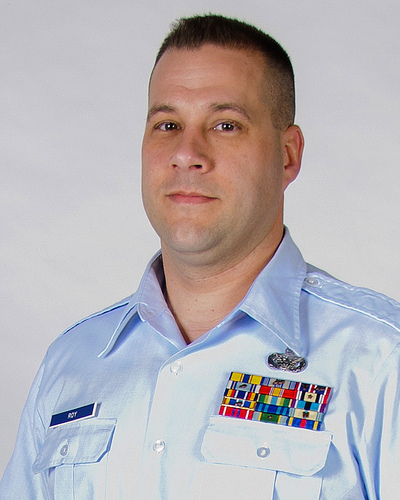
Master Sgt. Kevin Roy has been named the Kentucky Air National Guard’s Outstanding First Sergeant of the Year for 2013. Roy is a member of the 123rd Security Forces Squadron. (Kentucky Air National Guard photo by Master Sgt. Phil Speck)
KENTUCKY AIR NATIONAL GUARD BASE, LOUISVILLE, Ky. — Master Sgt. Kevin Roy of the 123rd Security Forces Squadron has been named the Kentucky Air National Guard’s Outstanding First Sergeant of the Year for 2013.
As first sergeant, Roy provides oversight and guidance to more than 85 Security Forces Airmen, assisting with any pay, personal and family issues that may arise. He has revamped the squadron’s Dependent-Care Program and operates a Family Liaison Program that facilitates regular interaction with the family members of deployed troops.
A full-time Louisville Metro Police officer, Roy joined the Guard in 1999 and has served as the squadron’s “first shirt” since March 2011. It’s a position he is well qualified for, according to Chief Master Sgt. Dan Radke, chief enlisted manager for the 123rd Security Forces Squadron.
“Part of his responsibilities include ensuring Airmen in the security forces are well trained and have all of the unit’s resources available to them,” Radke said. “Roy does more than that. He has an open door for these guys. He is a confidant, a mentor and professional colleague. He really strives to know each member of the squadron. They know that whatever issue they might be experiencing, their first sergeant is there to help.”
Roy also places a high level of emphasis on making sure his Airmen are properly trained.
“It is very important for them to stay current in their military education to be promotable to the higher enlisted levels,” said Roy, a certified Taser instructor and civilian Active Shooter Response Team member who is certified to conduct field sobriety tests and holds a bachelor’s degree in business management.
“I am also stressing to my Airmen the value of a good education, both within the military and law enforcement.”
Being a mentor and community leader outside the Air Guard is another priority for Roy, who encourages civic involvement among his Airmen. He is a volunteer with the Explorers Program and an instructor at Merit Badge University, which assists Boy Scouts in earning merit badges.
“I have to lead by example,” he said. “My father told me to surround myself with good people, and I encourage my Airmen to do the same thing. Get involved in the community; surround yourself with people who become a positive influence on you. That is my goal every day: to be a positive influence and good example to my guys.”
Staff Report
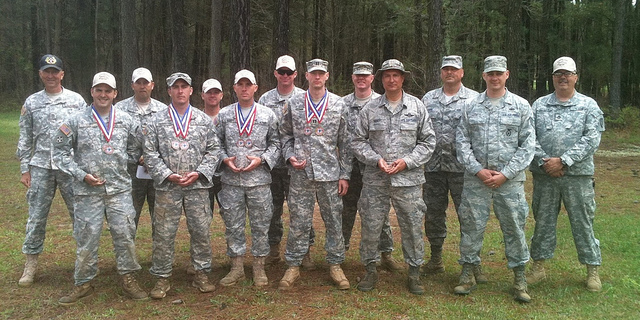
Sgt. 1st Class Chuck Reed, Staff Sgt. Jeff Ice, Staff Sgt. Eric Dean, Sgt. Ted Broughton, Staff Sgt. Corey Goatley, Sgt. Randy Ford Chief Warrant Officer Craig Scott, Lt. Col. Alan Slusher, Capt. Aaron Grimm, Master Sgt. John Sierbert (Photo by Sgt. 1st Class Chuck Reed, Kentucky National Guard Marksmanship Team)
Camp Butner Training Site in Stem, North Carolina – The Kentucky National Guard State Marksmanship Team was a force to be reckoned with during its performance at the National Guard Marksmanship Advisory Council (MAC) Region III Competition last March at Camp Butner Training Site in Stem, North Carolina.
The MAC III region consists of: Kentucky, Tennessee, North Carolina, South Carolina, Mississippi, Georgia, Florida, and Puerto Rico (Puerto Rico did not participate in the match).
“The competition consisted of two individual rifle matches, two individual pistol matches, one rifle team match; and one pistol team match,” said Lt. Col. Alan Slusher, who was a shooter on the team. “We divided up into two teams, A and B, with eleven shooters overall.”
The end result speaks for itself. Kentucky captured numerous awards, including first place team aggregate (a total of all matches), first place rifle team and third place pistol team.
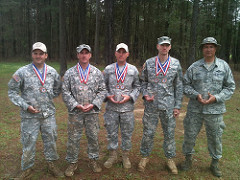
The A Team: Staff Sgt. Jeff Ice, Sgt. Ted Broughton, Chief Warrant Officer Craig Scott, Capt. Aaron Grimm, Master Sgt. John Sierbert (Photo by Sgt. 1st Class Chuck Reed, Kentucky National Guard Marksmanship Team)
In the individual matches the Kentucky shooters swept through the categories, scoring first, second and third in the individual rifle teams; first, second and third in the EIC rifle teams;, second place in the individual pistol match and second place in the EIC pistol match.
The Excellence-in-Competition Program (EIC) is an awards program recognizing marksmanship, open to any service member. Individuals earn badges by finishing in the top ten percent in marksmanship competitions hosted by military services, the Civilian Marksmanship Program or the National Rifle Association. Each win earns them a number of points toward their badge. Each win is commonly referred to as a ‘leg’.
“By winning the EIC rifle match at Camp Butner, Capt. Aaron Grimm has earned 30 points, and is now qualified to wear the gold distinguished rifleman badge,” said Slusher. “Sgt. Adam Broughton has earned his first ‘leg’ points, allowing him to wear the bronze EIC badge.”
Grimm also earned “leg” points in the EIC pistol match, working toward his gold Distinguished Pistol Badge. Senior Master Sgt. John Seibert and Staff Sgt. Jeff Ice both hold the gold Distinguished Riflemen Badge based on previous match earnings.
“A lot of hard work went into this regional match,” said Sgt. 1st Class Chuck Reed, the team’s coach. “These guys gave up a lot of weekends and it showed in the final scores.”
“There’s more to it than just bragging rights,” said Reed. “What goes on in the guard and reserve compels the active duty services to look over their shoulder. Competitive marksmanship is as close to actual combat as you’ll ever come as it puts on the pressure and puts you toe to toe with your competitor.”
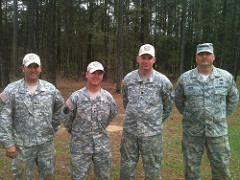
The B Team: Staff Sgt. Eric Dean, Staff Sgt. Corey Goatley, Lt. Col. Alan Slusher, Sgt. Randy Ford (Photo by Sgt. 1st Class Chuck Reed, Kentucky National Guard Marksmanship Team)
How do you get involved, you might ask? The process is easy, but you have to put some effort into it.
“The first step to earning a spot on the state team is to represent your company or battalion in the KYNG State Match, held May 19-20 at Ft. Knox,” said Slusher. “Look for the match letter of instruction and a guide in a JFHQ Weekly FRAGO.
“Shoot well at the state match and you may be asked to try out for the state team,” said Slusher, “Membership on the state team requires support from your unit commander, as you will be required to attend team practices, some of which may conflict with your unit drill schedule.”
Don’t worry about gear, said Slusher, as the unit provides all weapons and special equipment required.
Commanders who want to support the team can encourage each company in your command to compete in the state match. If a company cannot field a team, unit members may combine at battalion level.
“It’s important that you support your competitive shooters by allowing then to split-train whenever possible, fund their travel, and then reap the benefits of their newly acquired skills by using them as marksmanship trainers when the competitive season ends.
For more information on the Kentucky National Guard’s competitive shooting program, contact Capt. Aaron Grimm, State Marksmanship Coordinator, at 502-607-1578 or email him at [email protected].
Here are the final results of the match:
1st Place Team Aggregate (total of all matches)
KY ‘A’ Team
INDIVIDUAL MATCHES
Individual Rifle match
Individual Pistol Match
EIC Rifle Match
EIC Pistol Match
Also competing as individual shooters were Maj. Travis Carpenter, 138th Fires Brigade, and Tech. Sgt. Eric Smith, 123rd Security Forces Squadron.
By Tech. Sgt. Jason Ketterer, 123rd Airlift Wing Public Affairs
Click here to view a photo gallery for this story.
Click here to view a video report of this story.
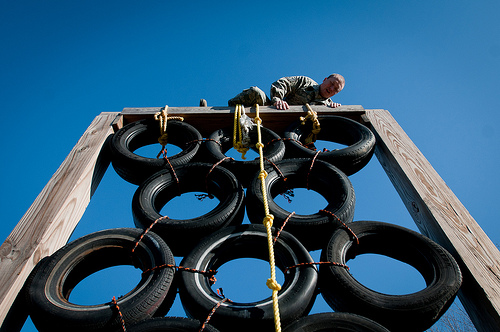
Master Sgt. Josh Devine, a member of the Kentucky Air National Guard’s 123rd Security Forces Squadron, climbs over a tire tower at Southern High School in Louisville, Ky., Dec. 10, 2011. Airmen from the 123rd SFS were at the high school to use the Junior ROTC obstacle course for a team-building exercise as part of Wingman Day activities. (U.S. Air Force photo by Senior Airman Maxwell Rechel)
LOUISVILLE, Ky. — Members of the Kentucky Air National Guard’s 123rd Security Forces Squadron spent Dec. 10 navigating an obstacle course at Louisville’s Southern High School as part of a team-building exercise held in conjunction with Wingman Day.
Wingman Day is an annual event designed to promote resilience and focus attention on the physical, spiritual, social and psychological health of Airmen while building esprit de corps, said Master Sgt. Larry Bristow, 123rd Security Forces Squadron unit training manager.
The idea is for Airmen to learn the importance of taking care of themselves and their fellow troops — a goal which made the obstacle course a natural choice for Wingman Day activities, Bristow said.
He came up with the idea of using the obstacle course — maintained by Southern’s Army Junior ROTC program — while attending his son’s soccer game at the campus last year.
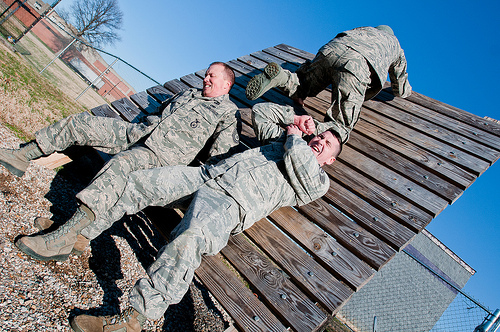
Staff Sgt. Ed Nooning and Master Sgt. Josh Devine, members of the Kentucky Air National Guard’s 123rd Security Forces Squadron, help Tech. Sgt. Jesse Smith over an obstacle at Southern High School in Louisville, Ky., on December 10, 2011. Airmen from the 123rd SFS were at the high school to use the Junior ROTC obstacle course for a team-building exercise as part of Wingman Day activities. (U.S. Air Force photo by Senior Airman Maxwell Rechel)
“When Wingman Day came around, we thought this would be a good event for the whole squadron to work together and become more familiar with each other,” he said.
Maj. Grant Simpson, commander of the 123rd Security Forces Squadron, said the course was a welcome change of pace from normal training at the Air Guard Base, which typically focuses on security patrols or other solitary activity.
“We get so sequestered in our computer training and everything else that a lot of times when you come to drill, you don’t get a chance to interact with people on another fire team or a different group,” he said.
The course features an un-anchored rope climb, low crawl, tower climb, tightrope, and 10-foot vertical wall.
“I think everybody did real well,” Simpson added, chuckling. “But they’re going to be hurting tomorrow.”
