
Pages
Stay In Touch
More
© 2013 KentuckyGuard
Story by Senior Airman Joshua Horton, 123rd Airlift Wing Public Affairs
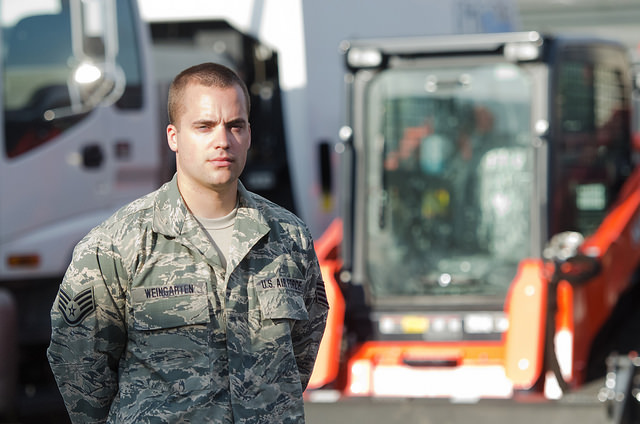
Staff Sgt. Matthew Weingarten, an operation management specialist in the Kentucky Air National Guard’s 123rd Civil Engineer Squadron, was instrumental in saving a child’s life May 2 during a Kentucky Derby party in Simpsonville, Ky. Weingarten noticed the boy submerged in the deep end of a swimming pool and pulled him to safety. (U.S. Air National Guard photo by Senior Airman Joshua Horton)
KENTUCKY AIR NATIONAL GUARD BASE, LOUISVILLE, Ky. — A Kentucky Air Guardsman was instrumental in saving a child’s life over Derby weekend after the boy nearly drowned in a backyard pool in Simpsonville, Kentucky.
Staff Sgt. Matthew Weingarten of the 123rd Civil Engineer Squadron was attending a Kentucky Derby party at a private residence with more than 50 other people May 2 when he and his wife noticed the boy kicking his feet under the pool’s surface.
“I started getting closer to the pool,” Weingarten said. “He seemed perfectly fine. He was kind of feeling out for his buddy who was right next to him.”
But Weingarten noticed something was wrong when he got to the edge of the pool.
“I looked down and his back started to arch, and he started to look up,” Weingarten said. “His eyes were completely glazed over — his lips blue. The second I saw him start to look up, I jumped in. I grabbed him and pulled him over to the side and jumped out.
“Before I could even initiate CPR or anything to that extent, one of the adults ran over and helped me remove him from the pool, sat him up and gave him a slap to the back. His lungs were full. A lot of water came out, and he started responding — a little slow at first.”
After a nurse who was also attending the party informed the child’s parents that residual water could lead to pneumonia or even cause drowning at a later time, the parents rushed the boy to the hospital.
“In the end, I found out that he was removed just in time to where there was no brain damage,” Weingarten said. “There was so much residual water that they had to keep him at the hospital overnight. They gave him antibiotics to flush everything out. I received word a couple days later that he’s going to do just fine.”
Weingarten’s timely intervention was spurred by thoughts of his own child.
“I’m a father,” Weingarten said. “I have a two-year-old at home. (When) I looked down (into the pool), the second I saw his face, I saw my kid. It took a few minutes to shake. In fact, it took a few hours to shake afterwards — the idea of seeing my son’s face on this child. I didn’t even have to think about it; I jumped in with everything I had on me and pulled him out.”
Weingarten’s quick response comes as no surprise to Master Sgt. James Richey, his supervisor in the 123rd Civil Engineer Squadron.
“I think it’s just kind of who Matt is,” Richey said. “Before he joined us, he did six months with us in Afghanistan, and we liked him so much that we sucked him into our unit. He’s just got a lot of personality and a lot of energy, so it doesn’t surprise me at all that he’d do something like this.”
Story by Master Sgt. Phil Speck, 123rd Airlift Wing Public Affairs Office
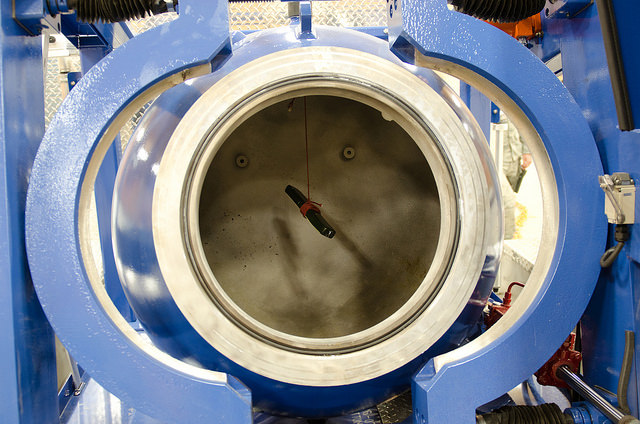
A stick of C4 explosives is suspended in a Bomb Containment Vessel during Explosive Ordnance Disposal training at the Fern Creek Fire Department in Louisville, Ky., Nov. 11, 2014. The vessel is the Kentucky Air National Guard’s newest piece of EOD equipment, allowing personnel to detonate explosives on-site with no repercussions to nearby people or structures. (U.S. Air National Guard photo by Master Sgt. Phil Speck)
KENTUCKY AIR NATIONAL GUARD BASE, LOUISVILLE, Ky. — The Kentucky Air National Guard has a new piece of equipment that allows specially trained Airmen to safely detonate bombs and other explosives without harming nearby personnel or structures.
Click here for more photos.
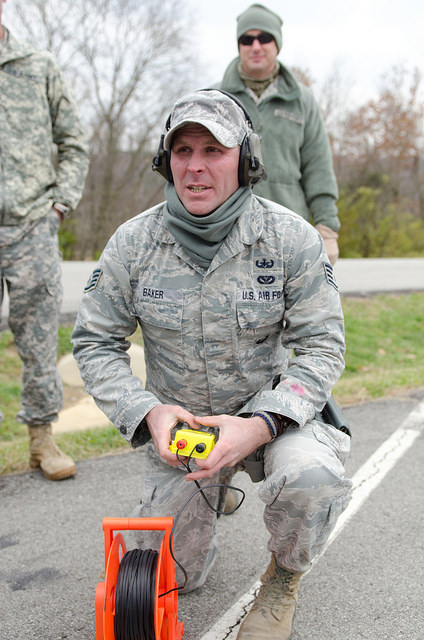
Staff Sgt. Timothy Baker, an Explosive Ordinance Disposal technician for the Kentucky Air National Guard’s 123rd Civil Engineer Squadron, prepares to detonate C4 inside the unit’s new Bomb Containment Vessel at a Fern Creek Fire Department training site in Louisville, Ky., Nov. 11, 2014. The steel vessel, which is mounted to a trailer, allows EOD personnel to detonate explosives on-site with no repercussions to nearby people or structures. (U.S. Air National Guard photo by Master Sgt. Phil Speck)
The gear, known as a Bomb Containment Vessel, does exactly what its name implies, according to Staff Sgt. Timothy Baker, an Explosive Ordinance Disposal technician for the 123rd Civil Engineer Squadron here. The capability can be especially useful if EOD is called upon to dispose of explosives in populated areas like the city of Louisville.
“If an improvised explosive device or any other sort of explosive is discovered anywhere in the area, EOD can destroy those explosives in a safe and contained manner without the worry of the destruction of any structures or bodily harm to bystanders,” Baker said.
The Kentucky Air Guard’s EOD team is one of the first three Air Guard units to receive the vessel, he added. Prior to its arrival, only one other Bomb Containment Vessel existed in the state of Kentucky.
The vessel is a trailer-mounted metal sphere with four-inch-thick steel walls. To make an explosive “safe,” EOD technicians carefully place the device into the vessel, seal the door and detonate it remotely.
The vessel can be used repeatedly for the disposal of up to 10 pounds of TNT-equivalent explosives without compromising its structural integrity, Baker said. For explosives of up to 20 pounds, the vessel can be used safely only once without being inspected for damage. It can be operated in a vented mode, to allow gases from an explosion to escape into the air, or in containment mode to prevent release of suspected chemical, biological or radiological contaminants.
The vessel also includes ports from which inside air samples can be extracted, or through which solutions can be pumped to neutralize threats.
“As soon as we received this piece of equipment, we reached out to all local law enforcement agencies, informing them of this new capability and the fact that we could aid them in responses as needed,” Baker said.
Maj. Keith Smith, commander of the 123rd’s Explosive Ordnance Disposal Team, said the vessel makes the unit even more effective in its dual mission of protecting military personnel from explosive weapons and in assisting civil authorities by neutralizing all manner of explosive devices.
“The total containment vessel drastically upgrades our capabilities to deal with explosive devices by allowing EOD techs to either contain a blast or transport the device to a safe location for disposal,” he said.
Story by Master Sgt. Phil Speck, 123rd Airlift Wing Public Affairs Office
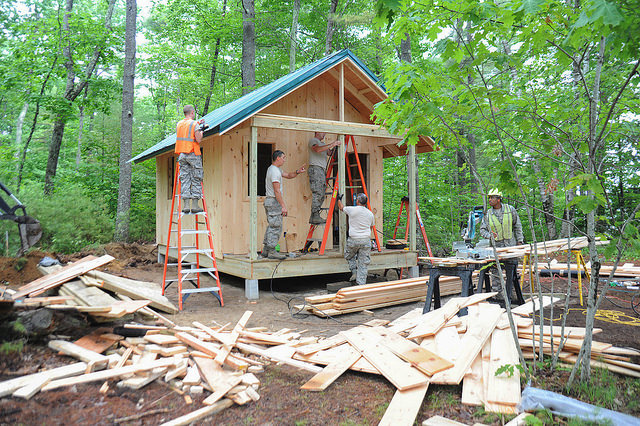
Airmen from the Kentucky Air National Guard’s 123rd Civil Engineer Squadron build a cabin for Boy Scouts and Scout Masters at William Hinds Boy Scout camp in Raymond, Maine, on June 13, 2014. About 30 Kentucky Air Guardsmen participated in the two-week mission as part of their annual field training. (Courtesy Photo)
KENTUCKY AIR NATIONAL GUARD BASE, LOUISVILLE, Ky. — Civil engineers from the Kentucky Air National Guard spent part of their summer giving back to the community while accomplishing valuable annual training, renovating a Boy Scout camp in rural Maine.
About 30 Airmen from the 123rd Civil Engineer Squadron, based in Louisville, joined with 18 Airmen from the Tennessee Air Guard’s 118th Civil Engineer Squadron and 20 Marine Corps Reservists to build cabins, install equipment and improve roads at Camp William Hinds in Raymond, Maine, as part of a Department of Defense program called Individual Readiness Training.
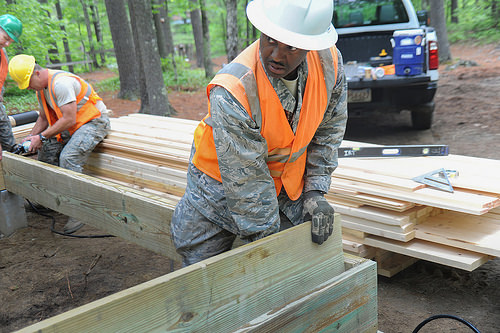
Lt. Col. Rodney Boyd, vice commander of the Kentucky Air National Guard’s 123rd Civil Engineer Squadron, prepares lumber for a new cabin at Camp William Hinds Boy Scout camp in Raymond, Maine, on June 5, 2014. About 30 Kentucky Air Guardsmen renovated facilities at the camp from June 1-15 as part of their annual field training. (Courtesy Photo)
The training, which took place over two weeks in June, provided an outstanding opportunity to do something valuable for the civilian community while enhancing war-time readiness skills in civil engineering, said Chief Master Sgt. Marty Fautz, chief enlisted manager for the 123rd CES.
“Every career field had work,” Fautz said. “The overall quality of the training was the biggest accomplishment. We got a lot of hands-on training for all of our (career fields) that the guys can’t get back home. Some of the guys haven’t touched the equipment we used since technical school, so it was a good two weeks for those guys.”
The Scouts supplied building materials and equipment rentals — paid for with private fund-raisers — while the Air Guard and Marine troops provided labor that matched with their unique areas of expertise. Plumbers, carpenters, electricians, power production specialists, heavy equipment operators and civil engineers all helped in the renovations, Fautz said.
The Airmen installed a zip line, graded roads, built cabins and renovated a dormitory building for Scouts and Scout Masters. Air Guard surveyors also worked extensively with the Marines, establishing plots for a shooting range by moving dirt and cutting into a hillside.
Fautz said mission was an especially rewarding one.

Airmen from the Kentucky Air National Guard’s 123rd Civil Engineer Squadron clear the way for a new road at William Hinds Boy Scout Camp in Raymond, Maine, on June 13, 2014. About 30 Kentucky Air Guardsmen participated in the two-week mission as part of their annual field training. (Courtesy Photo)
“When you talked to the civilians there that run the program, you could see how wrapped up they were with the Scouts, and how important and meaningful it was to do these upgrades for the benefit of the Scouts coming in,” he said.
“There were no big roadblocks, the equipment was there, the supplies were there, the manpower was there — we just had to cut the guys loose and let them go to work. When we left, everyone felt good about what they did and the training they got. It was a great trip.”
Lt. Col. Phil Howard, commander of the 123rd CES, explained that a lot of summer IRTs come with a checklist of items that have to be accomplished on a tight schedule, but this one provided enough time to work at a measured pace.
“This allowed the guys to slow down and actually train some of the younger troops,” he said. “Give them a hammer, in other words, rather than have the supervisors work on it because they have to get it done. So it was really an excellent training opportunity and one of the best (IRT missions) I’ve been on.”
Story by Staff Sgt. Vicky Spesard, 123rd Airlift Wing Public Affairs
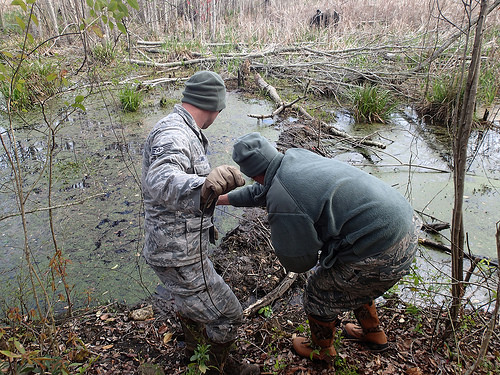
Staff Sgt. Tim Baker of the Kentucky Air National Guard’s 123rd Civil Engineer Squadron and Master Sgt. Greg Stephens of the 116th Air Control Wing position detonation cord and C4 explosive to blow up unoccupied beaver dams at Robins Air Force Base, Ga., on April 27, 2014. (Courtesy photo)
LOUISVILLE, Ky. — A destructive force made its way through the swamps of Georgia, bottling up water flow and flooding parts of Robins Air Force Base. The enemy at hand: the American beaver.
Answering the call for action were Staff Sgts. Dustin Turner and Tim Baker, Explosive Ordnance Disposal specialists with the Kentucky Air National Guard’s 123rd Civil Engineer Squadron.
The Airmen, who are more accustomed to defusing Improvised Explosive Devices or blowing up unstable munitions, applied their wartime skills to the beaver dams instead, eliminating the unoccupied structures with C4 explosives.
According to the Georgia Department of Natural Resources, beavers begin their ritual of chewing up trees and building dams each spring. That has the cascading effect of destroying natural waterways and other animal habitats.
In the case of the beaver assault on Robins Air Force Base, the eight dams — some as big as 60 to 75 feet long — were causing water to pool in streams that no longer flowed naturally. That led to a rise in water-fowl population and impaired base efforts to log tall trees in the forest near the end of runways, resulting in hazardous flight conditions.
“The beaver dams were impeding flight operations,” Turner explained. “Because the area is very swampy, heavy equipment couldn’t get in there to remove the dams, so the best option was to use explosives.”
To restore the natural water flow and bring flight operations back to normal, the two specialists — with the help of Senior Master Sgt. John Bell, Master Sgt. Greg Stephens and Tech. Sgt. Barry Duffield of the 116th Air Control Wing — drilled holes in the empty dams, filled them with explosives and blew them up.
“We were excited to get the call to help because this isn’t normally what we get to do,” Turner said. “We got the chance to get a little dirty and see terrain that we don’t get to see.”
In the event the beavers renew their aggressive campaign against the base, the 123rd Civil Engineer Squadron’s EOD specialists will be ready to take on the challenge.
“It’s a little out of our daily mission, so it’s a good training opportunity for us and a great way to lend assistance to another unit,” Turner said. “We would welcome the chance to help them out again.”
Story by Master Sgt. Phil Speck, 123rd Airlift Wing Public Affairs
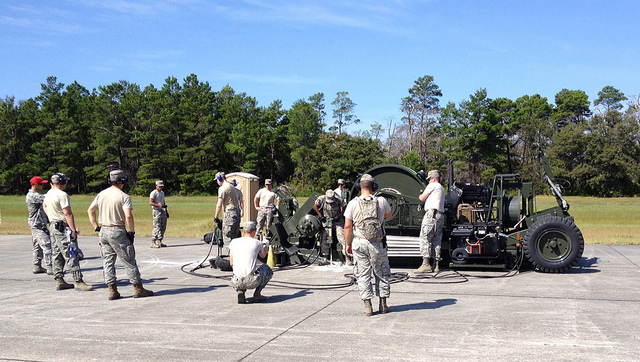
Troops from the Kentucky Air National Guard’s 123rd Civil Engineer Squadron join with other Airmen to anchor a Mobile Aircraft Arresting System at Tyndall Air Force Base, Fla., on Sept 16, 2013. The Kentucky Air Guardsmen were participating in Silver Flag, a week-long exercise to train and test the skills of civil engineers at a bare-base location in a simulated wartime environment. (U.S. Air National Guard photo by Tech. Sgt. Dave Soldat)
KENTUCKY AIR NATIONAL GUARD BASE, LOUISVILLE, Ky. — Kentucky Air National Guardsmen of the 123rd Civil Engineer Squadron deployed to a secluded bare base location to establish and maintain a base during a wartime mission exercise known as Silver Flag.
During the week long exercise, Sept. 13-21, the 26 Airmen joined over 246 Active Duty, Reserve and Guardsmen at Tyndall Air Force Base, Fla. This was the biggest class ever for Silver Flag said Lt. Col. Keith McCallie, Deputy Base Civil Engineer for the 123rd Civil Engineer Squadron, and student commander for Silver Flag.
“This was a well worth learning experience,” McCallie said. “a total force integration, a first that I’ve ever seen at Silver Flag.”
Silver Flag is training for all civil engineering (CE) personnel, including command and control, and specialized craftsmen training. This training is mandatory for civil engineers every 40 months. The exercise challenged each craft area in CE to perform under a wartime mission tasking, including emergency management, utilities, structures, heating ventilation and air conditioning, heavy equipment, electrical, power protection, site development, CE Operations, and fire. The Command and Control (C2) element from the 123rd CES attended the exercise.
Other units from other bases such as Personnel, Services, Communications, and Medical personnel participated in the exercise as well.
Tasks that had to be handled during the war games included purifying water, getting electrical generators online and power distribution, airfield lighting, erecting tent cities, rapid runway repair, installation of mobile aircraft arresting system and bare base site layout, just to name a few.
The units also showed they could pre-stage vehicles and conduct convoy operations with precision. They also defended assets by preventing simulated host-nation saboteurs from disrupting power distribution.
The exercise also allows Airmen access to specialized equipment they normally don’t get to work with back at their home station units, as well as a test bed for new and improved equipment coming through the Air Force. At the Silver Flag location, a new power distribution system was being field tested which consisted of new digital design as compared to an old aging analog system.
“This gives the Airmen a look at the new cutting edge technology, which is a benefit to troops, and gives the command element exposure to new technology.” McCallie said.
During the exercise the Cadre commented on the positive attitudes of everyone, and integration of the Air Force Active Duty, Reserves and Guard.
“Everyone meshed very well, no fights or feuding between the services, and it was eye opening to see how everyone was so enthusiastic.” McCallie added. “Morale was not an issue at this Silver Flag, everyone embraced this training with enthusiasm and the go-get attitude.”
By Master Sgt. Phil Speck, 123rd Airlift Wing Public Affairs
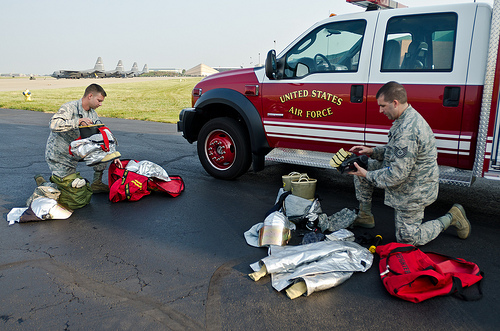
Staff Sgt. Kyle Miller (left) and Tech. Sgt. Dewayne Gibson, fire protection craftsmen from the 123rd Civil Engineer Squadron, inspect firefighting equipment Sept. 10, 2013, at the Kentucky Air National Guard Base in Louisville, Ky., prior to an overseas deployment. More than 85 Kentucky Air Guardsmen are being mobilized to support Air Expeditionary Force rotations and other Air Force missions this summer and fall. (U.S. Air National Guard photo by Master Sgt. Phil Speck)
KENTUCKY AIR NATIONAL GUARD BASE, LOUISVILLE, Ky. – More than 85 members of the Kentucky Air National Guard are being deployed to multiple locations this summer and fall in support U.S. military operations around the world, including Operation Enduring Freedom in Afghanistan.
The most recent group to mobilize consisted of 26 Airmen from the 123rd Security Forces Squadron, who deployed in support of an Air Expeditionary Force rotation earlier this month. They will provide security at an undisclosed air base in the Persian Gulf region for six months, according to Col. Jeffrey Peters, 123rd Mission Support Group commander.
In other mobilizations, 11 cargo handlers from the 123rd Logistics Readiness Squadron reported to Afghanistan in July and August to support Aerial Port operations, and 11 firefighters from the 123rd Civil Engineer Squadron are slated to deploy overseas in mid-October.
“Mission Support Group has seen an increase in deployments lately as group personnel are deploying as volunteers and in association with Air Expeditionary Force buckets,” Peters said. “The 123rd Civil Engineer Squadron, 123rd Force Support Squadron, 123rd Logistics Readiness Squadron and 123rd Security Forces Squadron all have Airmen deployed supporting contingency operations.”
Additional personnel from the 165th Airlift Squadron and 123rd Special Tactics Squadron deployed to Afghanistan in June and July, while other Kentucky Airmen are currently supporting domestic missions at sites across the United States.
“Most of the deployments are for six months,” Peters noted, adding, “We look forward to our Airmen’s safe return to their families.”
Story and photos by Airman Joshua Horton, 123rd Airlift Wing Public Affairs
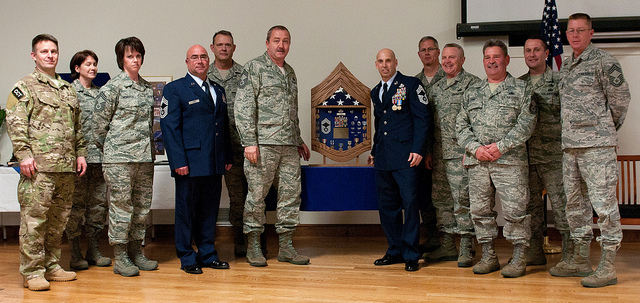
Chief Master Sgt. Steven Peters was honored for 30 years of service to the Air Force and Air National Guard during a retirement ceremony held Feb. 2, 2013, at the Kentucky Air National Guard Base in Louisville, Ky. Peters, chief of operations for the 123rd Civil Engineer Squadron, received a Meritorious Service Medal and a Kentucky Distinguished Service Medal in recognition of his exceptional performance. (U.S. Air Force photo by Airman Joshua Horton)
KENTUCKY AIR NATIONAL GUARD BASE, LOUISVILLE, Ky. — After 30 years of dedicated service to the active-duty Air Force and Air National Guard, Chief Master Sgt. Steven Peters retired during a ceremony held in his honor Feb. 2 at the 123rd Airlift Wing.
Lt. Col. Phil Howard, commander of the 123rd Civil Engineer Squadron, officiated the service, calling Peters a true professional who “always got the job done.”
“I’m honored to have this opportunity today to say a few things about the chief on his retirement after 30 years of service to the U.S. Air Force and Air National Guard,” Howard told an audience of more than 200 friends, family and coworkers in the Base Annex.
“I want to thank everyone here for taking their time to pay tribute to a true patriot, a leader, a veteran, a brother, a son and, most importantly for me, a great friend.”
Peters, chief of operations for the 123rd Civil Engineer Squadron, decided to join the Armed Forces during his junior year of high school. While working odd jobs, he came to the conclusion that his talents would be better served elsewhere after an Air Force recruiter visited his school. Peters enlisted a year later.
After attending technical training as a plumber at Sheppard Air Force Base, Texas, Peters was stationed at Carswell Air Force Base, Texas, for four years. Following a downsizing of the Air Force enlisted ranks, he left active duty and joined the Kentucky Air National Guard in 1986.
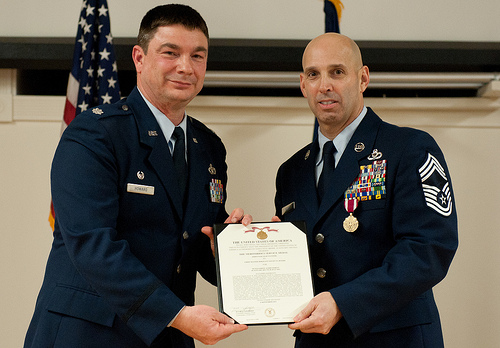
Chief Master Sgt. Steven Peters (right) is presented with a Meritorious Service Medal by Lt. Col. Phil Howard, commander of the 123rd Civil Engineer Squadron, during a retirement ceremony held in Peters’ honor at the Kentucky Air National Guard Base in Louisville, Ky., on Feb. 2, 2013. Peters, the squadron’s chief of operations, served in the active-duty Air Force and Air National Guard for three decades. (U.S. Air Force photo illustration by Airman Joshua Horton)
Peters’ first deployment was to Hawaii in 1988. After that, he deployed to multiple locations around the world, including England, Spain, Central America, Germany, Ecuador, Bagdad and Afghanistan.
Peters said his proudest moments were his participation in Operation Enduring Freedom, the war in Afghanistan; Operation Iraqi Freedom, the war in Iraq; Operations Jump Start 1 and 2, the National Guard-led effort to enhance border security with Mexico; and Operation Neuvos Horizontes, a Kentucky National Guard mission to build a school and other infrastructure in Ecuador while enhancing relations with the Ecuadorian military.
“The thing I remember is that he always did things neatly, always maintained great military bearing and always, always got the job done,” Howard said.
Peters demonstrated his leadership in 2004 when he was selected as distinguished graduate at a Pavements and Equipment Training Course. He declined to accept the honor so a younger, up-and-coming troop could receive the award instead. For his selfless actions, Peters was given the commander’s award for Leadership in Excellence instead.
“You always took care of the men, and that was your key role,” Howard said, calling it an especially critical function when the unit was deployed in 2011 to Bagram Air Field, Afghanistan — a site that receives regular enemy fire. “You quickly nailed down everyone’s location during rocket attacks, making sure we were all safe. You made sure everyone got credit for their hard work, personally processing 60 awards.”
Thanks in part to Peters’ persistence and character, Howard added, the 123d Civil Engineer Squadron received its first “excellent” rating during a 2010 Operational Readiness Inspection.
“I appreciate that you left this place better than you found it,” Howard said. “Most importantly, you met the prime objective, which is to always take care of the men and women of this unit. I want to salute you for your great contributions and a job well done.”
Story by Master Sgt. Philip Speck, 123rd Airlift Wing Public Affairs
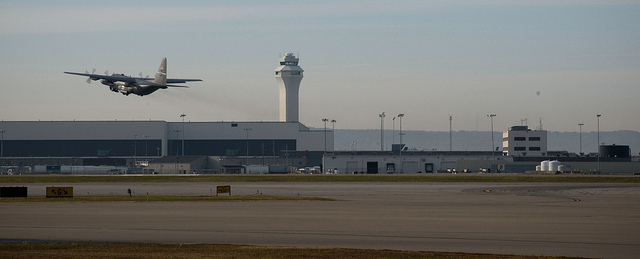
A Kentucky Air National Guard C-130 takes off from the Louisville International Airport. Recent training offered by employees of the Louisville Regional Airport Authority was designed to familiarize the Air Guardsmen with commercial lighting systems like those at Louisville International Airport and, as it so happens, Bagram Airfield. (US Air Force Photo by Master Sgt. Phil Speck)
LOUISVILLE, Ky. — Tech. Sgt. Willie Halfhill and Staff Sgt. Monty Williams were eating midnight chow at Bagram Airfield, Afghanistan, when they received an urgent call from the airfield tower June 18, 2011.
The runway lights were pulsing from bright to dim, posing safety issues for pilots attempting to land at the Air Force’s busiest airfield. Halfhill and Williams, both electrical journeymen in the Kentucky Air National Guard’s 123rd Civil Engineer Squadron, quickly left the dining facility and were on-site within minutes.
“When we arrived on scene and saw the lights fading in and out, I knew there was a problem,” Halfhill recalled.
They located the airfield lighting regulator, but after running a series of tests, the regulator stopped working altogether. In an instant, the runway went completely dark.
Halfhill and Williams scrambled to wake sleeping engineers who could help investigate the lighting system along the 11,800 foot runway, but a stream of air traffic continued to roll in. Pilots donned night-vision goggles and kept landing their aircraft, preventing the engineers from gaining access to the runway, 30,000 feet of lighting cable and hundreds of lights, Halfhill said.
The crew decided to stand down until lunchtime when the airfield could be closed for 30-minute intervals. After repairing a cable, the problem persisted, but they soon discovered another issue: a burned-out transformer. The team installed a new transformer, and all the lights came back up around 7:30 p.m.
The quick recovery was possible in part because of training the Airmen received in Louisville, Ky., before they ever deployed to Afghanistan, Halfhill said. That training, offered by employees of the Louisville Regional Airport Authority, was designed to familiarize the Air Guardsmen with commercial lighting systems like those at Louisville International Airport and, as it so happens, Bagram Airfield.
If it weren’t for the training, Halfhill said, the problem would have been more difficult to diagnose and taken much longer to repair.
To show the unit’s appreciation for the training, the commander of the 123rd Civil Engineer Sqaudron, Lt. Col. Phil Howard, presented three airport authority employees with coins during a recognition ceremony held at the Kentucky Air National Guard Base on Sept. 21. Honored during the event were Tom Hatfield, Cameron Roberts and Tony Roy.
“One of the reasons (our Airmen) were able to do what they did out there is because of your generosity in allowing us to get out onto the airfield in Louisville and train,” Howard told the airport authority team.
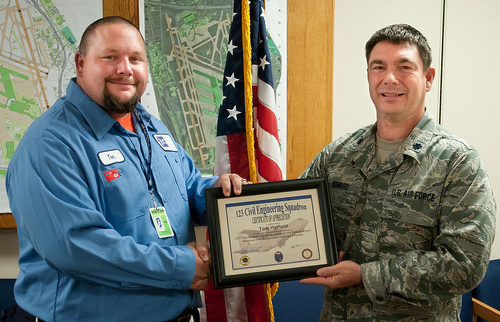
Tom Hatfield(left) with the Louisville Regional Airport Authority is awarded a certificate of appreciation from Lt. Col. Phil Howard of the 123rd Civil Engineer Squadron at the Kentucky Air National Guard Base in Louisville, Ky., Sept. 21, 2012. Airport authority employees assisted with training that became vital for Guardsmen serving in Afghanistan. (Kentucky National Guard photo by Master Sgt. Phil Speck)
Lt. Col Matt Stone, deputy commander of the Kentucky Air Guard’s 123rd Mission Support Group, said the airport authority’s efforts had a direct and positive impact on Operation Enduring Freedom.
“You contributed directly to the war effort over there,” Stone told the men. “These guys went over there as an experienced, much-better-trained crew — a more capable crew — because of what the three of you did. You spun them up on modern technology in airfield lighting.”
Prior to the Kentucky Air Guardsmen’s deployment, Halfhill contacted his civil engineer counterpart in Afghanistan for information about conditions at Bagram. He was told the airfield used commercial lighting gear, and not the Emergency Airfield Lighting System the Kentucky Airmen were familiar with.
So Halfhill contacted the Louisville Regional Airport Authority, with whom the Kentucky Air National Guard shares an airfield, to arrange training. Four civil engineers met with the airport team for two weeks, learning about the maintenance and troubleshooting of commercial airfield lighting.
“That two weeks of training we got helped immensely,” Halfhill said.
Halfhill, Williams and a Tennessee Air Guard civil engineer made up the airfield lighting team during the 123rd’s extremely busy deployment to Bagram. They worked from 6 p.m. to 6 a.m., six days a week (and sometimes more), constantly replacing lights that were damaged by jet blasts or run over during hundreds of daily aircraft operations. Sometimes, the team would have just a 30-second window in which to replace a light.
“The tempo was unbelievable,” Halfhill said. “That place never stopped.”
Howard compared the engineers to a well-oiled pit crew because of their ability to execute precision repairs in minimal time.
“I went out one night and took a video of them,” Howard recalled, “and it looked like the Indianapolis 500.”
Hatfield, an airfield technician with the airport authority, said his team was pleased to have the opportunity to work with the Air Guardsmen.
“It made us feel good that we were able to teach them how to work on these existing systems safely, and feel comfortable with the system, so it would be one less thing to worry about on their upcoming deployment,” Hatfield said.
“We look forward to continuing this partnership, and helping educate any new recruits that may be deploying any time in the future,” he added.
sdm
By Capt. John T. Stamm and Maj. Dale Greer, 123rd Airlift Wing Public Affairs
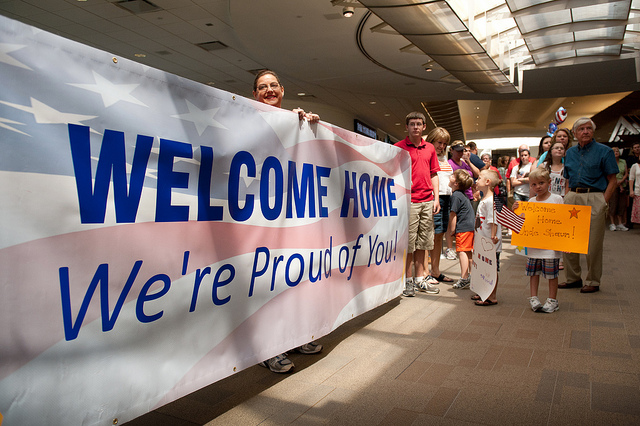
Friends and family of more than a dozen Kentucky Air National Guardsmen wait to greet the troops at Louisville International Airport in Louisville, Ky., as they return from a six-month deployment to Afghanistan on June 25, 2011. (U.S. Air Force photo by Maj. Dale Greer)
Click here to view more photos
LOUISVILLE, Ky. — The men and women of the Kentucky Air National Guard’s 123rd Civil Engineer Squadron completed a six-month deployment to Afghanistan July 29 when the unit’s final deployed members arrived home to cheering loved ones at Louisville International Airport.
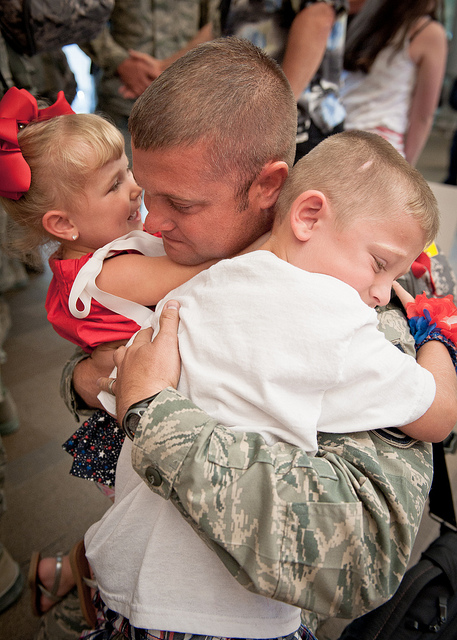
Master Sgt. Shaun Cecil, an electrician in the Kentucky Air National Guard's 123rd Civil Engineering Squadron, hugs his daughter, Caitlyn, and son, Trevor, in the Louisville International Airport passenger terminal in Louisville, Ky., June 25, 2011, after returning from a six-month deployment to Afghanistan. (U.S. Air Force photo by Maj. Dale Greer)
The Airmen were among more than 40 Kentucky Air Guard civil engineers who have been providing maintenance and construction services at Bagram Airfield, Afghanistan, since mid-December, said Senior Master Sgt. Marty Fautz, who served as the group’s operations superintendent during the deployment.
Other unit members returned home as part of redeployment rotations on June 25 and July 22.
While overseas, the Kentucky Airmen comprised approximately 60 percent of Bagram’s 455th Expeditionary Civil Engineer Squadron, a unit recognized as the Senior Airfield Authority and responsible for more than 1,000 acres of facilities, including 400 acres of concrete apron and an 11,000-foot runway, Fautz said.
During their tour, the Kentucky engineers programmed and constructed more than 60 projects, including the completion of over 2,000 in-house work orders, for a combined value of more than $300 million.
Fautz, who was involved in the planning and coordination of all projects tasked to the 455th, said his Airmen provided “incredible service” each day, as demonstrated when the Post Office warehouse tent became flooded, breaking the conveyor system and leaving mail to float freely in the flood waters.
Kentucky's adjutant general, Maj. Gen. Edward W. Tonini, greets more than a dozen members of the Kentucky Air National Guard's 123rd Civil Engineer Squadron at Louisville International Airport in Louisville, Ky., as they return from a six-month deployment to Afghanistan on June 25, 2011. (U.S. Air Force photo by Maj. Dale Greer)
“The conveyor presented a challenge,” he said. “There were several unsuccessful attempts by others to fix the conveyer before we jumped in and supported the Army in a team effort to shore up the tent and start the mail moving again.”
Other major projects completed at Bagram by 123rd engineers included a new C-130 maintenance hanger, a facility for security forces, construction of a 1,500-foot road for an aircraft homing beacon and the construction of two bed-down areas to house up to 500 personnel.
Some Kentucky Airmen, like Staff Sgt. Desiree N. Blair, were recognized by wing leadership for their exceptional performance in direct support of Operation Enduring Freedom.
Blair, a material control specialist involved in ordering parts and materials needed to complete work, solved a deficiency in the supply of barrier cables used to slow aircraft during emergency landings at Bagram Airfield.
“I remembered that the barriers we use at home during the Thunder Over Louisville air show come from Minot Air Force Base, so I gave them a call to get in touch with someone that could help us,” she said. “I was able to get them to send us five more cables that we were in dire need of.”
Despite such personal accomplishments, Blair was quick to offer praise for her fellow 123rd Airmen.
“Our guys work hard and take pride in everything they do, which is why our quality of work is so high,” she said. “We are a collection of the best the Air Force has to offer.”
Over a period of six months, Bagram typically will support more than 19,000 sorties, process over 200,000 personnel and move 1.2 million pounds of cargo, Fautz said, making it the busiest airfield in the world operated by the U.S. military.
That also makes it one of the largest challenges to support, from a civil engineering standpoint, but it was a challenge the Kentucky Airmen were ready to conquer, Fautz said.
“We have outstanding and very skilled personnel with us at every position,” he said. “These Airmen are not afraid to take on anything. They don’t give up or quit when the task seems impossible. They just rally together, dig in and get it done. Then they ask, ‘OK, what’s next?’ ”
Click here to view more photos
VHV
Story by Capt. Stephen Martin, Photos by Master Sgt. Phil Speck
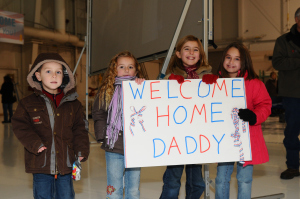
Children of deployed Airmen from the 123rd Airlift Wing await their loved ones returning from Afghanistan Jan. 12, 2011
LOUISVILLE, Ky. (Jan. 12, 2011) –The Kentucky Air National Guard deployed the 123rd Civil Engineers and brought home part of the 123rd Airlift Wing at the Kentucky Air National Guard Base today.
After weather delayed the unit’s departure a day, 21 Airmen from the Kentucky Air National Guard’s 123rd CES departed Louisville on board a C-130 to join the rest of their unit deployed in Afghanistan. While in country, the civil engineers will conduct firefighting operations, emergency management and explosive ordnance disposal.
“I’m looking forward to the deployment,” said Staff Sgt. Josh Thompson, 123rd CES , “though I hate to be apart from my Family, it’s important what we’re doing over there.
Col. Greg Nelson, 123rd AW commander addressed the CES before it departed,
“I know you will represent us well. You all are trained and ready to accomplish this mission,” said Nelson. “Fight hard, fight as Kentuckians.”
Just after the civil engineers departed Louisville, 27 Airmen from the 123rd AW flew in on board C-130s. They were deployed nearly two months in support of Operation Enduring Freedom.
The Kentucky National Guard currently has more than 500 troops deployed worldwide. Nearly 14,000 troops have mobilized for the War on Terror since 2001.
For additional photos of the event, please visit: www.flickr.com/photos/kyngpao/
