Pages
Stay In Touch
More
© 2013 KentuckyGuard
By Walt Leaumont, Kentucky National Guard Public Affairs
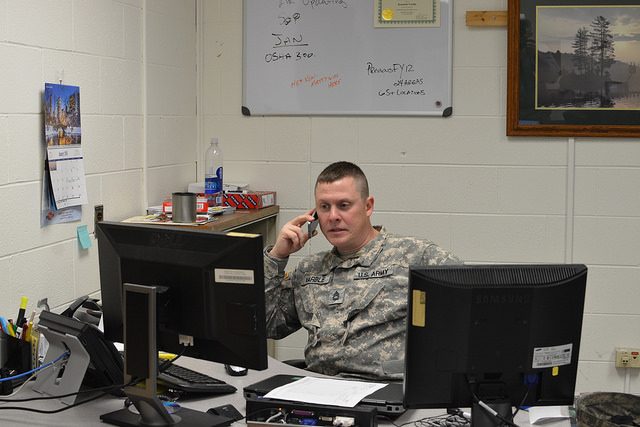
State Safety NCO Sgt. 1st Class Ken Varble provides advice to a unit in the field from his office in Frankfort, Ky. Feb. 25, 2016. In late 2015, Varble became the first Soldier in the Kentucky Army National Guard to pass the Occupational Health and Safety Technologist (OHST) exam. (Kentucky National Guard Photo by Walt Leaumont)
FRANKFORT, Ky. — ‘Safety is no accident’ is a common slogan used in the National Guard. To operate safely, it takes training, awareness, and professionals to advise and train. One of those professionals for the Kentucky Guard is Sgt. 1st Class Ken Varble, a three-year veteran of the State Safety Office.
Recently he achieved a major milestone in his career as he became the first Soldier in the Kentucky Army National Guard to pass the Occupational Health and Safety Technologist (OHST) exam. Having achieved a certification shows you have mastered the core knowledge required for professional safety practice. The OSHT credential is a validation of Varble’s professional expertise and a product of his training, self-development and on the job experience.
“This was an extremely difficult test that took a year to prepare for and over 4 hours to take,” said Varble. “I feel like I have accomplished a lot, and am glad to add the experience to my role with the Kentucky Guard.”
The certification adds to Varble’s position as a subject matter expert in all things safety. He regularly advises units and Soldiers on the appropriate regulations and guidelines of safety. Of the numerous manuals, handbooks or rules set forth by the Army or government safety organizations, Varble knows where to find the answer. He also ensures units and armories have the proper personal protective equipment (PPE) required to perform their job.
One weekend a month, Varble serves as a maintenance platoon sergeant with Kentucky’s 351st Aviation Maintenance Company.
Capt. Josh Witt, the State Safety Officer, said Varble is one of only 37 active OHSTs in the Commonwealth, and one of 1,800 nationwide.
“The Kentucky National Guard is privileged to have such a self-motivated and highly proficient operator on our team,” said Witt. “His accomplishment represents countless hours of study, academic preparation, and hands-on experience. Sgt. 1st Class Varble has distinguished himself as a fully qualified and capable ambassador in the field of Safety and Occupational health.”
“Having the OSHT certification increases my standing within the Safety Community,” said Varble. “It also gives me credibility and added confidence when I conduct unit visits.”
Although this certifies him as an expert, it is by no means the end of his training and education. Varble is currently attending Eastern Kentucky University working toward a Bachelor’s degree in Safety and Occupational Health and certification in Career Program 12 from the U.S. Army Safety Center.
By Staff Sgt. Scott Raymond, Kentucky National Guard Public Affairs
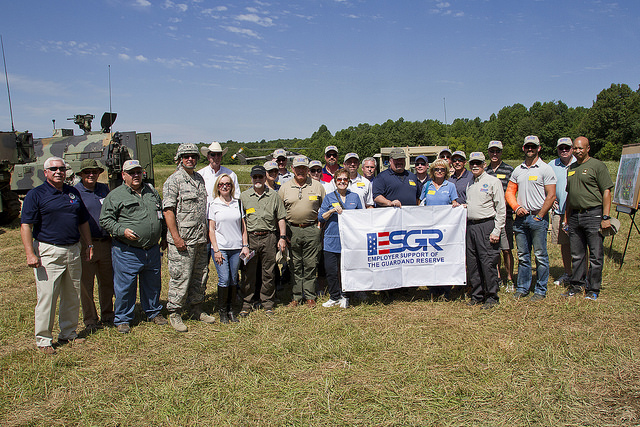
Kentucky civic leaders and employers visit with Kentucky Guardsmen as part of an Employer Support of the Guard and Reserve (ESGR) Boss Lift at Fort Knox, Ky., July 22, 2015. (U.S. Army National Guard photo by Staff Sgt. Scott Raymond)
FRANKFORT, Ky. — When a National Guard Soldier or Airman serves their one weekend and month and two-weeks in the summer, they are considered a traditional Guardsman. With the overwhelming majority of Kentucky’s Guardsmen falling into that category, hundreds of employers across the commonwealth are included in the extended Guard family. During ceremonies to welcome home, promote or award Guardsmen, we always hear the common gratitude to the families for sharing their loved one with the Guard. But it also a familiar acknowledgment to the employers and businesses that have also supported Kentucky’s Citizen-Soldiers.
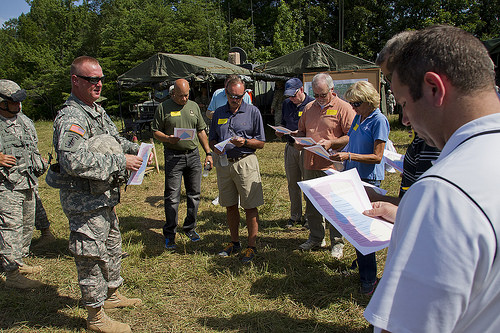
Lt. COl. Rob Larkin, command of the 138th Field Artillery Brigade speaks to employers and civic leaders during the civilians’ visit to the unit as part of an Employer Support of the Guard and Reserve boss lift at Fort Knox, Ky., July 22, 2015. The ESGR group toured the 138th’s tactical operations center, interacted with Soldiers and witnessed a live fire exercise of M109 Paladins. (U.S. Army National Guard photo by Staff Sgt. Scott Raymond)
As a thank you to several such military-friendly employers, Kentucky’s Employer Support of the Guard and Reserve held a day with the troops event, July 22. Commonly referred to as a Bosslift, such events provide employers and civic leaders the opportunity to see first hand what Kentucky’s Guardsmen, their employees, do when they are “off work.”
More than 30 representatives from local agencies and businesses from Lexington to Bowling Green flew by Blackhawk helicopter to Fort Knox, Kentucky and the Wendell H. Ford Regional Training Center in Greenville, Kentucky for the up-close view of National Guard training.
“The ESGR Bosslift program is essential in helping employers and community leaders understand what our Citizen-Soldiers do while in uniform,” said retired Army Brig. Gen. Mike Richie, a support specialist with Kentucky’s ESGR. “Most develop a deep appreciation for the dedication and sacrifice required to serve in the military. It’s also an opportunity to thank them for their contribution to our nation’s defense by employing and supporting our Service members.”
Click here for more photos.
Soldiers with the 138th Field Artillery Brigade were first to play host to the ESGR group at Fort Knox. Kentucky Adjutant General, Maj. Gen. Edward W. Tonini joined Lt. Col. Rob Larkin, commander of the 138th in greeting the civilians in a field environment the 138th was occupying for annual training. The employers met with the artillery Soldiers, toured their tactical operation center and vehicles, and witnessed a live fire exercise by the unit’s M109 Paladins.
One of the Paladin crew members was Sgt. 1st Class James Hatfield, a fireman with the Bardstown FIre Department. Among the visitors was Chief Marlin Howard, Hatfield’s boss.
“He has seen me in uniform before, but never in the field, never in this atmosphere, I’m sure his perspective will probably change a little bit,” said Hatfield. “Telling someone what you do is one thing, but when they see you in the environment you do it, is a completely different story. It’s hard for them to get that visual.”
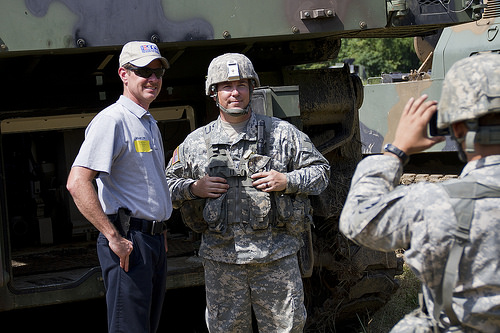
Chief Marlin Howard, chief of the Bardstown FIre Department has he photo taken with Sgt. 1st Class James Hatfield during an Employer Support of the Guard and Reserve boss lift at Fort Knox, Ky., July 22, 2015. Hatfield serves with Howard in Bardstown as his full-time employment. (U.S. Army National Guard photo by Staff Sgt. Scott Raymond)
“It means a lot that he came out here,” Hatfield added. “We are super busy at work and for him to take the time, see what I do and be a part of it, and to have a boss care enough to want to know what you do is pretty awesome.”
Hatfield has spent 21 years in the military uniform and 14 years as a fireman. The balance has worked for him, but knows some still believe that Guardsmen just get a couple extra days off each month.
“Employers on these boss lifts can see first hand, this isn;t a vacation out here, it’s good quality training for something we might have to do down the road.”
Howard said he has a small and close department, so everyone knows each other pretty well but hearing and seeing are two different things.
“He is a great employee and I kinda knew what he did outside work, but until you put boots on the ground with him, stand there beside with the equipment he works with, it’s an unbelievable moment,” said Howard. “It’s great to know and see that training that they get here, they take it back to their community.”
“I really appreciate everything the Guard has done to make us feel welcome into all of this, it’s been very nice and educational.”
In addition to the visit with the 138th, the employers and civic leaders traveled to the Kentucky’s Guard’s primary training facility in Greenville to see members of the 103rd Chemical Company during search and rescue training and Soldiers with the 138th Signal Company conducting vehicle roll-over training.
Chief Keith Jackson has a unique view of the day as he spent 27 years in the military. Now the Lexington Fire Department chief returns to the training fields to see Larkin, his friend and fellow fireman. Jackson expressed the pride he has for Larkin and the accomplishments he continues in the Guard and knows the sights and sounds will have an impact on the other employers.
“I think, today has opened their eyes to what truly at Citizen-Soldier is,” he said. “And they see what the Service members can offer, not only to the country but to the average American citizen.”
For more information on ESGR, visit www.esgr.mil, and www.kentuckyguard.com for information on Kentucky’s ESGR program.
Story by Staff Sgt. Michael J. Oliver, Bravo Company, Detachment 1, 2/75th Recruiting and Retention Battalion
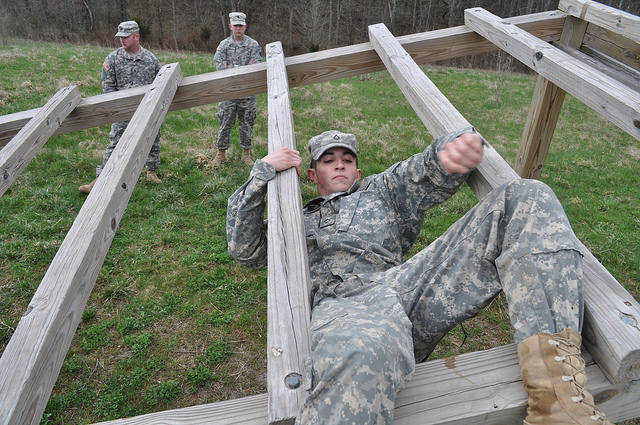
Kentucky National Guard recruit Pfc. Jacob Perkins of Crittenden, Ky., climbs through an obstacle during the Bravo Company Recruit Sustainment Program annual field training exercise at the Grant County High School Junior Reserve Officers’ Training Corps complex in Dry Ridge, Ky. (U.S. Army National Guard photo by Staff Sgt. Michael Oliver, 2/75th Recruiting and Retention)
DRY RIDGE, Ky. — More than 200 of the Kentucky National Guard’s newest recruits prepared for their future trip to Army Basic Combat Training during a field training exercise at Grant County High School in Dry Ridge, Ky.
“Our training prepares the new Soldiers for the rigorous and physical training they will encounter at BCT and they will be ahead of their peers when they go to their individual basic and advanced training,” said Cpt. Travis Riley, commander of Bravo Company, 2/75th Recruiting and Retention Battalion.
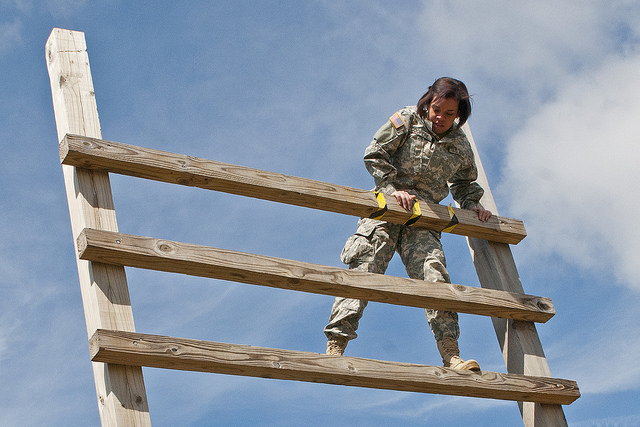
Kentucky National Guard recruit Pvt. Demikia Cooper of Independence, Ky., climbs an obstacle ladder as part of the Kentucky Guard’s Recruit Sustainment field training exercise in Dry Ridge, Ky., April 5, 2014. The exercise brought the recruits to the field to prepare them for the rigors of basic training. (U.S. Army National Guard photo by Staff Sgt. Scott Raymond)
To see more photos from this story, click here.
As part of the Kentucky Guard’s Recruit Sustainment Program, new enlistees are trained in the routine Soldier skills and Army Values before leaving to basic combat training and advanced individual training. The recruits drill one weekend a month, just like traditional Guardsmen, in preparation for what is to come.
“The field training exercise is a great opportunity to change up the schedule a bit,” said Riley. ” We bring them all together, get them outdoors all day and give them an even better taste of what’s next.”.
The future Soldiers were taught and guided through several Army warrior tasks and drills at the exercise. The training included fire team tactical movements, evaluate a casualty, prevent or control shock and first aid on a suspected fracture and open abdominal wound. The new Guardsmen also learned how to use a geographical map, a magnetic compass and determining their 50 meter pace count.
The highlight of the day, for most, including the new recruits muscling their way through a mile long obstacle course, and building team cohesion with relay events.
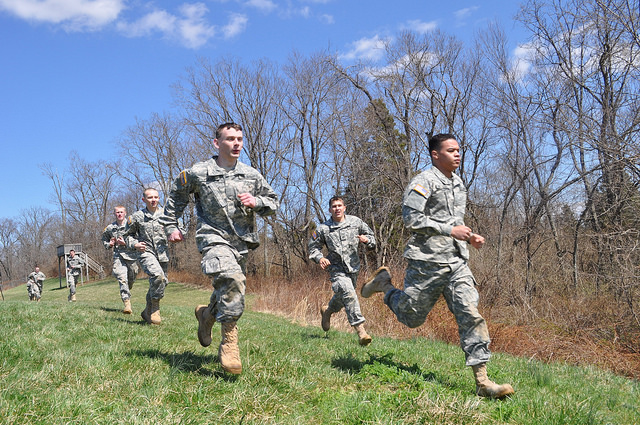
The Kentucky National Guard’s newest recruits prepared for Army Basic Combat Training during the Bravo Company Recruit Sustainment Program annual field training exercise at Grant County High School’s Junior Reserve Officer Training Corp complex in Dry Ridge, Ky., April 5, 2014. (U.S. Army National Guard photo by Staff Sgt. Michael Oliver, 2/75th Recruiting and Retention)
“Today’s training was tough but I’m glad we are doing it so I can be ready and pass basic,” said Pvt. 1st Class Emily Tillman of Hebron, Ky. Tillman also stated she wants to use the KYNG experience to become an agent with the U.S. Marshals.
The annual event was conducted by Soldiers with Bravo Co.’s Recruit Sustainment Program. This year, they received help from the high school’s Army Junior Reserve Officers’ Training Corps as cadets from the school led the recruits through the JROTC obstacle course.
“I think it’s real cool that everybody is using our JROTC field to help out with all the new recruits,” said Pvt. 1st Class Jacob Perkins, Grant County H.S. JROTC Cadet from Crittenden, Ky. “This gives me pride and a since of accomplishment knowing that I may have helped somebody pass their basic training,”
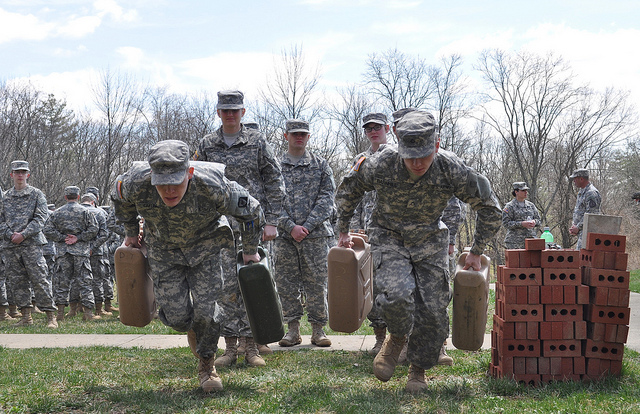
Kentucky National Guard recruits Pvt. Patrick Carlisle and Pfc. Darin Barnhill race each other while caring two filled 5 gallon water jugs during the Bravo Company Recruit Sustainment Program annual field training exercise at Grant County High School Junior Reserve Officer Training Corp complex in Dry Ridge, Ky. (U.S. Army National Guard photo by Staff Sgt. Michael Oliver, 2/75th Recruiting and Retention)
Story by Staff Sgt. Scott Raymond, Kentucky National Guard Public Affairs
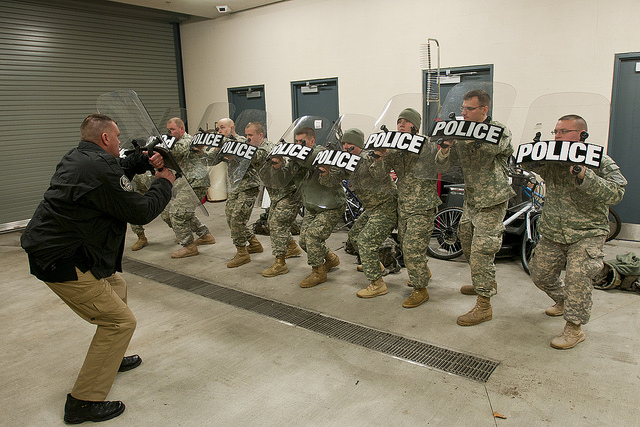
Soldiers of Charlie Company, 1st Battalion, 149th Infantry train with a Frankfort Police Department officer on the use of a riot shield in Frankfort, Ky., Jan. 18, 2014. The department conducted a full day of civil disturbance training for the unit including several tactics and techniques of crowd control. (U.S. Army National Guard photo by Staff Sgt. Scott Raymond)
FRANKFORT, Ky. — Soldiers of the 1st Battalion, 149th Infantry have always taken pride in the variety of skills they hold as a resource in the Kentucky National Guard. From assisting local officials during natural disasters in the state or securing convoys in Iraq, the 1/149th has pretty much done it all. The leadership of the battalion said there’s always room for more.
Guardsmen of the 1/149th’s Charlie Company out of Ravenna, Ky., added crowd control to their skill set during civil disturbance training in Frankfort, Ky., Jan. 18.
“As the military’s role keeps changing, we wonder how the infantry will remain a resource to Kentucky and how can it remain in the public’s eyes as a homeland security asset? This training is an answer to that,” said 1st Lt. Michael McFadden, executive officer with Charlie Co., who first proposed the idea last year after a chance meeting with local police officers.
To see more photos from this training, click here.
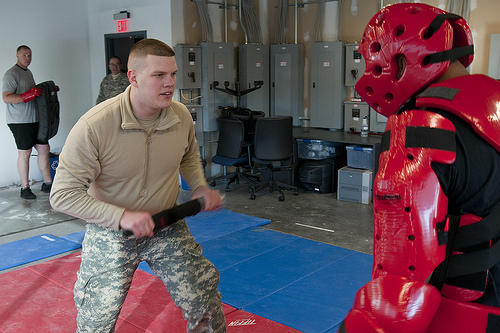
Spc. Dakota Sanborn with Charlie Company, 1st Battalion, 149th Infantry participates in the “Redman” exercise with the Frankfort POlice Department in Frankfort, Ky., Jan. 18, 2014. The “Redman” provides the opportunity to demonstrate baton techniques as part of crowd control training. (U.S. Army National Guard photo by Staff Sgt. Scott Raymond)
“As we transition from overseas deployments to operations at home, it’s important for us to establish partnerships with our communities and local organizations, such as the Frankfort Police Department,” he said. “This kind of training is invaluable for us and puts Charlie Company ahead of other units in value to the Guard and the state.”
Thanks to the cooperative efforts of the Frankfort Police, Charlie Co. was able to obtain helpful training needed to fulfill it’s current role as the Kentucky Guard’s Reaction Force. The role of a reaction force rotates among certain units in Kentucky every few years. The purpose is to have a trained and capable unit ready to assist local communities and augment local law enforcement agencies across the commonwealth in times of civil unrest.
McFadden believed training in crowd control would be a good fundamental his unit should learn. Frankfort Police Lt. Ken Hopkins totally agreed.
“This a win-win for us all,” said Hopkins. “We are tasked with (civil disturbance), they are tasked with it, it’s a hand in glove sort of thing, we just marry up the experts. I can tell you without a doubt that this department, the chief, the mayor, we are all huge supporters of the military. We have several officers who have served, including myself and we have Boone National Guard Center right here, so when the chance comes up to train with our military, we are all over the idea.”
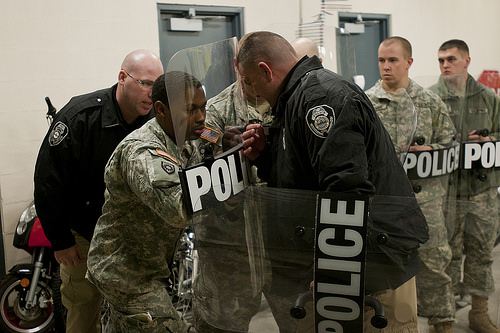
Frankfort Police officers train Soldiers with Charlie Company, 1st Battalion, 149th Infantry in the proper techniques of using a riot shield in Frankfort, Ky., Jan. 18, 2014. The collaboration between the department and the National Guard was said to be mutually beneficial in the training of both sides. (U.S. Army National Guard photo by Staff Sgt. Scott Raymond)
Hopkins, Frankfort’s Mobile Field Force Commander, orchestrated the training and selected members of his team to instruct the Soldiers on the necessary elements to contend with civil disturbances. Classes and demonstrations included the proper riot control formations, use of riot shields and batons and techniques for securing detainees. He said he was ecstatic to assist because he knew it was mutually beneficial.
While the roles of the military and local law enforcement are legally different according to the U.S. Constitution, Hopkins said its about the common goals and common training of those involved in assisting the public.
“Charlie Company has the training, our training, they are in the community just like we are, they are familiar with our tactics and our officers, so it makes perfect sense to call on them,” he said. “They have become a force-multiplier for us here in Frankfort.”
The full-day of instruction culminated with a large-scale exercise that night in Frankfort. The Soldiers were forced to put everything they had learned to work in order to quell a mock riot situation put on by the police officers and local volunteers.
The infantry Soldiers were also excited to change up the training schedule with a new block of instruction. While the night exercise and taser demonstrations were the highlights of the day, Charlie Co.’s Soldiers said they found each class helpful.
“The training was very in depth, it was intense and very interesting,” said Spc. Paul Samarin from Richmond, Ky. “We all found a new appreciation for the work that the police do and learned a lot of things we never knew they had to do.”
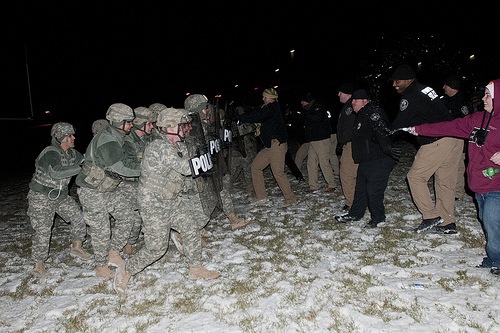
Soldiers of Charlie Company, 1st Battalion, 149th Infantry square off with officers from the Frankfort Police Department in a mock riot exercise in Frankfort, Ky., Jan. 18, 2014. The exercise was the culminating event of a full day training for the Soldiers on crowd control conducted by the officers. (U.S. Army National Guard photo by Staff Sgt. Scott Raymond)
The training was originally scheduled for October of 2013, but due to the government shutdown, the collaboration was put on hold. McFadden said the fact that the training was continued goes to show its importance.
“We are grateful that the Frankfort Police Department kept us on their schedule,” he said. “This is the kind of partnership we need and the unique training helps us as leaders keep our Soldiers involved and interested. If Frankfort calls, or if Kentucky calls, Charlie Company will be ready when needed in a new way.”
Story by Master Sgt. Phil Speck, 123rd Airlift Wing Public Affairs
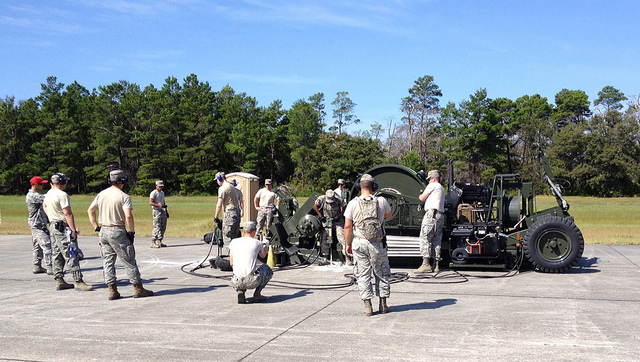
Troops from the Kentucky Air National Guard’s 123rd Civil Engineer Squadron join with other Airmen to anchor a Mobile Aircraft Arresting System at Tyndall Air Force Base, Fla., on Sept 16, 2013. The Kentucky Air Guardsmen were participating in Silver Flag, a week-long exercise to train and test the skills of civil engineers at a bare-base location in a simulated wartime environment. (U.S. Air National Guard photo by Tech. Sgt. Dave Soldat)
KENTUCKY AIR NATIONAL GUARD BASE, LOUISVILLE, Ky. — Kentucky Air National Guardsmen of the 123rd Civil Engineer Squadron deployed to a secluded bare base location to establish and maintain a base during a wartime mission exercise known as Silver Flag.
During the week long exercise, Sept. 13-21, the 26 Airmen joined over 246 Active Duty, Reserve and Guardsmen at Tyndall Air Force Base, Fla. This was the biggest class ever for Silver Flag said Lt. Col. Keith McCallie, Deputy Base Civil Engineer for the 123rd Civil Engineer Squadron, and student commander for Silver Flag.
“This was a well worth learning experience,” McCallie said. “a total force integration, a first that I’ve ever seen at Silver Flag.”
Silver Flag is training for all civil engineering (CE) personnel, including command and control, and specialized craftsmen training. This training is mandatory for civil engineers every 40 months. The exercise challenged each craft area in CE to perform under a wartime mission tasking, including emergency management, utilities, structures, heating ventilation and air conditioning, heavy equipment, electrical, power protection, site development, CE Operations, and fire. The Command and Control (C2) element from the 123rd CES attended the exercise.
Other units from other bases such as Personnel, Services, Communications, and Medical personnel participated in the exercise as well.
Tasks that had to be handled during the war games included purifying water, getting electrical generators online and power distribution, airfield lighting, erecting tent cities, rapid runway repair, installation of mobile aircraft arresting system and bare base site layout, just to name a few.
The units also showed they could pre-stage vehicles and conduct convoy operations with precision. They also defended assets by preventing simulated host-nation saboteurs from disrupting power distribution.
The exercise also allows Airmen access to specialized equipment they normally don’t get to work with back at their home station units, as well as a test bed for new and improved equipment coming through the Air Force. At the Silver Flag location, a new power distribution system was being field tested which consisted of new digital design as compared to an old aging analog system.
“This gives the Airmen a look at the new cutting edge technology, which is a benefit to troops, and gives the command element exposure to new technology.” McCallie said.
During the exercise the Cadre commented on the positive attitudes of everyone, and integration of the Air Force Active Duty, Reserves and Guard.
“Everyone meshed very well, no fights or feuding between the services, and it was eye opening to see how everyone was so enthusiastic.” McCallie added. “Morale was not an issue at this Silver Flag, everyone embraced this training with enthusiasm and the go-get attitude.”
Story by Staff Sgt. Vicky Spesard, 123rd Airlift Wing Public Affairs Office
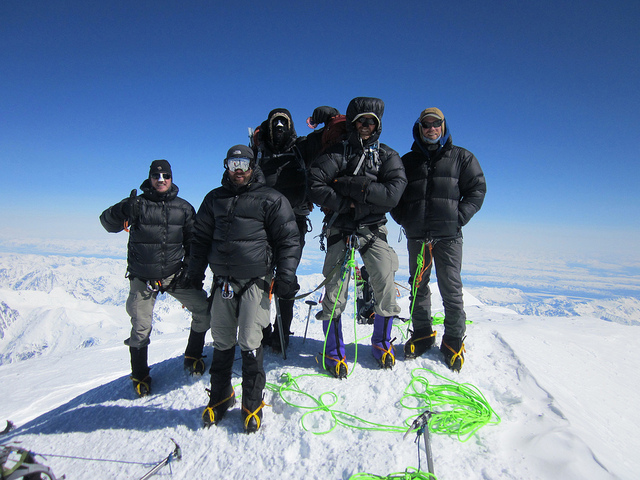
Five combat controllers from the Kentucky Air National Guard’s 123rd Special Tactics Squadron scaled Mount McKinley near Talkeetna, Alaska, on May 25, 2013, as part of arctic mountaineer training. The 20,237-foot summit is the highest mountain peak in North America. (Photo courtesy 123rd Special Tactics Squadron)
KENTUCKY AIR NATIONAL GUARD BASE, LOUISVILLE, Ky. — Five combat controllers from the Kentucky Air National Guard gained valuable extreme-weather experience recently by scaling to the top of Mount McKinley near Talkeetna, Alaska.
Senior Master Sgt. Wes Brooks, Master Sgts. Russ LeMay and Aaron May, and Tech. Sgts. Grant Kinlaw and Harley Bobay of the 123rd Special Tactics Squadron reached the summit of North America’s highest mountain May 25 after many weeks of mid-altitude and high-altitude conditioning.
The objective of such extreme training, which involved glacier travel techniques, crevasse rescue operations and avalanche prediction, was to give the Airmen experience they might need during cold-weather, high-altitude military operations, according to Chief Master Sgt. Tom DeSchane, the 123rd’s combat control enlisted manager.
“In preparing for part of their war-time tasking, these guys have to practice their mountaineering skills and land navigation through arctic conditions,” DeSchane said. “Each operator is issued his own skis, snow shoes and all the accoutrements for surviving the elements. Going up Mount McKinley teaches them how to rope-in and traverse the terrain safely with all of the equipment that they have to carry.”
Combat controllers are part of the Air Force Special Operations community and are among the most highly trained personnel in the U.S. military. As certified air traffic controllers, they deploy undetected into combat and hostile environments to establish assault zones or airfields while simultaneously conducting air traffic control, fire support, command and control, direct action, counter-terrorism, foreign internal defense, humanitarian assistance and special reconnaissance.
Planning for the high-altitude training exercise began about a year ago when the five men participated in mountaineering training in the snowy mountains outside Salt Lake City, Utah, with other members of their squadron.
There, the squadron practiced knots, anchors and other rope skills, as well as movement techniques, minimalistic equipment and clothing, and medium-altitude terrain traversing.
“Originally, the idea to climb (McKinley) came from Aaron, who had tried to climb the mountain before with his previous unit,” LeMay said. “His team was unable to reach the summit when they stopped to help rescue another group of climbers who had an accident.”
Accidents on the mountain are common and mostly caused by climbers who are not properly trained or prepared for the change in altitude and the extreme environment.
The Kentucky team took great care in preparing for their climb.
When the five-member team arrived in Anchorage, Alaska, outside Denali National Park and Preserve, they spent the first day with a guide service, familiarizing themselves with their equipment and preparing meals. The team then departed by air taxi to Mount McKinley base camp, where they spent three days engaged in hands-on training to ensure a solid skill foundation.
For the next 13 days the five Airmen and two guides applied all of their skills and techniques to climb the mountain summit, stopping at camps along the way to acclimate, rest and complete training objectives, before making the return trip to base camp.
“Summit day was the hardest part of the climb,” LeMay said. “It took us five to six hours of straight climbing from the last camp we stayed at to reach it. We were the first group of the day to reach the summit so we had about 45 minutes to ourselves to see how beautiful it was. It was the clearest day at the top, so we could see for miles around us. It was amazing.”
Having to make way for other climbing groups, the combat controllers returned to the camp they stayed in the night before to rest for their descent.
“It was tough to go up to the top,” LeMay continued. “Everything about going up and coming down was tough. The cold-weather environment is very unforgiving, and it makes even the smallest tasks very difficult.
“It was the best kind of cold-weather training we could have gotten. Working in such a harsh environment gave us invaluable experience. The climb was amazing, but a lot of hard work.”
Story by Staff Sgt. Scott Raymond, Kentucky National Guard Public Affairs
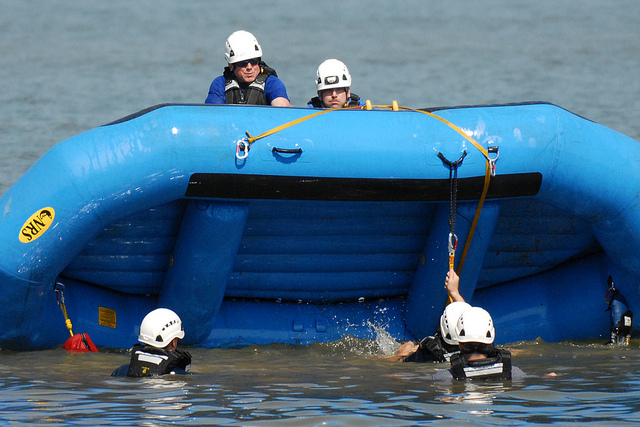
Members of the 41st Civil Support Team attempt to right a capsized raft in the Ohio River near Louisville, Ky., Aug. 27, 2013. The exercise was part of the unit’s training on swift water rescue operations. (U.S. Army National Guard photo by Staff Sgt. Scott Raymond)
LOUISVILLE, Ky. — Many know of the skill-set of the Kentucky National Guard’s 41st Civil Support Team. They are the go-to guys for any situation involving chemical, biological, radio-active or nuclear materials (CBRN). They have proven time and time again through real-world actions and excellence in proficiency checks that they are among the best of the best in the Nation.
But what the team wants everyone to know is that their abilities go far beyond their response to such incidents.
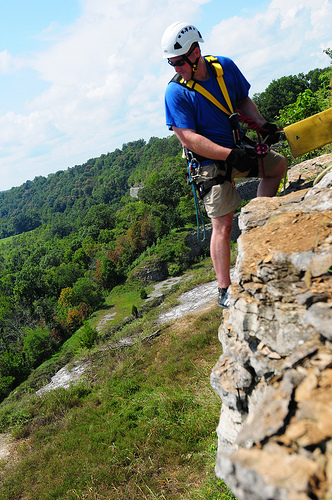
Sgt. Jacob Beach of the 41st Civil Support Team prepares to rappel down a cliff as part of a training exercise in Frankfort, Ky., Aug. 21, 2013. The unit received professional instruction on methods of technical rope rescue for use in urban operations during natural or man-made disasters. (U.S. Army National Guard photo by Staff Sgt. Scott Raymond)
To be up to the task 24/7, the team trains constantly, but recent exercises have taken them out of their usual element. To enhance that broad skill-set of the 22-man team, the Soldiers and Airmen gathered in August to practice technical rope rescues and swift water rescues.
To see more photos of the 41st’s training, click here.
“The 41st is known for their response to CBRN responses, and we are exceptionally good at doing that,” said Lt. Col. John Cline, commander of the 41st. “After Hurricane Katrina hit, the missions of all civil support teams across the Nation changed to include response to natural and man-made disasters.”
“This training relates to that for our response to floods, where we not only could rescue individuals in difficult situations, but also perhaps to pull drums of hazardous materials out of the water,” he said. “And anything that involves ropes is closely related with most of our operations for urban rescue.”
The team first came together for instruction on rope rescues in Frankfort, Ky., on the cliffs overlooking U.S. 127. Bill Matney, an emergency service instructor from Greensburg, Ky., provided both training opportunities.
“What we are giving them is options,” said Matney, owner and operator of Matney Consulting and Training. “We’re giving them tools for their toolbox, new methods and increasing their functional capabilities.”
Team members were taught fundamentals of rope rescue, including proper knots to tie, line anchor points and belay operations. They were then able to put the lessons to use as the team members played various roles in ascending and descending the cliffs in scenarios similar to what they may encounter in a real-world rescue.
The team next set up on the banks of the Ohio River in Louisville, Ky., for the swift water rescue training. The water-borne operations included instruction in hazard recognition, equipment use, and basic shore and boat-based rescue techniques.
“With the new natural disaster role, we looked at what the state needed as a whole and found some gaps so that’s why we’re here doing this,” said Sgt. 1st Class Steven Baker, a CBRN Specialist with the 41st.
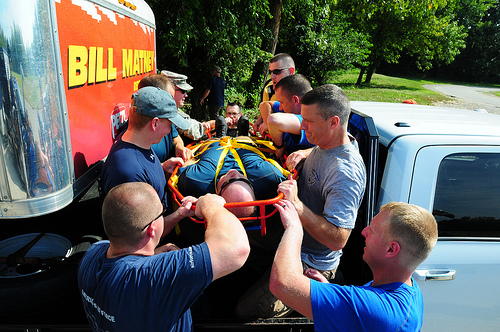
Soldiers and Airmen of the 41st Civil Support Team work to transport a fellow team member over an obstacle during training in Louisville, Ky., Aug. 27, 2013. The exercise demonstrated the difficulties of rescues performed in confined spaces and how to overcome the challenges. (U.S. Army National Guard photo by Staff Sgt. Scott Raymond)
“I think this is going to continue to enhance our skills and make us an even better asset to the state,” said Baker.
In addition to the rope and water rescue training, Matney also included lessons on confined space rescues. The 41st was instructed on how to properly secure a victim in a litter and how to move within restricted and unusual spaces.
Matney said he works with and trains a wide variety of first-responders and agencies, and commented on how impressed he was with the skills of the Soldiers and Airmen in the unit.
“I do this for a living, and I can tell you who is good and who needs more,” said Matney. “This crew is not here because they were told to be, they’re here because they want this. The quality of their leadership, their talent and their motivation is very impressive.”
“Overall, this is just great training to have,” said Cline. “We haven’t had to put it into action yet, thankfully. But if we do, we will be fully prepared to do so.”
Story and photos by Spc. Brandy Mort, 133rd Mobile Public Affairs Detachment
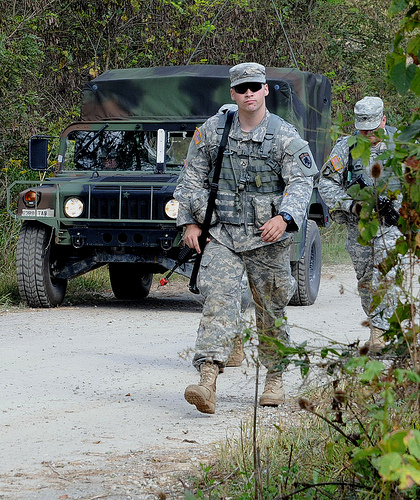
Pfc. Lanham walks with his squad to their next point of instruction during the 63rd Theater Aviation Brigade’s Command Sergeant Major Challenge at Hidden Valley Training Site in Powell County, Ky., Sept. 14, 2013. Soldiers of the unit gathered in a field environment for the event which gave them the opportunity to focus on basic Army task training. (U.S. Army National Guard photo by Spc. Brandy Mort)
POWELL COUNTY, Ky. — More than 400 Kentucky National Guardsmen from the 63rd Theatre Aviation Brigade participated in the second annual Command Sergeant Major Challenge at the Hidden Valley Training site in Powell County, Ky., Sept. 13-15.
From the time the sun rose and the dew settled and through the night Soldiers of the 63rd TAB faced a grueling three-day challenge. The event consisted of four different training lanes: Forward Operating Base Security, Medical, Army Warrior Tasks, and Survival. Underneath each lane were 42 subtasks dealing with each particular lane.
Units of the brigade were broke down into squads and were given precise instructions on when and where to be throughout the event. But it was entirely up to them to ensure they used land navigation skills and time management to maximize their training. Squads were awarded points for each task with the team with the most was presented the Command Sergeant Major Trophy during an awards presentation.
To see more photos from the event, click here.
According to the leadership of the brigade, the challenge was planned and executed by the enlisted members of the 63rd TAB. And that brought the enlisted ranks together, from the seasoned veteran to brand new privates.
“I’m happy this was my first drill with my unit,” said Pfc. Brittni Sherman, the newest patrol and supply specialist with the 2/147th Aviation. “It gives enlisted Soldiers like myself the opportunity to work within their platoon in order to accomplish the mission.”
The CSM challenge gives members of the 63rd TAB a special chance to practice basic soldier skills.
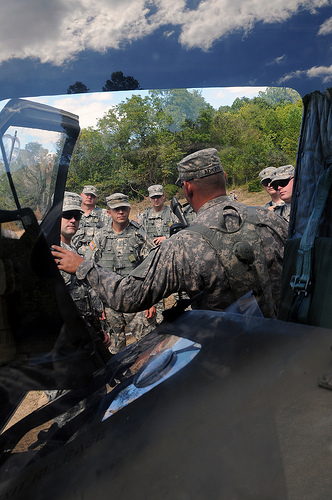
Sgt. 1st Class Adkins instructs Soldiers of the 63rd Theater Aviation Brigade on how to assist with a downed aircraft during the brigade’s Command Sergeant Major Challenge at the Hidden Valley Training Site in Powell County, Ky., Sept. 14, 2013. A variety of training lanes awaited the Soldiers of the brigade as they navigated the area from point to point with numerous Army tasks along the way. (U.S. Army National Guard photo by Spc. Brandy Mort)
“Aviation Soldiers typically work on or around aircrafts on Boone Center,” said Command Sgt. Maj. Kevin Wilkins, Command Sgt. Maj. of the 63rd TAB. “This is a unique opportunity for Soldiers to practice skills in a field environment.”
Despite the cold weather and rugged terrain, the Guardsmen enjoyed the training.
“Events like the CSM Challenge make us all better Soldiers,” said Sgt. Marcus Avery, crew chief with Bravo Company 2/147th, “We got the opportunity to bond amongst our teams, and develop more efficient troop leading procedures.”
Certain Soldiers of the 63rd TAB also participated in the event as observers and controllers, or the subject matter expert at each point of instruction. This gave Guardsmen the chance to act the role of opposition forces in scenarios and teach different classes based on the lanes.
“This is a special chance for each Soldier of the 63rd to learn different jobs within the brigade,” said Sgt. 1st Class Dale Adkins, flight operations NCO with Detachment 11, Observation Support Aircraft Agency, “I’m teaching the Soldiers what how to react to a downed aircraft, how to pull security around it and what to do to help the pilots and crew. Everyone gets exposure to an aircraft, even if their job doesn’t call for it.”
The tough weekend concluded with a special treat for the unit as the Department of Agriculture and Kentucky Proud coordinated a luncheon with food prepared by Kentucky Veterans. After all the instruction and hiking through the woods, all the units came together for a meal unlike they had had all weekend. Col. Michael Ferguson, the commander of the 63rd oversaw the luncheon and the award ceremony, congratulating many Soldiers on their accomplishments.
To see the photos from the Kentucky Proud luncheon, click here.
Kentucky’s new State Command Sergeant Major, Command Sgt. Maj. Thomas Chumley also attended, paying his first visit to Soldiers in the field in his new role and praised the 63rd.
“I’m very proud of the Soldiers of the 63rd TAB,” said Chumley, “You have set the bar for the Kentucky National Guard. It’s events like these that keep men and women wanting to serve.”
NOTE: As often as we can kentuckyguard.com publishes stories by or about Kentucky National Guard unit public affairs historian representatives, also known as UPAHRs. This is an additional duty taken on by a Soldier or Airmen with the intent of telling their unit’s story. This is one such story ….
Story and photos by 1st Lt. Joshua Witt, 1/149th Unit Public Affairs Historian Representative
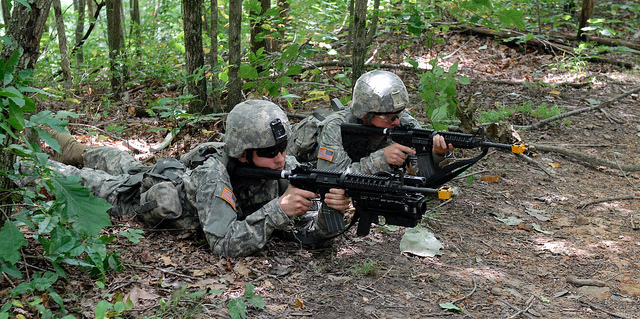
Soldiers of the 1st Battalion, 149th Infantry take up defensive positions during a training scenario at the Harold L. Disney Training Center in Artemus, Ky., July 23, 2013. (U.S. Army National Guard photo by 1st Lt. Joshua Witt)
ARTEMUS, Ky. — More than 500 Mountain Warrior Soldiers of 1st Battalion, 149th Infantry participated in annual training July 13-28 at the Disney Training Center in Artemus, Ky. Despite the heat index regularly cresting 100 degrees, the undaunted Infantry of the Kentucky National Guard diligently focused on achieving proficiency within their squads and sections. Emphasis this year was on collective tasks that support both their company and the battalion.
“It is imperative that we build capable squads before we transition to platoon training and potential deployments in the future,” said Capt. Jason Mendez, battalion training officer.
“We will continue to train and validate our maneuver squads and sections in a decisive action training environment that encompasses offensive, defensive, and stability operations,” said Maj. Joe Lear, acting battalion commander.
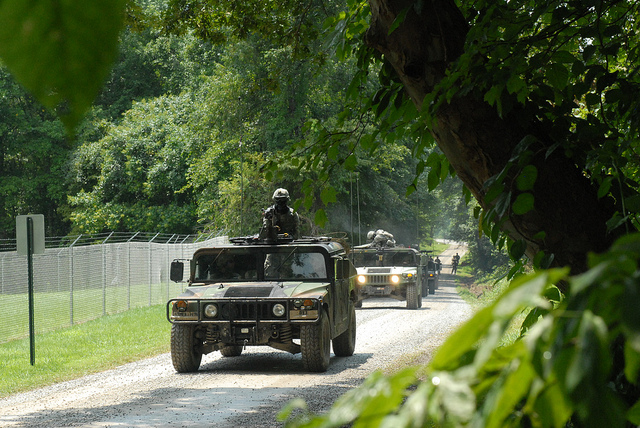
Soldiers of the 1/149th Infantry conduct a react to contact while mounted battle drill as part of their annual training at the Harold L. Disney Training Center in Artemus, Ky., July 23, 2013. (U.S. Army National Guard photo by 1st Lt. Joshua Witt)
To see more photos from the unit’s annual training, click here.
Annual training was completed with the successful validation of 18 rifle squads and six assault sections from Delta Company. By achieving this milestone the battalion will advance to platoon-level training in 2014.
During annual training infantry Soldiers conducted multi-echelon training and progressed through a crawl, walk, run methodology. Days and weeks of preparation culminated in a 96-hour continuous exercise. Each company was responsible for operating a training lane during annual training - react to conduct, knockout a bunker, and point ambush.
They planned and resourced the training while also certifying instructors. Key training events included squad and section validation through lanes training, tactical leader validation program, sustainment operations, staff decision making processes and communication exercises. The S2 section built a hybrid-threat training operational environment and controlled 24 oppositional force personnel during the final training events.
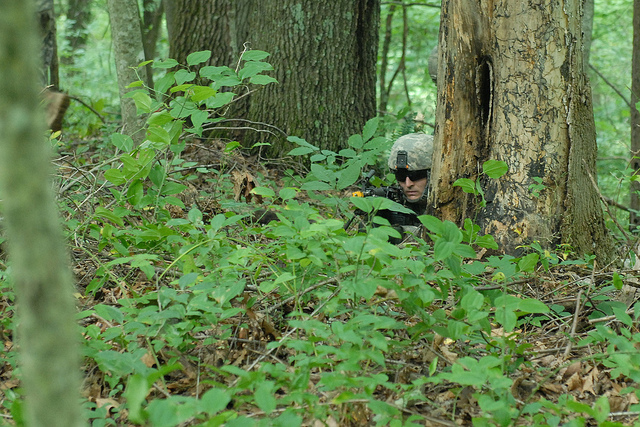
A Soldier with the 1/149th Infantry takes cover during a battle drill at the Harold L. Disney Training Center in Artemus, Ky., July 23, 2013. (U.S. Army National Guard photo by 1st Lt. Joshua Witt)
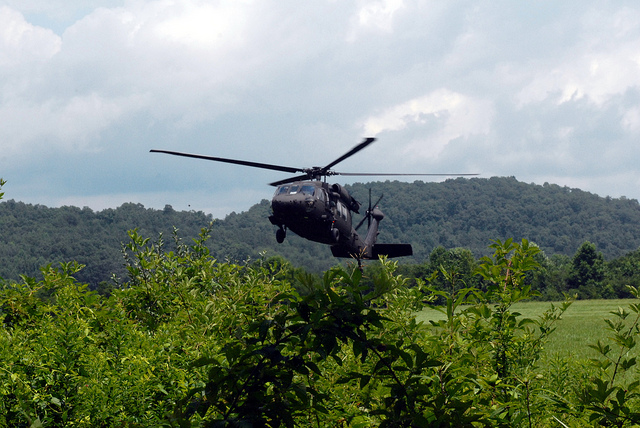
Soldiers and aircraft from Bravo Co. 2nd Battalion, 147th Aviation assisted the 1/149th Infantry with aviation support during the infantry’s annual training in Artemus, Ky., July 13-28, 2013. (U.S. Army National Guard photo by 1st Lt. Joshua Witt)
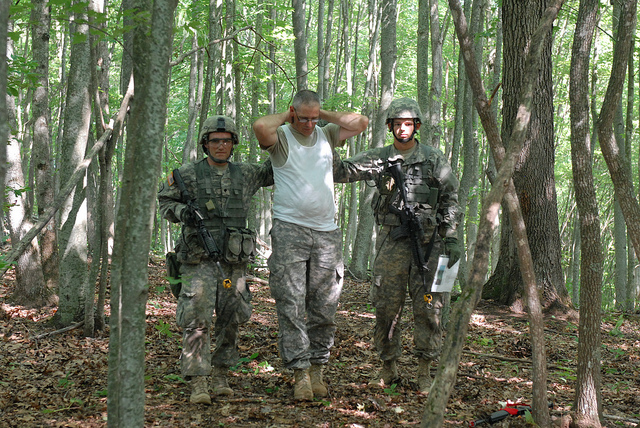
Soldiers of the 1/149th Infantry escort another Soldier posing as an enemy combatant during a scenario as part of the infantry’s annual training in Artemus, Ky., July 23, 2013. (U.S. Army National Guard photo by 1st Lt. Joshua Witt)
Story and photos by John Crosby, Atterbury-Muscatatuck Public Affairs
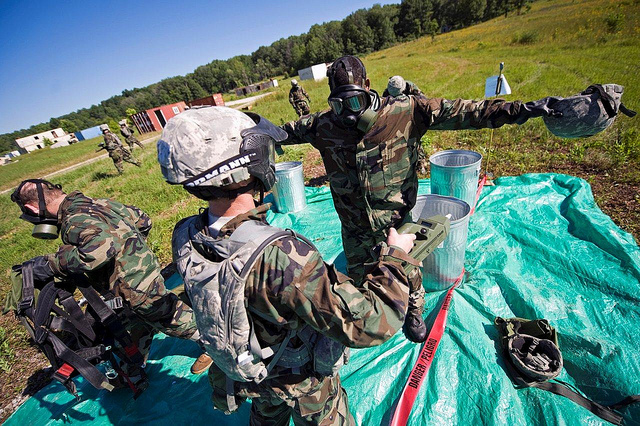
Kentucky National Guard Soldiers of the 103rd Chemical Battalion practice chemical decontamination during a simulated chemical weapons attack at Camp Atterbury, near Edinburgh, Ind., July 25. The battalion wide exercise was the culmination of two weeks of annual training. (Photo by John Crosby, Atterbury-Muscatatuck Public Affairs)
EDINBURGH, Ind. — The Kentucky National Guard’s 103rd Chemical Battalion conducted decontamination training at Camp Atterbury, near Edinburgh, Ind., July 25.
This culminating event, involving search and extraction, reconnaissance and decontamination teams, is the result of two weeks of annual training held here.
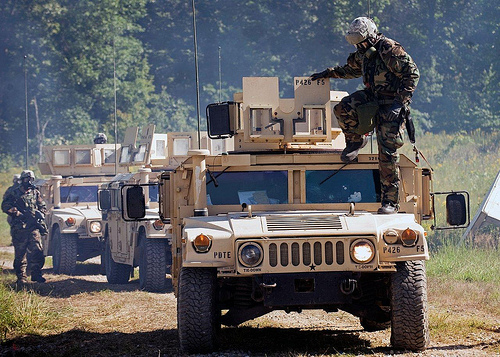
Kentucky National Guard Soldiers of the 103rd Chemical Battalion dismount their Humvees during a chemical decontamination exercise at Camp Atterbury, near Edinburgh, Ind., July 25. The battalion wide exercise was the culmination of two weeks of annual training. (Photo by John Crosby, Atterbury-Muscatatuck Public Affairs)
These troops conducted traditional Soldier skills training including weapons ranges and room clearing, as well as occupational specific training. Additionally, they conducted drivers familiarization training on the M113 Armored Personal Carrier equipped with an M58 Wolf Smoke Generator System. This system creates large plumes of smoke to provide concealment to Soldiers on the battlefield.
“We’ve been doing a lot of training this past year on the vehicle, but this is the first time we’ve been able to really get some hands on driving time, seeing what the vehicle can and can’t do and how it handles the terrain,” said Spc. Chris Mocabee, Chemical Specialist with the 301st Chemical Company. “Basically, if you’ve got a unit coming across the hot zone, we can provide smoke to limit the enemies visibility and make sure our guys don’t take any hits.”
This annual training period is the unit’s first since 2008. The unit deployed in support of Operation Iraqi Freedom from 2009-2010. In 2011 and 2012, the battalion trained to become part of the Kentucky Chemical, Biological, Radiological, Nuclear and High Yield Explosive Enhanced Response Force Package.
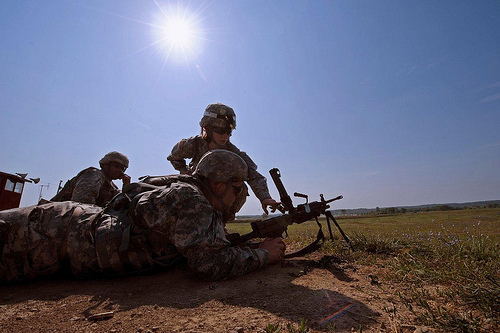
Kentucky National Guard Pfc. Kathrine Hix, Richmond, Ky., chemical specialist in Headquarters and Headquarters Detachment, 103rd Chemical Battalion inspects the chamber of an M249 Squad Automatic Weapon at Camp Atterbury, near Edinburgh, Ind., July 17. The battalion trained a variety of Soldier skills including the weapons ranges and room clearing operations, as well as occupational specialty specific training. (Photo by John Crosby, Atterbury-Muscatatuck Public Affairs)
“It’s been about five years since we’ve been out here as a unit in this capacity, training our traditional National Guard mission,” said 299th Chemical Company 1st Sgt. William Thompson Jr. “We’ve got so many new Soldiers in the unit, which is a plus when it comes to training because these younger guys have the fresh and latest techniques to share.”
The culminating event began with a simulated chemical, biological, radiological, nuclear related incident, in which Soldiers were contaminated. The M113 tracked vehicles rushed to the scene and deployed smoke. Reconnaissance forces donning gas masks and full chemical suits took out to search for casualties. Search and extraction teams helped gather casualties and guided them and their vehicles to the decontamination area where they were methodically filtered and cleaned of the attack.
“The day has been good, they’re operating smoothly now,” said Thompson of his Soldiers. “They’ve come a long way since the beginning of the week.”
Thompson added he hopes to return to Atterbury for annual training next year.