Pages
Stay In Touch
More
© 2013 KentuckyGuard
By, Maj. Jimmie Warinner, 1st Battalion, 623rd Field Artillery
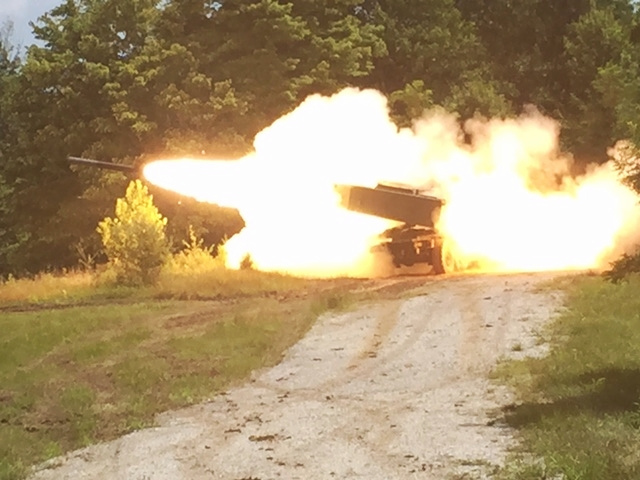
A M142 High Mobility Rocket Launcher (HIMARS) from the 1st Battalion, 623rd Field Artillery fires during training at Camp Atterbury, Ind., July 21, 2015. The launch was the first live fire exercise conducted at Camp Atterbury. (U.S. Army National Guard photo by Maj. Jimmie Warriner)
CAMP ATTERBURY, Ind. — Soldiers of the 1st Battalion 623rd Field Artillery recently completed an innovative and successful annual training at Camp Atterbury, Indiana. The key training event for AT 2015 was a seven day field training exercise that concluded July 24 with all crews in the battalion conducting multiple live fires with the M142 High Mobility Artillery Rocket System (HIMARS).
This was the first Multiple Launch Rocket System (MLRS) or HIMARS live fire ever conducted at Camp Atterbury, and was made possible through close coordination with the 1/623rd and Camp Atterbury’s Range Control personnel. Not only did this coordination allow Morgan’s Men to successfully complete crew certifications, but it also demonstrated an increased training capability for Camp Atterbury confirming that they can support future live fire training for both MLRS and HIMARS units.
This was only one of three “firsts” that Morgan’s Men accomplished during this annual training.
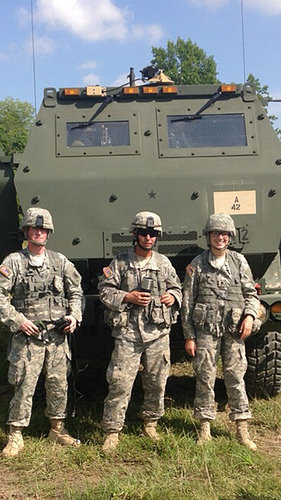
Spc. Michael Fosso, Staff Sgt. Norman Schwartz, and Spc. Logan Green with the 1st Battalion, 623rd Field Artillery stand in front of their HIMARS vehicle, “Rebel 42” during their live fire exercise during annual training July 21, 2015 at Camp Atterbury, Ind. Green is the first female crew member with the 1/623rd. (U.S. Army National Guard photo by Maj. Jimmie Warriner)
Among the crew members sending rockets roaring downrange was Spc. Logan Green, the first female MLRS Crewman to ever fire a rocket for the 1/623rd. With more combat arms military occupational specialties opening to women, females now have the option of becoming MLRS Crewmen (13M) or Fire Direction Control Operators (13P) within HIMARS units.
A HIMARS crew consists of a Gunner, Driver, and Launcher Chief. Green is the driver for Alpha Battery’s HIMARS nicknamed “Rebel 42”. She grew up in Florida and joined the Kentucky National Guard because she always wanted to be in the military and it allowed her to fund her college education.
“I am proud and excited to be the first female to live fire the HIMARS in the 1-623d and I want to set a good example for other Soldiers, males and females, who serve with me”. Green, a 2015 recipient of the Minuteman Scholarship, plans on continuing her military career by pursuing a commission as a Field Artillery officer through the University of Kentucky’s ROTC program.
Click here to read about Green’s enlistment into the Kentucky Guard.
The final “first” completed during Annual Training 2015 was support of a MLRS Crewmen (13M30) Advanced Leadership Course (ALC) conducted by 1st Battalion 238th Regiment. Nine Soldiers, including seven from the 1/623rd completed the first week of the 13M30 course at the Wendell H. Ford Regional Training Center in Greenville, Kentucky before traveling to Camp Atterbury to complete week two in the field. For the culminating event of the course, the ALC students were certified by the battalion’s Master Gunner and then participated in a HIMARS live fire.
This was the first time that a HIMARS live fire has been part of a MLRS crewman course, but something that Regional Training Institutes throughout the country are considering implementing as part of their course of instruction. The partnership between the 1/623rd and 1/238th proved that this concept of training is viable, allowing Soldiers to complete ALC while also participating in valuable training exercises with their assigned units and crews. This cooperative effort also resulted in the Soldiers completing the course with very little additional cost to the Kentucky Army National Guard beyond that of a normal annual training.
With Annual Training 2015 completed, Morgan’s Men are now preparing for future training operations and more “firsts” such as a planned training event with the Kentucky Air National Guard.
To learn more about Morgan’s Men and the great things they’re doing, follow them on Facebook.
Story by Sgt. 1st Class Rebecca Wood, 149th Maneuver Enhancement Brigade
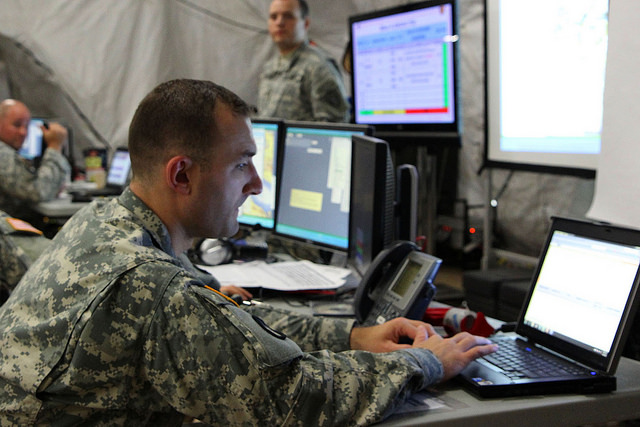
First Lt. Samuel Boulet, a battle captain in the 149th Maneuver Enhancement Brigade main tactical operations center, monitors reports and email during a 72-hour Command Post Exercise June 21-23 at Camp Atterbury, Indiana. (U.S. Army National Guard photo by Sgt. First Class Rebecca Wood)
CAMP ATTERBURY, Ind. — Soldiers of the 149th Maneuver Enhancement Brigade conducted a 72-hour Command Post Exercise (CPX) from June 21-23 at Camp Atterbury, Indiana. The units participating in the CPX were the Headquarters Company, 206th Engineer Battalion, 198th Military Police Battalion, 149th Battle Support Brigade and the 129th Signal Company. The main portion of the brigade started training on June 11 for the actual exercise.
The 198th MP Battalion’s operation officer, Maj. Brandon McNeese, was in charge of the battalion’s tactical operation center. He said the 198th also conducted main supply route patrols and convoy security for other elements in the brigade; but the main takeaway was to get back to the field craft training the Army was skilled at before 9/11.
“The overall mission was to come into a theater to set up operations in an austere environment,” said McNeese. “Years ago, before 9/11, we had training like this, but with a lot less assets. It was supposed to be like the beginning of a war, where there is nothing set up and we are initially moving in. We have gotten used to rolling into a forward operations base with established command posts and living areas, and cover down on equipment from other units.”
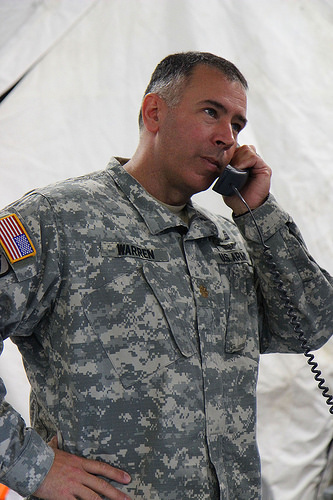 McNeese said this training was very helpful, especially to his soldiers who weren’t around before the War on Terror.
“For some of the newer soldiers, this is a very new experience because they never trained like this,” said McNeese, “but they have adapted very well. We had several shortfalls, but their morale and motivation kept them going and we pushed through and accomplished the mission.
“That’s not me,” said 1st Lt. Samuel Boulet, a current operations battle captain for the CPX, while looking around the TOC for the source of the ringing he heard. “Where is that phone?” Boulet barely had a moment to himself, while reports were populating on the Command Post of the Future (CPOF) and phones were ringing off the hook.
As a battle captain, Boulet’s job was to direct the flow of information and resources from the ground and the different sections in the brigade. He said this exercise was to test the brigade’s staff functions and prepare the Soldiers for a warfighter training exercise scheduled in 2016.
“It’s very energizing,” said Boulet. “You feel very plugged into everything that is going on around you.”
On a deployment to Iraq in 2010, Boulet actually worked as a battle captain on a company and battalion level, but he said he learned a lot from this CPX training.
“We did a large bridge gap of knowledge as a team, executing battle drills, tracking info and reports, communicating through missions, and mitigating crises when they happened,” said Boulet. “I wish I had this training before that deployment.”
One administrative specialist, Spc. Brooklynd Decker has been in the 206th Engineer Battalion for five years and was the sole human resources rep for the battalion’s operations center during the CPX. She said she was nervous to be in charge of her section, but felt honored to take on such an important role.
“It meant a lot to me and it was really good for morale, because everyone was important to the operation and had a serious job to do. Sometimes it was difficult to make quick decisions when the pressure was on and I had to communicate with my battle captain on a lot of things,” said Decker. “But overall I felt comfortable in my position, and I knew it was meant to be a learning experience -and I learned a lot.”
Decker and her peers were also enthusiastic about learning battle-tracking systems like CPOF and Joint Combat and Tactical Simulation, because of how they streamline communication between the battalion and the brigade.
“The battalion was so involved in brigade operations, more then we have ever experienced in the past and it gave us all a view of the bigger picture,” said Decker.
“The quality of this training could not have been captured in a short drill weekend. The timing for this type of exercise was perfect and I feel like we should do more exercises like this in the future.”
Story by Sgt. 1st Class Gina Vaile-Nelson, 133rd Mobile Public Affairs Detachment
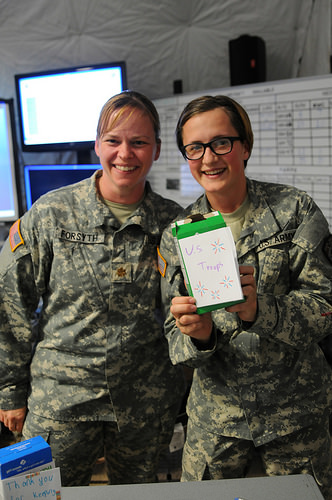
Kentucky National Guard Maj. Catherine Forsyth, logistics officer-in-charge, and Spc. Madison Witzleb, aviation operations specalist, Headquarters and Headquarters Company, 63rd Theater Aviation Brigade, enjoy a box of Girl Scout cookies during an annual training exercise at Camp Atterbury, Ind., April 27. Girl Scout Troop #1199, a Taylorsville, Ky.-based troop, donated boxes of cookies to the Kentucky Guardsmen as a comfort care-package to open during the unit’s week-long annual training exercise in support of Vibrant Response 2015. The cookies were used as a service project to earn the Troop to Troops badge for the Girl Scouts. (U.S. Army National Guard photo by Sgt. 1st Class Gina Vaile-Nelson)
CAMP ATTERBURY, Ind. - When Soldiers are away from their families, it’s the little things that mean the most. Even if you’re only across the river for a training exercise at Camp Atterbury, Indiana.
For Soldiers of the 63rd Theater Aviation Brigade, comfort was in the form of America’s favorite chocolate, shortbread and lemon-flavored cookies that only come out one time a year. And thanks to the Taylorsville, Ky.-Girl Scout Troop #1199, it was the perfect treat at the end of a 12-hour shift.
“Reading the handmade card attached to each box of Girl Scout Cookies thanking Soldiers for their service has touched our hearts,” said Staff Sgt. Carrie Payne, training noncommissioned officer for Headquarters and Headquarters Company, 63rd TAB.
“Everyone enjoyed the contribution of the cookies,” she said.
In 2014, the Girl Scouts, nationally, donated 12,108 boxes of cookies to U.S. Service members around the world.
Known as “Troop to Troops,” the gift of caring is a combined effort of community donations and extra cookies purchased to spread the joy in each box. According to Troop leader Jennifer Pucko, the Taylorsville troop has donated boxes shipped overseas before, but wanted to do something local this year.
“Most of the cookies are paid for by local donations the girls receive at the cookie booths,” she said. “One of our girl’s dad is in the National Guard, so we thought this year we’d find a local unit.”
Troop #1199’s cookies were served April 27 during shift change at the 63rd TAB’s annual training. The Kentucky Guardsmen were part of 3,000 military, federal and civilian personnel who participated in Vibrant Response, the nation’s premiere homeland defense exercise.
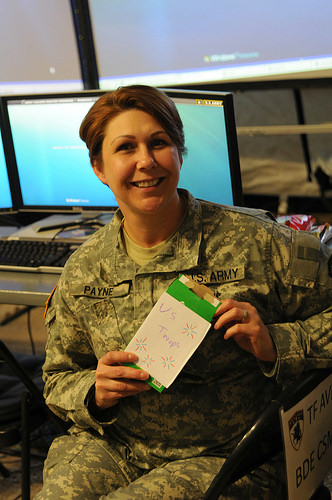
Staff Sgt. Carrie Payne, training noncommissioned officer, Headquarters and Headquarters Company, 63rd Theater Aviation Brigade, holds a box of Girl Scout cookies during an annual training exercise at Camp Atterbury, Ind., April 27. Payne said the hand-written notes attached to the boxes that Girl Scout Troop #1199, a Taylorsville, Ky.-based troop donated, were very much appreciated by her Soldiers that were on their annual training exercise in support of Vibrant Response 2015. (U.S. Army National Guard photo by Sgt. 1st Class Gina Vaile-Nelson)
There is a special patch that the Girl Scouts receive if they donate at least six boxes of cookies to Troop to Troops. According to its website, the Girl Scouts is a leadership-driven organization that engages girls to discover who they are, connect with others and take action to make the world a better place. The same types of activities and values that Soldiers like Payne experience in the National Guard.
“These young girls should be proud of themselves as individuals for recognizing those who serve our country,” Payne said.
My message to each one of these girls is to take one day at a time and always put your best foot forward,” she said. “Stay the leader you are being taught to be, not a follower.”
Story by Sgt. 1st Class Gina Vaile-Nelson, 133rd Mobile Public Affairs Detachment
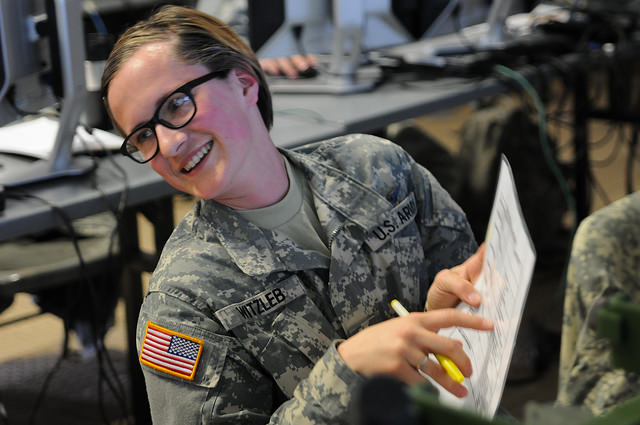
Kentucky National Guard Spc. Madison Witzleb’s smile and positive attitude keeps the 63rd Theater Aviation Brigade’s Tactical Operations Center a little less stressful during USARNORTH’s Vibrant Response 2015 exercise at Camp Atterbury, Ind. Witzleb, an aviation operations specialist assigned to Headquarters and Headquarters Company, 63rd Theater Aviation Brigade, is the newest member of the 63TAB, and said her first annual training with the brigade was challenging and fun. (U.S. Army National Guard photo by Sgt. 1st Class Gina Vaile-Nelson)
CAMP ATTERBURY, Ind. — There’s always that one. The young Soldier, fresh out of Advanced Individual Training (AIT), who shows up, loves the Army and smiles a lot.
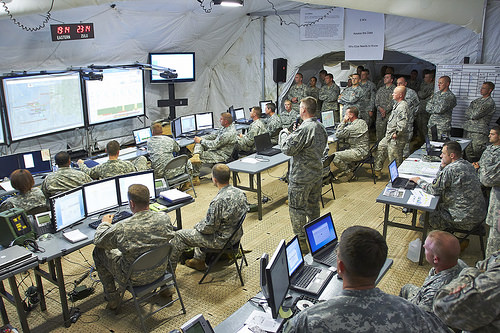
For Headquarters and Headquarters Company, 63rd Theater Aviation Brigade, it’s Spc. Madison Witzleb. She can run through the tactical operations center, affectionately known as the “TOC-mahal,” and if you blink, you’d miss her. She’s got a voice that will command even the hardest of hearing to attention if a distinguished visitor walks in. And a smile that her leaders and fellow Soldiers say can make any long day of training seem better.
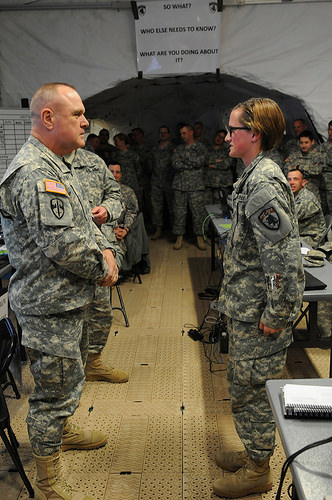
Kentucky National Guard State Command Sgt. Maj. Thomas Chumley presents Spc. Madison Witzleb, aviation operations specialist, Headquarters and Headquarters Company, 63rd Theater Aviation Brigade, with his challenge coin April 23, at Camp Atterbury, Ind. Witzleb was nominated by leadership to receive the coin for her motivation and determination to tackle every task with a positive attitude. (U.S. Army National Guard Photo by Sgt. 1st Class Gina Vaile-Nelson)
“Spc. Witzleb is constantly looking for ways to better herself and is never satisfied with just doing what she has been asked to do,” said Sgt. Maj. Kevin Wilkins, aviation operations chief for 63rd TAB. “She displays a willingness to learn as much as she can and she always has a smile on her face.
“My advice to our young Soldiers,” Wilkins said is, “display the same enthusiasm and dedication that Spc. Witzleb does.”
That passion for success is what makes Witzleb stand out in the crowd, and what landed her front and center before State Command Sgt. Maj. Thomas Chumley April 23. The 18-year-old aviation operations specialist was the first 63rd TAB Soldier to receive a coin during the unit’s annual training in support of Vibrant Response, which also happened to be her first coin ever.
“My face turned 50-shades of red,” she said, “but I was able to smile because I was on an excitement rush. I’d never received a coin before that.”
The challenge coins, a military tradition, are presented in recognition of special achievement. Witzleb was nominated by leadership to receive the coin for her professional work ethic and balanced attitude.
Witzleb said her first coin is something she will remember for a while, “the first words I said were: ‘I finally have one my dad doesn’t have!’”
Competition is in her blood. She was on her high school rifle team, plays golf, runs like the wind, and hopes that being in the Guard will help her compete with – and exceed her older brother’s physical fitness abilities.
“One day I will be able to beat him,” she said.
Besides the competition, her family is also good for inspiration, she said. Her father had a large impact on her decision to join the military, and her mother’s advice has kept her going, especially this AT when she really didn’t know what to expect.
“Coming into this (Vibrant Response) as my first exercise, it was nerve racking,” she said. “I was afraid of not being able to succeed in my tasked position.
“My mother always taught me to hold my head up high, even in a time of doubt,” she said. “I love a good challenge and this exercise holds up to its name.”
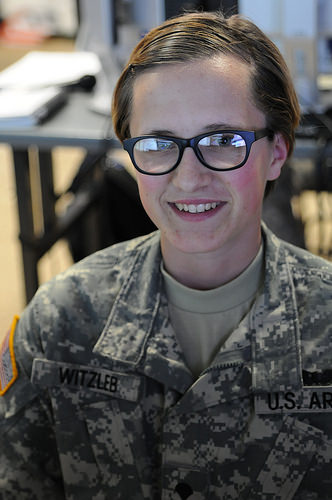
Kentucky National Guard Spc. Madison Witzleb’s smile and positive attitude keeps the 63rd Theater Aviation Brigade’s Tactical Operations Center a little less stressful during USARNORTH’s Vibrant Response 2015 exercise at Camp Atterbury, Ind. Witzleb, an aviation operations specialist assigned to Headquarters and Headquarters Company, 63rd Theater Aviation Brigade, is the newest member of the 63TAB, and said her first annual training with the brigade was challenging and fun. (U.S. Army National Guard photo by Sgt. 1st Class Gina Vaile-Nelson)
As the newest member of the 63rd TAB, Witzleb has many more challenges ahead for her Guard career. She’ll attend Morehead State University this fall to study criminology and take Reserve Officer Training Corps classes. She’s looking forward to also earning her status as a Kentucky Woman Veteran.
“Being a female veteran who can succeed in this career is an amazing accomplishment,” Witzleb said.
“I know many more have come before me, and they are providing some very large boots to fill,” she said, “but I am up for the challenge.”
Photos and story by 2nd Lt. Michael Reinersman, 63rd Theater Aviation Brigade Public Affairs Officer
The 63rd Theater Aviation Brigade conducted their annual training this year in support of Exercise Vibrant Response at Camp Atterbury, Indiana, July 31- Aug. 7. Vibrant Response is a major field training exercise conducted by U.S. Northern Command and led by Army North. Service members and civilians from the military and other federal and state agencies throughout the country train to respond to a catastrophic domestic incident. As the joint forces land component command U.S. Northern Command, Army North coordinates timely federal military response to disasters in the homeland to help the American people in times of need. (U.S. Army National Guard photo by 2nd Lt. Michael Reinersman, 63rd Theater Aviation Brigade Public Affairs Officer)
CAMP ATTERBURY, Indiana - The City of Indianapolis was chosen as the site for a nuclear disaster during Vibrant Response 14. Vibrant Response is a U.S. Northern Command-sponsored field training exercise for chemical, biological, radiological, nuclear and high-yield explosive consequence management forces, and is designed to improve their ability to respond to catastrophic incidents.
To see all photos from this story, please click HERE.
Approximately 5,500 military and civilian personnel from 28 U.S. states and territories took part in the largest confirmation exercise that the Department Of Defense conducts for its specialized response forces. Vibrant Response 14 used seven training areas in central and southern Indiana. Primarily, units trained at Camp Atterbury Joint Maneuver Training Center near Edinburgh, Ind. The training event simulates a tiered response from military and federal agencies to a nuclear or biological disaster in the United States.
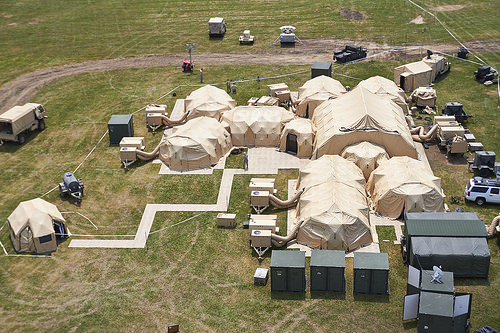
The 63rd Theater Aviation Brigade Tactical Operations Center, also known as the “TOC Mahal” was constructed and fully operational in less than 24 hours when Soldiers of the 63rd TAB arrived July 31 for Exercise Vibrant Response at Forward Operating Base Night Hawk on Camp Atterbury Indiana. (U.S Army National Guard photo by 2nd Lt. Michael Reinersman, 63rd Theater Aviation Brigade Public Affairs Officer)
The 63rd Theater Aviation Brigade has participated in the last three Vibrant Response exercises as part of their validation requirements by their higher headquarters, U.S. Army North. The 63rd TAB based in Frankfort, KY is the command and control element of aviation assets to ensure that missions requiring aviation support happened. Missions’ like moving equipment, personnel, and medical evacuations, or MEDEVAC were all coordinated within 63rd TAB’s Tactical Operation Center. Better known as “TOC Mahal”. To create practicality and rigor to the exercise, the TOC was manned and operated 24 hours during the 8 day exercise window from July 31st to Aug 7th.
“I was proud of the Brigade’s team effort.” said Lt. Col Michael Stephens, Commander of the 63rd TAB. He added, “Everyone’s individual acts led to the Brigades overall success during the training exercise. We have continued to build on previous training exercises and we will continue to refine our skill sets to be prepared for any civil support needed during a disaster.”
Vibrant Response provided a wide variety of training experiences to Soldiers of the Kentucky National Guard. Kentucky National Guardsmen of the 1204th Aviation Support Battalion, based out of Burlington, Ky. and Indiana National Guard’s 38th Combat Aviation Brigade, out of Shelbyville, IN partnered on sling load operations. They moved 500 gallon water blivets to supply water to Soldiers at Forward Operating Base Night Hawk, Campy Atterbury for hydration, cleaning, and cooking purposes. “New pilots from flight school and Soldiers from both units are able to maximize their training opportunities by practicing their individual tasks together.” said pilot Maj. Travis Ward with the 38th CAB. The training demonstrated the National Guards capability to deliver food and fresh water during a disaster.
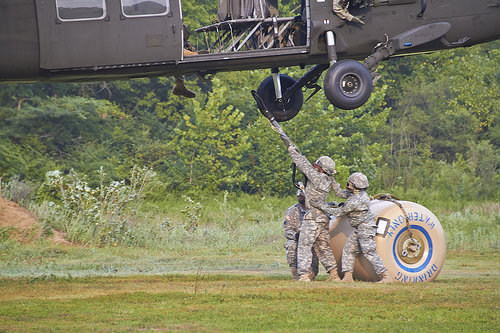
Sgt. 1st Class. Paul Brooks, Sgt. Michael Rhynes and Pvt. Tamie Acklin with A. Co., 1204th Aviation Support Battalion, headquartered out of Burlington, Ky., connect a water blivet to a UH-60 Black Hawk during sling load operations for the unit’s annual training Aug. 5. The 1204th conducted their AT at Camp Atterbury, Indiana. The Indiana National Guard’s 38th Combat Aviation Brigade transported the water to Forward Operating Base Night Hawk located on Camp Atterbury for hydration, cleaning, and cooking purposes. (U.S Army National Guard photo by: 2nd Lt. Michael Reinersman, 63rd Theater Aviation Brigade Public Affairs Officer)
Refueling helicopters, trucks and generators was the 1204th ASB primary mission during the exercise. “We are working rotational shifts to give us the chance to train on different things,” said Petroleum Supply Specialist Pfc. Adam Watts with Alpha Company, 1204th Aviation Battalion.
“Most of us that deployed in 2011 have refueled over 3,000 aircraft. This exercise gives our new Soldiers the chance to get hands on experience,” said Staff Sgt. Dave Rinehart with the 1204th Alpha Company. “You can’t go wrong working around aircraft. I love this job.”
Story by Sgt. 1st Class Harold Broughton, 1st Battalion, 149th Infantry
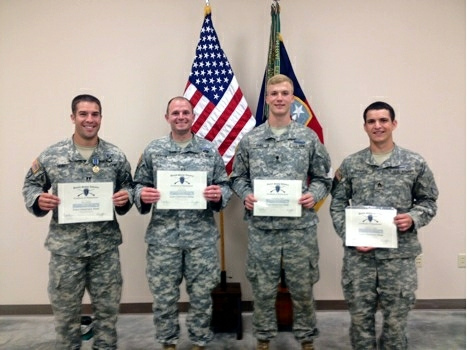
(L-R) Capt Ryan Hubbs, Capt. Jason Partin, Spc. Christopher Jones and Staff Sgt. Nicholas Combs display their earned Expert Infantryman Badge certificates at Camp Atterbury, Ind. The Soldiers were the final four of more than 40 who competed for the award. (Photo courtesy of Sgt. 1st Class Harold Broughton)
CAMP ATTERBURY, Ind. — On June 20, 20 warriors from the 1st Battalion, 149th Infantry Battalion arrived at Camp Atterbury Joint Maneuver Training Center to begin training for testing of the coveted Expert Infantryman Badge (EIB). The EIB is a distinction that displays a skill set the infantryman must possess in order to earn the difficult sought after award. Those that earn the EIB wear it with a sense of pride and accomplishment for good reason.
After a rough five days of training, Spc. Christopher Jones, Staff Sgt. Nicholas Combs, Capt. Jason Partin and Capt. Ryan Hubbs from were the newest Kentucky Guardsmen to wear the EIB.
“Having a regional EIB testing hosted by the 205th Infantry Brigade from Camp Atterbury is a great benefit for us, surrounding Army Reserve units and Active components the same,” said Sgt. Maj. Chris Jackson, operations sergeant major for the 1/149th. “Kentucky, Indiana, Michigan, Wisconsin and the 101st Airborne Division from Ft. Campbell, KY sent candidates to participate in this event that had a starting number of 115 soldiers to enter testing.”
In 1944 Army Chief of Staff, George C. Marshall began the development of an award to honor the U.S. Army Infantryman. The intentions were to create something that represented the Infantry’s tough role in hard-hitting combat and display the proficiency in the Infantry arts. Once the course was completed, 100 NCO’s from the 100th Infantry Division set out for the first EIB to be awarded. Once the three days of testing was completed only ten Soldiers were left standing in which they attended the last part of the testing of being interviewed. In the end, Technical Sgt. Walter Bull was the last man standing and earning his prestigious title of expert infantryman.
Although things have changed since 1944 and the testing has been revamped, the numbers have not shown the testing to become any easier as an Army success rate of only eight percent of the starting class earn the badge.
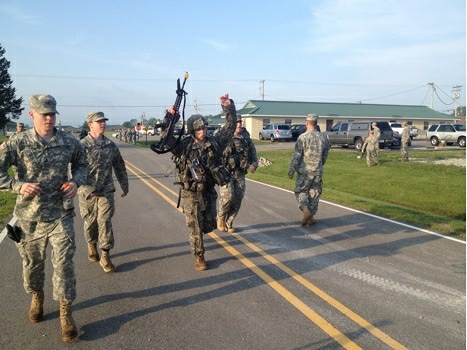
Staff Sgt. Nicholas Combs from Headquarters and Headquarters Company, 1st Battalion, 149th Infantry celebrates as he nears the finish line of the ruck march completing his expert infantryman assessment at Camp Atterbury, Ind. The ruck march was the final event after five days of rigorous training to earn the expert infantryman badge. (Photo courtesy of Sgt. 1st Class Harold Broughton)
The 20 Soldiers from 1/149th began their road to the EIB in March by being pre-tested to meet all prerequisites, three months before arriving at Camp Atterbury. Beginning with more than 40 Soldiers, they began assessing the individuals to ensure they were capable of qualifying expert with their assigned M4, achieve the minimum requirements for the Army Physical Fitness Test and prepared to endure the 12 mile road march in less than the required three hours. Upon completion, more than 50% were not going to have their shot at earning their EIB, leaving the remaining 20 Soldiers to test their skills and knowledge to become an expert infantryman.
The course consisted of five days of training with a variety of phases for the candidates. Each of the training lanes consisted of three Master Skills Testing and an Individual Tactical Test lane that included 10 tasks that must be completed in 20 minutes or less. If a candidate received back-to-back No-Go’s or a total of three in the entirety of the testing they would be terminated. The three main lanes are designated as Patrol, Traffic Control Point, and Urban lanes. The master skill tests were designed to display the skill needed to properly function, clear, and fire each weapon system an infantryman may encounter from a 9MM to a M2 .50-caliber machine gun. The culminating task involved with the individual tactical tests (ITT) included events that a Infantryman may encounter in a combat situation to include basic movement tactics, call for fire, request a MEDEVAC and employ hand grenades to name a few of the tasks.
Entering day one, the 115 candidates performed the APFT where they are required to achieve 75% in each event before moving on. Next up was the day and night land navigation which proved that day one would send many candidates back home without their EIB. More than half of the candidates were not able to successfully achieve the standards these events, terminating them from the course. Over the next three days the candidates would perform one lane testing per day and hope to move on for the fifth and final day that included the 12-mile ruck march that must be completed in less than three hours.
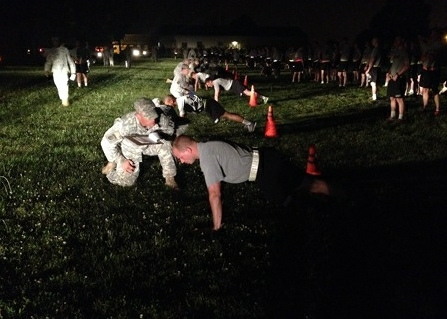
Capt. Jason Partin with Charlie Compnay, 1st Battalion, 149th Infantry does push-ups as part of the expert infantryman testing at Camp Atterbury, Ind. (Photo courtesy of Sgt. 1st Class Harold Broughton)
Only 23 Soldiers of the original 115 remained on the final day to begin the ruck march on the final day of testing. The four Kentuckians separated themselves by proving they had what it took passing the first four days of testing. The only thing standing between them and earning the EIB was the long physical demand of rucking 12 miles with 35lbs of gear. All four candidates began the day with the same goal and accomplished it within the required three-hour time limit earning their coveted Expert Infantryman Badge.
In all, 22 candidates received their EIB and only six were able to complete as “True Blue” candidates including Hubbs. By being considered True Blue the candidate must complete all task without a single no go, a daunting task on top of the already demanding course.
“When they get back to their units, these four individuals will be looked upon as a part of the most knowledgeable Infantryman the U.S. Army has to offer,” said Jackson. “And our Infantry Battalion is full of pride in their accomplishment.”
Story by Staff Sgt. Scott Raymond, Kentucky National Guard Public Affairs
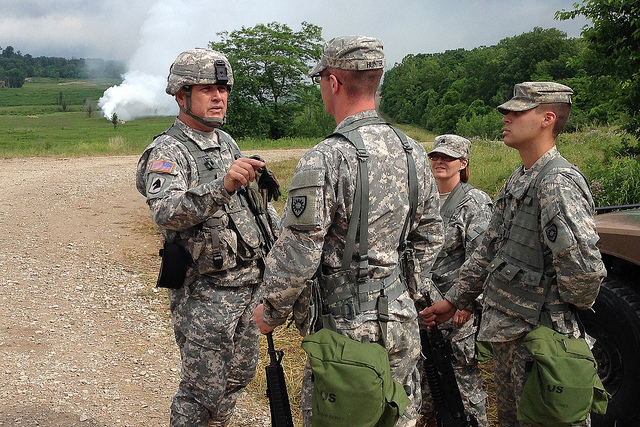
Command Sgt. Maj. Thomas Chumley speaks with Soldiers of the 103rd Chemical Battalion during a training exercise at Camp Atterbury, Ind., June 18, 2014. As the state command sergeant major, Chumley said it is his job to get out to see the troops and check on their well-being. (U.S. Army National Guard photo by Staff Sgt. Adam Rients)
CAMP ATTERBURY, Ind. — Kentucky Guardsmen went about their usual routines during annual training periods this spring and summer in a variety of places. Soldiers and units use this time to ensure they are up to the task of doing their specific job.
For State Command Sgt. Maj. Thomas Chumley, it is also an opportunity to ensure those Soldiers are doing the right thing and are being taken care of by the Kentucky National Guard.
“Visiting Soldiers during annual training and any other training event gives me the opportunity to talk to and observe Soldiers at their best and address any issue they may have,” he said. “It is also to let them know the senior leadership is proud of what they are doing, and appreciate the sacrifices they and their families make.”
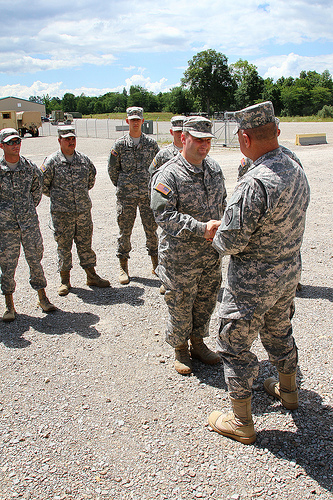
State Command Sgt. Maj. Thomas Chumley coins Spc. Hoskins with the 1149th Forward Support Company at Camp Atterbury, Ind., July 16, 2014. Chumley asked units to point out Soldiers that were excelling within their units for recognition. (U.S. Army National Guard photo by Staff Sgt. Scott Raymond)
Chumley said there were times in the past that Soldiers never saw their command sergeant major or even knew who he or she was. He refuse to go back to that time, because put simply, it’s his job. As the Kentucky Army Guard’s top enlisted advisor to the adjutant general, that job is an important one for the nearly 6,000 enlisted Soldiers serving in the commonwealth.
“I am their eyes and ears in Frankfort, I represent them to the leadership of this organization, and I cannot do it without getting out here and talking to them.”
Click here for more photos from this story.
Annual training periods provide the ideal chance for command visits and Chumley visits as many as the schedule allows. From Kentucky’s Wendell H. Ford Regional Training Center to Camp Atterbury, the 42-year military Veteran is out asking what the Soldiers think of the food, if they are up to date on their training requirements and if they take advantage of the benefits available to them. He said it is his chance to find ways to improve the Kentucky Army National Guard.
The visits are well received as Soldiers gather to visit with Chumley, meet a member of the command staff and share their feelings about training and the Kentucky Guard..
“I think its great that the sergeant major comes out to see us, check on us and show that he cares,” said Pfc. Lawless with the 1st Battalion, 149th Infantry. “It tells us leadership just doesn’t sit at a desk somewhere, they come out here and learn from us like we’re supposed to learn from them. It shows good leadership and I appreciate that.”
Chumley often asks how many of the Soldiers would consider giving more than 40 years to their country. Not that he expects very many to raise their hands, he knows he’s talking to a future command sergeant major and the future of the Kentucky Guard.
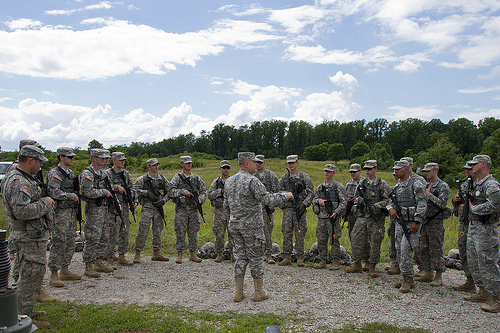
State Command Sgt. Maj. Thomas Chumley speaks to Soldiers with the 1st Battalion, 149th Infantry during annual training at Camp Atterbury, Ind., July 16, 2014. During his visit, Chumley spoke to as many Soldiers as possible to thank them for their dedication and hard work. (U.S. Army National Guard photo by Staff Sgt. Scott Raymond)
“One of the things I like most about coming out here is that I get to tell them how proud I am of them and thank them for what they do. Every time I get around these young Soldiers it reenergizes me and reminds me that I am here for them, and because of them.”
Photos by Sgt. Shanna Rice, 2123rd Transportation Company
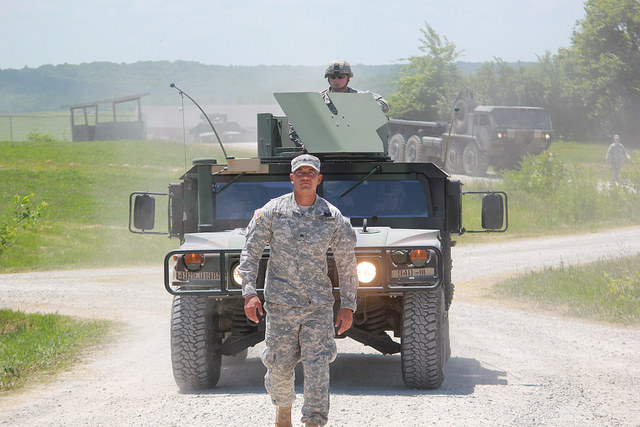
Sgt. Terrell Turner with the 2123rd Transportation Company ground guides a scout vehicle back in a training area after an exercise at Camp Atterbury, Ind. (U.S. Army National Guard photo by Sgt. Shanna Rice)
CAMP ATTERBURY, Ind. — Soldiers of the Kentucky Guard’s 2123rd Transportation Company conducted the unit annual training at Camp Atterbury Joint Maneuver Training Center May 27 - June 11, 2014. Driving in more than 25 company vehicles, the Richmond, Kentucky-based unit also continued its recycling work of transporting recycled materials from Bluegrass Army Depot in Richmond to a recycling center in Bedford, Indiana.
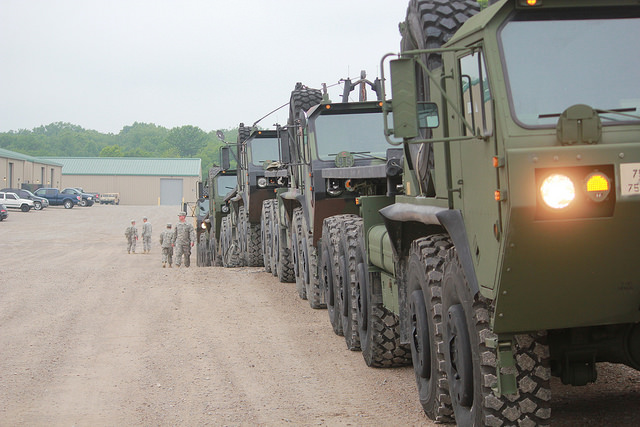
Soldiers of the 2123rd Transportation Company prepare for convoy operations during annual training at Camp Atterbury, Ind. (U.S. Army National Guard photo by Sgt. Shanna Rice)
First Sgt. Allen Christie said the combination of a real-world mission and quality training at Camp Atterbury made for a beneficial AT for the unit as a whole.
“The mission allowed our Soldiers to drive more than 20,000 collective miles and haul more than 70,000 pounds of cargo. Missions like these give them the opportunity to gain valuable experience in piloting these large vehicles.”
“I’m extremely proud of our Soldiers. We had lots of new faces and Soldiers in leadership roles for the first time, and we came out a better-trained and more cohesive unit.”
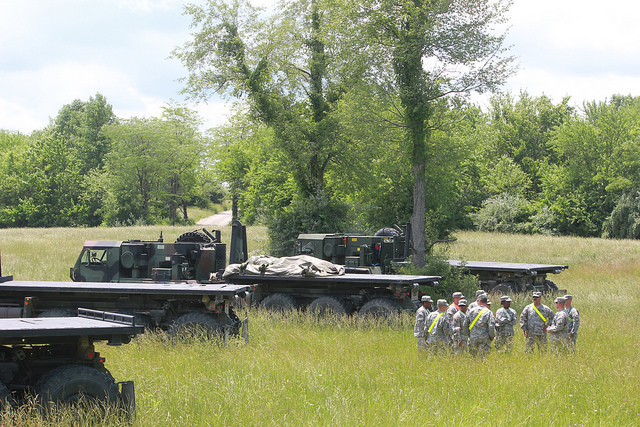
Soldiers with the 2123rd Transportation Company gather for convoy instruction during a short halt on a training mission during the unit’s annual training at Camp Atterbury, Ind. (U.S. Army National Guard photo by Sgt. Shanna Rice)
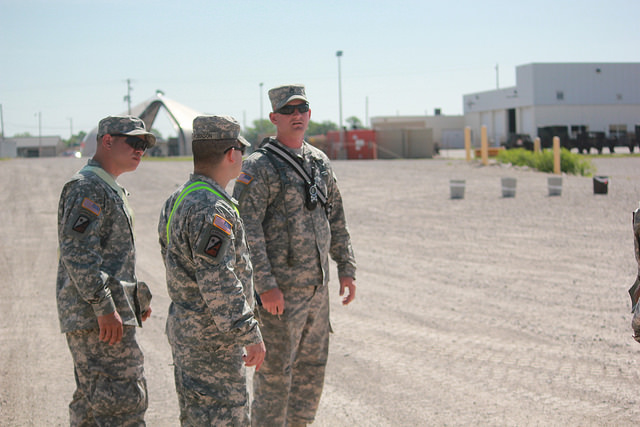
(L-R) Charles Scroggins, Spc. Cole Robinson, and Staff Sgt. Jarred Turner observe basic driver’s training during the 2123rd Transportation Company annual training at Camp Atterbury, Ind. (U.S. Army National Guard photo by Sgt. Shanna Rice)
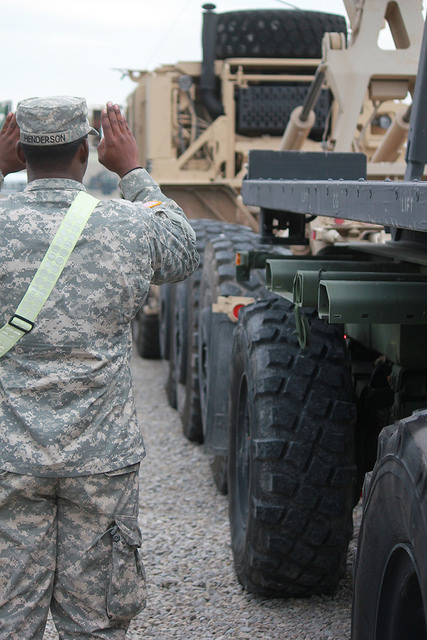
Pfc. Darrell Henderson gives clear hand and arm signals to his driver during driver’s training at Camp Atterbury, Ind. (U.S. Army National Guard photo by Sgt. Shanna Rice)
Photo Essay Courtesy of the 1204th Aviation Support Battalion
CAMP ATTERBURY, Ind. - During times of natural disasters some areas may be too remote or inaccessible for convoy resupply due to destruction or congested highways. These communities still need basic life support such as food and fresh water. The Kentucky Army National Guard possesses that ability.
Recently, Kentucky National Guardsmen of the 1204th Aviation Support Battalion, based out of Burlington, Ky. and Bravo Co. 2nd Battalion 147th Aviation, out of Frankfort, Ky. received training during the ARMY NORTH Vibrant Response Exercise on sling load operations. They distributed 500 gallon water blivets to a simulated devastated region. The training demonstrated seldom utilized capabilities to conduct relief operations during a natural disaster.
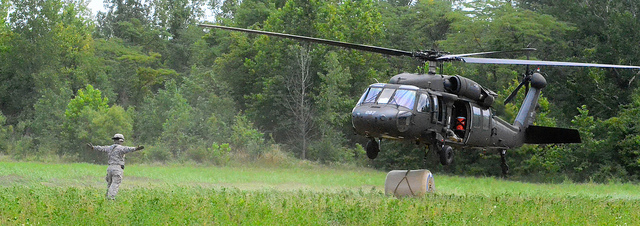
Sgt. Greg Wieland, a water purification specialist, with Alpha Company, 1204th Aviation Support Battalion, 63rd Tactical Aviation Brigade, Kentucky National Guard headquartered out of Burlington, Ky., signals a UH-60 Black Hawk helicopter as it carries a water blivet during a sling load operation during the U. S. Army North (Fifth Army) lead Vibrant Response 13-2 training exercise Aug. 2 at Camp Atterbury, Ind. The water blivet will be used to supply water to Soldiers at Forward Operating Base Night Hawk for hydration, cleaning, and cooking purposes. (Army Photo by Staff Sgt. Alexandria Brimage-Gray/Released)
“The initiative taken by the Soldiers of Alpha Company, 1204th ASB and Bravo Company 2-147th to accomplish this mission demonstrate everything that is right about the Kentucky Army National Guard aviation community, ” said Maj. Phil Robinson, commander of the 1204th. “The Soldiers and leaders from each unit capitalized upon an opportunity to combine their separate collective training events into a complex multi-echelon mission that provided some of the best training throughout the operation.”
“I am proud of the fact that these Soldiers are continually striving to integrate all aspects of our capabilities in a continuous effort to be prepared for any civil support need within the Commonwealth.”
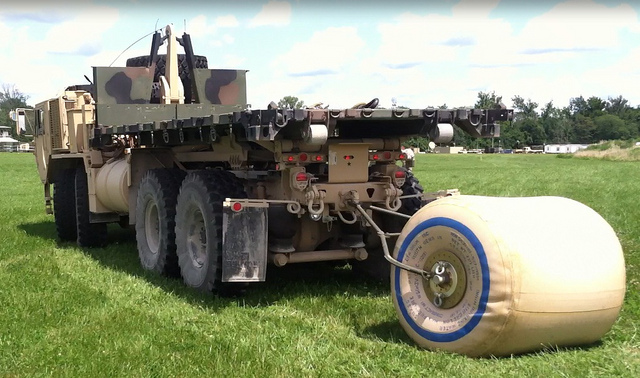
Forward Area Water Point Supply System (FAWPSS) is being delivered to the distribution point during the U.S. Army North (Fifth Army) lead Vibrant Response 13-2 training exercise Aug. 2 at Camp Atterbury, Ind. The water blivet will be used to supply water to Soldiers at Forward Operating Base Night Hawk for hydration, cleaning, and cooking purposes. (Photo by 1LT Gregory Slater/Released)
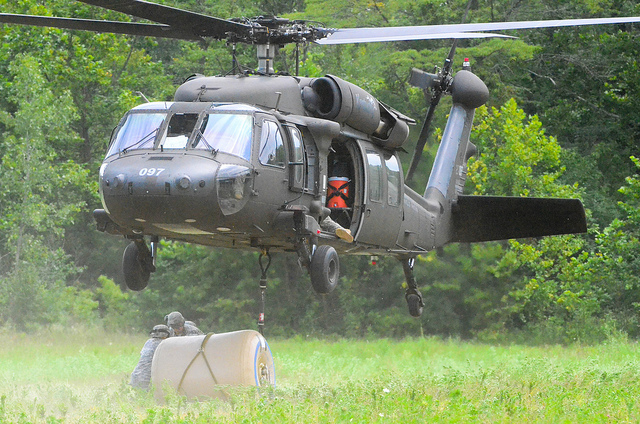
Water purification specialist with Alpha Company, 1204th Aviation Support Battalion, 63rd Tactical Aviation Brigade, Kentucky National Guard headquartered out of Burlington, Ky., connect a water blivet to a UH-60 Black Hawk while conducting sling load operations during the U. S. Army North (Fifth Army) lead Vibrant Response 13-2 training exercise Aug. 2 at Camp Atterbury, Ind. The water blivet will be used to supply water to Soldiers at Forward Operating Base Night Hawk for hydration, cleaning, and cooking purposes. (Army Photo by Staff Sgt. Alexandria Brimage-Gray/Released)
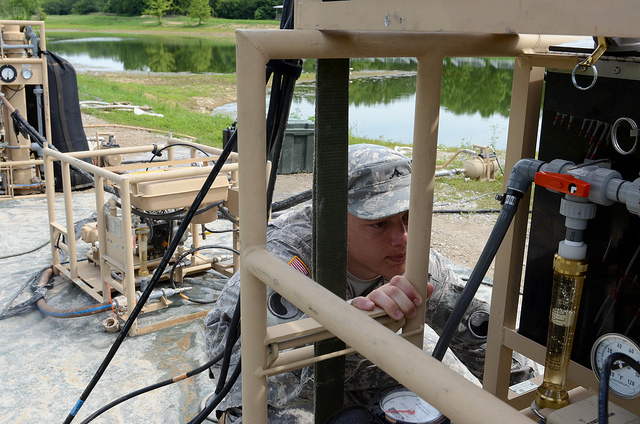
CAMP ATTERBURY, Ind. – Pvt. Nicholas Heath, a water purification specialist, with Alpha Company, 1204th Aviation Support Battalion, 63rd Tactical Aviation Brigade, Kentucky National Guard headquartered out of Burlington, Ky., conducts an inspection on the strainer as the water goes through a ultra filtration system during the U. S. Army North (Fifth Army) lead Vibrant Response 13-2 training exercise Aug. 2 at Camp Atterbury, Ind. The water moving through the strainer is the first step in the ultra filtration water purification process. (Army Photo by Staff Sgt. Alexandria Brimage-Gray/Released)
Story by Capt. Daniel VanHorn, 2/138th Field Artillery Public Affairs
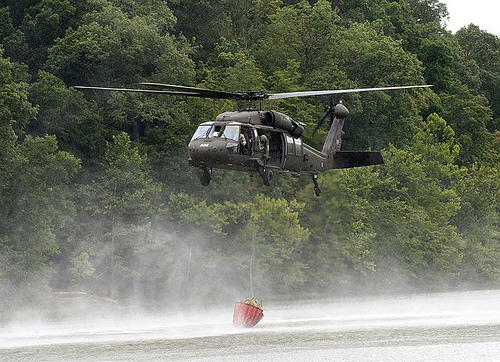
A UH-60 Blackhawk helicopter from Company B, 2nd Battalion, 147th Aviation Regiment, based out of Frankfort, Ky., fills a Bambi bucket from Brush Creek Reservoir during water bucket firefighting training at Muscatatuck Urban Training Center in Butlerville, Ind., during Vibrant Response 13-2, Aug. 6. Vibrant Response is a major homeland emergency response exercise conducted by U.S. Northern Command and led by U.S. Army North with approximately 5,700 service members and civilians from federal and state agencies throughout the country training at Camp Atterbury near Edinburgh, Ind. and Muscatatuck near Butlerville to respond to a catastrophic domestic incident. (Photo by Sgt. 1st Class Brad Staggs, Atterbury-Muscatatuck Public Affairs)
CAMP ATTERBURY, Ind. — How would state and federal agencies react if a nuclear bomb detonated in two major metropolitan areas? Similar scenarios played out across Indiana, where Soldiers from the Kentucky National Guard’s 63rd Theater Aviation Brigade conducted their annual two week training, as part of an exercise called Vibrant Response.
Exercise Vibrant Response is a major homeland emergency response exercise conducted by U.S. Northern Command. The exercise was facilitated by approximately 5,700 service members and civilians from federal and state agencies throughout the country. They trained at Camp Atterbury Joint Maneuver Training Center near Edinburgh, Ind. and Muscatatuck Urban Training Center near Butlerville, Ind., as well as throughout Southern Indiana to respond to a catastrophic domestic incident.
Col. Michael Ferguson, Commander of the 63rd TAB, has been preparing his Brigade for this mission for the past year. He understands the importance this training is for real-life disasters his Soldiers might have to face.
To see more photos from this story, click here.
“Our goal is to respond with speed and accuracy and be at the right place and right time to save lives,” he said. “Aviation assets are crucial when it comes to casualty evacuations and disaster area assessments and they can get in and out faster than any other available asset.”
Over the last four years, the 63rd has participated in 5 large-scale scenarios similar to this one, as part of their validation requirements by their higher headquarters, U.S. Army North
The brigade currently has one of the missions as a dedicated response force to provide command and control of aviation assets for Joint Task Force-Civil Support, the unit charged with heading up the Department of Defense response in the event of a major catastrophe.
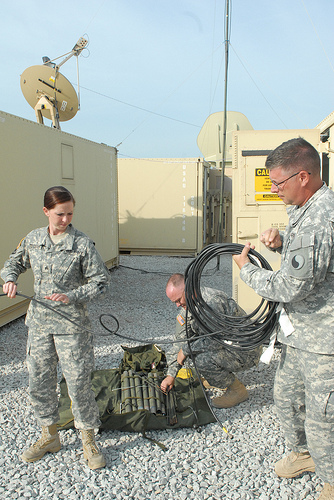
Sgt. Tiffany Teegarden of the 138th Signal Co., assists Soldiers with the 1204th Aviation Support Battalion in setting up communication networks at Camp Atterbury, Ind., Aug.2, 2013. A variety of Kentucky National Guard units worked to support each other as part of Exercise Vibrant Response in Southern Indiana. (U.S. Army National Guard photo by Capt. Daniel VanHorn)
According to Warrant Officer Brandon Kruchinski, a UH-60 Blackhawk pilot with B Company, 2-147th Assault Company, the exercise provided valuable opportunities to hone their skills in a variety of tasks.
“It’s been good experience working hand in hand with various agencies,” said Kruchinski. “We can use this training to become better at responding to a disaster. The real-world training is valuable because it allows us to cross-train with other agencies.”
Pilots were not the only Soldiers benefiting from the scale of the exercise.
The 351st Aviation Support Company, out of Frankfort, Ky., consists of numerous mobile maintenance facilities that can be packed and shipped to any location. Each container weighs about 15,000 pounds and has every tool needed to conduct repairs on downed or deadlines aviation assets. The systems are designed to be transported on the highway within hours of notification.
According to 1st Sgt. Timothy Porter, the 351st is comprised of more than 70 Soldiers who usually learn about helicopter maintenance by reading equipment and maintenance manuals. With the exercise underway, they have been able to work on Indiana’s dead-lined UH-60 helicopters.
“Conducting maintenance on the Indiana National Guard aviation assets allows our Soldiers to become validated on actual helicopters while gaining experience with transporting our mobile shop systems,” said Porter.
Vibrant Response has provided a wide variety of training experiences to Soldiers of the Kentucky National Guard. Often the exercise utilizes units from across the country and other assets in order to accomplish their training. This year, the 63rd deployed with its subordinate units from within the Commonwealth. The UH-60 Blackhawk unit, Bravo Co. 2-147, the OH-58 Kiowa unit, Charlie Co. 1-376th and support units, the 1204th Aviation Support Battalion and Bravo Co., 351st Aviation were all on the ground throughout Southern Indiana providing real-time mission support to all the players involved in the exercise. The aviation units even partnered up with the 138th Signal Company out of Lexington, Ky., to provide actual signal support to all the deployed units which showcased a great partnership between the major support commands of the Kentucky Guard.
“This exercise will enable Kentucky Aviators to be prepared to respond with great efficiency to a variety of situations,” said Ferguson. “Our Guardsmen are one of Kentucky’s finest assets.”