Pages
Stay In Touch
More
© 2013 KentuckyGuard
This is Part I of a five-part series documenting the travels of Kentucky Guard Command Historian, John Trowbridge as he explores Kentucky’s participation in the War of 1812.
Story and photos by Sgt. David Bolton, Kentucky National Guard Public Affairs Office
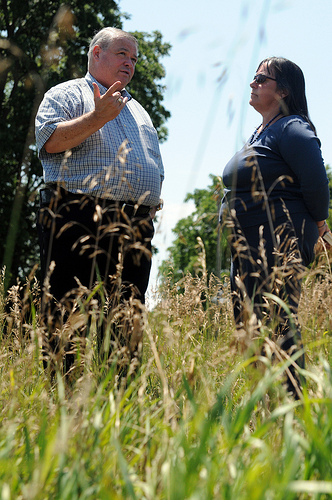
Kentucky National Guard State Command Historian John Trowbridge and Lisa Gilbert, chair of the Friends of Tecumseh monument discuss the significance of the role that the Kentucky militia played in the War of 1812 at the Thames Battlefield in Chatham-Kent, Ontario July 9, 2012. (Kentucky National Guard photo by Sgt. David Bolton, 133rd Mobile Public Affairs Detachment)
BRANTFORD, Ontario — For years, service members of the Kentucky National Guard have stood ready to answer the call of people of the state, as well as the nation. Now, 200 years later, the Kentucky Guard is remembering the service, sacrifice, and solidarity of those individuals who answered the same call to action during the War of 1812.
To see more photo from this story, click here
Documenting the history of the Kentucky militia and their role in the War of 1812 fell to Kentucky National Guard Command Historian John Trowbridge. Trowbridge, a retired Army veteran, traveled to Canada to work with other historians in order to paint a more complete picture of the involvement of Kentucky’s Guardsmen.
Trowbridge said, “Anytime you can work with another historian it is valuable because it gives us another avenue to research.”
Several historical sites were visited during the excursion to Ontario, Canada. Stops included: Brantford, the site of Malcolm’s Mill battle, Chatam-Kent, where the battlefields of Longwoods and Thames are located, and where, supposedly, the remains of two Kentucky militiamen are buried at Tecumseh Park.
An early version of the current U.S. flag with 15 stars and stripes was The Star-Spangled Banner. The fifteenth star emblazoned on the flag represented the last state to be made part of the nation since the Revolutionary War, Kentucky. This flag was to be the banner carried by U.S. forces at battles that spanned as far south as New Orleans and as far north as Brantford. Even though Kentucky was the last state to be put on the flag, it was the first to allow its militia to cross state and international boundaries.
But the patriotism of offering so many troops to the war efforts did not come without a price. Trowbridge noted that of the 2,260 Americans killed in the War of 1812, 64% of the casualties were Kentuckians.
“It’s a great experience to get to read about these things and then get to see what our guys saw in 1812,” said Trowbridge. “This is a unique opportunity because, until you get on the ground where those individuals stood, you can’t really appreciate it.”
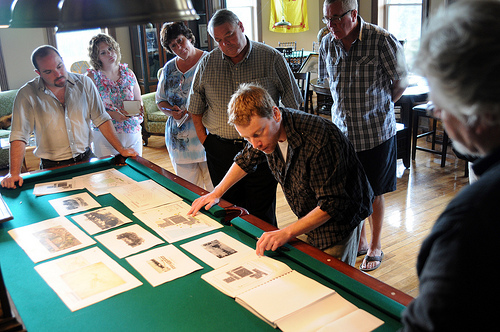
Historians from Kentucky and Canada, as well as local Canadian contributing members, review documents which may lead to the possible burial sites of Pvt. William Hardwick and Pvt. Foster Bartlett, two Kentucky militia service members who were killed during the War of 1812. The meeting took place at the old armory at Tecumseh Park in Chatham-Kent, Ontario July 9, 2012. (Kentucky National Guard photo by Sgt. David Bolton, 133rd Mobile Public Affairs Detachment).
The research being done isn’t about the differences between the British and the American forces, however. The focus is on understanding the impact and evaluating the importance of the Kentucky militia during the war.
“We’re not here to celebrate a war that happened 200 years ago,” said Trowbridge. “The focus is on remembering and honoring those who served on both sides of the conflict and the 200 years of peace that our countries have enjoyed since that time.”
In addition to traveling to Canada, Trowbridge also followed the Kentucky militiamen’s movements through the northern states of Michigan, Indiana, and Ohio. These locations will be explored in upcoming installments.
Story by Staff Sgt. Paul Evans, KY ADT 4 Unit Public Affairs and Historian Representative
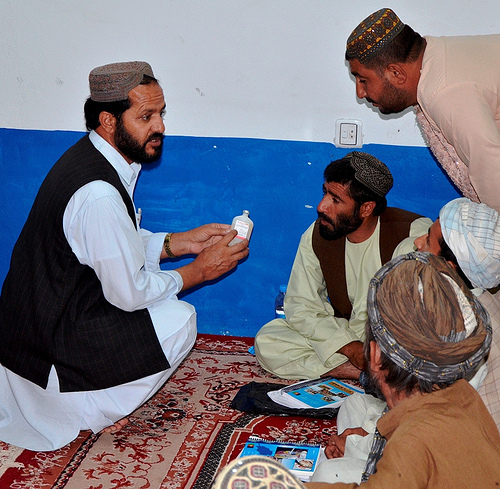
An instructor from Kandahar University explains vaccination administration to students during basic veterinarian training in southern Afghanistan’s Kandahar Province on May 30, 2012. The Kentucky National Guard’s Agribusiness Development Team 4 Veterinarian, Capt. David Licciardello of Belmont, Va. wrote the curriculum for the training program, which was led by an Afghan instructor. So far, the U.S. funded program has helped combat animal diseases by vaccinating an estimated 30,000 livestock. (U.S. Army photo by Capt. David Licciardello)
FORWARD OPERATING BASE PASAB, Afghanistan— “I think you could call it a home run in our District,” said Chief Warrant Officer Scott Goode, a 53-year-old native of Versailles, Ky. Goode serves as the Ag Team leader for Kandahar Province’s Arghandab District with Kentucky National Guard’s Agribusiness Development Team 4 in southern Afghanistan.
“Specifically in the Arghandab District, I know it’s probably been the best received, most important training that we’ve conducted since we’ve been here. I felt like that not only did the District Extension Agent, but the District Governor and several other people got a raised eyebrow to how effective it was,” Goode said.
“The local villages really appreciated it,” he added. “As far as I can tell, it went off without a hitch.”
In multiple districts within Kandahar Province, ADT 4 instituted a multi-pronged veterinarian training program, consisting of a combination of basic and advanced veterinary training. For students completing the basic training course, they received vaccines to go out into their village and vaccinate diseased animals. Students selected for advanced training were sent to a six month Para Vet training school in northern Afghanistan.
We had one of the locals that’s at the (Para Vet) school attending now, he cried with joy. It really was a life-changer for him,” Goode said. “It’s given them an opportunity to actually do some good in their community. Hopefully, they’ll all get through it and get set up in business as planned. If not, they’re still going to have a great skillset.”
“Both programs are the best I’ve seen since I’ve been here,” he said.
Capt. David Licciardello, a 54-year-old Belmont, Va. native, serving as ADT 4’s Veterinarian, explained the process behind the basic training programs
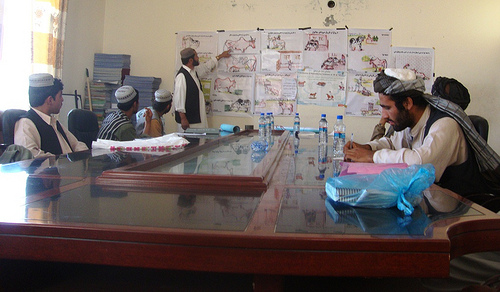
An instructor from Kandahar University teaches basic veterinarian training in southern Afghanistan’s Kandahar Province on April 25, 2012. The Kentucky National Guard’s Agribusiness Development Team 4 Veterinarian, Capt. David Licciardello of Belmont, Va. wrote the curriculum for the training program, which was led by an Afghan instructor. So far, the U.S. funded program has helped combat animal diseases by vaccinating an estimated 30,000 livestock. (U.S. Army photo by 1st Lt. Wesley Newton)
“What we’ve done is teach 10 workers from different villages basic veterinary skills to help veterinary workers. They learned the essentials of husbandry, disease, how to recognize disease, how to report disease, and basic techniques on how to vaccinate,” he said.
“We gave them a thousand vaccines each and sent them back to their villages after the graduation ceremony, he added. “They vaccinated close to ten thousand animals.”
“What this also did for us, since there’s no actual census data on the amounts and types of animals, they brought back with them log sheets with the types of animals and the numbers,” Licciardello continued. “So it gave us an assessment of how many different types of animals and numbers are in these individual villages. It worked well for us as well.”
“Overall, there’s over two million head of livestock in the (Kandahar) Province,” he said. “We’ve used the numbers we have from these projects to sort of interpolate how many different types of animals are in each District. It comes up to significant numbers, showing us that it’s a very important part of Agriculture for Afghanistan.”
“To me, it seems like a priority moving ahead with progress,” Licciardello noted.
“There was a need brought forth from the (Arghandab) District Extension Agent,” Licciardello explained about the training programs’ origins.
“He said ‘we have a lot of disease.’ We asked who’s taking care of it, (and) he said ‘we have no help,’” he said. “There are traditionally Para Vets, which is a guy that has gone off to school for six months, trained, sets up a little shop, and they will work with the Provincial Veterinarian. But there are none in Arghandab that are actually doing it.”
“We were left with a disease outbreak in the area, the Arghandab Valley, and no way of treating it. So I put together a curriculum of training, found an Afghan trainer to instruct these guys, purchased the vaccines and sent them out.”
“We do have a Kandahar University Professor doing the training for us on a curriculum that I made. He’s well received, and the people just really enjoy the program.”
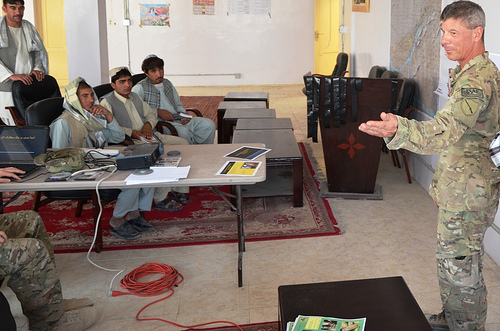
Army Reserve Capt. David Licciardello of Belmont, Va. answers questions from students during a basic veterinary class in southern Afghanistan as a part of the Kentucky National Guard’s Agribusiness Development Team 4 on April 17, 2012. Licciardello, ADT 4’s Veterinarian wrote the curriculum for the training program, which was led by an Afghan instructor. So far, the U.S. funded program has helped combat animal diseases by vaccinating an estimated 30,000 livestock. (Photo by DA Civilian Jonathon Mixon)
Licciardello briefly mentioned the role of the Arghandab Ag Team in the training process.
“What Chief Goode, Sgt. Dunn, and Lt. Newton did is they helped find candidates to send off to the Para Vet School, which is a school that we’re sponsoring. It’s a six month training school that can provide all the education,” Licciardello said. “They’ll (students) come back with equipment and skills, they’ll actually be taught how to run a business so they can be successful when they return.”
“The school is sponsored by the Dutch Committee for Afghanistan at the training center,” Licciardello added.
“We’ve done three of the same programs to teach basic Veterinary workers in Panjwai and Zharay, as well as Arghandab (Districts),” Licciardello summarized. “Cumulatively, we’ve vaccinated close to thirty thousand animals in these three Districts, and we have plans to do more.”
“Our (Arghandab) Extension Agent put his staff through a ‘train-the-trainer’ concept, and he’s trying to bring his proficiencies up enough to continue that type of education and those types of classes in the field,” Goode observed about the program’s success so far.
“That’s why I say it’s probably the best thing that’s hit that area in a long time,” Goode said. “It’s going to impact them for a long time, I think.”
“From my end, I’ve gotten nothing but great appreciation from the programs helping from the District Extension Agents (and) the students, who’ve really never had any formalized training…and it’s their whole life has been around these animals,” said Licciardello.
Story by 1st Lt. Gus LaFontaine, 133rd Mobile Public Affairs Detachment
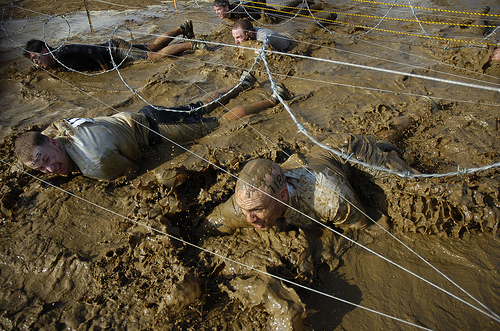
Participants run in the Tough Mudder event in Englishtown, NJ. The SAS (Special Air Service - British Special Forces) designed course consists of a 12 mile run as well as 20 obstacles and water crossings to contend with. (Photo courtesy of Tough Mudder)
FRANKFORT, Ky. — Tough Mudder is an extreme sportsman’s dream. During a 10 to 12 mile course, participants of Tough Mudder navigate obstacles with names like Fire Walker, Boa Constrictor, Everest, and Mud Mile. British Special Forces designed the Tough Mudder course to challenge motivated participants mentally and physically while also promoting camaraderie and good times.
The worldwide event stretches across five continents and on October 21-22 Tough Mudder will be coming to Maysville, Ky.
Sgt. Andrew Snowden, a veteran of Operation Enduring Freedom and member of the 203rd Forward Support Company, explained why he will be testing his fortitude at Tough Mudder.
“The main thing is it seems that it’s the kind of thing that you can be proud of yourself for accomplishing because it requires you to push yourself so hard physically.”
Snowden is no stranger to conquering obstacles. During his tour of duty in Afghanistan, Snowden was awarded the Army Commendation Medal for Valor. To prepare for Tough Mudder’s obstacles, Snowden is lifting weights and running.
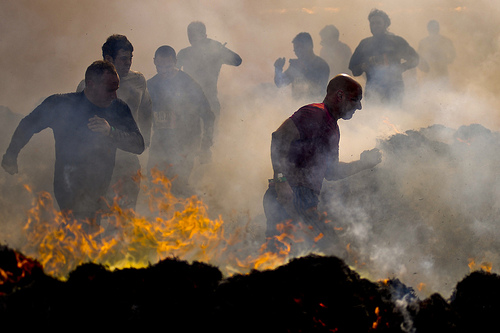
Participants run in the Tough Mudder event in Englishtown, NJ. The SAS (Special Air Service - British Special Forces) designed course consists of a 12 mile run as well as 20 obstacles and water crossings to contend with. (Photo courtesy of Tough Mudder)
“My brother and I have been training together,” said Snowden. “I do about two hours of weight training daily. I follow that up with an hour of cardio.”
Snowden plans on taking a team to Tough Mudder in October. Sgt. Anthony Whitaker, a fellow combat veteran and Snowden’s teammate for Tough Mudder, anxiously awaits the challenge.
“I want to push myself,” said Whitaker. “It’s one of those things that you can feel good about yourself for achieving. Plus, it goes towards a good cause.”
According to the their website, Tough Mudder has contributed over $3 million to the Wounded Warrior Project. During his 2010 deployment to Afghanistan, Whitaker’s mission was to transport wounded warriors from the battlefield to the nearest medical treatment facilities.
“I grew up in a military family and I have met lots of wounded warriors,” said Whitaker. “It’s important to look out for our own. We’ve got to find a way to help all the Wounded Warriors that are coming back today.”
Tough Mudder offers registration discounts to participants who sign up early, form a team, or are a past or present member of the Military Services. Extra adventurous registrants can even participate for free if they show up to the event with a Tough Mudder tattoo.
When asked if he would be showing up with “Tough Mudder” on his skin, Snowden replied, “I like tattoos to begin with so of course I will be getting a Tough Mudder tattoo!”
For more information on Tough Mudder coming to Kentucky, visit their website here
Story by Master Sgt. Philip Speck, 123rd Airlift Wing Public Affairs
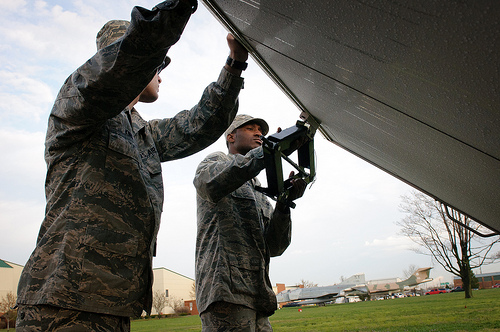
Airmen from the 123rd Force Support Squadron set up a new mobile field kitchen at the Kentucky Air National Guard Base in Louisville, Ky., on March 16, 2012. The kitchen can be deployed to the site of a natural disaster to provide hot meals for relief workers. (U.S. Air Force photo by Senior Airman Maxwell Rechel)
KENTUCKY AIR NATIONAL GUARD BASE, LOUISVILLE, Ky. — Airmen at the Kentucky Air National Guard’s 123rd Airlift Wing recently evaluated a new military field kitchen to verify that the trailer-based unit can be transported easily aboard C-130 aircraft.
Formally known as the Disaster Relief Mobile Kitchen Trailer, the unit features all the equipment necessary to prepare and serve hot meals to relief workers in austere environments, said Bill Hague, senior food service advisor for Babington Technology, the North Carolina-based company that designed it. The kitchen is intended for rapid deployment to the scene of any major catastrophe like a hurricane or earthquake, he said.
Babington brought the kitchen to Louisville in March because of the 123rd Airlift Wing’s extensive experience supporting overseas deployments and disaster-response missions across the United States, according to Tech. Sgt. Aaron Foote, base services specialist for the 123rd Force Support Squadron. The Kentucky wing has one of only two Contingency Response Groups in the Air National Guard, dedicated to rapidly deploying to the scene of a disaster or attack, opening up non-functional airfields, and orchestrating the flow of air traffic so relief supplies can be flown in and casualties can be flown out.
To see more photos from this story, click here
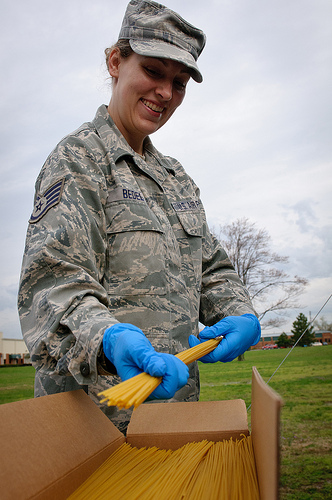
Senior Airman Amanda Bedel of the 123rd Force Support Squadron prepares to cook spaghetti during training on a new field kitchen at the Kentucky Air National Guard Base in Louisville, Ky., on March 16, 2012. The kitchen can be deployed to the site of a natural disaster to provide hot meals for relief workers. (U.S. Air Force photo by Senior Airman Maxwell Rechel)
The new kitchen differs from previous units in that food-service workers can begin preparing meals while the kitchen is still in transit, Hague said. That way, they can start serving meals as soon as the unit arrives at a disaster site. Older kitchens can take up to three hours to prepare food after their on-scene arrival.
“The DRMKT is the most rapidly responsive, capable field kitchen ever built for military applications,” Hague noted.
Robert Kaczorowski, functional area manager for services at the National Guard Bureau, said the new kitchen improves on current designs in another important way: Just about any food that can be procured on the local economy can be prepared and served. Older kitchens are designed to prepare only pre-packaged food called Unitized Group Rations.
Chief Master Sgt. Ray Dawson, air terminal superintendent for the 123rd Logistics Readiness Squadron here, and Tech. Sgt. Brian Milburn, a loadmaster for Kentucky’s 165th Airlift Squadron, evaluated the ease with which the kitchen could be loaded onto a C-130 and provided Hague with several suggestions for improvement to meet U.S. Air Force air-worthiness requirements.
Babington has been supplying military feeding equipment since 1995, Hague said. The first unit was the Marine Corps Tray Ration Heating System, followed by the Air Force Single Pallet Air Expeditionary Kitchen and the Army Assault Kitchen. After supporting relief operations during Hurricane Katrina, company engineers saw the limitations of existing mobile kitchens and decided to create the DRMKT.
Babington built its first prototype of the DRMKT four years ago, Hague said. The company has been testing it at disaster scenes ever since, the most recent being hurricane Irene in North Carolina, where the kitchen fed about 8,000 disaster victims.
Story and photo by Staff Sgt. Jason Maszor, 1204th Aviation Support Battalion
NOTE: Each week kentuckyguard.com publishes stories by or about Kentucky National Guard unit public affairs historian representatives, also known as UPAHRs. This is an additional duty taken on by a Soldier or Airmen with the intent of telling their unit’s story. This is one such story ….
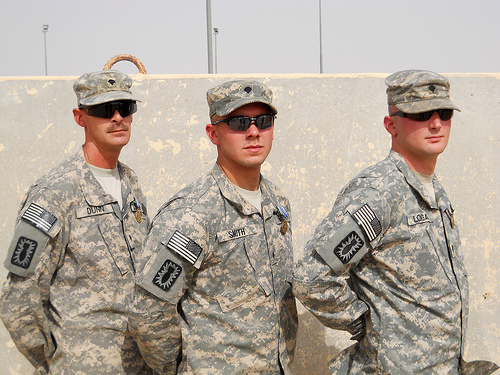
Spc. Glenn Dunn (left), Spc. Brandin Smith (center) and Spc. Duston Logan, all of the 1204th Aviation Support Battalion, were awarded the Army Achievement Medal in Camp Buehring, Kuwait, June 28, 2012. The Soldiers assisted in the drawdown of ammunition out of Iraq following the reposturing of U.S. Forces in 2011. (U.S. Army photo by Staff Sgt. Jason Maszor)
CAMP BUEHRING, Kuwait — On June 28, 2012 the six-man Ammunition Section of Alpha Company, 1204th Aviation Support Battalion, was formally recognized for their hard work and dedication in support of Operation New Dawn and Operation Enduring Freedom. Since the middle of November the Ammunition Section has been working with the 261st Ordnance Company, an Army Reserve Unit based out of West Virginia. Together they were able to contribute to the success of one of the most dynamic strategic sustainment operations in the history of the United States Army.
“You all should be extremely proud of yourselves, for you have accomplished the largest single logistical operation since World War II,” said Col. David L. Jones of the 113th Sustainment Brigade.
Jones was referring to the ammunition turn-in and repositioning of equipment from the drawdown in Iraq.
In just three months a five man team consisting of Staff Sgt. Jason Maszor, Sgt. Kyle Clifton, and three Soldiers from the 261st received, processed, repackaged, and condition coded 26 million rounds of ammunition valued over $45 million, according to the 261st Ordnance Co. The remaining members of the Ammunition Section; Spc. Glenn Dunn, Spc. Duston Logan, Spc. Lee Millar, and Spc. Brandin Smith worked alongside other Soldiers of the 261st and conducted over 7,000 inter depot transfers, issues, receipts, and shipments that amassed to over 150 million rounds valued at over $475 million.
For their hard work and dedication, the “Ammo Dawgs” of Alpha Co. were awarded achievement medals from the 261st Ordnance Company. Clifton from Crestview Hills, Ky., was awarded the Army Commendation Medal, Maszor, a native of California, Ky., Dunn of Dry Ridge, Ky., Logan from Alexandria Ky., Millar of Grant’s Lick, Ky., and Smith from Crittenden, Ky., were awarded the Army Achievement Medal.
Dunn, Logan, and Smith were also recognized for their hard work in preparing detonations for demilitarization with the 788th EOD Company.
“It was an honor to work with both Active Duty EOD Soldiers and fellow ammunition Soldiers from the Army Reserves,” said Logan. “It made me feel distinguished that another unit would take the time to acknowledge the hard work and accomplishments that we completed”.
Capt. Todd Allen, Alpha Co. commander said of the Soldiers, “It is great to see that their work did not go unrecognized. They are a great section of Soldiers and I am proud to have them in Alpha Company.”
Story and photos by Sgt. David Bolton, Kentucky National Guard Public Affairs Office
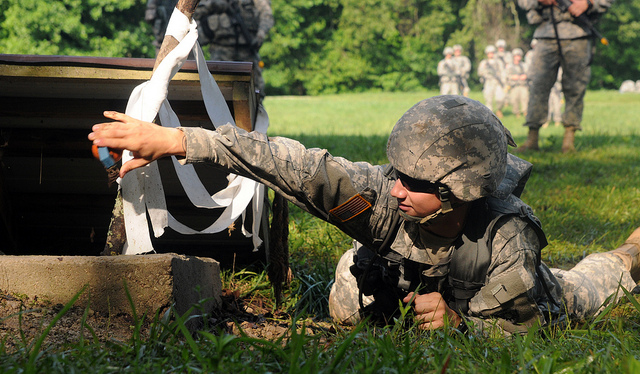
Kentucky Army National Guard Pvt. Markus W. Higgs, an infantryman with B Co.. 1st Battalion 149th Infantry from Bowling Green, Ky., deploys a grenade simulator in an improvised bunker during the grenade range training at the Harold L. Disney Training Center in Artemus, Ky., July 18, 2012. (Kentucky National Guard photo by Sgt. David Bolton, 133rd Mobile Public Affairs Detachment).
ARTEMUS, Ky.— Artillery simulators, grenades, convoy attacks, casualty evacuations, combatives, and fast roping from UH-60 Blackhawks; all part of the annual training that Soldiers of the Kentucky National Guard’s 1st Battalion, 149th Infantry Battalion experienced at the Harold L. Disney Training Center outside Barbourville, Ky., July 16-27.
“A lot of these guys are new recruits fresh out of basic, so it’s good training for them,” said Sgt. 1st Class Dennis Bumgardner, senior non-commissioned officer for Bravo Company of the 1-149th.
To see more photos from this story, click here
The training these Soldiers received was not just to improve their skills in various fieldcrafts, but also to prepare them for high-level stress combat situations. In order to accomplish this goal, other Soldiers who were with the 149th Maneuver Enhancement Brigade that deployed over 1,300 troops to Iraq, assisted with the different training lanes.
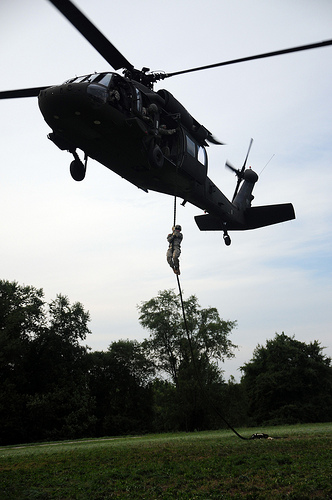
Kentucky Army National Guard Pvt. Cory M. Perry from Harland, Ky., an infantryman with Alpha Company from the 1st Battalion 149th Infantry, fast ropes from a B. Co 2nd Battalion 147th Aviation Regiment UH-60 Blackhawk Helicopter during a fast rope insertion/extraction system (FRIES) training exercise at the Harold L. Disney Training Center in Artemus, Ky., July 17, 2012. (Kentucky National Guard photo by Sgt. David Bolton, Ke133rd Mobile Public Affairs Detachment).
“We want these guys to get a feeling of what combat is like,” said Spc. Thomas D. Gross, an indirect-fire infantryman and acting trainer with Alpha Company of the 1-149th. “Being here lets us spend more time with the new guys and gives us a chance to train them to be comfortable under stress.”
Adding to the stress, daily rain showers kept the training areas constantly muddy. Grass, mud, and water covered the otherwise clean uniforms as the soldiers crawled under barbed-wire obstacles, ran through the soggy underbrush and dangled from ropes in the cloudy skies.
To enhance their training, another Kentucky Guard unit, the 2nd Battalion 147th Aviation Regiment, augmented the 1-149th by providing the aircraft and aerial support for casualty evacuations, land navigation, special purpose insertion/extraction system (SPIES), and fast rope insertion/extraction system (FRIES); making the training a joint exercise.
“The training gets us where we need to be, it’s nice to be able to get a sense of the heat of the moment,” said Pvt. 1st Class Markus W. Higgs, an infantryman with Bravo Company of the 1-149th.
The annual training of the 1-149th will last until July 27 at which point the Soldiers will break down their field tents, pack-up their gear, and head back their homes for some well deserved rest.
Story and photos by Staff Sgt. Paul Evans, KY ADT 4 Unit Public Affairs and Historian Representative
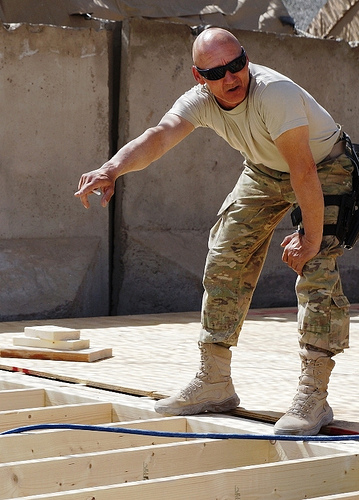
Spc. Michael Hilario, a member of the Kentucky National Guard’s Agribusiness Development Team 4 who resides in Lexington, Ky. looks over floor being built on May 3, 2012 in southern Afghanistan. Hilario was helping build hardened structures to make life more comfortable for ADT 4, and eventually ADT 5 as well. (U.S. Army photo by Staff Sgt. Paul Evans/Released)
FORWARD OPERATING BASE PASAB, Afghanistan— “No matter what we have to go through and the hard things we have to deal with, to be able to know that you’re here to help others, it’s a way of life just because it’s the way I was raised,” said Spc. Michael Hilario, a 47-year-old Virginia Beach, Va., native, who resides in Lexington, Ky. Hilario is currently deployed with the Kentucky National Guard’s Agribusiness Development Team 4 in Afghanistan.
Back in Kentucky, Hilario has served as an electrician with the Army National Guard’s 149th Vertical Engineering Detachment, 201st Engineer Battalion in Cynthiana, Ky. since joining the Guard after leaving the Navy Reserves in 2008. During his ten years with the Navy, Hilario deployed to Iraq twice as a SeaBee, spent two years active, earning the prestigious Seabee Combat Warfare device and Fleet Marine Force ribbon.
As a Seabee, Hilario was part of a Navy construction battalion from 1998 to 2008 that is well-known within the military for their ability to build just about anywhere in the world.
“I was active for right at two years. I was on the USS Kittyhawk for a little bit and the USS Antietam out west in California, (then) I was out of the service for a very short period of time and wanted to get back into the Seabees for my skills… I’ve been an electrician for over 18 years,” Hilario recalled.
“I’m a general contractor. That’s what I do best, so I got with the Seabees and went to Ramadi, Fallujah, Baghdad…we built airstrips, medevac hospitals, schools. It’s quite a good feeling to know you can go over and help people like that,” Hilario said.
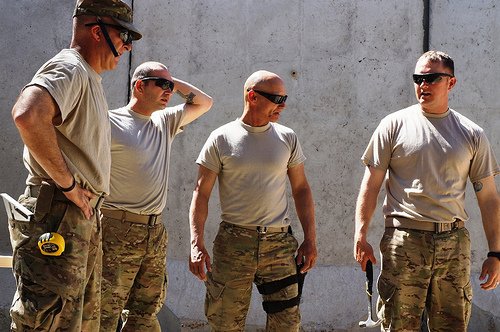
Pictured left to right: Master Sgt. John Black of Frankfort, Ky.; Spc. Russell Woosley of Smithfield, Ky.; Spc. Michael Hilario of Lexington, Ky.; and Staff Sgt. Mark Arnold of Harrodsburg, Ky. assess their next step constructing a building (not pictured) in southern Afghanistan on May 3, 2012. The four were helping build hardened structures to make life more comfortable for ADT 4, and eventually ADT 5 as well. (U.S. Army photo by Staff Sgt. Paul Evans/Released)
In Afghanistan, Hilario has put his past as a Seabee to good use by helping with ADT 4’s construction projects and serving as a liaison with the Seabees at FOB Pasab.
“Things that we’ve needed, I’ve been able to go over and obtain,” Hilario noted. “The things that they’ve needed, I’ve been able to help them as well. It’s brotherhood taking care of brotherhood here. It’s all family.”
“Just having prior service and knowing how when you get on the FOB, you’re very limited on resources. I guess just the Seabee experience that I’ve had… I’ve always been able to find a way to obtain some things, you know, anything that we need. Sometimes you’ve just got to look at the resources you have on the FOB and use everything you have,” Hilario explained.
“It’s helped our way of life here on FOB Pasab,” Hilario said. “That’s what it’s all about. I believe in helping others. That’s the way I was raised.”
“It’s pretty evident that he knows how to do electric work pretty good,” said Master Sgt. John Black, a 45-year-old Lawrenceburg, Ky. resident. Black works as a supervisor to Hilario on ADT 4’s ongoing construction projects. “He’s (also) a jack-of-all-trades.”
“My goal on this mission is… about helping others. I can help those that are less fortunate than I. That’s what it’s truly all about, that’s why I’m in the service now,” Hilario said.
“My dad’s a retired (Navy) Chief, my grandfather a retired (Navy) Master Chief, and on down the line,” he said. “To help others is not about myself. My goals of being are just to help others, that’s my personal goal. I wanted to be a part of the Agribusiness Development Team because I knew they were doing some good things here.”
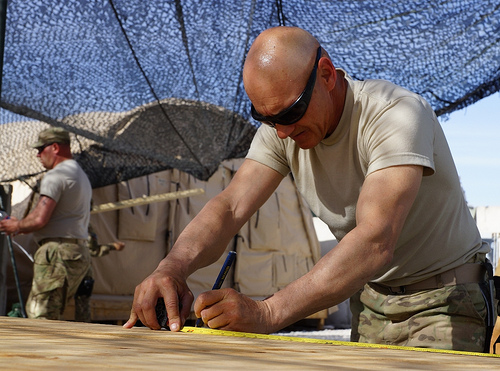
Spc. Michael Hilario, a member of the Kentucky National Guard’s Agribusiness Development Team 4 who resides in Lexington, Ky. measures wood before cutting it on May 3, 2012 in southern Afghanistan. Hilario was helping build hardened structures to make life more comfortable for ADT 4, and eventually ADT 5 as well. (U.S. Army photo by Staff Sgt. Paul Evans/Released)
Hilario has three children at home, two whom he says have learned to deal with him deploying.
“My oldest two, Britney, 21, Michael, 18, they’ve been through it a couple of times. They know it’s hard, but they’re military children,” Hilario said. “It’s gotten hard the first couple of times, but now they’re understanding how things are, what we’re here for, what we’re here to do, and they know this is part of daddy’s life as well as theirs.”
“The youngest, he’s getting ready to turn three, and he’s not really aware. I’m sure the video I sent him made him aware, let him know where dad’s going. He’ll look back on it in the years to come. We’ll sit down and we’ll talk about it too.”
“After Afghanistan, I’ll probably go home for a couple months and probably kind of a take it easy for a little bit. If they need me back, I’d go back again. I wouldn’t hesitate.”
“This is a family tradition here, and there’s no amount of money that can ever replace the feeling that you get when you’re able to help out people in your community and your country,” said Hilario. “There’s nothing like the feeling of going and helping people.”
Story and Photos by Sgt. Scott Raymond, Kentucky National Guard Public Affairs Office
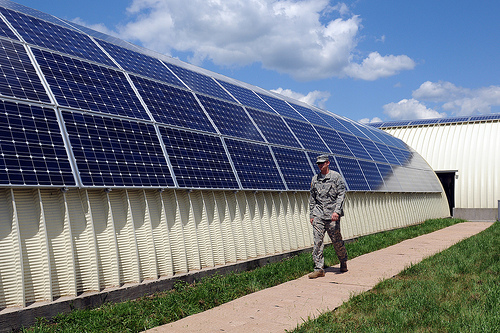
Sgt. Joseph Mattingly of Charlie Co., 1st Battalion, 376th Aviation walks between barrack buildings at the Harold L. Disney Training Center in Artemus, Ky., June 7, 2012. Solar panels installed on the buildings at the center are responsible for producing all the energy needed to power the buildings for use by units training at the site. (Kentucky National Guard photo by Sgt. Scott Raymond/Released)
ARTEMUS, Ky. — Nestled in the mountains of Eastern Kentucky, an array of blue, glass-like panel covered buildings sparkle in the afternoon sun. And the more the sun shines, the greater the benefit to the area. The panels harness the power of the sun and produce electricity for the Kentucky National Guard’s Harold L. Disney Training Center.
Located near Barbourville, Ky., the buildings at the site are unique and may even be considered an oddity as they sit in the middle of Kentucky’s coal country. But the 851 solar panels at the training center represent a positive impact the Guard is making for the Commonwealth and the environment.
The 550-plus acre training center is the first of its kind in the Kentucky National Guard to become a net-zero site. The term “net-zero” means that more energy is produced at a site than the site uses to sustain itself. Daily electrical operation of the Disney Training Center now comes from the skyward facing panels.
Along with the reduction of energy used, there is also a financial advantage for Kentucky. Capt. Joseph Sloan, Designs and Programs Manager for the Kentucky National Guard said the energy production could produce a surplus of energy, giving the Guard a credit toward their monthly energy costs.
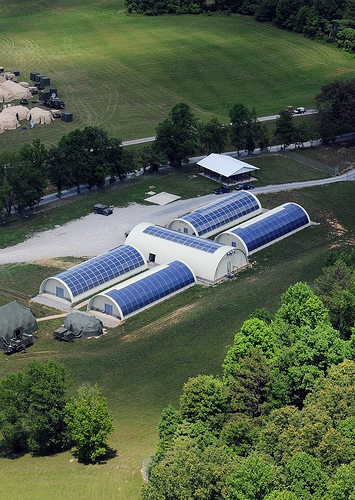
Aerial view of solar panels installed on the buildings of the Harold L. Disney Training Center in Artemus, Ky, June 7, 2012. The solar panel installation has effectively reduced the site’s energy usage to net-zero, meaning the site produces more energy than it uses. (Kentucky National Guard photo by Sgt. Scott Raymond/Released)
“We’re managing the budget, so this helps supplement the utility bill,” said Sloan. “But it’s also the right thing to do for the environment. It’s the responsible thing to do.”
According to the National Guard Bureau in Washington, D.C., Kentucky currently ranks first in the entire National Guard in energy reduction, and third in energy production.
Sloan said this achievement is not only because of the solar panel installation, but also in conjunction with an ongoing “energy audit”. Sloan and his office conduct this review in all armories and training sites in Kentucky.
“Everywhere, we’re checking windows, lighting, insulation and improving what we can, based on balancing the need and getting the greatest bang for the buck,” he said.
The usage of Disney Training Center dictated more buildings, and an opportunity for solar energy installation presented itself according to Sloan. Last year, for example, site officials said they accommodated more than 15,000 Soldiers, police officers, boy scouts and athletic teams for training.
Soldiers with Kentucky’s 201st Engineer Battalion constructed the buildings and the Guard partnered with Third Sun Solar, an Athens, Ohio based clean energy company, to install the panels.
Sloan said plans for more of the energy-absorbing panels are in the works, spreading the benefits through different regions of Kentucky. Installation is currently scheduled for the newest readiness centers, one recently completed in Owensboro, and the future site in Burlington, in Northern Kentucky. Work to add more panels also continues at Wendell H. Ford Regional Training Center in Greenville.
The solar panel additions will continue the Kentucky Guard’s effort to shrink its environmental footprint across the Commonwealth.
The Kentucky National Guard’s progress in solar energy recently attracted the attention of the international publication, Photon Magazine, who sent representatives to visit the state in June. Matthew Hirsch, associate editor with the San Francisco based magazine said the visit was part of a monthly series called PV (photovoltaic) Coast to Coast. Hirsch said the visit to the Bluegrass was enjoyable and a nice entry to their documentation of the solar market.
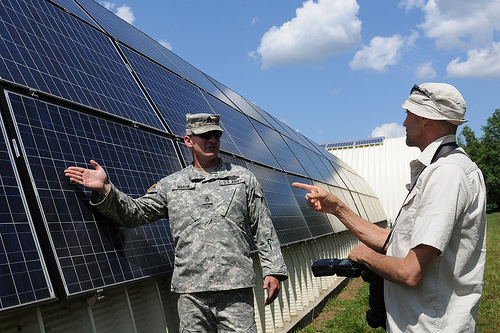
Sgt. 1st Class Chaz Martin, the non-commissioned officer in charge of the Harold L. Disney Training Center discusses solar panel installation at the site in Artemus, Ky., with a representative of Photon Magazine, June 7, 2012. Photon Magazine visited areas in Kentucky to collect information on solar energy efforts in the Commonwealth. (Kentucky National Guard photo by Sgt. Scott Raymond/Released)
“Our trip has been great,” he said. “We have met a lot of people here that are passionate, knowledgeable and interacting in growing solar energy.”
The fact that the Disney Center was the first net-zero site comes with some bragging rights in the Guard, but also the beginning of a consistency of clean energy used by Kentucky’s Citizen-Soldiers.
“This showcases us here in Artemus,” said Sgt. 1st Class Chaz Martin, non-commissioned officer in charge of training at the center. “National media even get to see that we are part of the Guard team here in Kentucky. We’re going green, saving energy and not costing the government as much.”
“This is a beautiful location, a place Soldiers have been coming to get their training since 1979,” said Martin. “And now that we are net-zero, we’re making that much bigger of an impact on the Kentucky Guard.”
Air Force program offers new tools to enhance any program or service
By Master Sgt. Philip Speck, 123rd Airlift Wing Public Affairs
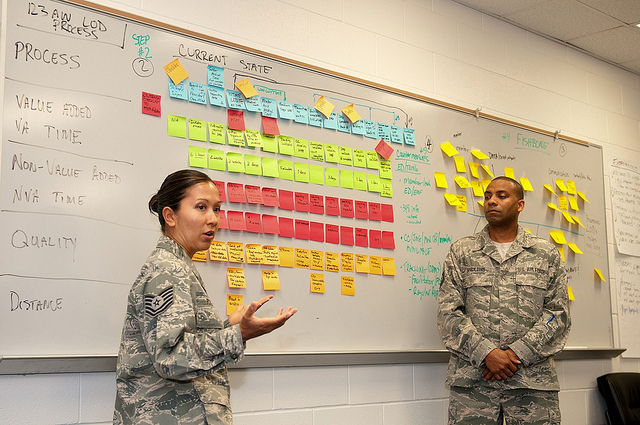
Photo caption: Tech. Sgt. Marie Plaza and Master Sgt. Gary Spaulding discuss the local workflow for Line of Duty determinations during an AFSO21 team meeting held at the Kentucky Air National Guard Base in Louisville, Ky., on June 28, 2012. AFSO21 — shorthand for Air Force Smart operations for the 21st Century – is an Air Force process-improvement method that can be used to streamline and enhance the effectiveness of virtually any program. (U.S. Air Force photo by Master Sgt. Philip Speck)
LOUISVILLE, Ky. — Kentucky Air National Guardsmen have a new toolset to help improve programs and processes across the base.
Called Air Force Smart Operations for the 21st Century, or AFSO21, the system can be used to “lean” almost program by cutting off excess fat, said Chief Master Sgt. Lori Zinsmeister, chief enlisted manager for the 123rd Force Support Squadron.
She recently served as the AFSO21 team lead for a review of the Line of Duty claims program, which tracks injuries or illnesses experienced during military duty.
Zinsmeister explained that the LOD system had become challenging for members to negotiate, necessitating a re-think of the program.
“It was taking up to 90 days for a Line of Duty claim to get through and people weren’t getting paid on time,” Zinsmeister said. “According to the Air Force Instruction, we are supposed to do it in a 65-day period.”
And so, for two-and-a-half days in June, a team of Kentucky Air Guardsmen used AFSO21 for the first time to analyze and streamline an existing process.
The first problem that needed to be resolved was that Line of Duty determination processing took too long at the local level. The team examined the local workflow to figure out how they could “lean out the fat” and make it faster.
“The goal was to improve the process for the individual Airman,” Zinsmeister said.
Based on their findings, the team created checklists for all involved parties, from the member and the commander to the medical group and the judge advocate general. The team also created a policy letter that allows a traditional commander to use a proxy to sign LOD paperwork, so cases can be expedited.
Moving forward, the group will develop a training program to make sure everyone is well informed on how the LOD process is supposed to work.
When an Airman gets sick or injured while on duty, he or she typically files a Line of Duty determination, which is tracked to ensure the Airman is given proper medical care and compensated for any lost time. They are then supposed to be returned to duty or evaluated for a medical disability.
“This is a very long process, and it involves a lot of different elements from within our wing, from finance to medical to the Force Support Squadron to legal to the individual Airman and his command element,” said Col. Greg Nelson, commander of the 123rd Airlift Wing. “This AFSO21 analysis improved all the steps to make it more efficient and timely to support the Airmen as best as possible.”
Lt. Col. Robert Hamm, vice wing commander, brought in Phil Chansler, director of Air University’s Lean Six Sigma Business Office at Maxwell Air Force Base, Ala., to help with the wing’s first AFSO21 case.
The goals of AFSO21 are to provide a standardized Air Force approach to continuously improving any process that employs Air Force capabilities, eliminating waste, sharing best practices and reducing cycle times.
AFSO21 also ensures that all Airmen understand their role in developing the ability to affect change and continuously learn new ways to improve processes in their daily activities, Hamm said.
AFSO21 uses an eight-step problem solving scheme that can be employed to fix any broken process:
1. Clarify the problem
2. Break down the problem and identify performance gaps
3. Set improvement target
4. Determine root causes
5. Develop countermeasures
6. See countermeasures through
7. Confirm results and process
8. Standardize successful processes
Nelson said he wants AFSO21 to become a “virus” that spreads basewide, to be used by individual Airmen all the way up through the flights, squadrons and groups.
He likes the AFSO21 improvement process because it combines Six Sigma, a private industry improvement process, with elements from combatant planning, such as the “OODA” loop — observe, orient, decide and act.
“The LOD evaluation is just the first event,” Nelson said. “I look for this to be a benchmark event that we can capitalize on and use for any process.”
The Kentucky Air Guard LOD team consisted of Zinsmeister, Master Sgt. Gary Spaulding, Lt. Col. Pat Pritchard, Maj. Robert Geary, Chief Master Sgt. Johnie Cherry, Tech. Sgt. Marie Plaza and Maj. Bruce Bancroft.
Hamm and Chansler were facilitators.
Story and photos by Sgt. Tasha Fields, 1204th ASB Unit Public Affairs Historian Representative
NOTE: Each week kentuckyguard.com publishes stories by or about Kentucky National Guard unit public affairs historian representatives, also known as UPAHRs. This is an additional duty taken on by a Soldier or Airmen with the intent of telling their unit’s story. This is one such story ….
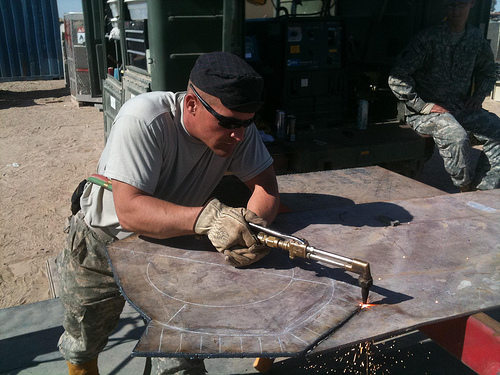
Spc. Dale Salsman of the 1204th Aviation Support Battalion cuts the outline of a guidon stand in Camp Buehring, Kuwait. (U.S. Army photo by Sgt. Tasha Fields)
CAMP BUEHRING, KUWAIT — What starts as pieces of rubble from scrap yards turns into pieces of artwork when Sgt. Chad Ward and Spc. Dale Salsman are finished. Ward, non-commissioned officer in charge of the weld shop, has been welding for a little over eight years and gained his knowledge through military school. His first projects included minor repairs on vehicles and farm equipment. Salsman however, has been welding for 20 plus years. The assistant team leader started making things like chessboards with a gradual progression to bed frames and larger items.
When asked what makes welding so interesting, Salsman said he uses it to relax and it helps him deal with stress. Ward said his excitement comes from the reactions on other’s faces when they see the completed project.
To see more photos from this story, click here
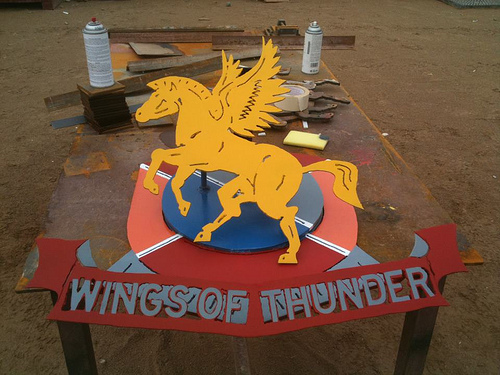
Detail of the 1204th ASB guidon stand. (U.S. Army photo by Sgt. Tasha Fields)
The creative side of Ward came out when he met Salsman. The two of them complement each other. One has the talent, which allows the other to start thinking of the next project. They have no issues taking constructive criticism from one another.
Their teamwork is used to put the completely freehand projects together. Salsman cuts while Ward paints.
“It feels good to be able to work with someone like Specialist Salsman,” said Ward. “He should be doing this for a living, he’s just that good. He’s like a tattoo artist with a torch.”
They use a variety of materials for finished projects such as steel, stick welder, oxy fuel (torch), grinders file, paint, and nuts and bolts. One project can take up to four days, depending on the number of parts and the detailing of the paint job.
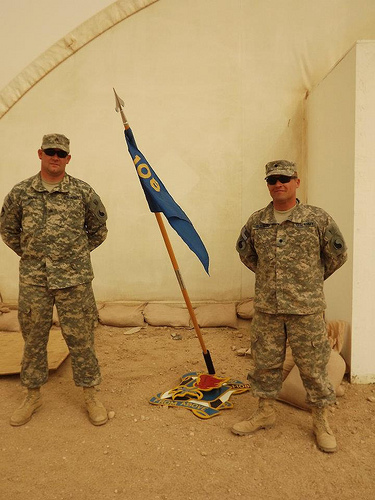
Sgt. Chad Ward (left) and Spc. Dale Salsman of the 1204th Aviation Support Battalion, stand with a newly created guidon stand in Camp Buehring, Kuwait. (U.S. Army photo by Sgt. Tasha Fields)
Since being in Kuwait, the two have created four guidon stands. The first one was for the incoming commander for the 1204th in February 2012. When describing this project, the two agreed that getting the color right was challenging due to rain and sand storms. When other units saw this artwork, they wanted one as well.
Salsman said, “It’s great to be able to take a bunch of trash and make something out of it.”