
Pages
Stay In Touch
More
© 2013 KentuckyGuard
Story by Staff Sgt. Scott Raymond, Kentucky National Guard Public Affairs
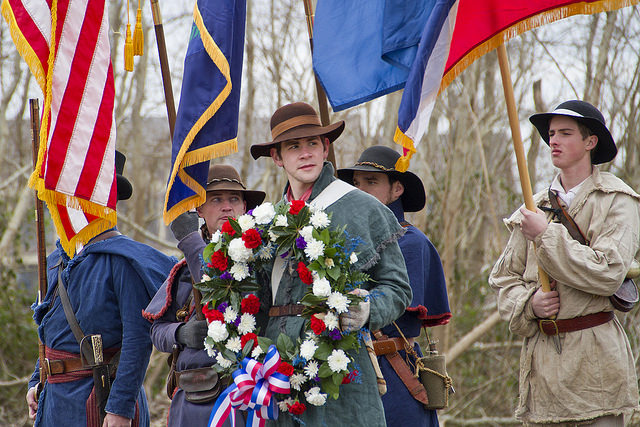
Reenactors with the 2nd Kentucky Militia form a color guard for the 200th commemoration of the Battle of New Orleans in Chalmette, La., Jan. 9, 2015. The 2nd Kentucky were part of a living history encampment near Chalmette Battlefield with hundreds of other reenactors for the weekend of events. (U.S. Army National Guard photo by Staff Sgt. Scott Raymond)
CHALMETTE, La. — In a sugar cane field along the meandering Mississippi River just outside New Orleans, La., two hundred years ago, Citizen-Soldiers fought along side Choctaw Indians, free African-Americans and criminal privateers, prevailing against the most powerful army in the world.
The Battle of New Orleans was the last major conflict of the War of 1812. The outcome ended the last war with England, preserved a claim to the Louisiana Territory, triggered migration and settlement along the Mississippi River and rebuilt the spirit of the American people.
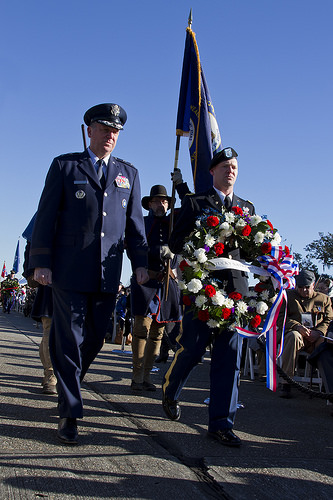
Maj. Gen. Edward W. Tonini escorts a wreath during the 200th commemoration of the Battle of New Orleans at Chalmette Battlefield, La., Jan. 8, 2015. Wreaths were laid by Kentucky, Tennessee, Mississippi and Louisiana at the Chalmette Monument in honor of the militiamen who fought in the battle. (U.S. Army National Guard photo by Staff Sgt. Scott Raymond)
In a celebration of unity, the 200th anniversary of the battle was commemorated at the Chalmette Battlefield and nearby locations, Jan. 8-9, 2015.
January 8 was celebrated as a national holiday for years after the battle, like a second Fourth of July. And so the story goes, the War of 1812 was like a second American fight for Independence. The hastily assembled American army of Soldiers, Marines, militiamen, Native Americans and pirates won the day for Gen. Andrew Jackson. 200 years later, representatives from the motley elements of that army gathered to pay tribute to fallen ancestors and the end of the war.
Maj. Gen. Edward W. Tonini and Maj. Gen. Glenn H. Curtis, adjutants general of the Kentucky and Louisiana National Guard respectively, participated in a wreath laying at the Chalmette Monument. The wreaths joined those of the Choctaw Nation of Oklahoma and the British Embassy for the United Kingdom among others in a symbolic display of unity of allied nations and people from various walks of life.
“We are here to commemorate and honor the memory and service of the combatants on both sides of the conflict,” said Tonini. “Whether American, British or Native American, these sacrifices secured 200 years of peace, cooperation and friendship between our nations.”
Throughout the weekend, events honored the battle, those who fought it and the 200 years since.
“Events this week commemorate the Battle of New Orleans, but also so much more,” said John Trowbridge, historian for the Kentucky National Guard. “We honor all those involved, especially the militiamen from Kentucky, Tennessee, Mississippi and Louisiana, the predecessors of today’s National Guard.”
To see more photos, visit our flickr site here.
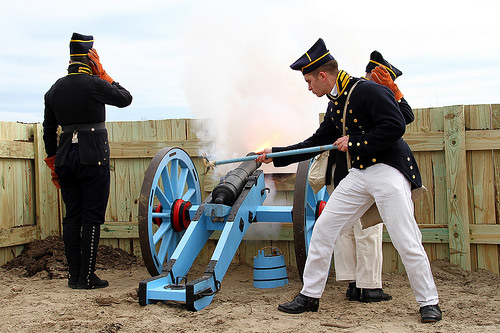
Reenactors participate in a living history encampment for the 200th commemoration of the Battle of New Orleans in Chalmette, La., Jan. 9, 2015. The multi-day encampment hosted large numbers of spectators and school children in a variety of events including a reenactment of the last battle of the War of 1812. (U.S. Army national Guard photo by Staff Sgt. Scott Raymond)
In addition to the National Park Service event at the battlefield, hundreds of reenactors set up a period encampment in St. Bernard Parish.
Tonini was on hand to recognize the members of the 2nd Kentucky Militia Reenactment Group with a signed proclamation from Gov. Steve Beshear naming Jan. 9, 2015 as 2nd Regiment, Kentucky Volunteer Milita Day in the Commonwealth.
“It’s important to recognize these individuals that keep history alive,” said Trowbridge. “They are stewards of the Nation’s past, providing a glimpse into a bygone age to honor those who fought and sacrificed in the War of 1812.”
The living history event also included bivouac tents, artillery pieces and a reenactment of the battle.
The following is a compilation of significant dates in our nation’s and the commonwealth’s military history. For more on the legacy of our Citizen-Soldiers and Airmen, visit the Kentucky National Guard eMuseum.
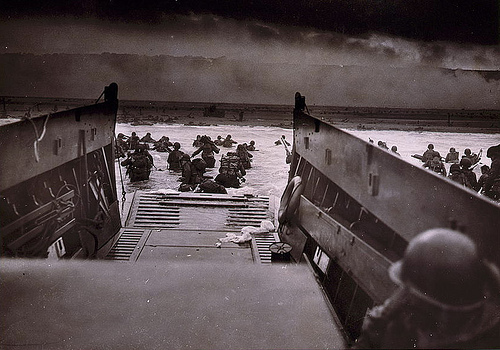
Normandy invasion, D-Day, June 6, 1944.
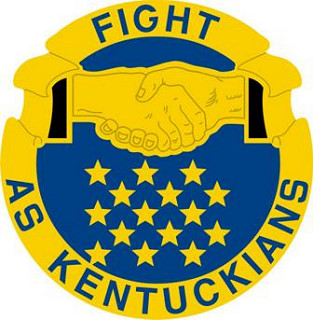
The crest for Army National Guard units of the Commonwealth of Kentucky includes fifteen stars, a reference to Kentucky being the fifteenth state admitted to the Union.
June 1, 1792 – Kentucky’s Birthday – Kentucky became the 15thstate of the United States of America.
June 1, 1942 – Technical Sgt. Johnnie Bottoms, Headquarters Company, 192nd Light Tank Battalion (Harrodsburg Tankers) died at Calauan Camp #3 – Old Bilibid Prison, Rizal Manila Philippines. (World War II)
June 1, 1969 – Sgt. Bertram A. “Sonny” Carr, Louisville, Ky., of B Battery 2nd Battalion, 138th Field Artillery was killed near Hamburger Hill. He was originally a member of Service Battery. (Vietnam War)
June 2, 1942 – Pvt. Willard Emmal Foster, Headquarters Company, 192nd Light Tank Battalion (Harrodsburg Tankers) died of dysentery at Camp O’Donnell, Capas, Tarlac, Philippines. (World War II)
June 3, 1942 – Battle of Midway began. (World War II)
June 6, 1944– D-Day Invasion of Europe. (World War II)
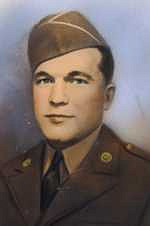
Sgt. Hezakiah Franklin Sallee
June 6, 1944 – Sgt. Hezakiah Franklin “Heze” Sallee of Company D, 192nd Light Tank Battalion (Harrodsburg Tankers) died in coal mining accident at Japanese Prisoner of War Camp Fukuoku-17, Nagasaki, Japan. (World War II)
June 6, 1952 – Operation Counter began. (Korean War)
June 8, 1864 – John H. Morgan raided Mt. Sterling, took Lexington, thence to Georgetown and Cynthiana, thence through Flemingsburg and West Liberty into the State of Virginia. (Civil War)
June 9, 1969 – Kentucky Air National Guard returned home from its duties during the Pueblo Crisis (Korea) and was released from active duty in ceremonies in Louisville. During the recall period of 17 months the wing flew 19,715 tactical flying hours from a total of 11,561 sorties. The 165th Squadron alone processed 257,200 prints and 284,251 feet of film and flew 4,438 recon sorties totaling 7,192 hours.
June 10, 1951 – Battle for the Punchbowl began. (Korean War)
June 10, 1953 – Siege of Outpost Harry began. (Korean War)
June 11, 1960 – The Kentucky Air National Guard facility at Standiford Field was dedicated to the honor of a former member of the unit, Capt. John William Shewmaker, killed in Korea Oct. 23, 1951, while flying with the 111th Fighter- Bomber Squadron. Members of the family were guests of the Kentucky Air National Guard for the occasion.
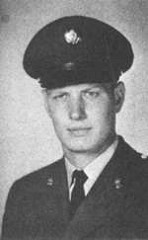
Staff Sgt. Harold Brown
June 11, 1969 – Staff Sgt. Harold Milton Brown, Mt. Washington, Ky., formerly Battery C, 2nd Battalion, 138th Field Artillery was killed by rocket fire while in a bunker in Chu Lai while serving with Battery C, 1st Battalion, 82nd Artillery, Americal Division. (Vietnam War)
June 13, 1942 – Pvt. Herbert C. Steele of Company D, 192nd Light Tank Battalion (Harrodsburg Tankers) died of dysentery at Camp O’Donnell, Capas, Tarlac, Philippines. (World War II)
June 14 – Flag Day
June 14, 1775 – U.S. Army founded.
June 14, 1920 – Col. Isaac Wilder is appointed Adjutant General of Kentucky, by Governor Edwin P. Morrow. Wilder resigned the position two days later.
June 15, 1950 – Governor Clements issues an executive order appointing Brig. Gen. Roscoe L. Murray to the rank of major general conforming to general assembly’s change to KRS 36.030 raising the rank of the adjutant general from brigadier general to major general. This is the first time in the history of the Commonwealth that the adjutant general was granted the rank of major general.
June 16, 1920 – James Madison DeWeese is appointed adjutant general of Kentucky for the second time by Governor Edwin P. Morrow.
June 18, 1812– U.S. Congress declared war against England. (War of 1812)
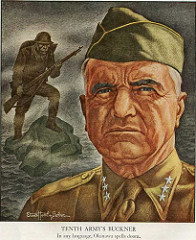
Lt. General Simon Buckner
June 18, 1945 – During action on Okinawa. Lt. Gen. Simon B. Buckner Jr. became the highest ranking American general officer killed in action during WWII. The Kentucky native was the son of Confederate General and Kentucky Governor Simon B. Buckner. In 1954 Congress posthumously promoted him to the rank of general. (World War II)
June 19, 1969 – C Battery, 2nd Battalion, 138thField Artillery attacked on Tomahawk Hill by North Vietnamese Army sappers. Other 2ndBattalion batteries at nearby firebases were shelled by the NVA so that they could provide little or no fire support for C Battery. Pfc. Joseph R. McIlvoy, Mackville, Ky., Specialist Four Ronald E. Simpson, Bardstown, Ky., Specialist Four David B. Collins, Bardstown, Ky., Sgt. James T. Moore, Bardstown, Ky., 1st Sgt. Luther M. Chappel, Worthville, Ky., were killed in the attack. When Firebase TOMAHAWK was attacked during the early morning hours in a pouring rain, sappers infiltrated the base and during the attack threw some 150 satchel charges into the bunkers in addition to firing rocket propelled grenades (RPG). The battle went on some two hours before the NVA were forced to retreat. The attack destroyed an ammunition storage area, four of the six M-109 self-propelled howitzers, nine bunkers, the mess hall, dining tent, maintenance building, four ammunition carriers, three 2 1/2-ton trucks, two 3/4-ton trucks, and three jeeps. The Battery had nine men killed; five of them were from Kentucky and the other four were non-Guard replacements from various, non-Kentucky, locations. The unit also suffered 37 wounded. A platoon of infantrymen from the 101stAirborne Division was providing perimeter security for the firebase and four of the 101st soldiers were killed and another 13 wounded. Senior Commander in Vietnam, General Creighton Abrams, said the 2ndBattalion 138th Field Artillery, was “one of the best trained, and absolutely the best maintained battalion-sized unit in Vietnam.” (Vietnam War)
June 20, 1792 – Governor Isaac Shelby signs act establishing the Kentucky Militia.
June 21, 1871 – Reunion at Paris, Ky., of 69 soldiers of the War of 1812; their combined ages equal 5,487.
June 21, 1871 – Capt. Thomas S. Theobald, of Frankfort, aged 79, receives a pension certificate as a veteran of the War of 1812, the first issued to a Kentuckian, and entitling him to $8 per month. He was First Lieutenant in Morrill’s company of Kentucky Mounted Rifles.
June 22, 1780 – Capture by Capt. Henry Bird and British-Canadian-Indian army, of Ruddle’s and Martin’s Stations, on upper waters of Licking River. (Early Indian Wars)
June 22, 1942 – Pledge of Allegiance recognized by Congress.
June, 1944 – GI Bill signed into law.
June 24 – Kentucky National Guard Day in the Commonwealth of Kentucky. On this day in 1792 Governor Shelby established how the Kentucky Militia was to be organized.
June 24, 1792 – Kentucky Militia is organized by Governor Shelby.
June 25, 1850 – Construction of Kentucky’s Battle Monument completed in the state cemetery at Frankfort.
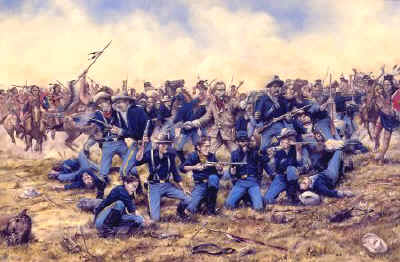
The Battle of Little Bighorn, June 25, 1876
June 25, 1876 - During the Battle of Little Bighorn, Madison County, Ky.-native, Pvt. William Harris and Pvt. George Scott of Lancaster County, Ky. bring water to Soldiers while under enemy fire. Their actions earn them both the Medal of Honor. Both are among the 263 Soldiers of the 7th Cavalry killed in the battle.
June 25, 1950 – Korean War began.
June 28, 1914 – World War I began in Europe after Archduke Francis of Austria and wife were assassinated.
June 29, 1846 – Appointment by President Polk of William O. Butler, of Carroll County, Kentucky to be major general of volunteers. Butler was the son of Kentucky’s first adjutant general, P.P. Butler. Butler State Park in Carrollton is named in honor of William O. Butler. (Mexican War)
June 29, 1950 – First U.S. ground forces arrive in Korea. (Korean War)
The following is a compilation of significant dates in our Nation’s and commonwealth’s military history. For more on the legacy of our Citizen-Soldiers and Airmen, visit the Kentucky National Guard eMuseum.
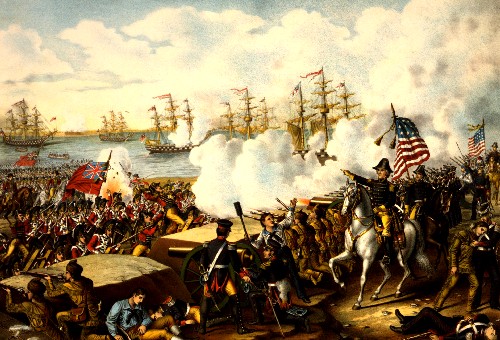
Battle of New Orleans, 1815
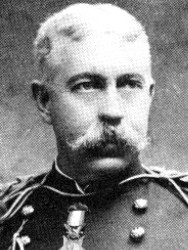
Brig. Gen. John Kerr
January 7, 1815 – 2,500 Kentucky militia, under Maj. Gen. John Thomas, less than one-fourth of them armed (as their arms were on flat-boats, not yet arrived), reach New Orleans. (War of 1812)
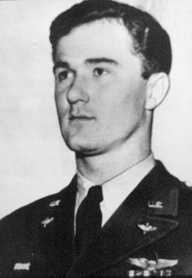
Capt. Thomas Mantell
January 7, 1948 – Capt. Thomas Francis Mantell Jr., was killed while on a training flight with three other P-51Ds (Mustang). Mantell was directed by flight tower at Godman Field, Ft. Knox, to pursue an unidentified flying object. While in pursuit of the object, his aircraft crashed near Franklin, Simpson County, Ky. Capt. Mantell was the first flight casualty of the Kentucky Air National Guard.
January 8, 1815 – American victory at the Battle of New Orleans. (War of 1812)
January 8, 1967 – Operation Cedar Falls (Vietnam War)
January 11, 1862 – Gunboat action at Columbus, Kentucky. (Civil War)
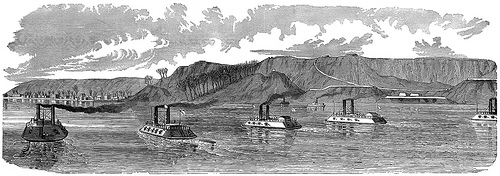
Union gunboats on the Mississippi River near Columbus, Ky., during the Civil War.
January 12, 1945 – 1st Lt. George A. Vanarsdale, Headquarters Company, 192nd Light Tank Battalion (Harrodsburg Tankers) died when the Japanese “Hell Ship” Enoura Maru was sunk (World War II)
January 13, 1917 – Lt. Nathaniel Gibson Hale of Murray’s L Company, Third Kentucky Infantry died of an accidental gunshot wound. Hale was in his tent at the regimental camp, Camp Owen Bierne, some two miles from Fort Bliss, near El Paso, TX. He was part of the Kentucky National Guard contingent called to federal duty to patrol a sixty mile stretch of the border between Fort Bliss and Fort Hancock during the Mexican Punitive Expedition. Hale belonged to the Murray unit, joining as a Pvt. on June 22, 1912. He was promoted to Sgt. and 1st Sgt. and elected 1st Lt. on July 10, 1914.
January 17, 1991 – Operation Desert Storm began
January 18, 1813 – Battle of Frenchtown, Michigan Territory (Monroe, MI) (War of 1812)
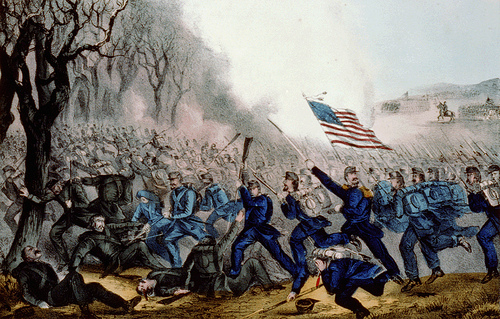
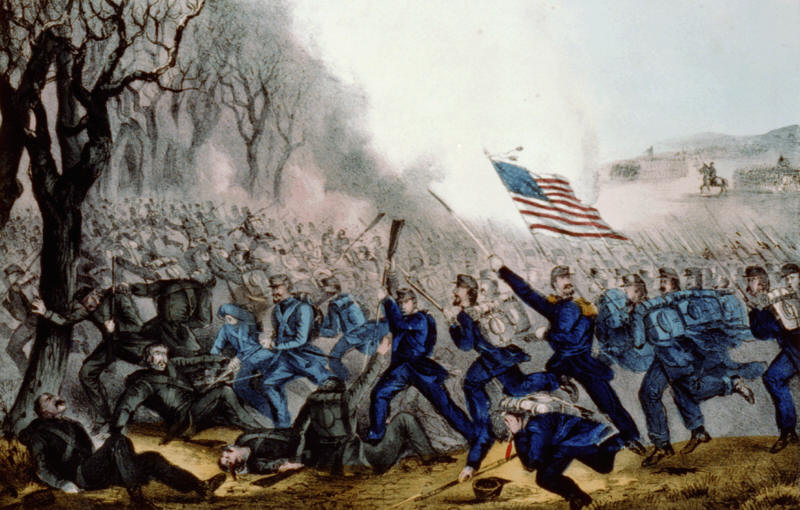
Battle of Mill Springs, Ky., 1862
January 19, 1862– Battle of Mill Springs, Pulaski County (Civil War)
January 20, 1968 – Battle of Khe Sanh began (Vietnam War)
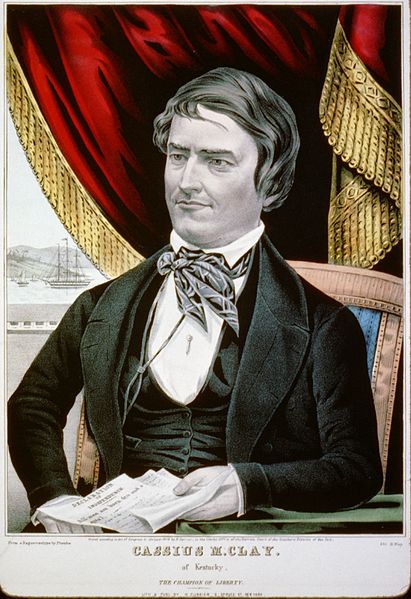
January, 1847 – Maj. John P. Gaines and Capt. Cassius M. Clay, with 30 Kentucky cavalry, along with 50 Arkansas cavalry, are surrounded at Encarnacion by an overwhelming force of Mexican cavalry, and compelled to surrender, taken to the city of Mexico, and imprisoned (Mexican-American War)
January 21, 1839 – The “Louisville Legion,” of dragoons, artillery, infantry and riflemen, authorized as part of the Kentucky Militia.
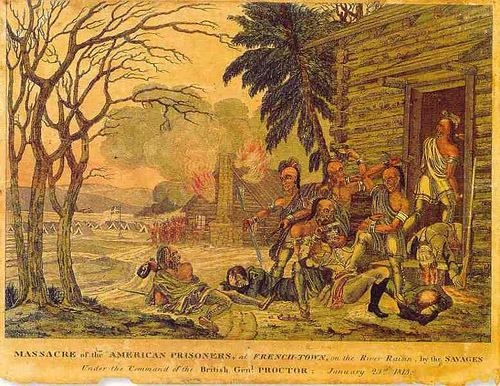
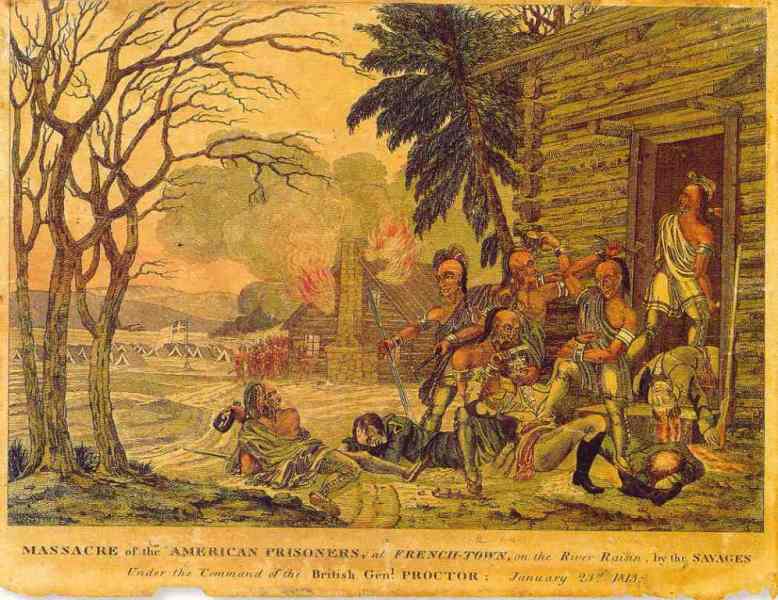
Massacre at the River Raisin, Mich., 1813
January 22-23, 1813 – Battle of the River Raisin, disastrous defeat and massacre of Kentucky troops. “Remember the Raisin” would become the battle cry of Kentucky troops during the remainder of the war in the northwest (War of 1812)
January 22, 1944 – Allies land at Anzio, Italy (World War II)
January 23, 1937 – Sgt. Thomas J. “Tommy” Brown of Madisonville, drowned while on state active duty in response to the flood of 1937. He was assigned to Headquarters Company, 3rd Battalion, 149th Infantry from Madisonville. He is the only known Kentucky National Guardsman who perished on duty during the great flood of 1937. According to newspaper accounts, Brown and 2ndLt. James L. Moore, Pvt. C. W. Anthony and a civilian, Emmett Ashby, were in a boat that lost its stern from vibrations from an outboard motor and quickly sank by the stern throwing all four into the nine-foot deep water. The other three were able to swim to shallow waters but did suffer from exposure and shock. Brown was last seen clinging to the boat bow debris before he sank from sight. The Guardsmen were on a survey mission to assess conditions in Ashbyburg and Jewel City area and Ashby was catching a ride to Ashbyburg in hopes of getting another ride closer to his home. Brown was a butcher in civilian life and was married and had one child. Brown’s battalion commander, Oren Coin, wrote a letter to a legislative committee on the widow’s behalf in December of 1937 seeking some sort of relief for his family. Sgt. Brown’s death most likely was the beginning of the push for the state’s death gratuity for Kentucky National Guardsmen who die on State Active Duty missions.
January 24, 1955 – Col. Philip P. Ardery, senior commander of the Kentucky Air National Guard since its founding, was promoted to the rank of Brig. Gen., the first Kentucky Air Guard member to wear the star of a general officer.
January 25, 1944 – Gustavus Herbert May is appointed Adjutant General of Kentucky by Gov. Simeon Willis.
January 25, 1951 – Operation Thunderbolt began (Korean War)
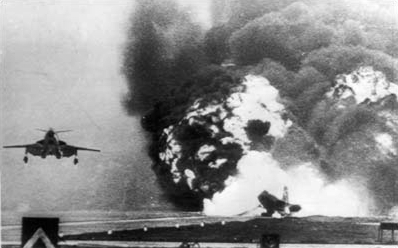
A Kentucky Air National Guard RF-101 Voodoo explodes shortly after take off at Itazuke Air Base, Japan.
January 26, 1968 – All units of the Kentucky Air National Guard except state Headquarters were called to federal service. Kentucky is only one of two states to have both Air and Army Guard units called up in 1968 (the other being Kansas). Kentucky was the only state to have both Air and Army mobilized units deploy overseas. The 165th Tactical Reconnaissance Squadron was assigned, along with two other Air National Guard recon squadrons to a rotation scheme which had each squadron assigned for 60-90 days to the Panama Canal, Alaska and Itazuke Air Base in Japan. During these missions their RF-101 Voodoo jets would photograph areas of interest looking for Soviet, or in the case of Japan, North Korean, naval activity. While the 165th was stationed in Japan in the spring of 1969 one of its pilots, Captain William Seiber, was almost killed when his plane exploded upon take off. The unit returned home and was released from active duty on June 9, 1969. (Pueblo Call-up/Vietnam War)
January 27, 1943 – Sgt. Elzie E. Anness, Headquarters Company, 192nd Light Tank Battalion (Harrodsburg Tankers) died at Camp Tanagawa, Osaka, Japan of dysentery (World War II)
January 28, 1957 – 1st Lt. Owen W. Turner, of Pleasure Ridge (Jefferson County) died when his burning plane crashed near Piedmont, Alabama, some sixty miles west of Atlanta. Turner was flying a T-28 from the Naval Air Station at Atlanta for a navigational proficiency flight to Standiford Field. Turner decided to return to Atlanta because of worsening weather conditions in his flight path. Turner joined the Kentucky Air National Guard in 1948 and was a member of the 165th Fighter Interceptor Squadron.
January 27, 1973 – Signing of Vietnam Peace Accord (Vietnam War)
January 29, 1828 – Preston S. Loughborough is appointed Adjutant General of Kentucky by Gov. Joseph Desha.
January 30, 1968 – Tet Offensive began (Vietnam War)
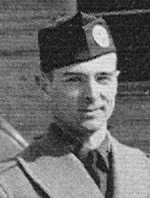
2nd Lt. Archibald Rue
January 31, 1945 – 2nd Lt. Archibald B. “Arch” Rue, Company D, 192nd Light Tank Battalion (Harrodsburg Tankers) died at Camp Fukupka #3 Yawata, Kyushu, Japan of acute colitis (World War II)
January 31, 1956 – Col. Lee J. Merkel, veteran commander of the Kentucky Air National Guard’s base and vice commander of the 123rd Fighter-Interceptor Wing, was killed in an air crash of an F-51 Mustang 10 miles north of Bedford, In.
January 31, 1968 – Battle of Hue began (Vietnam War)
The following is a compilation of significant dates in our commonwealth’s military history. For more on the legacy of our Citizen-Soldiers and Airmen, visit the Kentucky National Guard eMuseum.
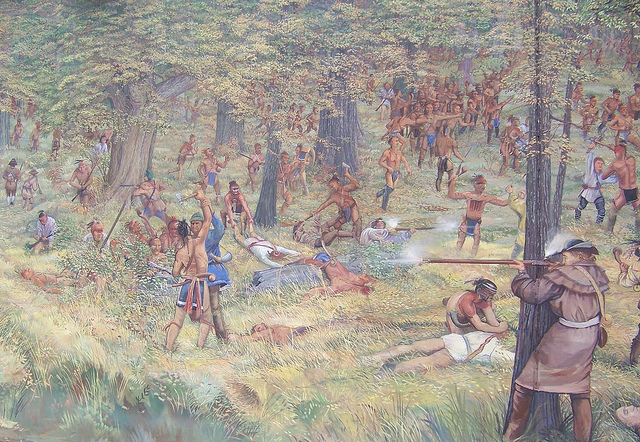
The Battle of Point Pleasant, October 10, 1774
October 1, 1879 – Joseph Preyer Nuckols appointed Adjutant General of Kentucky by Gov. Luke P. Blackburn.
October 1, 1887 – Samuel Ewing Hill is appointed Adjutant General of Kentucky by Gov. Simon Bolivar Buckner.
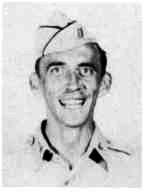
Capt. Richard Ross
October 1, 1950 – Capt. Richard Lee Ross, of Prospect (Jefferson County) died in an aircraft accident near West Point Kentucky during a training flight. He was a member of the 165th Fighter Squadron, Kentucky Air National Guard.
October 2, 1867 – Franklin Lane Wolford is appointed Adjutant General of Kentucky by Gov. John W. Stevenson.
October 2, 1869 – Pvt. Allie Cooper was killed while on state active duty in Springfield, Marion County while serving with Captain Levy’s Cavalry Company of the Woodford Rifles . The Guard had been called out by the governor in response to a request from a District Judge citing lawless bands in the area, sometimes referred to as “Regulators,” they had hung a man named Clem Crowdus. The Guard was sent to assist in capturing those responsible and to keep further similar incidents from occurring. Pvt. Allie Cooper’s killer, a citizen with the last name of Rollins was tried and convicted for Cooper’s murder. Newspaper accounts from the time say that Cooper and an unknown number of fellow soldiers were apparently off duty, were fired upon from the back room of a saloon by at least two assailants. Cooper and his fellow soldiers had been attending the county fair, was reportedly killed by a member of one of the “lawless bands” the Guard had been called in to quiet shortly after they entered the saloon and were speaking to the owner.
October 3, 1993 - Rangers from the 3/75th Ranger Regiment and Soldiers of the 160th Special Operations Aviation Regiment were involved in the Battle of Mogadishu, Somalia, later known through a book and movie as “Black Hawk Down.” Task Force Ranger successfully captured two high-ranking members of clan leader Mohammed Farah Aidid’s forces, but at the loss of 18 U.S. Service Members and two aircraft.
October 4, 1846 – Duel at Port Lavacca, Texas, between Capt. Thos. F. Marshall and Lieut. James S. Jackson, of Capt. Cassius M. Clay’s company, both of the Kentucky cavalry regiment; two shots exchanged, but both escape unhurt (Mexican-American War).
October 5, 1813 – Kentucky Governor Shelby, with 4,000 Kentuckians reinforce Gen. Harrison, and take part in the brilliant victory at the Battle of the River Thames, which closes the hostilities in the northwest theatre of operations (War of 1812).
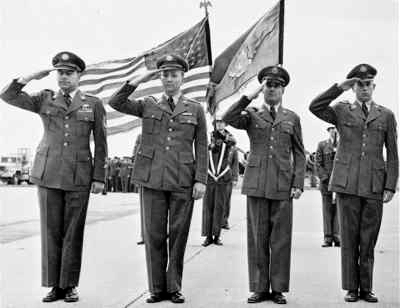
Recognized for their gallantry in rescuing Puerto Rican soldiers from a civilian air crash at Standiford Field were (from left): Master Sgt. Howard Curtis, Tech. Sgt Walter Carter, Tech. Sgt. Charlie Simmons, and Airman 1st Class Jessie Brown.
October 6, 1954 – The Kentucky Medal for Valor presented to Airman 1st Class Jessie Brown, Tech. Sgt. Walter Carter, Master Sgt. Howard Curtis and Tech. Sgt. Charles Simmons by Governor Lawrence Wetherby. They were the first Kentucky Air National Guard recipients to be awarded the medal.
October 7, 1961 – The 413th Ordnance Company arrived at Fort Stewart for active duty in response to the Berlin Crisis. They returned to Kentucky National Guard status on August 12, 1962.
October 7, 2001 – Operation Enduring Freedom began (Global War on Terrorism).
October 8, 1862 – Battle of Perryville, followed by Gen. Bragg’s withdrawal from Kentucky (Civil War).
October 8, 1971 – Operation Jefferson Glenn (Vietnam War)
October 9, 1950 – Invasion of North Korea (Korean War)
October 10, 1774 – Battle of Point Pleasant during Lord Dunmore’s War. Frontier militiamen from Va. were attacked by Ohio River Valley Indian tribes. After an all day battle the Indians left the field, heavy casualties on both sides. The treaty that followed this battle ceded the land southeast of Ohio River to Virginia, opening up that territory for settlement.
October 10, 1864 - Sgt. John Darrough from Maysville, Ky., serving with F Company, 113th Illinois Infantry saves the life a Union officer during action near Eastport, Miss. For his heroism, he receives the Medal of Honor.
October 10, 1942 – Sgt. Oscar Dean, Company D, 192nd Tank Battalion (Harrodsburg Tankers) died at Camp Cabanatuan, Nueva Ecija, Philippines of dysentery (World War II).
October 10, 1950 – Kentucky Air National Guard’s 123rd Fighter Group, personnel and equipment placed on active duty at the direction of President Harry S. Truman. They are ordered to report to Standiford Municipal Airport to serve for a period of 21 consecutive months unless sooner relieved. The unit is part of the First Air Force, Continental Air Command. Elements called to active duty: 123rd Fighter Group, 165th Fighter Squadron, 223rd Air Service Group (Less Detachment C) and 165th Utility Flight (Korean War).
October 10, 1961 – The 3rd Medium Tank Battalion arrived at Fort Knox for active duty in response to the Berlin Crisis. They returned to Kentucky National Guard status on August 12, 1962.
October 11, 1867 – Gov. John W. Stevenson authorizes Adjutant General Frank Wolford to raise 3 volunteer companies in Boyle, Marion, and Casey counties, to sustain the laws and protect the people against the outrages and murders of the “regulators.”
National Guard Association of the United States
October 11, 1879 – The first annual conference of the National Guard Association is held. The Association, which continues in operation today, acts as a political interest group representing Guard concerns with members of Congress. Federal law prohibits members of the armed forces on active duty from ‘lobbying’ Congress so the Association, which is composed of active and retired Guard officers, performs this function.
October 11, 1991 – Tebbs Shewmaker Moore is appointed Adjutant General of Kentucky by Gov. Wallace G. Wilkinson.
October 12, 2000 – Bombing of USS Cole in Yemen.
October 13, 1775 – United States Navy established in Philadelphia, Pa.
October 14, 1861 – John William Finnell is appointed Adjutant General of Kentucky by Gov. Beriah Magoffin and re-appointed to the position by Gov. James F. Robinson.
October 14, 1858 – Presentation to the Masonic Grand Lodge of Kentucky, of the sword worn by Col. Joseph Hamilton Daviess when he fell at the Battle of Tippecanoe – enclosed in a box made of oak from the vary tree under whose shade he expired; presented by Judge Levi H. Todd, of Indiana, a native of Kentucky and a member of the family of Col. Daviess.
October 14, 1952 – Operation Showdown/Battle of Hill 598 (Sniper Ridge) began. (Korean War)
October 15, 1813 – Kentucky troops reach Frenchtown, on the river Raisin, on their return from the victory of the Thames. They collect 65 skeletons of their massacred countrymen, and inter them with proper honors. (War of 1812)
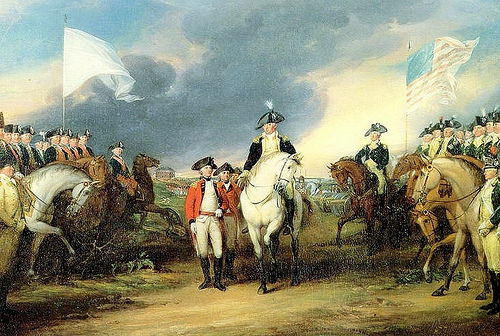
Cornwallis’ surrender at Yorktown, 1781
October 19, 1781 – Surrender of Gen. Charles Cornwallis at Yorktown, Virginia. (American Revolutionary War)
October 19, 2001 – First U.S. Combat Forces on ground in Afghanistan. (Operation Enduring Freedom)
October 20, 1969 – 2nd Battalion, 138th Field Artillery returned home and was released from active duty on October 20, 1969 after serving 11½ months in Vietnam. (Vietnam War)
October 20, 1950 – Korean War’s first Airborne Operation (Korean War)
October 22, 1790 – Harmar’s Defeat. Col. Trotter leads Kentuckians during the campaign. (Early Indian Wars)
October 23, 1944– Battle for Leyte Gulf (World War II)
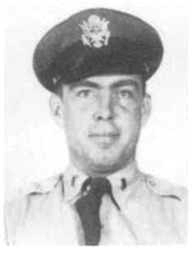
Capt. John Shewmaker
October 23, 1951 – Capt. John William Shewmaker of Harrodsburg was a pilot with the 165th Fighter Squadron for several years and went to Korea with the 111th Fighter-Bomber Squadron and was killed while flying an escort mission over North Korea on a bombing raid on this date. He was classified missing in action until the end of 1953. The Kentucky Air National Guard base was named Shewmaker Air National Guard Base in his honor on February 17, 1959 with a public ceremony in June 1960. The name was ordered changed in 1976 with the new designation of Standiford Field (ANG).
October 23, 1965 – Battle of the Ia Drang Valley began (Vietnam War)
October 23, 1983 – Beirut Terrorist Attack
October 24 – United Nations Day
October 24, 1944 – Pvt. Vernon H. Bussell, Pfc. Robert V. Cloyd, Pfc. Ancel Edgar Crick, Pvt. First Class John Lewis Cummins, Pvt. James William Sallee, all serving with Headquarters Company 192nd Light Tank Battalion (Harrodsburg Tankers) died aboard the Japanese “Hell Ship” Arisan Maru, when it was sunk.
October 25, 1983 – Operation Urgent Fury.
October 26, 1918 - Godman Airfield at Fort Knox becomes first airfield for U.S. Army Air Corps in Kentucky. It was built for the 29th Aero Squadron and first used by the 31st Balloon Company.
October 27 – Navy Day
October 28, 1961 – The 2nd Medium Tank Battalion arrived at Fort Stewart for active duty in response to the Berlin Crisis. They returned to Kentucky National Guard status on August 12, 1962.
October 29, 1967– Battle of Loc Ninh began (Vietnam War)
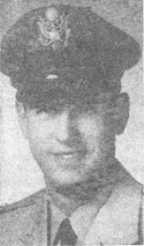
2nd Lt. Richard Hudson
October 30, 1957 – 2nd Lt. Richard Lloyd Hudson perished near Vevay, In., when the Kentucky Air National Guard F-86A Sabre Jet he was piloting crashed during a routine Air Defense Command scramble. He enlisted in the Kentucky Air National Guard in August 1953. He entered cadet training in November 1955 and received his commission and wings on March 28, 1957.
October 31, 1968 – Operation Rolling Thunder ended (Vietnam War)
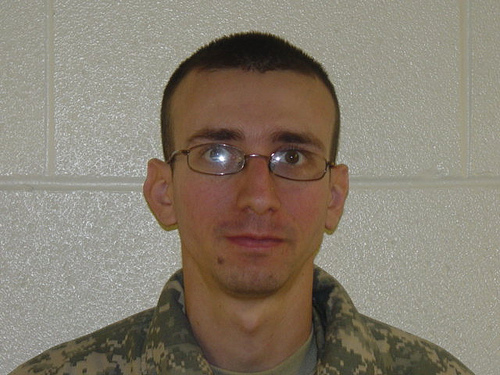
Sgt. Daniel Wallace
October 31, 2008 – Sgt. Daniel Wallace, of Dry Ridge, Grant County, Kentucky was killed when his unit was attacked by enemy forces while conducting a route clearing mission to remove improvised explosive devices (IED’s) in West Paktika Province, Afghanistan. Wallace was a member of Company C, 201st Engineer Battalion based in Cynthiana and serving with Company B from Olive Hill in Afghanistan. Wallace was serving as a gunner on a Mine-Resistant, Armor-Protected vehicle (MRAP) when they came under small-arms fire. The 201st mobilized in March 2008 and deployed to Afghanistan in May 2008. Wallace enlisted in the Kentucky National Guard in May of 2006.
Courtesy the Toledo, Ohio Blade
Story by Tom Henry, Blade staff writer
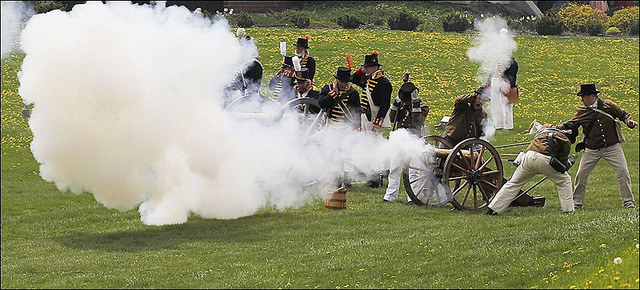
Re-enactors fire cannons to mark the First Siege of Fort Meigs that occurred on May 1, 1813. The celebration that concludes today is anchored at Fort Meigs but activities go on across the river. THE BLADE/LORI KING
Kentucky was a major player in the War of 1812, also known as the Second War for American Independence. Reenactments and ceremonies are taking place across the nation in remembrance through January 2015 of those who gave their lives.
FORT MEIGS, Ohio — Beyond the sounds of musket volleys and cannon blasts, the smells of campfires and gunpowder, the sights of blacksmiths, tents, 19th century soldiers, and drum-and-fife corps, one might reasonably wonder what has drawn throngs of people to Fort Meigs this weekend for a three-day bicentennial celebration of its first siege.
Click here for the original story!
Click here for additional photos!
There’s an obvious love of history. But there’s something more than that.
Brig. Gen. Patrick Dolan, the only chaplain in the Army National Guard who’s a general and one of only 11 chaplain-generals in the entire U.S. military, said such events draw people with an innate curiosity of what it means to bond together as a nation.
“We’re all in this together. It’s about a sense of self-sacrifice instead of entitlement,” Dolan said during an interview moments after helping to dedicate a Kentucky Soldiers Memorial at Fort Meigs. The memorial honors Kentucky soldiers who came north in rugged conditions — at great risk to themselves, with no guarantees — to help Ohio soldiers fight the British and Native Americans in the War of 1812.
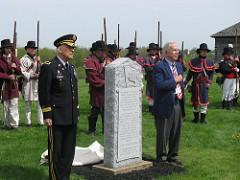
Chaplain (Brig. Gen.) Pat Dolan was on hand to represent the National Guard during the War of 1812 bicentennial reenactment at Fort Meigs, Ohio.
“The whole reason we came here was neighbor helping neighbor,” said Dolan, a member of the Kentucky National Guard and a veteran of Operation Iraqi Freedom.
That feeling of self-sacrifice and neighbor-helping-neighbor also resonates with Larry Nelson, a Bowling Green State University adjunct assistant history professor who has written several books about the Ohio frontier. Mr. Nelson spent 24 years as Fort Meigs State Memorial site manager until his retirement from the Ohio Historical Society in 2004.
“I hope they get a sense of heroism,” Mr. Nelson said after giving a presentation about the War of 1812, during which he said that Americans, Canadians, and British remain divided over why it started, what was accomplished, and who won.
“It’s a war that tells us about ourselves, good bad or indifferent. It’s a war when America was at its best and worst. It’s a war that needs to be remembered,” Mr. Nelson said.
Many people who spoke at Fort Meigs in Perrysburg and at an affiliated event Saturday afternoon at Fort Miamis in Maumee drew parallels and distinctions between the War of 1812 and more recent wars, such as those in Afghanistan and Iraq.
A common denominator has been sacrifice, they said.
“We know that in the natural world all things are connected, and so it is in history. The rich history of Ohio is both amazing and engaging and should not be forgotten,” Steve Madewell, Metroparks of the Toledo Area director said as he opened the Fort Miamis event, in which a marker was dedicated to honor a British regiment.
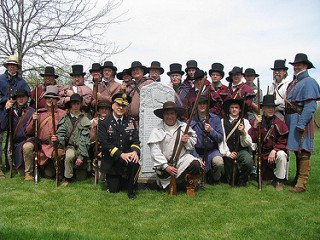
Chaplain (Brig. Gen.) Pat Dolan with some new friends during the War of 1812 bicentennial reenactment at Fort Meigs, Ohio.
The bicentennial celebration, which concludes today, is anchored at Fort Meigs but has included activities on both sides of the Maumee River.
Rick Finch, Fort Meigs site manager, said three years of planning went into the events.
Canadian re-enactor troops fire muskets in a ceremony to commemorate Fort Miamis. Canada was well on its way to nationhood during the War of 1812.
On Friday, 300 schoolchildren and 120 re-enactors interacted during the daytime, followed by a night artillery barrage observed by some 600 spectators.
About 2,000 people attended Saturday’s events at the fort, with a similar number expected today.
Activities begin at 10:30 a.m. and continue through 5 p.m., with the battle demonstration scheduled for 2 p.m.
Admission is $9 for adults, $8 for seniors, and $5 for students. Children 5 and under are free.
Some 625 re-enactors are participating this weekend, held in commemoration of the bloodiest battle at the fort. That’s nearly four times as many re-enactors as many other events there, Mr. Finch said.
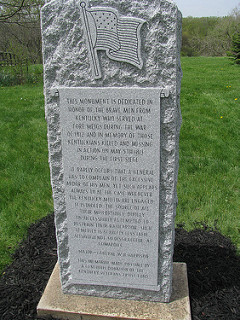
A monument recognizing the Kentucky soldiers who came north in rugged conditions — at great risk to themselves, with no guarantees — to help Ohio soldiers fight the British and Native Americans in the War of 1812.
“It’s been wonderful to have the fort come back to life,” he said. “I hope people get a real appreciation for the sacrifices and hardships. Even though the technology has changed, there is some consistency about the soldiering life.”
Rob Whitman, National Park Service ranger at Perry’s Victory and International Peace Memorial on South Bass Island, described how the Battle of Lake Erie was a turning point in the War of 1812, often viewed as a forgotten war.
Navy Comm. Oliver Hazard Perry’s victory was the first and only time the British lost an entire navy squadron in battle.
The construction of that landmark, a 352-foot peace memorial on South Bass Island, symbolized the desire for a new start. Mr. Whitman and others noted the United States has never been at war with the British or with Canada since.
At the Fort Miamis ceremony, Roy Norton, Consul General of Canada, said Canada wasn’t recognized as a country until 1867 — more than 50 years after the War of 1812 ended in 1815 — but was well on its way to nationhood then.
He said the United States and Canada now reap benefits of sharing the world’s largest nonmilitarized border, including trade. Ohio exports more to Canada than its next 11 export destinations combined, he said.
“Our citizens live with complete confidence they will never be attacked by the United States,” Mr. Norton said. “As allies, best friends, and economic partners, we work together daily.”
Contact Tom Henry at: [email protected] or 419-724-6079.
This is Part V of a five-part series documenting the travels of Kentucky Guard Command Historian John Trowbridge as he explores Kentucky’s participation in the War of 1812.
Story and photos by Sgt. Scott Raymond, Kentucky National Guard Public Affairs
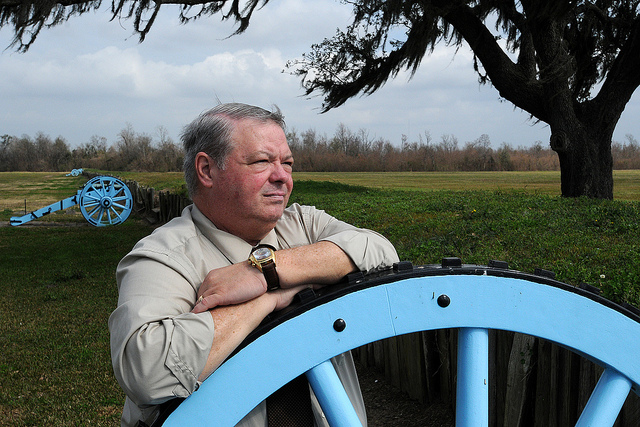
John Trowbridge, State Command Historian for the Kentucky National Guard takes in the view of Chalmette Battlefield in New Orleans, La., Jan. 28, 2013. Trowbridge’s site visit was part of his continued documentation of the role Kentuckians played in the War of 1812. (Kentucky National Guard photo by Sgt. Scott Raymond)
NEW ORLEANS, La. — In the latter days of the War of 1812, the conflict was winding down in the North and East, but Gen. Andrew Jackson was still preparing to meet the British on the final field of battle. With the help of Choctaw Indians, free men of color, pirates and volunteers from Tennessee and Kentucky, Jackson’s army defended New Orleans and the gateway up the Mississippi River from the redcoats final attempt to defeat the upstart United States.
The victory on the plantation fields of Chalmette outside New Orleans proved to be a much greater event to the fledgling government than a just a battle won. The outcome ended the last war with England, preserved a claim to the Louisiana Territory, triggered migration and settlement along the Mississippi River and rebuilt the spirit of the American people.
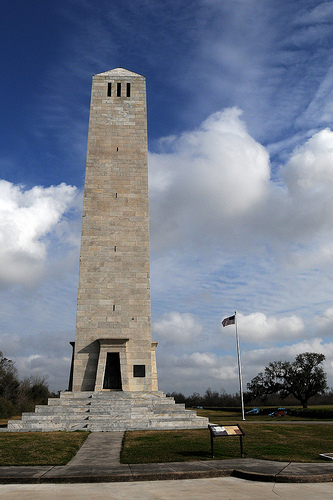
The Chalmette Monument stands just behind the canal Gen. Andrew Jackson fortified to defend New Orleans during the War of 1812. The victory preserved the U.S. claim to the Louisiana Territory and built patriotism in the American people. (Kentucky National Guard photo by Sgt. Scott Raymond)
“This was the most one-sided victory in U.S. military history,” said John Trowbridge, State Command Historian for the Kentucky National Guard. “And it was won by a ragtag army, pieced together to face what was at the time the greatest army in the world. More than two thousand Kentuckians were part of that group that fought for Jackson at New Orleans.”
Answering the call to fight, the Kentuckians gathered along the Ohio River, built rafts and flatboats and floated down the Mississippi to New Orleans. They took up defensive positions along a canal Jackson ordered fortified and across the water along the west bank of the river. The British arrived with a 10,000 man army, nearly out numbering the Americans 2-1. The final battle last roughly two hours. With thousands of causalities and their commanding general, Sir Edward Pakenham dead on the field, the British retreated, leaving the Americans in control of the Mississippi River.
Although the Treaty of Ghent had already been signed, news did not travel the ocean quickly. But with the victory at New Orleans, there was little doubt, the Americans had the upper hand in defending their country. Several months after the battle, the volunteers from Kentucky and Tennessee began the long journey home. At the time, the Natchez trace was the path to follow.
The trace had been used by Native Americans for centuries. In 1803, President Thomas Jefferson ordered the trace be improved for travel and postal runs to connect the newly purchased western territories. In 1815, it was the most direct and reliable route north to Tennessee. Stands or roadside markets and inns were constructed to aid travelers in their journey.
Several sections of the original trace remain, similar to the early nineteenth century. Trowbridge felt especially connected to the militiamen from 1815 as he placed his steps in the same ground two hundred years later. Stories of the time said the militias were loud and boisterous in celebrating their victory as they made their way home. Some were welcomed as national heroes when they arrived in Nashville. Not every Kentuckian came home however. Although casualities in the battle were low compared to the British, illness and infection struck down many Americans in the harsh swamp lands of Louisiana.
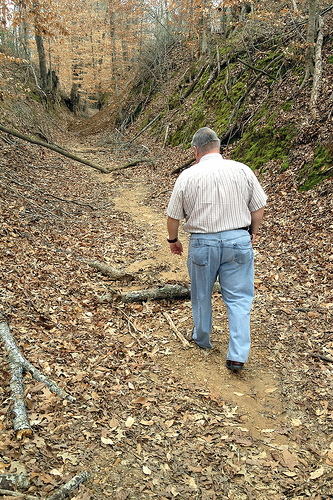
John Trowbridge, State Command Historian for the Kentucky National Guard walks along an old portion of the Natchez Trace near Jackson, Miss., Jan. 29, 2013. Trowbridge’s site visit was part of his continued documentary of the role Kentuckians played in the War of 1812. (Kentucky National Guard photo by Sgt. Scott Raymond)
“This is the same route they used, marching home from war,” said Trowbridge as he placed his own steps in the sunken pathway in Mississippi. “It may have been a sorrowful return for the Kentuckians after losing several compatriots in New Orleans. But it was still a return home and a return that meant the end of the war.”
“The Battle of New Orleans and the War of 1812 put Kentucky on the national stage,” he said. “The war established a warrior spirit in Kentuckians and a tradition of military service that remains today in the Kentucky National Guard.”
Victory in the forgotten War of 1812 forged the destiny of the continent for generations. From New Orleans through the Indiana Territory and into Canada, Kentuckians sacrificed to help establish the United States as a player in the events of the world.
As the last battle of the war, Trowbridge said this site visit should wrap up his planned documentary on Kentuckians during the War of 1812. He is looking forward to the bicentennial events he calls significant dates in the nation’s history, each with a Kentucky connection.
“After these visits, I have a better perspective of the Kentuckians roles in the War of 1812 and look forward to honoring their memories during the next several months,” he said.
The following is a compilation of significant dates in our Commonwealth’s military history. For more on the legacy of our Citizen-Soldiers and Airmen, visit the Kentucky National Guard eMuseum.
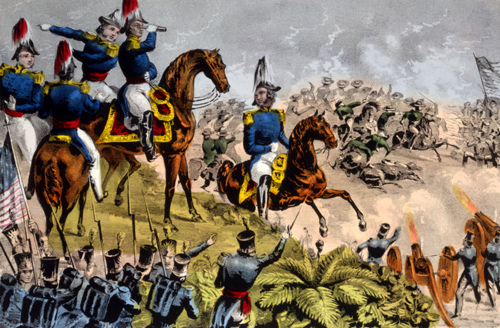
Battle of Buena Vista, February 23, 1847
February 1 – National Freedom Day. Honors the signing by President Abraham Lincoln of a resolution that later became the 13th Amendment to the U.S. Constitution. Lincoln signed the Amendment outlawing slavery on Feb. 1, 1865
February 3, 1900 – Daniel Ray Collier and John Breckinridge Castleman serve simultaneously as Adjutant General of Kentucky following the disputed 1900 governor’s election. Collier was the re-appointed Adjutant General under Gov. William S. Taylor, he remained in office in the Old Capitol, until May 22, 1900, at which time he yielded the office to General Castleman in compliance with a U.S. Supreme Court order.
February 4, 1818 – $300.00 appropriated to pay for a plan for a state armory in Kentucky.
February 4, 1917 – Harold Hite of Company A, 3rd Kentucky Infantry Regiment died of Pneumonia while on Federal Duty during the Mexican Border Campaign.
February 5, 1951 – Battle of Hill 440 began (Korean War)
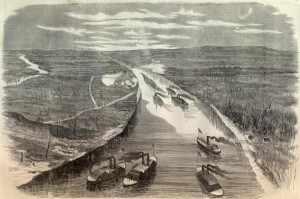
Siege of Fort Henry on the Tennessee River, 1862
February 6, 1862 – Fall of Fort Henry followed by Fort Donelson (Civil War)
February 6, 1992 – Kentucky Air National Guard C-130 crash in Evansville, IN. Maj. Richard A. Strang, Capt. Warren G. Klingaman, Lt. Vincent D. Yancar, Master Sgt. William G. Hawkins and Master Sgt. John M. Medley perished during a training flight, when their Kentucky Air National Guard Lockheed C-130B struck Drury’s Inn Motel and then crashed into JoJo’s restaurant exploding into flames. Eleven persons on the ground were killed.
February 8, 1778 – Daniel Boone and 27 men with him captured at Blue Licks by Indians.
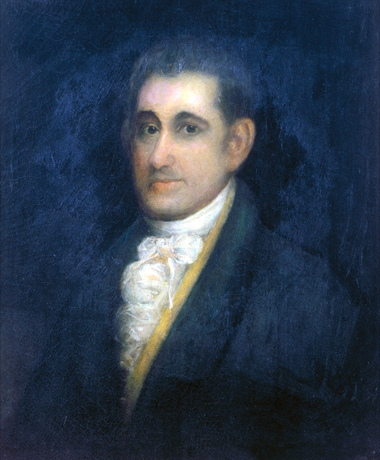
John Adair, former adjutant general and eighth governor of Kentucky
February 10, 1816 – Gen. John Adair receives “the highest approbation and thanks of the legislature” of Kentucky, for his gallantry at the battle of New Orleans, and more particularly for the deep interest he took in vindicating a respectable portion of the troops of Kentucky from the inappropriate imputation of cowardice, most unjustly thrown upon them” by Gen. Andrew Jackson.
February 11, 1860 – Gov. Beriah Magoffin of Kentucky directed to procure suitable gold medals, to present, in the name of the state, to each of the surviving Kentucky volunteers in the Battle of Lake Erie on September 10, 1813.
February 11, 1917 – Capt. Estel E. Owsley, Company H, 2nd Kentucky Infantry Regiment from Middlesboro died at Fort Thomas, Kentucky. He took ill on the trip from El Paso, TX to Kentucky as the unit returned from federal duty on the Mexican border.
February 12, 1973 – Operation Homecoming began (Vietnam War)
February 13, 1957 – United States Property & Fiscal Officer (USP&FO) Kentucky offices and warehouse facilities located on Bowman Field was destroyed by fire. Total property loss exceeded $250,000.
February 15, 1898 – Sinking of the USS Maine (Spanish-American War)
February 16, 1951– Siege of Wonsan began (Korean War)
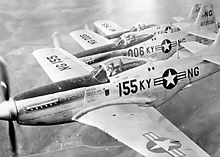
P-51 Mustangs of the Kentucky Air National Guard
February 16, 1947 – Federal recognition of the Kentucky Air National Guard units granted by National Guard Bureau. Original units of the Kentucky Air National Guard were: HQ, 123rd Fighter Group; HQ Detachment, 223rd Air Service Group; Detachment A, 223rd Air Service Group; 165th Fighter Squadron; 165th Utility Flight; 165th Weather Station.
February 19, 1849 – Act passed directing the “the following names of battles and campaigns be inscribed upon the bands of the State Military Monument (Frankfort cemetery): Boonesborough, Blue Licks, Estill’s Defeat, St. Clair’s Defeat, Harmar’s Defeat, Wayne’s Campaign, Indian Wars, Tippecanoe, Raisin, Mississiniwa, Fort Meigs, Thames, New Orleans, Monterey, Cerro Gordo, Buena Vista, Mexico; that the names of such distinguished citizens of Kentucky as fell in said battles, campaigns and Indian Wars be inscribed on the shaft, beneath said bands; and that the dedication on the monument shall show that it is erected by a grateful country in honor of the private soldiers, equally with that of the officers.”
February 19, 1945 – US Marines landed on Iwo Jima (World War II)
February 20, 1850 – From the Kentucky Legislature. The thanks and gratitude of the people of Kentucky, and a sword, tendered to Sgt. William F. Gaines of Georgetown, “the boy defender of the glorious banner of the 2nd Regiment of Kentucky Infantry, at the Battle of Buena Vista;” his name to be inscribed on a plate of metal, and attached to the flagstaff of the colors.
February 22, 1917 – 1st Sgt. William C. Liles of Company H, 3rd Kentucky Infantry Regiment from Hartford, Ohio County, Kentucky died of pneumonia while on active federal duty near El Paso, TX. Liles joined Company H when it was formed in 1906. (Mexican Punitive Expedition)
February 22, 1967 – Operation Junction City began (Vietnam War)
February 22-23, 1847 – Gen. Zachary Taylor, after two days of severe fighting, wins a great victory over the Mexican Army at Buena Vista — A small American army under the command of Gen. Taylor defeats a much larger force commanded by Gen. Santa Anna, President of Mexico. About ninety percent of Taylor’s army was composed of state volunteer (Guard) units, several of which were heavily engaged in the fight. The 2nd Kentucky Volunteer Infantry’s, second in command, Lt. Col. Henry Clay, Jr. (son of the famous former Secretary of State and Speaker of the House of Representatives) was killed while leading his men in blunting the Mexican assault. The 1st Mississippi Rifles, under the command of Col. Jefferson Davis (a Kentuckian and future U. S. Secretary of War and President of the Confederacy) and the 2nd Kentucky Cavalry charged into the flank of the Mexicans routing them off the field. (Mexican-American War)
February 23, 1847 – Resolutions passed by the Kentucky Legislature, complimentary to the Louisville Legion, and to Gens. Zachary Taylor and William O. Butler for their gallantry in Mexico, and directing the presentation of a sword to each of those generals, and to the widow of Maj. Philip Norbourne Barbour. Barbour fell at Monterey, and his body was directed to be buried in the state cemetery at Frankfort (Mexican-American War)
February 23, 1854 – Kentucky Legislature directs a sword to be presented to Henry E. Read, of Larue County, late ensign in Col. Andrews’ regiment of voligeurs, for gallant services in bearing the flag of his country through all the battles in the valley of Mexico, until he fell covered with wounds under the walls of Chapultepec.
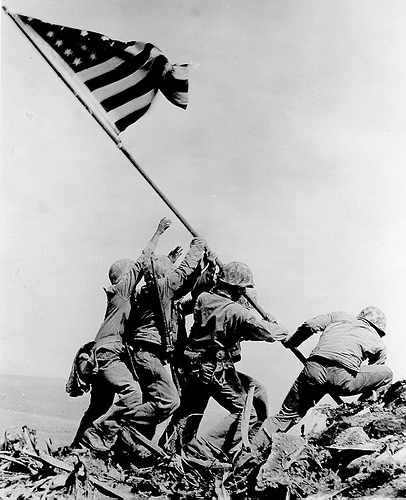
Iconic photograph by Joe Rosenthal of the raising of the American Flag on Mt. Suribachi, Feb. 23, 1945.
February 23, 1945 – U.S. Marines raised flag on Mt. Suribachi (Battle of Iwo Jima) (World War II)
February 23, 1969 – Post-Tet Offensive began (Vietnam War)
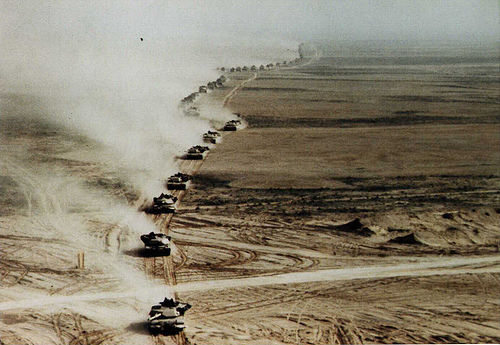
A U.S. convoy rolls through Kuwait during the ground campaign of Desert Storm, Feb. 1993.
February 24, 1991 – Operation Desert Storm ground campaign began.
February 25, 1848 – $15,000 appropriated to pay for a military monument in the state cemetery, “to commemorate the deeds of Kentucky’s gallant dead.”
February 25, 1871 – In making excavations at Monroe, Michigan, 30 human skulls and numerous bones were exhumed, the remains of Kentuckians massacred following the disastrous battle of the River Raisin.
February 26, 1991 – Battle of 73 Easting (Desert Storm)
February 27, 1991 – Battle of Medina Ridge (Desert Storm)
February 27, 1991 – Battle of Norfolk (Desert Storm)
February 28, 1847 – Gen. Alexander Doniphan (born, Maysville, Ky.) defeats the Mexicans at Sacramento, in Chihuahua (Mexican-American War)
February 28, 1867 – Dr. John M. Johnson, petitions the Kentucky Legislature an appropriation for the purpose of re-interring, in cemetery grounds at Atlanta, Georgia, the Kentucky Confederate dead who fell at Chickamauga, Missionary Ridge, Dalton, Atlanta, Decatur, Jonesboro, and in East and Middle Tennessee; about 300 identified and 200 unidentified.
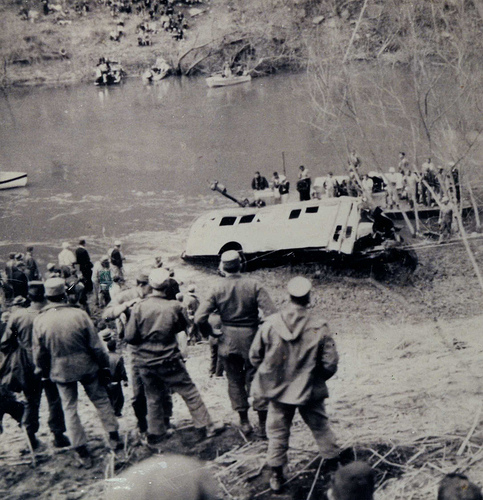
Kentucky National Guard troops assist in the recovery mission following the Prestonsburg school bus disaster, Feb. 28, 1958.
February 28, 1958 – Prestonsburg School Bus Disaster - What was then called the “worst traffic accident involving school children in the history of the United States” happened near Prestonsburg, Ky., when a school bus containing 48 children hit a wrecker and swerved into the flood swollen Levisa Ford of the Big Sandy River and disappeared. Twenty-two children escaped the bus before it sank and was swept away. The last body was not recovered until May 10th. The Kentucky National Guard assisted with the recovery operations.
The following is a compilation of significant dates in our commonwealth’s military history. For more on the legacy of our Citizen-Soldiers and Airmen, visit the Kentucky National Guard eMuseum.
January 1, 1953 – Units of the 123rd Fighter- Interception Wing, including Group Headquarters and the 165th Squadron were redesignated as fighter-bomber units.
January 1, 1962 - Navy SEAL teams established by President John F. Kennedy
January 1, 1968 – Assault on Fire Base Burt (Vietnam War)
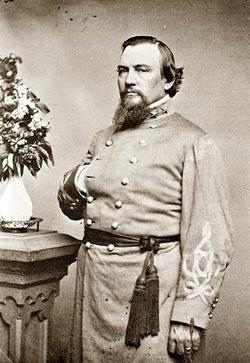
Confederate General Roger Weightman Hanson, Commander of the “Orphan Brigade” during the Civil War. Hanson is buried in Lexington, Ky.
January 4, 1863 - Confederate General Roger Weightman Hanson dies at Murfreesboro, Tennessee. His death was a result of wounds sustained two days earlier at the Battle of Stones River. Hanson was born in 1827 in Clark City, Tennessee. He served during the Mexican War and was a lawyer and a colonel in the Kentucky State Guard before the Civil War. He joined the Confederate army in September 1861 and received a commission as colonel in the 2nd Kentucky. He was assigned to Fort Donelson on the Cumberland River and when Union General Ulysses S. Grant captured the post on February 16, 1862, Hanson was sent to a Federal prison. He was exchanged after eight months and placed in command of the “Orphan Brigade.” The Orphan Brigade was a unit composed of 5,000 Kentucky residents who were cut off from their homes by the Union occupation of their state.
January 4, 1912 – William Birch Haldeman is appointed Adjutant General of Kentucky by Gov. James B. McCreary.
January 7, 1815 – 2,500 Kentucky militia, under Maj. Gen. John Thomas, less than one-fourth of them armed (as their arms were on flat-boats, not yet arrived), reach New Orleans. (War of 1812)
January 7, 1948 – Capt. Thomas Francis Mantell Jr., was killed while on a training flight with three other P-51Ds (Mustang). Mantell was directed by flight tower at Godman Field, Ft. Knox, to pursue an unidentified flying object. While in pursuit of the object, his aircraft crashed near Franklin, Simpson County, Ky. Capt. Mantell was the first flight casualty of the Kentucky Air National Guard.
January 8, 1815 – American victory at the Battle of New Orleans. (War of 1812)
January 8, 1967 – Operation Cedar Falls (Vietnam War)
Illustration of Columbus, Ky. and Union gunboats on the Mississippi River. Illustration from Frank Leslie Famous Leaders and Battle Scenes of the Civil War (New York, NY: Mrs. Frank Leslie, 1896)
January 11, 1862 – Gunboat action at Columbus, Kentucky. (Civil War)
January 12, 1945 – 1st Lt. George A. Vanarsdale, Headquarters Company, 192nd Light Tank Battalion (Harrodsburg Tankers) died when the Japanese “Hell Ship” Enoura Maru was sunk (World War II)
January 13, 1917 – Lt. Nathaniel Gibson Hale of Murray’s L Company, Third Kentucky Infantry died of an accidental gunshot wound. Hale was in his tent at the regimental camp, Camp Owen Bierne, some two miles from Fort Bliss, near El Paso, TX. He was part of the Kentucky National Guard contingent called to federal duty to patrol a sixty mile stretch of the border between Fort Bliss and Fort Hancock during the Mexican Punitive Expedition. Hale belonged to the Murray unit, joining as a Pvt. on June 22, 1912. He was promoted to Sgt. and 1st Sgt. and elected 1st Lt. on July 10, 1914.
January 17, 1991 – Operation Desert Storm began
January 18, 1813 – Battle of Frenchtown, Michigan Territory (Monroe, MI) (War of 1812)
January 19, 1862– Battle of Mill Springs, Pulaski County (Civil War)
January 20, 1968 – Battle of Khe Sanh began (Vietnam War)
January, 1847 – Maj. John P. Gaines and Capt. Cassius M. Clay, with 30 Kentucky cavalry, along with 50 Arkansas cavalry, are surrounded at Encarnacion by an overwhelming force of Mexican cavalry, and compelled to surrender, taken to the city of Mexico, and imprisoned (Mexican-American War)
January 21, 1839 – The “Louisville Legion,” of dragoons, artillery, infantry and riflemen, authorized as part of the Kentucky Militia.
January 22-23, 1813 – Battle of the River Raisin, disastrous defeat and massacre of Kentucky troops. “Remember the Raisin” would become the battle cry of Kentucky troops during the remainder of the war in the northwest (War of 1812)
January 22, 1944 – Allies land at Anzio, Italy (World War II)
January 23, 1937 – Sgt. Thomas J. “Tommy” Brown of Madisonville, drowned while on state active duty in response to the flood of 1937. He was assigned to Headquarters Company, 3rd Battalion, 149th Infantry from Madisonville. He is the only known Kentucky National Guardsman who perished on duty during the great flood of 1937. According to newspaper accounts, Brown and 2ndLt. James L. Moore, Pvt. C. W. Anthony and a civilian, Emmett Ashby, were in a boat that lost its stern from vibrations from an outboard motor and quickly sank by the stern throwing all four into the nine-foot deep water. The other three were able to swim to shallow waters but did suffer from exposure and shock. Brown was last seen clinging to the boat bow debris before he sank from sight. The Guardsmen were on a survey mission to assess conditions in Ashbyburg and Jewel City area and Ashby was catching a ride to Ashbyburg in hopes of getting another ride closer to his home. Brown was a butcher in civilian life and was married and had one child. Brown’s battalion commander, Oren Coin, wrote a letter to a legislative committee on the widow’s behalf in December of 1937 seeking some sort of relief for his family. Sgt. Brown’s death most likely was the beginning of the push for the state’s death gratuity for Kentucky National Guardsmen who die on State Active Duty missions.
January 24, 1955 – Col. Philip P. Ardery, senior commander of the Kentucky Air National Guard since its founding, was promoted to the rank of Brig. Gen., the first Kentucky Air Guard member to wear the star of a general officer.
January 25, 1944 – Gustavus Herbert May is appointed Adjutant General of Kentucky by Gov. Simeon Willis.
January 25, 1951 – Operation Thunderbolt began (Korean War)
January 26, 1968 – All units of the Kentucky Air National Guard except state Headquarters were called to federal service. Kentucky is only one of two states to have both Air and Army Guard units called up in 1968 (the other being Kansas). Kentucky was the only state to have both Air and Army mobilized units deploy overseas. The 165th Tactical Reconnaissance Squadron was assigned, along with two other Air National Guard recon squadrons to a rotation scheme which had each squadron assigned for 60-90 days to the Panama Canal, Alaska and Itazuke Air Base in Japan. During these missions their RF-101 Voodoo jets would photograph areas of interest looking for Soviet, or in the case of Japan, North Korean, naval activity. While the 165th was stationed in Japan in the spring of 1969 one of its pilots, Captain William Seiber, was almost killed when his plane exploded upon take off. The unit returned home and was released from active duty on June 9, 1969. (Pueblo Call-up/Vietnam War)
January 27, 1943 – Sgt. Elzie E. Anness, Headquarters Company, 192nd Light Tank Battalion (Harrodsburg Tankers) died at Camp Tanagawa, Osaka, Japan of dysentery (World War II)
January 28, 1957 – 1st Lt. Owen W. Turner, of Pleasure Ridge (Jefferson County) died when his burning plane crashed near Piedmont, Alabama, some sixty miles west of Atlanta. Turner was flying a T-28 from the Naval Air Station at Atlanta for a navigational proficiency flight to Standiford Field. Turner decided to return to Atlanta because of worsening weather conditions in his flight path. Turner joined the Kentucky Air National Guard in 1948 and was a member of the 165th Fighter Interceptor Squadron.
January 27, 1973 – Signing of Vietnam Peace Accord (Vietnam War)
January 29, 1828 – Preston S. Loughborough is appointed Adjutant General of Kentucky by Gov. Joseph Desha.
January 30, 1968 – Tet Offensive began (Vietnam War)
January 31, 1945 – 2nd Lt. Archibald B. “Arch” Rue, Company D, 192nd Light Tank Battalion (Harrodsburg Tankers) died at Camp Fukupka #3 Yawata, Kyushu, Japan of acute colitis (World War II)
January 31, 1956 – Col. Lee J. Merkel, veteran commander of the Kentucky Air National Guard’s base and vice commander of the 123rd Fighter-Interceptor Wing, was killed in an air crash of an F-51 Mustang 10 miles north of Bedford, In.
January 31, 1968 – Battle of Hue began (Vietnam War)
The following is a compilation of significant dates in our commonwealth’s military history. For more on the legacy of Kentucky’s men and women in uniform, visit the Kentucky National Guard eMuseum.
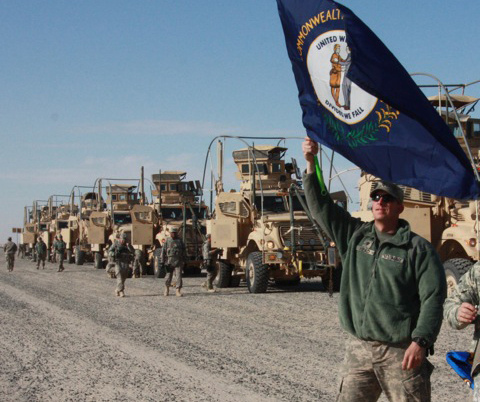
A Kentucky Guardsman waves the Kentucky flag at the border crossing into Kuwait, Dec.2, 2011, as part of one of the last Kentucky convoy out of the country. (Kentucky National Guard photo by Capt. Andrea Hahn)
December 1, 2009 – Pfc. Alva Lorenzy Holland, of Bellevue, Ky. (Campbell County) was on active duty status when he was killed in a motorcycle accident. Holland was en route to 149th Vertical Engineer Construction Company of Cynthiana when the accident occurred. Holland was a medical assistant at a chiropractic center in Cincinnati, Ohio. He was a 2004 graduate of Bellevue High School. Holland was a medic in the Kentucky National Guard’s 149th Vertical Engineer Construction Company. Holland volunteered for an active duty deployment in February, 2010 with the 2123rdTransportation Company.
December 2, 2011 - Last Soldiers of the 149th Maneuver Enhancement Brigade leave Iraq. They are among the final U.S. Forces to exit the country following the nearly nine-year war.
December 6, 1776 – Kentucky County established by Virginia, out of part of Fincastle County.
December 7 – National Pearl Harbor Remembrance Day, observed in remembrance of the December 7, 1941 attack.
December 7, 1971 – Richard L. Frymire is appointed Adjutant General of Kentucky by Gov. Wendell H. Ford. He would be re-appointed by Gov. Julian Carroll. Frymire, the former commander of the 165th Rac. Recon. Sq. became the first member of the Kentucky Air National Guard to serve as Adjutant General of Kentucky.
December 7, 1987 – Michael Walker Davidson is appointed Adjutant General of Kentucky by Gov. Wallace G. Wilkinson.
December 8, 1941 – The United States declared war on Japan (World War II)
December 8, 1941 – Initial Japanese attack on the Philippine Islands. Co. D, 192nd Tank Battalion (aka “The Harrodsburg Tankers”), come under attack. (World War II)
December 8, 1959 – Arthur Young Lloyd is appointed Adjutant General of Kentucky by Gov. Bert T. Combs and re-appointed by Gov. Edward T. Breathitt.
December 8, 1977 – Billy Gene Wellman is appointed Adjutant General of Kentucky by Gov. Julian M. Carroll. He would be re-appointed to the position by Govs. John Y. Brown, and Martha Layne Collins.
December 9, 1947 – Roscoe Lee Murray is appointed Adjutant General of Kentucky by Gov. Earle C. Clements and re-appointed by Gov. Lawrence W. Wetherby.
December 9, 1990 – 1st Battalion, 623rd Field Artillery federally activated for Operation Desert Shield/Storm.
December 9, 2003 – Donald C. Storm is appointed Adjutant General of Kentucky by Gov. Ernest Fletcher.
December 10, 1829 – Peter Dudley is appointed Adjutant General of Kentucky by Gov. Thomas Metcalf. Dudley would be re-appointed to the position by Governors John Breathitt, James T. Morehead, James Clark, Charles A. Wicklife, Robert P. Letcher, William Owsley, John J. Crittenden, and John L. Helm.
December 10, 1895 – Daniel Ray Collier receives his first appointment as Adjutant General of Kentucky from Gov. William O. Bradley. He received a second appointment on November 1, 1898, from Gov. William S. Taylor. Collier was re-appointed Adjutant General under Gov. William S. Taylor on December 13, 1899, following the contested governor’s election, and continued to hold office simultaneously with John B. Castleman from February 3, 1900 while the two candidates disputed the issues in the courts. Collier remained in office in the Old Capitol, serving under Taylor, until May 22, 1900, at which time he yielded the office to General Castleman in compliance with a U.S. Supreme Court order.
December 10, 1903 – William Purcell Dennis (Percy) Haly is appointed Adjutant General of Kentucky by Gov. J.C.W. Beckham.
December 10, 1939 – John Arthur Polin is appointed Adjutant General of Kentucky by Gov. Keen Johnson.
December 10, 1950 – Wonsan-Hungnam Campaign ended (Korean War)
December 10, 1991 – Robert Louis DeZarn is appointed Adjutant General of Kentucky by Gov. Brereton C. Jones.
December 11, 1923 – Jouett Henry Adjutant General of Kentucky by Gov. William J. Fields.
December 11, 1935 – George Lee McClain is appointed Adjutant General of Kentucky by Gov. Albert B. (Happy) Chandler.
December 11, 1941 – The United States declared war on Germany and Italy (World War II)
December 11, 1951 – Jesse Scott Lindsay is appointed Adjutant General of Kentucky by Gov. Lawrence W. Wetherby.
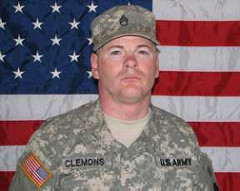
Staff Sgt. Thomas Clemons
December 11, 2006 – Staff Sgt. Thomas W. Clemons, Falls of Rough, (Grayson County) Ky., died as he was preparing to go on patrol with his team near Ad Diwaniyah, Iraq, when he succumbed to a heart attack. A member of the Kentucky Army Guard since August 2000, Clemons deployed in March 2006 to Iraq with Company B, 2nd Battalion, 123rdArmor.
December 11, 2007 – Our current Adjutant General, Maj. Gen. Edward W. Tonini is appointed to the role by Gov. Steve Beshear.
December 12, 1967 – Allan Kenneth Carrell is appointed Adjutant General of Kentucky by Gov. Louie B. Nunn.
December 12, 1985 – Gander, Newfoundland airplane crash. Upon leaving the Gander airfield, a military chartered Arrow Air DC-8 left from Gander headed for Fort Campbell, Kentucky, the plane crashed killing all 256 people aboard. Two hundred forty-eight members of the 101st Airborne Division and eight crewmembers died.
December 12, 1995 – John Russell Groves, Jr. is appointed Adjutant General of Kentucky by Gov. Paul E. Patton.
December 13, 1636 - General Court of the Massachusettes Bay Colony ordered the organization of the Colony’s militia companies into three regiments: The North, South and East Regiments. The colonists had adopted an English militia system in which all males, aged 16-60 were required to possess arms and participate in the defense of the community. The roots of the modern day National Guard.
December 13, 1907 – Philip Preston Johnston is appointed Adjutant General of Kentucky by Gov. Augustus E. Wilson.
December 13, 1955 – John Jacob Bethurum Williams is appointed Adjutant General of Kentucky by Gov. Albert B. Chandler.
December 13, 2003 - Deposed Iraqi leader Saddam Hussein captured near his home town of Tikrit, Iraq by U.S. Forces.
December 14, 1927 – William Henry Jones, Jr. is appointed Adjutant General of Kentucky by Gov. Flem D. Sampson and re-appointed to the position by Gov. Ruby Laffoon.
December 14, 1944 – Staff Sgt Joseph Baxter Million, and Pvt. Willard R. Yeast, both of Company D, 192nd Light Tank Battalion (aka “The Harrodsburg Tankers”) died when they were burned to death during the Palawan Island Massacre (World War II)
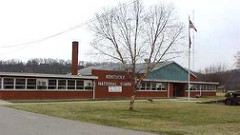
Caldwell Armory in Carrollton, Ky.
December 14, 2002 – Carrollton National Guard Armory named in honor of Robert “Goose” Caldwell.
December 16, 1944 – Battle of the Bulge began (World War II)
December 16, 1951 – 1st Lt. Lawrence Bertrand Kelly of Louisville (Jefferson County) died in Korea while serving on active duty flying an F-80 with the 80th Fighter Bomber Squadron, 8th FTR Bomb Group. He was declared missing on this date and his status was changed from MIA to KIA on December 31, 1953. Prior to his active service he was a member of the Kentucky Air National Guard (Korean War).
December 17, 1861 – Battle of Rowletts Station (Hart County) (Civil War)
December 17, 1989 – Operation Just Cause (Panama).
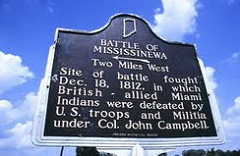
December 17-18, 1812– Battle of Mississinewa (near Marion, In.) (War of 1812)
December 18, 1972 – Operation Linebacker II (Christmas Bombing) (Vietnam War)
December 20, 1919 – James Madison DeWeese receives his first appointment as Adjutant General of Kentucky, his second appointment is June 16, 1920, by appointments made by Gov. Edwin P. Morrow.
December 22, 1921 – Newport Rolling Mills Strike Duty – The Kentucky National Guard under command of Col. Henry H. Denhardt, who later became Adjutant General, ordered by Gov. Edwin P. Morrow to quiet rioting and wide-spread violence. The first troops arrived on the morning of December 24th to sound of gunfire. The strike continued into 1922.
December 22, 1921– Cpl. Edward Vivion Trisler, of Company D, 192nd Light Tank Battalion died on 23 December 1942 at Camp Cabanatuan, Nueva Ecija, Philippines of dysentery.
December 23, 1941 – The main parade grounds at Fort Knox named Brooks Field in honor of Private Robert H. Brooks of Sadieville, first Armored Force casualty of World War II, killed in the Philippines while serving with Co. D, 192nd Tank Battalion (World War II)
December 24, 1921 – Pvt. Robert Deaton, a member of Company G, 149th Infantry, Barbourville, Ky., was accidentally killed at the corner of Powell and Brighton streets in Covington, while on state active duty during steel strikes at Newport. While he and Sgt. Charles Black were on duty, Sgt. Black became suddenly ill and about to fall, in recovering his balance his right arm knocked Deaton’s revolver from his holster. The revolver fell to the street discharging the cartridge. The bullet struck the right side of Deaton’s neck. He was rushed to the hospital but bled to death on the way. Col. H. H. Denhardt, commanding the troops made an investigation and pronounced the death accidental. Denhardt would later serve as Adjutant General.
December 24, 1964 – USAF began strikes on Laos (Vietnam War)
December 25, 1846 – Gen. Alexander W. Doniphan (formerly of Mason County, Ky.) defeats the Mexicans at Bracito (Mexican-American War)
December 27, 1860 – Major Robert Anderson (of Kentucky), U.S. Army, in command in Charleston harbor, burns the inside of Fort Moultrie, spikes the guns, and retires, with his band of 80 men, to Fort Sumter.
December 29, 1776 – McClellan’s fort (Georgetown) attacked by Indians (Early Indian Wars)
December 31, 1946 – President Harry S. Truman officially proclaims the end of hostilities in World War II.