Pages
Stay In Touch
More
© 2013 KentuckyGuard
By Peter Smith • [email protected] • February 26, 2010
Airmen return to the Kentucky Air National Guard from the Dominican Republic as part of the Haitian earthquake relief effort. The airmen operated a new air base. (By Sam Upshaw Jr., The Courier-Journal) Feb. 26, 2010
Four-year-old Jennifer Graves clutched tightly around her father’s neck as she greeted him after his five-week deployment in the Dominican Republic, where he was helping to bring in earthquake relief for Haiti.
“Daddy, you can come home today,” she told Staff Sgt. Raymond Graves, still in his combat fatigues after arriving home with 16 colleagues around noon Friday at the Kentucky Air National Guard Base in Louisville.
The airmen, from the 123rd Contingency Readiness Group, converted a rarely used civilian airfield in the Dominican Republic into a base for overseas relief flights to alleviate the burden on the heavily usedPort-au-Prince airport.
“Even though I was away from my family, I knew we were helping families that were in more need than we were,” said Sgt. Graves, of Pekin, Ind.
About 45 airmen in total worked at the base, with the rest due home Monday.
The airmen are part of a unit that specializes in bringing an “airbase in a box,” said Col. Greg Nelson, commander of the group’s parent 123rd Airlift Wing.
“This is the first operational mission they’ve been on, and they didn’t miss a beat,” Nelson said. The group was formed in 2008 and has about 110 members in total.
Soon after their Jan. 22 arrival at the Maria Montez International Airport in Barahona, Dominican Republic, they had set up air-traffic control operations and equipment for unloading aircraft. Within two hours, they were bringing in flights.
They unloaded more than 640 tons of food, water, blood plasma and other supplies from more than 60 aircraft. The supplies were then shipped by truck to Haiti.
The need for the airbase ended after Haiti’s shipping ports were repaired to the point where they could handle relief cargo, according to Guard officials.
The airmen, accustomed to working in 90 degree temperatures in Haiti, arrived on a C-130 aircraft after a one-day layover in Florida to temperatures in the 30s on the windswept airbase in Louisville.
“I see a lot of sun tans here,” Maj. Gen. Edward W. Tonini, adjutant general for Kentucky, quipped as the troops gathered in a warm indoor meeting area for pizza and chips. “What’s the deal here?”
But he quickly turned serious, saying he was in Washington earlier this week and that the Guard got “nothing but pats on the shoulder” for their work. The fact that they set up “as quickly as you did and as aggressively as you did was noticed at the highest levels in Washington,” he said.
Master Sgt. James Nalley of Bullitt County, said the group took pride in quickly unloading planes and getting the materials en route to Haiti. He said he wished the group could have helped in the quake-stricken land itself, but “it felt real good” to be able to do what they could.
The Jan. 12 earthquake killed an estimated 230,000 Haitians, injured about as many and left a million homeless, according to The Associated Press.
Col. Warren Hurst, commander of the 123rd Contingency Readiness Group, said that roughly half the airmen had seen duty in Iraq and Afghanistan, while others may be deployed there.
“This is a more rewarding mission, because it’s disaster relief,” he said.
He noted that the group is also designed to work in domestic disasters or terrorist attacks within a 400-mile radius of Louisville.
The Kentucky Guard, Tonini said, is unique in having a wide range of emergency units, including search-and-rescue and medical response teams.
Several family members were on hand to greet the returning airmen.
“I’m so excited — I can’t stand it,” said Heather Keith of Frankfort, Ky., as she waited with her two young sons for the flight bringing home her husband, Staff Sgt. Kenneth Keith.
“I’m elated,” said Tracey Graves, Raymond’s wife, as she stood with Jennifer and held their 4-month-old baby, Stephanie. “They’re home safe.”
Reporter Peter Smith can be reached at (502) 582-4469.
Staff Sgt. Raymond Graves, right, kisses his daughter Jennifer, 4, at the Kentucky Air National Guard following his return from the Dominican Republic as part of the Haitian earthquake relief effort. The airmen operated a new air base. (By Sam Upshaw Jr., The Courier-Journal) Feb. 26, 2010
Staff Sgt. Kenneth Keith carries his two sons Landon, 3, left, and Austin, 5, as his wife Heather Keith, right, smiles at them following his return from the Dominican Republic as part of the Haitian earthquake relief effort. The airmen operated a new air base. (By Sam Upshaw Jr., The Courier-Journal) Feb. 26, 2010
Parwan Provincial Governor, Abdul Basir Salangi, Kentucky Agribusiness Development Team leader, U.S. Army Lt. Col. Ruth A. Graves, of Franklin, Ky., U.S. Army Lt. Col. Marion Peterson, of Lexington, Ky., and the head of Parwan Director of Agriculture, Irrigation and Livestock, Shri Amri, cut the ribbon on a new diesel powered generator that will supply power for a well and provide irrigation to local farmers in Parwan province, Afghanistan, Feb. 24. (U.S. Army photo by Staff Sgt. Donald L. Reeves, 300th Mobile Public Affairs Detachment)
PARWAN PROVINCE, Afghanistan (Feb. 24, 2010) – A ribbon-cutting ceremony marked the opening of a new green house and well at the office of the the Director of Agriculture, Irrigation and Livestock in Parwan province, Afghanistan, Feb. 24.
Parwan Governor, Abdul Basir Salangi, attended the ceremony alongside members of the Kentucky Agribusiness Development Team.
The greenhouse and well are just two additions in a series of projects aimed at moving local Afghan farmers out of mere sustenance farming through teaching modern techniques and providing resources.
The DAIL office in Parwan valley serves as a training ground for local agriculture officials. They act in similar capacity as county extension agents in rural areas of the United States. They take the lessons learned, such as those that will be taught at the new greenhouse, back to their communities and teach locals how to implement the new techniques.
According to the ADT Team Leader, U.S. Army Lt. Col. Ruth A. Graves, “A lot of the problem is infrastructure and technology.”
Graves knows a bit about farming herself, as she raises cattle back in Franklin, Ky.
She described her first reaction to Afghan farming techniques, “It feels like you step backwards a hundred years in time. Most of the farmers still plow with oxen.”
“The greenhouses will extend the growing season,” and allow farmers to produce products well beyond the traditional seasons, said Graves. “It’s just like any farm. The weather and other factors play a big part in how much is produced from year to year.”
Graves helped to cut the ribbon on the diesel powered well that pumps water into a holding tanking and spoke about how this would improve the quality of life in an area where 80 percent of the local population is involved in some kind of farming, but only 12 percent of the land is arable.
“Anytime you use different techniques to control flooding and irrigation, it is an improvement. You get better water quality, instead of floods that leave behind stagnant water,” she said.
This is not the first irrigation project for the ADT. The team that is comprised mostly of National Guardsmen and attached to Task Force Cyclone were a huge part of the Salang River Aqueduct Erosion Control Project, which according to U.S. Army Lt. Col. Marion Peterson of Lexington, Ky., “Prevented a major aqueduct from collapsing.”
Peterson, who also serves with the Kentucky ADT, said that in addition to the well and greenhouse, the ADT will conduct veterinarian clinics at the DAIL office along with a future poultry project that will provide incubators and training to local farmers so they can raise chickens.
Graves and Peterson described a reforestation project in the works along with other projects such as solar power veterinarian offices, tractors for farmers and teaching farmers to raise honey bees.
Speaking at the ribbon cutting ceremony, Graves said that the greenhouse would have a lasting impact on local Afghans.
“Not only do they get the benefit of the produce,” Graves said, “but they get the benefit of the education that comes along with it.”
After cutting the colorful ribbon on the well with Graves and head of the Parwan, DAIL Shri Amri, Gov. Salangi told the crowd of people, “Because Parwan is the backbone for security it is very important that we provide jobs and opportunities here. We are very grateful for all the support. We hope to work together for the future of the people of Afghanistan.”
[youtube=http://www.youtube.com/watch?v=VtgUPvGSm8M]
If you cannot view this YouTube video, please click here.
OWENSBORO, Ky. (Feb. 26, 2010) — Governor Steve Beshear today joined Maj. Gen. Edward W. Tonini, Adjutant General for Kentucky, and local officials in a ceremonial groundbreaking for the new Kentucky Army National Guard Readiness Center in the city of Owensboro, Ky.
“This is a great day for the Commonwealth of Kentucky and the Kentucky National Guard,” said Gov. Beshear. “In a time when money is tight and other states are losing armories, we are fortunate to have a brand new readiness center that will serve as a home for our great citizen-soldiers and also be a valuable resource for the people of Owensboro and Daviess County. This project speaks highly of our National Guard and the men and women who so proudly serve our nation and state.”
Construction for the $14 million facility will begin later this spring. Located on 20 acres of land adjacent to the Owensboro-Daviess County Regional Airport, the project is expected to take between 12-18 months to complete.
“This new readiness center represents so many things to so many people,” said Maj. Gen. Tonini. “In addition to its main function as a headquarters for our hometown defense force, it will serve as base of operations in times of natural disaster and other emergencies. Last year’s ice storm showed the importance of mission readiness and this new structure puts us ahead of the game in preparing for the future.”
Following the groundbreaking ceremony, Owensboro Mayor Ron Payne presented Gov. Beshear and Adjutant General Tonini with a $1 million check for the old National Guard armory located at 1501 West Parrish Ave. That land will be used as part of the ongoing downtown development project.
The $10.3 million federal portion of funding for military construction is contained in the $446.8 billion dollar Omnibus Bill signed by President Barack Obama in December. The Owensboro facility funding is part of a non-geographic specific $30 million provided the National Guard Bureau, targeted at sites where projects are “shovel-ready.” The Kentucky Department of Military Affairs, through the Governor’s office, funded the design phase of this project earlier in 2009 in order for Kentucky to be best positioned to receive the funding.
The new Kentucky National Guard Readiness Center is the result of a 99-year land lease agreement signed Aug. 12, 2008 between the Kentucky Department of Military Affairs and the Owensboro-Daviess County Regional Airport.
Primarily designed to provide the Kentucky Army National Guard a regional base of operations, the $14 million facility consists of 57,644 square feet of administrative offices, storage facilities, classrooms and drill hall.
Twenty-five percent — or approximately $3.5 million — of the total cost is state-funded through the Department of Military Affairs.
Approximately 17 full-time and 163 part-time personnel will be employed at the new readiness center. The facility will be home to two Kentucky Army National Guard units, Headquarters Support Company and Forward Support Company, both with the 206 Engineer Battalion.
For more information on the Kentucky National Guard, please visit www.dma.ky.gov.
Related Links
Additional Photos
A member of the news media shoots video as the 123rd Airlift Wing prepares to load equipment and relief supplies onto a C-130 aircraft at the Kentucky Air National Guard Base on Jan. 22, 2010, for a flight to the Dominican Republic as part of earthquake relief efforts in Haiti. (U.S. Air Force photo by Maj. Dale Greer/Released)
CONTACT: Lt. Col. Kirk Hilbrecht, 502-352-8008
WHO: Kentucky Air National Guard’s 123rd Contingency Response Group
WHAT: Return from Haitian earthquake relief mission
WHERE: Kentucky Air National Guard Base, Grade Lane, Louisville, Ky.
WHEN: 11:15 a.m. February 26, 2010
LOUISVILLE, Ky. (Feb. 25, 2010) — The Kentucky Air National Guard’s 123rd Contingency Response Group is returning home following five weeks in the Dominican Republic supporting humanitarian relief operations in Haiti.
Media are invited to attend the initial return of aircraft scheduled for 11:15 a.m. Friday, February 26. NOTE: The actual arrival time is subject to change.
Media planning to attend should call Lt. Col. Kirk Hilbrecht, 502-352-8008.
Please arrive early to allow for processing through security and to set up your equipment. A photo ID is required to gain access to the airbase.
WASHINGTON, D.C. (Feb. 25, 2010) – With increasing government and private support, a National Guard program that helps high school dropouts transform their lives is closing in on its 100,000th graduate.
“The National Guard is proud of the success of the National Guard Youth ChalleNGe Program,” said Air Force Gen. Craig McKinley, the chief of the National Guard Bureau. “It is essential that we reduce the number of high school dropouts, and Youth ChalleNGe is part of the solution.”
McKinley was hosted by retired Air Force Lt. Gen. John B. Conaway, chairman of the National Guard Youth Foundation, along with several other corporate and military leaders, politicians and celebrities at the 2010 Challenge Champions Gala held Tuesday evening, Feb. 23.
“Gen. McKinley and the National Guard are not only fighting our nation’s wars overseas and helping here inside the United States … but they have another mission – helping to save America’s youth, so they can be productive citizens,” Conaway said.
Highlights for the nation’s second-largest mentoring program in the last year include a jump in the percentage of federal dollars contributed to each state from 60 percent to 75 percent; an Office of Management and Budget-directed $20 million boost in Defense Department money for the program for the 2011 fiscal year; and increasing private support despite a challenging economy.
“I’m not doing it for nobody else,” said Jameka Micchell, a 17-year-old ChalleNGe cadet from Georgia, who was selected to attend the gala. She is currently in the 17-month voluntary intervention program and has her heart set on joining the 92,850 young people who have graduated since 1993.
“I’m doing this for myself,” Micchell said, “because I realize that I need to change.”
About 1.3 million students drop out of high school each year, costing the nation more than $335 billion in lost wages, revenues and productivity over their lifetimes, said Youth ChalleNGe officials.
“This is a national epidemic, and it is a national shame,” said Louisiana Sen. Mary Landrieu. “We must do something about it, and this program does.”
High school dropouts are more likely to live in poverty, receive public assistance, go to prison and face health problems and divorce. Life expectancy is nine years shorter than a high school graduate. Of the $50 billion the federal government spends on incarceration, $45 billion is spent on individuals who did not get a high school diploma.
“Not only does this dropout rate cost our economy billions of dollars each year, but it means that fewer and fewer Americans are able to succeed in this economy,” Landrieu said. “It is our responsibility to provide opportunities – not guarantees, but opportunities.”
The National Guard has been doing that since 1993, when the congressionally mandated program was founded.
Twenty seven states and Puerto Rico currently have the program; another five states and the Virgin Islands have requested to add the program, which targets 16- to 18-year-old high school dropouts.
At the gala, J. Randolph Babbitt, the administrator of the Federal Aviation Administration gave out the first two pilots’ licenses he has personally presented since he took office – to two graduates of the Youth ChalleNGe Program.
Rick Hendrick, owner of Hendrick Motor Sports – home of NASCAR driver Dale Earnhardt Jr. – announced 10 mechanic internships for cadets.
And WWE superstar MVP told how he got caught up in street gangs and served a nearly 10-year prison sentence before turning his life around.
“Crime pays, but you have to pay it all back with interest,” MVP said. “It is through dedication, hard work and sacrifice you can achieve your dreams – not through crime.”
“The cadets are just very, very inspirational,” said Indy 500 champion Dan Wheldon of Panther Racing. “It really drives us on to be able to represent the National Guard and the Youth ChalleNGe Program.”
Earnhardt said he sees the cadets as the true stars. “Their paths in life are inspirational to all of us,” he said. “I don’t give them advice: I listen.”
WASHINGTON, D.C. (Feb. 23, 2010) - The U.S. Departments of Defense, Labor and Veterans Affairs are pleased to introduce the re-designed and enhanced National Resource Directory Web site, www.NationalResourceDirectory.gov.
Created for Wounded Warriors, Veterans and their families and caregivers, the new National Resource Directory has proved to be a useful tool for service providers who support the military and Veterans communities.
The National Resource Directory provides access to over 10,000 services and resources at the national, state and local levels to support recovery, rehabilitation and community reintegration. We are proud to assure our users they can trust the content as resources are reviewed regularly by a content management team that includes several Veterans and subject matter experts.
A few features of the new Web site include a faster, more robust search engine; a Bookmark & Share capability for use with social media tools; and an “In the News” feature that provides links to news and updates about Wounded Warrior and Veterans issues. Also included on the site is an expanded Homeless Assistance section where users can find information on a variety of programs and benefits.
Col. Wayne L. Burd passes the colors of the 75th Troop Command to Command Sgt. Maj. Michael Wilson after having officially taken command of the 75th, Feb. 21. (U.S. Army photo by Sgt. Michelle Johns, 75th Troop Command)
RICHMOND, Ky. (Feb. 22, 2010) — Soldiers gathered from around the Commonwealth to honor the service of Col. J. Hunter Matthews, Jr. and to welcome Col. Wayne L. Burd as the new commander of the Kentucky National Guard’s 75th Troop Command.
The units of the 75th Troop Command — 103rd Chemical Battalion, 751st Troop Command, the Medical Command, 201st Engineer Battalion, and the 206th Engineer Battalion — stood in formation as Matthews transferred command to Burd by the ceremonial passing of the 75th’s colors. Following the changing of command, Matthews was awarded the Meritorious Service Medal for his outstanding service while in command of the 75th.
Burd enters his new command having most recently served as the Operations Officer (J3) for the Kentucky National Guard. Burd was welcomed into his new posting by Brig. Gen. John W. Heltzel, Deputy Commander, JFHQ.
Matthews will begin preparation for his next command, the second Kentucky Agribusiness Development Team, which will mobilize for deployment to Afghanistan in May.
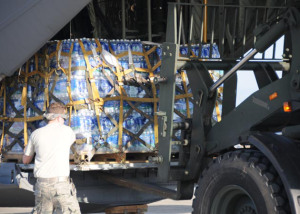
Airmen of the 123rd Contingency Response Group offload humanitarian supplies from a Rhode Island Air National Guard C-130 Hercules transport aircraft at the Barahona airfield in the Dominican Republic. (U.S. Air Force photo by Tech. Sgt. Dennis Flora, 123rd Airlift Wing Public Affairs; Released by Lt. Col. Kirk Hilbrecht)
ARLINGTON, Va. (Feb. 19, 2010) – The number of Air National Guard members supporting Operation Unified Response dropped to a little over 200 this week as Haitian authorities and nongovernmental organizations begin to accept a greater share of relief efforts in the ravaged country, Guard officials said Feb. 18.
At the peak, about 500 Airmen from at least 15 states were involved in the earthquake-relief efforts.
“As we look at our military requirements in supporting (the U.S. Agency for International Development) and the government of Haiti, we’re dialing it back where unnecessary as we right-size the force as requirements are needed on the ground, and we’re dialing it up where it’s necessary based upon needs on the ground,” said Army Lt. Gen. P.K. “Ken” Keen, the top U.S. commander in Haiti, via video teleconference from Port-au-Prince Feb. 17.
Airlifters, air traffic control personnel and civil engineers from the Air Guard were the most requested specialties, Guard officials said.
Almost 20 Idaho Air Guard members from the 124th Civil Engineering Squadron were deployed to the devastated nation after the magnitude 7.0 quake hit Jan. 12.
“Our Citizen-Airmen supported fellow military members in Haiti by setting up tents and providing power, sanitation, water and refrigeration for food storage,” said Lt. Col. Tim Marsano, the Idaho Guard spokesman.
Airmen from New Mexico, Texas, Florida, New York, Arkansas and Washington State were involved in reconnaissance and intelligence missions; and Kentucky combat controllers and Airmen from Florida, New Hampshire, Mississippi and South Carolina supported air traffic control and airfield operations.
Airlift of personnel and supplies as well as logistics and communications were also conducted by units from Florida, Illinois, Kentucky, New York, Ohio, Puerto Rico, Pennsylvania, West Virginia, Rhode Island and Mississippi.
Airmen from the 156th Airlift Wing of the Puerto Rico Air National Guard flew more than two dozen sorties since the immediate response efforts started carrying supplies and personnel into the country and injured Haitians to medical facilities outside the country.
The communications missions included the use of the Texas Air Guard’s RC-26 manned Intelligence, Surveillance and Reconnaissance aircraft as well as intelligence Airmen, who analyzed collected data of the disaster areas.
The 123rd Intelligence Squadron from the Arkansas Air Guard deployed seven Airmen to provide imagery analysis assets to the joint task force.
West Virginia’s 167th Airlift Wing reported that 385,000 pounds of supplies were delivered to Haiti from a staging-area they established in Martinsburg, W.V. They loaded a C-17 Globemaster III from the Mississippi Air Guard with supplies as well as civilian Boeing 747, Boeing 767 and DC-8 aircraft.
The state’s other Air Guard unit, the 130th Airlift Wing in Charleston, W.V., still has one C-130 flying airlift support from Pope Air Force Base, N.C., to Haiti.
The 40 members of the 123rd Contingency Readiness Group of the Kentucky Air Guard is the largest entity still deployed in support of the operation. They established an airbase in the Dominican Republic to manage air traffic. Three C-130 Hercules transport aircraft from the unit continue to fly logistical support missions into Haiti as needed.
A Pennsylvania Guard “Commando Solo” C-130J with a crew of 14 continues to broadcast information through its radio and television systems to the Haitian people. The unit also airlifted humanitarian aid on the unit’s other C-130s from Homestead Air Force Reserve Base, Fla., to Haiti at the beginning of the relief effort.
The U.S. military continues to work under USAID, the lead American component, and alongside partners, such as the United Nations.
Maj. Gen. Edward W. Tonini, Adjutant General for the Kentucky National Guard, greets officers from Egypt, Jordan, Pakistan, Portugal, and Slovenia who are visiting the state's National Guard headquarters in Frankfort as part of a training program at Ft. Knox, Feb. 18. (U.S. Army photo by Staff Sgt. Aaron Hiler, 133rd Mobile Public Affairs Detachment)
FRANKFORT, Ky. (Feb. 18, 2010) - Five officers from around the world visited the headquarters of the Kentucky National Guard to learn more about the National Guard’s role in the American military, Feb. 18.
Officers from Egypt, Jordan, Pakistan, Portugal, and Slovenia, who are attending the U.S. Army Armor Captain’s Career Course at nearby Ft. Knox, took time to learn about the National Guard’s unique place in the American armed forces. After receiving a briefing on the National Guard from Air Force Maj. Matthew Groves, the officers were greeted by the Adjutant General, Maj. Gen. Edward W. Tonini.
“We are always glad to see our fellow military officers from other nations,” said Tonini. “Soldiers around the world share a similar experience, regardless of their nationality or the uniform they wear. Because of the increasing role the Kentucky National Guard plays in the international scene, it is important that we share ideas and build relationships.”
By Valerie Tandoi
Ft. Dix Public Affairs Office
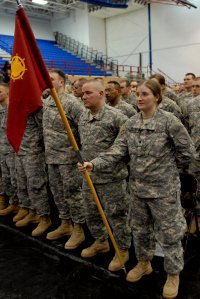
Spc. Samantha Hammer holds the guidon for the 2123rd Transportation Company during the unit's farewell ceremony Feb. 3, held at the Madison County High School in Richmond, Ky. (U.S. Army Photo by Staff Sgt. Gina Vaile-Nelson, 133rd Mobile Public Affairs Detachment)
FORT DIX, N.J. (Feb. 5, 2010) - Wintery weather awaited Kentucky Army National Guard’s 2123rd Transportation Company as it arrived at Army Support Activity-Dix, Feb. 5, to train for an Operation Enduring Freedom deployment in Afghanistan.
The Soldiers of the organization, from Richmond, Ky., lined up at ASA-Dix’s Central Issue Facility to receive their Improved Outer Tactical Vests it will need to help perform its mission. OTVs are protective vests padded with Kevlar KM2 fiber which are issued to increase a Soldiers’ chance of survivability on the battlefield. The outer vest system comes in 11 different sizes to ensure Soldiers of all body types can be as comfortable as possible.
The 2123rd was being supervised by Sgt. 1st Class Scott Smithler, from Evansville, Ind., for the event that includes receiving equipment to survive in a hazardous duty area. The tight knit brigade remained focused on its upcoming operation and weren’t going to let a little cold and wet weather stand in their way.
“The snow slowed us down a little bit, but we’re back on track again. We are optimistic that we should be able to keep up with our training schedule,” said Smithler. The transportation company has already spent a month previously training for this mission at Wendell H. Ford Regional Training center in Greenville, Ky.
The squad will continue to train at ASA-Dix before heading off to Afghanistan where they will begin their task of shipping and transporting vital supplies. The remaining training that the command will face before deploying overseas will include Blue Force Tracking qualification, Mine Resistant Ambush Protected vehicle training and familiarizing themselves with life support operations of an overseas Contingency Operating Base by using the ASA-Dix Contingency Operations Location.
Blue Force Tracking allows troops to pinpoint the location of both friendly forces and enemies while on a mission and track the most up-to-date information on the battlefield. MRAP training familiarizes soldiers with large scale armored fighting vehicles used to defend against Improvised Explosive Devices. The troops are given the opportunity to drive the vehicles, become acquainted with how the vehicles operate and experience simulation of what happens when the vehicles flip over.
The company consists of a mix of first time deploying Soldiers and others that have served multiple tours. “This will be my third deployment. I have already gone to Iraq twice,” Smithler said. Having troops that have deployed in the past on board helps to encourage and support those men and women who are getting ready to venture into a hostile location for the first time.
The mission to Afghanistan will be led by company commander Capt. John F. Moore from Elizabethtown, Ky.