
Pages
Stay In Touch
More
© 2013 KentuckyGuard
Story and photos by David Altom, Kentucky National Guard Public Affairs
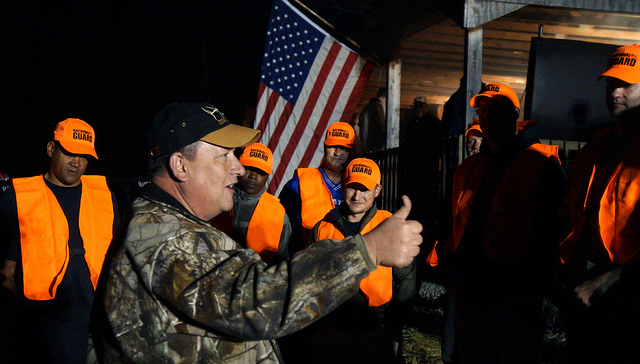
Kerry McDaniel gives the troops a thumbs up as they prepare for a weekend of fellowship and fun during last fall’s Hart County Wounded Warrior Hunt. The event was sponsored by the Horse Cave Volunteer Fire Department, the Hart County Rescue Squad and Western Kentucky University. (Photo by David Altom, Kentucky National Guard Public Affairs)
HORSE CAVE, Ky. – Question: What do you get when you take a bunch of volunteer first responders, some university students and professors and add in a hand full of injured war veterans?
Answer: An opportunity for charity, fellowship and a whole lot of fun!
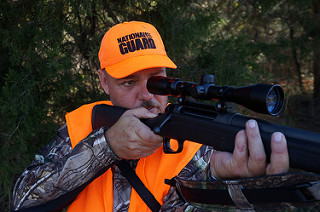
William Winburn takes aim during the 2012 Hart County Wounded Warrior deer hunt. Winburn was with 1st Battalion 623rd Field Artillery in Iraq when he was wounded seven years ago. “I only get to hunt once in a while,” he said. “This means the world to me since I don’t get to wear the uniform or be with the guys anymore.”
Last November members of the Horse Cave Volunteer Fire Department, the Hart County rescue squad and the Western Kentucky University biology department gathered together with sixteen of Kentucky’s Wounded Warriors for their third annual deer hunt. The event took place on the 800-acre WKU Green River Biological Preserve over a three day period.
Kentucky National Guard Sgt. 1st Class Chuck Reed has been organizing hunting and fishing trips for Wounded Warrior for years.
“This is good stuff for these guys,” said Reed. “Some of them used to hunt and just haven’t had the chance to get out since they were hurt. And for some it’s their first time hunting, and they have a blast doing something that’s different and fun. It just doesn’t get better than this!”
The hunt wasn’t just about the troops said Reed. Biology students from WKU took this as an opportunity to practice their skills in “the real world,” classifying the harvested animals, field dressing them, conducting examinations and collecting samples.
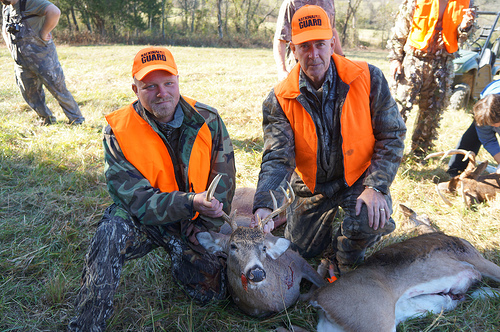
Jeremy Austin and his spotter, Maj. Gen. Lonnie Culver, show off the eight point buck taken during the 2012 Hart County Wounded Warrior Hunt. A veteran of Operation Iraqi Freedom, Austin says one of the great things about the Wounded Warrior hunts is enjoying the camaraderie with the troops. (Photo by David Altom, Kentucky National Guard Public Affairs)
“This is a community event,” said Kerry McDaniel, Hart County Emergency Services director. McDaniel coordinated the logistics with the local community. “It’s got a lot of support and volunteers. The goal is to put a smile on the soldier’s faces. Overall we do a pretty good job.”
For McDaniel the hunt is personal on many levels. His father, Alroy, was a Korean War veteran who took part in the previous hunts until his passing last year. In a unique turn of events, McDaniel’s son, Curtis, was injured in Afghanistan and this was his first time hunting at the event.
“Dad’s not here this year,” said McDaniel, “but I look around and I see him everywhere.”
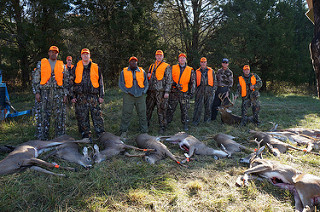
Participants of the Hart County Wounded Warrior Hunt stand over their first morning’s harvest. In addition to giving the troops the opportunity to take part in an American tradition, the hunt aided in the culling of the deer population on the Western Kentucky University’s game farm and provided biology students the opportunity to study wildlife anatomy and take parasitic specimens in the field. (Photo by David Altom, Kentucky National Guard Public Affairs)
Along with the hunt are cookouts, awards ceremonies and camaraderie. State and local officials joined the volunteers in honoring the veterans, and hugs and smiles were a common sight.
One surprising note: a custom deer blind to accommodate some of the handicapped veterans was built by the local Amish community.
“The Amish are very supportive of our military,” said McDaniel.
Injured while on duty in Iraq in 2005, Jeremy Austin misses being with the troops. He says events like the Hart County hunt keep that connection alive.
“I really enjoy being with the guys,” he said. “These kinds of things help a lot.”
Philip Hain was wounded in Afghanistan in 2011. His enthusiasm for being part of the weekend’s hunt is matched only by his gratitude.
“It’s a pleasure to be here with a bunch of like-minded people who enjoy hunting and being outdoors,” he said. “I could never do this on my own. I haven’t been hunting since I was a kid, and the things that these folks have done, to put all this together for us to come out and do all of this, it’s way beyond what I could imagine. It’s a once in a lifetime experience for me.”
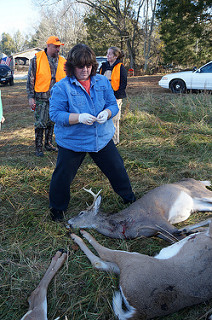
Western Kentucky University biology professor Cheryl Davis collected deer ticks for the study of Lyme disease. “Outreach programs like this wounded warrior hunt go beyond our students’ education and allows them to impact other people,” she says. (Photo by David Altom, Kentucky National Guard Public Affairs)
The partnership between the community and Western Kentucky University is mutually beneficial. Kentucky’s deer population is at record height and the hunt aids in the culling of the herd for the WKU game farm.
As the first morning’s harvest was brought in, WKU students were in the mix, assisting the Wounded Warriors in unloaded their trophies, field dressing the animals and taking samples for study back at school.
Cheryl Davis, WKU biology professor – parasitology, to be specific – was particularly excited by all that was going on. She and her students were collecting deer ticks for the study of Lyme disease.
“The students in our program are bright and have passion for what they’re doing,” said Davis. “But then if they can take that and apply it to service to others in terms of social responsibility in conservation and outreach programs like this wounded warrior hunt, that just doubles the impact because it goes beyond their education and allows them to impact other people. That’s something we’ve been working on for some time now at WKU.”
All of this is music to Reed’s ears.
“We’re working on having these hunts all across the state,” he said. “There are plenty of folks who want to help our troops. The more that get involved, the better for our Wounded Warriors.”
For more information on how you can help Kentucky’s Wounded Warriors email [email protected] or comment on our Facebook page.
Story by Maureen Rose, The Gold Standard
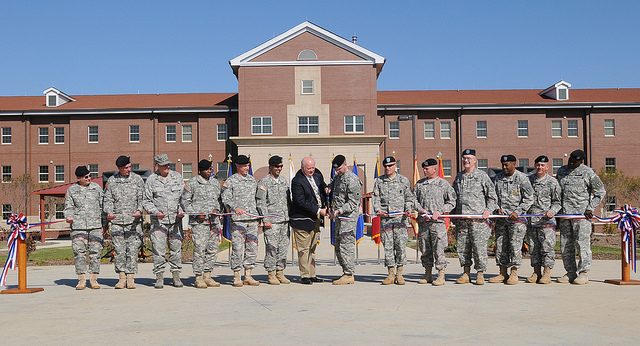
Family members of Master Sgt. Morgan French, along with members of the Kentucky National Guard Command Staff and Fort Knox Garrison staff cut the ribbon to open the new barracks for the Warrior Transition Unit at Fort Knox, Ky., Oct. 12, 2012. The building was named in French’s honor for his ties to Kentucky, Fort Knox and his service in U.S. Army Armor. (Kentucky National Guard photo by Sgt. Scott Raymond)
FORT KNOX, Ky. — “The namesake embodies the meaning of Soldier.”
The namesake being referred to was Master Sgt. Morgan French, for whom the Warrior Transition Battalion dedicated its barracks in a ceremony Oct. 12, 2012. The WTB serves Soldiers whose medical injuries or illnesses require six months or more of complex medical management or rehabilitation, and includes those from the active duty component as well as National Guard, and reservists and their Families.
Maj. Gen. Lonnie Culver, Deputy Adjutant General of the Kentucky National Guard, said French’s biography was better than any Hollywood story.
Culver related how French was a wounded warrior who served two more deployments after overcoming the cruel treatment he endured as a prisoner of war during World War II. French was the last survivor of the Harrodsburg Tankers, a Kentucky National Guard unit activated into federal service as the war loomed on the global horizon.
Shortly after the unit’s arrival at Clark Field in the Philippines in 1941, the Filipino-American forces were decimated by the Japanese attack on Manila airfield. French survived the Bataan death march only to be shipped to a POW camp in Japan where he spent three grueling years, and witnessed the mushroom cloud that spread over Nagasaki after an atomic bomb was dropped.
After recovering, French returned to active duty, completing two tours of duty in Korea as well as the U.S. and Germany. He received a Bronze Star and a Purple Heart during his 20-year career. After his retirement, he served another 20 years as an instructor at the Armor School at Fort Knox. He died in February.
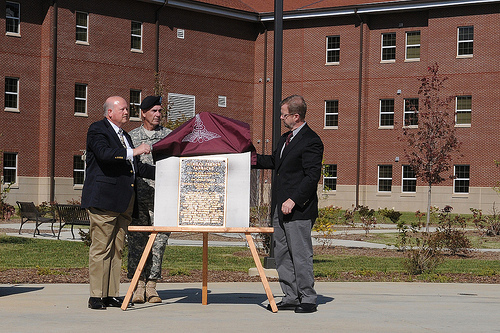
Family members of Master Sgt. Morgan French unveil a plaque during a barracks dedication ceremony at Fort Knox, Ky., Oct. 12, 2012. The new barracks named in French’s honor will house injured service members at the Warrior Transition Unit on post. (Kentucky National Guard photo by Sgt. Scott Raymond)
“He represented the thousands who served and paid dearly for the privilege,” Culver said. “My wish is that all who come into contact with this facility – Soldiers, family members, health care providers – will be inspired by Master Sgt. French’s story.”
Col. Bruce Jenkins, the Fort Knox garrison commander, agreed wholeheartedly.
“We got it right when we named these barracks for Master Sgt. French – he was an amazing hero and outstanding Soldier,” Jenkins said. “It only makes sense that he be honored this way.”
The $46.5 million barracks have 112 suites that can accommodate 224 Soldiers in the apartments that include bathroom facilities, walk-in closets, full service kitchens, laundry facilities and private sleeping quarters.
“What our Soldiers lived in before was good,” Jenkins added, “but these units are tailored specifically to their needs and most are handicap accessible.”
French’s son and granddaughter joined those cutting the ribbon to officially open the barracks, which were then open for tours. The barracks are conveniently located in the complex where the battalion headquarters are located, as well as the Soldier and Family Assistance Center, and just across the street from the hospital where most will receive their care.
“The Soldiers under our care will get what they need and get it quickly,” Jenkins vowed. “No one does it better than the U.S. Army.”
To see more photos from the ceremony, click here.
Story by Maureen Rose, Editor, The Gold Standard
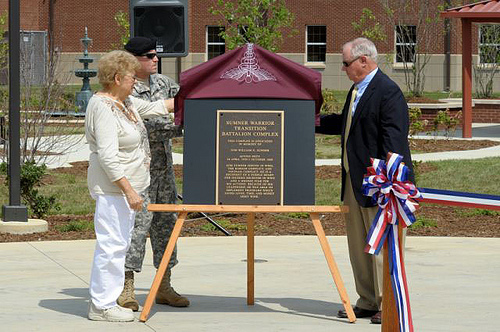
Del Sumner, Col. Bruce Jenkins, commander of U.S. Army Garrison at Fort Knox and Bill Sumner Jr. unveil a dedication plaque naming the warrior transition unit facility after the late Sgt. Maj. William Sumner in Fort Knox, Ky., Sept.5, 2012. (Photo by Stephen Moore, courtesy of The Gold Standard)
FORT KNOX, Ky. — Fort Knox dedicated its new Warrior Transition Battalion facility by naming it after a former U.S. Army Armor Center noncommissioned officer, Sgt. Maj. William Sumner, Sept. 5 with an audience of nearly 300, comprised of Soldiers, civic leaders and representatives of local veterans’ service organizations.
The new facility includes the Soldier and Family Assistance Center, administrative buildings, a dining facility, barracks and a turf field for exercising. Located across the street from Ireland Army Community Hospital, the complex is designed to be convenient as well as modern.
“We now have a quality campus for our wounded warriors,” said Col. Bruce Jenkins, garrison commander of Fort Knox, “and it’s very appreciated. It’s almost a one-stop shop for our wounded warriors.”
The ceremony did more than introduce the audience to the amenities of the complex.
“We’re equally proud of Sgt. Maj. Sumner who served more than 30 years in a career that spanned World War II, Korea, and Vietnam,” Jenkins said, reading details of Sumner’s biography provided by Sumner family members, the guests of honor at the day’s festivities. “He was awarded the Bronze Star with oak leaf cluster as well as the Purple Heart. He was obviously a Soldier and a leader who set the example for others to follow. Even after his retirement, he remained active by volunteering with the Disabled American Veterans, staying focused on taking care of troops.
“Sumner’s daughter, Sherry Brinegar, is a nurse case manager at this very complex, so Sumner is the perfect name for this facility,” he said.
After the unveiling of a portrait of Sumner and plaques that memorialized Sumner, Maj. Gen. Jeff Smith, commander of U.S. Army Cadet Command and Fort Knox, told the audience what an honor it was to pay respect to a hero like Sumner.
“But let me say this up front, it’s not really about the bricks and mortar,” Smith said. “It’s the human beings — the care providers, counselors, chaplains — who will help these Soldiers recover from their illnesses, injuries, wounds; $46 million has been invested in this complex, but it would be worth nothing if not for them.”
Smith invited a round of applause to thank health care providers who rarely receive enough thanks for all their hard work.
While the facility contains many state-of-the-art technologies, Smith said it was due.
“The Army recognizes that service to our country can take a toll; this has been a long time coming, but it’s what we owe our Soldiers,” he said. “You will marvel at the resources we provide for Soldiers to recover, but our Soldiers deserve this more than you can imagine. They deserve the best.”
Wounded warriors, Smith explained, have one job while they’re assigned to a WTB.
“Soldiers will work to heal their bodies, their minds, their souls; their sole mission is to recover,” he explained for those visitors to the installation. Addressing the complement of WTB Soldiers, Smith reminded them, “It’s your job to get healthy; it’s our job to resource that recovery.”
After the ribbon cutting, leadership declared the Sgt. Maj. William E. Sumner complex was officially open for business. Visitors were invited to tour the new buildings and talk with Soldiers and civilians who man the complex.
The Kentucky National Guard directly assists with the command and operation of the Warrior Transition Battalion at Fort Knox. In addition to the battalion commander, Lt. Col. Dwight Lewis, several Kentucky Guardsmen serve the unit in a variety of roles to provide the proper care to Soldiers utilizing the facility. According to the battalion command staff, the Kentucky Guard is in an appropriate and strategic position to support and maintain the program as it also supports Citizen-Soldiers who have been wounded and injured in the global war on terror.
Story and photos by Sgt. Cody Stagner, 133RD Mobile Public Affairs Detachment, Kentucky National Guard
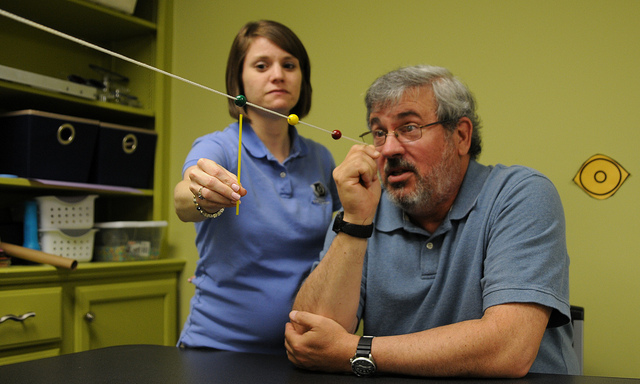
Vision therapist Jessi Drawbaugh guides retired Col. Karlas Owens through a series of vision tests. Owens’ vision problems are related to injuries he incurred during a tour of duty in Afghanistan. (Photo by Sgt. Cody Stagner, 133rd Mobile Public Affairs Detachment)
Click here for more photos.
SHELBYVILLE, Ky. — Dan Bowersox, doctor of optometry and owner of Bowersox Vision Center in Shelbyville, Ky., now offers free vision therapy for Kentucky military veterans suffering from symptoms of traumatic brain injury.
According to the Department of Veterans Affairs, nearly 800 Kentucky troops had been diagnosed with TBI from 2007-2011.
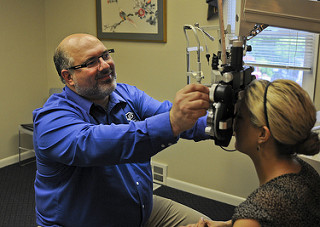
Dan Bowersox, doctor of optometry and owner of Bowersox Vision Center in Shelbyville, Ky., now offers free vision therapy for Kentucky military veterans suffering from symptoms of traumatic brain injury. (Photo by Sgt. Cody Stagner, 133rd Mobile Public Affairs Detachment)
A variety of eye problems can be traced to TBI, such as lazy eye, crossed eyes, double vision, blurred vision, light sensitivity, and reading and learning difficulties. For many veterans, neuro-optometric rehabilitation – better known as vision therapy – can address these symptoms directly and hopefully bring them back to normalcy.
“In my opinion, TBI is often under diagnosed and goes untreated,” commented Bowersox. “The ability to work depends on the ability to see. With this program, our goal is to improve our veterans’ quality of life, so they can return to work and to their daily lives.”
Bowersox designed his vision therapy treatment outcomes for three types of patients: small children, athletes, and those suffering from TBI. As he describes it, small children learn visual and memory skills and often notice better grades in school; athletes in sports vision therapy can benefit from enhanced performance; and TBI patients’ success stories involve the remarkable return to their normal daily lives.
“A couple months ago, I came in for a regular eye check-up when Dr. Bowersox recommended me for his program,” said Karlas Owens, retired colonel from the Kentucky Army National Guard, 238th Training Regiment. “It was kind of funny – it was like he knew every problem I was having and I didn’t even say them out loud.”
Owens retired after 34 years of service and was injured in 2003 while on tour in Afghanistan with the U.S. Army 10th Mountain Division.
“I struggled with memory lapse, reading comprehension, and headaches, mostly,” said Owens. “It was even hard for me to go into bright stores [like Wal-Mart] without feeling uncomfortable.”
“My wife was the first to notice the changes after about six weeks,” Owens said. “I used to forget some of the smallest things, like remembering why it was I walked into the other room. I would walk back and forth two or three times trying to remember. The memory exercises help a lot.”
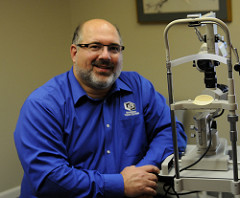
Dan Bowersox, doctor of optometry and owner of Bowersox Vision Center in Shelbyville, Ky., now offers free vision therapy for Kentucky military veterans suffering from symptoms of traumatic brain injury. (Photo by Sgt. Cody Stagner, 133rd Mobile Public Affairs Detachment
Some common tools found in a typical vision therapy session might range from simple reading to challenging memory games, or from basic spatial awareness activities to using 3-D glasses, computers, and a space fixator. All tools work to address differently attained skills but share one thing in common: they train – or retrain – the eyes and mind to focus on working together.
When asked what the most noticeable changes are in their patients at Bowersox Vision Center, Jessi Drawbaugh, vision therapist from Pleasureville, Ky., said, “I’ve seen the largest improvement in the social interaction and confidence of our patients. You can tell just by the way they look when they walk in and their attitudes when they leave.”
Symptoms of TBI and post-traumatic stress are often a topic of controversy in military journalism as they share many characteristics. Both Drawbaugh and Bowersox agreed in all cases they found increased self-esteem a positive side effect. Bowersox also believes – with as many shared symptoms – therapy treatment methods for TBI “is a good thing to do if someone has PTSD, because I feel it can decrease anxiety and frustration with life.”
Bowersox has worked with several veterans in the past and all have had positive experiences. He and his staff offer a welcome and friendly environment.
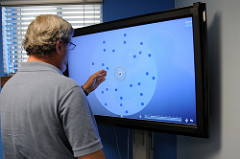
Retired Col. Karlas Owens goes through a series of vision tests. Owens’ vision problems are related to injuries he incurred during a tour of duty in Afghanistan. (Photo by Sgt. Cody Stagner, 133rd Mobile Public Affairs Detachment)
“There has to be more health professionals out there taking lead as part of the solution,” he said. “Rather than worrying about how to pay for treatment, we keep it simple; it’s a free service with no strings attached.”
“I have always wanted to work with the military. Now is my chance to give back and show thanks. Rather than worrying about how to pay for treatment, we keep it simple; it’s a free service with no strings attached.”
Find Bowersox Vision Center on Facebook or visit their website at www.drbowersox.com. Information on the Veterans Vision Therapy program is not listed so please call (502) 647-3937 for details and to schedule an appointment.
Staff report
Photos by Sharron Hilbrecht
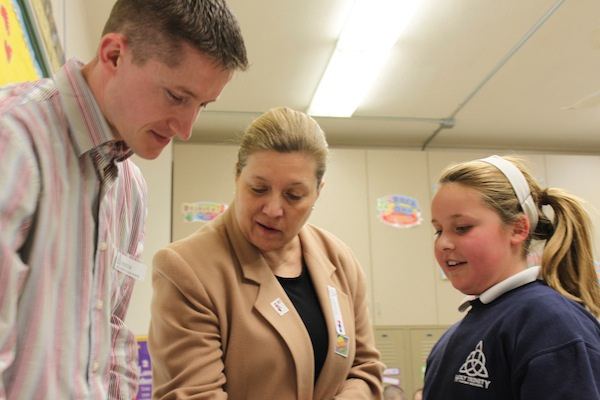
Cody Stagner, Linda Brashears and Gracie Estes discuss the art of making Valentine's Day cards. Stagner and Brashears visited Holy Trinity Parish School to tell the story of Kentucky's Wounded Warriors. (Photo by Sharron Hilbrecht)
Click here for more photos on this story.
LOUISVILLE, Ky. – A recent meeting between students at Holy Trinity Parish School and some of Kentucky’s Wounded Warriors resulted in an unexpected gift of the heart.
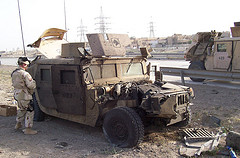
Cody Stagner survived the blast by an vehicle borne improvised explosive device in this humvee during his tour of duty in Iraq during 2005. (File photo)
It all began a week ago when Linda Brashears and Cody Stagner were invited to give a presentation to a group of fourth grade students. Brashears and Stagner are both veterans of Operation Iraqi Freedom, Brashears a former Army Reservist and Stagner a member of the Kentucky Army National Guard.
They are also Wounded Warriors.
Stagner is now a medical outreach coordinator for the Kentucky National Guard. Brashears is the military liaison for the Brain Injury Alliance of Kentucky. The pair were invited to share their stories with the children at Holy Trinity, where they showed photographs and answered questions to an enthusiastic and appreciative audience.
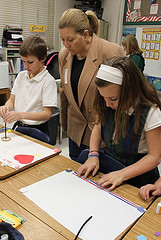
Linda Brashears looks on while Carter Casaburo and Allie DeWeese work on Valentine's Day cards for a Wounded Warrior. (Photo by Sharron Hilbrecht)
“We put the kids in our shoes for the day and told stories about the real life pictures we showed them,” said Stagner. “We shared some of the values we have as Service Members and what obstacles and conditions our Wounded Warriors may have overcome to survive their wars and real-life battles they may have while returning to the states and to their families.
Student Will Masterson said “It was most interesting to learn about the different lives of children in Iraq when compared to children in the United States.”
Ally DeWeese was a bit more practical in her interests. “I liked learning about what Soldiers ate,” she said.
She also asked if nail polish was allowed in the military and if the troops were allowed to go shopping. Her enthusiasm was typical and Stagner and Brashears did their best to address each and every question to its fullest.
Masterson noted that “the armor and protection they wear is very heavy.”
“In the end, I was proudest to see so many of them go out of their way to show gratitude by reaching to shake our hands and saying, ‘Thank you for your service’,” said Stagner.
The exchange was not entirely one sided. Brashears and Stagner returned a few days later to pick up a special gift: Valentine’s Day cards the students made especially for the Wounded Warriors.
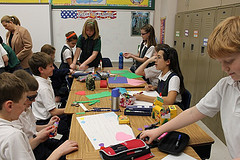
The fourth grade class at Trinity School Parish work on Valentine's Day cards for Kentucky's Wounded Warriors. (Photo by Sharron Hilbrecht)
The idea for the cards came up when the class asked about how they could show their respect. The students discussed sending Valentine’s cards to the Warrior Transition Battalion at Fort Knox, and they created their own designs. The rest, as they say, is history.
Making Valentine cards for the Soldiers evoked some interesting responses.
“We should learn to participate in activities that support our Wounded Warriors and to respect them,” said Gracie Estes said. “It was nice to do something for them.”
“What a wonderful way to say thank you to our soldiers,” said fourth grade teacher Michelle Hartlage.
Hartlage, by the way, has a brother who served a tour of duty in Afghanistan. It turned out that most of the children either had a relative or knew someone who had served in the military.
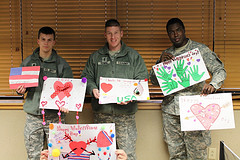
Spc. Gregory McDonald, 1st Lt. Adam Fleming and Sgt. Andrew Harris show off messages of affection from the students of Holy Trinity Parish School. The three are members of Bravo Company, Fort Knox Warrior Transition Battalion. (Courtesy photo)
“This was a big hit for us,” said Nancy Meiers, a parent volunteer at the school. “Since that day I’ve have parents came up and tell me that their children couldn’t stop talking about it.”
Meiers said the children’s interest was deeper than anyone expected. “They were fascinated by the Soldiers’ experiences, their impression of their living conditions in the desert, how they lived and what they ate. You could see it in the kids’ eyes. They see story on the news all the time, but this put a face to it and made their story a lot more personal.”
“One thing that resonated with the children is that there are many wounds that are not visible,” said Meiers. “That was a good message for their kids, and for adults.”
“I found it most interesting how the children themselves had different views of the military,” said Stagner. “Some saw it as glamorous and some found it dangerous. But I think all of them learned something they didn’t know.”
Stagner’s current mission is to widen the awareness of today’s Wounded Warrior and he saw the visit to Holy Trinity as step in the right direction.
“Hopefully, when these bright kids run into one of our Wounded Warriors or any other service member, they will know not to be afraid of him or her and have the confidence enough to address them and maybe lend a helping hand.”
By Sgt. Scott Raper, Kentucky National Guard Public Affairs
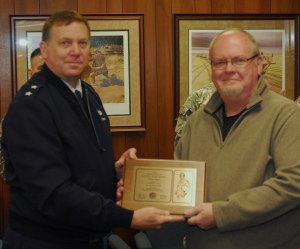
Maj. Gen. Edward W. Tonini, Kentucky Adjutant General, presents Dave Altom with his 2010 Keith L. Ware Public Affairs award for his editorial on Kentucky's Wounded Warriors Jan. 5. (photo by Capt. Stephen Martin, Kentucky National Guard Public Affairs)
FRANKFORT, Ky. - There are those in, and out of uniform, that are dedicated to telling the story of the Kentucky National Guard. One individual recently was awarded for just such work. Dave Altom with the Kentucky National Guard Public Affairs Office received the third place prize for civilian commentary for a story he wrote on Wounded Warriors. The award was given as part of the annual Maj. Gen. Keith L. Ware Public Affairs Communication Competition, a Department of the Army sponsored event that showcases journalism excellence from military personnel and civilian employees.
(Scroll below to read Altom’s editorial that won him the distinguished award.)
“I’ve been at this for a long time,” said Altom. “It’s a great feeling to know that my contributions are worthy and have brought attention to an extremely honorable cause and to the Kentucky National Guard.”
Altom’s article, Wounded Warriors, a National Treasure, chronicled the experience of several Kentucky Guardsmen on a fishing trip to Alaska (click link to read full story). The three-part series provided a glimpse into the lives of Kentucky’s wounded warriors and the rare opportunities offered to those who have given unselfishly to their country.
“I’ve held the American Soldier in high regard since I was a child,” said Altom. “My heroes and mentors were all veterans. I admired them for their character, their willingness to do what needed to be done and their sense of humor under less than optimal circumstances. Being around our Wounded Warriors reminds me so much of those men. Our troops have sacrificed so much for us all and I feel privileged to share their company.”
“All too often, we are so busy telling the story on behalf of our Guard that we don’t tell our own story or praise our own public affairs team,” said Lt. Col. Kirk Hilbrecht, director of public affairs, Kentucky National Guard. “The Keith L. Ware award bestowed upon Dave helps us ‘give credit where this credit is way-overdue’. I’m really proud of Dave and all that he continues to do for the Kentucky Guard.”
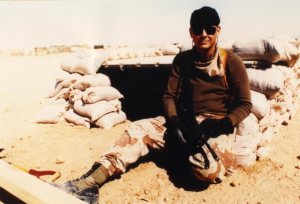
Dave Altom served as a sergeant during the Persian Gulf War, where he helped tell the story of American Soldiers supporting Operation Desert Shield and Desert Storm. Twenty years later he's still at it, his most recent efforts bringing attention to Kentucky's Wounded Warriors. (Photo by Retired Col. Phil Miller)
Altom wore the Army uniform for 20 years prior to working as a civilian. 16 of those years he spent in the Kentucky National Guard, deploying as part of Operation Desert Storm in 1991 and retiring in 2005. Following a stint as a Military Policeman, Altom began his distinguished career in public affairs. A University of Kentucky Graduate in telecommunications and English, Altom calls his work, a fascinating profession that serves the greater good. He has always been fond of doing whatever it took to tell a Soldier’s story, riding on tanks, hanging out of helicopters, rolling with the artillery, anything that would get their story told. He says that even though he’s not in uniform, he still has the opportunity to talk with and tell the story of the Soldiers and Airmen of the Kentucky National Guard.
“It’s not the PAO’s mission to be famous, but rather to make the Guard famous. The public deserves to know, and they need to know, what the Guard does. We have so many wonderful and, in my mind, important stories that have yet to be told, there isn’t a job that I’d rather have,” said Altom.
_____________________________________________________________________
Dave Altom’s editorial was published in the Bluegrass Guard, Vol. 15, Issue 1:
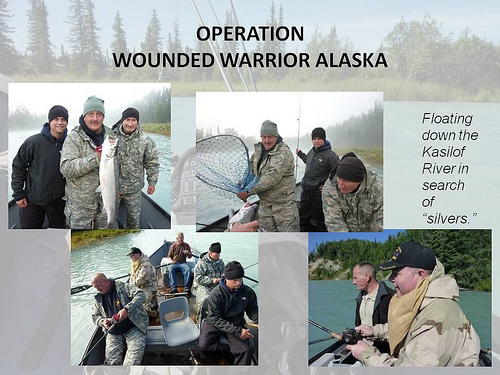
A photo collage of Operation Wounded Warrior to Alaska in 2010 with the Kentucky National Guard.
It was during a drive through Alaska’s Kenai Peninsula that Sgt. 1st Class Chuck Reed said something that impacted me profoundly. We were escorting six Kentucky Guard wounded warriors (whose story you can read in this very issue) and taking in some of the most magnificent landscapes I’d ever seen. I was talking about how great it was to hang out with the troops.
And that’s when Reed said that they were “national treasures.”
For some reason what he said – or maybe it was the way he said it, slow, deliberate and with typical NCO conviction – caught me off guard. I considered his words for a moment and said, “That’s true. National treasures. I never thought of them like that before.” Reed smiled and I got the funny feeling that the answer had been in front of me all along.
Since my early childhood I’d held veterans in high regard, my admiration becoming part of my DNA. Their example, both in deed and in word, ultimately led me to join the service and becoming a token member of their brotherhood. They’ve been my heroes, my mentors, my colleagues and, I’m honored to say, my friends.
We are now approaching the ten year mark since 9/11. Our nation has changed dramatically since then, in some good ways and some not so good, perhaps. Change happens, but one thing remains constant: the dedication and resolve of those who serve in uniform and put their lives on the line for those of us who cannot or will not do the same.
For so few to stand up and endure so much on the behalf of so many, that to me was a humbling thought as I sat in that van on that memorable day. How ironic that Reed used those words while we were in the heart of the United States’ last great frontier, a national treasure of towering mountains, fantastic wildlife, endless forests and, as we say here in Kentucky, a true pioneering spirit among its people.
I encourage everyone reading this to take heart in that ideal. You may already. I’ve no doubt that many of you are way ahead of me on this. But for those of you who aren’t, or perhaps just need a gentle reminder, think on this: we need to treasure our wounded veterans and keep in mind what they have endured on our behalf. That doesn’t mean pity them, nor does it mean treat them as if they’re broken. They may be injured, they may need healing, but there is strength and wisdom in each and every one that I’ve met, enough to make me question my own potential.
Funny thing. Most of the wounded warriors I know don’t consider themselves “heroes” in the traditional sense. They were just “lucky enough to survive.” But they’ve got experience and insight that most of us overlook in our daily lives. Make them part of your life, whether it’s part of your family day, your unit’s change of command or holiday celebration or just stopping by and saying “hey.” You can learn a lot from these guys.
They are, after all, our national treasures.
dwa
Story and photo by David Altom, Deputy Director, Kentucky National Guard Public Affairs
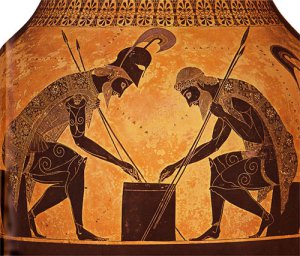
"Battle Buddies" -- Ajax and his brother in arms, Achilles, in happier times.
LOUISVILLE, Ky. — The stage is simple and barren. The actors are seated, reading from binders. There are no costumes, no props, no orchestra or special effects.
Still, the audience is silent and transfixed as a woeful howl fills the auditorium. The story of a warrior’s grief turns to despair, disgrace and finally … suicide.
This is the classic tragedy Ajax, a collaborative production by the Theater of War and the Actors Theatre of Louisville. Written 2,500 years ago by the Greek general Sophocles, the play is as relevant today as when it was first performed for the author’s own army.
The story is the definitive example of post-traumatic stress … Rambo without Stallone; The Deer Hunter without DeNiro: During the Trojan War the legendary warrior Ajax — a general officer worshiped by his men — grieves for the loss of his cousin, the heroic Achilles. Adding to his woes, Ajax is cheated out of a great honor by his higher command, prompting him to take out his frustration and rage on his offenders. Fate intervenes and instead of getting revenge he is tricked into slaughtering the army’s livestock.
Feeling foolish, the disgraced warrior contemplates the shame he has brought to his military career, his family and himself. In the end, Ajax takes his own life, literally throwing himself on his sword, leaving behind a grieving widow, a fatherless child and controversy among his fellow warriors.
Translated by Byan Doerries and directed by KJ Sanchez, the hour-long production hits all the key elements that lead to Ajax’s fall from honor to his ultimate self-destruction. The reading is noble, woeful and even humorous at times, thanks to a heartfelt performance by the actors.
Yes, it’s a Greek play and there is no mention of Vietnam, Iraq or Afghanistan. And yet the theme is as important today as it was 2,500 years ago. The value of Ajax is in showing quite literally how the more things change, the more they stay the same. Whether the weapons are swords or IEDs, the effects are the same; Soldiers today face with the same problems as their ancestors … combat stress, loss of fellow troops, frustration with “the system” and reintegration into the community and family.
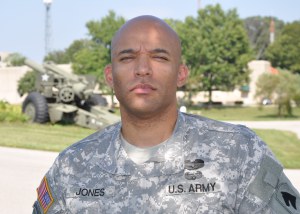
“It’s kind of a window into our world." Maj. Franklin Jones, a veteran of the war in Afghanistan, was part of the panel discussion focusing on issues raised by the Theater of War presentation.
Maj. Franklin Jones, a Kentucky Army National Guard officer and veteran of combat in Afghanistan, was part of an insightful discussion panel that followed the reading of the play.
“The play was pretty profound,” he said. “It’s kind of a window into our world. I can imagine how much good it does for other combat veterans to hear this.”
Among the issues Jones found in the play was the role of leadership in dealing with combat stress. “We have a tendency to iconify our leaders, to put them on a pedestal and make them perfect. And as leaders we have tendency to want to stay that way because that’s what enables us to lead. If my Soldiers see imperfections in me, I may think it makes us less effective. That’s not necessarily true.”
According to Jones the play highlights a key training deficiency — what to do when a combat veteran gets home.
“We just kind of have to figure it out,” he said. “The kind of training that we do, we do so much that it becomes second nature to us so that when we face a stressful situation we just react and don’t have to think about it. We go right back to our training. But when we get into a stressful situation at home we don’t have the training to deal with that.”
The panel proved integral to the presentation, bringing light to issues regarding the role of modern psychiatry, family and the Citizen-Soldier. Audience participation was encouraged and active.
Another member of the panel was Dr. Laura Johnson, Chief of the Behavioral Health Clinic at Fort Knox’s Ireland Army Community Hospital. When asked what can be done for those affected by the stresses of wartime deployment, Johnson — an Army veteran herself and wife of a deployed officer — summed it up with a simple sentence:
“We probably just need to cut each other some slack.”
Theater of War has delivered more than 150 productions in the United States and Europe reaching 30,000 service members and veterans of every rank, their families and caregivers.
Sanchez, the director of Theater of War, is also working on another play — ReEntry — based on interviews with veterans of the wars in Afghanistan and Iraq.
The next performance of Theater of War is scheduled for October 10. Admission is free. Call 502-584-1205 for ticket reservation.
Click here for more information on the Theater of War.
dwa
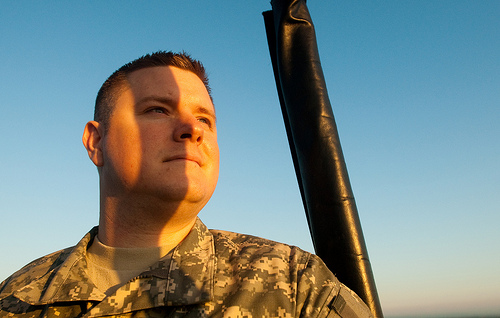
Wounded Warrior and Kentucky Army National Guardsman Sgt. Casey Cooper looks into the rising sun as he takes flight in the National Guard's hot air balloon as part of the Kentucky Derby Festival's US Bank Great Balloon Race, April 29. Sgt. Cooper, a member of the 223rd Military Police Company in Louisville, Ky., was wounded in the Raven 42 ambush at Salman Pak, Iraq on March 20, 2005. (U.S. Army photo by Staff Sgt. Aaron Hiler, 133rd Mobile Public Affairs Detachment)
Touch here for more photos on this story.
Louisville, Ky. (April 29, 2011) – The rising sun wasn’t the only splash of color gracing Louisville’s morning skies. Dozens of hot air balloons leapt into the skies over Bowman Field as part of the 2011 Kentucky Derby Festival’s US Bank Great Balloon Race. The National Guard’s hot air balloon, piloted by Bill Smith of Aero Force Balloons, was second to launch during the race and it carried a very special crewman – Wounded Warrior Sgt. Casey Cooper.
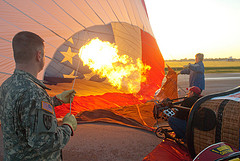
Kentucky Army Guardsman and Wounded Warrior Sgt. Casey Cooper of the 223rd MP Company helps Bill Smith of Aero Force Balloons raise the National Guard balloon prior to the Kentucky derby Festival US Bank Great Balloon Race, April 29. Sgt. Cooper was wounded in the Raven 42 ambush in Salman Pak, Iraq on March 20, 2005. (U.S. Army photo by Staff Sgt. Aaron Hiler, 133rd Mobile Public Affairs Detachment)
Sgt. Cooper, a member of the 223rd M.P. Company out of Louisville, was honored by the Kentucky Derby Festival and the National Guard balloon crew by being made an honorary crew member and was given a ride in the balloon during the Great Balloon Race.
Cooper waved to his five-year old son, Jayce, and his sister-in-law, Jessica Tanselle, as the National Guard balloon left the ground.
“I’ve never been up in a hot air balloon before, so I’ve been looking forward to this ride all week,” said Cooper.
Sgt. Cooper was chosen from a group of Wounded Warriors to join the National Guard balloon crew for this event. Cooper was wounded in the Raven 42 ambush at Salman Pak, Iraq in March of 2005, when he and six other MPs were ambushed by insurgent forces while escorting a transportation company. Sgt. Cooper received the Bronze Star Medal with “V” Device for Valor for his actions during the Raven 42 firefight.
“I love honoring our Wounded Warriors like this,” said hot air balloon pilot Bill Smith. Smith, owner of Aero Force Balloons, travels around the nation representing the National Guard with his hot air balloon.
“In addition to honoring a real hero like Sgt. Cooper for his wartime sacrifices, I also get to fly the National Guard balloon and let communities around the nation know that their National Guard is always there when it is needed.”
###
Story and photos by David Altom, Kentucky National Guard Public Affairs Office
email: [email protected]
October 8, 2010
Part three of a three-part series
"I think I won the lottery!" The Kenai Peninsula Experimental Aircraft Association treated Kentucky's wounded warriors to a unique tour over Alaskan glaciers. (Photo by David Altom, KYNG Public Affairs Office)
Gratitude is the other defining characteristic of the warriors. The most commonly heard phrase – “I think I won the lottery!” – is repeated over and over again when the Kentuckians are invited to fly over some local glaciers. The Kenai Peninsula Chapter of the Experimental Aircraft Association break out a variety of bush planes, float planes and other small aircraft to take them on the tour of a lifetime. The veterans fly for nearly two hours, winding among mountain tops and through glacial valleys unlike anything they have seen back home. Beaming faces and excited talk are plentiful as they egress from their rides.
Spc. Henry James gets a world class view of Alaskan glaciers thanks to the Kenai Peninsula Experimental Aircraft Association. (Photo by David Altom, KYNG Public Affairs Office)
Sgt. Casey Cooper takes a glacier tour in an Alaskan bush plane courtesy the Kenai Peninsula Experimental Aircraft Association. (Photo by David Altom, KYNG Public Affairs Office)
——————————————-
A glacier tour via float plane was just one of several adventures the Kentucky troops enjoyed as part of Operation Wounded Warrior Alaska. (Photo by David Altom, KYNG Public Affairs Office)
———————————————-
During quiet moments waiting for aircraft, or around the campfire, stories are told and notes are compared. Anger and frustration with the system are met with compassion and brotherly support. James, who was in the gunner position when an IED hit his hummer in 2005, talks of the difficulties he has gone through following major surgeries on his face and spine.
Despite his injuries Staff Sgt. Ken Wininger still trains troops for the Kentucky Army National Guard. The Alaska trip allowed him to connect with other wounded warriors. "We only met each other a few days ago, but we are probably one of the tightest crews you'll ever meet." (Photo by David Altom, KYNG Public Affairs Office)
Wininger can identify with his brother Soldier. Back during his 2007 tour in Afghanistan a double-stacked anti-tank landmine IED crushed his foot. Now he listens to James, silent at first, then responds.
“You better stop now, brother. I’m about ready to go back and kick some ass.”
Nightly sessions around the fire pit cemented the bond between the troops. Salmon Catcher Lodge provided accommodations for Operation Wounded Warrior Alaska. (Photo by David Altom, KYNG Public Affairs Office)
Such support prevails throughout the mission. There are no posers here, no pretenders, no whiners. Everyone has the proverbial “t-shirt” and mutual respect is the name of the game. Commiseration evolves into problem solving and long-term planning. The fishing trip turns into a series of mini-summits on the plight of Kentucky’s wounded warriors.
“At home I’m not able to do a whole lot,” says James. “This has been great to get outdoors to see the moose and nature, seeing the countryside. This has been great for me, really wonderful for me. I miss the guys, above the fishing. I miss the troops, the people I was with. I miss talking to them, how they’re doing, how their families are doing. When you’re hurt you turn to each other.”
Staff Sgt. Ken Wininger and Spc. Henry James, half a world away from the battlefields that changed their lives. (Photo by David Altom, KYNG Public Affairs Office)
Spc. Henry James fighting an Alaskan halibut. James was in the gunner's seat when his hummer was hit by an IED in 2005, severely injuring his face and spine. (Photo by David Altom, KYNG Public Affairs)
—————————————————
Hightower sees a lot of value in the discussion and wants to keep up the momentum for the wounded troops.
“We believe as a group we have good ideas that can help other wounded Soldiers and future wounded Soldiers,” he says. “Every individual Soldier is different in their experience. Collectively there is a lot of information, a lot of pointers that we can provide to assist others in their process.”
The trip is not without its challenges, but determination and teamwork can move mountains apparently. In addition to the Kentucky Army and Air National Guard staffers working out the trip details, the Mississippi Air Guard provides space on a C-17 transport to the 49th state and the Nebraska Air Guard gives up some seats on a KC-135 tanker for the return leg. Private donations come in from sources as diverse as members of Governor Beshear’s office staff, the Kentucky State Police Professional Association, along with dozens of friends, family and members of the Kentucky Guard who are touched by the Soldiers’ stories.
The members of Operation Wounded Warrior Alaska after a hard day's work. Terry Johnson, owner of Salmon Catcher Lodge, donated accommodations for the mission. "Giving something like this away is a little thing compared to what these guys have gone through. If I could I’d do it for every Soldier in the darned Army," says Johnson. (Photo by David Altom, KYNG Public Affairs Office)
One of the biggest contributors is Terry Johnson, owner of the Salmon Catcher Lodge where the troops stay for most of their Alaskan visit. Johnson turned the entire lodge over to the team for an entire week. A retired pilot for UPS and former Louisville resident, he has a habit of contributing to worthy causes. He has given up rooms at his lodge for several charitable causes, the IPA Children’s Hospital and the Dream Foundation to name a couple. Stricken by kidney disease himself, he identifies with the troops and their individual struggles with their health.
“I was touched by the sense of duty our troops showed following 911,” Johnson says. “About eighty percent of the pilots I work with are in the military, so I have great respect for what they do. I told my family that if I wasn’t a pilot I’d be a Soldier or a cop or a fireman.”
Johnson says he would like to host more trips for Kentucky’s wounded warriors and has invited them to come back next year.
“I came to realize that life isn’t about what’s in it for me. Giving something like this away is a little thing compared to what these guys have gone through. I’m in the fortunate position where I can do this for others. If I could I’d do it for every Soldier in the darned Army.”
Reed echoes the desire for a repeat mission.
“We have about 34 wounded warriors in the Kentucky Guard,” he says. “I’d like to get every one of those guys involved and get them up here. “I consider anybody who’s been to Iraq or Afghanistan, who’s been wounded or hurt, they’re national treasures, because they know what it means, they know what dedication is, they know what service is.
“We need to listen to these guys, get their input on a lot of things we do in the Kentucky National Guard and the Department of Defense as a whole. They know what they’re talking about when it comes to their situation. They love their country. They stepped up to the plate and it cost them.”
The members of Operation Wounded Warrior Alaska prepare to board a Nebraska Air National Guard KC-135 headed for "the lower 48." “I consider anybody who’s been to Iraq or Afghanistan, who’s been wounded or hurt, they’re national treasures" says Reed. (Photo by David Altom, KYNG Public Affairs Office)
The return flight on the refueling tanker is quiet and uneventful. The troops mentally prepare to see their families and reminisce about their adventure.
Wininger talks about the special joy he found in traveling with his team. “You could do all this by yourself, but it wouldn’t be as much fun. We only met each other a few days ago, but we are probably one of the tightest crews you’ll ever meet. In just a week we’ve become really close.”
Austin, the trip’s practical joker and commentator, is especially poignant about leaving his team mates.
“I’m having a hard time thinking about going back home,” he says. “I’m starting to think I’m gonna get back in this again, and I’m gonna miss it even more.
Story and photos by David Altom, Kentucky National Guard Public Affairs Office
email: [email protected]
October 7, 2010
Part two of a three part series
Staff Sgt. Bart Greenwood and Master Sgt. Brett Hightower have a close encounter with an Alaskan native. Hightower holds a miniature version, a gift from his children that accompanied him during his wartime deployments. (Photo by David Altom, KYNG Public Affairs Office)
As anyone who has “been there, done that” can attest, humor is a great stress reliever as well as part of the teambuilding process. Friendly jibes are passed between the warriors and the resulting comebacks invariably trigger a back blast of laughter among the team. On the water Hightower gets the reputation of having the worst luck catching fish until the very last minute. That is when he pulls in one of the largest catches of the day.
Master Sgt. Brett Hightower loves being in Alaska with his brothers in uniform. "This trip meant the opportunity to spend time with Kentucky National Guard Soldiers. The fellowship, the kinship, you kind of miss that." (Photo by David Altom, KYNG Public Affairs Office)
Master Sgt. Brett Hightower with the catch of a lifetime. Hightower is one of six injured Kentucky Army National Guard Soldiers who took part in Operation Wounded Warrior Alaska. (Photo by David Altom, KYNG Public Affairs Office)
xxx
XXXXXXX
“Way to go, master sergeant!” someone hollers. Hightower’s grin reveals an impish pleasure. Eyes alight, he takes the kidding, refines it and tosses it back, igniting a secondary burst of laughter. He’s just glad to be with the troops and they’re glad he’s with them.
“For me this trip meant the opportunity to spend time with Kentucky National Guard Soldiers,” says Hightower. “It’s the first time since my injury that I’ve been with a group of Guard guys who have been deployed, who have a whole lot in common, who have been injured. These are guys who have been deployed and served our state and our nation honorably.”
His smile is emphasized by a dimple on his cheek, a subtle reminder of his 2008 encounter with a grenade and small arms fire.
“The fellowship, the kinship, you kind of miss that.”
Jaremy Austin was wounded in a IED blast during his 2005 deployment in support of Operation Iraqi Freedom. "This is way beyond what I expected," he says of Operation Wounded Warrior Alaska. (photo by David Altom, KYNG Public Affairs Office)
Austin’s humor pushes the envelope, but the team understands. He lost an eye when a car bomb exploded on him in Iraq. He now has a Chevrolet insignia printed on the side of his glass replacement and he isn’t shy about showing it to the guides or anyone else who is standing within range. A moment of disbelief is followed by guffaws and laughter, and an instant bond is formed.
“I’m here, but I ain’t all there,” Austin says with a boyish smile that belies his injuries.
Getting in and out of the boats is not easy for the 28 year old war veteran, but he carries on like he is still wearing the uniform. Not once during the expedition does he complain. Like the others, he feels like he has won the lottery.
“This is way beyond what I expected,” he says. “I love the outdoors. I like fishing back home, but this is Alaska.”
Chatter between catches gets the troops talking about their experiences. Austin talks about his year in Walter Reed. The others let him go on, and then someone gets a bite and the rhythm changes completely.
Austin smiles in the ensuing chaos. “I love this. The best thing about this has been the camaraderie with the guys. I think it’s more because I’m with Kentucky guys.”
Jaremy Austin, Sgt. Casey Cooper and Ricky Brooks band together to bring in a halibut. "This best thing about this has been the camaraderie with the guys," says Austin. "I think it's because I'm with the Kentucky guys." (photo by David Altom, KYNG Public Affairs Office)
"W" for "wounded warrior": Jaremy Austin, Sgt. Casey Cooper and Ricky Brooks display the spoils of battle. (Photo by David Altom, KYNG Public Affairs Office)
XXXX
XXX
XXX
XXXX
The concept of comradeship may seem cliché in today’s media saturated society, but here on the Kenai Peninsula it defines this team. At one point Austin fights to bring in a halibut, his injured arm giving out after an epic fight. Brooks and Cooper pitch in and all three have hands on the rod as the fish is drug into the net. Beaming with pride, they pose with their trophy, Austin giving the “W” sign – “wounded warrior.”
The warriors’ stories are like their injuries, similar, but different. Hit by a VBIED (vehicle born improvised explosive device) in 2005, Brooks found his wounds compounded by the death of his brother-in-law, Eric Lee Toth, who was killed in the blast. Out of the Guard now, Brooks currently serves as a Kentucky State Trooper. He looks at the trip as a way to reconnect with his military past and share his experiences with new friends.
“When I got the call to go to Alaska it caught me completely off guard,” he says. “This is a trip I always wanted to do. It’s a dream come true. I’ve got a new network of friends, some good times and stories I’ll tell when I get back home.”
He pauses for a moment. “I’ll never forget being wounded. And I’ll never forget Alaska. This is something I’ll remember the rest of my life.”
Hit by a vehicle-born IED in 2005, Brooks' found his injuires compounded by the loss of his brother-in-law, Eric Lee Toth, who was killed in the same blast. (Photo by David Altom, KYNG Public Affairs Office)
Brooks and Austin working together in search of halibut on Cooks Inlet, Alaska. "I'll never forget being wounded," says Brooks. "And I'll never forget Alaska. This is something I'll remember the rest of my life." (Photo by David Altom, KYNG Public Affairs Office)
XXXX
XXX
XXXXXXXX
XXX
Brooks’ energy contrasts with that of Cooper, who was injured during the March 20, 2005 firefight at Salman Pak, Iraq. Cooper does not talk much about the war, focusing more on his family and friends and duties as a full-time Guardsman. Looking younger than his battlefield experience – he is “carded” at least once in a restaurant – his quiet reserve is broken during moments like the fight to bring in the halibut.
A great day to be in the Kentucky National Guard! Sgt. Casey Cooper enjoys a day of halibut fishing on Cooks Inlet, Alaska. (Photo by David Altom, KYNG Public Affairs Office)
“I felt obviously honored and privileged,” the military police NCO says of his invitation to go on the trip. “I felt a sense of ‘why me’, as opposed to those who are more deserving. Some of these guys continue to fight their battles on a daily basis. These are the ones who really deserve this.”
Cooper served a second tour of duty in Iraq since his injuries and continues to help train Soldiers. He is also married to a Guard member, Staff Sgt. Emily Cooper. His professional and private lives intertwined, he is thoughtful about what trips like this mean to his fellow troops.
A long way from Iraq. Sgt. Casey Cooper has served a second tour of duty since the 2005 Battle of Salman Pak. "I felt obviously honored and privileged," he says of being invited to Alaska. "Some of these guys continue to fight their battles on a daily basis." (Photo by David Altom, KYNG Public Affairs Office)
“Any show of faith from the military and private sponsors is a great morale boost for these guys. This shows that the support we get from the Kentucky National Guard is more than lip service. They really provide the kind of support these guys need.”
(Tomorrow: Gratitude, reflections and home)
