Pages
Stay In Touch
More
© 2013 KentuckyGuard
Story by Capt. Ryan Hubbs, Kentucky National Guard Resilience Coordinator
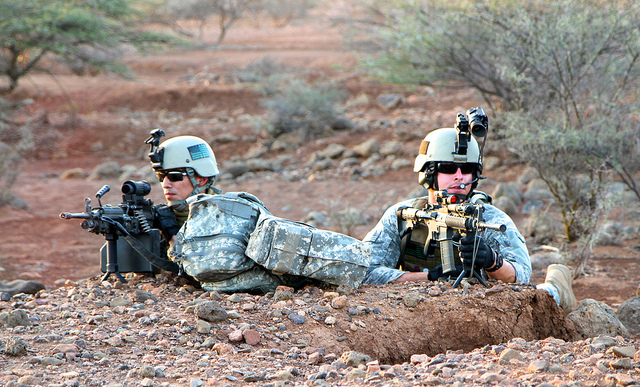
Multiple deployments can take their toll on our citizen soldiers and their families, which in turn degrades readiness. Resilience training offers tools and resources to combat the negative affects incurred during mobilization. (Photo by Sgt. Alexa Becerra, 2/138th PA)
GREENVILLE, Ky. — What makes a person be able to bounce back from adversity? Why do some people seem to thrive under pressure, while others can barely cope with the stresses of everyday life? Is it something you were born with, or is it a skill that can be learned?
For answers to these questions, the U.S. Army teamed up with the University of Pennsylvania and prominent psychologists to see what it was that makes an individual “resilient.”
Resilience is defined as the ability of an object to spring back into shape, or more specifically (when dealing with Soldiers) the ability of a person to recover quickly from adversity. Although originally, psychologist believed that resiliency was a trait individuals were born with, they have now discovered that resiliency is a skill that can be learned by anyone.
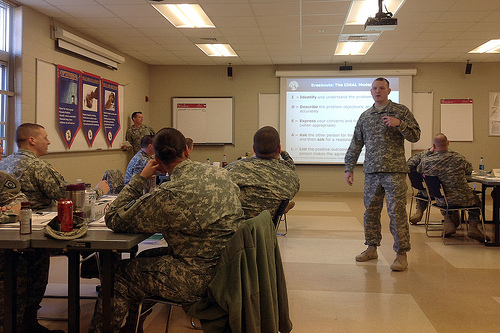
Kentucky Guardsmen participate in a group discussion as part of their Master Resiliency Trainer Course at the Wendell H. Ford Regional Training Center in Greenville, Ky., Jan. 20, 2015. (U.S. Army National Guard photo by Capt. Mike Moynahan)
It is no secret that today our men and women who serve in the National Guard face many situations which bring about stress. Juggling deployments, annual training, and drill weekends with a civilian job and family relationships can be extremely difficult, even for the most resilient individuals. It is because of this recognized stress that the Kentucky Army National Guard has seen fit to get as many Master Resilience Trainers as possible to teach these skills in their units, in order to make our Guard stronger.
From Jan. 12-23, leaders from a variety of units of the Kentucky Army Guard attended the Master Resilience Trainer Course at the Wendell H. Ford Regional Training Center in Greenville. Lead by Abbey Bradshaw, a resilience specialist from Fort Knox, the Resilience Team from the Michigan National Guard’s Great Lakes Resilience Center and some help from the Army Reserves, Soldiers from across Kentucky were immersed in the optimistic world of resiliency.
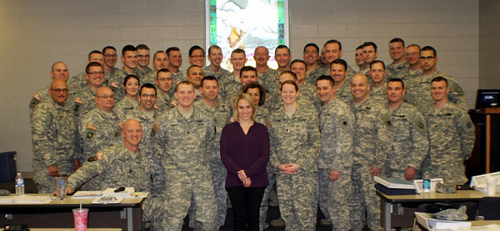
The graduating class of the Kentucky National Guard’s Master Resiliency Trainer Course at the Wendell H. Ford Regional Training Center in Greenville, Ky., Jan. 23, 2015. (U.S. Army National Guard photo by Capt. Mike Moynahan)
The two-week course teaches Soldiers a variety of skills dealing with how to become more self-aware of counterproductive thoughts and emotions and how to regulate them. The course focuses on optimistic thinking and gives Soldiers the tools be cool and confident in any situation. The course even teaches skills such as active constructive responding that help to foster better relationships with friends, family, and coworkers alike.
The course is with not without its critics though. The Army has been trying to eliminate the perception that it is “not okay” to share feelings.
“I was concerned about having to sit in a drum circle and talk about feelings,” said Master Sgt. Chuck Shuff with the 20th Special Forces Group when he first learned he was going to attend the course. “I was relieved when that turned out not to be the case at all. These are practical skills that Soldiers need to have.”
It is not uncommon for those who enter the course to be a little leery at first. However, by the end, almost all who complete the course say they come away with invaluable skills that not only help them become better Soldiers, but also better people.
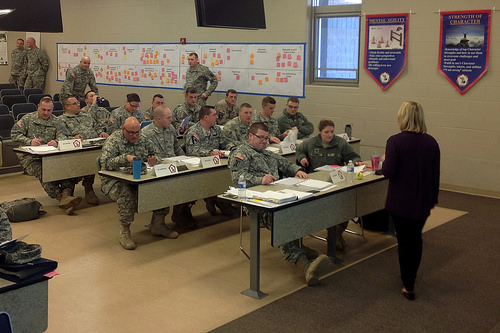
Kentucky Guardsmen attend a Master Resiliency Trainer Course at the Wendell H. Ford Regional Training Center in Greenville, Ky., Jan. 15, 2015. (U.S. Army National Guard photo by Capt. Mike Moynahan)
In an effort to spread the resiliency program, it is important to get buy-in from leaders at the top and whom Soldiers respect.
Capt. Mike Moynahan, a Ranger qualified Infantry company commander said, “The skills taught during the course are proven and effective, but it takes practice to become good at them. Mandatory training requirements can be overwhelming at times, but these skills will pay dividends while deployed for soldiers and their families.”
Overall, the 32 Soldiers who participated in the training had overwhelmingly positive things to say about the course. In addition, the Kentucky Army Guard is now at 96% strength for units that require an MRT. Facts that keep leadership optimistic for the future of resiliency in the military.
“The positive response for the program here in Kentucky has been encouraging,” said Maj. John Harvey who oversees the program. “With more than 125 MRTs trained and more classes scheduled, the Kentucky Guard is quickly becoming one of the most resilient states in the Nation.”
For more details on how you can receive resilience training or become involved in the state resilience program, please contact your unit MRT or State Resilience Coordinator.
Staff Report
(In partnership with multiple organizations around Lexington, Ky., Fayette County is launching a Veterans Treatment Court in order to help Veterans who have “fallen on hard times.” The program needs the support of volunteer Veteran-mentors who can have a positive influence in their fellow Service members that need this critical investment. Please consider joining this endeavor.)

Image courtesy of fightingptsd.org
LEXINGTON, Ky. — More than 20,000 Veterans currently live in Lexington Ky., and substantial growth in this population is anticipated over the next 18 months as troops are withdrawn from Afghanistan.At least 20 percent of these Veterans who have served in Iraq and Afghanistan are known to suffer from PTSD and over 80 percent injured of that number have sustained a Traumatic Brain Injury which is not detectable by casual personal observation. The impact of these conditions are not typically apparent, but they may be debilitating with long-term sequela, or aftereffect of an injury, including depression, anger, anxiety, memory loss, flashbacks and sleep disturbance.The emotional and psychological damage sustained by these veterans is fully understandable given their experiences: engaging in personal hand-to-hand combat, having killed aggressors or innocent non-combatants, being injured by a sniper or an IED, seeing friends injured or killed in battle and enduring the wear and tear which results from carrying 75 pounds of gear several hours per day.
“Once back home, veterans are challenged to find an outlet for the hyper-vigilance to which they became accustomed while in combat,” said Fayette Family Court Judge John Schrader, overseeing the incoming program. “Unfortunately many Veterans resort to self-medication of their emotional and physical injuries by excessive drinking and abuse of illegal drugs. ”
With diminished impulse control and substance abuse concerns, routine incidents such as road rage, being startled by fireworks or even a child’s playful scream can lead a Service member suffering from PTSD to criminal conduct which results in an arrest.
“While these veterans must be held accountable for their behavior, we know that without appropriate treatment, the problems which caused the criminal activity will continue to haunt them and their families long after they are released from incarceration, notes Schrader. “Unless we provide appropriate help, this person may well engage in the same (or even more serious) criminal behavior after incarceration, and put his or her family and other innocent people at risk of physical and emotional injury or death.”

Fayette Family Court Judge John Schrader
Kentucky Supreme Court Chief Justice John Minton has approved the request of Fayette Family Court Judge John Schrader to preside as a volunteer over the Fayette County Veterans Treatment Court, which began its work as a pilot project on Oct. 4, 2013.Veterans Treatment Court is designed to address these problems creatively in order to assist veterans in recovering their lives. The program utilizes the collaborative services of the VA, The Vet Center, Lexington-Fayette Urban County Government Police, Fayette County Attorney, Fayette County Sheriff, Kentucky’s Department of Public Advocacy, Fayette County Drug Court and the Kentucky Administrative Office of the Courts.The program requirements and services offered will be tailored for each Veteran and will include, as appropriate, frequent drug screening, curfew monitor, treatment for mental health and substance abuse, domestic violence offender treatment, family support, job training and placement, and assistance in obtaining appropriate housing.
A critical feature of VTC includes the ongoing support of a volunteer veteran-mentor (a “Battle Buddy”) who will support the Veteran participating in the program.
Veteran mentors are Veterans of the U.S. Armed Forces who volunteer their time to assist the Court. These mentors provide advice, personal experiences, recommendations and guidance to those selected for the program. Veteran mentors include those who have served in peacetime, Vietnam, Desert Storm/Shield, Operation Enduring Freedom and Operation Iraqi Freedom among others.
The Veteran mentor relationship promotes and fosters, through encouragement, a “can do” attitude in the Veteran; the Veteran becomes motivated to accomplish his or her goals in treatment, feels that he or she is not alone and knows that the mentor and the Court are there for them.

The Lexington, Ky. Veterans Treatment Court has just launched to assist the Veterans within Fayette Co. Ky. The team is lead by Judge John Schrader. (photo submitted)
Not every Veteran facing criminal charges will be eligible for the program as it will not serve, for example, those charged with violent felony offenses, sexual abuse, trafficking in heroin, and others which the team deems to be inappropriate for treatment.In the pilot program, only those who have received an honorable or general discharge are allowed to participate. The program relies on the services offered by the VA, but the grant request to be submitted in early 2014 would allow service of those dishonorably discharged as well, with other service providers. The program requires approximately 18 months of intensive work by the Veteran, including classes with daily homework assignments, reporting requirements, curfew, therapy and treatment, and weekly court appearances to monitor compliance. There are progressive sanctions as well for violations of the program requirements which include various terms of incarceration.
The community is invited to support our country’s courageous veterans and the ongoing work of Veterans Treatment Court. For further information, contact Judge Schrader at [email protected].
Story by David Altom, Kentucky National Guard Public Affairs
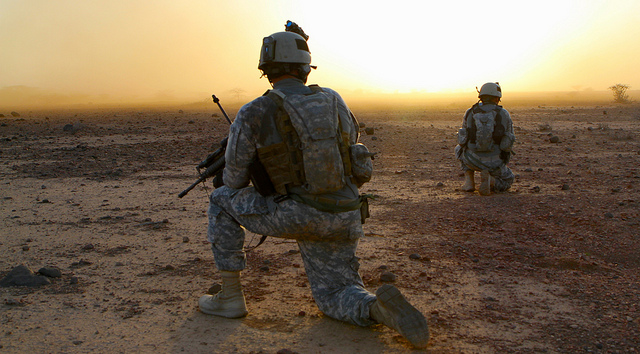
Transitioning back to the civilian world is a challenge for any combat veteran, says Floyd Hunsaker, Director of Mental Health for the Kentucky National Guard. “The skills that kept them alive over there sometimes get in the way of what we consider normal life here at home. And this program is here to help them.” (Kentucky National Guard archive photo)
FRANKFORT, Ky. — Following the withdrawal of troops in Iraq and the proposed drawdown in Afghanistan, the National Guard still has plenty of missions on its roster. One of the most important is taking care of its most precious resource: the combat veteran. In an unprecedented move, the Kentucky National Guard has joined forces with the Kentucky Veterans Program Trust Fund and the University of Louisville to develop a unique counseling program that will significantly change the way combat veterans are treated
Capt. Stephanie Fields, Deputy State Surgeon for the Kentucky National Guard, said the initial goal of the new program is to provide additional behavioral health resources for all of Kentucky’s combat veterans without the standard wait period they often experience with the Veterans Administration or their civilian medical provider.
“While everyone acknowledges that the Veterans Administration has been providing excellent treatment, the volume of soldiers has caused considerable wait times,” said Fields. “This new program will be a great help in that regard.”
But there is more to the program than just cutting waiting times. The use of medications and confidentiality issues also needed to be addressed.
“We also wanted to decrease the amount of medication use by our combat veterans by helping them with problem solving skills and ways to manage the stresses in their lives,” Fields said.
Confidentiality was a huge factor in the program. “Sometimes our veterans are reluctant to come in for help because of a perceived stigma, or they might be afraid asking for help might affect their military career,” said Fields. “We had to provide assurances if we were going to make any headway into those problems.”
Thanks to an $80,000 grant from the Kentucky Veterans Program Trust Fund, the new program attacks all three goals head on. A full time social worker handles requests with a relatively short turnaround time and a team from the University of Louisville has an innovative approach to dealing with the medication and privacy issues.
Dr. Eric Russ is an assistant professor at the University of Louisville’s Department of Psychiatry who used to work with the VA. He is very familiar with the issues facing today’s combat veteran and he has a staff that shares his passion.
“Our team is really enthusiastic about working with combat veterans. We’ve got a lot of expertise at the university in working on PTSD and depression and I’ve worked with veterans before, so this opportunity was pretty exciting for all of us.”
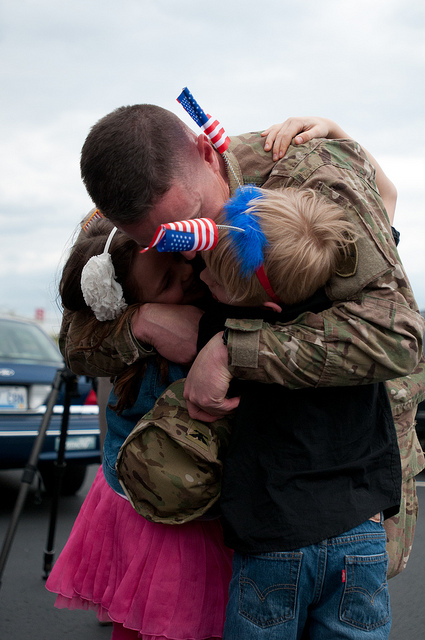
PTSD and depression aren’t suffered alone — they are suffered by families. The treatment the new program can go a long way in improving relationships and helping patients reconnect with their families, with their spouses and with their kids. (Kentucky National Guard Public Affairs archive photo)
“While medications can certainly play an important part in the treatment of some of these disorders,” said Russ, “for something like PTSD the gold standard treatment of care is ‘talk therapy.’ Particular kinds of talk therapy have proven to do really well, reducing PTSD symptoms in as little as ten to twelve weeks. We work really hard to keep medication use to a minimum and in some cases use none at all.”
Ten to twelve weeks is optimal, Russ explained. “The average is more like sixteen. This is still a pretty quick turnaround for folks who may have been dealing with these problems for a year or even in some cases several years.”
Then there is the issue of privacy and confidentiality. Russ hopes that because the U of L program is outside of the VA and the military system, veterans will feel more comfortable coming to his team for help. “We can provide a place that is outside of their chain of command and the military structure, but still provide effective care.”
Floyd Hunsaker, Director of Psychological Health for the Kentucky Army National Guard is especially excited about the new program.
“We certainly welcome this additional resource to help with our combat veterans,” said Hunsaker. “This will help them deal with the issues they are facing following their deployments. And it doesn’t have to be a PTSD issue. If you’ve got problems at home, things don’t seem right, this is a great opportunity to address all of those things.”
“If you’re a soldier and your friends and family say you’ve changed, maybe you should stop and think about what they’re talking about,” said Hunsaker. “The skills that kept them alive over there sometimes get in the way of what we consider normal life here at home. And this program is here to help them.”
According to Hunsaker, addressing confidentiality and getting hooked on medication are key to overcoming most veteran’s reluctance to asking for help.
“Now there’s no excuse,” he said.
Russ expressed confidence in the service the new program provides. He hopes to help not just the individual combat veteran, but their families and loved ones as well.
“The big message for families is that these problems are treatable,” he said. “Don’t believe what you see on television or in the movies. For a long time in mental health, particularly with veterans coming back from Vietnam and other conflicts, we didn’t have a good handle on PTSD and depression. We do now.
“These are diseases that aren’t suffered alone — they are suffered by families. The treatment we do with individuals can go a long way in improving relationships and helping patients reconnect with their families, with their spouses and with their kids.”
If you are a combat veteran in need, or you know of a combat veteran who can benefit from this program, contact 1st Lt. Adela McIntosh at [email protected] or 859-893-2000.
Troops requesting to make confidential appointments will need to contact Dr. Russ at 502-588-4883.
Please note that you do NOT have to be in the Kentucky National Guard to participate.
Staff report
“Dogs are our link to paradise. They don’t know evil or jealousy or discontent. To sit with a dog on a hillside on a glorious afternoon is to be back in Eden, where doing nothing was not boring — it was peace.”
― Milan Kundera, author
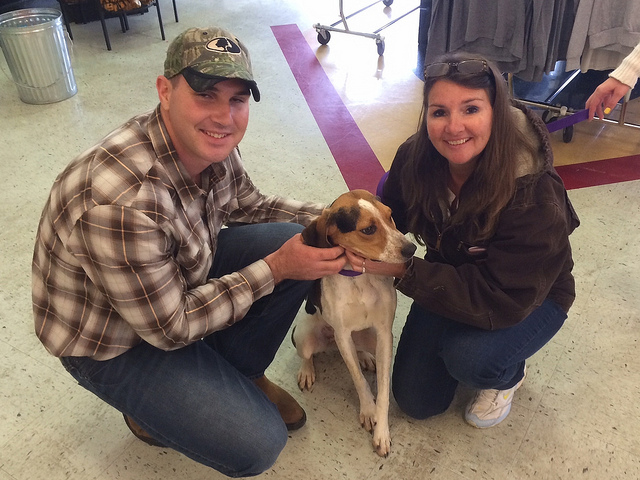
USMC Sgt Rodger Thacker II, his mother Georgia Thacker and Maggie. “Maggie is perfect for him,” said Georgia. “I think they were made for each other. Our son really needed this and I think she really will help him.” (Photo courtesy 1st. Lt. Chris Winburn, Kentucky National Guard Resilience Program)
FRANKFORT, Ky. — The bond between dogs and humans is thousands of years old. For millenia our canine friends have hunted alongside us, guarded our herds and our homes, fought in our wars and comforted us in times of woe. They are more than mere pets; they are our companions, co-workers and our best friends. In some cases they can also be healers of a special sort.
The “Canines Helping Our Military Personnel” or CHOMP program is a partnership between the Kentucky National Guard, the Lexington Humane Society and Federal Medical Center. The Humane Society provides dogs to veterans with a waived adoption fee. Before joining their new masters, the canines must first go through a training program run by inmates at the Federal Medical Center.
1st. Lt. Chris Winburn coordinates the project as part of the Kentucky Guard’s Resilience Program. Winburn’s primary focus is to market the program and find individuals that not only meet the criteria, but also have a desire to participate. To be eligible, a candidate should be a combat veteran and be in a place in their life that gives them a need for a companion animal. This need could come in several forms, but the idea is that the veteran is dealing with issues such as PTSD, thoughts of suicide, family issues or general feelings of loss or loneliness.
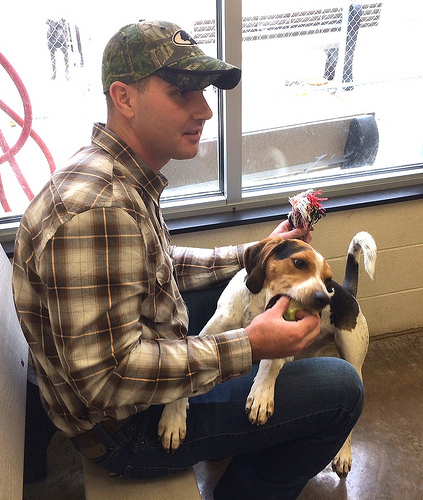
Hunting buddies: USMC Sgt. Rodger Thacker II is a twice deployed combat veteran. He teamed up with Maggie after receiving an email about the Kentucky National Guard’s Canines Helping Our Military Personnel (CHOMP) program. (Photo courtesy 1st. Lt. Chris Winburn, Kentucky National Guard Resilience Program)
“The concept originally came from research which showed that a companion animal can be a powerful positive influence in a person’s life,” said Winburn. “As suicide rates in the military, and particularly among combat veterans, continue to increase, the Kentucky National Guard Resilience Team has been focusing on ways to not only try and curb the problem of suicide, but also to build a stronger and more resilient force.”
Within just a few hours of putting out a notice about the CHOMP program, Winburn’s team received an email from Georgia Thacker, a Kentucky National Guard Family Readiness Group leader. She’s also the wife of Sgt. 1st Class Rodger Thacker, a twice deployed Guard soldier.
But it wasn’t her husband that was in need. Instead, Georgia sent the flyer to her son, an active duty Marine stationed in North Carolina. Almost immediately USMC Sgt. Roger Thacker II asked if he could participate in the program. He explained that he had dealt with issues relating to PTSD from two prior combat deployments, and that he had recently lost his four dogs in a divorce.
“Thacker’s situation was ideal for this program,” said Winburn. “He was twice deployed combat veteran and had gone through a tough spell here at home. His family relationship with the Kentucky Guard made it an easy decision.”
A few emails later and Thacker was in Kentucky the following week to meet his new best friend at the Lexington Humane Society.
After completing an application form, Thacker then met with Humane Society staffers. When asked for details on what kind of dog he wanted to adopt, that was easy: a hunting companion.
The Humane Society had the perfect candidate. Maggie is 11 month old Treeing Walker Coonhound, a breed known for their remarkable hunting ability. Rodger and Maggie spent some time getting to know one another and working with the Humane Society staff on the different commands that came from the FMC training program. The pup was excited to be interacting with people, but she somehow managed to sit and roll-over for a treat.
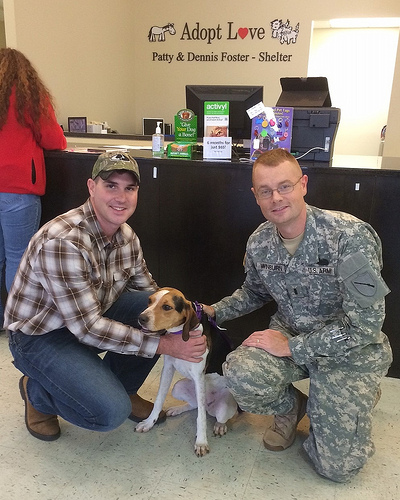
USMC Sgt Rodger Thacker II, 1st. Lt. Chris Winburn and Maggie. For more information on CHOMP contact 1st Lt. Chris Winburn at 502-607-1575 or at [email protected]. (Photo courtesy 1st. Lt. Chris Winburn, Kentucky National Guard Resilience Program)
“The only thing that was more impressive than watching Maggie’s training was witnessing a bond between dog and owner form before our very eyes in such a short time,” said Windburn. “That was pretty great.”
Humane Society staff helped Thacker fill out the necessary paperwork for adopting Maggie and briefed him about complimentary veterinarian visits and medications. He was even given a big bag of dog food.
“This program will make a huge impact in my life,” said Thacker. “I encourage anyone looking for a companion to help you in any way to consider this program. It was easy and the outcome better than I could ever imagine.”
Georgia, Thacker’s mother, is a big fan of CHOMP — and of Maggie! “This definitely helped my son,” she said. “Before I even heard of the program I told him, I think you need a companion. Then I saw the email and the next thing I knew Rodger was on his way to Kentucky.”
“Our son is so excited,” she said. “Maggie is perfect for him. I think they were made for each other. She’s going to be indoors with him, but they’ll also go hunting together. It was just a wonderful thing. He really needed this in his life right now and I think she really will help him.”
Dad was equally excited about the new addition to the family. “When Rodger got home with Maggie his face was so lit up, it was like, wow!” said Sgt. 1st Class Thacker. “It’s as if the man upstairs said, we got something for you, son.”
Winburn finds his work with CHOMP rewarding. “It’s great to be a part of an organization that cares so much about its members. The Resilience team knows that there are other veterans amongst our ranks that can benefit from the CHOMP program.”
If you or someone you know might be a good candidate for this program, and would like more information contact 1st Lt. Chris Winburn at 502-607-1575 or at [email protected].
Story and photo by David Altom, Kentucky National Guard Public Affairs
Additional photo courtesy Sgt. Cody Stagner, Bravo Battery, 1st Battalion, 623rd Field Artillery
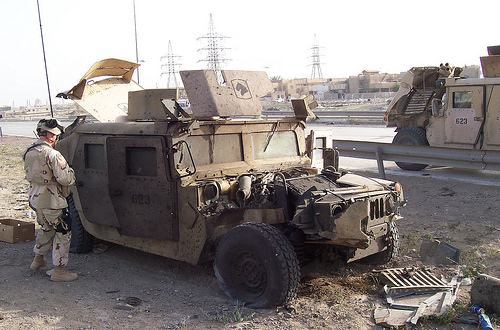
Improvised explosive devices – such as the one that destroyed this Kentucky Army National Guard humvee in 2005 – are the most common factor in the physical and emotional injuries that define many of today’s Wounded Warriors. (Photo courtesy Sgt. Cody Stagner, 1st Battalion, 623rd Field Artillery)
FRANKFORT, Ky. – After ten years of war in Afghanistan and eight years in Iraq, the U.S. military’s role in the global war on terror is one of the longest in our nation’s history; depending on how you do the math, Vietnam lasted between 10-12 years, so we are fast approaching that dubious distinction.
And while there are some similarities between these two historic events, there is also an important difference – how we treat our Wounded Warriors.
“What the Army and our society as a whole have learned is that we as a nation leave no Soldier behind,” said Col. Charlie Jones, J1 director for the Kentucky Army National Guard.
“‘I will never leave a fallen comrade,’ is reflected in both the U.S. Army Warrior Ethos and Soldier’s Creed. This doesn’t mean just overseas,” said Jones, a Veteran of the Iraq War. “That means here at home, too.”
Indeed. To that end, the Kentucky Guard now has case workers working every day to address the needs of returning troops, from dealing with physical injuries and PTSD to reintegration issues and researching resources to bring some sense of normalcy to their lives.

Kristen Wentz is a former U.S. Army captain who now uses her combat medical experience to fight for Kentucky's Wounded Warriors. (Photo by David Altom, Kentucky National Guard Public Affairs)
The Army Wounded Warrior Program (AW2) – a part of Warrior Transition Command and the U.S. Army’s Medical Command – has the mission of developing, coordinating, and integrating wounded, ill, and injured Soldiers, Veterans, and their Families and caregivers in order to promote future success in the force or in civilian life.
“Our motto is ‘As long as it takes’,” said AW2 case worker Kristen Wentz. “Where the VA typically tracks a Soldier returning from combat for five years, we track our Soldiers forever, for as long as they need us.”
Wentz is not your typical case worker. A registered nurse by profession, she is a former active duty captain who served in Baghdad as an emergency room nurse. She now uses her medical training – and her wartime experience – to fight for her wounded brothers and sisters in uniform.
“When I first started here I had about twenty cases,” said Wentz. “I’m up to thirty-five right now, out of nearly five hundred in Kentucky alone.”
There are currently more that 8,500 Soldiers in the program nationwide.
All of the Soldiers in AW2 have to be rated through an Army medical board where an evaluation is conducted to determine their status as a Wounded Warrior. Wentz and her team get cases from the Warrior Transition Units at Fort Campbell and Fort Knox. Sometimes they come in from other sources, such as coordinators and case workers at the VA and self-referrals.
Injuries vary, according to Wentz. Physical trauma from improvised explosive devices are the most common, as are wounded incurred by small arms fire. Post traumatic stress is another part of the returning Soldier’s reality and it is rampant.
Not all of her cases are combat injuries; some have been put on Wounded Warrior status because of a serious injury from an automobile accident, for instance.
Kentucky’s AW2 program has offices in Frankfort, Lexington, Knox and Campbell, but they have clients in every region of the state. While the AW2 works with the VA, the level of care is more focused on the Soldier’s needs.
“It’s case management work, but it’s completely personalized and more specific,” said Wentz. “We have different phases to the process. There’s the management phase, which is contact them every thirty days, then we progress them as needed. They can be fine for a while, then suffer a major life event and go back to phase one again.”
“I’m a local contact for the Soldier,” she said. “Many of our guys, especially those with PTSD or serious brain injury, have trouble navigating the system. Rather than have them organize all these phone numbers, it’s my job to help them.”
Success is sometimes hard to define. The main goal is to help the Wounded Warrior gain independence.
“We want them to become independent, but we don’t want it to be overwhelming,” said Wentz.
If you or someone you know need assistance, contact Kristen Wentz at her office 502-607-1302, cell 859-285-8479 or email her at [email protected]. If you have a service or program that can help the troops, she’s open to that, too.
Click here for more information on the U.S. Army Wounded Warrior Program (AW2).
If you think you or your organization has something to offer, click here for the AW2 Community Support Network.
Click here for the official AW2 blog.
Click here for the AW2 Facebook page.
Click here for the Kentucky Army National Guard Health Services Facebook page.
###
FORT KNOX, Ky. — Wounded Warriors, their caregivers and health professionals were given a unique opportunity to share and learn during the 2nd annual Operation: Headed Home conference held at Fort Knox on Oct. 14.

Encounters with IEDs in Iraq and Afghanistan are the primary cause for traumatic brain injury among US troops.
Designed to address traumatic brain injury and post traumatic stress disorder, the conference was sponsored by the Kentucky Department for Behavioral Health, Developmental and Intellectual Disabilities and representatives from federal, military, state and professional organizations across Kentucky.
More than 240 Service members, Veterans, military Families, caregivers and behavioral health professionals were in attendance, to share information, resources, and support regarding TBI and PTSD.
“It was important to show the providers what the military is going through, to give them a little taste of what’s going on in Afghanistan and Iraq,” said Cody Stagner, medical outreach coordinator for the Kentucky National Guard. “It also gave Soldiers an opportunity to better understand the issues they’re going through and to find the multiple resources to help them cope with their injuries.”
To give perspective, nearly 800 Kentucky troops were diagnosed with TBI in a survey ranging from 2007-2011. That’s in the Louisville and Lexington areas alone.
TBI isn’t limited to military personnel. Nearly 32,000 Kentuckians — civilian and military — sustained a traumatic brain injury in 2010, according to a University of Kentucky report.
The effects of TBI can be devastating. In addition to persistent headaches and short-term memory loss, emotional issues can arise, complicating problems with concentration and organization, thereby disrupting the Soldier’s personal and professional life; family members, caregivers, employers and friends all share in the suffering.
Operation Headed Home featured a panel of Soldiers and family members that discussed the conditions troops incurred while in country. Family members talked about the obstacles they faced in caring for their loved ones; they also shared in their success stories.
“Everyone was eager to learn and excited to be there,” said Stagner. “There were a lot of questions and it was interesting to hear what the participants were most interested in. That’s important as it will help us improve our approach and put on a better conference next time.”
Capt. Philip Majcher was part of a discussion panel on resiliency within the family. The Suicide Prevention Program Manager for the Kentucky Guard, Majcher said the conference provided an open environment that encouraged collaboration between participants.
“Active duty, National Guard, civilian providers, and family members were able to present what they offered,” he said. “The attendees were able to ask questions and talk about issues they have been working with themselves. By the end of the time, everyone was off their seats and sharing notes and laying out plans for the future.”
Providers and Service Members alike were briefed on post traumatic stress and post traumatic growth as well as mild traumatic brain injury. Majcher was optimistic that the conference would spark action among attendees.
“What started as a panel discussion became a working group,” he said.
“The panel discussion helped show how PTSD is a real issue, as is TBI,” said Jay Mattingly, care coordinator supervisor for the Kentucky Army National Guard. “These topics are being taken seriously and the military is working hard to address the mental health needs of our Soldiers.”
Another conference is being considered for next spring at Fort Campbell. Information will be posted at kentuckyguard.com as soon as possible.
For more information on TBI and PTSD contact Cody Stagner at [email protected] or call him at 502-607-1154.
dwa
Story by David Altom, Deputy Director, Kentucky National Guard Public Affairs
FORT KNOX, Ky. — Recognizing the need to address traumatic brain injury and post traumatic stress disorder, the Kentucky Department for Behavioral Health, Developmental and Intellectual Disabilities has united with representatives from federal, military, state and professional organizations across Kentucky to host the 2nd annual Operation: Headed Home conference.
This state-wide conference will address the needs of Service members, Veterans, military families, caregivers and behavioral health professionals with information, resources, and support regarding TBI and PTSD.
The conference will take place from 7:30 a.m. — 5 p.m. Oct. 14 at the Fort Knox Leaders Club.
There is no cost to participants.
A Kentucky Army National Guard Soldier on convoy security duty in Iraq. IEDs are the primary cause of brain injuries among US service members at war. (Kentucky National Guard file photo)
“We’re encouraging all Service members, Veterans, Family members, caregivers and healthcare professionals to attend,” said Cody Stagner, medical outreach coordinator for the Kentucky National Guard. “We also invite concerned members of the community to come as well.”
The conference will have presenters from military, Veteran, federal, state and community agencies on hand to share information and resources.
“Our speakers will address things like how Service members and Veterans can access resources and benefits,” said Stagner. “We want to get as much information out there to the people who need it the most.
“We’ve asked so much of our Service members and now it’s time we took care of them.”
Space for the conference is limited, so attendees must register in advance.
For registration information, contact Justina Keathley at 859-622-4968 or [email protected]
dwa
Story and photo by David Altom, Deputy Director, Kentucky National Guard Public Affairs

"Battle Buddies" -- Ajax and his brother in arms, Achilles, in happier times.
LOUISVILLE, Ky. — The stage is simple and barren. The actors are seated, reading from binders. There are no costumes, no props, no orchestra or special effects.
Still, the audience is silent and transfixed as a woeful howl fills the auditorium. The story of a warrior’s grief turns to despair, disgrace and finally … suicide.
This is the classic tragedy Ajax, a collaborative production by the Theater of War and the Actors Theatre of Louisville. Written 2,500 years ago by the Greek general Sophocles, the play is as relevant today as when it was first performed for the author’s own army.
The story is the definitive example of post-traumatic stress … Rambo without Stallone; The Deer Hunter without DeNiro: During the Trojan War the legendary warrior Ajax — a general officer worshiped by his men — grieves for the loss of his cousin, the heroic Achilles. Adding to his woes, Ajax is cheated out of a great honor by his higher command, prompting him to take out his frustration and rage on his offenders. Fate intervenes and instead of getting revenge he is tricked into slaughtering the army’s livestock.
Feeling foolish, the disgraced warrior contemplates the shame he has brought to his military career, his family and himself. In the end, Ajax takes his own life, literally throwing himself on his sword, leaving behind a grieving widow, a fatherless child and controversy among his fellow warriors.
Translated by Byan Doerries and directed by KJ Sanchez, the hour-long production hits all the key elements that lead to Ajax’s fall from honor to his ultimate self-destruction. The reading is noble, woeful and even humorous at times, thanks to a heartfelt performance by the actors.
Yes, it’s a Greek play and there is no mention of Vietnam, Iraq or Afghanistan. And yet the theme is as important today as it was 2,500 years ago. The value of Ajax is in showing quite literally how the more things change, the more they stay the same. Whether the weapons are swords or IEDs, the effects are the same; Soldiers today face with the same problems as their ancestors … combat stress, loss of fellow troops, frustration with “the system” and reintegration into the community and family.
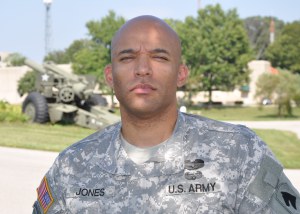
“It’s kind of a window into our world." Maj. Franklin Jones, a veteran of the war in Afghanistan, was part of the panel discussion focusing on issues raised by the Theater of War presentation.
Maj. Franklin Jones, a Kentucky Army National Guard officer and veteran of combat in Afghanistan, was part of an insightful discussion panel that followed the reading of the play.
“The play was pretty profound,” he said. “It’s kind of a window into our world. I can imagine how much good it does for other combat veterans to hear this.”
Among the issues Jones found in the play was the role of leadership in dealing with combat stress. “We have a tendency to iconify our leaders, to put them on a pedestal and make them perfect. And as leaders we have tendency to want to stay that way because that’s what enables us to lead. If my Soldiers see imperfections in me, I may think it makes us less effective. That’s not necessarily true.”
According to Jones the play highlights a key training deficiency — what to do when a combat veteran gets home.
“We just kind of have to figure it out,” he said. “The kind of training that we do, we do so much that it becomes second nature to us so that when we face a stressful situation we just react and don’t have to think about it. We go right back to our training. But when we get into a stressful situation at home we don’t have the training to deal with that.”
The panel proved integral to the presentation, bringing light to issues regarding the role of modern psychiatry, family and the Citizen-Soldier. Audience participation was encouraged and active.
Another member of the panel was Dr. Laura Johnson, Chief of the Behavioral Health Clinic at Fort Knox’s Ireland Army Community Hospital. When asked what can be done for those affected by the stresses of wartime deployment, Johnson — an Army veteran herself and wife of a deployed officer — summed it up with a simple sentence:
“We probably just need to cut each other some slack.”
Theater of War has delivered more than 150 productions in the United States and Europe reaching 30,000 service members and veterans of every rank, their families and caregivers.
Sanchez, the director of Theater of War, is also working on another play — ReEntry — based on interviews with veterans of the wars in Afghanistan and Iraq.
The next performance of Theater of War is scheduled for October 10. Admission is free. Call 502-584-1205 for ticket reservation.
Click here for more information on the Theater of War.