Pages
Stay In Touch
More
© 2013 KentuckyGuard
Story by Staff Sgt. Steve Tressler, Task Force Longrifles Public Affairs
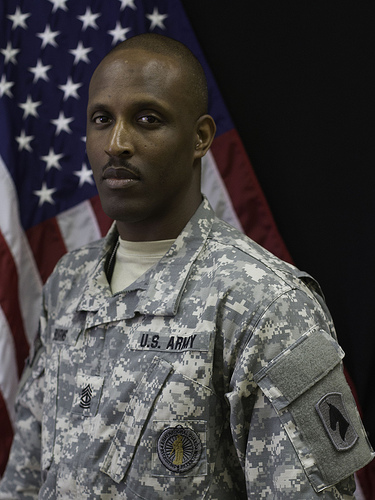
1st Sgt. Burns, with the 2nd Battalion, 138th Field Artillery also works as an instructor at the Bluegrass Challenge Academy at Fort Knox, Ky. According to Burns, 10 former cadets serve with Task Force Longrifles on their deployment to the Horn of Africa. (Photo courtesy of Task Force Longrifles)
DJIBOUTU — Task Force Longrifles 1st Sgt. Robert Burns, a native of Atlanta, Ga., didn’t want to turn out like many of the guys he grew up with who were in “jail or dead” he said. By his own admission, he was already in ‘the wrong crowd’ if he wanted succeed in life, and he knew it. So, unlike many of his friends, he joined the Army.
“They thought I was crazy” said Burns, “but looking back now, I know I was one of the lucky ones.”
Burns is grateful today for many reasons, his faith, his wife Ashley, his children, and the Army. When asked what the Army has done for him he responded exasperated with, “What hasn’t it done?! Travel, adventure, life-changing experiences, physical, mental and spiritual growth, just everything.”
So in 1999 when Burns was asked to join the Bluegrass Challenge Academy as an instructor it was a perfect fit.
The Bluegrass Challenge Academy was a part of the National Guard Youth Challenge Program which began as a ten-state pilot program in 1993 by an act of Congress. In 1998, following a comprehensive evaluation, Congress approved the Challenge program as a permanent program. Since then, the program has grown to include 33 sites in 27 states and Puerto Rico.
The program would also provide Burns a chance to make a difference in the lives of young men and women. Men and women coming from the type of environments that he was once a part of, at their age. Burns was already volunteering time with at-risk youth in the community so this would be nothing new to him.
“When they get here (Bluegrass Challenge Academy) they don’t know what to expect, but after the first few weeks they begin to get it and you see their whole outlook change. They get structure, which they never had before and didn’t know they needed and it makes a huge difference in how they conduct themselves and work” said Burns.
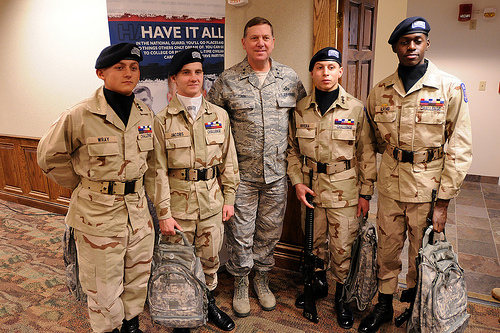
Kentucky’s adjutant general, Maj. Gen. Edward W. Tonini shares a group photo with cadets from Bluegrass Challenge Academy at Fort Knox, Ky., Dec. 13, 2012. Kentucky has two academies in the state, with the second, the Appalachian Challenge Academy operating in Harlan, Ky. (U.S. Army National Guard photo by Staff Sgt. Scott Raymond)
If you go to the website for the Bluegrass Challenge Academy, it has a picture of one of the cadets climbing a wall with the tagline of “Everything they need to pull themselves up.” The program is offered free of charge to its voluntary-only participants.
Its mission, said Burns, is to “intervene in the lives of 16-18 year old high school dropouts, and help them develop life skills, continue their education, and instill self-discipline so they can become productive citizens.” The numbers on their website speak for themselves below:
For Burns though the best part of his job there, is seeing his Challenge Academy graduates here in Africa. Ten of his former cadets became Soldiers and are all doing well here and that makes him proud of what he and his fellow instructors do for a living. They change lives everyday for the better, and those lives continue helping others.
To find out more about the Kentucky Youth ChalleNGe program call 1-877-KYYOUTH (877-599-6884)
Click here to contact the Bluegrass ChalleNGe Academy at Fort Knox, Ky.
Click here to contact the Appalachian ChalleNGe Academy at Harlan, Ky.
Story by Senior Airman Vicky Spesard, 123rd Airlift Wing Public Affairs
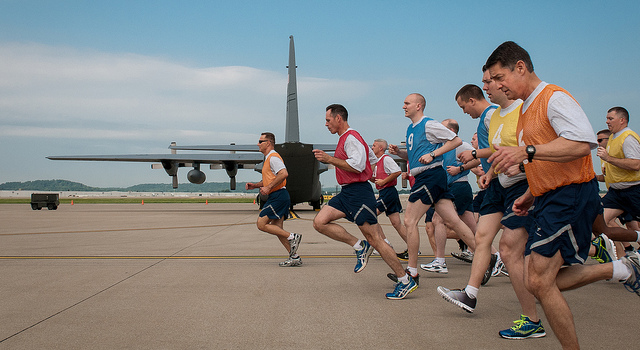
Members of the 123rd Airlift Wing conduct a mass physical fitness test by running on the flight line of the Kentucky Air National Guard Base in Louisville, Ky., on May 19, 2013. The mass testing is designed to improve efficiency while giving Airmen the edge to succeed. (U.S. Air National Guard photo by Airman Joshua Horton)
KENTUCKY AIR NATIONAL GUARD BASE, LOUISVILLE, Ky. — More than 250 members of the 123rd Airlift Wing took their annual fitness tests here April 28 using a new approach designed to improve efficiency while giving Airmen the edge to succeed.
The program, which was three months in the planning, incorporated a seven-stage process that allowed multiple large groups to complete the test in 30 minute blocks, according to Capt. Tiffany Campbell, wing fitness coordinator. Previous tests were held with groups as small as two, making administration more difficult.
“The format that we used is a huge benefit to our wing,” Campbell said. “It helped us bring many non-current fitness members up to a current status, which improves our overall readiness and helps unit commanders keep all of their members on a regular testing cycle.”
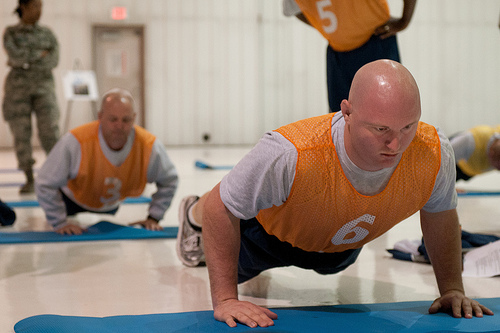
Staff Sgt. Brandon Curry, a firefighter from the 123rd Civil Engineer Squadron, participates in a mass physical fitness test at the Kentucky Air National Guard Base in Louisville, Ky., on April 27, 2013. The mass testing is designed to improve efficiency while giving Airmen the edge to succeed. (U.S. Air National Guard photo by Airman Joshua Horton)
Stage one of the “mass testing” event was a basic check-in where participants were given a score chart and a colored jersey that coincided with a specific testing coordinator who accompanied the member through the testing process. Stage two was the waist measurement.
Stages three and four consisted of pushups and sit-ups in the Fuel Cell Hangar. Mats were provided for comfort, and music played in the background.
The fifth stage was a 1 ½-mile run that took place on the flight line, providing runners with a flat surface and minimal turns to boost running performance.
Stage six returned participants to the hangar, where their final scores were tallied. Airmen with passing scores were dismissed, while Airmen who failed to meet standards proceeded to stage seven, where they were enrolled in a fitness-improvement program.
Each Airman was assigned a specific time to check in, ensuring that all members would test with Airmen from their own units, Campbell said. In total, six chalks lined up for the test.
“The new format is a great improvement,” Master Sgt. Collin King said after completing his test. “It was a more relaxed environment, and there was more comraderie taking the test with people you know, versus taking the test with one or two people you don’t know.”
Under the previous format, wing members were given numerous opportunities to test throughout the year, often in small groups of just two or three people and with members from different units intermingled together. Pushups and sit-ups were conducted in whatever space was available at the time, and the run took place over an uneven road that threaded past parking lots and active vehicle traffic.
“One of the goals of the new format was to give our members the advantage when taking this test,” Campbell said. “They had the flat surface, which allowed them to have a better run. There were people out there cheering on the testers. The morale overall was huge.
“We had so many volunteers who came out to help with the event,” she continued. “Every little effort that went into it showed. We couldn’t have had the success we did without them.”
Story by David Altom, Kentucky National Guard Public Affairs
May is Asian-Pacific American Heritage Month, and the Defense Department takes time to recognize and honor the dedicated service and contributions of Asian Americans and Pacific Islanders, both past and present, through military service in defense of our nation.
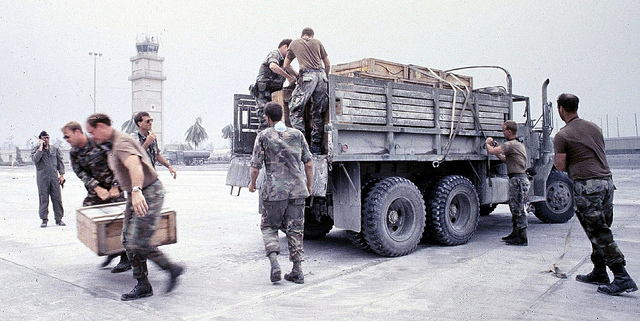
CLARK AIR BASE, Philippines — In 1991 U.S. Air Force and Marine personnel evacuated a truckful of munitions aboard a helicopter at the height of the Mount Pinatubo volcanic eruption at here. Clark AB closed down in November of 1991 ending almost a century of American military presence in the Philippines. (U.S. Air Force photo by Master Sgt. Val Gempis)
FRANKFORT, Ky. — Stacy Pesut’s earliest memories of leaving the Philippines aren’t really hers — she’s heard the story so often from her father, though, that they’ve become part of who she is.
“My dad says he remembers putting me on a duffle bag on the plane,” she says. “I was just a baby then, and he had to stay behind while my mom and I were evacuated.”

June 12, 1991, Mount Pinatubo eruption cloud from Clark Air Base (U.S. Air Force photo by R.S. Culbreth)
It was June of 1991 and Mount Pinatubo had erupted, killing 800 people and leaving 100,000 homeless. The amount of ash and smoke from the volcano was so severe that it actually lowered temperatures around the world for years to come.
Nearby Clark Air Force Base was devastated during the eruption, putting U.S. service members and their families at risk. Pesut was only a few weeks old when her mother and her father made a decision that would change her life forever. She and mom would fly out on a military transport while her dad, a military policeman with the Air Force, remained at his post.
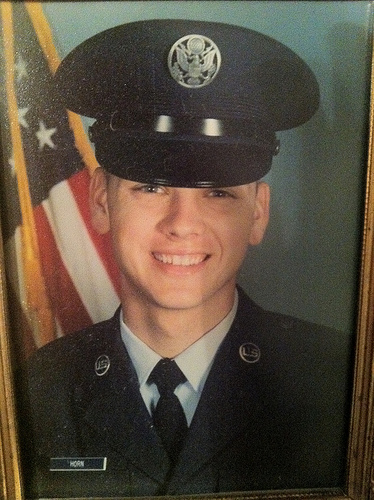
Pesut’s father, Tony Horn, as a young United States Air Force military policeman. Horn stayed behind while Pesut and her mother were evacuated in the wake of the eruption of Mt. Pinatubo, which killed more than 800 people in 1992. Horn is now a sergeant with the 149th Maneuver Enhancement Brigade. (Photo courtesy Spc. Stacy Pesut)
“My dad said it was really hard for him to see us leave,” said Pesut. “And it was really nerve-wracking for my mom because she’d never been away from home. She didn’t know anybody and she barely spoke any English, so it was really difficult for her.”
Pesut and her mother lived with her father’s mother in South Carolina. She was walking by the time her dad made it home. The family eventually settled down in Berea, Kentucky and for years Pesut considered herself a down home “country girl.”
One day that all changed.
“My dad came up to me and said, I think we’re going back to the Philippines for a year,” she said. “He had an opportunity to do some mission work for the church and we all went with him.”
The family had vacationed in the Philippines visiting family, but the idea of completely uprooting and moving to another country was a shock. Pesut joked that one of her main concerns was what they were going to eat.
“Until then my mom would fix two separate meals at home, Filipino food for herself and regular food for the rest of us. When I found out we were going to the Philippines I asked, are we going to have to eat Filipino food all the time?”
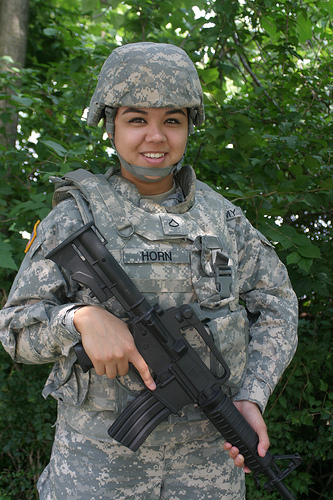
Before she was married, then-Pfc Stacy Horn took part in the Kentucky National Guard’s Be the Elite recruiting program, speaking at schools and helping promote the Guard’s image. (Photo courtesy Kentucky Army National Guard Recruiting)
The one year mission trip soon turned into two years, and that became eight. Pesut adapted to her new home just as her taste buds accepted new eating habits. She was a typical kid, going to school and making friends. Languages were a problem as she only spoke English, and the eastern Kentucky version of that.
“When I first got there they were going to make me do a report in front of the class, only it had to be in Filipino,” she said. “So here’s this little girl talking in this thick southern accent and I thought, I can’t speak Filipino. My uncle helped me write out some stuff, which I read in front of the class. Everybody laughed, saying you don’t pronounce it like that. I came home crying to my mom over that.”
Driven by this experience, Pesut became fluent in the two primary Filipino languages of Tagalog and Kapampangan. She overcame her shyness and became a praise and worship leader in her church, she graduated high school and majored in physical therapy at Angeles University Foundation.
Then came the time to return home. Coming back to the United States was yet another culture shock to Pesut. There was the language, of course, but other, little things were evident. Filipino culture is more conservative, she said, particularly when it comes to dressing modestly and the use of language.

Spc. Stacy Pesut and her classmates at Angeles University Foundation in the Philippines. (Photo courtesy Spc. Stacy Pesut)
“We don’t cuss much,” she said.
Most important was how differently her family interacts.
“It’s taken me a while to get used to how we’re all spread apart here in the states,” she said. “In the Philippines your house is next to your parents’ house, which is next to your grandparents house, and so on. We all live in a sort of family compound where we can get together and support one another.”
After settling down in Kentucky for a second time, Pesut began looking for a way to challenge herself even further. She also wanted to find a way to serve others, her nation in particular.
“I am from the Philippines,” she said, “But I consider the United States my home. I am a servant of God and I wanted a way to help other people.”
After discussing it with her father, Pesut decided to join the Kentucky National Guard. In an unexpected turn, dad not only supported her decision, he took her lead and joined up, too!
“He’d been in the Guard for a while before we went to the Philippines,” she said. “When I told him I wanted to join he said, I think I’ll go, too. So we went to the recruiter together and said, yep, we want to join.”

Spc. Stacy Pesut and her husband Sgt. Christopher Pesut. (Photo courtesy Spc. Stacy Pesut)
Her father, Sgt. Tony Horn, is currently in the 149th Maneuver Enhancement Brigade where he works in communication technology. Spc. Stacy Pesut is a human resources specialist for the Kentucky Army Guard, as is her husband, Sgt. Christopher Pesut.
Aside from her family, Pesut’s strongest connection with her Filipino culture is with food. Her current favorite Filipino food is sisig, a which is a pork dish. Sisig is a Kapampangan term which means “to snack on something sour.” The meat is usually marinated in lemon juice or vinegar, then seasoned with salt, pepper and other spices.
“It’s pretty hot,” she said. “We plenty of chili peppers to spice it up.”
At home she and her husband eat lumpia, which is similar to an eggroll. She also fixes stir fry beef, and according to her husband, “rice on rice on rice.”

Spc. Stacy Pesut (center) with brother Joshua, mother Marifi, grandmother Leticia and brother Joseph. Pesut continues to keep in touch with her grandmother and extended family in the Philippines. (Photo courtesy Spc. Stacy Pesut)
She said it’s difficult to pin down a favorite American dish as she and her family now mostly eat Filipino food.
“Even when we have family gatherings like Thanksgiving and Christmas, my mom fixes food from the Philippines,” she said.
Pushed for an answer, she resorts to an American classic.
“You can’t go wrong with cheeseburger,” she said, laughing.
Story by Sgt. Alexa Becerra, Task Force Longrifles Public Affairs
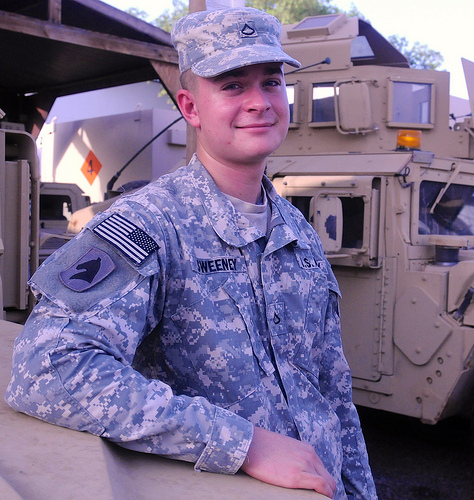
Pfc. Michael Sweeney is the youngest Soldier with Task Force Longrifles on their deployment to the Horn of Africa. Sweeney is also a graduate of the Bluegrass Challenge Academy at Fort Knox, Ky. (U.S. Army National Guard photo by Sgt. Alexa Becerra)
CAMP LEMONNIER, Djibouti - At the age of 17, teenagers face many challenges. They are close to graduating high school, they are looking at potential colleges, and are also about to hit the magic age of 18 when they are considered adults.
That wasn’t the case for Pfc. Michael Sweeney.
At 17, Sweeney, a native of Burlington, Ky., had already enlisted in the Kentucky National Guard. He had recently graduated with his GED from Bluegrass Challenge Academy, a school run by the National Guard designed to train and mentor selected at-risk youth to become contributing members of society.
“The Challenge Academy instilled a sense of discipline in me that I really needed at that time,” said Sweeney. “I wouldn’t be where I am today if it hadn’t been for the Academy.”
After receiving his GED, Sweeney set off for basic training and advanced individual training to become a cannon crewmember (13B) in the National Guard. He returned to Kentucky in April of 2012, and shortly after arriving to his new unit he received news about their upcoming deployment.
“I expected to deploy when I joined the Guard, but I definitely wasn’t expecting it to be so soon, “said Sweeney.
His case was a bit different than others; he was still 17 years old. He would turn 18 only a few days before the deployment.
“My squad leader sat me down and talked to me about the deployment,” said Sweeney. “He asked me if I was still willing to go, and when I said yes he let me know that if I had any questions I could ask him or any of the other Soldiers since most of them had deployed before.”
From that day on, Sweeney became the ‘Baby of the Battery’ and the ‘Baby of the Battalion’. He is the youngest of more than 500 Soldiers deployed here to the Horn of Africa in support of Operation Enduring Freedom.
“It has been different being the youngest,” said Sweeney. “At home I was the oldest out of four, and now I am the youngest out of the battalion.”
He said that his fellow Soldiers have been great mentors to him and they are always willing to give him advice or answer his questions.
“The guys here have all taken me under their wing, and have helped me become a better Soldier and hopefully a better person,” said Sweeney.
Sweeney said he has had many opportunities to learn about different cultures by volunteering in the local community and also from going on a well-drilling mission in Ethiopia.
“This deployment has made me truly appreciate what I have back home, people here don’t have much but they make the most of it,” said Sweeney.
Sweeney has decided to attend diesel mechanic school upon his return home, and plans to stay at least 20 years in the Guard.
“This deployment has been overall a great learning experience for me, and I have made lifelong friends and mentors,” said Sweeney.
Story by J.C. Newton, Kentucky National Guard Marketing Director
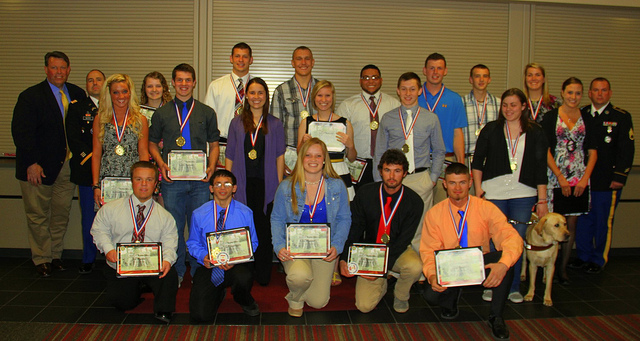
The members of the 2013 Tom Leach All-Resilient Team gather for a group photo during an awards banquet in Louisville, Ky., April 25, 2013. (Courtesy photo)
FRANKFORT, Ky. — “On the 2013 All-Resilient Team we have a blind archer, a deaf wrestler, a dwarfed football player, a bowler who couldn’t use her arms, a stroke victim basketball player, and 3 of our team members will be competing at the college level next year in field hockey, football, and wrestling,” said Mackenzie Hanes, Education Liaison for The Kentucky National Guard. “This year is pretty amazing,”
Alicia Kalbfleisch from Mercy Academy was one of only 22 students from across the Commonwealth named to the 2013 Tom Leach All-Resilient Team. Kalbfleisch was recognized for her hard work and determination in overcoming serious foot and leg issues in order to compete as both an equestrian rider and field hockey player.
“Alicia personifies everything this team is about!” said Hanes. “The Guard is a proud partner in this effort because it exemplifies everything a soldier is about. Resiliency, hard work, and persistence are all qualities of a professional soldier.”
More than 200 team members and their families attended the ceremony at the PNC Ballroom at Papa John’s Cardinal Stadium. The banquet was held in conjunction with the State High School Athletic Directors Awards Dinner.
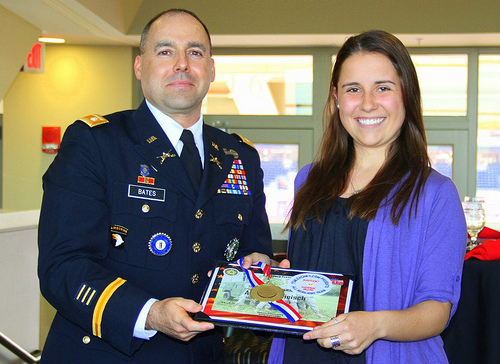
Alicia Kalbfleisch is presented her certificate as part of the 2013 All-Resilient Team by Lt. Col. Fred W. Bates V, commander of 2nd Battalion, 75th Recruiting and Retention during an awards ceremony in Louisville, Ky., April 25, 2013. (Courtesy photo)
“This is such an awesome honor for my child. It’s the culmination of all his hard work and persistence. I am so thankful for Mr. Leach and the National Guard in their efforts to make this occasion one we, as a family, will always treasure.” stated a proud mom.
“A great location, a great meal, and a room full of outstanding young Kentuckians, this was a wonderful evening. Having the opportunity to share these amazing young people’s stories is one of the highlights of my year,” said Tom Leach, the “Voice of the Kentucky Wildcats,” and the creator of the team.
“Alicia is just another example of the type athlete we honor. Not only did she make our team, she has signed to play field hockey at Centre College next fall.”
The formation of the team was a project close to Leach’s heart. As he observed his own son battle kidney issues to play the sport he loved, football. Tom approached The Guard with his idea, and together they formed the team.
This marked the third year for the team. Students across the Commonwealth were nominated by their Athletic Directors. Their nomination is submitted to a committee comprised of Tom Leach’s Office and members of the Kentucky National Guard. The final roster is set, and members of the team submit a highlight video to the Kentucky National Guard for publication on the All-Resilient Team Facebook page.
Follow this year’s team on the All-Resilient Team Facebook page, here.
Story by Senior Airman Vicky Spesard, 123rd Airlift Wing Public Affairs
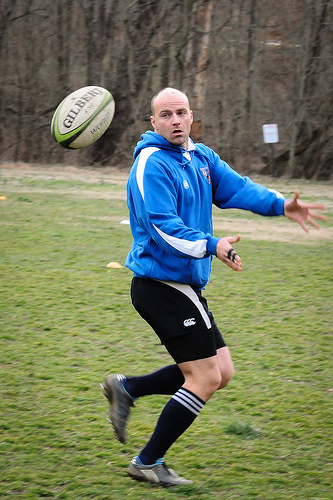
Master Sgt. Russ LeMay, a combat controller from the Kentucky Air National Guard’s 123rd Special Tactics Squadron, practices rugby with the Louisville Men’s Rugby Club in Louisville, Ky., on March 18, 2013. LeMay has played for both the U.S. Air Force and Combined Services rugby teams, and hopes to repeat again this year. (U.S. Air National Guard photo by Airman Joshua Horton)
KENTUCKY AIR NATIONAL GUARD BASE, LOUISVILLE, Ky. — Two yellow goal posts stand quietly in their own zones, one at each end of a glorious field of green marked with bright white lines at 10-meter intervals, waiting for a rugger to ground the ball in the in-goal area for the first five points of the season.
Master Sgt. Russ LeMay, a combat controller from the 123rd Special Tactics Squadron, has been that player for both the U.S. Air Force and the Combined Services rugby teams in past seasons, and he hopes to be again in the upcoming seasons later this year.
A relatively new player to the sport, LeMay says rugby is his passion and that he was hooked from the start.
“I played football all through high school and never really thought of rugby,” the Kentucky Air Guardsman said. “I had a friend invite me out to play with him for the Louisville Men’s Rugby Club in 2009 and I couldn’t get enough. I loved the speed of the game, the strategy and the team work of all 15 players on the field. It is an amazing sport that keeps you going.”
That camaraderie, competition and love of the game is what compelled LeMay to try out for both of the national teams.
“These are high-level clubs,” LeMay said. “Some of these guys are playing for the best teams in the nation. It’s quite a step up from what normal club rugby is around the United States.”
During his off time from the two teams and in between his duties with the Air Guard, LeMay plays with his Louisville squad and has encouraged other Air Guard members to join him.
“So far, we have five guys from the unit who are playing,” he said. “We meet twice a week for practice, games on Saturday, and we always have a great time.”
Indeed, rugby is a growing sport across the United States. In 2012, the number of active registered players has grown to more than 115,000, according to USA Rugby, the sport’s governing body. The National Sporting Goods Manufacturers Association in 2010 ranked rugby as the fastest-growing sport in the nation.
Rugby will also make an appearance at 2016 Summer Olympics in Rio after being absent from the games since 1924.
“Not only is the sport growing here, it has begun to grow more in Kentucky and across parts of the United States,” LeMay said. “ It’s awesome to see.”
Story and photos by Sgt. David Bolton, 133rd Mobile Public Affairs Detachment
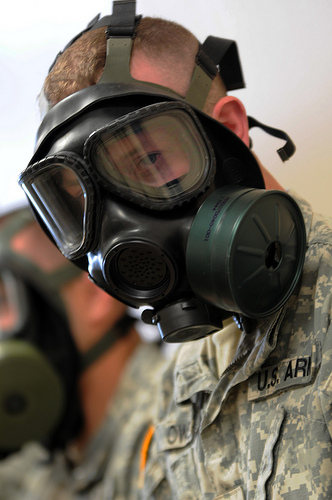
A Soldier from the 1103rd Military Police Detachment based in Brandenburg, Ky., waits to test his M41 gas mask at the Protective Assessment Test Station (PATS) exercise May 13, 2013 at Joint Base McGuire-Dix-Lakehurst, N.J. The exercise was part of the 1103rd’s pre-mobilization training in service of Operation Enduring Freedom to Afghanistan. (U.S. Army National Guard photo by Sgt. David Bolton)
JOINT BASE MCGUIRE-DIX-LAKEHURST, N.J. — Gas! Gas! Gas! Nine seconds. Locate the M41 gas mask. Eight seconds. Remove the mask from the hip pouch. Seven seconds. Press the mask firmly against the face. Six seconds. Pull the face straps over the head. Five seconds. Tighten the straps. Four seconds. Place hand over the air filter. Three seconds. Breathe in to pull the mask tight across the face. Two seconds. Exhale to clear the air in the mask. One second.
Successfully avoid contamination and potential injury.
For approximately 40 members of the Kentucky National Guard’s 1103rd Law and Order Detachment, nine seconds could mean the difference between life and death.
“God forbid a chemical attack happens,” said Sgt. Craig Probus, team leader with the 1103rd from Louisville, Ky. “We have nine seconds to don the masks and make sure it fits.”
As part of their mobilization training, the 1103rd completed the protective assessment test station exercise to prepare for possible chemical, biological, radiological, nuclear or explosive incidents.
During the training, soldiers disassembled their masks into component parts, reassembled the masks and ensured a proper seal around their face so that no outside air could leak into the mask.
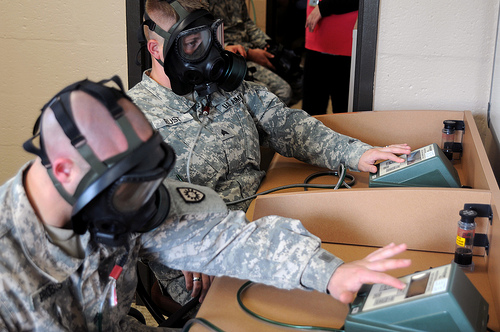
Sgt. Kelli Rust and Sgt. Craig Probus with the Kentucky National Guard’s 1103rd Military Police Detachment, ensure the proper seal of their M41 gas masks at the Protective Assessment Test Station (PATS) at Joint Base McGuire-Dix-Lakehurst, N.J., May 13, 2013. The machines are used to indicate if any ambient air is leaking into the masks which could result in a failure to keep the Soldiers safe should a Chemical, Biological, Radiological, Nuclear or Explosive (CBRNE) incident occur. (U.S. Army National Guard photo by Sgt. David Bolton)
Staff Sgt. William McKinney, squad leader and section chief with the 1103rd, said that the PATS test broke-down into five exercises: normal breathing, deep breathing, moving one’s head side-to-side, moving one’s head up and down, and chewing.
The movements of the head and face the soldiers were required to perform were meant to mimic the normal environment and wear that would be expected to occur if an attack were to happen. In addition to assuring the functionality of the gas masks, the training staff made sure that wearing the masks was comfortable.
“We want to make sure there is comfort in wearing the mask and to make sure that soldiers have some protection in a CBRNE environment,” said Isabella McCloud, lead instructor for the CBRNE/PATS course. “This mask is going to protect you.”
Although “gas, gas, gas” may be three of the most feared words a soldier may ever hear while on duty, knowing that they can put their faith in their protective equipment can keep their battle-minds ready and focused on the mission at hand.
Courtesy the Toledo, Ohio Blade
Story by Tom Henry, Blade staff writer
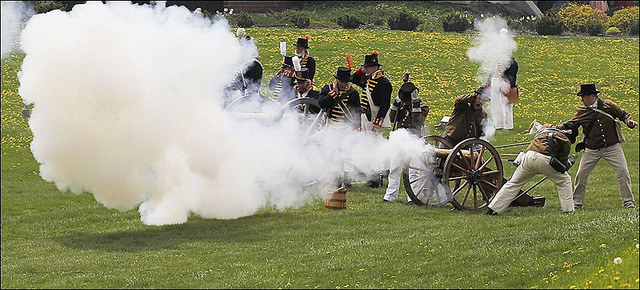
Re-enactors fire cannons to mark the First Siege of Fort Meigs that occurred on May 1, 1813. The celebration that concludes today is anchored at Fort Meigs but activities go on across the river. THE BLADE/LORI KING
Kentucky was a major player in the War of 1812, also known as the Second War for American Independence. Reenactments and ceremonies are taking place across the nation in remembrance through January 2015 of those who gave their lives.
FORT MEIGS, Ohio — Beyond the sounds of musket volleys and cannon blasts, the smells of campfires and gunpowder, the sights of blacksmiths, tents, 19th century soldiers, and drum-and-fife corps, one might reasonably wonder what has drawn throngs of people to Fort Meigs this weekend for a three-day bicentennial celebration of its first siege.
Click here for the original story!
Click here for additional photos!
There’s an obvious love of history. But there’s something more than that.
Brig. Gen. Patrick Dolan, the only chaplain in the Army National Guard who’s a general and one of only 11 chaplain-generals in the entire U.S. military, said such events draw people with an innate curiosity of what it means to bond together as a nation.
“We’re all in this together. It’s about a sense of self-sacrifice instead of entitlement,” Dolan said during an interview moments after helping to dedicate a Kentucky Soldiers Memorial at Fort Meigs. The memorial honors Kentucky soldiers who came north in rugged conditions — at great risk to themselves, with no guarantees — to help Ohio soldiers fight the British and Native Americans in the War of 1812.
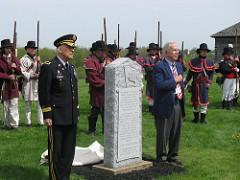
Chaplain (Brig. Gen.) Pat Dolan was on hand to represent the National Guard during the War of 1812 bicentennial reenactment at Fort Meigs, Ohio.
“The whole reason we came here was neighbor helping neighbor,” said Dolan, a member of the Kentucky National Guard and a veteran of Operation Iraqi Freedom.
That feeling of self-sacrifice and neighbor-helping-neighbor also resonates with Larry Nelson, a Bowling Green State University adjunct assistant history professor who has written several books about the Ohio frontier. Mr. Nelson spent 24 years as Fort Meigs State Memorial site manager until his retirement from the Ohio Historical Society in 2004.
“I hope they get a sense of heroism,” Mr. Nelson said after giving a presentation about the War of 1812, during which he said that Americans, Canadians, and British remain divided over why it started, what was accomplished, and who won.
“It’s a war that tells us about ourselves, good bad or indifferent. It’s a war when America was at its best and worst. It’s a war that needs to be remembered,” Mr. Nelson said.
Many people who spoke at Fort Meigs in Perrysburg and at an affiliated event Saturday afternoon at Fort Miamis in Maumee drew parallels and distinctions between the War of 1812 and more recent wars, such as those in Afghanistan and Iraq.
A common denominator has been sacrifice, they said.
“We know that in the natural world all things are connected, and so it is in history. The rich history of Ohio is both amazing and engaging and should not be forgotten,” Steve Madewell, Metroparks of the Toledo Area director said as he opened the Fort Miamis event, in which a marker was dedicated to honor a British regiment.
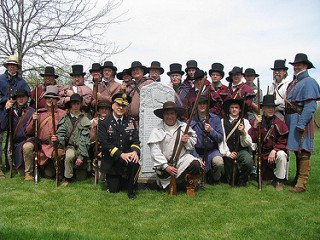
Chaplain (Brig. Gen.) Pat Dolan with some new friends during the War of 1812 bicentennial reenactment at Fort Meigs, Ohio.
The bicentennial celebration, which concludes today, is anchored at Fort Meigs but has included activities on both sides of the Maumee River.
Rick Finch, Fort Meigs site manager, said three years of planning went into the events.
Canadian re-enactor troops fire muskets in a ceremony to commemorate Fort Miamis. Canada was well on its way to nationhood during the War of 1812.
On Friday, 300 schoolchildren and 120 re-enactors interacted during the daytime, followed by a night artillery barrage observed by some 600 spectators.
About 2,000 people attended Saturday’s events at the fort, with a similar number expected today.
Activities begin at 10:30 a.m. and continue through 5 p.m., with the battle demonstration scheduled for 2 p.m.
Admission is $9 for adults, $8 for seniors, and $5 for students. Children 5 and under are free.
Some 625 re-enactors are participating this weekend, held in commemoration of the bloodiest battle at the fort. That’s nearly four times as many re-enactors as many other events there, Mr. Finch said.
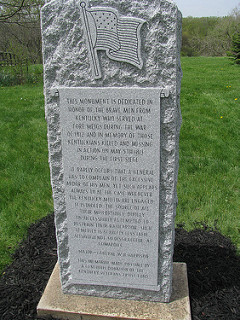
A monument recognizing the Kentucky soldiers who came north in rugged conditions — at great risk to themselves, with no guarantees — to help Ohio soldiers fight the British and Native Americans in the War of 1812.
“It’s been wonderful to have the fort come back to life,” he said. “I hope people get a real appreciation for the sacrifices and hardships. Even though the technology has changed, there is some consistency about the soldiering life.”
Rob Whitman, National Park Service ranger at Perry’s Victory and International Peace Memorial on South Bass Island, described how the Battle of Lake Erie was a turning point in the War of 1812, often viewed as a forgotten war.
Navy Comm. Oliver Hazard Perry’s victory was the first and only time the British lost an entire navy squadron in battle.
The construction of that landmark, a 352-foot peace memorial on South Bass Island, symbolized the desire for a new start. Mr. Whitman and others noted the United States has never been at war with the British or with Canada since.
At the Fort Miamis ceremony, Roy Norton, Consul General of Canada, said Canada wasn’t recognized as a country until 1867 — more than 50 years after the War of 1812 ended in 1815 — but was well on its way to nationhood then.
He said the United States and Canada now reap benefits of sharing the world’s largest nonmilitarized border, including trade. Ohio exports more to Canada than its next 11 export destinations combined, he said.
“Our citizens live with complete confidence they will never be attacked by the United States,” Mr. Norton said. “As allies, best friends, and economic partners, we work together daily.”
Contact Tom Henry at: [email protected] or 419-724-6079.
Story by Sgt. Alexa Becerra, Task Force Longrifles Public Affairs
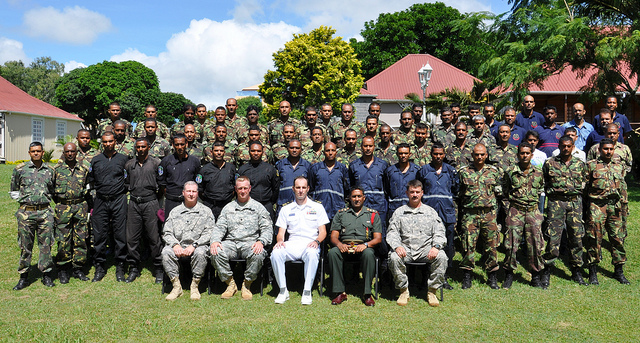
Soldiers of the 2nd Battalion 138th Field Artillery participated in a joint training exercise on the island nation of Mauritius with members of the nations military, April, 2013. The training consisted of classroom instruction on incident command functions, scene size-up safety, structural collapse rescue awareness, search and rescue techniques, shoring basics, and medical triage and treatment. (Courtesy photo)
MAURITIUS – Kentucky National Guard Soldiers from the 2-138th Field Artillery, currently deployed in support of Combined Joint Task Force-Horn of Africa, recently conducted a military-to-military engagement in Mauritius.
Overall, the purpose of the engagement was to familiarize their Special Mobile Forces with our best practices and share techniques used in urban search and rescue operations in order to increase the capabilities of first responders and to enhance partner-nation relationships.
“We were able to rehash what they had already been trained on, yet at the same time we were able to share with them our method of responding to events such as natural or manmade disasters, accidents, and incidents,” said Lt. Col. Rob Larkin, commander of the 2-138th and a native of Maysville, Ky.
“From our stand point, this mission also provided us a baseline to know what kind of detailed knowledge we can provide for them in the future,” Larkin added.
All three Kentucky National Guard Soldiers that participated in this engagement are firefighters and paramedics in their civilian careers, with over 60 years of combined experience in the field.
Lt. Col. Phil Honican, an artillery officer in the 2-138th and native of Lexington, Ky., was mission commander for this exchange and said he was very excited to be able to apply his civilian skill-set to help increase operational and institutional capabilities with East African partner nations.
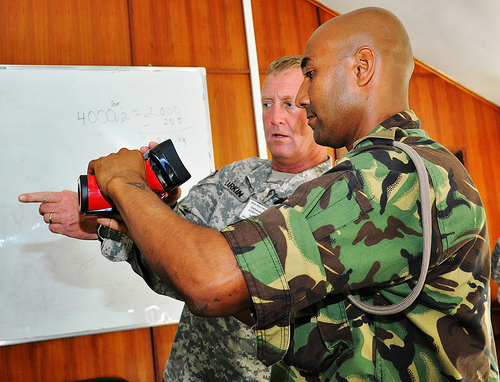
Lt. Col. Rob Larkin, commander of the 2-138th Field Artillery, shows a Special Mobile Force officer how to use a thermal imaging camera in Mauritius. Kentucky Guard Soldiers assisted with the joint military to military training as part of Task Force Longrifles deployment to the Horn of Africa. (Photo by Sgt. 1st Class Jonathon Towles)
By and large, the training consisted of classroom instruction on incident command functions, scene size-up safety, structural collapse rescue awareness, search and rescue techniques, shoring basics, and medical triage and treatment. The Mauritian forces also practiced hands-on methods to apply the new techniques.
“They are a very capable force; it was a very good exchange of information,” said Sgt. 1st Class Jonathon Towles, a cavalry scout attached to the 2-138th and native of Corsicana, Tx. “This mission provided the Mauritian forces with a unique skill set and capability that the U.S. has brought to the table, and I believe it would be beneficial to both nations to continue to work together in depth,” said Towles.
In addition, both militaries were able to share lessons learned from past experiences that helped contribute to the Mauritius Disaster Response Plan.
From here on, both nations look forward to continuing this relationship and sharing knowledge to enhance their capabilities.
“The mission ended with a sense of partnership and mutual respect,” said Towles.
Advice by Regina Harris, Kentucky National Guard Joint Family Support Assistance Program, Military Family Life Consultant, Personal Financial Counselor
FRANKFORT, Ky. — From the early years and beyond teach children these two truisms; keep in mind that you will likely repeat these fairly regularly (I know I do):
1. Money does not grow on trees
2. You don’t earn money just for breathing
It’s never too early to teach kids the importance of handling money. Well, almost never …. (Photo by Ellie Waters, Kentucky National Guard Visual Information)
With those two truisms firmly in mind, let’s get some general guidelines down. I like to be sure children know that while you can do lots of things with money they all fall in three (3) categories. The categories are in no particular order really, but conventional wisdom and some households do place more value on one category more than the others. They are Save, Give and Spend. If you all look at your own spending, you will see each item fits in one of these categories. While it would seem prudent to add a Waste or Blow category that is not necessary as those items fit in the spend category.
When children are young, I’d say up to at least 16 years old, you set the percentage for each category. The key is to help them form a habit of saving and giving. Let’s face it we don’t have to teach them to have a heart for spending; our culture helps us out on that front. The habit training around the spend category is to plan your spending. Yes, keep a list of things you want or need and always spend off that list. This training keeps children and dare I say adults from impulse buying or wasting money. On the spend list it is okay to add some blow money. You can even build a habit into that; chose an amount or percentage of money that belongs to no item in particular.
Another general guideline is that all money is up for division. This is true because we want to reinforce what we said earlier, that 1) Money does not grow on trees and 2) You don’t earn money just for breathing, right? I know the argument with this guideline, so let’s deal with it first.
1. Gifts of Money and Found Money Let’s face it; it happens birthdays, Grandparents, finding money and any other reason, sometimes strangers give them money just because they’re cute! Why you ask, must they Save and Give this money. In a word, consistency. To form a habit, consistency is a must. The goal is to train our children so they will never be broke (the save habit) and to never be selfish (the give habit). Moving on-
2. Allowance Refer back to truisms 1 and 2; money does not grow on trees and you don’t earn money for breathing. Allowance should not be granted but earned. On a personal note: our daughter does not earn money for regular household chores. We chalk chores up to you live here, so you help take care of the house. However, Always offer age appropriate opportunities for the children to earn some money. Some age appropriate activities are: for the very young: helping pickup after a younger sibling or delivering folded laundry to the appropriate bedrooms. A bit older children can clean out the car or organize a junk drawer. Much older children can do bigger jobs like wash and wax the car, clean out the garage or basement, make the grocery list or clean the outside of ground level windows on the house. There are a ton of activities that go above basic house cleaning duties to which a monetary value can be attached. Also, for those parents that are self-employed, they can actually employ their older children, which will allow that child to start an IRA. Woo Hoo!
While I am on the allowance subject I would be remiss not to mention paying for grades. This is a highly charged argument that is personal. My personal opinion, which by the way is not shared by my husband, is that I don’t agree with paying for grades because they only benefit the child. Let me soften that by saying that I do praise for hard work and good grades, by allowing my child to do things other than sleep, eat, do chores and go to school. When school is on-track (not perfect grades) just diligently working, doing her best; she is allowed extra curricula activities. As I said, this is a personal family issue, so you decide. My only advice: if you do decide to pay for grades is to be consistent. For example, don’t only pay if you have extra money or if they also had perfect behavior, unless that was part of the agreement already.
3. Living under your roof, but think they are grown-up Before, we pretty much directed their extra money for them. Now it is okay to loosen the reigns and teach responsibility about money. While you can still encourage and hope the habits of saving and giving formed, you could no longer require it. It may be time to open or allow them to now manage a savings account. Another, bigger responsibility is to give them their own clothing allowance to manage. Now they may negotiate or you may initiate saving for a class ring, Prom or a car. A checking account won’t be available without an adult until they are 18 years old, but they can manage a fictitious checkbook using their spend category money.
In closing, let me say that all the financial training in the world will be useless if the habits you are trying to teach are not modeled for them by the people they watch most closely, you the parent.
For more information email Regina at [email protected] or give her a call at 502-548-4836.