Pages
Stay In Touch
More
© 2013 KentuckyGuard
dwa
The Soldiers and Airmen of Agribusiness Development Team 2 have been deployed for nearly a year working with Afghan farmers with the mission of developing the local agricultural economy and stabilizing their war-torn nation. The Kentucky Guard team is scheduled to return home later this spring. Photo Courtesy ADT 2.
Bagram, Afghanistan – Kentucky National Guard troops stationed in northern Afghanistan joined basketball fans around the world in celebrating the win that sent the University of Kentucky Wildcats to the Final Four.
According to Col. Hunter Mathews, commander of Agribusiness Development Team 2, “All is right with the world at the moment. Go Cats!”
Members of the Kentucky Air National Guard's 123rd Civil Engineer Squadron are currently stationed at Bagram Airfield conducting firefighting operations, emergency management and explosive ordnance disposal. Photo courtesy the 123rd CE.
Click here to see the video shout out from the 123rd Civil Engineer Squadron
mjo
By Sgt. Paul Evans,103rd Brigade Support Battalion Unit Public Affairs Historian Representative
Soldiers of the 103rd Brigade Support Battalion and 1204th Aviation Support Battalion huddle around a computer at Wendell H. Ford Regional Training Center on March 5, 2011 during training on the Blue Force Trackersystem. The BFT is a vehicle mounted computer system designed to monitor Troops’ locations while on missions and communicate with other Soldiers. BFT training is an essential part of unit preparedness should the 103rd ever be called upon to serve the Commonwealth.
GREENVILLE, Ky. — The weather rolled in like a lion March 5 at the Wendell H. Ford Regional Training Center in Greenville, Ky., but the rain and wind didn’t stop Soldiers assigned to the Kentucky National Guard’s 103rd Brigade Support Battalion from perfecting their communications skills.
With the battalion’s high-speed radio and satellite systems, the Harrodsburg, Danville and Frankfort-based Soldiers refreshed their skills on the Single Channel Ground and Airborne Radio System and Blue Force Trackers, which are both essential to providing coordination between troops during times of disaster and deployments.
“When we are called upon to support and complete a mission, communication will be critical to make sure no one gets left behind,” said Capt. Elizabeth Chamberlain, signal officer for Headquarters and Headquarters Company, 103rd BSB.
Chamberlain said the exercise served as a way to establish signal procedures at each of the units and to train to standard upon those procedures. Also, she said, the exercise allowed Soldiers from each of the three units to work together and establish camaraderie between the units under the battalion.
The Soldiers covered the proper way to set up mobile communications satellites necessary to establish phone, radio and internet connections so that all units can communicate with the headquarters element – which is essential training considering the 103rd support the World Equestrian Games in September 2010 and the Ice Storm of 2009.
A Soldier with the 103rd Brigade Support Battalion explores a computer that is part of the Blue Force Tracker (BFT) system. The BFT is a vehicle mounted computer system designed to monitor Troops’ locations while on missions and communicate with other Soldiers. BFT training is an essential part of unit preparedness should the 103rd ever be called upon to serve the Commonwealth.
“This is a great opportunity for the 103rd to work up on their radio and communication skills with the Soldiers who know the systems best,” said Master Sgt. Jeffery McCrystal, HHC 103rd BSB.
dwa
Photos courtesy Mike Groves, Central City Times-Argus.
Greenville, Ky. – Kentucky National Guard firefighters teamed up with their civilian counterparts for some hands on training at the Wendell H. Ford Kentucky Training Center on Saturday, March 19.
The class, which simulated a propane tank fire, was taught by Johnny Walker, state training instructor. Members of the 176th, 177th and 178th Firefighting Teams trained with nearly 100 firefighters from Greenville, Central City, Graham and Bremen.
Staff Sgt. Jimmie Evans, 177th Firefighting Team, said it was a great experience for the Guardsmen to work with civilian firefighters.
Members of the Kentucky National Guard firefighting teams after a hard day of training with their civilian counterparts.
“We really like training with the state agencies and local fire departments,” he said. “It helps us learn how they do business so if we get called out together we’re all familiar with each other’s techniques, procedures and equipment.”
The Kentucky Guard teams have full spectrum firefighting and rescue capabilities, to include wildland fires, fire prevention services, high angle rescue and aircraft firefighting.
“We’re one of the best kept secrets in the Kentucky Guard,” said Evans.
The teams’ services are not limited just to the WHFRTC. During the 2009 ice storm the Guardsmen were put on state active duty and supported the Greenville fire department, responding to automobile accidents and several house fires.
###
dwa
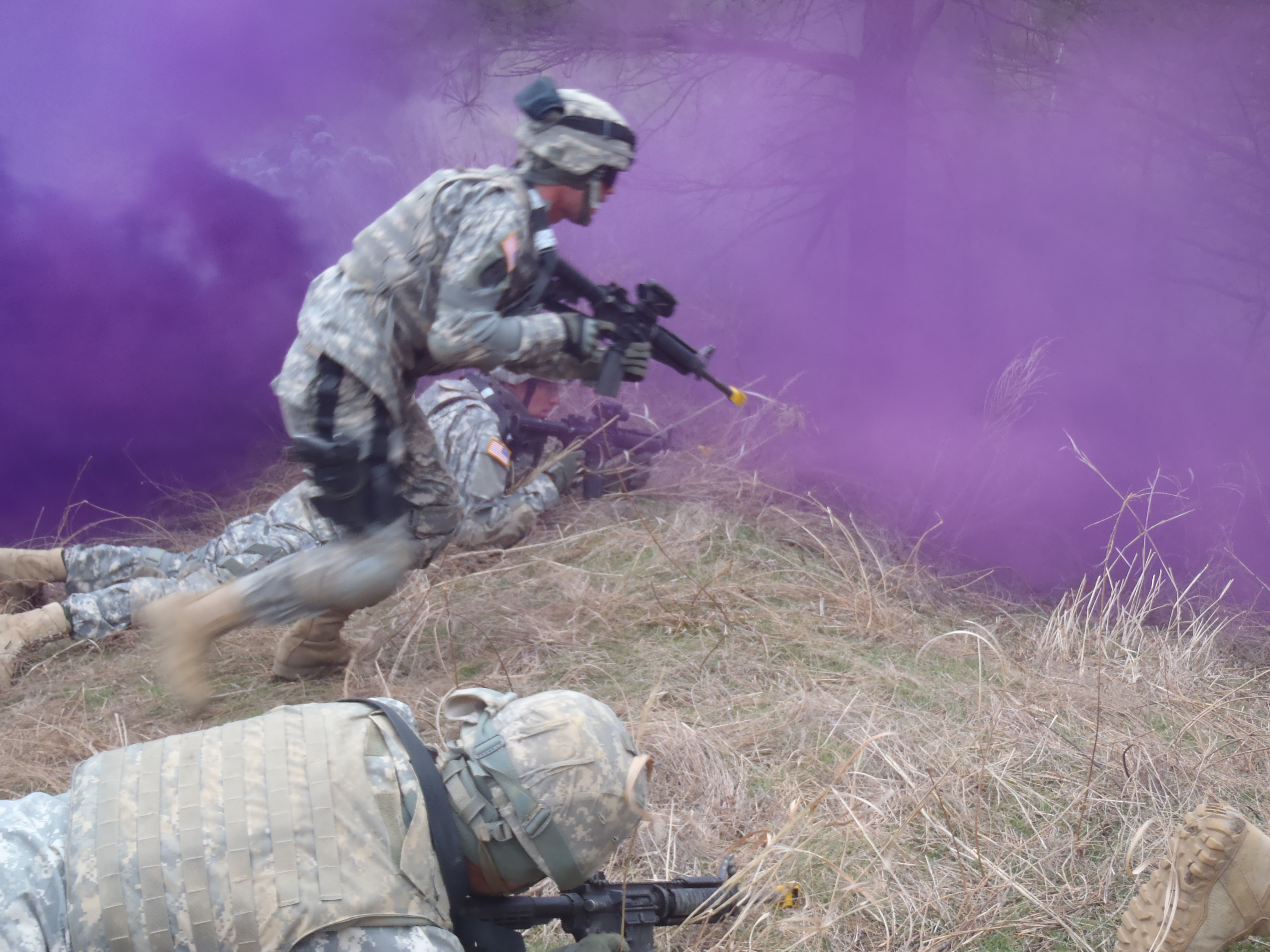
Kentucky Army National Guard Staff Sgt. Travis Rudd dashes toward an enemy machine gun position while Command Sgt. Maj. Victor Blair (opposite side) and Maj. John Schmitt provide suppressing fire during squad ambush training at the Wendell H. Ford Regional Training Center on Feb. 18, 2011. The three Soldiers belong to Agribusiness Development Team 3, which is preparing to deploy to Afghanistan later this spring. Squad ambush lane training tests Soldiers on basic squad tactics and individual movement techniques that the unit had received prior to mobilization. Photo courtesy Kentucky Army National Guard Pre-mobilization Training Assistance Element Team, Wendell H. Ford Regional Training Center.
mjo/keh
By Spc. Will Bolton, 133rd Mobile Public Affairs Detachment
dwa
Kentucky Army National Guard Field Maintenance Shop #3A is open and ready for business in Burlington, Ky. The shop offers wheeled vehicle maintenance, equipment recovery support and minor welding and fabrication for military vehicles. Photo by Warrant Officer Candidate Alexander Maloney, Headquarters Battery, 138th Field Artillery Brigade.
Burlington, Ky. – Kentucky National Guard troops in Northern Kentucky don’t have as far to drive to get their vehicles worked on thanks to a newly opened maintenance facility in the region.
Located in Burlington, the 5,897 square foot Field Maintenance Shop #3A is closely located to the future home of the 1204th Aviation Support Battalion. The shop is staffed by five full-time Soldiers and has 38,000 square feet of parking, most of which is fenced.
Staff Sgt. Roger Rucker prepares a load handling system – which is built on a hemmet chassis - for annual service. Rucker is a mechanic assigned to Field Maintenance Shop #3A. Photo by Warrant Officer Candidate Alexander Maloney, Headquarters Battery, 138th Field Artillery Brigade.
According to Lt. Col. Anthony Adams, the new FMS will save time and money for the Guard as well as the taxpayer.
“There was a genuine need for closer maintenance support to the units in northern Kentucky,” said Adams. “They were being supported from the field maintenance shop in Lexington, which was over an hour and a half away. That meant too much windshield time was wasted in driving back and forth for the troops, time that would obviously be better spent working on equipment.”
While maintenance on wheeled vehicles is the primary service offered by the shop, limited welding and minor fabrication can also be performed. The staff can also provide equipment recovery support, which means they can retrieve vehicles that break down on the road or in the field. This service is available to all military vehicles, including convoys passing through Kentucky.
In addition to routine maintenance for local units, the new shop will also increase readiness during state emergencies and natural disasters, which is good news for the local citizens.
The new Burlington field maintenance shop also has a spill containment pad which is used to contain spillage from leaking vehicles and military fuelers. These pads have proven essential in protecting the environment and alleviate the need clean up spills. Photo by Warrant Officer Candidate Alexander Maloney, Headquarters Battery, 138th Field Artillery Brigade.
“It’s important that we respond efficiently and effectively,” said Adams. “We are, after all, the first line of defense for our communities.”
FMS #3A will also have an economic impact on local businesses. In addition to leasing the building, the maintenance crews will make local purchases of common hardware and repair parts from civilian vendors as well as employ some tire repair services.
###
dwa
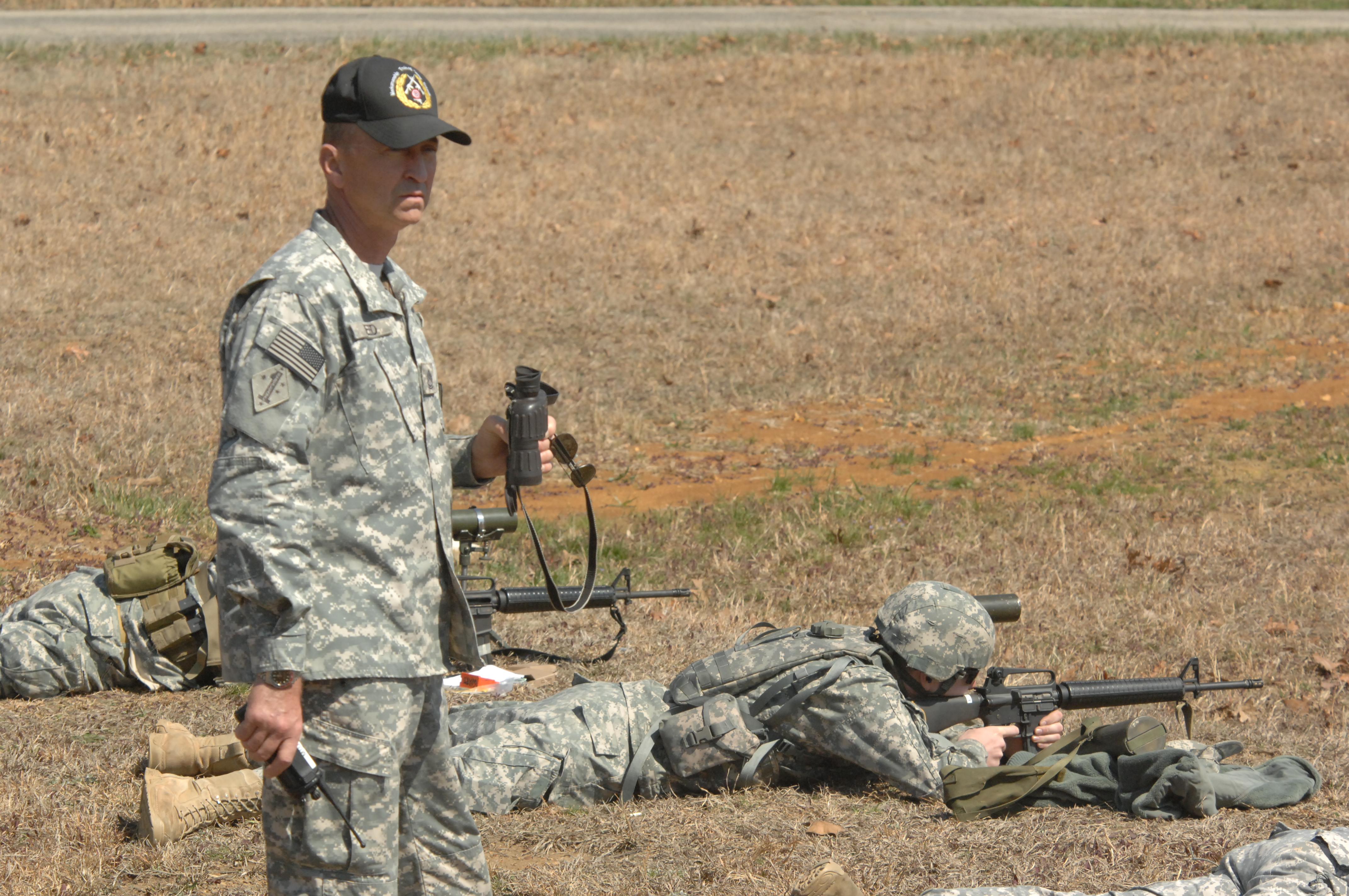
Sgt. First Class Chuck Reed oversees an Army National Guard shooting team on the range at Arnold Air Force Base near Tullahoma, Tenn. on Mar. 17. The team was preparing for the All Army Shooting competition at Fort Benning, Ga., which is being held this week. Army National Guard marksmanship teams are divided into seven regions designated by the Marksmanship Advisory Council. Reed, a member of Joint Forces Headquarters, is the coach for the team representing MAC Region 3. Photo courtesy Sgt. 1st Class Clinton Wood, Tennessee National Guard Joint Headquarters Public Affairs Office.
keh
By Army Spc. James Wilton, Task Force Red Bulls
Army Col. Hunter Mathews, Kentucky National Guard Agribusiness Development Team commander, speaks to Afghan soybean farmers about their farms during the inauguration ceremony for the Afghan Soybean Farmers Association at the Kapisa Governor’s compound March 17, 2011. The Kentucky ADT purchased seed and fertilizer for the farmers earlier this year. (U.S. Army photo by Spc. James Wilton) (Released)
KAPISA PROVINCE, Afghanistan - The Afghan Ministry of Agriculture, Irrigation and Livestock, and Nutrition and Education International, held an inauguration ceremony for the Kapisa Soybean Farmers Association at the governor’s compound March 17.
“Cooperation among farmers is the key to progress in Kapisa and throughout Afghanistan,” said Army Col. Hunter Mathews, Kentucky National Guard Agribusiness Development Team commander.
“Your formation of a soybean cooperative signals a great day for agriculture in Kapisa. By working together you will share in expertise, funding, and the use of soy processing equipment at a much lower cost than you would as individuals. This cooperation will make a positive difference in your success.”
The Kentucky Agribusiness Development Team joined the more than 100 Afghan farmers and representatives from the MAIL and NEI for the ceremony. The Kentucky ADT provided seed and fertilizer to the farmers earlier this year.
“By pulling together and working together, you are helping to turn Kapisa into one of the most progressive and promising agricultural areas in Afghanistan,” said Mathews.
“When I go home to Kentucky and America, I will speak often of the hard-working farmers of Kapisa who have banded together to make this province a more prosperous and productive community.”
The MAIL will oversee the association in Kapisa, while the most experienced soybean farmers from the province will serve as directors.
Kapisa is the first province to form a soybean farmers association, but not the last. Soybeans are currently grown in all Afghan provinces, while northern provinces like Kapisa and Parwan boast the highest production rates.
The MAIL and NEI held a similar ceremony in Parwan Province on March 19 for the inauguration of a Parwan Soybean Farmers Association. The Republic of Korea Provincial Reconstruction Team – which is paying for and building a soy milk factory in the province –attended.
NEI, based out of Pasadena, Calif., tested different crops from 2003 to 2005 for one that would be viable in the Afghan climate and a strong contender in the fight against malnutrition. Soy was selected for its high protein content and ability to flourish here.
This was the first time Afghan farmers had seen or grown soybeans.
“The Kapisa Soybean Farmers Association has joined together in order to educate the people of Afghanistan about the malnutrition and the way to fight it, which is with soy,” said Iman Muhammad Arif, Kapisa director of Agriculture, Irrigation and Livestock.
“Soybeans can be made into many healthy foods like milk, oil, naan bread and cookies. All of which are healthy and rich in iron and protein.”
To help make soy a common food source in homes across the country, NEI provides classes on processing and cooking soybeans to Afghan housewives.
“The fight against malnutrition must be fought in the homes and by each and every person in Afghanistan,” said Dr. Steven Kwon, President of NEI.
“To rebuild Afghanistan, people have to work hard and study hard. If you make people healthier through better nutrition, then they can work harder and study harder.”
He said the high demand and market price of soybeans coupled with the growth potential makes it a viable cash crop; making it a legal alternative to growing opium for Afghan farmers.
In 2009, Afghan farmers began producing enough soybeans to compete with other international farmers. These high numbers earned one farmer, Gluam Said, the award of Best Afghan Farmer in 2010.
Kwon said Afghanistan’s goal is to produce 300,000 tons of soybeans produced by 2015. He said he believes this is the amount that will end malnutrition in Afghanistan.
“You are making an important step for the future of Afghanistan. Because of you, Kapisa will defeat malnutrition, Afghanistan will defeat malnutrition,” said Kwon.
MJO
Story by Sgt. Bryan Ploughe, 1/623d FA
Sgt. 1st Class Chad Jones, 1/623rd FA, shoots pop up targets at a qualification range on Wendell H. Ford Regional Training Center in Greenville, Ky.
GREENVILLE, Ky. – Through the rain, wind and dropping temperatures, Soldiers assigned to the 623rd Field Artillery pushed their bodies and weapons to the limits March 5-6 at the Wendell H. Ford Regional Training Center in Greenville, Ky.
Though she gave her best effort, Mother Nature couldn’t deter the Kentucky National Guardsmen from taking their positions, loading their weapons and sending rounds down range for the annual weapons qualification. “We will talk about this day again,” said battalion commander Lt. Col. Jeffery Hughes.
“The leaking rubber boots and the MRE heaters that wouldn’t warm the meals properly,” he said.“Each of our Soldiers dealt with difficult conditions, but the morale of our troops remained high.”
The Soldiers arrived at WHFRTC at 7: 30 a.m. when the high temperature for the day had already been reached. Temperatures quickly dropped into the 30s with 15-to-20 mph winds.
The first iteration of Soldiers just completed zeroing weapons when the rain picked up. Through the downpours and sideways stinging rain, more nearly 300 Soldiers qualified for the yearly weapons requirement.
“This weather was horrible, but, everybody fired pretty well,” said Spc. Wesley Harrison, fire direction specialist. “I think we were motivated to get off the range quickly.
Kentucky Guardsmen uses the virtual weapons Engagement Skills Trainer at Wendell H. Ford Regional Training Center in Greenville Ky.
“We have to be out here once a year to stay proficient with our individual weapons, so we can deal with this for one day,” he said.
In addition to qualifying with the M16, a team of 50 Soldiers also trained and qualified with the M240B Squad Automatic Weapon.
Utilized since the Gulf War, the SAW is capable of firing 750-to-1000 rounds per minute with an effective range of 1800 meters.
“This weapon is awesome. The rate of fire and the accuracy that this weapon offers is something to get excited about,” said Spc. Jesse Mascoe, a fire direction specialist.
Hughes said the ability that each qualified Soldier displayed was professional and proof that the 623rd is ready for any mission in the future.
Particularly rainy ones.
“This weekend was a great display of the intestinal fortitude of our Soldiers to qualify in austere conditions without complaint,” he said. “The 623rd is filled with professional and capable Soldiers.”