
Pages
Stay In Touch
More
© 2013 KentuckyGuard
Story by Capt. Stephen Martin, Kentucky National Guard Public Affairs
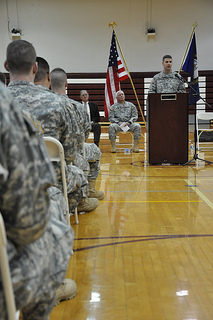
Capt Adam Evans, 149th Vertical Construction Company Commander addresses friends and family at the unit’s departure ceremony in Cynthiana, Ky., Feb 2. The Soldiers will be deploying to Afghanistan for the year. (U.S. Army National Guard photo by Capt. Stephen Martin)
CYNTHIANA, Ky. — The Kentucky National Guard held two departure ceremonies for the Soldiers of the 149th Vertical Construction Company over the weekend, one in Cynthiana and one in Olive Hill, Ky., as they prepare for a 9-month deployment to Afghanistan in support of Operation Enduring Freedom.
To see all the photos from this event, please click HERE.
“We are very fortunate to have our non-commissioned officers that have the experience of multiple deployments and truly uphold the values of the NCO Creed,” said Capt. Adam Evans, 149th VCC Commander. “I can truly say that the NCO’s of the 149th are the hard and tough backbone of this company, and will make this deployment a success.”
The 149th Vertical Construction Company is comprised of Soldiers trained in the necessary skills — masonry, carpentry, electrical etc. — to construct barracks, offices and other buildings. The unit is expected to return home sometime in late December of this year.
“I want to recognize the families, the parents, the husbands and wives and the children of these great Soldiers,” said Brig. Gen. Mike Richie, Kentucky National Guard Joint Force, Land Component Commander. “They will face the unknown for the next several months, and right now they are doing it with the kind of dignity and strength usually found in what we think of as heroes.
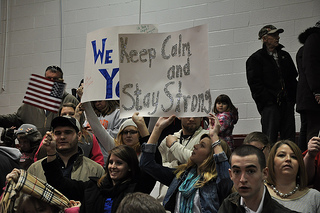
The Kentucky National Guard held a departure ceremony for the Soldiers of the 149th Vertical Construction Company on Saturday Feb. 2, in Cynthiana, Ky. The Soldiers will be deploying to Afghanistan for the year. (U.S. Army National Guard photo by Capt. Stephen Martin)
The unit deployed previously in 2008-2009 as part of the 201st Engineer Battalion mission to Afghanistan. Soldiers also supported last year’s tornado recovery effort in Salyersville and Menifee County.”Friends and family, you came today to honor these Soldiers and you’ve done that.” commented Kentucky State Representative Tom McKee. “Soldiers, Godspeed.”
Story by Sgt. 1st Class Thomas Elmore, 1123rd Sapper Company, Operations NCO
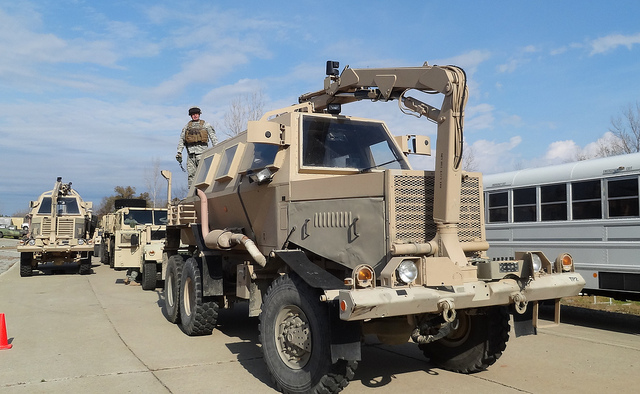
Soldiers of the 1123rd Engineer Company train on the Buffalo Surrogate Vehicle as part of their train-up for Route Clearance operations in Afghanistan. The Buffalo is a Mine Resistant Ambush Protected Vehicle with a hydraulic arm used to interrogate suspected Improvised Explosive Devices.(KYNG photo by Sgt. Kelly Burch, 1123rd Unit Public Affairs Historian Representative)
FORT KNOX, Ky — The 1123rd Engineer Sapper Company of Leitchfield, Kentucky had the opportunity to receive some practical hands on training at Fort Knox, Ky., Nov. 3, 2012. The 1123rd continually trains to remain proficient on demolition, obstacle emplacement and reduction as well as mobility and counter-mobility operations.
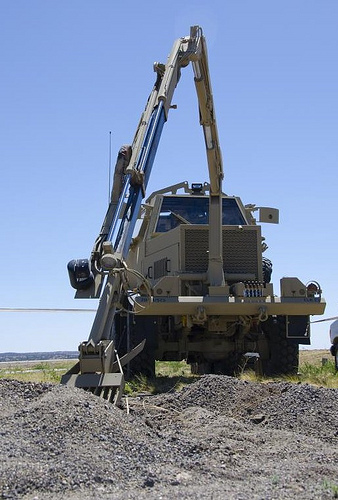
Soldiers of the 1123rd Engineer Company train on the Buffalo Surrogate Vehicle as part of their train-up for Route Clearance operations in Afghanistan. The Buffalo is a Mine Resistant Ambush Protected (MRAP) Vehicle with a hydraulic arm used to interrogate suspected improvised explosive devices.(KYNG photo by Sgt. Kelly Burch, 1123rd Unit Public Affairs Historian Representative)
The training mission of the 1123rd was to conduct route clearance operations during the training. The Soldiers received vital training and experience by being able to, for the first time, use recently acquired Buffalo armored vehicles or MRAP (Mine-Resistant Ambush Protected). The Buffalo was built for protection from IEDs and up to 45 pound landmine explosion under any wheel.
“As a sapper company this was the first time we’ve had a chance to focus collective training solely on route clearance missions,” said Sgt. 1st Class Geoffrey Gleitz. “From task organization to planning and then to the execution of our mission, all focused around route clearance. As a platoon we were able to start developing SOPs based off of our training, previous experiences and current TTPs.”
According to Soldiers of the unit, the sappers’ aggressive nature allows them to adapt to any mission the Army hands out. Only a handful of the Soldiers in the 1123rd had any experience in route clearance. They relied on their leadership, embedded expertise, and natural drive for success to complete the training.
This was the first time the 1123rd had the opportunity to incorporate the Buffalo for training on a training weekend. Individually, Soldiers were instructed by members of Counter IED Integration Cells on hand held detection systems. Soldiers also received several briefs that were supported by Kentucky’s Pre-deployment Training and Assistance Element.
The 1123rd is gearing up for a potential deployment to Afghanistan in 2013.
“Continued mission focused training like this will allow us to develop as we prepare for future operations,” said Gleitz.
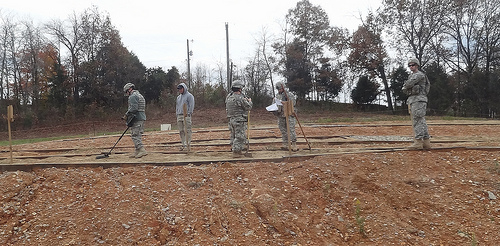
Soldiers of the 1123rd Engineer Company soldiers are instructed by members of Counter IED Integration Cells on hand held detection systems at Fort Knox, Ky., Nov. 2, 2012.(KYNG photo by Sgt. Kelly Burch, 1123rd Unit Public Affairs Historian Representative)
Story by Sgt. Cody Stagner, 133rd Mobile Public Affairs Detachment
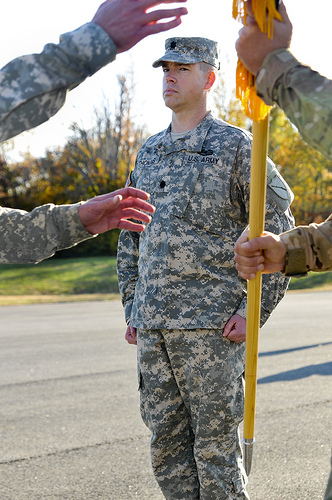
Kentucky Army National Guard Lt. Col. Scott C. Thomas waits for the 751st Troop Command guidon to be passed from former 751st battalion commander, Lt. Col. Brent A. Wilkins, at Wendell H. Ford Regional Training Center in Greenville, Ky., Oct. 27, 2012. Lt. Col. Thomas assumed command of the battalion during a change of command ceremony. (Kentucky National Guard photo by Sgt. Cody Stagner, 133rd Mobile Public Affairs Detachment/Released)
GREENVILLE, Ky. -The Kentucky Army National Guard’s 751st Troop Command welcomed Lt. Col. Scott C. Thomas as battalion commander during a change of command ceremony at Wendell H. Ford Regional Training Center in Greenville, Ky., Oct. 27, 2012. Thomas, a Louisville native, is currently the full-time Assistant Chief of Staff for the Kentucky National Guard.
Thomas replaced the outgoing commander, Lt. Col. Brent A. Wilkins.
“As a lieutenant colonel, the culminating responsibility is that of being the battalion commander,” said Thomas. “So, I am thrilled to take this command.”
To see more photos from the change of command, click here.
Units from the 751st joined at WHFRTC over the weekend for their first mission together under the new command. Soldiers from the battalion came from all over the state to complete soldier training and individual weapon qualification.
Soldiers are already taking notice to a new era of command.
“I first met him while at the firing range this weekend,” said Spc. John R. Kelly, a member of the KYARNG 202nd Band. “We talked with him for a couple minutes about how he was in the band. That was pretty cool.”
Kelly, a native of Union, Ky., valued the connection he made with his new commander and honored him by playing the French horn at Saturday’s ceremony.
“I am a very approachable officer,” said Thomas. “I like the feedback from the soldiers. Everyone brings something to the table. I relish when someone asks me to address a problem and I turn right around and say, ‘What’s your solution to that problem?’”
Thomas has plenty of experience leading soldiers. In the past 25 years, his long list of commands include leading troops during deployments to Afghanistan and Kosovo, and a stateside deployment for relief during Hurricane Katrina.
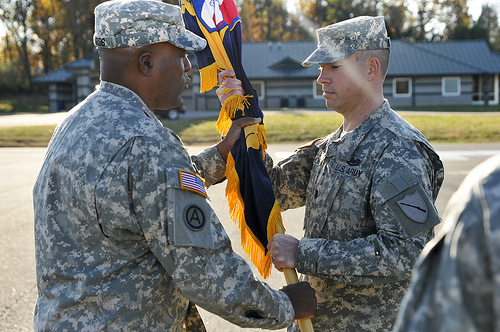
Kentucky Army National Guard Col. John Edwards, Commander of the 75th Troop Command passes the guidon of the 751st Troop Command to, the commander of the 75th Troop Command, during a change of command ceremony at Wendell H. Ford Regional Training Center in Greenville, Ky., Oct. 27, 2012. Lt. Col. Thomas assumed command of the 751st. (Kentucky National Guard photo by Sgt. Cody Stagner, 133rd Mobile Public Affairs Detachment/Released)
“It has been a long battle,” he said. “But, it has been worth it every step of the way.”
Thomas’ past will be paving the road for his battalion’s future.
“The future always has change,” he said. “Specifically, with two realignments of brigades that will affect the 751st. So, over the next two years we are going to see a transition for the battalion. I want to see it transition well and smooth without too much interruption in its daily mission. The 751st’s priorities and missions will not change. They will always be a support battalion for the units they serve.”
The 751st Troop Command comprises of six companies: 202nd Band, 307th Maintenance Company, 1163rd Medical Company, 2113th Transportation Company, 2123rd Transportation Company and 133rd Mobile Public Affairs Detachment.
Command Sgt. Maj. Pat Copas, the full-time J3 operations sergeant major for the Kentucky Guard, joined Thomas as the new leading noncommissioned officer for the 751st, replacing Command Sgt. Maj. David Arvin.
“(The) 751st Troop Command has a reputation of excellence, and I want to be a part of that team,” said Thomas. “They have an amazing staff, and the companies under them are simply dynamic in what they do. I am proud to be here.”
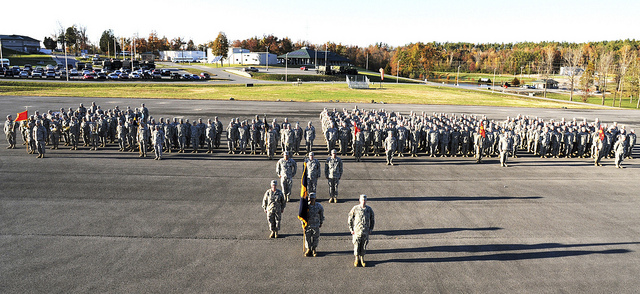
The Kentucky National Guard 751st Troop Command joins together for a battalion photo at Wendell H. Ford Regional Training Center in Greenville, Ky., Oct. 27, 2012. The battalion also recognized Lt. Col. Scott C. Thomas during the change of command ceremony earlier that day. (Kentucky National Guard photo by Pfc. Lerone Simmons, 133rd Mobile Public Affairs Detachment/Released)
Story by Sgt. Scott Raymond, Kentucky National Guard Public Affairs
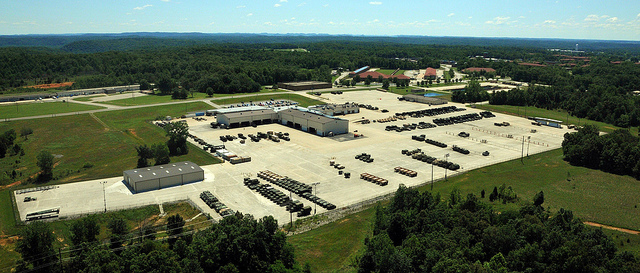
Aerial view of the Kentucky Army National Guard’s Maneuver Area Training Equipment Site at Fort Knox, Ky. The facility received the 2012 Army Award for Maintenance Excellence for Region III, a competition with 13 other states. (Photo by Chief Warrant Officer 2 Greg Scott)
FORT KNOX, Ky. — On the edge of the Fort Knox garrison, military vehicles and equipment sit in clean, straight lines next to ordinary maintenance buildings that line the roads. A majority of those vehicles are ready for service, thanks to the extraordinary work of the Soldiers in those buildings who maintain them.
One such building is the Kentucky Army National Guard’s Maneuver Area Training Equipment Site (MATES), whose Soldiers were recently recognized for running one of the best maintenance facilities in the National Guard.
In competition with 13 other states, the Kentucky facility placed first to win the 2012 Army Award for Maintenance Excellence (AAME) for their region, in the TDA (Table of Distribution Allowances) Small category.
“This award is a true measurement of everything this facility has accomplished, from maintenance to safety to community involvement,” said 1st Lt. Timothy Lee, Assistant MATES Superintendent.
In August, the site submitted its packet for consideration at the National Guard level. Shops across the country were graded on mission readiness, training, hazardous material management, resource management and recycling, to name a few categories.
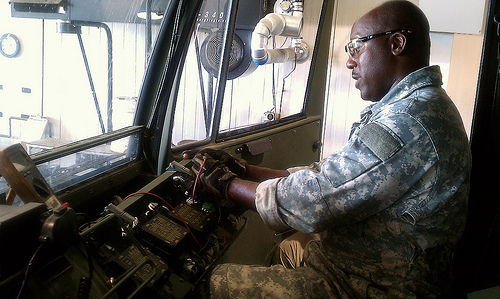
Master Sgt. Aaron Young, a Surface Maintenance Mechanic Inspector with HHB 623rd Field Artillery, troubleshoots an electrical fault in a M1078 vehicle at the Maneuver Area Training Equipment Site at Fort Knox, Ky. The facility employs 51 Kentucky Guardsmen full-time supporting Kentucky units and neighboring states.(Photo by Chief Warrant Officer 2 Greg Scott)
Lee said changes put into effect over the past year have really made an impact in the overall operation.“We have redefined our workflow process,” he said. “Redefined everyone’s jobs and job duties and implemented an inspection section for all aspects of work.”
Improvements in cost savings and site management have produced numbers worthy of national attention. The last eight months of the fiscal year saw a 300 percent increase in productivity per person over the previous year. All while 15 Soldiers of the 51-man workforce were deployed overseas.
Lee said they are working toward cost savings by changing the way they order parts. Instead of ordering whole repair kits for vehicles, individual parts were ordered. In complying with the Army Oil Analysis Program, which addresses the usage of vehicle and equipment fluids, Lee estimates that Kentucky saved $51,000 in man-power in just one year, while saving around $105,000 in products.
The site also has decreased its electrical needs thanks to installed solar panels that help provide power to the building. The panels contributed to a decrease of 31.5 percent in electric energy usage. Their inventory has nearly 400 less products on hand than last year.
“We have truly been able to do more with less in this fiscally constrained environment,” said Lee.
A number Lee said the whole MATES is proud of is its 96.6 percent organizational readiness rate from last year. This means that only 3.4 percent of the entire fleet was down for maintenance for more than one month consistently. This covers vehicles and equipment used in support of drill weekends, annual training periods or pre-mobilization training during the year for Kentucky units as well as National Guard units from Tennessee, Pennsylvania, Indiana and North Carolina.
“Our participation in the AAME competition has had great command emphasis and has been a critical ingredient to establishing an organizational culture that highlights the necessity of a rock-solid maintenance program,” said Lt. Col. Timothy Pickerrell, MATES Superintendent. “I am honored to lead this facility and to be a part of this hardworking group of technicians.”
1st Sgt. Douglas Hall is also proud of his Soldiers at the MATES, and gives a lot of credit to the leadership for “keeping everyone on track”. He said his command’s collective effort to improve the operation and boost morale is well received in the building and increases the motivation of the Soldiers to do a better job.
“Because of the way everything is organized and flows so well, we have maintained productivity,” said Hall. “Each shop is seeking even more work.”
Hall isn’t shy about acknowledging the accolades, knowing he’s part of a special operation that represents the Kentucky National Guard on a national level.
“If you want to see what a successful maintenance operation looks like, look at us.”
In addition to the MATES facility, the Central City-based 307th Component Repair Company also won first place in their regional unit category and will participate nationally later this year in an Army-wide competition.
Story and photos by Sgt. Paul Evans, KY ADT 4 Unit Public Affairs and Historian Representative
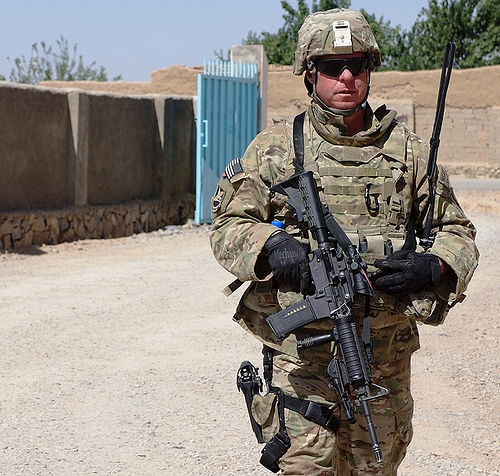
Staff Sgt. Jeff Ward of Georgetown, Ky. conducts a roaming patrol during a mission in southern Afghanistan on May 25, 2012. Ward, a member of the Kentucky National Guard’s Agribusiness Development Team 4, serves in Kentucky with the Louisville, Ky. based 123rd Contingency Response Group. (U.S. Army photo by Sgt. Paul Evans)
FORWARD OPERATING BASE PASAB, Afghanistan — Air Force Staff Sgt. Jeff Ward, a 43-year-old Georgetown, Ky. resident, got his first taste of military service 25 years ago. Originally spending seven years in the infantry and special operations with the Marine Corps, he has since spent the past six in security forces with the Air National Guard’s 123rd Contingency Response Group in Louisville, Ky.
In between the Marine Corps and the Air Force, Ward made a brief stop as a military policeman with the Kentucky Army National Guard, with which he deployed to Iraq in 2004. He also spent in six months in Baghdad, Iraq working as a civilian contract for Blackwater Security.
As a civilian, Ward is a federal officer with the Federal Protection Service. He also runs a small bodyguard company on the side called Internal Solutions, Inc. which he founded in 2009.
Now Ward brings his experience to the Kentucky National Guard’s Agribusiness Development Team 4 to help with various aspects of security.
“I’m a TC (truck commander), I taught the PSD (personnel security) and I run the ranges,” Ward said.
“All of my civilian training and military training helped me out on this mission. My age, my experience, because I’ve been through all of this before…it’s easier to tell (instruct) people that haven’t been through this.”
“Jeff (Ward), he’s an awesome guy,” said Air Force Staff Sgt. Raphael Williams of Louisville, Ky. “He’s always laughing, just joking. You always see a smile on his face.”
“He’s (Ward) just nuts. I like him, though,” added Air Force Staff Sgt. Austin McDonald of Louisville, Ky. “From his experiences, he knows personal security details pretty well. He’s taught us a lot about that, so it’s good to know.”
Ward said his previous stints have helped him learn how to discuss deployment with his 8-year-old son Micah and 9-year-old daughter Abby.
“I’ve deployed before, so I knew how to talk to my kids about me leaving,” Ward said. “My family…they understand it too. All the time in the military and all the times I went over before helped me deal with family better.”
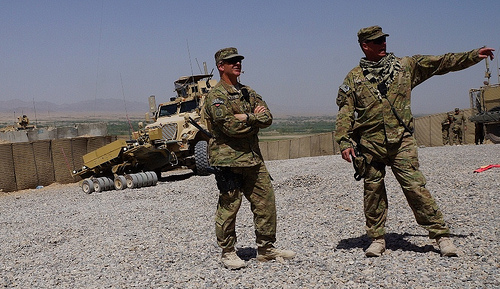
Staff Sgt. Jeff Ward (right) of Georgetown, Ky. advises Master Sgt. John Black (left) of Frankfort, Ky. on operation of a weapons range during a mission in southern Afghanistan on April 2, 2012. Ward, a member of the Kentucky National Guard’s Agribusiness Development Team 4, serves in Kentucky with the Louisville, Ky. based 123rd Contingency Response Group. (U.S.Army photo by Sgt. Paul Evans)
“It’s been kind of slow, but it’s been alright,” Ward said of the mission in Afghanistan. “I like a lot of the people here. There are a lot of good people in this unit.”
“They’re people you’re able to talk to, spend time with, somebody to hang out with,” Ward noted. “Somebody I can go overseas and hang out with, have fun with.”
Ward looked forward to returning home to continue training and continue working. He said he is scheduled to continue his military knowledge with attendance at new Air Force courses.
Story and photos by Sgt. Alexa E. Becerra, 2/138th Public Affairs
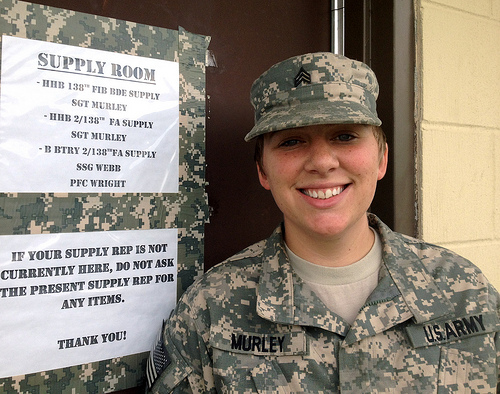
Sgt. Stephanie Murley, supply sergeant for 2nd Battalion, 138th Field Artillery, stands in front of her office door at Camp Atterbury, Ind., Sept. 16, 2012. Murley prepared for her third deployment overseas as Task Force Longrifles prepared to deploy to the Horn of Africa. (Kentucky National Guard photo by Sgt. Alexa Becerra)
CAMP ATTERBURY, Ind. - What images come to mind when you think of a combat veteran of two different wars? Perhaps a tall, muscular GI Joe, with a high and tight? Or do you conjure up a picture of a young Soldier at the airport, tears falling softly down his cheek as he is hugging his wife for the first time in a year, after a long combat tour?
It’s probably unlikely that the image of a young, 5-foot, 7-inch tall woman, with bright-blue smiling eyes popped into your mind.
Unless, of course, you know Sgt. Stephanie L. Murley.
Murley is a supply sergeant for Headquarters and Headquarters Battery 2nd Battalion, 138th Field Artillery. She is also about to become a veteran for the third time. At 24-years-old, she has completed one tour in Iraq, one in Afghanistan and now is preparing for her third deployment — this time to the Horn of Africa.
In Iraq, she worked as a supply clerk for B Battery, 2/138th. Even though it was her first deployment, she wasn’t scared.
“I started out working nights when I was in Iraq, then I shifted to days. I picked up a lot of supplies, dropped off reports and assisted in inventories,” said Murley.
“Life was pretty routine there, you had to find entertainment in the small things that most of us overlook,” she said. “I remember the first time it rained, we had no idea what was going on. All the females got up and went outside and got very excited.”
In Afghanistan with Agribusiness Development Team 1, her job changed a bit. She dealt with weapons, ammunition, and a bit of supply.
“If a weapon went down, I’d fill out the paperwork to take it to the armor and get it fixed. I also assisted in sensitive item inventories and ordering supplies for the Security Forces,” said Murley.
Afghanistan was a bit different experience when it came to feeling safe though.
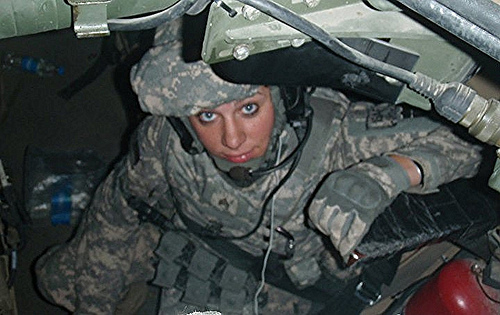
Sgt. Stephanie Murley poses for the camera in Bagram, Afghanistan in 2010 while serving on her second tour of duty overseas. She serves as a supply sergeant for Task Force Longrifles who are scheduled to deploy to the Horn of Africa in October. (Courtesy photo)
“Unlike Iraq, in Afghanistan we would get mortared almost every night,” said Murley, as she dropped her face and looked to the ground. “There were a few nights that I would pray to God and say, ‘please let me wake up in the morning.’”
Murley joined the Kentucky National Guard in 2006, at the age of 17. She joined because her grandfather, an Army veteran himself whom she greatly admired, had been in the military. His nobility and humility as a former Army man inspired her.
“It’s empowering to know I can do anything these guys can do,” she said.
Murley is not your typical one weekend a month and two-week summer training National Guardsmen, or woman if you will. She wears the uniform year-round. When she is not at her unit, she works full-time as a supply technician for the Kentucky Guard’s Central Issue Facility in Frankfort, Ky.
Along with being a Soldier and a technician for the Kentucky Guard, she is also the wife of Sgt. David Murley who is with Headquarters Battery, 1st Battalion, 623rd Field Artillery and is scheduled to deploy overseas in January. They got married in May of 2011, shortly after their return from Afghanistan.
“I’m going to miss my husband a lot,” said Murley, who stopped smiling. “This will be the longest we’ve been apart since we started dating.”
But Murley remains positive about this upcoming deployment, although she says she doesn’t know what to expect, because it will be very different than her tours in Iraq and Afghanistan.
“The job is stressful, don’t get me wrong. But the sense of accomplishment when it’s all said and done makes all the sacrifices worth it.” said Murley, that smile appearing once more. “I’m honored to be a female veteran.”
Story and photos by Sgt. David Bolton, Kentucky National Guard Public Affairs Office
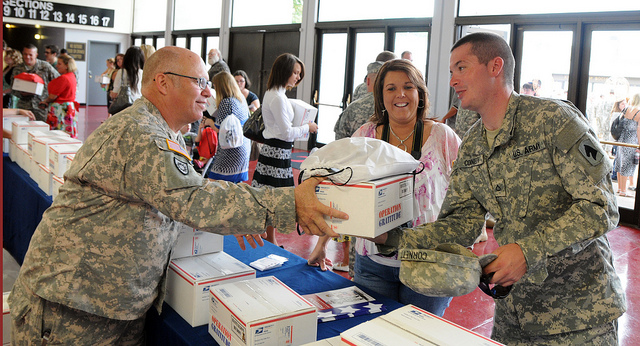
Chaplain Brent Kelly, Kentucky National Guard Yellow Ribbon Program Manager, passes out care packages to Families of Soldiers deploying with the 2nd Battalion, 138th Fires Brigade to the Horn of Africa at the Frankfort Convention Center in Frankfort, Ky., Aug. 31, 2012. The boxes contained teddy bears and books that could record the Service member’s voice as they read and be played back at any time. (Kentucky National Guard photo by Sgt. David Bolton)
FRANKFORT, Ky.— As Soldiers of the Kentucky National Guard’s 2nd Battalion, 138th Field Artillery prepared to serve their country abroad, the Guard’s Yellow Ribbon program prepared to serve the Families of these service members at home.
More than 500 care packages with special gifts for the Families of the deploying Soldiers were presented to children, spouses, aunts, uncles and grandparents prior to the farewell ceremony for the 2/138th Aug. 31, 2012 at the Frankfort Convention Center.
“The boxes have a teddy bear with a recordable book in it so that the Soldier can read it and record their voice so that the child can have that while they’re gone,” said Linda Jones, Child & Youth Programs Coordinator. “There is also a memory box that the kids can decorate and put things in that their parents send to them or something that is important to them.”
The boxes provided a way for the children and Families to stay connected and maintain ties with loved ones throughout the duration of the deployment.
“The bags have all sorts of goodies so the kids wind up having a really good connection with their parents who are deploying and spouses wind up feeling supported,” said Chaplain Brent Kelly, Yellow Ribbon Program Manager.
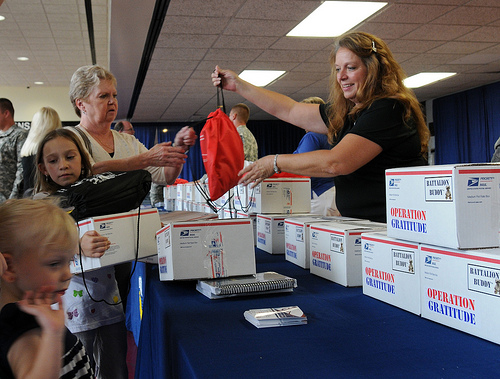
Workers with the Kentucky National Guard’s Yellow Ribbon Program pass out care packages to families of Soldiers deploying to the Horn of Africa at the Frankfort Convention Center in Frankfort, Ky., Aug. 31, 2012. (Kentucky National Guard photo by Sgt. David Bolton)
Supplying care packages isn’t the only thing that the Kentucky Guard Yellow Ribbon Program does however. They also provide National Guard and Reserve Members and their Families with information, services, referral and proactive outreach opportunities throughout the entire deployment cycle.
“Anytime a spouse has any kind of problem, if a child is having trouble in school, if they can’t pay their electric bill, maybe they’re stressed, anything you can think of, they can call and get help from somebody,” said Jones. “We want the spouses to think of Family Programs as their extended family, we’re there for them when their spouse is gone.”
This isn’t the only type of event that the Yellow Ribbon Program has provided to the Service members of the Kentucky Guard.
“We support Operation Military Cheer, Summer camps; we have a whole host of other events throughout the year to support Kentucky Guard Families,” said Kelly. “We understand what the Soldiers are going through and we are happy to support them and their Family because we in the Kentucky Guard are a Family.”
For those interested in finding out more about the Kentucky National Guard’s Yellow Ribbon Program, you can contact Ms. Kim Coyle at 1-502-607-1177
or visit http://www.jointservicessupport.org for more information.
Story and photos by Sgt. Paul Evans, KY ADT 4 Unit Public Affairs and Historian Representative
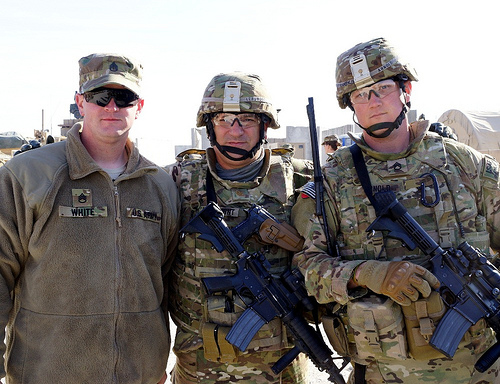
Pictured left to right: Staff Sgt. Charles White of Perryville, Ky., Maj. Walter Leaumont of Lexington, Ky., and Staff Sgt. Mark Arnold of Harrodsburg, Ky. get together for a photo prior to a mission with the Kentucky National Guard’s Agribusiness Development Team 4 prior to a mission in southern Afghanistan on February 14, 2012. The three Soldiers are also full-time staff members for Harrodsburg’s Headquarters and Headquarters Co. 103rd Brigade Support Battalion, 138th Fires Brigade. (U.S. Army photo by Sgt. Paul Evans)
FORWARD OPERATING BASE PASAB, Afghanistan — While most of Harrodsburg, Ky.’s 103rd Brigade Support Battalion, 138th Fires Brigade is back in Kentucky serving its citizens, they can’t help but remember a small team from their battalion is halfway across the world.
This team of nine Soldiers from across the 103rd Battalion deployed to southern Afghanistan as part of the Kentucky National Guard’s Agribusiness Development Team 4, taking with them the skills developed in the 103rd. Altogether, Soldiers from the 138th Fires Brigade as a whole make up more than one-fifth of ADT 4’s members.
“Most of the full-time staff has taken on the other duties that we normally didn’t have in order to continue our throughput,” said Frankfort, Ky. resident Capt. Brian Mattingly, the 103rd’s Battalion Administrative Officer. Three of the deployed 103rd members also serve as full-time staff back at the 103rd BSB Headquarters in Harrodsburg, Ky.
In addition to the nine unit members with ADT 4, the 103rd has more than a dozen Soldiers either deployed or preparing to leave for areas ranging from Afghanistan to Kuwait to Africa.
“Almost all of the Soldiers volunteered for those deployments,” Mattingly said. “That is the testament to the great leaders that we have in the 103rd BSB. Our Soldiers are the best in the state and always answer the call, day or night.”
“When I came in we had several people that volunteered for the mission, people that I had front line visibility on,” recalled Maj. Walter Leaumont of Lexington, Ky., ADT4’s Executive Officer.
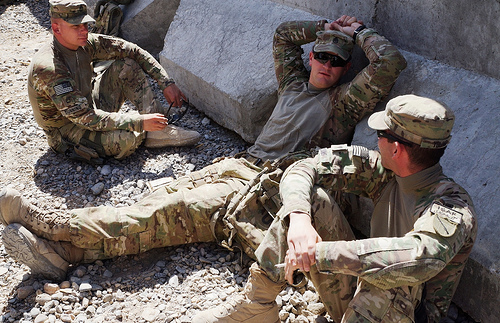
Staff Sgt. Charles White of Perryville, Ky. (center) takes some time to rest during a mission in southern Afghanistan alongside Spc. Christopher Young (right) of Richmond, Ky. and Sgt. 1st Class Greg Dunning (left) of Almo, Ky. The three Soldiers are members of Kentucky National Guard’s Agribusiness Development Team 4. (U.S. Army photo by Sgt. Paul Evans)
“They’re playing a vital part, just because we came in just a bunch of different people from different units, and it was nice having that core of 103rd personnel that I knew that were working well with each other,” Leaumont added.
“The war had been going on for almost 11 years, and it was time I went with them,” reflected Staff Sgt. Charles White, a Perryville, Ky. resident. Before leaving he worked as a full-time network administrator for Headquarters and Headquarters Co. 103rd BSB.
“It’s been a learning experience on positive and negative aspects of being a Soldier,” White added. “Just being a Soldier in itself is a challenge, but it’s actually pretty nice being around some familiar faces.”
“Maybe it’s seeing other aspects of their personality that you really don’t see back home,” White said about challenges of deploying with other 103rd members. “But all-in-all it’s just actually getting to know them even better.”
The 103rd troops with ADT 4 consist of: Staff Sgt. Michael Watts of Danville, Ky., originally from Co. A, Danville; Staff Sgt. Charles Yankey and Sgt. Randy Sewell of Frankfort, Ky. from Co. B, Frankfort; Master Sgt. John Black of Lawrenceburg, Ky. from Co. B; Staff Sgt. Mark Arnold of Harrodsburg, Ky., Staff Sgt. Charles White of Perryville, Ky., Sgt. Jeremiah Kwiek of Mt. Washington, Ky., Sgt. Paul Evans of Richmond, Ky., and Maj. Walter Leaumont of Lexington, Ky. from Headquarters and Headquarters Co. in Harrodsburg.
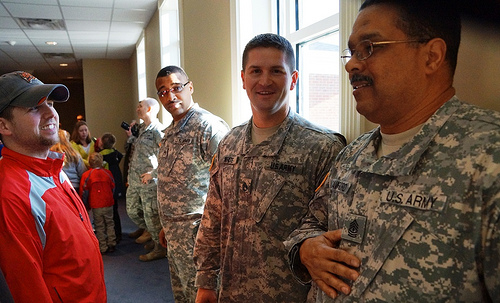
Members of Headquarters and Headquarters Co. 103rd Brigade Support Battalion, 138th Fires Brigade show support for their peers at a departure ceremony in Frankfort, Ky. on January 3, 2012. A total of nine 103rd BSB Soldiers currently serve in southern Afghanistan with the Kentucky National Guard’s Agribusiness Development Team 4. Pictured from left are: Sgt. 1st Class Anthony Tudor of Lancaster, Ky.; Staff Sgt. Jesse Davis of Lexington, Ky.; ADT 4 member Staff Sgt. Charles White of Perryville, Ky.; and First Sgt. James Crawford of Danville, Ky. (U.S. Army photo by Sgt. Paul Evans)
“With the use of media sharing outlets such as Facebook we are able to track their well-being and talk to them through the use of emails,” Mattingly said of keeping in touch with his deployed Soldiers.
“I talk to Mattingly probably once or twice a month just to check in,” Leaumont noted.
Asked whether he’s looking forward to getting back home to the 103rd, White offered an emphatic “yes.”
“I don’t know how to elaborate on that,” he said. “I’m looking forward to getting back home. We’ve got a great working group there. Everybody gets along-it’s a really nice working environment.”
“It’s always a relief to get everyone back home-not just Kentucky Soldiers and Airmen, but also everyone who has ever deployed or had duty overseas away from home,” Mattingly said.
Story by Maureen Rose, Editor, The Gold Standard
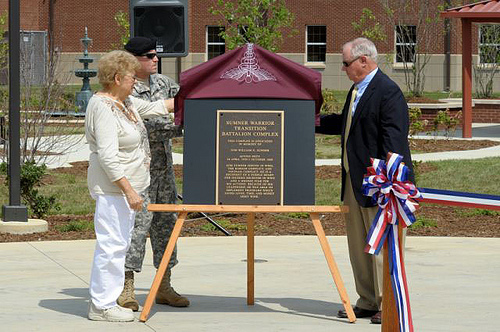
Del Sumner, Col. Bruce Jenkins, commander of U.S. Army Garrison at Fort Knox and Bill Sumner Jr. unveil a dedication plaque naming the warrior transition unit facility after the late Sgt. Maj. William Sumner in Fort Knox, Ky., Sept.5, 2012. (Photo by Stephen Moore, courtesy of The Gold Standard)
FORT KNOX, Ky. — Fort Knox dedicated its new Warrior Transition Battalion facility by naming it after a former U.S. Army Armor Center noncommissioned officer, Sgt. Maj. William Sumner, Sept. 5 with an audience of nearly 300, comprised of Soldiers, civic leaders and representatives of local veterans’ service organizations.
The new facility includes the Soldier and Family Assistance Center, administrative buildings, a dining facility, barracks and a turf field for exercising. Located across the street from Ireland Army Community Hospital, the complex is designed to be convenient as well as modern.
“We now have a quality campus for our wounded warriors,” said Col. Bruce Jenkins, garrison commander of Fort Knox, “and it’s very appreciated. It’s almost a one-stop shop for our wounded warriors.”
The ceremony did more than introduce the audience to the amenities of the complex.
“We’re equally proud of Sgt. Maj. Sumner who served more than 30 years in a career that spanned World War II, Korea, and Vietnam,” Jenkins said, reading details of Sumner’s biography provided by Sumner family members, the guests of honor at the day’s festivities. “He was awarded the Bronze Star with oak leaf cluster as well as the Purple Heart. He was obviously a Soldier and a leader who set the example for others to follow. Even after his retirement, he remained active by volunteering with the Disabled American Veterans, staying focused on taking care of troops.
“Sumner’s daughter, Sherry Brinegar, is a nurse case manager at this very complex, so Sumner is the perfect name for this facility,” he said.
After the unveiling of a portrait of Sumner and plaques that memorialized Sumner, Maj. Gen. Jeff Smith, commander of U.S. Army Cadet Command and Fort Knox, told the audience what an honor it was to pay respect to a hero like Sumner.
“But let me say this up front, it’s not really about the bricks and mortar,” Smith said. “It’s the human beings — the care providers, counselors, chaplains — who will help these Soldiers recover from their illnesses, injuries, wounds; $46 million has been invested in this complex, but it would be worth nothing if not for them.”
Smith invited a round of applause to thank health care providers who rarely receive enough thanks for all their hard work.
While the facility contains many state-of-the-art technologies, Smith said it was due.
“The Army recognizes that service to our country can take a toll; this has been a long time coming, but it’s what we owe our Soldiers,” he said. “You will marvel at the resources we provide for Soldiers to recover, but our Soldiers deserve this more than you can imagine. They deserve the best.”
Wounded warriors, Smith explained, have one job while they’re assigned to a WTB.
“Soldiers will work to heal their bodies, their minds, their souls; their sole mission is to recover,” he explained for those visitors to the installation. Addressing the complement of WTB Soldiers, Smith reminded them, “It’s your job to get healthy; it’s our job to resource that recovery.”
After the ribbon cutting, leadership declared the Sgt. Maj. William E. Sumner complex was officially open for business. Visitors were invited to tour the new buildings and talk with Soldiers and civilians who man the complex.
The Kentucky National Guard directly assists with the command and operation of the Warrior Transition Battalion at Fort Knox. In addition to the battalion commander, Lt. Col. Dwight Lewis, several Kentucky Guardsmen serve the unit in a variety of roles to provide the proper care to Soldiers utilizing the facility. According to the battalion command staff, the Kentucky Guard is in an appropriate and strategic position to support and maintain the program as it also supports Citizen-Soldiers who have been wounded and injured in the global war on terror.
Story and photo by 123rd Airlift Wing Public Affairs
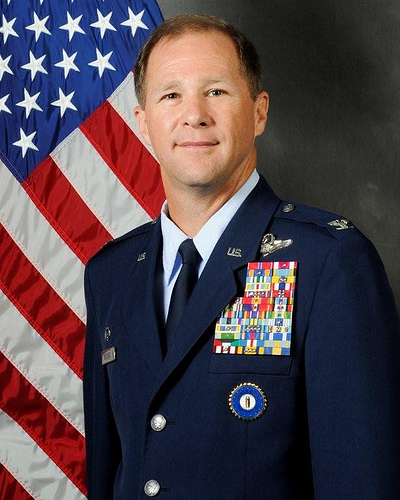
Col. Steven Bullard was named the new chief of joint staff of the Kentucky National Guard by Maj. Gen. Edward W. Tonini, Kentucky’s Adjutant General, Aug. 23, 2012. (Photo by 123rd Airlift Wing Public Affairs)
FRANKFORT, Ky. — Col. Steven P. Bullard has been selected as the next chief of staff at Headquarters, Kentucky Air National Guard, the adjutant general announced Aug. 23. Bullard, who currently serves as vice wing commander of the Kentucky Air National Guard’s 123rd Airlift Wing, is expected to assume the post in December, following the retirement of Brig. Gen. Michael J. Dornbush.
“Colonel Bullard excelled as vice commander and 123rd Mission Support Group commander for the 123d Airlift Wing,” said Maj. Gen. Edward W. Tonini in making the announcement.
“He also served successfully in several mobilization assignments, including NATO senior airfield authority and 451st Air Expeditionary Group Commander at Kandahar Airfield, Afghanistan; deputy director, Air Component Coordination Element, and USAF liaison with Combined Forces Command-Afghanistan and the government of Afghanistan.”
“Colonel Bullard’s success is a direct reflection of the level of professionalism and the deep talent base representative of the 1,200 Airmen in our nation’s finest Air National Guard wing.”
Upon accepting the position, Bullard will be eligible for promotion to the rank of brigadier general as a traditional Guardsman. He will maintain his civilian job as director of the Administrative Services Division in the Kentucky Department of Military Affairs.
The division is responsible for personnel administration and functions, procurement actions, accounting and fiscal functions, maintenance and storage of “War Records Bureau” documents and records, legislative activities, and state grant funding to the Civil Air Patrol.
Throughout his Air Force career, Bullard has served in numerous leadership roles, both at home and abroad. In addition to his duties in Afghanistan, the colonel served as chief of operations for the Joint Intelligence and Operations Center at Headquarters, U.S. Central Command, MacDill Air Force Base, Fla., from August 2008 through January 2009.
At home, Bullard served as director of joint doctrine and training, Joint Forces Headquarters, Kentucky National Guard, from April 2005 to July 2008.
During Operation Iraqi Freedom, he deployed as operations officer, then commander, of the 10-aircraft, 306-personnel joint Guard-Reserve 38th Airlift Squadron (Provisional) at Ramstein Air Base, Germany, from March to October 2003.
Bullard has participated in Operations Just Cause, Desert Shield, Provide Promise, Restore Hope, Joint Endeavor, Joint Forge, Southern Watch, Bright Star, Coronet Oak, Noble Eagle, Enduring Freedom and Iraqi Freedom. He also has participated in numerous Special Operations low-level deployments and served as lead instructor during Red Flag and Green Flag exercises.
Bullard served two terms as elected president of the National Guard Association of Kentucky and was the volunteer executive director of the Kentucky Committee for Employer Support of the Guard and Reserve from 1993 to 2001.
