
Pages
Stay In Touch
More
© 2013 KentuckyGuard
By 123rd Airlift Wing Public Affairs
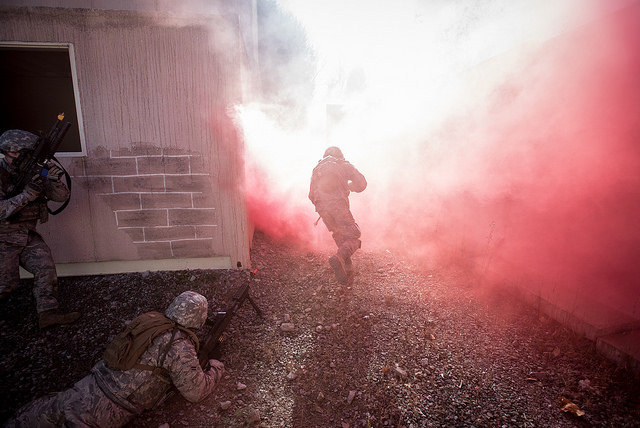
Fire Team members from the Kentucky Air National Guard’s 123rd Security Forces Squadron conduct training to recover a downed pilot inside a simulated Afghan Village at Fort Knox, Ky., Oct. 20, 2015. The Airmen were required to execute a coordinated search while defending their positions and engaging hostile enemy forces. (U.S. Air National Guard photo by Maj. Dale Greer)
FORT KNOX, Ky. — Fire Team members from the Kentucky Air National Guard’s 123rd Security Forces Squadron conducted a field training exercise here Oct. 20 that was designed to enhance their ability to operate in a combat environment.
Unit members were evaluated on their ability to extract a downed pilot from a simulated Afghan village and defend a military outpost in the Afghan countryside.
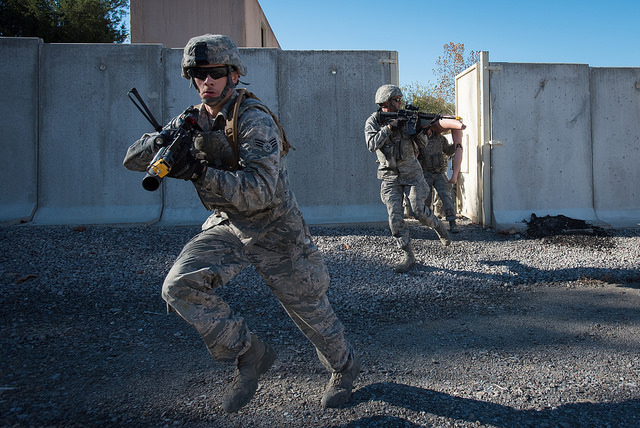
Fire Team members from the Kentucky Air National Guard’s 123rd Security Forces Squadron conduct training to recover a simulated downed pilot inside a mock Afghan Village at Fort Knox, Ky., Oct. 20, 2015. The Airmen were required to execute a coordinated search while defending their positions and engaging hostile enemy forces. (U.S. Air National Guard photo by Maj. Dale Greer)
Click here for more photos.
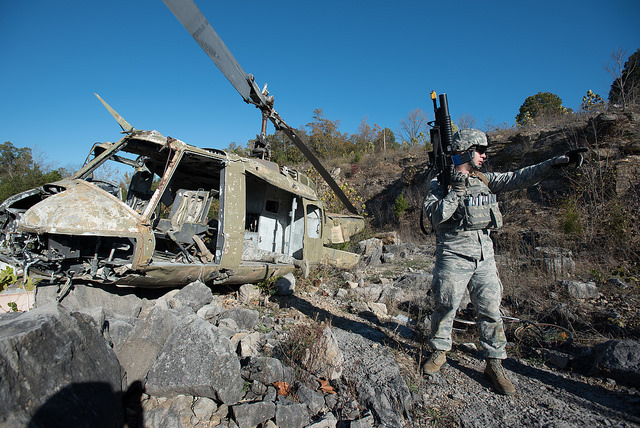
Senior Airman Randy Roberts, a Fire Team leader from the Kentucky Air National Guard’s 123rd Security Forces Squadron, directs efforts to recover a simulated downed pilot inside a mock Afghan Village at Fort Knox, Ky., Oct. 20, 2015. Roberts and his fellow Airmen were required to execute a coordinated search while defending their positions and engaging hostile forces. (U.S. Air National Guard photo by Maj. Dale Greer)
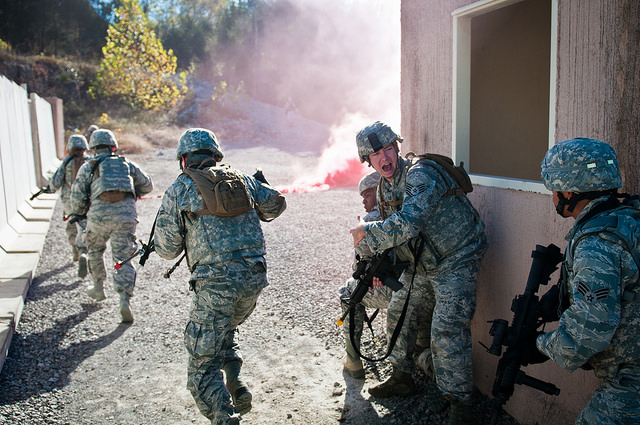
Tech. Sgt. Julien Borchert, a squad leader for the Kentucky Air National Guard’s 123rd Security Forces Squadron, shouts commands during a field training exercise at Ft. Knox, Ky., Oct. 20, 2015. Unit members were being evaluated on their ability to extract a downed pilot from a simulated Afghan village. (Kentucky Air National Guard photo by Master Sgt. Phil Speck)
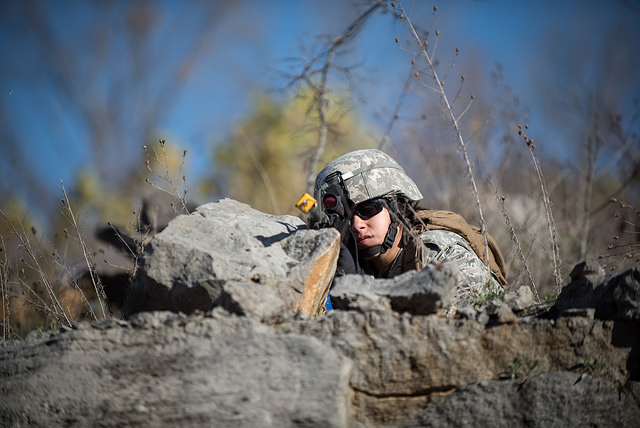
A Fire Team member from the Kentucky Air National Guard’s 123rd Security Forces Squadron provides cover as his teammates search for a simulated downed pilot inside a mock Afghan Village at Fort Knox, Ky., Oct. 20, 2015. The Airmen were required to execute a coordinated search while defending their positions and engaging hostile forces. (U.S. Air National Guard photo by Maj. Dale Greer)
By Maj. Dale Greer, 123rd Airlift Wing Pubic Affairs
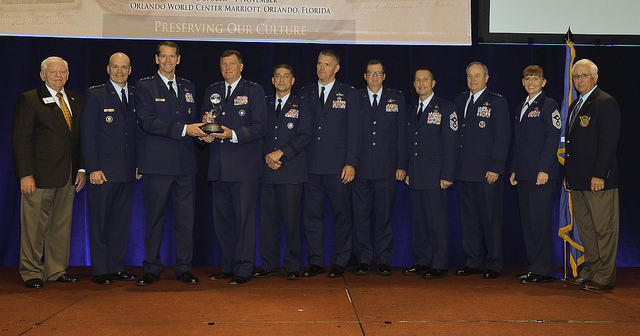
The director of the Air National Guard, Lt. Gen. Stanley Clarke (third from left) presents Maj. Gen. Edward Tonini (fourth from left), adjutant general of the Commonwealth of Kentucky, with the 2105 Airlift/Tanker Association’s Major General Stanley F.H. Newman Outstanding Unit Award during the annual A/TA Convention in Orlando, Fla., Oct. 30, 2015. The award was bestowed this year on the Kentucky Air National Guard’s 123rd Airlift Wing, based in Louisville, for exceptional performance from July 1, 2014 to June 30, 2015. Also pictured (left to eight) are Gen. Arthur Lichte (retired), chairman of the A/TA; Gen. Carlton Everhart II, commander of Air Mobility Command; Brig. Gen. Warren Hurst, Kentucky’s assistant adjutant general for Air; Col. Barry Gorter, commander of the 123rd Airlift Wing; Col. Robert Hamm, commander of the 123rd Operations Group; Chief Master Sgt. Ray Dawson, command chief of the 123rd Airlift Wing; Gen. Mark Welsh III, chief of staff of the U.S. Air Force; Chief Master Sgt. Victoria Gamble, command chief of Air Mobility Command; and Lt. Gen. Christopher Kelly (retired), former vice commander of Air Mobility Command. (U.S. Air Force photo).
ORLANDO, Fla. — The Kentucky Air National Guard’s 123rd Airlift Wing has been named the top airlift or tanker unit in the Air National Guard by the Airlift/Tanker Association, a group of aviation professionals dedicated to the support of military airlift.
Lt. Gen. Stanley Clarke III, director of the Air National Guard, presented the 2015 Major General Stanley F.H. Newman Award to Kentucky’s adjutant general, Maj. Gen. Edward Tonini, during the A/TA’s annual convention in Orlando, Fla., on Oct. 30.
“Once again, the Airmen of the Kentucky Air National Guard have demonstrated that the 123rd Airlift Wing is truly a world-class organization,” Tonini said. “From providing combat airlift in support of wartime taskings in Southwest Asia to helping stop the spread of Ebola in West Africa, the 123rd always answers the call to duty with unsurpassed excellence.”
The 123rd Airlift Wing won the award for exceptional service from July 1, 2014 to June 30, 2015. During that time, the unit mobilized more than 250 Airmen for wartime and humanitarian deployments to the U.S. Central Command and U.S. Africa Command areas of responsibility, supporting Operations Enduring Freedom, Freedom’s Sentinel and United Assistance.
In Southwest Asia, the wing’s 123rd Operations Group flew 403 combat and 625 combat-support sorties, airlifting 4,000 troops, more than 3,500 tons cargo and hundreds of wounded service members.
In Africa, the wing’s 123rd Contingency Response Group established an airlift hub to process and forward troops, cargo and medical supplies into Liberia as part of Operation United Assistance, the multi-agency effort to stop the largest Ebola outbreak in history.
Additionally, Airmen from the wing’s 123rd Special Tactics Squadron were deployed overseas for more than 2,000 days, supporting 270 combat missions and 50 Combat Search and Rescue sorties in U.S. Central Command.
The wing also deployed aircraft and crews to the Netherlands, Norway and Germany, interoperating with multiple NATO partners; and supported information exchange programs with Burkina Faso, Chile, Columbia, Djibouti, Jordan and Thailand.
The 123rd Airlift Wing, based in Louisville, Ky., is one of the most decorated units in Air Force history with 16 Air Force Outstanding Unit Awards. Last year, the wing won its sixth Distinguished Flying Unit Plaque and its fourth Curtis N. “Rusty” Metcalf Trophy from the National Guard Bureau as the top airlift wing in the Air National Guard.
The wing’s primary mission is tactical military airlift. It is equipped with eight C-130 Hercules aircraft and has been heavily engaged in airlift missions in dozens of countries around the world for more than 25 years, including multiple deployments to Iraq and Afghanistan.
The wing is unique in that also supports two other major operational missions. It is home to the only contingency response group in the Air National Guard, and the ANG’s only special tactics unit with both combat controllers and pararesecuemen.
The wing also provides explosive ordnance disposal, fatality search and recovery, two Critical Care Air Transport Teams, a CBRNE Enhanced Response Force Package, civil engineering, and security and support forces to combatant commanders in support of national security objectives, and to civilian leaders during homeland crises.
By Senior Airman Joshua Horton, 123rd Airlift Wing Public Affairs
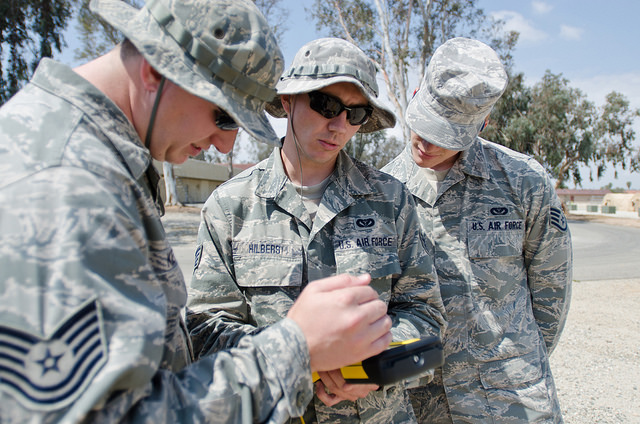
Tech Sgt. Nick Ketterer (left), Staff Sgt. Abe Hilbers (center) and Staff Sgt. Daniel Brooks (right), all Airmen from the Kentucky Air National Guard’s 123rd Civil Engineer Squadron, use surveying equipment during a training scenario at March Air Reserve Base, Calif., on June 10, 2015. The exercise was designed to simulate a real-world mission. (U.S. Air National Guard photo by Senior Airman Joshua Horton)
MARCH AIR RESERVE BASE, Calif. — More than 50 Members of the Kentucky Air National Guard’s 123rd Civil Engineer Squadron concluded a week-long training exercise here June 13 that was designed to enhance their job skills and command-and-control capabilities.
According to Lt. Col Rodney O. Boyd, deployment commander for the unit, the exercise provided CE Airmen with hands-on training in a natural, realistic environment.
“The purpose of this trip was two-fold,” Boyd said. “The first purpose was to accomplish (Air Force Specialty Code) training. CE requires specialized equipment that we don’t have at our home station, so this regional training site actually allows us to have the vehicles and equipment necessary to complete this training.
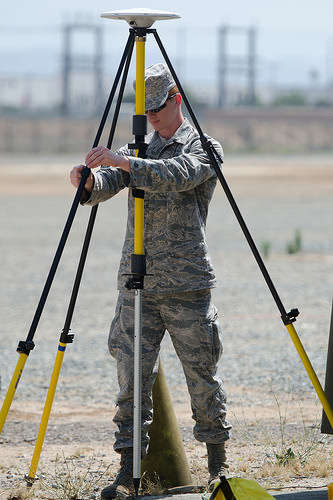
Staff Sgt. Daniel Brooks, an engineer for the Kentucky Air National Guard’s 123rd Civil Engineer Squadron, sets up surveying equipment during a training scenario at March Air Reserve Base, Calif., on June 10, 2015. The exercise was designed to simulate a real-world mission. (U.S. Air National Guard photo by Senior Airman Joshua Horton)
Click here for more photos.
“The second purpose was to accomplish a command-and-control exercise that focused on communication up and down the chain of command,” Boyd continued. “We covered project management, production control, resource allocation and, most importantly, personnel accountability.”
The Kentucky Air Guardsmen were split into seven different groups representing the different functional areas within CE. A cadre from March Air Reserve Base was assigned to each team.
Staff Sgt. Daniel Brooks, a Kentucky Air Guard civil engineer, saw the trip as an opportunity to gain more real-world exposure.
“My expectations coming into this training were to get more hands-on experience,” Brooks said. “Often times with drill, we run into other things that take us away from our job, so I was hoping to get more in-depth training with what we do as civil engineers. We’ve gotten tons of hands-on training. This trip’s been great.”
According to Lt. Col. Phillip Howard, commander of the 123rd Civil Engineer Squadron, the exercise was a tremendous success.
“The exercise went really well,” he said. “The (Unit Control Center) tackled the things in the right priority, and everybody completed their tasks. Overall, we accomplished all the goals, and these guys did a fantastic job.
“It was a good team effort between the guys that were being exercised and the eight or nine guys that got together and formed the exercise team.”
Follow our Air Guard on their official website: www.123aw.ang.af.mil
By 1st Lt. James Killen, 123rd Airlift Wing Public Affairs
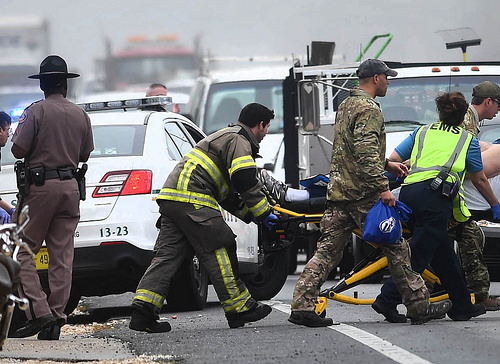
A pararescue Airman from the Kentucky Air National Guard’s 123rd Special Tactics Squadron assists an injured motorist following a traffic accident in Florosa, Fla., March 3, 2015. The Airman was later recognized with a Community Service Award from the Okaloosa Country Sheriff’s Department for his actions. (Photo by Nick Tomecek, Northwest Florida Daily News)
KENTUCKY AIR NATIONAL GUARD BASE, LOUISVILLE, Ky. — A pararescueman from the Kentucky Air National Guard received a Community Service Award from the Okaloosa Country, Fla., Sheriff’s Department May 20 for his actions in rendering assistance to injured motorists following a multi-vehicle traffic accident there.
The pararescueman, who is assigned Kentucky’s 123rd Special Tactics Squadron, was traveling toward Eglin Air Force Base, Fla., on Highway 98 March 3 when traffic suddenly came to a stop.
“I looked down the line of cars and I could see wheels in the air, so I popped the door open and sprinted down the lane,” he said.
The pararescueman, along with several other Air Force Special Operations Command Airmen who were riding in the same vehicle, quickly made their way to the accident scene and began rendering aid.
A pararecueman, or PJ, is the military equivalent to a civilian paramedic. PJs are also rated to parachute from aircraft into non-permissive environments, and are among the U.S. military’s most highly trained forces.
“When I got to the scene, I could see a motorcycle and I immediately shouted for the rider,” the PJ recalled. “He was fine, so I made my way to the SUV, whose passengers also said they were okay. Then I made my way to the overturned pickup, whose driver wasn’t in good shape.”
The Kentucky Airman assessed the condition of the man, whose feet were on the dashboard as he dangled upside down from his seat belt.
“I didn’t really want to move him, just in case he had a back injury, so I triaged him, checked his airway, his breathing and his pulse. But by that time, a crowd had started to gather around. I started telling them to back away, and my team took control of the rest of the scene.”
The Airman knew paramedics and law enforcement officers were already on their way, so the Air Force team continued to care for the wounded while controlling the scene, cleaning up debris and directing traffic.
When asked about their efforts, Okaloosa County Sheriff’s Deputy Sgt. James Duval said the Airmen performed superbly.
“When I arrived on the scene, every vehicle with injured persons had an Airman attending to them. The vehicle that was upside down had three or four Airman attending to the entrapped driver. They were accessing his medical status, immobilizing him to prevent additional injury and comforting him to prevent shock.
They had literally climbed inside the overturned vehicle so they could accomplish these tasks.
“It is a great comfort to have professional, skilled and talented emergency medics on-scene,” Duval continued. “I was commenting to another deputy, after things had calmed down, that if I was the injured party, these are the guys I’d like to have attending to me.”
Duval recommended each of the Airmen for a Community Service Award, which were presented May 20 in Okaloosa County.
“The Okaloosa County Sheriff’s Department recognized these quiet professionals for not only their willingness to assist when the need arose, but the professional manner in which they rendered that assistance,” the award citation read.
Everyone who was injured that day has since recovered with no lasting injuries.
Follow our Air Guard on their official website: www.123aw.ang.af.mil
By Master Sgt. Phil Speck, 123rd Airlift Wing Public Affairs
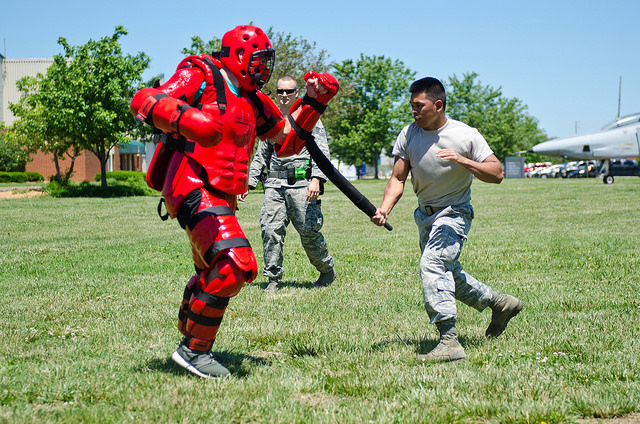
Senior Airman Reymart Relos (right), a services technician for the 123rd Force Support Squadron, attacks a 123rd Security Forces Squadron member during baton training as part of a week-long course for security forces augmentees at the Kentucky Air National Guard Base in Louisville, Ky., May 19, 2015. The course is designed to train Airmen from other career fields to perform base security functions, providing a pool of Airmen to assist the 123rd Security Forces Squadron during shortfalls in manning due to emergencies. (U.S. Air National Guard photo by Master Sgt. Phil Speck)
KENTUCKY AIR NATIONAL GUARD BASE, LOUISVILLE, Ky. — The 123rd Security Forces Squadron recently held a five-day Security Forces Augmentee training event for 10 Airmen from different job specialties spanning multiple units within the 123rd Airlift Wing.
Security Forces Augmentee training is designed to take Airmen outside of their career fields and provide them with the skills to perform basic security functions in order to assist security forces during shortfalls in manning due to emergencies, contingencies or an increase of the Force Protection Condition, according to Capt. Jason Rayl, operations officer for the 123rd Security Forces Squadron.
Rayl explained that the augmentees would be utilized in emergency situations until fully qualified security forces members could be recalled.
“It’s a good opportunity for members outside the security forces career field to participate in the security of the installation and gain a better understanding of how SFS operates in a home-station environment,” he said.
The training includes a variety of basic security forces tasks and concepts, including weapons qualification, use of force, small-unit tactics, searches and seizures, and more. All of the lessons are important, from tactics training to searching techniques, and help augmentees carry out the SFS mission set of air base defense and the Kentucky Air Guard’s mission of providing tactical airlift capabilities worldwide, Rayl said.
The augmentees also learned advanced weapons techniques, and hand-to-hand combat for self-defense and weapons retention — all training that a normal Airman outside of Security Forces would not learn.
The final day of training consisted of augmentees being paired with fully trained security forces members on a variety of different security posts and being practically evaluated with different exercise scenarios to test the trainees’ mastery of what they learned throughout the week.
At the completion of the course, a graduation ceremony was conducted in which the augmentees were presented certificates by the wing commander and unit challenge coins.
As the program grows, augmentees will receive additional on-the-job training to qualify them to work specialized security posts and entry control points to enhance overall security of the installation, Rayl said. They will also complete annual refresher training next year.
Airman 1st Class Benjamin Bohannon, a services technician for the 123rd Force Support Squadron, said the training was excellent.
“I enjoyed it — it was very different than what I was used to,” Bohannon said. “It’s 13 weeks of tech school all rolled into one week. It was very intense, but also good training.”
Craig Davis, unit training manager for the 123rd Security Forces Squadron, said the program pays substantial dividends for base security.
“Utilizing augmentees as a force-multiplier will enhance the security and well-being of all members on base,” Davis said.
Lt. Col. George Imorde, commander of the 123d Security Forces Squadron, mentioned the difficulty of scheduling the training annually in a resource-constrained environment but highlighted its importance.
“DoD-wide, resources are tight,” he said. “It took a collective effort to pull this training together. The combination of wing, group and squadron leadership support, coupled with energetic volunteerism and stellar non-commissioned officer initiative, is what ultimately made this a highly successful training event.”
Security Forces will be recruiting both full-time Airmen and members of the traditional Guard force from across the wing to meet the Air Force and Air National Guard’s needs during increases to Force Protection measures.
In light of recent attacks against military targets domestically and abroad, creating a trained and qualified augmentee force will ensure the overall safety and security of KYANG members and its assets, Imorde said.
Beginning in October, the 123rd Security Forces Squadron will be hold a new initial augmentee training program for volunteers who wish to participate and assist the entire wing. For more information, contact the 123d Security Forces Squadron.
By Maj. Dale Greer, 123rd Airlift Wing Public Affairs
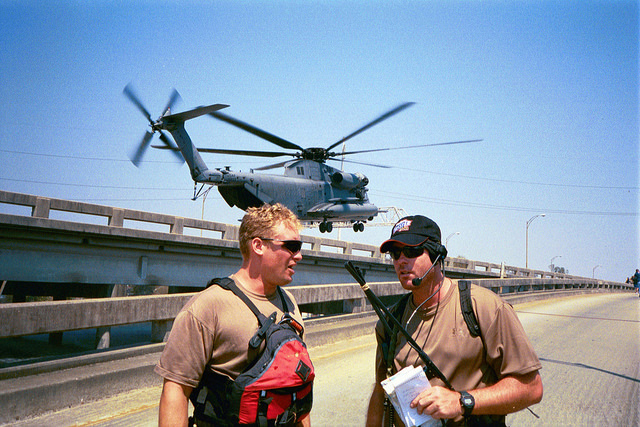
Two Kentucky Air National Guard Special Tactics troops confer as an Air Force MH-53 helicopter lands on Interstate 610 to evacuate New Orleans residents following Hurricane Katrina Sept. 4, 2005. (U.S. Air National Guard photo)
LOUISVILLE, Ky. — Chief Master Sgt. Pat Malone had seen a lot in his 23 years as a pararescueman for the U.S. military, including dicey combat extractions in Iraq and Afghanistan and more than a decade’s worth of civilian search-and-rescue missions in Alaska. But none of it prepared him for the devastation he saw firsthand when he and 21 fellow Kentucky Air National Guardsmen deployed to New Orleans Naval Air Station 10 years ago today as part of efforts to evacuate the victims of Hurricane Katrina and the ensuing flood.
“This was, by and large, the worst site of devastation I have ever seen in my entire career,” said Malone, who was chief enlisted manager for the Kentucky Air Guard’s 123rd Special Tactics Squadron in 2005 and retired from the service in 2012. “The sheer magnitude of it — and the conditions that our guys worked in — was the most horrific I’d seen in 23 years of service.” Chief Master Sgt. Jon Rosa, a Kentucky combat controller who also deployed with the 123rd Special Tactics Squadron and retired in 2009, concurred.
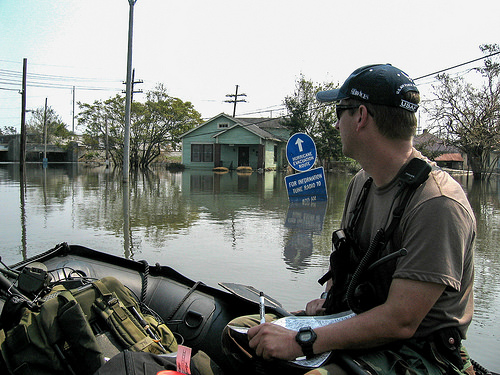
A Kentucky Air National Guard combat controller searches for stranded residents during a search-and-rescue mission in New Orleans following Hurricane Katrina Sept. 5, 2005. (U.S. Air National Guard photo)
“New Orleans is usually a place of such revelry,” said Rosa, then the squadron’s superintendent of combat controllers. “But it was like a scene out of ‘The Twilight Zone’ to be in downtown New Orleans and hear total silence except for the sloshing of flood waters. I just couldn’t believe this was America.”
But it was America, and thousands of New Orleaneans were stranded without provisions amid a sea of sewage- and chemical-laced water covering nearly 80 percent of the city.
Rosa, Malone and 20 other Kentucky special tactics troops were among the first military search-and-rescue troops to arrive in the stricken city and begin extracting trapped citizens starting Aug. 31.
The Kentucky forces joined up with about 25 other special tactics troops from across the Air National Guard, including Alaska’s 212th Rescue Squadron, California’s 131st Rescue Squadron, New York’s 102nd Rescue Squadron and Oregon’s 125th Special Tactics Squadron.
Patrolling the city in Zodiac motorboats and other vehicles, the Kentucky-led contingent rescued 1,292 people, sometimes by cutting through roofs to extract trapped residents.
“We had the ability to go through the city and conduct searches where no one else could reach at the time,” Malone said. “We launched from four to 14 boats a day, running about 14-hour shifts in the water.”
Once evacuees climbed aboard the Zodiacs, they were transported to makeshift helicopter landing zones set up along portions of the interstate highway system that weren’t submerged by flood waters.
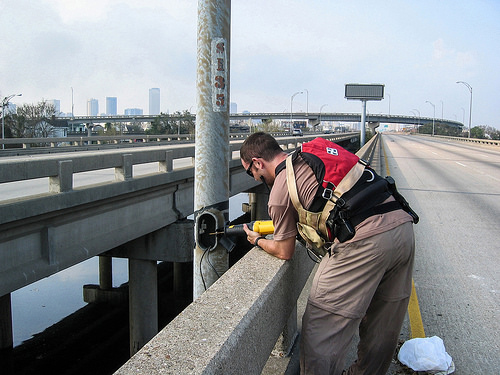
A special tactics troop from the Kentucky Air National Guard cuts down street light poles along Interstate 610 in New Orleans following Hurricane Katrina Sept. 3, 2005, to clear the way for a helicopter landing zone. (U.S. Air National Guard photo)
The landing zones were cleared by saw-wielding combat controllers who cut down light poles to remove obstructions and then marked the spots with spray paint so information like communications frequencies would be visible from the air, Rosa said.
After an LZ was established, combat controllers would make radio contact with any of the three airborne controlling authorities — entities like an Air Force AWACS plane — and advise that evacuees were ready for transport.
As helicopters began to roll in, the controllers would direct their safe flight into and out of the landing zones using the communications gear they carried on their backs.
One particularly productive LZ became so active that a new helicopter was landing every 50 seconds for 48 straight hours, Rosa said.
“For a while, I would imagine it was the busiest airport on the face of the earth,” he noted.
By the time the Kentucky Airmen returned home Sept. 7, the Air Guard special tactics contingent had controlled the flights of 3,179 sorties responsible for the evacuation of 11,927 people.
Working conditions were challenging, to say the least. Most troops got less than six hours of sleep a night, and the constant exposure to contaminated water caused rashes and minor chemical burns on some of the Airmen, Malone said.
“These guys were working in a giant cesspool contaminated with any chemical in anyone’s garage, oil, gas, deceased animals and sewage,” he said. “It was a giant petri dish. But they knew that what they were doing was important. They chose to be totally selfless and help fellow citizens of the United States. They’re the biggest heroes on the planet as far as I’m concerned.”
Rosa noted that many New Orleans residents seemed to agree.
“All the folks we rescued down there were so thankful,” he said. “I had about 20 people come up and hug me while I was trying to control helicopter landings. That’s very self-satisfying.”
By Staff Sgt. Vicky Spesard, 123rd Airlift Wing Public Affairs
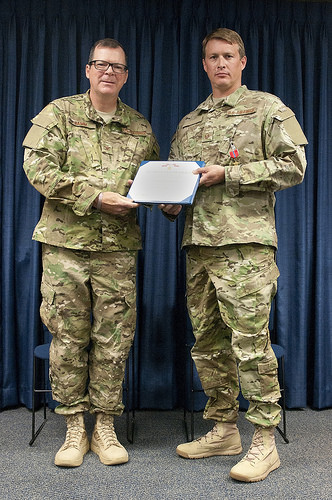
Master Sgt. Benjamin (right), a combat controller with the 123rd Special Tactics Squadron, is awarded the Bronze Star Medal during a ceremony at the Kentucky Air National Guard Base in Louisville, Ky., June 6, 2015. The medal, presented by Col. Robert Hamm, commander of the 123rd Operations Group, was awarded for meritorious service while conducting operations in support of Operation Inherent Resolve. (U.S. Air National Guard photo illustration by Staff Sgt. Vicky Spesard
KENTUCKY AIR NATIONAL GUARD BASE, LOUISVILLE, Ky. — A combat controller from the Kentucky Air National Guard’s 123rd Special Tactics Squadron was awarded the Bronze Star Medal here June 6 for meritorious service while deployed to Southwest Asia and Northwest Africa, where he engaged enemy forces and deterred their advances.
Master Sgt. Benjamin was instrumental in the execution of nine missions across five countries and seven landing zones, conducting nine forward-area refueling point surveys and one drop-zone certification in support of Operation Inherent Resolve, according to the award citation.
Benjamin supervised a 53-man joint special operations team during the night infiltration and assessment of a strategic airfield. Working with Marine Corps Force Reconnaissance operators, Benjamin was able to maintain tactical control of three separate maneuver elements on the ground while simultaneously conducting pavement evaluations for two primary runways on the airfield.
Additionally, he supervised a 12-man joint special operations team tasked with an airfield security assessment, enabling partner nation forces to maintain momentum and resupply forces in their fight against Al Qaeda.
Finally, Benjamin delivered crucial survey results to two Special Forces teams conducting strategic site assessments, equipping commanders with support to re-open strategic infrastructure.
The Bronze Star Medal was authorized by executive order on Feb. 4, 1944, and is awarded to service members who have distinguished themselves by heroic or meritorious achievement or service in connection with military operations against an armed enemy.
Story by Master Sgt. Phil Speck, 123rd Airlift Wing Public Affairs
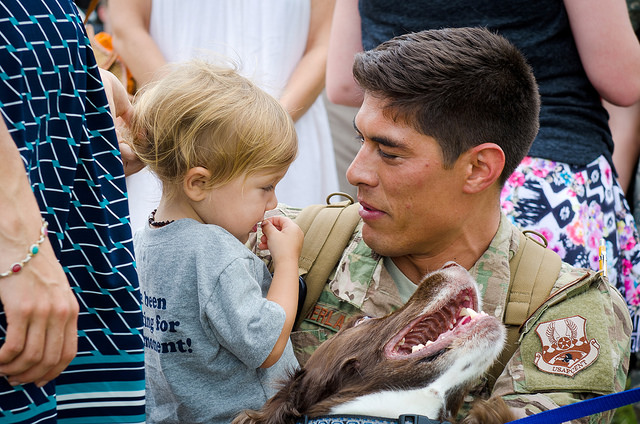
Capt. Trevor Sutherland, a pilot in the 165th Airlift Squadron, embraces his family during a homecoming ceremony at the Kentucky Air National Guard Base in Louisville, Ky., July 8, 2015. Sutherland and 29 other Kentucky Air Guardsmen returned from a deployment to the Persian Gulf Region, where they’ve been supporting Operation Freedom’s Sentinel since February. (U.S. Air National Guard photo by Master Sgt. Phil Speck)
LOUISVILLE, Ky. — Thirty Airmen from the 123rd Airlift Wing returned to the Kentucky Air National Guard base July 8, 2015, concluding the unit’s most recent overseas deployment to the Persian Gulf region. More than 100 friends and family were on hand to welcome them, waving flags and homemade signs as the Airmen’s C-130 aircraft taxied to its parking spot on the base flight line.
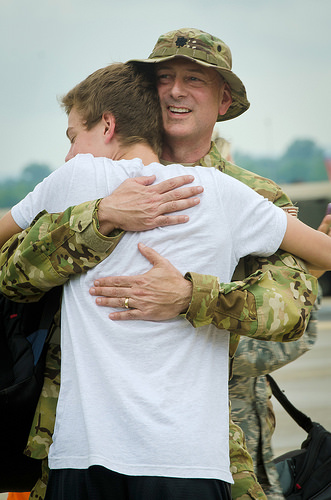
Lt. Col. Scott Ledford, a pilot in the 165th Airlift Squadron, embraces a family member during a homecoming ceremony at the Kentucky Air National Guard Base in Louisville, Ky., July 8, 2015. Ledford and 29 other Kentucky Air Guardsmen returned from a deployment to the Persian Gulf Region, where they’ve been supporting Operation Freedom’s Sentinel since February. (U.S. Air National Guard photo by Master Sgt. Phil Speck)
The wing began deploying aircraft and personnel to Southwest Asia in February, flying airlift missions in support of Operation Freedom’s Sentinel, the follow-on mission to Operation Enduring Freedom.Since that time, more than 100 Kentucky Air Guardsmen have deployed, serving on tours ranging from two to four months. While overseas, they joined forces with Airmen from the Missouri Air National Guard to fly C-130 airlift missions across the U.S. Central Command Area of Responsibility, which includes Afghanistan, Iraq and Northern Africa.
Click here for more photos.
In total, the Missouri-Kentucky Team flew more than 1,000 combat sorties that delivered over 3,500 short tons of cargo and nearly 4,000 personnel to destinations across the AOR.
The deployment marks the sixth time in the past 12 years that the Kentucky Air Guard has sent its aircraft, aircrews and maintenance personnel to support U.S. military operations in U.S. Central Command. The wing deployed aviation assets there in 2003, 2007, 2009, 2010 and 2012, operating from multiple undisclosed locations and Bagram Air Field, Afghanistan.
The wing’s non-aviation personnel also have been heavily engaged around the world since Sept. 11, 2001, logging thousands of deployments to dozens of overseas locations, including Iraq and Afghanistan. In October, more than 70 of the wing’s Airmen deployed to Africa to support Operation United Assistance, the international effort to fight the worst Ebola outbreak in history.
Story by Maj. Dale Greer, 123rd Airlift Wing Public Affairs
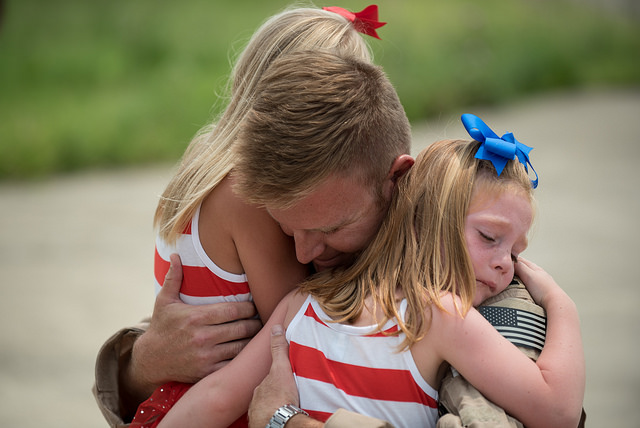
Capt. Ross Farling, a C-130 pilot in the 123rd Airlift Wing, hugs his daughters during an emotional homecoming ceremony at the Kentucky Air National Guard Base in Louisville, Ky., July 4, 2015. Farling was among 39 Kentucky Air Guardsmen who were returning from a deployment to the Persian Gulf region, where they’ve been supporting Operation Freedom’s Sentinel since February. (U.S. Air National Guard photo by Maj. Dale Greer)
LOUISVILLE, Ky. — This 4th of July was a special one for 39 members of the 123rd Airlift Wing, who received a hero’s welcome from more than 200 flag-waving friends and family when they returned to the Kentucky Air National Guard Base here today following a deployment to the Persian Gulf region.
Several of those family members, like 3-year-old Declan Gilreath and 2-year-old Max Gordon, carried signs with phrases like “Welcome Home Daddy!” and “Move It or Lose It: I’m here to get my DADDY!”
Many in the crowd found it impossible to contain their emotions. The daughters of one C-130 pilot burst into tears as soon as they began to hug their father, while others jumped for joy when they saw their loved ones walking toward them across the airfield tarmac.
Click here for more photos.
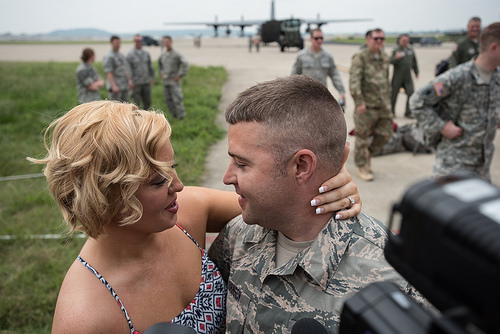
Tech. Sgt. Mike Johnson, a C-130 crew chief in the 123rd Airlift Wing, proposes to his girlfriend, Vanna Jones, on the flight line of the Kentucky Air National Guard Base in Louisville, Ky., July 4, 2015, after returning from a deployment to the Persian Gulf region. Jones said yes. (U.S. Air National Guard photo by Maj. Dale Greer)
For Vanna Jones, the day was especially significant. Her boyfriend, Tech. Sgt. Mike Johnson, dropped to one knee, presented her with a diamond engagement ring and asked her to marry him moments after he stepped off the C-130 aircraft that carried him home.
“I fell in love with you the first time I saw your smile, ” Johnson told Jones. “Will you marry me?”
A trembling Jones, clearly surprised, answered yes.
Maj. Gen. Edward Tonini, who was on hand to greet the returning Airmen, said scenes like Johnson’s proposal are one the highlights of his job.
“I’ve been the adjutant general now for seven and a half years,” Tonini said. “I’ve welcomed thousands upon thousands of Airmen and Soldiers home from combat, and every single time, it brings a tear to my eye to see the families as happy as they are when their loved ones come back from being in harm’s way. These 39 Kentucky Air National Guardsmen got to come home to their families on the 4th of July. It doesn’t get much better than that.”
The returning Airmen are among more than 100 Kentucky Air National Guardsmen who have been supporting Operation Freedom’s Sentinel since February, serving on tours ranging from two to four months.
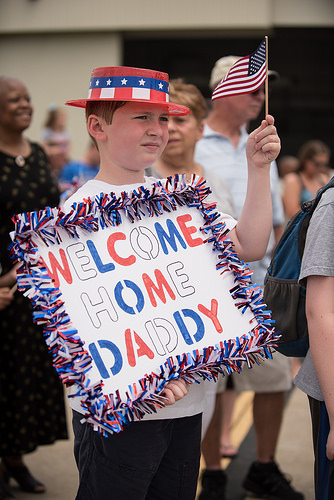
The son of a Kentucky Air National Guardsman waits for his father to step off a C-130 Hercules aircraft at the Kentucky Air National Guard Base in Louisville, Ky., July 4, 2105. The father was one of 39 Kentucky Airmen who returned to the United States following a deployment in the Persian Gulf region, where they’ve been supporting Operation Freedom’s Sentinel since February. (U.S. Air National Guard photo by Maj. Dale Greer)
Freedom’s Sentinel is the follow-on mission to Operation Enduring Freedom. It focuses on training, advising and assisting Afghan security forces; and on counterterrorism operations in Afghanistan.
During their deployment, the Kentucky troops joined forces with Airmen from the Missouri Air National Guard to fly C-130 airlift missions across the U.S. Central Command Area of Responsibility, which includes Afghanistan, Iraq and Northern Africa.
In the past four months, the Missouri-Kentucky Team flew more than 1,000 combat sorties that delivered over 3,500 short tons of cargo and nearly 4,000 personnel to destinations across the AOR.
The deployment marks the sixth time in the past 12 years that the Kentucky Air Guard has sent its aircraft, aircrews and maintenance personnel to support U.S. military operations in U.S. Central Command. The wing deployed aviation assets there in 2003, 2007, 2009, 2010 and 2012, operating from multiple undisclosed locations and Bagram Air Field, Afghanistan.
The wing’s non-aviation personnel also have been heavily engaged around the world since Sept. 11, 2001, logging thousands of deployments to dozens of overseas locations, including Iraq and Afghanistan. In October, more than 70 of the wing’s Airmen deployed to Africa to support Operation United Assistance, the international effort to fight the worst Ebola outbreak in history
By Master Sgt. Phil Speck, 123rd Airlift Wing Public Affairs Office
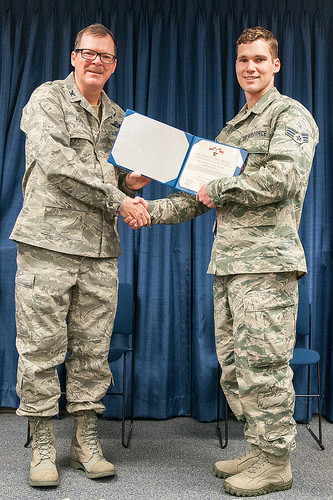 KENTUCKY AIR NATIONAL GUARD BASE, LOUISVILLE, Ky. — A combat controller from the Kentucky Air National Guard’s 123rd Special Tactics Squadron was awarded the Bronze Star Medal in a ceremony here March 14 for meritorious service while deployed to Afghanistan.
Senior Airman Robert Willging served with a combined joint special operations task force in Afghanistan from June 1 to Nov. 1, 2014 in support of Operation Enduring Freedom. During that deployment, Willging assisted in the planning and execution of more than 100 combat patrols and served with lead maneuver elements while coordinating aerial weapons teams, close air support and medical evacuation operations.
Willging personally controlled more than 120 aircraft during multiple day operations, to include combined operations with Afghan National Army Commandos in which he controlled, de-conflicted and engaged with 24 aircraft to ensure the safety of all ground elements, according to the award citation.
“Airman Willging’s utilization and control of aerial weapons teams, close air support, and medical evacuation platforms was second to none, and aided in the timely extraction of multiple wounded Afghan National Security Forces and (U.S. Special Operations Forces),” the citation said.
The Bronze Star Medal was authorized by executive order on Feb. 4, 1944, and is awarded to service members who have distinguished themselves by heroic or meritorious achievement or service in connection with military operations against an armed enemy.
