
Pages
Stay In Touch
More
© 2013 KentuckyGuard
Story and photos by Sgt. Scott Raymond, Kentucky National Guard Public Affairs Office
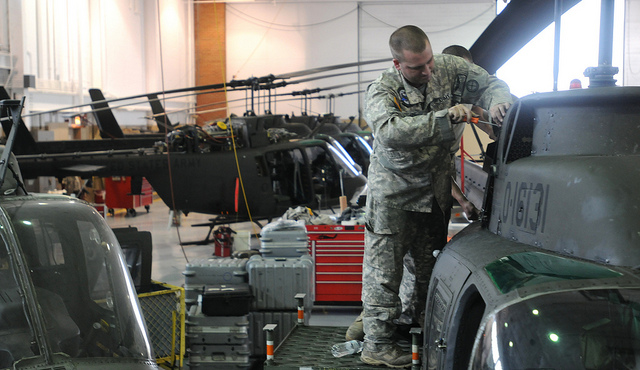
A Soldier with Charlie Co., 1st Battalion, 376th Aviation works to repair a OH-58 helicopter at the Army Aviation Support Facility in Frankfort, Ky., Sept. 18, 2012. The Kentucky Guard has become the maintenance hub for OH-58 repairs for all of the National Guard. (Kentucky National Guard photo by Sgt. Scott Raymond)
FRANKFORT, Ky. — It is often thought that a warrant officer in an Army Aviation unit is only a pilot. That is certainly not always the case. The aviation field also demands that experts are on hand as maintenance technicians to ensure that those pilots have a working aircraft to fly.
In the Kentucky National Guard some aviation warrant officers are not only keeping Kentucky Guardsmen in the air, but they’re also working to keep pilots in quality aircraft nationwide.
Chief Warrant Officer Three Jay Calcaterra, an aircraft maintenance supervisor for the 351st Aviation Support Battalion works daily at the Army Aviation Support Facility in Frankfort, Ky. He confirmed that not everyone in the hangar is a pilot, calling himself and other maintenance supervisors, “the walking warrants.”
“We determine which aircraft fly, how long they fly and what maintenance is required after they fly it,” he said.
Calcaterra said they have an extremely important job in the hangar, and that is to manage aircraft and the people who work on aircraft.
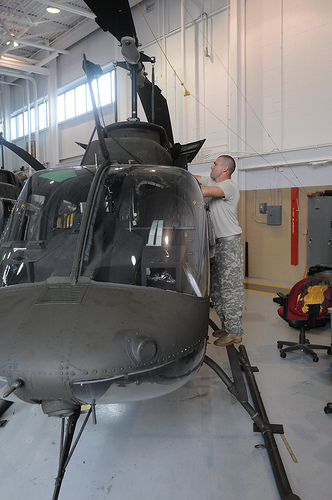
Spc. Tim Amyx with Charlie Co., 1st Battalion, 376th Aviation, works on a OH-58 helicopter at the Army Aviation Support Facility in Frankfort, Ky., Sept. 18, 2012. Because of the increase in maintenance requests, some Soldiers were brought on full time to help handle the workload. (Kentucky National Guard photo by Sgt. Scott Raymond)
The Kentucky Guard’s fleet of UH-60 Blackhawks and OH-58 Kiowa helicopters, and their operational readiness is the responsibility of Calcaterra and Chief Warrant Officer Two Ryan Thompson.
They said it takes a seasoned expert to meet the demands of what they are asked to do, but in referring to their warrant officer training, they rely on their abilities and the proficiencies of their staff to provide that expertise and keep Kentucky aircraft in the skies.
In 2011, the National Guard Bureau in Washington, D.C., was looking for a solution for the maintenance of all OH-58s flown by the Guard. They needed a hub where the aircraft could be properly and efficiently maintained to keep them flying. NGB looked to a state with a solid history of excellence in aviation.
“It’s because of our reputation, our work ethic and our operational readiness rates that we were asked to do this,” said Thompson. “Everyone knows we are always willing to step up and support the mission of NGB.”
With the amount of flight hours being put on a diminishing fleet of OH-58s nationally, NGB asked Kentucky to become the center though which all maintenance issues would stream. Kentucky’s Army Aviation originally only had four OH-58s of their own, but now they were asked to care for a lot more. Regardless of their home assignment, helicopters with any issue would be flown or transported to Frankfort to go through Thompson’s “phase”.
Thompson said the facility would normally put six helicopters through maintenance phases each year. Since February 2012, they have received, tested, worked on, and put back into service 23 OH-58s, across the country. That’s nearly a 400 percent increase and the year isn’t over yet.
He said Kentucky has worked with 16 different states in repairing their helicopters, transferring the aircraft back and forth to as far away as Arizona and Hawaii.
A phase begins with a test flight, if possible, to determine the faults or discrepancies, anything from broken radios to weak engines. The aircraft would then be disassembled from the nose to the tail and those problem areas would be fixed and required inspections completed. Upon its reassembly, the helicopter would be released for test flights to assure the problems were resolved, resulting in an “almost new” aircraft.
“I would never send out something that I wouldn’t give my own Soldiers,” said Thompson.
According to Thompson, the Kentucky Guard flies more hours in OH-58s than any other state. Thousands of hours of flight-time are given annually to support the state’s counter-drug program and in-state unit training missions.
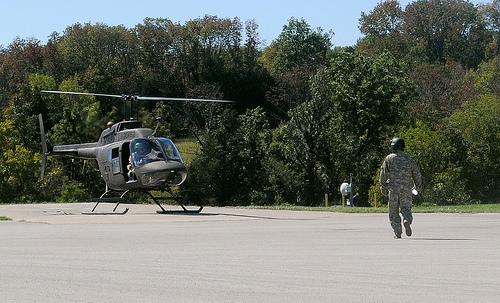
Soldiers at the Army Aviation Support Facility prepare for a test flight in a OH-58 helicopter in Frankfort, Ky., Sept. 24, 2012. The Kentucky Guard provides maintenance support to all OH-58s in the National Guard. (Kentucky National Guard photo by Sgt. Scott Raymond)
In addition to operations in the Commonwealth, OH-58s repaired by the Kentucky Guard are transferred to the U.S. State Department as well as flown in support of the Southwest border mission, Operation Guardian Eye.
Calcaterra, Thompson and the Soldiers in the hangars in Frankfort manage the maintenance of 75 percent of all OH-58s flying in the National Guard. Thompson said it’s a fine example of the Kentucky Guard preparing for and meeting the needs of the Guard as a whole.
Thompson believes the mission will last as long as OH-58s are flying for the Guard. In the meantime, Kentucky will remain nationally, a proven maintenance hub as well as an OH-58 parts hub.
The increased workload has benefitted some Soldiers with full-time work, which the warrants said creates an invaluable amount of experience for young aircraft mechanics. Thompson estimates that his Soldiers are getting as much hands-on training in two-weeks as some traditional Guardsmen serving on weekends would get in 15 years. In addition to the new airframes coming through, the experience for these Soldiers is the biggest gain of this mission said Thompson.
The warrants both said they couldn’t have done it without the support of Kentucky National Guard leadership. Thompson said Maj. Gen. Edward W. Tonini, Kentucky’s Adjutant General and Col. Michael Ferguson, 63rd Theater Aviation Brigade Commander, agreed to take on the mission and have consistently backed the mechanics’ efforts while promoting the quality work done by Kentucky Guardsmen.
“We take pride in what we do here,” Thompson said. “We have the experience and know-how to pull this off.”
“It’s a lot of work, a lot of hours, but we don’t have a reduction in our capabilities. This has been a whirlwind success.”
By Master Sgt. Philip Speck, 123rd Airlift Wing Public Affairs
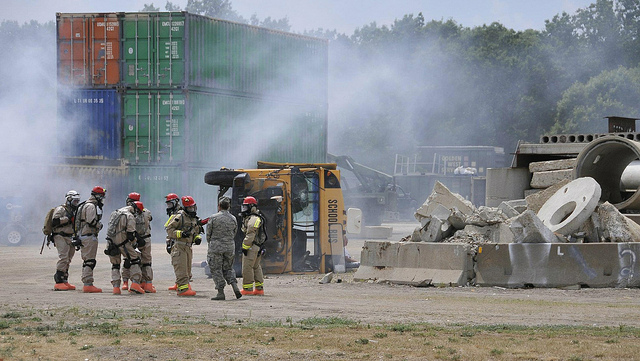
Fatality Search and Recovery Teams search for simulated human remains at Patriot 12, a disaster-response exercise held at Volk Field, Wis., from July 13-20, 2012. The Kentucky Air Guard joined with FSTRs from Arizona and Minnesota to train the newly formed Indiana FSRT during the exercise. (Courtesy Photo)
VOLK FIELD, Wis. — Members of a Fatality Search and Recovery Team from the Kentucky Air National Guard helped train other disaster-response officials during a national exercise held July 13-20 at Volk Field, Wis.
More than 1,100 military and civilian emergency responders participated in the exercise, known as Patriot 12, a National Guard scenario designed to simulate the damage from a major earthquake.
The primary mission of Kentucky’s FSRT was to train a Fatality Search and Recovery Team from the Indiana National Guard, according to 2nd Lt. Jonathan Fairbanks, the officer in charge of the Kentucky unit. The Indiana team, which has just been stood up, had never fielded its equipment before.
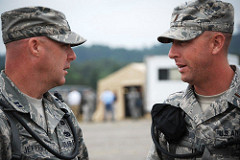
Kentucky Air National Guard 2nd Lt. Jonathan Fairbanks (right), 123rd Force Support Squadron Fatality Search and Recovery Team officer in charge, talks with Arizona FSRT officer in charge Capt. Paul W. Jefferson during the Patriot 12 disaster-response exercise held at Volk Field, Wis., from July 13-20, 2012. Fairbanks’ team joined with FSRTs from Arizona and Minnesota to train a newly established Indiana FSRT during the exercise. (Courtesy Photo)
“We showed them everything, from the initial setup and the initial brief from the on-site commander, all the way through the end of the exercise and cleaning everything up afterwards,” Fairbanks said.
The Kentucky team was hand-selected for the task by Brad Whitlinger, lead exercise planner for the National Guard Bureau, because he knew the unit was experienced, fully capable and integrated well with other teams, Fairbanks said. FSRT teams from Arizona and Minnesota also provided training to the Indiana group.
Fatality Search and Recovery Teams are charged with locating and recovering the remains of victims killed in hostile action or natural disasters. Team members have special training and equipment that allow them to operate in a broad spectrum of dangerous environments, including those contaminated by nuclear, biological or chemical agents.
During Patriot 12, all four FSRTs conducted training on the proper donning and doffing of personal protective equipment and the use of gear like litters and tents. They also trained on proper procedures for handling remains in contaminated and uncontaminated areas.
Actors added a dose of reality to the rubble-strewn environment, requiring FSTR members to interact with simulated victims, injured survivors and distraught family members who were frantically searching for loved ones.
Fairbanks said he was extremely pleased with the performance of his members, who had to balance the challenges of responding to exercise inputs in a dynamic environment with the need to train the Indiana unit while integrating with FSTRs from two other states.
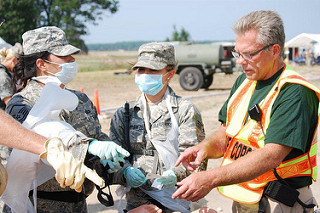
Kentucky Air National Guard Senior Airman Shelby Basham (center), a Fatality Search and Recovery Team member, talks to other FSRT members and the on-scene coroner during Patriot 12, a disaster-response exercise held at Volk Field, Wis., from July 13-20, 2012. The Kentucky Air Guard joined with the Arizona and Minnesota Air Guard FSRTs to train a newly established Indiana team during the exercise. (Courtesy Photo)
“What I thought was going to be our biggest challenge — integrating with the other teams — actually was our biggest strength,” he said. “When you bring in four teams with four different ways of doing things, sometimes you run into issues. But we didn’t really have that.”
Master Sgt. Krista Lindsey, non-commissioned officer in charge of Kentucky’s FSRT, said the exercise helped prepare the team for real-world deployments in which members will be required to work with a broad range of disaster-response officials.
“This was a great training experience since it is very likely we’ll be working with other units and augmentees in a mass-casualty environment,” Lindsey said.
Lindsey and Fairbanks both noted the crucial nature of the FSRT mission, which ensures that the remains of deceased citizens are recovered with dignity.
“I tell my team there aren’t very many jobs more important than ours,” Fairbanks said. “We ensure they get to bring their loved ones home, to get a proper resting place.”
Lindsey agreed.
“Our job as the Fatality Search and Recovery Team is essential because we are there to maintain the dignity of the family’s loved one with respect at the scene of a mass casualty, in both a chemical and non-chemical environment,” she said.
“Our team is prepared to operate knowing that we support the local authorities and we can bring our capabilities, processes, procedures and lessons learned from our training to effectively support each mission.”
###
Story and photos by Sgt. Alexa E. Becerra, 2/138th Public Affairs
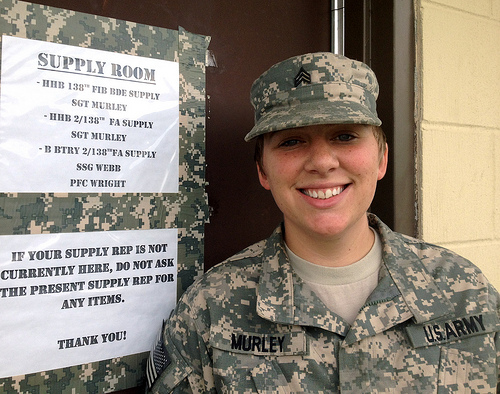
Sgt. Stephanie Murley, supply sergeant for 2nd Battalion, 138th Field Artillery, stands in front of her office door at Camp Atterbury, Ind., Sept. 16, 2012. Murley prepared for her third deployment overseas as Task Force Longrifles prepared to deploy to the Horn of Africa. (Kentucky National Guard photo by Sgt. Alexa Becerra)
CAMP ATTERBURY, Ind. - What images come to mind when you think of a combat veteran of two different wars? Perhaps a tall, muscular GI Joe, with a high and tight? Or do you conjure up a picture of a young Soldier at the airport, tears falling softly down his cheek as he is hugging his wife for the first time in a year, after a long combat tour?
It’s probably unlikely that the image of a young, 5-foot, 7-inch tall woman, with bright-blue smiling eyes popped into your mind.
Unless, of course, you know Sgt. Stephanie L. Murley.
Murley is a supply sergeant for Headquarters and Headquarters Battery 2nd Battalion, 138th Field Artillery. She is also about to become a veteran for the third time. At 24-years-old, she has completed one tour in Iraq, one in Afghanistan and now is preparing for her third deployment — this time to the Horn of Africa.
In Iraq, she worked as a supply clerk for B Battery, 2/138th. Even though it was her first deployment, she wasn’t scared.
“I started out working nights when I was in Iraq, then I shifted to days. I picked up a lot of supplies, dropped off reports and assisted in inventories,” said Murley.
“Life was pretty routine there, you had to find entertainment in the small things that most of us overlook,” she said. “I remember the first time it rained, we had no idea what was going on. All the females got up and went outside and got very excited.”
In Afghanistan with Agribusiness Development Team 1, her job changed a bit. She dealt with weapons, ammunition, and a bit of supply.
“If a weapon went down, I’d fill out the paperwork to take it to the armor and get it fixed. I also assisted in sensitive item inventories and ordering supplies for the Security Forces,” said Murley.
Afghanistan was a bit different experience when it came to feeling safe though.
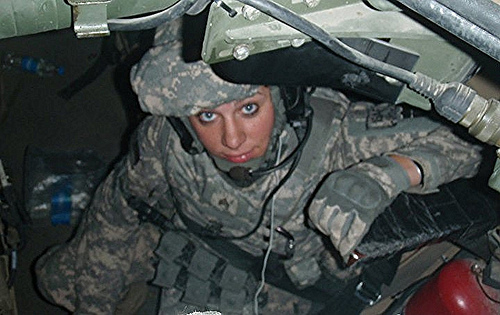
Sgt. Stephanie Murley poses for the camera in Bagram, Afghanistan in 2010 while serving on her second tour of duty overseas. She serves as a supply sergeant for Task Force Longrifles who are scheduled to deploy to the Horn of Africa in October. (Courtesy photo)
“Unlike Iraq, in Afghanistan we would get mortared almost every night,” said Murley, as she dropped her face and looked to the ground. “There were a few nights that I would pray to God and say, ‘please let me wake up in the morning.’”
Murley joined the Kentucky National Guard in 2006, at the age of 17. She joined because her grandfather, an Army veteran himself whom she greatly admired, had been in the military. His nobility and humility as a former Army man inspired her.
“It’s empowering to know I can do anything these guys can do,” she said.
Murley is not your typical one weekend a month and two-week summer training National Guardsmen, or woman if you will. She wears the uniform year-round. When she is not at her unit, she works full-time as a supply technician for the Kentucky Guard’s Central Issue Facility in Frankfort, Ky.
Along with being a Soldier and a technician for the Kentucky Guard, she is also the wife of Sgt. David Murley who is with Headquarters Battery, 1st Battalion, 623rd Field Artillery and is scheduled to deploy overseas in January. They got married in May of 2011, shortly after their return from Afghanistan.
“I’m going to miss my husband a lot,” said Murley, who stopped smiling. “This will be the longest we’ve been apart since we started dating.”
But Murley remains positive about this upcoming deployment, although she says she doesn’t know what to expect, because it will be very different than her tours in Iraq and Afghanistan.
“The job is stressful, don’t get me wrong. But the sense of accomplishment when it’s all said and done makes all the sacrifices worth it.” said Murley, that smile appearing once more. “I’m honored to be a female veteran.”
Story by: Capt. Stephen Martin, Kentucky National Guard Public Affairs
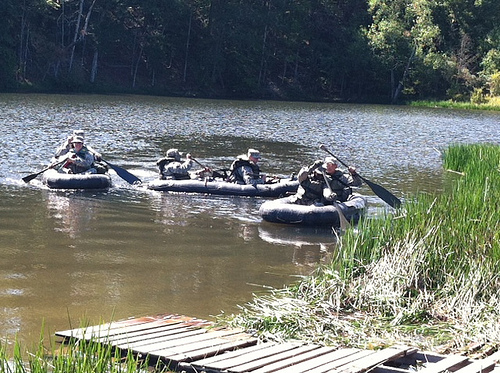
Soldiers of the 63rd Theater Aviation Brigade conduct a water crossing in zodiac boats with a simulated casualty to complete the tactical exercise during the first ever ‘Command Sergeant Major Challenge” at Hidden Valley Training Site in Eastern Kentucky Sept. 14-16, 2012. (photo by Chief Warrant Officer 5 Jim Chanley, 63rd Theater Aviation Brigade)
POWELL COUNTY, Ky. — It’s a weekend most won’t forget in the Army Aviation community any time soon.
To view all the photos of the event, please click here.
Brigade Command Sgt. Maj. Kevin Wilkins of the 63rd Theater Aviation Brigade was charged with leading the first ever Aviation Brigade-wide “Command Sergeant Major Challenge” at the Hidden Valley Training Site in Eastern Kentucky Sept. 14-16.
“I served in the Marines for seven years before joining the Kentucky Guard, and I can honestly say that this was the best field exercise I’ve ever participated in,” said Spc. Lora Detwiler, Bravo Co. 2nd Battalion, 147th Aviation Regiment. “I truly had a blast.”
The three-day event spread out over the 551 acres that covers Hidden Valley and had Soldiers navigating from point to point and conducting squad-size tactical exercises.
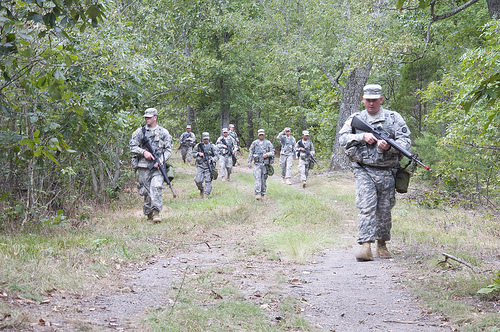
Members of Charlie Co. 1st Battalion, 376th Aviation conduct a route reconnaissanceduring the Kentucky National Guard’s 63rd Theater Aviation Brigade ‘Command Sergeant Major Challenge” at Hidden Valley Training Site in Eastern Kentucky Sept. 14-16, 2012. (photo by Capt. Stephen Martin, Kentucky National Guard Public Affairs)
Lt. Col. Mike Stephens, deputy commander of the 63rdTAB, praised Maj. Mark Brozak who logistically coordinated the entire event. “Brozak did a great job with the 1,000’s of ‘Hey Sir, what about this, what about that’ and managed it all seamlessly,” said Stephens.“This was definitely a team-effort. No one person could have pulled this off,” replied Brozak.
Twenty-six teams covered 13 lanes over the 44-hour training event ranging from reacting to indirect fire to interacting with foreign local-nationals to a water crossing in zodiac boats.
The challenge was not only to negotiate the lanes effectively. These 10-15 person squad-sized elements had a leader. That squad leader was charged with taking care of his or her troops. He or she had to determine where they were going to sleep, when they were going to eat and with the overall safety of the group.
“I hope you learned something this weekend,” Wilkins told his Soldiers at the end of the exercise. “I hope that you grew yourself and your teams as small elements and more than anything have grown your own leadership abilities.”
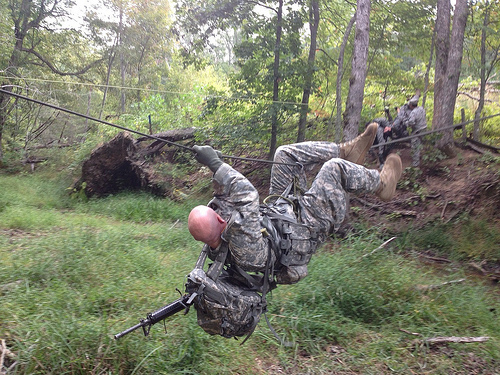
Sgt. Josh Bryant, Bravo Co. 2nd Battalion, 147th Aviation Regiment, navigates a make-shift rope bridge to accomplish the tactical exercise at the Kentucky National Guard’s 63rd Theater Aviation Brigade first ever ‘Command Sergeant Major Challenge’ at Hidden Valley Training Site in Eastern Kentucky Sept. 14-16, 2012. (photo by Spc. Tom Harrington, Bravo Co. 2-147 Aviation Unit Public Affairs Historian Representative)
The army aviation community is normally accustomed to work with or on helicopters and airplanes during drill weekend, so this month’s training took a few by surprise. Despite this fact, everyone was up for the challenge.
The exercise itself was also a competition amongst the squads on who would prevail as the best. 1st Lt. John Kerr’s squad from Headquarters and Headquarters Company, 63rdTAB took home the top prize which was a piece of an OH-58 Kiowa Helicopter Blade with the squad members names engraved in the unique plaque.
“This is a training event that went from the private level all the way to the colonel level and each one of you has served with distinction,” commented Col. Mike Ferguson, 63rd TAB commander. “Great job finishing the first and what will be an annual event. The challenge is on for next year.”
Story and photo by Lt. Col. Dallas Kratzer, ADT 5 executive officer
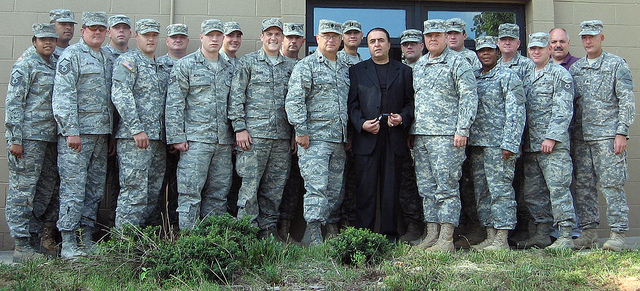
Members of the Kentucky National Guard’s Agribusiness Development Team 5 attend a language workshop at the Georgia National Guard Language Training Center in Marietta, Ga., August, 2012. (Photo courtesy of Kentucky ADT 5)
MARIETTA, Ga. — Members of Kentucky National Guard’s Agribusiness Development Team 5 recently traveled to Marietta, Georgia for two weeks of Pashto language immersion classes at the Georgia National Guard Language Training Center. Twenty of the thirty-nine member team spent two weeks learning the culture, history and language of the Pashto people of southern Afghanistan.
The class focused on common every day phrases, construction of sentences, numbers, and over 50 agricultural terms. Students left the class with over 300 Pashto words committed to memory and were able to translate basic sentences spoken in Pashto to English.
“Learning the Pashto language demonstrates a genuine interest in Afghanistan and their way of life,” said ADT 5 Commander Col. Bob Hayter, a native of Bowling Green, Ky. “In the Afghan culture it’s extremely important to establish personal relationships with the local population and its leaders prior to conducting any type of business. Chipping away at the language barrier will help us develop an instant rapport with the people as well as laying the cornerstone for a long and rewarding relationship.”
Pashto is spoken by nearly 40 percent of Afghanistan’s population and is a mixture of Persian, Dari, and other languages. Previous Kentucky National Guard Agribusiness Development Teams have worked primarily in the northern regions of Afghanistan. Kentucky’s ADT 5 will be the second team from Kentucky to work in the southern region of Afghanistan and will be replacing ADT 4 in late 2012.
Story by Sgt. Scott Raymond, Kentucky National Guard Public Affairs Office
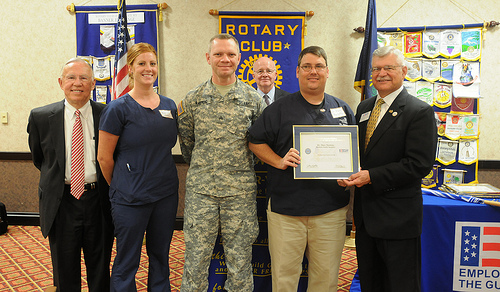
Dr. Marc Marlette is presented the Patriotic Employer Award by retired Maj. Gen. Robert Silverthorn, Kentucky ESGR Chairman, during an award ceremony in Florence, Ky., Sept. 17, 2012. (L-R) Ken Lucas, Commissioner of the Kentucky Dept. of Veterans Affairs, Anna Lafferty, Sgt. Scott Raymond, Dr. Marlette, Maj. Gen. Silverthorn.
FLORENCE, Ky. — On Sept. 15, 2012, a presidential proclamation was issued declaring the week of Sept. 16 – 22 as National Employer Support of the Guard and Reserve Week. In the announcement, President Barack Obama called upon all Americans to express thanks to the members of the National Guard and Reserve and their civilian employers. He also called on State and local officials, private organizations, and all military commanders, to observe the week with appropriate ceremonies and activities.Kentucky’s ESGR responded with presentations of the Patriotic Employer award to employers in the Commonwealth. During a ceremony hosted by the Florence Rotary Club in Florence, Ky., several Northern Kentucky businesses were honored for their contribution and support.
Among the recipients was Dr. Marc Marlette who runs his own dental practice in Florence. He was nominated not by a service member, but by a military spouse.
Anna Lafferty knows all to well the struggles and demands placed on Families and employers that are left behind when the military deploys. She stepped up to care for a family, a house, everything when I deployed to Iraq with the 149th Maneuver Enhancement Brigade in 2011.
Anna understood her new role as the head of our household, but she had just started a job as a dental assistant with a new office, Marlette Family Dentistry.
“I knew things would be tough,” she said. “Dr. Marlette hired me on knowing that I was the wife of a deploying Soldier, but having a military background, I think he knew what he was getting into.”
Times were rough indeed, but Anna said due in part to Marlette’s compassionate understanding, her job was never in question. In addition to her friends and family members, Anna said her boss became a caring asset to help her through the difficult months.
“It’s a simple thing to do, supporting your employees while at the same time supporting your country,” said Marlette. “Every employer should be supportive of those in the military.”
“Just because Anna’s not in the Army, she is affected as much as her husband is, and therefore my support should be there for both of them,” he said.
Marlette served for five years as a dentist in the U.S. Air Force. Carrying on a military tradition in his family, Marlette enlisted not only to serve his country, but also to do what he thought would make him a better dentist. He called Anna an invaluable member of his office and that her courage and strength should also be admired. He said the award was a pleasant surprise that he will hang at his business.
“I feel privileged to support a service member who is willing to go to war for his country,” said Marlette. “And also to know that I have such good employees working for me.”

ESGR was established in 1972 to promote cooperation and understanding between Reserve component members and their civilian employers and to assist in the resolution of conflicts arising from an employee’s military commitment.
Former U.S. Congressman and current Commissioner for the Kentucky Department of Veterans Affairs, Ken Lucas joined Kentucky ESGR Chairman, retired Maj. Gen. Robert Silverthorn to present the employer awards. As a former Air National Guard pilot, Lucas said he was glad to be part of the event.
“This award honors those who have empathy for the Guard and Reserve, and Families,” said Lucas. “It’s admirable to see (businesses) that are sensitive to the needs of those who went off to fight for our freedoms and our country.”
Since 9/11, more than 14,000 Kentucky Guardsmen have mobilized in support of the war on terror. And thousands of employers have also had to deal with the adversity and changes of a changing workplace affected by deployments.
The President concluded his proclamation with a reminder of what ESGR is about.
“During National Employer Support of the Guard and Reserve Week, let us pay tribute to the brave men and women who keep our Nation safe and celebrate their devoted employers, whose support is vital to the strength of our military.”
For more information on Employer Support of the Guard and Reserve, visit www.esgr.mil.
Story by Maj. Dale Greer, 123rd Airlift Wing Public Affairs
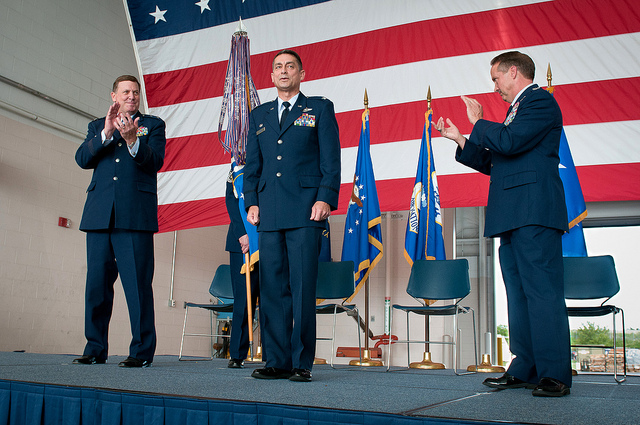
Kentucky’s Adjutant General, Maj. Gen. Edward W. Tonini (left), and Col. Greg Nelson (right) applaud Col. Warren H. Hurst, incoming commander of the wing, during a change-of-command ceremony at the Kentucky Air National Guard Base in Louisville, Ky., Sept. 16, 2012. Hurst is a combat veteran and command pilot with more than 4,000 flying hours. (U.S. Air Force photo by Senior Airman Maxwell Rechel)
LOUISVILLE, Ky. — Col. Warren H. Hurst officially took charge of the 123rd Airlift Wing during a change-of-command ceremony Sunday at the Kentucky Air National Guard Base in Louisville, promising that readiness would be the cornerstone of his command.
“For the past 20 years, there has been a Kentucky (aircraft) or a Kentucky Guardsman in every major operation that the United States has participated in,” Hurst told a crowd of nearly 1,000 Airmen gathered in the base Fuel Cell Hangar.
“Every day since 9/11, we have had Airmen deployed around the world supporting our national interests. We also have responded to multiple stateside missions in support of major natural disasters such as hurricanes, earthquakes, ice storms and floods.
“I thank you for what you have done, and for what you will continue to do. We need your talent to keep our wing at the forefront of excellence as we prepare for upcoming inspections and future challenges. My philosophy on inspections and contingencies is that we should always be ready. So when I ask if you are ready, I hope to hear, ‘Born ready!’”
Hurst, a combat veteran and command pilot with more than 4,000 flying hours, replaces Col. Greg Nelson, who has been named deputy director of strategic plans and policy at the National Guard Bureau in Washington, D.C.
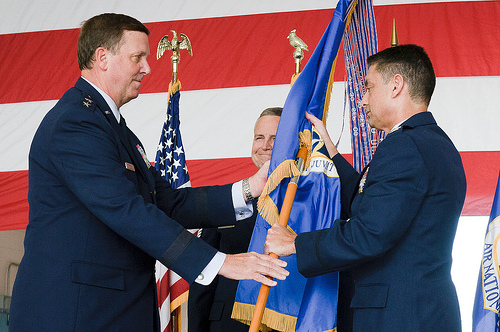
Col. Warren H. Hurst (right) accepts the guidon of the 123rd Airlift Wing from Kentucky’s Adjutant General, Maj. Gen. Edward W. Tonini, during a change-of-command ceremony at the Kentucky Air National Guard Base in Louisville, Ky., on Sept. 16, 2012. The formal ceremony signals the official transfer of power to from the previous wing commander, Col. Greg Nelson, to Hurst. (U.S. Air Force photo by Senior Airman Maxwell Rechel)
Prior to his current assignment, Hurst stood up and commanded the Kentucky Air Guard’s 123rd Contingency Response Group, a unit designed to be an early responder in the event of a terrorist attack, natural disaster or other major emergency anywhere within a 400-mile radius of Louisville. The group — one of only 10 CRGs in the Air Force and the first fully operational CRG in the Air National Guard — also is capable of supporting military contingency operations worldwide.
Before assuming command of the 123rd CRG, Hurst served a three-year temporary duty tour on the Tanker Airlift Control Center Battle Staff at Air Mobility Command Headquarters, Scott Air Force Base, Ill. He has an extensive background in planning and executing expeditionary airlift operations worldwide. For example, Hurst coordinated civil-military air relief efforts during the 2010 Haiti earthquake and served as deputy director of mobility forces to the Pacific Air Forces commander in response to the 2011 earthquake, tsunami and nuclear crisis in Japan.
Commissioned through Officer Training School in 1986 after earning bachelor’s and master’s degrees from the University of Houston—Clear Lake, Hurst has flown numerous C-130 combat and humanitarian missions worldwide, including operations in Bosnia, Somalia, Rwanda, Haiti, Liberia, Iraq and Afghanistan.
Kentucky’s Adjutant General, Maj. Gen. Edward W. Tonini, praised Hurst as a visionary officer whose leadership helped craft national policy in area of the disaster response.
“His work as director of mobility forces during numerous National Level Exercises and contingencies, including the earthquake, tsunami and subsequent nuclear fuel issues in Japan, give credit to his leadership abilities and his vision for this air wing,” Tonini told the audience.
“Warren was responsible for setting new standards of excellence in the disaster-response community and for developing NGB and Air Force policy in the CRG mission area,” he added. “His profile is already extremely positive and national in scope.”
Tonini, who officiated the change of command, then challenged Hurst to build on the accomplishments of his predecessor, calling the 123rd Airlift Wing a vital component of America’s defense and disaster-response capabilities.
“Warren, you are in a place now where you can make a huge difference, not just to the Airmen under your command, but to the citizens of the Commonwealth in their time of need,” he said.
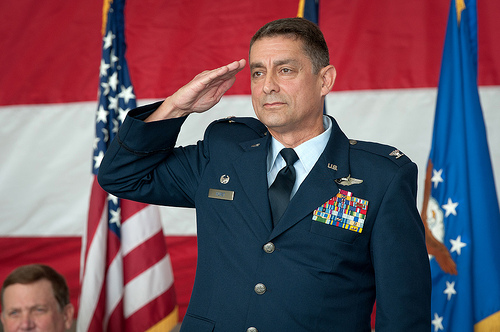
Col. Warren H. Hurst receives his first salute as commander of the 123rd Airlift Wing during a change-of-command ceremony at the Kentucky Air National Guard Base in Louisville, Ky., Sept. 16, 2012. Hurst replaces Col. Greg Nelson, who has been named deputy director of strategic plans and policy at the National Guard Bureau in Washington, D.C. (U.S. Air Force photo by Senior Airman Maxwell Rechel)
Tonini also had high praise for Nelson, whom he called “an exceptional and totally focused leader.”
During his four-year term as wing commander, which ran from Oct. 1, 2008 to Sept. 16, 2012, Nelson guided the unit to unprecedented levels of achievement, gaining new missions and aircraft while earning the wing’s 15th Air Force Outstanding Unit Award — a feat unsurpassed in the entire U.S. Air Force.
Throughout Nelson’s tenure, the wing deployed hundreds of Airmen to participate in numerous overseas missions in support of Operations Enduring Freedom, Iraqi Freedom, New Dawn and Coronet Oak, including a historic deployment to Afghanistan in 2010 and 2011 during which Kentucky aircrews broke multiple records for the amount of cargo airlifted and airdropped to coalition forces.
The wing was active closer to home, as well, mobilizing the 123rd CRG to the Dominican Republic to establish one of two contingency air hubs for the movement of humanitarian relief into Haiti following the massive 2010 earthquake. The unit ultimately was responsible for coordinating the delivery of 725 short tons of life-saving aid, an accomplishment Tonini termed “nothing short of remarkable.”
Nelson personally set new benchmarks of performance, too, Tonini said. He was instrumental in the development of the 123rd Contingency Response Group into a national model of excellence, and he expertly directed mobility operations during catastrophic floods in Pakistan in 2011 while deployed to Qatar as the deputy director of mobility forces at the Combined Air and Space Operations Center, U.S. Central Command.
“His efforts set new standards for the rest of us to follow,” Tonini said in summation. “Greg, thank you so much for your leadership, your professionalism and your compassion as the leader of this great organization. I look forward to working with you as you take your new position as the deputy director of strategic plans and policies at the National Guard Bureau.”
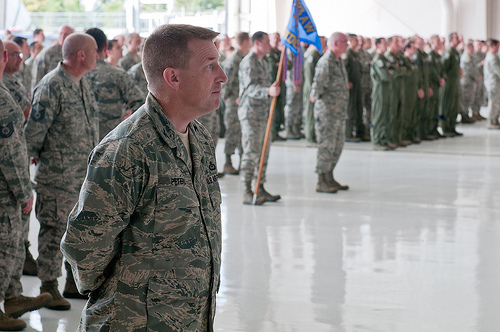
Nearly 1,000 Airmen gather in the Fuel Cell Hangar at the Kentucky Air National Guard Base in Louisville, Ky., for a ceremony Sept. 16, 2012, marking the change of command at the 123rd Airlift Wing. Col. Warren H. Hurst assumed command from Col. Greg Nelson, who has been named deputy director of strategic plans and policy at the National Guard Bureau in Washington, D.C. (U.S. Air Force photo by Senior Airman Maxwell Rechel)
Nelson used the occasion — his last official function as wing commander — to thank the men and women of the Kentucky Air Guard for their dedication and service over the past four years.
“Thank you for believing in my leadership, accepting my direction and helping make the 123rd Airlift Wing the best tactical airlift wing in the United States Air Force,” Nelson said to the audience.
“Four years ago, I told you a little about my history and what I believe in. As I leave today, I want you to know that I still believe in our great nation and our military. And more than ever, I believe in the strength of each and every man and woman in the 123rd Airlift Wing. You do not wait to be called. You always step up. You are always the first to be there.
“I want you to know what an honor and a blessing it has been to command the unit I grew up in. I am proud of each and every one of you for what you do for the Commonwealth of Kentucky and our great nation.”
The 123rd Airlift Wing, based in Louisville, is home to about 1,200 Airmen and 10 C-130 Hercules aircraft. The unit’s primary mission is tactical airlift. Other key missions include contingency response, special tactics combat control and pararescue.
For more photos from the change of command, click here.
Story by Sgt. David Bolton, Kentucky National Guard Public Affairs Office
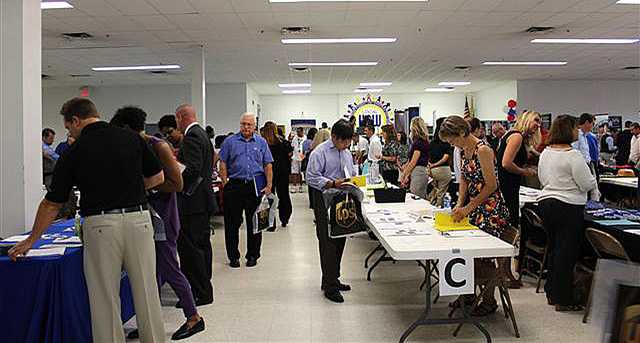
Kentucky Employer Support of the Guard and Reserve (ESGR) assists with job fairs throughout the Commonwealth, getting the word out to those looking for employment. This job fair at the United Auto Workers Hall in Louisville, Ky., was sponsored by U.S. Congressman John Yarmuth. (Photo by Charmaine Miller)
FRANKFORT, Ky.— Anyone who has ever been job hunting knows that there are numerous obstacles to overcome when trying to secure that perfect position. Finding a company that is accepting applications, meeting the qualification and education expectations, having a well-rounded resume, preparing for an interview, and inquiring about career advancements in the field.
For Kentucky National Guardsmen, there can also be the added dilemma of seeking out an employer who understands the military commitment required of them. In all these cases, the Kentucky National Guard Employer Support of the Guard and Reserve (ESGR) is there to assist service members and their families.
“ESGR is an agency that can make the Soldier’s return easier in terms of returning to employment,” said Harry T. Wiley, State Public Affairs Officer for Kentucky’s ESGR program. “We work with employers and with military reservists in Kentucky to find better jobs for service members who are underemployed and who need employment.”
ESGR is a Department of Defense agency that works to gain and maintain active support from all public and private employers. Programs are important because they help to maintain and provide stability for all.
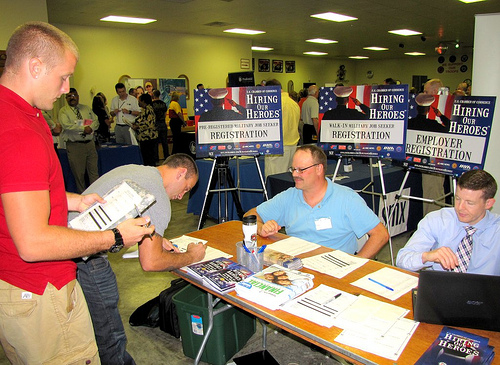
Job fair, Hire Our Heroes, sponsored by the KY Office of Employment and Training, Employer Support for the Guard and Reserve, KY Dept. of Labor Vets and KY Chamber of Commerce. The event held in Florence, Ky., July 24, saw over 150 job-seekers connect with local employers. (Photo courtesy of National College)
“Our goal with the Employment Initiative Program (EIP),” said retired Kentucky Army National Guard Col. Phil Miller, Program Support Specialist for Kentucky ESGR, “is to help service members and their spouses to stabilize, through gainful employment, the guard and reserve as a community-based defense force in each state.”
ESGR is improving by hosting functions such as Job fairs and Employment Assistance Workshops (EAW) where attendees can work on resume writing, interview skills, job searches, networking, and effective communication techniques.
“We’ve had a number of people hired on the spot at these job fairs,” said Miller. “That’s the biggest thing is to match the expectations of the service members with the expectations of the employers.”
Currently there are between 50 and 60 companies working with ESGR in job fairs to connect Soldiers and Airmen with employment opportunities. After the job fairs in Lexington and Louisville, Miller said that they were tracking an 80% success rate at the 90-day mark of having military personnel employed.
Employers can be recognized by the employee or employee family member for their support of military employees. Awards include Patriotic Award, Above and Beyond, Pro-Patria, and the Freedom Award.
ESGR Ombudsman service program works with employers and service members as a liaison to provide information about employee rights under the Uniformed Services Employment and Reemployment Rights Act (USERRA) laws in instances where service related issues arise.
“We can serve as an independent third party who can help both the Soldier and the employer know more about their respective responsibilities,” said Wiley. “ESGR helps negotiate settlements between parties which helps avoid conflict.”
For more information about resume and interview tips, go to: www.h2h.jobs or www.e3.ky.gov.
Story and photos by Sgt. David Bolton, Kentucky National Guard Public Affairs Office
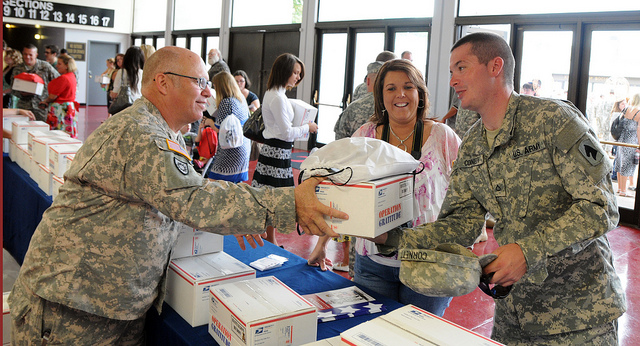
Chaplain Brent Kelly, Kentucky National Guard Yellow Ribbon Program Manager, passes out care packages to Families of Soldiers deploying with the 2nd Battalion, 138th Fires Brigade to the Horn of Africa at the Frankfort Convention Center in Frankfort, Ky., Aug. 31, 2012. The boxes contained teddy bears and books that could record the Service member’s voice as they read and be played back at any time. (Kentucky National Guard photo by Sgt. David Bolton)
FRANKFORT, Ky.— As Soldiers of the Kentucky National Guard’s 2nd Battalion, 138th Field Artillery prepared to serve their country abroad, the Guard’s Yellow Ribbon program prepared to serve the Families of these service members at home.
More than 500 care packages with special gifts for the Families of the deploying Soldiers were presented to children, spouses, aunts, uncles and grandparents prior to the farewell ceremony for the 2/138th Aug. 31, 2012 at the Frankfort Convention Center.
“The boxes have a teddy bear with a recordable book in it so that the Soldier can read it and record their voice so that the child can have that while they’re gone,” said Linda Jones, Child & Youth Programs Coordinator. “There is also a memory box that the kids can decorate and put things in that their parents send to them or something that is important to them.”
The boxes provided a way for the children and Families to stay connected and maintain ties with loved ones throughout the duration of the deployment.
“The bags have all sorts of goodies so the kids wind up having a really good connection with their parents who are deploying and spouses wind up feeling supported,” said Chaplain Brent Kelly, Yellow Ribbon Program Manager.
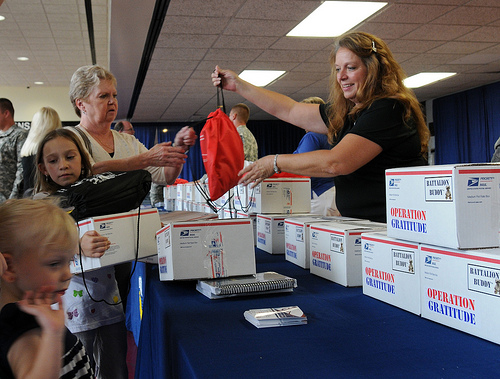
Workers with the Kentucky National Guard’s Yellow Ribbon Program pass out care packages to families of Soldiers deploying to the Horn of Africa at the Frankfort Convention Center in Frankfort, Ky., Aug. 31, 2012. (Kentucky National Guard photo by Sgt. David Bolton)
Supplying care packages isn’t the only thing that the Kentucky Guard Yellow Ribbon Program does however. They also provide National Guard and Reserve Members and their Families with information, services, referral and proactive outreach opportunities throughout the entire deployment cycle.
“Anytime a spouse has any kind of problem, if a child is having trouble in school, if they can’t pay their electric bill, maybe they’re stressed, anything you can think of, they can call and get help from somebody,” said Jones. “We want the spouses to think of Family Programs as their extended family, we’re there for them when their spouse is gone.”
This isn’t the only type of event that the Yellow Ribbon Program has provided to the Service members of the Kentucky Guard.
“We support Operation Military Cheer, Summer camps; we have a whole host of other events throughout the year to support Kentucky Guard Families,” said Kelly. “We understand what the Soldiers are going through and we are happy to support them and their Family because we in the Kentucky Guard are a Family.”
For those interested in finding out more about the Kentucky National Guard’s Yellow Ribbon Program, you can contact Ms. Kim Coyle at 1-502-607-1177
or visit http://www.jointservicessupport.org for more information.
Story and photos by Sgt. Paul Evans, KY ADT 4 Unit Public Affairs and Historian Representative
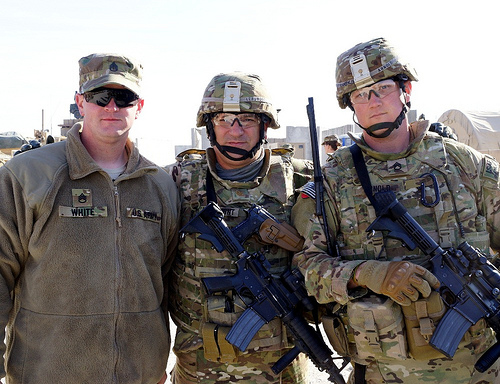
Pictured left to right: Staff Sgt. Charles White of Perryville, Ky., Maj. Walter Leaumont of Lexington, Ky., and Staff Sgt. Mark Arnold of Harrodsburg, Ky. get together for a photo prior to a mission with the Kentucky National Guard’s Agribusiness Development Team 4 prior to a mission in southern Afghanistan on February 14, 2012. The three Soldiers are also full-time staff members for Harrodsburg’s Headquarters and Headquarters Co. 103rd Brigade Support Battalion, 138th Fires Brigade. (U.S. Army photo by Sgt. Paul Evans)
FORWARD OPERATING BASE PASAB, Afghanistan — While most of Harrodsburg, Ky.’s 103rd Brigade Support Battalion, 138th Fires Brigade is back in Kentucky serving its citizens, they can’t help but remember a small team from their battalion is halfway across the world.
This team of nine Soldiers from across the 103rd Battalion deployed to southern Afghanistan as part of the Kentucky National Guard’s Agribusiness Development Team 4, taking with them the skills developed in the 103rd. Altogether, Soldiers from the 138th Fires Brigade as a whole make up more than one-fifth of ADT 4’s members.
“Most of the full-time staff has taken on the other duties that we normally didn’t have in order to continue our throughput,” said Frankfort, Ky. resident Capt. Brian Mattingly, the 103rd’s Battalion Administrative Officer. Three of the deployed 103rd members also serve as full-time staff back at the 103rd BSB Headquarters in Harrodsburg, Ky.
In addition to the nine unit members with ADT 4, the 103rd has more than a dozen Soldiers either deployed or preparing to leave for areas ranging from Afghanistan to Kuwait to Africa.
“Almost all of the Soldiers volunteered for those deployments,” Mattingly said. “That is the testament to the great leaders that we have in the 103rd BSB. Our Soldiers are the best in the state and always answer the call, day or night.”
“When I came in we had several people that volunteered for the mission, people that I had front line visibility on,” recalled Maj. Walter Leaumont of Lexington, Ky., ADT4’s Executive Officer.
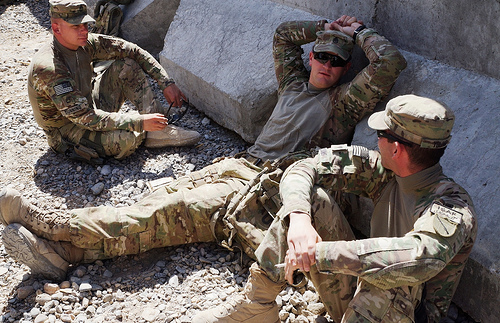
Staff Sgt. Charles White of Perryville, Ky. (center) takes some time to rest during a mission in southern Afghanistan alongside Spc. Christopher Young (right) of Richmond, Ky. and Sgt. 1st Class Greg Dunning (left) of Almo, Ky. The three Soldiers are members of Kentucky National Guard’s Agribusiness Development Team 4. (U.S. Army photo by Sgt. Paul Evans)
“They’re playing a vital part, just because we came in just a bunch of different people from different units, and it was nice having that core of 103rd personnel that I knew that were working well with each other,” Leaumont added.
“The war had been going on for almost 11 years, and it was time I went with them,” reflected Staff Sgt. Charles White, a Perryville, Ky. resident. Before leaving he worked as a full-time network administrator for Headquarters and Headquarters Co. 103rd BSB.
“It’s been a learning experience on positive and negative aspects of being a Soldier,” White added. “Just being a Soldier in itself is a challenge, but it’s actually pretty nice being around some familiar faces.”
“Maybe it’s seeing other aspects of their personality that you really don’t see back home,” White said about challenges of deploying with other 103rd members. “But all-in-all it’s just actually getting to know them even better.”
The 103rd troops with ADT 4 consist of: Staff Sgt. Michael Watts of Danville, Ky., originally from Co. A, Danville; Staff Sgt. Charles Yankey and Sgt. Randy Sewell of Frankfort, Ky. from Co. B, Frankfort; Master Sgt. John Black of Lawrenceburg, Ky. from Co. B; Staff Sgt. Mark Arnold of Harrodsburg, Ky., Staff Sgt. Charles White of Perryville, Ky., Sgt. Jeremiah Kwiek of Mt. Washington, Ky., Sgt. Paul Evans of Richmond, Ky., and Maj. Walter Leaumont of Lexington, Ky. from Headquarters and Headquarters Co. in Harrodsburg.
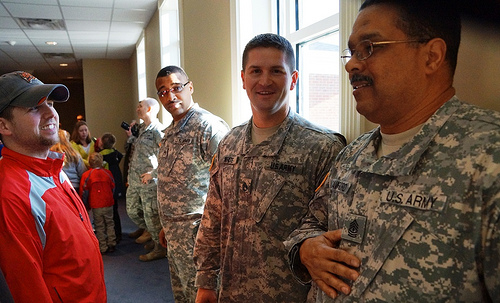
Members of Headquarters and Headquarters Co. 103rd Brigade Support Battalion, 138th Fires Brigade show support for their peers at a departure ceremony in Frankfort, Ky. on January 3, 2012. A total of nine 103rd BSB Soldiers currently serve in southern Afghanistan with the Kentucky National Guard’s Agribusiness Development Team 4. Pictured from left are: Sgt. 1st Class Anthony Tudor of Lancaster, Ky.; Staff Sgt. Jesse Davis of Lexington, Ky.; ADT 4 member Staff Sgt. Charles White of Perryville, Ky.; and First Sgt. James Crawford of Danville, Ky. (U.S. Army photo by Sgt. Paul Evans)
“With the use of media sharing outlets such as Facebook we are able to track their well-being and talk to them through the use of emails,” Mattingly said of keeping in touch with his deployed Soldiers.
“I talk to Mattingly probably once or twice a month just to check in,” Leaumont noted.
Asked whether he’s looking forward to getting back home to the 103rd, White offered an emphatic “yes.”
“I don’t know how to elaborate on that,” he said. “I’m looking forward to getting back home. We’ve got a great working group there. Everybody gets along-it’s a really nice working environment.”
“It’s always a relief to get everyone back home-not just Kentucky Soldiers and Airmen, but also everyone who has ever deployed or had duty overseas away from home,” Mattingly said.
