Pages
Stay In Touch
More
© 2013 KentuckyGuard
By Maj. Stephen Martin, Kentucky National Guard Public Affairs
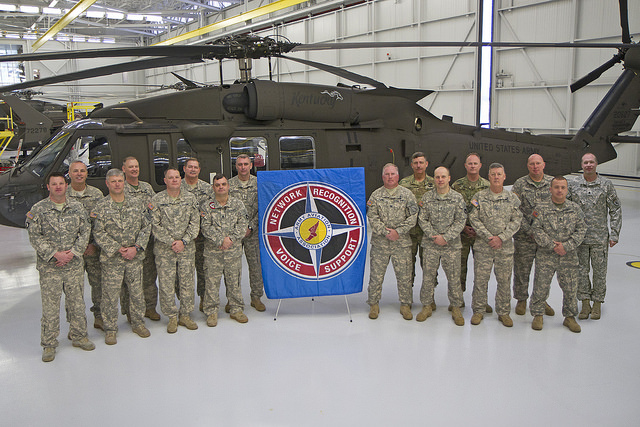
Fifteen members of the Kentucky National Guard’s 63rd Theater Aviation Brigade have accumulated 4,000 military flight hours or more in their career. The Bluegrass Chapter of The Army Aviation Association of America has recognized these aviation Soldiers for their accomplishment. Pictured from LEFT to RIGHT: Chief Warrant Officer 4 Porter Whitney, Chief Warrant Officer 4 John Boyle, Chief Warrant Officer 4 Eric Mattingly, Chief Warrant Officer 4 Tony Villier, Chief Warrant Officer 5 Steve Bowling, Command Chief Warrant Officer 5 Dean Stoops, Staff Sgt. Daryl Casey, Chief Warrant Officer 5 Harold Grider, Col. Brian Abney (State Army Aviation Officer), Chief Warrant Officer 5 Steve Knight, Chief Warrant Officer 4 Shawn Gabhart, Chief Warrant Officer 5 Stuart Lindfors, Chief Warrant Officer 5 Gerald Carroll, 1st Sgt. Matt Singer, 1st Sgt. Troy Logsdon, Lt. Col. Dewayne Lewis. (U.S. Army National Guard photo by Staff Sgt. Scott Raymond)
FRANKFORT, Ky. — The Kentucky National Guard’s Army aviation community is steeped in history. From their arrival in 1959 at the Capital City Airport in Frankfort, Ky. through being the first National Guard unit in the country assigned Blackhawks, Kentucky’s aviation Soldiers have remained at the forefront of their career field.
Fifteen members of the 63rd Theater Aviation Brigade have 4,000 military flight hours or more. They represent a wealth of aviation experience which few aviation formations can match. Because of this, The Bluegrass Chapter of the Army Aviation Association of America (Quad A) took time to recognize these Soldiers for their accomplishments.
To see photos of these Army Aviators in action over the years, please click HERE.
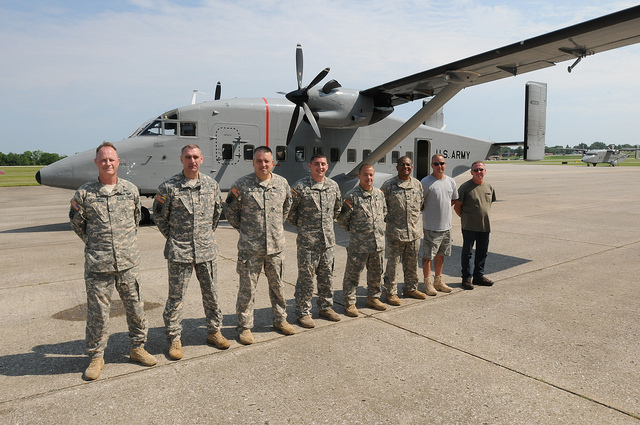
The Kentucky National Guard said farewell to their C-23 Sherpas during a ceremony at Capital City Airport in Frankfort, Ky., July 9, 2013. (U.S. Army National Guard photo by Staff Sgt. Scott Raymond)
“The Kentucky Guard aviation community is recognized by any measurable metric as one of the finest aviation organizations in any component of the Army,” said Col. Brian Abney, State Army Aviation Officer. “These 15 Soldiers are indicative of the quality of our program here in Kentucky for sure… The flying hour milestones that these individuals have reached remain a notable accomplishment for any organization and I am especially proud of this group of aviation professionals.”
An old aviator’s quote says, “You can always take off, but you can’t always land…” An axiom like this reminds all flyers the cost of the profession and the decisions that need to be made on a regular basis.
Collectively these 15 aviation Soldiers have accumulated in excess of 80,000 flight hours without a Class A, B or C accident and an average time in service of more than 28 years.
What does this mean to the Kentucky Guard?
For one, the safety record of the Kentucky Army National Guard is unparalleled. Indeed, the Kentucky Guard has not experienced a Class A or B Army accident since 1970. A time frame which encompasses multiple combat tours and numerous overseas deployments with more than 250,000 flight hours flown on a variety of different types of aircraft. This can be attributed to the level of experience that the troops in this profession boast.
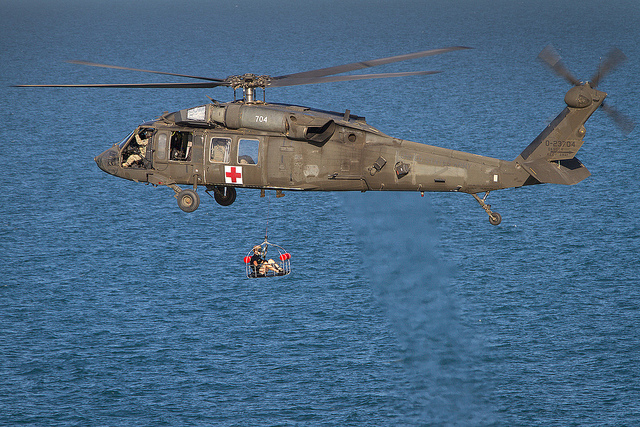
C Co 2/238th MEDEVAC conducts personnel recovery (PR) operations over the Northern Arabian Gulf (NAG) Oct. 10, 2013. The unit is qualifying all army aviation crewmembers on overwater hoist PR while on deployment. This was conducted as a joint training exercise with a sister flight company who deployed the Navy EOD teams into the water via HeloCast and were recovered by the MEDEVAC aircraft. (photo submitted)
Regarding combat flight time exclusively, these 15 aviation Soldiers have accumulated 10,000 hours across a combined total of 30 deployments since 9/11. These high flyers have flown in Afghanistan, Iraq, Kosovo, Kuwait, not to mention Europe, South America and Central Asia among other locations.
Considerably, these operations couldn’t be accomplished without the crew-chiefs, administrative and supply personnel. It’s a coordinated effort to get a multi-million dollar aircraft airborne. That’s why it’s equally impressive that three of the Soldiers on this list are enlisted crew-chiefs.
“Everybody plays a part, from the maintenance guys giving us a safe aircraft to operations ensuring we are safe to the crews executing the mission,” said 1st Sgt. Matt Singer, Company C., 1st Battalion 376th Aviation. ” 4,000 flight hours requires a whole lot more than 4,000 hours of work on the part of a lot of folks.”
“We may not go to flight school, but we can certainly give beneficial technical or tactical advice from a different point of view… in addition to providing comic relief and stinging sarcasm, which is required of all crew chiefs.”
63rd TAB Command Sgt. Major Bill Stocker talks about the significance of the enlisted Soldiers accomplishments.
“Crew-Chief’s in this community are the unsung heroes of aviation. These ‘part-time’ Guardsmen have the same requirements as their active duty counterparts and are held to the same standard. They are required to make sure the aircraft is in good working order especially after the officers upfront do their level-best to break the thing.”
Stocker points out that these service members are charged with both the fight abroad on behalf of the nation as well as providing support to the commonwealth. “Their experience level is kept here in this organization and is not turned over every three years. This is crucial to accomplishing the mission the way we do.”
“This band of brothers are great mentors for the next generation of crew-members and in showing us what right looks like. They are an invaluable commodity for this brigade,” said Stocker. “The Kentucky National Guard’s Army enlisted aviation community will reap the rewards of their hard work and commitment for years to come.”
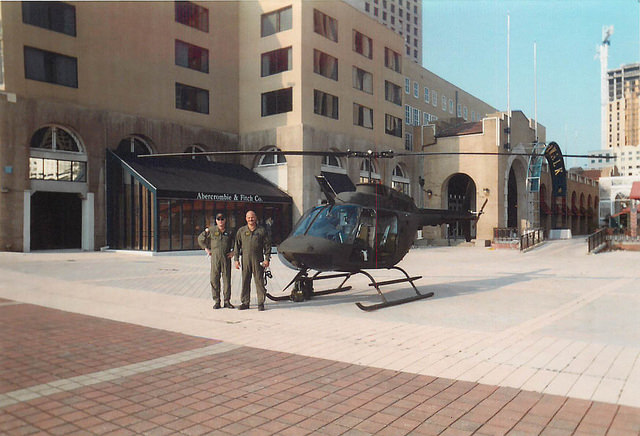
Chief Warrant Officers Bowling and Johnston pose just after they land an OH-58 A/C helicopter on Canal Street in New Orleans, La. in support of Hurricane Katrina in 2005. Fifteen members of the 63rd Theater Aviation Brigade have 4,000 military flight hours or more. This photo represents the storied history of that endeavor.(Photo courtesy of the 63rd TAB aviation community)
Chief Warrant Officer Steve Bowling offered up a piece of advice to new Soldiers entering the field.
“Today’s young aviators are better equipped than ever before, the new facilities are top notch, and the aircraft are awesome. The new aviator skill level with the newest systems are better than they have ever been. The Guard has done a great job of equipping the force for the future. In addition the amount of trust we can place on the younger folks has never wavered. They are as good as ever in my experience.”
“However being an old guy I still want them to know how to do things ‘the old fashioned way’ for when the new and improved stuff breaks. GPS is great but I still want to know I can pull out the old ‘HHM’ (Hand Held Map) and we all make it home at the end of the day safe.”
“Those are the things the REAL old guys taught me.”
Order from highest to lowest amount of hours: Chief Warrant Officer 4 John Boyle, 9,000 hours; Chief Warrant Officer 5 Harold Grider, 7,000 hours; Chief Warrant Officer 5 Gerald Carroll, 6,000 hours; Chief Warrant Officer 4 Eric Mattingly, 5,000 hours; Lt. Col. Dwayne Lewis, 5,000 hours; Command Chief Warrant Officer 5 Dean Stoops, 5,000 hours; Chief Warrant Officer 5 Steve Knight, 5,000 hours; Chief Warrant Officer 5 Stuart Lindfors, 5,000 hours; Chief Warrant Officer 4 Porter Whitney, 5,000 hours; Chief Warrant Officer 5 Steve Bowling, 5,000 hours; Chief Warrant Officer 4 Shawn Gabhart, 5,000 hours; 1st Sgt. Troy Logsdon, 4,000 hours; 1st Sgt. Matt Singer, 4,000 hours; Staff Sgt. Daryl Casey, 4,000 hours; Chief Warrant Officer 4 Tony Villier, 4,000 hours.
By Sgt. Lerone Simmons, 133rd Mobile Public Affairs Detachment
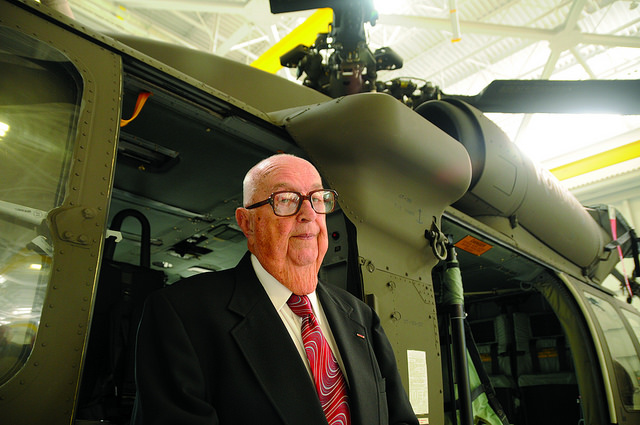
Retired Chief Warrant Officer William H. Canon, former shop foreman assigned to the 2113th Transportation Aircraft Maintenance Company, poses with a new UH-60M Black Hawk helicopter after a ribbon cutting ceremony for Kentucky’s new Army Aviation Support Facility and introduction of a new fleet of UH-60M’s, Boone National Guard Center, Frankfort, Ky., Oct. 14, 2015. Canon gave thirty five years of his life to providing maintenance to Kentucky’s aircraft. (U.S. Army National Guard photo by Sgt. Lerone Simmons)
FRANKFORT, Ky. - Sitting in a new multi-million dollar facility, retired Chief Warrant Officer William Canon Jr., reminisced about providing maintenance to the Kentucky National Guard’s aircraft in high winds, pouring rain, freezing cold and summer heat.
“When I first joined, our pilots had recently flown in World War II,” he said. “Our equipment was old and we didn’t have adequate places to work.
“We had to park trucks around the helicopters to make sure the wind didn’t hit them directly,” said Canon. “The elements are one of the worst things when it comes to properly maintaining aircraft.”
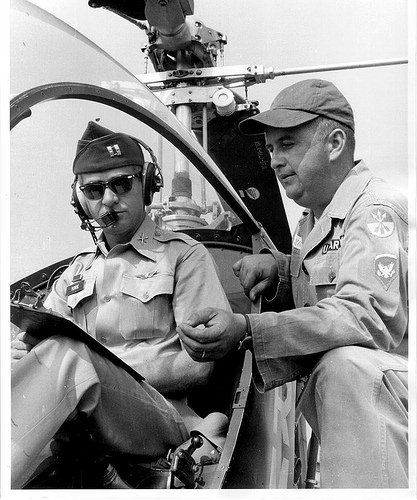
Capt. Yancey York confers with SPEC5 William H. Canon as he prepares for a flight in a OH-13E, circa 1960. (Photo courtesy Chief Warrant Officer(R) Harold Canon)
Click here for more photos.
Canon enlisted in the Army in 1950 and retired in 1990. He would join a fledgling aviation program in 1955.
In 1959, the Kentucky aviation assets found a new home in Frankfort, Kentucky, at the Capital City Airport. Then, 18-or-so-years later in 1971, Canon witnessed a state-of-the-art facility erected at Boone National Guard Center – the Army Aviation Support Facility. A hangar for the helicopters assigned to Kentucky. During his tenure, Canon rose to the level of shop foreman, assigned to the 2113th Transportation Aircraft Maintenance Company, and retired out of the old AASF.
But on Oct. 14, he joined hundreds of other current and former Kentucky National Guardsmen as the ribbon was cut, ceremoniously showing off the Kentucky National Guard’s newest AASF at Boone National Guard Center. He also got to view, sit in, and touch the new UH-60M, the Army’s newest in the Blackhawk fleet.
The new AASF is 126,000 square feet and uses geo-thermal heating and cooling, solar power, 80 kilowatts photovoltaic solar power, high efficiency lighting, daylight harvesting technology, and radiant floor heating. It holds several offices for staff, classrooms, a gym and plenty of space.
“We come from a time where we didn’t always have a climate controlled area or lots of space,” said Canon’s old company commander, retired Lt. Col. Willoughby S. Goin III, a former pilot with 12,000 flying hours.
“This will help allow the Guard to be able to deploy troops to any affected areas in a timely manner,” he said, “at times when ice storms, tornados and floods can destroy roads, the Guard can then utilize the air from this facility.”
Kentucky Gov. Steve Beshear, Maj. Gen. Edward W. Tonini, adjutant general for Kentucky and other special guests honored Canon in their remarks during the building’s dedication. The Kentucky Guard’s aviation safety record was also bragged upon during the remarks.
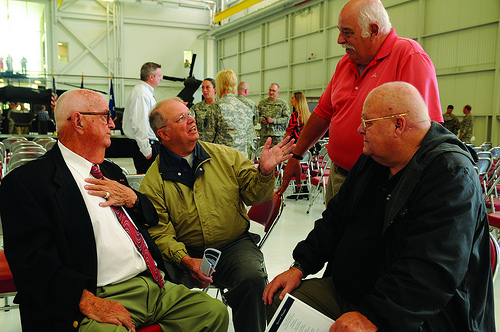
Sitting from left to right, retired Army Chief Warrant Officer William H. Canon, former shop foreman who was assigned to the 2113th Transportation Aircraft Maintenance Company, retired Army Lt. Col. Jere Roche, former commander of the 441st Medical Detachment, and retired Army Lt. Col. Willoughby S. Goin III, former commander of the 2113th Transportation Aircraft Maintenance Company, carry on a conversation after a ribbon cutting ceremony for Kentucky’s new Army Aviation Support Facility in Frankfort, Ky., Oct. 14, 2015. (U.S. Army National Guard photo by Sgt. Lerone Simmons)
Kentucky hasn’t had any major accidents or loss of life for the span of the last 250,000 flying hours, which Tonini said boils down to a huge feat of great maintenance and outstanding flying. He added that the Kentucky Guard has flown at least 15 missions over the Commonwealth during times of disaster, also while supporting the Joint Support Operations counterdrug efforts and overseas contingency operations.
For the many aviation retirees and current Guardsmen who maintain the Commonwealth’s air assets, the day was a reunion and a celebration of moving forward.
“What I’ve seen is outstanding,” said Canon. “I’m proud the progress we’ve made.”
Kentucky National Guard Staff Report
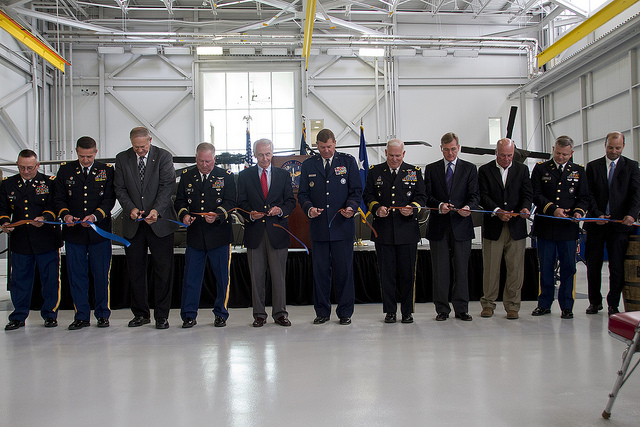
Gov. Steve Beshear, Maj. Gen. Edward W. Tonini, Kentucky Guardsmen and other guests cut the ribbon to officially open the Kentucky National Guard’s Army Aviation Support Facility in Frankfort, Ky., Oct. 14, 2015. The 126,000 square foot building replaces an aging facility built in 1971. (U.S. Army National Guard photo by Staff Sgt. Scott Raymond)
FRANKFORT, Ky. — To begin the new fiscal year, the Kentucky National Guard opened two new facilities Oct. 14, in its continued effort to support the Commonwealth and the nation.
To see all photos from this event, please click HERE.
Gov. Steve Beshear joined Maj. Gen. Edward W. Tonini, adjutant general for Kentucky in cutting the ribbon on a new Army Aviation Support Facility in Frankfort, Ky. The new $26 million facility has nearly 126,000 square feet of combined space to house UH-60 Blackhawk and LUH-72 Lakota helicopters.
The new hangars and office space provide the latest in cost-savings technology and energy efficiency. It will replace the aging AASF built in 1971.
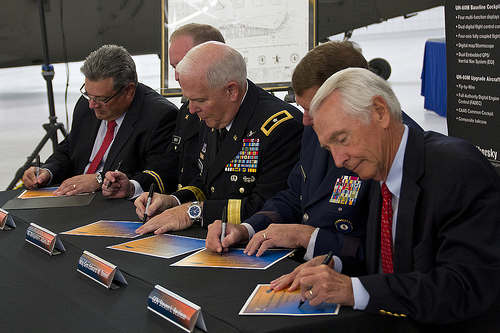
Gov. Steve Beshear, Maj. Gen. Edward W. Tonini, Brig. Gen. Benjamin F. Adams III, Col. Brian Abney and Tom Nicolett ceremoniously accept new UH-60M Blackhawk helicopters in Frankfort, Ky., Oct. 14, 2015. The signified the Kentucky Guard’s receipt of the newest model of the Army’s primary helicopter. (U.S. Army National Guard photo by Staff Sgt. Scott Raymond)
“The courageous men and women who constitute the Kentucky National Guard embody the words ‘service’ and ‘sacrifice,’” said Governor Steve Beshear. “It has been with the utmost confidence that I have called upon them in Kentucky’s time of need during an impressive number of federally declared disasters. This new Army Aviation Support Facility we’re dedicating today will only increase the effectiveness of the Kentucky National Guard as its members perform an already wide array of capabilities. With the best equipment and the best people, there’s not much we in Kentucky won’t be able to handle.”
Tonini then cut the ribbon on the Bowman Readiness Center in Louisville later that afternoon.
The Butler Reserve Center was acquired by the Kentucky National Guard in the fall of 2013 as a result of the 2005 Defense Base and Realignment and Closure law. Kentucky invested $4 million to renovate the facility. This center will support operations of the Commonwealth’s National Guard units.
“Events like these show the relevance of what we do for our to serve our metro, our Commonwealth and our nation,” said Tonini of the Bowman Center. “Make no mistake about it, this is a Kentucky National Guard facility. Not only will we honor the military legacy of the Soldiers walking through this building, we will enhance it and continue the tradition with Kentucky Guardsmen.”
With the newest construction projects ongoing at the same time, Col. Steve King, director of facilities for the Kentucky Guard, said it was a demanding undertaking, but a beneficial move in the right direction for the Guard.
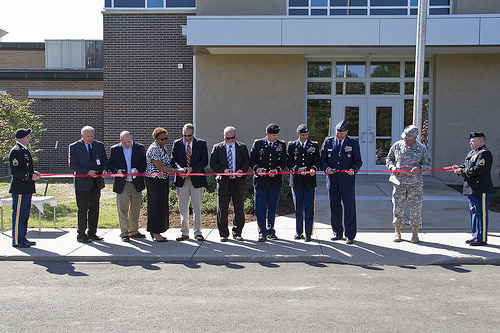
Maj. Gen. Edward W. Tonini, Brig Gen. Charles Jones, Guardsmen and other guests cut the ribbon to open the Bowman Readiness Center in Louisville, Ky., Oct. 14, 2015. The new facility now houses Kentucky’s 75th Troop Command among other units. (U.S. Army National Guard photo by Staff Sgt. Scott Raymond)
“The Kentucky National Guard and Department of Military Affairs routinely manage between 30 to 40 projects at any given time,” said King. “These projects range from minor renovations and maintenance of readiness centers or armories, to major military construction. When managing large scale projects simultaneously, it’s important to note the teamwork involved between all agency personnel. Most of these projects have federal funding, but all have to be worked through the Finance Cabinet for design and execution. This relationship is key to the successful execution of all these projects.”
Story by Maj. David Page, Kentucky National Guard Public Affairs
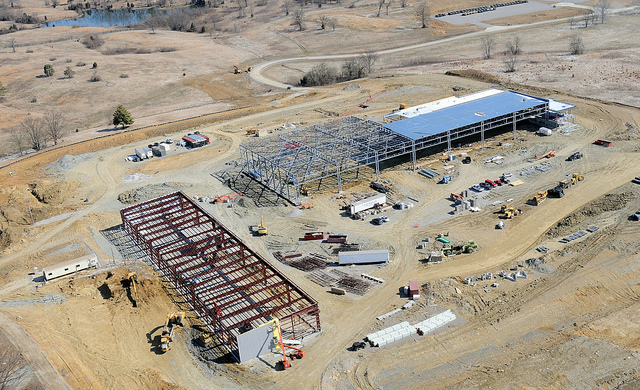
Aerial view of the new Army Aviation Support Facility on Boone National Guard Center in Frankfort, Ky. The new facility will more than quadruple its predecessor in space and will allow all aircraft to be stored indoors. (U.S. Army National Guard photo by Staff Sgt. Scott Raymond)
FRANKFORT, Ky. — In mid January, Kentucky Army Aviators will open a new 126,000 square foot, $25 million Army Aviation Support Facility on the Boone National Guard Center in Frankfort.
The facility will have 18 aircraft bays that will feature the latest in aviation support to include in-ground vaults in the hangars to house data hubs as well as lubricants, air and water ports to assist in maintenance of the rotary-wing aircraft.
“The new facility will be four times the size of the current AASF,” said Chief Warrant Officer Ryan S. Thompson, Aircraft Maintenance Supervisor, Joint Forces Headquarters. “Plus, it will have bays to house our aircraft, which will keep them out of the elements, therefore helping us reduce corrosion by as much as 80 percent and reduce the risk of lightning strikes on the flight line.”

Workers making progress on the new Army Aviation Support Facility during a July visit from Kentucky’s adjutant general, July 16, 2014. (U.S. Army National Guard photo by Maj. David Page)
Click here to see more photos from this story.
Besides the increased size, the new AASF is registered as a LEED (Leadership in Energy & Environmental Design) Silver certified facility by the US Green Building Council. Silver is the second of four levels in LEED, and it is based on points for positive environmental aspects of a project. This certification recognizes the Kentucky National Guard for its environmental stewardship in the selection of building materials, methods, and energy savings initiatives.
“Our approach to savings on this facility is multi-faceted,” said Col Steven T. King, Construction and Facilities Management Officer. “Firstly, we are constructing a building that is tightly sealed, well insulated, and durable to minimize energy demand.
“Secondly, through sustainable design building principles, we are using the site orientation to take advantage of natural day-lighting, high-efficiency artificial lighting, active and passive solar strategies, geothermal heating and cooling, occupancy sensors and programmed thermostats to schedule HVAC shut down during periods of non-occupancy, such as nighttime and non-IDT (inactive duty training) weekends. This effort enables us to focus on minimizing our energy operating costs. ”
Another contributing factor to helping with the LEED certification is the solar panels that will be installed on the facility. These panels will help provide up to 80 kilowatts of energy, which will provide approximately 20% of the energy requirements for the building.
“Although we have 80kW of photovoltaic energy that we will produce, our goal is to add additional panels in the future to make this facility a truly Net-Zero energy building,” said King. “This means that we will generate an amount equal to or greater than the amount of energy we consume.”
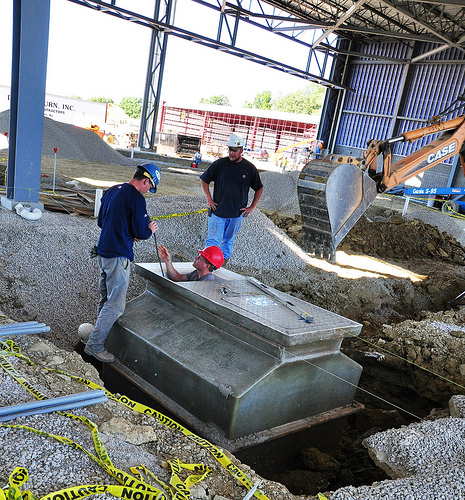
The new Army Aviation Support Facility will have 18 aircraft bays featuring the latest in aviation support to include in-ground vaults in the hangars to house data hubs as well as lubricants, air and water ports to assist in maintenance of the rotary-wing aircraft. (U.S. Army National Guard photo by Maj. David Page)
Beyond the positive environmental impact, the facility was designed with the “user” in mind.
To that end, Col. King and his staff reached out to Col. Abney and his aviation team to talk about what they needed in a facility. The group then toured three other Aviation Facilities around the U.S. to gather lessons learned from those projects.
“During the tours, we looked at how each facility flowed and how we could make ours more efficient,” said Thompson. “We then worked with Chief Warrant Officer Four Larry Goode (a member of Col. King’s team) on the elements we wanted and he helped us get everything under one footprint.”
What resulted from the tours and the collaboration was a design that was not only functional for all units to be housed there, but some small touches to help the Soldiers be more efficient. For example, the component support shops that provide maintenance functions are located immediately adjacent to the hangar floor, which enhances the overall logistical flow of the entire operation.
Another critical feature of the new building will be the fire suppression system in the hangars. In case of a fire, the system will fill the hangar up to 8’ of foam within 10 minutes to dowse a fire.
“We are looking forward to moving into the new facility,” said Thompson. “This has been a long-time in the making so it will be a great day when we cut the ribbon.”
As for the existing AASF, it will be receiving a new tenant as well. The Combined Support Maintenance Shop, also located on Boone Center, will move to help provide more space on the post.
Story by Capt. Gustave LaFontaine, 133rd Mobile Public Affairs Detachment
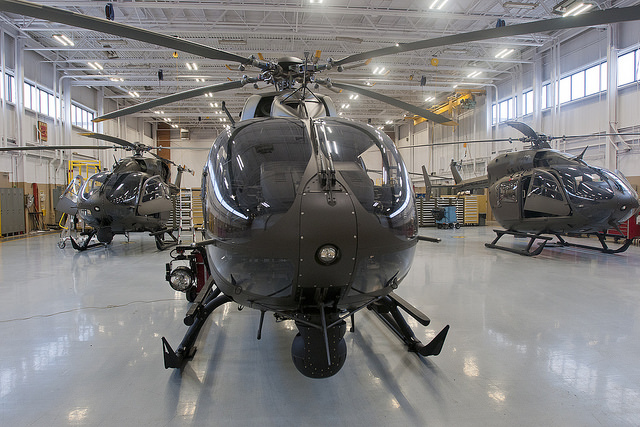
The three newest LUH-72s for the Kentucky National Guard sit in the Army Aviation Support Facility in Frankfort, Ky., Jan. 16, 2014. The Lakotas will replace the aging OH-58 Kiowa helicopters. (U.S. Army National Guard photo by Staff Sgt. Scott Raymond)
FRANKFORT, Ky. — The Kentucky Army National Guard recently added three new helicopters to their existing fleet. The brand new LUH-72A Lakota replaces the Vietnam era OH-58 Kiowa A/C. Charlie Company of the 1st Battalion, 376th Aviation now has four of the state of the art helicopters.
According to Col. Michael Ferguson, commander of the 63rd Theater Aviation Brigade, the new aircraft is designed to assist law enforcement as well as support domestic operations during hazardous events more effectively.
When asked to compare the UH-72A Lakota and the OH-58 A/C, Ferguson responded by saying that the Lakota has a modern avionics suite making the aircraft more capable to fly in inclement weather. He added that the aircraft’s Mission Equipment Package is updated and more robust to support a wide array of missions.
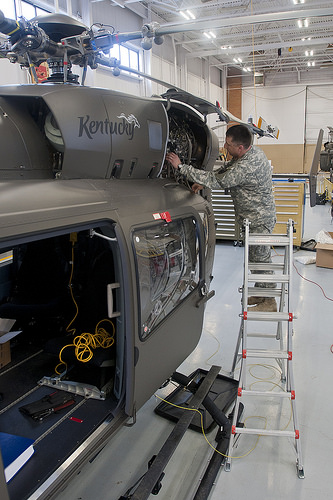
A Soldier with Charlie Co., 1st Battalion 376th Aviation examines the engine of a new LUH-72 helicopter at the Kentucky National Guard’s Army Aviation Support Facility in Frankfort, Ky., Jan. 16, 2014. Soldiers of the 63rd Theater Aviation Brigade are still getting used to the new aircraft and the many new upgrades the Lakota offers.(U.S. Army National Guard photo by Staff Sgt. Scott Raymond)
“The Lakota is a modern aircraft with unique capabilities to provide support to the citizens of the Commonwealth during our most challenging times,” said Ferguson.
Col. Brian Abney, Facility Commander for the Army Aviation Support Facility, spoke about how the increased capabilities of the Lakota will help serve the Commonwealth.
“This new airframe is a very stable and capable aviation platform. The aircraft’s flexibility enhances its ability to perform search and rescue, security support and command and control mission functions.”
Kentucky has been preparing to receive the Lakota for several years. A great deal of training accompanied the procurement of the new helicopters. Ferguson stated that the brigade has been sending Kentucky pilots to transition training for the past year. Pilots will continue the transition training through 2014.
Pilots aren’t the only Soldiers receiving new training. Helicopter maintainerswere recently certified by the Federal Aviation Administration as licensed Airframe and Powerplant Mechanics. Maintainers have also attended a course to learn how to sustain the Lakota.
Abney spoke about the readiness of Kentucky pilots and maintainers in regard to the new helicopter.
“I would put our aviators and maintainers up against the best in the world in any theater of operations. It’s a large part of their lives. It’s who they are. They have made a very good name for themselves in a very unforgiving environment and it’s well deserved.”
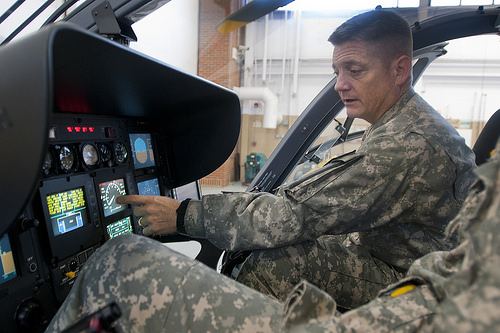
Chief Warrant Officer Joseph Mudd discusses the instrument panel of a new LUH-72 helicopter with another pilot at the Kentucky National Guard’s Army Aviation Support Facility in Frankfort, Ky., Jan. 16, 2014. (U.S. Army National Guard photo by Staff Sgt. Scott Raymond)
Kentucky will receive two more UH-72A helicopters during the next year. At that point Kentucky will have completed its fielding of the UH-72A. Ferguson feels confident that his pilots and maintainers are up to the task of utilizing the Lakota to its fullest capabilities.
“We are well postured to continue excellence in this specific mission. Kentucky has always been looked at as the standard bearer.”
Story by Spc. Brandy Mort, 133rd Mobile Public Affairs Detachment
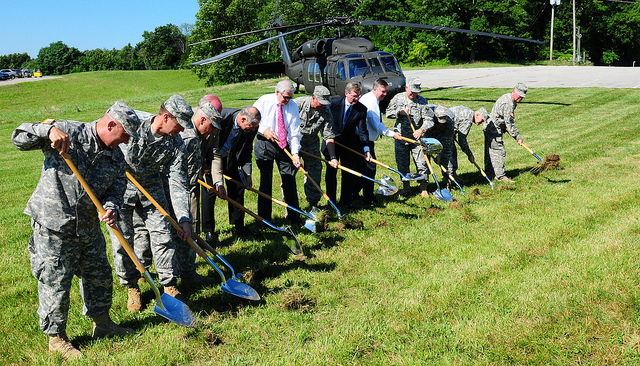
Kentucky Guardsmen and local officials ceremonially move the first bits of earth during a ground breaking ceremony at Boone National Guard Center in Frankfort, Ky., July 12, 2013. A new Army Aviation Support Facility will be built on an area adjacent to Capital City Airport. (U.S. Army National Guard photo by Staff Sgt. Scott Raymond)
FRANKFORT, Ky. — The legacy of aviation in the Kentucky Army National Guard took another step forward as ground was broke for a new center for operations in Frankfort, Ky., July 12.
Kentucky’s adjutant general, Maj. Gen. Edward Tonini and local officials of Frankfort planted the first shovels to begin construction for a new Army Aviation Support Facility (AASF) at Boone National Guard Center.
Click here for more photos of the ceremony.
The $25 million facility will provide training and standardization for all aviation personnel, maintaining strict adherence to the aviation safety program, and perform maintenance on assigned aircraft. The new hangars and office space will replace the aging facility, which was built in 1958.
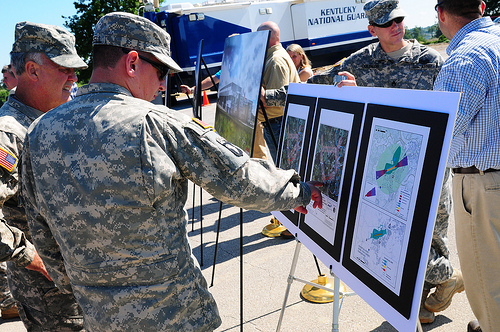
Kentucky Guardsmen examine diagrams of new flight plans to be created by the construction of a new aviation facility in Frankfort, Ky., July 12, 2013. The new building will replace the current aging hangars on the base. (U.S. Army National Guard photo by Staff Sgt. Scott Raymond)
“The new building will help ensure that we are ready, reliable and successful in completing missions in the future,” said Tonini.
Hon. William May, Mayor of Frankfort, was in attendance for the groundbreaking and looks forward to the ribbon cutting ceremony of the completed facility.
“The AASF will be a critical building,” said May. “It will not only help our Service members, it is also going to help the commonwealth of Kentucky in case of emergencies.”
With more than 92,000 square feet of combined space, the new complex will provide protection for the Kentucky Guard’s UH-60 Blackhawk and OH-58 helicopter fleet, along with maintenance and training space for the crews that fly and work on them. Kentucky Guard leadership said it will help ensure personnel and equipment are ready to respond to incidents and emergencies throughout the Commonwealth and in support of National Defense at home and abroad.
Franklin County Judge Executive Ted Collins was also on hand and said the facility was a great thing for the city and county and applauded Tonini and the Guard for the project’s design and location.
Retired Chief Warrant Officer William H. Canon Jr., who worked in both of the original facilities was thrilled to see the next step for Kentucky’s Army aviators and aircraft.
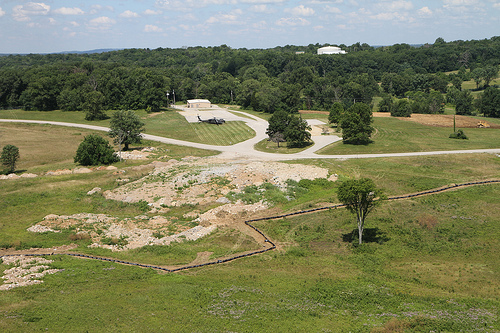
A UH-60 Blackhawk sits on part of the land where the Kentucky National Guard will build a new aviation support facility in Frankfort, Ky., July 12, 2013. The 92,000 square feet complex will house offices and hangers for all the Kentucky Guard’s helicopters. (U.S. Air National Guard photo by Lt. Col. Kirk Hilbrecht)
“I think this new building will be outstanding,” said Canon. “Having this new building will protect the aircraft from being damaged.”
Col. Brian Abney, Director of Aviation for Joint Force Headquarters thinks the new building will provide a more successful way to guard the aircraft and prepare for missions and believes each aviation unit is excited to make the move to a more modern facility.
“The new AASF will be a building that Soldiers and Airmen of the Kentucky National Guard will be proud of,” said Abney.
Story and photos by Sgt. Scott Raymond, Kentucky National Guard Public Affairs Office
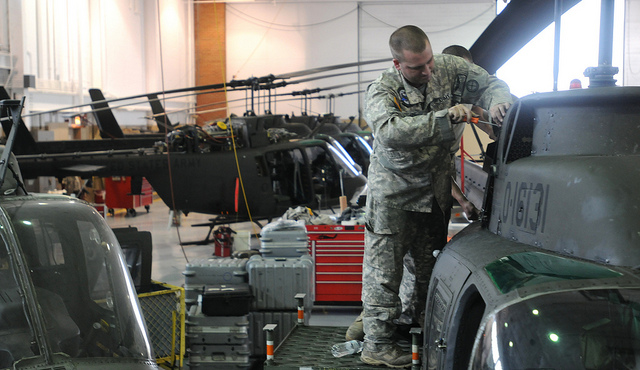
A Soldier with Charlie Co., 1st Battalion, 376th Aviation works to repair a OH-58 helicopter at the Army Aviation Support Facility in Frankfort, Ky., Sept. 18, 2012. The Kentucky Guard has become the maintenance hub for OH-58 repairs for all of the National Guard. (Kentucky National Guard photo by Sgt. Scott Raymond)
FRANKFORT, Ky. — It is often thought that a warrant officer in an Army Aviation unit is only a pilot. That is certainly not always the case. The aviation field also demands that experts are on hand as maintenance technicians to ensure that those pilots have a working aircraft to fly.
In the Kentucky National Guard some aviation warrant officers are not only keeping Kentucky Guardsmen in the air, but they’re also working to keep pilots in quality aircraft nationwide.
Chief Warrant Officer Three Jay Calcaterra, an aircraft maintenance supervisor for the 351st Aviation Support Battalion works daily at the Army Aviation Support Facility in Frankfort, Ky. He confirmed that not everyone in the hangar is a pilot, calling himself and other maintenance supervisors, “the walking warrants.”
“We determine which aircraft fly, how long they fly and what maintenance is required after they fly it,” he said.
Calcaterra said they have an extremely important job in the hangar, and that is to manage aircraft and the people who work on aircraft.
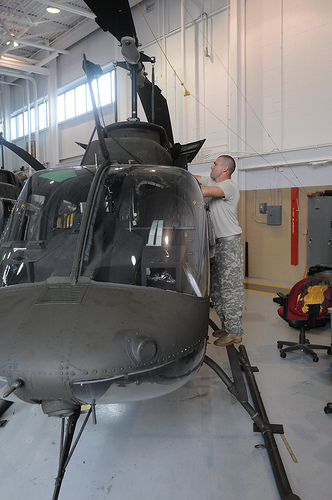
Spc. Tim Amyx with Charlie Co., 1st Battalion, 376th Aviation, works on a OH-58 helicopter at the Army Aviation Support Facility in Frankfort, Ky., Sept. 18, 2012. Because of the increase in maintenance requests, some Soldiers were brought on full time to help handle the workload. (Kentucky National Guard photo by Sgt. Scott Raymond)
The Kentucky Guard’s fleet of UH-60 Blackhawks and OH-58 Kiowa helicopters, and their operational readiness is the responsibility of Calcaterra and Chief Warrant Officer Two Ryan Thompson.
They said it takes a seasoned expert to meet the demands of what they are asked to do, but in referring to their warrant officer training, they rely on their abilities and the proficiencies of their staff to provide that expertise and keep Kentucky aircraft in the skies.
In 2011, the National Guard Bureau in Washington, D.C., was looking for a solution for the maintenance of all OH-58s flown by the Guard. They needed a hub where the aircraft could be properly and efficiently maintained to keep them flying. NGB looked to a state with a solid history of excellence in aviation.
“It’s because of our reputation, our work ethic and our operational readiness rates that we were asked to do this,” said Thompson. “Everyone knows we are always willing to step up and support the mission of NGB.”
With the amount of flight hours being put on a diminishing fleet of OH-58s nationally, NGB asked Kentucky to become the center though which all maintenance issues would stream. Kentucky’s Army Aviation originally only had four OH-58s of their own, but now they were asked to care for a lot more. Regardless of their home assignment, helicopters with any issue would be flown or transported to Frankfort to go through Thompson’s “phase”.
Thompson said the facility would normally put six helicopters through maintenance phases each year. Since February 2012, they have received, tested, worked on, and put back into service 23 OH-58s, across the country. That’s nearly a 400 percent increase and the year isn’t over yet.
He said Kentucky has worked with 16 different states in repairing their helicopters, transferring the aircraft back and forth to as far away as Arizona and Hawaii.
A phase begins with a test flight, if possible, to determine the faults or discrepancies, anything from broken radios to weak engines. The aircraft would then be disassembled from the nose to the tail and those problem areas would be fixed and required inspections completed. Upon its reassembly, the helicopter would be released for test flights to assure the problems were resolved, resulting in an “almost new” aircraft.
“I would never send out something that I wouldn’t give my own Soldiers,” said Thompson.
According to Thompson, the Kentucky Guard flies more hours in OH-58s than any other state. Thousands of hours of flight-time are given annually to support the state’s counter-drug program and in-state unit training missions.
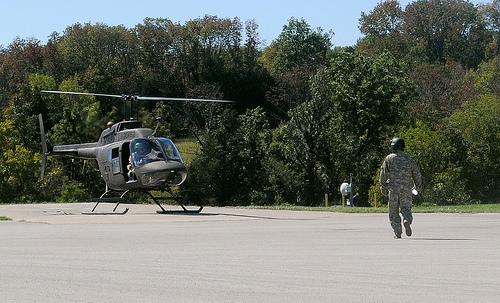
Soldiers at the Army Aviation Support Facility prepare for a test flight in a OH-58 helicopter in Frankfort, Ky., Sept. 24, 2012. The Kentucky Guard provides maintenance support to all OH-58s in the National Guard. (Kentucky National Guard photo by Sgt. Scott Raymond)
In addition to operations in the Commonwealth, OH-58s repaired by the Kentucky Guard are transferred to the U.S. State Department as well as flown in support of the Southwest border mission, Operation Guardian Eye.
Calcaterra, Thompson and the Soldiers in the hangars in Frankfort manage the maintenance of 75 percent of all OH-58s flying in the National Guard. Thompson said it’s a fine example of the Kentucky Guard preparing for and meeting the needs of the Guard as a whole.
Thompson believes the mission will last as long as OH-58s are flying for the Guard. In the meantime, Kentucky will remain nationally, a proven maintenance hub as well as an OH-58 parts hub.
The increased workload has benefitted some Soldiers with full-time work, which the warrants said creates an invaluable amount of experience for young aircraft mechanics. Thompson estimates that his Soldiers are getting as much hands-on training in two-weeks as some traditional Guardsmen serving on weekends would get in 15 years. In addition to the new airframes coming through, the experience for these Soldiers is the biggest gain of this mission said Thompson.
The warrants both said they couldn’t have done it without the support of Kentucky National Guard leadership. Thompson said Maj. Gen. Edward W. Tonini, Kentucky’s Adjutant General and Col. Michael Ferguson, 63rd Theater Aviation Brigade Commander, agreed to take on the mission and have consistently backed the mechanics’ efforts while promoting the quality work done by Kentucky Guardsmen.
“We take pride in what we do here,” Thompson said. “We have the experience and know-how to pull this off.”
“It’s a lot of work, a lot of hours, but we don’t have a reduction in our capabilities. This has been a whirlwind success.”
Story by Capt. Stephen Martin, Kentucky National Guard Public Affairs
Click HERE for more photos of this event.
Kentucky Guardsmen of the Army Aviation Support Facility and Frankfort Fire and Emergency Medical Service react to the 2011 annual aviation pre-accident exercise at Boone National Guard Center in Frankfort, Ky., Sept. 28. (photo by Sgt. 1st Class Michael J. Oliver, Kentucky National Guard Public Affairs Office)
FRANKFORT, Ky. — Soldiers from the Kentucky National Guard Army Aviation Support Facility tested their annual aviation pre-accident plan in Frankfort, Ky., Sept. 27.
“This exercise is so important for us to get right,” said Chief Warrant Officer 2 Tyler Johnson, Army Aviation Support Facility safety officer. “When we pulled the trigger, we had our Soldiers as well as all the emergency personnel in Frankfort respond in record time, which is the ultimate goal — take care of our crews as fast as we can.”
The flight facility simulated a UH-60 Blackhawk helicopter make an emergency landing on the grounds of Boone National Guard Center in Frankfort and had local law enforcement and emergency responders respond to the 911 call.
Frankfort Firefighter Jon Lawson administers medical treatment to Kentucky Guardsman Sgt. Devin Gregory, Bravo Company 2 Battalion 147th Aviation Regiment, on a stretcher during the 2011 annual aviation pre-accident exercise at Boone National Guard Center in Frankfort, Ky., Sept. 28. (photo by Sgt. 1st Class Michael J. Oliver, Kentucky National Guard Public Affairs Office)
Frankfort Fire and Emergency Management Services Battalion Chief Kyle Smith oversaw the support from Frankfort’s emergency responders. He was very pleased with the level of coordination between the agencies.
“It’s critical that we do these joint exercises between agencies in order to become proficient in working together,” said Smith. “We’re continuing to build that relationship with the Kentucky National Guard and it was a great experience today.”
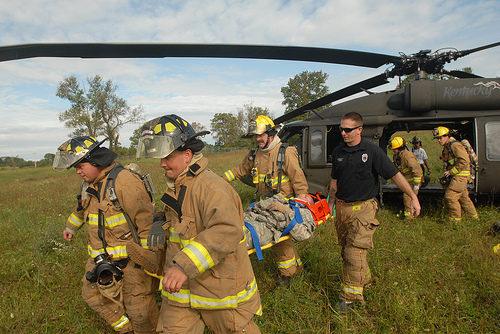
Frankfort local firefighters carry Kentucky Guardsman Chief Warrant Officer Jason Conley on a stretcher during the 2011 annual aviation pre-accident exercise at Boone National Guard Center in Frankfort, Ky., Sept. 28. (photo by Sgt. 1st Class Michael J. Oliver, Kentucky National Guard Public Affairs Office)
sdm
(republished with permission by The Ledger-Independent in Maysville, Ky.)
Ledger-Independent article on Col. David Fleming, Kentucky Army National Guard Aviator
Story by Wendy Mitchell
Col. David F. Fleming, already the namesake of the Kentucky Army Aviation Support Facility, is honored at the Aviation Museum of Kentucky, at Bluegrass Field in Lexington on Nov. 5, 2010
LEXINGTON, Ky. — From his roots of Fleming County history come more accolades for the late Col. David F. Fleming.
Fleming, already the namesake of the Kentucky Army Aviation Support Facility, is being honored today at the Aviation Museum of Kentucky, at Bluegrass Field in Lexington.
According to ceremony officials, Fleming, a master aviator and descendant of John Fleming for whom Fleming County was named, enlisted in the Kentucky Army National Guard in 1949, retired in 1988 and died in 1999.
He was commissioned a second lieutenant in the 149th Regimental Combat Team, now known as the 149th Armor Brigade, in 1953 and was assigned as a platoon leader in the Heavy Mortar Company. In 1956, the unit changed its mission to artillery, Fleming attended Army flight school and returned to KYARNG.
According to museum officials Fleming, “…had a front row seat to the modernization of Army aviation.”
In an interview conducted before his death, from the Kentucky National Guard History eMuseum, Fleming spoke about his part and changes in aviation during his life.
“It started out as a small section that provided an aerial observation platform for the ground commander … now it’s evolved into the aviation brigade — the fourth combat brigade of the modern Army division, Fleming said. “The advent of the Aviation Branch in April of 1984 really had a lot to do with that … now I think that while aviation continues its mission as a division combat element, it will also have to turn its attention to air-to-air combat in order to survive on the battlefield.”
Also being inducted this year are , Charles L. “Chip” Collins,”… a leader in the development and testing of over 50 different experimental aircraft systems…”; Mason County native Col. James Lewis Graybill, a flight instructor and check pilot; and Gene Soucy, a former member of the record-setting Eagles Aerobatic Flight Team.
The 2010 Aviation Achievement Award will be presented to Honor Flight Network of Kentucky.
Aviation Museum of Kentucky Hall of Fame activities begin at 6 p.m. with a reception and dinner to follow at 7 p.m.; the enshrinement ceremony follows the dinner, officials said.
For more on Kentucky Aviation go to www.kyaviation.org
Contact Wendy Mitchell at [email protected] or call 606-564-9091, ext. 276.
For more area news, visit www.maysville-online.com.