Pages
Stay In Touch
More
© 2013 KentuckyGuard
Staff Report
LEXINGTON, Ky. — Chief Warrant Officer 2 Jennifer Maggard was the featured speaker at the Lexington Veterans Affairs Medical Center Women’s History Celebration Mar. 26.
This is her speech…
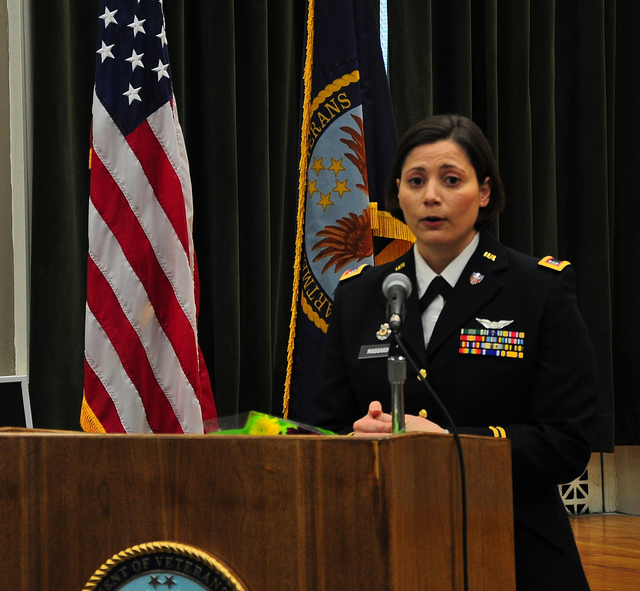
Chief Warrant Officer two Jennifer Maggard, from the Kentucky National Guard, was the guest speaker at a Women’s History Month Celebration honoring Women Veterans in Lexington Mar. 26. (U.S. Army National Guard photo by Capt. Stephen Martin)
“Thank you for including me in today’s ceremony honoring women’s history month. It is truly an honor to be here today to remember the women who were true pioneers in a movement that has allowed women to serve in the capacity that I and so many others do today.Growing up, I was always taught to take pride in everything I was doing. Not because I was a girl and not to prove that I was better than anyone else but because of the values my parents believed in. They instilled in me the values that the Army stands on today: Loyalty, Duty, Respect, Selfless Service, Honor, Integrity, and Personal Courage.
I was always active growing up in high school. I played soccer and because my high school didn’t have a girls team at the time, I played on the boys team… until my junior year when I helped to get a girls team started for our high school. I also ran track and believe it or not was a cheerleader. My competitive nature allowed me to go far in all the sports I participated in.
It was around my junior year of high school when I started thinking about how I was going to pay for college. I met with a recruiter one time and decided the National Guard was for me. I love to travel, have a sense for adventure and like the commercial says - in the Army National Guard: You Can. So I did!
I loved basic training. Being so involved in athletics helped to make basic training more manageable and easier for me to complete. I enjoyed working with my fellow basic trainees to accomplish missions, getting to shoot an M-16, but mostly I enjoyed having something bigger than myself to take pride in. I knew from the first day I would make a career out of being a Soldier.
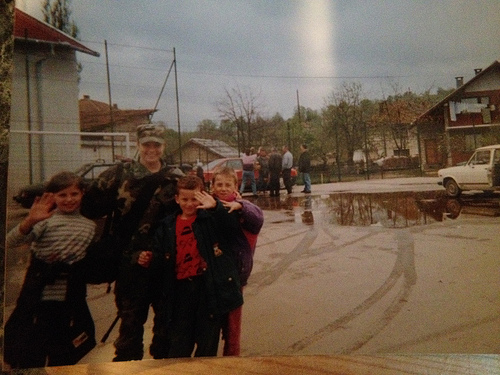
(Then) Spc. Jennifer Maggard deployed on a Peacekeeping Mission to Bosnia with the 223rd Military Police in 2001. Here, Maggard is visiting with some local school children in downtown Bosnia-Herzegovina. (photo submitted)
Being fresh out of Basic Training, I was ready for anything and everything the Army had to offer. I applied and was hired as a full time technician just two months after graduating AIT (Advanced Individual Training). Shortly after, there were several deployments ramping up and I wanted to be a part of it. I volunteered to deploy on a peacekeeping mission with the 223rd Military Police Company to Bosnia.
I enjoyed my time overseas and grew both as a Soldier and a person. The accommodations were very nice considering where we were. We had real beds, bath houses, fast food, a movie theater, and a very large PX (aka wal-mart). We had computer access and could call home just about every day if we wanted.
…We returned home on September 10th, 2001; flying over New York City literally only 10 hours prior to the first plane striking the tower. Little did I know that one short year later, I would be off on my second deployment crossing the border into Iraq on the second day of the war.
The accommodations this go around were very different from Bosnia. We had cots to sleep on in tents, outhouses, MRE’s, and care packages from home were about the only way to get supplies such as shampoo or soap. Of course without running water, even having those supplies didn’t do much good. This was a much tougher deployment both physically and mentally. Our unit lost a Soldier when a vehicle rolled over into water canal and he drowned trying to save the other Soldiers in the vehicle.
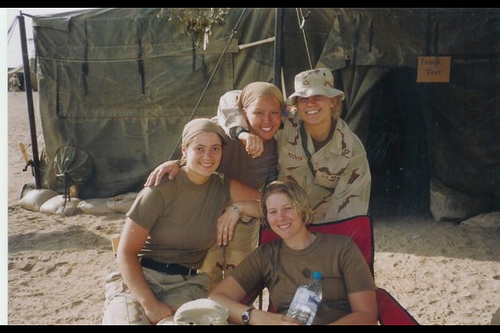
Sgt. Jennifer Maggard deployed to Iraq with the 223rd Military Police Company providing convoy security. This photo was taken two days before the unit crossed the border from Kuwait into Iraq at the start of the war in March 2003. (photo submitted)
Being one of 28 females out of 186 Soldiers made for an interesting deployment, especially with the living conditions. We had to build our showers and outhouses. The sand storms just made life no fun at all. Personal hygiene became difficult at times and creativity was a must. Of course not having a option made it more manageable. The deployment couldn’t end soon enough. That was a tough deployment to return home from knowing we all would not return alive. It made being with family and friends bittersweet knowing there was a family who would not get to make the same memories I was creating. Not a day goes by that I don’t think about Sgt. Darrin Potter and his family.
Shortly after returning from my second deployment, I was hired on fulltime to work as a recruiting and retention NCO (Non-Commissioned Officer) for the Guard. There I was, one of only 3 fulltime female recruiters in the state. I often found myself talking to the female recruits of fellow recruiters sharing my experience with them and sometimes their families.
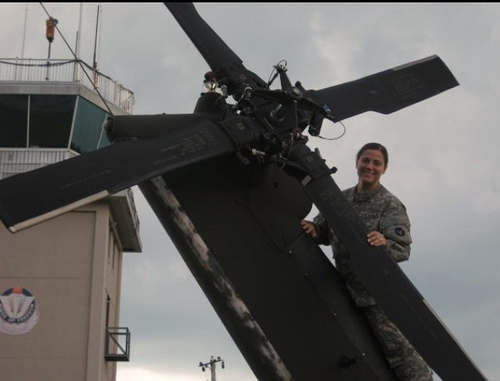
Warrant Officer one Jennifer Maggard preflights a UH-60 blackhawk during Rotary Wing Flight School in Fort Rucker, Ala June 2009. (photo submitted)
I went on to recruit for the Aviation unit located in Frankfort, where I was then recruited to attend warrant officer school and become a UH-60 Blackhawk pilot. This was the first time I was married and away from home for an extended period of time. All together, flight school was 18 months long and my husband stayed in Kentucky while I was in Ft Rucker, Ala. I was one of 200 females out of 4000 flight school students in the course, so you can imagine how hard that was on my husband. I was always treated with dignity and respect from my fellow flight school students but it was also something I demanded from them. Part of flight school is SERE-C (survival, evasion, resistance and escape) C-High risk. This is where we are taught as aviators how to escape and to prepare us for what we may experience if our aircraft ever goes down and we are captured. I was the only female in my class of 32. I was never treated any different from the male Soldiers and feel I gained their respect holding my own throughout the three-week course.
One thing I have always said about women serving away from home, whether it’s to attend a school or deploy on an overseas mission, (and not to discredit dad’s out there) is this: When dad doesn’t come home it’s just ‘one less plate to set on the table’ - when mom doesn’t come home it’s ‘who is going to make dinner?’
We all have our own strengths and weaknesses when it comes to our everyday tasks that we perform. I have found that it is just as much a struggle for a man to be away from home as it is a woman.
Now for the favorite part of my story of how my family came to be. When my husband and I found out we couldn’t have children, I knew immediately I wanted to adopt. It was a very stressful process both emotionally and financially. It was so nice to have the support of our immediate families as well as our church and military family. I researched every possible way to ease the financial burden adoption was going to place on us. I found that the Active duty military offered an adoption benefit to Active Duty Soldiers and national Guard soldiers on active duty at the time of adoption and finalization. I just so happened to be on active duty orders when our daughter was born and our adoption finalized so we were eligible for the $2,000 benefit.
I did a lot of research on National Guard members and found there was no benefit for traditional Guardsman but there was for State employees in addition to the Active Duty Troops. So between my research and my husband’s platform sitting on Kentucky’s First Lady Military Spouse committee, we were able to pass House bill 224 which allowed traditional Guardsman an adoption benefit of up to $3000 to help ease the financial burden that adoption can bring.
Our culture has come a long way and continues to change. We’re currently taking steps which incorporate women into the combat arms branches and very soon, women will virtually be conducting every assignment that only recently were closed to females.
Be up to the challenge, lead by example, and set a new higher standard not just for females but for all Soldiers.
To the female veterans who have come before me. Thank you. Thank you for your hard work and dedication to something bigger than yourselves. Thank you for being the example to all who have come after you and thank you for your sacrifices you have made both of yourselves and from your families.”
By Kentucky National Guard Command Historian John Trowbridge
With March being Women’s History month kentuckyguard.com is publishing a series of stories celebrating Kentucky women and the roles they played in our military history. Following is one such story ….
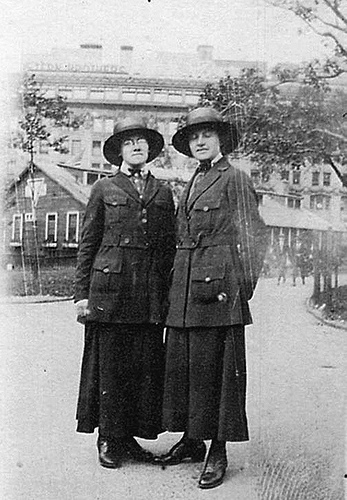
Elizabeth Eleanor and Margaret Gretchen Minnich,
while serving in the U.S. Army Nurse Corps at Sarisbury
Court, England.
FRANKFORT, Ky. — Part one of this story provided a brief history on women in the United States during World War I and how Elizabeth and Margaret Minnich came to uniformed service. Part two continues with their mobilization and deployment to Europe.
On 23 February 1918, the Minnich sisters’ unit was mobilized into active duty service and on 1 March was ordered to Camp Zachary Taylor in Louisville for additional instruction and training until 18 June 1918. In early April, the nurses were ordered to active duty for training, some reported to Camp Taylor, others were sent to hospitals at Camp Dix, Camp Sherman, Camp Devens, Camp Greene, Camp Lee, and Camp Upton. The Minnich sisters were sent to Camp Meade, Maryland, for their training.
By June 1918, Gorgas had certified Base Hospital No. 40 was prepared to take charge of a hospital in France, or anywhere else, and to conduct it to the best interest of the soldiers, and to the satisfaction of the Medical Department.
On 28 May 1918, Elizabeth and Margaret Minnich were ordered to the Holley Hotel in New York City, to await the arrival of the remainder of personnel of Base Hospital No. 40 at Camp Mills, prior to deployment overseas. After staying at the hotel, the nurses were assigned to comfortable quarters at various locations around the city until ordered overseas. In the interim, the nurses’ uniforms were being made and fitted by the Red Cross. In the afternoons, at the Armory in New York City, the nurses were drilled and given military instruction. During their stay in New York they were cared for by the Red Cross Association.
By 12 July 1918, the Minnich sisters were aboard the famous White Star Line’s RMS Olympic, which arrived at Southampton, England, on 19 July. The Olympic, sister ship of the Titanic and Britannic, had been converted into a troop transport in support of the war effort. The trip across the ocean was uneventful, the ocean quiet. Although the Olympic was crowded, everyone seemed happy and anxious to get to work. Upon arrival at the Southampton docks the nurses were sent to Sarisbury Court, arriving there the following morning by truck. When the personnel of Base Hospital No. 40 arrived at Sarisbury Court, the construction of the hospital buildings was not complete.
The majority of the personnel were detached and assigned to English and American hospitals in England and France. Quarters for the nurses had not been completed, so they had to be quartered on the third floor of the mansion house. Sarisbury Court was scheduled to be the largest American hospital in England. It was situated along a bend of the Hamble River, about six miles from Southampton; the estate covered 186 acres of rolling farmland, meadows, and woods. The manor house stood on high ground and on a clear day its tower could be seen twenty miles away. The manor house and surrounding property had been purchased by the American Red Cross for conversion to an American hospital.
The Red Cross personnel assigned to Sarisbury Court tried to relieve the Kentuckians’ homesickness and the boredom of waiting for patients by organizing entertainment and recreational activities for them. Captain Thomas C. Campbell, the Red Cross chaplain, organized a glee club and string band with Bruce Reynolds and Sidney Freeman, former members of the Boston Symphony Orchestra, who were serving with Base Hospital No. 40. Captain Campbell introduced croquet and lawn tennis to the nurses. Additionally, he observed that English women rode bicycles, and he procured a number of bicycles for the use of the nurses. To his surprise he discovered that only a few of the American nurses knew how to ride.
The nurses’ time in service was not all fun and games; they still had their duty to perform. When Base Hospital No. 40 arrived in England their hospital was not completely built, so personnel were assigned to various hospitals across England and France. Some of these teams were stationed close to the front and came under the guns of the enemy near the Metz Front and the Argonne Forest. In a letter written to The Lexington Leader, Corporal John R. Marsh, who had been a reporter for the paper before the war, made the following commentary on his returning fellow members of Base Hospital No. 40 that had been serving in France: Our “overseas contingent” got back from France the other day loaded down with souvenirs and stories, not to mention a few of those interesting creatures the A. E. F. has lovingly named “cooties.
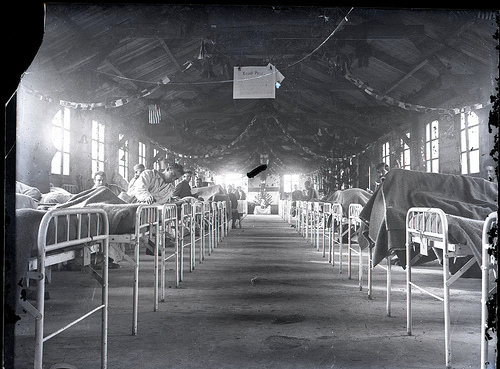 On 17 August, Margaret was part of a ten-nurse detachment attached to American Red Cross Medical Hospital No. 21, Paignton, Devonshire, England, and served with that organization until re-assignment to Base Hospital No. 40 on 2 January 1919.
Elizabeth remained with Base Hospital No. 40 in her sister’s absence. The Sarisbury Court hospital was opened for admission of patients on 27 September 1918, 125 cases being admitted on that date. During its operation, the majority of the hospital cases seen by the doctors and nurses were influenza and pneumonia and their complications.
The reunion of the sisters at Sarisbury Court in January 1919, was short lived, for, on 15 February, Margaret reported to Base Hospital No. 113, at Savenay, France.
The following day Elizabeth reported to Evacuation Hospital No. 20, located at Beau Desert, in the vicinity of Bordeaux, France, serving with that organization until 14 May 1919. On 15 May, Elizabeth was assigned to Base Hospital No. 111, also part of the Hospital Center, Beau Desert.
In June 1919, the sisters were reunited, this time in Savenay when Elizabeth was assigned to Base Hospital No. 113. During this time Base Hospital No. 113 was designated as a hospital from which all disabled nurses were to be evacuated to the United States. Records do not indicate if either of the sisters was ill during their time with this unit. However, unlike the other nurses of Base Hospital No. 40, they did not return to the United States with their original unit.
On 15 July 1919, the Minnich sisters sailed from St. Nazaire, France, aboard the Santa Teresa, arriving in New York on 27 July 1919. On 22 August, Elizabeth was placed on the Reserve Nurse List at Camp Dix, New Jersey. On 31 August, Margaret was also relieved from active duty. So ended the military careers of the Minnich sisters.
The war made a lasting impression on the Minnich sisters. They had survived their overseas military service; and although they had not come under direct fire of the enemy, they still shared with their male counterparts the suffering, death, and hazards of war. These women saw, first hand, the horror of war and its aftermath on the human body and spirit. They had to contend with, on a daily basis, the uncertainty of war. There was always the possibility of an attack by the enemy on their hospital, or the possibility of reassignment to a location closer to the front. They not only had to care for their patients, they had to take care of themselves to insure they did not become a casualty of an infectious disease.
Following their military service, the Minnich women returned to Kentucky and their nursing careers. The 1920 Federal Census listed Margaret as living in Paducah and Elizabeth as living in Frankfort.18 In August 1921, Margaret married Dr. Cary Randolph Blain, a Presbyterian minister of Christiansburg, Virginia. Margaret and Cary never had any children of their own; however, they adopted and raised three children.
In the early 1920s Elizabeth was working at Kings Daughters Hospital on East Main Street in Frankfort. She later moved to Breathitt County, taking a nursing position at Bach Memorial Hospital. By the 1930s she had moved to Ashland, where she worked as a nurse at Kings Daughters Hospital.20 In 1936, she became extremely ill, and, due to her veteran status, was sent to the Veterans Home in Dayton, Ohio, for treatment. Elizabeth Eleanor “Lizzy” Minnich died at the Veterans Home on 16 June 1939, following a three year illness. Her body was brought back to Kentucky where she was buried with military honors near the grave of her father, and sister, Rose, in the Ashland Cemetery.
During his military service, Private First Class John Bayles Minnich served at the Edgewood Arsenal in Maryland.23 According to his service record, he served with the newly organized Chemical Warfare Service. He was discharged on 8 December 1918. After the war, John returned to the hotel business, once again managing the Continental Hotel in Pineville. On 27 May 1927, he married Edith Nuckols, a schoolteacher in Pineville. The couple had one child, Elizabeth Gretchen Minnich, named in honor of her two aunts.
John Minnich served as president of the Kentucky Hotel Association in the 1920s. He moved his family to Middletown, Ohio, in 1930 when he took the manager position at the Manchester Hotel for Armco Steel Corporation. He served as the head of the Gas Rationing Board in Middletown during World War II. In 1965, the family moved to Ormond Beach, Florida, where John retired. He became a member of the Ormond Beach American Legion Post 267, the Oceanside Country Club, and the First United Methodist Church. John Minnich died on 21 April 1977, at the Ormond Beach Hospital. His remains were cremated.
A year after the death of her brother, on 1 April 1978, Margaret Gretchen Minnich Blain died at the Regency Nursing Home, Forstville, Maryland. She is buried in the historic Stonewall Jackson MemorialCemetery in Lexington, Virginia.
The story of this Kentucky family serves to illustrate the sacrifice not only of this family, but is typical of many American families who served in the armed forces of the United States during World War I. Although these Kentucky veterans were not in battle or on the battlefront, when called upon, they volunteered to serve. They honorably and faithfully performed their duty to their country. They put their lives on hold, willing to sacrifice their lives for a belief in democracy and freedom in the “War to End All Wars.”
123rd Airlift Wing Public Affairs
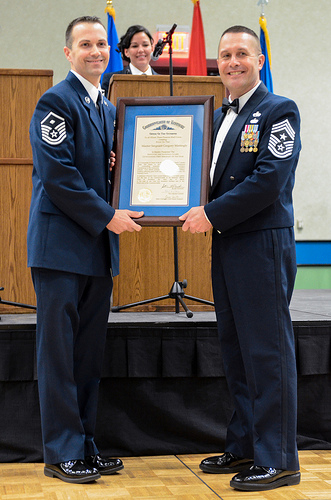
Chief Master Sgt. Ray Dawson (right), command chief master sergeant of the Kentucky Air National Guard’s 123rd Airlift Wing, presents Master Sgt. Gregory Mattingly with a Kentucky Colonel certificate during the Kentucky National Guard Soldier and Airman of the Year Banquet, held March 22, 2014, in Louisville, Ky. Mattingly, of the 123rd Mission Support Group, is the Kentucky Air Guard’s 2014 First Sergeant of the Year. (U.S. Air National Guard photos by Staff Sgt. Vicky Spesard)
LOUISVILLE, Ky. — The Kentucky Air National Guard honored its top first sergeant and Honor Guard Member of 2014 during a banquet held here Saturday night at the Kentucky Fair and Exposition Center.
Master Sgt. Gregory S. Mattingly of the 123rd Mission Support Group was recognized as the 2014 First Sergeant of the Year, while Master Sgt. Eric L. Hamilton was named Base Honor Guard Member of the Year.
Both Airmen are exceptional leaders who inspire others, according to their supervisors.
Mattingly provides guidance for 85 enlisted Airmen assigned to the 123rd Mission Support Group, the most diverse organization on base. An innovator who looks to inspire, he created the MSG “Diamond Sharp” coin to recognize Airmen who go above and beyond the call.
Mattingly also leads by example, serving as a motivating force during unit fitness tests, according to his commander, Lt. Col. Matt Stone.
Furthermore, the senior non-commissioned officer places a strong emphasis on morale and family readiness. He developed a Family Care Tracking Program for base first sergeants to ensure family members receive proper support, especially when their Airmen are deployed overseas. He personally contacted more than 50 deployed MSG Airmen to offer a broad range of support during their recent mobilizations.
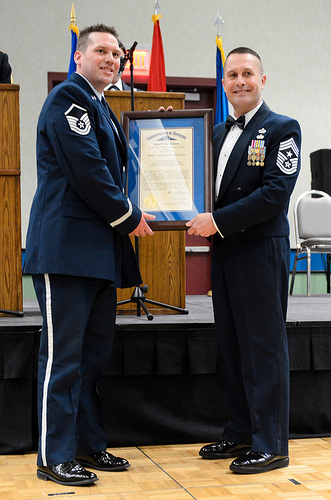
Chief Master Sgt. Ray Dawson (right), command chief master sergeant of the Kentucky Air National Guard’s 123rd Airlift Wing, presents Master Sgt. Eric Hamilton with a Kentucky Colonel certificate during the Kentucky National Guard Soldier and Airman of the Year Banquet, held March 22, 2014, in Louisville, Ky. Hamilton, a management specialist in the 123rd Logistics Readiness Squadron, is the Kentucky Air Guard’s Honor Guard Member of the Year for 2014. (U.S. Air National Guard photos by Staff Sgt. Vicky Spesard)
Hamilton, a management specialist in the 123rd Logistics Readiness Squadron, participated in 157 Honor Guard and Color Guard events over the previous year, surpassing the team average of 34 events by a substantial margin, according to his commander, Lt. Col. Kevin Thornberry.
He was chosen by peers and leadership to serve as Base Honor Guard non-commissioned officer in charge, motivating a dedicated team to complete 259 total details in 2013. Hamilton’s commitment to the program is reflected in his desire to pursue all training opportunities. He currently is certified by the Air Force as an Honor Guard Trainer and subject matter expert who conducts training for all new and existing Honor Guard members to ensure consistency and adherence to protocol.
“As NCOIC of the Base Honor Guard Team, Sergeant Hamilton is a great mentor,” Thornberry said. “He’s constantly providing training and guidance to increase the team’s overall effectiveness and professionalism, which is on display all the time in the public community.”
Story by Sgt. 1st Class Dennis Anderson, 238th Regiment Unit Public Affairs Historian Representative
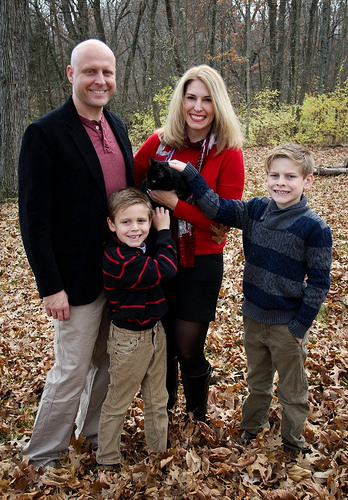
Maj. Bobbie Mayes with her family, husband, Maj. Jacob Mayes and sons, Joshua and Zachary. (Courtesy photo)
GREENVILLE, Ky. -- Maj. Bobbie Mayes is the first female commander of the Kentucky National Guard’s Officer Candidate School program. She was also the first female to serve as a Tactical Training Officer for Kentucky’s OCS in Greenville, Ky.
Mayes said she has two of the best jobs on earth, one at home and the other in uniform. The success that she has achieved has been anything but easy, but her two roles prepare her for the best of what both have to offer.
“Being a mom is much like being a commander,” said the mother of two boys. “When your kids are acting, growing and behaving in a positive light things run pretty smooth, but the moment you get a call from the principal’s office or you find something they aren’t supposed to have, it is time for discipline.”
“I love my troops and I love my children and I am a very fortunate person to have the opportunity to do what I do.”
Mayes has served in uniform since 1992, primarily as a military police officer. With tours of duty at Guantanamo Bay, Cuba and with Kentucky’s Agriculture Development Team in Afghanistan, Mayes has held many positions in her career. She doesn’t bother herself with the importance of being the first female Teaching, Advising and Counseling (TAC) officer or OCS commander, to her, it’s about doing your best at your job.
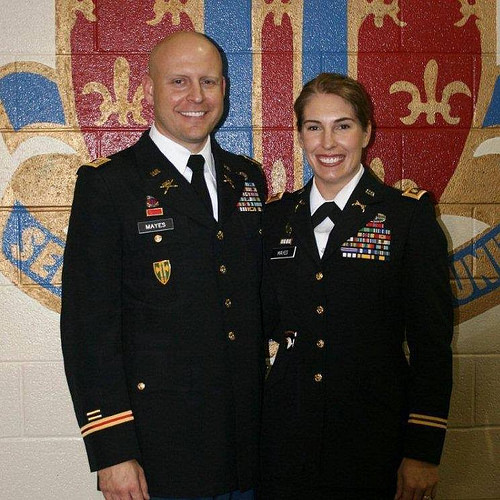
Majs. Jacob and Bobbie Mayes. (Courtesy photo)
When asked about being the first woman to serve in those positions, Mayes said, “The cool thing about this is that nobody really made a big deal out of it. I measure this as success.”
“Throughout history a big deal is usually made of folks who have broken a certain barrier or glass ceiling. The attention they are given is great, however, in my case without the attention, I see this a being very successful.”
Mayes’ husband, Maj. Jacob Mayes agrees that her jobs are similar, knowing when to turn the “drill sergeant” on and off.
“She relishes in her continual commitment to shape and mold those who follow her into something better.”
Being the best at her job has provided Mayes a solid reputation with members of the Kentucky Guard and with future officers in the ranks. Not just as a female Soldier, a woman in uniform, but as a leader.
“If someone just sees you as the OCS Commander, then they see you as one person, not male, female, black, white, short, fat, etc. They see you as a leader because of merit, perseverance and the leadership you give them.”
“I can say that being at the Regiment, I have never felt more like myself because of the caliber of folks I get to work with and being able to produce the finest Soldiers in the world. Who wouldn’t want my job, I am pretty lucky.”
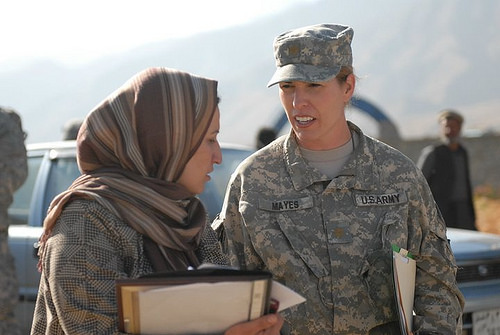
Maj. Bobbie Mayes speaks with a participant at a Women’s poultry course taught by members of Kentucky’s Agribusiness Development Team in Afghanistan, 2010. (Courtesy photo)
Col. Hal Lamberton, commander of the 238th Regiment said the best thing about Mayes is the quality she brings to the OCS program in professionalism and responsibility.
“There is no gender issue with her as the commander because she does the job of teaching, advising, and counseling the OCS candidates that well,” said Lamberton.
“Major Mayes is not seen as a female TAC Officer Commander but as the TAC Officer Commander. The officer candidates, unit cadre, and others outside the unit view her as reliable, responsible, and caring. Which I believe are desirable qualities of all officers regardless of gender.”
Story by Staff Sgt. Scott Raymond, Kentucky National Guard Public Affairs
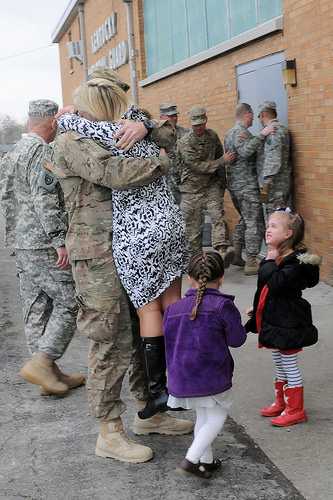
Spc. James Moore with the 1103rd Military Police Detachment hugs his fiance during a welcome home ceremony in Louisville, Ky., March 25, 2014. The unit spent nine months in Afghanistan in support of Operation Enduring Freedom. (U.S. Army National Guard photo by Staff Sgt. Scott Raymond)
LOUISVILLE, Ky. — Excited friends and family members joined ranking officials of the Kentucky National Guard to welcome home the Soldiers of the 1103rd Military Police Detachment in Louisville, Ky., March 25.
“These are some of the best days in the Kentucky National Guard, when we welcome our Guardsmen home,” said Brig. Gen. Scott Campbell, the Kentucky Army National Guard’s Land Component Commander. “I want to thank the 1103rd for representing the United States Army and Kentucky Army National Guard in an outstanding manner.”
MPs of the Brandenburg, Ky.-based unit spent nine months as the sole law enforcement unit stationed in Regional Command North in Afghanistan. An area the size of Washington State. The unit provided force protection support, police investigations, patrols and military customs enforcement.
To see more photos from the ceremony, click here.
The 1103rd worked as law enforcement liaisons with NATO military police organizations in a true interagency and multinational mission. The Guardsmen served alongside German, Croatian, Mongolian, Swedish, Belgian, and Latvian MPs and Soldiers daily, and with numerous U.S. contractors.
A couple of the Kentuckians worked as undercover agents for a FBI task force and the unit assisted with counterintelligence investigations within the country. The mission marked the first time in 10 years that a Kentucky Guard MP unit operated overseas as a MP asset in theater.
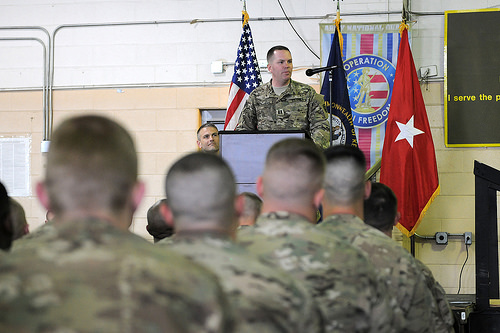
Capt. Michael Holliday, commander of the 1103rd Military Police Detachment speaks to his unit and friends and family members during a welcome home ceremony in Louisville, Ky., March 25, 2014. Holliday said the mission was the first in 10 years for the Kentucky Guard that a MP unit served as a military police asset overseas during a deployment. (U.S. Army National Guard photo by Staff Sgt. Scott Raymond)
“We had quite a diverse mission,” said Capt.Michael Holliday from Harrodsburg, Ky., commander of the 1103rd. “But we were lucky to have the opportunity to use the skills they have been taught as military police officers. We did a purely law and order mission and it’s pretty extraordinary to do that.”
Police work was not the only duty, however, for the unit as they helped reduce the U.S. military’s footprint in Afghanistan by retrograding $5.1 million worth of unnecessary unit equipment and redeployed 15 personnel before Feb. 1, without affecting their mission readiness or completion.
An additional highlight of the deployment for the 1103rd was their humanitarian mission in providing winter clothing to an Afghan orphanage in Mazr e Shariff.
Lt. Col. John Treufeldt, commander of the 198th Military Police Battalion complimented the unit on a job well done and expressed his gratitude to the Soldiers for using their MP training.
“I am extremely proud of their many accomplishments,” he said. “But mostly that they proved once again that military police Soldiers can deploy in small teams and accomplish the mission in a distinguished manner fitting of the MP Corps.”
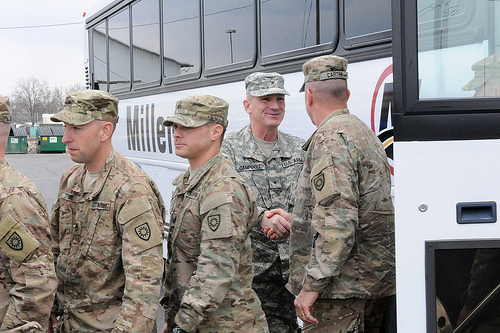
Brig. Gen. Scott Campbell welcomes home Soldiers of the 1103rd Military Police Detachment in Louisville, Ky., March 25, 2014. (U.S. Army National Guard photo by Staff Sgt. Scott Raymond)
As the Soldiers got off their bus, some needed to take few steps to be in the arms of family.
Spc. James Moore from Hopkinsville, Ky., was met quickly by his fiance, daughter and niece. Moore described his feelings as unlike anything he has felt before.
“It’s like I just jumped out of a plane, I’m almost hyperventilating,” said Moore. “My insides are shaking, my knees are buckling. I just remember grabbing people and hugging them. It’s crazy, but just great.”
“This is the best feeling ever. I feel like I’ve feel in love with everything again. I won’t take anything for granted after this. I’m just so happy to be home.”
Story by Lt. j.g. Bryan Mitchell, ISAF Regional Command North
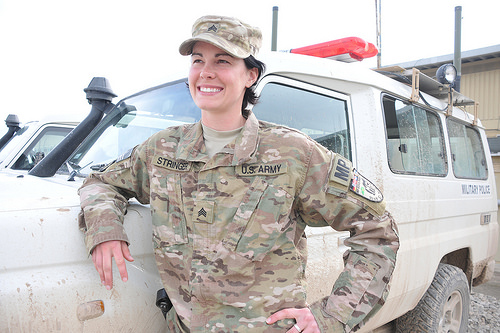
Sgt. Dana Stringer prepares to leave Afghanistan. (Photo by Lt. j.g. Bryan Mitchell)
CAMP MARMAL, Afghanistan – Two dozen troops from the Kentucky National Guard 1103rd Military Police Detachment recently finished their tour supporting Regional Command North.
Soldiers normally deploy to war with their focus clearly set on defeating the enemy. And the soldiers of the Kentucky National Guard 1103rd Military Police Detachment have plenty of experience in that field. With most members touting several combat tours in Iraq, the detachment arrived here in northern Afghanistan well prepared for the mental and physical rigors of a deployment.
But things are different here this time.
First, the Afghan National Security Forces are taking the lead in the fight against the insurgency. No longer are Americans and their coalition partners on point in the struggle to vanquish the enemies of a free and prosperous Afghanistan.
And then there’s geography.
Northern Afghanistan has long enjoyed relative security compared to the restive regions in the south and east of the country. The war began here where enemies of the Taliban collaborated with American forces to topple the government that harbored Osama bin Laden.
Finally, while their past missions have more focused on training or combat support, the Bluegrass State troops this deployment were tasked with maintaining law and order on this sprawling complex sandwiched between the shadow of the Hindu Kush mountains and the city of Mazar-e Sharif.
These factors allowed the troops to spend time getting to know Afghans rather than fighting them, and forge unique bonds with coalition partners who hail for 16 countries.
“That’s been the biggest difference for me,” said Staff Sgt. Bradford K. Stone. “I’ve gotten to learn a lot more about the average Afghan and understand their lives.”
The 36-year-old Carlisle, Ky., guardsman said the cultural differences do not separate a common thread between Afghans and Americans.
“They want to live in security, work hard to take care of their families and come back the next day to do it all over again,” he said.
Regional Command North is arguably one of the most diverse fighting coalitions in modern warfare. Seventeen nations collaborate daily to support the training of the Afghan National Security Forces.
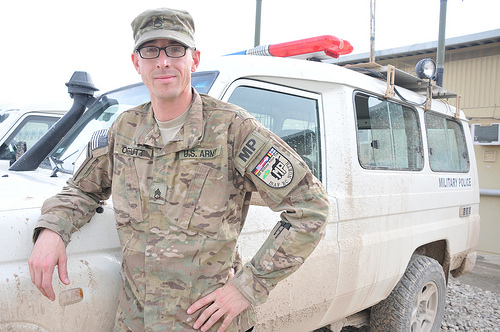
Sgt. Tyler Offutt prepares to depart Afghanistan. (Photo by Lt. j.g. Bryan Mitchell)
Along the way, troops from vastly different background form bonds common to any workplace.
Lt. Col. Marcus D. Ray, 48, of Elizabethtown, Ky., who served as the Provost Marshall, said his team approached enthusiastically the opportunity to serve and protect with six other military police units.
“We came here with an open mind and we met everyone here with that mindset, keeping an open mind and mutual respect,” Ray said. “As our coalition grew stronger over time, we were able to do things as a team. Not the American way, or the European way. We found a coalition way here.”
Sgt. Dana A. Stringer, 25, of Bowling Green, Ky., said the nine-month tour helped her mature.
“Before I got here, I had never had to pull someone over before. It was all just training,” she said. “I remember the first time I had to do it here and you think ‘Ok, I’m the enforcer now. I need to be professional’.”
Sgt. 1st Class Walter A. Carter Jr., 56, of Houstonville, Ky., said watching troops like Stringer grow into their roles was the highlight of his tour.
“To being apprehensive on their first traffic stop to now where it’s just a matter of fact,” Carter said.
“They were gaining respect on post because they treated people the way they would like to be treated. That’s what I will take away from this experience. And knowing how much better they will all be next time because of this experience.”
Sgt. 1st Class Michael L. Adkins Jr., 34, of Bowling Green, Ky., who in a past tour trained the Iraqi police, has two colorful accomplishments he will recollect on fondly many years from now.
He served as the personal security detail as well as escort for a group of mixed martial artists who spent a week touring Regional Command North in January and then performed the same role for a visit by the Miami Dolphins cheerleaders.
“It was the kind of work you could never expect but was very rewarding,” he said. “All of the visitors were so respectful and wanted to learn as much as possible about the soldiers and our work.”
The Miami Dolphins cheerleaders arrived hours ahead of a massive winter storm. Blinding wind, inches upon inches of snow and icy pavement slowed the base to a crawl and tortured troops not accustomed to cold weather operations.
“(The cheerleaders) never complained once, and it was some nasty weather we fought through,” he said. “They just kept smiling and wanting to get out with the troops.”
Sgt. Tyler D. Offutt, 30, of Brandenburg, Ky., also enjoyed a memorable moment here.
“You can try to come up with the most outlandish request for how you are going to do your re-enlistment ceremony. So I just threw out there that I wanted to do mine with (U.S. Marine Corps Brig. Gen. Craig Q. Timberlake) aboard a Black Hawk, not thinking it could ever happen,” he said.
But Timberlake, a Kentucky native who serves as the deputy commander for Regional Command North, wanted to thank Offutt for his work as the personal security detail when Timberlake left the installation and obliged.
“That was a great moment for me, and something I’ll never forget,” he said.
Timberlake expressed his appreciation for the unit’s service.
“Kentuckians are most appreciative of all the efforts of her sons and daughters but especially those that serve wearing the cloth of our nation,” Timberlake said. “The 1103rd served this command with honor and distinction. They are a professional outfit and their performance has been superb.
Equally important, Offutt said, was the unit’s philanthropic work. In October, a handful of the guardsmen delivered donated winter clothes to an Afghan orphanage.
“Our unit took a lot of pride in that mission, and to know helped those children stay warm over the winter was very satisfying,” he said.
All told, the Kentucky guardsmen served with distinction and return home knowing they made a positive impact in Afghanistan.
“The people of Kentucky should be very proud of these soldiers and of their sacrifice,” Ray said. “We left this area better than we found it and these soldiers can return home with pride.”
Story by Staff Sgt. Scott Raymond, Kentucky National Guard Public Affairs
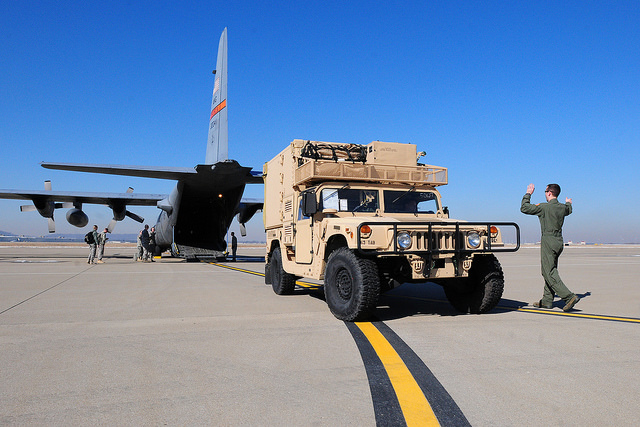
Soldiers with the 63rd Theater Aviation Brigade get assistance from Airmen with the Illinois Air National Guard in loading communication equipment into a C-130 at the Kentucky Air National Guard Base in Louisville, Ky., March 7, 2014. The load was part of the 63rd’s signal exercise in Pensacola, Fla., which tested the unit’s ability to respond to an incident within 24 hours. (U.S. Army National Guard photo by Staff Sgt. Scott Raymond)
PENSACOLA, Fla. — The Army has a plethora of communication systems. Soldiers with the 63rd Theater Aviation Brigade’s signal section participated in a multi-state communication exercise in Pensacola, Fla., March 7-9 to ensure that they could connect as many as they could in a potential crisis situation.
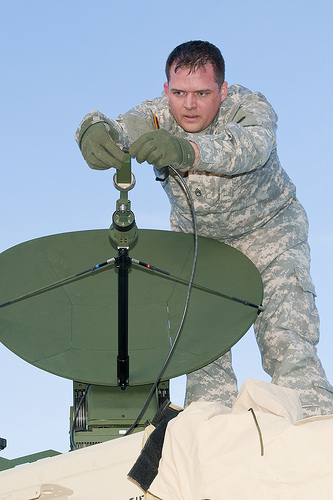
Staff Sgt. Jonathan Means sets up a dish antenna for a satellite unit nicknamed the “Cheetah” as part of a communication exercise for the 63rd Theater Aviation Brigade’s signal section in Pensacola, Fla., March 7, 2014. The Cheetah system is an auto-acquiring portable satellite receiver that provides high-speed data communications for internet and phone connections in remote locations or following a catastrophic event. (U.S. Army National Guard photo by Staff Sgt. Scott Raymond)
In a true test of interoperability, the Kentucky Soldiers flew to Florida, thanks to the Illinois Air National Guard and the Kentucky Air Guard’s 123rd Airlift Wing, to validate their equipment and skills for Task Force 46, a Michigan National Guard command.
“This exercise showcases the talents of this unit and the quality cooperation of a variety of assets,” said Capt. Joseph Fontanez, officer in charge of the Kentucky delegation.
To see more photos from the exercise, click here.
Fontanez said the exercise took into consideration all the logistics of responding to an incident, but it was still primarily an exercise in communicating. The unit’s goal was to send a forward command and control element within 24 hours to establish lines of communication between military units and local emergency responders for potential life-saving operations.
“We do this to ensure we are more than capable of filling in the communication needs of the task force and responding to an incident effectively.”
According to Task Force 46, the exercise enhanced the abilities of personnel and units to perform operations in support of local agencies and Homeland Defense during a catastrophic event, such as a large-scale chemical, biological or nuclear incident. A variety of units including aviation, medical, chemical and signal make up the response under the task force’s command and are based in Kentucky, Alabama, Florida and Michigan. Michigan is also home to the headquarters element for the Command and Control CBRN-E Response Enterprise Bravo.
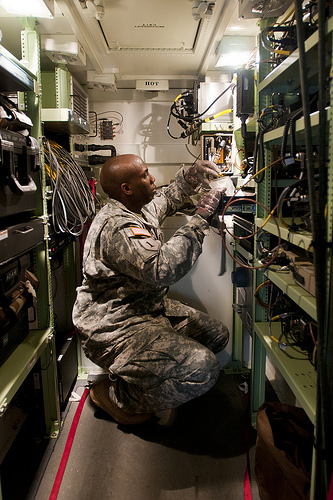
Master Sgt. Craig Anderson works to set up satellite systems during a communication exercise in Pensacola, Fla., March 7, 2014. The Kentucky Soldiers worked in an air defense, airspace management shelter, a large box filled with communication equipment attached to the back of a Humvee. (U.S. Army National Guard photo by Staff Sgt. Scott Raymond)
Each unit had their own roles and objectives to be validated for the exercise, but Fontanez said there was opportunity for more. As part of a first time test of their “24-hour response system” the Soldiers worked with Airmen with Kentucky’s 123rd Airlift Wing to pack up all the gear and equipment, including loading two Humvees into a C-130 and expedite their arrival in Florida.
“We play our part here and the team does a fantastic job, but we certainly tested the limits of our readiness for this exercise,” said Staff Sgt. Jonathan Means. “We tried something new and it worked well for us.”
The Kentucky Soldiers also worked to connect back to Frankfort, Ky. and finish the circle of communication from home station to field environment. With the added goals and unique equipment footprint, the 63rd was well represented and caught the eyes of others at the exercise.
Maj. Gen. Burton Francisco, Task Force 46 Commander was on hand to oversee the exercise and stressed the importance of exercising communication abilities of the units and how critical communication is for the task force.
“I’m very happy with I have seen so far, the Soldiers that are here representing each of their task forces are subject matter experts, each and every one of them,” he said. “I was very impressed with what I saw from Staff Sergeant Means and the whole Task Force Aviation team from Kentucky.”
The communication exercise is in preparation for the much larger Vibrant Response exercise held each August at Camp Atterbury, Ind. The unit will participate in other exercises prior to the annual event, but the Soldiers said the size of this exercise in Florida was invaluable for them and their jobs.
“These exercises are very beneficial for us in this field because our skills are perishable,” said Chief Warrant Officer Scott Goode. “We have to maintain our equipment and remain proficient in all the different radio systems and technologies. This is a great tool for keeping the unit sharp and ready to go at all times.”
Story by Rachael Tolliver, U.S. Army Cadet Command

2014 marks the 25th Bataan Memorial Death March.
FORT KNOX,Ky.-A marathon is 26.2 miles. And sometimes a marathon can seem like a death march-but not really.
If you want to know what a death march is really like, the 70,000 service men and women captured by Japanese forces during World War II can tell you. They were part of the Bataan Death March-a forced march through 70 miles of Philippine jungle, with very little to eat or drink.
This year marks the 25th anniversary of the Bataan Memorial Death March-a marathon-held in White Sands N.M., to honor those men and women, and will be held the weekend of March 21-23.
Of the 1,816 New Mexico National Guard troops captured-most were with the 200th Coastal Artillery Regiment-only 987 survived.
U.S. Army ROTC Cadets have spent months preparing for the annual marathon-preparations that include raising funds for travel and physical training. They could certainly run the marathon but many walk the 26.2 miles, which doesn’t seem like much until they put on a 35-pound pack.
Even for those who don’t wear the pack, they walk the same route over hills climbing to 1,650 feet at the steepest point, in the hot sun and wind and through ankle-deep sand that makes the marathon seem longer than it is. And yet, it doesn’t even remotely compare to what the men and women of Bataan had to endure.
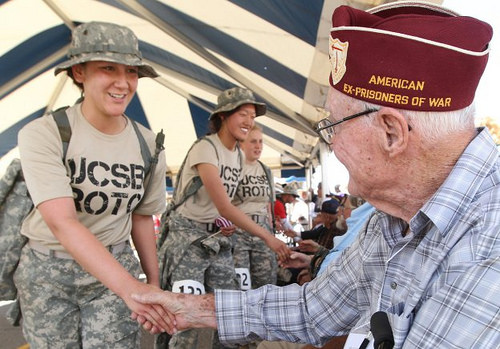
Cadets from the Surfrider Battalion of University of Santa Barbara shake hands with Bataan Death March survivor Eugene Schmitz as they cross the finish line of the 23rd Annual Bataan Memorial Death March at White Sands Missile Range in Las Cruces, New Mexico. Photo by John Wayne Liston
Cadets like Stephen Velisek, an accounting and finance major at the University of Colorado at Boulder, have participated in the event before and like most of the participants who come here, he said the first time he did it he was seeking a challenge.
“But after the experience and the event, I understood the true meaning of Bataan and now enjoy honoring the survivors as well,” Velisek said. “This happens during our spring break time-frame. But I am doing this because I enjoy the event and everything behind it-the experience is incomparable.”
The “everything behind it” to which Velisek referred includes a seminar about the actual Bataan Death March and how those forces came to be in Bataan. Survivors are on hand to discuss their experiences and explain the hardships and they also see the participants off at the start line and welcome them back at the finish. In short, the weekend is about educating the public on Bataan and the sacrifices our troops made there, and honoring those service men and women.
Like Velisek, the BMDM is also on Cadets Tanner Reinhart and Alessandra Angueira’s spring-break travel list. Reinhart, who is majoring in international affairs at the University of Colorado at Boulder, said he wanted to challenge himself physically and mentally as part of honoring the men and women who were force-marched through the Philippine jungle.
“I wanted to do something that I could look back on and be proud that I accomplished with my teammates-something worthwhile and meaningful,” Reinhart said. “I expect that it will be one of the most humbling experiences of my life.”
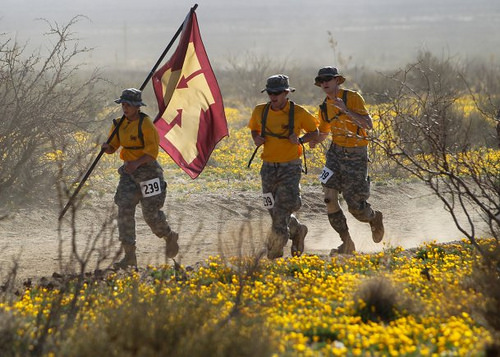
Cadets from the University of Minnesota run through the sand as they participate in the 23rd Annual Bataan Memorial Death March at White Sands Missile Range in Las Cruces, New Mexico. Photo by John Wayne Liston
Angueira said participation for her was about honoring the men and women who sacrificed during that time and also about the opportunity to build camaraderie.
“Going to the Bataan is better for me physically,” Angueira explained. “It has much more meaning, and at the end of the day, I am going to do something fun with my friends. It just happens to be a 26-mile ruck march with 35 pounds on my back.”
Although the event is a competition-the Bataan is regarded as one of the toughest marathons in which to compete-Cadet Zach Trevathan, a communications and journalism major at the University of New Mexico, said it’s more about the camaraderie and supporting the people around him so everyone makes it.
“I have been to the event before and I was a member of a unit in the New Mexico National Guard,” explained Trevathan. “Both of (those experiences) did a great job explaining the history and struggle that Bataan serves to commemorate.”
And that lesson of camaraderie and support is what Sgt. 1st Class Andrew Black hopes his Cadets take away from a weekend in the desert.
As a military science instructor at Western Kentucky University, Black knows a thing or two about military history. In addition to reading about it, he teaches lessons that can be learned from events such as WWII and Bataan.
“I personally find it to be a great challenge and an honor to participate (in the march) and to pay homage to the Soldiers that sacrificed so much,” Black said. “Last year I was not aware of how much I would gain from participating but I took away so much more than I could ever imagine.”
To explain, Black said his first marathon was more about checking a to-do box. He and some friends had heard about Bataan but had never gotten around to doing it-until last year.
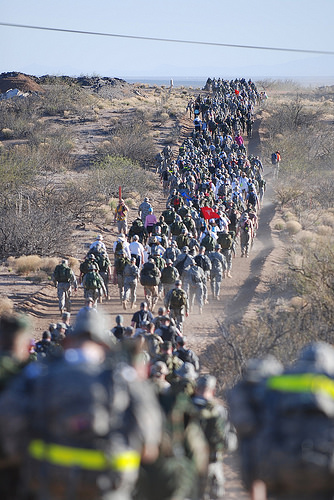
More than 5,000 Service members and civilians participate in the annual Bataan Memorial Death March at White Sands, N.M. (Photo courtesy of 1st Infantry Division)
“I was expecting something tough, something I could check off my bucket list-an event I could do,” Black said. “Then when we got there it wasn’t just a military event, it was a community event and there a lot of people from all over the U.S. and the world there. And there were a number of Bataan survivors-those who are left, and there aren’t many of them now. It’s just a powerful experience to go through.”
In meeting the survivors and hearing of their experiences Black said some of the things they talked about were the hardships, and how some guards were compassionate and some were brutal. But they also talked about the bond.
“(The survivors) talk about drawing power from each other, because if they had been alone they couldn’t have survived Bataan by themselves,” he said. “And that’s what I want the Cadets to learn. The lesson from their talks is that no matter how good someone is at any level, you have people from your left and right who have different strengths and who are there to help you. You can’t go through everything alone and having other people with you makes a world of difference.”
Cadets and cadre at New Mexico State University will also participate in the marathon but they have an additional responsibility: they are an event partner, a union that started in 1989 when the unit started the first BMDM to honor New Mexico’s own.
“We have a couple of teams competing,” said Maj. Paul Saiz, the unit’s executive officer. “But it’s more than that for us-we are honoring our own. We host a seminar on the death march during the weekend events, provide escorts for the survivors, and we have Cadets to man the water stations along the route when the marathon starts.”
Saiz also said they provide the color guard, a cannon for the opening ceremony and support the barbecue that is held in conjunction with the event.
But Black’s WKU ROTC Cadets are also honoring their own: the men of the Kentucky National Guard 38th Tank Company, known as the Harrodsburg Heroes, who were also captured and forced into the Bataan Death March. Of the 67 Kentucky tankers captured, only 37 made it home. Today that company is part of the 103rd Brigade Support Battalion, 138th Fires Brigade.
“Last year I did the marathon for myself, but this year I know more,” Black added. “This year I represent the school I work at in Kentucky, and the Kentucky National Guard has a deep history with Bataan too. So, taking these (guardsman) and their past with us-it’s huge to be representing their memory.”
Story by 2nd Lt. James W. Killen, 123rd Airlift Wing Public Affairs
KENTUCKY AIR NATIONAL GUARD BASE, LOUISVILLE, Ky. — The results are in, and three Airmen have been selected as the Kentucky Air National Guard’s 2014 Outstanding Airmen of the Year.
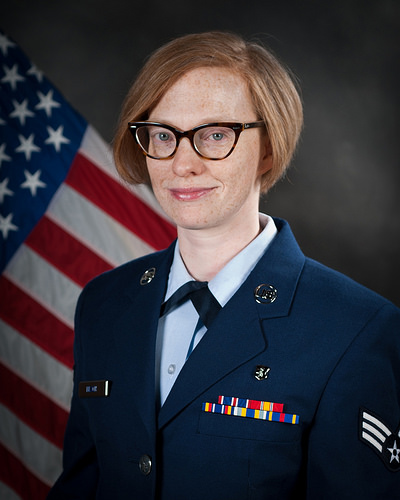
Senior Airman Katherine Beach, 2014 Airman of the Year
Senior Airman Katherine Beach, Tech. Sgt. Elmer Quijada and Senior Master Sgt. Shane LaGrone will each be recognized for excellence at a banquet held Saturday night at the Kentucky Fair and Exposition Center in Louisville, Ky.
The Airmen were chosen for their dedication to duty, leadership, job performance, personal improvement and community service, according to Chief Master Sgt. Jim Smith, state command chief master sergeant. They exemplify what it means to be outstanding Airmen and uphold the highest values of the Citizen-Airman, Smith said.
Beach, selected in the Airman category, is a cardiopulmonary technician with the 123rd Medical Group. A 2011 honor graduate from basic training at Lackland Air Force Base, Texas, she holds degrees from Bellarmine University and the University of Kentucky. Beach is currently assistant manager at the Shawnee branch of the Louisville Free Public Library.
In her role as a Kentucky Airman, Beach is a member of the rapid response and critical care teams; as a civilian, she provides leadership-skills training to community leaders and youth counselors; and as an individual, she maintains a high level of physical fitness and pursues several avenues of personal development.
“She is always a top performer and leads by the Core Values,” said her supervisor, 1st Lt. Angela Jenkins. “She is always willing to contribute to the team.”
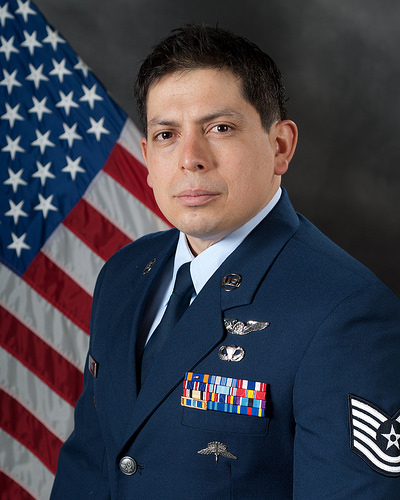
Tech Sgt. Elmer Quijada, 2014 NCO of the Year
Quijada, selected in the Non-Commissioned Officer category, is a pararescueman with the 123rd Special Tactics Squadron. The former active-duty troop is working toward a bachelor’s degree in organizational leadership and earned the title of pararescueman team lead because of his dedication to duty, officials said. He’s also the recipient of four Air Medals for meritorious achievement.
As a pararescueman, Quijada has been intimately involved with combat operations in Afghanistan, where he’s trained countless American, coalition and Afghan forces; as a civilian firefighter with the Frankfort Fire Department, he employs his special operations talents in the local community and leads demonstrations with school children; and as an individual, he has balanced his role as a firefighter and special operator with his role as a husband while completing two Community College of the Air Force degrees.
“His outstanding work as a special operator and with the Frankfort Fire Department, balanced with his role as a husband, make him an outstanding Airman,” said his supervisor, Master Sgt. David Wilcoxen.
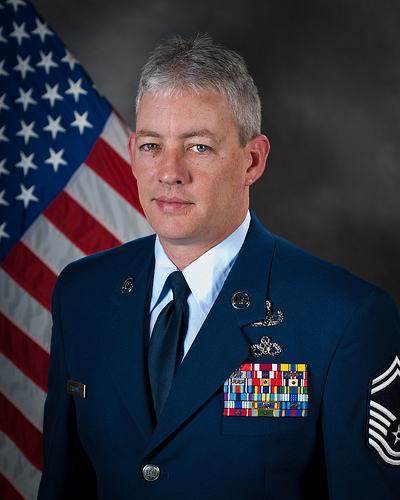
Senior Master Sgt. Shane LaGrone, 2014 Senior NCO of the Year
LaGrone, selected in the Senior NCO category, is the Explosive Ordnance Disposal Flight Chief for the 123rd Civil Engineer Squadron. He has a bachelor’s degree in Social and Criminal Justice from Ashford University and has earned the Bronze Star Medal with three bronze oak leaf clusters.
As EOD flight chief, LaGrone has provided leadership and training for 11 EOD technicians and worked with countless federal, state, and local law enforcement agency bomb squads; as a civilian, he has mentored and volunteered with the Boy Scouts of America, Bernheim Forest and Wounded Warriors Foundation; and as an individual, he completed the EOD flight commander’s course, better equipping his unit to face the challenges within the EOD community.
“In short, he is an outstanding senior NCO, and he keeps me in line,” said his supervisor, Maj. Keith Smith.
The Kentucky National Guard Soldier and Airman of the Year Banquet is scheduled to begin at 6 p.m. Saturday in the Conference Center Ballroom, South C Wing, Kentucky Fair and Exposition Center.
Story by Staff Sgt. Scott Raymond, Kentucky National Guard Public Affairs
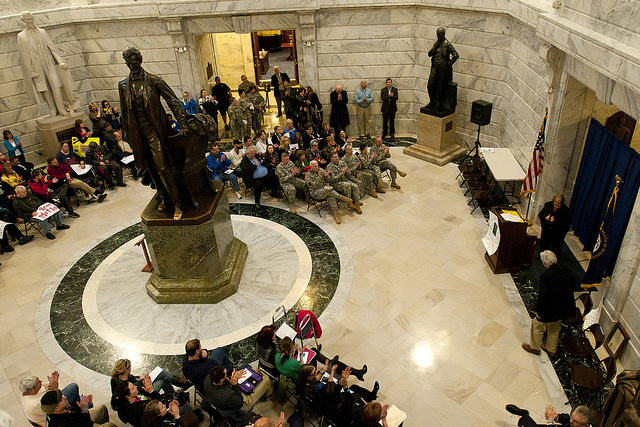
Kentucky Guardsmen join supporters of the Brian Injury Alliance of Kentucky (BIAK) for a rally at the State Capitol in Frankfort, Ky., March 12, 2014. BIAK held the rally to show support for legislation up for vote by Kentucky’s elected officials. (U.S. Army National Guard photo by Staff Sgt. Scott Raymond)
FRANKFORT, Ky. — Soldiers of the Kentucky National Guard joined with the Brain Injury Alliance of Kentucky (BIAK) and its supporters for BIAK’s 2014 Rally at the Rotunda in the State Capitol in Frankfort, Ky., March 12.
BIAK acts as the voice for the more than 225,000 Kentuckians have been affected by brain injuries. The purpose of the rally was to push support for legislation that would benefit those affected and strengthen laws for guarding against future brain injuries.
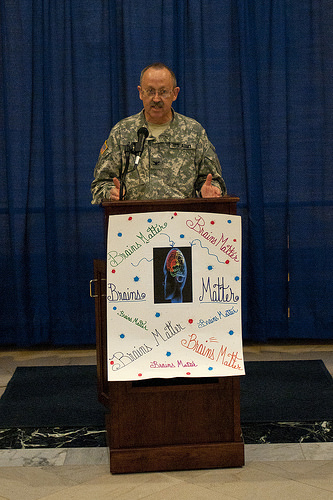
Col. Michael Gavin, State Surgeon for the Kentucky National Guard speaks to supporters of the Brain Injury Alliance of Kentucky at the State Capitol in Frankfort, Ky., March 12, 2014. The Kentucky Guard was on hand to support BIAK and their work to assist Service members and their families affected by brain injuries. (U.S. Army National Guard photo by Staff Sgt. Scott Raymond)
“It is important that Kentuckians understand the prevalence of brain injuries and their devastating impact on the lives of both the victims and their families,” said Kentucky Gov. Steve Beshear to the crowd of supporters pledging his support for the legislation and declared March 12 as Brain Injury Awareness Day in the commonwealth.
Speakers noted that one in five Kentucky families are affected by a brain injury and that Kentucky’s numbers are nearly double the national average for brain injuries. In the military, more than 294,000 members have suffered a brain injury during the Global War on Terror.
Kentucky National Guard State Surgean Col. Michael Gavin spoke about his experiences in treating brain injuries, both on the battlefield and here at home. During a 2005 tour of duty in Iraq he treated more than 138 injuries due to improvised explosive devices. One of his own Soldiers suffered brain trauma after being hit by an IED while on patrol.
“He wanted to be well, to serve his fellow Soldiers, but he was unable to do so because of this very real injury. This was a frightening experience for all of us.”
Gavin reinforced the necessity for awareness about brain injuries and their treatment. “This is an experience which occurs to some degree to almost 1.6 milllion of our countrymen every year. Fortunately, and because of your efforts, we are making strides in the best treatment which is prevention, and in disseminating information about the most appropriate evaluation and treatment of these all too common injuries.”
State Auditor Adam Edelen spoke of how BIAK resembles a family taking care of their own and the relevance of that work ethic to the crisis of brain injuries.
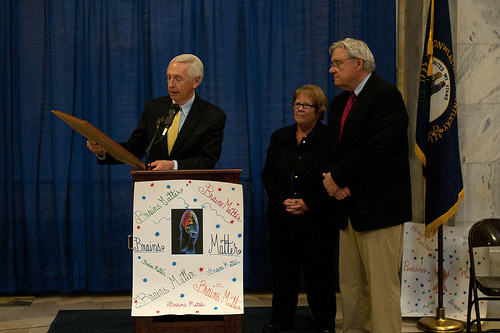
Gov. Steve Beshear reads a proclamation declaring March 12 as Brain Injury Awareness Day in Kentucky during a rally for the Brain Injury Alliance of Kentucky at the State Capitol in Frankfort, Ky., March 12, 2014. Beshear then presented the plaque to Mary Hass and Chell Austin with the Brain Injury Alliance of Kentucky during the rally. (U.S. Army National Guard photo by Staff Sgt. Scott Raymond)
“I know of no other organization anywhere in Kentucky that does a better job advocating for those in their critical point of need than BIAK,” he said.
The Brain Injury Alliance of Kentucky is a non-profit agency that began in Lexington, Ky. in the early 1980s and is now based in Louisville, Ky. BIAK seeks to share its philosophy, experience and skills with survivors, family members, students, caregivers, administrators, health professionals, legislators, the lay community and all those who desire to make a difference in the life of individuals with brain injuries and their families.
For more information, visit BIAK’s website at www.biak.us
Legislation up for support by BIAK included:
House Bill 235 - An addition of 303 new slots in the ABI acute and long-term Medicaid waivers in the Governor’s Executive Summary.
House Bill 157 - A bill requiring certain physicians to get training in recognizing the subtle signs of child abuse.
House Bill 199 - A bill that improves the requirements for booster seats and will protect Kentucky’s children.
House Bill 33 - A bill that improves on Kentucky’s texting and driving legislation.
House Bill 256 - A bill that will create a registry for adult abuse offenders to protect Kentucky’s vulnerable citizens.
Senate Bill 98 - Provides protection to Kentucky’s vulnerable citizens.