Pages
Stay In Touch
More
© 2013 KentuckyGuard
Story and photos by Staff Sgt. Scott Raymond, Kentucky National Guard Public Affairs
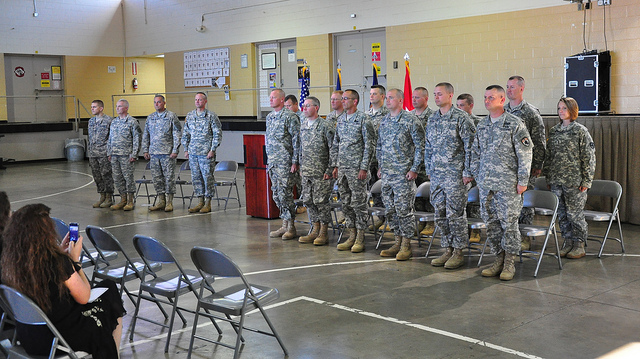
The newest graduates of the Kentucky National Guard’s Warrant Officer Candidate School stand at attention during a ceremony in Frankfort, Ky., Sept. 23, 2013. The new warrant officers recently completed the school and were commissioned Sept. 21 at Camp Atterbury, Ind. (U.S. Army National Guard photo by Staff Sgt. Scott Raymond)
FRANKFORT, Ky. — The small family that is the Kentucky Army National Guard’s Warrant Officer Corp got a little bigger with the commissioning of 12 new warrant officers, Sept. 21, 2013.
The Soldiers had just completed the final two-week phase of Warrant Officer Candidate School at Camp Atterbury Joint Maneuver Training Center in Edinburgh, Ind. Following the graduation there, the new warrant officers returned home for a recognition ceremony at the Boone National Guard Center in Frankfort, Ky., Sept. 23.
“On Saturday (Sept. 21), their military careers took on a whole new look, and a whole new responsibility,” said Kentucky’s State Command Chief Warrant Officer James Simms. ” This class represents the largest we’ve had, so the future is looking good for the warrant officer in Kentucky.”
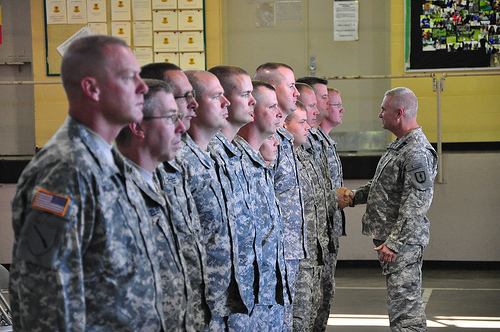
Col. Hal Lamberton, commander of the 238th Regiment congratulates each graduate of the Kentucky National Guard’s newest Warrant Officer Candidate School class during a ceremony in Frankfort, Ky., Sept. 23, 2013. The 12-member class represented the largest graduating class for the 238th and their WOCS. (U.S. Army National Guard photo by Staff Sgt. Scott Raymond)
The candidates started down the commissioning road around the beginning of the year, spending the majority of their time in training one weekend a month with the 238th Regimental Training Institute (RTI) in Greenville, Ky.
Warrant Officer Candidate School is made up of four phases: an on-line phase for preparatory course work, two phases of training with the 238th at the Wendell H. Ford Regional Training Center followed by the final phase at Camp Atterbury.
Kentucky’s RTI was recently named an Institute of Excellence by the U.S. Army and has been expanding it’s role as the state’s premier training facility, taking on new courses and more students. The unit has also impressed other states and other components with its availability and course offerings.
For two of the new warrant officers in the class, that’s just what they were looking for, because neither one are from the Kentucky Guard. Warrant Officer Arthur Stevens is an Army Reservist from the 378th Military Police Detachment in Louisville, Ky., but he lives in Clarksville, Tenn. Stevens said he had issues scheduling his school around his job and had never heard of the RTI. He said the decision worked perfectly with his work schedule and Reserve drill weekends.
“The only way I could have done this is with the RTI,” said the 13-year Veteran. “When I go back, I’m going to tell everyone I know that this is the way to go.”
“It was a great all-around experience,” Stevens said of the training. “It was great that the Guard took me in and made me part of the team.”
Simms said the Kentucky National Guard will help anyone become a warrant officer, regardless of their state or component. Warrant officers across the country work hand in hand with advanced courses and problem-solving and Simms believes they should work together to create new warrant officers as well.
“Thanks to skilled recruiters, quality leadership in the units and a fine training element we have in the 238th, we can make that happen here,” he said.
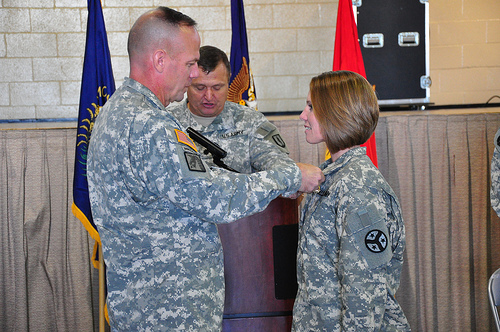
Brig. Gen. Stephen Hogan, assistant adjutant general for training recognizes Warrant Officer Amy Meadows as the honor graduate of the newest Warrant Officer Candidate School class during a ceremony in Frankfort, Ky., Sept. 23, 2013. Meadows, a Soldier with the Tennessee National Guard, chose Kentucky’s course because it allowed her to juggle work, college and becoming a warrant officer. (U.S. Army National Guard photo by Staff Sgt. Scott Raymond)
Warrant Officer Amy Meadows is with the Tennessee National Guard and also didn’t know how to deal with her full schedule of work and school. She knew the school would be longer than going through the traditional course at Fort Rucker, Ala., but had heard great things about the training provided by the 238th.
“I chose to go to Kentucky’s RTI because I needed another option,” she said. “I’m a full-time student and I work full-time at my civilian job, so I needed an option that allowed me to do all three, and the RTI was the best fit for my life.”
Meadows, from Mt. Juliet, Tenn., also graduated as the honor graduate of the class and said she has had always had respect for warrant officers, who always the ones who had the right answers.
“I’m a big believer in continuing knowledge and self-development,” she said. “And warrant officers are the pulse, the continuity of the Army, and I just wanted to be a part of it.”
Meadows will now be the Soldier everyone looks to for answers at the 278th Armored Cavalry Regiment in Knoxville, Tenn.
Each of the new warrant officers will now schedule and attend their job specific warrant officer basic course. But the training doesn’t stop there. To be the experts in their fields, warrant officers continually educate themselves for the benefit of themselves and their units. And from the regimental commander to each training, advising and counseling (TAC) officer, the 238th is glad to be instrumental in furthering the careers of the Army’s future leaders.
“We’re focused on building a stronger and more capable Warrant Officer Corps, the new leaders in the field,” said Chief Warrant officer Rick Skelton, TAC Officer with the 238th. “And I believe we are making good strides in doing our part here in Kentucky at the 238th.”
story by Capt. Stephen Martin, Kentucky National Guard Public Affairs
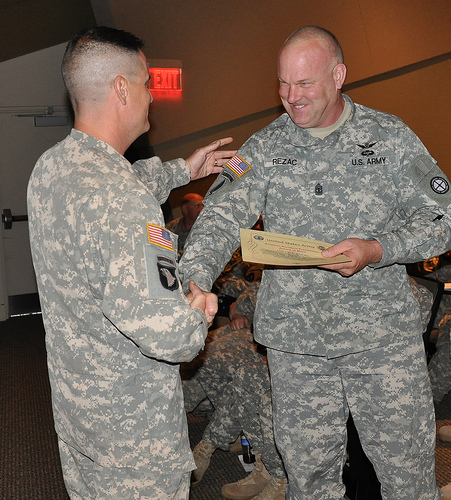
1st Sgt. Paul Rezac, C Co. 1st Bat. 376th is presented with a flying hour safety award by Col. Mike Ferguson, 63rd TAB Brigade Commander. Aircrew members from the Kentucky Guard army aviation community gathered together for their annual safety stand down at the Dept. of Transportation Building in Frankfort, Ky. Sept. 6, 2013. (photo by Capt. Stephen Martin, Kentucky National Guard Public Affairs)
FRANKFORT, Ky. — Aircrews from the Kentucky Guard army aviation community gathered together for their annual safety stand-down at the Dept. of Transportation building in Frankfort, Ky. Sept. 6.
“We get together each year to remind each other that this is a dangerous business we’re in,” remarked Col. Michael Ferguson, 63rd Theater Aviation Brigade Commander.
To see more photos from this event, please click HERE.
Aviation and ground safety were some of the topics covered during the day as well as retired Chief Warrant Officer 5 Delynn Gibson’s personal experience of spatial disorientation in a helicopter.
“Spacial D” as it’s known in the aviation world, is the inability to correctly interpret the aircraft’s attitude, altitude or airspeed, in relation to the Earth or point of reference, especially after that reference point, like the horizon, has been lost. If left unchecked or unrecognized, it can be fatal.
In addition to instruction on safety, several aircrew members were honored for the number of flying hours they had accumulated without an accident. The Kentucky National Guard’s army aviation program is considered one of the best in the country. The organization hasn’t had a major accident or incident in the last 30-plus years.
Chief Warrant Officer 4 Tony Villier has worked as a pilot at the army aviation support facility in Frankfort, Ky. for many years and sees safety as paramount to everything they do.
“Just because you have 2,000 hours doesn’t mean you know all of the dangers out there. The presentations today were on point and need to be incorporated into everything we do.”
Mr. Villier summed up the day appropriately, “never climb into a cockpit with someone braver than you.”
By Airman Joshua Horton, 123rd Airlift Wing Public Affairs
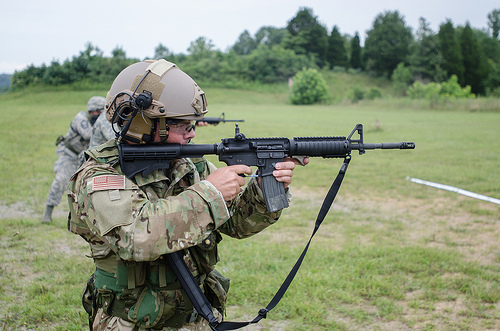
Tech. Sgt. Don Yeats, a radio frequency transmission craftsman from the 123rd Special Tactics Squadron, fires an M4 rifle during the Adjutant General’s Kentucky National Guard State Rifle and Pistol Training Event on July 27, 2013, at Fort Knox, Ky. Fifteen Airmen from the 123rd Airlift Wing competed in the contest July 27 and 28. The 123rd took first place in the pistol team competition, rifle team competition and overall aggregate. (U.S. Air National Guard photo by Master Sgt. Phil Speck)
KENTUCKY AIR NATIONAL GUARD BASE, LOUISVILLE, Ky. — Three teams from the 123rd Airlift Wing scored multiple victories against members of the Kentucky Army National Guard in the Adjutant General’s Kentucky National Guard State Rifle and Pistol Training Event held at Fort Knox, Ky., on July 27 and 28.
To see all the photos from this story, please click HERE!
The annual contest is sponsored by the Kentucky Army National Guard Small Arms Readiness Training Section to promote full combat readiness with a friendly competition, said Senior Master Sgt. Darryl Loafman, ground and weapons safety manager at the 123rd Airlift Wing here.
Awards are given for multiple team and individual competitions using pistols and rifles shot at life-size targets with distances ranging from 25 to 400 yards for rifles and 15 to 30 yards for pistols.
“Military members don’t normally get this opportunity to receive advanced marksmanship training at this level,” Loafman said. “This training goes well above and beyond the Air Force qualification course.”
This year, the 123rd’s A team took first place in the pistol team competition, overall competition and aggregate score. The B team took first place in the rifle team competition, while Loafman won the individual pistol competition and placed second overall.
“You really get to learn what people are made of,” Loafman said of the contest. “You’re building a team. You have all those personalities out there you have to be able to deal with, but you learn a lot about people when they’re under stress.”
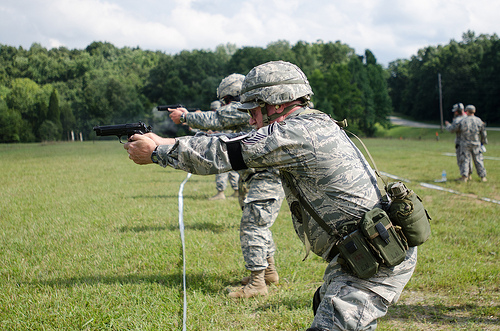
Senior Master Sgt. Darryl Loafman, pistol team captain for the 123rd Airlift Wing marksmanship team, fires an M9 pistol during the Adjutant General’s Kentucky National Guard State Rifle and Pistol Training Event on July 27, 2013, at Fort Knox, Ky. Fifteen Airmen from the 123rd Airlift Wing competed in the contest July 27 and 28. The 123rd took first place in the pistol team competition, rifle team competition and overall aggregate. (U.S. Air National Guard photo by Master Sgt. Phil Speck)
“I’ve been shooting a long time,” added Loafman, whose first event with the marksmanship team was in 1998. “Whether it’s different positions or new equipment, it’s fun just to compete and learn new things.”
Loafman encouraged all interested Kentucky Air Guardsmen to join the team.
“We’re always looking for new, young shooters to come out and represent the Kentucky Air National Guard.”
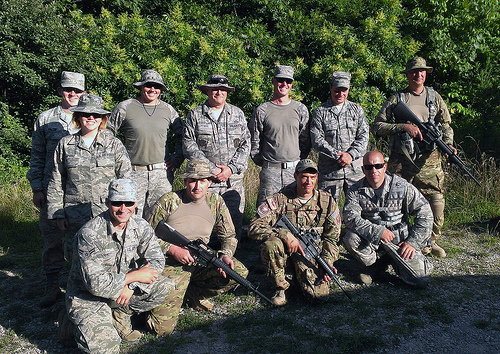
Fifteen Airmen from the 123rd Airlift Wing competed in the Adjutant General’s Kentucky National Guard State Rifle and Pistol Training Event July 27 and 28, 2013, at Fort Knox, Ky. The 123rd took first place in the pistol team competition, rifle team competition, and overall aggregate. (Courtesy Photo)
Fifteen Kentucky Air Guardsmen participated in the two-day contest, joining 40 Soldiers from the Army Guard.
Nine Airmen were added to The Governor’s Twenty, an exclusive list that represents the top 20 shooters of the competition. They were Loafman, Senior Airman David Farc, Senior Airman Jacob Fuller, Senior Airman Abe Hilbers, Tech. Sgt. Randall Ford, Tech. Sgt. William Pentecost, Master Sgt. Travis Keehner, Master Sgt. Timothy Kenney and Senior Master Sgt. John Siebert.
First-place rifle team members were Senior Airman Amber Updike, Ford, Pentecost and Keehner.
First-place pistol team members were Fuller, Hilbers, Loafman and Siebert.
Story and photos by Spc. Brandy Mort, 133rd Mobile Public Affairs Detachment
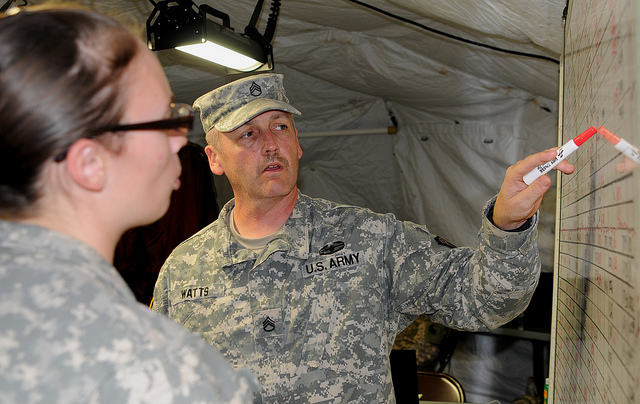
Staff Sgt. David Watts with the 63rd Theater Aviation Brigade, explains why time is critical to each of the participants of the second annual Command Sergeant Major Challenge at the Hidden Valley training site in Powell County, Ky., Sept. 13-15. Each group of participants was given roughly ten minutes to complete each task and four hours in which to complete each lane. (U.S. Army National Guard photo by Spc. Brandy Mort)
POWELL COUNTY, Ky. — Picking a location, surveying the land, and logistically planning a three-day challenge may sound like a tough job for most. However, that’s exactly what one man in the Kentucky National Guard did in preparation for one of the biggest training events for the 63rd Theater Aviation Brigade.
Staff Sgt. David Watts, Intelligence non-commissioned officer for the 63rd Theater Aviation Brigade designed the layout and developed the scenarios for each mission and subtasks for the Second Annual Command Sergeant Major Challenge at the 500-acre Hidden Valley Training site in Powell County, Ky., Sept. 13-15.
The 25-year veteran has worn the hat of a tanker for the active duty military and the Kentucky National Guard as well as an aviation intelligence NCO.
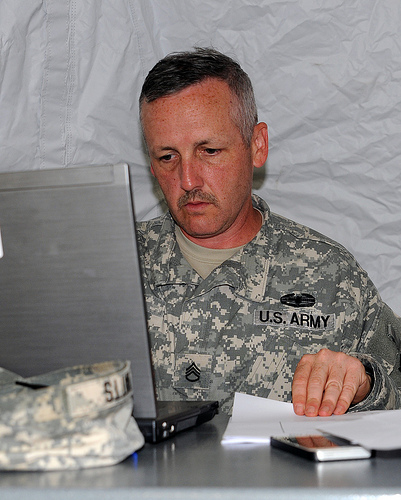
Staff Sgt. David Watts with the 63rd Theater Aviation Brigade, inputs data collected during the Command Sergeant Major Challenge at the Hidden Valley Training site, Sept. 13-15. This year, over 400 soldiers of the 63rd TAB participated. (U.S. Army National Guard photo by Spc. Brandy Mort)
Watts has been in charge of designing that course for both years of the event. However, plans had to drastically change since the number of participants nearly doubled for 2013. The event also changed in the manner that only enlisted Soldiers were involved, from the planning, all through the execution of the challenge.
“This year we had to develop more task points,” said Watts, “We have over 400 participants this year, which allowed us to be more creative with each scenario.”
As soon as the event ended last year, Watts mind was already focused on this years event.
“I’ve been working on this project for about eight months,” said Watts, “In that time I planned the scenarios, developed the course map, and surveyed the area.”
Brigade Command Sgt. Maj. Kevin Wilkins, who sponsored the event this year, expressed pride in the work Watts accomplished.
“Watts is the brains behind the entire mission,” said Wilkins, “He took it upon himself to get the job done. He is a strong asset to have in the 63rd.”
While Watts was in charge of most of the planning he doesn’t consider himself alone in the process. He also worked along with other various Soldiers from the 63rd TAB.
In his spare time he enjoys hanging out with his 12-year-old son and riding his motorcycle.
“I enjoy teaching him judo and archery,” said Watts.
The efforts made by Watts to complete a successful CSM Challenge was noticed by Kentucky’s State Command Sergeant Major, Command Sgt. Maj. Thomas Chumley. Chumley presented Watts with a coin for his excellence during an awards ceremony held on the last day of the event.
“This event is exactly the kind of idea we need to go with, for enlisted, by enlisted,” said Chumley. “Now that’s what I’m talking about!”
Story by Staff Sgt. Scott Raymond, Kentucky National Guard Public Affairs
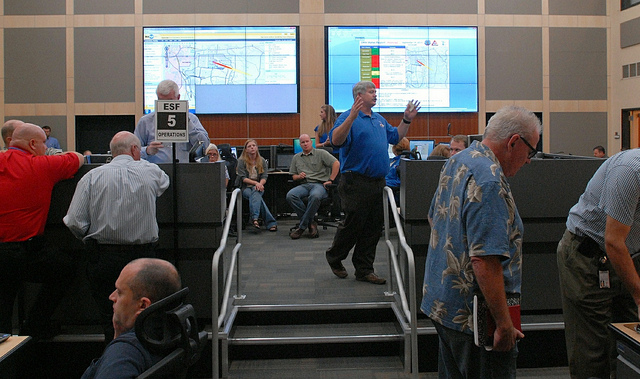
Mark Klaas, Chemical Stockpile Emergency Preparedness Program Manager for the Kentucky Division of Emergency Management directs personnel on the floor of the Emergency Operation Center in Frankfort, Ky., Sept. 18, 2013. KYEM participated in an annual exercise with a variety of state agencies in a simulated chemical explosion at the Bluegrass Army Depot in Richmond, Ky. (U.S. Army National Guard photo by Staff Sgt. Scott Raymond)
FRANKFORT, Ky. — Kentucky Division of Emergency Management (KYEM) is in the final stages of completing the new Commonwealth Emergency Operations Center (CEOC) at Boone National Guard Center in Frankfort, Ky. As one of the final tests of the new building, a variety of agencies from across the Commonwealth also assessed their skills with a large-scale exercise, Sept. 18, 2013.
Utilizing emergency managers from each region of the state, the agency simulated an accident involving chemical agents at the Bluegrass Army Depot in Richmond, Ky. The Chemical Stockpile Emergency Preparedness Program (CSEPP) exercise is an annual event for the CEOC and demonstrates one of the many potential natural and man-made disasters that KYEM trains for.
“The annual CSEPP exercise provides the Commonwealth the opportunity to test our response capabilities in the unlikely accident of a chemical release from the Bluegrass Army Depot,” said Mark Klaas, program manager for the exercise and CEOC operations manger during activations.
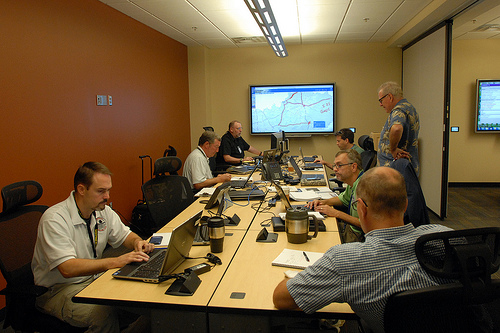
Representatives from various Kentucky agencies collaborate during the Chemical Stockpile Emergency Preparedness Program exercise in Frankfort, Ky., Sept. 18, 2013. More than 2000 personnel took part in the annual exercise state-wide. (U.S. Army National Guard photo by Staff Sgt. Scott Raymond)
“This year’s exercise allowed us to test the new systems and procedures with our cabinet and private sector partners in the new Commonwealth Emergency Operations Center,” he said. “We are very proud to have this new state of the art facility in which we can assist the Commonwealth in times of emergencies.”
More than 80 personnel from different agencies operated in the CEOC during the exercise and nearly 2000 were working their end in regional offices around the state. Representatives from other agencies such as the Red Cross, Department of Transportation, Public Health, Homeland Security, Kentucky Community Crisis Response Board, Kentucky Board of Emergency Medical Services and the Kentucky National Guard, all participated in the scenario.
Evaluators from the Federal Emergency Management Agency (FEMA) observed each step of the event to present a synopsis of how the exercise went.
“I am glad they took it all seriously,” said Charles Williams, an evaluator from Alabama’s Emergency Management. “The teamwork was great and the effort was certainly there.”
The new building received rave reviews in its state-of-the-art design and technologies. But as with anything brand new, there were a few bugs that presented themselves to be improved as KYEM gets used to its new home.
“My my observation, there were so many more good things that went right as opposed to what didn’t,” said Lt. Col. John Cline, commander of the Kentucky Guard’s 41st Civil Support Team.
“If they are using this exercise as a validation for the new building, I would say that it was certainly successful,” said Cline.
For more information on KYEM and CSEPP can be found at http://www.kyem.ky.gov.
Story and photos by Staff Sgt. Scott Raymond, Kentucky National Guard Public Affairs
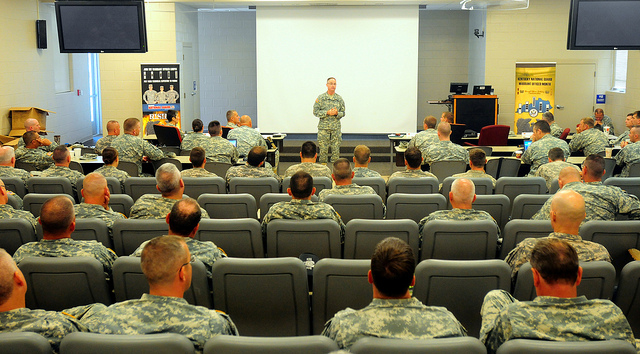
Chief Warrant Officer Gary Ensminger, the Command Chief Warrant Officer for the National Guard speaks to warrant officers of the Kentucky Guard at the Wendell H. Ford Regional Training Center in Greenville, Ky., Sept. 7, 2013. The warrant officers gather for their annual professional development conference to discuss the state of the warrant officer in the Kentucky National Guard. (U.S. Army National Guard photo by Staff Sgt. Scott Raymond)
GREENVILLE, Ky. — Warrant officers from every corner of the Commonwealth gathered at the Wendell H. Ford Regional Training Center, Sept. 7-8 for the chance to add more knowledge to their expertise. More than 100 Kentucky Guardsmen were there to attend an annual Warrant Officer Professional Development Conference.
“We hope this weekend that everyone can leave with a better understanding of training requirements, school requirements and recruiting requirements they need to become better warrant officers” said State Command Chief Warrant Officer James Simms. “We have warrants in Paducah, we have warrants in Ashland and they never see each other, but they have the same job, so this is the chance to bring them together to talk about improvements that could be made.”
Brig. Gen. Benjamin Adams, Chief of the Joint Staff for Kentucky visited the warrant officers and reminded them that they are the quiet professionals.
“The Warrant Officer Corps is a small group, but a professional group,” said Adams. “You are the ones that keep the organization running right at the speed we need it to run.”
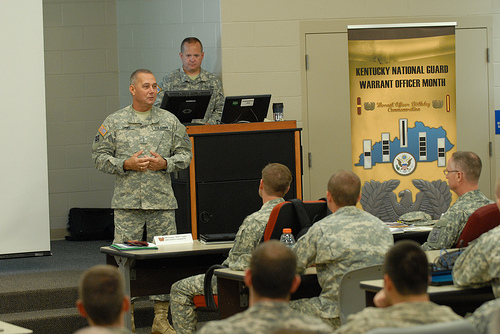
Chief Warrant Officer James Simms, Kentucky’s State Command Chief Warrant Officer speaks to warrant officers at the Wendell H. Ford Regional Training Center in Greenville, Ky., Sept. 7, 2013. Simms stressed continued education to those in attendance, a key to a successful career as a warrant officer. (U.S. Army National Guard photo by Staff Sgt. Scott Raymond)
The Kentucky Army Guard has around 140 warrant officers in its ranks and Simms said it is very hard to get all of them together at one time.
“We have 80 to 85 percent of all of our warrants here this weekend,” he said. “With deployments, attendance at advanced courses and some mission requirements, there’s a few that cannot make it, but we have guys here from every command, so they will take back the knowledge to those not here.”
Chief Warrant Officer Gary Ensminger, the Command Chief Warrant Officer for the Army National Guard made the trip to Kentucky to get feedback personally from Kentucky’s warrant officers. He said it’s his goal to gather questions and concerns to take back to the National Guard Bureau for the benefit of the Corps as a whole.
Also in attendance for the weekend was Chief Warrant Officer Douglas Englen, Regimental Standardization Officer for the 160th Special Forces Aviation Regiment from Fort Campbell, Ky.
Simms said the the guest speakers represented the outside components and their participation can give Kentucky an idea of what issues warrant officers around the whole Army are dealing with and how they are solving them.
“We have 140 different personalities to deal with, and each one has their own opinion because they are a warrant officer,” said Simms. “And each one of them think they know what right looks like. It is my job to get all those ideas together for the common good.”
The weekend offered the chance for the Soldiers to get to know one another and also to break-out into individual commands to discuss how things are going within each major command of the Kentucky Guard.
It was a first time experience for newly commissioned Warrant Officer Leah Pedicone with the 103rd Chemical Battalion. After 16 years in uniform, most recently as a military police officer, Pedicone decided to become a warrant officer.
In August, she graduated as the first female Warrant Officer for the Kentucky Guard as a chemical technician.
“I was approached about becoming a warrant officer and that was a great privilege,” she said. “Its a great opportunity for experience and to push the envelope and stretch the limits of the Chemical Corps.”
“I really didn’t know what to expect, but this weekend is pretty exciting,” said Pedicone. “I think this is a good chance for us to learn what our role is and to ensure we are all on the same page.”
Click HERE for more stories about the Kentucky National Guard Warrant Officer Program
Story by Staff Sgt. Scott Raymond, Kentucky National Guard Public Affairs
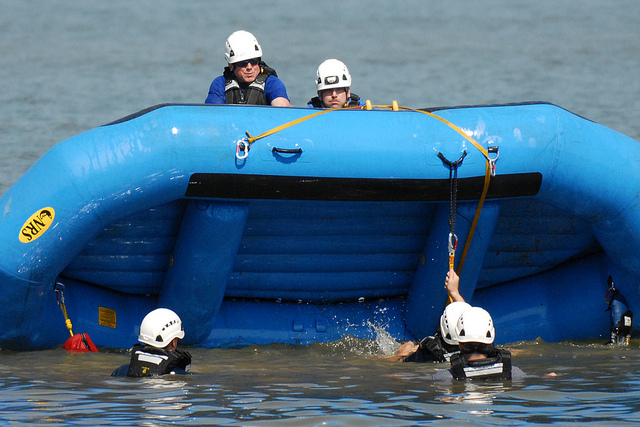
Members of the 41st Civil Support Team attempt to right a capsized raft in the Ohio River near Louisville, Ky., Aug. 27, 2013. The exercise was part of the unit’s training on swift water rescue operations. (U.S. Army National Guard photo by Staff Sgt. Scott Raymond)
LOUISVILLE, Ky. — Many know of the skill-set of the Kentucky National Guard’s 41st Civil Support Team. They are the go-to guys for any situation involving chemical, biological, radio-active or nuclear materials (CBRN). They have proven time and time again through real-world actions and excellence in proficiency checks that they are among the best of the best in the Nation.
But what the team wants everyone to know is that their abilities go far beyond their response to such incidents.
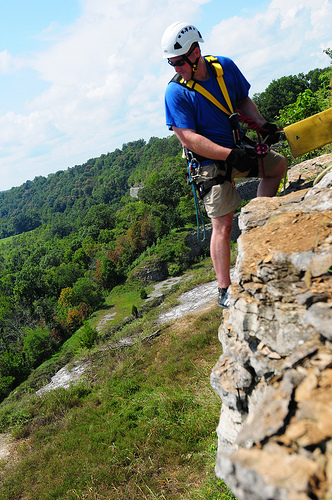
Sgt. Jacob Beach of the 41st Civil Support Team prepares to rappel down a cliff as part of a training exercise in Frankfort, Ky., Aug. 21, 2013. The unit received professional instruction on methods of technical rope rescue for use in urban operations during natural or man-made disasters. (U.S. Army National Guard photo by Staff Sgt. Scott Raymond)
To be up to the task 24/7, the team trains constantly, but recent exercises have taken them out of their usual element. To enhance that broad skill-set of the 22-man team, the Soldiers and Airmen gathered in August to practice technical rope rescues and swift water rescues.
To see more photos of the 41st’s training, click here.
“The 41st is known for their response to CBRN responses, and we are exceptionally good at doing that,” said Lt. Col. John Cline, commander of the 41st. “After Hurricane Katrina hit, the missions of all civil support teams across the Nation changed to include response to natural and man-made disasters.”
“This training relates to that for our response to floods, where we not only could rescue individuals in difficult situations, but also perhaps to pull drums of hazardous materials out of the water,” he said. “And anything that involves ropes is closely related with most of our operations for urban rescue.”
The team first came together for instruction on rope rescues in Frankfort, Ky., on the cliffs overlooking U.S. 127. Bill Matney, an emergency service instructor from Greensburg, Ky., provided both training opportunities.
“What we are giving them is options,” said Matney, owner and operator of Matney Consulting and Training. “We’re giving them tools for their toolbox, new methods and increasing their functional capabilities.”
Team members were taught fundamentals of rope rescue, including proper knots to tie, line anchor points and belay operations. They were then able to put the lessons to use as the team members played various roles in ascending and descending the cliffs in scenarios similar to what they may encounter in a real-world rescue.
The team next set up on the banks of the Ohio River in Louisville, Ky., for the swift water rescue training. The water-borne operations included instruction in hazard recognition, equipment use, and basic shore and boat-based rescue techniques.
“With the new natural disaster role, we looked at what the state needed as a whole and found some gaps so that’s why we’re here doing this,” said Sgt. 1st Class Steven Baker, a CBRN Specialist with the 41st.
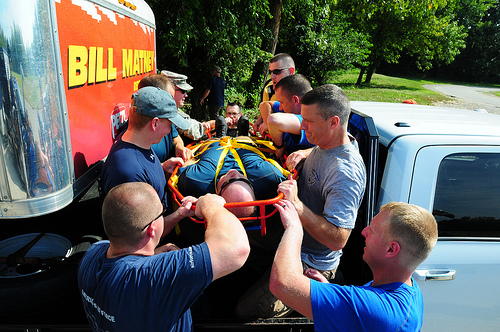
Soldiers and Airmen of the 41st Civil Support Team work to transport a fellow team member over an obstacle during training in Louisville, Ky., Aug. 27, 2013. The exercise demonstrated the difficulties of rescues performed in confined spaces and how to overcome the challenges. (U.S. Army National Guard photo by Staff Sgt. Scott Raymond)
“I think this is going to continue to enhance our skills and make us an even better asset to the state,” said Baker.
In addition to the rope and water rescue training, Matney also included lessons on confined space rescues. The 41st was instructed on how to properly secure a victim in a litter and how to move within restricted and unusual spaces.
Matney said he works with and trains a wide variety of first-responders and agencies, and commented on how impressed he was with the skills of the Soldiers and Airmen in the unit.
“I do this for a living, and I can tell you who is good and who needs more,” said Matney. “This crew is not here because they were told to be, they’re here because they want this. The quality of their leadership, their talent and their motivation is very impressive.”
“Overall, this is just great training to have,” said Cline. “We haven’t had to put it into action yet, thankfully. But if we do, we will be fully prepared to do so.”
By Master Sgt. Phil Speck, 123rd Airlift Wing Public Affairs
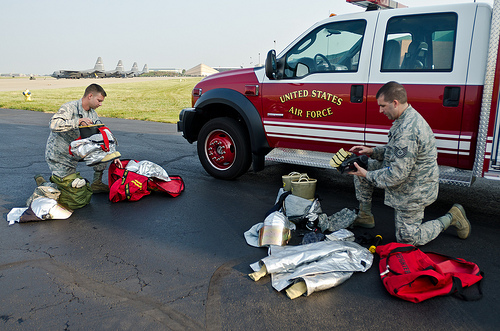
Staff Sgt. Kyle Miller (left) and Tech. Sgt. Dewayne Gibson, fire protection craftsmen from the 123rd Civil Engineer Squadron, inspect firefighting equipment Sept. 10, 2013, at the Kentucky Air National Guard Base in Louisville, Ky., prior to an overseas deployment. More than 85 Kentucky Air Guardsmen are being mobilized to support Air Expeditionary Force rotations and other Air Force missions this summer and fall. (U.S. Air National Guard photo by Master Sgt. Phil Speck)
KENTUCKY AIR NATIONAL GUARD BASE, LOUISVILLE, Ky. – More than 85 members of the Kentucky Air National Guard are being deployed to multiple locations this summer and fall in support U.S. military operations around the world, including Operation Enduring Freedom in Afghanistan.
The most recent group to mobilize consisted of 26 Airmen from the 123rd Security Forces Squadron, who deployed in support of an Air Expeditionary Force rotation earlier this month. They will provide security at an undisclosed air base in the Persian Gulf region for six months, according to Col. Jeffrey Peters, 123rd Mission Support Group commander.
In other mobilizations, 11 cargo handlers from the 123rd Logistics Readiness Squadron reported to Afghanistan in July and August to support Aerial Port operations, and 11 firefighters from the 123rd Civil Engineer Squadron are slated to deploy overseas in mid-October.
“Mission Support Group has seen an increase in deployments lately as group personnel are deploying as volunteers and in association with Air Expeditionary Force buckets,” Peters said. “The 123rd Civil Engineer Squadron, 123rd Force Support Squadron, 123rd Logistics Readiness Squadron and 123rd Security Forces Squadron all have Airmen deployed supporting contingency operations.”
Additional personnel from the 165th Airlift Squadron and 123rd Special Tactics Squadron deployed to Afghanistan in June and July, while other Kentucky Airmen are currently supporting domestic missions at sites across the United States.
“Most of the deployments are for six months,” Peters noted, adding, “We look forward to our Airmen’s safe return to their families.”
Story by Staff Sgt. Scott Raymond, Kentucky National Guard Public Affairs
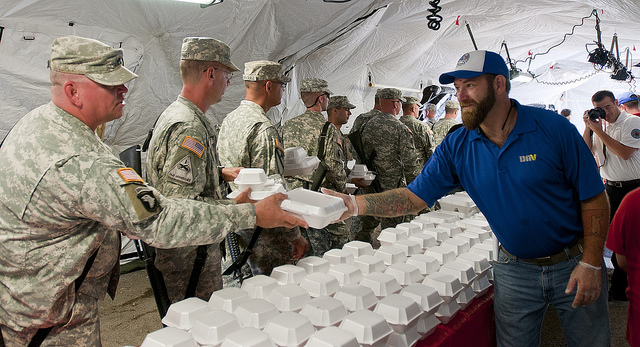
Michael Lewis, an Army Veteran and Kentucky farmer hands out lunches to Soldiers of the 63rd Theater Aviation Brigade at the hidden Valley Training Site in Powell County, Ky., Sept.15, 2013. Lewis joined with the Department of Agriculture in presenting the one-of-a-kind Kentucky Proud luncheon to the unit in appreciation and also to bring awareness of programs available that assist Service members interested in farming. (U.S. Army National Guard photo by Staff Sgt. Scott Raymond)
POWELL COUNTY, Ky. — Soldiers of the 63rd Theater Aviation Brigade concluded an extensive three-day training weekend with a unique picnic lunch at the Hidden Valley Training Site near Clay City, Ky., Sept. 15, 2013. The luncheon was courtesy of Kentucky’s Department of Agriculture and brought to them by a Veteran farmer.
“This a great end to a weekend,” said Command Sgt. Maj. Kevin Wilkins. “This weekend is quite different for these Soldiers, but so is this meal. What a treat for all of us.”
More than 400 Guardsmen of the unit participated in the Command Sergeant Major Challenge, an annual event for the 63rd that brings the aviation Soldiers out of the hangers and into the field for training in the Army Warrior tasks.
“I’m happy to receive a meal from Kentucky Proud,” said Spc. Tabitha King, a supply sergeant with 2/147th, “It’s from Kentucky so you know it’s going to be good.”
To see more photos from the luncheon, click here.
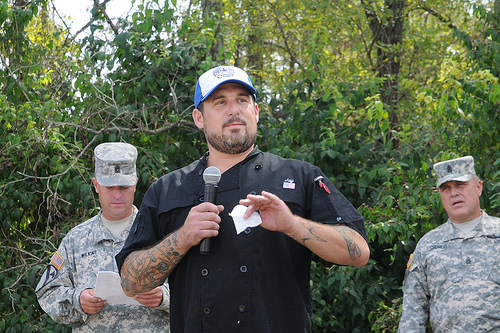
Jason Noto, Kentucky Proud vendor and U.S. Marine Veteran speaks to the Soldiers of the 63rd Theater Aviation Brigade at the Hidden Valley Training Site in Powell County, Ky., Sept. 15, 2013. Noto owns his own food business and farm in Sadieville, Ky., and prepared food for the Soldiers as part of a luncheon coordinated by the Kentucky Department of Agriculture. (U.S. Army National Guard photo by Spc. Brandy Mort)
The food was prepared by Jason Noto, owner and operator of Mia Nonni Mobile Food Truck and Shade Tree Farms in Sadieville, Ky. A native of Shelbyville, Ky., Noto served nine years in the Marine Corps and this year, followed a life-long dream of owning his own food business.
A menu of barbecue pulled pork and chicken, Italian sausage, vegetable boil of corn, potatoes and carrots were laid out with a variety of fixings available to each Soldier as they passed through the line.
Agriculture Commissioner James Comer was on hand to oversee the event and took the opportunity to speak to the Soldiers about the Homegrown By Heroes and Kentucky Proud Jobs for Vets initiatives. He said farming and being in the military are very similar and combining the two could be be beneficial for Service members and their communities.
” I’m glad to be here,” said Comer as he stood at the front of the food line shaking hands with each Soldier who passed.
“This is just a small token of our appreciation for everything our Service men and women do for us every single day,” he said.
The first of it’s kind, Homegrown By Heroes is a label that denotes a product is grown or produced by a current or former Service member. The Kentucky Proud Jobs for Vets helps Veterans find employment in the agriculture sector.
Comer’s programs are being pushed by Veteran farmers already working in Kentucky, such as Michael Lewis.
An Army Veteran and Kentucky Proud farmer, Lewis also spoke to the Soldiers, informing them of the many opportunities available in farming.
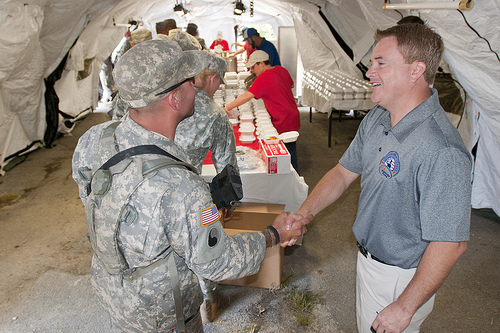
Kentucky Agriculture Commissioner, James Comer greets the Soldiers of the 63rd Theater Aviation Brigade during a luncheon at the Hidden Valley Training Site in Powell County, Ky., Sept. 15, 2103. The Department of Agriculture coordinated the event to show appreciation to the Kentucky National Guard and to bring awareness of local programs that assist Service members and Veterans in their own farming needs. (U.S. Army National Guard photo by Staff Sgt. Scott Raymond)
“There are many jobs related to agriculture out there,” he said. “And agriculture is one of the largest employment sectors in Kentucky.”
“I am here to ask you help me and the Kentucky Department of Agriculture,” he said. “To spread the word about the importance of these programs, and to plant a seed. If that seed sprouts into a backyard garden or a farm, we are here to help in any way we can.”
Lewis is also the Director of Growing Warriors, a program that helps to equip and train Veterans and their families with skills, tools and supplies to grow their own produce.
“It’s nice to be appreciated for all we do,” said Pfc. Joe Lovely, an aircraft hydraulics repair specialist with Bravo Company 351st. “I’m honored that they are using their own time, their own resources and their own family to provide us with locally grown products.”
Story and photos by Spc. Brandy Mort, 133rd Mobile Public Affairs Detachment
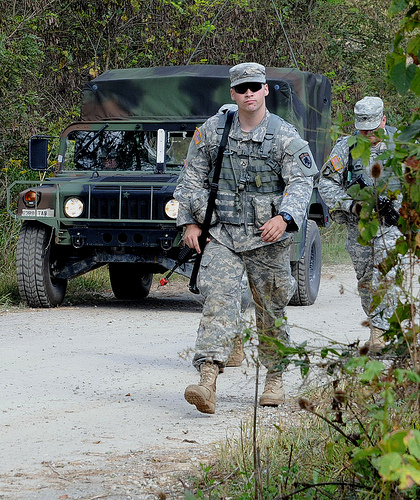
Pfc. Lanham walks with his squad to their next point of instruction during the 63rd Theater Aviation Brigade’s Command Sergeant Major Challenge at Hidden Valley Training Site in Powell County, Ky., Sept. 14, 2013. Soldiers of the unit gathered in a field environment for the event which gave them the opportunity to focus on basic Army task training. (U.S. Army National Guard photo by Spc. Brandy Mort)
POWELL COUNTY, Ky. — More than 400 Kentucky National Guardsmen from the 63rd Theatre Aviation Brigade participated in the second annual Command Sergeant Major Challenge at the Hidden Valley Training site in Powell County, Ky., Sept. 13-15.
From the time the sun rose and the dew settled and through the night Soldiers of the 63rd TAB faced a grueling three-day challenge. The event consisted of four different training lanes: Forward Operating Base Security, Medical, Army Warrior Tasks, and Survival. Underneath each lane were 42 subtasks dealing with each particular lane.
Units of the brigade were broke down into squads and were given precise instructions on when and where to be throughout the event. But it was entirely up to them to ensure they used land navigation skills and time management to maximize their training. Squads were awarded points for each task with the team with the most was presented the Command Sergeant Major Trophy during an awards presentation.
To see more photos from the event, click here.
According to the leadership of the brigade, the challenge was planned and executed by the enlisted members of the 63rd TAB. And that brought the enlisted ranks together, from the seasoned veteran to brand new privates.
“I’m happy this was my first drill with my unit,” said Pfc. Brittni Sherman, the newest patrol and supply specialist with the 2/147th Aviation. “It gives enlisted Soldiers like myself the opportunity to work within their platoon in order to accomplish the mission.”
The CSM challenge gives members of the 63rd TAB a special chance to practice basic soldier skills.
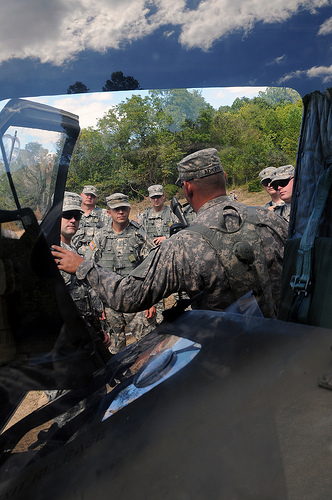
Sgt. 1st Class Adkins instructs Soldiers of the 63rd Theater Aviation Brigade on how to assist with a downed aircraft during the brigade’s Command Sergeant Major Challenge at the Hidden Valley Training Site in Powell County, Ky., Sept. 14, 2013. A variety of training lanes awaited the Soldiers of the brigade as they navigated the area from point to point with numerous Army tasks along the way. (U.S. Army National Guard photo by Spc. Brandy Mort)
“Aviation Soldiers typically work on or around aircrafts on Boone Center,” said Command Sgt. Maj. Kevin Wilkins, Command Sgt. Maj. of the 63rd TAB. “This is a unique opportunity for Soldiers to practice skills in a field environment.”
Despite the cold weather and rugged terrain, the Guardsmen enjoyed the training.
“Events like the CSM Challenge make us all better Soldiers,” said Sgt. Marcus Avery, crew chief with Bravo Company 2/147th, “We got the opportunity to bond amongst our teams, and develop more efficient troop leading procedures.”
Certain Soldiers of the 63rd TAB also participated in the event as observers and controllers, or the subject matter expert at each point of instruction. This gave Guardsmen the chance to act the role of opposition forces in scenarios and teach different classes based on the lanes.
“This is a special chance for each Soldier of the 63rd to learn different jobs within the brigade,” said Sgt. 1st Class Dale Adkins, flight operations NCO with Detachment 11, Observation Support Aircraft Agency, “I’m teaching the Soldiers what how to react to a downed aircraft, how to pull security around it and what to do to help the pilots and crew. Everyone gets exposure to an aircraft, even if their job doesn’t call for it.”
The tough weekend concluded with a special treat for the unit as the Department of Agriculture and Kentucky Proud coordinated a luncheon with food prepared by Kentucky Veterans. After all the instruction and hiking through the woods, all the units came together for a meal unlike they had had all weekend. Col. Michael Ferguson, the commander of the 63rd oversaw the luncheon and the award ceremony, congratulating many Soldiers on their accomplishments.
To see the photos from the Kentucky Proud luncheon, click here.
Kentucky’s new State Command Sergeant Major, Command Sgt. Maj. Thomas Chumley also attended, paying his first visit to Soldiers in the field in his new role and praised the 63rd.
“I’m very proud of the Soldiers of the 63rd TAB,” said Chumley, “You have set the bar for the Kentucky National Guard. It’s events like these that keep men and women wanting to serve.”