
Pages
Stay In Touch
More
© 2013 KentuckyGuard
Story by Staff Sgt. Scott Raymond, Kentucky National Guard Public Affairs
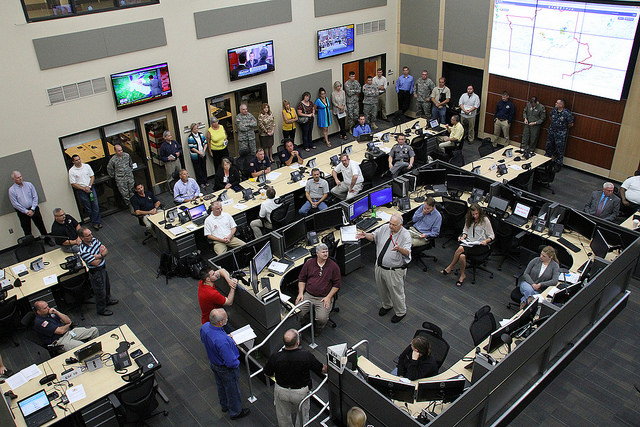
Charlie O’Neal, Assistant Director of Kentucky’s Emergency Management speaks to representatives from various state agencies to kickoff CAPSTONE-14 at the Commonwealth Emergency Operations Center in Frankfort, Ky., June 16, 2014. More than 20 state and local agencies gathered for the exercise which tested the state’s response to a major earthquake in the New Madrid Seismic Zone at the border of Kentucky and Missouri. (U.S. Army National Guard photo by Staff Sgt. Scott Raymond)
FRANKFORT, Ky. — During the winter of 1811-1812, the New Madrid fault line shook several times. The quakes were the strongest earthquakes east of the Rocky Mountains since Europeans settled the continent. The movement of the Earth reversed the flow of the Mississippi River and rang bells on the East Coast, more than 1,000 miles away. Two hundred years later, scientists say the seismic zone situated along the Kentucky-Missouri border is at high risk for another major earthquake at any moment.
To prepare for the possibility of a catastrophic event, Kentucky Emergency Management, the Kentucky National Guard and more than 20 other state and local agencies gathered June 16-20 in Frankfort for CAPSTONE-14. The multi-state exercise tested the state’s emergency response to a catastrophic earthquake along the fault line.
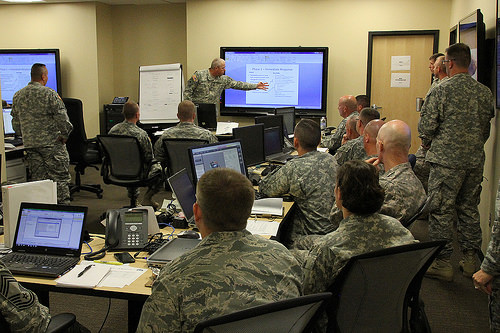
Col. William A. Denny briefs members of the Kentucky National Guard on their roles during the CAPSTONE-14 exercise in Frankfort, Ky., June 16, 2014. The exercise brought the Guard together with more than 20 other agencies to discuss their response to a major earthquake striking the state in the future. (U.S. Army National Guard photo by Staff Sgt. Scott Raymond)
“CAPSTONE-14 offers Kentucky and our neighboring states the opportunity to build upon the existing partnerships and opportunities to identify unified real-world solutions for emergency response to a catastrophic event of this magnitude,” said Michael Dossett, KYEM Director.
Under the direction of the Central United Earthquake Consortium (CUSEC), CAPSTONE-14 took three years to plan and is based upon the occurrence of a damaging earthquake in the New Madrid Seismic Zone. The consortium is made up the states which would be immediately affected by such an event and includes Alabama, Arkansas, Illinois, Indiana, Kentucky, Mississippi, Missouri and Tennessee.
Click here to see more photos from CAPSTONE-14.
A primary goal of the exercise was interoperability among the numerous agencies involved. Soldiers and Airmen of the Kentucky National Guard manned posts within the Commonwealth Emergency operations Center in Frankfort, but also put boots on the ground in earthquake response scenarios in the region.
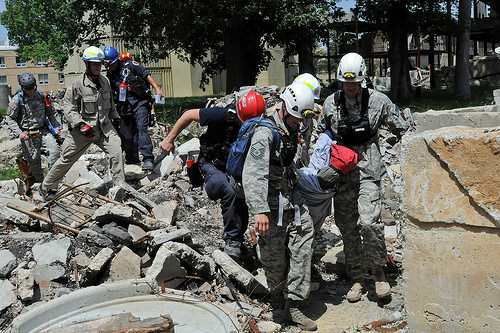
Members of the 41st Civil Support Team work with firefighters to recover a simulated casualty during training at Muscatatuck Urban Training Center in Butlersville, Ind., June 17, 2014. The firefighters, known as Task Force One from Louisville, Lexington and Northern Kentucky departments trained with the 41st as part of CAPSTONE-14, a multi-state exercise that tested emergency response to a major earthquake in the New Madrid Seismic Zone. (U.S. Army National Guard photo by Staff Sgt. Scott Raymond)
Members of the 41st Civil Support Team would be among the first called in. For CAPSTONE-14, the unit worked alongside civilian firefighters in search and rescue operations at Muscatatuck Urban Training Center (MUTC) in Indiana.
“Doing this in an exercise such as CAPSTONE allows us to experience the challenges that will be present during a real incident and gives us the opportunity to develop procedures to combat issues now instead of when a real threat hits,” said Capt. Steve Smith, team leader with the 41st.
“While the state of Kentucky would drastically be affected by a seismic incident on the New Madrid fault, it should give the citizens a little more comfort knowing that Search and Rescue organizations and the National Guard are being proactive in taking steps to work together prior to any incident,” said Smith.
Kentucky Guardsmen with the Chemical, Biological, Radiological, Nuclear and High Yield Explosive (CBRNE) Enhanced Response Force Package, or CERFP would also hit the ground quickly. The unit’s mission would assist in the location and extraction of victims from collapsed structures and the treatment of a mass casualty scenario. CERFP Soldiers and Airmen also trained at MUTC in conjunction with their counterparts from the Indiana and Georgia National Guard.

Staff Sgt. Joseph Bigelow, a crew chief for the Kentucky Air National Guard’s 123rd Contingency Response Group, marshals a Kentucky Air National Guard C-130 Hercules during CAPSTONE-14, a homeland earthquake-response exercise at Fort Campbell, Ky., on June 17, 2014. The 123rd CRG is joining with the U.S. Army’s 688th Rapid Port Opening Element to operate a Joint Task Force-Port Opening here from June 16 to 19, 2014. (U.S. Air National Guard photo by Master Sgt. Phil Speck)
Air Guardsmen with Kentucky’s 123rd Airlift Wing flew into regional airports in Western Kentucky to assess runway conditions and ensure a cargo hub could be set up for relief efforts into the damaged area. The wing worked with local officials and an active duty U.S. Army unit in their part of the exercise.
“The cooperation and interaction we have had this week is a critical part of what would be our response to such an event,” said Col. William A. Denny, plans and operations officer for the Kentucky Guard. “We must remain partners in our service to the commonwealth and CAPSTONE-14 has shown us what we have done right and what we can improve.”
“This is a scenario we don’t ever want to see, but when it happens, the Kentucky Guard will be there side by side with those who can best aid the state and the region.”
Story by David Altom, Kentucky National Guard Public Affairs
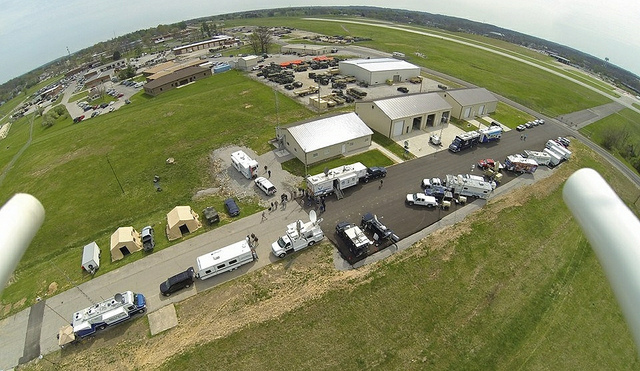
A bird’s eye view of COMEX 2014, courtesy of a unmanned aerial vehicle. Eighteen different communications command vehicles and trailers from 11 different agencies took part in COMEX 2014, a showcase for communications capabilities for first responders held at Boone National Guard Center.
FRANKFORT, Ky. — A recent communications exercise “showcase” held at Boone National Guard Center last April gave the Guard a chance to flex its muscles and strengthen its partnerships with local agencies.
“This showcase was developed to demonstrate interoperability with different agencies and new technologies,” said Chief Warrant Officer David Barker, wireless IT manager for the Kentucky National Guard. “We had eighteen different communications command vehicles and trailers from eleven different agencies. Most if not all had some type of reach back communications capability to support data and voice without land base communications support.”
In addition to National Guard and Kentucky Emergency Management assets, participating agencies included: the Kentucky Department of Transportation, the Labor Cabinet, Environmental Protection, Kentucky Early Warning System, the State Fire Marshall, and Military Auxiliary Radio Service.
Civilian volunteers, like those who run MARS, play a vital role in disaster communications. Barker was quick to champion those volunteers who took part in the showcase.
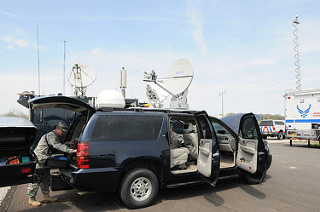
A Kentucky National Guard soldier prepares to deploy some wireless communications gear during COMEX 2014. (U.S. Army National Guard photo by Staff Sgt. Scott Raymond)
“If we didn’t rely on them we’d be hurting,” he said. “In a real disaster that’s your first line of response. They love this stuff, they spend their own money on gear and they are already deployed across every region of the state, out in the field and ready to respond.
A capability that was new to the COMEX was a UAV that was able to display video locally to the participants and demonstrate how it could take quality video and pictures of a disaster scene where it was too dangerous for personnel to go.
Capt. Joe Fontanez ran the tactical end of the exercise for the COMEX. He saw the exercise as an opportunity for everyone involved.
“This year we tried to do something different and integrate our tactical communications systems in the state-wide test,” he said. “This gave participating units the opportunity to test their tactical equipment alongside civilian equipment to see what talks and what doesn’t. For instance, the 63rd Theater Aviation Brigade was able to use their in house satellite communications assets for voice, video, data, and movement tracking which will enhance the incident site commander’s situational awareness on the ground.”
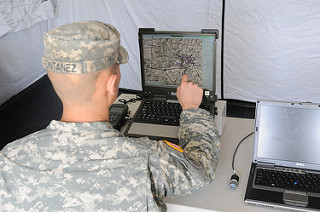
Capt. Joe Fontanez runs the tactical portion of COMEX 2014, showcasing the Kentucky National Guard’s radio communications capabilities. “Our Soldiers onsite were very upbeat and excited to be working with agencies from all over the state,” he said. (U.S. Army National Guard photo by Staff Sgt. Scott Raymond)
Fontanez stressed the partnership between the agencies, specifically on what the Guard can do to help its partners in time of emergency.
“We provided satellite internet that civilian agency partners would be able to utilize on the ground and also demonstrated how our system works to pass text message traffic as well as track vehicle movement in and around the incident site.”
Doing it in a parking lot is one thing, but can they do it in the field, under real world conditions?
“We plan on getting in a long range shot (100-200 miles) next year, allowing us to demonstrate how invaluable radio communications can be in the event our online digital technology fails.”
As with every exercise, strengths are measured and weaknesses identified and corrected. All in all, COMEX 2014 brought together a wide range of capabilities and personalities,
“Our Soldiers onsite were very upbeat and excited to be working with agencies from all over the state,” said Fontanez. “Not only did they get to show off their skills and equipment, but they got the opportunity to network with similiarly minded individuals who are passionate about communications. We even helped a few people with their own equipment which gave our troops an enormous sense of pride and accomplishment.”
Barker plans on taking the COMEX to other regions of the state, which will allow the Kentucky Guard to team up with even more agencies.
“We need to branch out a capture a bigger audience,” he said. “There is a ton of emergency agencies out there that we can work with. Not everybody can come to Frankfort, so we’re going to bring the showcase to them, let them know who we are and what we can do for them when a real emergency comes up. That’s the next step.”
Story by Staff Sgt. Scott Raymond, Kentucky National Guard Public Affairs
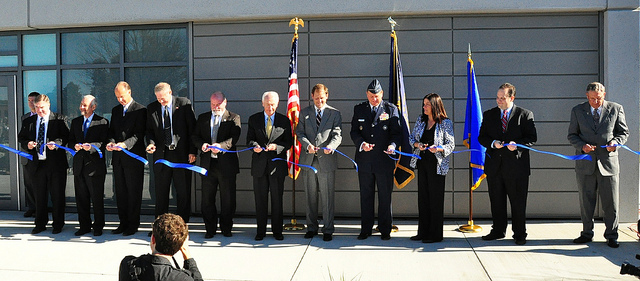
Governor Steve Beshear joins Adjutant General, Maj. Gen. Edward W. Tonini, and state and local elected officials in cutting the ribbon on the new Commonwealth Emergency Operations Center in Frankfort, Ky., Oct. 21, 2013. The facility will act as the hub of operations for future emergency response throughout the state. (U.S. Army National Guard photo by Staff Sgt. Scott Raymond)
FRANKFORT, Ky. — Kentucky Governor Steve Beshear joined Maj. Gen. Edward W. Tonini, the adjutant general for the Kentucky National Guard and emergency management officials from across the state for a ribbon cutting ceremony for the new Commonwealth Emergency Operations Center at Boone National Guard Center in Frankfort, Oct. 21, 2013.
The two-story, 26,150 square-foot facility replaces the former CEOC, built in the 1970s. The new building is constructed to withstand a variety of threats and weather conditions, including winds of up to 250 miles per hour. It is also outfitted with complete state-of-the-art communications technology to ensure rapid and efficient response during natural disasters and emergencies.
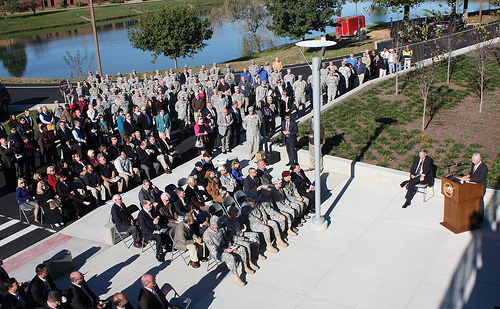
Governor Steve Beshear speaks to a crowd gathered for the ribbon cutting for the new Commonwealth Emergency Operations Center in Frankfort, Ky., Oct. 21, 2013. Gov. Beshear called the facility a lifeline to all 120 counties in the state in their time of need. (U.S. Army National Guard photo by Capt. Stephen Martin)
“This facility is a huge step toward bringing Kentucky’s emergency operations where it needs to be in the 21st century,” said Gov. Beshear. “As nice as it is, this is more than a building, it’s the lifeline to all of Kentucky’s 120 counties in times of trouble.”
To see more photos from the ribbon cutting, click here.
Tonini called the CEOC a symbol of the commitment made to the people of the Commonwealth. He recalled stories from past floods and tornadoes that wreaked havoc across the state, with the emergency response coming from cramped rooms in an out-dated building.
Beshear and Tonini both complimented the emergency operations staff and first responders in attendance, calling them the reason why Kentucky is a national model for emergency management.
“I am very enthusiastic about this new Commonwealth Emergency Operations Center and the effect it will have on Kentucky’s ability to respond in the future,” said Tonini. “This state-of-the-art, nearly $12 million facility, with all of the latest gear and systems, with its media room and conference rooms and planning rooms, it’s not worth a nickel without our people.”
“Our emergency managers are among the best in the nation, and they have proven their worth time and time again,” said Gov. Beshear.
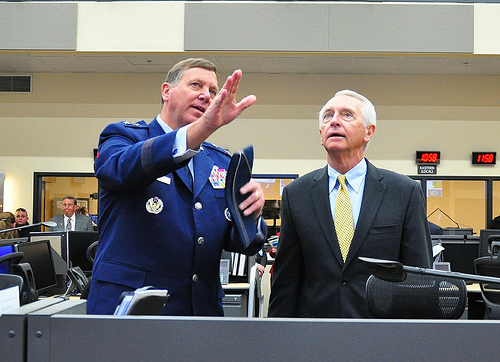
Kentucky’s Adjutant General, Maj. Gen. Edward W. Tonini explains to Governor Steve Beshear, features of the new Commonwealth Emergency Operations Center in Frankfort, Ky., Oct. 21, 2013. The tour followed the official ribbon cutting of the $11.8 million facility which took less than two years to complete. (U.S. Army National Guard photo by Staff Sgt. Scott Raymond)
The new center is capable of supporting more than 200 personnel during a disaster response, including Kentucky Emergency Management, the Kentucky Guard, state and federal agencies and private partners.
A large crowd gathered in front of the new building for the ribbon cutting including state and local elected officials. One in attendance has first hand knowledge of the abilities of those who will work in the facility. Pendleton County Judge Executive Henry Bertram spoke of the day he awoke to a completely flooded city in 1997. The rising waters of the Licking River devastated his county and surrounding areas. He contributed the resilience of the people affected to the work of Gov. Beshear and the agencies that will call the CEOC home.
“This place is a tool to give people the opportunity to put their community back together after a natural disaster,” he said. “The only reason we got back to our lives, was the people with emergency management.”
The new CEOC, funded at $11.8 million, was completed on time and at approximately $400,000 under budget. Nearly $10 million of the funding came from the Federal Emergency Management Agency’s Chemical Stockpile Emergency Preparedness Program. The Kentucky Department of Military Affairs and Office of Homeland Security provided the remainder.
Story by Staff Sgt. Scott Raymond, Kentucky National Guard Public Affairs
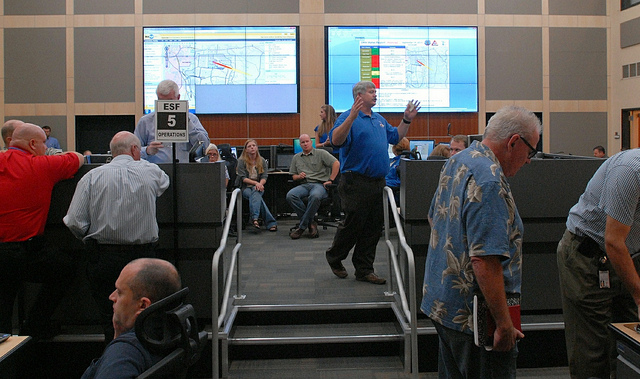
Mark Klaas, Chemical Stockpile Emergency Preparedness Program Manager for the Kentucky Division of Emergency Management directs personnel on the floor of the Emergency Operation Center in Frankfort, Ky., Sept. 18, 2013. KYEM participated in an annual exercise with a variety of state agencies in a simulated chemical explosion at the Bluegrass Army Depot in Richmond, Ky. (U.S. Army National Guard photo by Staff Sgt. Scott Raymond)
FRANKFORT, Ky. — Kentucky Division of Emergency Management (KYEM) is in the final stages of completing the new Commonwealth Emergency Operations Center (CEOC) at Boone National Guard Center in Frankfort, Ky. As one of the final tests of the new building, a variety of agencies from across the Commonwealth also assessed their skills with a large-scale exercise, Sept. 18, 2013.
Utilizing emergency managers from each region of the state, the agency simulated an accident involving chemical agents at the Bluegrass Army Depot in Richmond, Ky. The Chemical Stockpile Emergency Preparedness Program (CSEPP) exercise is an annual event for the CEOC and demonstrates one of the many potential natural and man-made disasters that KYEM trains for.
“The annual CSEPP exercise provides the Commonwealth the opportunity to test our response capabilities in the unlikely accident of a chemical release from the Bluegrass Army Depot,” said Mark Klaas, program manager for the exercise and CEOC operations manger during activations.
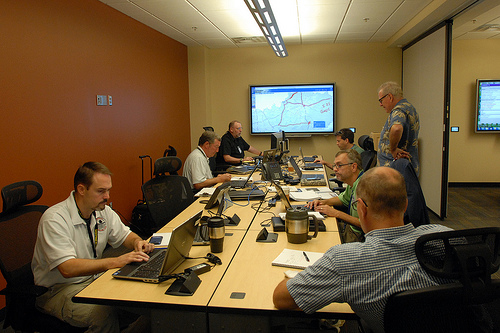
Representatives from various Kentucky agencies collaborate during the Chemical Stockpile Emergency Preparedness Program exercise in Frankfort, Ky., Sept. 18, 2013. More than 2000 personnel took part in the annual exercise state-wide. (U.S. Army National Guard photo by Staff Sgt. Scott Raymond)
“This year’s exercise allowed us to test the new systems and procedures with our cabinet and private sector partners in the new Commonwealth Emergency Operations Center,” he said. “We are very proud to have this new state of the art facility in which we can assist the Commonwealth in times of emergencies.”
More than 80 personnel from different agencies operated in the CEOC during the exercise and nearly 2000 were working their end in regional offices around the state. Representatives from other agencies such as the Red Cross, Department of Transportation, Public Health, Homeland Security, Kentucky Community Crisis Response Board, Kentucky Board of Emergency Medical Services and the Kentucky National Guard, all participated in the scenario.
Evaluators from the Federal Emergency Management Agency (FEMA) observed each step of the event to present a synopsis of how the exercise went.
“I am glad they took it all seriously,” said Charles Williams, an evaluator from Alabama’s Emergency Management. “The teamwork was great and the effort was certainly there.”
The new building received rave reviews in its state-of-the-art design and technologies. But as with anything brand new, there were a few bugs that presented themselves to be improved as KYEM gets used to its new home.
“My my observation, there were so many more good things that went right as opposed to what didn’t,” said Lt. Col. John Cline, commander of the Kentucky Guard’s 41st Civil Support Team.
“If they are using this exercise as a validation for the new building, I would say that it was certainly successful,” said Cline.
For more information on KYEM and CSEPP can be found at http://www.kyem.ky.gov.

Gov. Steve Beshear visits West Liberty, Ky on a Kentucky National Guard UH-60 Blackhawk after a tornado struck the town Mar. 2. (photo by Capt. Stephen Martin, Kentucky National Guard Public Affairs)
FOR IMMEDIATE RELEASE
CLICK HERE FOR MORE VIDEO AND PICTURES
FRANKFORT, Ky. (March 3, 2012) – After visiting catastrophic damages from Friday’s severe storms and tornadoes, Governor Steve Beshear spoke with both President Barack Obama and Homeland Security Secretary Janet Napolitano to relay critical emergency information and reaffirm Kentucky’s commitment to get relief to citizens quickly.
“The scope and magnitude of devastation in some of our communities is unlike anything I have ever seen,” said Gov. Beshear. “I’ve been in close contact with President Obama since Thursday to ensure we will have the resources our families will need to recover from these storms.”
Gov. Beshear authorized the Kentucky National Guard to deploy to communities as needed to assist with lifesaving efforts, security, and traffic control. So far, more than 220 troops have mobilized to five counties in Kentucky.

Kentucky's Governor Steve Beshear, Maj. Gen. Ed Tonini, the adjutant general, and Brig. Gen. John Heltzel, the director of Kentucky's emergency management, assess the damage in West Liberty, Ky. after the tornados of Friday 2 March. (photo courtesy of Kentucky National Guard, Tech. Sgt. Jason Ketterer, Public Affairs).
Both Gov. Beshear and Lt. Gov. Jerry Abramson visited storm-stricken areas Saturday morning. Gov. Beshear, along with Sen. Robert Stivers and Sen. Damon Thayer, toured heavy damage in communities in Morgan, Magoffin and Kenton counties. They were joined by Rep. John Will Stacy in West Liberty, Rep. John Short in Salyersville, and Rep. Adam Koenig in Piner.
Lt. Gov. Abramson assessed damage in the community of East Bernstadt in Laurel County with Sen. Tom Jenson.
“Gov. Beshear and I will do everything in our power to speed resources and assistance to our communities as we begin to recover from these storms,” said Lt. Gov. Jerry Abramson. “The damage to some of our towns is nearly incomprehensible. This is a difficult time, and we are holding all affected Kentuckians in our thoughts and prayers.”
Storm Numbers
The Kentucky Department of Public Health reports 18 fatalities from the storm:
Approximately 300 injuries have been reported.
Gov. Beshear declared a statewide emergency Friday to allow local officials immediate access to state resources to assist in public safety and recovery efforts. Twelve counties have declared states of emergency: Bath, Campbell, Johnson, Kenton, Laurel, Lawrence, Magoffin, Martin, Ohio, Pendleton, Rowan, and Trimble counties as well as the city of Paintsville.
Trained spotters and law enforcement officers throughout the state reported tornadoes in 19 different counties, according to Kentucky Emergency Management. Twenty-seven additional counties have reported damage.
Damage assessments and rescue missions continue. Severe storms began rolling across the Commonwealth Friday afternoon beginning in the far western part of the state and moved north and east of the Ohio River from Indiana.
Avoid Traveling in Communities with Storm Damage
Gov. Beshear strongly urged Kentuckians to heed warnings from emergency managers and stay off the roads and away from affected communities.
“Unfortunately, after a disaster like the one we have experienced, people take to the road for one of two reasons: to offer unsolicited help, or to tour the damage. That’s not helpful to our emergency responders,” said Gov. Beshear. “Our emergency responders and National Guard troops need immediate and unfettered access to our roads, and they can’t effectively continue that work if they’re fighting traffic.”
People who want to offer assistance to affected communities should contact their local Red Cross chapter for information. Emergency managers strongly discourage people from traveling to these communities to offer help.
Missing Persons
Friends or family who have been unable to locate loved ones since Friday’s storms are encouraged to register the missing person’s information on the Kentucky Emergency Management website at www.kyem.ky.gov or through the American Red Cross Safe and Well Program at www.americanredcross.org.
Meeting Critical Needs
Several shelters have opened by the Red Cross to accommodate citizens displaced by the storm:
Main Street
Sandy Hook, KY
100 Bulldog Lane
Louisa, KY
715 Warsaw Rd.
Dry Ridge, KY
911 TLC Lane
London, KY
147 Victory Ave.
Bedford, KY
For media updates, contact the Commonwealth Joint Information Center at 502-607-6901, 502-607-6903, or 502-607-6904.
CLICK HERE FOR MORE VIDEO AND PICTURES
Weather safety tips and weather alerts by county can be found on the Kentucky Emergency Management (KYEM) website at www.kyem.ky.gov. Road conditions are available at www.511.ky.gov.
For Immediate Release
Photos by Capt. Steve Martin and TSgt Jason Ketterer, Public Affairs, Kentucky National Guard
CLICK HERE FOR MORE IMAGERY OF KENTUCKY GUARDSMEN IN ACTION

Kentucky's Governor Steve Beshear, Maj. Gen. Ed Tonini, the adjutant general, and Brig. Gen. John Heltzel, the director of Kentucky's emergency management, assess the damage in West Liberty, Ky. after the tornados of Friday 2 March. (photo courtesy of Kentucky National Guard, Public Affairs).
FRANKFORT, Ky. (March 3, 2012) — Governor Steve Beshear and Lieutenant Governor Jerry Abramson and Kentucky’s Guard leadership are touring devastated areas across the Commonwealth.
The powerful storms caused widespread damage in forty Kentucky counties.
Gov. Beshear will view damages in West Liberty (Morgan County), Salyersville (Magoffin County), and Piner (Kenton County) today along with Adjutant General Ed Tonini, Senator Damon Thayer, of Georgetown, and Senator Robert Stivers, of Manchester. Lt. Gov. Abramson will visit East Bernstadt in Laurel County.
More than 220 National Guard Troops have been deployed to assist Johnson, Laurel, Magoffin, Menifee and Morgan counties with storm-related damages.
The Kentucky Department of Public Health has reported a total of 17 fatalities reported to the agency by local coroners. Due to a discrepancy in reporting, the number of fatalities in Menifee has been changed. Four fatalities have been reported in Laurel County, four in Morgan County, three in Kenton County, two in Johnson County, two in Menifee County, and two in Lawrence County. Approximately 300 injuries have been reported.
Gov. Beshear declared a statewide emergency Friday to allow local officials immediate access to state resources to assist in public safety and recovery efforts. Ten counties have declared states of emergency: Bath, Campbell, Johnson, Kenton, Laurel, Lawrence, Magoffin, Pendleton, Rowan, and Trimble counties as well as the city of Paintsville.
Trained spotters and law enforcement officers throughout the state reported 13 tornadoes in Kentucky, according to Kentucky Emergency Management. Damage assessments and rescue missions continue. Severe storms began rolling across the Commonwealth Friday afternoon beginning in the far western part of the state and moved north and east of the Ohio River from Indiana.
Donations and Assistance Citizens are strongly discouraged from driving through damaged areas, or traveling to damaged areas in an unsolicited effort to assist. Emergency responders need unfettered access to roads to continue rescue missions and assessment efforts.
Individuals wishing to provide assistance should contact their local Red Cross agency to determine ways to help those affected by the storms.
Missing Persons Friends or family who have been unable to locate loved ones since Friday’s
storms are encouraged to register the missing person’s information on the Kentucky Emergency Management website at www.kyem.ky.gov or through the American Red Cross Safe and Well Program at www.americanredcross.org.
Shelters Open
Several shelters have opened by the Red Cross to accommodate citizens
displaced by the storm:
* Elliott County High School
Main Street
Sandy Hook, KY
* Lawrence County High School
100 Bulldog Lane
Louisa, KY
* Grant County High School
715 Warsaw Rd.
Dry Ridge, KY
* Laurel Fire Dept.
911 TLC Lane
London, KY
For media updates, contact the Commonwealth Joint Information Center at 502-607-6902, 502-607-6903, or 502-607-6904.
Weather safety tips and weather alerts by county can be found on the Kentucky Emergency Management (KYEM) website at www.kyem.ky.gov. Road conditions are available at www.511.ky.gov.
CLICK HERE FOR MORE IMAGERY OF KENTUCKY GUARDSMEN IN ACTION
By Kevin Wheatley, Frankfort State Journal
Click here for the original Frankfort State Journal story.

John Heltzel, director of Kentucky Emergency Management, stands where the new emergency operation center will be built at Boone Center National Guard Armory. (Photo by Tricia Spaulding/[email protected])
FRANKFORT, Ky. — The state’s Emergency Operations Center can withstand a nuclear blast and an earthquake, but it can’t adequately house the multitude of state and federal officials who converge on Frankfort during presidentially declared emergencies.
Citing a lack of space in the 26,000-square-foot facility at Boone National Guard Center, the state plans to build a new EOC building that will be about three times larger and cost more than $9 million, Director of Kentucky Emergency Management John Heltzel said.
“It’s actually configured to let us grow,” he said, noting operations will expand depending on the severity of disasters.
Federal grants will pay for about 98 percent of the project, which will connect to the current EOC and is scheduled for completion by June 1, 2013, Heltzel said. Morel Construction of Louisville is the primary contractor.
The necessity of a larger EOC has been discussed for some time, but it became apparent during the ice storm of 2009, which cut off electricity in parts of Kentucky for about a month.
The storm marked the first time in recent history that Kentucky had a federal emergency declaration. More than 100 counties declared an emergency, and the Kentucky Army National Guard fully mobilized in response.
“We had all the support from the federal government show up,” Heltzel said.
“At the same time, we needed to have all elements of state government on site. This building is just not big enough to facilitate doing all the work that’s got to be done to meet the needs of the citizens.
“… The building actually held us back from being able to do some of the work that needed to get done.”
The current EOC was built during the Cold War era in the 1970s and, as a product of the time, can withstand a nuclear blast, Heltzel said. The concrete building can also survive a massive earthquake, a necessity given Frankfort’s potential vulnerability to the New Madrid fault line (in Missouri, Illinois and western Tennessee), he said.
But emergency management has grown considerably since then, Heltzel said.
Kentucky has fallen victim to 10 federally declared disasters in the last four years, he noted.
During the ice storm, some operations and meetings with state and federal officials spilled into the EOC’s hallways and five nearby buildings because of crowding.
“When you put in long hours and the stress involved, elbows get bumped and people are displaced in seating and things,” said David Altom, a spokesman for the state Department of Military Affairs.
“That really affects our efficiency and our ability to communicate and get things done. Just to have five guys – FEMA, state police, whoever –get together and talk in a quiet corner to solve a problem, there were no quiet corners.”
The current EOC, which handled about 5,000 incidents last year and takes calls every day at all hours, has about 30 seats available.
“At one point during the ice storm, we had more than 60 people in that room, and the halls were completely filled,” Heltzel said.
“… If we ever had to completely relocate in the middle of a disaster to another facility, that’s not going to be efficient. We’d lose some time during that transition.”
Members of the state media either hung out in the EOC’s hallways or in conference rooms while waiting for news briefings during the ice storm, Altom said.
The new EOC will also allow “significant elements” of the department’s Division of Emergency Management to relocate under on roof, Heltzel said, noting the division currently has three different locations.
The new EOC will also meet modern counter-terrorism requirements, such as putting concrete barriers near entry points.
“Of course, one of the good things about being at Boone Center is it’s a secure military post,” he said.
Since the current building is on the state historic register, the new EOC must match it in compliance with the Kentucky Historical Society’s regulations, said Buddy Rogers, a spokesman for the Division of Emergency Management
“I’m really pleased with the design work that was done because when you see it … they complement each other,” Heltzel said. “There’s no way to match a 30-year-old building with a brand-new building, but they did it in a way where they’re going to complement each other.
###
dwa
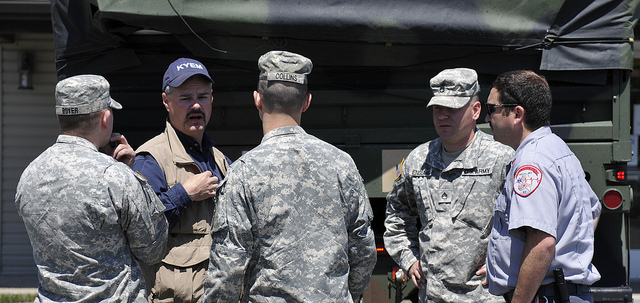
Jerry Rains, Regional Response Manager for Kentucky Emergency Management, talks with members of the Kentucky National Guard about the flooding situation in the Grand Rivers area on May 5, 2011. KYEM personnel and Guardsmen are currently deployed to multiple locations across Western Kentucky. (U.S. Air Force photo by Tech. Sgt. Dennis Flora, Kentucky Air National Guard)
FRANKFORT, Ky. (May 6, 2011) — Here are some photos and video shot by Kentucky National Guard photographers of the flood relief effort in Western Kentucky.
Click here for more Kentucky National Guard images.
[flickr video=5690476648 secret=800d0b824c w=400 h=225]
[flickr video=5689937101 secret=98e600f451 w=400 h=225]
[flickr video=5690640858 secret=4e916bae1e w=400 h=225]
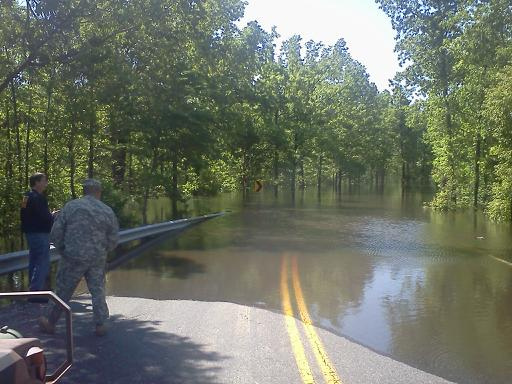
Staff Sgt. Jedadiah Cossel and McCracken County Emergency Management member, John Colson, assess the current water level on a McCracken County highway that serves as a major artery for the county. (Photo by Sgt. Chad Massingale, Alpha Battery, 1st Battalion, 623rd Field Artillery)
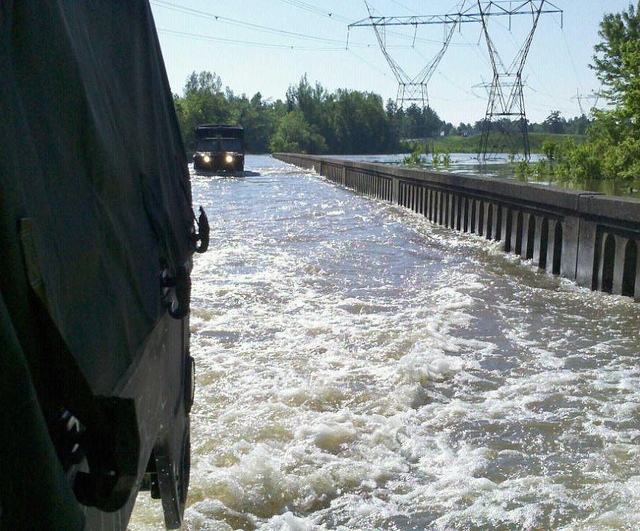
Kentucky National Guard Soldiers in humvees assist Kentucky Emergency Management officials in flood damage assessment surveys in McCracken County. (Photo by Pfc. Justin Lindsey, Alpha Battery, 1st Battalion 623rd Field Artillery)
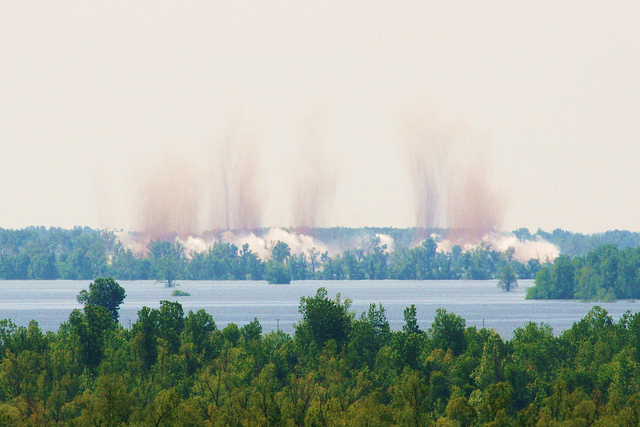
On May 5, 2011, the Army Corps of Engineers detonated a levee located on the Mississippi River near Hickman, Ky. to relieve stress that was causing additional flooding to surrounding communities. (Photo by Sgt. Bryan Ploughe, 1st Battalion, 623rd Field Artillery Unit Public Affairs Historian Representative.)
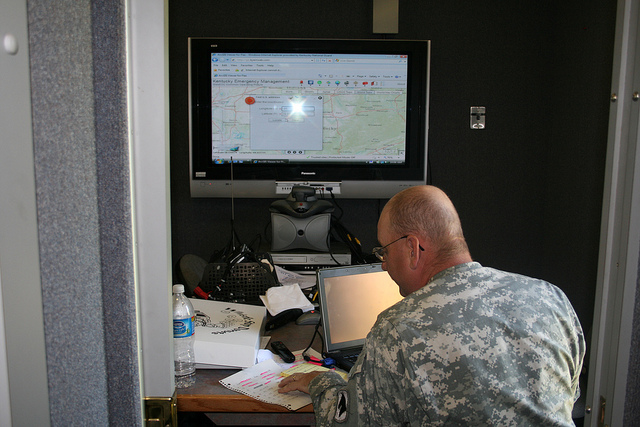
Spc. John Wilson with A Battery, 1st Battalion, 623d Field Artillery, carefully plots road blockages in Livingston Co.(Grand Rivers) Ky. while helping support flood relief efforts with Kentucky Division of Emergency Management in the mobile emergency response center. (Photo by Sgt. Bryan Ploughe, 1st Battalion, 623rd Field Artillery Unit Public Affairs/Historian Representative.)
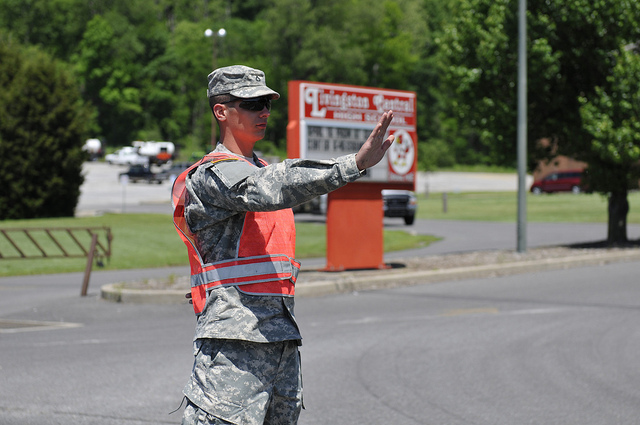
Pfc. Jacob Manning, 1123rd Sapper Company, Kentucky National Guard out of Leitchfield, Ky, stops traffic at an entry control point leading into the city of Smithland, Ky. on May 5, 2011. The entry control points help protect the community from looting and unauthorized entry from non-residents. Guardsmen are currently deployed to six counties locations across Western Kentucky. (U.S. Air Force photo by Tech. Sgt. Dennis Flora, Kentucky Air National Guard)
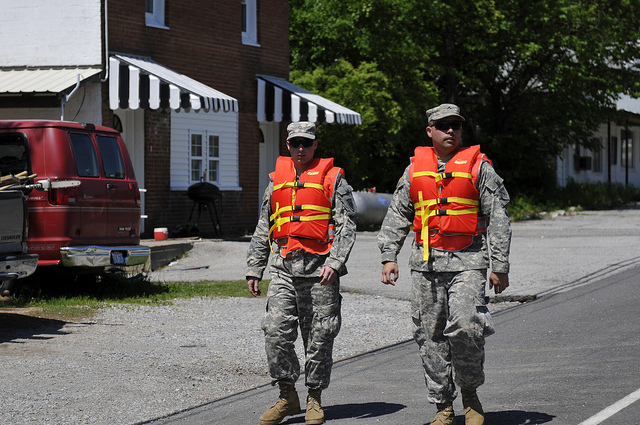
Pvt. Dustin Girten and Pfc. Chad Frank of the 1123rd Sapper Company patrol by foot along the levee in Smithland, Kentucky on May 5, 2011. Guardsmen are currently deployed to multiple locations across Western Kentucky, including Hickman and Smithland. (U.S. Air Force photo by Tech. Sgt. Dennis Flora, Kentucky Air National Guard)
keh
As published in the Courier-Journal, 18 April 2011
Written by Pinky Mehta, Associated Press
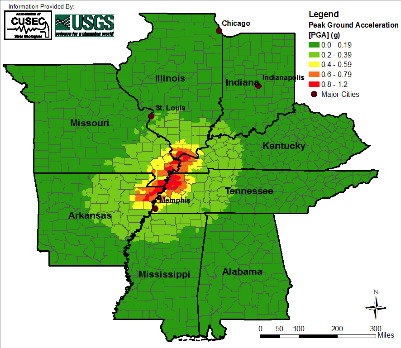
The New Madrid fault lies in western Kentucky and a major earthquake has been predicted for years. The 1812 earthquake along the New Madrid fault was the largest in U.S. history; it caused the Mississippi River to temporarily run backwards, with major damage as far away as Lexington, Kentucky.
FRANKFORT, Ky — About 255,300 Kentucky residents and more than 2.1 million people in a wide region of the central United States have registered to participate in the area’s largest earthquake disaster preparedness drill.
The Kentucky Division of Emergency Management is asking participants to “drop, cover, and hold on,” at 10:15 a.m. CDT April 28.
Spokesman Buddy Rogers said the region’s next big earthquake can’t be predicted but damage will range in the billions of dollars. Schools, businesses, individual citizens, and government officials are expected to participate in the drill.
Dubbed the Great Central U.S. ShakeOut, the drill will be a coincidental prelude to a weeklong national earthquake preparedness exercise starting May 16.
Like other states along the Mississippi and Ohio rivers, the New Madrid fault is one of several faults that crisscross Kentucky, KDEM director John Heltzel said.
The April 28 shakeout will take into account emergency response lessons learned from the severe winter ice storms in 2010-2011. Emergency Management improvements include quicker response times and improved communication.
Heltzel said the response posture has changed.
“Typically Midwestern states normally think of response in terms of days. In Kentucky, under the governor’s leadership now, we think in terms of hours,” Heltzel said.
Communication systems have also been tweaked. Emergency Management has partnered with more than 120 amateur radio operators in every county, alternated bridging and routing and prepared additional satellite communications.
The National Level Exercise 2011 will simulate what would happen if a 7.7 magnitude earthquake strikes the New Madrid Seismic Zone — comprising three different fault lines loosely joined — in western Kentucky.
The simulated impact on the commonwealth would include 235,000 people seeking shelter, while 330,000 households would be without power. Critical infrastructure would be destroyed or damaged, including 250 bridges. Communication would fail or be greatly impaired. Emergency responders would scramble to get information and local emergency management would be limited in getting information out.
But Heltzel said his team would be prepared in this “what if” scenario.
“I think we have absolutely the best response plan in the history of the commonwealth,” he said.
sdm
story and photos by Capt. Stephen Martin, Kentucky National Guard Public Affairs

More than 25 Kentucky National Guard Soldiers, Airmen and members of Kentucky Emergency Management came together to train on JRSOI Operations at Wendell H. Ford Regional Training Center in Greenville, Ky., April 5-7.
GREENVILLE, Ky. – In early May Kentucky will take part in National Level Exercise 2011, a test of the state’s response to a catastrophic earthquake along the New Madrid Fault. While NLE 2011 is a training exercise involving hundreds of Soldiers, Airmen and emergency first responders, local communities could expect to see thousands of personnel from across the nation supporting the relief effort during a real life event.
Somebody has to receive those resources and push them forward.
That’s where the JRSOI team comes in. JRSOI stands for Joint Reception, Staging, Onward Movement and Integration and it provides the process of receiving personnel from outside the Commonwealth, equipping them and quickly moving them forward to provide support.
According to Lt. Col. Dawn Muller, JRSOI Air Guard director, the current disaster response plan was effective during the 2009 ice storm, but it lacked some coordination.
“We realized after several years of doing this, there absolutely has to be command and control of incoming support to be effective in responding to disasters such as the ice storm,” said Muller.

The leaders of the Kentucky JRSOI team, Army Guard Lt. Col. Christopher Meyer and Air Guard Lt. Col. Dawn Muller oversee training and discussion on JRSOI operations at Wendell H. Ford Regional Training Center in Greenville, Ky., April 5-7.
More than 25 Kentucky National Guard Soldiers, Airmen and members of Kentucky Emergency Management came together to train on JRSOI Operations at Wendell H. Ford Regional Training Center in Greenville, Ky., April 5-7.
The JRSOI team encompasses all aspects of a military operation, from coordinating humvees and housing to ensuring accountability and reporting to those who are managing the response.
“Communication is absolutely critical,” said Sgt. 1st class Janet Holliday, human resource secialist. “We must have visibility of the assets coming in and be able to report that all the way to the governor. It’s our responsibility.”
Several JRSOI sites could be set up across the state depending upon the emergency and would in-process and coordinate both military and civilian personnel coming from outside the state to assist. Each site would be operated by both military and emergency management personnel ensuring that all relief efforts were coordinated to maximize the response.

Kentucky Air Guardsman Chief Master Sgt. Kevin Robison, and Kentucky Emergency Management personnel Larry Dixon and Mike Dossett, along with members of the Kentucky Army National Guard discuss ways to improve operations for the JRSOI team at Wendell H. Ford Regional Training Center in Greenville, Ky., April 5-7.
Lt. Col. Hal Lamberton, Director of Military Support, emphasized the requirement for coordination.
“Until we get these outside assets into the affected area, we need to have 100 percent accountability for those units and ensure they get the equipment they need, whether it be chainsaws or MRE’s (Meals Ready to Eat) and direct them to where they’re supposed to go,” he said.
Lamberton said the JRSOI is not focused on just earthquakes, but it can support any type of state emergency or natural disaster such as flood, tornadoes or winter storms.
The conference saw a lot of dialogue on who will have what responsibilities and how those responsibilities are broken up, especially when working alongside civilian agencies.
“Bottom line, what’s our goal?” asked Daniel Cameron, a senior analyst working for the National Guard Bureau. “Deliver mission capable organizations to the operational commander as rapidly as possible in order to provide the necessary support to the citizens of the Commonwealth.”
###
