
Pages
Stay In Touch
More
© 2013 KentuckyGuard
By Staff Sgt. Scott Raymond, Kentucky National Guard Public Affairs
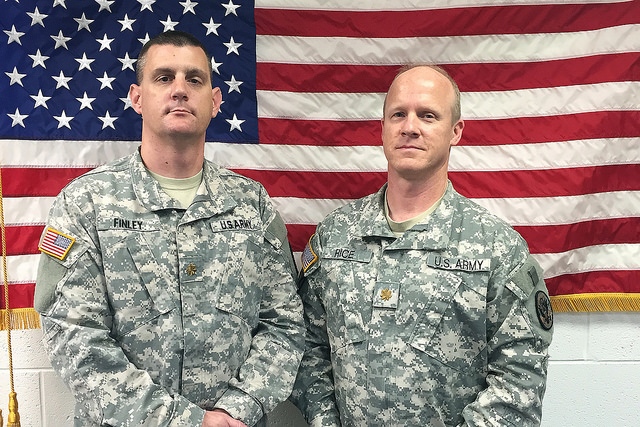
Maj. Jason Finley (left) and Maj. Michael Rice with the 41st Civil Support Team were recipients of the Army Medical Department’s “A” proficiency designator for professional excellence. Both serve as medical operations officers with the 42st. (Courtesy photo)
FRANKFORT, Ky. — Annually the Army Medical Department (AMEDD) awards the prestigious 9A proficiency designator to a small handful of Army officers. This year, three of the awardees were National Guardsmen, and two of those three were from Kentucky’s 41st Civil Support Team.
Majs. Jason Finley and Michael Rice, medical operations officers with the 41st CST are the first Kentucky Guardsmen to earn the designation.
“Maj. Rice and I were both blessed to be considered and awarded the Army Medical Department 9A proficiency designator this year,” said Finley.
“I would have to say this is a great honor and milestone in my career,” said Rice. “My passion will always be for people and how to better serve patients and the Kentucky National Guard through
forward thinking and implementation of those ideas that will make each better.”
The 9A designator is the highest recognition for professional excellence in the AMEDD. The AMEDD “A” proficiency designator is an honor bestowed upon candidates approved by the Army Surgeon General for professional excellence, who have attained full professional status, and have achieved national prominence in their field. Candidates must be leaders in their specialty, and have made significant contributions to the advancement of knowledge in a particular field.
Applicants must be a distinct asset to the AMEDD, both as an officer as well as a professional specialist. Finally, those officers selected must have had at least 15 years of professional experience, with at least 10 of those years being on active duty in the Army.
Finley was one of 37 officers chosen from the Medical Service Corps, while Rice was one of 12 Officers chosen from the Medical Specialist Corps.
“Even after four years on this team, I continue to be amazed by the skills, knowledge, and professionalism of its members,” said Maj. Kris Morlen, commander of the 41st. “This accomplishment by Maj. Finley and Maj. Rice is a testament to their ongoing quest for excellence, and is indicative of the passion by which they, and our other team members pursue this calling. I find myself at a loss for words to describe the pride I have in them for earning this prestigious honor.”
Story by Staff Sgt. David Bolton, 133rd Mobile Public Affairs Detachment
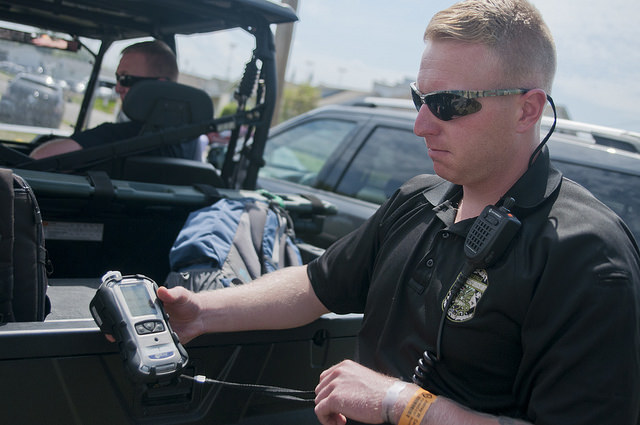
Army Staff Sgt. Joel Ray Campbell, survey team chief with the Kentucky National Guard’s 41st Civil Support Team, demonstrates the use of an air detection device during the 141st Kentucky Derby at Churchill Downs in Louisville, Ky., May 2, 2015. The 41st CST worked with other local agencies to help monitor any potential Chemical, Biological, Radiological and Nuclear threats at Derby. (U.S. Army National Guard photo by Staff Sgt. David Bolton)
LOUISVILLE, Ky. — They listen. They watch. They wait. In the shadow of the iconic twin spires, the Kentucky National Guard’s 41st Civil Support Team helped ensure the safety of the Derby crowd at Churchill Downs for the 141st Run for the Roses. Thirteen years of Derby support has taught CST members one thing: this is a joint effort.
“Derby support is a complete team effort,” said Maj. Kris Morlen, 41st CST commander. “Local law enforcement, hazardous material specialists, medical and 41st CST members come together for large events to comprise, what has come to be known as, the Joint Emergency Services Unit.”
According to Morlen, members of JESU patrol the grounds in small, four to five-person Joint Hazardous Assessment Teams to look for signs and symptoms associated with chemical, biological, radiological and nuclear material exposure. The JHAT use an array of devices that scan for radioactive isotopes, elevated levels of carbon dioxide, ammonium nitrate, neutrons and other potentially harmful elements.
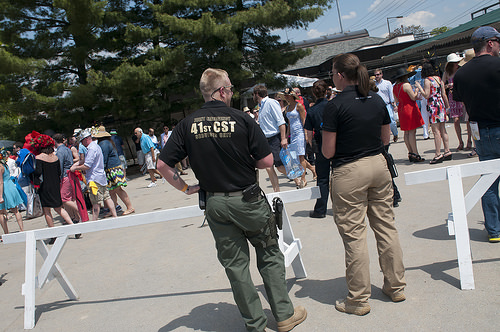
Army Staff Sgt. Joel Ray Campbell, survey team chief with the Kentucky National Guard’s 41st Civil Support Team, and Air Force Staff Sgt. Jennifer Evans, survey team chief with the Arkansas National Guard’s 61st CST, monitor crowds entering Churchill Downs during the 141st Kentucky Derby in Louisville, Ky., May 2, 2015. The CST helped monitor any potential chemical, biological, radiological and nuclear threats at Derby. (U.S. Army National Guard photo by Staff Sgt. David Bolton)
“We respond to reports of suspicious or abandoned packages when the Louisville Metro Police Department directs us to provide security and support to the Hazardous Device Technicians assigned to investigate those items,” said Morlen.
Click here for more photos.
Maj. Jason Finley, medical operations officer with the 41st, said having a group of individuals from various agencies, working together, makes the mission that much easier to accomplish.
“Everyone on the JESU team is on the same page when it comes to Hazmat,” said Finley. “It’s an advantage for the agency, and helps the incident commander have better oversight of the situation.”
The incident commander is responsible for all JESU operations in a given area.
“We’re all members of the responder community,” said Air Force Master Sgt. Scott Terrill, 41st survey team noncommissioned officer in charge. “In this setting you have people who specialize in Hazmat to deal with CBRN threats, law enforcement to set up perimeters and secure a scene, and medical personnel in case of mass casualty incidents.”
In order to be as effective as possible, members of the 41st develop strong relationships with the agencies they work with to provide the highest quality support.

Maj. Jason Finley, medical operations officer with the Kentucky National Guard’s 41st Civil Support Team, scans crowds entering Churchill Downs for the 141st Kentucky Derby in Louisville, Ky., May 2, 2015. Finley worked as a member of the Joint Emergency Services Unit to detect and identify any potential chemical, biological, radiological and nuclear threats for the Derby. (U.S. Army National Guard photo by Staff Sgt. David Bolton)
“Our role as a supporting agency doesn’t start or end at a CBRN response site,” said Capt. Stephen Smith, operations officer with the 41st. “We strive to continuously provide training throughout the year in order to educate the first responder community on who we are and the services we can provide to an incident site.”
Despite having only 21 Guardsmen assigned to the unit, the 41st provides emergency managers with a large amount of unique assets in a WMD and CBRN response situation.
“On the 41st, we are either responding to a WMD and other hazard incidents, training to respond, or training others to respond,” said Maj. Ricky Grant, nuclear medical science officer with the 41st. “We are force maximizers.”
Story by Staff Sgt. Scott Raymond, Kentucky National Guard Public Affairs
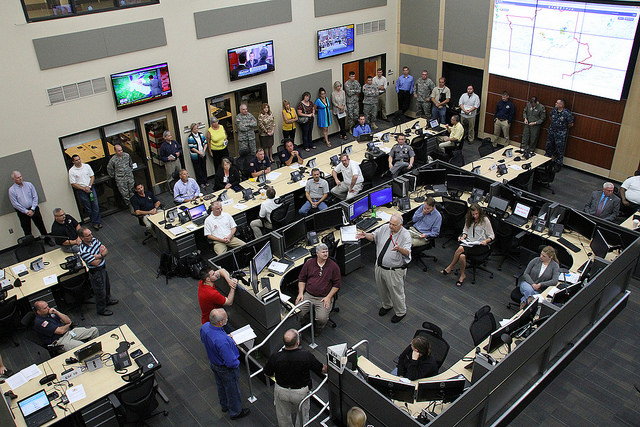
Charlie O’Neal, Assistant Director of Kentucky’s Emergency Management speaks to representatives from various state agencies to kickoff CAPSTONE-14 at the Commonwealth Emergency Operations Center in Frankfort, Ky., June 16, 2014. More than 20 state and local agencies gathered for the exercise which tested the state’s response to a major earthquake in the New Madrid Seismic Zone at the border of Kentucky and Missouri. (U.S. Army National Guard photo by Staff Sgt. Scott Raymond)
FRANKFORT, Ky. — During the winter of 1811-1812, the New Madrid fault line shook several times. The quakes were the strongest earthquakes east of the Rocky Mountains since Europeans settled the continent. The movement of the Earth reversed the flow of the Mississippi River and rang bells on the East Coast, more than 1,000 miles away. Two hundred years later, scientists say the seismic zone situated along the Kentucky-Missouri border is at high risk for another major earthquake at any moment.
To prepare for the possibility of a catastrophic event, Kentucky Emergency Management, the Kentucky National Guard and more than 20 other state and local agencies gathered June 16-20 in Frankfort for CAPSTONE-14. The multi-state exercise tested the state’s emergency response to a catastrophic earthquake along the fault line.
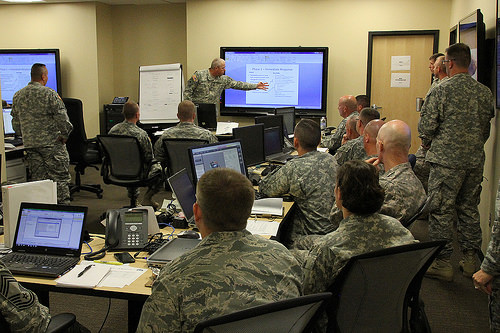
Col. William A. Denny briefs members of the Kentucky National Guard on their roles during the CAPSTONE-14 exercise in Frankfort, Ky., June 16, 2014. The exercise brought the Guard together with more than 20 other agencies to discuss their response to a major earthquake striking the state in the future. (U.S. Army National Guard photo by Staff Sgt. Scott Raymond)
“CAPSTONE-14 offers Kentucky and our neighboring states the opportunity to build upon the existing partnerships and opportunities to identify unified real-world solutions for emergency response to a catastrophic event of this magnitude,” said Michael Dossett, KYEM Director.
Under the direction of the Central United Earthquake Consortium (CUSEC), CAPSTONE-14 took three years to plan and is based upon the occurrence of a damaging earthquake in the New Madrid Seismic Zone. The consortium is made up the states which would be immediately affected by such an event and includes Alabama, Arkansas, Illinois, Indiana, Kentucky, Mississippi, Missouri and Tennessee.
Click here to see more photos from CAPSTONE-14.
A primary goal of the exercise was interoperability among the numerous agencies involved. Soldiers and Airmen of the Kentucky National Guard manned posts within the Commonwealth Emergency operations Center in Frankfort, but also put boots on the ground in earthquake response scenarios in the region.
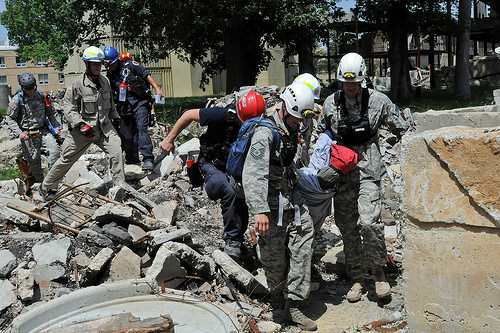
Members of the 41st Civil Support Team work with firefighters to recover a simulated casualty during training at Muscatatuck Urban Training Center in Butlersville, Ind., June 17, 2014. The firefighters, known as Task Force One from Louisville, Lexington and Northern Kentucky departments trained with the 41st as part of CAPSTONE-14, a multi-state exercise that tested emergency response to a major earthquake in the New Madrid Seismic Zone. (U.S. Army National Guard photo by Staff Sgt. Scott Raymond)
Members of the 41st Civil Support Team would be among the first called in. For CAPSTONE-14, the unit worked alongside civilian firefighters in search and rescue operations at Muscatatuck Urban Training Center (MUTC) in Indiana.
“Doing this in an exercise such as CAPSTONE allows us to experience the challenges that will be present during a real incident and gives us the opportunity to develop procedures to combat issues now instead of when a real threat hits,” said Capt. Steve Smith, team leader with the 41st.
“While the state of Kentucky would drastically be affected by a seismic incident on the New Madrid fault, it should give the citizens a little more comfort knowing that Search and Rescue organizations and the National Guard are being proactive in taking steps to work together prior to any incident,” said Smith.
Kentucky Guardsmen with the Chemical, Biological, Radiological, Nuclear and High Yield Explosive (CBRNE) Enhanced Response Force Package, or CERFP would also hit the ground quickly. The unit’s mission would assist in the location and extraction of victims from collapsed structures and the treatment of a mass casualty scenario. CERFP Soldiers and Airmen also trained at MUTC in conjunction with their counterparts from the Indiana and Georgia National Guard.
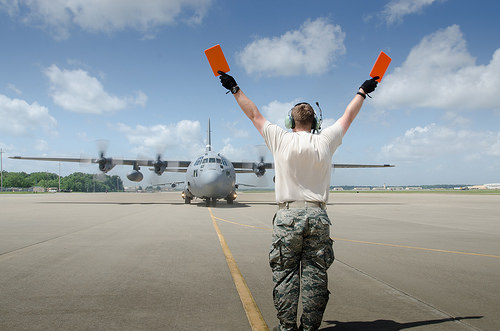
Staff Sgt. Joseph Bigelow, a crew chief for the Kentucky Air National Guard’s 123rd Contingency Response Group, marshals a Kentucky Air National Guard C-130 Hercules during CAPSTONE-14, a homeland earthquake-response exercise at Fort Campbell, Ky., on June 17, 2014. The 123rd CRG is joining with the U.S. Army’s 688th Rapid Port Opening Element to operate a Joint Task Force-Port Opening here from June 16 to 19, 2014. (U.S. Air National Guard photo by Master Sgt. Phil Speck)
Air Guardsmen with Kentucky’s 123rd Airlift Wing flew into regional airports in Western Kentucky to assess runway conditions and ensure a cargo hub could be set up for relief efforts into the damaged area. The wing worked with local officials and an active duty U.S. Army unit in their part of the exercise.
“The cooperation and interaction we have had this week is a critical part of what would be our response to such an event,” said Col. William A. Denny, plans and operations officer for the Kentucky Guard. “We must remain partners in our service to the commonwealth and CAPSTONE-14 has shown us what we have done right and what we can improve.”
“This is a scenario we don’t ever want to see, but when it happens, the Kentucky Guard will be there side by side with those who can best aid the state and the region.”
Story by Staff Sgt. Scott Raymond, Kentucky National Guard Public Affairs

Master Sgt. Scott Terrill and Sgt. Joel Ray Campbell, both with the 41st Civil Support Team collect water samples at a school in Boone County, W. Va., Jan. 26, 2014. Ten members of the unit assisted the West Virginia National Guard following a chemical spill in the Kanawha River Valley. (Photo courtesy of 41st CST)
CHARLESTON, W. Va. — Guardsmen with Kentucky’s 41st Civil Support Team were honored by the West Virginia National Guard recently for their actions and expertise provided during a chemical spill that affected water supplies in the Kanawha River Valley, W.Va.
The nine Soldiers and one Airman were presented the West Virginia State Service ribbon and the West Virginia Emergency Service Award by the state’s adjutant general, Maj. Gen. James B. Hoyer, in Charleston, W. Va., Jan. 30, 2014.
Eight counties in the Kanawha Valley declared states of emergency after after a chemical leak contaminated the West Virginia American Water Company’s system in the area. To assist its neighbor and sister unit, the 35th Civil Support Team, members of the 41st travelled to West Virginia to help in the assessment of water contamination.
“They were able to utilize their specific skill set acquired at the CST in order to perform proper water sampling for testing and validation,” said Lt. Col. John Cline, commander of the 41st. “It was great that we were called upon to assist, it shows how training pays off when
real-world missions arise.”
“I am proud of our Soldiers’ and Airman’s work, but am not surprised at their exemplary performance. It is every day business for the 41st.”
The team members worked alongside the 35th to collect water samples from 103 schools in the eight counties affected. Throughout the six-day mission, the 41st filled in for command and control, provided input into the collection plan and offered expert advice on techniques and procedures of the sampling.
In addition to Kentucky’s CST, Guardsmen from Virginia, Tennessee, Ohio and the District of Columbia answered the call to assist West Virginia during the crisis.

Staff Sgt. David Reeves of the West Virginia National Guard’s 35th Civil Support Team collects a water sample at St. Francis Hospital in Charleston, W.Va., Jan. 11, 2014. Team members have been collecting samples and monitoring chemical levels in the water since a contamination issue was detected Jan. 10. (U.S. Army photo by Lt. Col. Todd Harrell West Virginia National Guard)
“Having a civil support team in every state makes it easy for us to speak the same language and we all share a common bond,” said Capt. Stephen Smith, survey team leader with the 41st. “We are all unique units, but together we are able to focus on the problem at hand and bridge any gaps that might otherwise pose problems operationally.”
“It was a privilege to assist West Virginia in their time of need,” said Smith. “It’s great to be able come to their aid with what the CST brings to the table and to offer our support to get things back to normal.”
Story by Staff Sgt. Scott Raymond, Kentucky National Guard Public Affairs
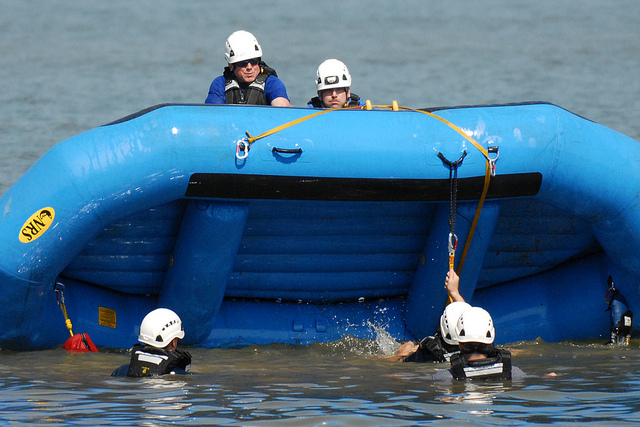
Members of the 41st Civil Support Team attempt to right a capsized raft in the Ohio River near Louisville, Ky., Aug. 27, 2013. The exercise was part of the unit’s training on swift water rescue operations. (U.S. Army National Guard photo by Staff Sgt. Scott Raymond)
LOUISVILLE, Ky. — Many know of the skill-set of the Kentucky National Guard’s 41st Civil Support Team. They are the go-to guys for any situation involving chemical, biological, radio-active or nuclear materials (CBRN). They have proven time and time again through real-world actions and excellence in proficiency checks that they are among the best of the best in the Nation.
But what the team wants everyone to know is that their abilities go far beyond their response to such incidents.
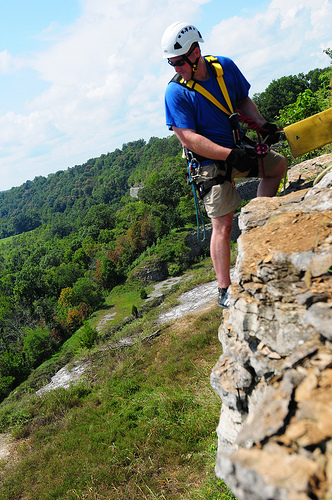
Sgt. Jacob Beach of the 41st Civil Support Team prepares to rappel down a cliff as part of a training exercise in Frankfort, Ky., Aug. 21, 2013. The unit received professional instruction on methods of technical rope rescue for use in urban operations during natural or man-made disasters. (U.S. Army National Guard photo by Staff Sgt. Scott Raymond)
To be up to the task 24/7, the team trains constantly, but recent exercises have taken them out of their usual element. To enhance that broad skill-set of the 22-man team, the Soldiers and Airmen gathered in August to practice technical rope rescues and swift water rescues.
To see more photos of the 41st’s training, click here.
“The 41st is known for their response to CBRN responses, and we are exceptionally good at doing that,” said Lt. Col. John Cline, commander of the 41st. “After Hurricane Katrina hit, the missions of all civil support teams across the Nation changed to include response to natural and man-made disasters.”
“This training relates to that for our response to floods, where we not only could rescue individuals in difficult situations, but also perhaps to pull drums of hazardous materials out of the water,” he said. “And anything that involves ropes is closely related with most of our operations for urban rescue.”
The team first came together for instruction on rope rescues in Frankfort, Ky., on the cliffs overlooking U.S. 127. Bill Matney, an emergency service instructor from Greensburg, Ky., provided both training opportunities.
“What we are giving them is options,” said Matney, owner and operator of Matney Consulting and Training. “We’re giving them tools for their toolbox, new methods and increasing their functional capabilities.”
Team members were taught fundamentals of rope rescue, including proper knots to tie, line anchor points and belay operations. They were then able to put the lessons to use as the team members played various roles in ascending and descending the cliffs in scenarios similar to what they may encounter in a real-world rescue.
The team next set up on the banks of the Ohio River in Louisville, Ky., for the swift water rescue training. The water-borne operations included instruction in hazard recognition, equipment use, and basic shore and boat-based rescue techniques.
“With the new natural disaster role, we looked at what the state needed as a whole and found some gaps so that’s why we’re here doing this,” said Sgt. 1st Class Steven Baker, a CBRN Specialist with the 41st.
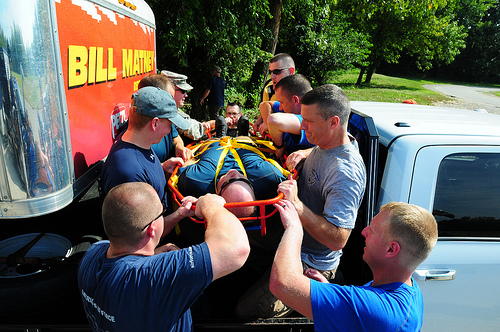
Soldiers and Airmen of the 41st Civil Support Team work to transport a fellow team member over an obstacle during training in Louisville, Ky., Aug. 27, 2013. The exercise demonstrated the difficulties of rescues performed in confined spaces and how to overcome the challenges. (U.S. Army National Guard photo by Staff Sgt. Scott Raymond)
“I think this is going to continue to enhance our skills and make us an even better asset to the state,” said Baker.
In addition to the rope and water rescue training, Matney also included lessons on confined space rescues. The 41st was instructed on how to properly secure a victim in a litter and how to move within restricted and unusual spaces.
Matney said he works with and trains a wide variety of first-responders and agencies, and commented on how impressed he was with the skills of the Soldiers and Airmen in the unit.
“I do this for a living, and I can tell you who is good and who needs more,” said Matney. “This crew is not here because they were told to be, they’re here because they want this. The quality of their leadership, their talent and their motivation is very impressive.”
“Overall, this is just great training to have,” said Cline. “We haven’t had to put it into action yet, thankfully. But if we do, we will be fully prepared to do so.”
Story and photos by Staff Sgt. Scott Raymond, Kentucky National Guard Public Affairs
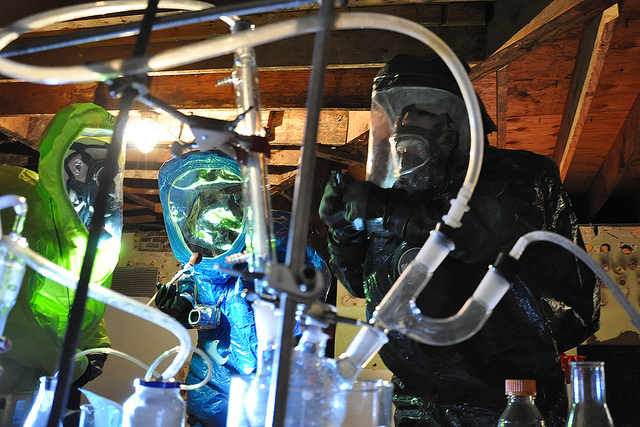
Members of the 41st Civil Support Team work to collect samples of an unknown substance during a mock hazardous material situation as part of the unit’s training proficiency evaluation in Frankfort, Ky., April 11, 2013. The 41st trains to respond to any incident in Kentucky that involves weapons of mass destruction to include chemical, biological and radiological agents. (Kentucky National Guard photo by Staff Sgt. Scott Raymond)
FRANKFORT, Ky. -The Kentucky Guard’s 41st Civil Support Team is a 22-member unit with a huge responsibility. The small group stands ready to augment local or regional terrorism response capabilities in events that are suspected to involve weapons of mass destruction. They are trained to provide support to incidents including the use of chemical, biological or radiological agents.
Every 18 months the unit is put through a multi-day exercise, a TPE, or Training Proficiency Evaluation. Soldiers and Airmen of the 41st concluded their newest TPE April9-12, 2013. Observers from U.S. Army North came to Kentucky to gauge the unit’s effectiveness in potentially hazardous and difficult situations. The unit impressed, achieving a passing score from the graders after only one day of training. Team members said they didn’t train to just pass.
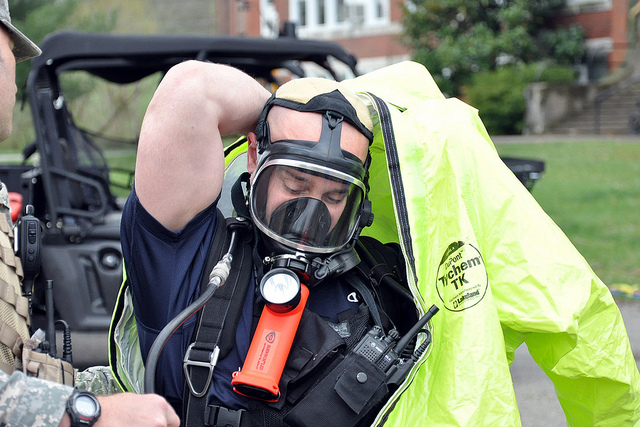
Air Force Staff Sgt. Joseph Cloutier, a survey team member with the 41st Civil Support Team dons his protective suit during a unit exercise in Frankfort, Ky., April 11, 2013. The 41st is a joint forces unit, made of Soldiers and Airmen. (Kentucky National Guard photo by Staff Sgt. Scott Raymond)
“The purpose of this validation is to test the unit on its full spectrum of capabilities,” said commanding officer, Maj. John Cline. “It’s all in order to ensure that we are prepared to respond to the Commonwealth’s needs in any required all-hazard event.”
Air Force Staff Sgt. Joseph Cloutier said the 41st has been his assignment of his career in the military and that he enjoys the unique mission. And with such uncommon skill sets, Cloutier knows the challenges of their jobs and the necessity of the training extensive routines.
“This exercise shows our capabilities, but also our limitations, so it proves what we can and cannot do out there,” he said.
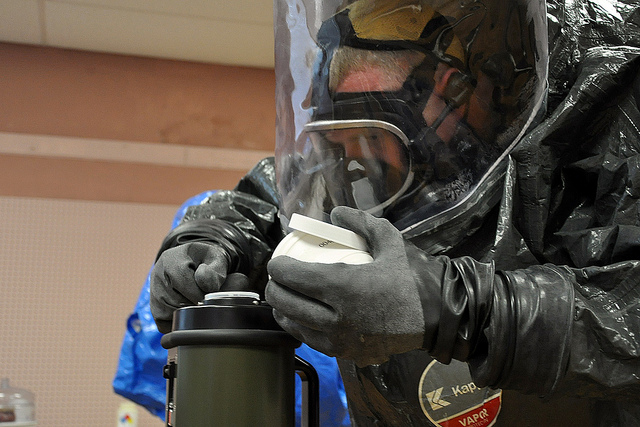
Sgt. Joel Ray Campbell, a survey team member with the 41st Civil Support Team collects a sample of a mock hazardous material during a training exercise in Frankfort, Ky., April 11, 2013. Based in Louisville, Ky., the unit maintains its ability to be en route to an emergency within one hour of notification. (Kentucky National Guard photo by Staff Sgt. Scott Raymond)
According to Maj. Kris Morlen, deputy commander of the 41st, the unit is a highly skilled group of well experienced professionals. Several members have been with the unit since its inception more than 12 years ago. Morlen is the newest member, having only been with the 41st for less than two years, but certainly understands the importance of the training event.
“This gives us the opportunity to showcase the skills of our team members,” he said. “It’s a point of pride for us to do well here.”
Morlen also has respect for the quality of work done by the unit. The leadership of the 41st say they get a lot of ‘You guys are good.’
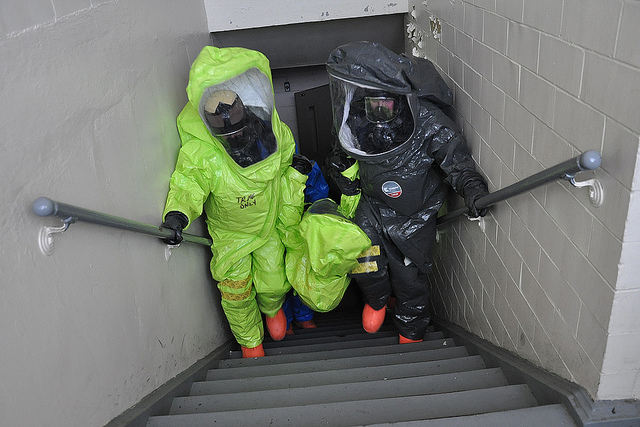
Members of the 41st Civil Support Team practice evacuating an injured team member during a training exercise in Frankfort, Ky., April 11, 2013. The unit trains year-round in various degrees of its operation to prepare for a training proficiency evaluation every 18 months. (Kentucky National Guard photo by Staff Sgt. Scott Raymond)
To see more photos from this story, click here.
