
Pages
Stay In Touch
More
© 2013 KentuckyGuard
Story by Sgt. Scott Raymond, Kentucky National Guard Public Affairs Office
Photos by Sgt. David Bolton, Kentucky National Guard Public Affairs Office
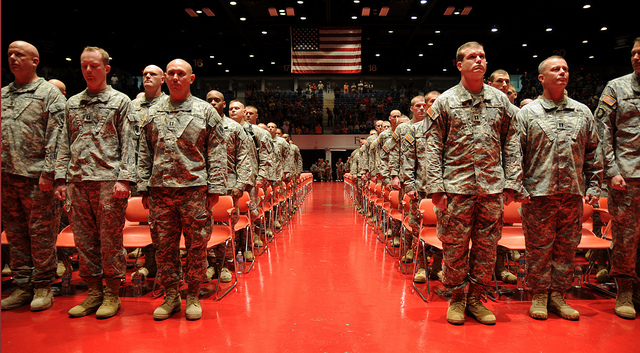
Soldiers from the 2nd Battalion, 138th Field Artillery enter and stand at attention during the farewell ceremony held at the Frankfort Convention Center in Frankfort, Ky., Aug. 31, 2012. Approximately 536 Kentucky Guardsmen will deploy to the Horn of Africa for nine months. (Kentucky National Guard photo by Sgt. David Bolton)
FRANKFORT, Ky. — The Kentucky National Guard honored approximately 565 Soldiers of the 2nd Battalion, 138th Field Artillery, during a departure ceremony at the Frankfort Convention Center in Frankfort, Ky., Aug. 31, 2012.
Hundreds of Family members and friends gathered with the Kentucky National Guard command staff to provide a fitting farewell as the unit departed for the Horn of Africa for a scheduled nine-month deployment.
To see more photos from the ceremony, click here.
Kentucky’s Adjutant General, Maj. Gen. Edward W. Tonini and Secretary of State, Alison Lundergan Grimes were on hand to greet Family members and speak to the troops, who will be known as Task Force Long Rifle. Tonini reminded them all of the importance of serving their country and the Commonwealth.
“You are serving in the highest level of Kentucky military tradition,” he said. “You are living examples of our Unbridled Service. This mission is about giving comfort, aide and stability to a community of people.”
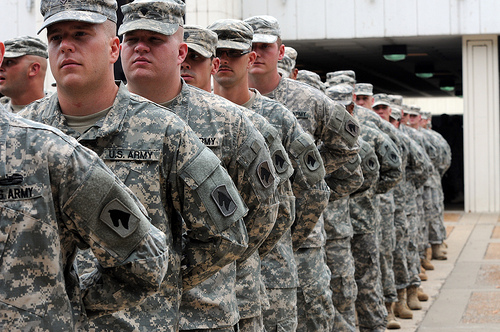
Soldiers from the 2nd Battalion, 138th Field Artillery stand at ease during rolecall before the farewell ceremony held at the Frankfort Convention Center in Frankfort, Ky., Aug. 31, 2012. Approximately 565 Guardsmen will deploy to the Horn of Africa for nine months to help promote regional security and to protect U.S. and Coalition interests in the region. (Kentucky National Guard photo by Sgt. David Bolton)
“This is what we Guardsmen do day in and day out.”
The mission of the 2/138th will be to promote regional security and stability while strengthening local national relationships, as well as to protect U.S. and Coalition interests in East Africa.
This is not the first deployment of Kentucky National Guard troops to Africa. The Kentucky Air Guard sent aircraft and crews to Somalia and Rwanda in the early 1990s as part of international humanitarian famine relief efforts. In addition, Kentucky Army Guard units have trained with coalition forces in neighboring Egypt as part of Operation Bright Star. Individual troops and teams have also deployed to the continent in support of U.S. military operations over the past few years.
Regardless of the location of a deployment, Soldier readiness remains the same, and according to the 2/138th leadership, Task Force Long Rifle is primed to take on this unique mission.
“We’re 110 percent ready,” said Command Sgt. Maj. Timothy Gividen, Task Force Long Rifle Command Sergeant Major. “I am really proud of these Soldiers, they’ve trained really hard. I know we are ready to get there, come back and stand proud for a job well-done.”
The Kentucky National Guard Yellow Ribbon Program has also contributed to prepare the families of the deploying Soldiers. Yellow Ribbon events and a strong Family Readiness Group have helped remind those left at home that they will not be alone.
“Deployment is never easy,” said Kelley Slaughter, wife of Capt. Mark Slaughter. “But because of the programs available to families and going to Yellow Ribbon events, our family is prepared, and we have great information and resources.”
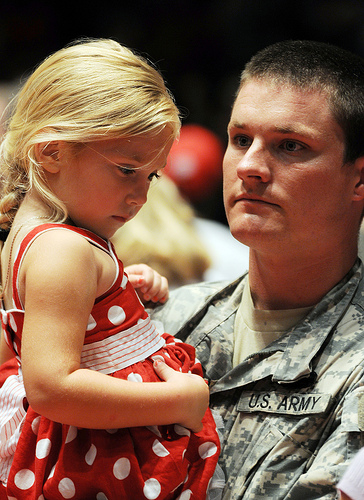
Spc. Perry Lowe with the Headquarters and Headquarters Battalion, 138th Fires Brigade, holds his niece after the farewell ceremony for the 138th’s departure to the Horn of Africa held at the Frankfort Convention Center in Frankfort, Ky., Aug. 31, 2012. (Kentucky National Guard photo by Sgt. David Bolton)
“I am so thankful they are here to help,” she said.
The Lexington, Ky.-based 2/138th stands as the most decorated unit in the Kentucky National Guard having completed tours in Iraq and Afghanistan during the war on terror.
Tonini said Soldiers of the 2/138th and the National Guard are an essential element in world events.
“Task Force Long Rifle shows the power of a force for good that can only be wielded by a Guardsman,” he said. “This mission is about building and strengthening partnerships and being responsible world citizens.”
The Soldiers will train at Camp Atterbury, Indiana prior to deploying to Africa. The unit is expected to return home in the summer of 2013.
Story and photos by Sgt. Alexa Becerra, 2/138th Public Affairs
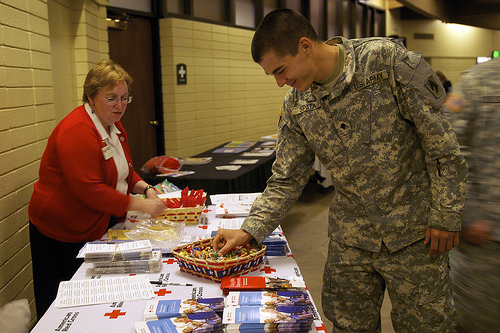
Soldiers and families of the 2/138th Fires Brigade receive information from various resources available to them during a Yellow Ribbon Program event at Keeneland in Lexington, Ky., July 14, 2012. (Kentucky National Guard photo by Sgt. Alexa Becerra)
LEXINGTON, Ky. — Being deployed is never easy on a Soldier. Most married Soldiers will tell you it’s harder on the spouses than it is on them. Spouses don’t disagree either.
However, there is a way to help with the stress of a deployed love one — the Yellow Ribbon Program.
Soldiers and their families had the opportunity to attend a pre-mobilization Yellow Ribbon event in July at Keeneland in support of the 2nd Battalion, 138th Regiment’s deployment scheduled for later this year.
This event provided Soldiers and their families with information on the resources and training available to them during the deployment such as financial readiness, medical insurance and counseling.
“This event is basically a pre-mobilization briefing for the families,” said Joan Kivior, Family Assistance Specialist for the Kentucky National Guard Family Programs, and retired Army 1st Sgt. “Soldiers are briefed during their SRP’s (Soldier Readiness Program) and in all their briefings they get before they go. This gives the families the opportunity to get the same information and resources and also the opportunity for them to ask their questions.”
“The Yellow Ribbon event also gave families the opportunity to feel more a part of the deployment phase, more connected and informed about the deployment process,” Kivior said.

A volunteer from the Ladies Auxiliary Post 4075 in Frankfort, Ky., spends time with the children of Soldiers who attended a Yellow Ribbon Program event at Keeneland in Lexington, Ky., July 14, 2012. (Kentucky National Guard photo by Sgt. Alexa Becerra)
During the event, activities were available for the children of Soldiers and family members attending the event. Volunteers from the Ladies Auxiliary Post 4075 out of Frankfort, Ky., played board games and constructed houses with building blocks with the kids while the parents learned about the Yellow Ribbon Program.
“Today has been beneficial for everyone,” said Carrie Webb, event attendee and wife of Staff Sgt. Bobby Webb. “There are different aspects to the entire event. You get information for the family, the Soldier, the spouse and the children. I think the National Guard is taking good care of everything, like with insurance and childcare.”
“The hotline that the Kentucky Family Assistance Center provides is there for everything, every hour of everyday,” said Webb. “They are there for any aspect, anything you may need while our Soldiers are gone.”
“I truly believe, having deployed a couple times, the biggest burden is probably on the family,” said Col. Brian F. Wertzler, 138th Fires Brigade Commander. “I’m glad that we can show them they are not alone and we can assist during this process.”
No doubt this mobilization will be a little easier for the Soldiers’ families than the last thanks to all the love and support for our Soldiers and their families courtesy of the Yellow Ribbon Program.
For more information on the Yellow Ribbon Program in the Kentucky National Guard, click here
By Master Sgt. Philip Speck, 123rd Airlift Wing Public Affairs

Kentucky Air National Guard Tech. Sgt. Don Yeats, 123rd Special Tactics Squadron radio maintenance specialist, weaves in out of cones during a motorcycle safety train-the-trainer course at the Kentucky Air National Guard Base in Louisville, Ky., on Aug. 23, 2012. The course, part of the Motorcycle Safety Foundation’s RiderCoach Program, was designed in part to train student instructors so they can go on to teach motorcycle safety to other service members. (Kentucky Air National Guard photo by Master Sgt. Phil Speck)
LOUISVILLE, Ky. — Motorcycle accidents continue to be one of the leading causes of death among members of the Air Force, with seven Airmen having lost their lives in bike crashes since Memorial Day alone, according to data from the Air Force Safety Center.
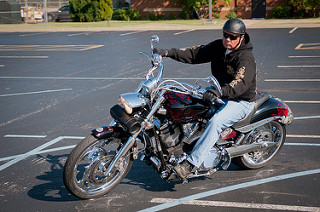
Kentucky Air National Guard Master Sgt. Mark Williams, vehicle operations non-commissioned-officer-in-charge for the 123rd Logistics Readiness Squadron, turns a corner during a motorcycle safety train-the-trainer course at the Kentucky Air National Guard Base in Louisville, Ky., on Aug. 22, 2012. The course, part of the Motorcycle Safety Foundation’s RiderCoach Program, was designed in part to train student instructors so they can go on to teach motorcycle safety to other service members. (Kentucky Air National Guard photo by Master Sgt. Phil Speck)
But safety officials across the Kentucky National Guard are now better prepared than ever to reduce motorcycle accidents, thanks to a motorcycle safety train-the-trainer course conducted at the Kentucky Air National Guard Base from Aug. 20-27.
The eight-day course, facilitated by members of the 123rd Airlift Wing Safety Office and taught by an instructor from the National Motorcycle Safety Foundation, drew more than 20 students from the Kentucky Army and Air National Guard, said Tech. Sgt. Luke Piro, 123rd ground safety technician. Six of those students are now certified instructors who can teach the course to other service members at their home units.
“The National Guard Bureau put out a Guard-wide email looking for volunteers to host this event, and the 123rd Airlift Wing is always ready to take on new missions,” Piro explained. “We’re making a push to change the culture in the world of motorcycle safety.”
The Kentucky course, funded by the National Guard Bureau, included four days of classroom instruction and four days of hands-on training covering everything from basic riding skills to defensive driving. Instructor-trainees also were given the opportunity to teach the material to other students while receiving coaching from the MSF expert, Tim Cody.
The course was broken into 17 exercises, the first nine of which dealt with basic riding skills like straight-line driving, shifting, stopping and turning, Piro said. The final eight covered advanced skills in those same areas, as well as situational awareness and obstacle avoidance.
The course placed a high emphasis on situational awareness and defensive driving, so that riders would be better conditioned to respond quickly to unsafe conditions as they develop.
“When you’re riding, you definitely want to know how to be seen, where to be seen and how to anticipate where that next threat is coming from,” said Lt. Col. Todd Lally, 123rd Airlift Wing chief of safety. “That is what this training will teach you.”
Cody said it’s important for riders to remember that highways were made four-wheeled vehicles, not motorcycles.
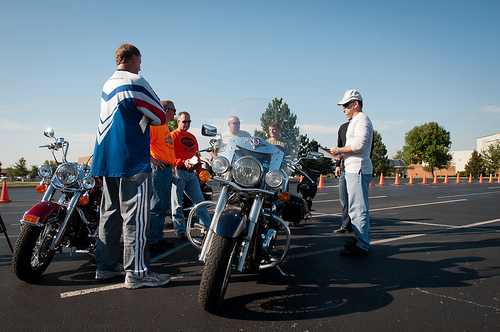
Kentucky Air National Guard members talk about the next exercise during a motorcycle safety train-the-trainer course at the Kentucky Air National Guard Base in Louisville, Ky., on Aug. 23, 2012. The course, part of the Motorcycle Safety Foundation’s RiderCoach Program, was designed in part to train student instructors so they can go on to teach motorcycle safety to other service members. (Kentucky Air National Guard photo by Master Sgt. Phil Speck)
“Nothing on the road is designed for motorcycles, so we have to operate a motorcycle within the realm of highways that are designed for cars and trucks,” said Cody, who has been teaching the MSF course for 17 years. “Motorcycles only represent 2 percent of miles traveled on highways, but represent about 14 percent of the deaths on the nation’s highways.”
The student instructors attending the course said they decided to become teachers because they wanted to give back to the military biker community, making Soldiers and Airmen safer riders.
“Every day that we’re out there on the road, there are people who don’t pay attention to you, people talking on cell phones who don’t know you are there,” said Master Sgt. Mark Williams, non-commissioned-officer-in-charge of vehicle operations for the 123rd Logistics Readiness Squadron.
Lt. Col. Armand Bolotte said he wanted to become a coach because he felt an obligation to mentor younger troops.
“I felt like it was a way to give back, to help those who need to know how to ride safely,” said Bolotte, operations officer for the 123rd Logistics Readiness Squadron. “Motorcycle accidents are one of the biggest killers of Airmen in the Air Force, and we can help the younger generation by doing a better job of teaching the basics of good riding.”
Story and Photos by: Staff Sgt. Fredrick P. Varney, 133rd Mobile Public Affairs Detachment
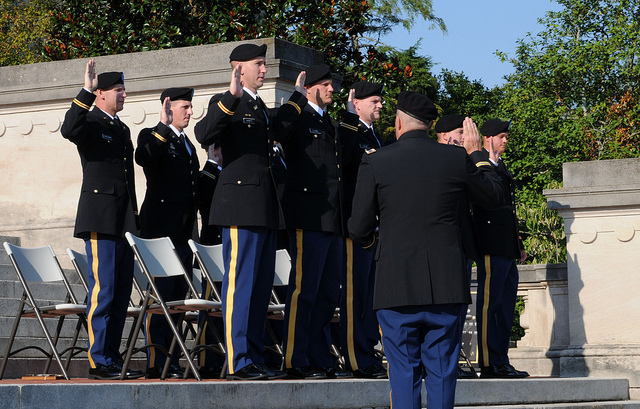
Col. William A. Denny, Commander for the 238th Regiment, administers the oath of office to OCS class 54-12 during the Officer Commissioning Ceremony at the Kentucky State Capitol in Frankfort, Ky., Aug 25. The 238th Regiment graduated 11 new officers to serve in the Kentucky National Guard. (photo by Staff Sgt. Fredrick Varney, Kentucky National Guard 133rd Mobile Public Affairs Detachment)
FRANKFORT, Ky.— Eleven second lieutenants raised their right hands and swore an oath of office to become the Kentucky National Guard’s newest officers at the Kentucky State Capitol in Frankfort, Ky. Aug. 25 , 2012.
Officer Candidate Class 54-12 endured a rigorous 18-month training program on their way to becoming the next leaders in the Kentucky National Guard. Officer candidates were tested in key areas such as physical fitness, leadership abilities, land navigational skills and operational orders.
“The hardest part of the OCS program is definitely the mental aspect,” said distinguished honor graduate 2nd Lt. Martin A. Goldey.
Goldey was presented with the Erickson Trophy for attaining the highest overall standing in leadership, academics and the Commandant’s evaluation in the class. The Erickson Trophy is awarded in honor of retired Maj. Gen. Edgar C. Erickson, former Chief of the National Guard Bureau. Each state officer candidate school grants the trophy annually.
To see more photos from this story, click here
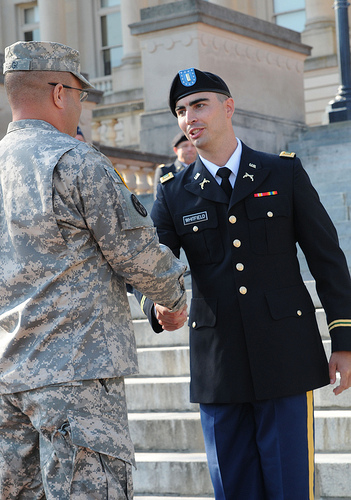
Staff Sgt. John Riggi shakes hands with newly promoted 2nd. Lt. Joshua Whitfield during the 238th Regiment’s OCS Commissioning Ceremony at the State Capitol in Frankfort, Ky., Aug 25. Class 54-12 graduated 11 new lieutenants to serve in the Kentucky Army National Guard. (photo by Staff Sgt. Fredrick Varney, Kentucky National Guard 133rd Mobile Public Affairs Detachment)
Other awards included the Physical Fitness Award, which was given to 2nd Lt. Donald Prysi for attaining the highest overall score on the Army Physical Fitness test. 2nd Lt. Carson Gregory was presented the National Guard Association of Kentucky Award for earning the highest academic average in the class. 2nd Lt. Christopher Cook was presented the Association of the U.S. Army Plaque for demonstrating the highest standards of leadership throughout the course.Class 54-12 president 2nd Lt. Scott A. Hill said finishing the OCS program meant a great deal for him because he had previously held leadership roles as both a teacher and volleyball coach, but nothing compared to having the opportunity to lead his fellow Soldiers in the Kentucky National Guard.
“I can’t think of anything more honorable than serving one’s country as an officer in the United States Army, especially the Kentucky National Guard,” said Hill.
The traditional custom of having friends and Family pin their newly promoted officers was observed and each Soldier designated one non-commissioned officer to render their first salute.
Maj. Gen. Edward W. Tonini, Kentucky’s Adjutant General, served as the keynote speaker for the graduation ceremony, while the 202nd Army Band participated by playing both the National Anthem and “My Old Kentucky Home”.
Story and photos by Sgt. David Bolton, Kentucky National Guard Public Affairs Office
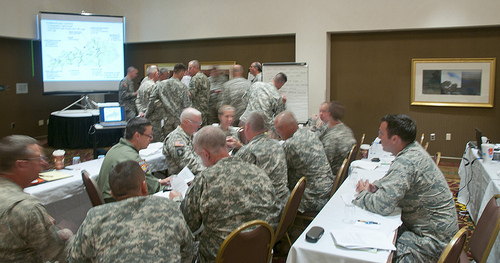
Joint Force Headquarters (JFHQ) members from the Kentucky National Guard plan strategic measures on how to assist citizens of Kentucky in the event of a state emergency in Frankfort, Ky. August 3, 2012. (photo by Sgt. David Bolton, Kentucky National Guard Public Affairs Office).
FRANKFORT, Ky.-United States Northern Command (USNORTHCOM) and National Guard Bureau (NGB) servicemembers convened at the Capital Plaza Hotel to discuss ways on how to best aid the civilians of Kentucky and the first responders when faced with domestic disasters in Kentucky Aug. 3, 2012.“The training will help us do a better job of planning during a crisis and to be more thorough in responding to the needs of the citizens of the Commonwealth in the event of a national disaster,” said Col. William A. Denny, Kentucky National Guard Deputy Chief of Staff for Operations.
The domestic response graduated level staff was comprised of individuals from Civil Support Teams (CST) all the way through senior general officer leadership. Joint Forces Headquarters (JFHQ) members from the Kentucky National Guard sought to lie out plans on how to assist citizens of Kentucky in the event of a state emergency.
Among the topics considered were the logistics of responding to state disasters in terms of mustering troops for response, coordinating with government officials, correctly paying Soldiers, responsibly allocating resources, dealing with legal matters, etc.
“After these three days we’re staffed to better serve the governor and citizens of Kentucky,” said Maj. Dean Roberts, a National Guardsman from Colorado Springs, Colo. working with USNORTHCOM. “There is nothing that the Kentucky Guard does without the request of civilian authorities.”
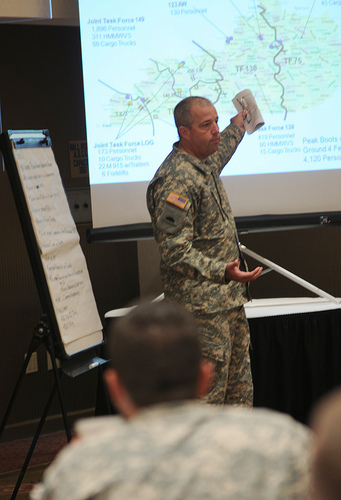
Kentucky Army National Guard Col. William A. Denny, Kentucky National Guard Deputy Chief of Staff for Operations, explains planning and logistical operations for the task forces assigned to different sectors of Kentucky in the event of a natural disaster scenario in the state August 3, 2012 in Frankfort, Ky. (photo by Sgt. David Bolton, Kentucky National Guard Public Affairs Office)
Scenarios included in the planning and development of these response measures drew from past natural disasters in Kentucky including ice storms, earthquakes, wild fires, and tornados. Joint operations with FEMA were also part of the presentations and contingency planning operation process.Unique to the National Guard has been the additional responsibility of homeland missions in conjunction with federal operations overseas. With the continued drawdown of troops from overseas, the Kentucky National Guard is beginning to apply those learned skill sets from theater operations here at home.
“50 percent of our mission is to support domestic operations and it’s very critical that we translate those military skills that we learn as part of our training into domestic operations and support for the Commonwealth of Kentucky,” said Brig. Gen. Mike Richie, Commander of the Land Component Command for the Kentucky National Guard. “That’s what this training is about, it’s about how you take those military skills and apply those in a disaster situation.”
When dealing with natural disasters, the leadership of the Kentucky National Guard knows that there must be a precise and systematic series of precautionary and reactionary responses to any given situation. Preparation is the catalyst for efficiency.
“There’s an art and a science to domestic response. It’s the most important of all guard missions,” said Roberts.
Story and photos by Sgt. Paul Evans, KY ADT 4 Unit Public Affairs and Historian Representative
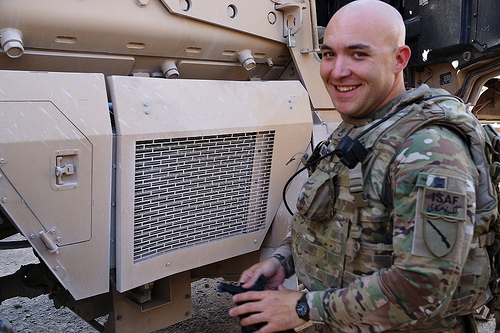
Staff Sgt. Robert Foushee of Lexington, Ky. smiles for the camera while preparing for a mission in southern Afghanistan on May 20, 2012. Foushee serves as a Dismounted Team Leader and Truck Commander with the Kentucky National Guard’s Agribusiness Development Team 4. (U.S. Army photo by Sgt. Paul Evans)
FORWARD OPERATING BASE PASAB, Afghanistan—“We run lead truck probably every other mission, that’s about the way it works,” explained Staff Sgt. Robert Foushee, a 28-year-old Lexington, Ky., native.In February 2012, Foushee deployed to southern Afghanistan’s Kandahar Province as a Security Platoon Dismounted Team Leader and Truck Commander with the Kentucky National Guard’s Agribusiness Development Team 4. Since then, his team has effectively taken over its role of running security from the front of ADT 4’s convoys, according to Foushee.
“It’s weird. I think coming here…training the way we trained as 1st Squad, I was always the lead truck, so I got used to that in training,” Foushee recalled. “There’s a natural nervousness, not so much about the IEDs or the insurgent forces or anything. I was more nervous about being able to find the routes,” he said with a smile.
“You know, not making a wrong turn and not knowing where I’m going and ending up in Helmand (Province),” he joked. Helmand, which is west of FOB Pasab, is commonly regarded as Afghanistan’s most volatile area.
“Leaving the United States, I always expected this giant wave of fear to hit me when I stepped outside the gate the first time, when that truck rolled outside the wire the first time,” Foushee noted. “That wasn’t the case. I think I was comfortable with myself…I was comfortable with my team, I knew that they knew what they were doing. And it was just business-time to go to work.”
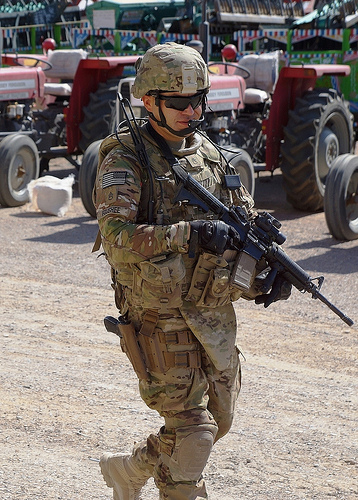
Staff Sgt. Robert Foushee of Lexington, Ky. conducts security checks during a mission in southern Afghanistan on May 25, 2012. Foushee is a Dismounted Team Leader and Truck Commander with the Kentucky National Guard’s Agribusiness Development Team 4. (U.S. Army photo by Sgt. Paul Evans)
“I think now we’re more comfortable out front than we are in the back,” Foushee continued. “That’s our role on this mission. We’re the scout guys, that’s our job. That’s our role and we own it.”“You bear a large responsibility not only for the navigation portion, but obviously you’re the IED spotter for the crew, you’re the guy that’s letting everybody know what’s coming up,” Foushee explained. “Yeah, there are some unique pressures that go with it, but I welcome that.”
Foushee briefly talked up how diversity helped his team function better.
“I think I have the best of all worlds. I have an Air Force Porter (Staff Sgt. Jonathon Stribling of Louisville, Ky.) who has literally grown into the best Soldier I’ve ever had work for me, I have a Sapper (Sgt. Nikko Moreno of Bowling Green, Ky.) who has almost 10 years of experience and can tell you anything you need to know about engineering, and I have an MP (Military Policeman Spc. Chris Young of Richmond, Ky.) who has worked detainee ops in Iraq,” Foushee said.
“So I have a vast background, and I also have open minds,” he added. “I have guys who listen to me, guys that will work with me, guys that will share their experience with me but not expect me to go the way they went in the past…I think that aspect has made my team, and I’m pretty biased, I think it’s made my team the best here.”
“The team makes the leader in a lot of aspects. We kind of see it the other way that the leader makes the team, but I don’t have to worry about what my guys are doing,” Foushee noted. “When I tell them to do something, I know they’re doing it-I don’t have to micromanage them. If I give them a task, they’ll figure out a way to do it, or they’ll come and ask me.”
“I think he (Foushee) has done everything that’s been asked of him, and I think he tries to do more,” said Stribling. “He tries to exceed the standards that they set for him.”
“He’s a good NCO,” Stribling added. “He’s still a young guy, still learning things just like I am. I think he’ll just grow as he progresses through his career.”
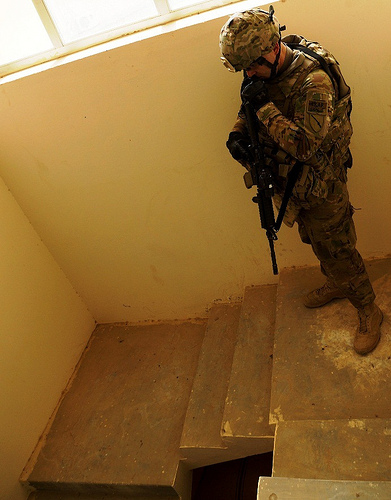
Staff Sgt. Robert Foushee of Lexington, Ky. conducts security checks of a building in southern Afghanistan on February 20, 2012. Foushee is a Dismounted Team Leader and Truck Commander with the Kentucky National Guard’s Agribusiness Development Team 4. (U.S. Army photo by Sgt. Paul Evans)
Initially, Foushee described some trouble getting onto ADT 4 from his full-time job as a Readiness NCO in Richmond, Ky.’s Charlie Co., 2nd Battalion, 75th Recruiting & Retention Command.”I don’t think my Battalion was on board maybe from the get-go…they thought I was too valuable where I was, they didn’t want to lose me, try to replace me for a year,” Foushee recalled. “But I had a really good company commander, Capt. Stephen Strack, who kind of stood up and said ‘hey, this is a squared away guy. He wants to do this. Let him do it.’ He made the case for me and they let me go.”
“I’ve met a lot of great people, felt like part of a great team,” Foushee mentioned, “to be part of something bigger than yourself. It’s a great experience to bond with a unit, and to go through this whole thing with a great group of people that I think I will never forget.”
“In the beginning, I learned from my fellow Soldiers, but here I learned from experience,” Foushee noted. “Seeing things on the road, seeing things outside the wire, and learning how to adapt and overcome those things.”
“I’ve been blessed to work with people from vast backgrounds,” he added. “I originally came into the Army from an Armor background. And I’ve worked with former Marines like Sgt. (Charles) White, guys with extensive backgrounds like Sgt. (Charles) Yankey and Sgt. (William) Lile, so I think every day you learn something.”
“What I think I’ve learned is that you can learn in any environment, regardless of the situation you’re placed in. If you open your mind, you can learn something. I mean, I’ve learned something from every single person I’ve encountered on this mission…Coalition, Afghani, local nationals. I’ve learned something from each and every one of them in a different way.”
“Every day I’ve spent in the Guard has prepared me for this. You know, one of the things that I tried to make the case for coming on this deployment is that I’ve been taking dancing lessons for seven years and I want to go to the prom. This is the prom, this is the World Series…this is the World Series of what we do.”
“Coming from recruiting, where you have a vast background, you have people from all different branches of service. You have people from all different MOS’s (military occupational specialties). They’re all kind of lumped in together with a mission of putting people in the Guard and getting them trained,” Foushee said.
“Well, that’s kind of what ADT is too,” he continued. “You have people from all different backgrounds that are kind of ‘okay, here you are together for six months, now go do the mission.’ So I think that time in recruiting working with all different styles of people helped me meld in with this team and maybe work easily with people that don’t see things the exact same way as I do.”
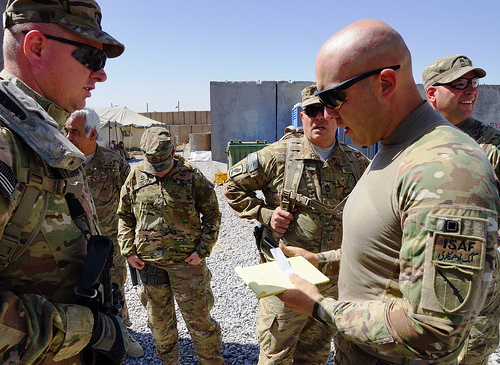
Staff Sgt. Robert Foushee (right) of Lexington, Ky. goes over notes prior to a dismounted security mission in southern Afghanistan with Staff Sgt. Eric Elliot (left) of Lawrenceburg, Ky. on May 20, 2012. Foushee and Elliot serve as Team Leaders with the Kentucky National Guard’s Agribusiness Development Team 4. (U.S. Army photo by Sgt. Paul Evans)
“We’re all Soldiers, everybody here is hand-picked-you know, I think everybody here is the best of the best in some regards,” Foushee observed. “This isn’t a mission where you have people brand-new to the Army.”“It’s been a great experience,” Foushee said of his time so far in Afghanistan. “I’ve learned more in six months here than I’ve probably learned in six years in garrison.”
“And this place kind of forces you to take an inner look at yourself too,” he continued. “It’s one of those things that Soldiers don’t talk about a lot. You have to look deep inside and face yourself because you’re kind of alone, you’re away from all of the distractions that America has to offer, and you can’t really hide behind anything.”
Foushee discussed some of the surprises of coming to Afghanistan.
“The biggest surprise I’ve had has been the normalcy of it,” he recalled. “You see the news, you see the media reports, you see how people view what’s going on in Afghanistan, but what you don’t see is 99 percent of the people here are just trying to live their lives.”
“And the Pashtun people, I’m so amazed, so overwhelmed at the resiliency of these people,” he said. “These people, they cope with things that people in our culture never had to cope with, and they do it on a daily basis. They live with war, they live with strife, they live with constant threat of driving to the grocery store and their car exploding on the way because there’s an IED. But they just keep living.”
“A perfect example is up in Arghandab, there’s a river that they’ve built a bridge across it with mud and sticks,” he explained. “Americans wouldn’t do that. We would swim across the river or we’d just figure out a way to live on the other side of the river.”
“That blows me away. I could not go into how impressed I am with the Pashtun people,” Foushee said.
Foushee briefly discussed the challenges he’s seen ADT 4 face since arriving in February 2012.
“I think with the move south, ADT kind of had to reinvent itself. The three previous years, we worked in northern areas, where you had a completely different type of people,” he said.
“Coming down here, we’ve had to kind of reinvent the wheel, so-to-speak. We’re working with a whole new culture of people, not just different ways of going about things, but also a whole new agricultural dynamic of what will grow, what won’t grow,” Foushee explained. “What will work, what won’t work-how to deal with the climate here, which is a lot different than up north.”
“We’ve started the mission. Six months in, we’re way ahead of the power curve, where we should be, and there’s no limit to what we can do and what ADT 5 can do on the back end of that,” he added.
“I joined the Army to be a defender of freedom, a warrior,” Foushee said. “But this (mission) brings a different aspect to it. You’re still winning the war, but you’re not doing it with bullets, but with bread.”
Story and photos by Sgt. David Bolton, Kentucky National Guard Public Affairs Office
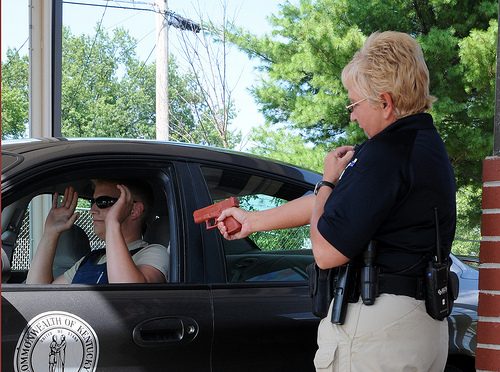
Kentucky Guardsman Spc. Austin Kirk, a security specialist at Boone National Guard Center in Frankfort,Ky., plays the role of a terrorist during a training exercise designed to simulate a suicide bomb attack August 15, 2012. Ginger Starrett and Brady Murphy, also security specialists at BNGC were on scene to apprehend Kirk as he attempted to detonate a vehicle-borne improvised explosive device. (photo by Sgt. David Bolton, Kentucky National Guard Public Affairs Office)
FRANKFORT, Ky.— An unassuming vehicle pulls up to the front gate of the Boone National Guard Center August 15, 2012 in Frankfort, Ky. It’s a typical Wednesday afternoon. The driver is motioned forward by Ginger Starrett, a security specialist assigned to BNGC. White-knuckled with a stone-cold face, the driver pulls up to the entry control point. Noticing his stern demeanor, Starrett begins to inspect the vehicle with a discerning eye. An instant later, the driver has pulled out a homemade detonator and attempts to set off a vehicle-borne improvised explosive device (VBIED).What happened next was part of a carefully designed and choreographed series of events that was meant to diminish any further threat to service members and civilians working at BNGC.
“We have a plan for Boone Center”, said Eldern Riley, State Anti-terrorism Program Manager. “Protect the assets and resources of the Kentucky National Guard including personnel and facilities.”
Col. Charlie Harris, State Security Manager, said that in addition to exercising the plan to keep the people of BNGC safe, the coordination with other agencies like the Kentucky State Police Bomb Squad and the Frankfort Police Department was important.
Despite the intensity of this event, it is not the first rigorous training exercise that has taken place at BNGC. Other scenarios have included an active shooter situation in which the security forces had to respond to a shooter on post.
“Our security force has done a lot,” said Larry McCord, Security Operations Chief at BNGC. “J2 (which deals with physical, personnel, and intelligence security) writes the plans and someone must implement it, we can do that.”
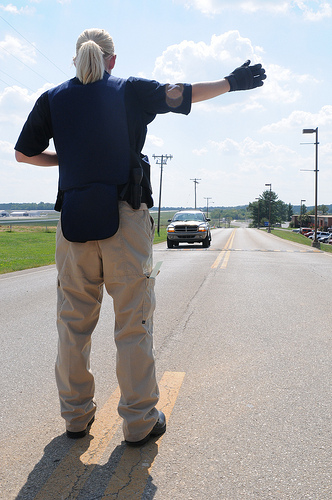
Jennifer Chilton, an Interim Security Specialist at Boone National Guard Center in Frankfort, Ky., directs traffic away from the front gates after a Vehicle-Bourne Improvised Explosive Device (VBIED) was detected as part of a bomb threat exercise scenario at BNGCC in Frankfort, Ky., Aug. 15, 2012. (Photo by Sgt. David Bolton, Kentucky National Guard Public Affairs Office)
The hard work of the BNGC officers has not gone unnoticed. Over the past few years the BNGC has been presented the Army Security Award as well as the Department of the Army’s Best Antiterrorism Program Unit for 2011.The process of responding and adjusting to these kinds of threats is continually revamped based on prior exercises and training simulations.
“We learned some things and we’ll use what we learned to update future plans,” said Harris.
McCord noted that the exercise was a huge success saying, “It’s a big feather in our cap for the Kentucky State Police to give us credit for our part in the exercise.
The true benefit of conducting this kind of life-like training is the payoff that it brings.
Riley said that the training exercises helped the younger officers to prepare for real world events.
“There’s a lot more than most people think,” said McCord. “Someday, someone is going to make a move and I hope that we’re there to catch it. It’s not a matter of if, but when.”
The Kentucky Guard Command Staff directed August as Antiterrorism Awareness Month to bring a heightened sense to the potential threats against personnel and facilities throughout Kentucky.
By Master Sgt. Philip Speck, 123rd Airlift Wing Public Affairs
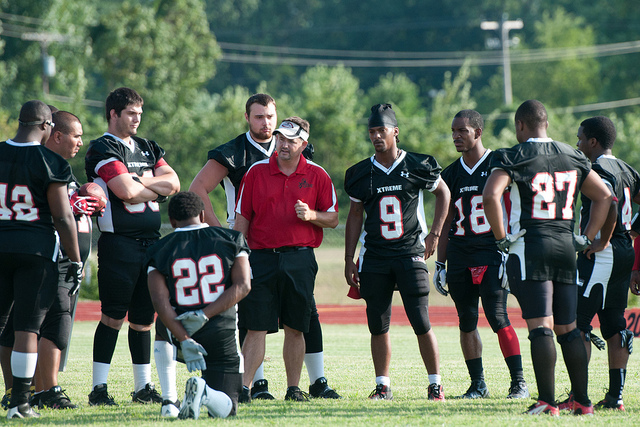
Dave Rooney, head offensive coordinator for the Kentucky Xtreme football team, discusses plays during a football game in Jeffersonville, Ind., on July 28, 2012. Rooney is the Airmen and Family Readiness Program manager for the Kentucky Air National Guard’s 123rd Airlift Wing in Louisville, Ky. (Kentucky Air National Guard photo by Master Sgt. Phil Speck)
LOUISVILLE, Ky. — They’ve worked together for years as fellow Airmen in the Kentucky Air National Guard, deploying overseas to support the war effort or mobilizing at home in response to natural disasters. Now, they’re giving back to the community by displaying athletic prowess on the gridiron.
A group of Kentucky Air Guardsmen is fielding an indoor and outdoor football team called Kentucky Xtreme.
“A few of us thought it was a pretty cool idea to own a football team — a way to give back to the community and to help guys live out their dreams,” said Staff Sgt. Victor Cole, the majority owner, general manager and coach.
Cole, a maintenance analyst for the 123rd Maintenance Operations Flight at the Kentucky Air National Guard in Louisville, Ky., played football for Kentucky State University, followed by minor league ball until 2008. While on deployment to Afghanistan as part of Agribusiness Development Team 3, Cole learned about the Kentucky Xtreme concept and wanted to get involved in football again.
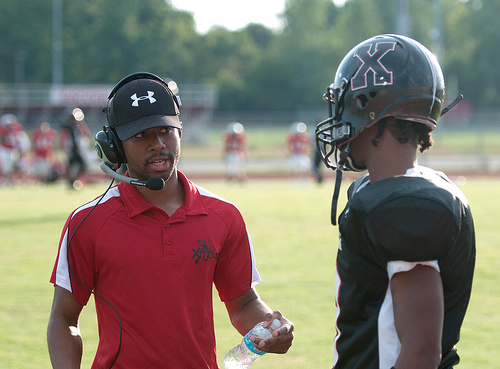
Kentucky Air National Guard Staff Sgt. Victor Cole, a maintenance analyst for the 123rd Maintenance Operations Flight, talks to one of his players during a Kentucky Xtreme football game in Jeffersonville, Ind., on July 28, 2012. Cole is majority owner, general manager and coach for the Kentucky Xtreme outdoor football team, a minor league squad based in Louisville, Ky. (Kentucky Air National Guard photo by Master Sgt. Phil Speck)
Cole was joined in the effort by Dave Rooney, manager of the base Airmen and Family Readiness Program, who serves as the team’s head offensive coordinator. Other Air Guard co-owners are Chief Master Sgt. Victor Dry, 123rd Communications Flight maintenance chief; Staff Sgt. Aaron McGahee, a fire team member for the 123rd Contingency Response Group; and Tech. Sgt. Terrance Jones, a crew chief for the 123rd Aircraft Maintenance Squadron.The Kentucky Xtreme outdoor team is part of the Interstate Football League, a minor-league group comprised of teams from Indiana, Michigan and Kentucky. The outdoor league, which plays from June to September, is basically a skills-development effort with players who don’t get paid to play, Cole said. This summer, Kentucky Xtreme practiced a couple of times a week at Doss High School in Louisville, and played their home games at Jeffersonville High School in Jeffersonville, Ind.
The Kentucky Xtreme indoor team is, by contrast, a professional arena football squad that belongs to the Continental Indoor Football League, Cole said. Arena football is normally played from February to June, and the Kentucky squad expects face its opponents in home games at Freedom Hall in Louisville.
Both teams are ideal for players who’ve played high school or college football and want to keep playing to hone their skills or possibly make it to the National Football League, Cole said.
He added that his experience in the Air Guard has been crucial to developing an effective coaching style.
“Being in the Guard has taught me leadership skills, discipline and how to deal with individuals,” he said.
Cole goes on to say he’s glad he can help bring a professional, family-friendly football team to Louisville, and he encourages people to come out and support the team.
“We would love to have support from folks out at the base and their families,” he said.
Commentary by Chief Warrant Officer 3 Ryan Turner, 63rd Theater Aviation Brigade
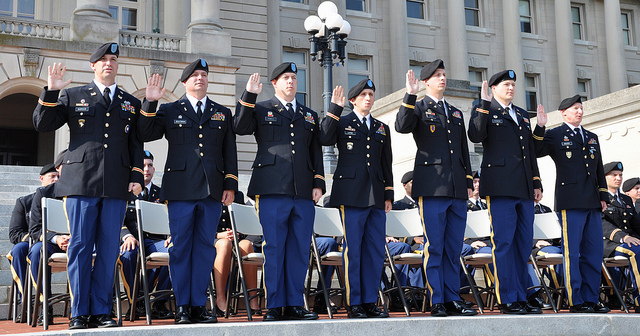
Kentucky National Guardsmen swear in as new warrant officers at the state capitol in Frankfort, Ky., Aug. 20, 2011. (Kentucky National Guard photo by Sgt. 1st Class Michael J. Oliver)
FRANKFORT, Ky. — If you have ever had the pleasure of visiting the Warrant Officer Career College at Fort Rucker, Alabama, you will notice a sign at your feet as you enter the building that reads “Quiet Professional.” That cannot be further from the truth in today’s Warrant Officer Corps.
The evolution of the Warrant Officer Corps has stemmed much debate about our role as highly adaptable technical experts, leaders, and mentors.
Today’s Army warrant officer is still looked upon by their commander for the technical answer. However, a warrant officer’s role extends well beyond just supporting their commander in their field of expertise. They serve as guideposts for enlisted Soldiers, at both the junior and senior level. This is where mentorship becomes a very important role for the warrant officer.
We must constantly be looking for highly motivated and knowledgeable Soldiers who are dedicated to lifelong learning in their field of expertise. Those are the types of Soldiers we are looking for to enter our Warrant Officer Corps.
In sales, the best lead comes from the buyer or satisfied customer. There are currently 145 warrant officers in our ranks. The Command Chief Warrant Officer, Chief Warrant Officer 5 James Simms looks upon each of those warrant officers, or satisfied customers, to find eligible Soldiers who have the potential to become a warrant officer too.
With over 7,400 members currently serving in the Kentucky Army National Guard, the Warrant Officer Corps in Kentucky certainly does not make up the majority. Even so, the Warrant Officer Corps’ strength is not is numbers but in technical knowledge, and their ability to lead Soldiers and advise the commander in their individual skill.

Army warrant officers have officially been around since 1918. Originally designated as Army mine planters, the career field has constantly expanded to include technical and aviation warrants in the modern service. The Kentucky Army National Guard currently has 146 warrant officers serving the Commonwealth.
Today’s warrant officer is part of the command staff, attending all staff meetings where they can certainly offer vast knowledge and understanding through their progressive assignments and experience. Typically, the senior enlisted leadership and the warrant officer(s) stay in place while commanders transition through the unit. This offers the continuity needed to allow continued growth of the unit’s mission and the Soldier’s within it.
The demands put on Soldiers today are much stricter than the recent past. However, the experiences the average Soldier has gained through military schools, various assignments, and, let us not forget, multiple deployments, has allowed so much opportunity for growth within our ranks.
Who could have predicted that the Kentucky Army National Guard would have Soldiers who are 25 years old with three deployments? That experience is largely what makes an excellent warrant officer. It all comes down to experience.
Kentucky’s Warrant Officer Corps also offers a great balance between younger Soldiers and older Soldiers. Often, senior leaders depict the warrant officer as a Soldier who joined the military before they were born. Although we have plenty of senior warrant officers in our ranks, you will now see a better mix of age and experience as a whole. This is mostly due to the growth of the warrant officer positions within Kentucky.
When we first stood up the warrant officer strength management position in Kentucky, there were less than 60 warrant officers and just over 100 authorizations. Now, there are over 190 warrant officer authorizations with 146 total warrant officers in the Kentucky Army National Guard. Due to the fact that almost 50% of the current warrant officers in Kentucky can retire, we are constantly recruiting and looking for their future replacement.
After serving for 24 years in the Army National Guard, 17 of those years in recruiting, I have never seen this much opportunity within the Kentucky Army National Guard. There are no limits to how far you can take your career. Whether your goal is to become the State Command Sergeant Major, the Command Chief Warrant Officer, or the Adjutant General, the limits only lie within yourself and your goals.
If you want more information on the Warrant Officer Program, please contact Chief Warrant Officer 3 Ryan Turner.
Office: (502) 607-6200
Cell: (502) 320-3653
Story and photos by Sgt. Scott Raymond, Kentucky National Guard Public Affairs Office
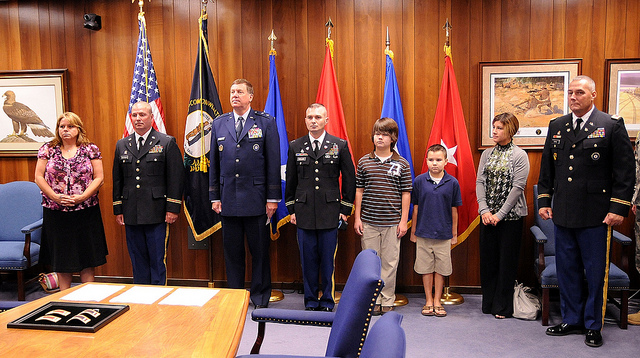
Kentucky’s Adjutant General, Maj. Gen. Edward W. Tonini presides over an appointment ceremony for Warrant Officers Timothy Collins and Robert Boatman at Boone National Guard Center in Frankfort, Ky., Aug. 21, 2012. (Kentucky National Guard photo by Sgt. Scott Raymond)
FRANKFORT, Ky. — The Kentucky National Guard appointed two new warrant officers to its ranks during a ceremony at Boone National Guard Center in Frankfort, Aug.21. Kentucky’s Adjutant General, Maj. Gen. Edward W. Tonini presided over the event.
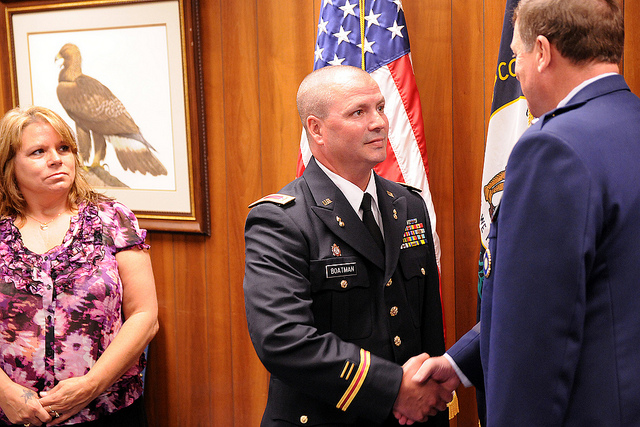
Kentucky’s Adjutant General, Maj. Gen. Edward W. Tonini congratulates Warrant Officer Robert Boatman as Mechelle Boatman watches, during an appointment ceremony at Boone National Guard Center in Frankfort, Ky., Aug. 21, 2012. (Kentucky National Guard photo by Sgt. Scott Raymond)
Warrant Officer Robert Boatman of the 103rd Brigade Support Battalion has served in the military for nearly 18 years. The Lawrenceburg, Ky., native, has served in the Kentucky National Guard since 2003. Boatman completed his warrant officer school in 2011, but waited until a position opened up for him to be appointed. His wife Mechelle was on hand to pin his new rank on his uniform.
Boatman said he believes his new rank will open new doors and take him further in his career as he hopes to go as high as he can.
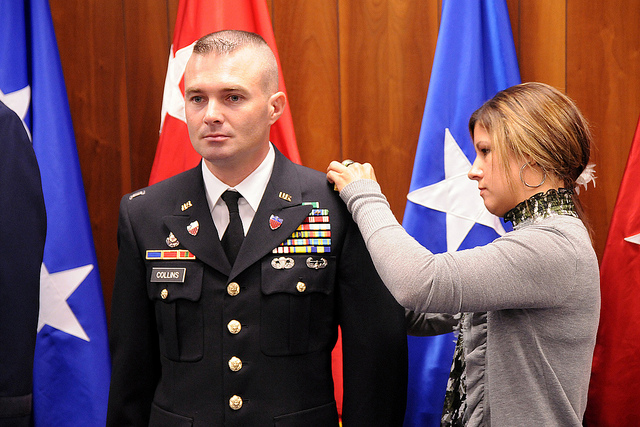
Lora Collins pins warrant officer rank to the uniform of her husband,Timothy Collins, during an appointment ceremony at Boone National Guard Center in Frankfort, Ky., Aug. 21, 2012. (Kentucky National Guard photo by Sgt. Scott Raymond)
Warrant Officer Timothy Collins, also with the 103rd BSB, joined the Kentucky National Guard in 2001 after serving in the U.S. Marine Corps. The Russell Springs, Ky., native, worked as the Administration NCO, and will become an AGR (Active Guard and Reserve) Manager for the Human Resources Office in Frankfort. Collins was joined at the ceremony by his wife Lora and their two sons, Ethan and Elijah.
“Becoming a warrant officer has been a career goal for me,” said Collins. “I did this to do bigger and better things for my profession and myself.”
State Command Chief Warrant Officer James Simms spoke of the importance of warrant officers in the service and of the quality Soldiers joining that elite group. Referring to Boatman and Collins, Simms called them examples of the leadership and expertise needed in the Kentucky Army National Guard.
Currently there are over 190 warrant officer authorizations with 148 total warrant officers in the Kentucky Army National Guard. The small group of Soldiers is recruiting to fill its ranks with experts in their field. Boatman said if he could say anything to those thinking of becoming a warrant officer, it’s about the experience one can bring.
“Learn everything you can,” he said. “And bring the traits a good NCO, it’s what makes a good warrant officer.”
