
Pages
Stay In Touch
More
© 2013 KentuckyGuard
Story by Staff Sgt. Scott Raymond, Kentucky National Guard Public Affairs
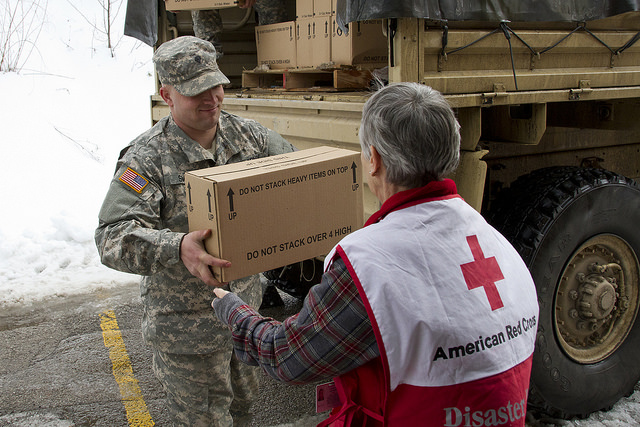
Spc. Timothy Smith with the 1st Battalion, 149th Infantry hands a case of water to Anne Cockley, a Red Cross volunteer at Green Hills Elementary School in Bledsoe, Ky., Feb. 24, 2015. The Soldiers assisted with water deliveries throughout Harlan County in response to a water shortage caused by a recent winter storm. (U.S. Army National Guard photo by Staff Sgt. Scott Raymond)
HARLAN, Ky. — More than 100 Kentucky Guardsmen were activated this week to assist local communities following a devastating winter storm.
Snowfall totals in excess of two feet along with bitterly cold temperatures pushed counties in Eastern and Southern Kentucky to the brink. With 93 of Kentucky’s 120 counties declaring emergencies, Gov. Steve Beshear issued a state of emergency Feb. 16, opening the door for the Guard to assist.
Soldiers with the 201st Engineer Battalion helped clear more than 70 miles of roads in Lee County alone. Trucks from the 138th Field Artillery Brigade and 149th Maneuver Enhancement Brigade moved palletized water from Louisville to staging areas.
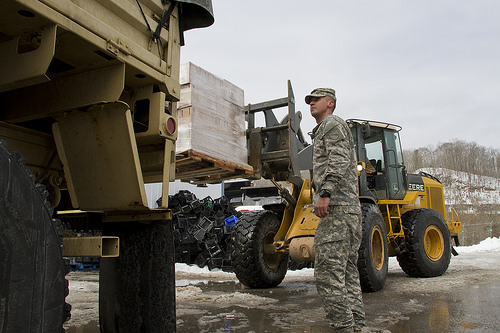
Spc. James Harmon with Alpha Company, 1st Battalion, 149th Infantry helps guide a pallet of water into a vehicle for distribution in Harlan, Ky., Feb. 24, 2015. The Guardsmen were able to supply distribution points across Harlan County to get the water closer to those in need. (U.S. Army National Guard photo by Staff Sgt. Scott Raymond)
In Harlan County, Soldiers with Alpha Company, 1st Battalion, 149th Infantry transported pallets of water to distribution points throughout the county following water system failures.
“We have the equipment to do the job,” said Staff Sgt. Terry Brock with Alpha Co. “We’ve been delivering water, clearing roads, shoveling driveways, helping people get to doctors, just helping out wherever we can.”
Brock, who lives in Harlan County, even had to deliver water to his own family on one of the unit’s runs. “It was good to help them out and to be in a spot to help out the whole county of Harlan too.”
Visit our flickr site for more photos.
Frozen lines and pump failures knocked out the water to an estimated 45,000 households in Eastern Kentucky. Together with the snow, the rural mountain communities were impacted much worse than other parts of the state.
Harlan County Judge Executive Dan Mosley said he has requested a lot of local and state resources throughout this process and finds it encouraging to find so many willing to help.
“The Guard has helped us out in a big way,” he said. “We would not have been able to set up so many distribution points if it wasn’t for the National Guard, the Red Cross and Operation UNITE. There would be a lot of people without water in their homes if it wasn’t for the Kentucky National Guard units doing what they’re doing here.”
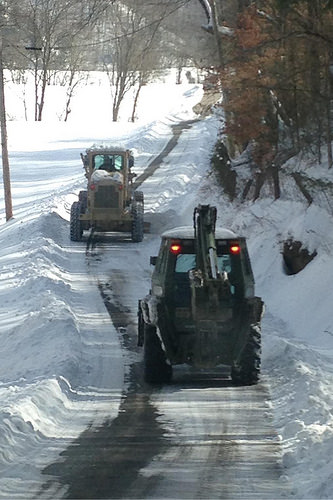
Soldiers with the 201st Engineer Battalion work to remove snow from a road in Lee County, Ky., Feb. 19, 2015. The unit cleared more than 70 miles of snow following the winter storm that impacted much of Kentucky. (Photo courtesy of 201st Engineer Battalion)
According to Spc. James Harmon with Alpha Co., the unit was responsible for the delivery of more than 7,000 gallons of water. In coordination with the Red Cross, the Guardsmen supplied designated distribution points that were closer for citizens to pick up the water. Each run became similar to a wellness check as the Citizen-Soldiers recognized familiar faces and were able to judge the situation based upon the words of their own friends and locals they knew.
“I grew up here in Harlan, it’s a great community of people,” said Harmon. “I just helped deliver water to my old elementary school in Bledsoe. It’s why I enjoy being a part of the National Guard. We serve our Nation, but are also here to help our neighbors get back on their feet.”
Soldiers in the are also provided transportation assistance to emergency personnel, ensuring doctors, nurses and health care staff made it to work.
With more than 30 vehicles in use across the Commonwealth, the Guardsmen are expected to continue each mission through the week.
Check out some video of the Harlan County response mission below:
Story by Staff Sgt. Andrew Short, 1103rd Military Police Detachment Unit Public Affairs Historian Representative
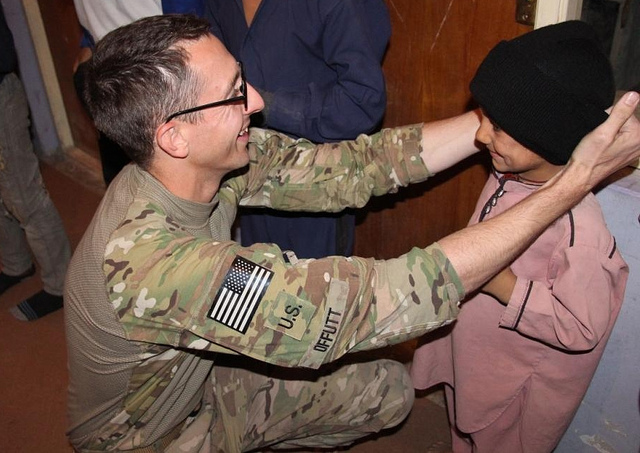
Sgt. Tyler Offutt with the 1103rd Military Police Detachment places a knit cap on an Afghan child at an orphanage in the Balkh Province, Afghanistan, Oct. 22, 2013. Soldiers of the unit delivered coats, gloves, hats, toys and candy to the orphanage to provide the children with warm clothing for the winter. (U.S. Army National Guard photo by Staff Sgt. Andrew Short)
BALKH PROVINCE, Afghanistan — Soldiers of the 1103rd Military Police Detachment out of Brandenburg, Ky., paid a visit to a local orphanage in northern Afghanistan with some much needed items of comfort, Oct. 22, 2013. The unit, led by Sgt. 1st Class Brian Gillock, assisted in a humanitarian mission in preparing children for the harsh winter looming in the near future.
The team arrived in a multi-vehicle convoy loaded with an assortment of winter coats, hats, gloves, candy, and stuffed animals all generously donated by the Jacob Sexton Memorial Afghan Children’s Coat Drive. The drive collects coats to send to children in Afghanistan in honor of Indiana Army National Guard Spc. Jacob Sexton, an Iraq and Afghanistan war veteran who died in October, 2009.
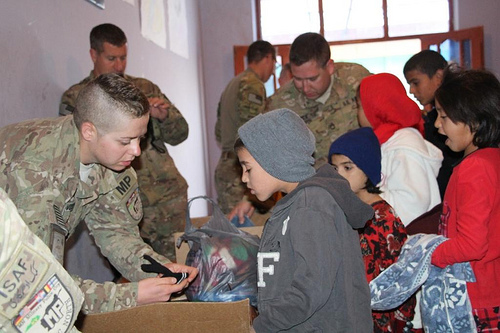
Spc. Jacqueline Voss with the 1103rd Military Police Detachment fits a young Afghan child with new gloves at an orphanage in the Balkh Province, Afghanistan, Oct. 22, 2013. Voss said the experience was one of the best she had experienced while deployed overseas. (U.S. Army National Guard photo by Staff Sgt. Andrew Short)
child for a new pair of winter gloves
“There are few more worthy investments than those we make towards children,” said Staff Sgt. Bradford Stone, a member of the 1103rd security team. “This was one of the most rewarding missions I’ve had the privilege to experience.”
The team was greeted by Rohahza Akbary, principle of the Balkh Orphanage, who welcomed them inside for warm cups of chai. Akbary led the team in to a large corridor filled with a variety of smiling children from all ages. The children grew quiet and curious as box after box was brought into the room. As the boxes were opened, their cautious curiosity was quickly replaced with joy and laughter as the gifts were revealed.
“I have to echo what other Soldiers have said, this is truly one of the most rewarding experiences since arriving here in Afghanistan,” said Maj. Gregory Jefferson. “The children were very happy to receive new clothing and you could see the appreciation in their faces. It was great.”
As the children settled into their new winter gear, their curiosity grew stronger. The children began to mingle with the Soldiers, pointing up at their uniforms and giving them their best “thumbs up with a smile.” One little girl managed to utter the words “thank you” in her best broken English. Akbary informed the troops that dinner time was approaching and that she must prepare the children to eat.
“It was a most fulfilling experience, getting an opportunity to play with the kids and all. I wish we could do this more often,” said Spc. Jacqueline Voss.
The children waved their goodbyes, some with bright smiles and others with a mouth full of candy. The Soldiers of the 1103rd loaded up their trucks and left the orphanage with peace of mind, knowing that for at least one more winter, the children would have something to keep them warm.
“It was an honor to take the lead for such a noble cause,” said Gillock. “Often the people of Afghanistan don’t interact with the U.S., especially in the north. If
this is their sole interaction with us and it’s this positive, while they receive needed coats and articles for warmth, then we are all truly winners in this conflict.”
Story by Staff Sgt. Sidney Hoffmann, ADT 5 Unit Public Affairs Historian Representative
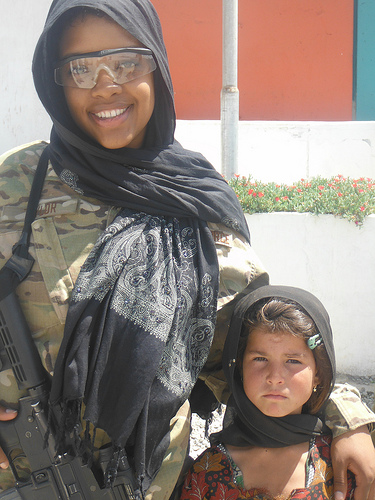
Master Sgt. Zakiya Taylor with Kentucky’s Agribusiness Development Team 5 stands with the daughter of a woman attending a canning class in Zaharay District, Afghanistan. The class, facilitated by U.S. Service members was a refresher course for local women to preserve foods for their families. (U.S. Army National Guard photo by Staff Sgt. Sidney Hoffmann)
ZAHARAY DISTRICT, Afghanistan — Kentucky Agribusiness Development Team 5 has completed many projects with this humanitarian mission here in Regional Command South, Afghanistan. One project they became a part of was a canning class facilitated by a U.S. Army Female Engagement Team from Fort Bliss, Texas.
The FET coordinated the location and ensured the information got out to the local women about the class. Master Sgt. Zakiya Taylor of ADT 5 provided the instructor from Kandahar City and distributed the supplies, which included the steam pot, funnels, ladles, jars, jar lifters, and sealers.
“With the supplies, we were able to provide approximately 40 local Afghan women with the tools and knowledge necessary to begin canning fruits and vegetables in their own homes,” said Taylor, ADT 5’s food preservation specialist.
Reinforcing the idea of Afghans teaching Afghans, the team contracted with a young Afghan woman, Laila Afag, from Kandahar City to teach the classes. A successful business woman in her own right, Afag co-owns three canning factories in the city and is an expert in teaching canning techniques for fruits and vegetables. Additionally, six of the women were teachers in the local area and would be able to pass along what they had learned in the class to others. Interestingly, one of the local teachers is a fifteen year old girl from Zharay, she was one of the few that could read, write and understand the material. The teachers were excited to display their educational skills and Afag allowed the teachers to assist her in presenting to the class.
“The canning supplies we were able to provide will be for home use and the demonstration classes given by Laila Afag will help the women preserve their produce,” said Taylor. “This makes them not only marketable in the future, but a sustainable tool to pass down to future generations.”
Since refrigeration and cold storage is not readily available in many of the local homes here, being able to store foods for longer periods of time is essential for the survival of the people.
Afag was highly motivated and proud she could extend her knowledge and services to this project.
“It is an easy craft; one they can pass down from one generation to the next,” she said. “They will be able to can and preserve a large variety of food if done correctly. The knowledge is there, because it is popular in this area.”
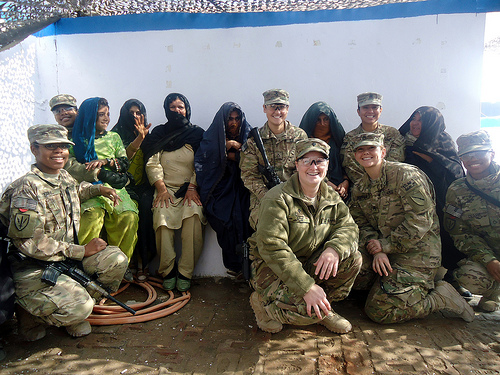
Female Soldiers with Kentucky’s Agribusiness Development Team 5 gather for a group photo with women and children in the Zaharay District, Afghanistan. The Afghan women attended a canning class while some Soldiers helped with a children’s class. (Courtesy photo)
It is important to note these women are familiar with the process; however, the value-added is having the proper tools and focusing on sanitary techniques.
The class included the process of paste canning, pickling and fruits preserving. Each woman was provided a handout to follow along with during the presentation. The material was presented at a very basic level, which provided beginners a jumpstart on making quality preserves without studying the science of preserving. The women were very interested in participating and learning about the canning process. Afterward, many women stated they felt confident and certain they could effectively implement these techniques at home.
A high note of the event was when the Zharay District Governor, Sayeed Ashina Agha, and Director Bismullah Khan, District Education Representative, came on the last day of training to recognize the women and give them encouragement and support for their participation. Even though the Taliban threats occur and transportation is not always an option to get to Forward Operating Base Pasab, these women truly risk their lives to take advantage of the programs provided for them.
“There is nothing like seeing their smiling faces and knowing the team has done something these women will take with them for the rest of their lives,” said Taylor.
Story and photos by Staff Sgt. Kristen Duus, 1st Stryker Brigade Combat Team, 1st Armored Division
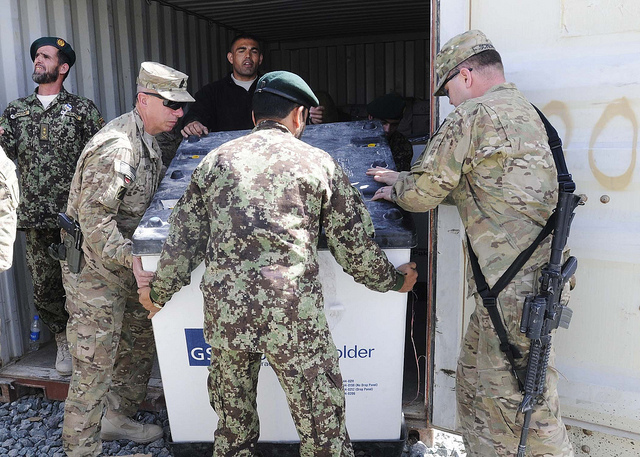
Sgt. Maj. David Munden, Kentucky Agri-business Development Team noncommissioned officer in charge and Sgt. Eric Schenck, 1st Brigade, 1st Armored Division chaplain’s assistant, help soldiers from the Afghan National Army with supplies at Forward Operating Base Pasab, Kandahar Province, Afghanistan, March 17. The brigade chaplain, along with ADT 5, participated in Operation Love Thy Neighbor, which provides clothes and school supplies to the ANA to pass to local villages. (U.S. Army photo by Staff Sgt. Kristen Duus)
FORWARD OPERATING BASE PASAB, Afghanistan — What happens when you have a team of educators who deploy to a country that only has a 17 percent literacy rate? Those educators set out to change those numbers.
The Kentucky Agribusiness Development Team, a National Guard unit, deployed to Kandahar province, Afghanistan, participated in Operation Love Thy Neighbor at Forward Operating Base Pasab, March 17.
Air Force Lt. Col. Dallas Kratzer, the Kentucky ADT deputy commander, and a native of Lawrenceburg, Ky., worked in conjunction with the 1st Brigade, 1st Armored Division chaplain to provide clothes and school supplies to the Afghan National Army through the Afghan Religious and Cultural Affairs, who in turn distribute the supplies to local villages.
Lt. Col. Abdul Ghani, the chief of RCA, 3rd Brigade, 205th Corps, ANA, appreciated the donations from the soldiers.
One of the biggest things for Afghanistan is now, with the United States’ help, the ANA has accomplished a lot, said Ghani. They have also progressed a lot in the education aspect as far as teaching soldiers and helping the villages and locals.
“This is truly an Afghan to Afghan thing,” said Kratzer. “All we’re doing is facilitating the materials. We’re equipping them with school supplies so their kids have an interest in being taught, learning and improving what they have.”
The supplies, which have all been donated, are set to foster a more positive relationship with the local Afghan citizens and the ANA, said Kratzer.
Sgt. Eric Schenck, 1/1 AD chaplain’s assistant, and a native of Wisconsin Rapids, Wis., works closely with the Afghan RCA teams. Schenck helps receive, inspect, store and deliver the donations to the ANA. Schenck also coordinated with the ADT, who immediately jumped on board.
“This is a win-win for all,” said Schenck. “The fact that it is the ANA giving the items fosters positive feelings and will help build supportive sentiments.”
“It feels to directly improve the living conditions here in Afghanistan,” said Schenck. “It hurts to see so many people living in poverty. I want to help somehow and this is a great way to do some good while I’m deployed.”
Kratzer concluded by emphasizing that this project was to build relationships, not just between Americans and Afghans, but also with the ANA and locals.
“In everything that we do, we want to build sustainability to help foster something that will continue on,” said Kratzer. “It’s not about giveaways. It’s about relationships.”
Story and photos by Capt. Chase Kohne, ADT 5
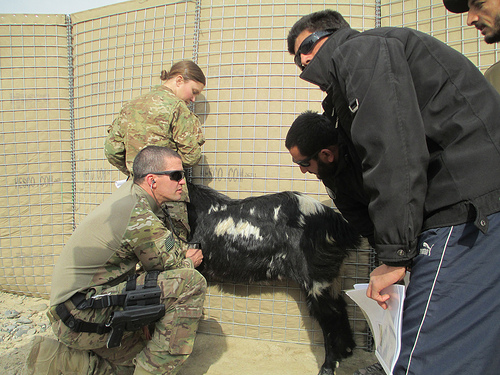
Capt. Chase Kohne of Kentucky’s Agribusiness Development Team 5 checks the vital signs of a goat in in Kandahar Province, Afghanistan, January 2013. ADT 5 provided classes for local herders on how to care for their animals during a two-day clinic. (KYNG photo by Staff Sgt. Sidney Hoffman)
KANDAHAR PROVINCE, Afghanistan — Members of the veterinary team of Kentucky’s Agribusiness Development Team 5 conducted their first joint Veterinary Outreach Program with a Special Forces team in the Maiwand District of Kandahar Province, Afghanistan. The two day exercise involved training the Afghan National Army Special Forces (ANASF) medics in common veterinary techniques to include large animal handling and restraint, physical exams, basic anatomy, proper nutrition, common diseases and preventive medicine.The training was tailored to meet the needs of southern Afghanistan, focusing on common ailments prevalent within the district of Maiwand.“This was the first time since their training that they were able to interact with a local group of herders and apply their training to helping their people,” said Capt. Chase Kohne, ADT 5 veterinarian. “Their ability to work with the herders as well as identify and treat common ailments truly legitimized the efforts of the ag-team over the past 12 months.”
Planning for a joint exercise with Afghan para-veterinarians working with ANASF medics has been in the works since early 2012 under ADT 4. Eight individuals were selected from five districts within Kandahar province for six months of training from the Dutch Committee for Afghanistan. This group of para-veterinarians is committed to helping their communities through livestock production and prevention of disease.
Kentucky ADTs have been present in southern Afghanistan since early 2012 with a focus on crop production and preservation, water management and livestock. Common problems for livestock in the region are a lack of proper nutrition and water in order for the livestock to work, produce milk or eggs, or reproduce normally. Improper vaccination and de-worming techniques is also an obstacle, leaving the livestock susceptible to treatable diseases, infections, worms and parasites.
The exercise concluded on the second day with local Afghan para-veterinarians working jointly with the ANASF medics that were supervised by the ADT 5 veterinary team. Nearly 300 animals were treated to include donkeys, camels, cattle, sheep and goats that belonged to local herders in a small village in Maiwand District. Both the ANASF medics and para-veterinarians participated in the delivery of treatment which included vaccinations, deworming, dental care and treatment of infections.
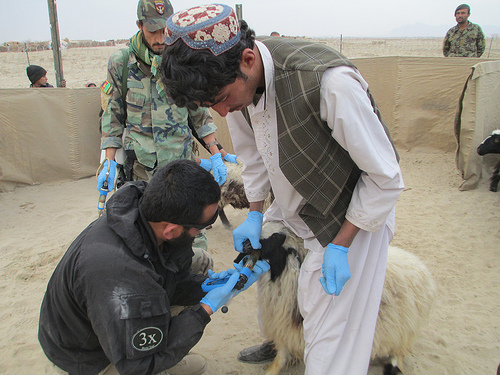
Afghan herders treat a goat after instruction from members of Kentucky’s Agribusiness Development Team 5 in Kandahar Province, Afghanistan, January 2013. ADT 5 conducted a veterinary clinic for local herders on the care of the variety of animals found in the province. (KYNG photo by Capt. Chase Kohne, ADT5)
The veterinary team assigned to ADT 5 was also given the opportunity to mentor the local Afghan para-veterinarians.“We are transitioning to a phase where the trained para-veterinarians will be working for their people independent from the International Security Assistance Force (ISAF),” said CEW Amberlie Silva, ADT 5 Agribusiness Specialist. “You could see the confidence in their skills growing with each animal they treated. It was a truly rewarding experience to see the para-veterinarians that we helped train giving back to their country in a way that can help to improve the quality of life for entire communities of people.”
ADT 5 will continue to develop joint exercises with the locally trained Afghan agricultural leaders as well as the provincial government in order to ensure the skills received during our time here continue to remain as troops begin to draw back. Col. Bob Hayter, commanding officer of ADT 5, believes that the key to a sustainable solution lies within the coordination of the local Afghan people with the Guardsmen and ISAF personnel.
“We are working hard to analyze their problems and formulate action to achieve agricultural improvement, economic opportunity, social advancement and, thereby, to promote the national well-being,” said Hayter. “This can only be achieved through a unified effort with ISAF and the Afghan government in a way which could never be accomplished solely through individual efforts.”
Story by Staff Sgt. Sidney Hoffman, ADT 5 Unit Public Affairs Historian Representative
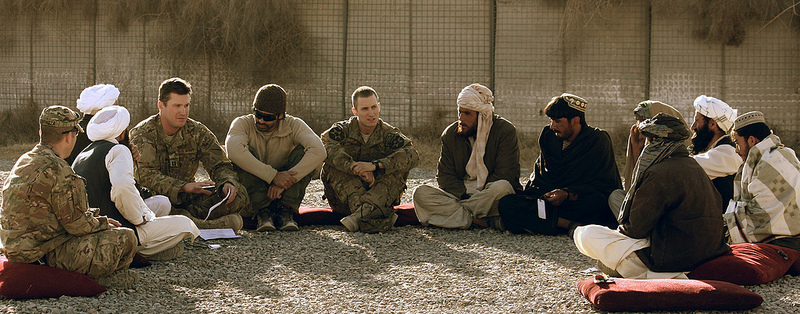
Capt. Forrest Holdsworth (4th from left), of Kentucky’s Agribusiness Development Team 5, speaks with district leaders and local farmers in Arghandab District of Kandahar Province, Afghanistan, Dec. 23, 2012. The meeting was the first for ADT 5 to meet with locals and continue relationships improved by ADT 4. (Courtesy photo)
KANDAHAR PROVINCE, Afghanistan — Members of Kentucky Agribusiness Development Team 5 traveled to Argandab District Headquarters to meet with District Governor Haji Shaw Mohammed in late December, 2012. This was the first meeting between ADT 5 and the governor since arriving in country. The conference focused on continuing the positive relationship established by Kentucky’s ADT 4. According to Maj. Bill Hatfield, the Argandab District has been very successful in self-governance and agriculture development over the past year. Their visit was to reinforce these improvements by highlighting the importance this meeting holds for future operations in the area.
“When I was here last, you would barely ever see a car and now traffic jams are the norm when traveling through the city,” said ADT 5 commander Col. Bob Hayter while traveling through the bustling city of Kandahar.
His statement highlighted the progress being made in security and commerce in the past seven years. Hayter had previously been assigned to RC South in 2005 as a Military Training Team Embedded trainer with the Afghan National Army and had been stationed in Kandahar for over a year.
As they traveled through the Argandab area, several members of the agribusiness team remarked on how different this district was from the western districts they had visited. They noted the abundance of trees and green spaces that even the bleakness of the Afghan winter could not hide.
According to team’s lead civil engineer, Capt. Forrest Holdsworth, “This could be attributed to the district’s position higher in the Argandab River watershed, thereby producing an abundance of vegetation compared to districts like Panjwai and Maiwand. In Kandahar Province, water is a valuable commodity which has the greatest impact on the agricultural success of the region, yet is it also one of the most scarce.”
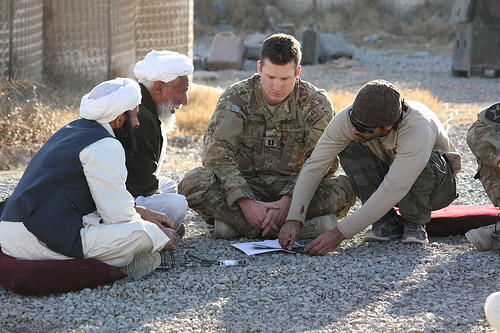
Capt. Forrest Holdsworth (middle), of Kentucky’s Agribusiness Development Team 5, speaks with district leaders and local farmers in Arghandab District of Kandahar Province, Afghanistan, Dec. 23, 2012. ADT 5 will assist local farmers in agricultural techniques such as controlling pomegranate diseases and managing water resources. (Courtesy photo)
Shaw thanked all of them for coming and discussed with the team some of the agricultural challenges facing his district and how he hoped that ADT 5 might be able to assist over the coming year.
Among his priorities were: training the farmers of Argandab on more advanced farming techniques used in America; training on pomegranate diseases that have been prevalent over the past year; and helping farmers properly manage water resources in the district.
The Governor was glad to hear one of the primary objectives of ADT 5 was to train farmers in water management in an effort to help get the most of this limited resource. Hayter expressed to the Governor that such assistance would gladly be provided by the team, and they would immediately begin working to help accomplish these goals.
Shaw expressed he had been very pleased with the efforts of the previous agribusiness team and hoped his work with ADT 5 would be equally as successful. Hayter thanked the Governor for his remarks and expressed his hope for similar successes over the course of the next few months. The KYADT V staff felt that Argandab District was well positioned for the transition of ISAF over the next year and would be ready for 2014.
Story and photos by Sgt. David Bolton, Kentucky National Guard Public Affairs Office
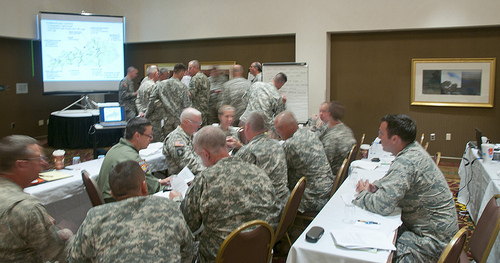
Joint Force Headquarters (JFHQ) members from the Kentucky National Guard plan strategic measures on how to assist citizens of Kentucky in the event of a state emergency in Frankfort, Ky. August 3, 2012. (photo by Sgt. David Bolton, Kentucky National Guard Public Affairs Office).
FRANKFORT, Ky.-United States Northern Command (USNORTHCOM) and National Guard Bureau (NGB) servicemembers convened at the Capital Plaza Hotel to discuss ways on how to best aid the civilians of Kentucky and the first responders when faced with domestic disasters in Kentucky Aug. 3, 2012.“The training will help us do a better job of planning during a crisis and to be more thorough in responding to the needs of the citizens of the Commonwealth in the event of a national disaster,” said Col. William A. Denny, Kentucky National Guard Deputy Chief of Staff for Operations.
The domestic response graduated level staff was comprised of individuals from Civil Support Teams (CST) all the way through senior general officer leadership. Joint Forces Headquarters (JFHQ) members from the Kentucky National Guard sought to lie out plans on how to assist citizens of Kentucky in the event of a state emergency.
Among the topics considered were the logistics of responding to state disasters in terms of mustering troops for response, coordinating with government officials, correctly paying Soldiers, responsibly allocating resources, dealing with legal matters, etc.
“After these three days we’re staffed to better serve the governor and citizens of Kentucky,” said Maj. Dean Roberts, a National Guardsman from Colorado Springs, Colo. working with USNORTHCOM. “There is nothing that the Kentucky Guard does without the request of civilian authorities.”
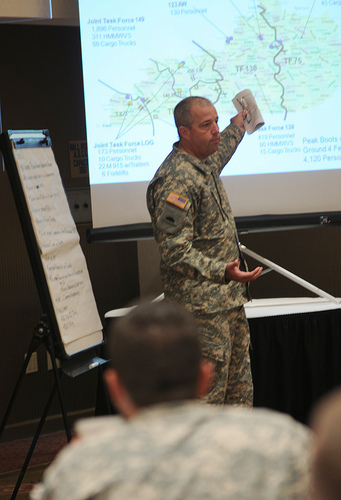
Kentucky Army National Guard Col. William A. Denny, Kentucky National Guard Deputy Chief of Staff for Operations, explains planning and logistical operations for the task forces assigned to different sectors of Kentucky in the event of a natural disaster scenario in the state August 3, 2012 in Frankfort, Ky. (photo by Sgt. David Bolton, Kentucky National Guard Public Affairs Office)
Scenarios included in the planning and development of these response measures drew from past natural disasters in Kentucky including ice storms, earthquakes, wild fires, and tornados. Joint operations with FEMA were also part of the presentations and contingency planning operation process.Unique to the National Guard has been the additional responsibility of homeland missions in conjunction with federal operations overseas. With the continued drawdown of troops from overseas, the Kentucky National Guard is beginning to apply those learned skill sets from theater operations here at home.
“50 percent of our mission is to support domestic operations and it’s very critical that we translate those military skills that we learn as part of our training into domestic operations and support for the Commonwealth of Kentucky,” said Brig. Gen. Mike Richie, Commander of the Land Component Command for the Kentucky National Guard. “That’s what this training is about, it’s about how you take those military skills and apply those in a disaster situation.”
When dealing with natural disasters, the leadership of the Kentucky National Guard knows that there must be a precise and systematic series of precautionary and reactionary responses to any given situation. Preparation is the catalyst for efficiency.
“There’s an art and a science to domestic response. It’s the most important of all guard missions,” said Roberts.
Story and photos by Sgt. Paul Evans, KY ADT 4 Unit Public Affairs and Historian Representative
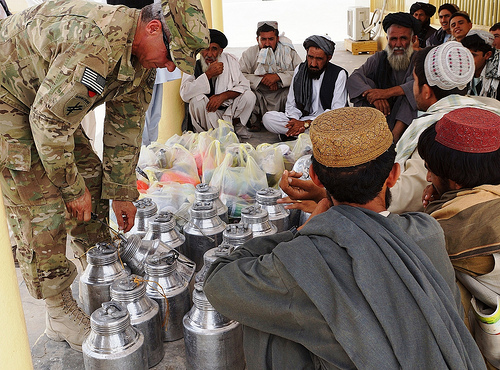
Capt. David Liciardello of Belmont, Va. prepares to distribute milk sterilization supplies in southern Afghanistan on July 5, 2012. The tools were provided at the conclusion of a dairy training program which Kentucky’s Agribusiness Development Team 4 helped local Afghan officials design and coordinate. (U.S. Army photo by Sgt. Paul Evans)
FORWARD OPERATING BASE PASAB, Afghanistan — Got milk? In America, the slogan serves as a simple question posed in efforts to remind people to pick up a gallon at their local grocery store. But in southern Afghanistan, things aren’t always so simple due to a nonexistent economy from decades of war and a lack of resources and education to produce healthy, pasteurized milk.Seeing a need, the Kentucky National Guard’s Agribusiness Development Team 4 took the challenge of helping locals in Zharay District, Kandahar Province develop skills to process their milk. While still not quite up to quality levels expected, the education at least trained Afghans on how to remove detrimental diseases.
“There’s a certain need, and the desire came through from the District Agriculture Extension Agent,” noted Capt. David Licciardello, a 54-year-old Belmont, Va., resident, who serves as ADT 4’s Veterinarian Advisor.
“Dairy is an important part of the (Afghan) culture, as well as nutrition,” he added. “The milk here is not processed, so there’s a large amount of disease transferred, particularly to children. Brucellosis is the big thing.”
“It (brucellosis) affects multiple organs, heart, joints,” Licciardello described. “It’s sort of an insidious disease, and it’s more difficult on the children, obviously, but it can affect anyone.”
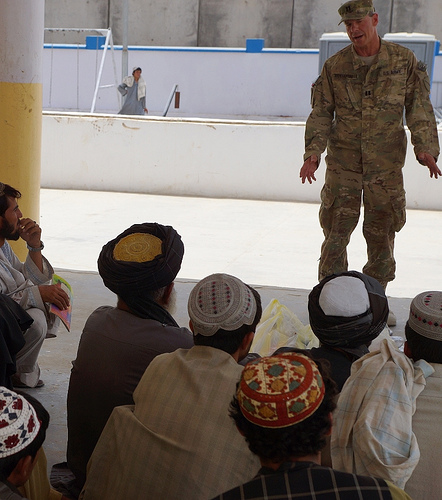
Kentucky Agribusiness Development Team 4’s Veterinarian, Capt. David Liciardello of Belmont, Va. speaks to local farmers in southern Afghanistan on July 5, 2012 following a six-day dairy training course intended to help farmers better clean their milk and take care of livestock. ADT 4 helped local Afghan officials design the training’s curriculum and coordinate its execution. (U.S. Army photo by Sgt. Paul Evans)
“What we’ve done is we’ve presented a class to people that produce dairy and given them methods of sterilizing milk and cleaning the cows,” Licciardello recalled. “Also, we trained them on treating some of the diseases that cows are prone to get, collection techniques so they can sell the milk to dairies and make a profit from it to expand their herd, proper nutrition of the cows, and husbandry. It was a six-day course of training to 20 Afghans.”“It made them (farmers) aware of the diseases that can be spread by unpasteurized milk. That was the big thing,” Licciardello said. ‘They were taught some methods of sterile collection and chemical sterilization so the diseases don’t spread to their children, at least.”
“Trainees were all given a small milk kit, collection cans, mastitis instruments, and sterilization techniques and tools,” he said. “So, they walked away with some things that would help them in their dairy production.”
“They’ve also been told how to feed their cows better so they get higher production, more milk, some breeding techniques, and how to increase their herd sizes. The affects should be fairly good here,” he added.
“What we’re also looking at is putting in a dairy production facility here in the (Zharay) District, so this was kind of getting a feel for how dairy farmers react to having a dairy right in their back yard. It was a very positive response. They’re looking forward to it.”
“All of the trainees were very encouraging and enthusiastic about the training,” Licciardello observed. “They’re also really happy to learn that they can make more money in profits from the milk and the prospect of having a dairy built here in the District.”
Based on the positive reaction and needs, Licciardello discussed plans to expand the training to other Districts within the Kandahar Province.
“We’ll probably try to do this in some other Districts because of the public health implications of milk-borne diseases,” he said. “And we also hopefully will move ahead with the dairy project here in Zharay (District), which will require further training.”
Licciardello also described some of what ADT was able to learn from students in their dairy training class.
“We actually gave them a survey form to fill out and it was all positive feedback,” he described. “They’d like to get more training. It was very enthusiastic feedback.”
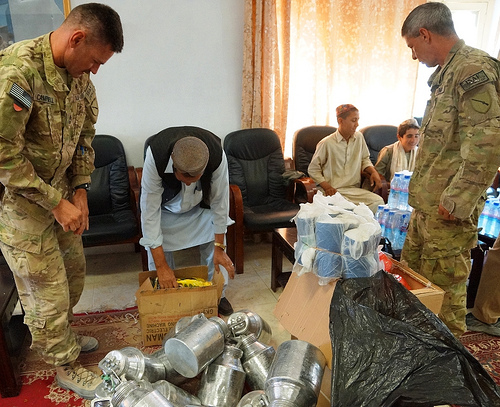
Capt. David Liciardello (right) of Belmont, Va. helps Nicholasville, Ky.’s Staff Sgt. Chris Campbell (left) unpack milk sterilization supplies in southern Afghanistan on July 5, 2012. The tools were provided at the conclusion of a dairy training program which Kentucky’s Agribusiness Development Team 4 helped local Afghan officials design and coordinate. (U.S. Army photo by Sgt. Paul Evans)
“The information that we got, some of it was the amount of milk they could produce and requirements that they have. They need animal health workers, which they don’t have here. Kentucky ADT has sent two students to school to learn that, so they’ll come back here and help these guys, which they appreciate.”“We’ve also learned that production of milk here is higher than what was originally thought, and that helps us with the planning for the dairy,” he added.
In the end, Capt. Licciardello described what meant the most about dairy training to him personally.
“I feel like we may have prevented some of the citizens here from becoming sick, having these very life-threatening diseases or chronic diseases being spread,” he said.
Thanks to the continuing efforts of ADT 4, it would seem that in the future, many more Afghan citizens will be able to say that they too have milk. Disease-free milk at that.
Story and photos by Staff Sgt. Paul Evans, KY ADT 4 Unit Public Affairs and Historian Representative
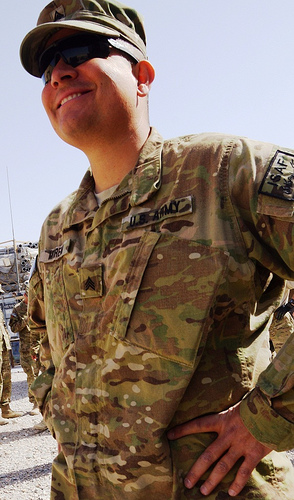
Kentucky Agribusiness Development Team 4’s Sgt. Nikko Moreno of Bowling Green, Ky. smiles in southern Afghanistan on March 14, 2012. The Danville, Calif. native now serves with ADT 4’s Security Platoon, helping provide protection for the mission of educating local farmers. (U.S. Army photo by Staff Sgt. Paul Evans)
FORWARD OPERATING BASE PASAB, Afghanistan—“When I lost my job, that was really hard for me,” recalled Sgt. Nikko Moreno, a 39-year-old Danville, Calif. native now residing in Bowling Green, Ky. “I’d worked so hard for so many years and built up to have nothing.”
Moreno has come a long way in the past few years since his journey began in California. There, he suddenly found himself unemployed from his job in Construction Management by the recession. To fully understand Moreno’s journey and how he ended up in Afghanistan, however, the story gets a little longer.
Before rejoining the military in the Kentucky Army National Guard’s 3123rd Engineer Detachment, 206th Engineer Battalion in Madisonville, Moreno spent about seven years on Active Duty as a combat engineer. While there, he served in Korea, Germany, Bosnia, Ft. Lewis, Wash. and even attended the prestigious Sapper school at Ft. Leonard Wood, Mo.
“When I initially joined (the Army), I joined the Reserves, and I was at the reserves for a very short time,” Moreno recalled. “They said that the unit was being deactivated, so I had a choice to either go Active Duty or to get out.”
“So I decided to go Active, and the first place they sent me was Korea. After that…I was shipped up to Ft. Lewis, Wash., and I was there for a couple years,” he continued.
“Then I was deployed to Bosnia with 1st Armored Division, and was there for all of ’96, and then came back, was home in Germany,” Moreno noted. “We went back in ’98, then I was home in ’99, and when my time came up for reenlistment, they were going to Kosovo. I just, I had a lot on my plate, a lot of directions I wanted to go. I chose to get out.”
After leaving Active Duty Army life behind, Moreno returned to California.
“After I got out, I went home and started dating my now wife, Shannon, and started working,” he recalled. “I finished college, but while I was in college, I started working in construction, and what I did, I was doing a Network Engineering degree-and I just didn’t really find that it was what I liked to do, and I ended up going back to construction.”
“I liked the way it was hands on and detail-oriented, outside,” Moreno noted. “You know, we did the whole thing for like the first nine years of our marriage. We bought a house, she (Shannon) got established in her career, I got established in mine, and then when the recession kind of hit California, it hit construction really hard.”
“I was laid off from my first job, I was able to pick up a second job as a Superintendent with another company that I’d worked with, and after three months, I got laid off from that one just because there was no work,” he said.
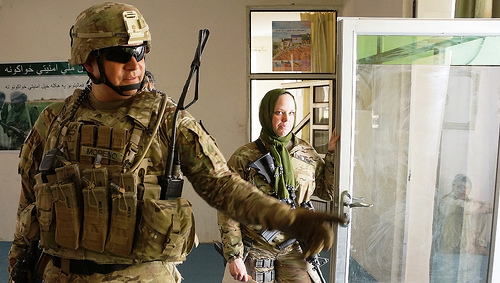
Kentucky Agribusiness Development Team 4’s Sgt. Nikko Moreno of Bowling Green, Ky. conducts security checks during a mission in southern Afghanistan on May 8, 2012. The Danville, Calif. native now serves with ADT 4’s Security Platoon, helping provide protection for the mission of educating local farmers. (U.S. Army photo by Staff Sgt. Paul Evans)
“We’re the type of couple, that on weekends, we like to get out and explore. My father-in-law owned a house in Kentucky,” Moreno continued. “He came up to us and said, well why don’t you go check out Kentucky. I kind of laughed it off as a joke.”
“But given my experience on going a lot of different places with the military, a lot of the places I thought I wouldn’t like I ended up liking,” Moreno reflected. “So I went to my wife and said ‘well, why don’t we give it a try.’ We flew out in August (2009), stayed for a week, and we fell in love.”
“We loved the people, we loved the area,” he described. “It was beautiful, it was green, there was a lot of things to do, and it really was the people. They were very courteous and very welcoming.”
“It’s such a contrast to California, where people can be so rude and so focused on their job or time or money, and it wore us out,” Moreno noted. “We left California Halloween and arrived at the house in November (2009).”
“I ended up joining the Guard because I always-I guess, at that point in my life, the military was the only thing that made sense to me,” Moreno said. “I really believed in what it stood for, I believed in how I felt wearing the uniform, and I just kind of wanted to get just kind of control of my life again.”
After joining, Moreno took advantage of an opportunity to deploy southern Afghanistan as part of the Kentucky National Guard’s Agribusiness Development Team 4, where he now serves.
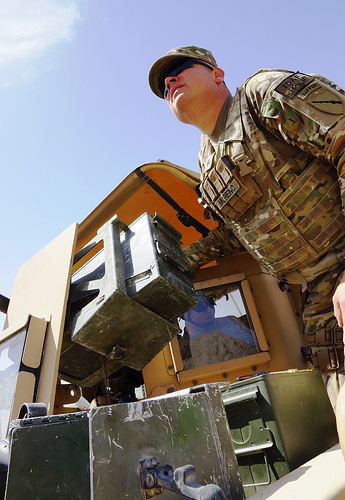
Kentucky Agribusiness Development Team 4’s Sgt. Nikko Moreno of Bowling Green, Ky. coaches a Soldier during weapons training in southern Afghanistan on April 2, 2012. The Danville, Calif. native now serves with ADT 4’s Security Platoon, helping provide protection for the mission of educating local farmers. (U.S. Army photo by Staff Sgt. Paul Evans)
“It was kind of nice to have the chance to be a part of the humanitarian side of a military mission…to kind of go out and help somebody that wants to make something of their lives,” Moreno described. “I am accomplishing my goals for coming on this mission. You know, I will have participated in something that makes a difference for people.”
“I think we’re making a difference to the right people,” Moreno noted. “There are people that are taking what we’re giving them and doing positive things. Of course there’s corruption, there’s that stuff too-but someone told me one time that even if you make a difference in one person’s life, it’s making a difference. So I do think we’re making a difference.”
Moreno offered some insights to the surprises of coming to Afghanistan.
“There’s actually a lot of green,” he noticed. “It’s actually a fertile place. I was completely ignorant about Afghanistan…but coming here I expected desert and I’m finding kind of fertile areas that congregate around a river valley.”
“Ignorance breeds hate, and I was ignorant about it. And now I see that not everybody is bad, some people are just like you and I. They just want to get on with their lives peacefully, and it’s enjoyable to watch these people and how resourceful they are to just kind of like work what they have.”
“They don’t have trellises for grapes or high-speed areas to process their stuff—they make everything they have,” he observed. “A bridge across the water isn’t some concrete pillars and planks. It’s roots and mud, it’s sticks and stuff. They’re very ingenious, and they’re very resourceful.”
“To be honest, my previous military experience was a lot different from this,” Moreno observed. “When we rolled into Bosnia, there was nothing established. We rolled into a muddy field, set up concertina wire, filled sandbags, built bunkers, built towers, we were really self-sufficient. We did everything pretty much on our own. It prepared me in that I was prepared for how bad it could be.”
“Here, it was kind of like coming to a catered party,” Moreno described. “There’s no mud, we have air conditioned and heated tents, there isn’t really a lot of suffering involved in the day-to-day stuff that we’re doing here.”
Family and friends back home have been supportive, according to Moreno.
“My family has been exceptionally supportive,” he noted. “For my wife, it’s new. We weren’t married when I was in the military before, so she’s learning. She’s really smart, my wife. She is able to adapt really quickly to what a situation requires—she kind of knows what to and what not to listen to.”
“My mom, you know, a mom’s a mom. She’s definitely worried for her son and the rest of us, and sees any war as negative, and wants us all home,” Moreno continued.
“Oh my gosh, they send me packages,” Moreno added with an excited smile. “That’s another new thing…the difference between my active experience and this is the technology, and care packages and things like that.”
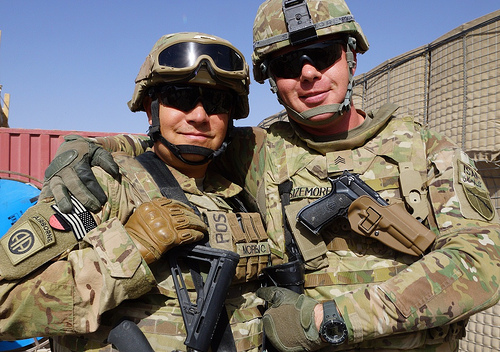
Kentucky Agribusiness Development Team 4’s Sgt. Nikko Moreno (left) of Bowling Green, Ky. spends quality time with Lawrenceburg, Ky.’s Sgt. Bobby Sizemore (right) before a mission in southern Afghanistan on April 1, 2012. The Danville, Calif. native now serves with ADT 4’s Security Platoon, helping provide protection for the mission of educating local farmers. (U.S. Army photo by Staff Sgt. Paul Evans)
“Before, I didn’t really get care packages. I’d get letters and stuff, and it was nice to get letters,” he recalled. “Now I get care packages, and I don’t get letters very much. They have Skype, phones, and they have Facebook, and all these internet media that we really didn’t back then.”
Moreno reflected on how his peers have helped him get through the deployment so far.
“That’s one thing I love about the military is that you always have brothers no matter what,” he said. “And it’s always diverse. If I’m feeling vulnerable, there’s a person I’ll go talk to that I know won’t put me down or take advantage of the fact that I’m like ‘hey man, I’m feeling weak.’ Or if there’s someone I want to joke around with, he’s there. There’s always a multitude of people and personalities you can go and talk to.”
“Being with this hodge-podge group, there’s a lot of stories that you can get to know people and find out where they came from and who they are. I really like that, too-just learning about people and what they’ve come up through,” Moreno continued.
“I met him (Moreno) at our very first drill,” said Lawrenceburg, Ky.’s Sgt. Bobby Sizemore. “My first impression of him was that he was a little different.”
“He wasn’t exactly the type of guy that I’m used to because I know he’s got a lot of vast experience,” Sizemore described. “Since then, we just started to click, so we’ve become good friends.”
“Before we left, me and my wife, Moreno and his wife—we also had Sergeant Randy Sewell and his wife, we all went out to dinner together,” Sizemore continued. “We were actually able to bond, our wives were able to meet, and that has created that support back home. Our wives stayed in touch, so it was just a good thing. They all get along really good.”
“Moreno’s very, very, very goal oriented,” Sizemore observed. “Once he sets his mind to something, he goes after it, and that’s inspiring. There’s so many people today that give up so easy when they don’t get what they want. I admire him for never giving up.”
“He’s got a big heart, and he cares for people,” Sizemore added. “That’s another inspiring feature about Sergeant Moreno, is just that he’s a good person overall.”
“Me and him, we’ve shared so much that he’s like a brother to me now,” Sizemore said. “He’s one of those guys that when you’re having a bad day, you can go to and talk to, and more times than most, he’s going to put a smile on your face.”
“He’ll be a lifelong friend. We’ve shared a lot of good things, a lot of bad times,” Sizemore added.
From California to Kentucky and Afghanistan, one could say the complicated journey continues for Sgt. Moreno and his many trades.
By Staff Sgt. Paul Evans
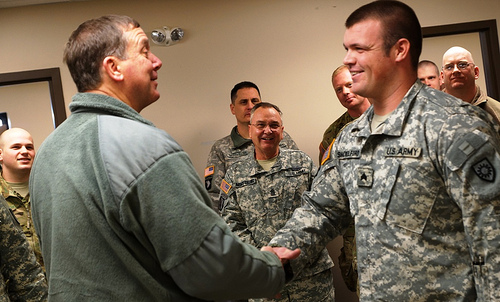
Kentucky Adjutant General Maj. Gen. Edward Tonini shakes hands with Sgt. Cade Shackelford, a native of Harrodsburg, Ky. while recognizing his hard work at Camp Atterbury, Ind. on January 29, 2012. Shackelford, who recently returned from Iraq as a member of the 149th Maneuver Enhancement Brigade, played a key role in supporting ADT 4’s Supply section during the mobilization process.
CAMP ATTERBURY, Ind.— As the Soldiers, Airmen, and civilian agricultural specialists assigned to Kentucky Agribusiness Development Team 4 gathered in the unit’s temporary headquarters on Sunday, January 29, two helicopters buzzed overhead. One Airmen joked about breaking news: the people on board were only men, who were rumored to have put their pants on one leg at a time this morning.
Inside the helicopters was an array of top Kentucky National Guard leadership, including Kentucky Adjutant General, Maj. Gen. Edward Tonini, Command Sgt. Maj. Greg Armstrong, and various other top leaders from around the state. The leaders came to Camp Atterbury to say their goodbyes to ADT 4 before their departure to Afghanistan to perform the critical task of empowering Afghan farmers with training to become more efficient at using the resources available to them.
An overall buzz of anxious excitement filled the room before the entourage made its way into the building a few minutes later. After exchanging greetings, it was time to address the crowd, led by Tonini and ADT 4 Commander Col. Tommy Barrier.
“In all sincerity and in all honesty, I can say that I’ve never had an ounce of reservation about this group because I saw you all form up and know what the leadership has done to ensure that you all have the right mix (of talent)… I have nothing but confidence in the work that you’re doing,” said Tonini.
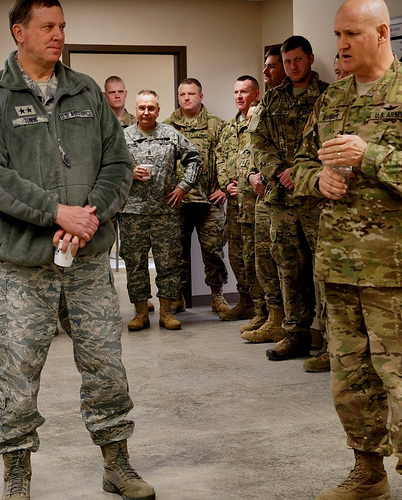
Col. Tommy Barrier, Commander of Kentucky’s Agribusiness Development Team 4 speaks at Camp Atterbury, Ind. on January 29, 2012 as Kentucky Adjutant General Maj. Gen. Edward Tonini looks on along with Soldiers, Airmen, and Civilian specialists of ADT 4. The speech was part of a farewell event for the ADT 4 Team before their departure for Afghanistan.
“As you all know, Kentucky was individually picked out in order to do something really different…even though it’s going to be more demanding and more difficult, the reality of it is that you’re all well prepared to do the job,” Tonini added.
Following speeches and a word of prayer, Tonini took time to recognize some of the Soldiers nominated by ADT 4 leadership before everyone went their separate ways. One of the Soldiers, Air Force Staff Sgt. Jonathan Stribling, a native of Louisville, Ky., excitedly described receiving his second coin in his career, a time-honored Army tradition of recognizing hard work.
“It felt good. It was shocking…I don’t feel I did anything spectacular, anything better than anyone else,” said Stribling. “But still, it feels good. I’m not gonna lie,” he added.
As the Soldiers prepared to leave Indiana for southern Afghanistan over the next few days, the visit provided one last opportunity for Kentucky National Guard leadership to show their appreciation to the ADT’s team members. There was a common feeling amongst those in attendance, that this mission demonstrates one more opportunity for Kentuckians to help change the world, even if it is half a world away.
