
Pages
Stay In Touch
More
© 2013 KentuckyGuard
By Staff Sgt. Scott Raymond, Kentucky National Guard Public Affairs
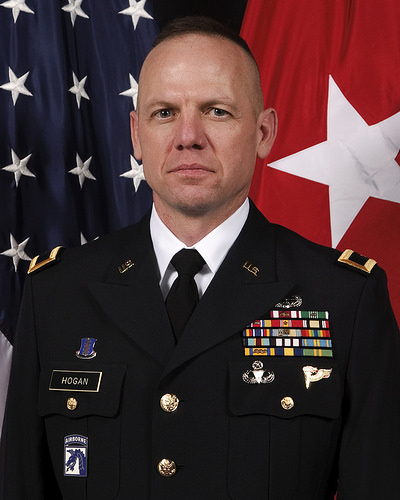
Brig. Gen. Stephen R. Hogan was appointed the 52nd adjutant general of Kentucky, Dec. 7, 2015 by newly-elected Gov. Matt Bevin. (Kentucky National Guard photo)
FRANKFORT, Ky. — A favorite quote amongst members of the Kentucky Guard goes like this, “There’s something in the very air of Kentucky which makes a man a Soldier.”
That’s also how you could sum up Brig. Gen. Stephen R. Hogan, Kentucky’s newest Adjutant General.
After a 30-year career in an Army uniform, Hogan returned from retirement in December to assume the role as the commonwealth’s 52nd adjutant general.
Hogan inherits a Kentucky National Guard that is in his mind “the best it’s ever been.”
It’s now his job to keep it there.
“Everyday in uniform is a blessing. Being a Soldier is all I’ve wanted to do since I was five-years-old, and this position offers me a challenge I have not seen before,” he said. “I derive satisfaction from being around the Soldier and being a part of this team. The willingness to serve something bigger than self is the cost of admission for this organization.”
After three decades in service, Hogan will rely on his Soldier’s perspective to lead Kentucky’s Soldiers and Airmen. That strong frame of reference for operations across the spectrum must serve him well as the Guard continues to be called upon at a moment’s notice in a variety of ways.
“We’ve become comfortable with unpredictability in an ambiguous environment,” he said. “ the Guard needs to remind itself of its role, and the reoccurring themes of flexibility and expertise in a great deal of areas.”
“I think any unit needs to be orchestrated, as a team and there is no point in a Guardsman’s career from E-2 to a two-star that the standards aren’t important.”
On his first day in the Guard in 1993, Hogan received what he calls the keys to leadership at the most simplistic, basic level.
“Retired Col. Bill Clark summed it up like this; ‘You must be a subject matter expert in your field, and whatever your troops are required to do, you are required to do.'”
Hogan said he hasn’t forgotten those words and that ideal. He said they’ve helped carry him through his career as an officer. Military education and experience have taught him more, but not as much as that original to-the-point conversation.
Hogan’s father was the only direct family member that served in the military. Even though he was drafted into the Army in the 1950s, Hogan said his father was very proud of his service because he understood the concept of service of self.
After commissioning through Morehead State University’s ROTC program in 1985, Hogan served eight years on active duty with the 101st Airborne Division and 6th Infantry Division.
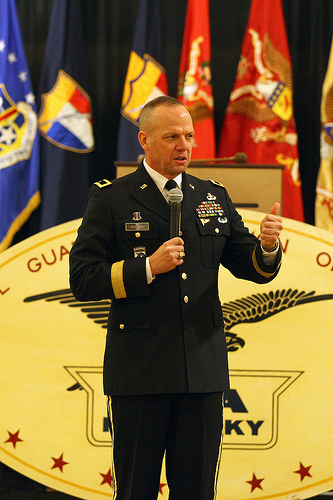
Brig. Gen. Stephen R. Hogan speaks during the National Guard Association of Kentucky conference in Louisville, Ky., Feb. 6, 2016. Hogan said the Kentucky Guard was in as good of shape as it could be and stressed teamwork for the organization moving forward. (U.S. Army National Guard photo by Staff Sgt. Scott Raymond)
June 2, 1993 was Hogan’s first day as a Kentucky Guardsmen. He became a tactical officer with the 138th Field Artillery Brigade, followed by stints with the 149th Armor and Kentucky’s Officer Candidate School.
But it would be his time in command of Kentucky’s Joint Support Operations, the Counter Drug task force that would define the leader that now commands the Kentucky Guard.
As the former commander of the hand-picked unit, Hogan said he has seen some of the finest Soldiers Kentucky has to offer serving the commonwealth. He said leading a group of driven Soldiers with such camaraderie and dedication to service remains a highlight of his career. It was core principles that he believes made and continues to make JSO such a quality unit. An idea he sees as essential for the Guard to thrive.
“We’re going to emphasize core fundamentals and competencies for Soldiers and Airmen. We’ve proven what we can do and how well we’ve done it, but I would like to see some forward movement in all aspects of how we do our jobs.”
“I would like to see the organization return to those core competencies and become an even more professional institution.”
Hogan understands he now has a unit of 8,500 under him to supervise and represent. It’s time for him to become a subject matter expert in a new job, for which he knows he has work to do. And his success will be measured on the success of his troops.
“If I don’t push myself, the organization pushes me, and requires me to be the best version of myself as we go forward in order to earn my part on the team.”
Kentucky National Guard Public Affairs Staff Report
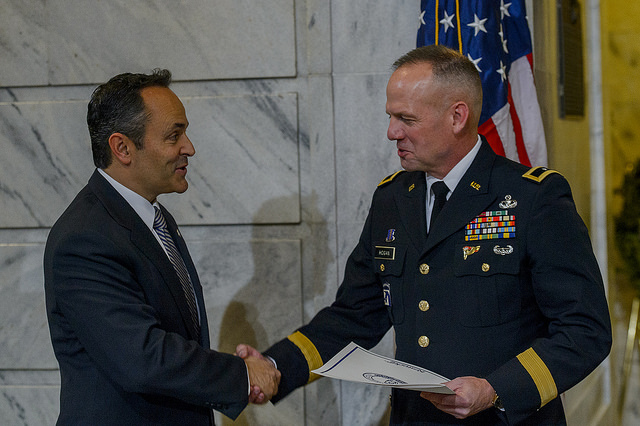
Governor Matt Bevin congratulates Brig. Gen. Stephen R. Hogan following Hogan’s swearing in at the State Capitol in Frankfort, Ky., Dec. 8, 2015. Bevin selected Hogan as the 52nd adjutant general, commanding the Kentucky National Guard. (Photo by Marvin Young)
FRANKFORT, Ky. — Retired Brig. Gen. Stephen Hogan, who served more than 30 years in the Kentucky National Guard and active duty Army is the state’s next adjutant general, Governor-elect Matt Bevin announced Dec. 7.
Hogan was sworn into office shortly after midnight, Dec. 8, succeeding Maj. Gen. Edward W. Tonini who has served in the role since 2007.
Hogan said he will be taking charge of a National Guard organization that is among the best in the nation. Hogan was officially introduced to members of the Kentucky Guard during a welcome ceremony at the Boone National Guard Center following the inauguration.
“This is a wonderful feeling to be before you today,” said Hogan to those in attendance. “I am very honored and humbled to be back in uniform for an organization that I have a great deal of confidence in.”
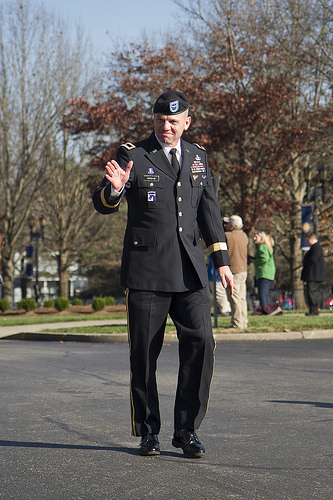
Brig. Gen. Stephen R. Hogan, Kentucky’s adjutant general walks in the Inaugural parade in Frankfort, Ky., Dec. 8, 2015. Hogan was selected by newly-elected Governor Matt Bevin to lead the Kentucky National Guard. (U.S. Army National Guard photo by Staff Sgt. Scott Raymond)
Click here for more photos.
As Kentucky’s 52nd adjutant general, Hogan will command the nearly 8,000 military members of the Kentucky Army and Air National Guard. He will also oversee the statewide Department of Military Affairs, Kentucky Emergency Management, the Appalachian and Bluegrass Challenge Academies and Bluegrass Station in Avon, Kentucky.
The cabinet-level post administers an annual budget of approximately $170 million to support operations at 56 armories, three major training sites and the Air National Guard base at Louisville International Airport.
Hogan brings a wealth of experience to the job, formerly serving as assistant adjutant general for the Kentucky Army National Guard. In that role, he was responsible for balancing the requirements of readiness, modernization, force structure and sustainment of the National Guard for mobilization and domestic missions. He oversaw specified units that provided wide ranging support to the National Guard’s federal and state mission sets, as well as those units that provided specialized support to civil authorities.
Hogan was commissioned through the Reserve Officer Training Corps program at Morehead State University in 1985. He earned a Master of Strategic Studies from the U.S. Army War College in 2008. In 2010 and 2013 he completed the U.S. Northern Command Joint Task Force Command Course and U.S. Northern Command Joint Dual Status Commander’s Course.
Hogan’s significant active duty assignments included tours with the 101st Airborne Division (Air Assault), Fort Campbell, Kentucky; 6th Infantry Division Light, Fort Richardson, Alaska; The Army Operations Center at the Pentagon, Washington, D.C., and Multi-National Corps Iraq, Baghdad, Iraq. When not serving on federal active duty, Hogan served in the Kentucky Army National Guard as an active duty Guardsman with the State’s Counter-Drug Unit, from June 1993 to February 2011.
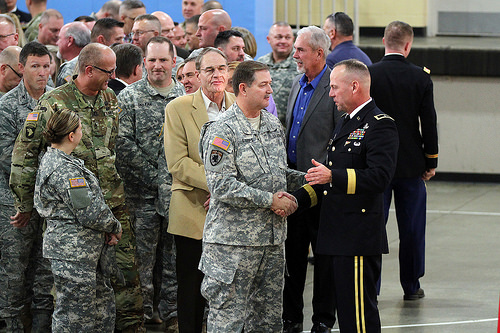
Command Chief Warrant Officer Dean Stoops congratulates Brig. Gen. Stephen R. Hogan on becoming Kentucky’s newest adjutant general during an introduction ceremony in Frankfort, Ky., Dec. 8, 2015. Hogan was officially introduced to members of the Kentucky Guard following the gubernatorial inauguration. (U.S. Army National Guard photo by Staff Sgt. Scott Raymond)
Hogan rode in the Inaugural parade through downtown Frankfort to the Capitol to attend Bevin’s public swearing in. Bevin praised Hogan’s service and expressed his trust in Hogan’s future as the leader of the Kentucky Guard.
“It is my pleasure to name Brigadier General Stephen R. Hogan as adjutant general for the Commonwealth of Kentucky,” said Bevin. “We owe our freedom and safety to the men and women of our military. General Hogan has served our country and our commonwealth with honor and distinction and understands first hand, the critical importance of the Citizen-Soldier. I have absolute confidence that he will be an excellent Commanding General.”
By Sgt. Brandy Mort, 133rd Mobile Public Affairs Detachment
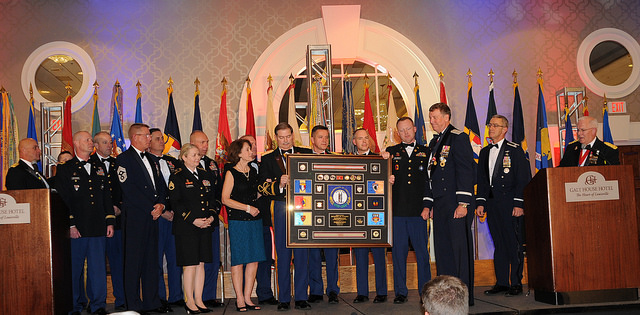
Members of the Kentucky National Guard command staff present Maj. Gen. Edward W. Tonini a framed collection of memorabilia from Kentucky units during a retirement ceremony in Louisville, Ky., Nov. 21, 2015. (U.S. Army National Guard photo by Sgt. Brandy Mort)
LOUISVILLE, Ky. — Maj. Gen. Edward W. Tonini doesn’t officially retire until Dec. 7, 2015. Representatives of the Kentucky Army and Air National Guard, distinguished guests, along with friends and family members gathered to honor Tonini’s legacy during a retirement ceremony in Louisville, Nov. 21.
After nearly 47 years of service, Tonini leaves behind an unprecedented legacy, not only to the service members he’s led and citizens of the commonwealth of Kentucky, but also to those he’s served alongside.
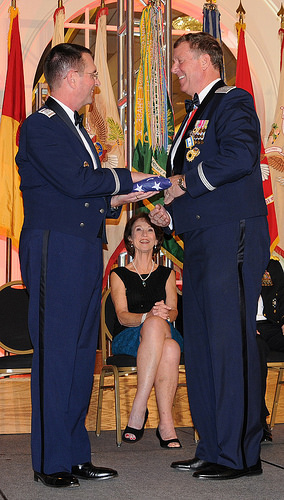
Lt. Gen. Joseph Lengyel, Vice Chief of the National Guard Bureau presents a flag to Maj. Gen. Edward Tonini as a token of appreciation from NGB during a retirement ceremony for Tonini in Louisville, Ky., Nov. 21, 2015. (U.S. Army National Guard photo by Sgt. Brandy Mort)
“On behalf of the Chief of the National Guard Bureau and the other adjutants general not in attendance, we owe you a great deal of gratitude, we thank you for your distinguished service, both in the state and National level,” said Lt. Gen. Joseph L. Lengyel, Vice Chief of the National Guard Bureau.
“On behalf of us all, thank you for all that you have done and will continue to do.”
Click here for more photos.
It was an emotional event for Tonini as countless amounts of awards, gifts, and tokens of gratitude were bestowed. As he stood at the podium in the ballroom, he couldn’t help but to pause before addressing the crowd.
“I am so spectacularly proud of what my units, both Army and Air have been able to accomplish. When you talk about Kentucky, I guarantee you they are at the top of any list. I want to look around this room and look upon every single one of your faces and say…” With tears in his eyes he said, “Thank you all.”
After first retiring in 2003 following a stint as the director of the National Guard’s “Your Defenders of Freedom” program at the Pentagon, Tonini was chosen as the 51st adjutant general of the Kentucky Guard.
Just a year later Tonini provided the decisiveness and effectiveness the commonwealth needed to respond to a catastrophic ice storm in 2009. The storm was the largest call-up of Kentucky Guardsmen in state history and it set the tone for the operational tempo of Kentucky’s Soldiers and Airmen.
Thousands of Kentuckians would deploy overseas and remain fully committed to the needs of the commonwealth. Under Tonini’s watch, a new emergency operations center was built, business was expanded at Bluegrass Station and numerous facilities’ construction projects were completed, all benefiting the Guard and the state.
Tonini took on the responsibility of multiple national-level positions during his tenure including president of the Adjutant General Association of the United States where he testified before government officials as a staunch advocate and defender of the National Guard.
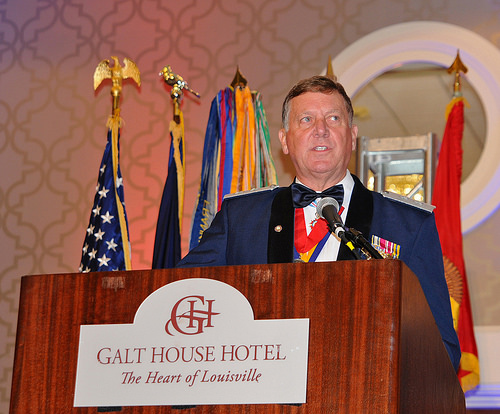
Maj. Gen. Edward W. Tonini speaks during his retirement ceremony in Louisville, Ky., Nov. 21, 2015. Tonini concluded his 47-year career by stating that he will always be a Guardsman. (U.S. Army National Guard photo by Sgt. Brandy Mort)
While it’s hard to summarize a such a long military career, the Kentucky Guard ensured Tonini received the gratitude of a state for eight years of dedication.
“Forty seven years is a long time and I can tell you this is incredibly difficult for me,” said Tonini. “I can promise you I will stay engaged in the best interest of the Kentucky National Guard, because I will always be a Guardsman.”
Story and photos by Lt. Col Kirk Hibrecht, Director of Public Affair, Kentucky National Guard
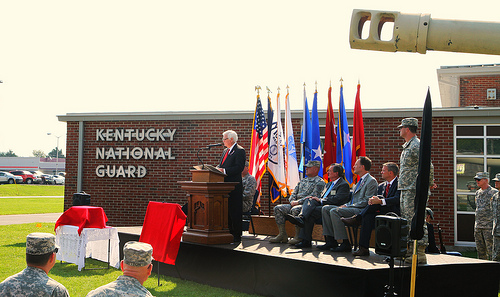
U.S. Representative Hal Rogers attends the casing of the colors ceremony of the Kentucky National Guard’s C Battery, 1st Battalion 623rd Field Artillery in Monticello, Ky. August 2, 2014. (Photo by Lt. Col. Kirk Hilbrecht, Kentucky National Guard Public Affairs).
MONTICELLO, Ky (August 2, 2014) -U.S. Representative Harold ‘Hal’ Rogers presided over the casing of the colors ceremony of the Kentucky National Guard’s C Battery, 1st Battalion 623rd Field Artillery in southern Kentucky on Saturday.
The artillery unit unveiled its new designation as Battery B, continuing its 168-year legacy as “Morgan’s Men” in Monticello.
The unit dates back to 1846 as the 1st Kentucky Calvary. Morgan’s men fought with John Hunt Morgan and the Confederacy during the Civil War. Elements of the 1/623rd participated in World War I, World War II, Korea, Desert Storm, Operation Iraqi Freedom, and Operation Enduring Freedom.
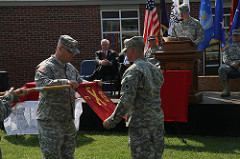
U.S. Representative Hal Rogers presides over the casing of the colors ceremony of the Kentucky National Guard’s C Battery, 1st Battalion 623rd Field Artillery in Monticello, Ky. August 2, 2014. (Photo by Lt. Col. Kirk Hilbrecht, Kentucky National Guard Public Affairs).
Congressman Rogers was a Kentucky Guardsman assigned to C Battery.
“Shortly after graduating from Wayne County High School, I went to the old armory building downtown Monticello, raised my right hand and enlisted in Battery C 1/623rd Field Artillery,” said Rogers. “As these colors of Battery C are permanently encased, let us rest calmly in the days to come knowing that the citizen soldiers of this community will continue to stand watch over us and guard this Nation’s security and our Commonwealth.”
Rogers was named the enlisted Soldier of the Year in the Kentucky National Guard in 1961.
“It’s an historic day and a bittersweet day as we case the colors of Battery C,” said Major General Tonini, adjutant general of Kentucky. “We will never forget the contribution to this community or to national defense.”
Following the casing ceremony, Congressman Rogers was presented with the Harry S. Truman Award, the highest honor of the National Guard Association of the United States (NGAUS).
“The Truman Award is more than just our association’s highest honor. It is recognition of inclusion in a special fraternity of patriots, people who have made a difference in the institutions that defend our nation,” said retired Maj. Gen. Gus Hargett, the president of the National Guard Association of the United States.
“Rep. Harold Rogers is just that kind a patriot,” he said.
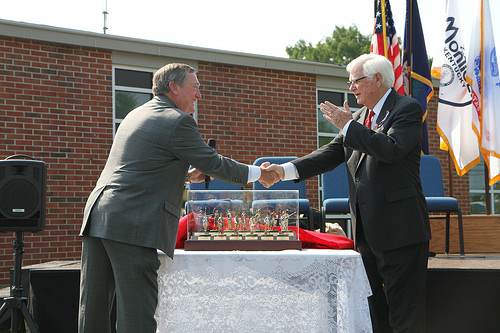
Maj. Gen. (retired) Gus Hargett, President of the National Guard Association of the United States presents the prestigious Harry S. Truman award to U.S. Representative Hal Rogers in Monticello, Ky. August 2, 2014. The Truman award is the Association’s highest honor for sustained and exceptional contributions to the security of the United States by a civilian or military leader (Photo by Lt. Col. Kirk Hilbrecht, Kentucky National Guard Public Affairs).
Story by Staff Sgt. Scott Raymond, Kentucky National Guard Public Affairs
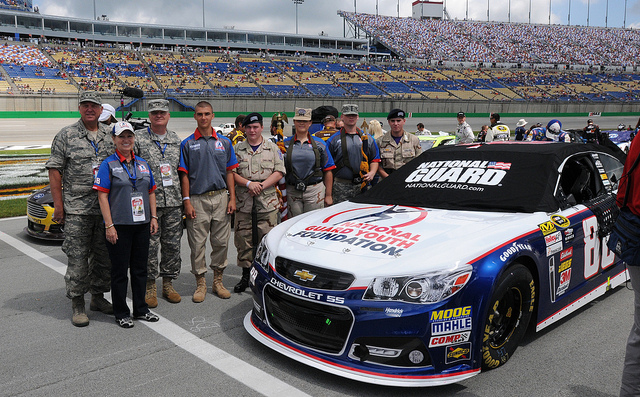
Kentucky’s adjutant general, Maj. Gen. Edward W. Tonini joins Gail Dady of the National Guard Youth Foundation, Louisiana’s adjutant general, Maj. Gen. Glenn H. Curtis and Challenge Program cadets for a group photo with the 88 Chevrolet on pit road prior to the start of the Quaker State 400 NASCAR race at Kentucky Speedway in Sparta, Ky., June 30, 2013. The National Guard Youth Foundation teamed up with Hendrick Motorsports to race the 88 with a special logo for the race at Kentucky Speedway. (U.S. Army National Guard photo by Staff Sgt. Scott Raymond)
SPARTA, Ky. — Persistent rain showers did little to dampen the spirits and excitement of a group of teens at the Kentucky Speedway this past weekend. The young men and women are current and former cadets with the National Guard Youth Challenge programs. They were given a full-access pass to all NASCAR had to offer at this year’s Quaker State 400 race at the track in Sparta, Ky.
As part of the National Guard Youth Foundation - the national nonprofit that supports Challenge - and the Challenge program’s relationship with Hendrick
Motorsports, several cadets, foundation officials and members of the National Guard were invited to the track to see Dale Earnhardt Jr. drive the number 88 Chevrolet with a special National Guard Youth Foundation logo on his car.
To see more photos from the race weekend, click here.
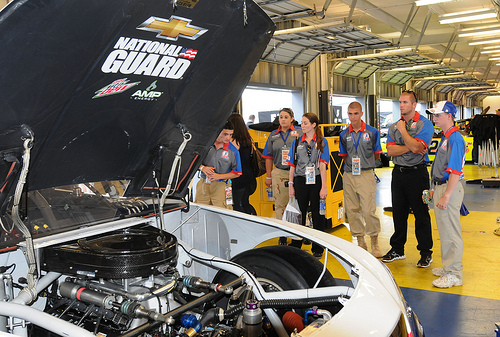
Challenge program cadets receive a garage tour from Hendrick Motorsports prior to the running of the Quaker State 400 NASCAR race at the Kentucky Speedway in Sparta, Ky., June 29, 2013. The tour was part of a full weekend of race access for the cadets as part of the relationship between Hendrick Motorsports and the National Guard Youth Foundation. (U.S. Army National Guard photo by Staff Sgt. Scott Raymond)
“We are honored and deeply appreciate the opportunity to partner with Hendrick Motorsports and Dale Earnhardt Jr. to raise awareness of the Challenge program,” said Gail Dady, National Guard Youth Foundation Board of Directors President. “The Hendrick Motorsports team went to an extraordinary level to make this an unforgettable experience for the cadets.”
The excitement began Friday morning with a press conference announcing the sponsorship and highlighting the Challenge programs. Rome Meade, a graduate of the Appalachian Challenge Academy in Harlan, Ky., sat with Dady, Earnhardt Jr., and Kentucky’s adjutant general, Maj. Gen. Edward W. Tonini in the press room at the track for the interaction with media. Meade said he was proud to have Earnhardt drive for the program, acknowledging that many more people will know about the program after the race.
In between the rain drops, Meade and his fellow cadets were treated to garage tours, a meet and greet with Earnhardt, Rick Hendrick, owner of Hendrick Motorsports and also University of Kentucky Basketball coach John Calipari.
During the meet and greet, Earnhardt told the cadets and the crowd that the relationship he has had with the National Guard has been one he has had a lot of fun with and takes very seriously. He said he was honored to drive his car with the foundation logo in the race and remains excited to be a part of the program.
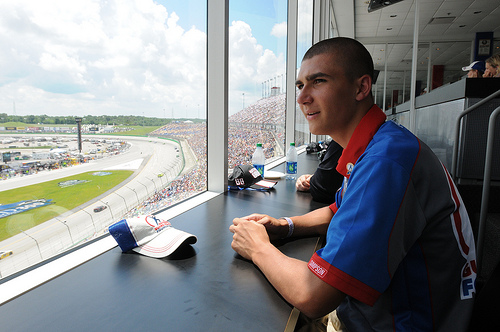
Jeremy Suhor, a cadet with the Louisiana Youth Challenge program watches the Quaker State 400 NASCAR race from his seat at the Kentucky Speedway in Sparta, Ky., June 30, 2013. A life-long race fan, the race was Suhor’s first in person. (U.S. Army National Guard photo by Staff Sgt. Scott Raymond)
“This is a great opportunity for us to tell more people about the Youth Foundation,” he said. “What it’s about, what it does, what it entails and how many kids’ lives it’s helped turned around, and the effect it’s had on the communities.”
Although Earnhardt didn’t drive the car into victory lane on Sunday, the clouds did part long enough for the cadets to enjoy the full race a day late. They were still trackside presenting the colors for the pre-race festivities and had the time to walk pit road and take some memorable snapshots with their favorite cars. The cadets eventually found a front and center seat for the race in a suite above the start/finish line of the track.
“I never expected to be at my first NASCAR race,” said New Orleans native, Jeremy Suhor, a cadet at the Louisiana Youth Challenge Program. “I’ve had a lot of great opportunities since I’ve been in Challenge.”
“The weekend has been awesome,” said Meade. “It’s one of the best experiences of my life.”
To learn more about the National Guard Youth Foundation, visit their website www.ngyf.org.
The following is a compilation of significant dates in our Commonwealth’s military history. For more on the legacy of our Citizen-Soldiers and Airmen, visit the Kentucky National Guard eMuseum.
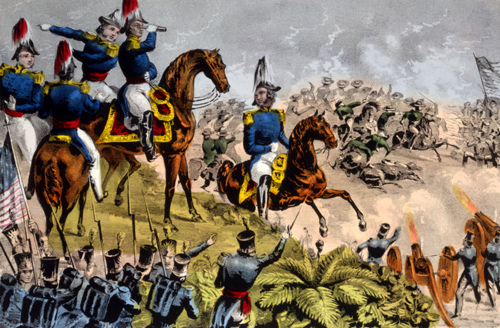
Battle of Buena Vista, February 23, 1847
February 1 – National Freedom Day. Honors the signing by President Abraham Lincoln of a resolution that later became the 13th Amendment to the U.S. Constitution. Lincoln signed the Amendment outlawing slavery on Feb. 1, 1865
February 3, 1900 – Daniel Ray Collier and John Breckinridge Castleman serve simultaneously as Adjutant General of Kentucky following the disputed 1900 governor’s election. Collier was the re-appointed Adjutant General under Gov. William S. Taylor, he remained in office in the Old Capitol, until May 22, 1900, at which time he yielded the office to General Castleman in compliance with a U.S. Supreme Court order.
February 4, 1818 – $300.00 appropriated to pay for a plan for a state armory in Kentucky.
February 4, 1917 – Harold Hite of Company A, 3rd Kentucky Infantry Regiment died of Pneumonia while on Federal Duty during the Mexican Border Campaign.
February 5, 1951 – Battle of Hill 440 began (Korean War)
Siege of Fort Henry on the Tennessee River, 1862
February 6, 1862 – Fall of Fort Henry followed by Fort Donelson (Civil War)
February 6, 1992 – Kentucky Air National Guard C-130 crash in Evansville, IN. Maj. Richard A. Strang, Capt. Warren G. Klingaman, Lt. Vincent D. Yancar, Master Sgt. William G. Hawkins and Master Sgt. John M. Medley perished during a training flight, when their Kentucky Air National Guard Lockheed C-130B struck Drury’s Inn Motel and then crashed into JoJo’s restaurant exploding into flames. Eleven persons on the ground were killed.
February 8, 1778 – Daniel Boone and 27 men with him captured at Blue Licks by Indians.
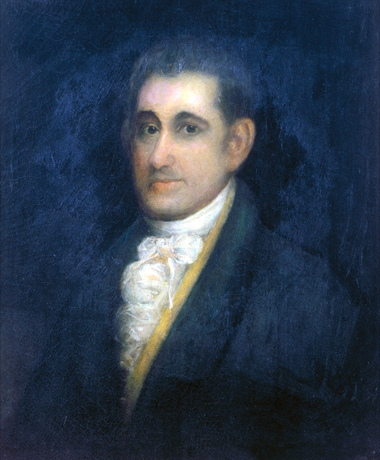
John Adair, former adjutant general and eighth governor of Kentucky
February 10, 1816 – Gen. John Adair receives “the highest approbation and thanks of the legislature” of Kentucky, for his gallantry at the battle of New Orleans, and more particularly for the deep interest he took in vindicating a respectable portion of the troops of Kentucky from the inappropriate imputation of cowardice, most unjustly thrown upon them” by Gen. Andrew Jackson.
February 11, 1860 – Gov. Beriah Magoffin of Kentucky directed to procure suitable gold medals, to present, in the name of the state, to each of the surviving Kentucky volunteers in the Battle of Lake Erie on September 10, 1813.
February 11, 1917 – Capt. Estel E. Owsley, Company H, 2nd Kentucky Infantry Regiment from Middlesboro died at Fort Thomas, Kentucky. He took ill on the trip from El Paso, TX to Kentucky as the unit returned from federal duty on the Mexican border.
February 12, 1973 – Operation Homecoming began (Vietnam War)
February 13, 1957 – United States Property & Fiscal Officer (USP&FO) Kentucky offices and warehouse facilities located on Bowman Field was destroyed by fire. Total property loss exceeded $250,000.
February 15, 1898 – Sinking of the USS Maine (Spanish-American War)
February 16, 1951– Siege of Wonsan began (Korean War)
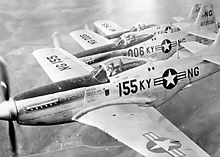
P-51 Mustangs of the Kentucky Air National Guard
February 16, 1947 – Federal recognition of the Kentucky Air National Guard units granted by National Guard Bureau. Original units of the Kentucky Air National Guard were: HQ, 123rd Fighter Group; HQ Detachment, 223rd Air Service Group; Detachment A, 223rd Air Service Group; 165th Fighter Squadron; 165th Utility Flight; 165th Weather Station.
February 19, 1849 – Act passed directing the “the following names of battles and campaigns be inscribed upon the bands of the State Military Monument (Frankfort cemetery): Boonesborough, Blue Licks, Estill’s Defeat, St. Clair’s Defeat, Harmar’s Defeat, Wayne’s Campaign, Indian Wars, Tippecanoe, Raisin, Mississiniwa, Fort Meigs, Thames, New Orleans, Monterey, Cerro Gordo, Buena Vista, Mexico; that the names of such distinguished citizens of Kentucky as fell in said battles, campaigns and Indian Wars be inscribed on the shaft, beneath said bands; and that the dedication on the monument shall show that it is erected by a grateful country in honor of the private soldiers, equally with that of the officers.”
February 19, 1945 – US Marines landed on Iwo Jima (World War II)
February 20, 1850 – From the Kentucky Legislature. The thanks and gratitude of the people of Kentucky, and a sword, tendered to Sgt. William F. Gaines of Georgetown, “the boy defender of the glorious banner of the 2nd Regiment of Kentucky Infantry, at the Battle of Buena Vista;” his name to be inscribed on a plate of metal, and attached to the flagstaff of the colors.
February 22, 1917 – 1st Sgt. William C. Liles of Company H, 3rd Kentucky Infantry Regiment from Hartford, Ohio County, Kentucky died of pneumonia while on active federal duty near El Paso, TX. Liles joined Company H when it was formed in 1906. (Mexican Punitive Expedition)
February 22, 1967 – Operation Junction City began (Vietnam War)
February 22-23, 1847 – Gen. Zachary Taylor, after two days of severe fighting, wins a great victory over the Mexican Army at Buena Vista — A small American army under the command of Gen. Taylor defeats a much larger force commanded by Gen. Santa Anna, President of Mexico. About ninety percent of Taylor’s army was composed of state volunteer (Guard) units, several of which were heavily engaged in the fight. The 2nd Kentucky Volunteer Infantry’s, second in command, Lt. Col. Henry Clay, Jr. (son of the famous former Secretary of State and Speaker of the House of Representatives) was killed while leading his men in blunting the Mexican assault. The 1st Mississippi Rifles, under the command of Col. Jefferson Davis (a Kentuckian and future U. S. Secretary of War and President of the Confederacy) and the 2nd Kentucky Cavalry charged into the flank of the Mexicans routing them off the field. (Mexican-American War)
February 23, 1847 – Resolutions passed by the Kentucky Legislature, complimentary to the Louisville Legion, and to Gens. Zachary Taylor and William O. Butler for their gallantry in Mexico, and directing the presentation of a sword to each of those generals, and to the widow of Maj. Philip Norbourne Barbour. Barbour fell at Monterey, and his body was directed to be buried in the state cemetery at Frankfort (Mexican-American War)
February 23, 1854 – Kentucky Legislature directs a sword to be presented to Henry E. Read, of Larue County, late ensign in Col. Andrews’ regiment of voligeurs, for gallant services in bearing the flag of his country through all the battles in the valley of Mexico, until he fell covered with wounds under the walls of Chapultepec.
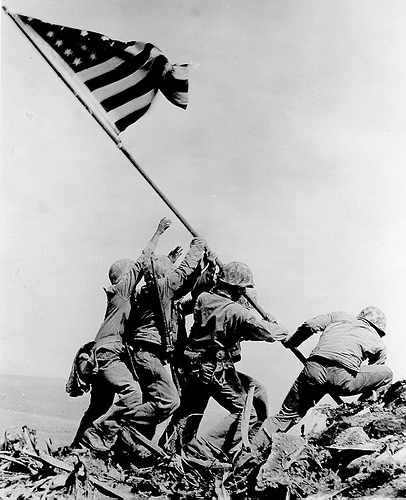
Iconic photograph by Joe Rosenthal of the raising of the American Flag on Mt. Suribachi, Feb. 23, 1945.
February 23, 1945 – U.S. Marines raised flag on Mt. Suribachi (Battle of Iwo Jima) (World War II)
February 23, 1969 – Post-Tet Offensive began (Vietnam War)
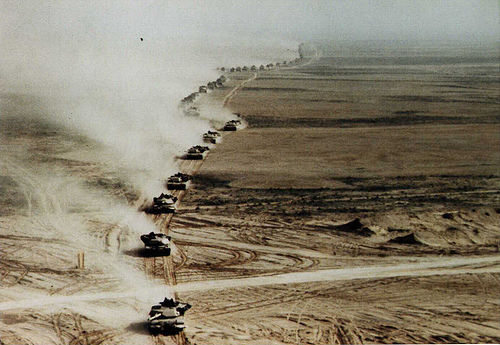
A U.S. convoy rolls through Kuwait during the ground campaign of Desert Storm, Feb. 1993.
February 24, 1991 – Operation Desert Storm ground campaign began.
February 25, 1848 – $15,000 appropriated to pay for a military monument in the state cemetery, “to commemorate the deeds of Kentucky’s gallant dead.”
February 25, 1871 – In making excavations at Monroe, Michigan, 30 human skulls and numerous bones were exhumed, the remains of Kentuckians massacred following the disastrous battle of the River Raisin.
February 26, 1991 – Battle of 73 Easting (Desert Storm)
February 27, 1991 – Battle of Medina Ridge (Desert Storm)
February 27, 1991 – Battle of Norfolk (Desert Storm)
February 28, 1847 – Gen. Alexander Doniphan (born, Maysville, Ky.) defeats the Mexicans at Sacramento, in Chihuahua (Mexican-American War)
February 28, 1867 – Dr. John M. Johnson, petitions the Kentucky Legislature an appropriation for the purpose of re-interring, in cemetery grounds at Atlanta, Georgia, the Kentucky Confederate dead who fell at Chickamauga, Missionary Ridge, Dalton, Atlanta, Decatur, Jonesboro, and in East and Middle Tennessee; about 300 identified and 200 unidentified.
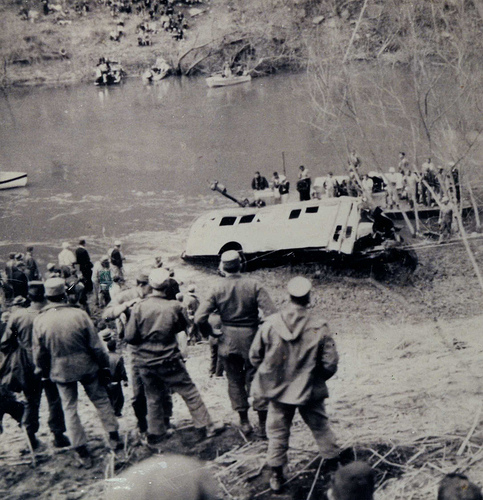
Kentucky National Guard troops assist in the recovery mission following the Prestonsburg school bus disaster, Feb. 28, 1958.
February 28, 1958 – Prestonsburg School Bus Disaster - What was then called the “worst traffic accident involving school children in the history of the United States” happened near Prestonsburg, Ky., when a school bus containing 48 children hit a wrecker and swerved into the flood swollen Levisa Ford of the Big Sandy River and disappeared. Twenty-two children escaped the bus before it sank and was swept away. The last body was not recovered until May 10th. The Kentucky National Guard assisted with the recovery operations.
Story and photos by Sgt. Scott Raymond, Kentucky National Guard Public Affairs
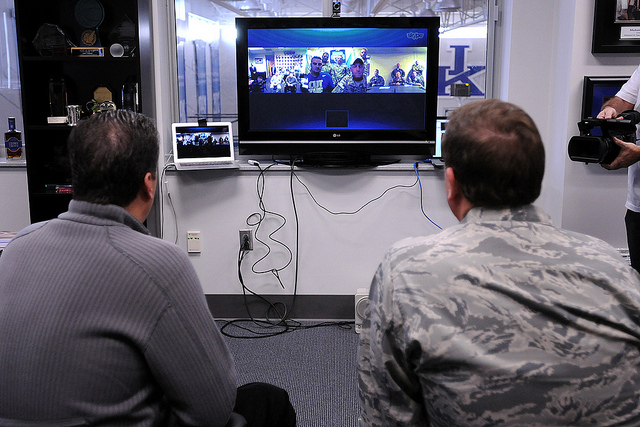
University of Kentucky basketball coach John Calipari and Kentucky Adjutant General Maj. Gen. Edward W. Tonini talk with deployed Guardsmen via Skype from Calipari’s office in Lexington, Ky., Jan. 8, 2013. The call connected the coach with Kentucky Soldiers in Africa and Camp Shelby, Miss. (Kentucky National Guard photo by Sgt. Scott Raymond)
LEXINGTON, Ky. — For some Kentucky Guardsmen, being deployed overseas got a little bit easier on January 8, 2013 with a unique opportunity to chat with University of Kentucky men’s basketball coach John Calipari. A Skype conference from the UK campus connected the coach and Kentucky Adjutant General, Maj. Gen. Edward W, Tonini with Soldiers in the Horn of Africa and Camp Shelby, Miss.
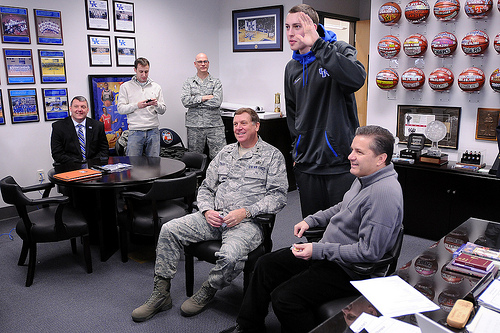
University of Kentucky sophomore forward Kyle Wiltjer waves to troops watching a skype conference with coach John Calipari and adjutant general Maj. Gen. Edward W. Tonini in Lexington, Ky., Jan. 8, 2013. Deployed Guardsmen had the opportunity to talk with Calipari and Wiltjer about UK’s season. (Kentucky National Guard photo by Sgt. Scott Raymond)
“It was really exciting to have the unique opportunity to speak to Coach Cal, a first for me,” said Staff Sgt. Robbie Simpson of the 1st Battalion, 623rd Field Artillery, currently in Camp Shelby. “And is was an enjoyable break from the training schedule. It felt like home for a few.”
To see more photos from this story, click here.
Deployed Kentucky Guardsmen have said that one of the worst things about being away from home is being away from UK basketball. Soldiers of the 2nd Battalion, 138th Field Artillery serving in Djibouti, Africa donned their blue t-shirts and hung a UK flag as a backdrop for the call. The Soldiers of the 1/623rd just recently arrived in Mississippi where they are preparing to deploy to Jordan in the coming weeks.
But for a short time, Djibouti and Camp Shelby might have well been Rupp Arena for the Soldiers, as they reveled in the chance to ask Coach Cal questions and give him their opinions of how the Wildcats are doing this season.
Sophomore forward Kyle Wiltjer also made a surprise appearance to talk with the troops and flash his “three googles,” (you may need to be a UK fan to understand that one).
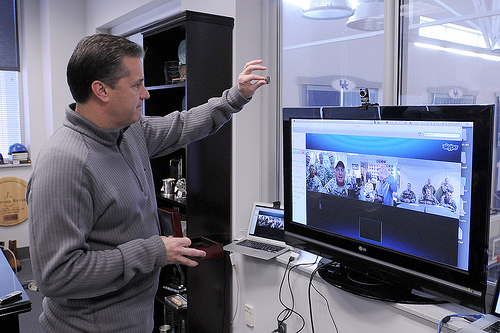
University of Kentucky men’s basketball coach John Calipari shows off his 2012 NCAA National Championship ring to deployed Soldiers during a Skype call from Lexington, Ky., Jan. 8, 2013. Calipari took the opportunity to thank the Soldiers for their service and dedication to his team. (Kentucky National Guard photo by Sgt. Scott Raymond)
Calipari shared his thoughts on the Wildcats, both this year and last, and showed off the 2012 NCAA National Championship ring to the troops. He commended them for their courage, thanking them for their service to Kentucky and the country.
“His remarks and the genuine comments that were made is an example of the true ambassador that he has become for the entire state, not just sports or for the military, but for the citizens as well,” said Simpson.
“Coach Cal has shown an incredible willingness to be with us, to be part of us, we consider him a Guardsman, even though he’s a basketball coach,” said Tonini. “He’s part of our team and everyone knows that and appreciates that.”
The following is a compilation of significant dates in our commonwealth’s military history. For more on the legacy of our Citizen-Soldiers and Airmen, visit the Kentucky National Guard eMuseum.
January 1, 1953 – Units of the 123rd Fighter- Interception Wing, including Group Headquarters and the 165th Squadron were redesignated as fighter-bomber units.
January 1, 1962 - Navy SEAL teams established by President John F. Kennedy
January 1, 1968 – Assault on Fire Base Burt (Vietnam War)
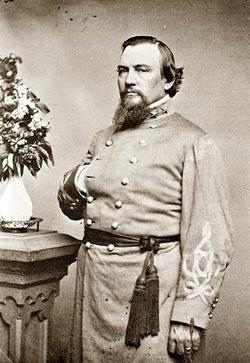
Confederate General Roger Weightman Hanson, Commander of the “Orphan Brigade” during the Civil War. Hanson is buried in Lexington, Ky.
January 4, 1863 - Confederate General Roger Weightman Hanson dies at Murfreesboro, Tennessee. His death was a result of wounds sustained two days earlier at the Battle of Stones River. Hanson was born in 1827 in Clark City, Tennessee. He served during the Mexican War and was a lawyer and a colonel in the Kentucky State Guard before the Civil War. He joined the Confederate army in September 1861 and received a commission as colonel in the 2nd Kentucky. He was assigned to Fort Donelson on the Cumberland River and when Union General Ulysses S. Grant captured the post on February 16, 1862, Hanson was sent to a Federal prison. He was exchanged after eight months and placed in command of the “Orphan Brigade.” The Orphan Brigade was a unit composed of 5,000 Kentucky residents who were cut off from their homes by the Union occupation of their state.
January 4, 1912 – William Birch Haldeman is appointed Adjutant General of Kentucky by Gov. James B. McCreary.
January 7, 1815 – 2,500 Kentucky militia, under Maj. Gen. John Thomas, less than one-fourth of them armed (as their arms were on flat-boats, not yet arrived), reach New Orleans. (War of 1812)
January 7, 1948 – Capt. Thomas Francis Mantell Jr., was killed while on a training flight with three other P-51Ds (Mustang). Mantell was directed by flight tower at Godman Field, Ft. Knox, to pursue an unidentified flying object. While in pursuit of the object, his aircraft crashed near Franklin, Simpson County, Ky. Capt. Mantell was the first flight casualty of the Kentucky Air National Guard.
January 8, 1815 – American victory at the Battle of New Orleans. (War of 1812)
January 8, 1967 – Operation Cedar Falls (Vietnam War)
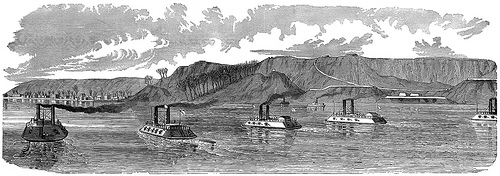
Illustration of Columbus, Ky. and Union gunboats on the Mississippi River. Illustration from Frank Leslie Famous Leaders and Battle Scenes of the Civil War (New York, NY: Mrs. Frank Leslie, 1896)
January 11, 1862 – Gunboat action at Columbus, Kentucky. (Civil War)
January 12, 1945 – 1st Lt. George A. Vanarsdale, Headquarters Company, 192nd Light Tank Battalion (Harrodsburg Tankers) died when the Japanese “Hell Ship” Enoura Maru was sunk (World War II)
January 13, 1917 – Lt. Nathaniel Gibson Hale of Murray’s L Company, Third Kentucky Infantry died of an accidental gunshot wound. Hale was in his tent at the regimental camp, Camp Owen Bierne, some two miles from Fort Bliss, near El Paso, TX. He was part of the Kentucky National Guard contingent called to federal duty to patrol a sixty mile stretch of the border between Fort Bliss and Fort Hancock during the Mexican Punitive Expedition. Hale belonged to the Murray unit, joining as a Pvt. on June 22, 1912. He was promoted to Sgt. and 1st Sgt. and elected 1st Lt. on July 10, 1914.
January 17, 1991 – Operation Desert Storm began
January 18, 1813 – Battle of Frenchtown, Michigan Territory (Monroe, MI) (War of 1812)
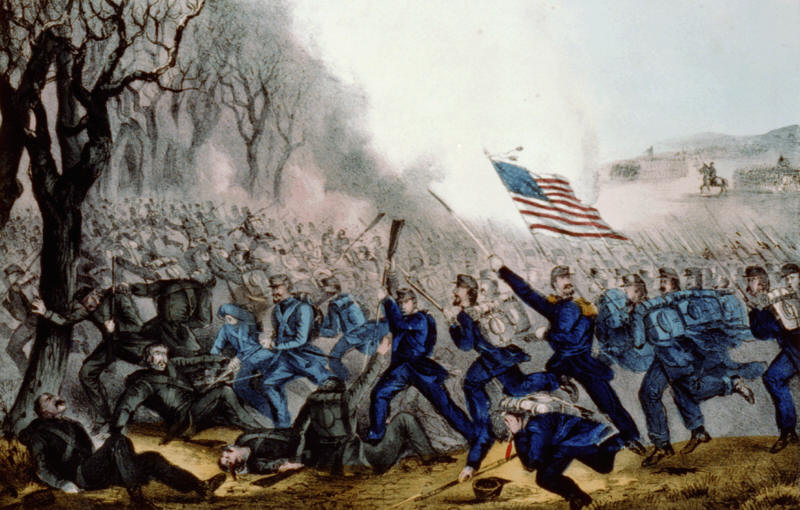
January 19, 1862– Battle of Mill Springs, Pulaski County (Civil War)
January 20, 1968 – Battle of Khe Sanh began (Vietnam War)
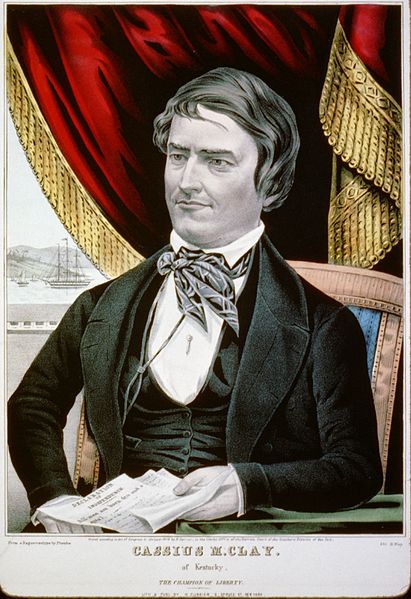
January, 1847 – Maj. John P. Gaines and Capt. Cassius M. Clay, with 30 Kentucky cavalry, along with 50 Arkansas cavalry, are surrounded at Encarnacion by an overwhelming force of Mexican cavalry, and compelled to surrender, taken to the city of Mexico, and imprisoned (Mexican-American War)
January 21, 1839 – The “Louisville Legion,” of dragoons, artillery, infantry and riflemen, authorized as part of the Kentucky Militia.
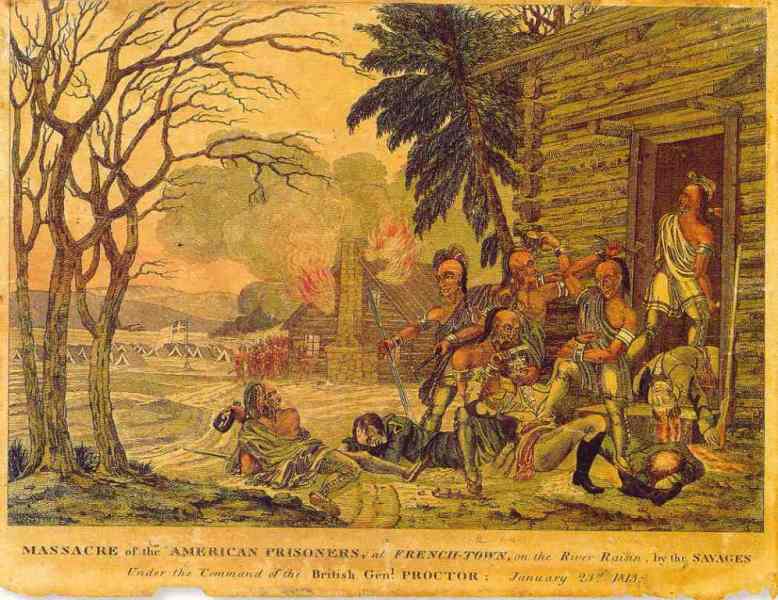
January 22-23, 1813 – Battle of the River Raisin, disastrous defeat and massacre of Kentucky troops. “Remember the Raisin” would become the battle cry of Kentucky troops during the remainder of the war in the northwest (War of 1812)
January 22, 1944 – Allies land at Anzio, Italy (World War II)
January 23, 1937 – Sgt. Thomas J. “Tommy” Brown of Madisonville, drowned while on state active duty in response to the flood of 1937. He was assigned to Headquarters Company, 3rd Battalion, 149th Infantry from Madisonville. He is the only known Kentucky National Guardsman who perished on duty during the great flood of 1937. According to newspaper accounts, Brown and 2ndLt. James L. Moore, Pvt. C. W. Anthony and a civilian, Emmett Ashby, were in a boat that lost its stern from vibrations from an outboard motor and quickly sank by the stern throwing all four into the nine-foot deep water. The other three were able to swim to shallow waters but did suffer from exposure and shock. Brown was last seen clinging to the boat bow debris before he sank from sight. The Guardsmen were on a survey mission to assess conditions in Ashbyburg and Jewel City area and Ashby was catching a ride to Ashbyburg in hopes of getting another ride closer to his home. Brown was a butcher in civilian life and was married and had one child. Brown’s battalion commander, Oren Coin, wrote a letter to a legislative committee on the widow’s behalf in December of 1937 seeking some sort of relief for his family. Sgt. Brown’s death most likely was the beginning of the push for the state’s death gratuity for Kentucky National Guardsmen who die on State Active Duty missions.
January 24, 1955 – Col. Philip P. Ardery, senior commander of the Kentucky Air National Guard since its founding, was promoted to the rank of Brig. Gen., the first Kentucky Air Guard member to wear the star of a general officer.
January 25, 1944 – Gustavus Herbert May is appointed Adjutant General of Kentucky by Gov. Simeon Willis.
January 25, 1951 – Operation Thunderbolt began (Korean War)
January 26, 1968 – All units of the Kentucky Air National Guard except state Headquarters were called to federal service. Kentucky is only one of two states to have both Air and Army Guard units called up in 1968 (the other being Kansas). Kentucky was the only state to have both Air and Army mobilized units deploy overseas. The 165th Tactical Reconnaissance Squadron was assigned, along with two other Air National Guard recon squadrons to a rotation scheme which had each squadron assigned for 60-90 days to the Panama Canal, Alaska and Itazuke Air Base in Japan. During these missions their RF-101 Voodoo jets would photograph areas of interest looking for Soviet, or in the case of Japan, North Korean, naval activity. While the 165th was stationed in Japan in the spring of 1969 one of its pilots, Captain William Seiber, was almost killed when his plane exploded upon take off. The unit returned home and was released from active duty on June 9, 1969. (Pueblo Call-up/Vietnam War)
January 27, 1943 – Sgt. Elzie E. Anness, Headquarters Company, 192nd Light Tank Battalion (Harrodsburg Tankers) died at Camp Tanagawa, Osaka, Japan of dysentery (World War II)
January 28, 1957 – 1st Lt. Owen W. Turner, of Pleasure Ridge (Jefferson County) died when his burning plane crashed near Piedmont, Alabama, some sixty miles west of Atlanta. Turner was flying a T-28 from the Naval Air Station at Atlanta for a navigational proficiency flight to Standiford Field. Turner decided to return to Atlanta because of worsening weather conditions in his flight path. Turner joined the Kentucky Air National Guard in 1948 and was a member of the 165th Fighter Interceptor Squadron.
January 27, 1973 – Signing of Vietnam Peace Accord (Vietnam War)
January 29, 1828 – Preston S. Loughborough is appointed Adjutant General of Kentucky by Gov. Joseph Desha.
January 30, 1968 – Tet Offensive began (Vietnam War)
January 31, 1945 – 2nd Lt. Archibald B. “Arch” Rue, Company D, 192nd Light Tank Battalion (Harrodsburg Tankers) died at Camp Fukupka #3 Yawata, Kyushu, Japan of acute colitis (World War II)
January 31, 1956 – Col. Lee J. Merkel, veteran commander of the Kentucky Air National Guard’s base and vice commander of the 123rd Fighter-Interceptor Wing, was killed in an air crash of an F-51 Mustang 10 miles north of Bedford, In.
January 31, 1968 – Battle of Hue began (Vietnam War)
The following is a compilation of significant dates in our commonwealth’s military history. For more on the legacy of Kentucky’s men and women in uniform, visit the Kentucky National Guard eMuseum.
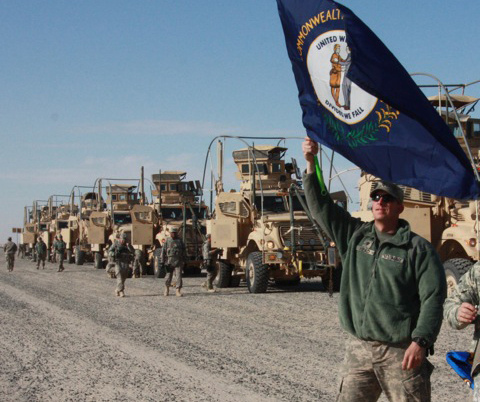
A Kentucky Guardsman waves the Kentucky flag at the border crossing into Kuwait, Dec.2, 2011, as part of one of the last Kentucky convoy out of the country. (Kentucky National Guard photo by Capt. Andrea Hahn)
December 1, 2009 – Pfc. Alva Lorenzy Holland, of Bellevue, Ky. (Campbell County) was on active duty status when he was killed in a motorcycle accident. Holland was en route to 149th Vertical Engineer Construction Company of Cynthiana when the accident occurred. Holland was a medical assistant at a chiropractic center in Cincinnati, Ohio. He was a 2004 graduate of Bellevue High School. Holland was a medic in the Kentucky National Guard’s 149th Vertical Engineer Construction Company. Holland volunteered for an active duty deployment in February, 2010 with the 2123rdTransportation Company.
December 2, 2011 - Last Soldiers of the 149th Maneuver Enhancement Brigade leave Iraq. They are among the final U.S. Forces to exit the country following the nearly nine-year war.
December 6, 1776 – Kentucky County established by Virginia, out of part of Fincastle County.
December 7 – National Pearl Harbor Remembrance Day, observed in remembrance of the December 7, 1941 attack.
December 7, 1971 – Richard L. Frymire is appointed Adjutant General of Kentucky by Gov. Wendell H. Ford. He would be re-appointed by Gov. Julian Carroll. Frymire, the former commander of the 165th Rac. Recon. Sq. became the first member of the Kentucky Air National Guard to serve as Adjutant General of Kentucky.
December 7, 1987 – Michael Walker Davidson is appointed Adjutant General of Kentucky by Gov. Wallace G. Wilkinson.
December 8, 1941 – The United States declared war on Japan (World War II)
December 8, 1941 – Initial Japanese attack on the Philippine Islands. Co. D, 192nd Tank Battalion (aka “The Harrodsburg Tankers”), come under attack. (World War II)
December 8, 1959 – Arthur Young Lloyd is appointed Adjutant General of Kentucky by Gov. Bert T. Combs and re-appointed by Gov. Edward T. Breathitt.
December 8, 1977 – Billy Gene Wellman is appointed Adjutant General of Kentucky by Gov. Julian M. Carroll. He would be re-appointed to the position by Govs. John Y. Brown, and Martha Layne Collins.
December 9, 1947 – Roscoe Lee Murray is appointed Adjutant General of Kentucky by Gov. Earle C. Clements and re-appointed by Gov. Lawrence W. Wetherby.
December 9, 1990 – 1st Battalion, 623rd Field Artillery federally activated for Operation Desert Shield/Storm.
December 9, 2003 – Donald C. Storm is appointed Adjutant General of Kentucky by Gov. Ernest Fletcher.
December 10, 1829 – Peter Dudley is appointed Adjutant General of Kentucky by Gov. Thomas Metcalf. Dudley would be re-appointed to the position by Governors John Breathitt, James T. Morehead, James Clark, Charles A. Wicklife, Robert P. Letcher, William Owsley, John J. Crittenden, and John L. Helm.
December 10, 1895 – Daniel Ray Collier receives his first appointment as Adjutant General of Kentucky from Gov. William O. Bradley. He received a second appointment on November 1, 1898, from Gov. William S. Taylor. Collier was re-appointed Adjutant General under Gov. William S. Taylor on December 13, 1899, following the contested governor’s election, and continued to hold office simultaneously with John B. Castleman from February 3, 1900 while the two candidates disputed the issues in the courts. Collier remained in office in the Old Capitol, serving under Taylor, until May 22, 1900, at which time he yielded the office to General Castleman in compliance with a U.S. Supreme Court order.
December 10, 1903 – William Purcell Dennis (Percy) Haly is appointed Adjutant General of Kentucky by Gov. J.C.W. Beckham.
December 10, 1939 – John Arthur Polin is appointed Adjutant General of Kentucky by Gov. Keen Johnson.
December 10, 1950 – Wonsan-Hungnam Campaign ended (Korean War)
December 10, 1991 – Robert Louis DeZarn is appointed Adjutant General of Kentucky by Gov. Brereton C. Jones.
December 11, 1923 – Jouett Henry Adjutant General of Kentucky by Gov. William J. Fields.
December 11, 1935 – George Lee McClain is appointed Adjutant General of Kentucky by Gov. Albert B. (Happy) Chandler.
December 11, 1941 – The United States declared war on Germany and Italy (World War II)
December 11, 1951 – Jesse Scott Lindsay is appointed Adjutant General of Kentucky by Gov. Lawrence W. Wetherby.
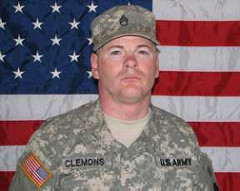
Staff Sgt. Thomas Clemons
December 11, 2006 – Staff Sgt. Thomas W. Clemons, Falls of Rough, (Grayson County) Ky., died as he was preparing to go on patrol with his team near Ad Diwaniyah, Iraq, when he succumbed to a heart attack. A member of the Kentucky Army Guard since August 2000, Clemons deployed in March 2006 to Iraq with Company B, 2nd Battalion, 123rdArmor.
December 11, 2007 – Our current Adjutant General, Maj. Gen. Edward W. Tonini is appointed to the role by Gov. Steve Beshear.
December 12, 1967 – Allan Kenneth Carrell is appointed Adjutant General of Kentucky by Gov. Louie B. Nunn.
December 12, 1985 – Gander, Newfoundland airplane crash. Upon leaving the Gander airfield, a military chartered Arrow Air DC-8 left from Gander headed for Fort Campbell, Kentucky, the plane crashed killing all 256 people aboard. Two hundred forty-eight members of the 101st Airborne Division and eight crewmembers died.
December 12, 1995 – John Russell Groves, Jr. is appointed Adjutant General of Kentucky by Gov. Paul E. Patton.
December 13, 1636 - General Court of the Massachusettes Bay Colony ordered the organization of the Colony’s militia companies into three regiments: The North, South and East Regiments. The colonists had adopted an English militia system in which all males, aged 16-60 were required to possess arms and participate in the defense of the community. The roots of the modern day National Guard.
December 13, 1907 – Philip Preston Johnston is appointed Adjutant General of Kentucky by Gov. Augustus E. Wilson.
December 13, 1955 – John Jacob Bethurum Williams is appointed Adjutant General of Kentucky by Gov. Albert B. Chandler.
December 13, 2003 - Deposed Iraqi leader Saddam Hussein captured near his home town of Tikrit, Iraq by U.S. Forces.
December 14, 1927 – William Henry Jones, Jr. is appointed Adjutant General of Kentucky by Gov. Flem D. Sampson and re-appointed to the position by Gov. Ruby Laffoon.
December 14, 1944 – Staff Sgt Joseph Baxter Million, and Pvt. Willard R. Yeast, both of Company D, 192nd Light Tank Battalion (aka “The Harrodsburg Tankers”) died when they were burned to death during the Palawan Island Massacre (World War II)
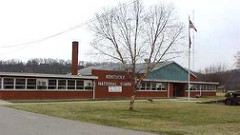
Caldwell Armory in Carrollton, Ky.
December 14, 2002 – Carrollton National Guard Armory named in honor of Robert “Goose” Caldwell.
December 16, 1944 – Battle of the Bulge began (World War II)
December 16, 1951 – 1st Lt. Lawrence Bertrand Kelly of Louisville (Jefferson County) died in Korea while serving on active duty flying an F-80 with the 80th Fighter Bomber Squadron, 8th FTR Bomb Group. He was declared missing on this date and his status was changed from MIA to KIA on December 31, 1953. Prior to his active service he was a member of the Kentucky Air National Guard (Korean War).
December 17, 1861 – Battle of Rowletts Station (Hart County) (Civil War)
December 17, 1989 – Operation Just Cause (Panama).
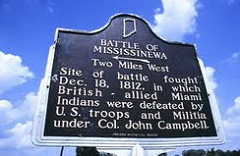
December 17-18, 1812– Battle of Mississinewa (near Marion, In.) (War of 1812)
December 18, 1972 – Operation Linebacker II (Christmas Bombing) (Vietnam War)
December 20, 1919 – James Madison DeWeese receives his first appointment as Adjutant General of Kentucky, his second appointment is June 16, 1920, by appointments made by Gov. Edwin P. Morrow.
December 22, 1921 – Newport Rolling Mills Strike Duty – The Kentucky National Guard under command of Col. Henry H. Denhardt, who later became Adjutant General, ordered by Gov. Edwin P. Morrow to quiet rioting and wide-spread violence. The first troops arrived on the morning of December 24th to sound of gunfire. The strike continued into 1922.
December 22, 1921– Cpl. Edward Vivion Trisler, of Company D, 192nd Light Tank Battalion died on 23 December 1942 at Camp Cabanatuan, Nueva Ecija, Philippines of dysentery.
December 23, 1941 – The main parade grounds at Fort Knox named Brooks Field in honor of Private Robert H. Brooks of Sadieville, first Armored Force casualty of World War II, killed in the Philippines while serving with Co. D, 192nd Tank Battalion (World War II)
December 24, 1921 – Pvt. Robert Deaton, a member of Company G, 149th Infantry, Barbourville, Ky., was accidentally killed at the corner of Powell and Brighton streets in Covington, while on state active duty during steel strikes at Newport. While he and Sgt. Charles Black were on duty, Sgt. Black became suddenly ill and about to fall, in recovering his balance his right arm knocked Deaton’s revolver from his holster. The revolver fell to the street discharging the cartridge. The bullet struck the right side of Deaton’s neck. He was rushed to the hospital but bled to death on the way. Col. H. H. Denhardt, commanding the troops made an investigation and pronounced the death accidental. Denhardt would later serve as Adjutant General.
December 24, 1964 – USAF began strikes on Laos (Vietnam War)
December 25, 1846 – Gen. Alexander W. Doniphan (formerly of Mason County, Ky.) defeats the Mexicans at Bracito (Mexican-American War)
December 27, 1860 – Major Robert Anderson (of Kentucky), U.S. Army, in command in Charleston harbor, burns the inside of Fort Moultrie, spikes the guns, and retires, with his band of 80 men, to Fort Sumter.
December 29, 1776 – McClellan’s fort (Georgetown) attacked by Indians (Early Indian Wars)
December 31, 1946 – President Harry S. Truman officially proclaims the end of hostilities in World War II.
Story by Sgt. Scott Raymond, Kentucky National Guard Public Affairs
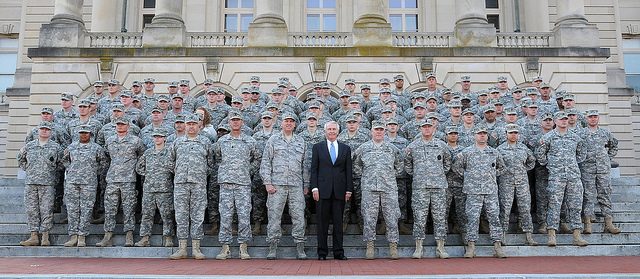
Kentucky Governor, Steve Beshear and the Adjutant General, Maj. Gen. Edward W. Tonini, join recruiters and new Kentucky Guard recruits on the steps of the State Capitol in Frankfort, Ky., Nov. 20, 2012. The Guardsmen gathered at the Capitol to celebrate Kentucky meeting its recruiting goal for the ninth year in a row.(Kentucky National Guard photo by Sgt. Scott Raymond)
FRANKFORT, Ky. — For the ninth year in a row, the Kentucky Army National Guard’s 2nd Battalion, 75th Recruiting and Retention met the state’s assigned end strength goal. The recruiters of the unit ensured that Kentucky remained above the 7,370 Soldiers needed in its ranks as set by the National Guard Bureau (NGB) in Washington, D.C.
To celebrate the occasion, Kentucky’s Adjutant General, Maj. Gen. Edward W. Tonini gathered with members of the 2/75th and recent enlistees at the State Capitol in Frankfort, Nov. 20, 2012 to share his congratulations and bestow honors on a select few.
To see more photos from the event, click here.
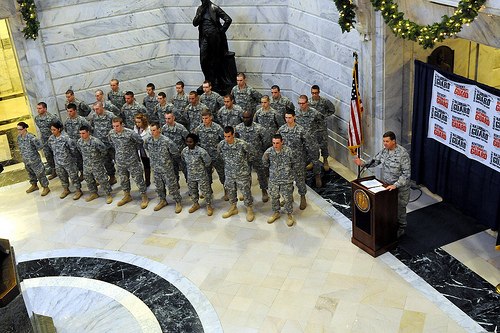
Kentucky’s Adjutant General, Maj. Gen. Edward W. Tonini speaks during a press conference in the State Capitol in Frankfort, Ky., to celebrate the 2/75th Recruiting and Retention’s ninth year of meeting its recruiting mission, Nov. 20, 2012. (Kentucky National Guard photo by Sgt. Scott Raymond)
“What we do here today, recognizing both our recruiting team and our new recruits, gives a face to the men and women who answer the call, whether it is overseas on a battlefield far away, or here at home during a flood or in the aftermath of a devastating tornado,” said Tonini.
Maj. Fred W. Bates V, Commander of the 2/75th since 2011, said the unit’s success has been one based upon the recruiters’ responsibility for each new Soldier recruited, from the time they swear in to their first day with their new unit. And he believes his unit has fully accepted that responsibility.
“I believe our battalion has been successful for 9 years because we truly place the mission first, and always go the distance to take care of our new Soldiers,” said Sgt. 1st Class Charles Miller, non-commissioned officer in charge of Bravo Company, Detachment 1 of the 2/75th in Louisville, Ky.
Miller has served with the unit for each of those nine years, and was recognized as the area supervisor of the year for Kentucky and also for the entire southeastern region of the United States.
Miller and other recruiters, such as Staff Sgt. Miguel Santiago who was named Kentucky’s recruiter of the year, agreed that their job is about helping others see their potential and not wasting their chance to better themselves in what the recruiters said is one of the greatest opportunities in life. As their commander, Bates is proud of the hard work of every member of his staff, but more importantly, proud of the message his recruiters are representing.
“We have met mission because the Soldiers in the Kentucky Army National Guard have worked together to show people in the Commonwealth why it is imperative to serve them and our Nation,” said Bates. “It has been more than just recruiters talking with applicants, Moms, Dads
families; More than sharing what the benefits are in education, job skills, life skills; it is people seeing that the Kentucky National Guard is an organization they want to belong to and want to be a part of.”
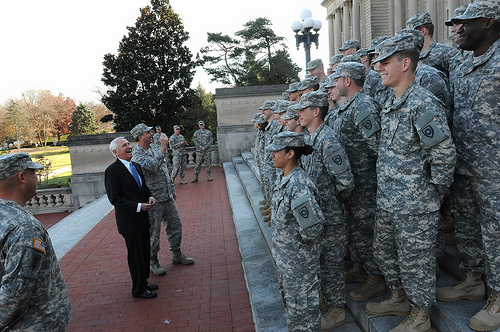
Kentucky Governor, Steve Beshear and the Adjutant General, Maj. Gen. Edward W. Tonini, laugh with new Kentucky Guard recruits on the steps of the State Capitol in Frankfort, Ky., Nov. 20, 2012. (Kentucky National Guard photo by Sgt. Scott Raymond)
The event at the Capitol celebrated the success of the recruiters, but also for a select few of the recruits who recently have raised their hand to serve in the National Guard. More than 30 of the newest members of the Kentucky National Guard were on hand to be recognized for being among “The Hundred”, who Bates called some of the best and brightest in Kentucky.
Tonini and Bates accepted a challenge from NGB to enlist an additional 100 Soldiers in the final two months of the 2011 fiscal year. Recruiters had to meet their original goal, plus 100. The Kentucky Guard launched a marketing campaign called “Be The Elite” to generate interest in the Guard and to highlight the benefits of serving their state. They succeeded and enlisted more than 100 young men and women in the final push. Bates said that is another example of why the adjutant general has such confidence in the unit’s operation and why the state Recruit Sustainment Program (RSP) is ranked 4th out of all 54 states and territories.
Kentucky Governor Steve Beshear took a few moments out of his busy schedule to also congratulate the recruiters and speak to the newest recruits, thanking them for their dedication to the Commonwealth and their country.
According to Bates, the 2/75th has worked hard to continue building on the foundation set forth by previous commanders and recruiters to stay on track. He said they have focused on: maintaining integrity, always placing the mission first, the RSP, officer recruiting, and taking care of families.
“We have the faith and the focus to stay on track and can continue to be successful if we do not take these things for granted,” said Bates.
Along with the 1,200 Airmen of the Air National Guard, Kentucky has 8,570 Guardsmen stationed in more than 50 locations in the Commonwealth.