Pages
Stay In Touch
More
© 2013 KentuckyGuard
By Senior Airman Joshua Horton, 123rd Airlift Wing Public Affairs
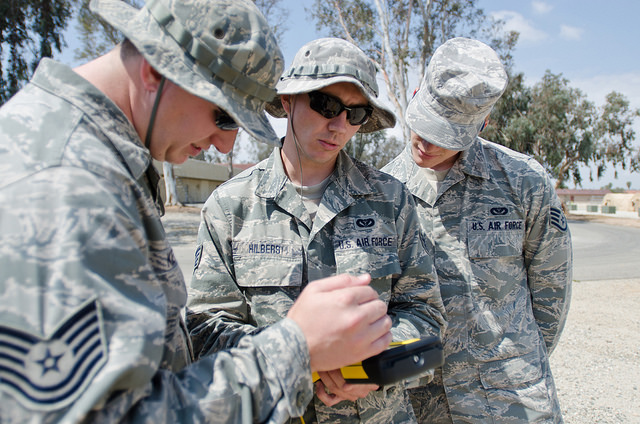
Tech Sgt. Nick Ketterer (left), Staff Sgt. Abe Hilbers (center) and Staff Sgt. Daniel Brooks (right), all Airmen from the Kentucky Air National Guard’s 123rd Civil Engineer Squadron, use surveying equipment during a training scenario at March Air Reserve Base, Calif., on June 10, 2015. The exercise was designed to simulate a real-world mission. (U.S. Air National Guard photo by Senior Airman Joshua Horton)
MARCH AIR RESERVE BASE, Calif. — More than 50 Members of the Kentucky Air National Guard’s 123rd Civil Engineer Squadron concluded a week-long training exercise here June 13 that was designed to enhance their job skills and command-and-control capabilities.
According to Lt. Col Rodney O. Boyd, deployment commander for the unit, the exercise provided CE Airmen with hands-on training in a natural, realistic environment.
“The purpose of this trip was two-fold,” Boyd said. “The first purpose was to accomplish (Air Force Specialty Code) training. CE requires specialized equipment that we don’t have at our home station, so this regional training site actually allows us to have the vehicles and equipment necessary to complete this training.
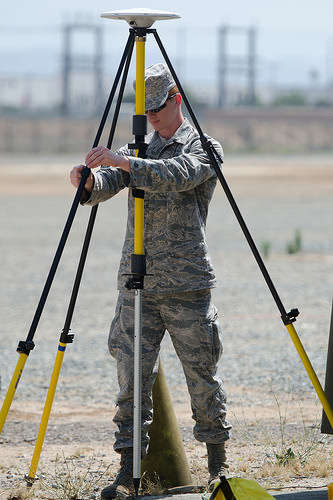
Staff Sgt. Daniel Brooks, an engineer for the Kentucky Air National Guard’s 123rd Civil Engineer Squadron, sets up surveying equipment during a training scenario at March Air Reserve Base, Calif., on June 10, 2015. The exercise was designed to simulate a real-world mission. (U.S. Air National Guard photo by Senior Airman Joshua Horton)
Click here for more photos.
“The second purpose was to accomplish a command-and-control exercise that focused on communication up and down the chain of command,” Boyd continued. “We covered project management, production control, resource allocation and, most importantly, personnel accountability.”
The Kentucky Air Guardsmen were split into seven different groups representing the different functional areas within CE. A cadre from March Air Reserve Base was assigned to each team.
Staff Sgt. Daniel Brooks, a Kentucky Air Guard civil engineer, saw the trip as an opportunity to gain more real-world exposure.
“My expectations coming into this training were to get more hands-on experience,” Brooks said. “Often times with drill, we run into other things that take us away from our job, so I was hoping to get more in-depth training with what we do as civil engineers. We’ve gotten tons of hands-on training. This trip’s been great.”
According to Lt. Col. Phillip Howard, commander of the 123rd Civil Engineer Squadron, the exercise was a tremendous success.
“The exercise went really well,” he said. “The (Unit Control Center) tackled the things in the right priority, and everybody completed their tasks. Overall, we accomplished all the goals, and these guys did a fantastic job.
“It was a good team effort between the guys that were being exercised and the eight or nine guys that got together and formed the exercise team.”
Follow our Air Guard on their official website: www.123aw.ang.af.mil
By Staff Sgt. Scott Raymond, Kentucky National Guard Public Affairs
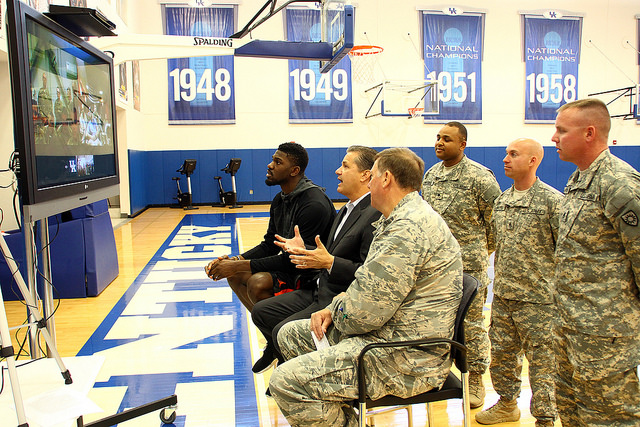
University of Kentucky Men’s basketball Coach John Calipari joined Maj. Gen. Edward W. Tonini to speak via Skype with Kentucky Guardsmen deployed overseas Oct. 22, 2015. Guardsmen with the 441st Survey and Design Team also were in attendance prior to their deployment in October, 2015. (U.S. Army National Guard photo by Staff Sgt. Scott Raymond)
LEXINGTON, Ky. — The University of Kentucky is steeped in traditions, especially when it comes to basketball. Head coach John Calipari helped keep a tradition alive by chatting via Skype with deployed Kentucky Guardsmen from UK’s training facility in Lexington, Oct. 22.
From the UK practice court, Calipari began by thanking the Guardsmen for what they do and how glad he was to see the gatherings of Wildcat fans on the other end again for this special meeting. Soldiers of the 1163rd Area Support Medical Company in Afghanistan, Bravo Company, 351st Aviation in the Middle East shared the video screen and some time to discuss Kentucky Basketball with the coach.
In addition, three Soldiers from the 441st Survey & Design Team were on hand to meet Coach Cal and ask questions of their own.
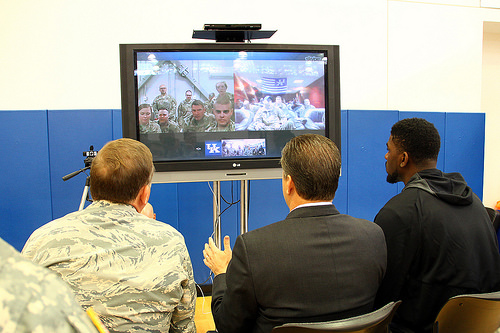
Soldiers with the 1163rd Area Support Medical Company and Bravo Company, 351st Aviation speak via Skype with University of Kentucky Men’s Basketball Head Coach John Calipari from UK’s training facility in Lexington, Ky., Oct. 22, 2015. The event was the fourth conversation in the last five years between Calipari and deployed Soldiers. (U.S. Army National Guard photo by Staff Sgt. Scott Raymond)
“We’re very appreciative of Coach Cal to take time out of his busy schedule to give back to the state of Kentucky and the military as a whole by giving us well wishes and safe travels as we leave for our deployment,” said Spc. Jermaine Higgins, a technical engineer with the 441st. “What a send-off.”
Click here for more photos.
The 441st is scheduled to depart Kentucky for Afghanistan later this month.
Calipari entertained each and every question from the Soldiers, from his concerns for the upcoming season to how he and his players manage stress. Senior Forward Alex Poythress also sat in on the conversation as an added treat for the Soldiers.
The Skype call was the fourth such event in the last five years. In 2015, a winter storm broke the streak, but Maj. Gen. Edward W. Tonini, Kentucky’s adjutant general said the meeting had to continue. He called the conversation a fun and unique way to interact with Guardsmen overseas.
“Being deployed around the globe, our Guardsmen need every reminder of home,” said Tonini. “Everyone knows Coach Cal is a member of our team and I thank him for his generosity. This special conversation could be a highlight of the deployment for many of our Soldiers, and I’m glad we could bring it to them.”
“Any chance we can get to thank the dedicated men and women of our military, we do it,” said Calipari. “They’re over there fighting for our freedoms, and if we can give them a reason to stand up and cheer or get mad at a losing a game, which last season, there was only one of those, to bring them joy, we’re honored to do so.”
By 1st Lt. James Killen, 123rd Airlift Wing Public Affairs
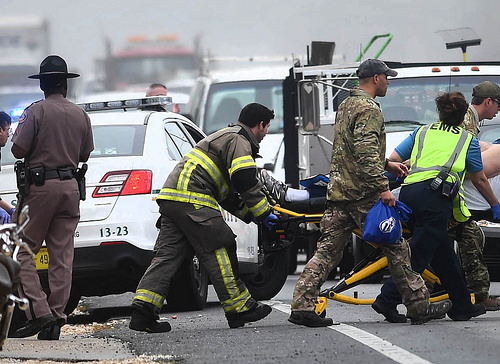
A pararescue Airman from the Kentucky Air National Guard’s 123rd Special Tactics Squadron assists an injured motorist following a traffic accident in Florosa, Fla., March 3, 2015. The Airman was later recognized with a Community Service Award from the Okaloosa Country Sheriff’s Department for his actions. (Photo by Nick Tomecek, Northwest Florida Daily News)
KENTUCKY AIR NATIONAL GUARD BASE, LOUISVILLE, Ky. — A pararescueman from the Kentucky Air National Guard received a Community Service Award from the Okaloosa Country, Fla., Sheriff’s Department May 20 for his actions in rendering assistance to injured motorists following a multi-vehicle traffic accident there.
The pararescueman, who is assigned Kentucky’s 123rd Special Tactics Squadron, was traveling toward Eglin Air Force Base, Fla., on Highway 98 March 3 when traffic suddenly came to a stop.
“I looked down the line of cars and I could see wheels in the air, so I popped the door open and sprinted down the lane,” he said.
The pararescueman, along with several other Air Force Special Operations Command Airmen who were riding in the same vehicle, quickly made their way to the accident scene and began rendering aid.
A pararecueman, or PJ, is the military equivalent to a civilian paramedic. PJs are also rated to parachute from aircraft into non-permissive environments, and are among the U.S. military’s most highly trained forces.
“When I got to the scene, I could see a motorcycle and I immediately shouted for the rider,” the PJ recalled. “He was fine, so I made my way to the SUV, whose passengers also said they were okay. Then I made my way to the overturned pickup, whose driver wasn’t in good shape.”
The Kentucky Airman assessed the condition of the man, whose feet were on the dashboard as he dangled upside down from his seat belt.
“I didn’t really want to move him, just in case he had a back injury, so I triaged him, checked his airway, his breathing and his pulse. But by that time, a crowd had started to gather around. I started telling them to back away, and my team took control of the rest of the scene.”
The Airman knew paramedics and law enforcement officers were already on their way, so the Air Force team continued to care for the wounded while controlling the scene, cleaning up debris and directing traffic.
When asked about their efforts, Okaloosa County Sheriff’s Deputy Sgt. James Duval said the Airmen performed superbly.
“When I arrived on the scene, every vehicle with injured persons had an Airman attending to them. The vehicle that was upside down had three or four Airman attending to the entrapped driver. They were accessing his medical status, immobilizing him to prevent additional injury and comforting him to prevent shock.
They had literally climbed inside the overturned vehicle so they could accomplish these tasks.
“It is a great comfort to have professional, skilled and talented emergency medics on-scene,” Duval continued. “I was commenting to another deputy, after things had calmed down, that if I was the injured party, these are the guys I’d like to have attending to me.”
Duval recommended each of the Airmen for a Community Service Award, which were presented May 20 in Okaloosa County.
“The Okaloosa County Sheriff’s Department recognized these quiet professionals for not only their willingness to assist when the need arose, but the professional manner in which they rendered that assistance,” the award citation read.
Everyone who was injured that day has since recovered with no lasting injuries.
Follow our Air Guard on their official website: www.123aw.ang.af.mil
By Sgt. Lerone Simmons, 133rd Mobile Public Affairs Detachment
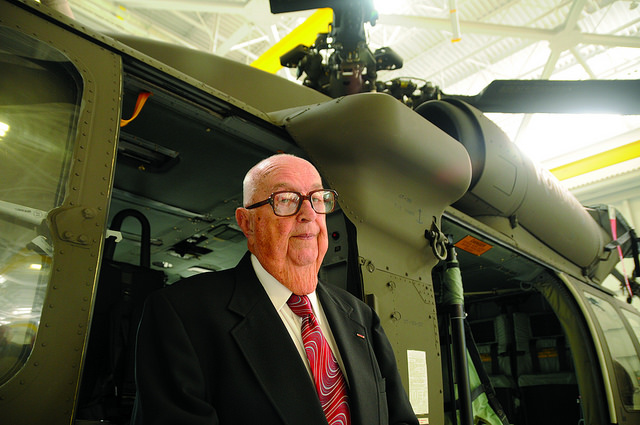
Retired Chief Warrant Officer William H. Canon, former shop foreman assigned to the 2113th Transportation Aircraft Maintenance Company, poses with a new UH-60M Black Hawk helicopter after a ribbon cutting ceremony for Kentucky’s new Army Aviation Support Facility and introduction of a new fleet of UH-60M’s, Boone National Guard Center, Frankfort, Ky., Oct. 14, 2015. Canon gave thirty five years of his life to providing maintenance to Kentucky’s aircraft. (U.S. Army National Guard photo by Sgt. Lerone Simmons)
FRANKFORT, Ky. - Sitting in a new multi-million dollar facility, retired Chief Warrant Officer William Canon Jr., reminisced about providing maintenance to the Kentucky National Guard’s aircraft in high winds, pouring rain, freezing cold and summer heat.
“When I first joined, our pilots had recently flown in World War II,” he said. “Our equipment was old and we didn’t have adequate places to work.
“We had to park trucks around the helicopters to make sure the wind didn’t hit them directly,” said Canon. “The elements are one of the worst things when it comes to properly maintaining aircraft.”
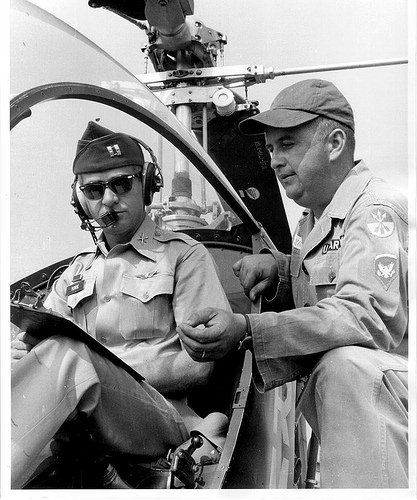
Capt. Yancey York confers with SPEC5 William H. Canon as he prepares for a flight in a OH-13E, circa 1960. (Photo courtesy Chief Warrant Officer(R) Harold Canon)
Click here for more photos.
Canon enlisted in the Army in 1950 and retired in 1990. He would join a fledgling aviation program in 1955.
In 1959, the Kentucky aviation assets found a new home in Frankfort, Kentucky, at the Capital City Airport. Then, 18-or-so-years later in 1971, Canon witnessed a state-of-the-art facility erected at Boone National Guard Center – the Army Aviation Support Facility. A hangar for the helicopters assigned to Kentucky. During his tenure, Canon rose to the level of shop foreman, assigned to the 2113th Transportation Aircraft Maintenance Company, and retired out of the old AASF.
But on Oct. 14, he joined hundreds of other current and former Kentucky National Guardsmen as the ribbon was cut, ceremoniously showing off the Kentucky National Guard’s newest AASF at Boone National Guard Center. He also got to view, sit in, and touch the new UH-60M, the Army’s newest in the Blackhawk fleet.
The new AASF is 126,000 square feet and uses geo-thermal heating and cooling, solar power, 80 kilowatts photovoltaic solar power, high efficiency lighting, daylight harvesting technology, and radiant floor heating. It holds several offices for staff, classrooms, a gym and plenty of space.
“We come from a time where we didn’t always have a climate controlled area or lots of space,” said Canon’s old company commander, retired Lt. Col. Willoughby S. Goin III, a former pilot with 12,000 flying hours.
“This will help allow the Guard to be able to deploy troops to any affected areas in a timely manner,” he said, “at times when ice storms, tornados and floods can destroy roads, the Guard can then utilize the air from this facility.”
Kentucky Gov. Steve Beshear, Maj. Gen. Edward W. Tonini, adjutant general for Kentucky and other special guests honored Canon in their remarks during the building’s dedication. The Kentucky Guard’s aviation safety record was also bragged upon during the remarks.
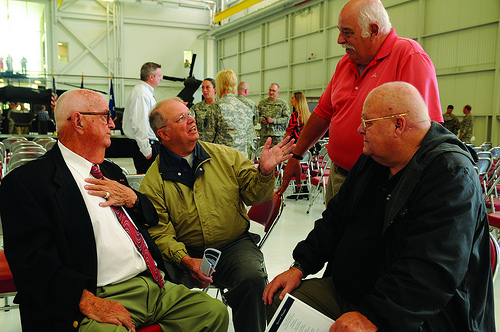
Sitting from left to right, retired Army Chief Warrant Officer William H. Canon, former shop foreman who was assigned to the 2113th Transportation Aircraft Maintenance Company, retired Army Lt. Col. Jere Roche, former commander of the 441st Medical Detachment, and retired Army Lt. Col. Willoughby S. Goin III, former commander of the 2113th Transportation Aircraft Maintenance Company, carry on a conversation after a ribbon cutting ceremony for Kentucky’s new Army Aviation Support Facility in Frankfort, Ky., Oct. 14, 2015. (U.S. Army National Guard photo by Sgt. Lerone Simmons)
Kentucky hasn’t had any major accidents or loss of life for the span of the last 250,000 flying hours, which Tonini said boils down to a huge feat of great maintenance and outstanding flying. He added that the Kentucky Guard has flown at least 15 missions over the Commonwealth during times of disaster, also while supporting the Joint Support Operations counterdrug efforts and overseas contingency operations.
For the many aviation retirees and current Guardsmen who maintain the Commonwealth’s air assets, the day was a reunion and a celebration of moving forward.
“What I’ve seen is outstanding,” said Canon. “I’m proud the progress we’ve made.”
By Staff Sgt. Christopher Barton, 1st Battalion, 149th Infantry
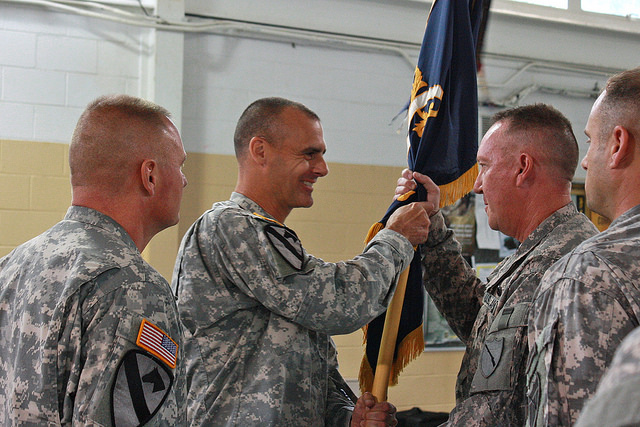
Col. Bryan Howay, commander of the 75th Troop Command passes the colors of the 1st Battalion, 149th Infantry to Lt. Col. Thomas Black during a change of command ceremony in Barbourville, Ky., Oct. 3, 2015. Black took charge from Lt. Col. Joseph Lear who led the battalion since 2013. (U.S. Army National Guard photo by Staff Sgt. Christopher Barton)
BARBOURVILLE, Ky. — Lt. Col. Thomas Black took charge of of the 1st Battalion, 149th Infantry during a change of command ceremony in Barbourville, Oct. 3. Black succeeded Lt. Col. Joseph Lear who has led the battalion since 2013.
Brig. Gen. Charles Jones, Kentucky’s deputy adjutant general, joined friends, family members and Soldiers of the battalion in welcoming Black and congratulating Lear on a successful run as the unit commander. In addition, five former battalion commanders and one former command sergeant major of the unit were in attendance, a testament to the legacy of the Mountain Warriors within the Kentucky Guard and the commonwealth.
Click here for more photos.
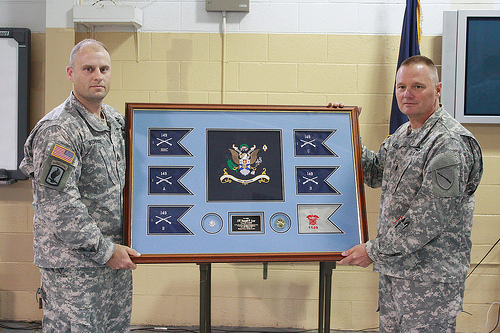
Command Sgt. Maj. Matthew Roberge presents Lt. COl. Joseph Lear with a framed collection of the guidons of the 1st Battalion,, 149th Infantry during a change of command ceremony in Barbourville, Ky., Oct. 3, 2015. Lear commanded the unit since 2013. (U.S. Army National Guard photo by Staff Sgt. Christopher Barton)
“Being here in this moment at this place is nothing short of surreal,” said Black. “I couldn’t help but be reminded of the leadership over the past 3 decades that I have been blessed with, the history I have shared with this battalion, and the heritage that at this very moment I am inheriting.”
Black has served in the Kentucky Guard for more than 30 years, most recently as the operations and planning officer for the 75th Troop Command. As a traditional Guardsman, Black owns and operates a real estate firm in Southern Kentucky.
Lear, who called the chance to lead the battalion the best job he’s ever had, will move to the 75th TC as an operations officer. Black said the battalion has a legacy of great leadership and the last two years were indicative of the same under Lear.
“This battalion is the best combat arms battalion in the Army National Guard. It will remain that way and continue to lead the way. We will emphasize our efforts on near term challenges, constantly evaluating who we are, where we are with respect of who we want to be and where we want to be in respect to long term goals.”
Col. Bryan Howay, commander of the 75th TC called Black a very diverse leader, considering his roles as a Soldier, the father of a Soldier and a local businessman, “there’s nothing he can’t relate to.”
“My most honorable character is being a Dad, my 2nd most honorable character is being a Untied States Army Infantry officer proudly serving in the Kentucky Guard,” said Black. “And now my most honored position while wearing this uniform is commander of the 1st Battalion, 149th Infantry.”
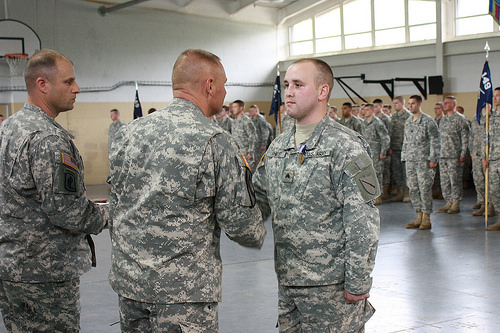
Lt. Col. Joseph Lear presents Sgt. Daniel White with the Soldier’s Medal in Barbourville, Ky., Oct. 3, 2015. White received the award for his actions in saving a motorist’s life in an automobile accident in Frankfort, Ky., in 2014. (U.S. Army National Guard photo by Staff Sgt. Christopher Barton)
In addition to the change of command, the Mountain Warriors also celebrated one of their own with a prestigious honor. Sgt. Daniel White was presented the Soldier’s medal for his actions in helping to save the life of a motorist involved in a fiery automobile accident in January of 2014.
“This means a lot to me, to be recognized for the award,” said White. “It’s not the recognition that any of us were looking for though, the main priority was that Mr. Burdett was out of harm’s way and we did everything that we could do for him. We were lucky enough to be in the right place to put our training in effect and do what anybody in that situation would have done.”
Kentucky National Guard Staff Report
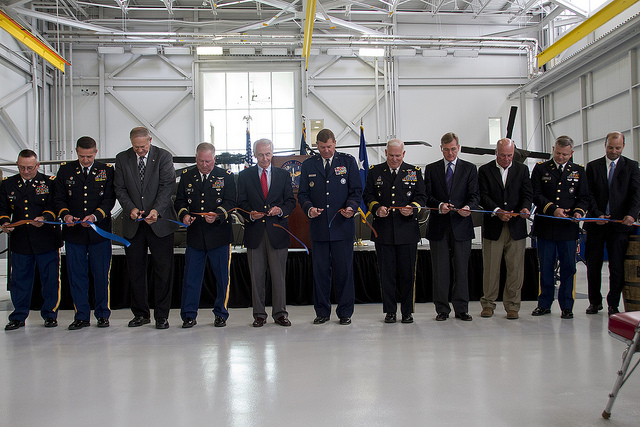
Gov. Steve Beshear, Maj. Gen. Edward W. Tonini, Kentucky Guardsmen and other guests cut the ribbon to officially open the Kentucky National Guard’s Army Aviation Support Facility in Frankfort, Ky., Oct. 14, 2015. The 126,000 square foot building replaces an aging facility built in 1971. (U.S. Army National Guard photo by Staff Sgt. Scott Raymond)
FRANKFORT, Ky. — To begin the new fiscal year, the Kentucky National Guard opened two new facilities Oct. 14, in its continued effort to support the Commonwealth and the nation.
To see all photos from this event, please click HERE.
Gov. Steve Beshear joined Maj. Gen. Edward W. Tonini, adjutant general for Kentucky in cutting the ribbon on a new Army Aviation Support Facility in Frankfort, Ky. The new $26 million facility has nearly 126,000 square feet of combined space to house UH-60 Blackhawk and LUH-72 Lakota helicopters.
The new hangars and office space provide the latest in cost-savings technology and energy efficiency. It will replace the aging AASF built in 1971.
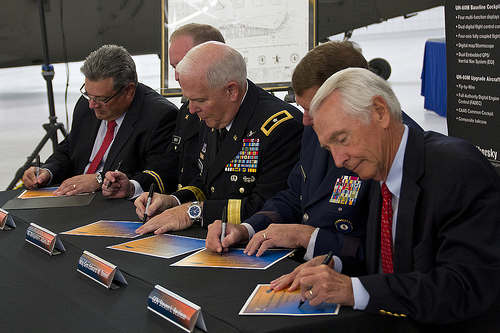
Gov. Steve Beshear, Maj. Gen. Edward W. Tonini, Brig. Gen. Benjamin F. Adams III, Col. Brian Abney and Tom Nicolett ceremoniously accept new UH-60M Blackhawk helicopters in Frankfort, Ky., Oct. 14, 2015. The signified the Kentucky Guard’s receipt of the newest model of the Army’s primary helicopter. (U.S. Army National Guard photo by Staff Sgt. Scott Raymond)
“The courageous men and women who constitute the Kentucky National Guard embody the words ‘service’ and ‘sacrifice,’” said Governor Steve Beshear. “It has been with the utmost confidence that I have called upon them in Kentucky’s time of need during an impressive number of federally declared disasters. This new Army Aviation Support Facility we’re dedicating today will only increase the effectiveness of the Kentucky National Guard as its members perform an already wide array of capabilities. With the best equipment and the best people, there’s not much we in Kentucky won’t be able to handle.”
Tonini then cut the ribbon on the Bowman Readiness Center in Louisville later that afternoon.
The Butler Reserve Center was acquired by the Kentucky National Guard in the fall of 2013 as a result of the 2005 Defense Base and Realignment and Closure law. Kentucky invested $4 million to renovate the facility. This center will support operations of the Commonwealth’s National Guard units.
“Events like these show the relevance of what we do for our to serve our metro, our Commonwealth and our nation,” said Tonini of the Bowman Center. “Make no mistake about it, this is a Kentucky National Guard facility. Not only will we honor the military legacy of the Soldiers walking through this building, we will enhance it and continue the tradition with Kentucky Guardsmen.”
With the newest construction projects ongoing at the same time, Col. Steve King, director of facilities for the Kentucky Guard, said it was a demanding undertaking, but a beneficial move in the right direction for the Guard.
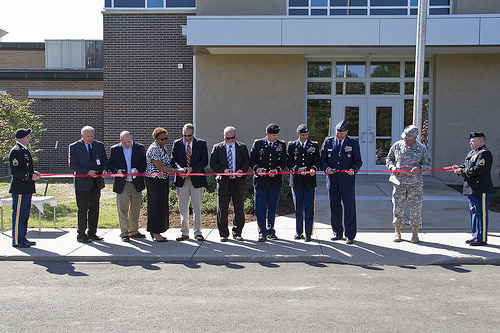
Maj. Gen. Edward W. Tonini, Brig Gen. Charles Jones, Guardsmen and other guests cut the ribbon to open the Bowman Readiness Center in Louisville, Ky., Oct. 14, 2015. The new facility now houses Kentucky’s 75th Troop Command among other units. (U.S. Army National Guard photo by Staff Sgt. Scott Raymond)
“The Kentucky National Guard and Department of Military Affairs routinely manage between 30 to 40 projects at any given time,” said King. “These projects range from minor renovations and maintenance of readiness centers or armories, to major military construction. When managing large scale projects simultaneously, it’s important to note the teamwork involved between all agency personnel. Most of these projects have federal funding, but all have to be worked through the Finance Cabinet for design and execution. This relationship is key to the successful execution of all these projects.”
Story and photos by: Spc. Abe Morlu, 133rd Mobile Public Affairs Detachment
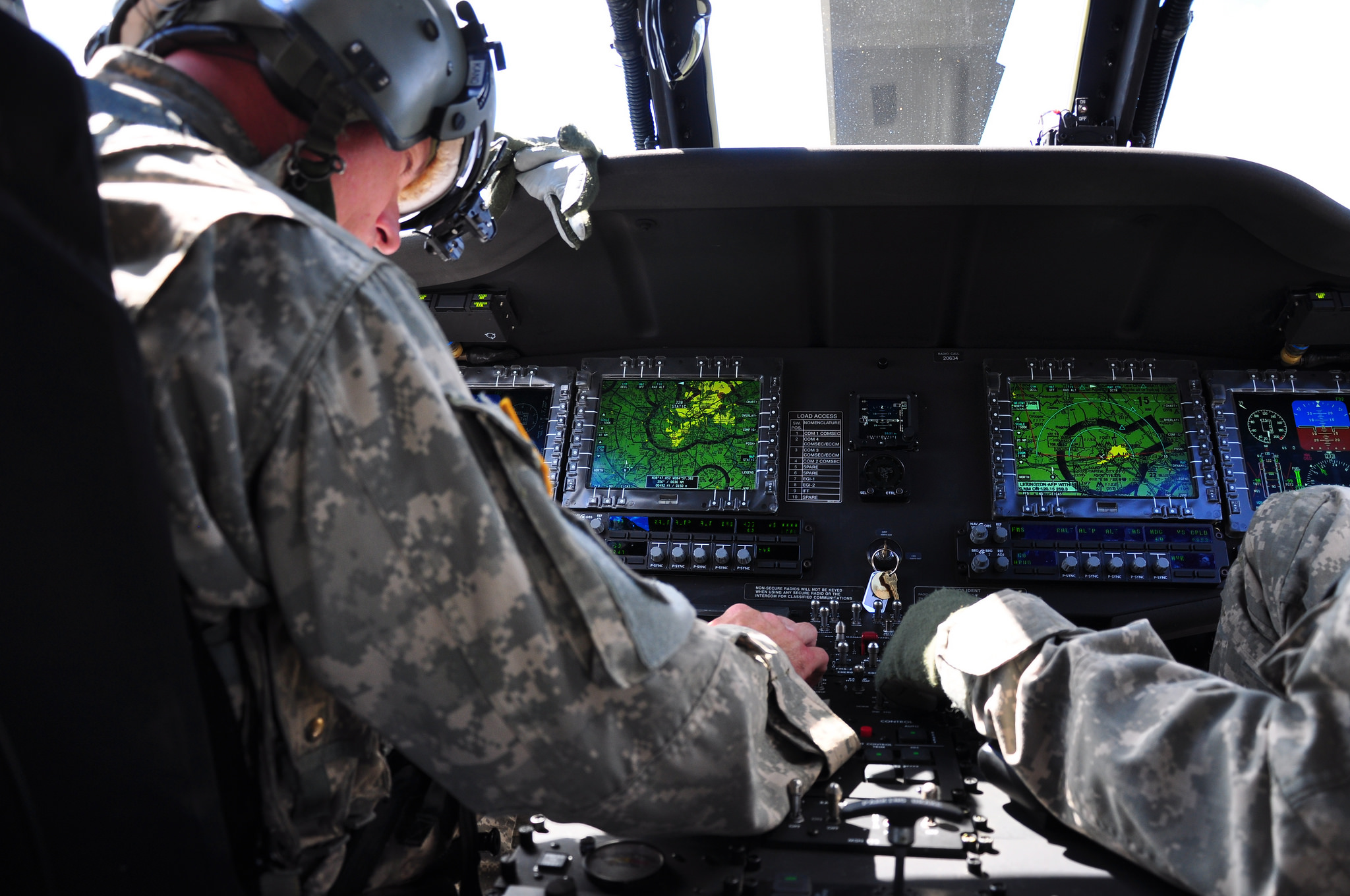
Chief Warrant Officer Wallace Kand, a UH-60 Black Hawk pilot, performs preflight checks on the helicopter prior to a training mission at the Boone National Guard Center in Frankfort, Ky., Sept. 23, 2015. These Kentucky Guard pilots train as much as they can to stay current and be ever ready should they be called upon. U.S. Army National Guard photo by Spc. Abe Morlu
FRANKFORT, Ky. -In its ongoing mission to support both state and federal missions, the Kentucky National Guard has added a new flight facility at the Boone National Guard Center. Along with the facility is a fleet of 16 new helicopters as well.
To see all the photos, please click HERE.
Construction is coming to a close on the new hangar to house the 20 aircraft used by the KYNG. That fleet consists of ten brand-new UH-60M Blackhawks, six two-year-old UH-72A Lakotas, three UH-60L (older model) Blackhawks, and one C-12 (King Air) Huron Airplane. The C-12 is currently housed in a hangar at the Capital City Airport leased by the KYNG.
“For the first time since 1983, when the Kentucky Guard was the first Guard unit to receive Blackhawks, all the aircraft will be able to fit in one building,” said Chief Warrant Officer Gerald Carroll, aviation safety officer for the Army Aviation Support Facility. The original hangar was constructed in 1972, and housed both the UH-1 Iroquois and OH-58 Kiowa.
“These were much smaller aircraft so was no problem storing them in the hangar,” according to Carroll.
Once the UH-60L arrived in 1983 that was no longer the case. Aircraft had to be left outside due to the lack of hangar space. “It is not ideal to store the craft outside because they are susceptible to damage from Mother Nature,” said Staff Sgt. Daryl Casey, a crew chief at the AASF.
Corrosion and lightning strikes are the nemesis of aircraft. They can cause millions of dollars of damages. “Lightning can damage bearings as well as the hull of the craft on its escape,” said Chief Warrant Officer Stephanie Motley, one of the instructor pilots for the new UH-60 mike model aircraft.
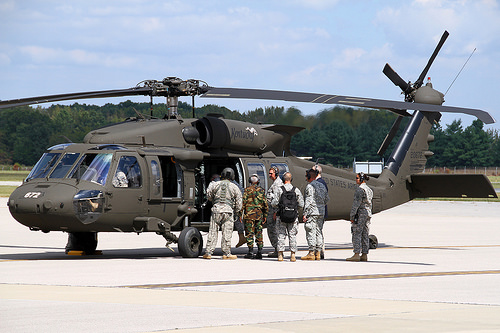
Kentucky Guardsmen and members of the Djibouti military board a UH-60M Blackhawk at Fort Knox, Ky., Sept. 16, 2015. During the Djibouti delegation’s visit to Kentucky, the new Blackhawks provided aerial tours of Kentucky Guard facilities as part of the National Guard’s State Partnership Program. (U.S. Army National Guard photo by Staff Sgt. Scott Raymond)
Not only will the new facility keep the aircraft out of the elements saving the Kentucky Guard from high costs in maintenance and repair, but it will also save energy consumption. The new facility will allow more natural light to enter during the day, relieving the reliance on electric lighting to preform daily tasks. This change directly eased the budget strains created by high energy costs.
Should there not be enough sunlight to illuminate the hangar, electric lighting can be used. However the electricity to turn the lights on does not come from the local power company. It is produced by the solar array installed on the roof of the hangar.
Gone are the days of heating the hangar with vents high up on the ceiling. The floors of the new hangar use geothermal energy to heat itself. They bring the heat closer to the crew and not inefficiently blowing down from above as hot air rises.
“The new technologies and availability of necessary outlets, allow us to better maintain the new Mikes,” said Chief Warrant Officer Stuart Lindfors,” a UH-60 instructor pilot.
Servicing the new helicopters is the same as its predecessor however, there are a few new parts alien to the UH-60L which require maintenance. The new model has new systems such as a rotor brake, said Casey.
“It’s like working on a 2000 Ford truck versus working on a 2015 Ford truck,” Casey said. “It pretty much works the same but has a few extra bells and whistles.”
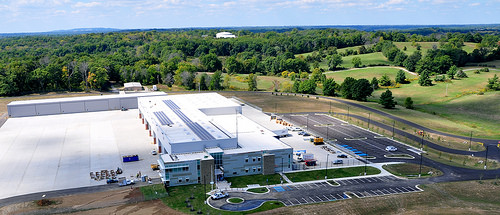
An overhead view of the new Army Aviation Support Facility at the Boone National Guard Center in Frankfort, Ky., Sept. 23, 2015. The new AASF is spacious enough for all the aircraft to be stored indoors, and it is also very energy efficient using solar and other natural power sources. (U.S. Army National Guard photo by Spc. Abe Morlu)
One of those bells and whistles is the hover hold function present in the new model. It allows the pilot to hold a set altitude and position with no input form the pilot. No more having to fight with external forces to hold position as in the older model.
“They are both great aircraft but, the new technology helps us better use our skills learned in training,” said Chief Warrant Officer Wallace Kand, a recent graduate of the UH-60M flight course.
“No longer will we envy the equipment and facilities of other states,” said Carroll. “Kentucky is a leader when it comes to Army aviation.”
Spirits are high with anticipation of beginning operations in the new facility as well. It will be the first time in almost 40 years being able to house and maintain all the aircraft indoors.
“We have accomplished so much with our antiquated equipment and facilities over the years,” said Col. Brian Abney, commander of the AASF. “I cannot wait to see what we will produce with the new facilities.”
Kentucky National Guard Staff Report
FRANKFORT, Ky. — As uncertainty hangs over defense budgets and the impacts on the troops, Service members remain ready and able. Regardless of decisions at the highest level, a Guardsman is the steward of his own career. Kentucky’s State Command Sgt. Maj. David Munden has some advice for the coming year.
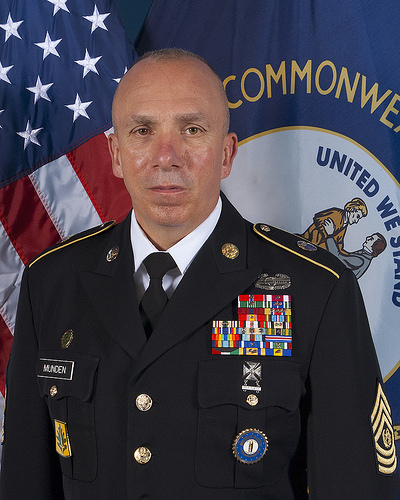 I appreciate the opportunity to speak to all of our Soldiers. I would like to let you know a few areas that are important to me as I serve in the Kentucky Guard. As a sergeant, these topics are what I believe and expect my fellow sergeants to embrace.
We face uncertainty in our budget, as that is appropriated to us by Congress. Currently, we are allotted about the same amount of money as last year. With that, opportunities for additional training and schools with be limited.
I strongly encourage all who need NCOES for their current rank or future promotion opportunities to avail themselves for school in this training year. As we move to the STEP (Select, Train, Educate, Promote) system in 2017, we will have less latitude in assigning school quotas to Soldiers.
As part of STEP, The Army will be changing the NCOES requirement for promotion to sergeant through sergeant major. In general, the NCOES required will fall back one rank. Soldiers who want to be promoted to sergeant will have to complete Basic Leader Course (formerly known as Warrior Leader Course) prior to being promoted. Sergeants will have to complete Advanced Leader Course, and staff sergeants will have to complete Senior Leader Course prior to being promoted.
Many NCO’s in our ranks are currently holding positions of leadership in which they have not achieved what will be the mandated NCOES for that position. For example, we have many sergeants who have not completed the Basic Leader Course, when they should be attending the Advanced Leader Course at the present time. Should these sergeant’s fail to attend BLC during this training year, they will be at a high risk of never being promoted again, as they will not have the NCOES for the next grade, and will not be able to access a school seat for the NCOES that they need to hold their current grade.
I strongly believe that we are in the leadership business. We constantly and consistently grow and produce leaders from our ranks. We need all Soldiers to make themselves available, through training and service, to serve as a leader in our business. Do all that you can to make it to NCOES this training year.
Going back to funding, I realize that money will be tight. Do not let that limit your imagination or motivation to train and teach at the squad and team level. Staff sergeants have never been allocated training funds to spend, so you have a lot of experience at creating good training from your hip pocket or from the resource library. I have full faith and confidence in you to train, teach, mentor and lead our Soldiers.
Every day that I serve with you is an honor and a privilege for me. I will do my best to see each and every one of you in the coming year, whether it is at the armory, in the field, at the schoolhouse, or wherever Soldiers are. Thank you for your service to our country and our state.
By Staff Sgt. David Bolton, 133rd Mobile Public Affairs Detachment
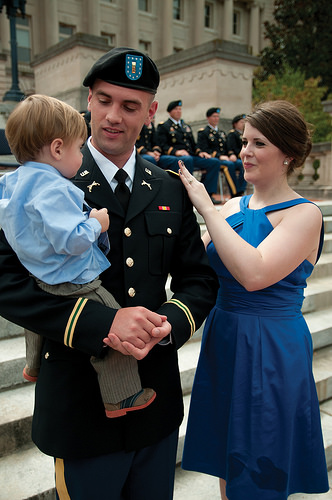
Newly-commissioned 2nd Lt. Morris is pinned by his wife, Cynthia during a ceremony at the state Capitol in Frankfort, Ky., Sept. 27, 2015. The ceremony honored the graduates of the Warrant Officer and Officer Candidate Schools before fellow Service members, friends and family. (U.S. Army National Guard photo by Staff Sgt. David Bolton)
FRANKFORT, Ky. — The rigors of the Army’s Officer Candidate School are not for the faint of heart. The same can be said for completing the stringent requirements of the Lexington Police Academy in Kentucky. For newly commissioned Kentucky Army National Guardsman 2nd Lt. Kevin Morris, successfully passing both at the same time required the utmost focus.
“You’re probably going to be putting in around 50 hours a week for the academy just in prep time and then you have to find time to get ready for OCS,” Morris said. “You can’t just show up; you have to have your uniforms laid out, pressed and prepped with your boots shined, believe it or not.”
Although going through both programs simultaneously took extensive amounts of time, Morris said there was a valuable aspect to the dual training.
Meeting Challenges
“The benefit there was it was kind of like you never turned it off,” Morris said. “You didn’t go home and get rusty; you had to be taking on a task daily to step up and meet the challenges that were going to come your way.”
Morris said the programs didn’t focus only on physical fitness.
“You had to study and actually crack a book open and do some work there,” he said. “That helped with OCS because you’re constantly in that working out and study mode. The academy also gave us an associate’s degree in law enforcement.”
While completing the programs may be difficult, Morris said, just getting accepted to them was even more difficult. Out of the more than 800 applicants for the LPD academy, only a fraction of that were accepted, he said.
Good Timing
“It was good timing and I got lucky,” Morris said. “I applied when the application class was around 800 and they only took 32 or 33 for the department. Given those odds, I wasn’t going to pass it up. I knew it was going to be tough, but I knew it was one of those things that if you pass it up, it may not come back to you.”
While the physical demands of OCS and the LPD Academy can take a toll on a person, the emotional toll of having a family, especially a newborn child, can be just as stressful, Morris said.
“My son was two days old when I left for phase one of OCS and was a month old when I began the academy,” he said. “So there were definitely some stresses there. But at the end of the day, it was my family that had that support and helped me keep my sanity where I could take a step back and spend time with them.”
Credits Wife for Support
Morris credited his wife, Cynthia, for helping him through OCS and the academy even while she completed a four-year nursing program in just two years.
“I have to tip my hat to her,” he said. “We’ve been running pretty hard for two years. But you know what, you put that hard work in and the rewards will come.”
“He has worked very hard for this,” Cynthia said of her husband. “He loves to serve the people and his country. He’s going to be a great leader; he’s a very good man to be in charge.”
By Capt. Rob Cooley, 133rd Mobile Public Affairs Detachment
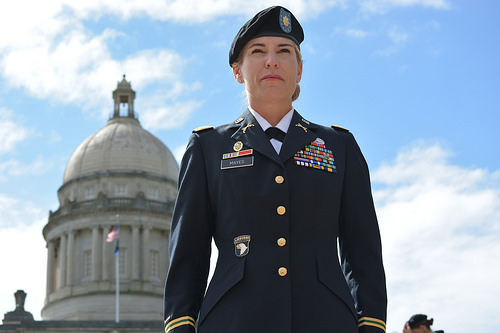
Maj. Bobbie Mayes, commander of the Kentucky National Guard’s Officer Candidate School at the Kentucky State Capitol building, Sept. 27, 2015. The graduation ceremony was Mayes’ last as commander as she relinquish the position this fall. (U.S. Army National Guard photo by Capt. Rob Cooley)
FRANKFORT, Ky. — Maj. Bobbie Mayes, the first Kentucky National Guard female Officer Candidate School commander, 238th Regimental Training Institute, reviewed the final school graduation of her command at the Kentucky State Capitol Sept., 27, 2015.
“As the OCS commander I’ve been able to mold the captains and lieutenants who mold the future officers and warrant officers,” said Mayes.
Mayes said this class has been special. “This class has been very diverse, from education, occupation and gender,” she said.
Mayes started with the OCS Program in 2004 as a Teach Assess Counsel (TAC), a position now referred to as platoon trainer.
“As a TAC officer, I remember long sun-up to sun-down days molding the Kentucky National Guard’s future leaders, teaching them Operation Orders, Troop Leading Procedures, and Individual Movement Techniques,” she said.
In 2007, she left the OCS program to serve a three-year tour as the company commander of the 940th Military Police Company. She deployed in 2011 with the Kentucky National Guard Agriculture Development Team. She returned to the 238th in 2011, first as a staff training officer then commander.
Mayes said she is as optimistic about the future of the newly commissioned officers as she is her own. In her next assignment as the personnel officer for the 238th RTI, she will continue to support the careers of those assigned to the 238th.