Pages
Stay In Touch
More
© 2013 KentuckyGuard
Story by Chief Warrant Officer Joseph Lyddane
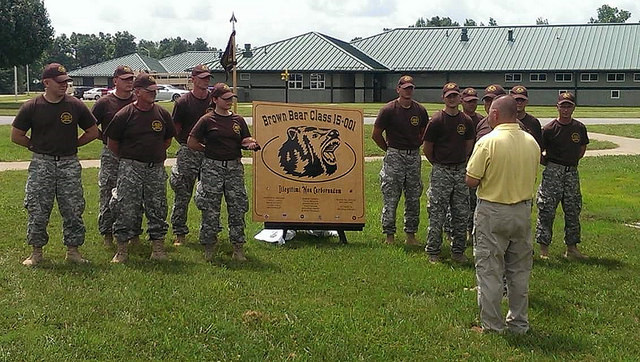
Warrant Officer Candidate Stephanie Bradley and her fellow Warrant Officer Candidates from Class 15-001 take part in a WOCS tradition by presenting their class sign to the Fort Rucker, Alabama staff. (Kentucky Army National Guard photo by Chief Warrant Officer Joseph Lyddane)
GREENVILLE, Ky. — Prior to August 26, 1920, women were considered inferior to men, they were limited to careers that many believed to be suppressive, and society’s view placed them as being less capable than their male counterparts. After more than seventy years of campaigning (the first women’s rights conference was held a Seneca Falls, New York, in 1848) history was made when women were officially added to the US Constitution under the 19th Amendment, granting them the right to vote. A small victory but a huge accomplishment at the time and also marked a turning point in the struggle for equality and women’s rights; no longer were women considered second class citizens. For this reason, August 26th has been declared by the President as Women’s Equality Day since 1972.
Click here for more photos.
Throughout the last century women like Eleanor Roosevelt, Rosa Parks, Grace Hopper, Jackie-Joyner-Kersee, and Maya Lin have shattered barriers and confronted stereotypes; each joining the ranks of thousands who have fueled the imagination and drive of others with aspirations of making a difference. Similar to those original trail blazers, there is a new generation of women on the forefront proving that women are skilled, qualified, and resilient enough to overcome the challenges offered in today’s military.
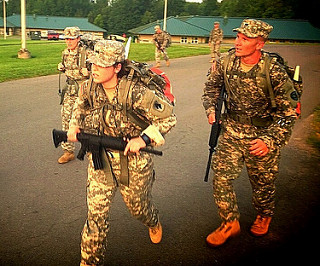
In the early morning hours on July 18, 2015, the Warrant Officer Candidates of Class 15-001 are required to complete a 6.2 mile ruck march in less than 106 minutes. This is one the many tests required of WOCs during their training and — according to Warrant Officer Candidate Stephanie Bradley — one of the toughest challenges yet. (Kentucky Army National Guard photo by WOC David Cureton)
Stephanie Bradley is one such example. One of five siblings, three brothers and a twin sister she decided to enlist in the Kentucky Army National Guard eight years ago in order to support her personal goal of attending college.Because of her background, hard work ethic, and accompanying reputation, she is in pursuit of a new goal after receiving approval to become a Warrant Officer. She is one of eleven Warrant Officer Candidates currently attending the 238th Regimental Training Institute’s Warrant Officer Candidate School at the Wendell H. Ford Regional Training Center in Greenville, Kentucky – and in observance of Women’s Equality Day it is important to point out she is the only female.
“I was inspired by all the Warrant Officers I have met and wanted to progress in my professional career,” said Bradley.
Upon commissioning and after completing her Warrant Officer Basic Course she will be a 920B, Supply Systems Technician responsible for instructing, managing, and supervising the receipt, storage, and issuance of supplies and equipment.
The male dominated Warrant Officer Candidate Class 15-001, aptly named the Brown Bears can be an intimidating environment to some but for Warrant Officer Candidate (WOC) Bradley, it’s a welcomed challenge and, now six months into the course, has almost solidified her dream. As a previous nominee for Unit NCO of the year and Battalion Soldier of the year, it is clear that her superiors have recognized her talent.
“WOC Bradley consistently demonstrates the subject matter expertise that Warrant Officers are known for. She will make an excellent addition to the Warrant Officer Corps,” said Capt. Jake Kwiek, commander of Alpha Company, 103rd Brigade Support Battalion.
When her peer and fellow candidate WOC John Smith was asked what makes her stand out from the rest, he replied, “She always goes above what is expected and has been an asset for the entire class, she personally developed our study methods that has kept us all on track.”
“From the first day I met WOC Bradley during last January’s OCS/WOCS open house, I was impressed with her initiative and ability to get things done, and done right,” said State Command Chief Warrant Officer Dean Stoops. “She initially stood out amongst her fellow applicants by her ability to complete the application process in a very short period of time, and in time to attend Zero Phase in March and begin Phase Two in April.
“I knew then, this Soldier was Warrant Officer material and would go far as a Supply Systems Technician. I have no doubts she has a bright future ahead of her and will be a great asset to the Kentucky Army National Guard and the Quartermaster Corps.”
With a Bachelor’s Degree in Arts (minor in psychology) from Lindsey Wilson College, an extensive amount of military training, several accolades, and a reputable civilian career in production control at Lockheed-Martin, this future warrant officer has proven to be one of the Kentucky Army National Guard’s rising stars.
Bradley’s advice to other females in the military? “Do not let the perceived physical standards hold you back. Be willing to step outside of their comfort zones and if you’re the one complaining and wishing things would change, then put yourself in a position where you can change it – as a leader.”
For more information on the Kentucky National Guard’s warrant officer program contact Chief Warrant Officer Ryan Turner at (502) 607-6200, Cell: (502) 320-3653 or email at [email protected].
By Staff Sgt. Scott Raymond, Kentucky National Guard Public Affairs
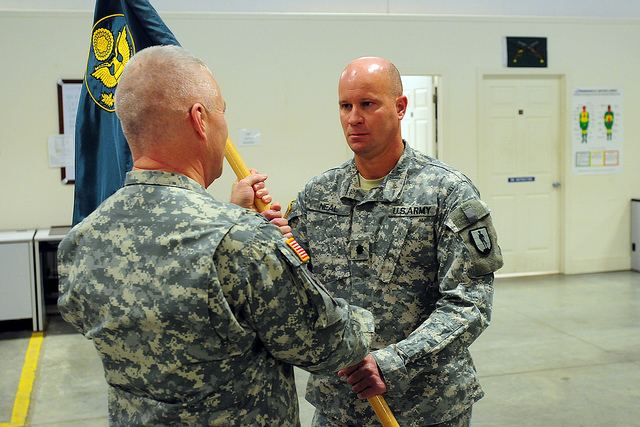
Lt Col. Todd Neal receives the battalion guidon from Col. Hal Lamberton during a change of command ceremony at the Wendell H. Ford Regional Training Center in Greenville, Ky., Nov. 15, 2013. Neal assumed command of the 2nd Modular Training Battalion of the 238th Regiment. (U.S. Army National Guard photo by Staff Sgt. Scott Raymond)
GREENVILLE, Ky. — Lt. Col. Todd Neal assumed command of the 2nd Modular Training Battalion, 238th Regiment during a change of command ceremony at the Wendell H. Ford Regional Training Center in Greenville, Ky., Nov. 15, 2013.
Lt. Col. David Roche relinquished command, a position he has held for the past two years. Col. Hal Lamberton, the regimental commander said Roche was a pivotal part of the 238th Regional Training Institute being named an Institution of Excellence for 2012. Lamberton also awarded Roche the Meritorious Service Medal for his leadership of the 2/238th.
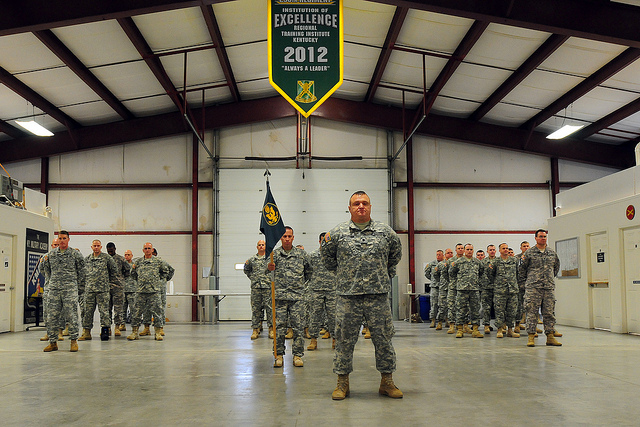
Soldiers of the 238th Regiment stand in formation during a change of command ceremony at the Wendell H. Ford Regional training Center in Greenville, Ky., Nov. 15, 2013. The regiment is is made up of the 1st Field Artillery Battalion, the 2nd Modular Training Battalion and the Regimental Headquarters. (U.S. Army National Guard photo by Staff Sgt. Scott Raymond)
Neal comes to the unit from the 149th Maneuver Enhancement Brigade where he spent several years in the brigade’s plans and operations section. Neal said taking command of a battalion should be on every officer’s list of goals in their careers. He thanked several Soldiers and mentors who have helped him along the way to this highlight of his time in uniform.
“As a young officer, there are two or three things you look to do. You want to be a successful platoon leader and get a company command, but most guys look at the pinnacle of their careers being a brigade or battalion commander,” said Neal. ” This is a step I fortunately been able to take and I look forward to the challenge and doing a good job for the organization and the leadership and improve on what is already in place.”
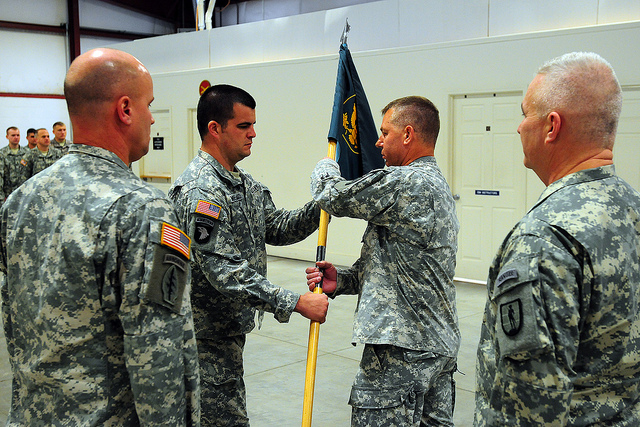
Lt. Col. Daivd Roche receives the battalion guidon from Master Sgt. Benzie Timberlake during a change of command ceremony at the Wendell H. Ford Regional Training Center in Greenville, Ky., Nov. 15, 2013. Roche relinquished command of the 2nd Modular Training Battalion to Lt. Col. Todd Neal (left). (U.S. Army National Guard photo by Staff Sgt. Scott Raymond)
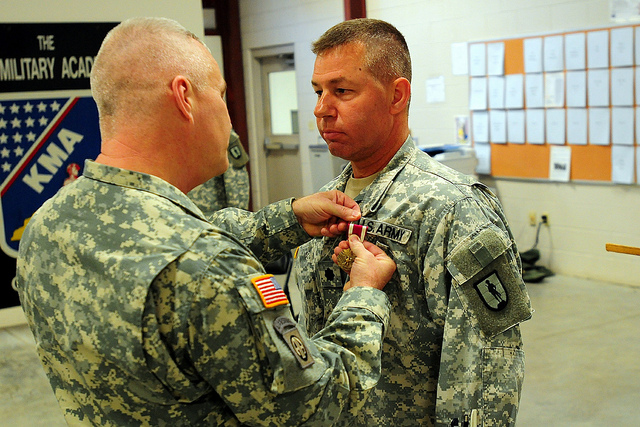
Col. Hal Lamberton, commander of the 238th Regiment pins the Meritorious Service Medal to the uniform of Lt. Col. David Roche following a change of command ceremony in Greenville, Ky. Lamberton cited Roche as a key figure in the 238th receiving the distinction of becoming an institution of excellence in 2012. (U.S. Army National Guard photo by Staff Sgt. Scott Raymond)
Story and photos by Staff Sgt. Scott Raymond, Kentucky National Guard Public Affairs
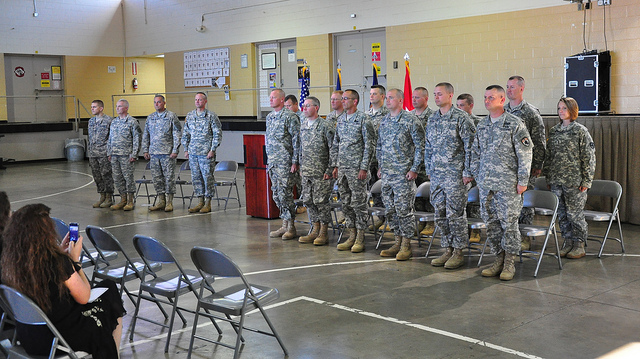
The newest graduates of the Kentucky National Guard’s Warrant Officer Candidate School stand at attention during a ceremony in Frankfort, Ky., Sept. 23, 2013. The new warrant officers recently completed the school and were commissioned Sept. 21 at Camp Atterbury, Ind. (U.S. Army National Guard photo by Staff Sgt. Scott Raymond)
FRANKFORT, Ky. — The small family that is the Kentucky Army National Guard’s Warrant Officer Corp got a little bigger with the commissioning of 12 new warrant officers, Sept. 21, 2013.
The Soldiers had just completed the final two-week phase of Warrant Officer Candidate School at Camp Atterbury Joint Maneuver Training Center in Edinburgh, Ind. Following the graduation there, the new warrant officers returned home for a recognition ceremony at the Boone National Guard Center in Frankfort, Ky., Sept. 23.
“On Saturday (Sept. 21), their military careers took on a whole new look, and a whole new responsibility,” said Kentucky’s State Command Chief Warrant Officer James Simms. ” This class represents the largest we’ve had, so the future is looking good for the warrant officer in Kentucky.”
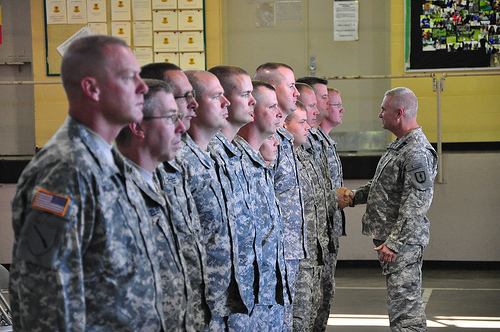
Col. Hal Lamberton, commander of the 238th Regiment congratulates each graduate of the Kentucky National Guard’s newest Warrant Officer Candidate School class during a ceremony in Frankfort, Ky., Sept. 23, 2013. The 12-member class represented the largest graduating class for the 238th and their WOCS. (U.S. Army National Guard photo by Staff Sgt. Scott Raymond)
The candidates started down the commissioning road around the beginning of the year, spending the majority of their time in training one weekend a month with the 238th Regimental Training Institute (RTI) in Greenville, Ky.
Warrant Officer Candidate School is made up of four phases: an on-line phase for preparatory course work, two phases of training with the 238th at the Wendell H. Ford Regional Training Center followed by the final phase at Camp Atterbury.
Kentucky’s RTI was recently named an Institute of Excellence by the U.S. Army and has been expanding it’s role as the state’s premier training facility, taking on new courses and more students. The unit has also impressed other states and other components with its availability and course offerings.
For two of the new warrant officers in the class, that’s just what they were looking for, because neither one are from the Kentucky Guard. Warrant Officer Arthur Stevens is an Army Reservist from the 378th Military Police Detachment in Louisville, Ky., but he lives in Clarksville, Tenn. Stevens said he had issues scheduling his school around his job and had never heard of the RTI. He said the decision worked perfectly with his work schedule and Reserve drill weekends.
“The only way I could have done this is with the RTI,” said the 13-year Veteran. “When I go back, I’m going to tell everyone I know that this is the way to go.”
“It was a great all-around experience,” Stevens said of the training. “It was great that the Guard took me in and made me part of the team.”
Simms said the Kentucky National Guard will help anyone become a warrant officer, regardless of their state or component. Warrant officers across the country work hand in hand with advanced courses and problem-solving and Simms believes they should work together to create new warrant officers as well.
“Thanks to skilled recruiters, quality leadership in the units and a fine training element we have in the 238th, we can make that happen here,” he said.
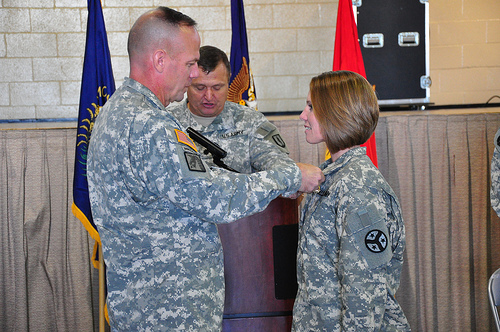
Brig. Gen. Stephen Hogan, assistant adjutant general for training recognizes Warrant Officer Amy Meadows as the honor graduate of the newest Warrant Officer Candidate School class during a ceremony in Frankfort, Ky., Sept. 23, 2013. Meadows, a Soldier with the Tennessee National Guard, chose Kentucky’s course because it allowed her to juggle work, college and becoming a warrant officer. (U.S. Army National Guard photo by Staff Sgt. Scott Raymond)
Warrant Officer Amy Meadows is with the Tennessee National Guard and also didn’t know how to deal with her full schedule of work and school. She knew the school would be longer than going through the traditional course at Fort Rucker, Ala., but had heard great things about the training provided by the 238th.
“I chose to go to Kentucky’s RTI because I needed another option,” she said. “I’m a full-time student and I work full-time at my civilian job, so I needed an option that allowed me to do all three, and the RTI was the best fit for my life.”
Meadows, from Mt. Juliet, Tenn., also graduated as the honor graduate of the class and said she has had always had respect for warrant officers, who always the ones who had the right answers.
“I’m a big believer in continuing knowledge and self-development,” she said. “And warrant officers are the pulse, the continuity of the Army, and I just wanted to be a part of it.”
Meadows will now be the Soldier everyone looks to for answers at the 278th Armored Cavalry Regiment in Knoxville, Tenn.
Each of the new warrant officers will now schedule and attend their job specific warrant officer basic course. But the training doesn’t stop there. To be the experts in their fields, warrant officers continually educate themselves for the benefit of themselves and their units. And from the regimental commander to each training, advising and counseling (TAC) officer, the 238th is glad to be instrumental in furthering the careers of the Army’s future leaders.
“We’re focused on building a stronger and more capable Warrant Officer Corps, the new leaders in the field,” said Chief Warrant officer Rick Skelton, TAC Officer with the 238th. “And I believe we are making good strides in doing our part here in Kentucky at the 238th.”
Class 55-13 “Born to Fight, trained to lead”
Story and photos by Staff Sgt. Scott Raymond, Kentucky National Guard Public Affairs

Col. William A. Denny, commander of the 238th Regimental Training Institute, swears in 17 Kentucky National Guardsmen as second lieutenants during a commissioning ceremony in Frankfort, Ky., Aug. 24, 2013. Friends, family members and fellow Soldiers gathered on the steps of the State Capitol to honor the newest officers in the Kentucky Guard. (U.S. Army National Guard photo by Staff Sgt. Scott Raymond)
FRANKFORT, Ky. — Kentucky National Guard leadership joined friends and families as the 17 graduates of Officer Candidate School Class 55-13 were promoted to the rank of second lieutenant on the steps of the state capitol building on the morning of August 24.
In his address to the graduating class Maj. Gen. Edward W. Tonini, Kentucky’s Adjutant General said, “At some point these young people will be the leader, the one in charge, with troops under their direction and a mission to complete. They’ll have to balance home life, families, employment, education and other military obligations. It won’t be easy, but it will be a life worth living.”
To see more photos from the ceremony, click here.

2nd Lt.George Jackson recieves his Officer Candidate School certificate of completion from Kentucky’s Adjutant General, Maj. Gen. Edward W. Tonini during a commissioning ceremony in Frankfort, Ky., Aug. 24, 2013. Jackson was one of 17 Guardsmen promoted and will begin his officer career with 1st Battalion, 623rd Field Artillery. (U.S. Army National Guard photo by Staff Sgt. Scott Raymond)
After receiving their diplomas graduates were pinned by family members and loved ones, and then saluted by someone who has been an influence in their life.
The Kentucky National Guard OCS is run by the 238th Regimental Training Institute located at the Wendell H. Ford Regional Training Center in Muhlenberg County.
Click here to read more about the 238th RTI!

2nd Lt. Christopher Englen is pinned by his mother, Christina and father, Chief Warrant Officer Douglas Englen during a commissioning ceremony in Frankfort, Ky., Aug. 24, 2013. Englin will begin his career as an officer with the 1st Battalion, 147th Aviation. (U.S. Army National Guard photo by Staff Sgt. Scott Raymond)
Graduates included: 2nd Lt. Monica Bryan, 1st Battalion, 623rd Field Artillery; 2nd Lt. Michael Buelow, 1st Battalion, 623rd Field Artillery; 2nd Lt. Christopher Carrington, 103rd Brigade Support Battalion; 2nd Lt. Christopher Englen, 1st Battalion, 147th Aviation; 2nd Lt. Samuel Fugal, 201st Engineer Battalion; 2nd Lt. Aaron Hart, 299th Chemical; 2nd Lt. James Hatch, 299th Chemical; 2nd Lt. George Jackson, 1st Battalion, 623rd Field Artillery; 2nd Lt. Troy Lowery, 203rd Forward Support Company; 2nd Lt. Aaron McKannan, 1st Battalion, 149th Infantry; 2nd Lt. Matthew Murphy, 2nd Battalion 138th Fires Brigade; 2nd Lt. Jonathan Olea, 63rd Theater Aviation Brigade; 2nd Lt Michael Reinersman, 63rd Theater Aviation Brigade; 2nd Lt. David Scalf, 201st Engineer Battalion; 2nd Lt. David Shanklin II, 201st AGR; 2nd Lt. Daniel Sunderlin, 1st. Battalion 149th Infantry; and 2nd Lt. Brandon Witt, 1st Battalion 149th Infantry.

Newly promoted officers of Officer Candidate School Class 55-13 gather for their group photo following their commissioning ceremony in Frankfort, Ky., Aug. 24, 2013. (U.S. Army National Guard photo by Staff Sgt. Scott Raymond)
Story by David Altom, Kentucky National Guard Public Affairs
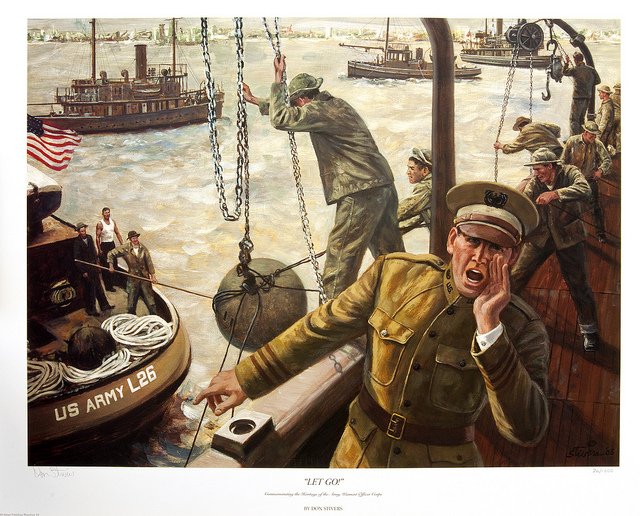
“Let Go!” depicts the founding the Army Mine Planter Service as part of the Coast Artillery Corps. The act designated warrant officers to serve as masters, mates, chief engineers and assistant engineers of mine-planting vessels.
July has been declared Kentucky National Guard Warrant Officer Month in a proclamation by Gov. Steve Beshear. This is one of a series of articles we are publishing in celebration of the warrant officer corps. Click here to read more about 95th birthday of the Army’s warrant officer corps.
FRANKFORT, Ky. — The warrant officer corps is probably the most misunderstood of all of ranks in the United States Army. The truth of the matter is that the warrant officer rank has a long and distinguished legacy going back to 1775 and the founding of our nation. As far as the Army is concerned, in July 1918 the first Warrant Officer Corps was established when an act of congress established the Army Mine Planter Service as part of the Navy’s Coast Artillery Corps; during the First World War warrant officers were responsible for mine defenses in major ports and vessels of all sizes were used to lay and maintain minefields.
Chuck Yeager, famed for breaking the sound barrier, began his career during World War II as a flight officer, the U.S. Army Air Corps equivalent of a warrant officer.
There are several notable warrant officers in military history. Brig. Gen. Chuck Yeager, famous for breaking the sound barrier, began his career as a flight officer (aka warrant officer) in the U.S. Army Air Corps during World War II.
Michael Novosel once piloted a B-29 bomber in World War II. During the Vietnam War he made the decision to give up his rank of lieutenant colonel in the Air Force to fly Army helicopters as a chief warrant officer with special forces and MEDEVAC units. It was as a warrant officer that he was presented the Medal of Honor for his bravery in conducting a medical evacuation under fire.
Tom Hennen was a United States Army warrant officer with 24 years in the imagery intelligence field. His skills and training led to him becoming the first warrant officer in space, flying aboard the Space Shuttle Atlantis in 1991.
A B-29 bomber pilot during World War II, Michael Novosel gave up his commission as an Air Force lieutenant colonel to fly Huey helicopters with the Army during Vietnam. He was a chief warrant officer when he received the Medal of Honor in 1971.
Today, in its 95th anniversary, the Army’s warrant officer corps continues its legacy as an integral and essential element in daily operations and the chain of command. Following are a few myths and facts about this fascinating and often misunderstood rank.
Myth #1. Warrant officers are not “real officers.”
False: Warrant officers are highly skilled, specialty officers, and while the ranks are authorized by Congress, each branch of the uniformed services selects, manages, and utilizes warrant officers in slightly different ways. Warrant officers can and do command detachments, units, activities, vessels, aircraft, and armored vehicles as well as lead, coach, train, and counsel subordinates.
According to Chief Warrant Officer Ryan Turner, who runs the Kentucky Guard’s warrant officer recruiting program, “The warrant officer’s main job is to serve as a technical expert, provide skills, guidance, and expertise to commanders and organizations in their particular field.”
Among his many accomplishments, Tom Hennen goes down in history as the first warrant officer in space.
Myth #2. Only the Army has warrant officers.
False: The United States Navy and the Marine Corps have warrant officers, as does the Coast Guard and the Public Health Service Commissioned Corps. The United States Air Force inherited the warrant officer ranks from the Army Air Corps at its inception in 1947, but stopped appointing warrant officers in 1959.
Myth #3. All warrant officers are pilots.
False: Not so, says Turner. “Warrant officers in the Army are the technical experts, combat leaders, trainers, and advisors in more than forty basic military occupational specialties. They serve across the active component, the Army National Guard, and the U.S. Army Reserve.”
Warrant officers also command the Army’s waterborne and sea-going vessels, most Army Bands and as aircraft commanders of most Army Aviation aircraft. In addition, they may be found in command of various small units and detached teams such as special forces and criminal investigation detachments.
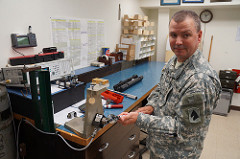
Warrant Officer Robert Boatman’s calibration shop ensures that the Kentucky Guard’s equipment and gear are all set to the right specifications, an essential factor in the increasing technology used by today’s soldiers. (Photo by David Altom, Kentucky National Guard Public Affairs)
Myth #4. Warrant officer training is a piece of cake.
False: Well, depending on your point of view. There are three basic approaches to becoming a warrant officer: 1) The six-week active resident course at Fort Rucker, Ala. 2) Distance learning plus four and a half weeks (if you are an E-5 with Warrior Leader Course) or 3) Through the 238th Regimental Training Institute, completing distance learning, five drills and a two-week annual training period. No matter which direction take, there are classes in leadership, tactics and military history and protocol, along with extensive physical training and testing.
According to Chief Warrant Officer Rick Skelton, TAC officer with the 238th RTI’s warrant officer candidate school, the training ain’t easy, but it’s not insurmountable, either.
“At one point it was actually one of the toughest schools in the army,” said Skelton. “It’s still pretty rigorous. We just finished a 6.2 mile ruck march with a fifty pound pack. You’ve got to have your head in the game, but you can do it. You just have to want to be there.”
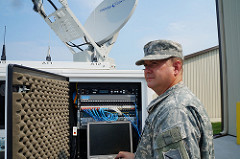
Kentucky National Guard Chief Warrant Officer Harold Brandenburg runs satellite communications during emergencies and natural disaster missions, linking local, state and federal agencies together when traditional networks are at a complete standstill. (Photo by David Altom, Kentucky National Guard Public Affairs)
Myth #5: The warrant officer corps is an archaic and dying breed.
False: “The warrant officer corps is alive and well and growing,” said State Command Warrant Officer Chief Jimmy Simms. “Just recently the Kentucky Army National Guard has received authorization for new warrant positions in electronic warfare, putting us ahead of the curve in this growing field. Artillery targeting is another warrant officer field that is growing, as are warrant positions in special forces. So, yes, we are a powerful force in the Guard and we’re getting stronger every day.”
For more information on the Kentucky National Guard’s warrant officer program contact Chief Warrant Officer Ryan Turner at (502) 607-6200, Cell: (502) 320-3653 or email him at [email protected].
Story and photos by Sgt. 1st Class Dennis Anderson, with additional photos by Sgt. Datarra Ignacio-Hooper, Headquarters 238th Regiment Unit Public Affairs Historian Representatives.

With 11 full-time and 54 part-time staff members on board at the 10,000 acre Wendell H. Ford Regional Training Center, the 238th Regimental Training Institute is the Kentucky National Guard’s flagship “schoolhouse.” It recently received Institute of Excellence status, authorizing the training of reserve component and active duty troops. (238th RTI photo)
Click here for more photos.
GREENVILLE, Ky. — On 6 April 2013, the 238th Regimental Training Institute conducted a change of responsibility ceremony at the Wendell H. Ford Regional Training Center, Greenville, Ky. Incoming Command Sgt. Maj. Richard Southard is taking over for Master Sgt. Timothy Goad.
During Goad’s tenure the 238th Regiment received the highest accreditation by the United States Army Training and Doctrination Command of “Institute of Excellence” in December 2012.
“During my 32 years of service in my various assignments in transportation, field artillery and military police, I am most thankful for my assignment with the 238th Regiment,” he said. “The dedication and support from the 238th‘s NCO corps ensured not only my success but yours as well. Our first accreditation through TRADOC was not only a success, but through your hard work and perseverance we received the highest rating possible, as an Institute of Excellence.”
‘This is a bittersweet moment for me,” he added. “The sweet is the opportunity to lead such an outstanding group of NCOs as yourselves. The bitter portion is having to step down.”
Click here to read about the 238th RTI’s status as an “Institution of Excellence.”

“A bittersweet moment.” 238th Regimental Training Institute outgoing top NCO, Command Timothy Goad, addresses the troops.
Goad is now assigned as senior operations NCO for the regiment. He served in the military since 1980 and in the active guard and reserve since 1997. He deployed on multiple occasions including Operations Desert Shield/Desert Storm, Operation Enduring Freedom, Operation Iraqi Freedom II and Operation Iraqi Freedom 07-09. Goad’s many awards and decorations include the Bronze Star Medal, Meritorious Service Medal, Army Commendation Medal, Army Achievement Medal, Army Good Conduct Medal, Southwest Asia Service Medal, Iraq Campaign Medal, Global War on Terrorism Service Medal, and the Global War on Terrorism Expeditionary Medal. He has three children and two grandchildren.
Regimental commander Col. William A. Denny expressed gratitude for Goad’s contributions, saying that, ‘We’ve had a great year and the highlight of that year being accreditation. Thank you for stepping up and thank you for the tremendous job you’ve done.”
Denny also expressed his confidence that Southard would lead the regiment in continued excellence in training Soldiers.
“We are continuing to head in the right direction and with Command Sgt. Maj. Southard’s leadership we will continue to make great strides,” he said.

238th Regimental Training Institute incoming Command Sgt. Maj. Richard Southard is taking over responsibilities for Master Sgt. Timothy Goad.
“I do thank the Kentucky Army National Guard, State Sergeant Major and of course COL Denny for having confidence in me to come back to the 238th to serve as Commandant here,” said Southard. “I appreciate and thank Master Sgt. Goad for the job he has done. I hope you show me that support and confidence too. And I know I will work well with each and every one of you.”
Southard most recently served as the 149th Brigade Support Battalion command sergeant major. Southard has served since on active duty from 1983 to 1988 and has served in the National Guard since 1988. He also has served on several deployments from Operations Desert Shield/Desert Storm, Operation Enduring Freedom, Operation Iraqi Freedom and Operation New Dawn. Southard is a graduate of Weber State University. Southard’s awards and decorations include Bronze Star Medal w/”V” device, Bronze Star Medal, Army Commendation Medal, Army Achievement Medal, Southwest Asia Service Medal and others. Southard is married and has a daughter.
“Best bang for the buck” prepares active duty and reserve component Soldiers for real world missions
Story by David Altom, Kentucky National Guard Public Affairs
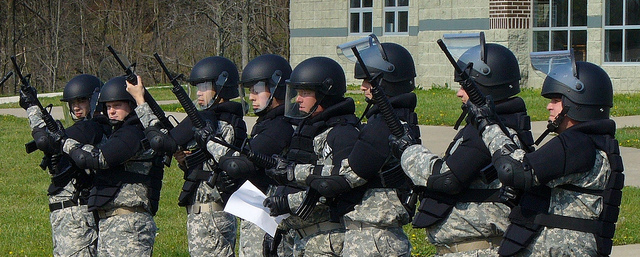
“Always ready, reliable and accessible!” Military police students practice civil disturbance tactics during MOS class at the 238th Regimental Training Institute at the Wendell H. Ford Regional Training Center. The 238th RTI recently received accreditation as an Institute of Excellence, qualifying it to teach active duty and reserve component soldiers across several disciplines. (Kentucky Army National Guard photo by Sgt. 1st Class Dennis M. Anderson, 238th Regimental Training Institute)
GREENVILLE, Ky. – In a time of budget cuts, drawdowns and a post-war scramble for resources and money, a bright light of achievement shines on the Commonwealth of Kentucky. The 238th Regimental Training Institute, once reknown as the Kentucky Military Academy, has caught the eye of the United States Army – and in a good way.
It was January of this year that the 238th RTI was designated as an “Institute of Excellence” by the Army, the culmination of a series of inspections that resulted in a 98% average, with three of five inspections with a perfect score. This designation is the first for the 238th, covering a variety of disciplines to include field artillery, infantry, military police, officer candidates and warrant officer candidates.
What does this achievement mean for the 238th RTI and the Kentucky Army National Guard? In short, it means greater training opportunities for the Kentucky Army Guard and a secure relationship with Big Army.
“This Institution of Excellence accreditation puts us in the top echelons of our peers,” said Col. Allen Denny, commander of the 238th RTI. “This is important as it gives us a leg up when competing for resources, additional courses and other opportunities.”
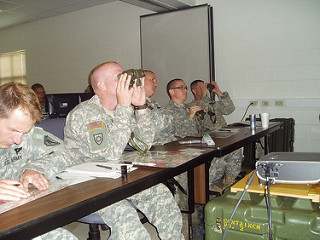
Students in an artillery class conducted by the 238th Regimental Training Institute at the Wendell H. Ford Regional Training Center. Cadre push to have the latest training on the technological skills so soldiers are better prepared when they hit the ground on deployment. (Kentucky Army National Guard photo by Sgt. 1st Class Dennis M. Anderson, 238th Regimental Training Institute)
“We are in an uncertain environment due to a shift in strategy, a transition from an Army at War to an Army in Preparation, and an era of fiscal uncertainty,” said Denny. “However, this accreditation puts us in excellent position to maintain and to grow and to continue to add benefit to the Kentucky National Guard and the One Army School System.”
With 11 full-time and 54 part-time staff members on board at the 10,000 acre Wendell H. Ford Regional Training Center, the 238th RTI is not the largest such institution, which makes the accreditation all the more remarkable. Other facilities such as Camp Shelby, Miss. and Fort Jackson, S.C. have been around for a lot longer and are considerably larger, but the 238th RTI is hot on their heels in terms of growth and quality of instruction.
Click here to read about the Kentucky Army Guard’s first ever combined officer and warrant officer graduation
“This accreditation solidifies our credibility, whether it’s training Kentucky National Guardsmen or Guard members from other states,” said Lt. Col. William McDaniel, operations chief for the 238th. “It also gives us the opportunity in certain course fields that we have to train active component Soldiers so they receive the same training value here that they would at an active duty school.”
Capt. Anthony Haley, budget analyst resource manager, wasn’t surprised that the regiment received its accreditation. “This was something we’ve been preparing for about three years. A lot of hard work and dedication went into preparation into getting to this point.”
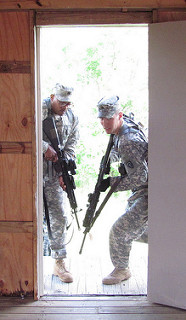
Busting down doors — Students practice tactical skills during exercises conducted by the 238th Regimental Training Institute at the Wendell H. Ford Regional Training Center. The quality of training provided by the 238th RTI is such that it’s common for students to return home and ask when the next level class is available. (Kentucky Army National Guard photo by Sgt. 1st Class Dennis M. Anderson, 238th Regimental Training Institute)
Credit where credit is due
While Haley said that the accreditation was a team effort, he pointed to two specific elements in the mission’s success: the training staff and cadre, and the quality assurance team.
“Our quality assurance guys need to get some of the credit. They spent a lot of time looking the documents and the standards and making sure that when the TRADOC accreditation team came that they could see and understand that we were meeting the Army standards.”
To hear everyone talk about the accreditation process, Sgt. 1st Class Kevin Estes gets much of the credit for making sure that the regiment got it’s due recognition. Regulations had to be analyzed, spreadsheets composed and binders assembled. Then it all had to be presented and explained. As the quality assurance NCO, that was Estes’ job and he’s lauded by the staff for pulling it off with exemplary professionalism and a ton of hard work.
Estes, a true quiet professional, summed it all up in one sentence: “It was just another day in the office.”
There’s more to it, of course. Estes explained that while he had to look at and assess the standards, the instructors were the ones who got the job done … and done right!
Professional and credible instructors
“The regiment has always had good instructors,” he said. “But it wasn’t always easy to show ‘what right looks like.’ We’ve always instructed very well and put out quality Soldiers. What the accreditation standard does is make you show that you’re actually doing that, and doing it at a higher standard.”
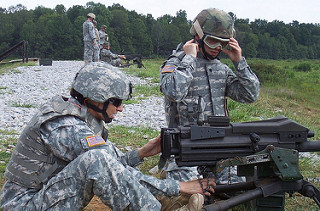
At the firing range with the 238th Regimental Training Institute at the Wendell H. Ford Regional Training Center. Hands on application of classroom skills is an essential ingredient in training professional soldiers. (Kentucky Army National Guard photo by Sgt. 1st Class Dennis M. Anderson, 238th Regimental Training Institute)
That’s the measuring of it all. But then there’s the actual hands-on instruction, the meat of the matter and the key to the 238th’s success.
“What it all boils down to is, if we’re not putting out a quality product, we’re not going to get repeat business,” said Sgt. 1st Class James Abston.
The quality product, of course, being professionally trained Soldiers. A field artillery course manager, Abston says the “repeat business” from his students is testament to the high level of training affected by the regiment.
“Our students are the reason we’re here,” Abston said. “I’ve got guys who just graduate from the lower level courses emailing me asking when the high level courses are being offered. They’re getting our name out there and asking to come back, plus they’re telling their units to send more troops to us for training.”
The accreditation is all nice and good, but Abston sees the role of the regiment as a higher calling.
Click here to find out more about the Kentucky National Guard Warrant Officer program
“To me the most important part is that these students can wind up deploying and in the middle of the fight. Most of them have already been deployed – they’re war veterans and they know what they need. They’ll throw down the flag if they need to, so that means you have to provide quality training and prove that you know what you’re talking about.”
The experience and leadership exhibited by the students has proven to be an asset to the schoolhouse, says instructor Sgt. 1st Class Timothy England.
“We scan our students as they come through and we put a bug in their ear about coming back and being an instructor,” he said. “Our instructor pool improves with each year. They learn from each other, they don’t hoard information but instead they love sharing it.
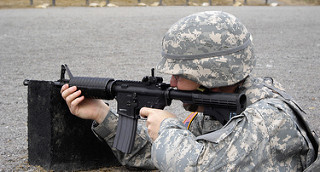
This is what it’s all about! The 238th Regimental Training Institute has full access to range facilities at the Wendell H. Ford Regional Training Center, one of the fastest growing training sites in the nation. (Kentucky Army National Guard photo by Sgt. 1st Class Dennis M. Anderson, 238th Regimental Training Institute)
NCOs are the backbone
Of course, behind every unit is a top sergeant, in this case the regiment’s Command Sgt. Maj. Timothy Goad. And like any good top sergeant, Goad brags on his non-commissioned officers, giving them credit for the work that’s been done.
“As long as the Army’s been around the NCO corps has been its backbone. In the time that I’ve been here I’ve been so proud of the quality of our NCOs. They’re phenomenal! I just give them some direction and they take it and run with it. You can’t find a better group in my opinion. That shows in our accreditation as an institute of excellence.”
Goad points out that a majority of the RTI’s staff is M-Day, or part-time. “I have to salute our M-Day staff. They’ve got other jobs and careers in the civilian world, but they still put out quality training that is high above the standard.”
One of the misconceptions about the regiment is that it doesn’t deploy. That’s true. But it’s also true that “the school house” is full of instructors who have deployed, literally “been there, done that and got the t-shirts to prove it.”
“Approximately 80 percent of our staff has deployed at one time or another,” said Master Sgt. Charles Johnston, senior field artillery instructor. “When our students see that combat patch on their instructor’s uniform, that means something.”
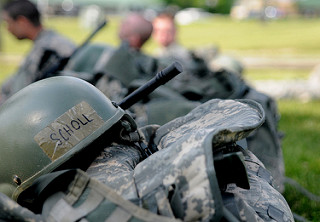
Kentucky National Guard Officer Candidate students take a moment to relax after a required 10-mile ruck march to complete phase two of their OCS curriculum with the 238th Regimental Training Institute at the Wendell H. Ford Regional Training Center. The 238th RTI also offers a warrant officer candidate program as well as a broad range of MOS training for active duty and reserve component NCOs. (Photo by: Spc. David Bolton, Public Affairs Specialist, 133rd Mobile Public Affairs Detachment, Kentucky Army National Guard).
Technology and the future
Johnston also points out that the 238th RTI aggressively pursues updating the technology that they teach on. “If we find out that our courses are lagging behind we push pretty hard to make sure that we update our gear and put it in our training. We want to make sure that what we’re teaching is something that matters to our students and is up to date.”
So there you have it. While history shows that the post-war U.S. military often ponders future missions and direction, the Kentucky National Guard and the 238th Regimental Training Institute have a definite purpose – and perhaps even a higher calling.
Chief instructor Master Sgt. John Hazlett sums it all up with characteristic though practical optimism:
“This accreditation is a celebration of the fact that we have all of these different elements at this regiment and they’re all being recognized at the highest level. If any of these elements fail at their job, we don’t become an institute of excellence. So everybody’s got to do their part for us to succeed.”
“The future of the Kentucky National Guard is happening now at the 238th,” said Hazlett. “The point of the spear is right here. New ideas that come out of active duty, from Afghanistan, Iraq and Africa, we’re the first to implement those right here, right now. When a Soldier comes here, they truly learn how to be a leader, how to lead a squad, a platoon or a company. When they leave here, they leave better than they ever were before.”