
Pages
Stay In Touch
More
© 2013 KentuckyGuard
Kentucky infantrymen conduct largest air assault exercise in six years
By Staff Sgt. Scott Raymond, Kentucky National Guard Public Affairs
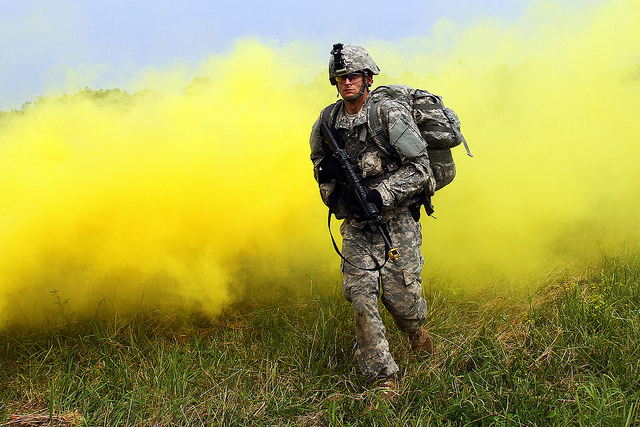
Spc. Robert Satterfield with Bravo Company, 1st Battalion, 149th Infantry exits a landing zone during an air assault exercise at Muscatatuck Urban Training Center in Butlerville, Ind., July 26, 2015. Three companies of infantrymen participated in one of the largest training exercises for the battalion in six years. (U.S. Army National Guard photo by Staff Sgt. Scott Raymond)
BUTLERVILLE, Ind. — In terms of basic Soldier skills, the infantry is arguably the hardest training unit in the Kentucky Guard. But it’s not everyday Soldiers of the 1st Battalion, 149th Infantry get to put all that training into a full-spectrum exercise. As a culminating event to this year’s two-week annual training for the unit, the Mountain Warriors conducted a multi-day air assault mission at the Muscatatuck Urban Training Center near Butlerville, Ind., July 24-27.
“Stuff like this is phenomenal, it’s great training,” said Spc. David Woodford with Alpha Company, 1/149th. “This kind of training will keep me in uniform.”
Soldiers with Alpha and Bravo Co., 1/149th loaded their gear and flew by UH-60 Blackhawks to the landing zone at Muscatatuck, compliments of the U.S. Army Reserves’ 11th Theater Aviation Command out of Fort Knox, Ky. Each Soldier carried their weapon and everything they needed for the three-day mission on their backs. Many of the Guardsmen flew on their first helicopter ride. And at the end of it, they had to get themselves, their gear and their fellow Soldiers out of the aircraft as quickly and as organized as possible.
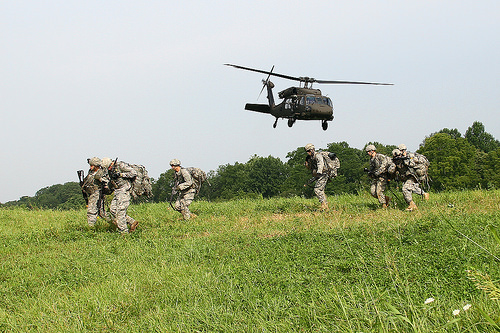
Soldiers with the 1st Battalion, 149th Infantry conduct an air assault exercise at Muscatatuck Urban Training Center in Butlerville, Ind., July 26, 2015. Aviators from the 11th Theater Aviation Command at Fort Knox, Ky., provided eight UH-60 Blackhawk helicopters to transport the infantrymen to the training site. (U.S. Army National Guard photo by Staff Sgt. Scott Raymond)
Click here for more photos.
From the landing zone, the 1/149th was tasked with assaulting and securing a building complex occupied by members of Charlie Company, simulating an opposition forces. The three companies of infantrymen then had to hold their position and establish relations with locals.
In advance of the air assault, a small platoon of scouts paved the way for the main body attack. For those scouts, the mission was a couple days longer as they infiltrated the area two days prior to the battalion’s arrival. They were the eyes and ears of the attack. A job they said they wouldn’t trade for any other in the battalion.
“This is as high as you can get as far as training value,” said Staff Sgt. Nicholas Combs with Headquarters, Headquarters Company, 1/149th. “No one here would want any other job during this training. When this mission is all said and done, only good stories will come out of it.”
From boarding and egressing a helicopter, moving as a fire team and even kicking in doors, the Mountain Warriors checked off a number of mission essential tasks they must train for each year. Lt. Col. Joseph Lear, commander of the 1/149th said the AT provided an excellent chance for each section of the battalion to not only train, but to put their job specialities to the test.
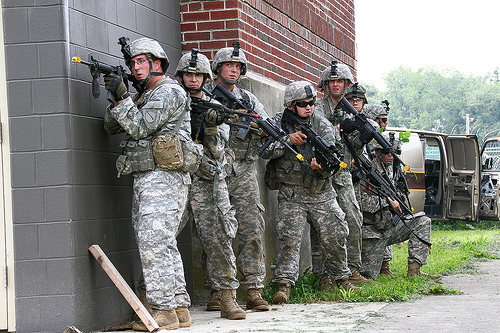
Soldiers with the 1st Battalion, 149th Infantry stack on a wall during a training exercise at the Muscatatuck Urban training Center in Butlerville, Ind., July 26, 2015. The unit conducted an air assault mission to seize a building complex and hold their position against a simulated enemy force. (U.S. Army National Guard photo by Staff Sgt. Scott Raymond)
“Conducting an air assault is one of our primary tasks,” said Lear. “This enabled us to do something we haven’t done since 2009 as a battalion. It’s a tremendous training multiplier for us, to be able to do that kind of mission at that scale, we are grateful to have the opportunity.”
Members of Delta Company provided the ground assault and convoyed by Humvees to the site. In reserve was the 1149th Forward Support Company, whose job is to ensure the infantry can do their job. Chief Warrant Officer Melissa Propes with the 1149th said the annual training was also an invaluable training opportunity for her Soldiers as well.
“I love seeing these Soldiers get experience in what they do, and they got to do that here. Not only did they get good training, it made a difference to the infantry. And that is absolutely what the 1149th FSC is supposed to do,” she said. “Everybody from the infantryman to the mess section, to distro to maintenance, everybody has an essential piece of the puzzle, or they wouldn’t be here. And we’re just happy to contribute.”
Leading up to the assault mission, Soldiers of the unit trained in a variety of squad and platoon-sized drills at Camp Atterbury, Indiana, to hone their skills and prepare for the final mission.
Pvt. Scottie Pace is a cook with the 1149th FSC and attended his first annual training.
“When I first enlisted, I had no idea what to expect on an AT,” he said. “Now, I feel like knowing that I can do my job and help the unit is a great thing to prepare me for future training and makes me a better Soldier.”
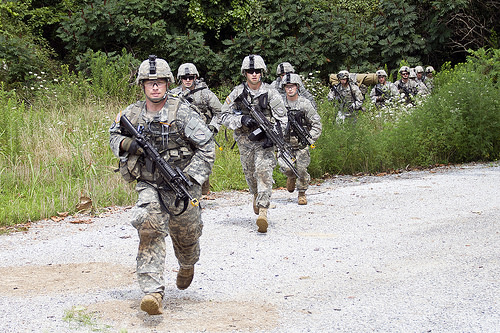
Soldiers with the 1st Battalion, 149th Infantry advance across a road during a training exercise at the Muscatatuck Urban Training Center in Butlerville, Ind., July 26, 2015. The exercise was the culminating event of the unit’s two-week annual training period. (U.S. Army National Guard photo by Staff Sgt. Scott Raymond)
More than 550 Soldiers of the battalion were on hand for the training period. Platoon leaders and company commanders agreed their Soldiers greatly benefitted from the unique training and the boost in morale.
“There’s nothing like training in the field,” said Spc. Joseph Hill from Alpha Co. “You’re really able to do your job and refresh your skills. It’s hard to find a bad part of this AT.”
Battalion leadership were pleased with the effort put forth by their Soldiers and the chance to put them in the field and participants and witnesses to the unique energy of the infantry.
“This type of training is also why people enlist,” said Lear. “They don’t join to stand a drill hall and get briefs. These troops will talk about this air assault for years.”
“That’s how this type of training leads to retention, which leads to strength, which leads to funding, which leads to more quality training. That’s the impact this has on this battalion.”
Story by Sgt. Lerone Simmons, 133rd Mobile Public Affairs Detachment
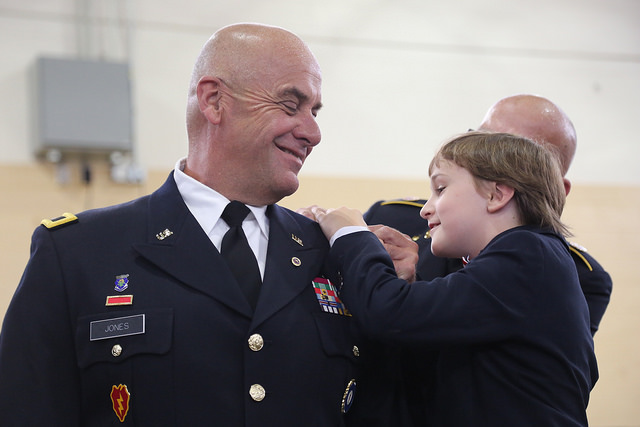
Newly promoted Brig. Gen. Charles T. Jones, Kentucky Assistant Adjutant General, watches as his grandson Brooks O’Neal, pins on his epaulet during the promotion ceremony at the Boone National Guard Center, Frankfort, Ky. July 17, 2015. (Kentucky National Guard photo by Olivia Burton)
FRANKFORT, Ky. — Family, friends, honored guests, and colleagues gathered at the Billy G. Wellman Armory on Boone National Guard Center to commemorate the promotion of Col. Charles T. Jones to the rank of Brigadier General, July 17, 2015.
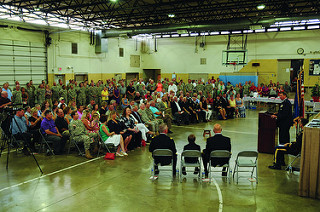
Family, honored-guests, collegues and friends gathered to observe newly promoted Brig. Gen. Charles T. Jones’ promotion ceremony at the Billy G. Wellman Armory, Boone National Guard Center, Frankfort, Ky. July 17, 2015. Jones currently serves as the Assistant Adjutant General of the Kentucky National Guard. (Kentucky National Guard photo by Sgt. Lerone Simmons)
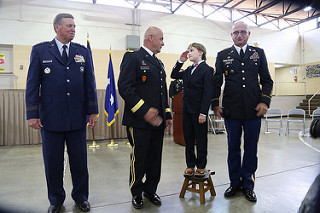
Brooks O’Neal salutes his grandfather. Brig. Gen. Charles Jones during his promotion ceremony in Frankfort, Ky., July 17, 2015. (Photo by Olivia Burton)
“This is a tremendous opportunity to be able to continue to affect change in the lives Soldiers,” said Jones. “I am truly blessed.” Jones said he owes much of his success to hard work and support of his family. “Hard work is what got me here, and that’s what I’ll continue to do.” Click here for more photos. His wife Linda, daughter Brandi, and eight-year-old grandson Brooks O’Neal, accompanied him at the ceremony. Brooks took part in the promotion ceremony by pinning the epaulet rank on his grandfather’s uniform.As one of the honored guests, Maj. Gen. Edward W. Tonini, Kentucky Adjutant General welcomed Jones to the command staff and expressed his confidence in the newly promoted brigadier general.
“In my mind, he’s a Soldier’s Soldier,” said Tonini. “I am tremendously comfortable having him across the office as deputy adjutant general. I know when I leave, the Guard will be in the best possible hands.”
Jones first commissioned in 1981 through the Kentucky Military Academy Officer Candidate Program and was also prior enlisted with Bravo Company, 1st Battalion, 149th Infantry Brigade. He is a veteran of Operation Iraqi Freedom, serving from 2006 to 2007 as commander, 149th Infantry Brigade Combat Team and Garrison Commander Contingency Operations Base Spiecher as part of the 101st Airborne Division and the 25th Infantry Division as part of Multination Division North.
Story by Capt. Ryan Hubbs, 1st Battalion, 149th Infantry
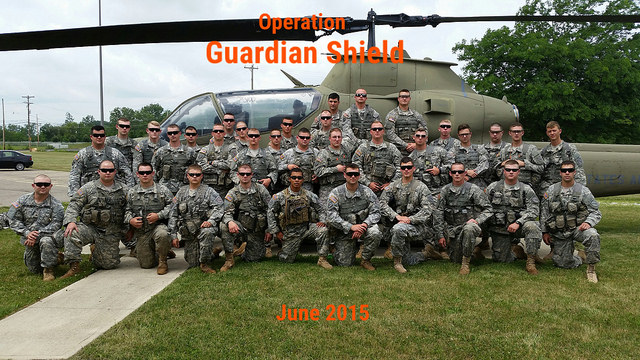
Soldiers from Bravo Company 1-149th Infantry participated in one of the largest regional, multi-agency exercise in the history of the Kentucky Guard at Camp Sherman, Ohio, June 16-18, 2015. Acting as the Quick Reaction Force for a Special Focus Event known as Operation Guard Shield, members of Bravo Co. quickly assembled at their home station, loaded their equipment, and deployed to the exercise site in less than 7 hours. (U.S. Army National Guard photo by Capt. Ryan Hubbs)
Camp Sherman, Ohio — “GAS, GAS, GAS!” What would you do if you had to respond to a Chemical, Biological, Radiological, or Nuclear (CBRN) threat? For members of Bravo Company 1st Battalion, 149th Infantry, they were about to find out…
With the focus of the National Guard’s efforts over the last 14 years, centered on the War on Terror, it is important as Soldiers in the National Guard to be able to respond domestic events as well.
Soldiers from Bravo Co. participated in one of the largest regional, multi-agency exercise in the history of the Kentucky Guard June 16-18. Acting as the Quick Reaction Force for a Special Focus Event known as Operation Guardian Shield, the infantrymen quickly assembled at their home station, loaded their equipment, and deployed to the exercise site in less than 7 hours.
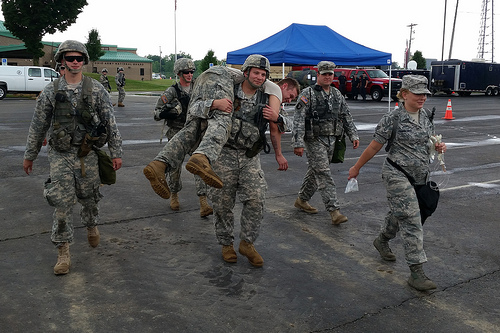
Soldiers from Bravo Company 1-149th Infantry escort a simulated casualty during a training exercise at Camp Sherman, Ohio, June 17, 2015. Acting as the Quick Reaction Force for Operation Guard Shield, members of Bravo Co. quickly assembled at their home station, loaded their equipment, and deployed to the exercise site in less than 7 hours. (U.S. Army National Guard photo by Capt. Ryan Hubbs)
In conducting this full scale exercise event, the 40 participants flew from London, Kentucky to Rickenbacker Air National Guard Base, Ohio in a C-130 provided by the Ohio National Guard. The soldiers then conducted a quick Joint Reception, Staging, Onward Movement, and Integration (JRSOI) briefing describing the situation on the ground. From there the Bravo Co. participants loaded up onto four UH-60 Blackhawk Helicopters and departed for Camp Sherman, Ohio were they would begin their exercise.
The scene at the incident site was a train derailment caused by a domestic terrorist organization (for exercise purposes only). The train was carrying hazardous materials which were in theory released into the air. Bravo Co.’s job worked with the incident manger, local law enforcement, local fire departments, and the CBRN Enhanced Response Force (CERF) to provide security to the site, help evacuate casualties, and prevent decontaminated personnel from entering into the contaminated zone and vice versa.
Staff Sgt. David Olszewski, Platoon Sergeant for 2nd Platoon, Bravo Co. discussed the benefits of training for the mission prior to executing. “Luckily, we have trained with our protective masks so it was not a complete shock to the system; however, it was still difficult to communicate while wearing them. Having trained with masks previously allowed us as Soldiers to not only have confidence in our equipment, but also provided us the stress inoculation necessary to remain calm and collected while wearing the mask.”
Rubble and debris from the derailment site could be seen everywhere. Role players were hired to act as casualties, on lookers, family members searching for loved ones, and members of the media to make the scenario more realistic.
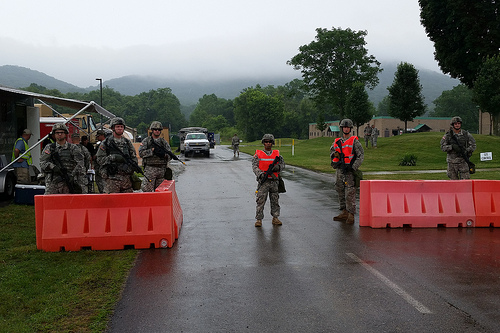
Soldiers from Bravo Company 1-149th Infantry man a tactical control point during a training exercise at Camp Sherman, Ohio, June 17, 2015. The exercise, Operation Guard Shield, brought National Guardsmen from at least eight states together with a variety of civilian organizations to respond to a simulated domestic incident. (U.S. Army National Guard photo by Capt. Ryan Hubbs)
Throughout the day Bravo Co. established and manned a tactical control point, provided litter assistance for casualties who had undergone the decontamination process, conducted a wide area search for survivors, and treated multiple simulated casualties for a variety of injuries all while wearing their protective gas masks and equipment.
With such a large-scale event involving a variety of organizations, interagency communication was difficult but vital to the exercise.
“The most challenging aspect of the operation was coordinating across multiple agencies including military, law enforcement, and emergency management,” explained Olszewski. “Agencies use different communication systems, pro-words, acronyms, and command structures so it can be a challenge to determine the most effective and efficient means of sending and receiving information.”
Along with Soldiers from the Kentucky Guard, Operation Guardian Shield included Soldiers and Airmen from Indiana, Illinois, Pennsylvania, Georgia, West Virginia, Ohio, and National Guard Bureau. Also, representatives and agents from the Department of Homeland Security, FBI, FEMA, Civil Air Patrol, Red Cross, and Ohio Emergency Management were all on the scene. This made the need for coordinated communications extremely important.
At the conclusion of the exercise, all 40 Bravo Company participants loaded up onto to the UH-60s, returned to the air base, loaded onto a C-130 and returned to London where they officially ended their mission.
“We hope to continue to participate in high profile exercises such as this,” said Capt. Ryan Hubbs commander of Bravo Co. “This event allowed us to complete a full spectrum of mission essential tasks and practice our most important mission which is to protect the citizens of our nation. It was great to be able to shift the focus onto a domestic response event, and give us broader perspective of what our duties as members of the National Guard entails.”
“Best bang for the buck” prepares active duty and reserve component Soldiers for real world missions
Story by David Altom, Kentucky National Guard Public Affairs
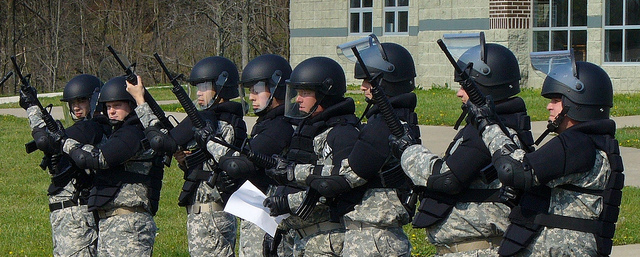
“Always ready, reliable and accessible!” Military police students practice civil disturbance tactics during MOS class at the 238th Regimental Training Institute at the Wendell H. Ford Regional Training Center. The 238th RTI recently received accreditation as an Institute of Excellence, qualifying it to teach active duty and reserve component soldiers across several disciplines. (Kentucky Army National Guard photo by Sgt. 1st Class Dennis M. Anderson, 238th Regimental Training Institute)
GREENVILLE, Ky. – In a time of budget cuts, drawdowns and a post-war scramble for resources and money, a bright light of achievement shines on the Commonwealth of Kentucky. The 238th Regimental Training Institute, once reknown as the Kentucky Military Academy, has caught the eye of the United States Army – and in a good way.
It was January of this year that the 238th RTI was designated as an “Institute of Excellence” by the Army, the culmination of a series of inspections that resulted in a 98% average, with three of five inspections with a perfect score. This designation is the first for the 238th, covering a variety of disciplines to include field artillery, infantry, military police, officer candidates and warrant officer candidates.
What does this achievement mean for the 238th RTI and the Kentucky Army National Guard? In short, it means greater training opportunities for the Kentucky Army Guard and a secure relationship with Big Army.
“This Institution of Excellence accreditation puts us in the top echelons of our peers,” said Col. Allen Denny, commander of the 238th RTI. “This is important as it gives us a leg up when competing for resources, additional courses and other opportunities.”
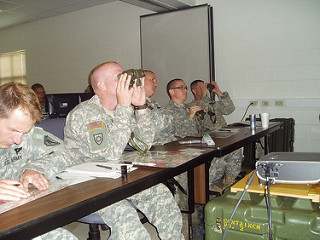
Students in an artillery class conducted by the 238th Regimental Training Institute at the Wendell H. Ford Regional Training Center. Cadre push to have the latest training on the technological skills so soldiers are better prepared when they hit the ground on deployment. (Kentucky Army National Guard photo by Sgt. 1st Class Dennis M. Anderson, 238th Regimental Training Institute)
“We are in an uncertain environment due to a shift in strategy, a transition from an Army at War to an Army in Preparation, and an era of fiscal uncertainty,” said Denny. “However, this accreditation puts us in excellent position to maintain and to grow and to continue to add benefit to the Kentucky National Guard and the One Army School System.”
With 11 full-time and 54 part-time staff members on board at the 10,000 acre Wendell H. Ford Regional Training Center, the 238th RTI is not the largest such institution, which makes the accreditation all the more remarkable. Other facilities such as Camp Shelby, Miss. and Fort Jackson, S.C. have been around for a lot longer and are considerably larger, but the 238th RTI is hot on their heels in terms of growth and quality of instruction.
Click here to read about the Kentucky Army Guard’s first ever combined officer and warrant officer graduation
“This accreditation solidifies our credibility, whether it’s training Kentucky National Guardsmen or Guard members from other states,” said Lt. Col. William McDaniel, operations chief for the 238th. “It also gives us the opportunity in certain course fields that we have to train active component Soldiers so they receive the same training value here that they would at an active duty school.”
Capt. Anthony Haley, budget analyst resource manager, wasn’t surprised that the regiment received its accreditation. “This was something we’ve been preparing for about three years. A lot of hard work and dedication went into preparation into getting to this point.”
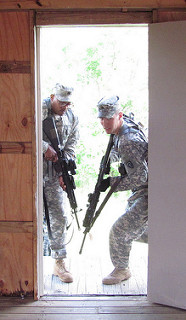
Busting down doors — Students practice tactical skills during exercises conducted by the 238th Regimental Training Institute at the Wendell H. Ford Regional Training Center. The quality of training provided by the 238th RTI is such that it’s common for students to return home and ask when the next level class is available. (Kentucky Army National Guard photo by Sgt. 1st Class Dennis M. Anderson, 238th Regimental Training Institute)
Credit where credit is due
While Haley said that the accreditation was a team effort, he pointed to two specific elements in the mission’s success: the training staff and cadre, and the quality assurance team.
“Our quality assurance guys need to get some of the credit. They spent a lot of time looking the documents and the standards and making sure that when the TRADOC accreditation team came that they could see and understand that we were meeting the Army standards.”
To hear everyone talk about the accreditation process, Sgt. 1st Class Kevin Estes gets much of the credit for making sure that the regiment got it’s due recognition. Regulations had to be analyzed, spreadsheets composed and binders assembled. Then it all had to be presented and explained. As the quality assurance NCO, that was Estes’ job and he’s lauded by the staff for pulling it off with exemplary professionalism and a ton of hard work.
Estes, a true quiet professional, summed it all up in one sentence: “It was just another day in the office.”
There’s more to it, of course. Estes explained that while he had to look at and assess the standards, the instructors were the ones who got the job done … and done right!
Professional and credible instructors
“The regiment has always had good instructors,” he said. “But it wasn’t always easy to show ‘what right looks like.’ We’ve always instructed very well and put out quality Soldiers. What the accreditation standard does is make you show that you’re actually doing that, and doing it at a higher standard.”
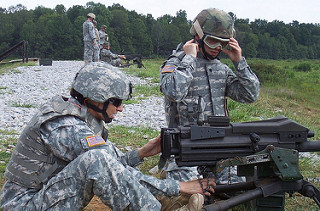
At the firing range with the 238th Regimental Training Institute at the Wendell H. Ford Regional Training Center. Hands on application of classroom skills is an essential ingredient in training professional soldiers. (Kentucky Army National Guard photo by Sgt. 1st Class Dennis M. Anderson, 238th Regimental Training Institute)
That’s the measuring of it all. But then there’s the actual hands-on instruction, the meat of the matter and the key to the 238th’s success.
“What it all boils down to is, if we’re not putting out a quality product, we’re not going to get repeat business,” said Sgt. 1st Class James Abston.
The quality product, of course, being professionally trained Soldiers. A field artillery course manager, Abston says the “repeat business” from his students is testament to the high level of training affected by the regiment.
“Our students are the reason we’re here,” Abston said. “I’ve got guys who just graduate from the lower level courses emailing me asking when the high level courses are being offered. They’re getting our name out there and asking to come back, plus they’re telling their units to send more troops to us for training.”
The accreditation is all nice and good, but Abston sees the role of the regiment as a higher calling.
Click here to find out more about the Kentucky National Guard Warrant Officer program
“To me the most important part is that these students can wind up deploying and in the middle of the fight. Most of them have already been deployed – they’re war veterans and they know what they need. They’ll throw down the flag if they need to, so that means you have to provide quality training and prove that you know what you’re talking about.”
The experience and leadership exhibited by the students has proven to be an asset to the schoolhouse, says instructor Sgt. 1st Class Timothy England.
“We scan our students as they come through and we put a bug in their ear about coming back and being an instructor,” he said. “Our instructor pool improves with each year. They learn from each other, they don’t hoard information but instead they love sharing it.
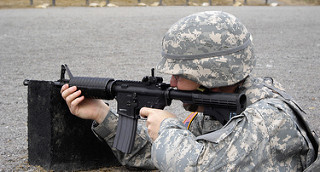
This is what it’s all about! The 238th Regimental Training Institute has full access to range facilities at the Wendell H. Ford Regional Training Center, one of the fastest growing training sites in the nation. (Kentucky Army National Guard photo by Sgt. 1st Class Dennis M. Anderson, 238th Regimental Training Institute)
NCOs are the backbone
Of course, behind every unit is a top sergeant, in this case the regiment’s Command Sgt. Maj. Timothy Goad. And like any good top sergeant, Goad brags on his non-commissioned officers, giving them credit for the work that’s been done.
“As long as the Army’s been around the NCO corps has been its backbone. In the time that I’ve been here I’ve been so proud of the quality of our NCOs. They’re phenomenal! I just give them some direction and they take it and run with it. You can’t find a better group in my opinion. That shows in our accreditation as an institute of excellence.”
Goad points out that a majority of the RTI’s staff is M-Day, or part-time. “I have to salute our M-Day staff. They’ve got other jobs and careers in the civilian world, but they still put out quality training that is high above the standard.”
One of the misconceptions about the regiment is that it doesn’t deploy. That’s true. But it’s also true that “the school house” is full of instructors who have deployed, literally “been there, done that and got the t-shirts to prove it.”
“Approximately 80 percent of our staff has deployed at one time or another,” said Master Sgt. Charles Johnston, senior field artillery instructor. “When our students see that combat patch on their instructor’s uniform, that means something.”
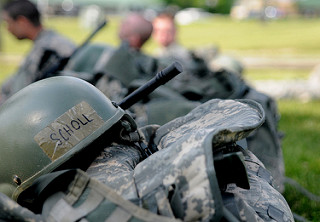
Kentucky National Guard Officer Candidate students take a moment to relax after a required 10-mile ruck march to complete phase two of their OCS curriculum with the 238th Regimental Training Institute at the Wendell H. Ford Regional Training Center. The 238th RTI also offers a warrant officer candidate program as well as a broad range of MOS training for active duty and reserve component NCOs. (Photo by: Spc. David Bolton, Public Affairs Specialist, 133rd Mobile Public Affairs Detachment, Kentucky Army National Guard).
Technology and the future
Johnston also points out that the 238th RTI aggressively pursues updating the technology that they teach on. “If we find out that our courses are lagging behind we push pretty hard to make sure that we update our gear and put it in our training. We want to make sure that what we’re teaching is something that matters to our students and is up to date.”
So there you have it. While history shows that the post-war U.S. military often ponders future missions and direction, the Kentucky National Guard and the 238th Regimental Training Institute have a definite purpose – and perhaps even a higher calling.
Chief instructor Master Sgt. John Hazlett sums it all up with characteristic though practical optimism:
“This accreditation is a celebration of the fact that we have all of these different elements at this regiment and they’re all being recognized at the highest level. If any of these elements fail at their job, we don’t become an institute of excellence. So everybody’s got to do their part for us to succeed.”
“The future of the Kentucky National Guard is happening now at the 238th,” said Hazlett. “The point of the spear is right here. New ideas that come out of active duty, from Afghanistan, Iraq and Africa, we’re the first to implement those right here, right now. When a Soldier comes here, they truly learn how to be a leader, how to lead a squad, a platoon or a company. When they leave here, they leave better than they ever were before.”
ACH
By Staff Sgt. Aaron Hiler, 133rd Mobile Public Affairs Detachment
Kentucky National Guard Spc. Anthony Hoffman, a Soldier assigned to 2nd Platoon, Delta Company, 1st Battalion, 149th Infantry, fires an M41A4 Tube-launched, Optically-tracked, Wire-Guided missile during live fire exercise at Fort Knox, Ky., Sept. 18. The TOW missile system was originally designed in the early 1960’s and has been a primary anti-tank and anti-bunker weapon for the U.S. Army.
FORT KNOX, Ky. (Sept. 24, 2010) – A violent explosion rocked through a peaceful valley in central Kentucky Sept. 18, and when the dust and smoke rose into the air, the sudden silence was interrupted by cheering Soldiers.
Delta Company, 1st Battalion, 149th Infantry provided plenty of explosions during the unit’s weapons sustainment training at Fort Knox, Ky.
For the first time in more than a decade, the 1-149th conducted a live fire exercise with its Tube-Launched, Optically-tracked, Wire-guided missile launchers.
The M41A4 TOW Improved Target Acquisition System missile is the latest variant of the vulnerable anti-tank/anti-bunker weapon in the Army’s inventory. The TOW missile was originally introduced into the military arsenal in the 1960’s during the Vietnam War and has been configured for use in stand-alone and vehicle-mounted roles.
“This is not only the first time we fired TOW missiles in 10 years, but also the first time any Kentucky National Guard unit fired from the new ITAS,” said Capt. Robert Andersen, 1-149th Infantry training officer.
“It’s a very mobile device that delivers extremely accurate, devastating effects on a point target,” Andersen said. “We received the system about six months ago and immediately began training our Soldiers.”
Kentucky Guardsmen, Spc. Kenny Crag and Spc. Anthony Hoffmann, 2nd Platoon, Delta Company, 1st Battalion, 149th Infantry, load an M71 missile cartridge into a Tube-launched, Optically-tracked, Wire-guided missile launcher during live fire exercise at Ft. Knox., Sept. 18. This is the first time in more than a decade that the company conducted a live fire with live TOW missiles.
Soldiers of the unit also received training on the TOW ITAS in March when the unit fielded the weapon system.
“This has been a fun experience,” said Spc. Anthony Hoffmann, a gunner assigned to 2nd Plt. Co. D, 1-149th.
“I’ve fired other weapons before, but this is a whole new animal. I really enjoyed it,” Hoffmann said.
