Pages
Stay In Touch
More
© 2013 KentuckyGuard
Story by Sgt. Brandy Mort, 133rd Mobile Public Affairs Detachment
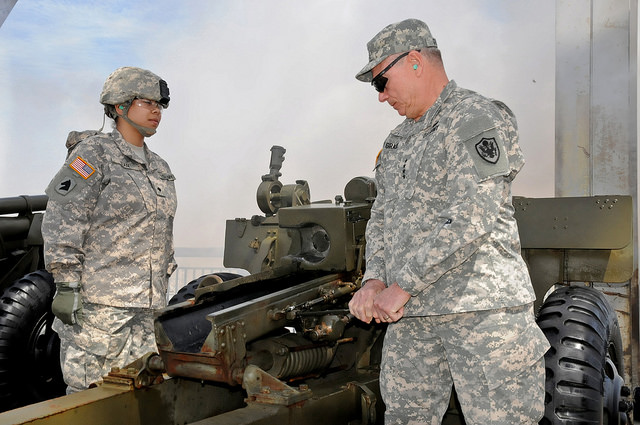
Gen. Frank J. Grass, chief of the National Guard Bureau fires a 105mm Howitzer cannon loaded by Spc. Natasha Bean, supply specialist for the 138th Field Artillery Brigade during the 2015 Thunder Over Louisville, April 18. Bean and Spc. Tiffany Dirolf were two of the Soldiers from the 138th providing artillery salutes from the 2nd Street bridge during the event. (U.S. Army National Guard photo by Sgt. Brandy Mort)
LOUISVILLE, Ky. — At Thunder Over Louisville, there are a lot of certainties. If the weather is good, crowds will be big. The air show is cool and during the breaks, people look up to the Second Street Bridge and eyeball the cannons and Soldiers who man them. But it isn’t always a man.
Spc. Natasha Bean and Spc. Tiffany Dirolf, supply specialists assigned to the 138th Field Artillery Brigade, were chosen by brigade leadership to support the cannon salute. The pair loaded the cannons for chief of the National Guard Bureau, Gen. Frank J. Grass, and Maj. Gen. Edward Tonini, adjutant general for the Kentucky National Guard, before the air show kicked off.
“It was an absolute honor to load the sound for Gen. Grass,” Bean said. “He is one of the top officers in the military and not a lot of people get to meet him, let alone prepare him to fire a cannon.”
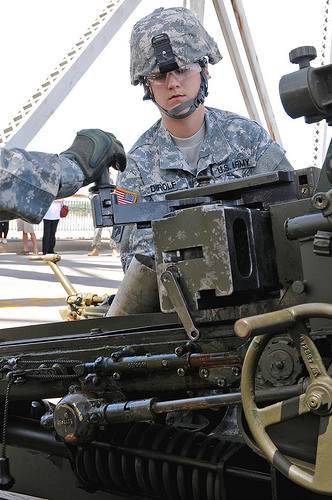
Spc. Tiffany Dirolf, supply specialist for the 138th Field Artillery Brigade, loads a practice round in a 105mm Howitzer cannon during the 2015 Thunder Over Louisville, April 18. (U.S. Army National Guard photo by Sgt. Brandy Mort)
Before the Thunder mission, the entire cannon salute team received training on how to properly load the 105mm Howitzers. The field artillery is a combat arms branch, and females typically aren’t assigned to fire crews.
While their presence on the team was a significant honor for the battle buddies, Sgt. 1st Class James Marcum, chief of smoke of the firing battery, said they were tactical and professional while teaching the generals how to fire them.
“I think the Soldiers did an outstanding job,” said Marcum. “They only had about 30 minutes to prep the generals and they did fantastic. They should be very proud of what they have accomplished today.”
Best friends outside the uniform, Bean and Dirolf went to basic combat training together, were in the same company for advanced individual training, and deployed to the Horn of Africa together in 2012. They both took pride in their selection to fire the Thunder cannons, and hope it encourages other females to consider opportunities in the guard - even better if it is with their best friend.
“Always having my best friend with me and sharing the same dream helps,” said Bean. “I don’t know where I would be without her.”
Story by Chief Warrant Officer Joseph Lyddane
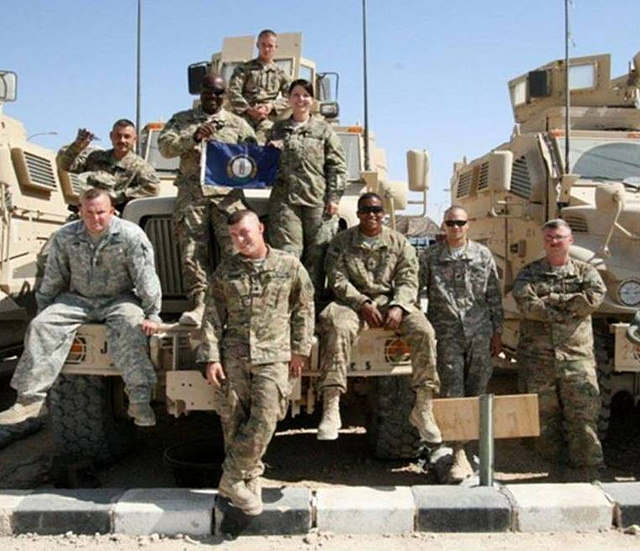
Chief Warrant Officer Melissa Propes (second row from top, middle) with her team in Jordan. During her deployment with 1st Battalion 623rd Field Artillery she was the Battalion Maintenance Officer. She later became the first female FMS Shop Chief for the Kentucky Army National Guard. (Photo courtesy Chief Warrant Officer Melissa Propes)
FRANKFORT, KY. — The title “mechanic” is synonymous with the terms hard work, grease, oil, and more often than not, male. Although inequality remains prevalent between men and women in the workforce, there are those amongst the projected 159.4 million females in the United States proving that women can dominate, excel, and outperform males at their own game.
One Kentucky Army National Guard Soldier decided to break the mold in pursuit her own aspirations. Emerging from humble beginnings, Chief Warrant Officer Melissa Propes took the advice of her mother who told her, “You can be anything you want to be if you work hard for it.”
When Propes joined the Kentucky Army National Guard on February 25, 1999 she was faced with a decision, as many of us are, as to which path to choose. With pride and determination, as a senior at Campbellsville High School, she set her sights on the male dominated Military Occupational Specialty of 63W (Wheeled Vehicle Mechanic) and was assigned to the 326th Ordnance Detachment in Glasgow. She attended basic training thereafter and made a name for herself right away by graduating as the Honor Graduate during her Advanced Individual Training.
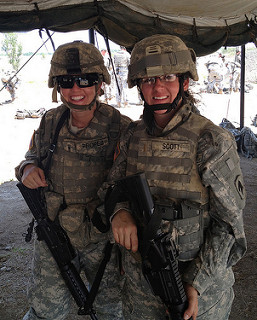
Chief Warrant Officer Melissa Propes (right) and 2nd Lt. Stephanie Scott, both of 1st Battalion, 623rd Field Artillery, pause during training at Wendell H. Ford Regional training Center in Greenville, Ky. July, 2012. (Courtesy photo)
Chief Propes recognized the importance of continuing her education early on and enrolled in Eastern Kentucky University in 1999 and attended Western Kentucky University from 2000-2002. However, she decided her heart was in the maintenance field, so while serving on orders for a pending deployment she decided to apply for the Nashville Auto Diesel College (NADC) and was accepted shortly after.
Propes’ work ethic became apparent during her tenure at NADC. She not only was a contributing member on the school newspaper staff, but she worked her way up the ladder at Outback Steakhouse to become a server trainer.
Amid all of her responsibilities, additional duties and monthly drills Propes was able to graduate in 2004 with a diploma in Auto and Diesel Technology as well as receive the prestigious Craftsman Award for having a ninety-five percent shop average.
“There was a defining moment when I realized that being in the National Guard meant more than just showing up for drill and ‘doing your job,'” said Propes. “I was very young when we got mobilized it became clear to me that if I wasn’t proficient at my job, someone could get killed. That’s when it became serious for me.”
In true leadership fashion, Propes credits her team for getting through that period of her life. “I could not have done it without the flexibility and support from my managers, coworkers and family.”
It is difficult to get a foot in the door at some of your major mechanics facilities much less to be the first female mechanic. Propes did just that when she became a hydraulics technician for Thompson Machinery in 2004. Overcoming the odds against her, the disregard of her coworkers, and even the advice of her supervisor that perhaps she was in the wrong career field, she persevered by starting early, working late, and sometimes putting in over eighty hours per week eventually winning the confidence and respect due her.
The experience and credibility established during her time with Thompson Machinery led to her becoming the first full-time female mechanic to be hired at the Combined Support Maintenance Shop as a Heavy Mobile Equipment Repairer. A promotion and new responsibilities validated her hard work and efforts.
“This was the first time I felt that I could impact my organization beyond just being a good mechanic,” she said.
After being promoted to Staff Sergeant, becoming a shop foreman, senior mechanic, again being the first female to be selected as an equipment specialist, she decided to accept the challenge of attending Warrant Officer Candidate School to become a 915A Surface Maintenance Mechanic Warrant Officer. Did I mention she was the honor graduate once again of her Warrant Officer Basic Course?
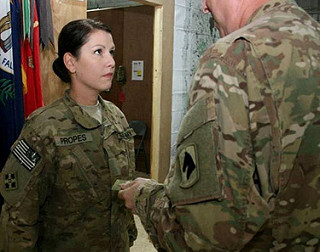
Melissa Propes being promoted to the rank of CW2. Early on in life Propes took the advice of her mother who told her, “You can be anything you want to be if you work hard for it.” (File photo)
A newly minted Warrant Officer Propes was eager to accept the position Battalion Maintenance Officer for the 1-623rd. She later became the first female field maintenance shop chief in the state. She deployed with the 1-623 thereafter in 2013 where she provided area maintenance support of active duty units, Marines, Special Forces, civilian contractors, reefer vans, and UAV launchers.
“There was something new and challenging every day,” said Propes.
Her attitude and approach are exactly why she was nominated for the 2014 Warrant Officer of the Year award. While she didn’t win, she gave her competition a run for their money.
“Chief Propes was very competitive and made the job of the selection board very difficult.” said State Command Chief Warrant Officer Dean Stoops. “We need more women in the warrant officer corps and if Chief Propes is an indicator of the potential that’s out there, then the future of the corps is bright.”
“Chief Propes is proof that with hard work, commitment, and a willingness to assume responsibilities,”said Chief Warrant Officer Connie Vick, one of Propes’ mentors and friends. “All dreams can be accomplished. She is an inspiration to young female Soldiers to excel and achieve their own dreams. I am proud to call her one of my fellow warrant officers.”
After the challenges and struggles throughout the last fifteen years, many would choose to take a break or at least stop to breathe. Not Chief Propes. Upon returning from deployment she now has an additional goal of attending Western Kentucky University’s Technology Management Program in order to enhance her supervisory and leadership skills as well as become, as she put it “an even greater asset to the maintenance community.”
“I can’t take personal credit for my accomplishments,” said Propes. “I’ve had some outstanding mentors throughout my career. Our organization has a focus on mentorship, both in receiving and providing, at all levels, NCOs and officers.”
According to Propes, being a warrant isn’t exactly a walk in the park. “It’s not for easy and I don’t think it’s for everybody. But if you love what you do and you wan to continue being a part of your specialized field and make it better, then the warrant officer program is perfect for someone with that mindset and desire.”
Story by Sgt. Alexa Becerra, Task Force Longrifles Public Affairs
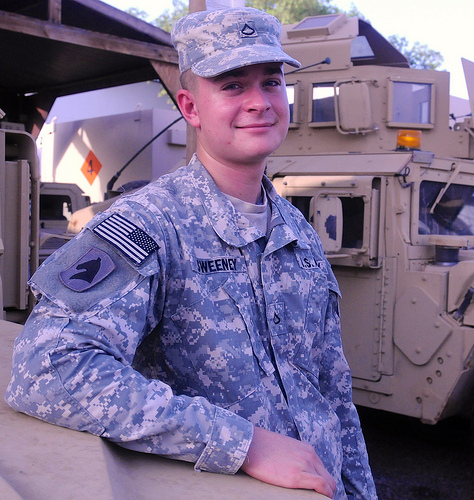
Pfc. Michael Sweeney is the youngest Soldier with Task Force Longrifles on their deployment to the Horn of Africa. Sweeney is also a graduate of the Bluegrass Challenge Academy at Fort Knox, Ky. (U.S. Army National Guard photo by Sgt. Alexa Becerra)
CAMP LEMONNIER, Djibouti - At the age of 17, teenagers face many challenges. They are close to graduating high school, they are looking at potential colleges, and are also about to hit the magic age of 18 when they are considered adults.
That wasn’t the case for Pfc. Michael Sweeney.
At 17, Sweeney, a native of Burlington, Ky., had already enlisted in the Kentucky National Guard. He had recently graduated with his GED from Bluegrass Challenge Academy, a school run by the National Guard designed to train and mentor selected at-risk youth to become contributing members of society.
“The Challenge Academy instilled a sense of discipline in me that I really needed at that time,” said Sweeney. “I wouldn’t be where I am today if it hadn’t been for the Academy.”
After receiving his GED, Sweeney set off for basic training and advanced individual training to become a cannon crewmember (13B) in the National Guard. He returned to Kentucky in April of 2012, and shortly after arriving to his new unit he received news about their upcoming deployment.
“I expected to deploy when I joined the Guard, but I definitely wasn’t expecting it to be so soon, “said Sweeney.
His case was a bit different than others; he was still 17 years old. He would turn 18 only a few days before the deployment.
“My squad leader sat me down and talked to me about the deployment,” said Sweeney. “He asked me if I was still willing to go, and when I said yes he let me know that if I had any questions I could ask him or any of the other Soldiers since most of them had deployed before.”
From that day on, Sweeney became the ‘Baby of the Battery’ and the ‘Baby of the Battalion’. He is the youngest of more than 500 Soldiers deployed here to the Horn of Africa in support of Operation Enduring Freedom.
“It has been different being the youngest,” said Sweeney. “At home I was the oldest out of four, and now I am the youngest out of the battalion.”
He said that his fellow Soldiers have been great mentors to him and they are always willing to give him advice or answer his questions.
“The guys here have all taken me under their wing, and have helped me become a better Soldier and hopefully a better person,” said Sweeney.
Sweeney said he has had many opportunities to learn about different cultures by volunteering in the local community and also from going on a well-drilling mission in Ethiopia.
“This deployment has made me truly appreciate what I have back home, people here don’t have much but they make the most of it,” said Sweeney.
Sweeney has decided to attend diesel mechanic school upon his return home, and plans to stay at least 20 years in the Guard.
“This deployment has been overall a great learning experience for me, and I have made lifelong friends and mentors,” said Sweeney.
“Best bang for the buck” prepares active duty and reserve component Soldiers for real world missions
Story by David Altom, Kentucky National Guard Public Affairs
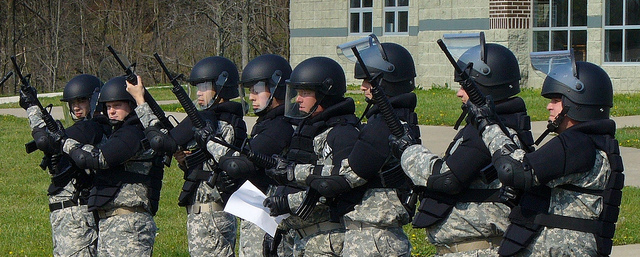
“Always ready, reliable and accessible!” Military police students practice civil disturbance tactics during MOS class at the 238th Regimental Training Institute at the Wendell H. Ford Regional Training Center. The 238th RTI recently received accreditation as an Institute of Excellence, qualifying it to teach active duty and reserve component soldiers across several disciplines. (Kentucky Army National Guard photo by Sgt. 1st Class Dennis M. Anderson, 238th Regimental Training Institute)
GREENVILLE, Ky. – In a time of budget cuts, drawdowns and a post-war scramble for resources and money, a bright light of achievement shines on the Commonwealth of Kentucky. The 238th Regimental Training Institute, once reknown as the Kentucky Military Academy, has caught the eye of the United States Army – and in a good way.
It was January of this year that the 238th RTI was designated as an “Institute of Excellence” by the Army, the culmination of a series of inspections that resulted in a 98% average, with three of five inspections with a perfect score. This designation is the first for the 238th, covering a variety of disciplines to include field artillery, infantry, military police, officer candidates and warrant officer candidates.
What does this achievement mean for the 238th RTI and the Kentucky Army National Guard? In short, it means greater training opportunities for the Kentucky Army Guard and a secure relationship with Big Army.
“This Institution of Excellence accreditation puts us in the top echelons of our peers,” said Col. Allen Denny, commander of the 238th RTI. “This is important as it gives us a leg up when competing for resources, additional courses and other opportunities.”
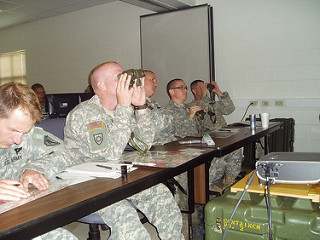
Students in an artillery class conducted by the 238th Regimental Training Institute at the Wendell H. Ford Regional Training Center. Cadre push to have the latest training on the technological skills so soldiers are better prepared when they hit the ground on deployment. (Kentucky Army National Guard photo by Sgt. 1st Class Dennis M. Anderson, 238th Regimental Training Institute)
“We are in an uncertain environment due to a shift in strategy, a transition from an Army at War to an Army in Preparation, and an era of fiscal uncertainty,” said Denny. “However, this accreditation puts us in excellent position to maintain and to grow and to continue to add benefit to the Kentucky National Guard and the One Army School System.”
With 11 full-time and 54 part-time staff members on board at the 10,000 acre Wendell H. Ford Regional Training Center, the 238th RTI is not the largest such institution, which makes the accreditation all the more remarkable. Other facilities such as Camp Shelby, Miss. and Fort Jackson, S.C. have been around for a lot longer and are considerably larger, but the 238th RTI is hot on their heels in terms of growth and quality of instruction.
Click here to read about the Kentucky Army Guard’s first ever combined officer and warrant officer graduation
“This accreditation solidifies our credibility, whether it’s training Kentucky National Guardsmen or Guard members from other states,” said Lt. Col. William McDaniel, operations chief for the 238th. “It also gives us the opportunity in certain course fields that we have to train active component Soldiers so they receive the same training value here that they would at an active duty school.”
Capt. Anthony Haley, budget analyst resource manager, wasn’t surprised that the regiment received its accreditation. “This was something we’ve been preparing for about three years. A lot of hard work and dedication went into preparation into getting to this point.”
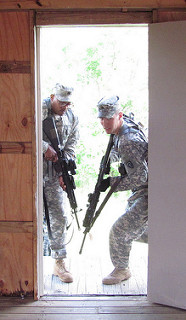
Busting down doors — Students practice tactical skills during exercises conducted by the 238th Regimental Training Institute at the Wendell H. Ford Regional Training Center. The quality of training provided by the 238th RTI is such that it’s common for students to return home and ask when the next level class is available. (Kentucky Army National Guard photo by Sgt. 1st Class Dennis M. Anderson, 238th Regimental Training Institute)
Credit where credit is due
While Haley said that the accreditation was a team effort, he pointed to two specific elements in the mission’s success: the training staff and cadre, and the quality assurance team.
“Our quality assurance guys need to get some of the credit. They spent a lot of time looking the documents and the standards and making sure that when the TRADOC accreditation team came that they could see and understand that we were meeting the Army standards.”
To hear everyone talk about the accreditation process, Sgt. 1st Class Kevin Estes gets much of the credit for making sure that the regiment got it’s due recognition. Regulations had to be analyzed, spreadsheets composed and binders assembled. Then it all had to be presented and explained. As the quality assurance NCO, that was Estes’ job and he’s lauded by the staff for pulling it off with exemplary professionalism and a ton of hard work.
Estes, a true quiet professional, summed it all up in one sentence: “It was just another day in the office.”
There’s more to it, of course. Estes explained that while he had to look at and assess the standards, the instructors were the ones who got the job done … and done right!
Professional and credible instructors
“The regiment has always had good instructors,” he said. “But it wasn’t always easy to show ‘what right looks like.’ We’ve always instructed very well and put out quality Soldiers. What the accreditation standard does is make you show that you’re actually doing that, and doing it at a higher standard.”
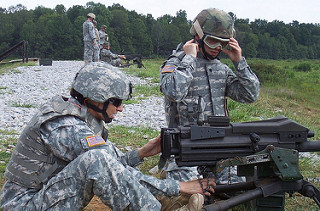
At the firing range with the 238th Regimental Training Institute at the Wendell H. Ford Regional Training Center. Hands on application of classroom skills is an essential ingredient in training professional soldiers. (Kentucky Army National Guard photo by Sgt. 1st Class Dennis M. Anderson, 238th Regimental Training Institute)
That’s the measuring of it all. But then there’s the actual hands-on instruction, the meat of the matter and the key to the 238th’s success.
“What it all boils down to is, if we’re not putting out a quality product, we’re not going to get repeat business,” said Sgt. 1st Class James Abston.
The quality product, of course, being professionally trained Soldiers. A field artillery course manager, Abston says the “repeat business” from his students is testament to the high level of training affected by the regiment.
“Our students are the reason we’re here,” Abston said. “I’ve got guys who just graduate from the lower level courses emailing me asking when the high level courses are being offered. They’re getting our name out there and asking to come back, plus they’re telling their units to send more troops to us for training.”
The accreditation is all nice and good, but Abston sees the role of the regiment as a higher calling.
Click here to find out more about the Kentucky National Guard Warrant Officer program
“To me the most important part is that these students can wind up deploying and in the middle of the fight. Most of them have already been deployed – they’re war veterans and they know what they need. They’ll throw down the flag if they need to, so that means you have to provide quality training and prove that you know what you’re talking about.”
The experience and leadership exhibited by the students has proven to be an asset to the schoolhouse, says instructor Sgt. 1st Class Timothy England.
“We scan our students as they come through and we put a bug in their ear about coming back and being an instructor,” he said. “Our instructor pool improves with each year. They learn from each other, they don’t hoard information but instead they love sharing it.
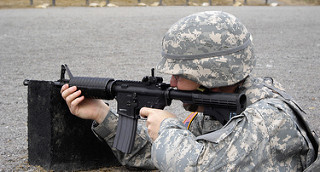
This is what it’s all about! The 238th Regimental Training Institute has full access to range facilities at the Wendell H. Ford Regional Training Center, one of the fastest growing training sites in the nation. (Kentucky Army National Guard photo by Sgt. 1st Class Dennis M. Anderson, 238th Regimental Training Institute)
NCOs are the backbone
Of course, behind every unit is a top sergeant, in this case the regiment’s Command Sgt. Maj. Timothy Goad. And like any good top sergeant, Goad brags on his non-commissioned officers, giving them credit for the work that’s been done.
“As long as the Army’s been around the NCO corps has been its backbone. In the time that I’ve been here I’ve been so proud of the quality of our NCOs. They’re phenomenal! I just give them some direction and they take it and run with it. You can’t find a better group in my opinion. That shows in our accreditation as an institute of excellence.”
Goad points out that a majority of the RTI’s staff is M-Day, or part-time. “I have to salute our M-Day staff. They’ve got other jobs and careers in the civilian world, but they still put out quality training that is high above the standard.”
One of the misconceptions about the regiment is that it doesn’t deploy. That’s true. But it’s also true that “the school house” is full of instructors who have deployed, literally “been there, done that and got the t-shirts to prove it.”
“Approximately 80 percent of our staff has deployed at one time or another,” said Master Sgt. Charles Johnston, senior field artillery instructor. “When our students see that combat patch on their instructor’s uniform, that means something.”
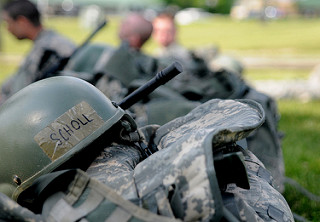
Kentucky National Guard Officer Candidate students take a moment to relax after a required 10-mile ruck march to complete phase two of their OCS curriculum with the 238th Regimental Training Institute at the Wendell H. Ford Regional Training Center. The 238th RTI also offers a warrant officer candidate program as well as a broad range of MOS training for active duty and reserve component NCOs. (Photo by: Spc. David Bolton, Public Affairs Specialist, 133rd Mobile Public Affairs Detachment, Kentucky Army National Guard).
Technology and the future
Johnston also points out that the 238th RTI aggressively pursues updating the technology that they teach on. “If we find out that our courses are lagging behind we push pretty hard to make sure that we update our gear and put it in our training. We want to make sure that what we’re teaching is something that matters to our students and is up to date.”
So there you have it. While history shows that the post-war U.S. military often ponders future missions and direction, the Kentucky National Guard and the 238th Regimental Training Institute have a definite purpose – and perhaps even a higher calling.
Chief instructor Master Sgt. John Hazlett sums it all up with characteristic though practical optimism:
“This accreditation is a celebration of the fact that we have all of these different elements at this regiment and they’re all being recognized at the highest level. If any of these elements fail at their job, we don’t become an institute of excellence. So everybody’s got to do their part for us to succeed.”
“The future of the Kentucky National Guard is happening now at the 238th,” said Hazlett. “The point of the spear is right here. New ideas that come out of active duty, from Afghanistan, Iraq and Africa, we’re the first to implement those right here, right now. When a Soldier comes here, they truly learn how to be a leader, how to lead a squad, a platoon or a company. When they leave here, they leave better than they ever were before.”
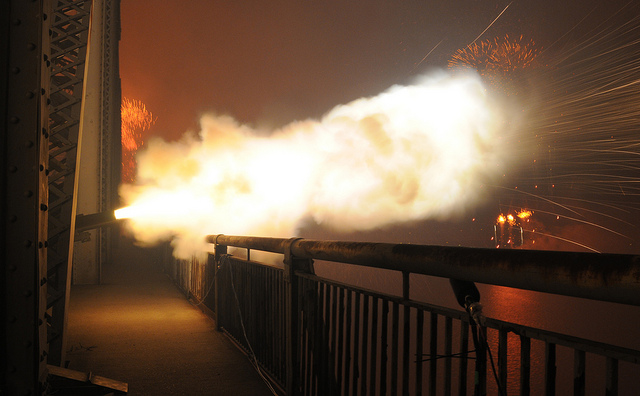
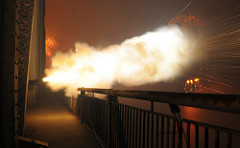
Flames erupt from the business end of a 105mm Howitzer cannon atop the 2nd street bridge in Louisville, Ky. during the finale of the 22nd annual Thunder Over Louisville fireworks show April 21, 2012. The Howitzers were operated by members of the Kentucky National Guard's 138th Fires Brigade and members of Alpha Company 103rd Brigade Support Battalion. (Photo by: Spc. David Bolton, Public Affairs Specialist, 133rd Mobile Public Affairs Detachment, Kentucky Army National Guard).
Click here to see the complete photo essay.
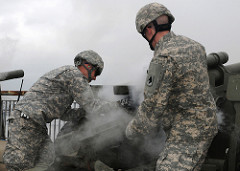
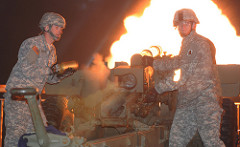
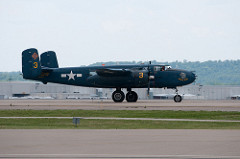
 LOUISVILLE, Ky. — The Kentucky National Guard played an important role in support of the biggest airshow in the nation last week. Thunder Over Louisville had an estimated crowd of more than 400,000 and was broadcast to service member stationed in 176 countries and aboard 140 U.S. Navy ships at sea.
In case you’re one of the few who didn’t see the show, we thought you’d like a behind the scenes look at our troops in action as well as a glimpse of the great and wonderful aircraft that took party in this one of a kind show.
Special thanks to Master Sgt. Phil Speck and Spc. David Bolton for their hard work in getting these unique images.
Just click on the photo for high resolution image and full caption information.
oOo






dwa
Click here to access the original story.
Click here for more history of the Kentucky National Guard.
FRANKFORT, Ky. — A new painting commemorating the 20th anniversary of the Persian Gulf War has been posted on the Kentucky National Guard eMuseum website.
The Road to War, by artist Michael Goettner, honors the Kentucky National Guard troops that took part in Operation Desert Shield / Storm - 25 February 1991 in Southern Iraq.
The painting was commissioned by the 138th Fires Brigade in 2011 for a limited edition of signed and numbers prints of the original painting. The painting features the 1st Battalion, 623rd Field Artillery Battalion who mobilized on 10 December 1990 and returned in May 1991.
The battalion was commanded by Maj. John Wayne Smith with subordinate units from Glasgow, Tompkinsville, Campbellsville, Monticello and Springfield, Kentucky. While deployed they were assigned to the 196th Field Artillery Brigade, 24th Infantry Division, XVIII Corps; 1st Cavalry Division, VII Corps. Their mission was to provide fire support in Saudi Arabia, Iraq, and Kuwait.
During the deployment the 1/623rd worked with the 101st and XVIII Airborne Corps as well as VII Corps; given mission to provide fire support to six coalition divisions.
The concept for the artwork is taken from a photograph taken by Lt. John Dooley of A Battery.
###
Story and photo by Sgt. Bryan Ploughe, 1st Battalion, 623rd Field Artillery UPAHR
Members of HHB 1/623d FA performing a color guard detail at the opening ceremony of Vet Jam, located in Barren County, Ky. This event has been held for five years and the Kentucky Guard has been a participant since its beginning. (Kentucky Army National Guard photo by Sgt. Bryan Ploughe, 1/623rd FA UPAHR)
NOTE: Each Wednesday kentuckyguard.com publishes stories by Kentucky National Guard unit public affairs historian representatives, also known as UPAHRs. This is an additional duty taken on by a Soldier or Airmen with the intent of telling their unit’s story. This is one such story ….
Glasgow, Ky (June 11, 2011) – This year’s Vet Jam held in Glasgow marked five years of an outdoor music festival recognizing and celebrating some of the area’s unsung heroes: the American war veteran.
This year’s event featured performances from 10 local bands ranging from bluegrass to hard rock, and catered to hundreds of supporters. Members of the Kentucky National Guard’s 1st Battalion, 623rd Field Artillery – based in Glasgow – took to the field and conducted a color guard detail as the national anthem was performed. The Soldiers also provided a 21-gun salute in honor of the war heroes.
Ernie Wagoner hosted the celebration on his farm. He expressed emotion in talking about the Kentucky Guard troops attending the event.
“The 623d is near and dear to me, as well as this community,” Wagoner said. “It is just a natural fit to have them here today, and they know we are here for them. They have been here and helped out since the conception of this event, and they are deeply appreciated for all that they do and we hope they are able to continue to do so in the future.”
First time attendee, Staff Sgt. Patrick Raby, Headquarters Battery, 1/623rd, was impressed by the celebration.
“This event is unbelievable,” he said. “I was not sure what to expect upon arrival today, and the sight of all of these veterans, that include World War II, Korea, Viet Nam, Gulf War and others is very humbling.”
“The wealth of knowledge and experience that is concentrated here is priceless,” he added. “More communities need to arrange an event of this caliber to recognize and show appreciation for what they have today.”
Proceeds from Vet Jam go to support local veterans organizations.
###
dwa
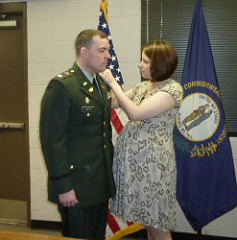
Jessica Sampler pins the rank of captain on the lapel of her husband, Justin, in a ceremony conducted at Boone National Guard Center. (Photo courtesy Chaplain (Maj.) Bill Draper)
Click here for more photos on this and other stories about the Kentucky National Guard.
FRANKFORT, Ky. (June 7, 2011) — The Kentucky National Guard artillery community is getting a little spiritual enrichment with the promotion and assignment of its newest chaplain.
Chaplain Justin Sampler was promoted to the rank of captain in ceremonies conducted at the Boone National Guard Center. Joint Force Headquarters State Chaplain (Col.) David Graetz conducted the promotion while Sampler’s wife, Jessica, assisted.
Sampler’s first assignment as chaplain is with 1st Battalion, 623rd Field Artillery.
Sampler grew up in Oklahoma and joined the Army National Guard his senior year of high school. After serving as a “thirteen mike” he went to officer’s candidate school and became a field artillery officer. He then moved to Louisville and attended the Southern Baptist Theological Seminary, where he graduated.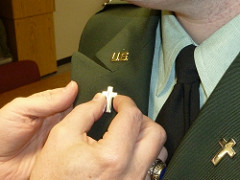
“Out of all the units that I could be assigned, I’m thankful to be with the 623rd,” said Sampler. “After serving with them as an artillery officer and now as a chaplain, I am able to relate to their mission and in turn I am able to provide them with spiritual support. It’s the best of both worlds.”
###
dwa
The standard Army Physical Fitness Test is just one part of the Longrifle Raid. Photo by 1st Lt. Daniel Van Horn, 2/138th FA.
Story by 1st Lt. Daniel Van Horn, 2/138th FA and David Altom, KYNG PAO
FORT KNOX, Ky. – The Kentucky longrifle holds an unassailable position in American history. The mere mention of the word “longrifle” conjurs up images of militiamen from more than two centuries ago running through the woods toward the gunfire, silent, stoic and eager to engage the enemy.
The obstacle course challenges Soldiers' physical endurance, fitness and problem solving abilities. Photo by 1st Lt. Daniel Van Horn, 2/138th FA.
We are now in the 21st century and the longrifle legacy is alive and well in Kentucky, as seen by the Longrifle Raid, a recent competition held by the 138th Fires Brigade during their weekend training at Fort Knox on Mar. 18-19.
Command Sgt. Maj. Thomas Chumley sees the competition in terms of esprit de corps as well as practical application.
“I have always wanted an event which test Soldiers endurance in the artillery community both mentally and physically,” he said. “Many other branches have similar tests and Soldiers get to wear badges or tabs to represent their hard work and devotion to their job. We were lacking this, which is why we created the Longrifle Raid.”
The first two events tested endurance as Soldiers needed to complete an Army standard physical training test with 70 percent in each category, followed by an obstacle course. Once this was completed Soldiers had to zero their M-16 with 18 rounds and qualify on their first try. The troops then ruck marched to one of the training areas to complete missions such as react to fire, land navigation, grenade throws, evaluate a casualty, react to an improvised explosive device, call for fire and load a SINGARS radio. Soldiers then hoofed it back to their base and slept for a couple of hours before being tested on questions about unit history, the soldiers creed, Fiddler’s Green and the Army Song.
An artillery Soldier negotiates an obtacle on the way to becoming a Longrifle Raider. Photo by 1st Lt. Daniel Van Horn, 2/138th FA.
1st Lt. Daniel Van Horn, a platoon leader for Charlie Battery, 2nd Battalion, 138th Field Artillery sees the Longrifle Raid as a way of showing off Soldiers’ knowledge and abilities in every area and not just in their designated MOS.
“This competition was very successful,” said Van Horn. “It’s inspired our Soldiers to dedicate themselves not only to hone their individual skills but to also learn the history and pride of the 2/138th, which in my opinion is equally as important.”
“This event demonstrates the diverse knowledge of artillerymen and the skills required for today’s theater of operations to be ready for any mission, at anytime, anywhere,” he said.
For their efforts the Longrifle Raiders get to wear a red cord within the brigade at artillery events and functions on their ASU’s and Class A uniforms, making them stand apart as Soldiers who are highly skilled and capable of performing to a higher standard.
The first batch of Longrifle Raiders are (left to right) Pvt. 1st Class Jerry Hutchinson, Pvt. 1st Class Joseph Coy, Sgt. Holdin Reed, Sgt. Gregory Farmer, Cadet Victor Farrar, Spc. Jordan Tebbe. 1st Lt. Daniel Van Horn and Master Sgt. Robert Hughes. Photo by Maj. Tim Culver, 2/138 FA.
###