Pages
Stay In Touch
More
© 2013 KentuckyGuard
By Sgt. Lerone Simmons, 133rd Mobile Public Affairs Detachment
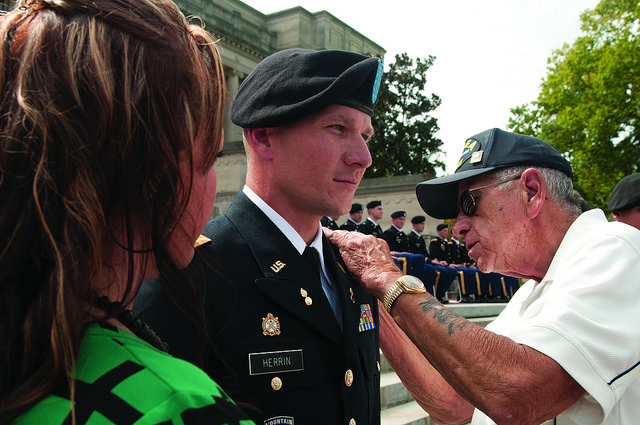
Newly promoted Warrant Officer Robert A. Herrin, receives his new rank from Gilbert Herrin, his grandfather and Korean War Veteran during Kentucky’s Warrant Officer Candidate school graduation ceremony at the State Capitol, Frankfort, Ky. September 27, 2015. The Kentucky Guard commissioned 9 new lieutenants and 10 warrant officers at the event. (U.S. Army National Guard photo by Sgt. Lerone Simmons)
FRANKFORT, Ky. — With the stage set in the heart of the Commonwealth, the Kentucky Army National Guard welcomed its newest commissioned and warrant officers during a graduation ceremony on the steps of the state Capitol in Frankfort, Kentucky, Sept. 27.
Attached to the 238th Regional Training Institute, Officer Candidate School class 57-15 and Warrant Officer class 15-001 completed rigorous training programs at Wendell H. Ford Regional Training Center in Greenville, Kentucky and Fort McClellan, Alabama, earning their seats at the ceremony and commissioned as officers.
It was the last commissioning ceremony with Kentucky’s Maj. Gen. Edward W. Tonini, adjutant general, presiding. Tonini will retire later this fall.
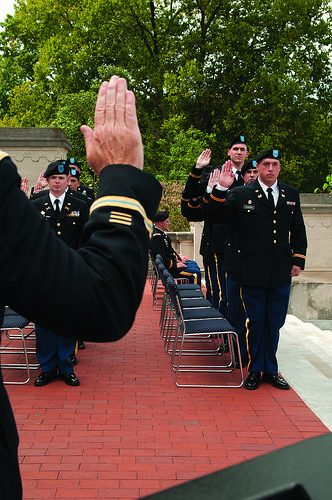
The newest officers and warrant officers in the Kentucky National Guard are sworn in by Col. Hal Lamberton, commander of the 238th Regimental Training Institute, during a graduation ceremony at the State Capitol, Frankfort, Ky. September 27, 2015. (U.S. Army National Guard photo by Sgt. Lerone Simmons)
Tonini reflected on his more than forty-six years of service to include an ever-changing National Guard during his remarks.“Today’s Guard is the most experienced and combat ready since it’s inception.”
He highlighted the importance of striving for success and maintaining positive standards.
“Success doesn’t come to you, you go to it,” he said. “You are the key to our Soldier’s success.”
Second Lt. Benjamin R. Smith, OCS distinguished honor graduate and Louisville native, said he respected the legacy that Tonini leaves behind.
“We want to maintain the standards and expectations that the adjutant general has set out for the Guard,” said Smith.
Smith also credited the outstanding leadership for equipping his class with the tools to become great officers.
“The OCS program has helped us grow together with the help of our top-notch leadership,” he said. “They taught us how to properly take charge while maintaining a balance of military and personal life.”
Click here for more photos.
According to Warrant Officer Terry R. Roark, a Berea, Kentucky-native, the leadership imparted a high level of mentorship and direction onto him.
“The mentorship from the leadership has been phenomenal, their direction and guidance was key to my success,” he said.
For Capt. Jayson McDonald, lead platoon trainer assigned to the 238th RTI, the age-old question of “are leader’s made or born,” is one with a two-fold answer.
“They have to come in with confidence, drive, and the ability to learn,” said McDonald. “This is something I can not impart in someone, however, we provide them the opportunity and the challenging environment for them to create and execute a plan to succeed,” he said.
McDonald began training the class at Phase 0 and was proud of their success.
“I’m really impressed with them. A lot of them came in without any military experience but took the information they were given and applied it as necessary to make it to this stage,” he said.
The ceremony concluded with new officers receiving congratulations from family, friends and other Soldiers.
By Staff Sgt. Scott Raymond, Kentucky National Guard Public Affairs
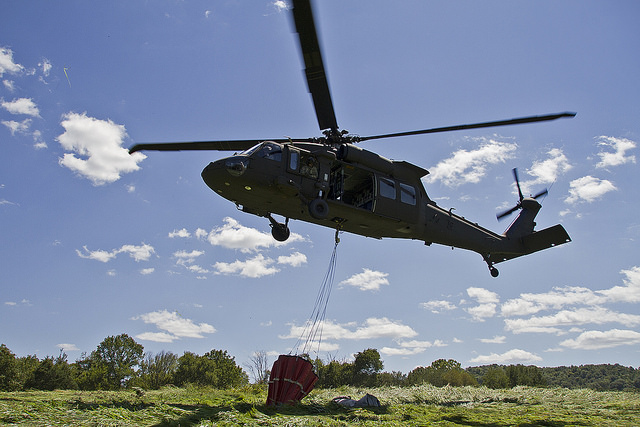
A UH-60 Blackhawk with the Kentucky National Guard’s 63rd Theater Aviation Brigade lifts off with a Bambi Bucket System attached to train on water drops in Franklin County, Ky., Aug. 24, 2015. Air crews train annually with the water drop system to wildfires locally or nationally. (U.S. Army National Guard photo by Staff Sgt. Scott Raymond)
FRANKFORT, Ky. — As an annual requirement, many National Guard air crews train to fight wildfires in their UH-60 Blackhawks. With so many wildfires burning in the country, this annual training comes at an appropriate time for Kentucky Guard aviators.
In August, Soldiers with the 63rd Theater Aviation Brigade practiced water drops in a rural area of Franklin County, Kentucky.
“The training keeps our crews up to date so that in the event we do get called for forest fires or anything like that, we have the crews readily available, trained up and delay free in any response,” said Warrant Officer Candidate Michael Lona.” 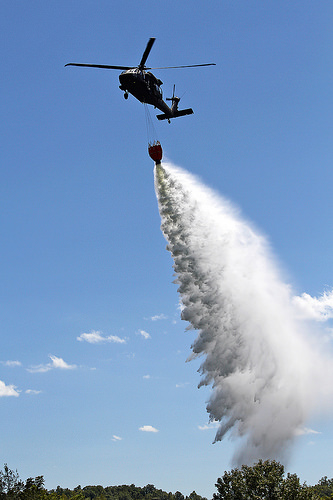
With the use of the Bambi Bucket System, a water delivery bucket attached to the helicopter, crews are able to make water drops of several hundred gallons of water on hotspots or fires.
Click here for more photos.
Crews train in multiple ways of filling the bucket and making the drops, each dependent upon the terrain, the type of fire and the firefighting strategy.
“This is an extremely technical skill, so it’s necessary that that our crews remain proficient,” said Capt. James Caniff, Flight Operations Supervisor. “Being able to fight a forest fire with our helicopters is a huge assets to state and in some instances the nation.”
There are five Bambi Bucket Systems available on the commonwealth, all managed by the Forest Service and shared with the Kentucky Guard when needed.
By Master Sgt. Gerard Brown, Georgia National Guard Public Affairs
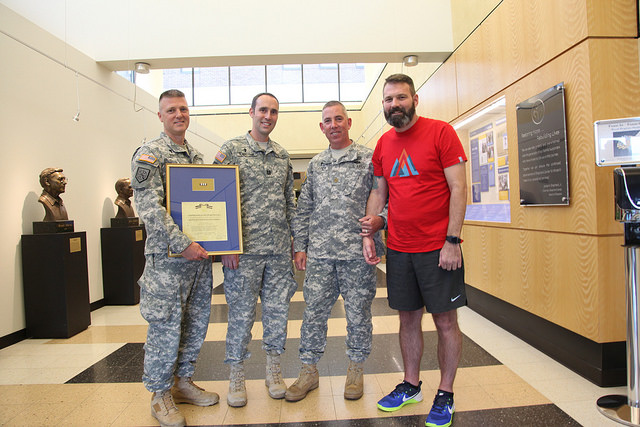
Chaplain (Capt.) Jon Pirtle and Chaplain (Capt.) Shane Blankenship with the Georgia National Guard are recognized by Chaplain (Maj.) Bill Draper for their assistance during Sgt. 1st Class Chris Bradley’s (right) rehabilitation from a paralyzing accident. (U.S. Army National Guard photo by Master Sgt. Gerard Brown)
ATLANTA, Ga. — One team one fight, or Soldiers taking care of Soldiers are common phrases used in the military, especially when it comes to aiding different units or even different branches during difficult situations. More often, this reference is used when comparing the military’s fight against a common enemy, but in this case, two National Guard states came together to aid Sgt. 1st Class Chris Bradley with his fight to walk again.
Bradley was involved in an accident that left him paralyzed from the neck down. The severity of the injury left only one option for Bradley and his family and that was to seek treatment at the Shepherd Center located in Downtown Atlanta. The facility is one of the nation’s top rehabilitation hospitals for both spinal cord and brain injury and was the best option for Bradley to be able to walk again.
A call from the Kentucky National Guard came to the Chaplain’s office at the Clay National Guard Center to see if the Georgia National Guard had a Chaplain that could assist one of their Soldiers.
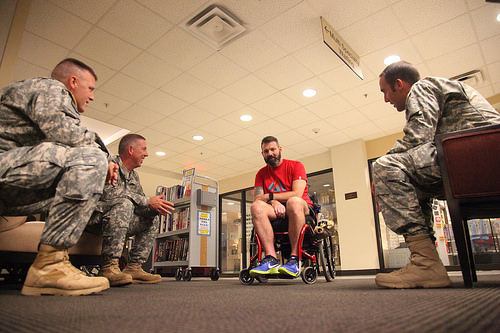
Sgt. 1st Class Chris Bradley (center) speaks with chaplains from the Georgia and Kentucky National Guard during rehabilitation in Atlanta, Ga., Aug. 24, 2015. (U.S. Army National Guard photo by Master Sgt. Gerard Brown)
Without a moment’s hesitation, Chaplain Pirtle stepped forward to assist the Soldier during this rough period. Interesting enough, Pirtle attended Southern Baptist Theological Seminary in Louisville Kentucky, while also being a Chaplain Candidate in the Kentucky National Guard.
Injuries similar to those incurred by Bradley normally take two years to fully heal and as of 90 days, he is showing great progress.
“Bradley has come a long way,” said Maj. Bill Draper, full time operations chaplain for the Kentucky Army National Guard. “He has never thought of himself as a victim and has always had a this is what I am going to do type of spirit.”
At the time of the unfortunate accident, Bradley was a recruiter for the Kentucky National Guard. Although currently working as a recruiter for the Guard, his previous jobs included both Infantry and Field Radio Operator. The end of this year will mark his 18th year of military service to his country, 15 of those years were in the Kentucky National Guard and the remaining three were during his enlistment in the Marine Corps. The road ahead will be a long one for Bradley, but his goal is to walk out of the hospital on his own.
During his multiple visits to the Shepherd Center, Pirtle spent time with Bradley during rehabilitation sessions as well as praying with him and his family, but it did not end there. Pirtle went beyond his technician duties and continued to spend time with both Bradley and his family after hours. By doing this, he was able to clearly see the improvements made by Bradley in re-learning basic motor skills such as, being able to hold a fork again, dress himself and to stand on his own.
“I always wanted to encourage Sgt. 1st Class Bradley, but every time I left I found myself encouraged by his spirit, his attitude and mostly his passion to overcome.” said Chaplain Pirtle, regional care chaplain for the Georgia National Guard. “I often felt I was ministered to, just by being around both him and his wife and their journey to recovery.”
“Obtaining my independence during this process was one of the most rewarding moments,” said Bradley.
Pirtle was recognized by the Kentucky National Guard for his selfless service in taking care of one of their own. He was awarded the Kentucky Commendation Medal and was commissioned an Honorable Kentucky Colonel, by the Governor.
“As I have gone through this process, it has been refreshing to see someone in an Army uniform, because it made me feel like I was right back in the military,” said Bradley. “The banana bread that Chaplain Pirtle’s wife brought was also amazing and meant a lot.”
Pirtle’s wife also answered the call and wanted to be part of the rehabilitation process.
“Chris’s wife is part of the Guard just as my wife is part of the Guard,” said Pirtle. “These two Guard families are wedded just based on the virtue of both of us being in the guard.”
Though Bradley will be leaving from the Shepherd Center soon to head back to Kentucky to continue his rehabilitation, the bond that was formed between the two will continue despite the distance.
By Lt. Col. Kirk Hilbrecht, Kentucky National Guard Public Affairs
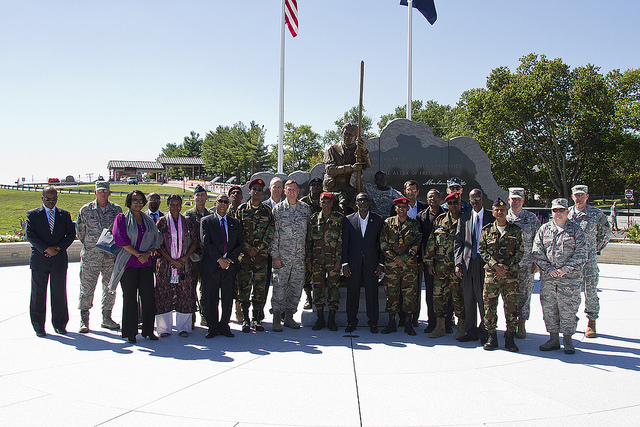
Kentucky Guardsmen gather with several members of Djibouti’s military and government cabinets at the Kentucky National Guard Memorial in Frankfort, Ky., Sept. 15, 2015. The visit was part of the Kentucky Guard’s State Partnership with Djibouti. (U.S. Army National Guard photo by Staff Sgt. Scott Raymond)
FRANKFORT, Ky. — The Kentucky National Guard hosted several members of Djibouti’s military and government cabinets, Sept. 13-20, as part of the Kentucky Guard’s State Partnership with Djibouti. Civilian members of the Djiboutian delegation included the Honorable Tom Kelly, U.S. Ambassador to Djibouti, the President of the National Assembly, Mr. Muhamed Ali Houmed, Djiboutian ministers of health, foreign affairs, chambers of commerce, and the University of Djibouti. The military delegates included chiefs of defense, Air Force, logistics, military education and materiel. This was the first Djiboutian partnership event in Kentucky since the National Guard selected Kentucky for this state partnership in June.
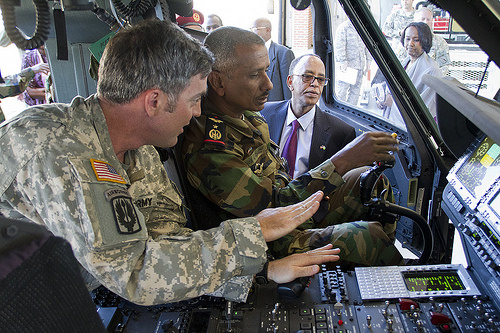
Chief Warrant Officer Kevin Keith discusses the capabilities of a UH-60 Blackhawk with Lt. Col. Chakib Mahamed Ali, deputy commander of the Djibouti Air Force during a visit to the Kentucky Guard’s Army Aviation Support Facility in Frankfort, Ky., Sept. 15, 2015. Members of the Djibouti military toured several sites across Kentucky as part of the country’s new partnership with the Kentucky Guard. (U.S. Army National Guard photo by Staff Sgt. Scott Raymond)
“Our Kentucky Guardsmen, our government officials and our civic leaders have been fantastic ambassadors to these global neighbors this week,” stated Kentucky’s Adjutant General, Maj. Gen. Edward Tonini. “We’re honored to host our new partners and friends from the Republic of Djibouti.”
While in Kentucky, the Djiboutian delegation toured Boone National Guard Center in Frankfort; ate dinner at the Governor’s Mansion with Lt. Gov. Crit Luallen; visited Kentucky troops working at Fort Knox and training at Wendell H. Ford Regional Training Center in Western Kentucky; toured Kentucky’s Air National Guard Base; made a stop at Churchill Downs; attended a University of Louisville football game; toured Waterstep and UPS; interacted with ROTC cadets at the University of Louisville and at the University of Kentucky; met boxing great, Muhammad Ali; and visited the Louisville Islamic Center.
“We came to Kentucky knowing of the Kentucky Guard,” said President Muhamed Ali Houmed, “We are leaving Kentucky now knowing these people as friends. Friends of us and friends of Djibouti.”
Click here for more photos.
Through the SPP, the Kentucky Guard will conduct military-to-military engagements in support of defense security cooperation goals similar to this current trip. The program also works to strengthen partner nation’s domestic response capabilities.
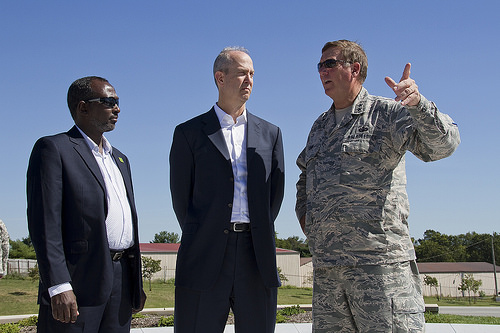
Maj. Gen. Edward W. Tonini, Kentucky’s adjutant general, speaks with Thomas Kelly, U.S. Ambassador to Djibouti (middle) and Mr. Muhamed Ali Houmed, President of the National Assembly of Djibouti during a visit to the Kentucky National Guard Memorial in Frankfort, Ky., Sept. 15, 2015. The partnership with Djibouti is the Kentucky’s Guard second collaborative effort as part of the National Guard’s State Partnership Program. (U.S. Army National Guard photo by Staff Sgt. Scott Raymond)
The State Partnership Program is administered by the National Guard Bureau and guided by U.S. Department of State foreign policy goals. The SPP has been successfully building relationships for over 20 years involving 74 nations around the globe. With the inclusion of Djibouti, the National Guard will have 69 state partnerships in 75 countries.
A Kentucky delegation led by Tonini participated in the State Partnership Program signing ceremony in Djibouti, Africa in June 2015. http://tinyurl.com/djiboutikyspp
Djibouti is Kentucky’s second partnership program. The Ecuador-Kentucky SPP was formalized in 1996. Since its inception, the partnership has completed 66 exchange events with Ecuador ranging from security, maintenance, emergency management, and Army and Air Force aviation.
By Maj. Carla Raisler, 133rd Mobile Public Affairs Detachment
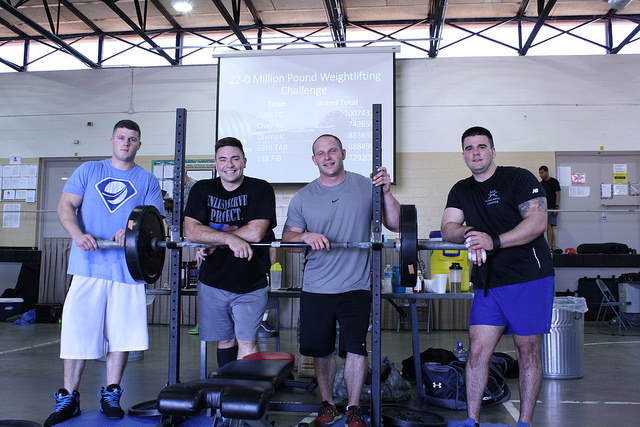
Kentucky Guardsmen lift more than four million pounds to bring awareness to suicide prevention as part of the 22-0 Million Pound Challenge in Frankfort, Ky., Sept. 17, 2015. Staff Sgt. Corey Blankenship from Bravo Company, 1st Battalion, 149th Infantry lifted 306,300 lbs.; Spc. Cody Andrews also from Bravo Co., lifted 298,966 lbs., 1st Lt. Adam Disney, 1-149 IN lifted 253,835 lbs., and Capt. Josh Bailey, 1-149 IN lifted 233,940 lbs. (U.S. Army National Guard photo by Maj. Carla Raisler)
FRANKFORT, Ky. — Five teams came together at the Boone National Guard Center to raise awareness for suicide prevention by competing to be the first to lift one million pounds in the 22-0 Million Pound Weightlifting Challenge.
According to the VA’s 2012 Suicide Data Report an estimated 22 suicides a day are by individuals who served in the military. The 22-0 movement is bringing awareness to this epidemic through community outreach initiatives like the Kentucky National Guard’s 22-0 Million Pound Weightlifting Challenge.
Lifting one million pounds is an impossible task when left to one person, but when the weight is distributed among the team members, the task is no longer impossible. This concept translates to anyone who is dealing with personal struggles. For those in uniform, it reinforces the idea that they can look to their fellow veterans for support.
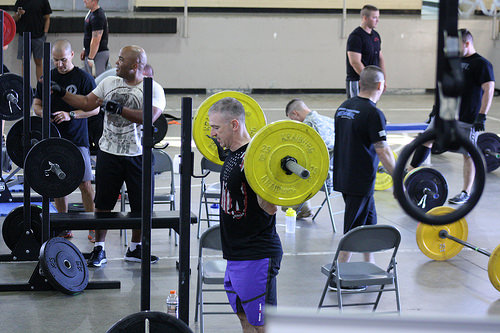
Maj. Eddie Simpson lifts his share of one million pounds as part of the Over 40 Team during the 22-0 Million Pound Challenge in Frankfort, Ky., Sept. 17, 2015. (U.S. Army National Guard photo by Maj. Carla Raisler)
On this day, 24 Soldiers showed up. They came in civilian clothing, they left their positions, their rank, and their individual experiences behind. They had one goal in mind. Lift one million pounds.
Deputy Chief of Staff for Personnel, Col. Michael Abell, started the event off by discussing the merits of teamwork and a steady, deliberate pace when tackling difficult tasks.
“There will always be difficulty in an undertaking that one or all members of a team believe is unlikely to be accomplished, but the camaraderie that develops in the pursuit of such a task is unique,” Abell said. “The shared hardship causes the members of the team to push harder than they would alone, because they simply refuse to fail their other team members.”
Abell went on to talk about how that directly relates to personal struggles.
“We all struggle in life, we all have victories and disappointments and at some point, we all find ourselves in a place where we simply cannot do it alone - this is when true friends, those who can see us struggle, show up and pull us out of dark places, dust us off and help us start moving again,” Abell said. “It is a form of love and the word doesn’t have to be spoken, the action of helping without being asked proves it.”
Teams from each major subordinate command assembled to step up to the challenge. Specialty teams like the “Over 40 Team” and the “Olympians” rounded out the final five that competed in the challenge.
Click here for more photos.
Each team had their own strategy.
“We are going for low weights, high reps,” said Maj. Michael Woodson, Headquarters, Headquarters Battery 2/138th Field Artillery and a member of the “Over 40 Team.”
“We are have two men lifting and two men resting,” said 1st Lt. Adam Disney, Headquarters, Headquarters Company, 1-149th Infantry and member of the 75th TC team. Disney’s team only had four members.
Every team is unique in tackling the challenge, just like every situation is unique when confronting suicide. We all answer the challenge regardless of MOS or background.
“I walked in and I was part of the team,” said Staff Sgt. Erin Baxter, 133rd Mobile Public Affairs Detachment and member of the 63rd TAB. “It wasn’t about how much I could or couldn’t max, it was about grabbing some weights and getting to work.”
By the end of the event the five teams had lifted a total of 4,585,705 pounds. The team from 75th Troop Command won the challenge by being the first team to reach one million pounds in just over three hours.
By Staff Sgt. Scott Raymond, Kentucky National Guard Public Affairs
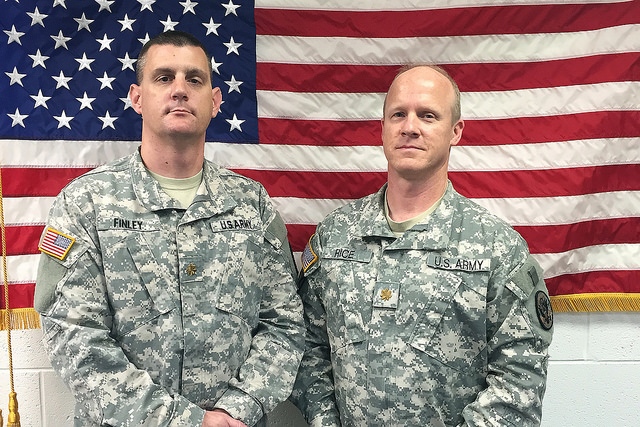
Maj. Jason Finley (left) and Maj. Michael Rice with the 41st Civil Support Team were recipients of the Army Medical Department’s “A” proficiency designator for professional excellence. Both serve as medical operations officers with the 42st. (Courtesy photo)
FRANKFORT, Ky. — Annually the Army Medical Department (AMEDD) awards the prestigious 9A proficiency designator to a small handful of Army officers. This year, three of the awardees were National Guardsmen, and two of those three were from Kentucky’s 41st Civil Support Team.
Majs. Jason Finley and Michael Rice, medical operations officers with the 41st CST are the first Kentucky Guardsmen to earn the designation.
“Maj. Rice and I were both blessed to be considered and awarded the Army Medical Department 9A proficiency designator this year,” said Finley.
“I would have to say this is a great honor and milestone in my career,” said Rice. “My passion will always be for people and how to better serve patients and the Kentucky National Guard through
forward thinking and implementation of those ideas that will make each better.”
The 9A designator is the highest recognition for professional excellence in the AMEDD. The AMEDD “A” proficiency designator is an honor bestowed upon candidates approved by the Army Surgeon General for professional excellence, who have attained full professional status, and have achieved national prominence in their field. Candidates must be leaders in their specialty, and have made significant contributions to the advancement of knowledge in a particular field.
Applicants must be a distinct asset to the AMEDD, both as an officer as well as a professional specialist. Finally, those officers selected must have had at least 15 years of professional experience, with at least 10 of those years being on active duty in the Army.
Finley was one of 37 officers chosen from the Medical Service Corps, while Rice was one of 12 Officers chosen from the Medical Specialist Corps.
“Even after four years on this team, I continue to be amazed by the skills, knowledge, and professionalism of its members,” said Maj. Kris Morlen, commander of the 41st. “This accomplishment by Maj. Finley and Maj. Rice is a testament to their ongoing quest for excellence, and is indicative of the passion by which they, and our other team members pursue this calling. I find myself at a loss for words to describe the pride I have in them for earning this prestigious honor.”
By Maj. Dale Greer, 123rd Airlift Wing Public Affairs
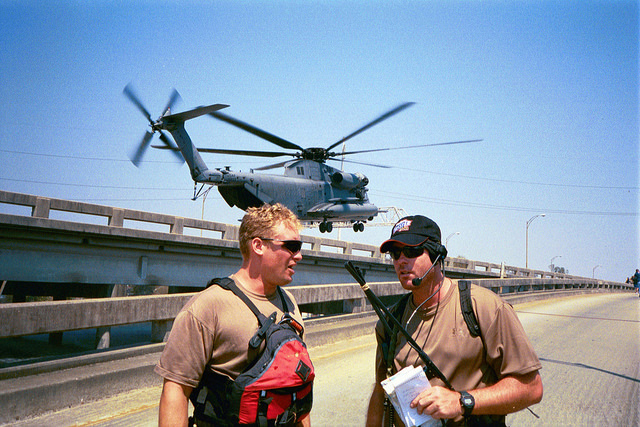
Two Kentucky Air National Guard Special Tactics troops confer as an Air Force MH-53 helicopter lands on Interstate 610 to evacuate New Orleans residents following Hurricane Katrina Sept. 4, 2005. (U.S. Air National Guard photo)
LOUISVILLE, Ky. — Chief Master Sgt. Pat Malone had seen a lot in his 23 years as a pararescueman for the U.S. military, including dicey combat extractions in Iraq and Afghanistan and more than a decade’s worth of civilian search-and-rescue missions in Alaska. But none of it prepared him for the devastation he saw firsthand when he and 21 fellow Kentucky Air National Guardsmen deployed to New Orleans Naval Air Station 10 years ago today as part of efforts to evacuate the victims of Hurricane Katrina and the ensuing flood.
“This was, by and large, the worst site of devastation I have ever seen in my entire career,” said Malone, who was chief enlisted manager for the Kentucky Air Guard’s 123rd Special Tactics Squadron in 2005 and retired from the service in 2012. “The sheer magnitude of it — and the conditions that our guys worked in — was the most horrific I’d seen in 23 years of service.” Chief Master Sgt. Jon Rosa, a Kentucky combat controller who also deployed with the 123rd Special Tactics Squadron and retired in 2009, concurred.
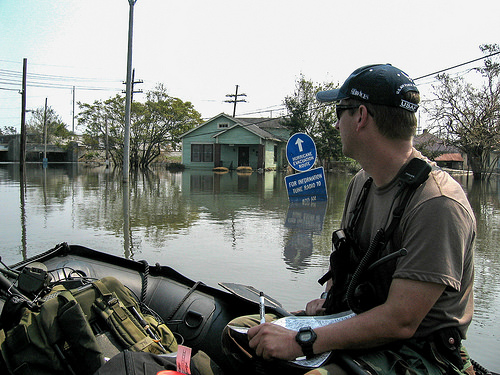
A Kentucky Air National Guard combat controller searches for stranded residents during a search-and-rescue mission in New Orleans following Hurricane Katrina Sept. 5, 2005. (U.S. Air National Guard photo)
“New Orleans is usually a place of such revelry,” said Rosa, then the squadron’s superintendent of combat controllers. “But it was like a scene out of ‘The Twilight Zone’ to be in downtown New Orleans and hear total silence except for the sloshing of flood waters. I just couldn’t believe this was America.”
But it was America, and thousands of New Orleaneans were stranded without provisions amid a sea of sewage- and chemical-laced water covering nearly 80 percent of the city.
Rosa, Malone and 20 other Kentucky special tactics troops were among the first military search-and-rescue troops to arrive in the stricken city and begin extracting trapped citizens starting Aug. 31.
The Kentucky forces joined up with about 25 other special tactics troops from across the Air National Guard, including Alaska’s 212th Rescue Squadron, California’s 131st Rescue Squadron, New York’s 102nd Rescue Squadron and Oregon’s 125th Special Tactics Squadron.
Patrolling the city in Zodiac motorboats and other vehicles, the Kentucky-led contingent rescued 1,292 people, sometimes by cutting through roofs to extract trapped residents.
“We had the ability to go through the city and conduct searches where no one else could reach at the time,” Malone said. “We launched from four to 14 boats a day, running about 14-hour shifts in the water.”
Once evacuees climbed aboard the Zodiacs, they were transported to makeshift helicopter landing zones set up along portions of the interstate highway system that weren’t submerged by flood waters.
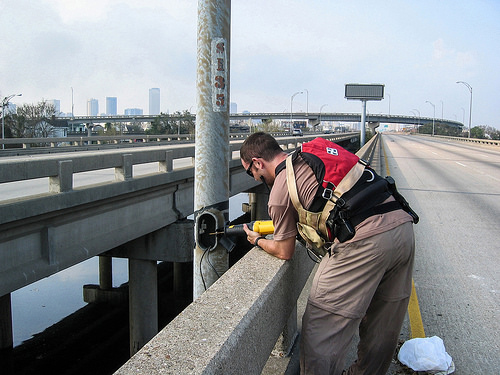
A special tactics troop from the Kentucky Air National Guard cuts down street light poles along Interstate 610 in New Orleans following Hurricane Katrina Sept. 3, 2005, to clear the way for a helicopter landing zone. (U.S. Air National Guard photo)
The landing zones were cleared by saw-wielding combat controllers who cut down light poles to remove obstructions and then marked the spots with spray paint so information like communications frequencies would be visible from the air, Rosa said.
After an LZ was established, combat controllers would make radio contact with any of the three airborne controlling authorities — entities like an Air Force AWACS plane — and advise that evacuees were ready for transport.
As helicopters began to roll in, the controllers would direct their safe flight into and out of the landing zones using the communications gear they carried on their backs.
One particularly productive LZ became so active that a new helicopter was landing every 50 seconds for 48 straight hours, Rosa said.
“For a while, I would imagine it was the busiest airport on the face of the earth,” he noted.
By the time the Kentucky Airmen returned home Sept. 7, the Air Guard special tactics contingent had controlled the flights of 3,179 sorties responsible for the evacuation of 11,927 people.
Working conditions were challenging, to say the least. Most troops got less than six hours of sleep a night, and the constant exposure to contaminated water caused rashes and minor chemical burns on some of the Airmen, Malone said.
“These guys were working in a giant cesspool contaminated with any chemical in anyone’s garage, oil, gas, deceased animals and sewage,” he said. “It was a giant petri dish. But they knew that what they were doing was important. They chose to be totally selfless and help fellow citizens of the United States. They’re the biggest heroes on the planet as far as I’m concerned.”
Rosa noted that many New Orleans residents seemed to agree.
“All the folks we rescued down there were so thankful,” he said. “I had about 20 people come up and hug me while I was trying to control helicopter landings. That’s very self-satisfying.”