Pages
Stay In Touch
More
© 2013 KentuckyGuard
Story by 2nd Lt. James Killen, 123rd Airlift Wing Public Affairs
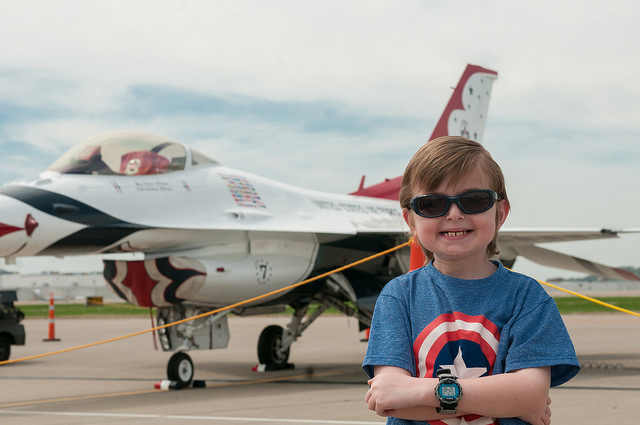
Nine-year-old Dawson Barr and his family visit the Kentucky Air National Guard’s 123rd Airlift Wing to view aircraft that will be flown in the annual Thunder Over Louisville Air Show, in Louisville, Ky., April 18, 2015. Dawson has been battling cancer his entire life and currently has an inoperable brain tumor, making him legally blind in both eyes. (U.S. Air National Guard photo by 2nd Lt. James W. Killen)
KENTUCKY AIR NATIONAL GUARD BASE, LOUISVILLE, Ky. — Members of the Kentucky Air National Guard welcomed a 9-year-old boy with cancer to the base Saturday as aircraft from around the world prepared to perform in the Thunder Over Louisville air show.
Dawson Barr, accompanied by his sister, mother and father, toured the flight line with Chief Master Sgt. Joe Dawson, superintendent of the 123rd Operations Group here.
“Dawson had an absolute blast!” Chief Dawson said. “We visited every aircraft on the flight line, met and talked with several people along the way, and we also got to watch a C-17 Globemaster taxi out and take off.”
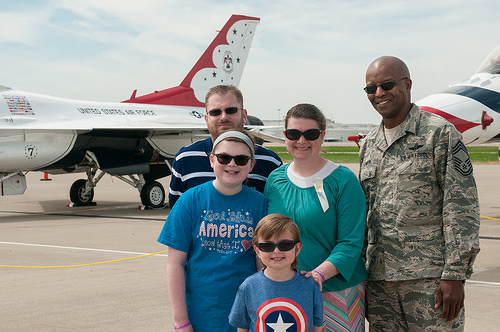
Nine-year-old Dawson Barr and his family visit the Kentucky Air National Guard’s 123rd Airlift Wing to view aircraft that will be flown in the annual Thunder Over Louisville Air Show, in Louisville, Ky., April 18, 2015. Dawson has been battling cancer his entire life and currently has an inoperable brain tumor, making him legally blind in both eyes. (U.S. Air National Guard photo by 2nd Lt. James W. Killen)
Dawson toured the Operations Building, ate lunch supplied by the 123rd Security Forces Squadron, and watched several aircraft take off while observing from the 165th Airlift Squadron Heritage Room, which offers one of the best views on base.
Dawson was diagnosed with cancer at just 6 months of age. Doctors were cautious about his life expectancy, primarily because of the number of tumors he has — seven on the brain and three on the spine — and their severity.
He has defied the odds, though, and according to his mother, Aimee Barr, “He’s an amazing little kid with a magnetic personality; he’s a fighter, too.”
Dawson endured five years of chemotherapy, ending his treatments in February 2012. He currently has one inoperable tumor that severely impacts his vision, making him legally blind in both eyes. The chemotherapy and other treatments have left Dawson with a number of challenges, from hormone imbalances to osteoporosis.
Aimee says that doesn’t stop him, though.
“He’s a normal 9-year-old boy. He wants to play soccer, he wants to be a professional football player, and if that doesn’t work, he’s going to be a professional baseball player.”
Dawson made an impact on several of the people he met at the Kentucky Air Guard, with many noting how positive and upbeat he was, and how he asked so many great questions.
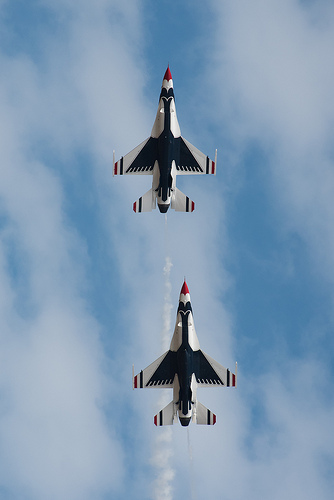
Two F-16 Fighting Falcons from the U.S. Air Force Thunderbirds aerial demonstration team perform in the Thunder Over Louisville air show April 18, 2015, in Louisville, Ky. More than 650,000 people lined the banks of the Ohio River for the show. (U.S. Air National Guard photo by Maj. Dale Greer)
“I thoroughly enjoyed meeting and spending time with Dawson, his sister, Lauren, and their parents, Aimee and Shane Barr,” Chief Dawson said. “That young man is a fighter in the true sense of the word, with the most positive attitude and the most uplifting spirit that you will ever see in a little boy.”
Dawson has a message for those who may be struggling with challenges or illness. In a calm and steady voice he said, “If you’re going through something, just keep going. Eventually something good will happen, and it will be okay.”
Story by David Altom, Kentucky National Guard Public Affairs
Maj. Bobbie Mayes and Sgt. Maggie Eveland are featured — along withe Eveland’s horse, Khaleesi — in the Kentucky National Guard’s Suicide Prevention Awareness PSA. (CLICK IMAGE TO SEE VIDEO)
FRANKFORT, KY — On an average day 22 military veterans take their own life. Of those 22, 69% are 50 years old or older.
With these sobering statistics in mind, the Kentucky National Guard has released a public service announcement designed to raise awareness about suicide prevention. The 30-second in-house production features Maj. Bobbie Mayes, Sgt. Maggie Eveland and Eveland’s horse, Khaleesi. The video also has messages of support and contact information for military personnel and veterans in need.
An accompanying “behind the scenes” video features Sgt. Eveland discussing the challenges of life, the value of suicide awareness training and how Khaleesi helped inspire her through a period of crisis.
If you need help or know someone who does, call Call 1-800-273-TALK to discuss veteran suicide.
For more information on suicide prevention contact:
Capt. David W. Shelley, email: david.w.shelley.mil@mail.mil
Resilience, Risk Reduction and Suicide Prevention Program Manager
502-607-1941
Story by 2nd Lt. Michael Reinersman, 133rd Mobile Public Affairs Detachment
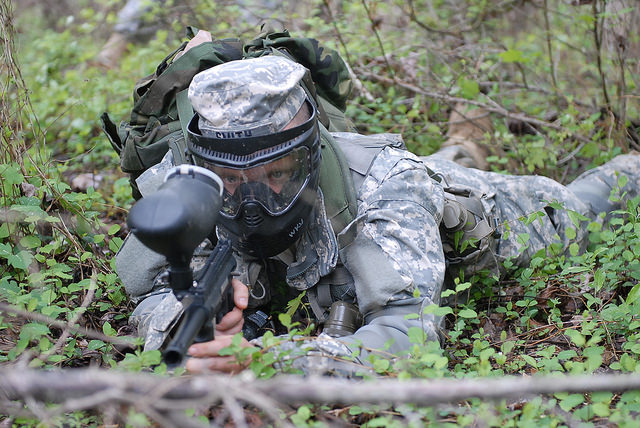
Officer Candidate Benjamin Smith from Class 57-15 pulls security during the combined Officer Candidate School, Reserve Officer Training Corps with Western Kentucky University and Murray State University during a field training exercise at Wendell H. Ford Regional Training Center in Greenville, Ky., April 17, 2015. Smith and 73 other Soldiers participated in the second combined OCS and ROTC exercise. (U.S. Army National Guard photo by 2nd. Lt. Michael Reinersman)
GREENVILLE, Ky. - Future Army leaders from across the commonwealth joined forces to conduct a combined field training exercise at Wendell H. Ford Regional Training Center in Greenville, Ky., April 16-18, 2015.
Officer candidates from the Kentucky National Guard Officer Candidate School along with cadets from Murray State University and Western Kentucky University’s Reserve Officer Training Corps spent three days in the field covering troop leading procedures while conducting platoon and squad level tactics.
This included scenarios such as movement to contact and platoon ambush and raids. The goal of the combined field training exercise is to assess and provide instruction to the officer candidates and ROTC cadets in leadership positions while conducting infantry tasks.
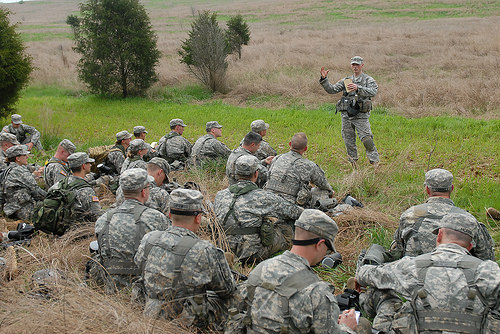
Capt. Colin Bair, Assistant Professor of Military Science at Murray State University conducts an after action review with cadets from Western Kentucky University and Kentucky Guard Officer Candidates during field training exercise at the Wendell H. Ford Regional Training Center in Greenville, Ky., April 17, 2015. This marks the second year that ROTC programs from Western Kentucky and Murray State have participated in the field training exercises with the Kentucky OCS program. (U.S. Army National Guard photo by 2nd. Lt. Michael Reinersman)
According to Western Kentucky University’s Assistant Professor of Military Science, Capt. Lincoln Ward, there are many benefits to training and collaborating with the Kentucky Guard.
“This has been a good partnership,” said Ward. “Working with new soldiers from different backgrounds provides a new challenge to the cadets.” Adding that, “The Kentucky National Guard provides us with resources that we don’t normally have at a ROTC program or the NCO support that can help access land and medics.”
This marks the second year that ROTC programs from Western Kentucky and Murray State have participated in the field training exercises with the Kentucky OCS program. To enhance training this year, cadets and candidates used a military grade paintball system, to simulate live fire.
Click here for more photos.
“This enhancement from last year’s training will make it more realistic and environmentally friendly by using bio degradable paint balls,”said Sgt. 1st Class Anthony Kennedy, operations noncommissioned officer for the 238th Regimental Training Institute. “It is a better alternative than having shell casing all over the training area.”
Officer candidate Jennifer Steinmetz also echoed the mutual benefits of the training exercise.
“This would have been a hard training event to conduct since we don’t have the numbers,” said Steinmetz. “There are eight officer candidates, training with the cadets allowed the officer candidates to participate in full platoon and squad lanes,”
“Now, that we have those spots filled, during phase three, it will not be such a shock when we conduct platoon and squad lanes.”
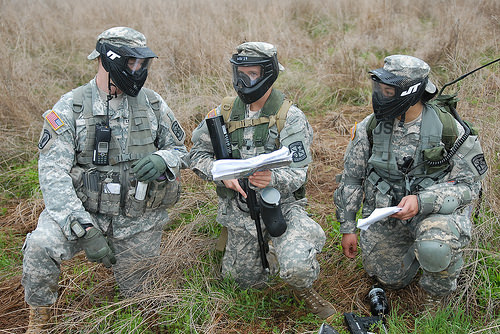
Capt. Colin Bair, Assistant Professor of Military Science at Murray State University checks the coordinates of ROTC Cadet Kelsey McArthur and Chrystal Falefata from Western Kentucky University during field training exercise at the Wendell H. Ford Regional Training Center in Greenville, Ky., April 17,2015. The goal of the combined field training exercise is to assess and provide instruction to the officer candidates and ROTC cadets in leadership positions while conducting infantry tasks. (U.S. Army National Guard photo by 2nd. Lt. Michael Reinersman)
Phase three is the last step in the OCS commissioning process. The final phase covers troop leading procedures, infantry squad tactics, and culminates with a field leadership exercise at Fort McClellan, Alabama.
Cadet Kyle Taylor with Western Kentucky University and a member of Kentucky’s Bravo Company, 149th Infantry, said training on a college campus is just plain difficult.
“Since we don’t have a lot space on campus, it’s great to be in a tactical environment and run lanes,” he said. “We are able to evaluate each other and work to get better.”
According to both Kentucky OCS and ROTC leadership, the Spring FTX was another successful collaboration between two commissioning programs to develop future leaders in the Kentucky Guard, Army Reserve and active duty.
Video by Spc. Cody Cooper, 133rd MPAD
By Maj. Dale Greer, 123rd Airlift Wing Public Affairs
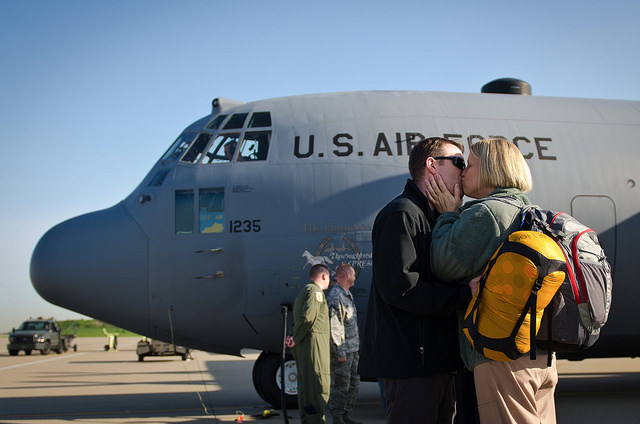
Maj. Jenn Helton, a C-130 navigator in the 123rd Airlift Wing, kisses her husband at the Kentucky Air National Guard Base in Louisville, Ky., April 24, 2015, prior to departing for a deployment to the Persian Gulf. Helton was among more than 40 Kentucky Air National Guardsmen who deployed to an undisclosed air base in support of Operation Freedom’s Sentinel. (U.S. Air National Guard photo by Master Sgt. Phil Speck)
KENTUCKY AIR NATIONAL GUARD BASE, LOUISVILLE, Ky. — The third rotation of more than 40 Kentucky Air National Guardsmen departed here today for deployment to an undisclosed air base in the Persian Gulf, where they will fly airlift missions in support of Operation Freedom’s Sentinel.
Click here for more photos.
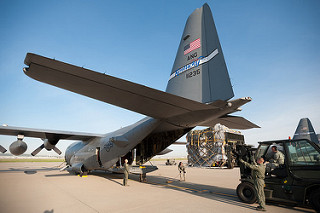
Loadmasters and cargo specialists from the 123rd Airlift Wing load cargo onto a C-130 Hercules aircraft at the Kentucky Air National Guard Base in Louisville, Ky., April 24, 2015, prior to the aircraft’s departure for deployment to an undisclosed air base in the Persian Gulf region. More than 40 Kentucky Air National Guardsmen boarded the plane. They will join other Airmen already in theater to fly airlift missions in support of Operation Freedom’s Sentinel. (U.S. Air National Guard photo by Maj. Dale Greer)
Freedom’s Sentinel is the follow-on mission to Operation Enduring Freedom. It focuses on training, advising and assisting Afghan security forces; and on counterterrorism operations in Afghanistan.
Kentucky’s adjutant general, Maj. Gen. Edward W. Tonini, thanked the deploying Airmen for their continued commitment to military operations all over the world.
“The 123rd Airlift Wing has been engaged in the Global War on Terror from the beginning, and I know you will be a part of this fight until the very end,” Tonini told the Airmen in a briefing just before their departure. “When our nation, our Air Force and our Commonwealth needs the best, they call on you. I have the utmost trust and confidence in your abilities to conduct your mission while overseas, and I thank you for stepping up once again to answer our nation’s call.”
The director of the state Board of Elections, Matt Selph, also was on hand to wish the Airmen farewell as a representative of Alison Lundergan Grimes, Kentucky’s secretary of state.
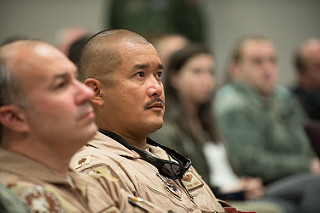
Maj. Johnny Cantu, a C-130 pilot in the 123rd Airlift Wing, attends a briefing at the Kentucky Air National Guard Base in Louisville, Ky., April 24, 2015, prior to his deployment to an undisclosed air base in the Persian Gulf region. Cantu and more than 40 other Kentucky Air Guardsmen comprise the third rotation of 123rd Airmen to deploy to the base since February. They will be flying airlift missions throughout the U.S. Central Command Area of Responsibility in support of Operation Freedom’s Sentinel, which provides military training and counterterrorism capabilities in Afghanistan. (U.S. Air National Guard photo by Maj. Dale Greer)
“As a former Army first sergeant in the reconnaissance field who spent time in Iraq and Afghanistan being transported on C-130s by men and women just like you, I’d like to relay on behalf of Secretary Grimes how thankful we are for the jobs that you do and the sacrifies that your families make,” Selph said. “I know I was thankful that men and women like you were able to get me and my troops deployed and redeployed safely.”
The Airmen, who departed aboard a Kentucky Air National Guard C-130 Hercules aircraft, will replace earlier rotations of Kentucky Airmen that deployed in February. While overseas, the Airmen are expected to transport troops and cargo supporting a range of coalition military operations in the United States Central Command Area of Responsibility, which includes Afghanistan, Northern Africa and the Persian Gulf. Deploying Airmen include aircrew members, aircraft maintenance personnel and support staff.
The mission is expected to conclude by early July.
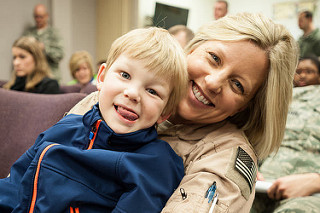
Maj. Jenn Helton, a C-130 navigator in the 123rd Airlift Wing, and her son, Kaiden Helton, attend a briefing at the Kentucky Air National Guard Base in Louisville, Ky., April 24, 2015, prior to Helton’s deployment to an undisclosed air base in the Persian Gulf region. Helton and more than 40 other Kentucky Air Guardsmen comprise the third rotation of 123rd Airmen to deploy to the base since February. They will fly airlift missions throughout the U.S. Central Command Area of Responsibility in support of Operation Freedom’s Sentinel, which provides military training and counterterrorism capabilities in Afghanistan. (U.S. Air National Guard photo by Maj. Dale Greer)
The deployment marks the sixth time in the past 12 years that the Kentucky Air Guard has sent its aircraft, aircrews and maintenance personnel to support U.S. military operations in the U.S. Central Command AOR. The wing deployed aviation assets there in 2003, 2007, 2009, 2010 and 2012, operating from multiple undisclosed locations and Bagram Air Field, Afghanistan.
The wing’s non-aviation personnel also have been heavily engaged around the world since Sept. 11, 2001, logging thousands of deployments to dozens of overseas locations, including Iraq and Afghanistan. In October, more than 70 of the wing’s Airmen deployed to Africa to support Operation United Assistance, the international effort to fight the worst Ebola outbreak in history.
Story by David Altom, Kentucky National Guard Public Affairs
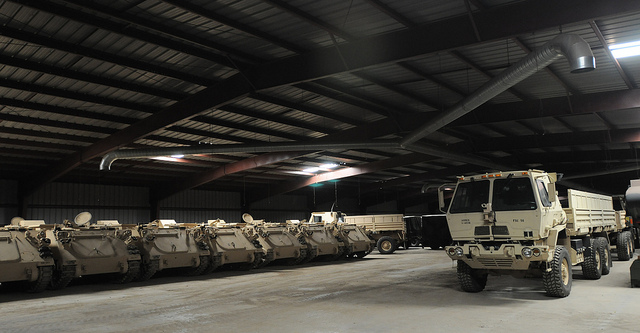
This is just a sample of the equipment stored under corrosion preventing conditions by the Kentucky Army National Guard at the Wendell H. Ford Regional Training Center. Corrosion is a worldwide problem, consuming our infrastructure and threatening our military gear. On a daily basis the Kentucky Guard has to protect more than $100 million worth of equipment from falling prey to corrosion. (Kentucky National Guard photo by Staff Sgt. Scott Raymond, Kentucky National Guard Public Affairs Office)
FRANKFORT, Ky. — Riddle me this: What ensures combat readiness, preserves our equipment, protects the environment, and saves taxpayers a whole lotta money?
Answer: corrosion awareness!
Okay, bad joke. But the truth of the matter is, corrosion awareness is no joke. In fact, today — April 24, 2015 — is World Corrosion Awareness Day. Not just for the National Guard, not just for the United States Army, but for the whole world.
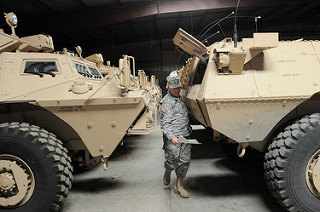
Chief Warrant Officer Gregg Blakeley checks the status of an M1117 Armored Security Vehicle. More than $100 million worth of vehicles and gear are under daily monitoring for corrosion by Kentucky National Guard personnel. (U.S. Army National Guard photo by Staff Sgt. Scott Raymond)
So, what’s the big deal? Well, corrosion costs nearly $4 trillion worldwide each year, which makes for the big deal. Corrosion eats away at our infrastructure, our bridges, rail systems, pipelines, you name it. Given enough time and neglect, our technological society and way of life are at risk, threatened by corrosion and its aftereffects.
Okay, so that’s why corrosion awareness is important. But now you may ask, what’s that got to do with the Kentucky National Guard?
The answer: plenty.
Click here for more photos on this story.
One of the best kept secrets about the Kentucky National Guard is our corrosion protection program. At Fort Knox and the Wendell H. Ford Regional Training Center we have established long-term corrosion protection measures that are essential to our war-fighting mission.
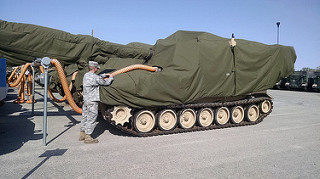
Staff Sgt. Eric Miers checks the controlled humidity protection hose hooked up to an M109 Paladin at the Mobilization and Training Equipment Site at Fort Knox. (Kentucky National Guard photo by Chief Warrant Officer Christopher Kehl)
“We’ve got twelve Paladins and twelve ammo carriers worth about thirty million dollars,” said Command Sgt. Maj. Timothy Gividen, artillery shop supervisor at the Kentucky Guard’s Mobilization and Training Equipment Site at Fort Knox. “There’s another forty million in HIMARS rocket launchers, too. Add on all of the other equipment we’re signed for, that’s more than one hundred million dollars of the taxpayers’ dollars that we have to protect.
“That’s a huge investment in the Guard and a great responsibility for our shop.”
Gividen’s team of eight mechanics focuses primarily on artillery. They keep the M109A6 Paladins hooked up to a controlled humidity protection system, which keeps the interior of the vehicles dry and tight. The complex series of overgrown hoses are hooked up to hatches and the muzzles of the gun barrels, connected to what amounts to a giant dehumidifier. The soldiers do daily checks to ensure everything is sealed up right.
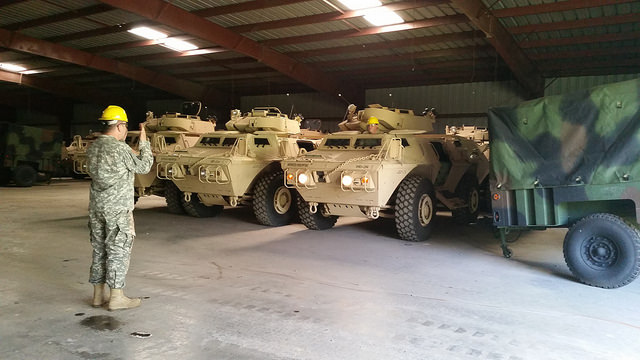
From HUMVEES and ASVs to high dollar HIMARS launchers, more than $100 million worth of vehicles and gear are under daily monitoring for corrosion by Kentucky National Guard personnel. (Photo courtesy Kentucky National Guard UTES)
“The CHP system does its part, but people are still essential to the process,” said Gividen. “It’s our job to keep all of this equipment in combat ready status, so all the troops have to do is come in, do some PMCS [preventive maintenance checks and services] and go train or deploy.”
The M142 High Mobility Artillery Rocket System launchers are kept in a giant warehouse-like building with controlled temperature environment that protects them from weather and moisture. The latest in artillery technology, they are precise and accurate and battlefield proven. At $2.5 million apiece, they are also very expensive. Warrant Officer William Cottrell, work group leader at the MATES artillery shop, emphasizes the sensitive nature of the systems they are charged with protecting.
“There are a lot of computer components in these systems,” he said. “Replacing one computer box on HIMARS can run hundreds of thousands of dollars. This isn’t our money we’re talking about; it’s the taxpayers’. We work hard to make sure there aren’t any problems.”
“Our CHPs and OP [operation preservation] lines provide us with a distinct advantage during these challenging times in our operating environment, to preserve equipment for much longer periods of time and reduce our overall maintenance costs exponentially,” said Maj. Steven Engels, Surface Maintenance Manager for the Kentucky Guard. “With the likelihood that equipment modernization will decrease in the future due to budget constraints, preserving and maintaining the equipment that we have is as important as ever to respond to potential domestic natural disasters in support of civil authorities as well as military missions across the world.”
Story by Staff Sgt. Scott Raymond, Kentucky National Guard Public Affairs
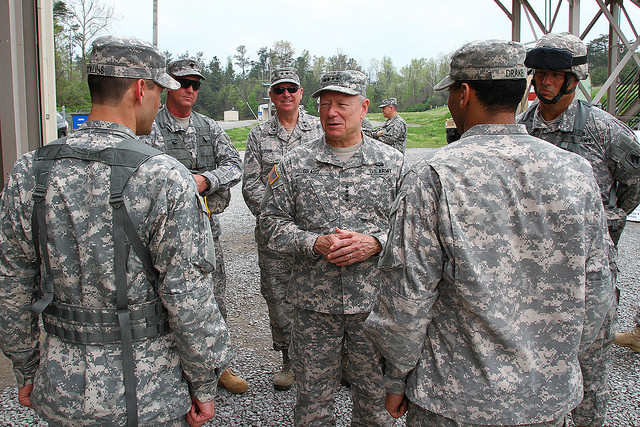
Gen. Frank J. Grass, chief of the National Guard Bureau speaks with Soldiers with the 138th Field Artillery Brigade at the Wendell H. Ford Regional Training Center in Greenville, Ky., April 17, 2015. During his three-day visit, Grass met with Soldiers and Airmen across the state, attended Thunder Over Louisville and Military Appreciation Day at Keeneland in Lexington, Ky. (U.S. Army National Guard photo by Staff Sgt. Scott Raymond)
FRANKFORT, Ky. — Military challenge coins are handed out everyday for excellence, but it’s not everyday that a Soldier’s first coin is from a four-star general. That was the case for Pfc. Lauren Walker, a combat medic with the 1163rd Area Support Medical Company.
“That was my first coin, my first big recognition as a Soldier that I’m doing the right thing,” said Walker. “It’s a pretty big deal to me.”
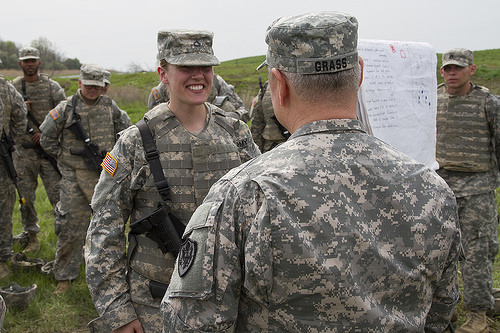
Pfc. Lauren Walker with the 1163rd Area Support Medical Company speaks with Gen. Frank J. Grass, chief of the National Guard Bureau at the Wendell H. Ford Regional Training Center in Greenville, Ky., April 17, 2015. The 1163rd was finishing up the unit’s pre-mobilization training prior to a scheduled deployment to Afghanistan this spring. (U.S. Army National Guard photo by Staff Sgt. Scott Raymond)
“It means a lot to us that he came down here from D.C. to see the little 1163rd. It was a great reminder for us to stay motivated to keep up the hard work and keep driving on.”
Visit our flickr page for more photos of Gen. Grass’ visit to Kentucky.
For Soldiers with the 1163rd, pre-mobilization training was going according to schedule April 18 at the Wendell H. Ford Regional Training Center in Greenville, Ky. Then in the middle of a field training class, everything came to a brief halt as Gen. Frank J. Grass, chief of the National Guard Bureau rolled up on their location.
Escorted by Maj. Gen. Edward W. Tonini, Kentucky’s adjutant general, Grass visited as part of his initiative to travel to every state and territory to personally thank Guardsmen around the Nation.
“Every time I travel, one of the things I find is I learn something about the National Guard that I didn’t know,” said Grass. “Getting to visit Soldiers and Airmen here and learn about the missions that you all are doing is phenomenal.”
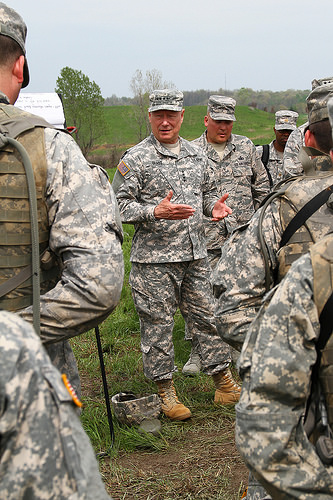
Gen. Frank J. Grass, chief of the National Guard Bureau speaks with Kentucky Guardsmen of the 1163rd Area Support Medical Company during a visit to the Wendell H. Ford Regional Training Center in Greenville, Ky., April 17, 2015. Grass thanked the Soldiers for their service and answered questions from them on the state of the National Guard. (U.S. Army National Guard photo by Staff Sgt. Scott Raymond)
“You think about the number of people that serve in uniform, this is an all volunteer force, and you’ve got to thank them,” he said.
Grass observed part of the training class then spoke with the unit about their upcoming deployment and their thoughts on being a part of the Guard.
“What I find interesting everywhere I go is how young the force is, how talented and how astute they are to what is happening in the world, and they know exactly why they’re joining.”
Sgt. Duncan Wooster’s story also inspired Grass. Wooster enlisted late in life and has a stable career as an airline pilot, but is also determined to be a true non-commissioned officer to the 1163rd. Grass complimented Wooster on helping young Soldiers of the 1163rd to devise plans to be smarter with the extra money they will make during the deployment.
“I’m excited and very honored to go work with such a great group of people and just want to try to influence them to make better decisions,” said Wooster. “I took everything Gen. Grass said to heart and was very impressed that he took time to come out in the field to see us. It was an honor to meet him and speak with him one-on-one.”
The National Guard chief’s visit left a positive buzz with the unit. A drive that their leadership hopes carries them into and through their deployment to Afghanistan.
“The time Gen. Grass spent with the Soldiers indicates to me that we stood out and made a positive impression on him,” said 1st Lt. Anna Mataspha, officer in charge of the 1163rd’s training. “How many other units in the Guard have come across the Chief of the National Guard, that’s pretty special and it elevates us to be even better than what we already are. It’s a great boost right before they deploy.”
During his three-day visit to Kentucky, Grass also met with Soldiers of the 138th Field Artillery Brigade in Greenville and Soldiers with Charlie Co., 1st Battalion, 376th Security and Support Aviation upon his return to Louisville. Grass was also an impressed spectator at Thunder Over Louisville, April 18 and a special guest at Military Appreciation Day at Keeneland in Lexington, Kentucky, April 19.
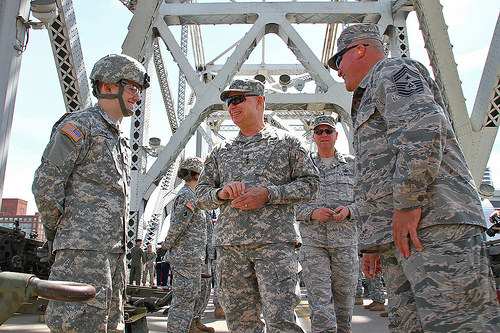
Gen. Frank J. Grass, chief of the National Guard Bureau and Chief Master Sgt. Mitch Brush speak with Spc. Kyle Shenk with the 138th Field Artillery Brigade during Thunder Over Louisville, April 18, 2015. Grass visited with Kentucky Guardsmen on duty for the event throughout downtown Louisville. (U.S. Army national Guard photo by Staff Sgt. Scott Raymond)
“Thunder Over Louisville was just phenomenal and to see how much the military was involved, the salute to Veterans, the salute the Kentucky Army and Air National Guard, there was a half-million people there and you couldn’t move without bumping into a Guardsmen or their family member somewhere.”
In awe of the events and the participation of the Kentucky Guard, Grass departed Kentucky with final thoughts to the Citizen-Soldiers and Airmen of the bluegrass.
“I would tell them thank you for serving your nation and look at the opportunities you’re getting as a member of the Guard, and thanks to their families and employers. It all becomes a family and the Guard is more family than anything I’ve seen.”
Story by Maj. Dale Greer, 123rd Airlift Wing Public Affairs
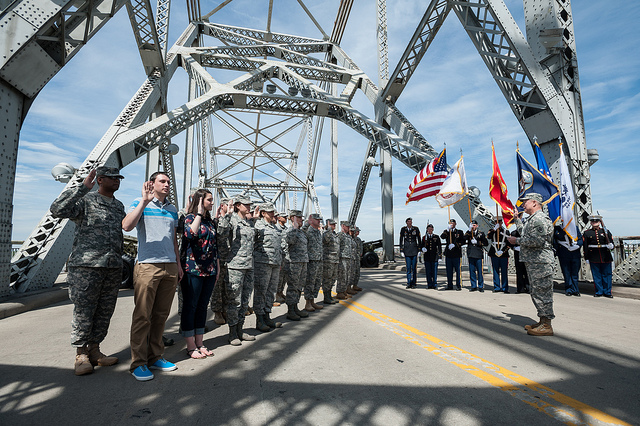
Army Gen. Frank J. Grass, chief of the National Guard Bureau, swears in 20 Soldiers and Airmen from the Kentucky National Guard during a re-enlistment ceremony on the Clark Memorial Bridge in downtown Louisville, Ky., April 18, 2015. The event, televised live, kicked off the 2015 Thunder Over Louisville air show. (U.S. Air National Guard photo by Maj. Dale Greer)
LOUISVILLE, Ky. — The 2015 Thunder Over Louisville air show began Saturday with a barrage of canon fire executed by the Kentucky National Guard’s 138th Field Artillery Brigade and a mass re-enlistment ceremony for 20 Kentucky Guardsmen led by Army Gen. Frank J. Grass, chief of the National Guard Bureau.
Senior Airman Lindsey Horton, a recruiting assistant in the Kentucky Air Guard’s 123rd Force Support Squadron, said it was a great honor to be sworn in by the nation’s top National Guard officer on live television.
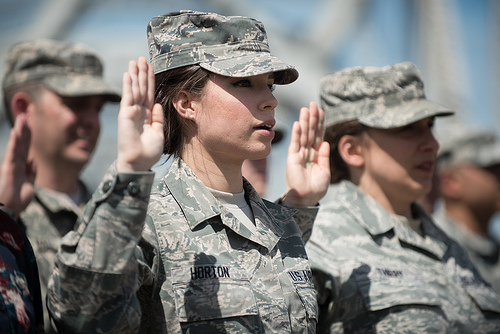
Senior Airman Lindsey Horton, a recruiting assistant in the Kentucky Air National Guard, takes the oath of enlistment during a mass swearing-in ceremony on the Clark Memorial Bridge in downtown Louisville, Ky., April 18, 2015. The ceremony, which kicked off the Thunder Over Louisville air show, was led by Army Gen. Frank J. Grass, chief of the National Guard Bureau. (U.S. Air National Guard photo by Maj. Dale Greer)
“Serving in the Air National Guard is something that I take a lot of pride in,” Horton said. “I’ve really taken the Air Force Core Values of service, integrity and excellence to heart, so being able to reaffirm my commitment to them with Gen. Grass was a great experience.”
Grass, who also serves on the Joint Chiefs of Staff as one of seven military advisors to the president of the United States, thanked Horton and the other troops for their continued service, calling their dedication to duty a “phenomenal act.”
Earlier in the day, Grass toured the Kentucky Air National Guard Base in Louisville to learn more about the missions of the 123rd Airlift Wing, which include tactical airlift, contingency response, and special tactics capabilities like combat control and pararescue.
One of the highlights of the air show was a tribute to Col. Gail Halvorsen, a retired C-54 pilot who became famous when he originated the idea of air-dropping small bundles of chocolate to the children of West Berlin during the Berlin Airlift of 1948-49. What began with Halvorsen’s small act of kindness eventually grew to include hundreds of American Airmen and more than 21 tons of candy.
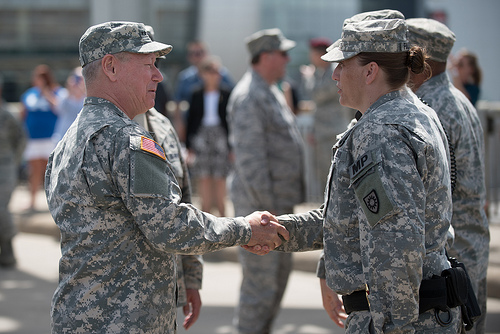
Army Gen. Frank J. Grass, chief of the National Guard Bureau, speaks to Sgt. 1st Class Jennifer Fulkerson from the Kentucky Army National Guard after a mass swearing-in ceremony on the Clark Memorial Bridge in downtown Louisville, Ky., April 18, 2015. Grass administered the oath of enlistment during the ceremony, which kicked off the Thunder Over Louisville air show. (U.S. Air National Guard photo by Maj. Dale Greer)
In honor of Halvorsen, who became known as the Berlin Candy Bomber and was guest of honor at this year’s show, a Kentucky Air Guard C-130 Hercules air-dropped two simulated bundles of candy over the Ohio River before a crowd of more than 650,000 spectators.
Other highlights of the air show included performances by the U.S. Air Force Thunderbirds aerial demonstration squadron, the U.S. Army Golden Knights parachute team and the U.S. Marine Corps AV-8B Harrier Demonstration Team.
Story by Sgt. 1st Class Gina Vaile-Nelson, 133rd Mobile Public Affairs Detachment
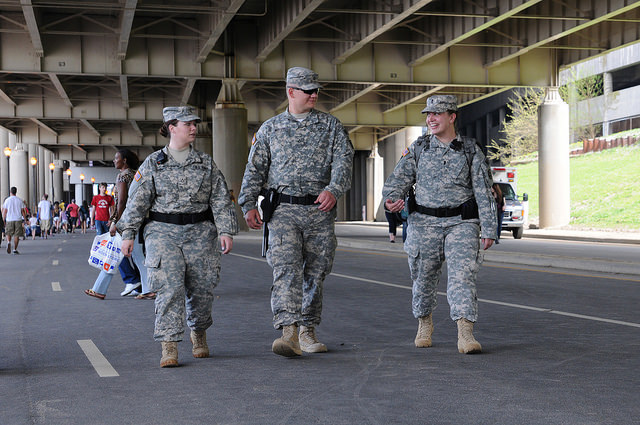
Pfc. Allison Shontz, Pvt. 1st Class Dillion Morvel and 1st Lt. Maria Burns, military police assigned to the 223rd Military Police Company patrol River Road from Seventh Street to Ninth Street April 18, in support of Thunder Over Louisville security detail. More than 1,200 Law Enforcement Officers and 140 military policemen patrolled the Riverfront to ensure crowd safety. (U.S. Army National Guard photo by Sgt. 1st Class Gina Vaile-Nelson)
LOUISVILLE, Ky. - Before sending the Louisville Metro Police officers and Soldiers from the Kentucky National Guard’s 223rd Military Police Company out on foot patrol, Louisville’s mayor, Greg Fischer and Metro Police Chief Steve Conrad had two important messages: stay safe and keep Louisville safe.
“I thank you LMPD and Kentucky Guard,” Fischer said, “we can’t do this without you.”
More than 1,200 officers made up the combined force of LMPD, Kentucky Guard, Jefferson County Sheriff’s Office, Kentucky State Police and federal law enforcement agencies. LMPD and the Guardsmen conducted foot patrols that roved the waterfront from 4 p.m., until the last spectators receded from the downtown area.
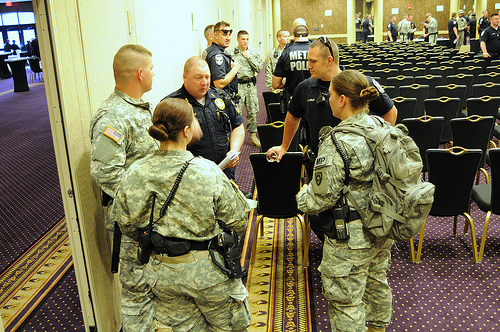
Soldiers assigned to the 223rd Military Police Company receive a patrol plan from the Louisville Metro Police prior to hitting the streets April 18, in support of Thunder Over Louisville. More than 1,200 Law Enforcement Officers and 140 military policemen patrolled the Riverfront to ensure crowd safety (U.S. Army National Guard photo by Sgt. 1st Class Gina Vaile-Nelson)
“We are very grateful for what the National Guard provides us,” said Sgt. Phil Russell, Louisville Metro Police commander of media, public relations.
“With a half-million people in downtown Louisville, we absolutely need the support of the National Guard. We are grateful for the extra set of eyes and the partnership that we hope continues,” he said.
The partnership comes easy for the Louisville-based 223rd MPs. While unit leadership didn’t have an exact number of Soldiers employed by LMPD, their network of police contacts is extensive. Several Soldiers are employed by civilian police departments, and are familiar with the way civilian departments operate.
“We conduct training for events like this when we get our field time,” said 1st Sgt. Mike Ochs, 223rd MP Company first sergeant. “We get briefings from the mayor and police chief, and they always comment on how critical the support of the Kentucky Army National Guard is.
“It’s good for our Soldiers to hear that, it really puts everything into perspective as far as what our role is. We always have good camaraderie with LMPD during Thunder and Derby support; there is never any animosity that this is their turf, we work as one.”
Ochs said the law enforcement presence is important for the attendees to feel safe and secure during Louisville’s largest party. But he said all Soldiers representing the Guard is an important mission as well.
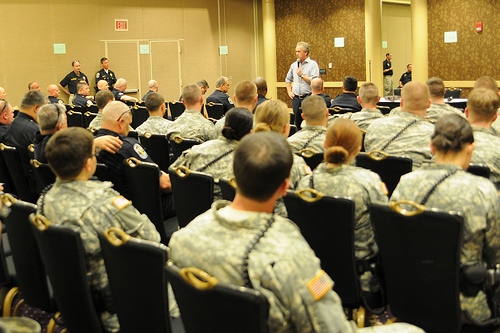
Louisville Mayor Greg Fischer thanks Louisville Metro Police Department and the Kentucky National Guard’s Louisville-based 223rd Military Police Company for their support to Thunder Over Louisville security April 18, in Louisville. More than 1,200 Law Enforcement Officers and 140 military policemen patrolled the Riverfront to ensure crowd safety. (U.S. Army National Guard photo by Sgt. 1st Class Gina Vaile-Nelson)
“When you are here, and in the uniform, you are an ambassador for the United States military, but especially the Kentucky Guard,” he said.
The 223rd MPs had more than 140 Soldiers supporting LMPD and representing the Guard.
First platoon leader, 1st Lt. Maria Burns, was one of those foot-Soldiers, logging miles between a three-block radius on River Road, from Seventh Street to Ninth.
“This is my third year working Thunder,” Burns said. “We mingle, talk to people and just show them that we are here if they need us.”
Burns said there was one incident two years ago where her team assisted LMPD with dispersing a crowd at the Louisville Skate Park after firecrackers were set off.
“This year, I don’t think we’re going to see anything like that here, this crowd looks pretty happy.”
Story by Sgt. 1st Class Gina Vaile-Nelson, 133rd Mobile Public Affairs Detachment
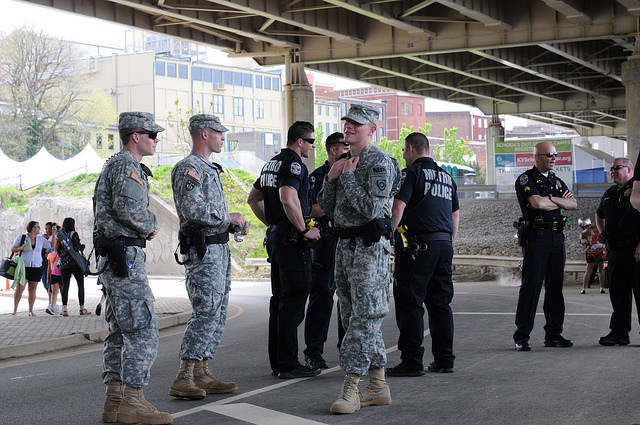
Soldiers assigned to the 223rd Military Police Company and Louisville Metro Police officers man a safety point at Sixth Street and River Road April 18, in support of Thunder security operations. More than 1,200 Law Enforcement Officers and 140 military policemen patrolled the Riverfront to ensure crowd safety. (U.S. Army National Guard photo by Sgt. 1st Class Gina Vaile-Nelson)
LOUISVILLE, Ky. - It literally takes an Army, specifically the Kentucky Army National Guard, to ensure the two-week party in Louisville, aka the Kentucky Derby Festival (KDF), goes off without a hitch.
Whether its traffic enforcement, security patrols, entertaining the crowd with give-aways and obstacles, or starting events with a cannon, the Kentucky Guard plays a huge role in Thunder Over Louisville, the kick-off to Derby Festival. The Soldiers and Airmen operate right alongside the KDF as well as local, state and federal agencies to ensure festival patrons have an explosive time, without incident.
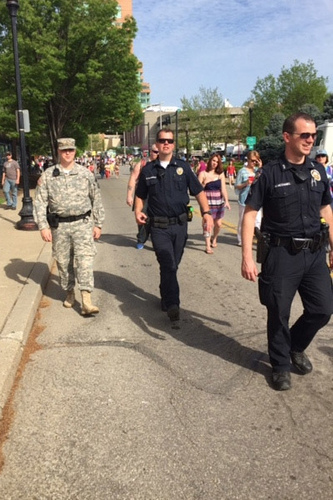
The Kentucky National Guard’s 223rd Military Police and Louisville Metro Police officers coordinated patrols to keep Thunder-goers safe April 18, in Louisville. More than 1,200 Law Enforcement Officers and 140 military policemen patrolled the Riverfront to ensure crowd safety. (U.S. Army National Guard photo by Sgt. 1st Class Gina Vaile-Nelson)
“We are very grateful for what the National Guard provides us,” said Sgt. Phil Russell, Louisville Metro Police commander of media, public relations.
Approximately 250 Kentucky Guardsmen supported the 25th Thunder. The Guard has participated in the annual event in some capacity since its conception in 1990.
“When you are here, and in the uniform, you are an ambassador for the United States military; but especially the Kentucky Guard,” said 1st Sgt. Mike Ochs, 223rd Military Police Company first sergeant.
“It’s good for the crowd to see us, and the public is always wonderful to us,” he said.
Sgt. 1st Class Nick Vinson, a Guard recruiter, has helped coordinate the Kentucky Recruiting and Retention Battalion’s partnership with the KDF since 2008, and has worked everything from the Guard’s rock wall to the command center.
“Thunder emphasizes what the Guard does for Kentucky,” Vinson said. “It’s not only the largest event within this area of the state, but for our recruiters and our community relations personnel; this is the largest single-day event of the year. We impact as many people at Thunder as we do in a week at the State Fair.”
On the bridge, Soldiers assigned to the 138th Field Artillery Brigade know their cannons are not just a staple of Thunder, but something that many viewers look forward to hearing, and feeling. But their own experience is something they said they don’t take for granted.
“It was exciting to be part of Thunder Over Louisville,” said Spc. Tiffany Dirolf, supply specialist, 138th Field Artillery Brigade. “I am normally in a room all the time and today I had one of the best seats in the house.”
Whether patrolling the busy streets or loading the cannons, the Kentucky Army National Guard is always ready to make each Thunder better than the last.
Story by Maj. Dale Greer, 123rd Airlift Wing Public Affairs
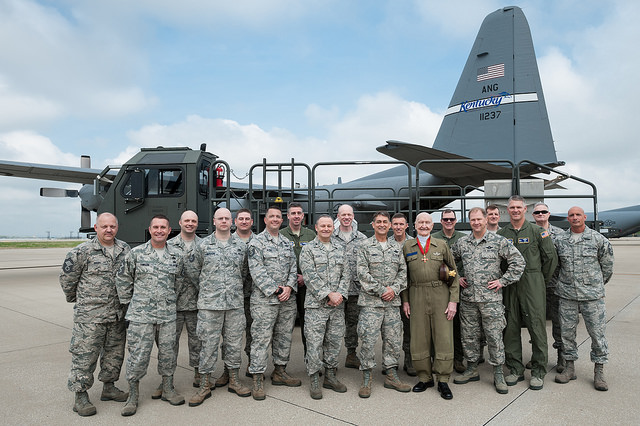
Col. Gail Halvorsen, a former U.S. Army Air Corps pilot who originated the idea of airdropping candy to German children during the 1948-49 Berlin Airlift, visits the Kentucky Air National Guard Base in Louisville, Ky., April 17, 2015. Halvorsen, who is known as the Berlin Candy Bomber, will be the guest of honor during the 2015 Thunder Over Louisville air show April 18. The Airmen are standing in front of a Halverson Loader, named for the colonel, that can rapidly load up to 25,000 pounds of cargo onto airlift aircraft. (U.S. Air National Guard photo by Maj. Dale Greer)
KENTUCKY AIR NATIONAL GUARD BASE, LOUISVILLE, Ky. — Members of the Kentucky Air National Guard will pay tribute to the famous “candy drops” of the Berlin Airlift during Saturday’s Thunder Over Louisville air show.
A Kentucky Air Guard flight crew will deploy two simulated bundles of candy over the Ohio River from the back of a Kentucky C-130 Hercules aircraft at 4:39 p.m., according to Lt. Col. John Ward, a pilot in the 123rd Airlift Wing who will be flying the aircraft.
The idea for candy drops originated in 1948 with C-54 pilot Gail Halvorsen, who was then a first lieutenant in the U.S. Army Air Corps. Halvorsen, who eventually rose to the rank of colonel, will be the guest of honor at this year’s air show.
“It’s a real privilege to participate in this kind of tribute because it honors the tremendous accomplishments of Colonel Halvorsen and the proud military heritage of the airlift community,” Ward said.
“In a way, the Berlin Airlift was similar to the missions our own wing flew in Bosnia in the 1990s, when we were able to drop hundreds of tons of food and humanitarian aid to Bosnian civilians after they were cut off from the rest of the world by an intense ethnic war.”
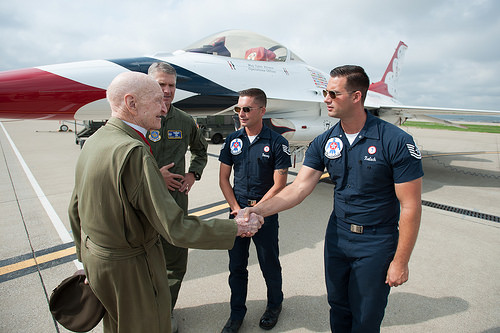
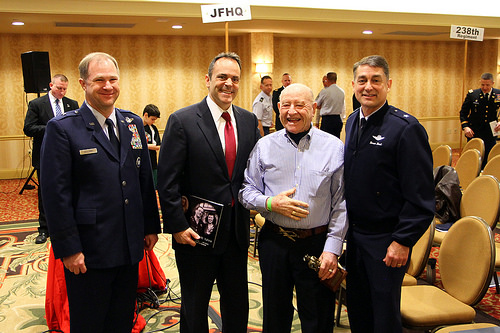
Col. Gail Halvorsen, a former U.S. Army Air Corps pilot who originated the idea of airdropping candy to German children during the 1948-49 Berlin Airlift, visits with crew members from the U.S. Air Force Thunderbirds at the Kentucky Air National Guard Base in Louisville, Ky., April 17, 2015. Halvorsen, who is known as the Berlin Candy Bomber, will be the guest of honor during the 2015 Thunder Over Louisville air show April 18. (U.S. Air National Guard photo by Maj. Dale Greer)
In 1948, Halvorsen found himself flying airlift missions into West Berlin as part of Operation Vittles, the U.S.-backed effort to keep the territory supplied with food, milk and coal after the Soviet Union blocked road and rail access in what was to become the first major battle of the Cold War.
One day in July, Halvorsen was walking inside the perimeter fence at West Berlin’s Tempelhof Air Base — headquarters for Operation Vittles — when he came across about 30 children gathered on the other side.
“We had been bombing Germany just a few years before, and you’d thing they would be antagonistic, but they weren’t,” Halvorsen recalled Friday during a visit to the Kentucky Air National Guard Base. “I was there at the fence talking to them for about an hour, and when I turned to leave, I realized that not one had asked for candy. It was the first time that had ever happened to me when I was in a foreign country. And these kids hadn’t had any chocolate for a couple of years.
“They didn’t ask because they were grateful — grateful for flour and grateful to be free. They wouldn’t beg for something so extravagant as chocolate. When I realized that kids from 9 to 15 years of age had that kind of value system, that they valued freedom so much, it kind of blew my mind.
“So I reached in my pocket, and I had two sticks of Wrigley’s Doublemint gum, and I thought, ‘You can’t give that to 30 kids. You’re going to have a fight.’
“I turned to leave again, and I got about two steps when a voice came through to me clear as a bell: ‘Go back to the fence.’ It was almost a command. So I went back to the fence and pulled my hand out of pocket, and I broke the sticks in half so I would have four pieces.
“They didn’t push or shove, and the kids that didn’t get to have a piece of gum asked for a strip of the wrapper. They took those pieces of wrapper and put them to their noses so they could smell it, and their eyes got big just from the smell.
“That did it. I thought, ‘I gotta do something more.’
“I’d always flown by the book, and I got promoted because I flew by the book. But I told them, ‘Stand in this grassy area tomorrow, and when I fly overhead, I’ll drop enough chocolate for all of you to have some.’”
When the children asked Halvorsen how they would know which plane was his, he told them to look for the aircraft that’s wiggling it wings, earning him the nickname Uncle Wiggly Wings.
That same day, Halvorsen asked his crewmates to give him their chocolate rations. He then fashioned makeshift parachutes from three handkerchiefs, to which he attached the precious candy.
When Halvorsen’s crew returned to the airfield the next day while flying a re-supply mission, he looked down and saw all 30 kids standing exactly where they were told to be. The crew chief collected the tiny bundles and dropped them out of the plane from a flare chute behind the pilot’s seat.
“We didn’t know if the candy had made it over the fence, but when we flew over them again on takeoff, all 30 kids were lined up by the fence with their mouths going up and down, chewing like crazy and waving at the airplane.”
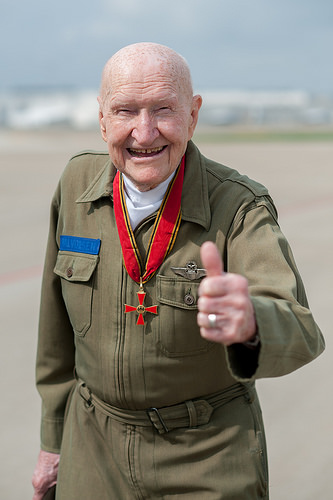
Col. Gail Halvorsen, a former U.S. Army Air Corps pilot who originated the idea of airdropping candy to German children during the 1948-49 Berlin Airlift, visits the Kentucky Air National Guard Base in Louisville, Ky., April 17, 2015. Halvorsen, who is known as the Berlin Candy Bomber, will be the guest of honor during the 2015 Thunder Over Louisville air show April 18. (U.S. Air National Guard photo by Maj. Dale Greer)
Encouraged by the success, Halvorsen’s crew repeated the candy drop three more times — “and then I got caught.”
His superior officers were not happy by the unauthorized airdrops, and the phrase “court martial” was used more than once. But a general officer caught wind of Halvorsen’s stunt and, impressed by the kindness of the act, told him to keep it up. Others American aircrews soon joined in. By the end of the operation — and with the help of boatloads of candy from American manufacturers — more than 21 tons of sweets had been airdropped to the children of West Berlin.
Experts in foreign relations say the campaign “had a major impact on the transition of hate that West Berliners had for (Allied forces),” Halvorsen noted. “It really helped change the attitudes of the West Berliners and improve relations after the war.”
In fact, the impact extended far beyond the borders of Germany, affecting a global audience that had begun to view the actions of the Soviet Union with increasing unease.
“The Soviets were putting the screws to the West Berliners, while we were feeding their children chocolate,” Halvorsen said. “The contrast was remarkable, and several historians have said it helped end the blockade.”
The mission also made a lasting personal impression on Halvorsen, who is 96 and will forever be remembered as the Berlin Candy Bomber.
“It made me realize the importance of little decisions in my life,” he said. “Those little decisions that you make on the road of life put your footsteps on the path where you end up, good or bad.”
The voice that Halvorsen heard, clear as a bell in 1948, led to a very small decision that helped change the course of history.
In addition to the “Candy Bomber” tribute, this year’s air show will feature performances by the U.S. Air Force Thunderbirds and the U.S. Marine Corps Harrier Harrier AV-8B Demonstration Team.
Other acts include the U.S. Army Golden Knights parachute demonstration team, a Canadian Air Force CT-142 trainer, P-51 Mustang and F-86 Sabre warbirds, a United Parcel Service 767, and multiple aerobatic performances.
As in past years, the Kentucky Air National Guard is providing logistical support that enables military aircraft to participate in the show, which routinely draws crowds of more than 500,000 and is broadcast live by local TV and radio stations, said Capt. Josh Ketterer, air show coordinator for the Kentucky Air Guard.
“We log hundreds of hours of work every year to plan and support Thunder so the public has an opportunity to see for themselves the incredible abilities of the finest military aviators in the world,” Ketterer said. “It’s a privilege and an honor for us to support that mission, and I’m looking forward to great show.”