Pages
Stay In Touch
More
© 2013 KentuckyGuard
Story by Maj. Dale Greer, 123rd Airlift Wing Public Affairs
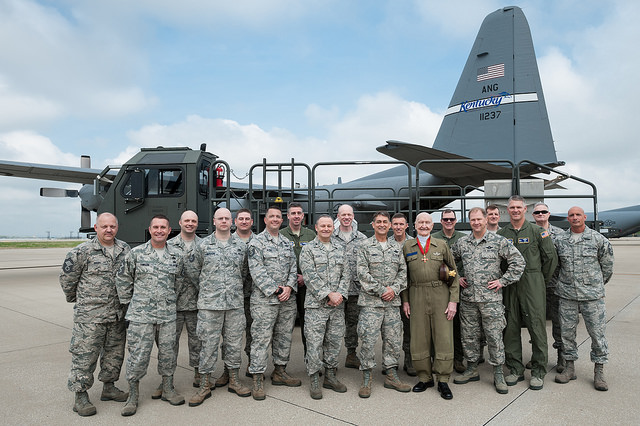
Col. Gail Halvorsen, a former U.S. Army Air Corps pilot who originated the idea of airdropping candy to German children during the 1948-49 Berlin Airlift, visits the Kentucky Air National Guard Base in Louisville, Ky., April 17, 2015. Halvorsen, who is known as the Berlin Candy Bomber, will be the guest of honor during the 2015 Thunder Over Louisville air show April 18. The Airmen are standing in front of a Halverson Loader, named for the colonel, that can rapidly load up to 25,000 pounds of cargo onto airlift aircraft. (U.S. Air National Guard photo by Maj. Dale Greer)
KENTUCKY AIR NATIONAL GUARD BASE, LOUISVILLE, Ky. — Members of the Kentucky Air National Guard will pay tribute to the famous “candy drops” of the Berlin Airlift during Saturday’s Thunder Over Louisville air show.
A Kentucky Air Guard flight crew will deploy two simulated bundles of candy over the Ohio River from the back of a Kentucky C-130 Hercules aircraft at 4:39 p.m., according to Lt. Col. John Ward, a pilot in the 123rd Airlift Wing who will be flying the aircraft.
The idea for candy drops originated in 1948 with C-54 pilot Gail Halvorsen, who was then a first lieutenant in the U.S. Army Air Corps. Halvorsen, who eventually rose to the rank of colonel, will be the guest of honor at this year’s air show.
“It’s a real privilege to participate in this kind of tribute because it honors the tremendous accomplishments of Colonel Halvorsen and the proud military heritage of the airlift community,” Ward said.
“In a way, the Berlin Airlift was similar to the missions our own wing flew in Bosnia in the 1990s, when we were able to drop hundreds of tons of food and humanitarian aid to Bosnian civilians after they were cut off from the rest of the world by an intense ethnic war.”
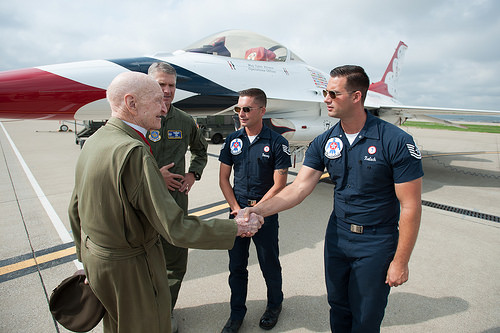
Col. Gail Halvorsen, a former U.S. Army Air Corps pilot who originated the idea of airdropping candy to German children during the 1948-49 Berlin Airlift, visits with crew members from the U.S. Air Force Thunderbirds at the Kentucky Air National Guard Base in Louisville, Ky., April 17, 2015. Halvorsen, who is known as the Berlin Candy Bomber, will be the guest of honor during the 2015 Thunder Over Louisville air show April 18. (U.S. Air National Guard photo by Maj. Dale Greer)
In 1948, Halvorsen found himself flying airlift missions into West Berlin as part of Operation Vittles, the U.S.-backed effort to keep the territory supplied with food, milk and coal after the Soviet Union blocked road and rail access in what was to become the first major battle of the Cold War.
One day in July, Halvorsen was walking inside the perimeter fence at West Berlin’s Tempelhof Air Base — headquarters for Operation Vittles — when he came across about 30 children gathered on the other side.
“We had been bombing Germany just a few years before, and you’d thing they would be antagonistic, but they weren’t,” Halvorsen recalled Friday during a visit to the Kentucky Air National Guard Base. “I was there at the fence talking to them for about an hour, and when I turned to leave, I realized that not one had asked for candy. It was the first time that had ever happened to me when I was in a foreign country. And these kids hadn’t had any chocolate for a couple of years.
“They didn’t ask because they were grateful — grateful for flour and grateful to be free. They wouldn’t beg for something so extravagant as chocolate. When I realized that kids from 9 to 15 years of age had that kind of value system, that they valued freedom so much, it kind of blew my mind.
“So I reached in my pocket, and I had two sticks of Wrigley’s Doublemint gum, and I thought, ‘You can’t give that to 30 kids. You’re going to have a fight.’
“I turned to leave again, and I got about two steps when a voice came through to me clear as a bell: ‘Go back to the fence.’ It was almost a command. So I went back to the fence and pulled my hand out of pocket, and I broke the sticks in half so I would have four pieces.
“They didn’t push or shove, and the kids that didn’t get to have a piece of gum asked for a strip of the wrapper. They took those pieces of wrapper and put them to their noses so they could smell it, and their eyes got big just from the smell.
“That did it. I thought, ‘I gotta do something more.’
“I’d always flown by the book, and I got promoted because I flew by the book. But I told them, ‘Stand in this grassy area tomorrow, and when I fly overhead, I’ll drop enough chocolate for all of you to have some.’”
When the children asked Halvorsen how they would know which plane was his, he told them to look for the aircraft that’s wiggling it wings, earning him the nickname Uncle Wiggly Wings.
That same day, Halvorsen asked his crewmates to give him their chocolate rations. He then fashioned makeshift parachutes from three handkerchiefs, to which he attached the precious candy.
When Halvorsen’s crew returned to the airfield the next day while flying a re-supply mission, he looked down and saw all 30 kids standing exactly where they were told to be. The crew chief collected the tiny bundles and dropped them out of the plane from a flare chute behind the pilot’s seat.
“We didn’t know if the candy had made it over the fence, but when we flew over them again on takeoff, all 30 kids were lined up by the fence with their mouths going up and down, chewing like crazy and waving at the airplane.”
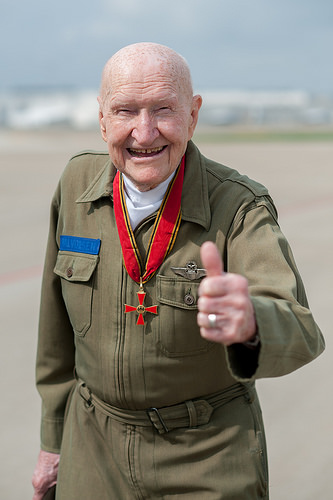
Col. Gail Halvorsen, a former U.S. Army Air Corps pilot who originated the idea of airdropping candy to German children during the 1948-49 Berlin Airlift, visits the Kentucky Air National Guard Base in Louisville, Ky., April 17, 2015. Halvorsen, who is known as the Berlin Candy Bomber, will be the guest of honor during the 2015 Thunder Over Louisville air show April 18. (U.S. Air National Guard photo by Maj. Dale Greer)
Encouraged by the success, Halvorsen’s crew repeated the candy drop three more times — “and then I got caught.”
His superior officers were not happy by the unauthorized airdrops, and the phrase “court martial” was used more than once. But a general officer caught wind of Halvorsen’s stunt and, impressed by the kindness of the act, told him to keep it up. Others American aircrews soon joined in. By the end of the operation — and with the help of boatloads of candy from American manufacturers — more than 21 tons of sweets had been airdropped to the children of West Berlin.
Experts in foreign relations say the campaign “had a major impact on the transition of hate that West Berliners had for (Allied forces),” Halvorsen noted. “It really helped change the attitudes of the West Berliners and improve relations after the war.”
In fact, the impact extended far beyond the borders of Germany, affecting a global audience that had begun to view the actions of the Soviet Union with increasing unease.
“The Soviets were putting the screws to the West Berliners, while we were feeding their children chocolate,” Halvorsen said. “The contrast was remarkable, and several historians have said it helped end the blockade.”
The mission also made a lasting personal impression on Halvorsen, who is 96 and will forever be remembered as the Berlin Candy Bomber.
“It made me realize the importance of little decisions in my life,” he said. “Those little decisions that you make on the road of life put your footsteps on the path where you end up, good or bad.”
The voice that Halvorsen heard, clear as a bell in 1948, led to a very small decision that helped change the course of history.
In addition to the “Candy Bomber” tribute, this year’s air show will feature performances by the U.S. Air Force Thunderbirds and the U.S. Marine Corps Harrier Harrier AV-8B Demonstration Team.
Other acts include the U.S. Army Golden Knights parachute demonstration team, a Canadian Air Force CT-142 trainer, P-51 Mustang and F-86 Sabre warbirds, a United Parcel Service 767, and multiple aerobatic performances.
As in past years, the Kentucky Air National Guard is providing logistical support that enables military aircraft to participate in the show, which routinely draws crowds of more than 500,000 and is broadcast live by local TV and radio stations, said Capt. Josh Ketterer, air show coordinator for the Kentucky Air Guard.
“We log hundreds of hours of work every year to plan and support Thunder so the public has an opportunity to see for themselves the incredible abilities of the finest military aviators in the world,” Ketterer said. “It’s a privilege and an honor for us to support that mission, and I’m looking forward to great show.”
Story by Staff Sgt. Scott Raymond, Kentucky National Guard Public Affairs
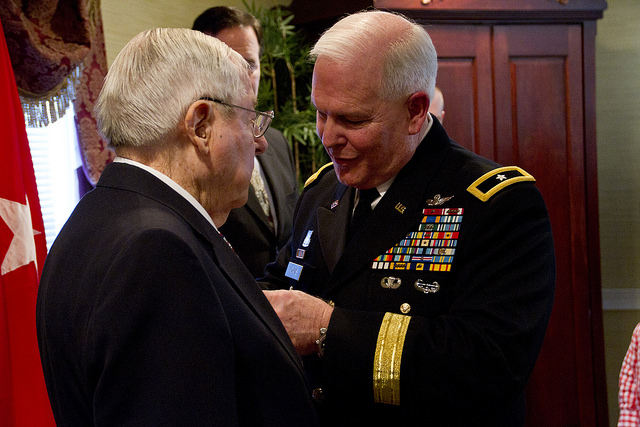
Brig. Gen. Benjamin F. Adams III pins the Bronze Star Medal to the coat of Hubert D. Jasper, a WWII Veteran in Nicholasville, Ky., March 30, 2015. Jasper never received the awards following his return from Europe after the war in 1945. (U.S. Army National Guard photo by Staff Sgt. Scott Raymond)
NICHOLASVILLE, Ky. — The Kentucky National Guard assisted a local family recently to ensure a World War II Veteran received the recognition he deserved.
Hubert D. Jasper lives in Paris, Kentucky. In 1943, he was inducted into the Army and for the next two years fought his way across Europe in some of the largest campaigns of the war. Thanks to the diligent work of his daughter, the help of a Congressman and the Kentucky Guard, Jasper was awarded his long-overdue decorations in a ceremony in Nicholasville, March 30, 2015.
Brig. Gen. Benjamin F. Adams III, Chief of the Joint Staff for the Kentucky Guard served as the officiating officer for the ceremony at which Jasper received several awards including the Bronze Star and the Knight of The Legion of Honor medal from France.
“It is extremely important for us as a nation to pay homage to those who came before us and to show the respect they deserve for their contributions,” said Adams.
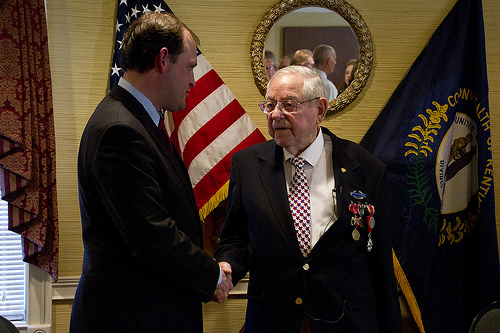
Congressman Andy Barr congratulates Hubert D. Jasper, following an awards ceremony honoring Jasper in Nicholasville, Ky., March 30, 2015. Congressman Barr was on hand to present the French Knight of The Legion of Honor medal to Jasper. (U.S. Army National Guard photo by Staff Sgt. Scott Raymond)
Visit our flickr page for more photos.
Jasper served with a mortar platoon as part of the First Army, Ninth Division, landing at Utah Beach 1o days after D-Day. He would fight in three of the four campaigns to liberate France and was among the first American Soldiers to assist with driving the German Army from Belgium. In 1944, Jasper and the Ninth Division were involved the Battle of Hurtgen Forest, only to advance into the Battle of the Bulge during that winter, a streak of some of the most fierce fighting in Europe..
In May, 1945, the war in Europe ended, but not before Jasper had helped carry a 135-pound mortar and equipment more than 600 miles, fighting their way to Germany.
After the war, Jasper returned to the U.S. and his job as a store manager for J.J. Newberry’s department store. He would manage stores from Tennessee, throughout Kentucky, Indiana, Missouri and Pennsylvania. He also returned to his wife of four years, Opal and his son. He quickly immersed himself back into civilian life and according to family members, didn’t speak much about his experience in the war.
Many years later, upon reading an article of another WWII Veteran receiving his due awards, Jasper inquired of his own. His daughter, Mary Carolyn Jasper did a majority of the leg work in researching her father’s service.
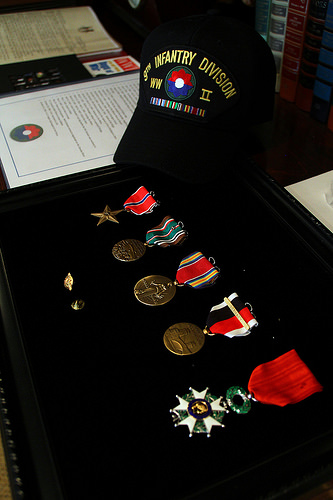
The awards of Hubert D. Jasper, a WWII Veteran, await the official presentation to Jasper at an awards ceremony in Nicholasville, Ky., March 30, 2015. (U.S. Army National Guard photo by Staff Sgt. Scott Raymond)
“I have been honored to be able to work with my dad to secure these medals and the recognition he deserves, my brothers and I always knew he was such a special person,” said Mary Carolyn. “After I have talked with him about where he fought, what he did and the conditions he endured in the war, I am even more impressed with the man that is my father.”
Congressman Andy Barr, the grandson of a World War II Veteran, was on hand to present the French Knight of The Legion of Honor medal which is the highest honor bestowed by France to those who assisted in liberating the country during World War II.
One final award, a local tradition, certified Jasper as an official Kentucky Colonel.
Adams called Jasper and his fellow Soldiers, the rock upon which current Service members have built the standards of going beyond the call of duty.
“It was a privilege for me to honor a member of the greatest generation,” said Adams. “The Kentucky National Guard is proud to be involved in this long-overdue recognition and to celebrate the service of Pfc. Jasper.”
Shutsy Reynolds flew aircraft over the United States to support the war effort
Women Airforce Service Pilots helped pave the way for female pilots today
By Staff Sgt. Vicky Spesard, 123rd Airlift Wing Public Affairs
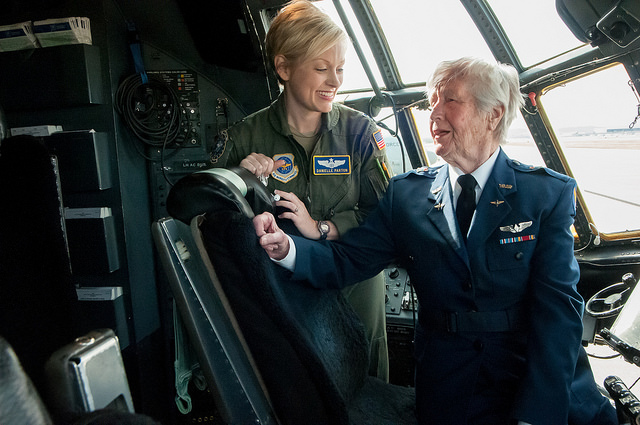
Capt. Danielle Parton, a pilot in the 123rd Airlift Wing, shares flying stories with Florence Shutsy Reynolds on the flight deck of a C-130 aircraft at the Kentucky Air National Guard Base in Louisville, Ky., March 22, 2014. Reynolds, a former pilot in the Women Airforce Service Pilots corps during World War II, was visiting the base as part of National Women’s History Month. (U.S. Air National Guard photo by Staff Sgt. Vicky Spesard)
Wrapping up March, Women’s History month, here is a final story in our series celebrating women and the roles they play in our military history.
KENTUCKY AIR NATIONAL GUARD BASE, LOUISVILLE, Ky.—Sitting in the pilot’s seat of a C-130 cockpit here, Florence Shutsy Reynolds, 91, looked right at home as she beamed a smile at the airstrip in front of her.
Reynolds, a former member of the Women Airforce Service Pilots corps during World War II, was visiting the 123rd Airlift Wing March 22 in celebration of Women’s History Month.
“It truly is my honor and pleasure to have you here at our base to represent women pilots,” said Col. Barry Gorter, commander of the 123rd Airlift Wing, after presenting Reynolds with a certificate declaring her Honorary Wing Commander for the day. “You are one of many of the brave women who performed a dangerous mission and did a job that many people felt, at the time, women shouldn’t be doing. You have helped pave the way for women in our services today.”
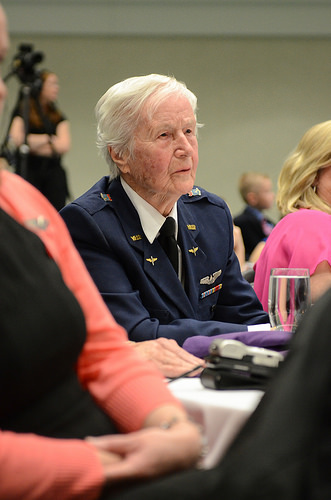
Florence Shutsy Reynolds, 91, a former member of the Women Airforce Service Pilots corps during World War II, attends the Kentucky National Guard’s Airman and Soldier of the year Banquet in Louisville, Ky., March 22, 2014. The WASP program’s primary focus was to reassign responsibility for flight operations over the United States from male to female pilots, freeing men to go to war. (U.S. Air National Guard photo by Staff Sgt. Vicky Spesard)
Indeed, not much is written or spoken about the WASP program. Its primary focus was to reassign the responsibility for flight operations over the United States from male to female pilots, freeing the men to go to war. Because some military leaders believed that women pilots would damage the reputation of the male-dominated military, however, the program was quickly disbanded and brushed aside when the war ended, Reynolds said.
“It was a time when women were not even encouraged to go to work, let alone fly airplanes,” she explained. “We trained hard, flew dangerous assignments and we lost pilots in our group. All of which the military tried to cover up and put away when the war ended.”
Trying to get the word out about the WASP program and the contributions that she and her fellow WASP veterans made is one of the reasons Reynolds accepted the invitation to celebrate National Women’s History Month with the Kentucky Air Guard.
“I was very excited to be invited to the base to share my story of the WASP program,” said the aviator, dressed in a replica WASP uniform that she wears when touring to promote her fellow flyers. (Her original uniform is in a museum.) “It is always wonderful to meet other pilots and, most of all, other women who have the opportunity to fly.”
During her honorary day as wing commander, Reynolds toured the base, got an extensive look inside a C-130, ate lunch with wing members and gave a lecture about the WASP program.
After posing for pictures with many Air Guard members and swapping pilot stories, the Pennsylvania native traveled to the Kentucky State Fairgrounds to serve as the keynote speaker for the annual Kentucky Airman and Soldier of the Year Banquet.
“She truly is an inspiration to all of us,” said Staff Sgt. Shelby Basham, a member of the Kentucky Air Guard’s Fatality Search and Recovery Team. “Her determination in traveling the country, telling her story of the WASP program and doing what she did at a time where many didn’t believe in her is truly amazing.”
Equally amazed was Reynolds herself.
“To see the women here who are trained and who fly as equals is very gratifying,” Reynolds said, wiping tears from her eyes. “My message to them is to keep dreaming. Don’t let anyone tell you that you can’t do something, and always fly as high as you can.”
Staff Report with contributions from Jim Warren, Lexington Herald Leader
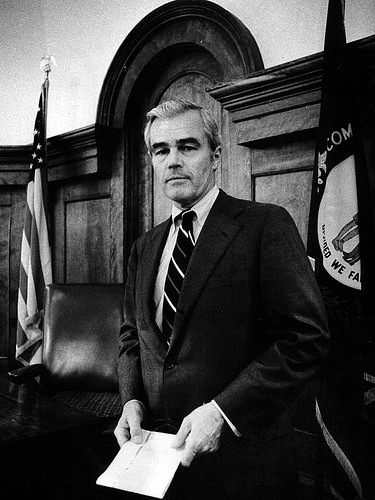
Henry Miegs II, former Franklin Circuit Court Judge and founding father of the Kentucky AIr National Guard. (Courtesy photo)
FRANKFORT, Ky. — Former Franklin Circuit Court Judge Henry Meigs II was a hero and a visionary who helped found the Kentucky Air National Guard.
Meigs died Dec. 5 in Louisville, Kentucky at the age of 93.
Born in New York, Meigs earned a law degree from the University of Kentucky after his service in World War II. He served as an Army Air Corps fighter pilot in the Pacific, flying the P-38 Lightning, shooting down six Japanese planes. He received the Silver Star and Distinguished Flying Cross among numerous other air medals.
Enlisting into the Army in 1942, Meigs trained as a fighter pilot at Shaw Field in South Carolina. He then transferred to the 6th Night Fighter Squadron, flying missions in the South Pacific around Guadalcanal. Meigs would win at least three of his victories against Japanese bombers here, including the reported feat of shooting down two enemy planes within 60 seconds.
In 1944, Meigs married Sara Lesley Willis, daughter of Kentucky Governor Simeon Willis. The wedding was the first and so far only time the governor’s daughter was wed in the Governor’s Mansion.
While in law school, Meigs accepted a position as the first air officer in the Kentucky Guard in 1945, assuming the rank of lieutenant colonel. At the same time, the National Guard Bureau was generating interest among the states for the creation of Air National Guard units. In 1946, Gov. Willis sent his son-in-law to Washington D.C. to meet with officials about bringing an Air Guard unit to Kentucky.
Through correspondence with Brig. Gen. Gustavus H. May, Kentucky’s adjutant general, that meeting led to the 123rd Fighter Group coming to Standiford Field in Louisville. Through his hard work and determination, Meigs led the charge to bring the new air assets to the Commonwealth. A few months later, in 1947, the 123rd was federally recognized and then-Lt. Col. Philip Ardery took charge as the wing’s first commander.
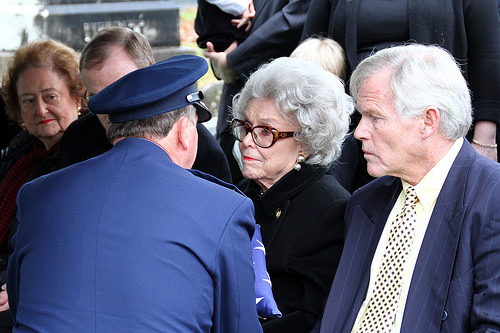
Kentucky Adjutant General, Maj. Gen. Edward W. Tonini presents the burial flag to Sara Willis Meigs at the funeral of her husband Henry Meigs at the Frankfort Cemetery in Frankfort, Ky., Dec. 5, 2014. A World War fighter pilot, Meigs would help found the Kentucky Air National Guard. (U.S. Army National Guard photo by Staff Sgt. Scott Raymond)
“The Kentucky Air National Guard has a storied history of excellence, and it all started with Judge Meigs and Philip Ardery in 1947,” said Maj. Gen. Edward W. Tonini, Adjutant General for Kentucky. “Judge Meigs led quite a distinguished life, from a World War II Ace to a prominent fixture in the courtrooms of the Commonwealth.”
“We are grateful for his vision and resolve that helped shape the Kentucky Air National Guard into a major player in the defense of this country and the security of our state.”
Click here to read more about the history of the Kentucky Air National Guard.
Meigs practiced law in Frankfort from 1949 until 1960, when then-Gov. Bert Combs selected him to serve as the first circuit judge of the newly created 48th District.
Because the court was based in Frankfort, Judge Meigs immediately was called on to handle cases testing the constitutionality of many pieces of state legislation and issues ranging from Christian schools to the Ten Commandments and the separation of powers in state government.
A second judgeship for the 48th District was created in 1974, and Squire Williams Jr. joined Judge Meigs on the bench. When the two retired in 1983, it marked the closing of “an important chapter in the history of the Kentucky judiciary,” the Herald-Leader reported.
After leaving the bench, Meigs moved to Louisville, where he practiced law until retiring in 2000.
In addition to his wife, Judge Meigs is survived by two sons, four grandchildren and three great-grandchildren.
By Master Sgt. Charles Delano, 165th Airlift Wing Public Affairs
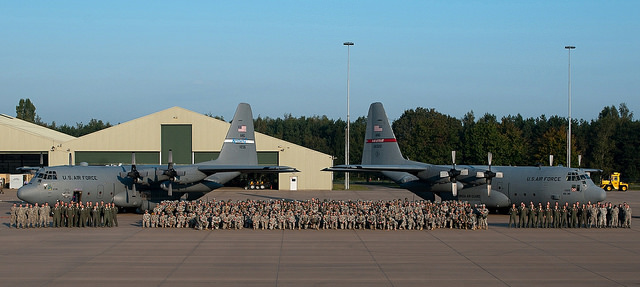
Aircrews from the Kentucky and Georgia Air National Guard pose with their C-130 aircraft and paratroopers assigned to the U.S. Army’s 82nd Airborne Division, 173rd Airborne Brigade Combat Team and the 5th Quartermaster Company, as well as paratroopers from the Netherlands, Britain and Poland, at Eindhoven Air Base, Netherlands, Sept. 18, 2014. The Air Guardsmen flew the paratroopers as they completed a historic jump onto Tango Drop Zone in Groesbeek, Netherlands, to commemorate the World War II assault conducted by Allied forces 70 years ago during Operation Market Garden. (U.S. Army photo by Staff Sgt. Mary S. Katzenberger)
Click here to see the unedited photos.
GARDERMOEN, Norway — Airmen from the Georgia Air National Guard’s 165th Airlift Wing and the Kentucky Air National Guard’s 123rd Airlift Wing transported 82nd Airborne Division paratroopers to an airfield outside of Oslo, Norway, Sept. 23 as part of Operation Noble Ledger.
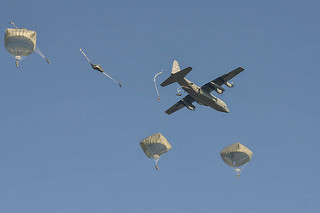
U.S., British, Dutch and Polish troops parachute from a Kentucky Air National Guard C-130 near Groesbeek, Netherlands, Sept. 18, 2014, as part of the 70th-anniversary re-enactment of Operation Market Garden. The historic World War II mission was, at the time, the largest airborne assault ever conducted. (U.S. Air National Guard photo by Master Sgt. Charles Delano)
A total of three C-130H Hercules aircraft airdropped 110 paratroopers and performed an engine-running offload of an additional 20 Soldiers to a drop zone in Rena, Norway.
Noble Ledger tested the cohesiveness of about 6,500 U.S., German, Norwegian, Danish and Dutch soldiers in the field. The multinational cadre is part of a larger 13,000 member NATO Response Force that conducts humanitarian and armed conflict missions throughout NATO countries.
The 82nd Airborne’s mission for the exercise consisted of seizing an enemy-occupied zone and holding it for 24 hours until reinforcements arrived, according to Air Force Lt. Col. Dave Flynn, a pilot with the Kentucky Air Guard.
“The airlift portion of Noble Ledger is important because it provides the Army with realistic logistics for delivering Soldiers to combat zones,” Flynn said. “It reflects the synergy the Air National Guard provides to the Total Force.”
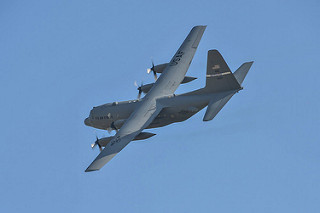
A Kentucky Air National Guard C-130 banks over Groesbeek, Netherlands, Sept. 18, 2014, after deploying U.S., British, Dutch and Polish paratroopers as part of the 70th-anniversary re-enactment of Operation Market Garden. The historic World War II mission was, at the time, the largest airborne assault ever conducted. (U.S. Air National Guard photo by Master Sgt. Charles Delano)
For the Airmen of the 165th and 123rd Airlift Wings, the exercise provided another opportunity to airdrop paratroopers into an unfamiliar drop zone. The aircrews conducted previous airdrops in September as part of a re-enactment of the World War II paratrooper assault known as Operation Market Garden.
“I am thrilled to have participated in the two airdrops in the Netherlands which honored the World War II paratroopers and also for providing air support for this important NATO exercise,” said Air Force Capt. Alan Ratliff, a Georgia Air Guard pilot.
By Master Sgt. Charles Delano, 165th Airlift Wing Public Affairs, Georgia Air National Guard
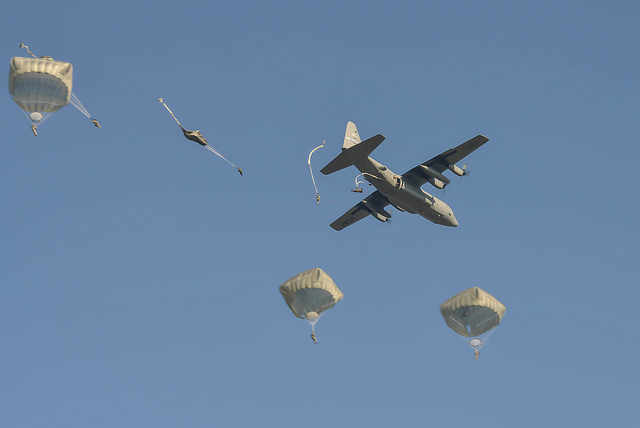
U.S., British, Dutch and Polish troops parachute from a Kentucky Air National Guard C-130 near Groesbeek, Netherlands, Sept. 18, 2014, as part of the 70th-anniversary re-enactment of Operation Market Garden. The historic World War II mission was, at the time, the largest airborne assault ever conducted. (U.S. Air National Guard photo by Master Sgt. Charles Delano)
EINDHOVEN, Holland – Four C-130H Hercules aircraft assigned to the 165th Airlift Wing, Georgia Air National Guard, and the 123rd Airlift Wing, Kentucky Air National Guard, air-dropped a mix of 360 U.S., British, Dutch and Polish paratroopers over fields near Groesbeek, Netherlands, Sept. 18 to commemorate the 70th Anniversary of Operation Market Garden, a record-setting Allied mission that deployed more than 30,000 airborne troops and additional ground forces in a massive attempt to crush Germany during World War II.
“It is our privilege to provide the airborne portion of this commemoration,” said Lt. Col. Chris Davis, mission commander for the 165th Airlift Wing, which is the lead C-130 unit. “It is our wish that every World War II veteran, past and present, be honored by this reenactment, and to thank the ‘Greatest Generation’ for their acts of valor.”
Among the jumpers were four Georgia Air National Guard joint terminal attack controllers from the 165th Air Support Operations Squadron and six Georgia Army National Guard soldiers from the 108th Cavalry Regiment, who jumped as part of a reenactment of the September 1944 airborne assault by 82nd Airborne Division paratroopers on Drop Zone Tango.
“It was a great experience to jump with the British, Dutch and Polish paratroopers on a drop zone that had not been jumped since the DZ was active in 1944,” said Maj. Roger Brooks, a joint terminal attack controller from the 165th. “After the jump, I was honored by the reception of the town mayor and local citizens. They were thankful for the liberation of the Netherlands by allied forces.”
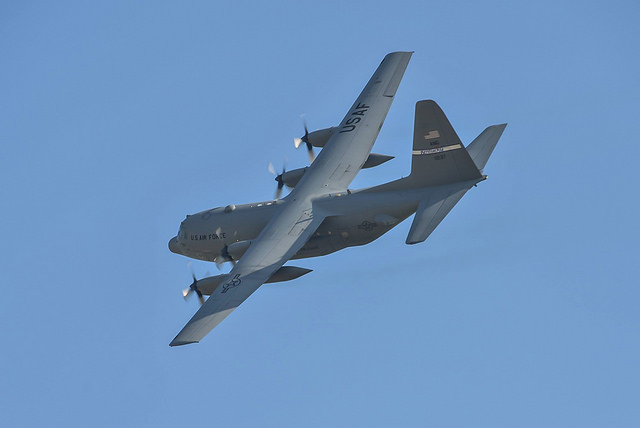
A Kentucky Air National Guard C-130 banks over Groesbeek, Netherlands, Sept. 18, 2014, after deploying U.S., British, Dutch and Polish paratroopers as part of the 70th-anniversary re-enactment of Operation Market Garden. The historic World War II mission was, at the time, the largest airborne assault ever conducted. (U.S. Air National Guard photo by Master Sgt. Charles Delano)
A larger re-enactment involving more than 1,000 troops is scheduled for Sept. 20.
The following is a compilation of significant dates in our commonwealth’s military history. For more on the legacy of our Citizen-Soldiers and Airmen, visit the Kentucky National Guard eMuseum.
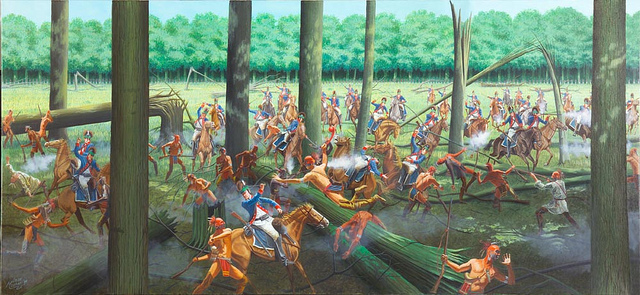
Battle of Fallen Timbers - August 20, 1794
August 1, 1864 – Daniel Weisiger Lindsey is appointed Adjutant General of Kentucky by Gov. Thomas E. Bramlette.
August 2, 1990 – Operation Desert Shield began.
August 3, 1795 – Treaty of Peace between the United States and the Allied Indian Tribes of the Northwest, signed at Greenville, in Ohio (Treaty of Greenville).
August 4, 1790 – U.S. Coast Guard established
August 5, 1864 - U.S. Navy Landsman Daniel Noble, a native of Bath County, Ky., a crewmen of the U.S.S. Metacomet aided in the rescue of the U.S. Monitor Tecumseh when that vessel was struck by a torpedo in passing enemy forts in Mobile Bay, Ala. Noble braved the enemy fire which was said by the admiral to be “one of the most galling” he had ever seen and aided in rescuing from death ten of the crew of the Tecumseh, thereby eliciting the admiration of both friend and foe. Noble receives the Medal of Honor for his actions. (Civil War)
August 5, 1891 - Cpl. Franklin McDonald from Bowling Green, Ky., a Soldier with Company G, 11th U.S. Infantry defended a mail coach from an attack by Kiowa Indians near Fort Griffin, Texas. He receives the Medal of Honor for his gallantry in action. (Indian Wars)
August 4, 1950 – Defense of Pusan/Naktong Perimeter began (Korean War)
August 5, 1968 – Death of Capt. Robert W. “Buz” Sawyer killed in an aircraft crash near Kansas City, Missouri in a RF-101 “Voodoo.” He was a member of the 165th Tactical Recon Sq on federal duty at Richards-Gabeur AFB, Missouri during the Pueblo call up.
August 7, 2002 – Death of Tech. Sgt. Christopher A. Matero and TSgt. Martin A. Tracy, Combat Controllers for the 123rd Special Tactics Flight of the Kentucky Air National Guard both perished when a U.S. Air Force MC-130H crashed during a training flight in Puerto Rico.
August 7, 1792 – Purple Heart Medal established
August 7, 1871 – U.S. and State Guard troops were called at Frankfort, Paris and Lexington, following rioting and shootings at polling locations.
August 7, 1942 – Battle of Guadalcanal (World War II)
August 9, 2001 – Dean Allen Youngman is appointed Adjutant General of Kentucky by Gov. Paul E. Patton.
August 12, 1782 – Battle of the Upper Blue Licks between Captain John Holder and a party of Kentuckians and a band of marauding Wyandotte Indians (Early Indian Wars)
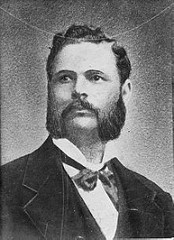
Thomas Shaw
August 12, 1881 - Thomas Shaw, a native of Covington, Ky., while serving with K Company, 9th U.S. Cavalry forced the enemy back after stubbornly holding his ground in an extremely exposed position and prevented the Native Americans superior numbers from surrounding his command. Shaw receives the Medal of Honor for his actions. (Indian Wars)
August 12, 1952 – Battle of Bunker Hill (Hill 122) began (Korean War)
August 14, 1945 – Japan Surrendered, ending World War II.
August 15, 1782 – Siege of Bryan’s Station by Capt. William Caldwell and a combined force of Indians and Canadians. Siege lasted until 17 August 1782 (Early Indian Wars)
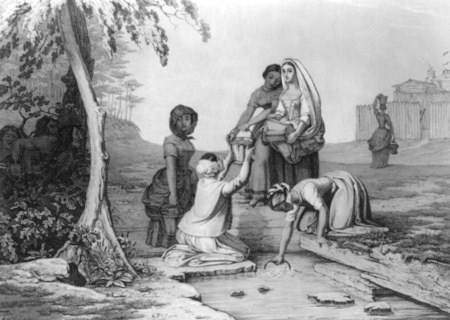
Black and white Nagel & Weingaertner lithograph of the women of Bryant’s Station, Ky supplying the garrison with water and defeating the stratagem of the Indians led on by Simon Girty the renegade 1782. You can see indians spying behind a tree.
August 15, 1851 – Col. William L. Crittenden, of Louisville, Capt. Victor Kerr, and 48 others, nearly all Kentuckians under his command-deceived by Gen. Lopez into the belief that the “patriots” of Cuba were engaged in a revolution for freedom-engage in an armed expedition which invades the island; two days after landing, they are attacked by 700 Spanish troops, and after a gallant fight captured, and, next day, shot; of 80 others of his command, captured with him 77 were afterward shot. The U.S. Government promptly dispatch the steam frigate Saranac, to inquire into the circumstances.
August 15, 1944 – Allied Invasion of Southern France (World War II)
August 18, 1951 – Battle of Bloody Ridge began (Korean War)
August 19, 1782 – Battle of Blue Licks, Kentucky. On a hill next to the Licking River in what is now Robertson County, a force of about 50 British rangers and 300 American Indians ambushed and routed 182 Kentucky militiamen killing some 64. It was the worst defeat for the Kentuckians during the war (Considered the last battle of the American Revolution)
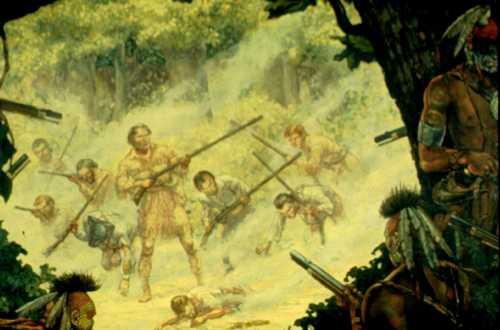
Battle of Blue Licks - August 19, 1782
August 19, 1881 - Sgt. Brent Woods from Pulaski County, Ky., a member of Company B, 9th U.S. Cavalry saved the lives of members of his detachment during fighting against Native Americans in New Mexico. He receives the Medal of Honor for his actions. (Indian Wars)
August 20, 1794– Battle of Fallen Timbers. Gen. “Mad” Anthony Wayne defeats nearly 2000 Indians and 70 Canadians. Gen. Charles Scott, with 1600 Kentucky volunteers were part of this command (Early Indian Wars)
August 22, 1869 – Three companies of volunteer soldiers or state militia, 95 men in all, leave Louisville for Lebanon, to take care of the “Regulators,” whose depredations in that region are again making life unbearable.
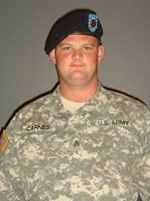
Staff Sgt. Nicholas Carnes
August 26, 2007 – Staff Sgt. Nicholas Carnes of Ludlow (Kenton County) was killed by small arms fire during a firefight in the village of Lewanne Bazaar, Paktika Province, Afghanistan. Carnes, 25, was assigned to Battery A, 2nd Battalion, 138th Field Artillery, based in Carrollton, Ky. Carnes deployed with his unit in March of 2007 in support of Operation Enduring Freedom. Carnes was awarded the Bronze Star Medal, the Purple Heart, the Afghanistan Campaign Medal and the Kentucky Distinguished Service Medal for his service in Afghanistan. A member of the Kentucky Army National Guard since 1999, Carnes is the fourteenth Kentucky Guard Soldier to lose his life as the result of combat action in the global war on terror. He was the second Soldier to be killed in Afghanistan (Global War on Terrorism)
August 29, 1952 – Korean War’s Largest Air Raid (Korean War)
August 31, 1847 – Requisition upon Kentucky for two more regiments of infantry for service in the Mexican War. Before September 20th they are reported and organized, 3rd Kentucky Regiment under command of Col. Manlius V. Thomson of Georgetown and 4th Kentucky Regiment under command of Col. John S. Williams of Winchester (Mexican-American War)
This July we proudly celebrate Independence Day and our Nation’s 238th birthday. And we continue to honor Kentucky’s military history each month with important dates and events that have helped shape our Commonwealth and our country.
The following is a compilation of significant dates in our commonwealth’s military history. For more on the legacy of our Citizen-Soldiers and Airmen, visit the Kentucky National Guard eMuseum.
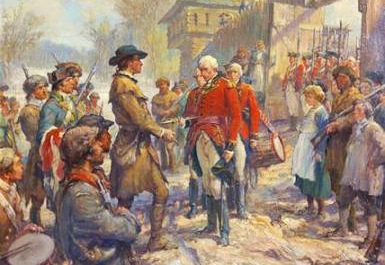
George Rogers Clark and the capture of Kaskaskia, July 4, 1778.
July 1-3, 1863 - Battle of Gettysburg, Pa. The turning point in the American Civil War.
July 1, 1898 - 1st Lt. Benjamin Hardaway from Benleyville, Ky., with the 17th U.S. Infantry assists in rescuing wounded Soldiers under heavy enemy fire at El Cany, Cuba during the Spanish-American War. He is awarded the Medal Honor for his actions. - Pvt. James Nash from Louisville, Ky., with the 10th U.S. Infantry is also awarded the Medal of Honor for his actions at Santiago, Cuba.
July 1, 1942 – Tech. Sgt. Berchell Keeling, Company D, 192nd Light Tank Battalion (Harrodsburg Tankers) died at Camp Cabanatuan, Nueva Ecija, Philippines of dysentery (World War II)
July 1, 1945 – Borneo campaign ended unopposed (World War II)
July 1, 1970 – Siege of Fire Base Ripcord began (Vietnam War)
July 1, 1955 – Units of Kentucky Air National Guard were redesignated as fighter-interceptor outfits.
July 2, 1926 – U.S. Army Air Corps established.
July 2, 1950– Korean War’s only U.S. Sea Battle (Korean War)
July 2, 1951 – 1st. Lt. Eugene Louis Ruiz was the first combat casualty from the Kentucky Air National Guard’s 123rd when he was shot down in Korea, as a member of the 45th Tactical Reconnaissance Squadron of the 543rd Tactical Support Group (Korean War)
July 2, 1967 – Operation Buffalo began (Vietnam War)
July 2, 1969 – Sgt. James Allen Wray, formerly Battery C, 2nd Battalion, 138th Field Artillery, was killed while serving with Battery B, 1st Battalion, 40th Field Artillery, 108th Artillery Group (Vietnam War)
July 3, 1863 - Pvt. Oliver Rood, a native of Franklin County, Ky., while serving with the 20th Indiana Volunteer Infantry, captures the flag of the 21st North Carolina Infantry during the Battle of Gettysburg, Pa. He is awarded the Medal of Honor for his actions.
July 3, 1942 – Pvt. Edward George Willis, Headquarters Company, 192nd Light Tank Battalion (Harrodsburg Tankers) died at Camp Cabanatuan, Nueva Ecija, Philippines of dysentery (World War II)
July 3, 2005 – Sgt. Ryan Jay Montgomery, of Greensburg, Kentucky was killed in Iraq when his up-armored HUMVEE encountered an improvised explosive device (IED) while returning from a convoy escort mission near Baghdad. At the time of his death, Montgomery was assigned to B Battery 1st Battalion, 623rd Field Artillery (Global War on Terrorism)
July 4, 1776 - The Continental Congress approves the final wording of the Declaration of Independence. The original draft was submitted on July 2nd, but Congress finally agreed on changes and edits two days later. Day becomes a national holiday in 1870.
July 4, 1777 – Second attack on Boonesborough by Indians (Early Indian Wars)
July 4, 1778 – Kaskaskia surprised and captured by George Rogers Clark and his men (Revolutionary War).
July 4, 1863 – Battle of Tebb’s Bend, Taylor County, Kentucky (Civil War)
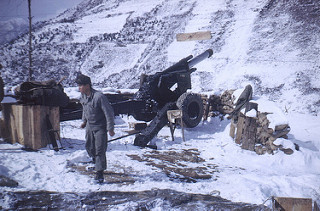
1st Battalion, 623rd Field Artillery in the “Smoke Valley”, South Korea, 1952.
July 5, 1952 – Kentucky’s 1st Battalion, 623rd Field Artillery, armed with eighteen 155mm towed howitzers, moves into “Smoke Valley,” South Korea in support of X Corps in holding operations against Communist Chinese assaults. During this period it will earn a Republic of Korea Unit Citation for its fire support of South Korea troops in repelling an enemy assault. In October the battalion, the last Guard artillery unit deployed to Korea, will see hard fighting and earns a Navy Unit Commendation embroidered PANMUNJOM for firing missions in support of the 1st Marine Division (Korean War)
July 5, 1950 – Battle of Osan (Korean War)
July 8, 1942 – Sgt. Jennings Bryan Scanlon, Headquarters Company, 192ndLight Tank Battalion (Harrodsburg Tankers) died at Camp Cabanatuan, Nueva Ecija, Philippines of dysentery. (World War II)
July 8, 1998 – Maj. Robert Stephen Hacker, a member of Headquarters and Headquarters Company, 201st Engineer Battalion of the Kentucky Army National Guard, died of injuries received in a vehicle accident while on active duty in the Esmeraldas Province of the South American nation of Ecuador.
July 9, 1918 – Army Warrant Officer Corps birthday.
July 9, 1966 – Battle of Minh Thanh Road (Vietnam War)
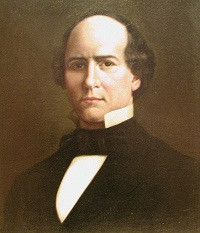
Theodore O’Hara
July 10, 1867 – Death of Theodore O’Hara in Alabama.
July 10, 1943 – Operation Husky (World War II)
July 12, 1870 - Cpl. John Given, a native of Davies County, Ky., with Company K, 6th U.S. Cavalry, dies in action against a numerically superior hostile force of Native Americans at Wichita River, Texas. His gallantry in action on this day earns him the Medal of Honor.
July 12, 1942 – 1st Sgt. Yandell Terhune, of Company D, 192nd Light Tank Battalion (Harrodsburg Tankers) died at Camp Cabanatuan, Nueva Ecija, Philippines of dysentery (World War II)
July 13, 1892 – Pvt. Almyr Sherrell Edwards of Company G, 3rd Regiment Kentucky State Guard died while on state active duty. His unit activated on July 11, 1892 at the request of the mayor of Paducah in response to a riot by an armed group of citizens intent on freeing a suspect from the local jail, On that day an African American, Thomas Burgess, was arrested on charges of being a “sneak thief” (burglar). The African American community believed that this individual was going to be unfairly convicted, and a group tried to release him from the jail, dispersing once daylight hours came, peaceably. The next evening they returned near midnight, armed, and then commenced firing on the jail and the guardsman who were defending it. During a short firefight Edwards was mortally wounded. Newspaper accounts of the time reflect a tense state of race relations during these events in Paducah. A monument in honor of Edwards was dedicated on July 13, 1893. The monument was believed to have been moved to its current location after the 1939 floods and it is now located in Caldwell Park at 14th & Park Ave in Paducah.
July 13, 1950 – Battle of Kum River began (Korean War)
July 13, 1953 – Battle of Kumsong River Salient began (Korean War)
July 13, 1995 – Sgt. 1st Class Charles Sidney “Chuck” Fitch Sr. died of a massive heart attack following a PT test. Fitch enlisted in the Kentucky Army National Guard in September of 1988. Fitch became an Active Guard Reserve (AGR) in September 1991 serving as a Recruiting and Retention NCO until his death.
July 15, 1916 – Pvt. Kenneth Witty of Hopkinsville, Christian County, died while on federal active duty of typhoid pneumonia at Fort Thomas, Kentucky. He was part of the Kentucky National Guard contingent called to federal duty to patrol a sixty mile stretch of the border between Fort Bliss and Fort Hancock during the Mexican Punitive Expedition. He enlisted in Company D, 1st Battalion, 3rd Regiment on June 21, 1916.
July 15, 1951 – 1st Lt. George Conder perished during a massive flight demonstration when two F-51s collided in mid-air.
July 15, 1970 – Pfc. Lanny Kay Brown, of Monticello (Wayne County) died during Annual Training at Fort Knox. He was a member of C Battery, 1st Battalion, 623rd Field Artillery. Brown was standing inside a squad tent in the unit bivouac area at approximately 8:30 p.m. during a violent thunderstorm when he was electrocuted by a lightning strike. Brown joined the Kentucky Army National Guard on June 12, 1968.
July 16 – Atomic Veterans Day – First Nuclear Bomb Test; Code name “Trinity”
July 16, 1968 – Operation Kingfischer began (Vietnam War)
July 16, 1836 – Gov. Morehead, at the request of President Jackson, issues his proclamation calling for 1,000 mounted Kentuckians, to rendezvous in Frankfort by August 17, to proceed to Camp Sabine, and protect the southwestern frontier. Before August 3, 45 companies tender their services, but only 10 are accepted, one each from Franklin, Henry, Shelby, Madison, Harrison, Oldham, Gallatin, Woodford, Jefferson, and Fayette counties. The governor appoints Leslie Combs, of Fayette, colonel, Thomas A. Russell, of Fayette, lieutenant colonel, and George Boswell, of Shelby, major. Before they commence their march, orders are received for their discharge.
July 17, 1789 – Chenoweth Station Massacre, Shawnee Indians attacked the settlement of Capt. Richard Chenoweth killing 3 of his children and another man. Chenoweth and 3 other children were wounded, his wife was shot with an arrow tomahawked and scalped, but did not perish.
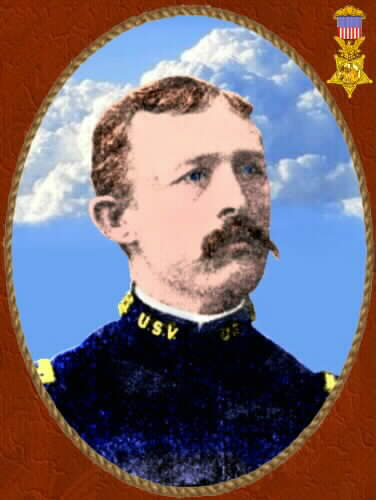
Thomas Cruse, Owensboro native and Medal of Honor recipient.
July 17, 1882 - 2nd Lt. Thomas Cruse, a native of Owensboro, Ky., with the 6th U.S. Cavalry in action at Big Dry Fork, Arizona Territory, gallantly charged hostile Native Americans, and with his carbine compelled a party of them to keep under cover of their breastworks, thus being enabled to recover a severely wounded soldier. He is awarded the Medal of Honor for his actions. Cruse was a 1879 graduate of West Point and retired from the Army as a brigadier general.
July 17, 1952 – Battle for Old Baldy began (Korean War)
July 19, 1950 – Battle of Taejon began (Korean War)
July 20, 1847 – Remains of Col. William R. McKee, Lt. Col. Henry Clay, Jr., Capt. William T. Willis, Capt. William H. Maxey, Adjutant E.M. Vaughn, Lt. James Powell and 11 privates who fell in battle during the Mexico War are interred in the state cemetery at Frankfort. 20,000 people were present, including several hundred of the returned Soldiers from the Mexican War.
July 22, 1864 – Battle of Intrenchment Creek, part of Atlanta Campaign. Kentucky Orphan Brigade suffers heavy casualties (Civil War)
July 22, 1946 – Organization of the units of the Kentucky Air National Guard authorized by the War Department. Organizational authority was extended in October and December during the process of organizing and manning the Kentucky Air National Guard.
July 22, 1942 – Staff Sgt. Wallace Denny, Company D, 192nd Tank Battalion (Harrodsburg Tankers) died at Camp Cabanatuan, Nueva Ecija, Philippines of dysentery (World War II)
July 22, 1977 – Staff Sgt. Joseph M. McHenry, of Owensboro (Daviess County) and Pfc. Danny Edwin Rowan, of Hartford (Ohio County) died in a ¼ -ton jeep accident during a convoy from Fort Hood, Texas to Home Station for the CSC, 2nd Battalion, 123rd Armor in Owensboro. McHenry and Pfc. Danny Rowan were traveling eastbound on Interstate 30 near Mt Vernon, in Franklin County, Texas at approximately 1:10 p.m. local time when the left rear tire blew out causing the vehicle to go out of control.
July 22, 1991 – Tech. Sgt. David A. Atkinson, of Louisville (Jefferson County) died about 8 p.m. during an airborne training exercise at Hurlburt Field near Fort Walton Beach Florida. Atkinson was performing a “high-opening” jump from about 12,500 feet. Atkinson was a member of the 123rd Tactical Airlift Wing Combat Control Team of the Kentucky Air National Guard.
Clockwise, from top: UN forces reach the 38th parallel; F-86 Sabre fighter aircraft in Korean combat; Incheon harbor, starting point of the Battle of Inchon; Chinese soldiers welcomed home; Marines over the top of the Incheon seawall.
July 24, 1953 – Final U.S. Ground Combat of Korean War began (Korean War)
July 27, 1953– Korean War ended.
July 27 - National Korean War Veterans Armistice Day.
July 27, 2009 – Pfc. Timothy J. Rogers, of Corbin, Whitley County, died as the result of a traffic accident while on the way home from annual training. He was a member of Company B, 1st Battalion, 149th Infantry.
July 28, 1942 – Pvt. Fred C. Leonard, Jr., Headquarters Company, 192nd Light Tank Battalion (Harrodsburg Tankers) died at Camp Cabanatuan, Nueva Ecija, Philippines of cerebral malaria (World War II)
July 31, 1813 – Kentucky Governor Isaac Shelby issues call for volunteers to revenge hundreds of Kentuckians massacred at the River Raisin (present-day Monroe, MI). Shelby would go on to lead the Kentucky troops himself at the Battle of the Thames while still serving as governor (War of 1812)
###
The following is a compilation of significant dates in our nation’s and the commonwealth’s military history. For more on the legacy of our Citizen-Soldiers and Airmen, visit the Kentucky National Guard eMuseum.
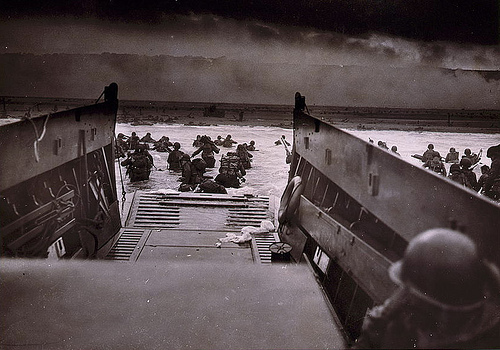
Normandy invasion, D-Day, June 6, 1944.
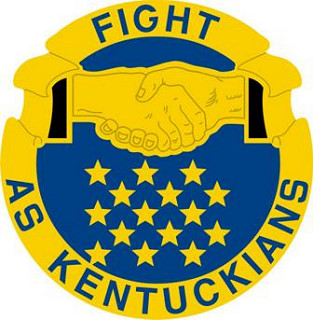
The crest for Army National Guard units of the Commonwealth of Kentucky includes fifteen stars, a reference to Kentucky being the fifteenth state admitted to the Union.
June 1, 1792 – Kentucky’s Birthday – Kentucky became the 15thstate of the United States of America.
June 1, 1942 – Technical Sgt. Johnnie Bottoms, Headquarters Company, 192nd Light Tank Battalion (Harrodsburg Tankers) died at Calauan Camp #3 – Old Bilibid Prison, Rizal Manila Philippines. (World War II)
June 1, 1969 – Sgt. Bertram A. “Sonny” Carr, Louisville, Ky., of B Battery 2nd Battalion, 138th Field Artillery was killed near Hamburger Hill. He was originally a member of Service Battery. (Vietnam War)
June 2, 1942 – Pvt. Willard Emmal Foster, Headquarters Company, 192nd Light Tank Battalion (Harrodsburg Tankers) died of dysentery at Camp O’Donnell, Capas, Tarlac, Philippines. (World War II)
June 3, 1942 – Battle of Midway began. (World War II)
June 6, 1944– D-Day Invasion of Europe. (World War II)
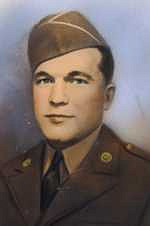
Sgt. Hezakiah Franklin Sallee
June 6, 1944 – Sgt. Hezakiah Franklin “Heze” Sallee of Company D, 192nd Light Tank Battalion (Harrodsburg Tankers) died in coal mining accident at Japanese Prisoner of War Camp Fukuoku-17, Nagasaki, Japan. (World War II)
June 6, 1952 – Operation Counter began. (Korean War)
June 8, 1864 – John H. Morgan raided Mt. Sterling, took Lexington, thence to Georgetown and Cynthiana, thence through Flemingsburg and West Liberty into the State of Virginia. (Civil War)
June 9, 1969 – Kentucky Air National Guard returned home from its duties during the Pueblo Crisis (Korea) and was released from active duty in ceremonies in Louisville. During the recall period of 17 months the wing flew 19,715 tactical flying hours from a total of 11,561 sorties. The 165th Squadron alone processed 257,200 prints and 284,251 feet of film and flew 4,438 recon sorties totaling 7,192 hours.
June 10, 1951 – Battle for the Punchbowl began. (Korean War)
June 10, 1953 – Siege of Outpost Harry began. (Korean War)
June 11, 1960 – The Kentucky Air National Guard facility at Standiford Field was dedicated to the honor of a former member of the unit, Capt. John William Shewmaker, killed in Korea Oct. 23, 1951, while flying with the 111th Fighter- Bomber Squadron. Members of the family were guests of the Kentucky Air National Guard for the occasion.
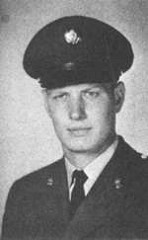
Staff Sgt. Harold Brown
June 11, 1969 – Staff Sgt. Harold Milton Brown, Mt. Washington, Ky., formerly Battery C, 2nd Battalion, 138th Field Artillery was killed by rocket fire while in a bunker in Chu Lai while serving with Battery C, 1st Battalion, 82nd Artillery, Americal Division. (Vietnam War)
June 13, 1942 – Pvt. Herbert C. Steele of Company D, 192nd Light Tank Battalion (Harrodsburg Tankers) died of dysentery at Camp O’Donnell, Capas, Tarlac, Philippines. (World War II)
June 14 – Flag Day
June 14, 1775 – U.S. Army founded.
June 14, 1920 – Col. Isaac Wilder is appointed Adjutant General of Kentucky, by Governor Edwin P. Morrow. Wilder resigned the position two days later.
June 15, 1950 – Governor Clements issues an executive order appointing Brig. Gen. Roscoe L. Murray to the rank of major general conforming to general assembly’s change to KRS 36.030 raising the rank of the adjutant general from brigadier general to major general. This is the first time in the history of the Commonwealth that the adjutant general was granted the rank of major general.
June 16, 1920 – James Madison DeWeese is appointed adjutant general of Kentucky for the second time by Governor Edwin P. Morrow.
June 18, 1812– U.S. Congress declared war against England. (War of 1812)
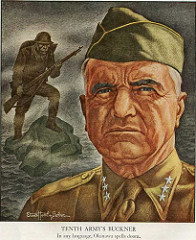
Lt. General Simon Buckner
June 18, 1945 – During action on Okinawa. Lt. Gen. Simon B. Buckner Jr. became the highest ranking American general officer killed in action during WWII. The Kentucky native was the son of Confederate General and Kentucky Governor Simon B. Buckner. In 1954 Congress posthumously promoted him to the rank of general. (World War II)
June 19, 1969 – C Battery, 2nd Battalion, 138thField Artillery attacked on Tomahawk Hill by North Vietnamese Army sappers. Other 2ndBattalion batteries at nearby firebases were shelled by the NVA so that they could provide little or no fire support for C Battery. Pfc. Joseph R. McIlvoy, Mackville, Ky., Specialist Four Ronald E. Simpson, Bardstown, Ky., Specialist Four David B. Collins, Bardstown, Ky., Sgt. James T. Moore, Bardstown, Ky., 1st Sgt. Luther M. Chappel, Worthville, Ky., were killed in the attack. When Firebase TOMAHAWK was attacked during the early morning hours in a pouring rain, sappers infiltrated the base and during the attack threw some 150 satchel charges into the bunkers in addition to firing rocket propelled grenades (RPG). The battle went on some two hours before the NVA were forced to retreat. The attack destroyed an ammunition storage area, four of the six M-109 self-propelled howitzers, nine bunkers, the mess hall, dining tent, maintenance building, four ammunition carriers, three 2 1/2-ton trucks, two 3/4-ton trucks, and three jeeps. The Battery had nine men killed; five of them were from Kentucky and the other four were non-Guard replacements from various, non-Kentucky, locations. The unit also suffered 37 wounded. A platoon of infantrymen from the 101stAirborne Division was providing perimeter security for the firebase and four of the 101st soldiers were killed and another 13 wounded. Senior Commander in Vietnam, General Creighton Abrams, said the 2ndBattalion 138th Field Artillery, was “one of the best trained, and absolutely the best maintained battalion-sized unit in Vietnam.” (Vietnam War)
June 20, 1792 – Governor Isaac Shelby signs act establishing the Kentucky Militia.
June 21, 1871 – Reunion at Paris, Ky., of 69 soldiers of the War of 1812; their combined ages equal 5,487.
June 21, 1871 – Capt. Thomas S. Theobald, of Frankfort, aged 79, receives a pension certificate as a veteran of the War of 1812, the first issued to a Kentuckian, and entitling him to $8 per month. He was First Lieutenant in Morrill’s company of Kentucky Mounted Rifles.
June 22, 1780 – Capture by Capt. Henry Bird and British-Canadian-Indian army, of Ruddle’s and Martin’s Stations, on upper waters of Licking River. (Early Indian Wars)
June 22, 1942 – Pledge of Allegiance recognized by Congress.
June, 1944 – GI Bill signed into law.
June 24 – Kentucky National Guard Day in the Commonwealth of Kentucky. On this day in 1792 Governor Shelby established how the Kentucky Militia was to be organized.
June 24, 1792 – Kentucky Militia is organized by Governor Shelby.
June 25, 1850 – Construction of Kentucky’s Battle Monument completed in the state cemetery at Frankfort.
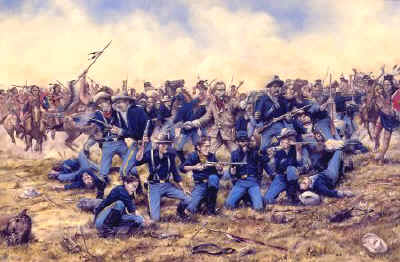
The Battle of Little Bighorn, June 25, 1876
June 25, 1876 - During the Battle of Little Bighorn, Madison County, Ky.-native, Pvt. William Harris and Pvt. George Scott of Lancaster County, Ky. bring water to Soldiers while under enemy fire. Their actions earn them both the Medal of Honor. Both are among the 263 Soldiers of the 7th Cavalry killed in the battle.
June 25, 1950 – Korean War began.
June 28, 1914 – World War I began in Europe after Archduke Francis of Austria and wife were assassinated.
June 29, 1846 – Appointment by President Polk of William O. Butler, of Carroll County, Kentucky to be major general of volunteers. Butler was the son of Kentucky’s first adjutant general, P.P. Butler. Butler State Park in Carrollton is named in honor of William O. Butler. (Mexican War)
June 29, 1950 – First U.S. ground forces arrive in Korea. (Korean War)
The following is a compilation of significant dates in our nation’s and the commonwealth’s military history. For more on the legacy of our Citizen-Soldiers and Airmen, visit the Kentucky National Guard eMuseum.
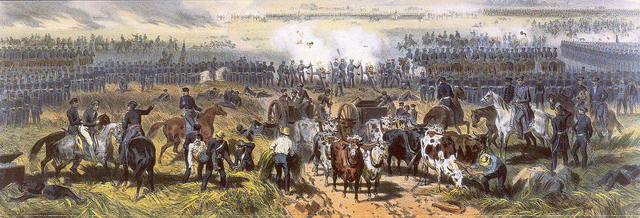
The Battle of Palo Alto, May 8, 1846
May 1, 1970– Cambodia Campaign began (Vietnam War)
May 2-3, 1863 – Battle of Chancellorsville, Virginia (Civil War)
May 2, 1936 – First records of Kentucky National Guardsmen assisting in the security of Churchill Downs for the Kentucky Derby.
May 2, 1945 – German unconditional surrender to Italian Allies (World War II)
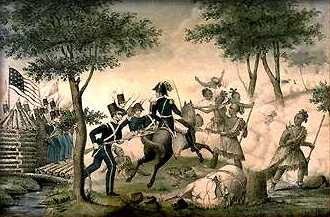
Siege of Fort Meigs, Ohio, May 5, 1813
May 5, 1813 – Brig. General Green Clay, with 3,000 Kentuckians, reaches besieged Fort Meigs, Ohio. On orders from General William Henry Harrison divides his force, his part of the force cuts their way through the enemy’s lines into the fort. 800 Kentuckians, under Col. Wm. Dudley, are order to cross the Maumee River and attack the guns and spike them so they can no longer fire. Once this was accomplished, the militia pursues what appears to be retreating Indians under the leadership of Tecumseh. After they entered the woods, the Indians counterattacked while the British forces swung around their flanks cutting most off from the river. Only about 150 escaped with the remainder being killed or captured. Of those captured, about 50 were murdered by the Indians before Tecumseh put a stop to it. The British, without use of their artillery, soon lifted the siege and moved back into Canada (War of 1812)
May 5, 1942 – Fall of Corregidor (World War II)
May 5, 1968 – Mini-Tet began (Vietnam War)
May 8, 1846 – General Zachary Taylor defeats the Mexicans at Palo Alto (Mexican-American War)
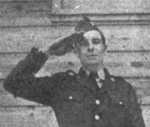
Pvt. Roy Goodpaster
May 8, 1945 – Pvt. Roy Edward Goodpaster, Company D, 192nd Light Tank Battalion (Harrodsburg Tankers) died at Camp Moji Hospital Fukuoka #4 Kyushu Island Japan of wounds received aboard the “Hell Ships” Oryoku Maru & Enoura Maru (World War II)
May 8, 1945 – VE (Victory Europe) Day, Germany’s Unconditional Surrender Signed (World War II)
May 8, 1972 – U.S. Navy mined North Vietnamese ports (Vietnam War)
May 9, 1781 – McAfee Station, along Salt River attacked by over 150 indians. Only 13 men and their families inside who kept up a gallant defense for near 1/2 day until help arrived from nearby Harrodsburg. One settler killed at onset of action, 1 minor wounded. As pursuit was made the Indians made a stand at the ford of the river 1 more killed and 1 injured when thrown from horse. (Early Indian Wars)
May 9, 1846 – General Zachary Taylor defeats the Mexicans at Resaca de la Palma (Mexican-American War)
May 9, 1868 – Kentucky Legislature to present a Gold Medal to Samuel Hatfield, of Floyd County, another survivor of the Kentuckians who assisted in achieving Perry’s victory on Lake Erie, September 10, 1813.
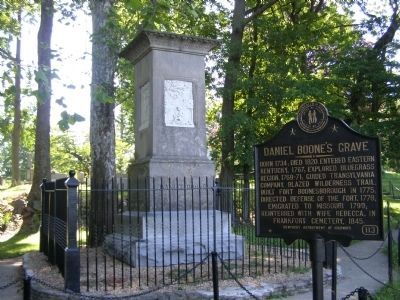
Daniel Boone gravesite, Frankfort Cemetery
May 9, 1868 – Kentucky Legislature appropriates funding to repair monument over Daniel Boone’s grave, which had been defaced by Federal soldiers during the war.
May 10, 1773 – The McAfee Company (James Jr., Robert, & George McAfee along with James McCoun Jr. and Samuel Adams) left Virginia on a 4-month expedition into Kentucky . Explored lands along Ohio & Kentucky Rivers. descended the Kentucky to where Frankfort now is located, continued exploration of Henry, Franklin, Anderson, & Mercer Counties. Eventually making land claims along Salt River.
May 10, 1863 – Confederate General “Stonewall” Jackson dies from wounds after being fired upon by his own men a week earlier. (Civil War)
May 10, 1969 – Battle for Hill 937, nicknamed Hamburger Hill (Vietnam War)
May 10, 1972 – Operation Linebacker (Vietnam War)
May 11, 1871 – Re-interment at Crab Orchard, Lincoln, County, of the unknown Southern soldiers who fell at the Battle of Wildcat Mountain, in 1862.
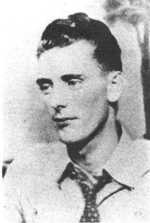
Pfc. Wesley Hungate
May 12, 1942 – Pfc. Wesley Davis Hungate, Company D, 192nd Light Tank Battalion (Harrodsburg Tankers) died at Camp O’Donnell, Capas, Tarlac, Philippines of dysentery while a Japanese prisoner of war (World War II)
May 13, 1846 – Congress of the United States declares war on Mexico. Maj. Gen. E.P. Gaines makes a requisition on the Governor of Kentucky for 4 regiments of volunteers, comprising 2,400 men (Mexican War)
May 13, 1968 – 2nd Battalion, 138th Field Artillery entered active duty and served 11½ months in Vietnam. Kentucky was only one of two states to have both Air and Army Guard units called up in 1968 (the other being Kansas). Kentucky was the only state to have both Air and Army mobilized units deploy overseas (Vietnam War and Pueblo Call-up)
May 16, 1861 – Kentucky proclaimed its neutrality. (Civil War)
May 17 – Armed Forces Day.
May 17, 1846 – Governor Owsley issues a proclamation, appealing to Kentuckians “to form themselves into volunteer companies,” and to report to him forthwith (Mexican War)
May 18, 1846 – The Louisville Legion, offer their services to the governor, and are accepted (Mexican War)
May 19, 1942 – Sergeant Ben R. Devine, Company D, 192nd Tank Battalion (Harrodsburg Tankers) died at Camp O’Donnell, Capas, Tarlac, Philippines of dysentery while a Japanese prisoner of war (World War II)
May 20, 1777 – St. Asaph’s or Logan’s Fort or Logan’s Station resists attack by Indians (Early Indian Wars)
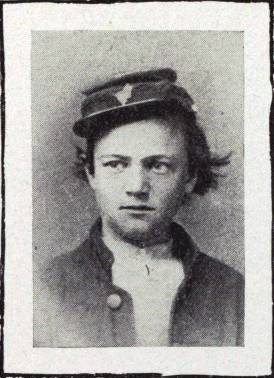
William Horsfall
May 21, 1862 – William H. Horsfall from Campbell County, Ky., a 15-year-old drummer with Company G, 1st Kentucky Infantry, saves the life of a wounded officer lying between the lines of fire at Corinth, Miss. Horsfall received the Medal of Honor for his actions. (Civil War)
May 22, 1846 – Formal proclamation of Governor Owsley for two regiments of infantry or riflemen, and one of cavalry, for the service of the United States against Mexico (Mexican-American War)
May 24, 1946 – The 359th Fighter Group was redesignated as HQ, 123rd Fighter Group, and allotted to the Air National Guard of Kentucky, together with its colors and World War II battle participation credits. The 368th Fighter Squadron was also allotted to the KyANG with its colors and record, and redesignated as the 165th Fighter Squadron.
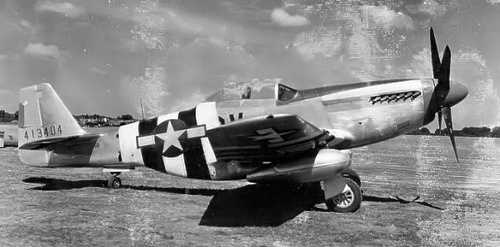
P-51 Mustang of the 359th Fighter Group
May 25, 1921 – Private Manley Vaughan, Troop C, 53rd Machine Gun Squadron, Louisa, Kentucky, was killed near Borderland W. Va. Kentucky National Guard soldiers from Louisa, Morehead and London were on state active duty from May 14, to June 4, 1921 along the Kentucky – West Virginia border in connection with a coal strike in the Tug River District.
May 26, 1846 – Governor Owsley announces, that the requisition upon Kentucky for troops is full (Mexican War)
May 26, 1871 – Confederate Memorial Day inaugurated, commemorating the occasion when Jefferson Davis was freed from prison.
May 27, 1778 – George Rogers Clark and men camp on Corn Island, at Falls of the Ohio (Louisville).
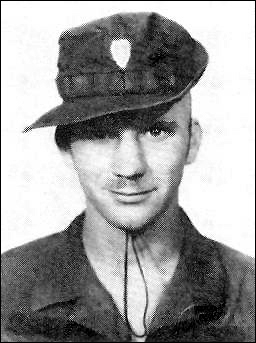
Sgt. Chales Clinton Fleek
May 27, 1969 – Sgt. Charles Clinton Fleek from Petersburg, Ky. smothered the blast of an enemy hand grenade with his body, sacrificing his life to protect those around him fighting in Bihn Duong Province, Vietnam. Fleek was awarded the Medal of Honor for his gallantry and willing self-sacrifice. (Vietnam War)
May 30 – Memorial Day
May 30, 1806 - In Logan County, Ky., future president Andrew Jackson participates in a duel, killing Charles Dickinson, a lawyer regarded as one of the best pistol shots in the area. The proud and volatile Jackson, a former senator and representative of Tennessee, called for the duel after his wife Rachel was slandered as a bigamist by Dickinson, who was referring to a legal error in the divorce from her first husband in 1791. Jackson met his foe at Harrison’s Mills on Red River in Logan, Kentucky, on May 30, 1806. In accordance with dueling custom, the two stood 24 feet apart, with pistols pointed downward. After the signal, Dickinson fired first, grazing Jackson’s breastbone and breaking some of his ribs. However, Jackson, a former Tennessee militia leader, maintained his stance and fired back, fatally wounding his opponent. It was one of several duels Jackson was said to have participated in during his lifetime, the majority of which were allegedly called in defense of his wife’s honor. None of the other rumored duels were recorded, and whether he killed anyone else in this manner is not known. In 1829, Rachel died, and Jackson was elected the seventh president of the United States.
May 30, 1868 – By proclamation of General John A. Logan of the Grand Army of the Republic, the first major Memorial Day observance is held to honor those who died “in defense of their country during the late rebellion.” Known to some as “Decoration Day,” mourners honored the Civil War dead by decorating their graves with flowers. On the first Decoration Day, General James Garfield made a speech at Arlington National Cemetery, after which 5,000 participants helped to decorate the graves of the more than 20,000 Union and Confederate soldiers buried in the cemetery. The 1868 celebration was inspired by local observances that had taken place in various locations in the three years since the end of the Civil War. In fact, several cities claim to be the birthplace of Memorial Day, including Columbus, Mississippi; Macon, Georgia; Richmond, Virginia; Boalsburg, Pennsylvania; and Carbondale, Illinois. In 1966, the federal government, under the direction of President Lyndon B. Johnson, declared Waterloo, New York, the official birthplace of Memorial Day. They chose Waterloo–which had first celebrated the day on May 5, 1866–because the town had made Memorial Day an annual, community-wide event, during which businesses closed and residents decorated the graves of soldiers with flowers and flags. By the late 19th century, many communities across the country had begun to celebrate Memorial Day, and after World War I, observers began to honor the dead of all of America’s wars. In 1971, Congress declared Memorial Day a national holiday to be celebrated the last Monday in May. Today, Memorial Day is celebrated at Arlington National Cemetery with a ceremony in which a small American flag is placed on each grave. It is customary for the president or vice president to give a speech honoring the contributions of the dead and to lay a wreath at the Tomb of the Unknown Soldier. More than 5,000 people attend the ceremony annually. Several Southern states continue to set aside a special day for honoring the Confederate dead, which is usually called Confederate Memorial Day.
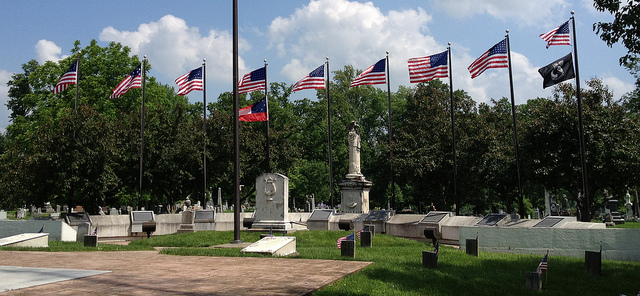
Memorial Day - the last Monday in May