Pages
Stay In Touch
More
© 2013 KentuckyGuard
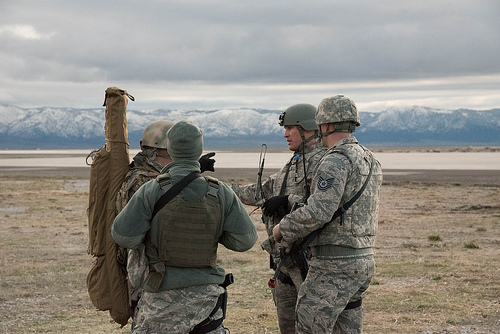
In an effort to deter aggression, fighter aircraft routinely fly while troops on the ground mobilize and train to defend the ROK. However, there still lies another piece to the puzzle.That puzzle piece is none other than the 607th Air Mobility Division.
Source: KR16 air mobility: The glue holding everything together
*Incredible Job Opportunities Available*
The largest trucking career fair in the United States is coming to Louisville and ESGR has partnered with it’s developers to make this year’s event extra special for our military service members!
WHO: Any military service member and anyone in their family who unemployed or UNDER-employed (driver, Human Resources, logistics, IT, etc.).
For the Official Press Release, please click the link: MATSVeteranHiringEducationJointPressRelease
WHAT: The Mid-American Trucking Show (MATS) is coming to Louisville Mar 31 to Apr. 2, 2016. MATS is the largest trucking convention in the United States. Hundreds of trucking companies will be represented at this year’s event. This year’s theme is focused on hiring our military service members into this vast trucking industry. There will be a veteran-only hiring fair on Thursday, Mar 31, from 10:00 am to 1:00 pm. During this time, the event will be closed to the general public.
WHEN: Mar. 31, 2016 from 10:00 am to 1 pm
WHERE: Louisville Fair Grounds Expo Center, 937 Phillips Ln, Louisville, KY 40209
WHY: Thousands of military veterans have found success in the trucking industry. The industry leaders realize this and are passionate about hiring veterans into the business in all areas and at all levels. If you are in need of a career or need to change your career, you will not want to miss this free event.
PLEASE NOTE: There is no cost for veterans or their families to attend this event; however, an $8 per vehicle parking fee is charged by the Louisville Fair Grounds to park in their parking lot. A Craig Morgan concert will also take place the evening of Apr. 1st as part of the event and will be free for veterans and their families.
Like KY ESGR’s Facebook page to get the latest on this event and all military employment news and update: www.facebook.com/KYESGR
Commentary by Col. Hal Lamberton, Commander of 238th Regimental Training Institute
To see the photos from this event, please click HERE.
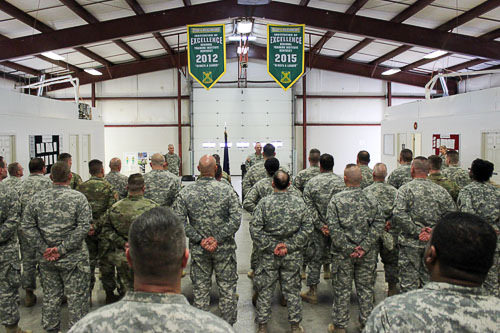
Brig. Gen. Stephen Hogan honors the 238th Regimental Training Institute for their recognition and accreditation by the TRADOC Commanding General as a Training Institute of Excellence at Wendell H. Ford Regional Training Center in Greenville, Ky., Mar. 6. (photo submitted)
In 2015, teams from TRADOC, OCS, WOCS, the Field Artillery and Infantry Centers of Excellence deployed to the 238th Regional Training Institute and completed the accreditation process necessary to receive the Institute of Excellence rating. The 238th accomplished this goal because of its leadership, operations and instruction programs. This is the second time in a row the 238th has received this rating.
This feat could not have been accomplished without the teamwork of the 238th. Credit goes directly to the Soldiers who bring their very best to work everyday.
What is this accreditation?
Accreditation is a part of TRADOC’s Quality Assurance Program that helps to ensure that the learning institution’s Doctrine, Organization, Training, Materiel, Leadership & Education, Personnel, and Facilities (DOTMLPF) domains enable the institution to develop Soldiers and leaders with the competency needs of today’s Army.
It focuses the commander’s attention on the state of the institution’s on-going programs and processes across its DOTMLPF domains as measured against TRADOC-approved Army accreditation standards.
Army Enterprise Accreditation Standards (AEAs) are aligned with TRADOC core functions for sustaining TRADOC’s core competencies in support of the Army Campaign Plan and TRADOC Strategic Plan.
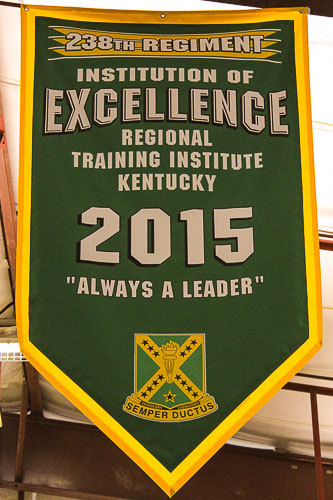
238th Regimental Training Institute’s Banner of Excellence for 2015.
Institutions are inspected on a 3-year accreditation cycle. The level of accreditation is based on a culmination of standard ratings assigned to an institution. There are four levels of accreditation - - with the ‘Institution of Excellence’ being the highest level to be achieved.
Why is this important?
All Army components have their training organizations evaluated by TRADOC. In the National Guard there are 80 of these organizations.
Our evaluation puts the 238th RTI in the top ten 10% of the NG training organizations.
Our current evaluation was much more extensive than in the past. All elements of the RTI and all programs were evaluated. These included the 238th HQ, 1-238th BN, 2-238th BN, the OCS and WOCS programs. In the past, just the 1-238th BN and the OCS programs were evaluated.
Strategically, what this accreditation does for us is put the 238th RTI at the head of the National Guard Bureau’s G3-TASS-TRI list of schools to conduct additional courses and receive additional resources. Because of the hard work of everyone at the 238th, the RTI is well positioned for the future.
By Staff Sgt. Scott Raymond, Kentucky National Guard Public Affairs
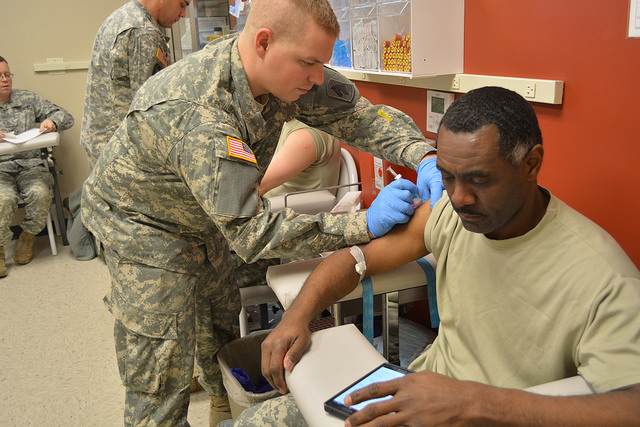
Soldiers assigned to the 138th Fires Brigade conduct annual Periodic Health Assessments Jan. 10, 2015 at Boone National Guard Center in Frankfort, Ky. The 138th conducted the PHA as a self-sustaining unit which did not have to rely on the support from civilian contractors to complete. This self-sustaining capability allowed for minimal delays and saw roughly 350 Soldiers processed over the course of the three-day drill weekend. (U.S. Army National Guard photo by Staff Sgt. David Bolton)
FRANKFORT, Ky. — With any military unit, medical readiness is one of the most important critical elements for any operation. Without healthy Soldiers, units are often incapable of completing their mission. For National Guard units, that can be even more vulnerable as units may be called upon in short notice for local emergencies and domestic operations.
For the Kentucky National Guard, consistency has been the key to medical readiness that recently ranked first out all 54 states and territories.
“We are considered fully medically ready,” said Col. Shane Randolph, state surgeon. “We may rank first, but what we care about is the number. We are above 90% as a whole and the National Guard Bureau’s goal for the state is 85%, so we are certainly doing a good job at keeping our Soldiers healthy.”
According to Maj. Stephanie Fields, Kentucky’s deputy state surgeon, this consistency has come from conducting Periodic Health Assessments (PHA) organically and properly managing that information afterwards.
The game plan from the command level has trickled down to successes within each brigade throughout the commonwealth. Sgt. 1st Class Dennis Deatley, medical operations NCO for 138th Field Artillery said advancements in technology and new ways of doing things have helped his brigade thrive with medical readiness.
“You have to proactive at the brigade level,” he said. “Health Services have provided me a solution for whatever I have needed for my Soldiers. The entire brigade really enjoys that our own medics and docs do our own PHAs,and we’re getting pretty proficient at it.”
Deatley said one of the biggest advantages is the use of the unit’s own medical professionals. Although the use of civilian contractors in the field is helpful, cross training medics of the 138th to assist in a variety of ways for each PHA is a benefit to the units and the Soldiers and allows for smoother PHAs.
He credits Kentucky’s case managers which each brigade has one assigned, have also worked to streamline the process from the initial scheduling of PHAs, through each event and facilitating necessary follow-ups.
Medical readiness is constantly in flux said Fields. She said Kentucky may be first one week and ninth the next, but its about taking care of Soldiers and keeping those numbers high.
“There are several things that have contributed to Kentucky’s readiness over the last several years, but the most important is understanding that ‘medical’ doesn’t stop when you check the block for the PHA,” said Fields. “We also keep in mind that this benefits other states as well. We work together sometimes asking each other what worked for them to boost numbers, then we try to incorporate their ideas into our plans and vice-versa.”
“We like to think of it as a competition, but for the health of our force, we will always work together.”
Commentary by Capt. Michael Moynahan, Commander of Delta Co., 1st Battalion, 149th Infantry
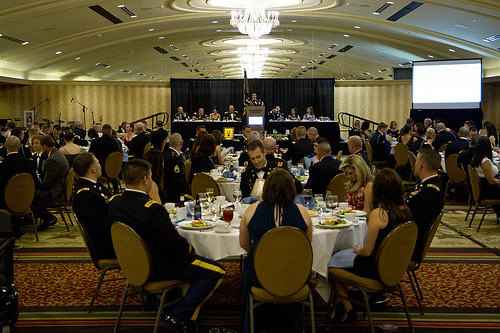
Kentucky Guardsmen gathered for the 1st Battalion, 149th Infantry Ball in Louisville, Ky., Feb. 6, 2016. (U.S. Army National Guard photo by Staff Sgt. Scott Raymond)
LOUISVILLE, Ky. — On Saturday, February 6, 2016 the 1st Battalion, 149th Infantry Battalion hosted their annual banquet at the National Guard Association of Kentucky’s Conference at the Crowne Plaza in Louisville.
For all photos of the event, please click HERE.
Billed as the “Infantry Ball”, the event turned out over 200 guests from units from all Major Support Commands across the Commonwealth. The organizers of the event were President of the Mess, Capt. Mike Moynahan and Capt. Ryan Hubbs. Both are Company Commanders in the Infantry Battalion. Capt. Hubbs served as Mr. Vice and as the master of ceremonies made sure that the “Rules of the Mess” were strictly enforced and that all events stayed on schedule.
The Infantry Battalion kept their guests engaged throughout the evening by encouraging participation in time honored military events such as the Toasts, Grog Bowl and Awards ceremony.
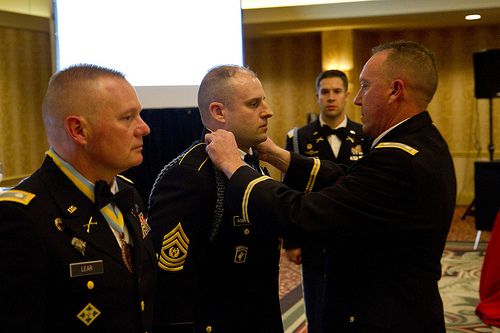
Lt. Col. Thomas Black presents the Order of Saint Maurice to Command Sgt. Maj. Matthew Roberge during the 1st Battalion, 149th Infantry Ball in Louisville, Ky., Feb. 6, 2016. (U.S. Army National Guard photo by Staff Sgt. Scott Raymond)
Lt. Col. Joseph Lear and Command Sgt. Major Matt Roberge were both honored by receiving the National Infantry Association’s most prestigious award known as the Order of Saint Maurice. Established in 1994 as a joint venture between the U.S. Army Infantry Branch and the National Infantry Association, these awards are given to those Soldiers who have contributed significantly to the Infantry and maintain the highest order of integrity and commitment to their brothers in arms.
Lt. Col. Jeffrey Cole was also the recipient of the Order of Saint Maurice. Lt. Col. Cole is the former Battalion Commander of the Infantry Battalion who passed away from his long battle with cancer in 2015. After a long standing ovation from the entire hall, Mrs. Christi Cole, wife of Lt. Col. Cole received the award in his honor.
The event was capped off with Kentucky’s newest Adjutant General, Brig. Gen. Stephen Hogan addressing the room full of Guard Soldiers and their guests discussing the importance of family and supporting the Guard’s Mission. The 202nd Band provided the music for dancing well into the night.
Staff Report
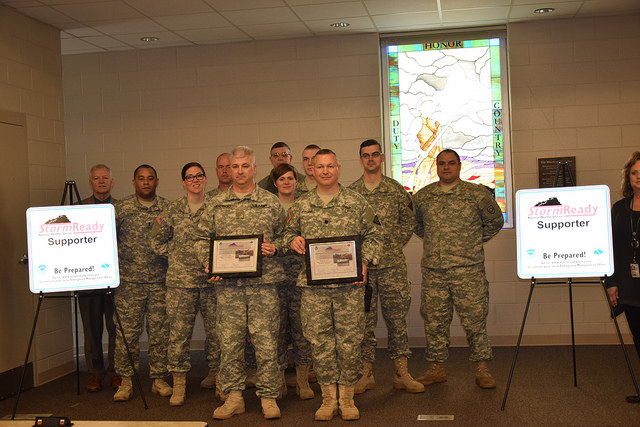
Lt. Col. Allen Boone and Maj. Jeffrey Hendricks, along with Soldiers from the Guard Training Center, received framed certificates and a ‘Storm Ready’ sign that will be posted at Wendell H. Ford Regional Training Center in Greenville, Ky. February 22, 2016. (Courtesy Photo)
Greenville, Ky. -The Wendell H. Ford Regional Training Center (WHFRTC) part of the Garrison Training Center-KY (GTC-KY) was recognized by the National Weather Service (NWS) & NOAA on Feb. 22, 2016 for becoming certified as a member of the “Storm Ready Community.”
The National Weather Service’s (NWS) “Weather-Ready Nation” initiative is about building community resilience in the face of increasing vulnerability to extreme weather and water events. Roughly 98% of all presidential disaster declarations are weather and flood related, leading to over 500 deaths, 2,500 injuries and nearly $24 billion in damages each year (sources: Federal Emergency Management Agency(FEMA), National Climatic Data Center (NCDC) and Munich Reinsurance Company). The devastating impacts of extreme events can be reduced through improved readiness. The StormReady® program (www.stormready.noaa.gov) is a partnership with emergency management that helps reduce risk and increases community resilience to hazards.
Rick Shanklin, with the National Weather Service said the WHFRTC certification shows a commitment by the Kentucky National Guard to strengthen its emergency management capabilities and protect personnel within the facility.
“In times of crisis, it is important to have people trained and ready to step up,” Shanklin said. “Guard Soldiers have a mission related to emergency management, but this facility is also set up to serve as a central point in times of emergency.”
Lt. Col. Allen Boone, who is the base operations officer at WHFRTC, said 10 Soldiers at the center are now certified weather spotters, further enhancing the mission of the National Guard.
“I was here in 2008 and I know what that tornado was like,” he said. “This certification prepares this facility, as well as giving the community a peace of mind that we are watching the skies.”
Maj. Jeff Hendricks, the former provost marshal and emergency manager for WHFRTC, said the process to become certified began more than a year ago and was logical for the facility.
“The U.S. Army had already mandated emergency management plans for each facility in the nation, so the two fit well together,” he said.
“It was not an easy process to be certain, but it was a worthwhile one.” Hendricks, who now serves as the Kentucky National Guard’s S-2 (Intelligence) officer, said he was inspired to seek the certification after seeing a news report about Indiana’s Holiday World achieving StormReady.
Commentary by Command Chief Warrant Officer Five Dean Stoops, Kentucky National Guard
NOTE: The Kentucky National Guard Public Affairs Office became aware of a civilian aviation incident that involved one of our senior leaders in the organization. The office approached this individual and asked him to recount this event in a commentary for both our young aviators as well as the fact that it’s a pretty cool story.
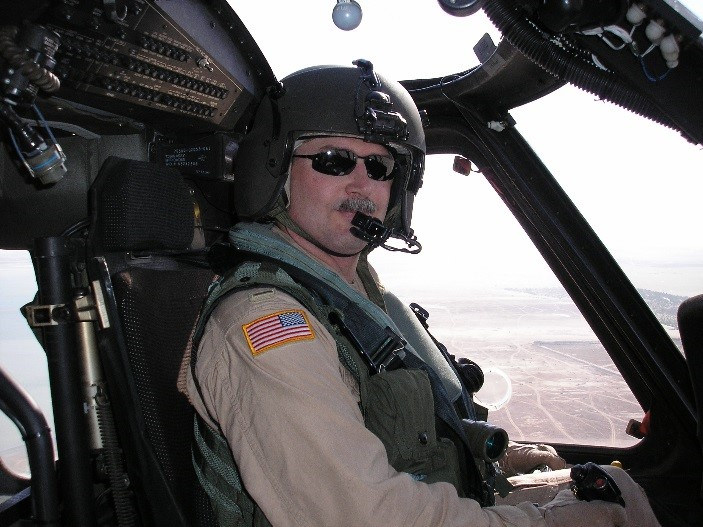
Before becoming the KYARNG CCWO, CW5 Stoops was the Senior Standardization Instructor Pilot for the 63rd Theater Aviation Brigade and Aviation Standardization Officer and Accident Investigator for the National Guard Bureau. (photo submitted by CW5 Dean Stoops)
LAST MONTH, fifteen Kentucky Army National Guard aviation Soldiers were recognized for their collective combat and domestic aviation operations experience, and how that experience benefited our nation and the citizens of Kentucky. That article prompted me to reflect on how my 36 years of Army aviation training and experience most recently benefited me and Cindy, my wife of 35 years, in a very direct and personal way. In fact, if not for the knowledge, skill, and abilities gained through my military training and experience, we might not have survived what I can only describe as ‘A high adrenaline producing moment.’
Click HERE to view all pictures from this story.
As Soldiers occasionally called upon to perform hazardous missions, we rely on our training and experience to overcome any and all obstacles, to come home safe. However, rarely do we anticipate utilizing those skills and that experience in our everyday personal life; particularly in a way that means the difference between life and death, or at the least serious physical injury. A few months ago, I came face-to-face with such an event and I attribute my years of military training and experience, to Cindy and I being alive and well to enjoy the 2015 Christmas holiday season with our family. Before I begin this story however, I must preface the tale with the introduction that underpins the beginning of most stories told by fisherman and old aviators – There I was!
It was Friday afternoon on the 27th day of November 2015, the day after Thanksgiving, when at approximately 3:05 p.m. I uttered those fateful words of distress – Mayday, Mayday, Mayday! I had mentally and physically practiced this phrase thousands of times - and the position report that should follow any emergency declaration - since my earliest days of flying as a student pilot, but this time it was not a practice emergency landing, nor the final maneuver of a pilot check ride. This time it was for real.
As you would hope on any flight in an airplane, the previous 3 hours and 40 minutes were uneventful. Not being too interested in the technical aspects of flying, Cindy occupied her time reading as she usually does while our two small dogs slept most of the flight. Bubba in the back seat, and Charlie in her lap.
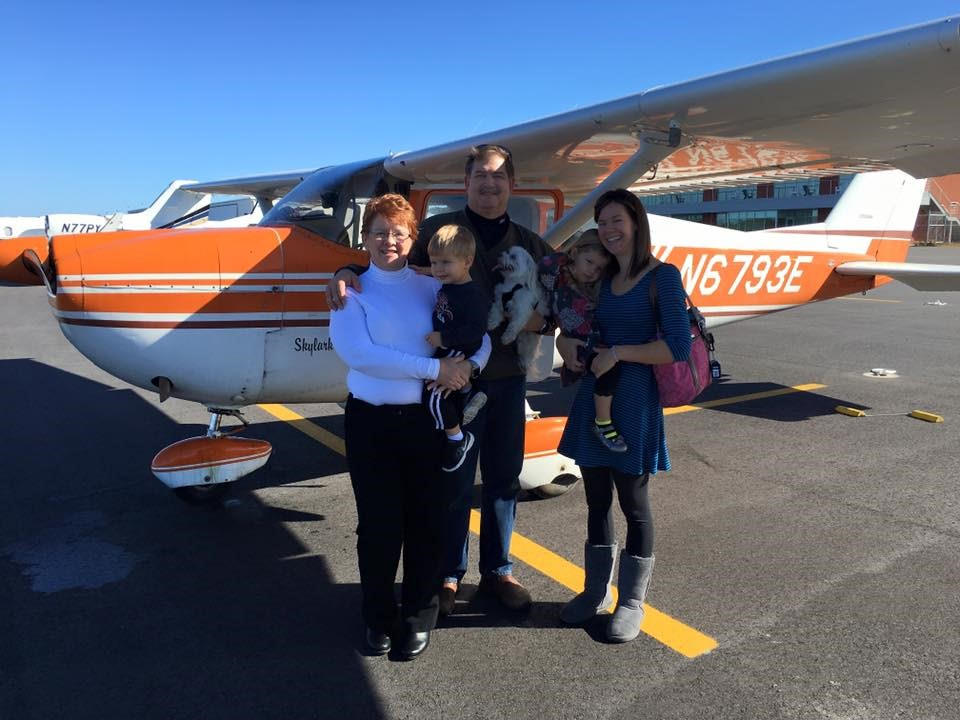
Preflight checks completed, Dean and Cindy say their farewells to “the kids” prior to leaving Jacksonville, NC on their return trip to Frankfort, KY. (photo submitted by CW5 Dean Stoops)
Being an avid pilot and having an airplane in the family since I was a young boy, Cindy and I elected to fly my dad’s Cessna 175A Skylark to Jacksonville, NC to visit the kids instead of spending 12 hours on the road each way. We had taken many trips in the family airplane over the years, but this was the first long flight I had flown in nearly six years. So imagine my relief when after traveling nearly 400 nautical miles, and over rugged mountainous terrain in a single-engine airplane, we were finally home, or so I thought.
Planning for a straight-in approach to runway 25 at Frankfort, Ky., I reduced power over the Lexington airport and began a slow descent from a cruise altitude of 4,500 feet to Frankfort’s traffic pattern altitude of approximately 2,000 feet. Upon reaching 2,000 feet I leveled off and completed the required before landing checks. This included setting the fuel selector from LEFT tank which I had been in for the last 30 minutes - to BOTH tanks, set the fuel mixture control to RICH, and verifying the carburetor heat control was ON. It should be noted that during the flight I set the fuel mixture control to lean out the fuel-air setting for optimal engine performance. In addition, the right tank was burning fuel faster than the left tank so I had to balance the fuel several times during the flight by running on the left tank. This is common for this airplane and among many Cessna high-wing single-vent fuel tank systems. Each tank was showing 1/4 full which is what I expected it to be upon landing. The Pilot Operating Handbook for this airplane says when full, the two overhead wing fuel tanks contain 42 gallons of useable fuel for all flight modes. It also says that at 3000 RPM the engine will consume 10 gallons per hour. This was confirmed during our flight to Jacksonville, NC several days earlier so based upon my preflight checks, I knew I had 4.2 hours of fuel available. I knew I would be landing at the required 30 minute fuel reserve, therefore, I had no concerns about fuel leading up to the descent and preparation for landing at Frankfort. I also make it a habit to turn on the carburetor heat during reduced power descents to prevent carburetor icing, so the carb heat was already on, which I again verified during the before landing check.
We were now only a few minutes away and 10 miles east of our final destination preparing to land. I had just closed out with Lexington approach control who I had been in radio contact with for the past 30 minutes, and checked the automated weather reporting service at the Frankfort airport, but I had not yet changed to the Common Traffic Advisory Frequency (CTAF) at Frankfort. This turned out to work in my favor because the CTAF radio is not always manned at Frankfort.

Crossing from Tennessee to Kentucky at Pine Mountain. Not a good place to make a forced landing. (photo submitted by CW5 Dean Stoops)
After completing my before landing checks and upon reaching 2,000 feet I applied power to level off, but something was wrong. The engine started to sputter and run rough. It was at this point I muttered under my breath, “Something is not right.” Cindy said, “What do you mean”, and I repeated my statement. Thinking I may not have set the fuel selector properly, I visually and physically rechecked it, but it appeared to be OK. The engine was still running rough and would not produce full power, so I also rechecked that the fuel mixture control was set to RICH, which it was, the carburetor heat was ON, which it was, and that the magneto switch was set to BOTH, which it was. Any one of these controls not set in the proper configuration, could cause the engine to run rough, however, everything was set properly. By this point I knew we were in trouble and that I needed to make a decision fast about my next course of action. Could I make the airport which was only about 8 miles away, or should I make a precautionary landing before the engine quit all together? What if the engine quit short of the runway and over the city of Frankfort?
NOTE: To listen to the ATC Audio of the event, please click below.
I pumped the throttle several times and got only partial power of approximately 2400 RPM of the 3100 RPM that was previously available during cruise flight. I manipulated the throttle settings for about 15 seconds, but still could not make enough power to sustain level flight. The engine was still running rough and would not make full power, so I considered my options which included flying over the city of Frankfort to try to make it to the airport, or to make a precautionary landing under partial power in a field to minimize any danger to people on the ground. Still having partial power, I decided to land before the engine quit entirely and told Cindy we were going to have to make a precautionary landing off the airport.
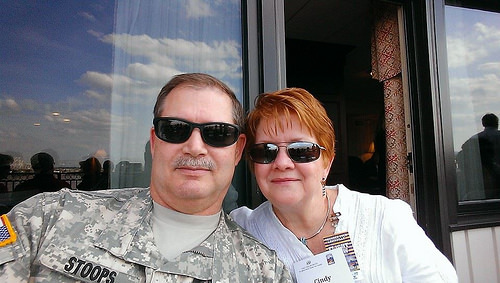
CCWO Dean Stoops and his wife Cindy watching Thunder Over Louisville from the Galt House Hotel. (photo submitted by CW5 Dean Stoops)
Doing as she had been briefed many times, Cindy started pointing out open fields on her side of the airplane. I had already picked out one on my side though that appeared flat and long enough, would allow for a landing into the wind, and was near a road and a house. Cindy had Charlie, our five pound white maltase in her lap, so put him in the back seat with our other dog, Bubba, tightened her seatbelt, and took off her glasses just as she had been briefed. I started a hard left turn to the cow pasture I had selected, changed back to the Lexington approach control radio frequency which was in standby mode, and made my first distress call, advising of my position and that I would be making an emergency landing off the airfield. I considered briefly whether or not to change to the Frankfort airport CTAF frequency, but quickly discounted that option as useless. After all, I did not know if anyone would be monitoring that frequency and Lexington approach control should still have me on their radar and could initiate search and rescue. I was at about 1,500 feet MSL (mean sea level) now, or 800 feet AGL (above ground level), and working toward my recommended glide speed of 80 MPH, however, the field I had selected was at my 4 to 5 o’clock position. Because of this, I continued my hard left turn, then back to the right to line up into the wind for a southwesterly landing into the field. In short order the engine quit and the propeller stopped. It was dead quiet except for the noise of the airplane gliding through the air. My worst fear had come true, the engine was dead. I was about 500-700 feet AGL, had no power and was making a dead-stick landing off airport. I made my second distress call to Lexington approach and used those bone chilling code words, MAYDAY, MAYDAY, MAYDAY for the first time. I was slightly relieved to know the controller heard my transmission as I remember her advising me to report when on the ground, if able. This is a standard and common reply to an aircraft in distress preparing to make in imminent emergency landing, but I also couldn’t help thinking the last two words of that reply were not very comforting.
At this point, all I could do was to ensure we made the field, a cow pasture located approximately 4 ½ miles east of Frankfort at the intersection of Georgetown Road and Woodlake Road. I was confident now that no one on the ground would be hurt, but couldn’t help thinking to myself “can I land the airplane without hurting Cindy, my wife of nearly 36 years, or our two dogs.” I was comfortable with my glide airspeed of 80 MPH and glide angle to the cow pasture, but had not yet set the flaps for landing, so I applied 20 degrees of flaps, then 30, then tried to go to 40, but could not get the manual flap lever to lock in at 40 degrees. Setting the flaps to full down was important. It would allow me to slow the airplane down to about 60 MPH without stalling. I tried again, but still no luck at locking the flaps at 40 degrees, so I settled for 30 degrees since the ground was fast approaching and I was running out of time. It was only after thoroughly reviewing both our actions during this emergency that I discovered why I could not get the flaps to lock in at 40 degrees.
Following a casual ‘after action review’ with Cindy on the way home that evening, I concluded that my right arm travel was restricted because, not wanting to see the “crash”, she closed her eyes and buried her head behind my right shoulder. Without realizing it at the time, her upper body was inadvertently restricting my arm movement preventing me from getting the manual flap lever into the 40 degree full-flaps position. This proved to be inconsequential because the approach worked out well, and I made what was probably one of my smoothest and best airplane landings ever, although at the time I was deeply concerned about keeping the nose wheel up to prevent it from digging into the ground which could cause the airplane to flip over.
The field was long and a fairly hard-packed grassy cow pasture, with two debris piles and a ditch running along the left side which I managed to miss. We were fast approaching the end of the field where there was a wire fence, small trees, barn and old silo. I applied the brakes as expeditiously as I could, while trying not to lose breaking action by sliding on the grass. The plane finally came to a full stop about 200 feet short of the end of the field and the previously noted obstacles. Whew! We were down safe with no injuries to us and no damage to the airplane.
Almost immediately a white suburban and motorcyclist pulled up next to us to see if we were OK. It was the property owner, and a neighbor who had witnessed the emergency landing and came to render aid. Cindy emerged from her protected position from behind my right shoulder and gave the good Samaritans a thumbs up, while I made radio contact with a commuter airplane requesting that they advise Lexington approach that we were down safe, no injuries and no damage to the airplane.
During the 30 minutes or so that followed, I remained busy communicating with overhead airplanes dispatched to check on us, and filing an initial telephonic report with the Federal Aviation Administration (FAA). We also received assistance from a Lexington Metro Police helicopter that landed to check on us, and the Franklin County Sheriff who was dispatched to render aid and secure the site.
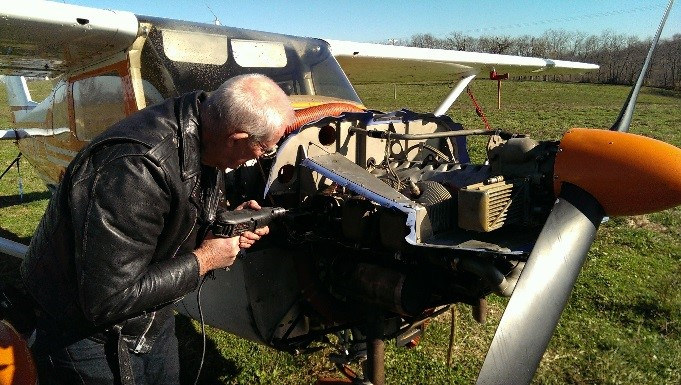
Dick Stoops cleaning the #1 cylinder exhaust valve guide. He said repairing and replacing the #1 cylinder exhaust valve “Was like performing heart surgery through someone’s belly button.” (photo submitted by CW5 Dean Stoops)
A post-flight inspection an hour later by my father Dick Stoops, the airplane owner and a licensed FAA Airframe & Powerplant mechanic and Authorized Inspector, verified no damage to the airplane, fuel remaining in the wing tanks, proper operation of the engine ignition system and carburetor heat system. However, a full power check revealed that the engine would only produce a maximum of 2400 RPM when it should be producing 2900-3000 on the ground. He determined there was some unknown mechanical problem and would not be flying the airplane out of this field that day. Nearly dark now, the airplane was secured and arrangements made with the property owner to return on another day for further mechanical diagnosis.
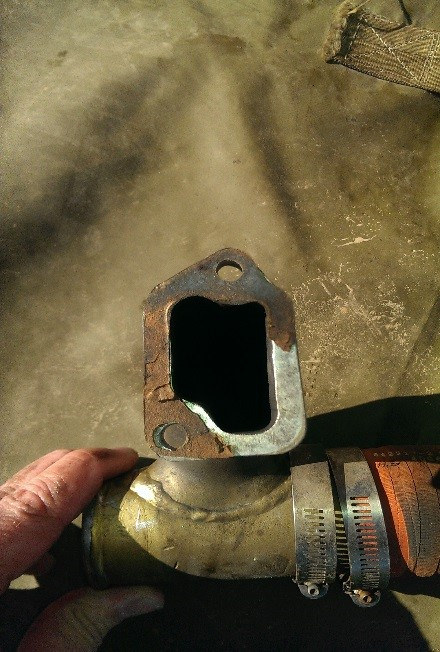
One of three intake manifold gaskets that had deteriorated allowing air to be sucked into the cylinder. (photo submitted by CW5 Dean Stoops)
Like any pilot forced to make an emergency landing, I was anxious to find out what the problem was. And, while I couldn’t rule out pilot error initially, my military training and experience as an Aviation Safety Officer and Accident Investigator, told me to be patient, for I knew it could take several days or weeks to find the root cause of the problem. Further mechanical diagnosis over the following six weeks by me and my dad, revealed that three gaskets that seal the gap between the intake manifold and the cylinders had deteriorated to the point that excess air was being sucked into three of the six cylinders. This caused the fuel-air mixture to burn leaner and hotter than normal. The resulting hotter than normal internal cylinder temperatures was not detectable during the flight and had no apparent effect while operating at high RMP during cruise flight. However, during the last two minutes of the flight when the throttle was retarded to descend, the resulting reduced compression and cooling temperatures caused the #1 cylinder exhaust valve to stick in the open position. Further diagnosis revealed the #4 and #5 cylinders were producing very low compression and also leaking from the exhaust valves. Although these two valves were not stuck or frozen, the cylinders were not producing any compression. They required overhauling and replacement. We were able to repair the frozen exhaust valve on the #1 cylinder without replacing the cylinder. Ultimately, Dad and I were able to complete all repairs in the field and Dad flew the airplane out of the field site on Jan. 5, 2016, more than five weeks later.
In retrospect, the aggressive S-turn maneuvering I did to set up for the precautionary landing probably contributed to the fuel un-porting in the fuel tanks and caused the engine to quit on short final. It was either that, or the engine was receiving more air than fuel and flamed out as a result of the lean fuel-air mixture. If I could have landed straight-ahead, or could have left the throttle in the full power setting rather than idle, I may have been able to sustain some power for the approach and precautionary landing.
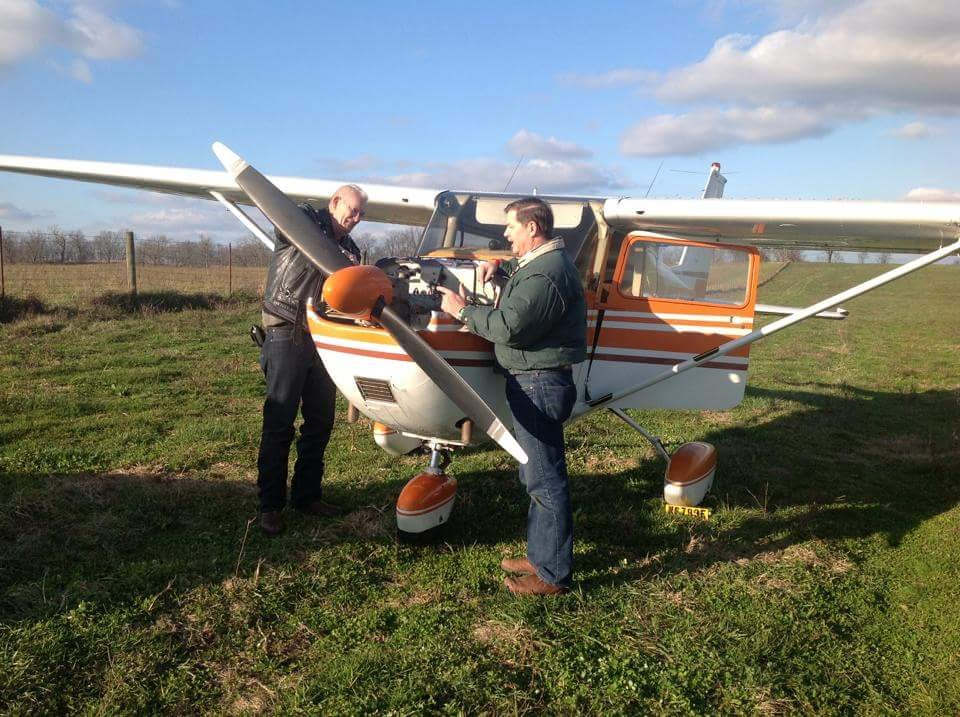
Dean and his dad, Dick Stoops, a FAA Airframe & Powerplant Mechanic/Authorized Inspector attempt to diagnose the cause of the engine problem that led to the emergency landing. (photo submitted by CW5 Dean Stoops)
My family and I are all thankful no one was hurt and that if we had been injured, we would have had immediate assistance thanks to the overwhelming effort of the Lexington Approach Control facility who initiated search and rescue procedures, and to the property owner and neighbor who arrived immediately upon our landing.
While I cannot discount the possibility of divine intervention in the successful outcome of this incident, I do know if not for the knowledge, skills, abilities, and judgement gained through my nearly four decades of training and experience with the Kentucky National Guard; Christmas 2015 and future Thanksgiving holidays for my family could have forever been marked with a cloud of sadness.
I’ve always had faith that my military training and experience would see me through any difficulty. However, I have never needed to apply that knowledge, those skills and abilities, or apply that judgment so directly, in my personal life. For me, the overarching takeaway, is to apply what you learn through your military experience to your everyday activities. Be deliberate and disciplined in what you do, in all aspects of your life, including your family recreational and travel activities. You never know when your military training and experience will preempt a mishap or pull you through, should an emergency occur.
Now that the airplane is fixed, Cindy and I plan to fly to Jacksonville, NC in June.
By Walt Leaumont, Kentucky National Guard Public Affairs
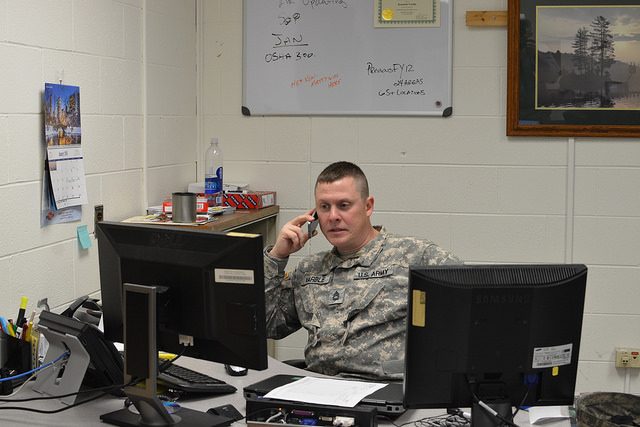
State Safety NCO Sgt. 1st Class Ken Varble provides advice to a unit in the field from his office in Frankfort, Ky. Feb. 25, 2016. In late 2015, Varble became the first Soldier in the Kentucky Army National Guard to pass the Occupational Health and Safety Technologist (OHST) exam. (Kentucky National Guard Photo by Walt Leaumont)
FRANKFORT, Ky. — ‘Safety is no accident’ is a common slogan used in the National Guard. To operate safely, it takes training, awareness, and professionals to advise and train. One of those professionals for the Kentucky Guard is Sgt. 1st Class Ken Varble, a three-year veteran of the State Safety Office.
Recently he achieved a major milestone in his career as he became the first Soldier in the Kentucky Army National Guard to pass the Occupational Health and Safety Technologist (OHST) exam. Having achieved a certification shows you have mastered the core knowledge required for professional safety practice. The OSHT credential is a validation of Varble’s professional expertise and a product of his training, self-development and on the job experience.
“This was an extremely difficult test that took a year to prepare for and over 4 hours to take,” said Varble. “I feel like I have accomplished a lot, and am glad to add the experience to my role with the Kentucky Guard.”
The certification adds to Varble’s position as a subject matter expert in all things safety. He regularly advises units and Soldiers on the appropriate regulations and guidelines of safety. Of the numerous manuals, handbooks or rules set forth by the Army or government safety organizations, Varble knows where to find the answer. He also ensures units and armories have the proper personal protective equipment (PPE) required to perform their job.
One weekend a month, Varble serves as a maintenance platoon sergeant with Kentucky’s 351st Aviation Maintenance Company.
Capt. Josh Witt, the State Safety Officer, said Varble is one of only 37 active OHSTs in the Commonwealth, and one of 1,800 nationwide.
“The Kentucky National Guard is privileged to have such a self-motivated and highly proficient operator on our team,” said Witt. “His accomplishment represents countless hours of study, academic preparation, and hands-on experience. Sgt. 1st Class Varble has distinguished himself as a fully qualified and capable ambassador in the field of Safety and Occupational health.”
“Having the OSHT certification increases my standing within the Safety Community,” said Varble. “It also gives me credibility and added confidence when I conduct unit visits.”
Although this certifies him as an expert, it is by no means the end of his training and education. Varble is currently attending Eastern Kentucky University working toward a Bachelor’s degree in Safety and Occupational Health and certification in Career Program 12 from the U.S. Army Safety Center.