Pages
Stay In Touch
More
© 2013 KentuckyGuard
Story By David Altom, Kentucky National Guard Public Affairs
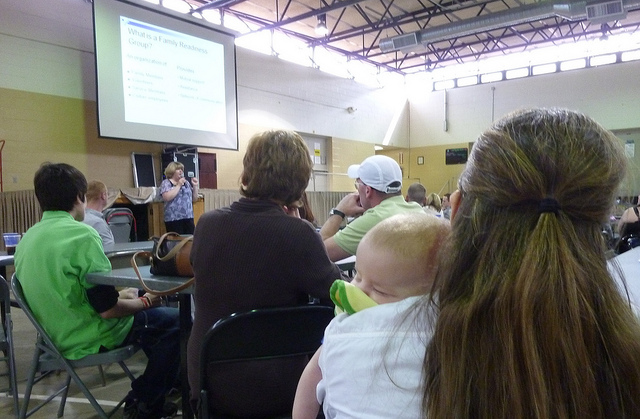
Young Anderson Powers takes a break during a Family Readiness Group briefing at Boone National Guard Center in Frankfort, Ky. Anderson is the son of Sgt. Mike Powers and his wife Erin. (Photo by David Altom, Kentucky National Guard Public Affairs)
FRANKFORT, Ky. — It’s 3 a.m., your windows were just shattered by a hailstorm, the lights are out and the kids are crying. You turn to your loved one for help and — hello! — he/she has been deployed to Southwest Asia for the past 30 days.
Who you gonna call? Why, your Family Readiness Group, that’s who!
Seriously, if you’ve been in the military lifestyle for any time at all, you’ve probably “been there, done that” when it comes to things going wrong. And hopefully at some point in your experience you’ve had some contact with this thing call the Kentucky National Guard Family Assistance Center. They offer a wide range of service and support to all Kentucky military families, National Guard, reserve and active duty as well.
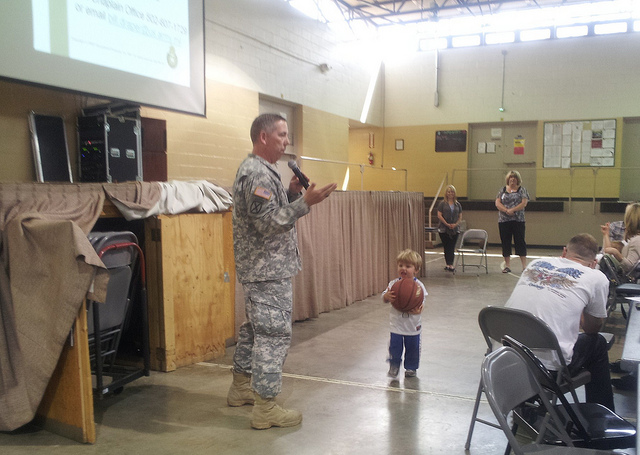
Chaplain (Maj.) Bill Draper shares the spotlight with Liam Powers during a Family Readiness Briefing at Boone National Guard Center in Frankfort. Liam is the son of Sgt. Mike Powers and his wife Erin. (Photo by David Altom, Kentucky National Guard Public Affairs)
“We’re a one stop shop when it comes to helping our military families,” said Kristen Arnett, coordinator. “We address the needs of the service member’s family throughout every stage of their career, during deployment, before, after, you name it.”
A typical family readiness briefing covers subjects as diverse as service member pay and finances, legal obligations, benefits, dealing with the media and even who to call if the water pipes break.
“Our FRG is awesome,” said Sgt. 1st Class Michael Ball, Headquarters Company, 2nd Battalion 238th Aviation. “They do a great job of keeping our families prepared and informed, and they have proven valuable whenever problems came up. They really make a difference when it comes to taking care of our troops and their families.”
For Robin Hartman, wife of Sgt. Steve Hartman, Co. C, 2nd Battalion 238th Aviation, her family readiness group proved essential in getting through their first deployment.
“I had no idea what to expect,” she said. “Thank goodness for the Family Assistance Center and Family Programs! They provided a ton of great information at the Yellow Ribbon briefing before our unit deployed, and helped us get organized and prepared.”
According to Hartman, information regarding legal paperwork are crucial to preparing for deployment.
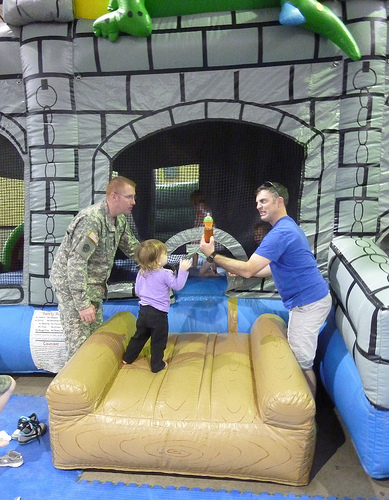
"Sorry, miss, but this is more than three ounces." -- Sgt. Ross Haste and Chief Warrant Officer Kevin Keith perform a safety check for contraband liquids at the castle gate during a Family Readiness Group briefing. (Photo by David Altom, Kentucky National Guard Public Affairs)
“We were able to walk through the material and gather our records, phone numbers, marriage license, and power of attorney — everything I might need while he was gone, and all of which I needed at some point during that year.”
Probably the most important piece of information she received was the phone number to the Family Assistance Center.
“I used it a lot and they were incredible,” she said.
Networking is another benefit of the family readiness group system. No matter how strong your personal support mechanism is, sometimes you just need someone who shares a common experience.
“The other wives and family members in our unit stayed in touch with one another, got together on occasion and just provided each other with a support system no other group could provide,” said Hartman. “Second to faith in times of deployment, I would definitely encourage a knowledge of the family assistance resources and involvement in the Family Readiness Group.”
Click here for more information on the Family Assistance Center or call 1-800-372-7601.
Click here to see the Kentucky Nationa Guard Yellow Ribbon Facebook page.
And don’t forget to talk to your readiness NCO to find out more about your unit’s Family Readiness Group!
Release from 123rd AW, Kentucky National Guard
Photos by Maj. Dale Greer and Master Sgt. Phil Speck, Public Affairs Officer, 123rd AW, Kentucky National Guard
CLICK HERE FOR MORE PHOTOS
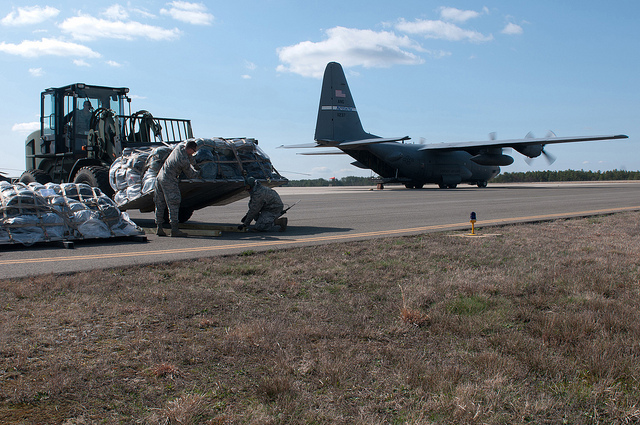
Pallets of cargo are offloaded from a Kentucky Air Guard C-130 during an Engine Running Offload at Joint Base McGuire-Dix-Lakehurst, N.J., March 26, 2012, in support of Eagle Flag. The Kentucky Air National Guard’s 123rd Contingency Response Group from Louisville, Ky., and the 690th Rapid Port Opening Element from Fort Eustis, Va., joined forces for the exercise, which tasks them with establishing a Joint Task Force-Port Opening. (U.S. Air Force photo by Master Sgt. Phil Speck)
JOINT BASE MCGUIRE-DIX-LAKEHURST, N.J. — More than 80 Airmen from the Kentucky Air National Guard in Louisville, Ky., deployed March 26 to Joint Base McGuire-Dix-Lakehurst, N.J., where they joined with more than 50 active-duty Army troops and Air Guardsmen from New Jersey and Mississippi to establish an aerial port at Lakehurst Naval Air Engineering Station within 24 hours of landing.
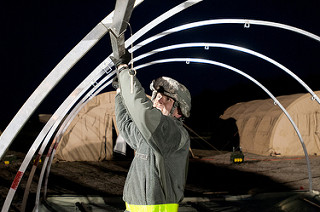
1st Lt. Kevin Eilers of the Kentucky Air National Guard’s 123rd Contingency Response Group sets up an Alaskan Shelter tent at Joint Base McGuire-Dix-Lakehurst, N.J., March 26, 2012, during Exercise Eagle Flag. More than 80 Airmen from the Kentucky Air Guard have joined forces with over 50 active-duty Army troops and Air Guardsmen from New Jersey and Mississippi to establish an aerial port at Lakehurst Naval Air Engineering Station within 24 hours of landing. Inspectors from U.S. Transportation Command will evaluate the performance of the Kentucky unit during the exercise. (U.S. Air Force photo by Master Sgt. Phil Speck)
The tasking is part of Exercise Eagle Flag, during which inspectors from U.S. Transportation Command will evaluate the performance of Kentucky’s 123rd Contingency Response Group. The Kentucky Guardsmen are working in concert with Soldiers from the 690th Rapid Port Opening Element, based at Fort Eustis, Va., which is responsible for transferring the incoming air cargo to trucks for simulated forward movement over land.
CLICK HERE FOR MORE PHOTOS
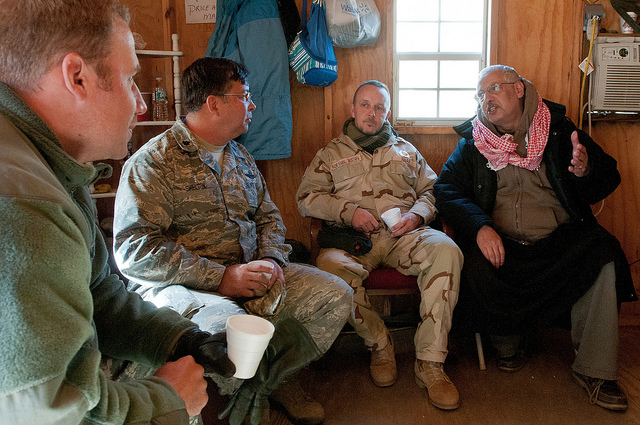
Lt. Col. Rick Shelton (second from left) gets to know local leaders over tea while visiting the fictional town of Sabor, Nessor, during a U.S. Transportation Command verification exercise held at Joint Base McGuire-Dix-Lakehurst, N.J., March 27, 2012. Shelton, commander of the Kentucky Air National Guard’s 123rd Global Mobility Readiness Squadron, is playing the role of operations officer for Joint Task Force-Port Opening, a unit charged with establishing an aerial port at the simulated Akrab International Airport within 24 hours of landing. Shelton is joined by Army Maj. Keith Pruett (far left), commander of the U.S. Army’s 690th Rapid Port Opening Element in Fort Eustis, Va. The RPO is responsible for transferring incoming air cargo to trucks for simulated forward movement over land. Also pictured (left to right) are the notional Col. Nadir Kamal Mustafa, a commander in the Royal Nessorian Air Force; and Wasim Naguib, the fictional mayor of Sabor. (U.S. Air Force photo by Maj. Dale Greer)
Story by Specialist Matthew Dornbusch, 1204th Aviation Support Battalion Unit Public Affairs Historian Representative
Click here for more photos on this story.
NOTE: Each week kentuckyguard.com publishes stories by Kentucky National Guard unit public affairs historian representatives, also known as UPAHRs. This is an additional duty taken on by a Soldier or Airmen with the intent of telling their unit’s story. This is one such story ….
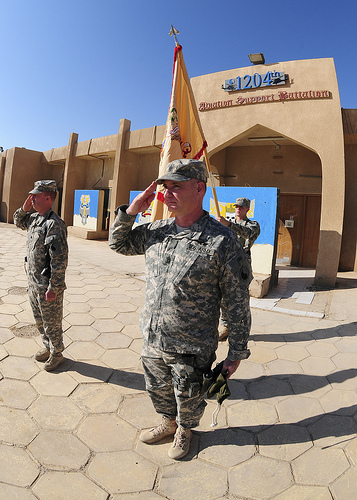
Lt. Col. Tom Roach, Command Sgt. Maj. Tim Walton render honors at the transfer of authority ceremony for the 1204th Aviation Support Battalion, Camp Taji Iraq, 3 November 2011. (Kentucky National Guard photo)
CAMP BEUHRING, Kuwait – On December 16th 2011 the Soldiers of the 1204th Aviation Support Battalion departed Contingency Operating Site Taji, Iraq bound for Kuwait, representing more than eight years of Kentucky National Guard operations in support of Operation Iraqi Freedom and Operation New Dawn.
The story began four months earlier when on August 24th 2011 when the 1204th, under the command of Lt. Col. G. Tom Roach Jr., mobilized in support of Operation New Dawn. On August 27th Headquarters and Support Company and Alpha Company left their home station in Independence, Ky. to join units from four other states to include Alabama, Florida, Maryland and South Carolina in Fort Hood, Texas for mobilization training. For over 53 days the 600 Soldiers completed their validation and deployed to execute operations Iraq and Camp Buehring, Kuwait beginning October 1st 2011.
Following the uncasing of the battalion colors on November 3rd 2011, the 1204th quickly got to work, assuming the extraordinary responsibility of aviation logistics sustainment and support operations from COS Taji, while simultaneously planning for the withdrawal of the 29th Combat Aviation Brigade.
“The withdrawal of U.S. forces from Taji and the Iraq Joint Operations Area was the biggest such operation since the World War II,” said Roach. “The 1204th accomplished this with just 30% of the battalion’s strength forward. The remainder of the battalion worked to establish operations in Kuwait to further support the 29th CAB’s mission.”
The variety of tasks were daunting but doable. Plans had to be made to support for the 29th CAB over the final 45 days of aviation operations in Iraq, to include running arming and refueling points and supplying aviation repair parts. Also, ground maintenance completed over 28 work orders with approximately 1,056 man-hours performed. Both teams were critical in keeping refueling equipment running around the clock.
“The Taji refueling point reminded me of a speedway you see off the side of a highway,” said Sgt. John Amburgey. “At times there would be aircraft in a line to get fuel. At one point we had 14 aircraft waiting on fuel.”
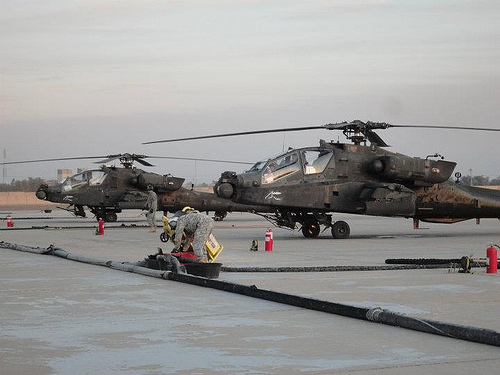
Members of the Kentucky National Guard's 1204th Aviation Support Battalion service U.S. Army AH-64D helicopters at Camp Taji FARP.in Taji, Iraq. The 1204th is the last Kentucky National Guard unit out of Iraq. (Kentucky National Guard photo)
Alpha Company broke records by refueling nearly 100 aircraft in a twenty-four hour period. In the forty-five days, the fuelers at Taji pumped nearly 370,000 gallons of fuel into more than 2,600 American and Iraqi rotary wing aircraft. Likewise, Echo Company refueled over 64 aircraft and pumped nearly 150,000 gallons of fuel.
Alpha Company’s transportation control team also manifested and oversaw the movement of 3,40 personnel and loaded over 580 pallets of equipment with a value of $26 million and requiring 100 flatbed trailers to move – all this five days ahead of schedule.
“It was a smooth process from beginning to end,” said Spc. Greg Woodring. “Of course you’re going to have a learning curve not knowing the job, but we quickly learned.”
With aviation repair parts no longer locally available, the Soldiers of the 1204th developed procedures to use aviation transportation to move repair parts from Kuwait to Taji. During this high operational tempo period, they processed over 400 high-priority requisitions valued at over $5 million.
Bravo Company – comprised of troops from Alabama, Florida & South Carolina – completed phase maintenance inspections and oversaw the relocation of contractor maintenance from Iraq to Kuwait. They shipped over 6,000 separate types of parts worth $60 million and filling over 100 flatbed trailers from Iraq to Kuwait.
While all this was going on Charlie Company kept everyone connected and talking, providing 24/7 operations network capability, redundant back-ups, communication security keys and secured video teleconferencing capabilities to the entire brigade with only five personnel.
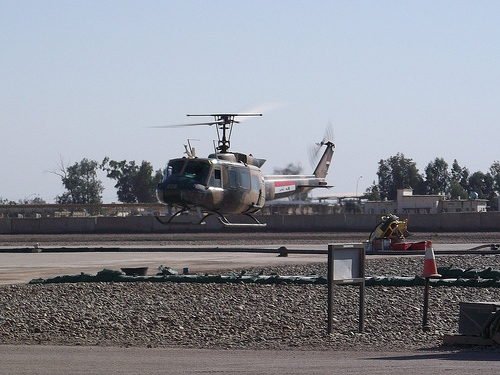
An Iraqi UH-1H hover taxis in for service by members of the Kentucky National Guard's 1204th Aviation Support Battalion in Taji, Iraq. The 1204th is the last Kentucky National Guard unit out of Iraq. (Kentucky National Guard photo)
The health and safety of deployed troops is always a concern. To that end, the medical platoon treated more than 1,100 patients in just five weeks while at Taji. These figures include Soldiers, Department of Defense employees, Department of State employees, and third country nationals.
According to Sgt. Jerrod Dean, “The 1204th Medical section upon arriving at COS Taji was a relatively inexperienced group of medics that in time were able to come together while working with other medical elements to provide above standard care to all personnel.”
The medical platoon also trained 117 civilians on basic medical care.
The 1204th Mortuary Affairs section had the unenviable distinction of participating in the last two KIA evacuations during Iraqi Freedom and New Dawn; the first a third country national killed in a truck convoy and the last for the personal effects of the last U.S. Soldier killed.
While conducting operations at Taji the 1204th was assigned to clear all equipment, buildings, and personnel. In total they collected nearly $2 million worth of lost, abandoned or frustrated Army equipment; received 18 tons of ammunition valued at nearly $300,000, and cleared nearly 400 buildings of sensitive material. They also coordinated the movement to Kuwait of nearly 1,400 containers, pieces of rolling stock, or over-sized items by 22 convoys during the final 30 days U.S. forces were in Iraq.
The 1204th’s legacy in Iraq is one to be proud of, said Roach. “With the conclusion of Operation New Dawn and the withdrawal of U.S. combat forces from Iraq, the 1204th Aviation Support Battalion wrote another chapter in the vaunted history of the 29th Division.
The 1204th ASB is currently stationed in Kuwait and continues to support the 29th Combat Aviation Brigade.
By Sgt. Scott Raymond, Kentucky National Guard Public Affairs
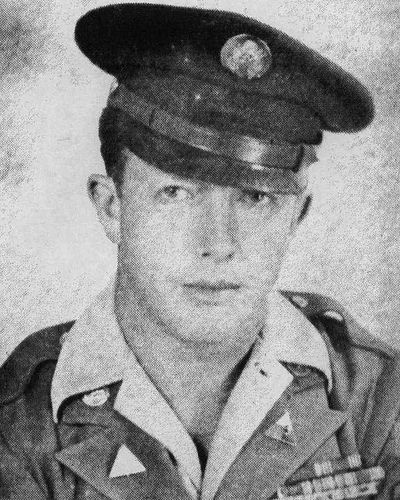
Morgan French was an original member of the Harrodsburg Tankers who fought the Japanese in the Philippines during World War II. After suffering as a prisoner of war he remained in the military and even served two tours in the Korean War. (Photo from 192nd historical files)
RADCLIFF, Ky. – The Kentucky National Guard mourns the loss of a true American Patriot, Morgan French, who passed away February 24, at the age of 92.
French, originally from Perryville, Ky., served his country for 23 years in the U.S. Army and Kentucky National Guard. He was an original member of the Harrodsburg Tankers who fought the Japanese in the Philippines during World War II. Taken as a prisoner of war in 1942, French endured the Bataan Death March and 40 months of imprisonment prior to the end of the war in 1945. He was the last survivor of D Company, 192nd Tank Battalion.
French enlisted in 1937 as a teenager from Boyle County who joined the Kentucky National Guard, ‘to get a break from farming.” At the time, he didn’t realize he, and his brother Edward, had traded the farms of the Bluegrass for the islands of the South Pacific. In 1940, the 38th Tank Company out of Harrodsburg was ordered to federal service. And following training in Ft. Knox and Louisiana, they were headed overseas.
Shortly after the Japanese attack on Pearl Harbor, the Harrodsburg Tankers were under attack in the Philippines. In May of 1942, Allied Forces surrendered and were forced to march to POW camps and to ships that carried them to Japan. This became known as the Bataan Death March. Thousands of American and Filipino troops died along the way, but Morgan French survived.
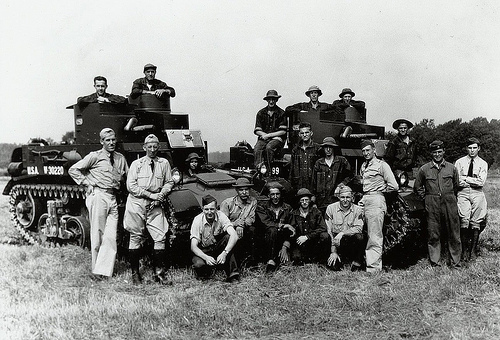
Members of the 192nd Tank battalion pose with their vehicles during the unit's deployment in WWII.(Photo from 192nd historical files)
French was sent to Japan as forced labor in factories and mines. Only 37 of the original 66 Kentucky Guard Members from Harrodsburg survived Japanese captivity. His brother Edward was killed in the fighting preceding the surrender.
Four years after sailing for the Philippines, French returned to U.S. soil. He remained in the Army and even served two tours in the Korean War, completing 23 years of service in uniform. As a civilian, French worked as a tank instructor at Ft. Knox until he retired in 1984.
He was preceded in death by his wife of 55 years, Maxine Milby, and is survived by two sons and two grandchildren. Morgan French was buried with full military honors at North Hardin Memorial Gardens in Radcliff, Ky., March 2.
FOR MORE ON THE HARRODSBURG TANKERS VISIT:
The Harrodsburg Tankers
The 66th Anniversary Commemorative Booklet about the Harrodsburg Tankers - Company D, 192nd Tank Battalion (PDF File 934 KB)
Article on the 192nd’s experiences from call-up to liberation in Chapter 2, KYNG History, 1937 - 1962, a draft manuscript edited by Col (Ret) Joe Craft
Story and photos by Staff Sgt. Paul Evans, Kentucky Agribusiness Development Team 4 Public Affairs NCO
Click here for more photos on this story.
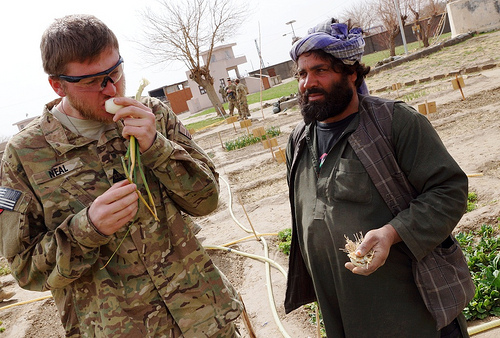
Civilian Agricultural Specialist Beau Neal, a native of Versailles, Ky., tastes an onion grown by a local farmer in Afghanistan on February 20, 2012. Neal is a member of the Kentucky National Guard’s Agribusiness Development Team 4, whose mission is to help Afghan locals develop more effective farming and business practices by providing education and sustainable tools. (Photo by Staff Sgt. Paul Evans, Kentucky Agribusiness Development Team 4 Public Affairs NCO)
FORWARD OPERATING BASE PASAB, Afghanistan — “I grew up on a farm. I always wanted to be outside,” reflected 26-year-old Beau Neal on his experience with agriculture during an interview in southern Afghanistan on March 7, 2012.
Neal, a civilian agricultural specialist from Versailles, Ky. with the Kentucky National Guard’s Agribusiness Development Team 4, said he started helping on the family farm around the age of eight and has loved farming ever since.
“Summer time, it’s daylight to dark for me, messing with the cows, baling hay, working in the tobacco field. From the time that I was able to work, I’ve been working hard,” he said.
Deployed to southern Afghanistan with a team of Soldiers, Airmen, and agricultural specialists on ADT 4, Neal finds himself in a slightly different role advising Afghan farmers as a civilian.
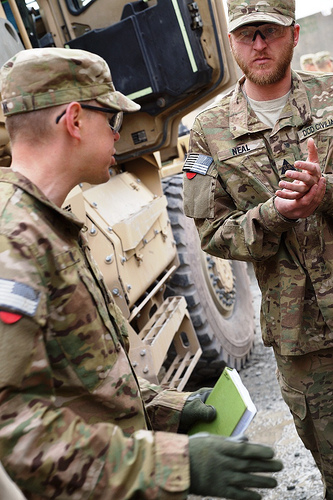
Civilian Agricultural Specialist Beau Neal (right), a native of Versailles, Ky., listens to Army National Guard Cpt. Brian Ink of Harrodsburg, Ky. on February 20, 2012 before going out on mission. The two are members of the Kentucky National Guard’s Agribusiness Development Team 4, whose mission to help Afghan locals develop more effective farming and business practices by providing education and sustainable tools. (Photo by Staff Sgt. Paul Evans, Kentucky Agribusiness Development Team 4 Public Affairs NCO)
“My job on the mission is to assist and advise all the members of the ADT in any problems we may face or any projects we might get going, as well as work in cooperation with some guys from the U.S. Dept. of Agriculture, Provincial Reconstruction Teams, and U.S. Agency for International Development … to make the agricultural economy a little bit more stable,” he explained.
Back home Neal works as a crop development research scientist at the University of Kentucky. That’s also where he obtained his bachelor’s degree in agricultural education and master’s degree in plant and soil science.
“My dream is to eventually just farm full-time, but as this point I’m happy with my job at UK because essentially I get to farm for them,” he said.
So how exactly did a young agricultural specialist like Beau Neal end up on a military mission in Afghanistan?
“Col. Barrier (the ADT 4 Commander) contacted me. He told me he’d been authorized to seek out civilians for this mission, and he said I was the first one he thought of,” Neal recalled. “He’s a pretty good friend of the family, I’ve got a background in agriculture, got an education in it, so he called me. After thinking about it three or four weeks, I decided to seriously consider it…and here I sit.”
Neal’s goals are on the mission are fairly simple.
“Hopefully, we can impact some lives and help some people,” he said. “I know, the old adage is if you help one person, you’ve done alright. But hopefully, we’ll help a lot more than one person. I’ll definitely gain a once in a lifetime experience out of this.”
Asked what’s motivated him on the mission so far, Neal offered a few things to consider.
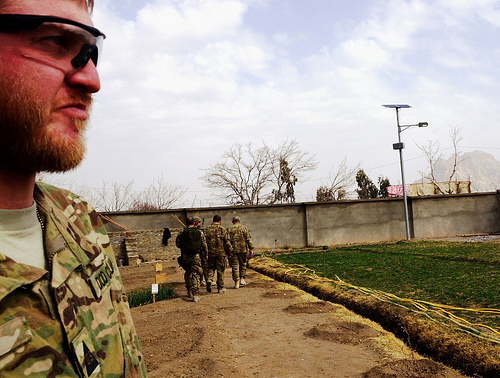
Civilian Agricultural Specialist Beau Neal, a native of Versailles, Ky., reviews the landscape of a farm in Afghanistan on February 20, 2012. Neal is a member of the Kentucky National Guard’s Agribusiness Development Team 4, whose mission is to help Afghan locals develop more effective farming and business practices by providing education and sustainable tools. (Photo by Staff Sgt. Paul Evans, Kentucky Agribusiness Development Team 4 Public Affairs NCO)
“I think the biggest thing is I get to experience what our Soldiers experience on a regular basis, but without being one. Not many people get to be over here and see what the Soldiers go through and see how mentally and physically wearing it is on the body, and I’ve gotten to see that firsthand. It just heightens my respect for the American Soldier,” he said.
“I’ve always wanted to do something like missionary work and I feel like this door opened for that reason,” Neal added. “I feel like this is mission work in a sense, so it gave me an opportunity to sort of do that.”
What has Neal enjoyed most about his trip to Afghanistan so far?
“Definitely going out and seeing the countryside here. I think just seeing how much different it is here than it is at home… the culture, it’s a world of difference from what we have at home and it really makes you thankful for what you’ve got and realize we take a lot for granted,” he said.
“I just felt like this was a once in a lifetime opportunity to help some people,” Neal reflected. “To this point, I haven’t been let down. It’s definitely something I can take back home and tell a lot of people (about)… it has definitely opened my eyes to the world and opened my eyes to what the Soldiers over here are sacrificing, because I’m right here with them taking part in it. It’s made me thankful for being an American.”
Story by David Altom, Kentucky National Guard Public Affairs
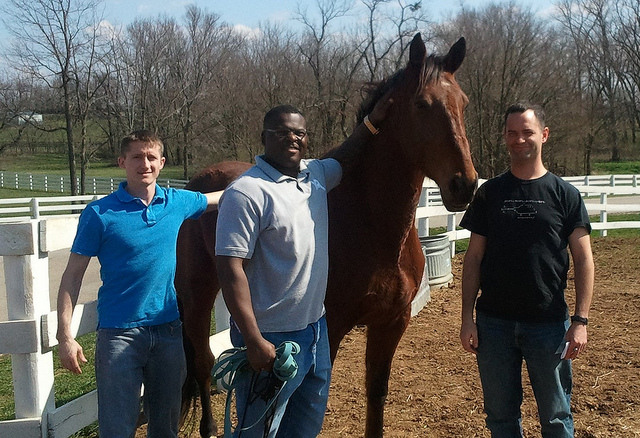
Sgt. Cody Stagner, Sgt. 1st. Class Craig Quisenberry and 1st Lt. Stephen Lawson with their new friend Nathan. Nathan is part of the Horses for Heroes program, which is run by Central Kentucky Riding for Hope. The program helped Kentucky National Guard Soldiers as they explored ways of building resilience in the wake of wartime deployments. (Photo by 1st Lt. Rob Cooley, Kentucky National Guard Resilience Program)
Click here for more information on Central Kentucky Riding for Hope and Horses for Heroes.
LEXINGTON, Ky. – The Kentucky National Guard Resilience Team teamed up with new friends for some very unique training recently at the Kentucky Horse Park in Lexington, Ky.
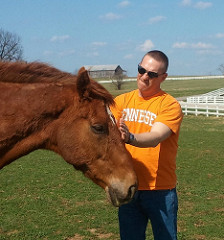
2nd Lt. Chris McGhee, 198th Military Police Battalion, take a little time to bond with Messenger. A member of the Central Kentucky Riding for Hope, Messenger helped Kentucky National Guard Soldiers as they explored coping with emotional or internal conflict, personal relationships, mental agility and strength of character as part of their resilience training. (Photo by 1st Lt. Rob Cooley, Kentucky National Guard Resilience Program)
Central Kentucky Riding for Hope, a 30 year-old non-profit is a Premier Accredited Center of PATH Int’l (Professional Association of Therapeutic Horsemanship International) with the mission of enriching the community by improving the quality of life and health of individuals with special physical, cognitive, emotional or social needs through therapeutic activities with the horse.
“In a state known for our beautiful horses, horsemanship, and world famous horse riding and racing facilities, it just makes sense to explore ways to blend this rich part of our culture, into our Resilience Training Program,” said 1st Lt. Rob Cooley, Kentucky’s Resilience Coordinator. “It didn’t take much digging to find this great team and it turns out they were looking for an opportunity to work with the military as well.”
Denise Spittler is the program director for CKHR.
“Our focus is to develop programs that help veterans transition back into the community, family and work-place,” she said. “We also focus on helping the family during this transition. Simply said ‘just getting back to living’.”
In 2010, CKRH began the Horses for Heroes program with the objective of enhancing outcomes and improving the quality of life for veterans and their families post deployment by providing equine assisted activities.
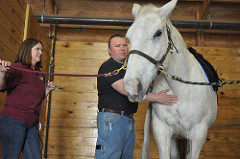
Central Kentucky Riders for Hope Program Director Denise Spittler coaches 1st Lt. Robert Cooley as he gets to know Chewey. A member of Horses for Heroes, Chewey helped Kentucky National Guard Soldiers as they explored coping with emotional or internal conflict, personal relationships, mental agility and strength of character as part of their resilience training. (Photo by 1st Lt. Stephen Lawson, Kentucky National Guard Resilience Program)
The approach is unique: Soldiers work with a horse to develop skills that will help them transition back to community, family and life; develop skills for interpersonal relationships; accept physiological changes; identify worldview changes; develop and achieve life goals.
Equine assisted activities and therapies offered at CKRH include therapeutic horsemanship (non-mounted); therapeutic riding (mounted); psycho- educational (non-mounted); psychotherapy (non-mounted); therapeutic carriage driving.
The Resilience Training Assistant course at the horse park took place during a four day period. Students were presented with the resilience training in both the classroom and equine setting. The training consists of identifying and explaining the six core competencies, which are the foundation of resilience training: self-awareness, self-regulation, optimism, mental agility, strengths of character, and connection followed by a series of subsequent skills that reinforce the competencies.
Each of the four days of training was topped off by Spittler introducing the classroom concepts and skills through CKRH’s metaphoric and therapeutic equine environments. Horses ranging from 800 to 1,400 pounds were utilized to help strengthen the impact of training.
One of the videos shown during the course was a Veteran’s Day public service announcement initiated by Jane Beshear, wife of Gov. Steve Beshear. Mrs. Beshear, it turns out, was a CKRH volunteer and advocate prior to gracefully stepping into her role as Kentucky’s First Lady.
“A key part of our state’s overall equine legacy is how we incorporate horses into our daily lives” explained the First Lady. “Horses for Heroes is one more example of how Kentucky is the horse capital of the world.”
“It was an honor for CKRH to be the host site for this resiliency training,” said Spittler. “The experience with Guard Members was an energizing and educational experience. It was powerful to see how this group of leaders is motivated to help other Kentucky National Guard members.”
“It was interesting experiencing military training in such an unconventional manner,” said 2nd Lt. Chris McGhee, incoming executive officer for Charlie Company, Wounded Warrior Battalion at Fort Knox. “Each day the classroom and equine environments meshed in a manner that allowed us to immediately test, apply, and evaluate the effectiveness of the course, leading to a deeper understanding of the training concepts.”
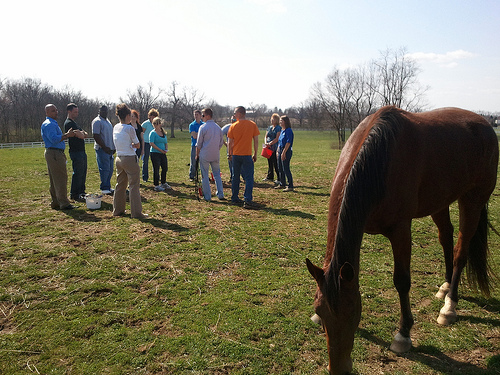
Nathan patiently grazes while members of the Kentucky resilience team discuss the lessons they learned during a four day training session at the Kentucky Horse Park. A member of the Horses for Heroes program, Nathan helped Soldiers as they explored coping with emotional or internal conflict, personal relationships, mental agility and strength of character. (Photo by 1st Lt. Rob Cooley, Kentucky National Guard Resilience Program)
Combining resilience training with the equine therapy is “good stuff,” according to Capt. Melissa Mattingly, Headquarters, 103rd Battalion Support Brigade.
“Horses show you things about yourself that you may not be able to realize on your own,” said Mattingly. “They allow you to cut through walls built around ourselves as defense mechanisms and helps expose what is underneath.”
“I gained an understanding from the horse about signals that I may or may not be sending, and I feel the interaction with the horse helps to better read people and relationships. That gave me an opportunity to look at the situation as a metaphor, as was explained to the class.”
“The Kentucky National Guard is doing a phenomenal job with their resilience program,” said Spittler. “I was really impressed by the passion of their students and their staff. Just the short time I spent with them I can see that they are committed to making a difference.”
Headquarters and special tactics units also recognized
Story by Maj. Dale Greer, 123rd Airlift Wing Public Affairs, Kentucky National Guard
Photos by Tech. Sgt. Dennis Flora and Senior Airman Maxwell Rechel, 123rd Airlift Wing Public Affairs, Kentucky National Guard
CLICK HERE FOR MORE PHOTOS OF THE EVENT
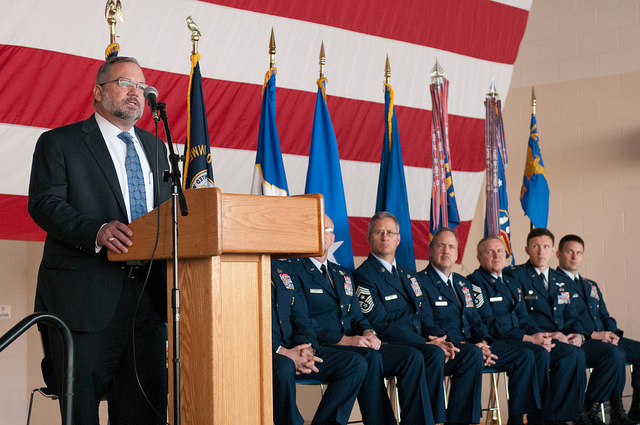
Richard Reed, special assistant to President Barack Obama for national security affairs, congratulates Airmen of the 123rd Airlift Wing during an awards ceremony held March 18, 2012, at the Kentucky Air National Guard Base in Louisville, Ky. Reed was at the base to honor the wing and two other Kentucky Air Guard units for their excellence. (U.S. Air Force photo by Tech. Sgt. Dennis Flora)
LOUISVILLE, Ky. — One of President Barack Obama’s top advisors praised the Kentucky Air National Guard for superior achievement March 18, calling the organization “second to none” during a ceremony honoring the 123rd Airlift Wing for winning a nearly unprecedented 15th Air Force Outstanding Unit Award.
Also recognized were Kentucky Air National Guard Headquarters, which accepted its 9th Air Force Organizational Excellence Award; and the 123rd Special Tactics Squadron, which received an Air Force Meritorious Unit Award from Air Force Special Operations Command.
“It is indeed a pleasure for me to be here and recognize the great accomplishments of the more than 1,200 Citizen-Airmen in the Kentucky Air National Guard,” said Richard Reed, special assistant to the president for national security affairs and senior director for resilience policy. “The missions you perform are critically important to ensuring our nation’s security, defense and disaster response, both at home and abroad.”
The 123rd Airlift Wing’s 15th Air Force Outstanding Unit Award is especially noteworthy, Reed told an audience of more than 1,000 Airmen who packed a hangar at the Kentucky Air National Guard Base. Research indicates that only three other units have ever earned 15 AFOUAs.
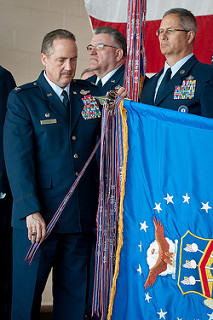
Col. Greg Nelson, commander of the Kentucky Air National Guard’s 123rd Airlift Wing, pins a streamer on the wing’s unit flag during an awards ceremony held March 18, 2012, at the Kentucky Air National Guard Base in Louisville, Ky. The streamer represents the wing’s 15th Air Force Outstanding Unit Award, a nearly unprecedented achievement in the history of the U.S. Air Force. Only three other units are believed to have earned 15 AFOUAs. (U.S. Air Force photo by Senior Airman Maxwell Rechel)
“This level of achievement is a testament to the 123rdAirlift Wing’s rich legacy of service and excellence, dating back to your founding in 1947,” he said. “With six Distinguished Flying Unit Plaques, three Metcalf Trophies, three 15th Air Force Solano Trophies and three Spaatz Trophies, the 123rd Airlift Wing is among the most — if not the most — decorated units in the United States Air Force.
“That heritage of excellence continues today. Your recent accomplishments show a dedication to mission performance that is really unsurpassed. Whether supporting the war overseas or defense of the homeland in the United States, you are always there.”
During the award period, which ran from October 2009 to September 2011, the wing deployed 741 personnel to 32 locations in 21 countries. Many were in direct combat or combat-support missions, including 150 Airmen who deployed to Bagram Air Base, Afghanistan, with five of the unit’s C-130 aircraft to fly airlift missions in support of Operation Enduing Freedom. Those Airmen logged an unprecedented 100 percent mission-capable rate while flying 3,600 sorties that transported 41,000 passengers and moved 13,500 tons of cargo, including 3.5 million pounds of airdropped materiel. They also broke multiple monthly records for overall combat airdrops and amount of cargo moved in theater.
Members of the 123rd Civil Engineer Squadron deployed to Bagram, too, completing more than $300 million in base construction projects in six months, including a fully functional Air Mobility Command passenger terminal and the first permanent C-130 maintenance hangar.
In a novel concept, the wing deployed 17 Airmen to Afghanistan for Agribusiness Development Teams 1 and 2, fostering the creation of a sustainable agriculture economy and boosting income for 1,400 Afghan raisin vineyards by 50 percent in less than 6 months. One of the wing’s officers was later selected as commander of ADT 3 — the first time an Air Guardsman has led an agribusiness development team. That group of 60 Army and Air National Guardsmen coordinated Afghanistan’s first-ever commercial mulberry harvest in the Panshir Valley, producing 75 metric tons of mulberries and netting about $45,000 for local farmers.
Over in Kyrgyzstan, the wing deployed 28 Security Forces to Manas Air Base, protecting 4,000 personnel and over $2 billion in assets during the massive build-up of forces needed to support a troop surge in U.S. Central Command.
When a devastating earthquake struck Haiti in 2010, the wing’s 123rd Contingency Response Group was hand-picked to open an airlift hub in the Dominican Republic, enabling the evacuation of 210 personnel and delivering 725 short tons of life-saving aid. The CRG Commander also coordinated the airflow into Haiti and later deployed to run air operations for tsunami and earthquake relief in Japan.
“I’ve had the opportunity to watch elements of this unit in action in the Dominican Republic, and I’ve certainly spent a fair amount of time dealing with the aftermath of events in Japan,” said Reed, who leads the development of disaster-response policy at the White House. “I can tell you: At the end of the day, your work speaks for itself. In most cases, that’s either a really good thing or a really bad thing. In your case, it’s a damn good thing.”
Reed noted that the 123rd Airlift Wing has a long history of disaster response and humanitarian relief, including missions in response to Hurricanes Katrina, Rita and Gustav.

More than 1,000 Air Guardsmen gathered in the Fuel Cell Hangar at the Kentucky Air National Guard Base in Louisville, Ky., March 18, 2012, for an awards ceremony in which a top White House official, Richard Reed, honored three local units for outstanding service. Reed is special assistant to President Barack Obama for national security affairs. (U.S. Air Force photo by Tech. Sgt. Dennis Flora)
“Your militia heritage really gives you a special passion to support the citizens of the United States,” he said. “And you are true innovators in homeland security and defense, as exemplified by The 123rd Airlift Wing Initial Response Hub, which stands alone in the capability it will provide during response to a major disaster.”
Now operational, the Initial Response Hub is a small group of Kentucky Air Guardsmen with the training, equipment and C-130 aircraft to deploy within hours to the site of a natural disaster or enemy attack, set up command and control of a non-functioning airfield, provide first-feed situational awareness to the national command authority and begin accepting incoming aircraft for humanitarian assistance or medical evacuation. No other unit in the U.S. military has all of these capabilities housed in one unit, with the C-130 aircraft to permit immediate response.
“In short, you bring the capability our nation will need during a crisis, and you will be there within a few hours of the call,” Reed said. “It’s a capability that will serve this nation well, and it’s a capability we need to provide for the safety and welfare of Americans here, as well as citizens across the globe.”
Reed said the Initial Response Hub’s first-feed situational-awareness capability is especially valuable, given that reliable information is often hard to come by in the early hours following a natural disaster.
“I spend a lot of time deconflicting information from a variety of sources to try to prepare senior leadership — in particular the president — for understanding what’s going on, on the ground,” he said. “That’s not an easy task to do. So this capability will really help me paint the picture for the boss in such a way that he can make decisions from a very, very well-informed position.”
Reed noted that the Initial Response Hub is more than just an idea on paper. It was validated in 2010 when the wing earned an “Excellent” rating during the Air Mobility Command’s first-ever homeland-defense Operational Readiness Inspection. It also was mobilized during the last three National Level Exercises — large-scale disaster-response scenarios involving a full spectrum of government agencies.
Last year, for example, the wing stood up an Initial Response Hub for medical evacuation in Missouri, directing 17 aircraft, 80 tons of cargo and 104 passengers while interoperating with U.S. Transportation Command, the Federal Emergency Management Agency and numerous other federal, state and local civilian organizations.
“The president’s guidance is pretty simple: We need to have an aggressive, well-coordinated and comprehensive response,” Reed said. “Your understanding of your mission in support of domestic operations is key. (Your wing commander) tells me the 123rd Airlift Wing is not the kind of unit that waits to be called when need arises. You pick up the phone and say, ‘You need us, and we’re on the way.’ I call that leaning forward, and I appreciate that. When America needs help, you’ve constantly demonstrated that you are ready and you will be there.”
The day’s other two awards recognized exceptional achievements by the 123rd Special Tactics Squadron and Headquarters, Kentucky Air National Guard.
The special tactics squadron earned a Meritorious Unit Award as part of the 720th Special Operations Group during an evaluation period that ran from October 2009 to September 2011. During that time, the Kentucky unit deployed more than third of its personnel in 29 combat and combat-support roles in Southwest Asia, Southeast Asia, Africa, South America and the Caribbean. The unit’s combat controllers and pararescuemen conducted more than 450 ground combat missions and 10,000 hours of Combat Search and Rescue, saving 54 personnel.
The squadron’s Airmen also were among the first U.S. troops on the ground following the Haiti earthquake, establishing air operations at Port-au-Prince and controlling the first C-17 disaster-relief airdrop.
“I was there when that happened,” Reed recalled, “and I can tell you, if it had not been for the efforts of that particular mission, that disaster-recovery operation could have gone south really, really quickly.”
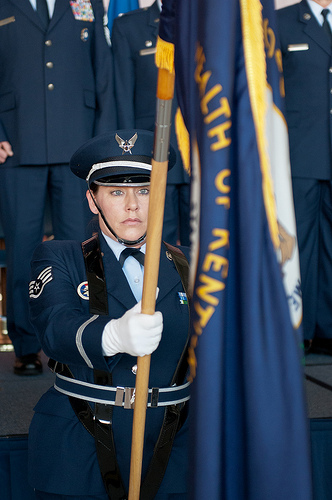
Staff Sgt. Windy Wagner of the 123rd Airlift Wing Honor Guard displays the flag of the Commonwealth of Kentucky during a presentation of the colors conducted March 18, 2012, at the Kentucky Air National Guard Base in Louisville, Ky. The presentation preceded an awards ceremony in which a top White House official, Richard Reed, honored three local units for outstanding service. Reed is special assistant to President Barack Obama for national security affairs. (U.S. Air Force photo by Tech. Sgt. Dennis Flora)
Headquarters earned its 9th Air Force Organizational Excellence Award in part by aggressively seeking new missions for the Kentucky Air National Guard. During its award period, which also ran from October 2009 to September 2011, the unit launched successful campaigns to bring two new missions to Kentucky — a Fatality Search and Recovery Team; and a Chemical, Biological, Radiologicial, Nuclear and High-Yield Explosive Enhanced Response Force Package.
Reed noted that such accomplishments were remarkable, given the current climate of constrained resources and budget cuts that “don’t necessarily support any new missions, and yet you find a way to bring two to Kentucky.”
Headquarters Airmen also reached out to U.S. allies abroad, coordinating underwater search-and-rescue training for members of the Ecuador military and hosting foreign officers from 12 nations as part of comprehensive international education efforts.
“Congratulations again on your great accomplishments,” Reed said. “I can think of no honor more fitting than one which simply says, ‘Outstanding.’ ”
Kentucky’s adjutant general, Maj. Gen. Edward W. Tonini, echoed Reed’s praise, calling March 18 an “historic day.”
“It’s not every day we’re fortunate to receive such distinguished awards, and certainly not three of them at one time,” Tonini said. “If you’re not from Kentucky, it might seem amazing — maybe even impossible — for a single unit, in this case the 123rd Airlift Wing, to receive not one, not two, but 15 Air Force Outstanding Unit Awards. Or that the headquarters unit could merit nine Air Force Organizational Excellence Awards. Some people might even be surprised to note that the best special tactics squadron in the nation resides right here in the Kentucky National Guard.
“But having spent 43 years in the Kentucky National Guard, I’m not surprised by any bit of this. I’ve seen for myself the professionalism and pride of our Airmen, both here at home and overseas. When these C-130s touch down in any of the seven continents, they bring with them the pride of Kentucky and a legacy that I believe is second to none. Our men and women exhibit their unbridled service in everything they do for the Commonwealth and their country, from Bagram to Kyrgyzstan, from Quito to Haiti, and most recently even Antarctica. Outstanding in every way.”
Kentucky’s assistant adjutant general for Air, Brig. Gen. Mark Kraus, encouraged the men and women of the Kentucky Air National Guard to take pride in their accomplishments and the heritage of those who came before them.
“You should be rightly proud, not only of your recognition as top achievers but also of the heritage of this organization — an organization that from its very beginning valued excellence and built upon that foundation block by block,” he said. “Let me encourage you to continue to mark a path of excellence, both professionally and personally. It will equip you for the tasks and challenges that lie ahead and serve to inspire a future generation of Kentucky Air National Guardsmen who will follow your lead.
“Thank you again for your exemplary service, your sacrifice and the difference you make every day toward mission accomplishment. Folks, I simply could not be more proud to serve along side you.”
Col. Greg Nelson, commander of the 123rd Airlift Wing, thanked his Airmen for their continued legacy of excellence in defense of America.
“What a great day to be in the Kentucky Air National Guard, and what an outstanding day to be a member of the 123rd Airlift Wing,” he said. “To the men and women of the 123rd Airlift Wing: Thank You. This is your award. This is your day to celebrate.
“Wing Command Chief Master Sgt. Curtis Carpenter and I can’t thank you enough for the great things you did during this time period of October 2009 to September 2011. We also can’t thank you enough for every day you’ve been in the fight since the attack of 11 September 2001.
“Thanks to the retirees who established our heritage, and thanks to every single one of you for the oath you took, swearing your allegiance to support the constitution and your promise to fight for our freedom every single day. The 123rd Airlift Wing is the best tactical airlift wing in the United States Air Force. Thank for standing ready, thank you for flying safe and fighting hard.”
CLICK HERE FOR MORE PHOTOS OF THE EVENT
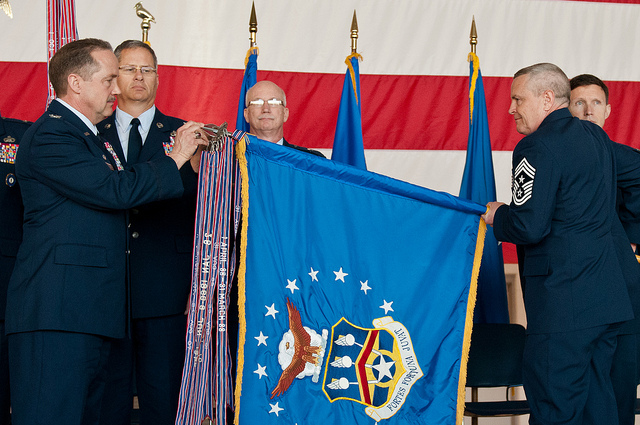
Col. Greg Nelson, commander of the Kentucky Air National Guard’s 123rd Airlift Wing, pins a streamer on the wing’s unit flag, held by Wing Command Chief Master Sgt. Curtis Carpenter, during an awards ceremony held March 18, 2012, at the Kentucky Air Guard Base in Louisville, Ky. The streamer represents the wing’s 15th Air Force Outstanding Unit Award, a nearly unprecedented achievement in the history of the U.S. Air Force. Only three other units are believed to have earned 15 AFOUAs. (U.S. Air Force photo by Tech. Sgt. Dennis Flora)
Story by Staff Sgt. Paul Evans, KY ADT 4 Public Affairs NCO
FORWARD OPERATING BASE PASAB, Afghanistan—On the horizon, the tall mountains of southern Afghanistan kept watch on April 16, 2012 as Capt. Varinka Ensminger, an officer with the Kentucky National Guard’s Agribusiness Development Team 4 ran quickly across the rugged, dusty gravel. For Ensminger, a native of Mount Olive, N.J., and also a Lexington, Ky. police officer at home, it wasn’t a question of why she was running, but who she was running for.
Please click HERE to see all the photos of Capt Ensminger’s race.
Ensminger, a 31-year-old who’s been running since the age of 10, ran to help raise money for the Team Hoyt’s Annual Boston Marathon fundraiser, running a total of 26.2 miles. Not able to run the Boston Marathon in person this year due to her deployment with ADT 4, Ensminger took time from her busy schedule as an officer on the ADT mission to train for and complete the marathon from Afghanistan.
Capt. Varinka Ensminger smiles during military training in southern Afghanistan on March 10, 2012. Ensminger ran the Boston Marathon from Afghanistan to help raise money as a member of the Team Hoyt Charity on April 16, 2012. The 31-year-old Lexington, Ky. resident chose not to let her deployment with the Kentucky National Guard’s Agribusiness Development Team 4 stop her from helping raise money for a good cause. (Photo by U.S. Army Staff Sgt. Paul Evans)
Ensminger had help from various supporters throughout the ADT and other units on FOB Pasab cheering her on, handing out drinks, and even running the same route as her, though shorter distances, to provide encouragement. By the end of her run, Ensminger had completed the grueling trek in the hot, dusty terrain in a respectable 3 hours and 43 minutes.
“It’s the Boston Marathon,” Ensminger exclaimed. “And I’ve always had compassion for folks that aren’t able to compete because of some type of either medical condition or disability. That’s how I linked up with Dick and Rick (Hoyt). I’ve read some of their books and used it as motivation for myself that, you know, whenever I can’t or don’t think I’m able to do something, I always look at them and think how they always find the will within themselves to do so.”
The inspirational story of Dick Hoyt and his son Rick can be found on the team’s website at: http://www.teamhoyt.com/about/index.html.
“This year, I knew the deployment was coming up, so I had to figure out what I was going to do to still stay in contact,” Ensminger said. “So I’m involved in all their emails…I usually send kind of pow-wow chants to them or motivation or offer advice about injuries and training.”
“As motivation, I decided I’d tell them how I’d been running through the deployment, the different locations I’d been, and trying to give kind of that spark,” Ensminger said. “Even though we’re far apart…I’ll be with them in spirit across the finish line.”
Being a member of Team Hoyt’s assembly of world-class runners has come with some pressures, according to Ensminger. She spoke fondly and seemed slightly star struck when mentioning one specific team member who is the only woman to ever win three consecutive Boston Marathons.
“Uda Pipping is like a huge, renowned, world famous athlete, so I’m in her shadow,” Ensminger said excitedly. “But I love it because she treats me like a normal person…like I’m at her level even though we’re light years apart.”
Stationed on a small base in the Afghan countryside, running options are fairly limited for Ensminger. For her run, Ensminger reached the required 26.2 miles running across FOB Pasab’s rocky terrain.
“There’s a 1.89 mile loop that I’ve just been running with a couple running partners here. Just on training runs, if darkness hits, I go back inside and finish up the distance on the treadmill,” Ensminger explained.
“I love to run outside, so the fact that I’m logging more miles on treadmill (during training) is because it’s so hard to see in the dark with the ground holes and the speed bumps and everything. I really don’t like the treadmill, but I’ve embraced the love-hate relationship and the suck of it,” Ensminger noted.
Capt. Varinka Ensminger runs the Boston Marathon from Afghanistan to help raise money as a member of the Team Hoyt Charity on April 16, 2012. The 31-year-old Lexington, Ky. resident chose not to let her deployment with the Kentucky National Guard’s Agribusiness Development Team 4 stop her from helping raise money for a good cause. (Photo by U.S. Army Staff Sgt. Paul Evans)
Aside from helping raise money for a good cause, Ensminger hoped her running also helped inspire her fellow service members.
“Personally, I hope that it motivates other folks to kind of keep on track here or find something mentally to get through the deployment,” Ensminger said. “If they’ve got a goal, make sure they still stay on track and achieve it…for me, it’s still being a part of the team no matter where you are geographically. You’re still part of it.”
Ensminger has found additional motivation in her training partner, Sgt. 1st Class Crystal Dunn of Lexington, Ky.
“I think the really great part is that I’m out here with my battle buddy Crystal, and she’s very supportive. She’ll stay at the gym for an hour, an hour and a half, sometimes two hours with me, which she wasn’t normally accustomed to. From that, she’s really embraced running,” Ensminger said.
On the day of the big run, Dunn even came out to run 10 miles in support of Ensminger’s effort.
“For me, that’s extra motivation. Because I know she’s sacrificing herself, sticking out these long hours in the gym. I’ve noticed the positive changes in her…she’s really developed as a runner and she’s kind of set some goals where she maybe normally wouldn’t have, so that makes me happy,” Ensminger added.
“We go to the gym…it’s just when she’s (Ensminger’s) running 16 miles, I figure I can at least run 6 or 8 or 10,” Dunn explained.
“She’s (Ensminger’s) been running like 50 miles (per week) for the last couple of weeks,” Dunn said. “She’s a big advocate for runners and people trying to stay active. It’s a big part of her life just because of her lifestyle, and being able to be a part of that and help someone else… it’s just very fitting, very rewarding for her.”
Staff report
Photos by Lt. Col. Kirk Hilbrecht, Kentucky National Guard Public Affairs
Surviving families of fallen service members attended Keeneland's Military Appreciation Day, April 22. (Air Force photo by Lt. Col. Kirk Hilbrecht, Kentucky National Guard Public Affairs)
Click here for more photos.
LEXINGTON, Ky. — More than 75 survivors from of fallen active duty and reserve component service members attended Military Appreciation Day at Keeneland Racetrack on Sunday 22 April, 2012.
Maj. Gen. Tonini, Kentucky's adjutant general, visits with surviving families of fallen service member attending Keeneland's Military Appreciation Day, Sunday 22 April. (Air Force photo by Lt. Col. Kirk Hilbrecht, Kentucky National Guard Public Affairs)
Sponsored by Keeneland Racetrack and coordinated by the Kentucky National Guard’s Survivor Outreach Services, the day included free admission, family activities and a buffet lunch.
The highlight of the day was being recognized in the winner’s circle.
“This was an outstanding gathering for our survivors of American heroes” said Mark Grant, SOS coordinator. “The folks at Keeneland opened their doors and their hearts to this great families and showed them what Kentucky hospitality is all about.”
Survivor Outreach Services is an Army-wide program designed to provide dedicated and comprehensive support to survivors of deceased Soldiers. Members from across the Commonwealth and surrounding states took part in the day’s festivities.
“It was an honor to be part of such a great event” said David Orange, SOS coordinator. “We can never repay these survivors for the loss of their loved ones, but we can surely show them how much we care and that their sacrifices have not been forgotten.”
To find out more about Survivor Outreach Services contact:
Mark Grant, 502-413-4172 or email him at [email protected]
David Orange, 502-607-1099 or e-mail him at [email protected]
Story by 1st Lt. Mark Slaughter, Kentucky National Guard Public Affairs
Soldiers and their Families from the 1/149th Infantry Battalion attending "ReBlue" briefings hosted by Kentucky National Guard Yellow Ribbon Program held on April 20-21, 2012 at the Eastern Kentucky University Center for the Arts in Richmond, Kentucky (Photo by 1st Lt. Mark Slaughter, Kentucky National Guard Public Affairs)
Click here to see more photos.
Staff Sgt. Anthony Williamson helps his seven month old son Jaxton practice his marching skills during a break at the 1/149th Infantry Battalion "ReBlue."(Photo by 1st Lt. Mark Slaughter, Kentucky National Guard Public Affairs)
RICHMOND, Ky. – Kentucky Guardsmen and Family Members of the 1/149th Infantry Battalion attended the Yellow Ribbon Reintegration event at Eastern Kentucky University in Richmond, Ky. April 20-21. This “ReBlue” was the final chapter of their deployment in Iraq supporting Operation New Dawn.
“This was the largest event ever conducted by the Yellow Ribbon Reintegration Program,” said 1stLt. Oscar Ortiz, Kentucky National Guard Yellow Ribbon Event Coordinator. “We pulled resources from all over the state to ensure we were able to provide a quality product for the deserving Service Members and their families.”
Yellow Ribbon is a program authorized by the National Defense Authorization Act of 2008 by the Department of Defense. The goal of the Yellow Ribbon Reintegration Program is to provide information, services, referral and proactive outreach opportunities throughout the entire deployment cycle for the Guard and Reserve members and families.
This was a team effort by the staff of the Kentucky Army National Guard Family Programs and everybody worked hard to pull off this event.
“The Yellow Ribbon Staff was very nice and helpful,” said Tina Goforth, fiancée of Spc. Garrick Wilson.
Spc. Caleb McEndree feeds his son Braxton during a break at the 1/149th Infantry Battalion “ReBlue” hosted by Kentucky National Guard Yellow Ribbon Program held on April 20-21, 2012 at the Eastern Kentucky University Center for the Arts in Richmond, Kentucky (Photo by 1st Lt. Mark Slaughter, Kentucky National Guard Public Affairs)
“I think it a good idea,” said Vietnam Veteran Steve Medairos, father of Spc. Christopher Ricci. “They never had anything like this for us. What they are doing now for the guys is good.”
“The Richmond event was the capstone to a weeklong reintegration process which prepares the unit to return to training status,” said Ortiz.
At the conclusion of the two-day training, Tina Wynn said, “We got a lot of helpful information about Tricare, Military One Souces and other information we didn’t have before.”