
Pages
Stay In Touch
More
© 2013 KentuckyGuard
Story and photos by: Spc. Abe Morlu, 133rd Mobile Public Affairs Detachment
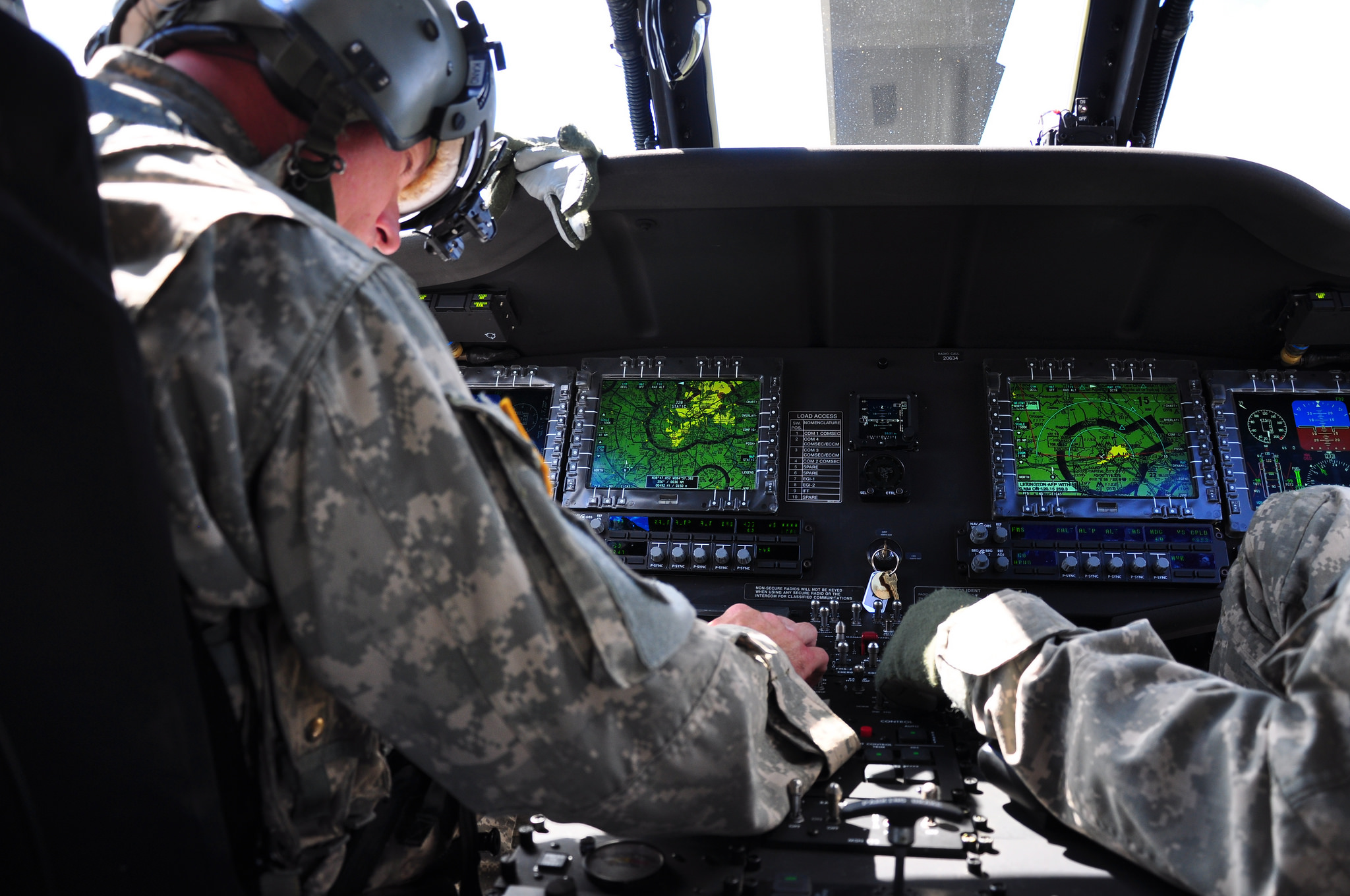
Chief Warrant Officer Wallace Kand, a UH-60 Black Hawk pilot, performs preflight checks on the helicopter prior to a training mission at the Boone National Guard Center in Frankfort, Ky., Sept. 23, 2015. These Kentucky Guard pilots train as much as they can to stay current and be ever ready should they be called upon. U.S. Army National Guard photo by Spc. Abe Morlu
FRANKFORT, Ky. -In its ongoing mission to support both state and federal missions, the Kentucky National Guard has added a new flight facility at the Boone National Guard Center. Along with the facility is a fleet of 16 new helicopters as well.
To see all the photos, please click HERE.
Construction is coming to a close on the new hangar to house the 20 aircraft used by the KYNG. That fleet consists of ten brand-new UH-60M Blackhawks, six two-year-old UH-72A Lakotas, three UH-60L (older model) Blackhawks, and one C-12 (King Air) Huron Airplane. The C-12 is currently housed in a hangar at the Capital City Airport leased by the KYNG.
“For the first time since 1983, when the Kentucky Guard was the first Guard unit to receive Blackhawks, all the aircraft will be able to fit in one building,” said Chief Warrant Officer Gerald Carroll, aviation safety officer for the Army Aviation Support Facility. The original hangar was constructed in 1972, and housed both the UH-1 Iroquois and OH-58 Kiowa.
“These were much smaller aircraft so was no problem storing them in the hangar,” according to Carroll.
Once the UH-60L arrived in 1983 that was no longer the case. Aircraft had to be left outside due to the lack of hangar space. “It is not ideal to store the craft outside because they are susceptible to damage from Mother Nature,” said Staff Sgt. Daryl Casey, a crew chief at the AASF.
Corrosion and lightning strikes are the nemesis of aircraft. They can cause millions of dollars of damages. “Lightning can damage bearings as well as the hull of the craft on its escape,” said Chief Warrant Officer Stephanie Motley, one of the instructor pilots for the new UH-60 mike model aircraft.
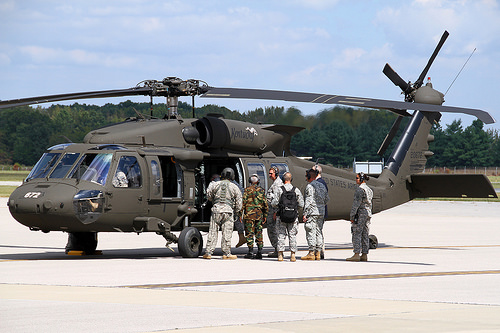
Kentucky Guardsmen and members of the Djibouti military board a UH-60M Blackhawk at Fort Knox, Ky., Sept. 16, 2015. During the Djibouti delegation’s visit to Kentucky, the new Blackhawks provided aerial tours of Kentucky Guard facilities as part of the National Guard’s State Partnership Program. (U.S. Army National Guard photo by Staff Sgt. Scott Raymond)
Not only will the new facility keep the aircraft out of the elements saving the Kentucky Guard from high costs in maintenance and repair, but it will also save energy consumption. The new facility will allow more natural light to enter during the day, relieving the reliance on electric lighting to preform daily tasks. This change directly eased the budget strains created by high energy costs.
Should there not be enough sunlight to illuminate the hangar, electric lighting can be used. However the electricity to turn the lights on does not come from the local power company. It is produced by the solar array installed on the roof of the hangar.
Gone are the days of heating the hangar with vents high up on the ceiling. The floors of the new hangar use geothermal energy to heat itself. They bring the heat closer to the crew and not inefficiently blowing down from above as hot air rises.
“The new technologies and availability of necessary outlets, allow us to better maintain the new Mikes,” said Chief Warrant Officer Stuart Lindfors,” a UH-60 instructor pilot.
Servicing the new helicopters is the same as its predecessor however, there are a few new parts alien to the UH-60L which require maintenance. The new model has new systems such as a rotor brake, said Casey.
“It’s like working on a 2000 Ford truck versus working on a 2015 Ford truck,” Casey said. “It pretty much works the same but has a few extra bells and whistles.”
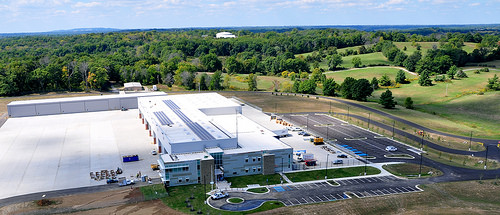
An overhead view of the new Army Aviation Support Facility at the Boone National Guard Center in Frankfort, Ky., Sept. 23, 2015. The new AASF is spacious enough for all the aircraft to be stored indoors, and it is also very energy efficient using solar and other natural power sources. (U.S. Army National Guard photo by Spc. Abe Morlu)
One of those bells and whistles is the hover hold function present in the new model. It allows the pilot to hold a set altitude and position with no input form the pilot. No more having to fight with external forces to hold position as in the older model.
“They are both great aircraft but, the new technology helps us better use our skills learned in training,” said Chief Warrant Officer Wallace Kand, a recent graduate of the UH-60M flight course.
“No longer will we envy the equipment and facilities of other states,” said Carroll. “Kentucky is a leader when it comes to Army aviation.”
Spirits are high with anticipation of beginning operations in the new facility as well. It will be the first time in almost 40 years being able to house and maintain all the aircraft indoors.
“We have accomplished so much with our antiquated equipment and facilities over the years,” said Col. Brian Abney, commander of the AASF. “I cannot wait to see what we will produce with the new facilities.”
Staff Report
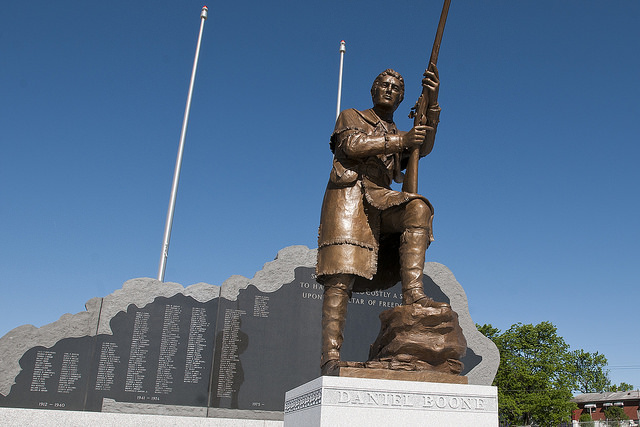
A statue of Daniel Boone keeps watch over the new Kentucky National Guard Memorial in Frankfort, Ky. The monument with the inscribed names of more than 230 Kentucky Guardsmen will be dedicated this Memorial Day. (U.S. Army National Guard photo by Staff Sgt. Scott Raymond)
FRANKFORT, Ky. — On a Memorial Day unlike those gone by, the Kentucky Guard stands proud before a fitting monument to those Citizen-Soldiers who gave the last full measure of devotion for their home and Nation. The dedication of the Kentucky National Guard Memorial has been a long time in the making. But as we present it to the world, Guardsmen are reminded, and will be everyday henceforth, ‘What Memorial Day mean to me?’
“Memorial Day is a day that is set aside to remember and honor those who served and gave their lives so that we may live and continue to live in this country freely. Not only is it a day to reflect on the sacrifices made by the Service members, but in my opinion it is also a day to hold those ones close who have lost a father, mother, child, brother, sister or a friend, while they were selflessly serving and defending our Country.”
Spc. Stacy Pesut, 103rd
“Memorial Day is a day to reflect for me. Having been born in a different country, under a different political system, I am acutely aware that America is the greatest country in the world; and Memorial Day is a day when I can reflect and show reverence to the men and women of our armed forces who gave their life in order to ensure it stays that way.”
1st. Lt. Marlon Jones, 2nd Battalion, 138th Field Artillery
“Memorial Day is a day I take time to remember my fallen brothers I knew, who served with my unit once upon a time.”
Staff Sgt. Dana Stringer, 149th Maneuver Enhancement Brigade
“I don’t think you’d have to call it Memorial Day, nor do I think it matters what you call it. We need an occasion annually to gather together and remember our fallen brothers and sisters, because it is through that fellowship that we heal and through that fellowship that the fallen live on in our memories. We call it Memorial Day, but that’s not what’s important.”
Col. Michael Abell, Director, G1
“It is a day when we should all pause to honor the Service members that paid the ultimate sacrifice defending our freedoms, rights and liberties. It should also be a day that we recommit ourselves to maintaining vigilance over those freedoms so that their sacrifices are not wasted and that our children and future generations have the same rights and opportunities.”
Command Sgt. Maj. Michael Rowan, 198th Military Police Battalion
“This day is a standstill moment in time for us to stop what we’re doing, remember the fallen and what the words honor and duty actually mean. We need to celebrate and appreciate what we have, because many lost everything to give us the freedom to choose who we are and the ability to live life to the fullest.”
Sgt. 1st Class Rebecca Wood, 149th Maneuver Enhancement Brigade
“For most people Memorial Day represents the beginning of summer, a time for picnics, beach trips, boating and vacations. Some feel this is shallow and inappropriate, but I’ve come to think otherwise: It is because of the sacrifices of those who fell in defense of our nation and our unique American way of life that we can have the freedom to do all of these things. So celebrate, America, party on! Go four-wheeling and hiking and skiing and have a wonderful time. And as you gather around the barbeque at the end of your Memorial Day and watch the setting sun, be sure to raise a glass in honor of those who made this all possible, our honored fallen, for they are surely looking down upon us with pride … and more than a little envy.”
Staff Sgt. (ret.) David Altom, Public Affairs Office
Staff Report
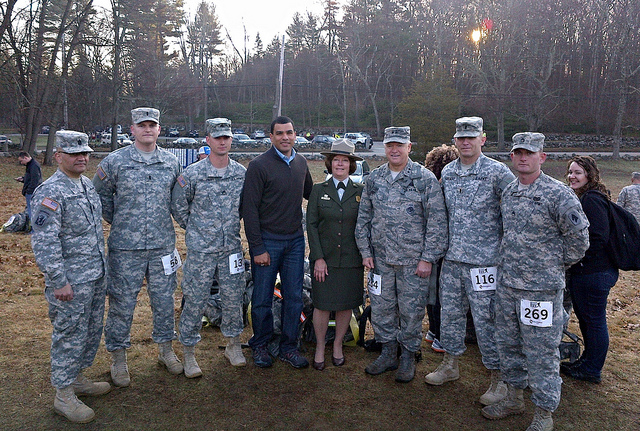
Kentucky Guardsmen are greeted by the Adjutant General for Massachusetts, Maj. Gen. L. Scott Rice (third from right) at the Boston Tough Ruck in Concord, Mass., April 18, 2015. The event brought more than 230 Service members and first responders to Minuteman National Historical Park for the 26.2 mile ruck march.(Courtesy photo)
FRANKFORT, Ky. — For the second year in a row, Kentucky Guardsmen participated in the Boston Tough Ruck in Concord, Massachusetts, April 18. 1st Lt. Carson Gregory with the 2123rd Transportation Company organized the team to compete. Staff Sgt. Jarred Turner and Sgt. Nick Holloway, also from the 2123rd were joined by 1st Lt. Christopher Cook from the 299th Chemical Company to round out the team.
The race, which took place in Concord’s Minuteman National Historical Park, is a 26.2 mile event held in conjunction with the Boston Marathon. The Tough Ruck is a program of the Military Friends Foundation to honor military members who have been killed in action or died of suicide. Funds raised from the race go to benefit military families.
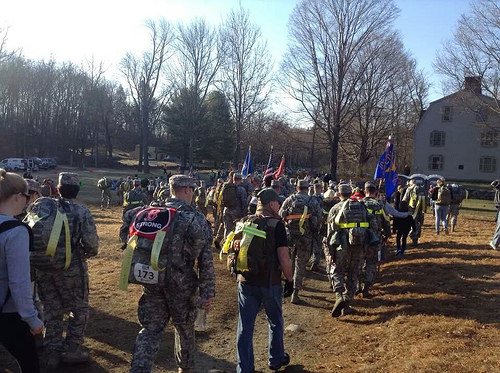
Service members, first responders and civilians begin the 26.2 mile long Boston Tough Ruck in Concord, Mass., April 18, 2015. Proceeds from the event went to Military Friend Foundation to benefit the families of Service members. (Courtesy photo)
“No one knows a Soldier like another Soldier. When we heard of the great strides that the Military Friends Foundation were making in the lives of Soldiers in need we knew we wanted to be a part of it,” said Turner. “Not only do we get to raise money for this great cause but we get to spend a weekend with like-minded individuals.”
Click here for more photos.
More than 230 participants marched in the event. In addition to a large number of Service members, numerous firemen, police officers and civilians also took on the challenge. Gregory said it was impressive to see the outpouring of support for fallen heroes. That support of remembrance is what event officials say make the tough ruck so special.
“What stood out for me was the number of streamers, the names of fallen Soldiers, that were carried on Saturday,” said Gregory. “Even with the hundreds of names that participants registered ahead of time, the amount of additional names created before the start of the race was humbling.”
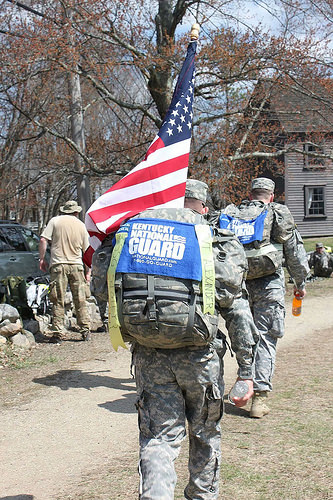
Kentucky Guardsmen march in the Boston Tough Ruck in Concord, Mass., April 18, 2015. The Kentuckians were easy to spot with the their large U.S. and University of Kentucky flags. (Courtesy photo)
“I took the opportunity to ask about the names other Soldiers were carrying. Hearing the stories, and how much that particular Soldier meant to them, put the strain and privilege of the event into perspective for me.”
The event is run by roughly 100 volunteers, from military families to Boy Scout troops. The Kentuckians all agreed that the atmosphere, while not the original route or size of the Boston Marathon, has its own special feel that is appropriate for the location and the cause.
“Crossing the finish line to be greeted by the Gold/Blue Star families is a great feeling,” Turner said. “The community is also very patriotic, their support is what keeps us going.”
The Kentucky team trained for months prior to the ruck, logging more than 300 miles combined to prepare for the 26.2 miles. Turner said it was all about practice and hydration, but the focus remained on them doing this as a team. Holloway said he was doing it to support his fellow Soldiers he marched with and to help them achieve their goal, as well as his own.
Those goals were measured in accomplishments and memories.
This year hit home for Holloway as they marched in memory of past Soldiers. Not long before the ruck, he lost his grandfather who was former military and Kentucky State Trooper.
“I told my Papaw before he passed that I was going to participate in the Boston Marathon Tough Ruck this year, and he was extremely proud that I am setting such a goal, and putting myself in a position to help others,” said Holloway. “On a personal note, that’s a big part of who my Papaw was, and a great man that I looked up to.”
“When it’s all said and done we may not get towering trophies or championship rings for completing the Tough Ruck, but our paycheck will be in the form of knowing that we are successful and we did it for an amazing cause.”
“With 2015 marking the second consecutive year Kentucky Soldiers have accepted the event’s challenge, it supports the idea that Kentucky Guardsmen are always up for a challenge,” said Gregory. “The act of Soldiers pushing themselves to limits like these speaks volumes about the dedication, drive, and determination of Soldiers and units we have here in the Commonwealth.”
Gregory is looking forward to another opportunity to do the ruck march. As are his troops.
“It wasn’t two days — in fact, we were on the drive home from Boston — when my Soldiers were asking about plans to participate in the Tough Ruck next year. Who knows — maybe we’ll try for a three-peat.”
Story by Lt. Col. Kirk Hilbrecht, Director of Public Affairs, Kentucky National Guard
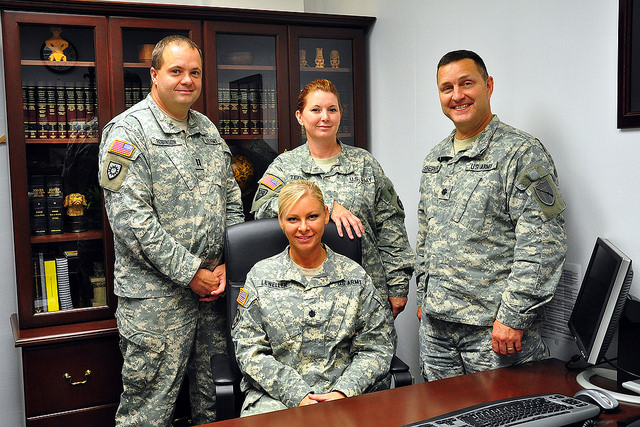
The Kentucky National Guard’s Staff Judge Advocate General, Lt. Col. Natalie Lewellen (seated), (L-R) Capt. Spencer Robinson, Staff Sgt. Paulette Terry and Lt. Col. Jason Shepherd. The team works to provide legal counsel to the Kentucky Guard. (U.S. Army National Guard photo by Staff Sgt. Scott Raymond)
FRANKFORT, Ky - Kentucky’s Staff Judge Advocate Lt. Col. Natalie Lewellen has a vision for her Judge Advocate General directorate.
“Our door is always open and we will always give you our best legal opinion. Hopefully such advice will be helpful to the Commanders and Service members we are here to serve,” Lewellen stated. “There may not always be an easy legal ‘Yes’ in every scenario or proposal, but we will always try to help you find a legal and ethical option that will work.”
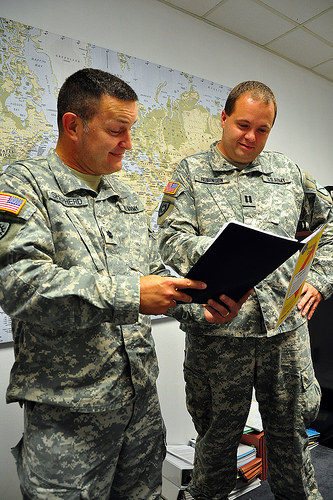
Lt. Col. Jason Shepherd and Capt. Spencer Robinson discuss a legal case file in Frankfort, Ky., Aug. 19, 2014. The members of the Kentucky Guard’s Staff Judge Advocate General’s office assist in handling a wide variety of legal cases on a daily basis. (U.S. Army National Guard photo by Staff Sgt. Scott Raymond)
Kentucky’s State Judge Advocate has seen a significant uptick in casework with in the National Guard and Kentucky. Most of these cases involve violations in ethics, regulations and sexual assault cases. Lewellen attributes the increase in caseloads to the drawdown in theatre operations and an increase in ethic and work environment awareness.
“The military has amplified focus in the areas of government ethics and sexual assault prevention in recent years,” said Lewellen. “As a result, there are now higher demands for education, training, investigation and resolution in these areas, which expands the scope of the traditional legal caseload. In fact, elements in both the NCOER and OER directly reflect the Soldier’s workplace attitude and bearing with regard to these ideas, as to the wave of new policies, instruction and directives issues by higher authorities in these areas.”
With only Lewellen and Staff Sgt. Paulette Terry, full-time staff paralegal, serving Kentucky’s 8,500 troops on a daily basis, case work began to pileup.
To expedite the increased case load, Lewellen brought on two more full-time JAG officers; Lt. Col. Jason Shepherd and Capt. Spencer Robinson.
Both have extensive backgrounds in law and regulations. Prior to joining the Kentucky Guard JAG team, Shepherd worked for the IRS’ tax exemption and government divisions. Robinson worked as a contractor for Medicaid cases and in a private law practice.
“I was interested in the types of cases the Kentucky JAG office worked on,” stated Robinson. “This JAG office is more interesting and challenging that the general practices and state agencies I’ve served.”
Though this current JAG team has been together for a short time, they have quickly learned to exercise each others’ strengths.
“I really like the crosstalk and the complimentary talents each of us has to serve our Kentucky Guard,” said Shepherd. “Having a qualified JAG office focused on helping our Kentucky Guard find the right way through a problem truly is good news.”
Staff Report
Government Shutdown UPDATE
FRANKFORT, Ky — The second week of Government Shutdown is quickly coming to a close. Questions from our Kentucky Guard Soldiers, Airmen, civilian employees and our families abound. Here are some quick facts for you regarding this shutdown.
1. The Government is shutdown. As such, this time period is NOT business as usual. Congress has yet to appropriate funds to pay for FY2014 operations and activities.
2. National Guard drill periods have been suspended. This is due in part to the lack of appropriated Operations and Maintenance (O&M) monies that would allow Guardmembers to order new parts, to travel to drill, to contract support for drilling Service members.
3. Pay Our Military Act is law. This law allows the government to pay Servicemembers who are working in an active capacity.
If you have any specific questions as to how the above items pertain to you, please contact the leadership in your chain of command.
The National Guard Bureau has created a micro-site that offers the latest information and extensive policies regarding the Government Shutdown. These items can be accessed at: http://www.nationalguard.mil/features/shutdown/default.aspx
While we endure the shut down, we encourage you to remember these three items:
1. The Government is currently shut down. As such, we are not back to business as usual, even though most of our furloughed workers are back to work.
2. Fact is fact. Fiction is fiction. Rumors move at the speed of light.
3. Your leaders have information and resources for you. Again, call your chain of command if you have any questions.
That is what your Kentucky National Guard leaders are here for.
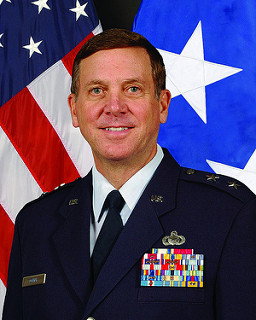
Maj. Gen. Edward W. Tonini, Adjutant General, Kentucky
October 8, 2013
To all members of the Kentucky National Guard, their families and to those who support our National Guard:
I wanted to reach out to you all with the most up-to-date information at my disposal. If you have a specific question related to you or your section, don’t hesitate to use the chain of command to garner the answers to your questions. Your Kentucky Guard leaders are in constant contact and are briefed several times daily regarding the Government Shutdown, the mil-tech recall, and other pending issues.
UPDATE ON FURLOUGHED MILITARY TECHNICIANS:
We are extremely thankful to have the vast majority of our Full-Time National Guard Duty Service Members back to work as a result of the Pay Our Military Act and the Secretary of Defense’s interpretation of the same.
We are diligently working with our respective representatives at the National Guard Bureau and our contacts within the DoD to bring ALL of our Full-Time National Guard Duty personnel back to work.
The government is still shut down. As an obvious consequence, ‘business is NOT back to normal.’ The nation’s military – as a whole – has been extremely limited in its ability to perform by the lapse of appropriated funds for FY14, which started on October 1st.
WHAT THIS MEANS TO YOU AND OUR KENTUCKY GUARD:
Drills have been suspended. Mission support is limited. Travel is restricted. The National Guard-funded cooperative agreements with our state entities and facilities are in extreme flux and remain very much at risk.
The entire National Guard needs appropriated dollars to do our job.
I speak for each and every Kentucky Guardsman when I say, “We want to do our job.”
OUR JOB is to stand ready for when the Governor or the President calls us to duty. This duty may be stateside in the Commonwealth or in a neighboring state; fighting the waters, the winds or the earthquakes. OUR JOB may be conducted overseas to battle terrorism and to keep our freedoms free.
Our Kentucky National Guard members want to do the job we signed up to do.
Right now, we can’t do OUR JOB.
I’m deeply concerned that this lapse in appropriated funds is crippling our ability to respond in time of crisis. Our traditional Guardsmen can’t train, can’t prepare, can’t conduct drills to ready ourselves and our equipment to deal with disasters –natural or man-made.
The longer the government operates with a lapse in appropriation, the worse our readiness becomes for our state and our nation, as part of the Homeland Defense team.
I once again assert that all Soldiers and Airmen of the Kentucky National Guard are mission critical to our Commonwealth and our country.
As best we can, we’ll continue to stand ready, with a very lean force, to respond to the call of our Governor to save lives and property here at home. We still are the most cost-effective force to defend America abroad when called.
I am committed to working with senior military and political leaders, encouraging them to allow us to train to maintain our ability to do our job when called.
Again, you, too, can express your concerns to our elected officials.
Your voice, as a member of the Guard, is crucial to ensure that we can do our job.
Our representatives, our senators and our President are accountable to us and need to hear our concerns.
I know the continuing budget uncertainty is stressful and frustrating. Please reach out to your Guard leadership for continued support.
Your professionalism and commitment to our Guard makes us the best force and the best Troops available for our Commonwealth and our country.
Thank you for your continued service in these very uncertain and challenging times.
God Bless you all.
Major General Ed Tonini
The Adjutant General – Kentucky
Story by Staff Sgt. Scott Raymond, Kentucky National Guard Public Affairs
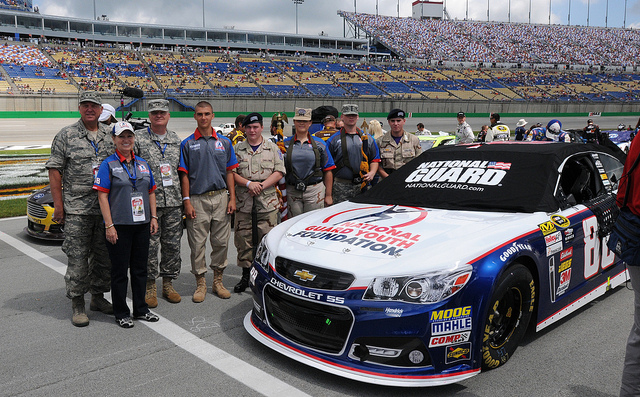
Kentucky’s adjutant general, Maj. Gen. Edward W. Tonini joins Gail Dady of the National Guard Youth Foundation, Louisiana’s adjutant general, Maj. Gen. Glenn H. Curtis and Challenge Program cadets for a group photo with the 88 Chevrolet on pit road prior to the start of the Quaker State 400 NASCAR race at Kentucky Speedway in Sparta, Ky., June 30, 2013. The National Guard Youth Foundation teamed up with Hendrick Motorsports to race the 88 with a special logo for the race at Kentucky Speedway. (U.S. Army National Guard photo by Staff Sgt. Scott Raymond)
SPARTA, Ky. — Persistent rain showers did little to dampen the spirits and excitement of a group of teens at the Kentucky Speedway this past weekend. The young men and women are current and former cadets with the National Guard Youth Challenge programs. They were given a full-access pass to all NASCAR had to offer at this year’s Quaker State 400 race at the track in Sparta, Ky.
As part of the National Guard Youth Foundation - the national nonprofit that supports Challenge - and the Challenge program’s relationship with Hendrick
Motorsports, several cadets, foundation officials and members of the National Guard were invited to the track to see Dale Earnhardt Jr. drive the number 88 Chevrolet with a special National Guard Youth Foundation logo on his car.
To see more photos from the race weekend, click here.
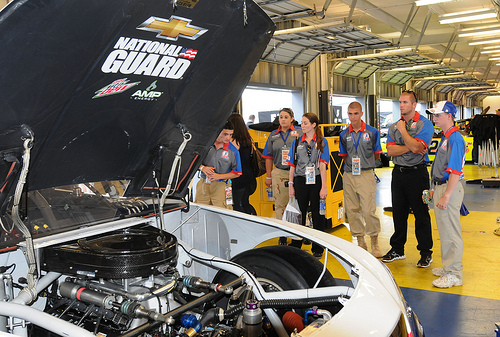
Challenge program cadets receive a garage tour from Hendrick Motorsports prior to the running of the Quaker State 400 NASCAR race at the Kentucky Speedway in Sparta, Ky., June 29, 2013. The tour was part of a full weekend of race access for the cadets as part of the relationship between Hendrick Motorsports and the National Guard Youth Foundation. (U.S. Army National Guard photo by Staff Sgt. Scott Raymond)
“We are honored and deeply appreciate the opportunity to partner with Hendrick Motorsports and Dale Earnhardt Jr. to raise awareness of the Challenge program,” said Gail Dady, National Guard Youth Foundation Board of Directors President. “The Hendrick Motorsports team went to an extraordinary level to make this an unforgettable experience for the cadets.”
The excitement began Friday morning with a press conference announcing the sponsorship and highlighting the Challenge programs. Rome Meade, a graduate of the Appalachian Challenge Academy in Harlan, Ky., sat with Dady, Earnhardt Jr., and Kentucky’s adjutant general, Maj. Gen. Edward W. Tonini in the press room at the track for the interaction with media. Meade said he was proud to have Earnhardt drive for the program, acknowledging that many more people will know about the program after the race.
In between the rain drops, Meade and his fellow cadets were treated to garage tours, a meet and greet with Earnhardt, Rick Hendrick, owner of Hendrick Motorsports and also University of Kentucky Basketball coach John Calipari.
During the meet and greet, Earnhardt told the cadets and the crowd that the relationship he has had with the National Guard has been one he has had a lot of fun with and takes very seriously. He said he was honored to drive his car with the foundation logo in the race and remains excited to be a part of the program.
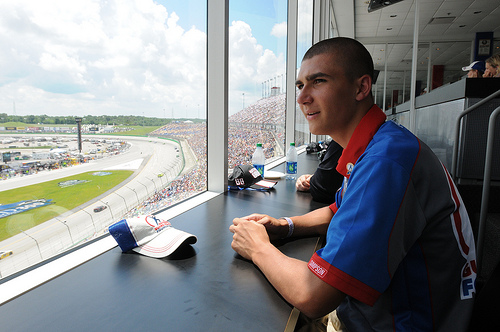
Jeremy Suhor, a cadet with the Louisiana Youth Challenge program watches the Quaker State 400 NASCAR race from his seat at the Kentucky Speedway in Sparta, Ky., June 30, 2013. A life-long race fan, the race was Suhor’s first in person. (U.S. Army National Guard photo by Staff Sgt. Scott Raymond)
“This is a great opportunity for us to tell more people about the Youth Foundation,” he said. “What it’s about, what it does, what it entails and how many kids’ lives it’s helped turned around, and the effect it’s had on the communities.”
Although Earnhardt didn’t drive the car into victory lane on Sunday, the clouds did part long enough for the cadets to enjoy the full race a day late. They were still trackside presenting the colors for the pre-race festivities and had the time to walk pit road and take some memorable snapshots with their favorite cars. The cadets eventually found a front and center seat for the race in a suite above the start/finish line of the track.
“I never expected to be at my first NASCAR race,” said New Orleans native, Jeremy Suhor, a cadet at the Louisiana Youth Challenge Program. “I’ve had a lot of great opportunities since I’ve been in Challenge.”
“The weekend has been awesome,” said Meade. “It’s one of the best experiences of my life.”
To learn more about the National Guard Youth Foundation, visit their website www.ngyf.org.
Photos by: Spc. Brandy Mort, 133rd Mobile Public Affairs Detachment, Kentucky National Guard.
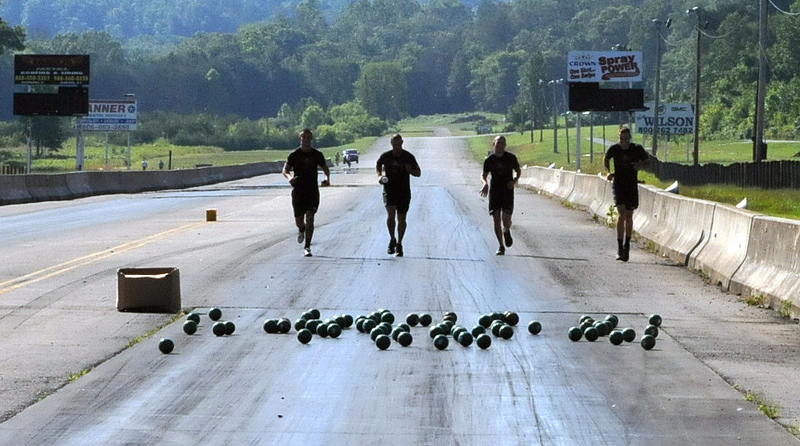
Kentucky National Guardsmen completed an Extreme Rampage Obstacle course in Clay City, Ky., June 15. The first three guardsman crossed the finish line and ran back to complete the race as a single unit.
CLAY CITY, Ky. - Four Kentucky National Guardsmen, “Live life to the extreme,” during the Extreme Rampage obstacle course challenge held in Clay City, Ky., June 15. The course measured physical and mental ability with rough terrain and various amounts of obstacles. These “Super men” show what hard work and determination are all about.
To see the full story of this event, please click HERE.
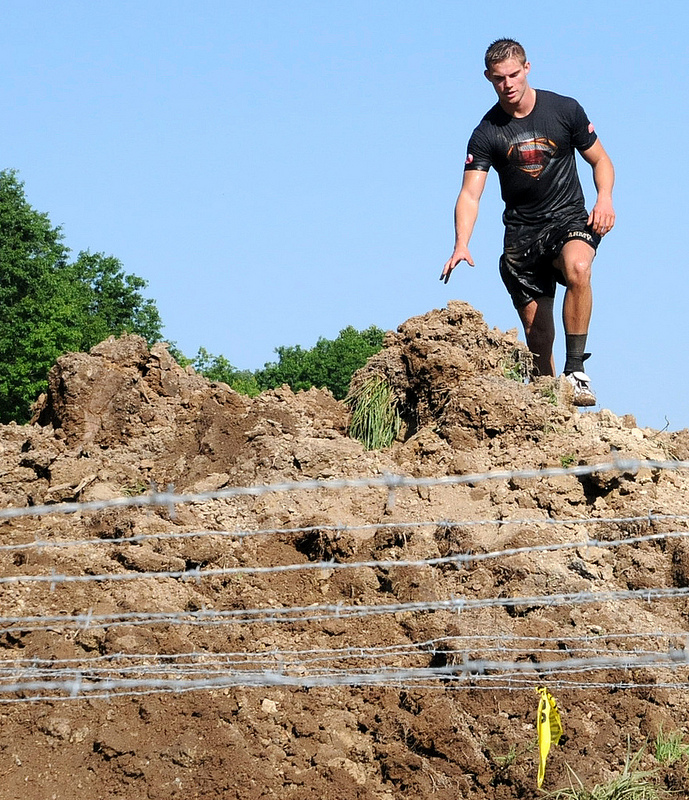
Pvt. Grant Mahoney, Chemical Specialist with the 299th Chemical Company climbs over the dirt wall obstacle in the Extreme Rampage Obstacle course in Clay City, Ky., June 15. Mahoney was one of four Kentucky National Guardsman completing the course. (Army photo by Spc. Brandy Mort, 133rd Mobile Public Affairs Detachment, Kentucky National Guard.)
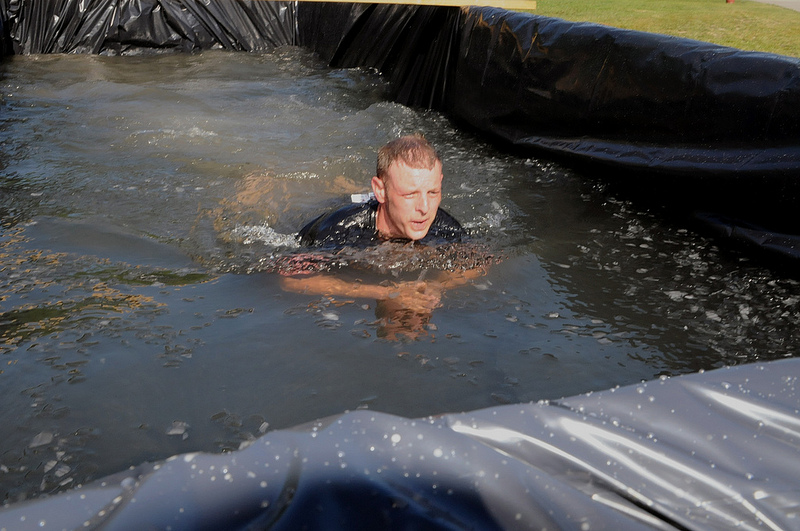
Sgt. 1st Class Dillon Blevins, Recruiting and Retention non-commissioned officer, completed an Extreme Rampage Obstacle Course in Clay City, Ky., June 15th. During one of the final obstacles, the competitors swam across an ice cold pool.
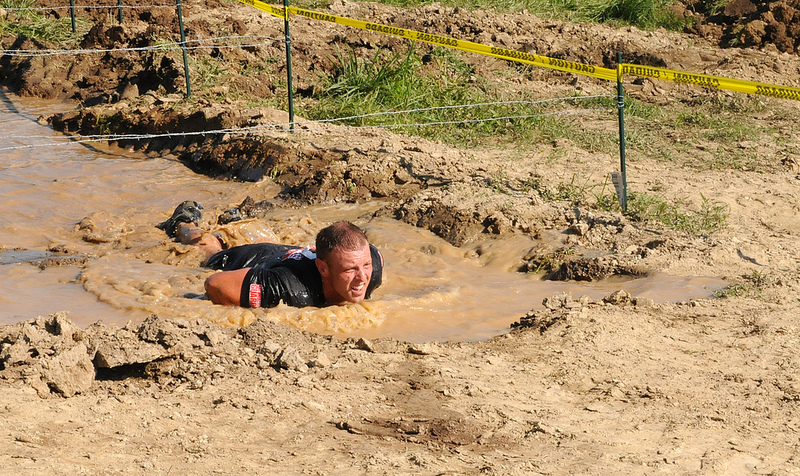
Sgt. 1st Class Dillon Blevins, Recruiting and Retention non-commissioned officer, swims through the last obstacle of the Extreme Rampage Obstacle course in Clay City, Ky., June 15. Blevins was one of four Kentucky National Guardsman completing the course. (Army photo by Spc. Brandy Mort, 133rd Mobile Public Affairs Detachment, Kentucky National Guard.)
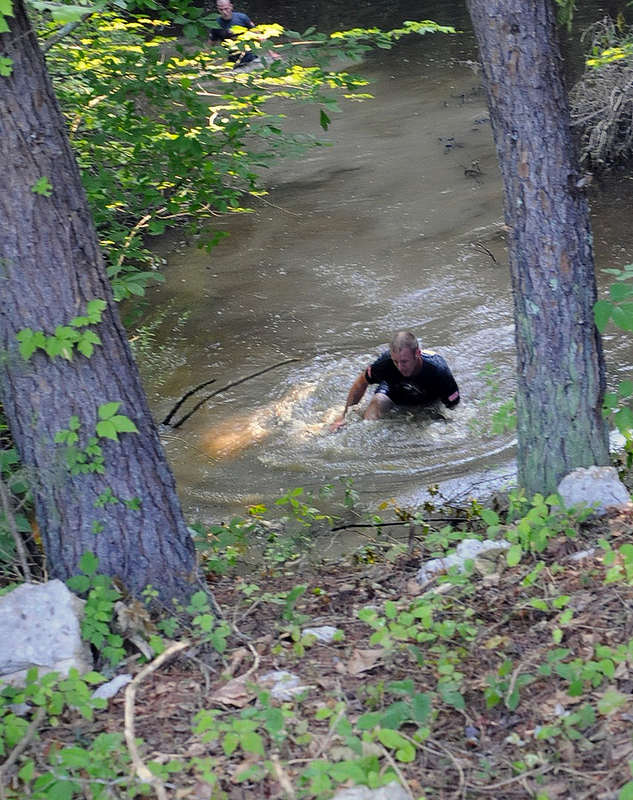
Sgt. 1st Class Dillon Blevins, Recruiting and Retention non-commissioned officer, completed an Extreme Rampage Obstacle Course in Clay City, Ky., June 15th. One of the first obstacles involved swimming or walking through a lake.
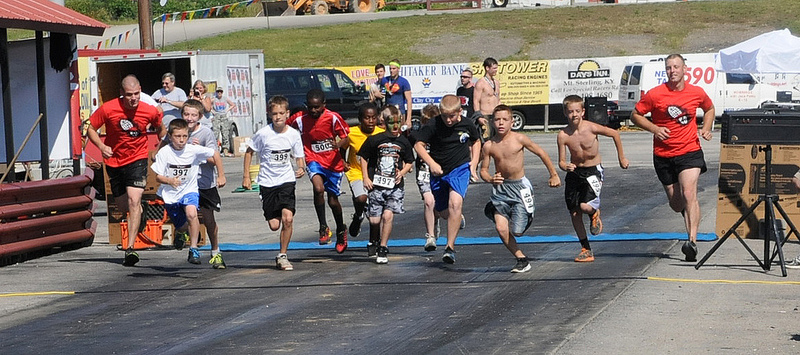
Kentucky National Guardsmen completed an Extreme Rampage Obstacle course in Clay City, Ky., June 15. After completing the 5 mile adult course, Staff Sgt. Joe Herrington and Sgt. 1st Class Dillon Blevins, Recruiting and Retention non-commissioned officers, ran a miniature course with children ages eight to twelve.
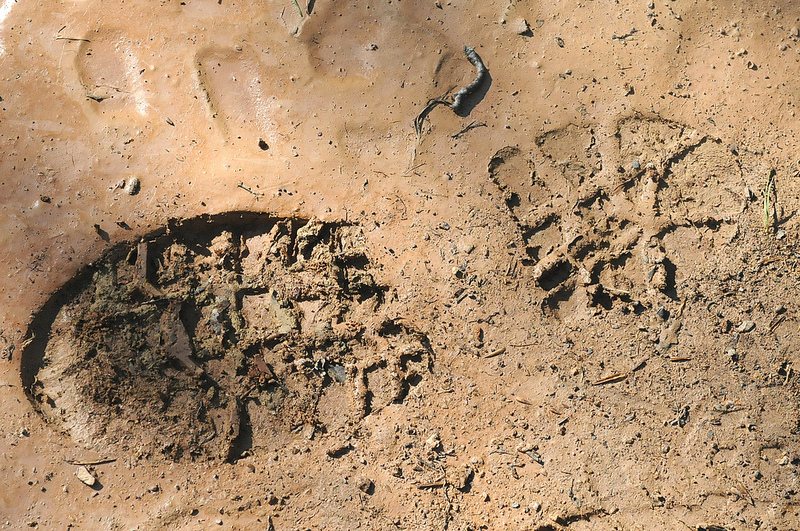
Kentucky National Guardsmen completed an Extreme Rampage Obstacle course in Clay City, Ky., June 15. The rough terrain in itself was a tough obstacle for those completing the obstacle course.
Story by Staff Sgt. Scott Raymond, Kentucky National Guard Public Affairs
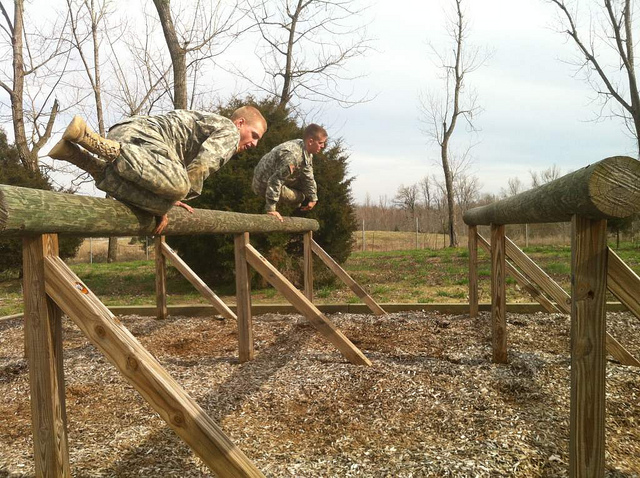
Soldiers of the 1st Battalion, 149th Infantry negiotiate an obstacle on the confidence course at the Wendell H. Ford Regional Training Center in Greenville, Ky., April 6, 2013. The Soldiers volunteered to run the course as part of a competition for selection to future Army schools. (Kentucky National Guard photo by 1st Lt. Thomas Ormsby)
GREENVILLE, Ky. — Soldiers of the 1st Battalion, 149th Infantry travelled to the Wendell H. Ford Regional Training Center in Greenville, Ky., for a 3-day drill, April 5-7, 2013. The weekend included more than just a typical training schedule however, thanks to the Mountain Warrior Assessment Program. For 22 Infantrymen, it was a chance to compete for coveted slots for attendance to notable Army schools such as Airborne and Air Assault. These courses offer specialized training that few Soldiers receive during their careers along with the chance to wear more of their “resume” on their chest.
“This assessment enables us to identify Soldiers with significant physical and intellectual skills who would be a good fit for our Scout Platoon, Sniper Squad, or as a student at a demanding course, such as Ranger or Air Assault,” said 1-149th commanding officer, Maj. Jeffrey Cole.
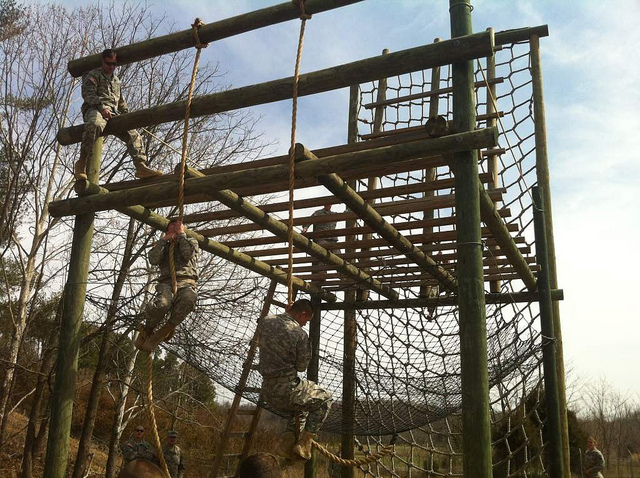
Soldiers of the 1st Battalion, 149th Infantry negotiate an obstacle on the confidence course at the Wendell H. Ford Regional Training Center in Greenville, Ky., April 6, 2013. The unit had 22 volunteers compete for slots in future Army schools such as Airborne and Ranger courses. (Kentucky National Guard photo by 1st Lt. Thomas Ormsby)
The 22 Soldiers volunteered for the opportunity with the top performers given the first options for the schools. The designed assessment included the Army Physical Fitness Test with a modified 5-mile run, the confidence course, weapon qualification and a 12-mile road march with equipment.
“Anytime you have volunteers for an event such as this, you know you are going to get the best soldiers each unit has to offer,” said event officer in charge, 1st Lt. Ryan Hubbs.
“During the assessment soldiers were not yelled at or forced to complete any exercise or activity. Instead they took it upon themselves to push as hard as possible to be best. These are the kind of self-motivated, initiative-taking soldiers that we want in our Army and this is the type of culture and attitude the 1-149 wants to foster in our Battalion.”
Click here to see more photos from the weekend on the Mountain Warriors Facebook page.
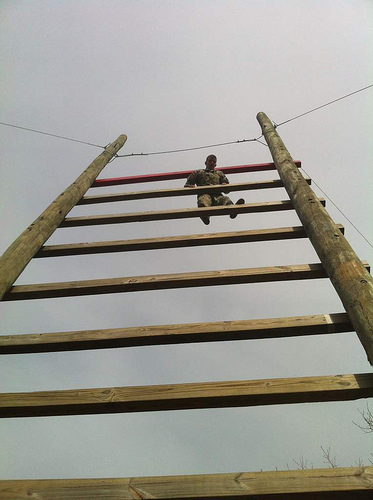
A Soldier with the 1st Battalion, 149th Infantry climbs an obstacle on the confidence course at the Wendell H. Ford Regional Training Center in Greenville, Ky., April 6, 2013. As part of a unit assessment, infantrymen were put through the confidence course, an Army Physical Fitness Test and a road march to compete for Army school slots. (Kentucky National Guard photo by 1st Lt. Thomas Ormsby)
Soldiers called it a fast paced and intense day of training with the appropriate challenges needed for the Infantry. Staff Sgt. Charlie Minix was the non-commissioned officer in charge of last year’s event and said this year’s was made more demanding. Already Ranger qualified, Minix participated for a spot in an Airborne school. He finished sixth out of the 22. As a veteran Soldier, he said his age may be catching up with him but he was proud of the newer members of the unit.
“I was pleased to see so many of the young Soldiers able to tough through the challenges of the weekend,” said Minix. “The assessment was set up like a mini Ranger School. It allowed the battalion to see and test those Soldiers ability to strive to be the best. Overall it was a very challenging weekend, I look forward to next year.”
Spc. Manuel Alvarez-Estrada finished with the most points of the assessment. He said the event did challenge him to put forth more physically, but he said helping to pace other Soldiers to the finish line was a highlight of his efforts. Alvarez-Estarda has high hopes to attend either Ranger or Airborne school sometime next year. He also plans to resume he studies at Eastern Kentucky University and possibly pursue Officer Candidate School.
“These Soldiers are not only mentally and physically sharp, but they also possess an internal will to succeed that will help carry them through arduous experiences,” said Cole. “This training event requires their very best and a deep commitment to persevere, but, in the end, they are better for having done it.”
Story and photos by Sgt. 1st Class Joseph Wilbanks, 1st Armored Division Public Affairs
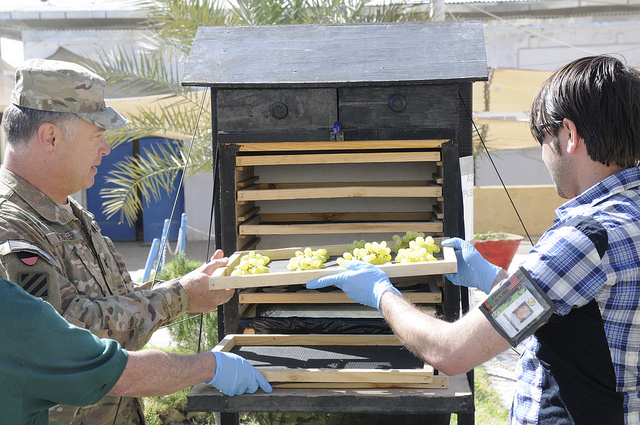
Lt. Col. Dallas Kratzer with Kentucky’s Agribusiness Development Team 5 assists with a demonstration for local farmers to show the proper methods of preserving fruit in Kandahar, Afghanistan, March 10, 2013. The project was in cooperation with the Kandahar Provincial Reconstruction Team. (U.S. Army photo by Sgt. 1st Class Joseph Wilbanks)
KANDAHAR, Afghanistan — The Kandahar Provincial Reconstruction Team (KPRT) demonstrated a better fruit drying method for Afghan farmers at Camp Nathan Smith March 10, 2013.
This solar-powered fruit dryer could help the Afghans preserve fruit in a more sanitary fashion that is also faster than the traditional method used by Afghan farmers.
But it’s not just about a faster method for John E. Loyd, an agricultural advisor for the USDA and member of the KPRT.
“This is not only a better method, it also is much more sanitary and effective. It also will produce a marketable product for the Afghans. It’s just a better technique that gives a better yield.”
The traditional method used by Afghans was a single sheet of plastic or metal that the fruit was laid on to dry. The solar-powered boxes built by the KPRT allow for multiple layers to be stacked on top of each other. It reduces the time from five days to about three days. The box also keeps insects out, which makes for a much more sanitary product.
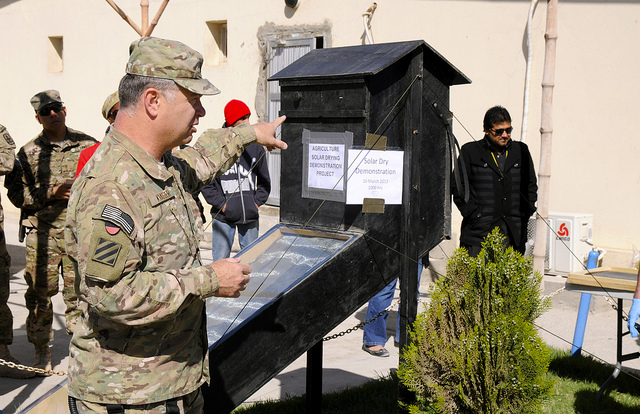
Lt. Col. Dallas Kratzer with Kentucky’s Agribusiness Development Team 5 discusses the operation of a solar dyer for drying fruit during a demonstration for local farmers in Kandahar, Afghanistan, March 10, 2013. Afghan farmers on average lose 40 percent of their crops because of poor methods in preservation. (U.S. Army photo by Sgt. 1st Class Joseph Wilbanks)
This allows the Afghans to retain more of their harvest and produce a product that can be sold in neighboring countries. Most of the dried fruit produced in Afghanistan currently would not pass inspection to be sold internationally due to the way it is dried. The solar boxes will help remedy that as well as prevent waste.
“About 40 percent of what the Afghans grow is lost to spoilage and this is a way to prevent that,” said Air Force Lt. Col. Dallas F. Kratzer II, the Kentucky Agribusiness Development Team Liaison Officer to the KPRT.
This will also help supplement the diet of the people of Afghanistan through the winter
“They don’t have cold or cool storage normally, but by drying the fruit it retains a lot of the nutrients,” said Kratzer. “It’s a way to have sustainable nutrition throughout the year.”
