
Pages
Stay In Touch
More
© 2013 KentuckyGuard
Story and photos by Staff Sgt. Sidney Hoffmann, ADT 5 Unit Public Affairs/Historian Representative
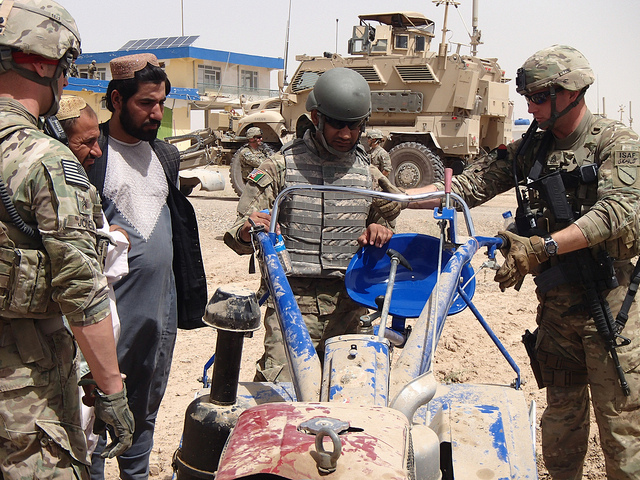
Staff Sgt. Matthew Nicholson with Kentucky’s Agribusiness Development Team 5 instructs local farmers on the operation of a tractor at the Zharay District Education Center in Kandahar Province, Afghanistan, June, 2013. The instruction was a refresher course from previous lessons given by ADT 4 in 2012.(U.S. Army National Guard photo by Staff Sgt. Sidney Hoffmann)
FORWARD OPERATING BASE PASAB, Afghanistan — The Kentucky Agribusiness Development Team 5 has worked diligently in maintaining working relationships with the surrounding areas of interest. The Zharay District Education Center or ZDEC is one of our closest ongoing projects. On this particular day, Tech. Sgt. Nathan Steele and 1st Lt. Ben Maillet recruited the assistance of our mechanics to come demonstrate a refresher course on how to use tractors for harvesting.
The Changchai is called a “walker” or “walk behind” tractor that has attachments serving different purposes. Since it is the season for harvesting their wheat, it is important the local farmers are comfortable working the equipment. Staff Sgt. Matthew Nicholson and Sgt. Johnathan Jones combined their skills to demonstrate how to start the tractor as well has how to safely operate the equipment and use of the gears while in motion.
“It was nice to use my abilities outside of the unit’s needs to assist the agribusiness team and actively contribute to the local farmers’ success,” said Nicholson, ADT 5’s motor sergeant.
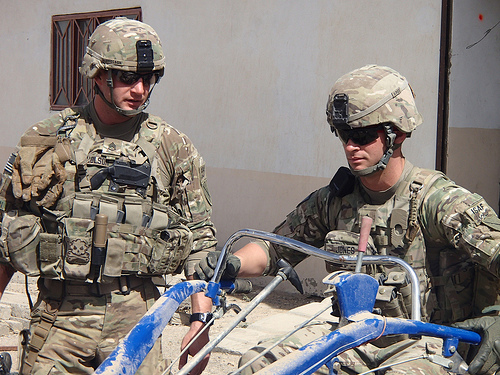
Staff Sgt. Matthew Nicholson (left) and Sgt. Jonathan Jones, both with Kentucky’s Agribusiness Development Team 5 test the gear of a walk-behind tractor during a refresher course for local farmers in Kandahar Province, Afghanistan, June, 2013. The Soldiers enjoyed the opportunity to put their personal skills from home at work on deployment. (U.S. Army National Guard photo by Staff Sgt. Sidney Hoffmann)
“At home, I really enjoy riding my tractor on the farm,” said Jones. “I never thought I would get to use my personal skills to aid this mission. It’s nice to have the chance to operate outside of my normal duties within the security forces and contribute to the agribusiness team.”
This mission is a continuation of the tractor safety training conducted with the ZDEC last year when ADT 4 was managing this location.
Click here for the ADT 4 story.
“We noticed the ZDEC workers were not utilizing all of the equipment available to maximize the amount harvested in a shorter period of time,” said Steele. “For example, it takes 2 or 3 weeks to harvest the wheat they currently have by hand, but if they were to use the Changchai, they could quite possibly complete the harvesting in one or two days. The intent is to ensure they know what the equipment can do for them.”
As ADT 5’s support is coming to a close, it is important to the team to leave behind a positive imprint and encourage the locals to continue to maximize their exporting abilities as well as build up the relationship between themselves and the Afghanistan government.
Story courtesy of Ashford University

Tom Hoffmann receives an Ashford University diploma on behalf of his daughter, Sidney, who is currently serving in Afghanistan. (PRNewsFoto/Ashford University)
SAN DIEGO -- A special pin complemented Tom Hoffmann’s cap and gown as he waited eagerly to cross the stage with nearly 1,200 graduates at the Ashford University spring commencement ceremony held earlier this month in Moline, Ill. The pin, which was given to him by his daughter Sidney Hoffmann just before she was deployed, was a yellow ribbon with a blue star banner pendant, indicating you have a child actively serving in the military. Tom traveled to commencement from just outside of Dallas to accept a diploma on behalf of Sidney, who is serving in the armed forces (Kentucky National Guard) in Afghanistan.
“It’s very exciting to be able to be a part of your child’s graduation, but to get it for her while she is serving our country is an honor,” said Mr. Hoffmann. “Like any father, I pushed her to complete her education and continued to push even when she was deployed. This is a big milestone. She was committed to getting a degree as well as serving her country.”
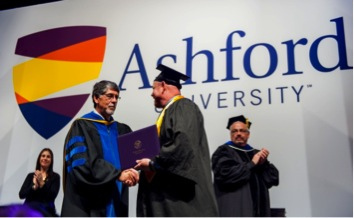
Tom Hoffmann accepts his daughter’s diploma during commencement ceremony in Moline, Ill., May 17, 2013. (Photo courtesy of Ashford University)
Sidney, 29, completed her bachelor’s degree in human resources management with magna cum laude honors. She began her college career at a traditional university; however, Ashford University’s progressive online platforms provided Sidney the flexibility necessary to continue her educational pursuits while being deployed overseas.
“This truly was a rewarding experience,” said Sidney. “The distance learning program allowed me the ease of working a full time job while providing the flexibility to participate on time with my classmates and instructors. I really appreciate everything Ashford has done for me and my family. I am truly grateful to the faculty and staff that made it possible for my father to take part in this momentous occasion.”
In a private ceremony prior to graduation, Ashford University President Dr. Richard Pattenaude presented Mr. Hoffmann with a challenge coin to present to Sidney when she returns home.
Click here to see the video of Mr. Hoffman accepting Sidney’s diploma.
Story and photos by Sgt. 1st Class Joseph Wilbanks, 1st Armored Division Public Affairs
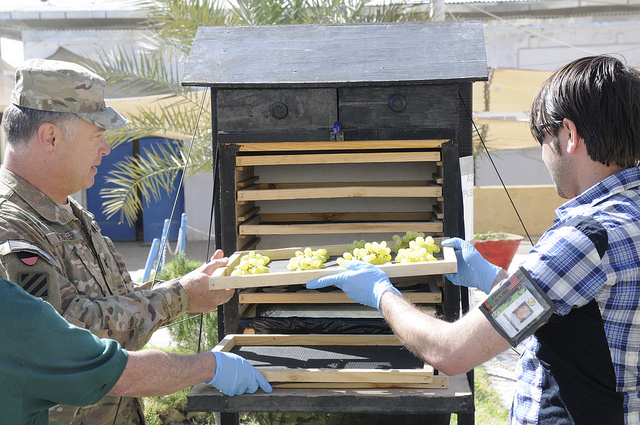
Lt. Col. Dallas Kratzer with Kentucky’s Agribusiness Development Team 5 assists with a demonstration for local farmers to show the proper methods of preserving fruit in Kandahar, Afghanistan, March 10, 2013. The project was in cooperation with the Kandahar Provincial Reconstruction Team. (U.S. Army photo by Sgt. 1st Class Joseph Wilbanks)
KANDAHAR, Afghanistan — The Kandahar Provincial Reconstruction Team (KPRT) demonstrated a better fruit drying method for Afghan farmers at Camp Nathan Smith March 10, 2013.
This solar-powered fruit dryer could help the Afghans preserve fruit in a more sanitary fashion that is also faster than the traditional method used by Afghan farmers.
But it’s not just about a faster method for John E. Loyd, an agricultural advisor for the USDA and member of the KPRT.
“This is not only a better method, it also is much more sanitary and effective. It also will produce a marketable product for the Afghans. It’s just a better technique that gives a better yield.”
The traditional method used by Afghans was a single sheet of plastic or metal that the fruit was laid on to dry. The solar-powered boxes built by the KPRT allow for multiple layers to be stacked on top of each other. It reduces the time from five days to about three days. The box also keeps insects out, which makes for a much more sanitary product.
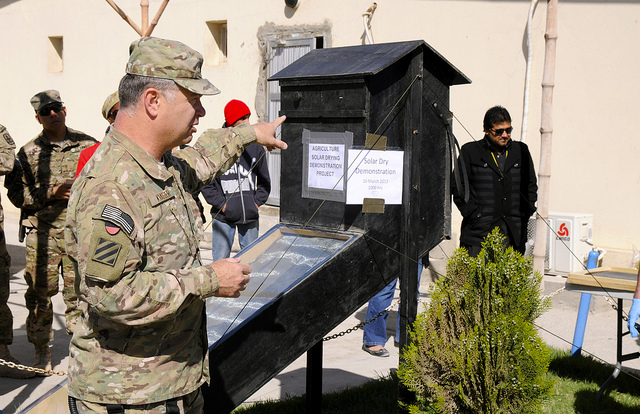
Lt. Col. Dallas Kratzer with Kentucky’s Agribusiness Development Team 5 discusses the operation of a solar dyer for drying fruit during a demonstration for local farmers in Kandahar, Afghanistan, March 10, 2013. Afghan farmers on average lose 40 percent of their crops because of poor methods in preservation. (U.S. Army photo by Sgt. 1st Class Joseph Wilbanks)
This allows the Afghans to retain more of their harvest and produce a product that can be sold in neighboring countries. Most of the dried fruit produced in Afghanistan currently would not pass inspection to be sold internationally due to the way it is dried. The solar boxes will help remedy that as well as prevent waste.
“About 40 percent of what the Afghans grow is lost to spoilage and this is a way to prevent that,” said Air Force Lt. Col. Dallas F. Kratzer II, the Kentucky Agribusiness Development Team Liaison Officer to the KPRT.
This will also help supplement the diet of the people of Afghanistan through the winter
“They don’t have cold or cool storage normally, but by drying the fruit it retains a lot of the nutrients,” said Kratzer. “It’s a way to have sustainable nutrition throughout the year.”
Story and photos by Staff Sgt. Kristen Duus, 1st Stryker Brigade Combat Team, 1st Armored Division
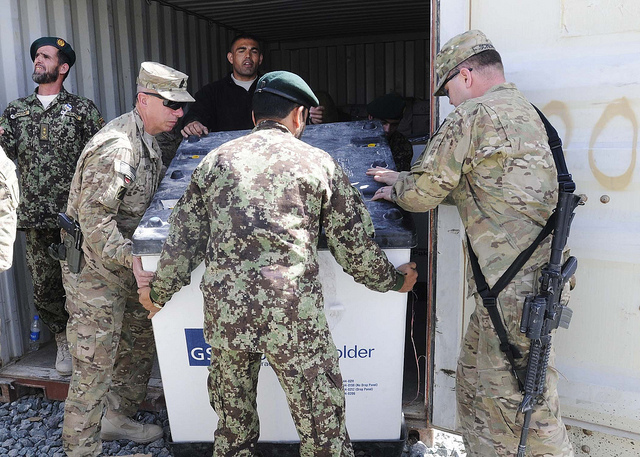
Sgt. Maj. David Munden, Kentucky Agri-business Development Team noncommissioned officer in charge and Sgt. Eric Schenck, 1st Brigade, 1st Armored Division chaplain’s assistant, help soldiers from the Afghan National Army with supplies at Forward Operating Base Pasab, Kandahar Province, Afghanistan, March 17. The brigade chaplain, along with ADT 5, participated in Operation Love Thy Neighbor, which provides clothes and school supplies to the ANA to pass to local villages. (U.S. Army photo by Staff Sgt. Kristen Duus)
FORWARD OPERATING BASE PASAB, Afghanistan — What happens when you have a team of educators who deploy to a country that only has a 17 percent literacy rate? Those educators set out to change those numbers.
The Kentucky Agribusiness Development Team, a National Guard unit, deployed to Kandahar province, Afghanistan, participated in Operation Love Thy Neighbor at Forward Operating Base Pasab, March 17.
Air Force Lt. Col. Dallas Kratzer, the Kentucky ADT deputy commander, and a native of Lawrenceburg, Ky., worked in conjunction with the 1st Brigade, 1st Armored Division chaplain to provide clothes and school supplies to the Afghan National Army through the Afghan Religious and Cultural Affairs, who in turn distribute the supplies to local villages.
Lt. Col. Abdul Ghani, the chief of RCA, 3rd Brigade, 205th Corps, ANA, appreciated the donations from the soldiers.
One of the biggest things for Afghanistan is now, with the United States’ help, the ANA has accomplished a lot, said Ghani. They have also progressed a lot in the education aspect as far as teaching soldiers and helping the villages and locals.
“This is truly an Afghan to Afghan thing,” said Kratzer. “All we’re doing is facilitating the materials. We’re equipping them with school supplies so their kids have an interest in being taught, learning and improving what they have.”
The supplies, which have all been donated, are set to foster a more positive relationship with the local Afghan citizens and the ANA, said Kratzer.
Sgt. Eric Schenck, 1/1 AD chaplain’s assistant, and a native of Wisconsin Rapids, Wis., works closely with the Afghan RCA teams. Schenck helps receive, inspect, store and deliver the donations to the ANA. Schenck also coordinated with the ADT, who immediately jumped on board.
“This is a win-win for all,” said Schenck. “The fact that it is the ANA giving the items fosters positive feelings and will help build supportive sentiments.”
“It feels to directly improve the living conditions here in Afghanistan,” said Schenck. “It hurts to see so many people living in poverty. I want to help somehow and this is a great way to do some good while I’m deployed.”
Kratzer concluded by emphasizing that this project was to build relationships, not just between Americans and Afghans, but also with the ANA and locals.
“In everything that we do, we want to build sustainability to help foster something that will continue on,” said Kratzer. “It’s not about giveaways. It’s about relationships.”
Story by Terry Hutchins, Civilian Expeditionary Workforce with Kentucky Agribusiness Development Team 5
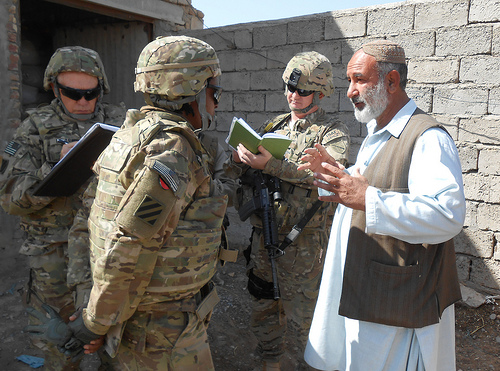
Victoria Burke with the Civilian Expeditionary Workforce, speaks with Mr. Hikmat, a local business owner, in a discussion regarding his poultry feed production in Kandahar Province, Mar. 13, 2013. (Kentucky National Guard photo by Lt. Col. Dallas Kratzer)
KANDAHAR PROVINCE, Afghanistan-The production of livestock is very important to the majority of Afghans whose livelihoods are dependent on agriculture. The number of cattle, sheep, goats and poultry reared in Afghanistan is 3.7 million, 8.8 million, 7.3 million and 12.1 million respectively. As an example, on an average marketing day, the outdoor livestock market located within Kandahar province will see 4,200 sheep, 700 goats and 1,500 cattle sell within a few hours, according to the Afghanistan Livestock Census: 2002-2003.
Kentucky’s Agricultural Development Team number 5 recently spent a successful day evaluating the attributes and economic potential for the Hikmat Feed Factory located in Kandahar City. The team is charged with the responsibility of assisting with agricultural development within Kandahar Province.
The Hikmat Feed Factory is a family owned business, operated by the owner, Abdul Baqi Hikmat, his son and 14 employees. During the visit, the ADT 5 team evaluated the feed facility for quantity of feed being produced; quality of the feed ingredients and proper ration formulation, product pricing and marketability.
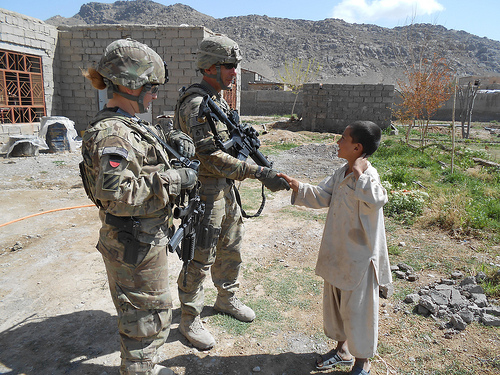
Staff Sgt. John Hall and Spc. Rachel Fox of the Kentucky Agribusiness Development Team 5 speak with an Afghan youth at a local business in Kandahar Province, Mar. 13, 2013. (Kentucky National Guard photo by Lt. Col. Dallas Kratzer)
“There is a lot of opportunity here,” said Maj. James Hatfield, ADT 5 agriculture chief. “Mr. Hikmat has an impressive amount of knowledge and creates a valuable product. We need to leverage our connections to farmers to create a link between quality feed and animal health. This link will help increase livestock health and the demand for feed. My hope is that this will also create a demand for more produce sold, to create more feed, thus creating a sustainable cycle between feed factories, producers, and livestock traders.”
The team found a well managed feed mill with a knowledgeable nutritionist; Hikmat is a university trained animal nutritionist with a PhD in animal nutrition from Kabul University. The small factory specializes in poultry feeds and produces a pelletized chick starter, layer mash, finishing feed and breeder feed. The average cost is $19 per 100 pounds of feed which is 17 percent less than the imported alternative from Pakistan. At present the imported feeds dominate the market. The small provincial mill also produces feed for ruminants, sheep, cattle and goat feed which is a non-pelletized blend that sells for $15 for a 100 pound bag.
The feeds are a blend of 20 input ingredients that are sourced from local traders and industry by-products. The ingredients include: corn, wheat, rice millings, rice hulls, waste raisins and figs, chick pea, dried sesame cake, peanut hulls, dried bread and macaroni waste, cotton seed cake and bone meal.
Through perseverance, Hikmat and son have taken .05 percent of the poultry market nationally and almost 100 percent of the ruminant feed market in Kandahar city. However, Hikmat wants to at least double his output. He feels that his product is not well known beyond the city limits and he would like to move feed out into the regions. This is where the ADT 5 saw an opportunity to help both the suppliers and farmers come together to achieve wins for both of them.
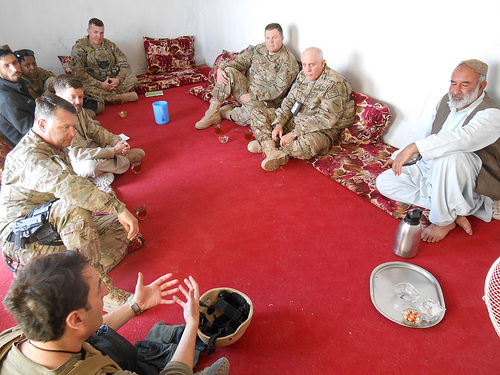
Members of Kentucky’s Agribusiness Development Team 5 have tea with Mr. Hikmat to discuss the types of feed and potential markets in the Kandahar region, Mar. 14, 2013. (Kentucky National Guard photo by Capt. Forrest Holdsworth)
Following the interview with Hikmat, the Kentucky team created an action plan with the objective of broadening the customer base for the feed mill and at the same time introducing animal nutrition concepts to Afghan para-vets, Extension agents and eventually to livestock producers. The team selected Zharay District, south of Kandahar city, approximately 20 miles south of the Hikmat Feed Factory.
ADT 5 plans to select producers who will participate in a lamb-feeding demonstration starting in April of this year and continuing through early October. The feeder lambs are selected based on frame size; and will be vaccinated, dewormed and treated for external parasites by the Afghan para-vets trained by ADT 4 and mentored by the current team. The lambs will be placed on a daily feed ration which includes wheat straw as a forage source. Each lamb will be weighed periodically during the feeding period and will be compared to lambs managed in the conventional method. During the feeding process Kandahar city based butchers and individuals will be solicited and invited to view the lambs while being fed, thus cultivating a direct market scenario that hopefully will continue and develop into an annual event. The October marketing is directed toward a major religious holiday Eid-al-Adha.
As a result of this effort producers will be educated on prescribed feeding programs that can be used to take advantage of market demand for lamb. The economic data for this enterprise will be compiled, assessed and shared with Afghan educators, leaders and producers.
“It is refreshing to see a home grown, home educated entrepreneur creating forward and backward linkages in the local economy,” said Victoria Burke, member of the Civilian Expitionary Workforce with ADT 5. “And if he increases his business, so will these linkages, which is a good thing.“
Story and photos by Spc. Matthew Thomason, ADT 5
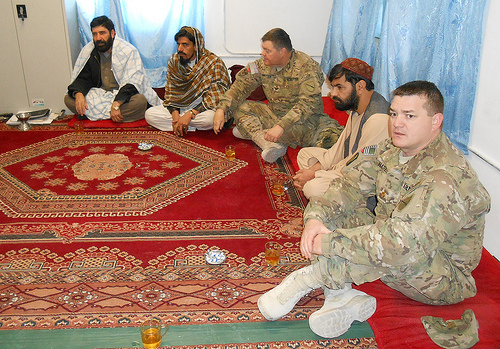
Col. Bob Hayter (center) and Maj. James Hatfield, of Kentucky’s Agribusiness Development Team 5 meet with farmers and Afghan government officials in the Zharay District, Jan. 23, 2013. The meeting brought roughly 200 farmers together to discuss potential improvements in farming in the area. (Kentucky National Guard photo by Spc. Matthew Thomason)
ZHARAY DISTRICT, Afghanistan — Darkness enveloped the landscape as soldiers from Kentucky Agribusiness Development Team 5 began strategically placing their vehicles and personnel at the Zharay District Education Center on January 23, 2013. They were there to provide security, oversight and facilitation for the government shura. The shura would address multiple issues such as irrigation, pest control and livestock management that local farmers were dealing with and attempt to help these farmers resolve their agricultural problems.
A shura is an Islamic process of decision making through assembly and deliberation. It comes from the Arabic word for consultation.
“This shura linked over 200 local farmers with GIRoA (Government of the Islamic Republic of Afghanistan) officials at both the district and provincial level,” said Tech Sgt. Nathan Steele. “By implementing surveys on 15 different topics, we are able to better understand what problems these farmers face.”
ADT 5 has been diligently working alongside officials of the GIRoA to improve the resources and education of the farmers within Zharay District and their ability to provide sustainment for both themselves and the local economy.
“ADT 5 has the ability to indirectly reduce kinetic activity on the battlefield by helping to improve the farmer’s ability to provide food for their families and generate income,” said Steele. “The less money the farmers have to take from the Taliban produces one less IED or enemy fighter to target ISAF or GIRoA forces.”
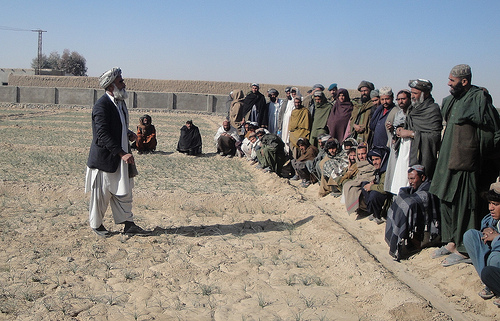
Local farmers meet with officials of the Government of the Islamic Republic of Afghanistan in the Zharay District, Jan. 23, 2013 to discuss the problems the farmers face in the area. Soldiers of Kentucky’s Agribusiness Development Team 5 assisted in the council and provided security to the gathering. (Kentucky National Guard photo by Spc. Matthew Thomason)
“This is the first shura of its kind in this area and outside the wire, coordinating security between the Afghan National Army, Afghan Uniformed Police and ISAF personnel that received no interference by opposing forces. This really speaks volumes to the will of the Afghan people and the success of ISAF forces in a region once known as the birthplace of the Taliban,” he explained.
The undisputed success of this shura truly speaks to the dedication of both the ISAF and GIRoA forces who are both working toward a common goal of success for the nation and people of Afghanistan.
Steele said there are broader impacts of the shura’s success, calling it a show of competency in the local government. He believes that because of actions such as this, the people of Afghanistan can see that their government is working for them.
“This discredits the Taliban and insurgency and helps to ensure the confidence of the people is in their own government, he said. “In my opinion, we (ISAF and GIRoA forces) didn’t just aide local farmers today, we helped to ensure the success of Afghanistan and that is a win in my book.”
Story by Staff Sgt. Sidney Hoffman, ADT 5 Unit Public Affairs Historian Representative
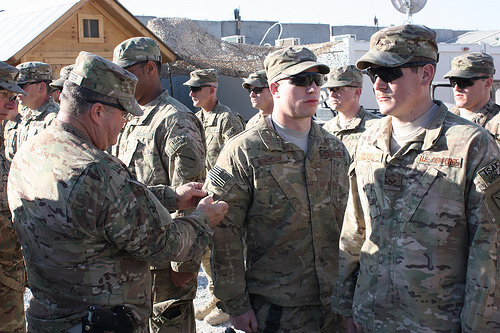
Col. Bob Hayter places a 3rd Infantry Division patch on the uniform of Staff Sgt. Blake Nicholson during Kentucky Agribusiness Development Team 5’s deployment patch ceremony in Kandahar Province, Afghanistan, Jan. 24, 2013. This is the second deployment for Nicholson, but first with the Army. (KYNG photo by Capt. Joseph Fontanez)
KANDAHAR PROVINCE, Afghanistan — The Soldiers and Airmen of Kentucky Agribusiness Development Team 5 received their official combat patch while serving under the 3rd Infantry Division during a ceremony at Forward Operating Base Pasab in Kandahar Province, Afghanistan, Jan. 24, 2013. The day marked a very historical moment for many of our service men and women.
3rd ID was established in 1917 and has been involved in war efforts since World War I. “Rock of the Marne” is a motto they inherited after their defense position in France along the Marne River and is still used today. It is renowned for being one of the most decorated units in our nation’s history.
Col. Bob D. Hayter started off the ceremony with January’s significance to a previous military historical event. Jan. 17, 1991 was the initial push of coalition forces to help Kuwait liberate itself from the Iraqi invasion. There were 34 nations in support of Kuwait’s defense, culminating in victory Feb. 24, 1991. This is significant for a few of our team members since they participated in that effort.
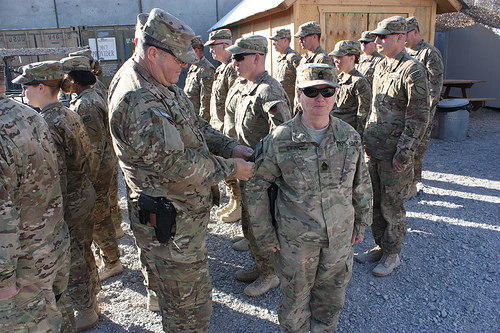
Col. Bob Hayter places a 3rd Infantry Division patch on the uniform of Master Sgt. Connie Gwinn during Kentucky Agribusiness Development Team 5’s deployment patch ceremony in Kandahar Province, Afghanistan, Jan. 24, 2013. After 33 years of service, this is Gwinn’s first deployment overseas. (KYNG photo by Capt. Joseph Fontanez)
“There are four people here that were in the first Gulf War and some who have been on multiple deployments. This is a historic event for us all,” said Hayter.
“This is the first time I have worked side by side with the Army,” said Staff Sgt. Blake Nicholson about the uniqueness of the unit as a joint forces operation with both Army and Airmen. “As my second deployment, this tour has allowed me to learn different leadership techniques, make new friends and most of all help rebuild Afghanistan.”
While some are on their second or even sixth deployment, others have spent their entire career without an opportunity to be a part of such a rewarding experience, such as Master Sgt. Connie Gwinn.
“After 33 years of service, being in the military is a reward, but being a true veteran is a special honor in itself,” she said.
Story and photos by Capt. Chase Kohne, ADT 5
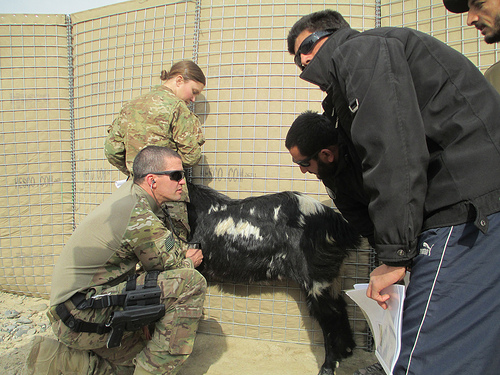
Capt. Chase Kohne of Kentucky’s Agribusiness Development Team 5 checks the vital signs of a goat in in Kandahar Province, Afghanistan, January 2013. ADT 5 provided classes for local herders on how to care for their animals during a two-day clinic. (KYNG photo by Staff Sgt. Sidney Hoffman)
KANDAHAR PROVINCE, Afghanistan — Members of the veterinary team of Kentucky’s Agribusiness Development Team 5 conducted their first joint Veterinary Outreach Program with a Special Forces team in the Maiwand District of Kandahar Province, Afghanistan. The two day exercise involved training the Afghan National Army Special Forces (ANASF) medics in common veterinary techniques to include large animal handling and restraint, physical exams, basic anatomy, proper nutrition, common diseases and preventive medicine.The training was tailored to meet the needs of southern Afghanistan, focusing on common ailments prevalent within the district of Maiwand.“This was the first time since their training that they were able to interact with a local group of herders and apply their training to helping their people,” said Capt. Chase Kohne, ADT 5 veterinarian. “Their ability to work with the herders as well as identify and treat common ailments truly legitimized the efforts of the ag-team over the past 12 months.”
Planning for a joint exercise with Afghan para-veterinarians working with ANASF medics has been in the works since early 2012 under ADT 4. Eight individuals were selected from five districts within Kandahar province for six months of training from the Dutch Committee for Afghanistan. This group of para-veterinarians is committed to helping their communities through livestock production and prevention of disease.
Kentucky ADTs have been present in southern Afghanistan since early 2012 with a focus on crop production and preservation, water management and livestock. Common problems for livestock in the region are a lack of proper nutrition and water in order for the livestock to work, produce milk or eggs, or reproduce normally. Improper vaccination and de-worming techniques is also an obstacle, leaving the livestock susceptible to treatable diseases, infections, worms and parasites.
The exercise concluded on the second day with local Afghan para-veterinarians working jointly with the ANASF medics that were supervised by the ADT 5 veterinary team. Nearly 300 animals were treated to include donkeys, camels, cattle, sheep and goats that belonged to local herders in a small village in Maiwand District. Both the ANASF medics and para-veterinarians participated in the delivery of treatment which included vaccinations, deworming, dental care and treatment of infections.
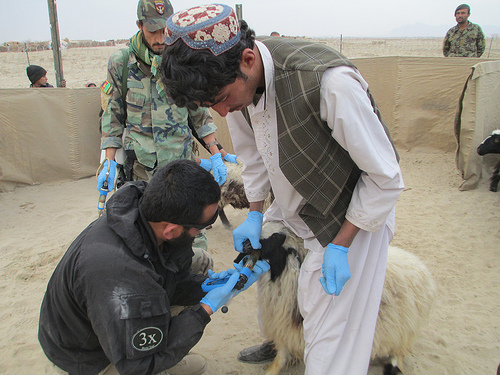
Afghan herders treat a goat after instruction from members of Kentucky’s Agribusiness Development Team 5 in Kandahar Province, Afghanistan, January 2013. ADT 5 conducted a veterinary clinic for local herders on the care of the variety of animals found in the province. (KYNG photo by Capt. Chase Kohne, ADT5)
The veterinary team assigned to ADT 5 was also given the opportunity to mentor the local Afghan para-veterinarians.“We are transitioning to a phase where the trained para-veterinarians will be working for their people independent from the International Security Assistance Force (ISAF),” said CEW Amberlie Silva, ADT 5 Agribusiness Specialist. “You could see the confidence in their skills growing with each animal they treated. It was a truly rewarding experience to see the para-veterinarians that we helped train giving back to their country in a way that can help to improve the quality of life for entire communities of people.”
ADT 5 will continue to develop joint exercises with the locally trained Afghan agricultural leaders as well as the provincial government in order to ensure the skills received during our time here continue to remain as troops begin to draw back. Col. Bob Hayter, commanding officer of ADT 5, believes that the key to a sustainable solution lies within the coordination of the local Afghan people with the Guardsmen and ISAF personnel.
“We are working hard to analyze their problems and formulate action to achieve agricultural improvement, economic opportunity, social advancement and, thereby, to promote the national well-being,” said Hayter. “This can only be achieved through a unified effort with ISAF and the Afghan government in a way which could never be accomplished solely through individual efforts.”
Story by Staff Sgt. Sidney Hoffman, ADT 5 Unit Public Affairs Historian Representative
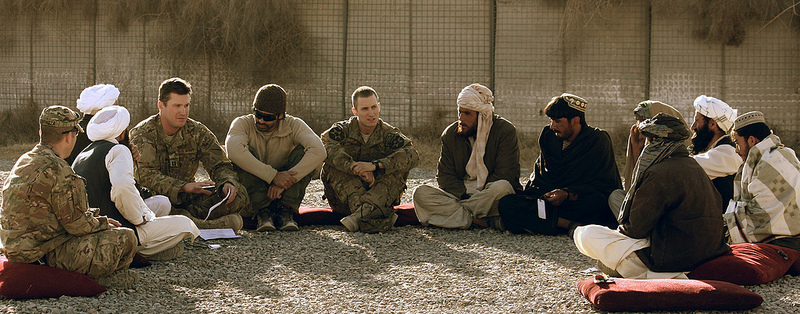
Capt. Forrest Holdsworth (4th from left), of Kentucky’s Agribusiness Development Team 5, speaks with district leaders and local farmers in Arghandab District of Kandahar Province, Afghanistan, Dec. 23, 2012. The meeting was the first for ADT 5 to meet with locals and continue relationships improved by ADT 4. (Courtesy photo)
KANDAHAR PROVINCE, Afghanistan — Members of Kentucky Agribusiness Development Team 5 traveled to Argandab District Headquarters to meet with District Governor Haji Shaw Mohammed in late December, 2012. This was the first meeting between ADT 5 and the governor since arriving in country. The conference focused on continuing the positive relationship established by Kentucky’s ADT 4. According to Maj. Bill Hatfield, the Argandab District has been very successful in self-governance and agriculture development over the past year. Their visit was to reinforce these improvements by highlighting the importance this meeting holds for future operations in the area.
“When I was here last, you would barely ever see a car and now traffic jams are the norm when traveling through the city,” said ADT 5 commander Col. Bob Hayter while traveling through the bustling city of Kandahar.
His statement highlighted the progress being made in security and commerce in the past seven years. Hayter had previously been assigned to RC South in 2005 as a Military Training Team Embedded trainer with the Afghan National Army and had been stationed in Kandahar for over a year.
As they traveled through the Argandab area, several members of the agribusiness team remarked on how different this district was from the western districts they had visited. They noted the abundance of trees and green spaces that even the bleakness of the Afghan winter could not hide.
According to team’s lead civil engineer, Capt. Forrest Holdsworth, “This could be attributed to the district’s position higher in the Argandab River watershed, thereby producing an abundance of vegetation compared to districts like Panjwai and Maiwand. In Kandahar Province, water is a valuable commodity which has the greatest impact on the agricultural success of the region, yet is it also one of the most scarce.”
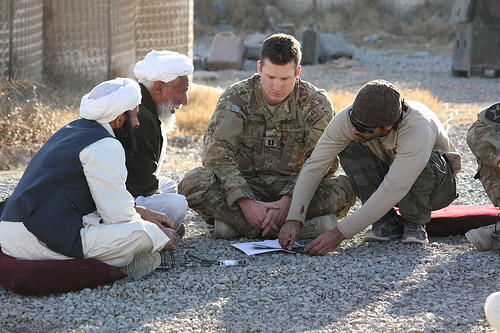
Capt. Forrest Holdsworth (middle), of Kentucky’s Agribusiness Development Team 5, speaks with district leaders and local farmers in Arghandab District of Kandahar Province, Afghanistan, Dec. 23, 2012. ADT 5 will assist local farmers in agricultural techniques such as controlling pomegranate diseases and managing water resources. (Courtesy photo)
Shaw thanked all of them for coming and discussed with the team some of the agricultural challenges facing his district and how he hoped that ADT 5 might be able to assist over the coming year.
Among his priorities were: training the farmers of Argandab on more advanced farming techniques used in America; training on pomegranate diseases that have been prevalent over the past year; and helping farmers properly manage water resources in the district.
The Governor was glad to hear one of the primary objectives of ADT 5 was to train farmers in water management in an effort to help get the most of this limited resource. Hayter expressed to the Governor that such assistance would gladly be provided by the team, and they would immediately begin working to help accomplish these goals.
Shaw expressed he had been very pleased with the efforts of the previous agribusiness team and hoped his work with ADT 5 would be equally as successful. Hayter thanked the Governor for his remarks and expressed his hope for similar successes over the course of the next few months. The KYADT V staff felt that Argandab District was well positioned for the transition of ISAF over the next year and would be ready for 2014.
Story and photos by Sgt. Scott Raymond, Kentucky National Guard Public Affairs
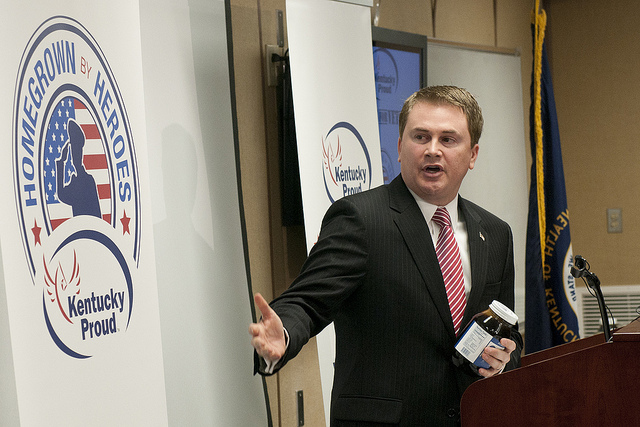
Kentucky Agriculture Commissioner, James Comer speaks during a press conference at Boone National Guard Center in Frankfort, Ky., Jan. 22, 2013. Comer announced two new programs to benefit veterans and military farmers, in cooperation with the Kentucky National Guard. (Kentucky National Guard photo by Sgt. Scott Raymond)
FRANKFORT, Ky. — Serving in the military and farming are said to be two of the hardest jobs one could have. New initiatives launched by Kentucky’s Department of Agriculture aim to make both just a bit easier in the Commonwealth. Agriculture Commissioner James Comer announced the Kentucky Proud Jobs for Vets and Homegrown by Heroes programs during a press conference at Boone National Guard Center in Frankfort, Ky., Jan. 22, 2013.
To see more photos from the press conference, click here.
Click here for the Homegrown by Heroes website.
Click here to see the WUKY story.
Click here to see the Lexington Herald-Leader story.
Comer spoke to a packed room that included Kentucky’s Adjutant General, Maj. Gen. Edward W. Tonini, state senators and representatives and veteran/farmers. He said the initiatives aim to improve employment of veterans in agriculture and to benefit military farmers, by using the state’s successful history on the battlefield and in the crop fields.
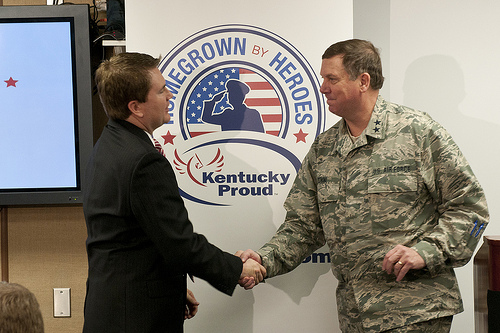
Kentucky Agriculture Commissioner, James Comer thanks Kentucky’s Adjutant General, Maj. Gen. Edward W. Tonini following his speech during a press conference at Boone National Guard Center in Frankfort, Ky., Jan. 22, 2013. Tonini said the two new programs launched by the Agriculture Department would benefit the Kentucky Guard and the Commonwealth. (Kentucky National Guard photo by Sgt. Scott Raymond)
“We know Kentucky is a great agriculture state with a great agriculture heritage, and we know Kentucky is a great military state,” said Comer. “What a great partnership this will be, that will highlight the work of Kentucky troops teaching farming all over the world and to come back and create economic development back here at home. That’s what this partnership is all about.”
The Kentucky Proud Jobs for Veterans program will work to connect military veterans looking for work in agriculture with Kentucky farmers and agribusiness who need labor. Comer said it’s a simple idea that will work with national organizations to connect people from all over the country to employment opportunities in the state.
Robert Silverthorn, Kentucky Field Chairman for the Employer Support of the Guard and Reserve (ESGR), said the new program can help fill the void of employment possibilities in the rural areas of the state for Guardsmen, reservists and veterans.
“This is an exciting day for the Commonwealth of Kentucky,” said Silverthorn. “And the reason is, you have a five billion dollar industry that often times gets lost in the other noise of economic development in our state. And for the Kentucky committee of the Employer Support of the Guard and Reserve now to be partnered in this initiative is something that is particularly exciting for us.”
The Kentucky Proud Homegrown By Heroes program allows military farmers to identify themselves through a new logo applied to any or all of their products for sale throughout the state. Comer said this will only increase the awareness buyers have of products grown in Kentucky and their desire to support not only Kentucky farmers, but also local farmers that are Veterans as well.
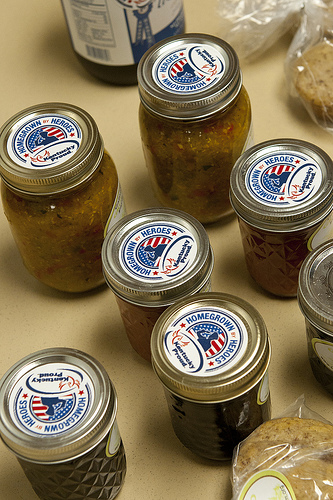
Jars of products produced by military farmers in Kentucky are adorned with the new Kentucky Proud Homegrown By Heroes label at a press conference in Frankfort, Ky., Jan. 22, 2013. Kentucky Agriculture Commissioner James Comer hopes the labels will become a national model for other states to implement. (Kentucky National Guard photo by Sgt. Scott Raymond)
Comer has hopes the new programs will become national models for other states to follow. He called attention to the Veteran Farmer Coalition, whose nationwide mission “is to mobilize veterans to feed America.”
Michael O’Gorman, Executive Director of the Veteran Farmer Coalition said he has been working to introduce veterans to careers in agriculture for years and hopes for every American “to recognize the Homegrown By Heroes label, to know where it came from and to know who it stands for.”
Tonini said Kentucky has always been perceived as a great agriculture state, and in turn produced five successful agribusiness development teams in Afghanistan. The Kentucky Guard has been instrumental in the agricultural improvements overseas, and now has the chance to help out at home.
“There’s no better core in America than Soldiers and farmers, it’s as simple as that,” said Tonini. “The Kentucky National Guard is very proud to be a part of such a unique endeavor and will support it in every way possible.”
