Pages
Stay In Touch
More
© 2013 KentuckyGuard
Story by John Trowbridge, Kentucky National Guard
Wrapping up Black History Month and leading into Women’s History Month, kentuckyguard.com presents this unique look at a woman who swore to fight for her nation and ended up combating social justice ….
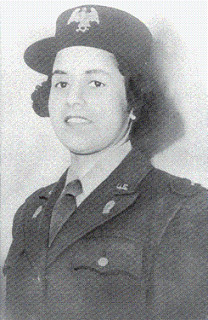
1st Lt. Anna Mac Clarke was a pioneer, part of a unique group of women who came together to help their country win a world war. She and her sister Soldiers also fought another war at home; that of racism, and they, as one unified force, began to break down the barriers of her race and gender which would eventually lead to the civil rights movement of the late 1940s, up through the 1960s.
FRANKFORT, Ky. — “It was raining that April morning as the train rolled into the station at Lawrenceburg, Kentucky. It was one of those day-long rains that slows the world down and gives you time to reflect. They had been waiting to meet the train that was bringing her back home. Home to her final resting place, this young woman who had, in the short span of 24 years, accomplished so much, not only for herself but for her race and her gender.” From the introduction to A Study in Military Leadership, 1997
Anna Mac Clarke was born June 20, 1919 in Lawrenceburg, Kentucky. Anna Mac, as she was called, was always known by her neighborhood friends as a “tomboy” who liked to play football and take care of animals, specifically cats and her pet chameleon. While growing up in her small town community, Clarke’s peers and elders knew that she was destined to do something great.
On May 28, 1937, less than one month before her 18th birthday, Clarke was awarded a diploma from Lawrenceburg High School, which at the time was referred to as the “Colored High School.” After graduating from high school, Anna Mac decided to pursue a college education. She considered many options, but in the end decided to attend Kentucky State College (now KSU), an historically black college located in Frankfort, Kentucky which is less than 15 miles from where she grew up in Lawrenceburg. While at Kentucky State, Clarke was a very active student, participating in sports, Delta Sigma Theta Sorority, and the school’s newspaper, The Kentucky Thorobred. Clarke graduated from Kentucky State College in 1941, earning a Bachelor’s degree in both sociology and economics. However, Anna Mac had a hard time finding employment that was appropriate for her skills and was not extremely low paying.
In 1942, Anna Mac Clarke joined the All-Volunteer Women’s Army Auxiliary Corps and left for Basic Training at Fort Des Moines, Iowa. After she completed Basic Training, Clarke went on to Officer Candidate School.
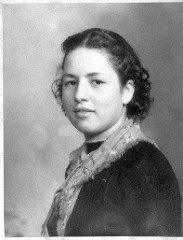
Anna Mac Clarke’s high school photograph.
On November 30, 1942, the Officer Candidate School at Fort Des Moines in Iowa –where Clarke was stationed—was desegregated. Within two weeks of the desegregation, Clarke became a candidate in the 15th Officer Class, WAAC OCS Program. There were two other African Americans in her class, but she would be the only one to finish the course eight weeks later on February 16, 1943. By the end of February, Clarke was reassigned to the Fourth Company, Third Regiment, as a Platoon Leader. Third Officer Anna Mac Clarke was the first African-American WAAC assigned to command what was otherwise an all-White unit.
With First Officer Sara E. Murphy, Clarke led a unit of 144 African-American WAACs to serve in Wakeman General Hospital at Camp Atterbury in Indiana. This assignment lasted for only a month, and in June 1943, Clarke worked in the Classification and Assignment Department of WAAC headquarters in Washington, D.C. She enrolled in the Adjutant General’s School at Camp Meade, Maryland, and after having completed the training she was assigned to Chicago’s WAAC recruiting program. Clarke was promoted to second officer on July 16, 1943, and she returned to Fort Des Moines. The Army transformed the auxiliary units of WAAC into the Regular Army, and Clarke became a member of the Women’s Army Corps (WAC) in September 1943.
Protesting enforced segregation
On February 7, 1944, Clarke led the first WAC unit onto the base at Douglas Army Air Field. Located in eastern Arizona, this Army Air Field was one of only four in the U.S. to have both African-American soldiers and WACs. The theater on the post was segregated, and Clarke had been warned by the African-American soldiers not to go there. However, Clarke and several women went to the theater, refusing to sit in the colored section. She protested the enforced segregation to the theater management, her immediate supervisor and then the Commanding Officer, Colonel Harvey E. Dyer. On February 21, 1944, Colonel Dyer issued the order to his officers “to educate properly all enlisted and civilian personnel in your respective departments to accept any colored WACs assigned as you would any white enlisted man or enlisted woman in the Army of the United States. Every consideration, respect, courtesy and toleration will be afforded every colored WAC. No discrimination will be condoned.”
In March 1944 Anna Mac was admitted to a hospital on the base with sharp pains in her side. Doctors diagnosed her with appendicitis, and decided that she needed an appendectomy to save her life. At first it was believed to be a successful surgery and Clarke was expected to make a full recovery. Unfortunately, gangrene had entered her body due to the infection brought on by the surgery.
1st Lt. Anna Mac Clarke died on April 19, 1944, at the age of 24.
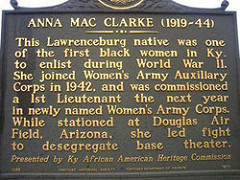 She was buried back home in Lawrenceburg, where a Kentucky historical marker located on the grounds of the courthouse now tells her story.
One person can make a difference
Anna Mac Clarke was a pioneer, part of a unique group of women who came together for one purpose, to help their country win a world war. She and her sister WAACs would also fight another war at home; that of racism, and they, as one unified force, began to break down the barriers of her race and gender which would eventually lead to the civil rights movement of the late 1940s, up through the 1960s. Anna Mac would never know the full impact her efforts to right injustice would have on things that we take for granted today, not only in the military, but in the civilian world as well.
On July 26, 1946, a little over two years after her death, President Truman issued Executive Order 9981, which called for equal treatment and opportunity for blacks in the military. Four years later on March 1, 1950, the President’s Committee on Equality of Treatment and Opportunity reported that beginning in April 1950 the Army’s quota system for blacks was out and that segregation was over in the military.
As for the WAC, in 1947 members of the WAC were permitted to opt for service in either the army or the newly separated air force. The Women’s Armed Services Integration Act gave women permanent military status in the regular army or reserves. Finally, in 1978, the WAC itself was disestablished and its members were assigned or could enroll in all branches of the army and air force.
Story by Maj. Dale Greer, 123rd Airlift Wing Public Affairs
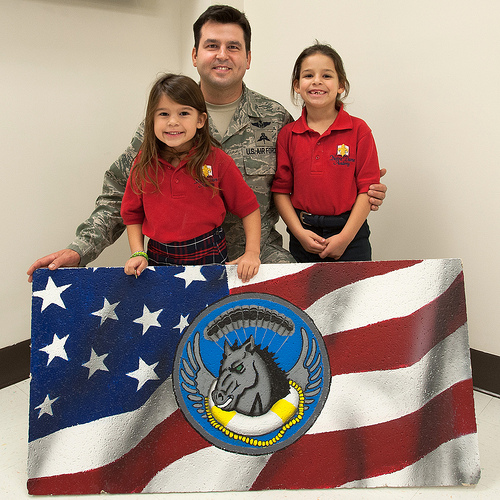
Master Sgt. Joey Youdell, a pararescueman in the Kentucky Air National Guard’s 123rd Special Tactics Squadron, created a “unit pride” ceiling tile with his daughters, Olivia (left) and Juliet. The hand-painted tile is one of several that have been installed in The Winner’s Circle recreation center at the Kentucky Air Guard Base in Louisville, Ky. (U.S. Air National Guard photo by Maj. Dale Greer)
KENTUCKY AIR NATIONAL GUARD BASE, LOUISVILLE, Ky. — The daughters of a Kentucky Air National Guardsman have put their artistic talents to use by helping showcase unit pride.
Master Sgt. Joey Youdell and his daughters, Olivia and Juliet, painted a ceiling tile depicting the heraldry of his unit, the Louisville-based 123rd Special Tactics Squadron.
The tile was then installed in the ceiling of The Winner’s Circle, a Morale, Welfare and Recreation Center here. It joins ceiling tiles from other subordinate units assigned to the Kentucky Air Guard’s 123rd Airlift Wing.
“Our leadership wanted to create something that would represent the spirit of the Special Tactics Squadron, and I thought it would be a great project to do with my daughters,” said Youdell, a pararescueman who has deployed overseas multiple times.
Youdell’s daughters painted a base coat on the tile, which soaked up a lot of pigment due to its porous nature and multiple perforations, while Youdell worked on the main art.
“The girls did a great job filling in all the holes with paint,” he said. “It took a long time, but we had a lot of fun doing it.”
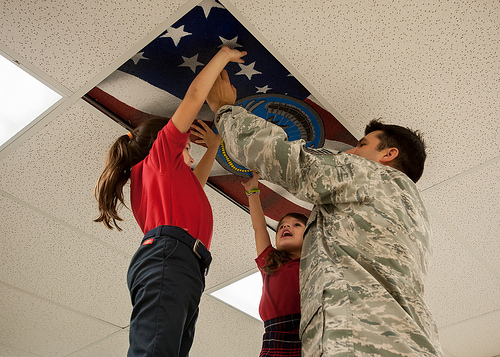
Master Sgt. Joey Youdell, a pararescueman in the 123rd Special Tactics Squadron, installs a custom-painted ceiling tile in the Morale, Welfare and Recreation facility at the Kentucky Air National Guard Base in Louisville, Ky., Nov. 21, 2013. The facility features ceiling tiles depicting the missions of various units on base. Youdell painted the tile with the help of his daughters, Juliet and Olivia. (U.S. Air National Guard photo by Maj. Dale Greer)
The unit’s heraldry features a Pegasus surrounded by a life buoy and suspended by a ram-air parachute.
“The parachute is significant to the unit as a primary means of worldwide deployment, indicating that all special tactics squadron operators are airborne qualified,” according to the Pentagon’s Institute of Heraldry.
“The Pegasus symbolizes genius and inspiration and also represents the unit’s amalgamation of the ground and air elements, which is key to the mission.”
The 123rd Special Tactics Squadron is comprised of pararescuemen like Youdell, combat controllers and special operations weathermen.
Pararescuemen are parachute-jump qualified trauma specialists who must maintain emergency medical technician-paramedic credentials throughout their careers. With this medical and rescue expertise, PJs are able to perform life-saving missions in the world’s most remote areas. A PJ’s primary function is personnel recovery specialist, providing emergency medical capabilities in humanitarian and combat environments. PJs deploy in any available manner, including air-land-sea tactics, into restricted environments to authenticate, extract, treat, stabilize and evacuate injured personnel.
Combat controllers are among the most highly trained personnel in the U.S. military. As FAA-certified air traffic controllers, they deploy undetected into combat and hostile environments to establish assault zones or airfields while simultaneously conducting air traffic control, fire support, command and control, direct action, counter-terrorism, foreign internal defense, humanitarian assistance and special reconnaissance.
Special operations weathermen are meteorologists with advanced tactical training to operate in hostile or denied territory. They gather and interpret weather data and provide intelligence from deployed locations while working primarily with Air Force and Army Special Operations Forces.
The unit’s slogan, “Ingenium Superat Vires,” means “Genius Overcomes Strength.”
Sgts Dallas Robinson and Nick Cunningham were partnered together to represent the U.S. Olympics men’s bobsled team for this year’s Winter Olympics in Sochi, Russia. (photo submitted)
Story by: Capt. Stephen Martin, Kentucky National Guard Public Affairs
FRANKFORT, Ky. — Kentucky Guardsman Sgt. Dallas Robinson, from Georgetown, Ky., represented the U.S. Olympic men’s bobsled team this year in the 2014 Olympic Winter Games that took place in Sochi, Russia.
“I’m extremely proud of Sgt. Robinson and his accomplishments over the last two weeks,” said Col. Mike Abell, Brigade Commander for the 75th Troop Command. “The Olympics are rooted in military tradition and training, so it’s fitting that a Soldier - a Guardsman - helped to represent our nation.”
While Robinson didn’t medal this year in the Olympics, he was there at every event to cheer on his fellow teammates. Robinson was one of the first to congratulate 4-man team, Steven Holcomb, Steven Langton, Curtis Tomasevicz and Christopher Fogt on their Bronze place finish. (Steven Holcomb and Steven Langton also won a Bronze Medal in the 2-man Bobsled event this year).
Kentucky Gov. Steve Beshear was also very impressed with Robinson’s success.
“Kentuckians shine on a national and international stage regularly, and for this Guardsman to represent us internationally at the Olympics is quite extraordinary,” said Beshear. “I congratulate Dallas on a job well done and know this is only the beginning for this fine young man.”
Robinson is a member of the 2123rd Transportation Company, based out of Richmond, Ky. and has been a member of the U.S. Army World Class Athlete Program for the last several years in preparation for this opportunity in Sochi.
Originally an Eastern Kentucky University track-star training for the Olympics, Robinson found his way into bobsledding by accident.
After an injury derailed his chances of qualifying for the Beijing Olympics in 2008, Robinson was then recruited by the USA Rugby team. After a shoulder injury ended that opportunity, he entered into the world of coaching track at Berea College.
One of the athletes that Robinson coached started competing in bobsledding and ended up inviting Robinson to come out and assist him. This is where Robinson’s bobsledding career began.
Sgts Rob Cunningham and Dallas Robinson compete in the 2-man bobsled event for the 2014 Winter Olympics in Sochi, Russia. (photo submitted)
His first award was in 2011 when he won silver in the four-man race at the World Cup in Lake Placid, N.Y. From there, he’s placed in the World Cup 4 additional times and twice in the World Championships in Switzerland. Robinson knows the significance of his participation in the Winter Olympics.
In an interview with the Louisville Courier-Journal, Robinson was quoted as saying, “I think about the positive relationship I have built with the Russian people and how much that could mean for future athletes in our sport. When I think about the legacy I want to leave the state of Kentucky and my family, I want that legacy to be one of pursuing your dreams, living life chasing God and loving like there is no tomorrow.”
See links for two great articles on Sgt. Robinson.
Courier-Journal Article
Herald-Tribune Article
Story courtesy WLEX 18
Kentucky National Guard leadership was on hand at the Lexington VA Medical Center to honor Troy Bowling for his service to Kentucky’s veterans. Pictured with him are Capt. Aaron Van Sickle, Adjutant General Edward W. Tonini, Brig. Gen. Benjamin Adams III, State Command Sgt. Maj. Thomas Chumley and State Command Chief Master Sgt. James Smith. (Photo courtesy Lexington Veterans Administration Medical Center)
Click here to see the original LEX18 story.
LEXINGTON, Ky. — He served our country in World War II and his service didn’t end there.
On Friday, Troy Bowling received a big honor for at the Lexington Veterans Affairs Medical Center.
Governor Steve Beshear, Adjutant General Edward W. Tonini and members of the Kentucky National Guard leadership were on hand at the VA Center Friday to honor him.
He’s volunteered more than 73,000 hours to the VA Center. Bowling joined the Marines at age 17. And at 19, he was shot during Iwo Jima. He was left for dead and listed as killed in action until he raised his hand to let medics know he was still alive.
“I don’t consider myself a hero because I came back. The only ones I consider a hero are those who were left behind. That was most of my unit,” he said.
“We must never forget the sacrifices that our veterans, such as Mr. Bowling, have made to defend our country and protect our freedoms, ” said Kentucky National Guard State Command Sgt. Maj. Thomas Chumley. “His sense of duty and dedication is amazing and the humble way in which he continues to serve our nation’s veterans is awe inspiring. He represents the best of what our military service members have to offer. We can all learn a great lesson from this great Kentuckian.”
Bowling has received a number of honors including the Purple Heart and the Lifetime Service Achievement Award from the Department of Veterans Affairs.
Story by Lt. j.g. Brian Mitchell, ISAF Regional Command North
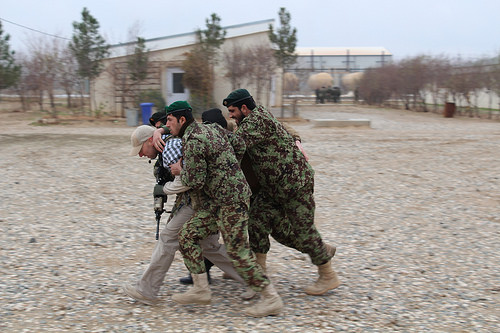
Soldiers from the Kentucky National Guard 1103rd Military Police Detachment recently trained members of the Afghan National Army on personal security detail. Members of the ANA are training on how to remove a dignitary from a threatening situation. (U.S. Navy photo by Lt. j.g. Brian Mitchell)
CAMP MARMAL, Afghanistan — Back in Kentucky, Master Sgt. Timothy Mullins and Sgt. Brad Stone are two of the scores of dedicated law enforcement officers working to keep citizens of the Bluegrass State safe.
But here in Afghanistan, where both served as military police officers aboard the largest military outpost in the northern part of the country, they represent so much more.
Their cumulative civilian experience, Mullins patrolling the southeastern Appalachian corner of Kentucky for the state police while Stone maintains order at Lexington’s Federal Medical Center, is vast.
Add to that their combined deployed experience, Mullins served previously in Iraq training customs officials while Stone is on his fourth tour following three in Iraq, and you’d be hard pressed to find soldiers with a better understanding of what is means to protect and serve both at peace and at war.
So they leapt at the opportunity to share their knowledge with the burgeoning Afghan National Army.
The two members of the Kentucky National Guard 1103rd Military Police Detachment recently spent several days teaching a group of Afghans how to conduct personnel security detail, which is the finely honed skill of protecting dignitaries and military leaders.
“This was a great chance for us to give back and show the Afghans some of the specialized skills a military needs to protect its leadership,” Mullins said.
Their experience mimics that of the hundreds of fellow soldiers deployed to this sprawling German-run outpost. With the war winding down, American and coalition troops are taking a back seat to the burgeoning Afghan National Army.
After investing hundreds of millions in training and equipping the Afghan National Security Forces – essentially the combined forces of the nation’s army, police forces and specialized law enforcement institutions – the coalition is decreasing its footprint here while the Afghans take the lead in combating a stubborn insurgency.
While most soldiers deployed here train their Afghan counterparts on basic military tactics and techniques – everything from marksmanship to logistics, vehicle maintenance to pilot training – Mullins and Stone recruited two of the Kentucky National Guard colleagues to conduct the two-day training evolution.
But here in Afghanistan, where the average citizen lives on roughly $3 per day and illiteracy still plagues a majority of the population, simple training can be challenging. The more complex scenarios like personnel security detail can be especially daunting.
“We were worried because we realize they don’t have a background in this work, and it’s more complex and involved than simple soldiering,” Stone said.
They packed a lot in two days, touching on escort formations, arrivals and departures, advance work, motorcade operations and a broad overview of how protective services fits into a larger military structure.
Nevertheless, like so many other soldiers here, the guardsmen were pleasantly surprised with how well their pupils took to the course.
“Honestly, I was amazed at how quickly they picked it up,” Mullins said. “You quickly realize they may be illiterate but that does not mean they’re not intelligent.”
Stone echoed the sentiment.
“It was amazing to watch them quickly come into their own,” he said. “It didn’t matter who you put in what position or what sort of format we threw at them. They would be able to shift and show you how quickly they adapt.”
The training exercise proved to be the highlight of an interesting tour during a pivotal time during this 13-year conflict.
Camp Marmal is as colorful an installation to be found anywhere in this Texas-sized country.
Seventeen nations contribute troops to the mission here.
A German two-star general commands the region, Mongolian soldiers serve as sentries at the gates while F-16s from the Royal Netherlands Air Force patrol the skies above the base.
A Fort Knox-based Cavalry unit just finished its nine-month tour providing combat arms support while a Missouri National Guard unit equipped with Apache attack helicopters, Chinook and Black Hawk transport choppers ferries troops and gear between snow-capped mountains and lush river valleys.
The diverse coalition stirs a lively base life.
It’s a place where you can hear a half dozen languages before breakfast and where troops are just as likely to travel from their tent to work and to the gym by bicycle as they are by tactical vehicle.
Despite the differences in culture and war-zone regulations, Mullins found his coalition partners to be capable, professional and mission focused.
“We learned a lot from each other, but you really learn that military people are similar in so many ways,” he said. “We all come here wanting to do a good job and you find all the differences aren’t as important as everyone’s commitment to serve at a high level.”
Now, as the unit eyes its return to Kentucky, Stone and Mullins are hoping their brief encounter with the Afghans will result in the same commitment.
“These people have been through so much, but they work hard and they showed me a lot of professionalism and purpose,” Stone said. “I’m hopeful for them.”
Story by John Trowbridge, Kentucky National Guard
In recognition of February as Black History Month kentuckyguard.com is publishing a series of articles honoring African-American men and women who are significant figures in Kentucky’s military history. The following is one such story ….
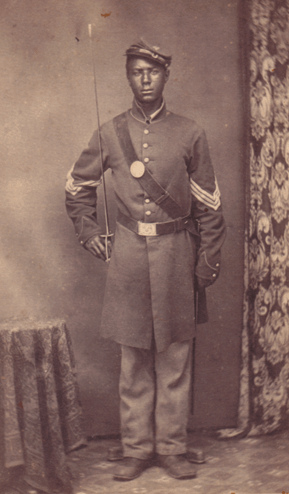
Corporal Andrew Jackson Smith posthumously received the Medal of Honor 137 years after his actions at the Battle of Honey Hill, South Carolina,
FRANKFORT, Ky. — On January 16, 2001, two Medal of Honor presentations were made by President Bill Clinton at the White House. The first, to the descendants of Corporal Andrew Jackson Smith, 137 years after his actions at the Battle of Honey Hill, South Carolina, and former President Theodore Roosevelt was also posthumously awarded the medal at the same ceremony, for his actions during the Spanish-American War.
Andrew Jackson Smith was born into slavery on September 3, 1843 at Grand Rivers, Ky., the son of Susan, a slave, and Elijah Smith, a slave owner. Upon the outbreak of the Civil War, Elijah Smith joined the Confederate military, with the intention of taking 19-year-old Andrew along with him. When Andrew Smith learned of this, he and another slave ran away, walking 25 miles through the rain before presenting themselves to a Union Army regiment, the 41st Illinois Infantry, in Smithland.
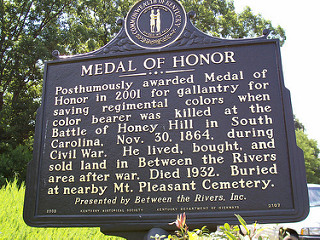
A historical marker honoring Corporal Andrew Jackson Smith. Smith died in 1932 and was buried in the Mount Pleasant African American Cemetery in Lyon County, Kentucky. The cemetery is located in the Land Between the Lakes National Park that straddles both Kentucky and Tennessee.
Smith was taken in by the 41st Illinois and became a servant to Maj. John Warner at the regiment’s post in nearby Paducah. Among Smith’s duties were, in the event of Warner’s death, to return his belongings to his home in Clinton, Il.. On March 10, 1862, the regiment moved out to Pittsburg Landing, Tn., where it took part in the Battle of Shiloh a month later. During the fighting, Smith supplied Warner with fresh horses after the officer had two mounts shot out from under him. Smith was then struck by a spent minie ball that entered his left temple, rolled just under the skin, and stopped in the middle of his forehead. The bullet was removed by the regimental surgeon, leaving Smith with only a scar.
By November 30, 1864, Smith was serving as a corporal in the 55th Massachusetts Volunteer Infantry. On that day, both the 55th and its sister regiment, the 54th Massachusetts, participated in the Battle of Honey Hill in South Carolina. The two units came under heavy fire while crossing a swamp in front of an elevated Confederate position. When the 55th’s color bearer was killed, Smith took up the Regimental Colors and carried them through the remainder of the fight. It was for this action that Smith was later awarded the Medal of Honor.
It’s interesting to note that Smith’s regimental commander had recommended him for the Medal of Honor shortly after the battle, but it never came to fruition. It was only after family members brought it to the attention of state officials just a few years ago that the process was completed.
Smith was promoted to color sergeant before leaving the Army. After the war, he returned to Kentucky, where he bought and sold land. He died at age 88, on March 4, 1932, and was buried in Mount Pleasant Cemetery, Grand Rivers, Ky.
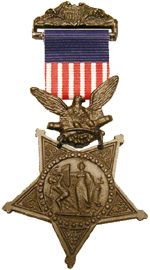
The Civil War Medal of Honor.
Smith’s official Medal of Honor citation reads:
Corporal Andrew Jackson Smith, of Clinton, Illinois, a member of the 55th Massachusetts Voluntary Infantry, distinguished himself on 30 November 1864 by saving his regimental colors, after the color bearer was killed during a bloody charge called the Battle of Honey Hill, South Carolina. In the late afternoon, as the 55th Regiment pursued enemy skirmishers and conducted a running fight, they ran into a swampy area backed by a rise where the Confederate Army awaited. The surrounding woods and thick underbrush impeded infantry movement and artillery support. The 55th and 54th regiments formed columns to advance on the enemy position in a flanking movement. As the Confederates repelled other units, the 55th and 54th regiments continued to move into flanking positions. Forced into a narrow gorge crossing a swamp in the face of the enemy position, the 55th’s Color-Sergeant was killed by an exploding shell, and Corporal Smith took the Regimental Colors from his hand and carried them through heavy grape and canister fire. Although half of the officers and a third of the enlisted men engaged in the fight were killed or wounded, Corporal Smith continued to expose himself to enemy fire by carrying the colors throughout the battle. Through his actions, the Regimental Colors of the 55th Infantry Regiment were not lost to the enemy. Corporal Andrew Jackson Smith’s extraordinary valor in the face of deadly enemy fire is in keeping with the highest traditions of military service and reflect great credit upon him, the 55th Regiment, and the United States Army.
Story by Master Sgt. Phil Speck, 123rd Airlift Wing Public Affairs Office
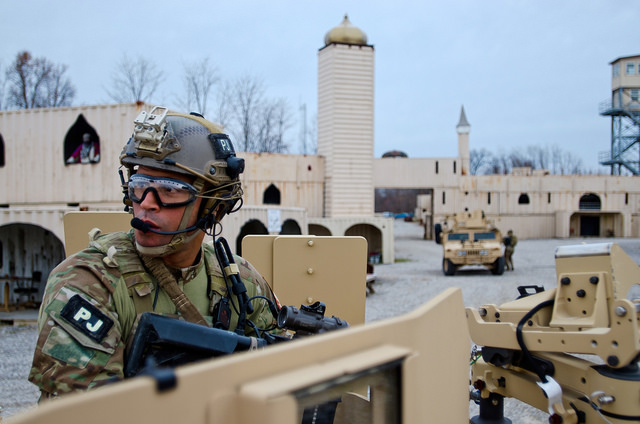
A member of the Kentucky Air National Guard’s 123rd Special Tactics Squadron defends a vehicle during training at Zussman Range at Fort Knox, Ky., on Nov. 21, 2013. The Airman and his teammates were practicing insertions, extractions and close-quarters combat in a simulated Afghan village. (U.S. Air National Guard photo by Master Sgt. Phil Speck)
FORT KNOX, Ky. — A UH-60 Blackhawk helicopter comes to a hovering stop above a two-story building in the middle of an Afghan village. With blades rotating above, a Kentucky Air National Guard pararescueman scoots to the edge of the chopper’s open door and grabs a thick rope before sliding 25 feet down to the building’s roof. He’s followed by five teammates who quickly secure the rooftop and scan the village for threats.
The scene may sound like a sequence from a Hollywood blockbuster, but it’s just another day at the “office” for members of the Kentucky Air National Guard’s 123rd Special Tactics Squadron. They executed the mission in November as part of regular combat training at Fort Knox’s Zussman Urban Training Center.
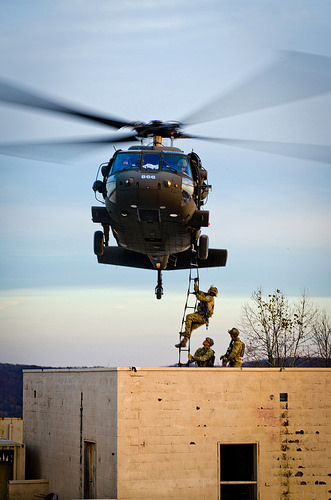
Members of the Kentucky Air National Guard’s 123rd Special Tactics Squadron climb a rope ladder onto a Kentucky Army National Guard UH-60 Blackhawk during training at Zussman Range at Fort Knox, Ky., on Nov. 21, 2013. The Airmen were practicing insertions, extractions and close-quarters combat in a simulated Afghan village. (U.S. Air National Guard photo by Master Sgt. Phil Speck)
The center offers realistic combat environments that simulate what troops can expect to find Afghanistan, according to Staff Sgt. Jeff G., a Kentucky Air Guard pararescueman whose last name is being withheld because of the sensitive nature of his duties.
“This is as good as it gets for training,” he said.
Pararescuemen and their combat controller colleagues from the 123rd Special Tactics Squadron are Special Forces Airmen. The former specialize in medical treatment and personnel recovery, while the latter control air traffic and air strikes. Both maintain a high level of training to be prepared for any mission.
The “fast rope insertion” described above is just one of many skills the men trained for in November. They also trained for fast extraction, in which a helicopter hovers overhead and drops a rope ladder for the operatives to climb up.
“We do this training to keep our skills up, stay proficient, so we can seamlessly integrate with other units,” Staff Sgt. G. said.
While at Zussman, the team also conducted close-quarters battle training. The operatives cordoned and searched buildings for people or high-value targets such as weapons caches, clearing the buildings one room at a time and eliminating threats as needed.
Throughout this process, they were met by actors who portrayed local Afghans, from a local market owner to hostile enemy forces that assaulted them with high-powered paintball guns. STS personnel used modified versions of their real-world weapons to fight back, employing non-lethal paint bullets, or “simunitions,” to return fire.
The Airmen also conducted full-mission-profile training tasks, using the equipment they would take with them overseas for a real-world operation. Among these tools were the Jaws of Life, a powered cutting device used to extract individuals from a downed aircraft or vehicle.
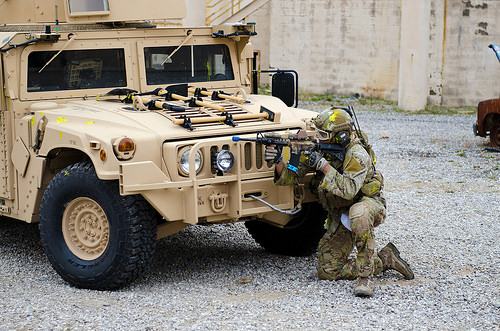
A member of the Kentucky Air National Guard’s 123rd Special Tactics Squadron defends his position during training at Zussman Range at Fort Knox, Ky., on Nov. 21, 2013. The Airman and his teammates were practicing insertions, extractions and close-quarters combat in a simulated Afghan village. (U.S. Air National Guard photo by Master Sgt. Phil Speck)
According to Master Sgt. Bryan Hunt, a combat controller for the 123rd STS, the unit does this type of training — which they call Military Operations on Urban Terrain — four times a year. It benefits both newcomers and unit veterans he said.
Each scenario was preceded by a dry run, or a practice walk-through. The Airmen would then execute a full-mission profile with night-vision goggles while taking simulated hostile fire.
“We try to apply everything we learned during a dry run, so when you’re actually being shot at, and you’re hot, your goggles are fogging up, the challenge was keeping your head, staying calm and applying the techniques you’ve learned previously,” Staff Sgt. G. said.
“The training was excellent and beneficial because it mimicked actual combat in Afghanistan. It represents that 360-degree battlefield that we experience in Afghanistan.”
Story by Staff Sgt. Scott Raymond, Kentucky National Guard Public Affairs
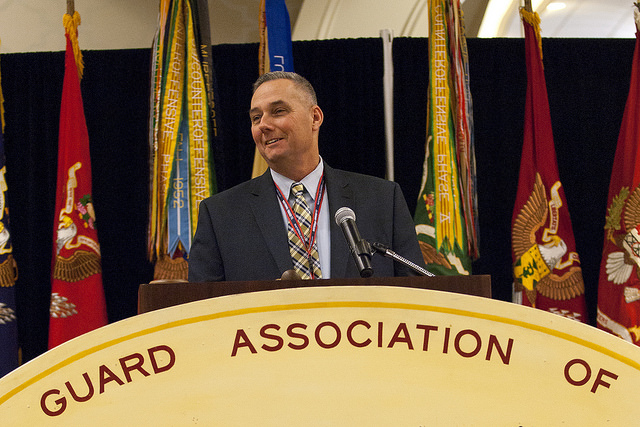
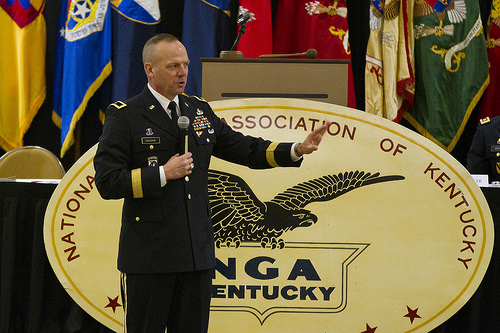
Chief Warrant Officer retired James Simms speaks during the National Guard Association of Kentucky Conference in Louisville, Ky., Feb. 8, 2014. Simms took over as the executive director of the association from Kim Knight during the meeting. (U.S. Army National Guard photo by Staff Sgt. Scott Raymond)
LOUISVILLE, Ky. — It was business as usual for the annual National Guard Association of Kentucky Conference held in Louisville, Ky., Feb. 8. Speakers spoke, the future was discussed and awards were given, but it also marked the end of a decade of service for the association’s director.
Kim Knight had worked tirelessly as the executive director for 10 years and felt it was time to hand over the reigns. Retired Chief Warrant Officer James Simms will take over for Knight.
“This job has given me an opportunity to grow and make many new lifelong friends along the way,” said Knight, who’s husband, Chief Warrant Officer Steve Knight is a standardization flight officer for the Kentucky Guard. “It is time for me to begin a new chapter in mine and Steve’s life. I look forward to what God has planned for us.”
Knight said she was honored to serve as the director and was happy to be a part of the associations growth. She fully supports her successor and offered her assistance in the transition.
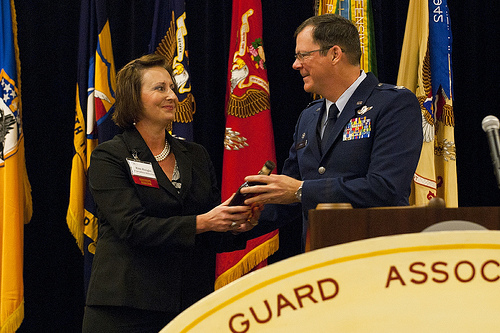
Kim Knight is presented a token of appreciation from the National Guard Association of Kentucky Board President, Col. Robert Hamm during the NGAKY Conference in Louisville, Ky., Feb. 8, 2014. Knight served as the executive director of the association for 10 years. (U.S. Army National Guard photo by Staff Sgt. Scott Raymond)
“I feel that James Simms will take the National Guard Association to the next level with his expertise and military experience he brings to the organization.”
Simms said he was humbled to take over from such a long-standing tradition in Kentucky and praised Knight’s work.
“Kim Knight has put her heart and soul into this association over the last decade to insure it never made a step backwards and was always striving to have us all realize the value of the organization,” he said.
Simms believes the lessons he learned from being a warrant officer will help analyze issues and present possible solutions to help the association’s board to better the National Guard in Kentucky.
“As the executive director of NGAKY I will face many new challenges and responsibilities. With the changing times facing the nation today, in both the military and in other government agencies, we all must look how we can meet our obligations as tax payers and Soldiers.”
“Myself, along with the members of the Board of Directors, will do our best to insure we are good stewards of the associations finances and send a message to our leaders that supports the needs of our Soldiers and Airmen in these uncertain times.”
To See more photos from this year’s conference, click here.
Story by David Altom, Kentucky National Guard Public Affairs
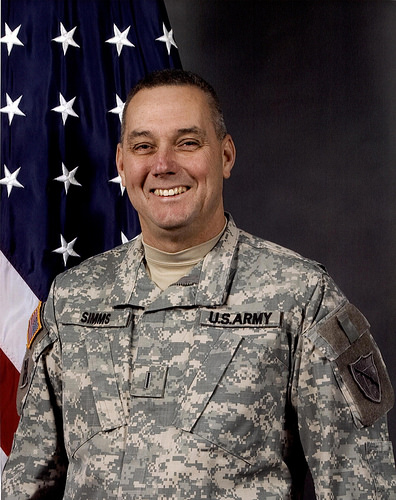
State Command Chief Warrant Officer James “Jimmy” Simms retired after 42 years of service with the Kentucky National Guard. Among his accomplishments, he helped develop Kentucky’s first Warrant Officer Candidate School. (Official Kentucky National Guard photo)
FRANKFORT, Ky. — Retired State Command Chief Warrant Officer Jimmy Simms has had a long row to hoe, as we say here in the Bluegrass State. The fourth person to hold that prestigious position, Simms retired last month after 42 years in the Kentucky Army National Guard and leaving behind a legacy that will affect generations to come.
Born in Versailles, Simms enlisted in the Kentucky Guard in February of 1972 as a wheel vehicle mechanic. His first assignment was with the old 203rd General Support Company in Danville, Kentucky until transferring to the 2nd Battalion, 138th Field Artillery in 1984.
“I joined the Kentucky Guard when the country was still committed to Viet Nam and a lot of protest against that war was ever present,” he said. “At the age of eighteen I wasn’t sure what direction was right for me. I had friends that were in the National Guard and I liked how they could be part of the military and still go to college or have a career here at home, so I decided that was for me.”
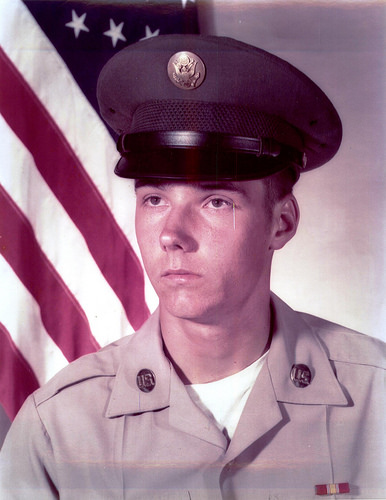
A brand new Jimmy Simms 42 years ago. Little did he know where his career would take him. (Photo courtesy retired CW5 Jimmy Simms)
In 1985 Simms was appointed as a warrant officer in field artillery as the battalion maintenance technician. He would later transition to the same position for the 138th Field Artillery Brigade where he helped with the transition to the new fires brigade concept.
“After being in the Guard a while I began to see how all the different ranks and MOS’s supported each other and the unique qualities of each,” he said. “I thought about that and decided that my experience and knowledge could open the door to become a warrant officer.”
While assigned to the 138th Fires Brigade Simms was mobilized twice and deployed once to Iraq in support of Operation Iraqi Freedom. He also completed a six month tour with the Joint Task Force in support of the Alaskan Road project on Annette Island Alaska.
“I have known Chief Simms since for over 30 years,” said Maj. Gen. Lonnie Culver, who commanded Simms during his time in the artillery. “He is a great Soldier, warrant officer, father, husband and friend. It has been an honor and pleasure serving with him, and it was always good to know that I had an expert who took pride in his work and took care of his Soldiers. He represents the warrant officer corps so well.”
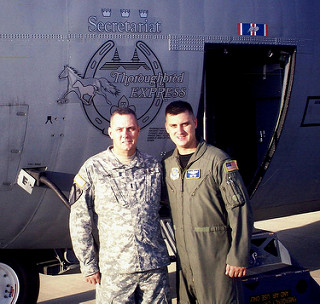
CW5 Jimmy Simms and his son, Bradley. Both father and son flew on the same flight that brought the senior Simms home from Iraq. (Photo courtesy retired CW5 Jimmy Simms)
In October 2009 Simms was transferred to the state headquarters and assigned the position of senior maintenance officer. He was promoted to the rank of CW5 in January 2010.
Simms’ career also included a variety of positions in the federal technician program, starting out as a wheeled vehicle mechanic and moving up to shop chief. He retired as a technician in in 2009 with 31 years of service. Upon his retirement he was selected to run the operational equipment reset program at the maneuver and training equipment site at Fort Knox until his selection as the fourth state command chief on February 24, 2011.
Simms had many highlights in his warrant officer career, but two stand out above all the rest: his appointment to CW5 and being part of the planning and establishing of the Kentucky National Guard’s Warrant Officer Candidate School. In July 2011 Kentucky graduated its first warrant officers and Simms was there to witness it.
“I was so proud of those eight new warrant officers,” he said. “That was a great day for Kentucky and a great day for the warrant officer program.”
Newly appointed State Command Warrant Officer Dean Stoops had high praise for his predecessor.
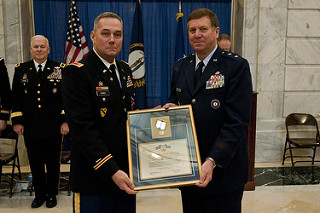
State Command Chief Warrant Officer Jimmy Simms receiving the Kentucky Distinguished Service Medal from Adjutant General Edward W. Tonini on January 14, 2014. Simms relinquished his responsibility to newly appointed State Command Chief Dean Stoops and retired after 42 years of service. (U.S. Army National Guard photo by Staff Sgt. Scott Raymond)
“There are several things to admire about Chief Simms, but in particular is his commitment to know about each and every Warrant Officer in the Kentucky National Guard,” said Stoops. “It’s not easy to remember the details about each Soldier, but Chief Simms has the ability to know where each of his Warrant Officers are assigned, where they work, what their civilian and military jobs are, and even the personal things he has learned over the years.
“This is the characteristic of a great leader and I hope I can do half as well as Chief Simms.”
What would Simms advise someone looking to become a warrant officer? “I would tell a young soldier considering being a warrant office to plan their career to be an outstanding NCO by attending all their professional military education and be a leader regardless of their current rank. Then when the opportunity for warrant officer becomes available they will have the background and experience to meet the requirements to apply.”
He has similar advice for senior NCOs, but he tempers it by saying, “As a senior NCO you have a vital role in your command and you must weigh the benefits to both yourself and the Guard.”
After retiring from the Guard Simms plans to spend more time with Patricia, his wife of forty years, and his three children Autumn, Bradley and Benjamin and grandchildren Preston, Brayden and Eva.
But the Guard is still in his blood. He recently accepted an appointment as the executive director of the National Guard Association of Kentucky, the professional organization for the Kentucky Guard’s officer and warrant officer corps. His passion for that organization is in sync with his continuing dedication for the Guard.
“I’d love to see all NCOs and officers become active members in either the NGAKY or the Enlisted Association National Guard of Kentucky. With a joint effort we can send a strong message from all members of the Kentucky Guard to leaders in Frankfort and Washington to support legislation that protects our military and the individual Soldier and Airmen.”
Story by Staff Sgt. Scott Raymond, Kentucky National Guard Public Affairs
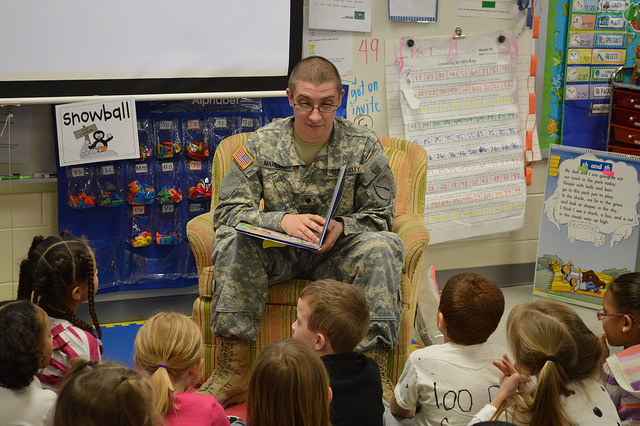
Spc. Gregory Marcum with the 2123rd Transportation Company reads to students at Glenn Marshall Elementary School in Richmond, Ky., Feb. 7, 2014. Five Soldiers visited the students as part of the unit’s adopt-a-school program which encourages Soldiers to volunteer in their communities. (Photo courtesy of Abby Anglin)
RICHMOND, Ky. — Pages in the books were turned, children listened and laughed as Soldiers read about Pete the Cat and Oscar the talking dog, but it was the roller coaster ride that they may remember the most.
In a quiet classroom of Glenn Marshall Elementary School in Richmond, Ky., Pete and Oscar, characters from popular children’s books were not the center of attention for the students. The young eyes were focused on the Kentucky Guardsmen who paid a special visit to the school Feb. 7. to share reading time, and have a little fun.
Several Soldiers from the Richmond-based 2123rd Transportation Company spent a portion of their day with students as part of the unit’s adopt-a-school program. The five Citizen-Soldiers called the experience rewarding and worth their time. The feelings were mutual.
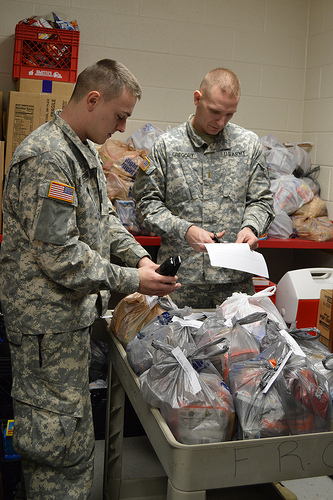
Spc. Justin Perkins and 2nd Lt. Carson Gregory with the 2123rd Transportation Company prepare lunch bags for students at Glenn Marshall Elementary School in Richmond, Ky., Feb. 7, 2014. Soldiers visited the school to read to the children and help teachers with activities during the day. (Photo courtesy of Abby Anglin)
“We were honored to have our local heroes spend time with our students today,” said Abby Anglin, Guidance Counselor at the school. “The Soldiers helped in the cafeteria, prepared and delivered Friday Food Bags for our most needy children, read books to classrooms, and talked with individual students. We appreciate this visit so much and look forward to their return.”
Capt. Nelson Anglin, commander of the 2123rd said the program is brand new to the unit this year and that it’s just a small part of his goal for the unit to be valuable members of the community. From food drives to picnics and mentoring with local schools, Anglin believes it’s simply about making a difference.
“The National Guard is about service to our country and our state,” he said. “I try to emphasize to my Soldiers the importance of volunteering in our community and helping in any way they can. We do this to make a difference.”
With the help of his wife, Abby, Anglin set up the day at Glenn Marshall and was welcomed by the staff.
“We are so thankful for the services of these men and women,” said Elizabeth Shields, an exceptional child instructor at the school. “They don’t realize how much anything they do big or small, changes the lives of our kids.”
“Many of our students come from challenging home situations and the Soldiers visiting shows these kids that people out there care about them,” said 2nd Grade Teacher Shelley Renfro.
Each of the transportation Soldiers said they enjoy working with the community and setting a good example for the children.
Sgt. Jarred Turner was surprised how supportive the young children were of the military and how curious they were of the Soldiers’ jobs.
“I’ve never heard so many ‘thanks for your service’ from young kids,” he said. “They were diligent in asking serious questions. I never realized how much they really care about what we are doing.”
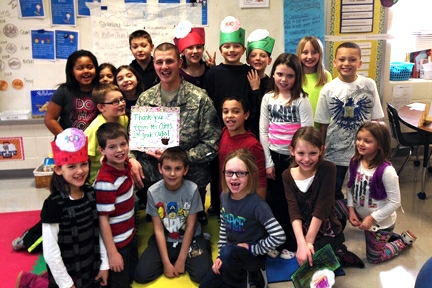
Spc. William Redington with the 2123rd Transportation Company shares a moment with students at Glenn Marshall Elementary School in Richmond, Ky., Feb. 7, 2014. The second-graders made a thank you card to give to Soldiers of the unit for spending time at the school as part of the unit’s community involvement program. (Photo courtesy of Abby Anglin)
Spc. William Redington captured the enthusiasm of the children when he led a whole classroom on a roller coaster ride, breaking the quiet atmosphere. Each child raised their arms, swayed to the left, then right and screamed as they dropped down the tracks on their imaginary journey. Redington said he wanted to excite the children upon the Soldiers arrival and was pleased with their participation. He also hopes such interaction can bring about greater mutual respect between the military and society.
“I do a lot of volunteer work already, I love giving back to the community,” he said. ” But, wow! The reactions from the kids, all those smiles, this was one of my favorites. What a day in uniform.”
Anglin said he has good support for the program in his unit, especially with the younger Soldiers who are excited for the unique assignments. He acknowledged that at first, finding volunteers was hard, but with the stories he has heard from this visit, word will spread amongst the unit. He plans on doing more such events with other schools in the area throughout the year.
Anglin always challenges his unit to make an impact and asks them ‘Is your life about something bigger than yourself?” He said he’s happy and excited to get the answers.
“It doesn’t have to take a war or disaster to make a difference. In this case, if we can help one kid or one teacher, then we have made that difference.”